44
CASE 4
SUGGESTED ANSWERS TO DISCUSSION QUESTIONS
(1)
Statement on Auditing Standards 78, “Consideration of Internal Control in a
Financial Statement Audit: An Amendment to SAS No. 55,” identifies the five
elements of internal control as the Control Environment, Risk Assessment,
Control Activities, Information and Communication, and Monitoring. Cline’s
questions appear to be designed to determine the degree of information that has
In studying the control environment of a company, SAS 78 recommends that a
number of factors should be assessed including those listed below. For several
of these factors, the types of information that the Abernethy and Chapman
auditors might use to make their evaluation is also discussed. A quick look at the
control environment will probably lead the auditors to the decision that Lakeside
has not established the environment needed for adequate internal control.
Integrity and ethical values. The auditors should inquire as to policy
Commitment to competence. Lakeside should have a training program to
ensure that its employees have the knowledge and skills necessary to
accomplish tasks. The auditors should inquire as to any such programs.
Board of directors or audit committee participation. Abernethy and Chapman
Management’s philosophy and operating style. By talking with Rogers and
the other members of management, the auditors should be able to determine
Organizational structure. If Lakeside has a chart presenting the various
officials and their jobs, the auditors can assess whether control policies would
Assignment of authority and responsibility. This factor includes how authority
and responsibility for operating activities are assigned and how reporting
Human resource policies and practices. These policies and practices relate
to hiring, orientation, training, evaluating, counseling, promoting,
Risk assessment is the second component of internal control. The auditors will
determine and evaluate how Lakeside identifies, analyzes, and manages risks
relevant to the preparation of the financial statements. The auditors will want to
Next, the auditors will look at the actual control activities in place to see that
specific control objectives are being met. Within this testing, the auditors should
look at the following as goals of the company’s internal control:
Performance reviews. Independent checks on both performance and proper
valuation of recorded amounts should be conducted. The auditors will want
46
Physical controls. By physical observation of the warehouse, the stores, and
other assets, the auditor can determine if Lakeside has adequate safeguards
over its assets.
Segregation of duties. By looking at the organization of a company, the
Next, the auditors will have to examine any information that helps to
ascertain the efficiency of the company’s information and communication system.
In the case presented, little data is provided to evaluate the information system
except that Rogers feels the systems are outdated for a company of this size.
Therefore, the auditors should assess the design of the system and the people
who operate the accounting system. For example, the auditors might want to
select a number of transactions and trace them from the point of origination
through the accounting system to see that the recording process is performed
properly. This testing is designed to determine if the system is capable of
performing the following tasks in an effective manner:
Identify and record all valid transactions.
The final component of internal control is monitoring. Monitoring is the process
that assesses the quality of internal control performance over time. Lakeside
does not appear to have an extensive monitoring system, such as an internal
(2)
An evaluation of the overall control environment is not possible from Exhibits 4-3
and 4-4. However, the auditors can see that responsibilities have been
developed and divided within the company. Each individual or department
seems to have a well-defined job within the two systems. Thus, some evidence
exists to indicate that management is aware of the importance of internal control.
Such systems simply cannot be created without adequate support by the
company‘s management.
In addressing control activities, the auditors can see, as indicated in the answer
to Exercise (2), that the company seems to use adequate documents and
authorization procedures (Strength). In addition, although the Assistant to the
President has many different duties (Weakness), the company seems to have
made an attempt to segregate responsibilities in an appropriate manner.
Both of the information systems that are presented also seem well designed,
(3)
After a preliminary assessment of control risk, the auditors have three possible
actions:
a) Because of potential strengths found within internal control, the auditor
may feel that control risk can be assessed at below the maximum level.
48
b) Because of weaknesses found within internal control, the control risk
may have to be assessed at the maximum level. This evaluation will
c) Although potential strengths may be identified within internal control,
the auditors may still opt to assess control risk at the maximum level.
(4)
The auditor will normally begin verifying control policies and procedures by
making inquiries of the employees as to the performance of their duties. The
answers provided indicate to the auditor whether each individual understands the
duties that have been assigned as well as their purpose. A proper knowledge of
a job usually means that employees are more likely to comply with the system
and fulfill their responsibilities. In addition, the auditor is often able to observe
the work of these individuals during the audit fieldwork. From these
observations, an evaluation can also be made as to the quality of the work being
performed.
(5)
49
This new information provides an increased risk on the motivation/incentive for
fraud to occur, and an increase in opportunity through collusion affecting
SUGGESTED ANSWERS TO EXERCISES
(1)
a)
The following page presents a flowchart for the revenue recognition system.
Numerous acceptable variations of this flowchart may be created. This problem
is not intended to suggest a rigid format for the flowchart but rather to give the
student experience in constructing and reading one. When evaluating a
student’s work, several questions should be asked:
Does the flowchart truly mirror the system?
Is the flowchart understandable?
Is the flowchart overly complex, containing too many symbols and
explanations?
50
Exercise 1a
Client: Lakeside Company PF-12
System: Revenue and Cash Receipts Cycle – Distributorship Revenue Recognition Prepared JCD 9/10/12
Reviewed JVB 11/11/12
Reviewed EVK 12/10/12
Notes Sales Division Inventory Department Assistant to the President Controller’s Office
A. Record telephone order
on prenumbered sales invoice.
B. Verify availability of merchandise
and estimate shipping date.
C. Compare to current
Note A
Sales Invoice
2
From
Sales
Sales Invoice
1
From
Customer
From
Sales
From
Inven.
Bill of Lading
3
Sales Invoice
2
Bill of Lading
4
5
5
4
3
2
Sales Invoice
1
5
4
3
2
No.
Bill
Asst.
Inven.
From
From
Inven.
3
2
Cust.
From
Inven.
4
3
Current Price
From
Bill of Lading
1
Asst.
Contr.
Cust.
Contr.
Cust.
Approved
Credit List
From
Note G
Bill of Lading
3
Cust.
(1)
b)
Revenue and Cash Receipts Cycle
Distributorship Cash Receipts
Checks arrive from customers along with a copy of the invoice slip. The checks
are received by the Treasurer’s Office where each check is immediately stamped
“For Deposit Only.” The checks are listed on a bank deposit slip and on a four–
part cash remittance list. This listing includes the customer, the amount paid,
and the invoice number.
Assistant to the President:
The sales division sends the first copy of the cash remittance list to the Assistant
to the President. He compares the bank deposit slip that he has received from
the bank against the total of the cash remittance list for that same date with a
Sales Division:
The invoice slips and the first three copies of the cash remittance list are sent by
the Treasurer’s Office to the Sales Division. The second copy of the sales
invoice and the fourth copy of the bill of lading had originally been filed by that
52
Case 4 – Exercise 2a
INTERNAL CONTROL – PRELIMINARY ANALYSIS
CLIENT: The Lakeside Company
SYSTEM: Cash Receipts
DATE:
PREPARED BY:
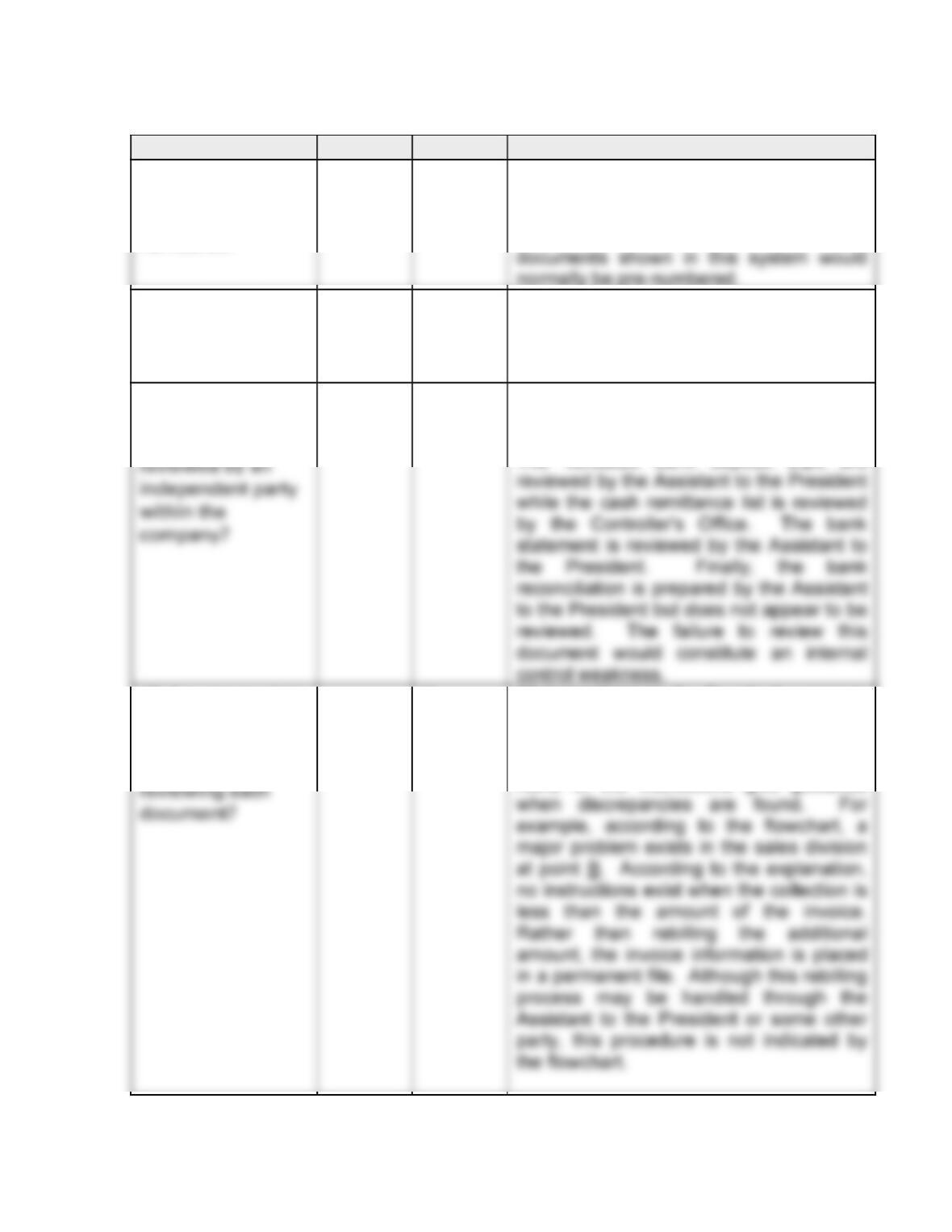
List each document found in this system, the number of copies, and whether
it is prepared internally or externally.
* Invoice Slips (one copy per payment) – prepared internally but returned
* Cash Remittance List (four copies per day) – prepared internally.
* Bank Statement (one copy per month) – prepared externally.
53
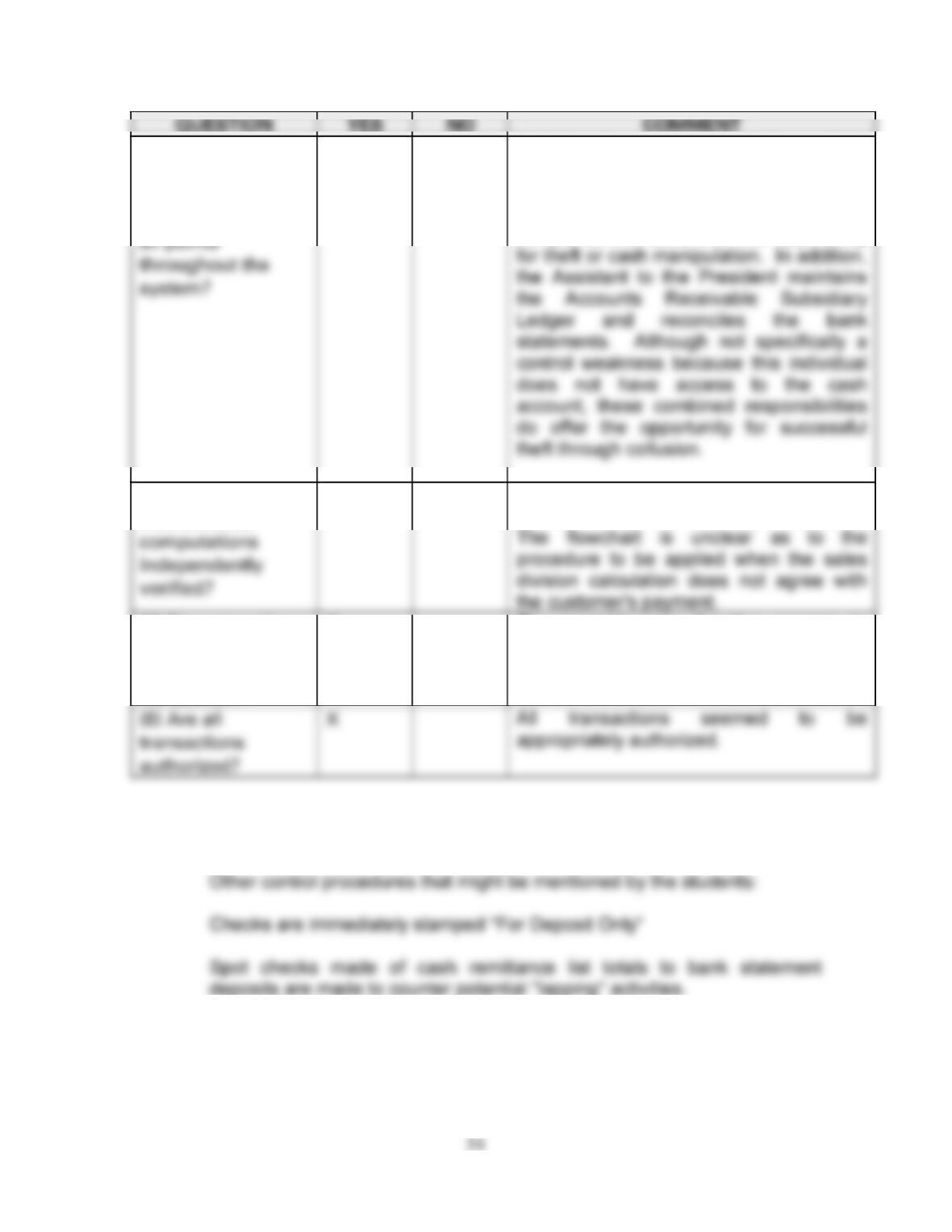
QUESTION YES NO COMMENT
(1) Is each
document within
this system pre–
numbered?
X Exhibits 4-3 and 4-
4 indicate that the
sales invoices (including the sales invoice
slip) and the bills o
f lading are
prenumbered. None of the other
(2) Is the authority
for completing
each document
clearly delineated?
X Exhibit 4-
4 indicates that all documents
within this system are clearly ass
igned to
a specific department.
(3) Are all
documents
subsequently
reviewed by the Assistant to the President
while the cash remittance list is reviewed
by the Controller’s Office. The bank
statement is reviewed by the Assistant to
the President. Finally, the bank
ared by the Assistant
to the President but does not appear to be
X A
number of the documents are reviewed
prior to the beginning of this system such
as the sales invoice and the bill of
lading.
The
validated bank deposit slips are
(4) Are appropriate
procedures clearly
spelled out for
completing and
when discrepancies are found. For
ding to the flowchart, a
major problem exists in the sales division
. According to the explanation,
no instructions exist when the collection is
less than the amount of the invoice.
Rather than rebilling the additional
mation is placed
in a permanent file. Although this rebilling
process may be handled through the
Assistant to the President or some other
party, this procedure is not indicated by
X All instructions on the flowchart
appear to
be reasonably complete, although any set
of written instructions could be put into
more detail. One problem does exist:
N
one of the instructions give guidance
(5) Is the record–
keeping function
independent of the
custody function at
for theft or cash manipulation. In addition,
the Assistant to the President maintains
the Accounts Receivable Subsidiary
Ledger and reconciles the bank
statements. Although not specifically a
control weakness because this individual
access to the cash
account, these combined responsibilities
do offer the opportunity for successful
X The Treasurer’s Office,
which serves the
custodial function for the cash funds,
also
records the initial receipt of cash. That
type of organization is typical of small
companies but does offer the oppo
rtunity
(6) Are all
mathematical
The flowchart is unclear as to the
procedure to be applied when the sales
division calculation does not agree with
X A
ll computations are independently
verified except for the cash
discounts.
(7) Does record
–
keeping begin at
the origin of the
transaction?
X
The record-keeping function appears
to
begin immediately upon receipt of the
cash.
ll transactions seemed to be
(9) Indicate any other specific internal control features that have been built
into this system.
(10) Indicate any other specific internal control weaknesses that appear to
be present in this system.
55
Other control weaknesses that might be noted by the students: Invoice
Case 4 Exercise 2 (b)
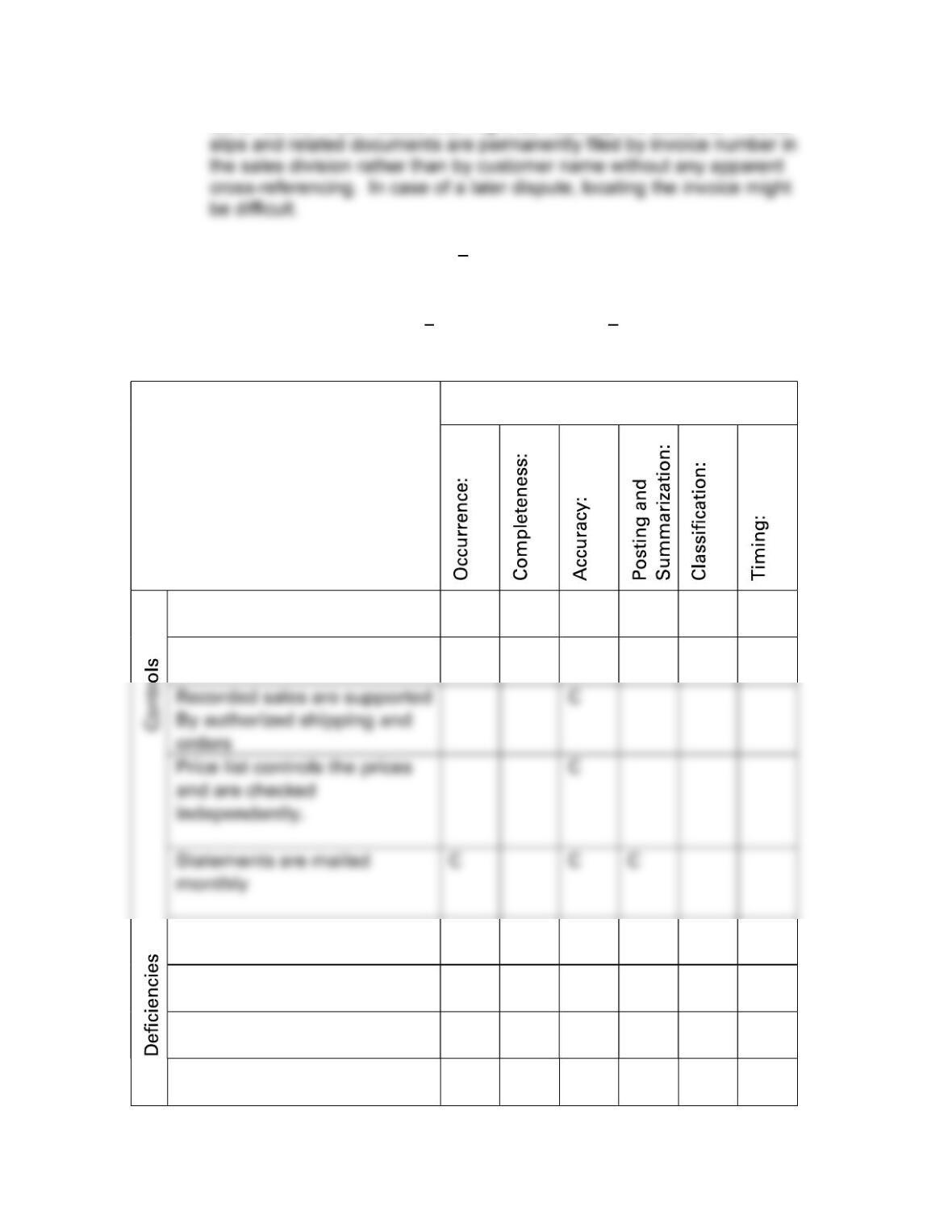
Abernethy and Chapman
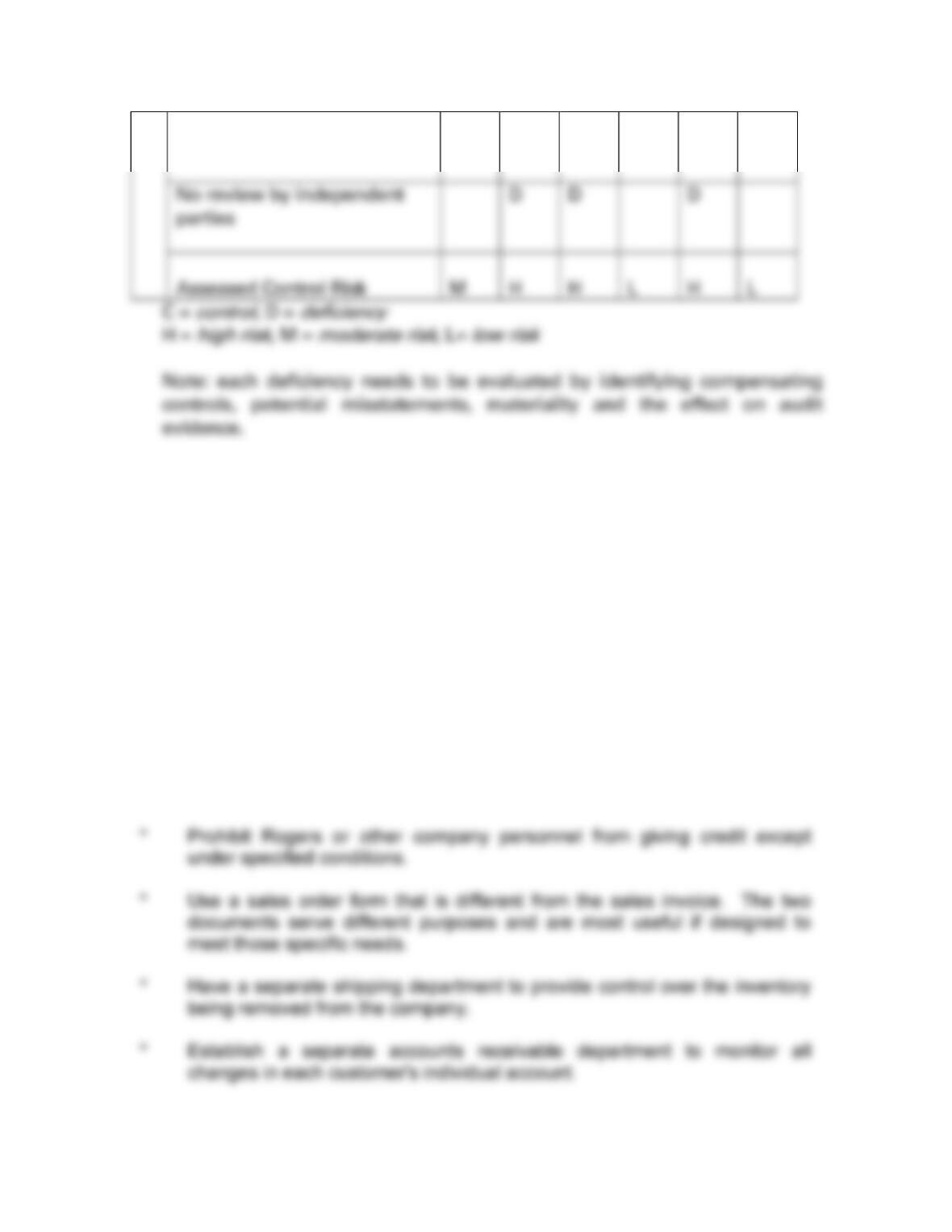
INTERNAL CONTROL Control Risk Matrix Revenue Cycle
Client: Lakeside
Internal Control
Revenue Transaction-Related Audit
Objectives
Sales orders recorded on
prenumbered forms
C C
Credit is approved by Rogers
C
56
Miller has access to orders,
billing and accounting
D D D
Case 4 – Exercise 3
The Lakeside Company
Internal Control Weaknesses – Revenue Recognition Procedures
December 31, 2012
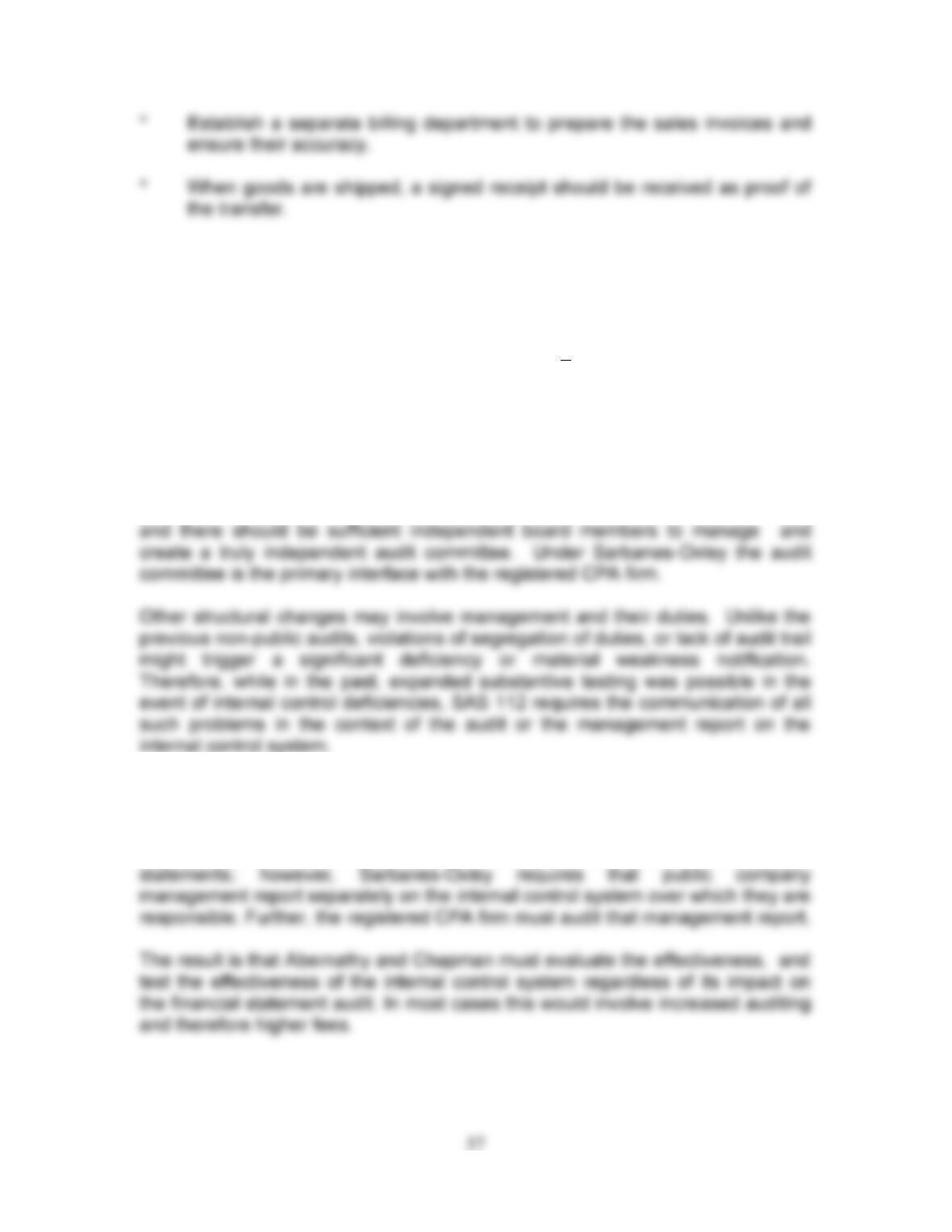
Improvements that could be made in the revenue recognition system for the
distributorship sales division are listed below.
As a small organization, the controls that might actually be implemented are
limited to those procedures that would be cost effective. Listed below are several
possible improvements that could be considered:
* Establish a separate credit department to investigate new clients and set
credit limits based on this information.
SUGGESTED ANSWERS TO SARBANES OXLEY QUESTIONS
(1)
The board of directors needs to be organized so that it can fulfill its purpose. The
primary improvement is to increase its independence and operation. The
President of the Corporation should be the Chairman of the Board of Directors,
(2)
The audit or internal control is still relevant in the determination of the audit risk
model and the determination of detection risk relative to the audit of the financial