CHAPTER 4
INTRODUCTION TO VALUATION: THE
TIME VALUE OF MONEY
Answers to Concepts Review and Critical Thinking Questions
1. Compounding refers to the growth of a dollar amount through time via reinvestment of interest earned.
It is also the process of determining the future value of an investment. Discounting is the process of
determining the value today of an amount to be received in the future.
5. It would appear to be both deceptive and unethical to run such an ad without a disclaimer or
explanation.
6. It’s a reflection of the time value of money. TMCC gets to use the $24,099. If TMCC uses it wisely,
it will be worth more than $100,000 in thirty years.
7. This will probably make the security less desirable. TMCC will only repurchase the security prior to
maturity if it to its advantage, i.e. interest rates decline. Given the drop in interest rates needed to make
this viable for TMCC, it is unlikely the company will repurchase the security. This is an example of a
“call” feature. Such features are discussed at length in a later chapter.
Solutions to Questions and Problems
NOTE: All end-of-chapter problems were solved using a spreadsheet. Many problems require multiple
steps. Due to space and readability constraints, when these intermediate steps are included in this solutions
manual, rounding may appear to have occurred. However, the final answer for each problem is found
without rounding during any step in the problem.
Basic
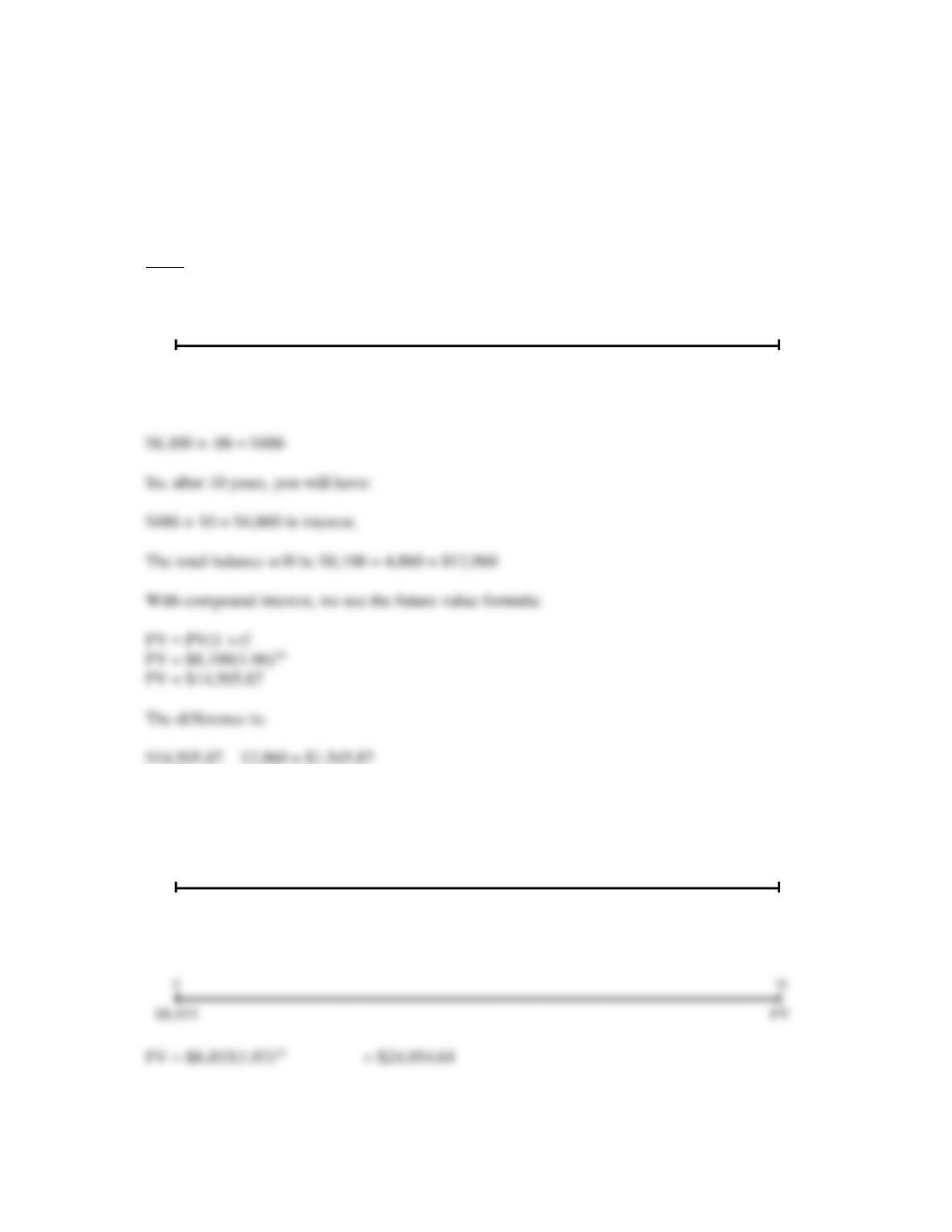
1. The time line for the cash flows is:
0
10
$8,100
FV
The simple interest per year is:
2. To find the FV of a lump sum, we use:
FV = PV(1 + r)t
0
7
$3,150
FV
0
$8,453
FV
FV = $3,150(1.13)7 = $7,410.71
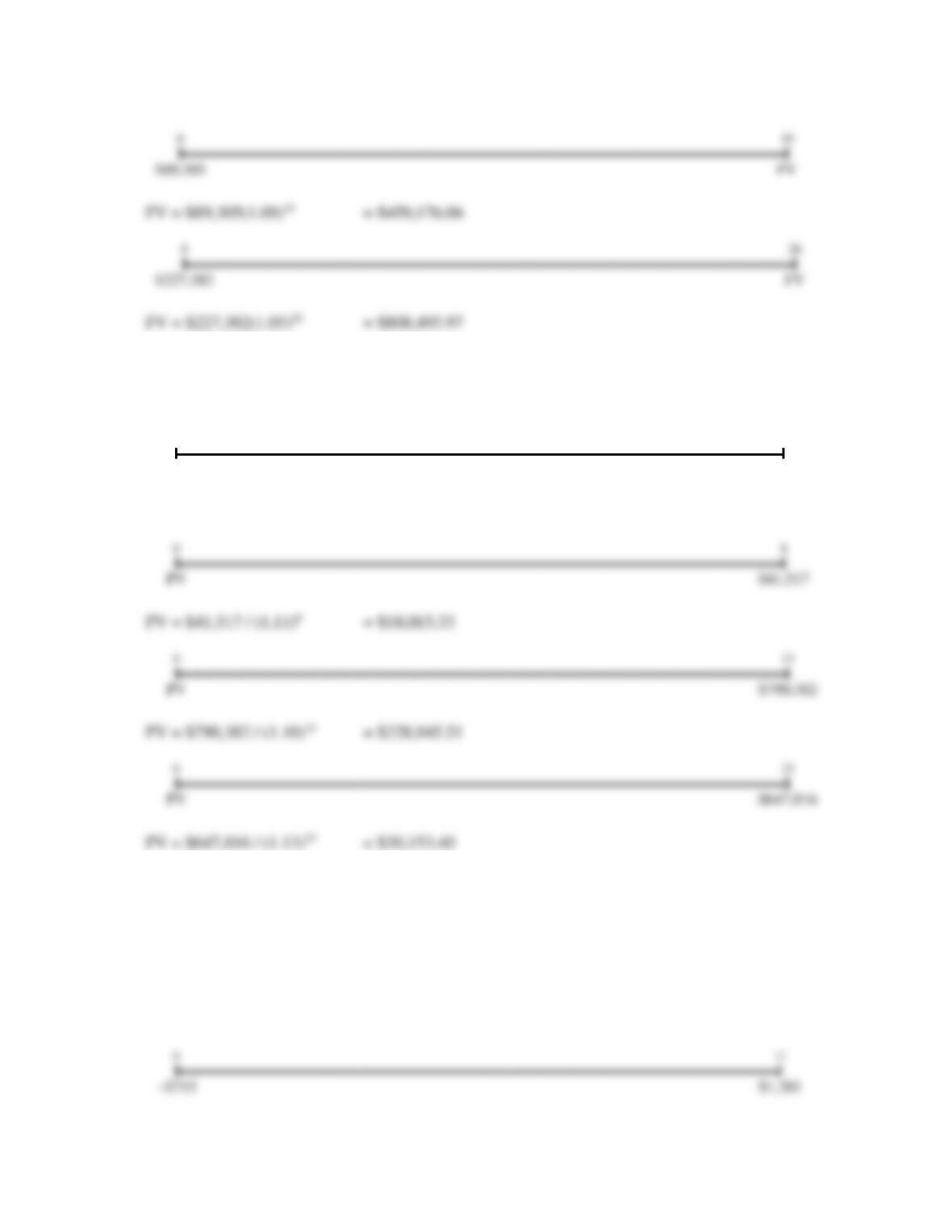
3. To find the PV of a lump sum, we use:
PV = FV / (1 + r)t
0
15
PV
$17,328
PV
$41,517
0
PV
PV
PV = $17,328 / (1.07)15 = $6,280.46
4. To answer this question, we can use either the FV or the PV formula. Both will give the same answer
since they are the inverse of each other. We will use the FV formula, that is:
FV = PV(1 + r)t
Solving for r, we get:
r = (FV / PV)1 / t – 1
$1,381
FV
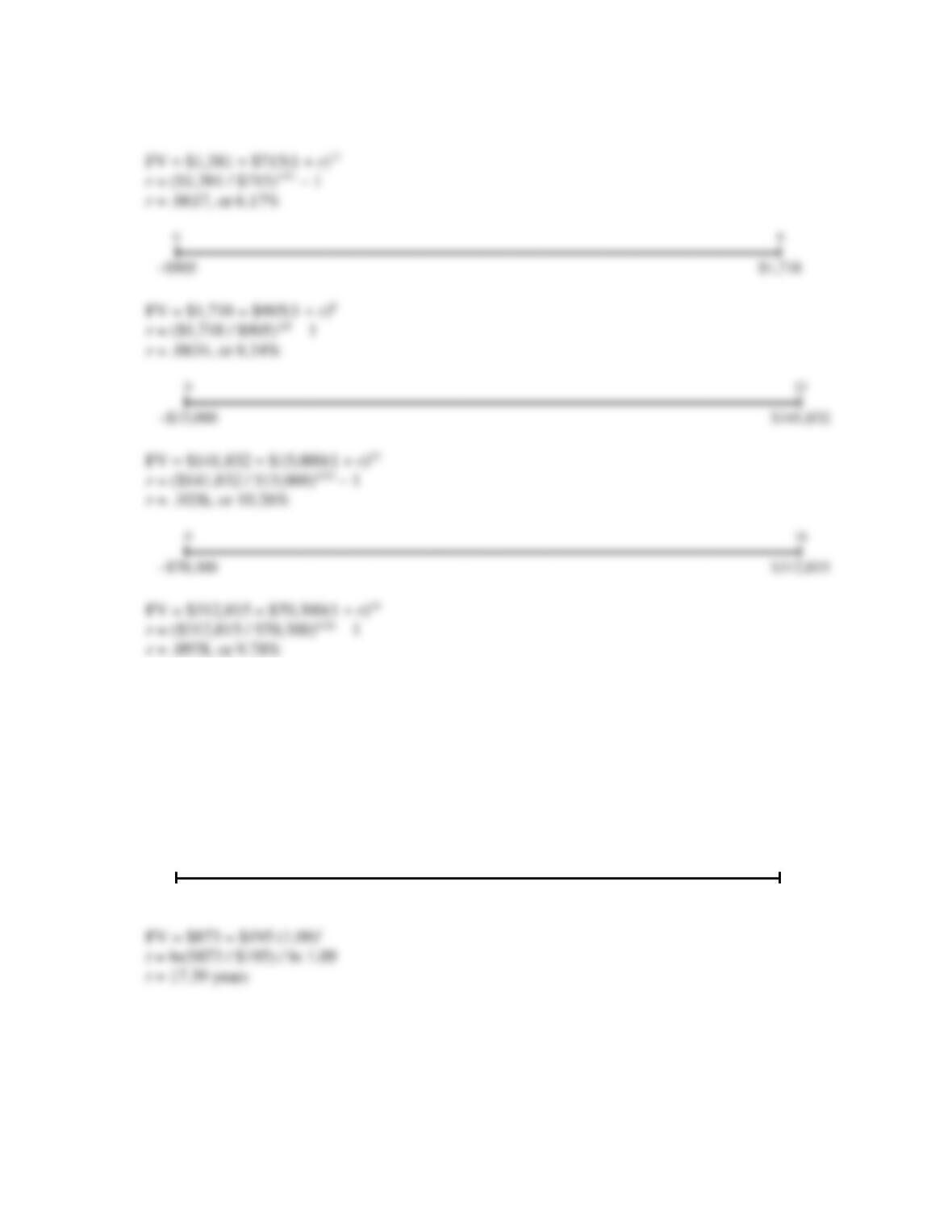
5. To answer this question, we can use either the FV or the PV formula. Both will give the same answer
since they are the inverse of each other. We will use the FV formula, that is:
FV = PV(1 + r)t
Solving for t, we get:
t = ln(FV / PV) / ln(1 + r)
0
t
–$195
$873
6. The time line is:
0
18
–$53,000
$295,000
To answer this question, we can use either the FV or the PV formula. Both will give the same answer
since they are the inverse of each other. We will use the FV formula, that is:
FV = PV(1 + r)t
7. To find the length of time for money to double, triple, etc., the present value and future value are
irrelevant as long as the future value is twice the present value for doubling, three times as large for
tripling, etc. To answer this question, we can use either the FV or the PV formula. Both will give the
same answer since they are the inverse of each other. We will use the FV formula, that is:
FV = PV(1 + r)t
8. The time line is:
0
140
–$20
$15,000
To answer this question, we can use either the FV or the PV formula. Both will give the same answer
since they are the inverse of each other. We will use the FV formula, that is:
FV = PV(1 + r)t
9. The time line is:
0
t
–$35,000
$150,000
10. The time line is:
0
25
PV
$730,000,000
To find the PV of a lump sum, we use:
11. The time line is:
0
80
PV
$1,000,000
12. The time line is:
0
111
50
FV
13. The time line is:
0
119
$150
$1,620,000
To find the FV of the first prize in 2045, we use:
0
31
$1,620,000
FV
14. The time line is:
0
76
–$.10
$3,207,852
To answer this question, we can use either the FV or the PV formula. Both will give the same answer
since they are the inverse of each other. We will use the FV formula, that is:
15. The time line is:
0
4
–$12,377,500
$10,311,500
Intermediate
16. To answer this question, we can use either the FV or the PV formula. Both will give the same answer
since they are the inverse of each other. We will use the FV formula, that is:
FV = PV(1 + r)t
Solving for r, we get:
r = (FV / PV)1 / t – 1
a. The time line is:
0
20
–$50
$100
b. The time line is:
0
10
–$50
FV
c. The time line is:
0
10
–$50.50
$100
17. The time line is:
0
10
PV
$150,000
To find the PV of a lump sum, we use:
18. To find the FV of a lump sum, we use:
FV = PV(1 + r)t
0
45
$5,000
FV
0
35
$5,000
FV
19. The time line is:
0
2
8
$13,000
FV
Even though we need to calculate the value in eight years, you will only have the money for six years,
so we need to use six years as the number of periods. To find the FV of a lump sum, we use:
20. The time line is:
0
2
t
$30,000
$150,000
To answer this question, we can use either the FV or the PV formula. Both will give the same answer
since they are the inverse of each other. We will use the FV formula, that is:
21. To find the FV of a lump sum, we use:
FV = PV(1 + r)t
In Regency Bank, you will have:
0
240
$6,150
FV
0
22. The time line is:
0
t
–$1
$3
To find the length of time for money to double, triple, etc., the present value and future value are
irrelevant as long as the future value is twice the present value for doubling, three times as large for
tripling, etc. We also need to be careful about the number of periods. Since the length of the
compounding is three months and we have 24 months, there are eight compounding periods. To answer
23. The time line is:
0
t
–$1,800
$3,100
To answer this question, we can use either the FV or the PV formula. Both will give the same answer
since they are the inverse of each other. We will use the FV formula, that is:
24. The time line is:
0
120
PV
$85,000
To find the PV of a lump sum, we use:
25. The time line is:
0
45
PV
$1,000,000
To find the PV of a lump sum, we use:
Challenge
26. The time line is:
0
40
–$20,000
FV
In this case, we have an investment that earns two different interest rates. We will calculate the value
of the investment at the end of the first 20 years then use this value with the second interest rate to find
the final value at the end of 40 years. Using the future value equation, at the end of the first 20 years,
the account will be worth:
It is irrelevant which interest rate is offered when as long as each interest rate is offered for 20 years.
We can find the value of the initial investment in 40 years with the following:
Calculator Solutions
1.
Enter
10
6%
$8,100
N
I/Y
PV
PMT
FV
Solve for
$14,505.87

2.
Enter
7
13%
$3,150
N
I/Y
PV
PMT
FV
Solve for
$7,410.71
Enter
16
7%
N
I/Y
PV
PMT
FV
Solve for
N
I/Y
PV
PMT
FV
Solve for
$459,176.06
Enter
26
5%
$227,382
N
I/Y
PV
PMT
FV
Solve for
$808,495.97
3.
Enter
15
7%
$17,328
N
I/Y
PV
PMT
FV
Solve for
–$6,280.46
Enter
11%
$41,517
N
I/Y
PV
PMT
FV
Solve for
–$18,015.33
Enter
13
PMT
Solve for
Enter
25
13%
$647,816
N
I/Y
PV
PMT
FV
Solve for
–$30,513.40
4.
Enter
11
$715
$1,381
N
I/Y
PV
PMT
FV
Solve for
6.17%

5.
Enter
9%
$195
$873
N
I/Y
PV
PMT
FV
Solve for
17.39
Enter
7%
N
I/Y
PV
PMT
FV
Solve for
7.51
Enter
$47,800
$326,500
N
I/Y
PV
PMT
FV
Solve for
16.95
Enter
$38,650
$213,380
N
I/Y
PV
PMT
FV
Solve for
9.82
6.
Enter
18
$53,000
$295,000
N
I/Y
PV
PMT
FV
Solve for
10.01%
7.
Enter
4.7%
$1
$2
N
I/Y
PV
PMT
FV
Solve for
15.09
Enter
Solve for
30.18
Enter
$905
Solve for
Enter
N
I/Y
PV
PMT
FV
Solve for
Enter
Solve for

8.
Enter
140
$20
$15,000
N
I/Y
PV
PMT
FV
Solve for
4.84%
11.
Enter
80
7.25%
$1,000,000
N
I/Y
PV
PMT
FV
Solve for
–$3,700.12
12.
Enter
111
$50
N
I/Y
PV
PMT
FV
Solve for
13.
Enter
119
$1,620,000
N
I/Y
PV
PMT
FV
Solve for
Enter
31
8.12%
$1,620,000
N
I/Y
PV
PMT
FV
Solve for
$18,207,019.19
14.
Enter
76
$.10
$3,207,852
N
I/Y
PV
PMT
FV
Solve for
25.54%
15.
Enter
4
$12,377,500
$10,311,500
N
I/Y
PV
PMT
FV
Solve for
–4.46%
Enter
N
I/Y
PV
PMT
FV
Solve for
9.
Enter
N
I/Y
PV
PMT
FV
Solve for
10.
Enter
FV
Solve for

b.
Enter
10
.10%
$50
N
I/Y
PV
PMT
FV
Solve for
$50.50
c.
Enter
10
$50.50
$100
N
I/Y
PV
PMT
FV
Solve for
7.07%
19.
Enter
6
7.5%
$13,000
N
I/Y
PV
PMT
FV
Solve for
$20,062.92
20.
Enter
9%
$30,000
$150,000
N
I/Y
PV
PMT
FV
Solve for
18.68
N
I/Y
PV
PMT
FV
Solve for
Enter
20
$6,150
N
I/Y
PV
PMT
FV
Solve for
You must wait 2 + 18.68 = 20.68 years.
17.
Enter
N
I/Y
PV
PMT
FV
Solve for
18.
Enter
45
$5,000
N
I/Y
PV
PMT
FV
Solve for
Enter
35
$5,000
N
I/Y
PV
PMT
FV
Solve for

22.
Enter
8
$1
$3
N
I/Y
PV
PMT
FV
Solve for
14.72%
25.
Enter
45
11%
$1,000,000
N
I/Y
PV
PMT
FV
Solve for
–$9,129.90
Enter
45
5.5%
$1,000,000
N
I/Y
PV
PMT
FV
Solve for
–$89,875.09
26.
Enter
N
I/Y
PV
PMT
FV
Solve for
$77,393.69
Enter
Solve for
23.
Enter
Solve for
24.
Enter
.65%
Solve for