Exercise 4A-9 (continued)
5.
Materials
Conversion
Total
Ending work in process inventory:
Equivalent units of production ……………………………………………
240
120
Cost per equivalent unit ……………………………………………………
$18.20
$23.25
Cost of ending work in process inventory ……………………………..
$4,368
$2,790
$7,158
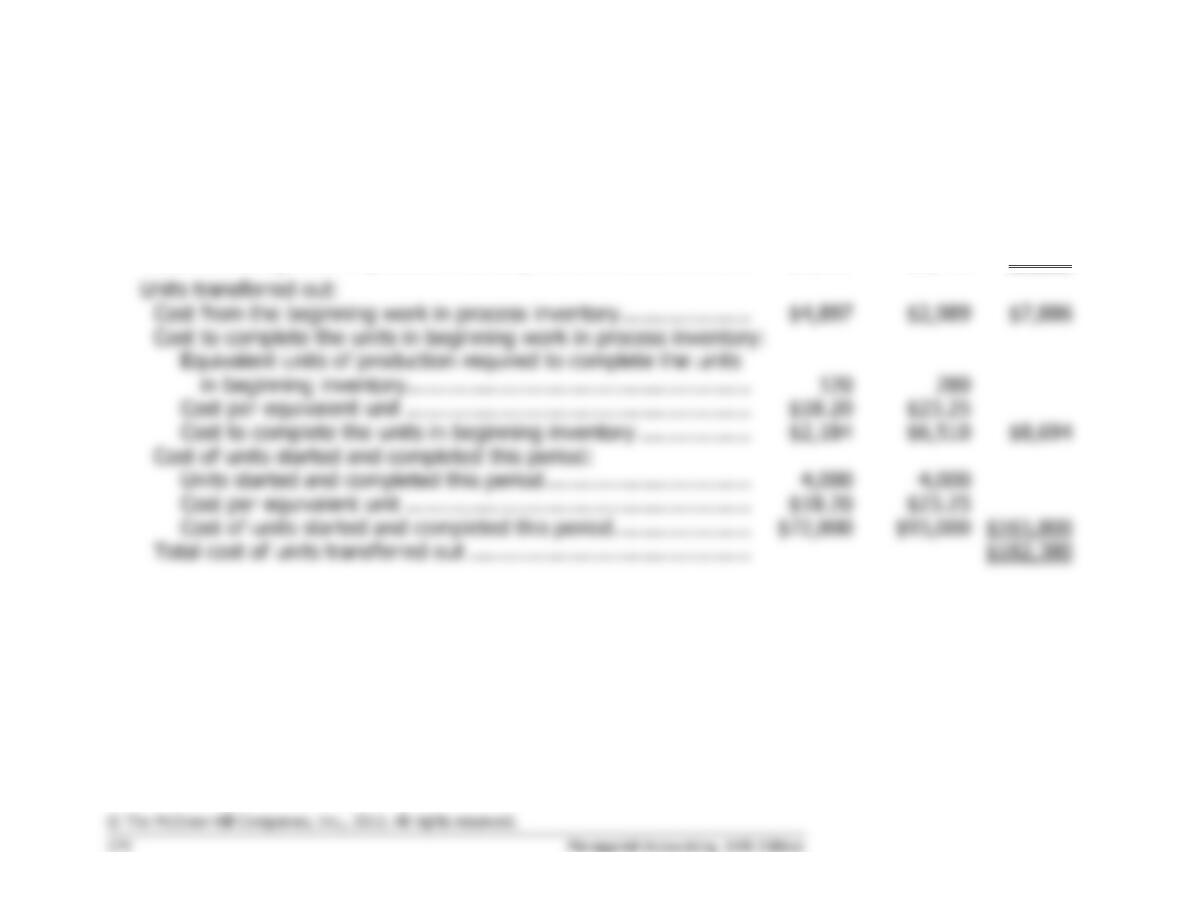
Units transferred out:
Cost from the beginning work in process inventory …………………
$4,897
$2,989
$7,886
Cost to complete the units in beginning work in process inventory:
$18.20
$23.25
Cost of units started and completed this period:
$165,800
Total cost of units transferred out ………………………………………
$182,380
Problem 4A-10 (45 minutes)
FIFO Method
1.
Equivalent Units of Production
Materials
Conversion
To complete beginning work in process:
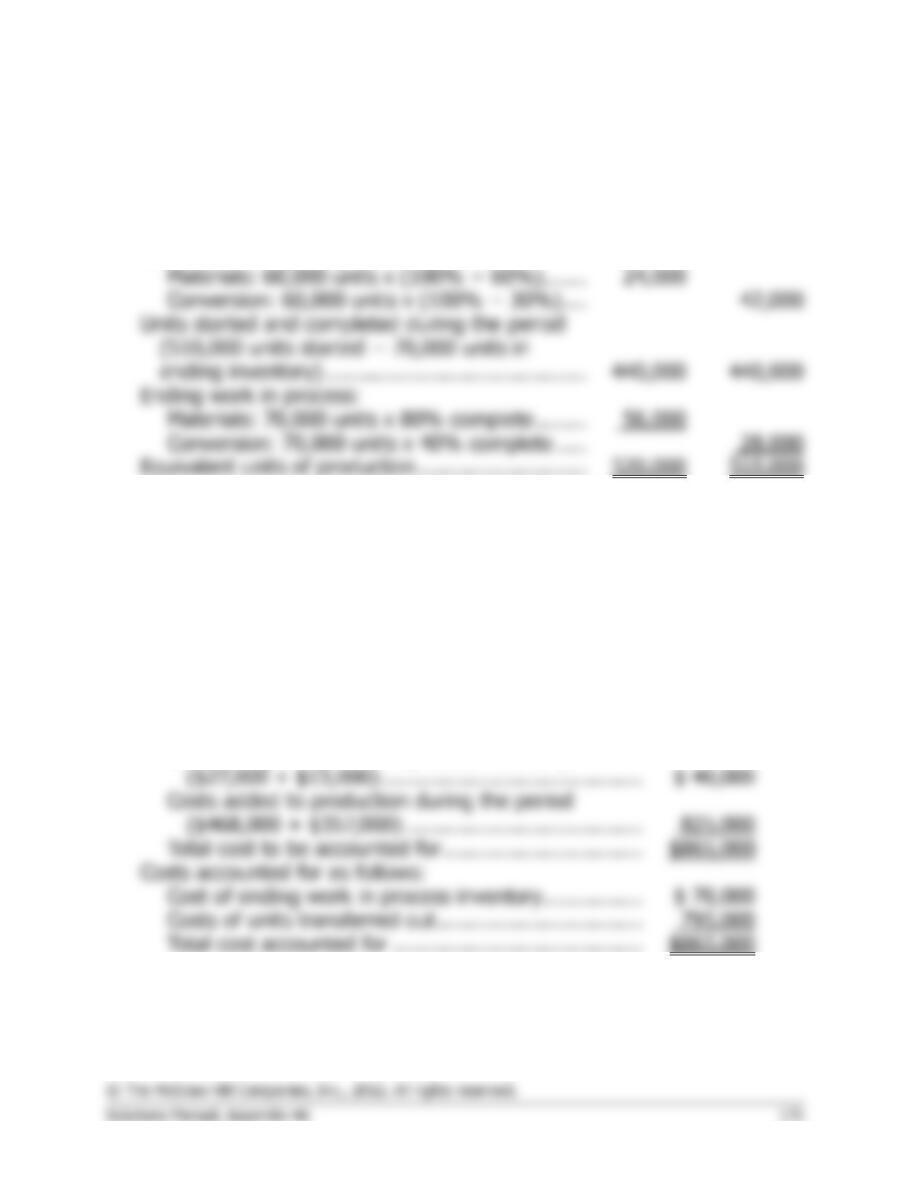
Materials: 60,000 units x (100% − 60%) …….
Conversion: 60,000 units x (100% − 30%) ….
440,000
Ending work in process:
Materials: 70,000 units x 80% complete ……..
Conversion: 70,000 units x 40% complete …..
Equivalent units of production ………………………
2.
Cost per Equivalent Unit
Materials
Conversion
Cost added during the period (a) …………..
$468,000
$357,000
Equivalent units of production (b) ………….
520,000
510,000
Cost per equivalent unit (a) ÷ (b) ………….
$0.90
$0.70
3. See the next page.
4.
Cost Reconciliation
Costs to be accounted for:
Costs added to production during the period
Total cost to be accounted for …………………………..
Costs accounted for as follows:
Costs of units transferred out …………………………...
Total cost accounted for ………………………………….
$865,000
Cost of beginning work in process inventory
Problem 4A-10 (continued)
3.
Costs of Ending Work in Process Inventory and Units Transferred Out
Materials
Conversion
Total
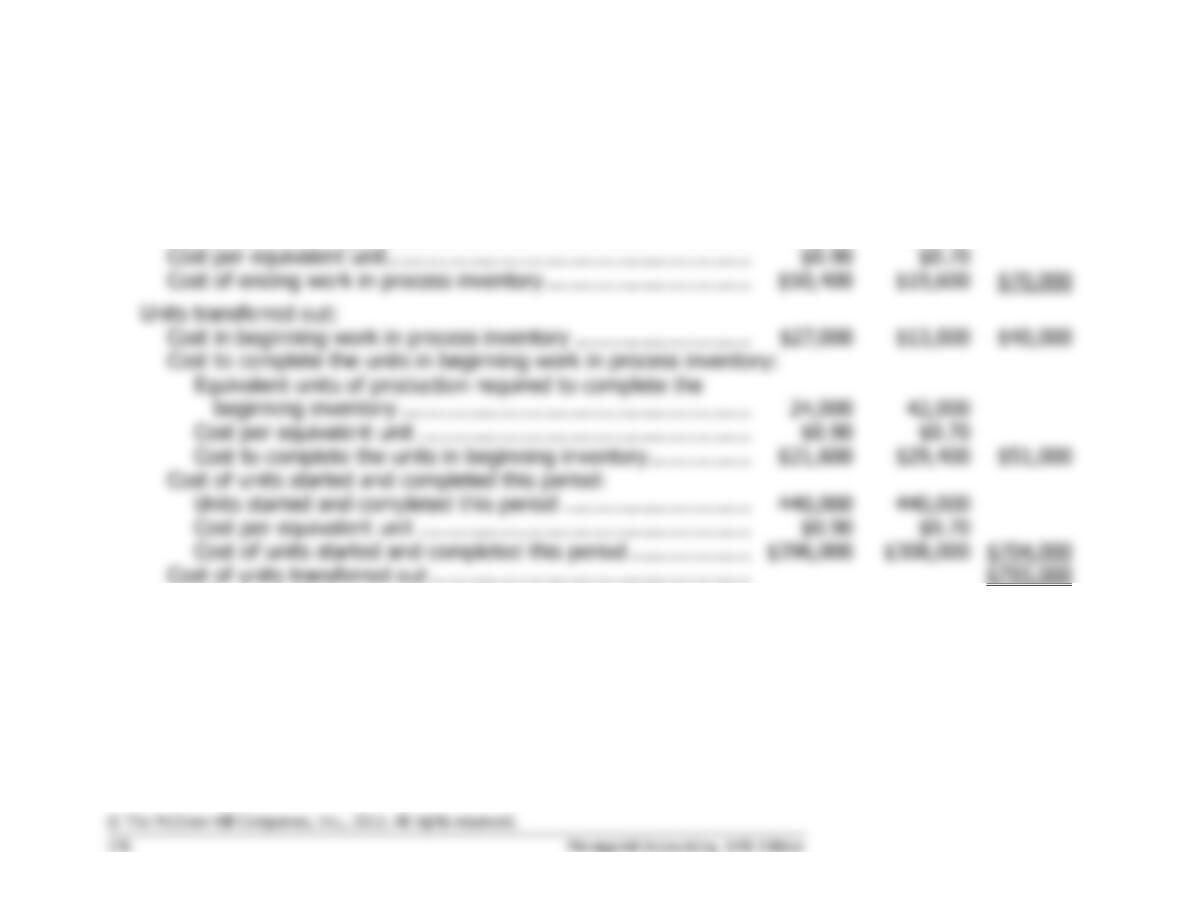
Ending work in process inventory:
Equivalent units of production ………………………………………….
56,000
28,000
Cost per equivalent unit ………………………………………………….
Units transferred out:
Cost in beginning work in process inventory ……………………….
$13,000
24,000
42,000
$29,400
Cost of units started and completed this period:
$396,000
$704,000
$795,000
Problem 4A-11 (45 minutes)
FIFO method
1.
Equivalent Units of Production
Materials
Conversion
To complete beginning work in process:
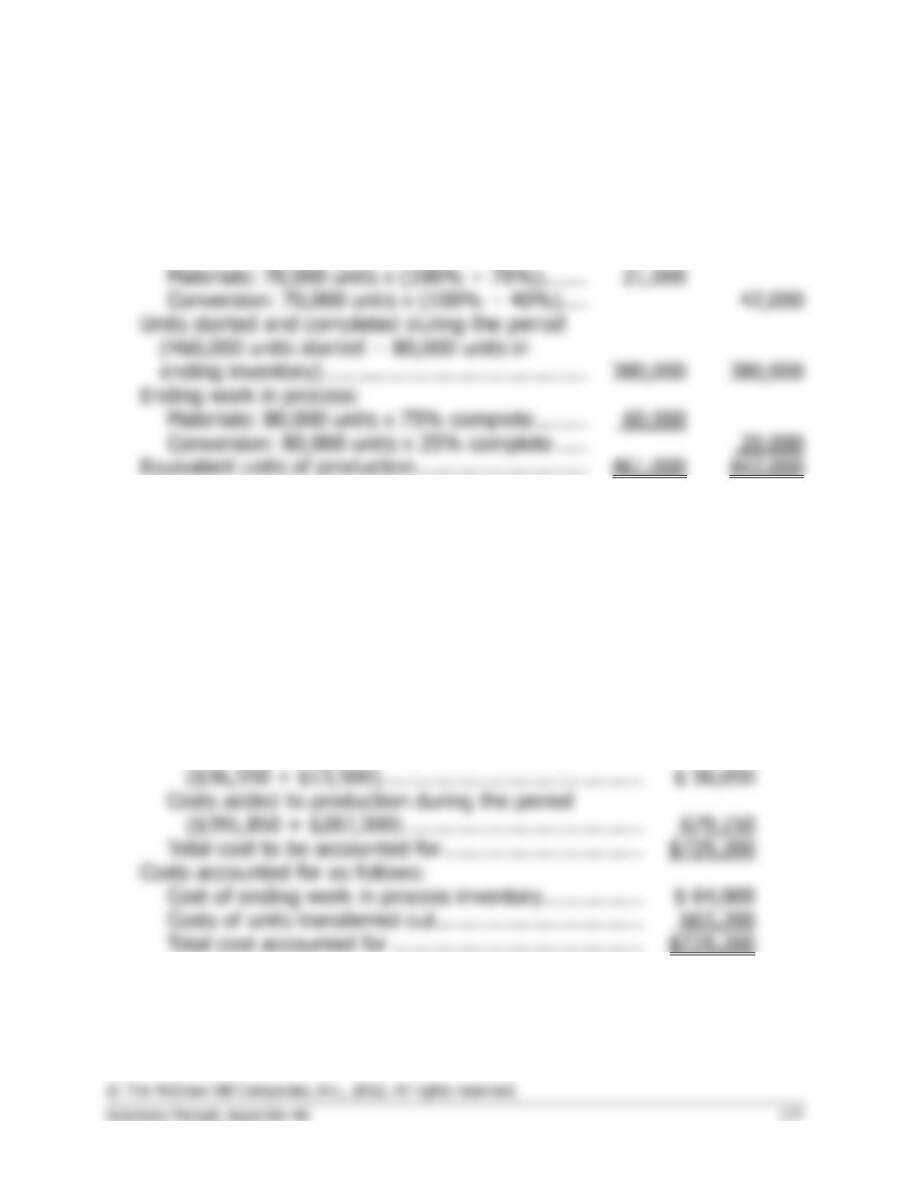
Materials: 70,000 units x (100% − 70%) …….
Conversion: 70,000 units x (100% − 40%) ….
380,000
Ending work in process:
Materials: 80,000 units x 75% complete ……..
Conversion: 80,000 units x 25% complete …..
Equivalent units of production ………………………
2.
Cost per Equivalent Unit
Materials
Conversion
Cost added during the period (a) …………..
$391,850
$287,300
Equivalent units of production (b) ………….
461,000
442,000
Cost per equivalent unit (a) ÷ (b) ………….
$0.85
$0.65
3. See the next page.
4.
Cost Reconciliation
Costs to be accounted for:
Costs added to production during the period
Total cost to be accounted for …………………………..
$729,200
Costs accounted for as follows:
Costs of units transferred out …………………………...
Total cost accounted for ………………………………….
$729,200
Cost of beginning work in process inventory
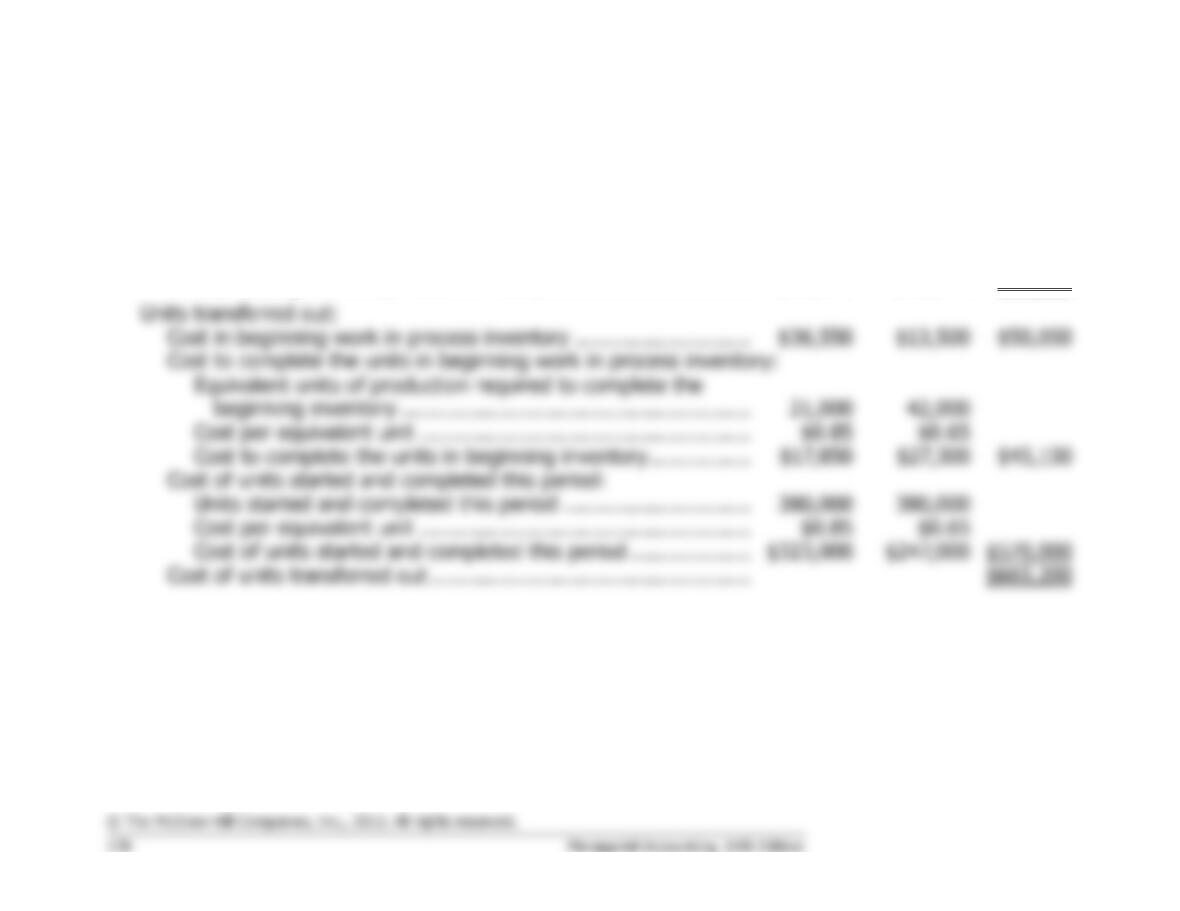
Problem 4A-11 (continued)
3.
Costs of Ending Work in Process Inventory and Units Transferred Out
Materials
Conversion
Total
Ending work in process inventory:
Equivalent units of production ………………………………………….
60,000
20,000
Cost per equivalent unit ………………………………………………….
$0.85
$0.65
Cost of ending work in process inventory …………………………...
$51,000
$13,000
$64,000
Units transferred out:
Cost in beginning work in process inventory ……………………….
$13,500
21,000
42,000
$27,300
Cost of units started and completed this period:
$0.85
$0.65
$323,000
$570,000
$665,200
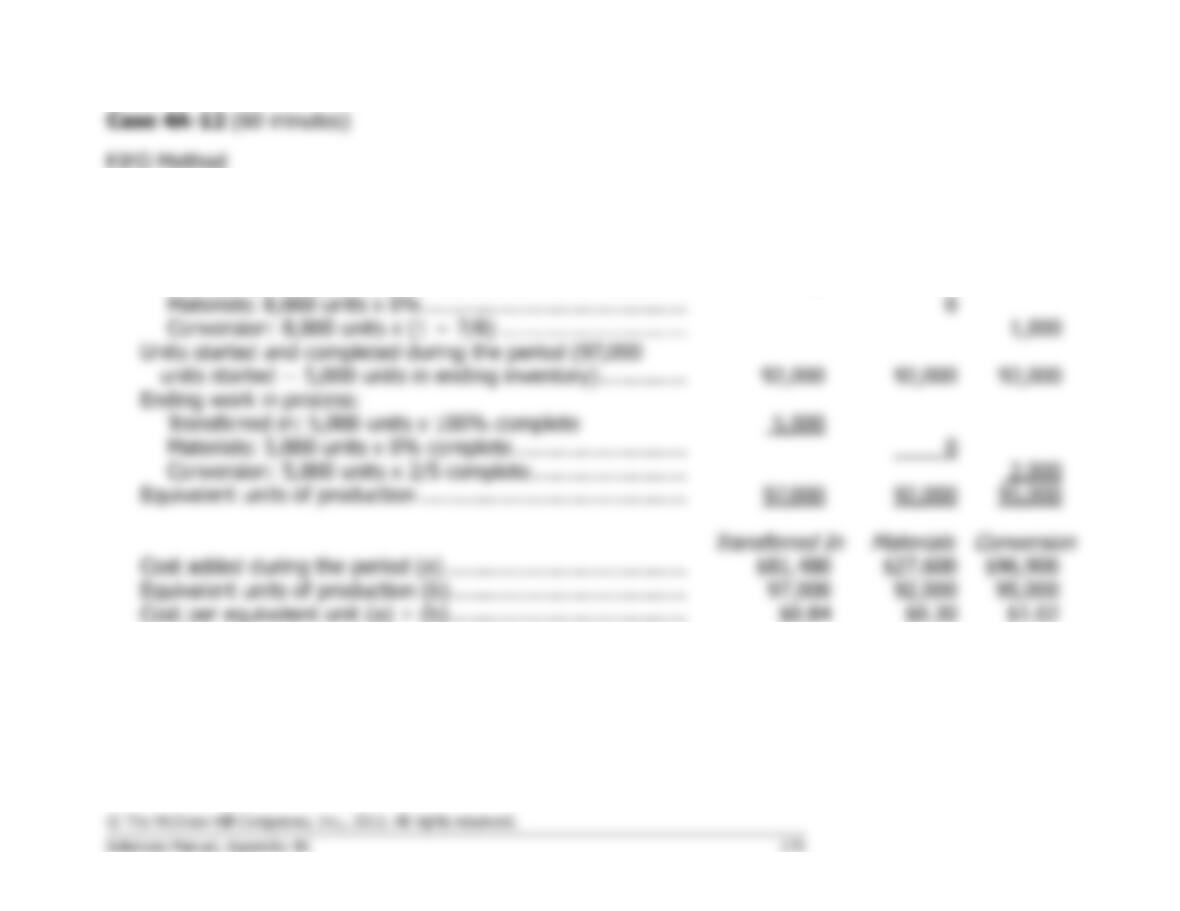
1.
Transferred In
Materials
Conversion
To complete beginning work in process:
Transferred in: 8,000 units x 0% ……………………………..
0
Ending work in process:
Equivalent units of production …………………………………….
Materials
Conversion
Cost added during the period (a) …………………………………
Equivalent units of production (b) ………………………………..
Cost per equivalent unit (a) ÷ (b) ………………………………..
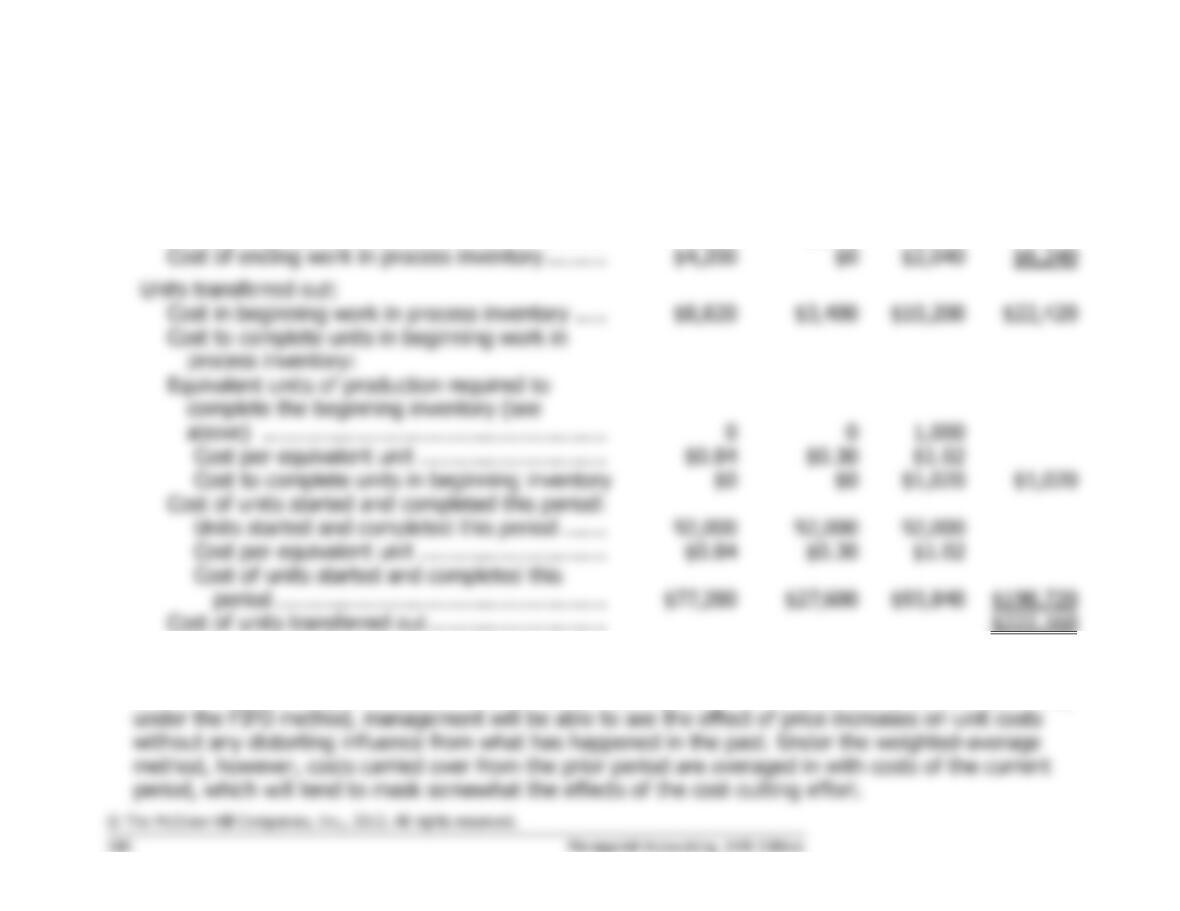
Case 4A-12 (continued)
Transferred In
Materials
Conversion
Total
Ending work in process inventory:
Equivalent units of production ……………………..
5,000
0
2,000
Cost per equivalent unit ……………………………..
$0.84
$0.30
$1.02
Cost of ending work in process inventory ……….
$2,040
Units transferred out:
Cost in beginning work in process inventory …..
0
1,000
$0.30
$1.02
$1,020
Cost of units started and completed this period:
92,000
$0.30
$1.02
$198,720
Cost of units transferred out ……………………….
$222,160
2. The effects of the cost-cutting will tend to show up more under the FIFO method. The reason is that
the FIFO method keeps the costs of the current period separate from the costs of prior periods. Thus,
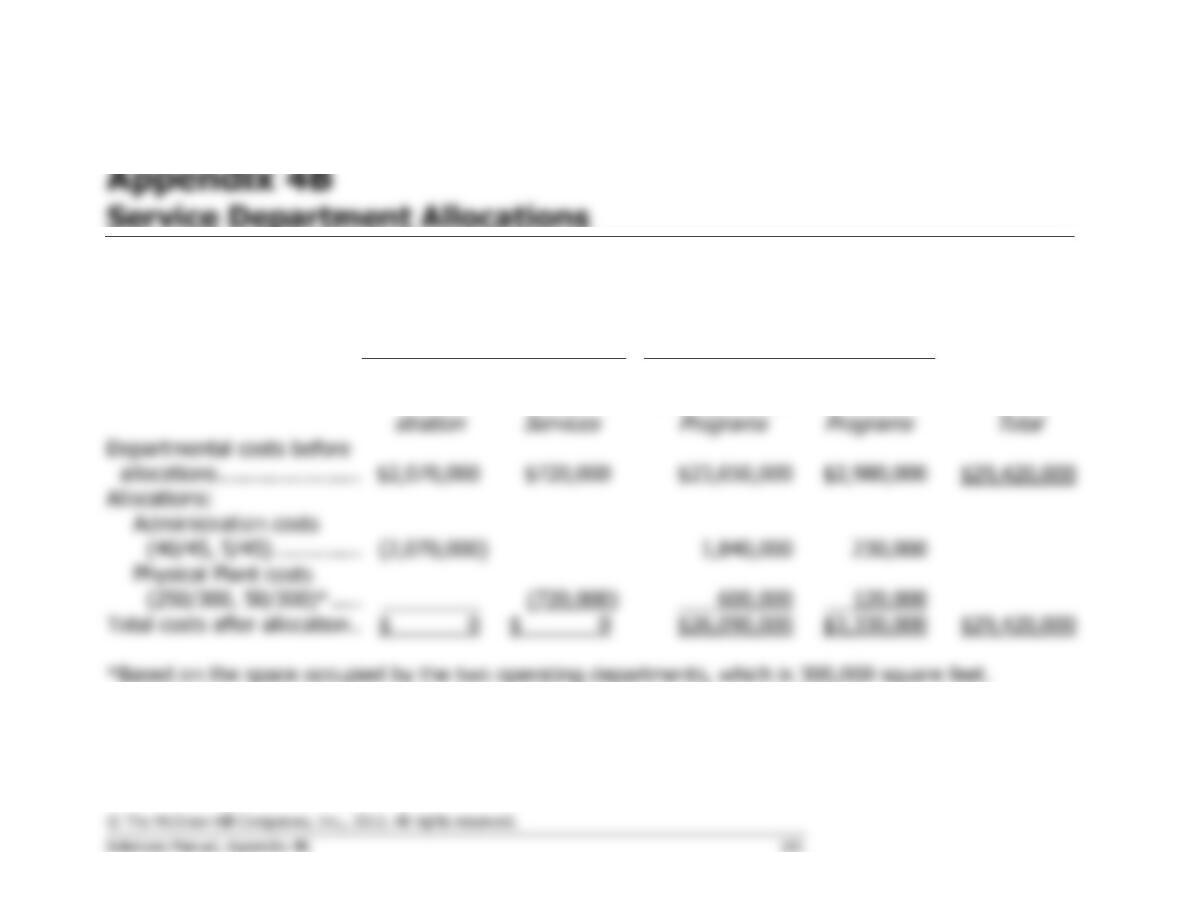
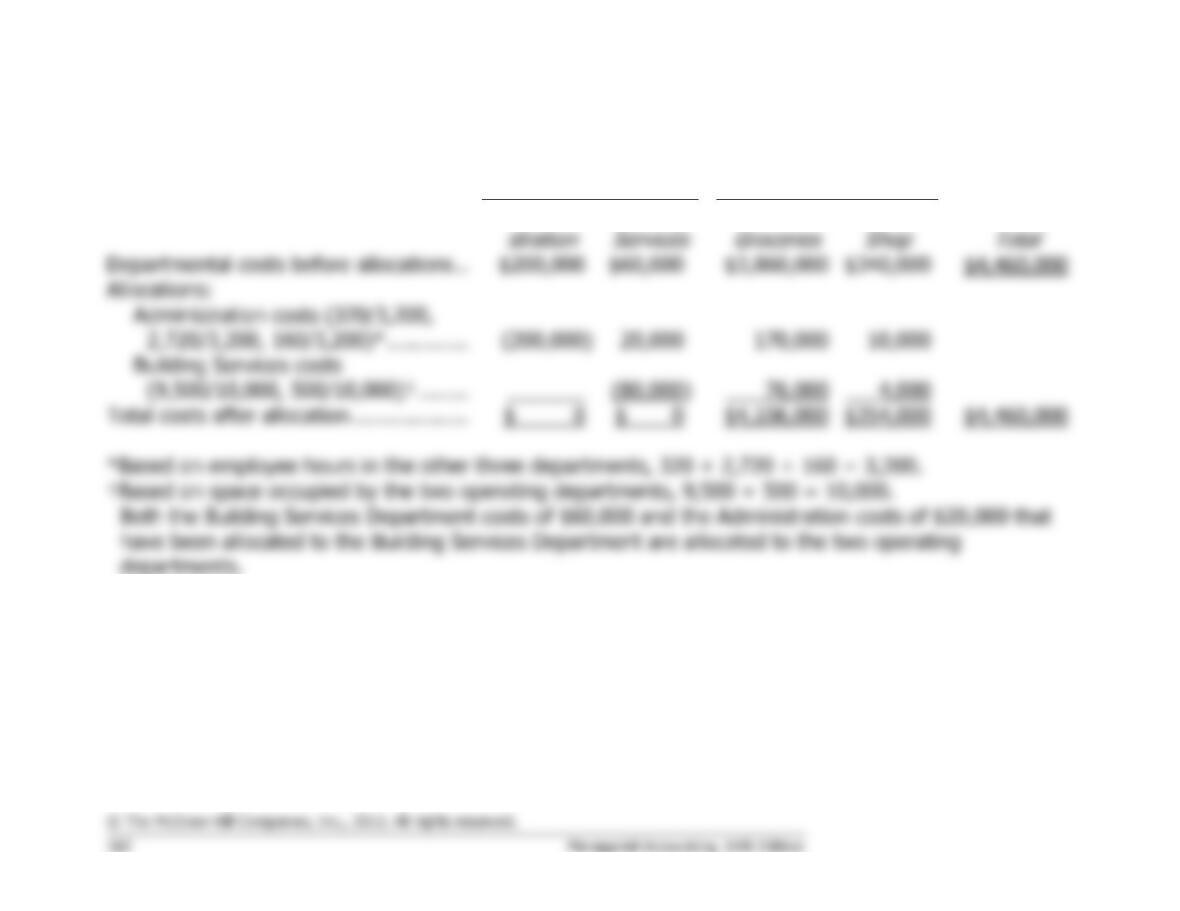
Exercise 4B-1 (15 minutes)
Service Departments
Operating Departments
Admini-
Physical
Plant
Undergraduate
Graduate
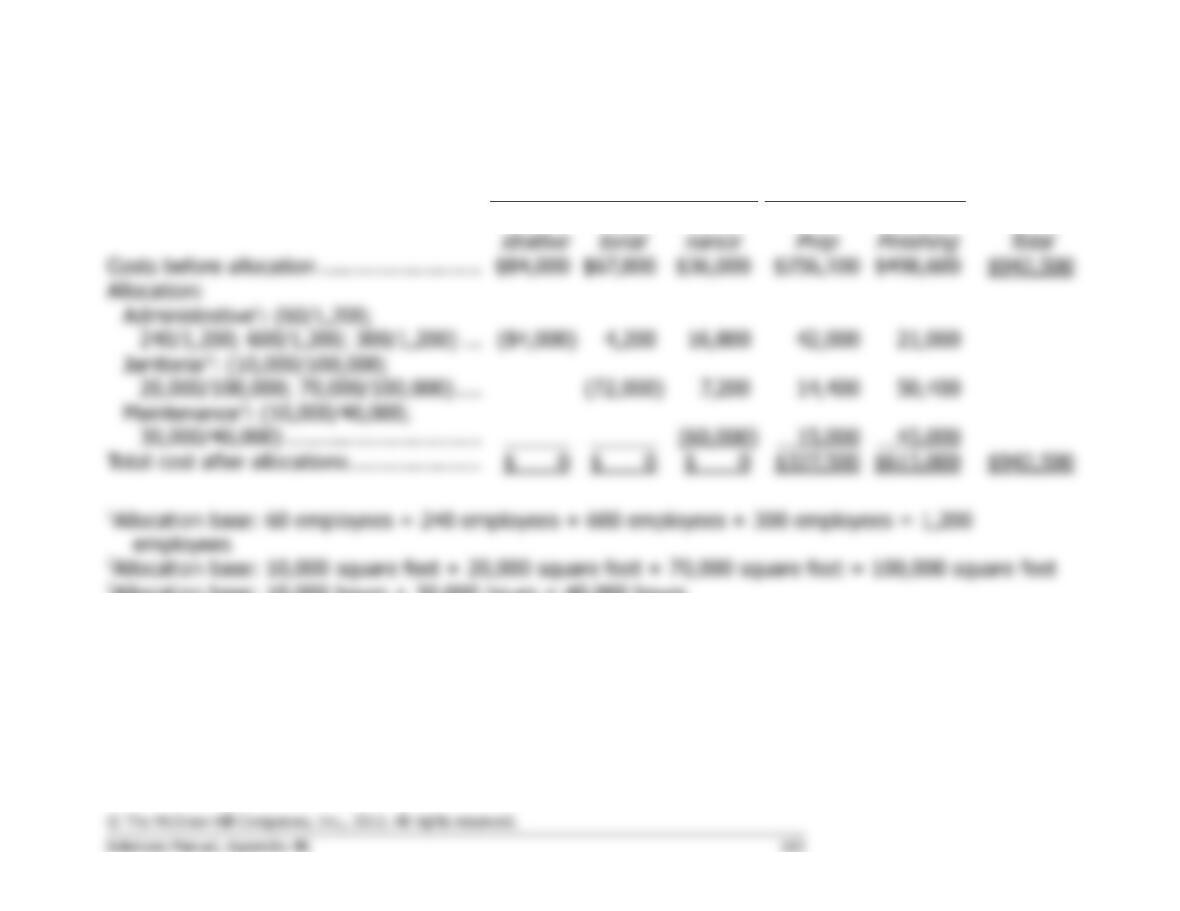
Exercise 4B-2 (15 minutes)
Service
Departments
Operating
Departments
Admini-
Building
Coffee
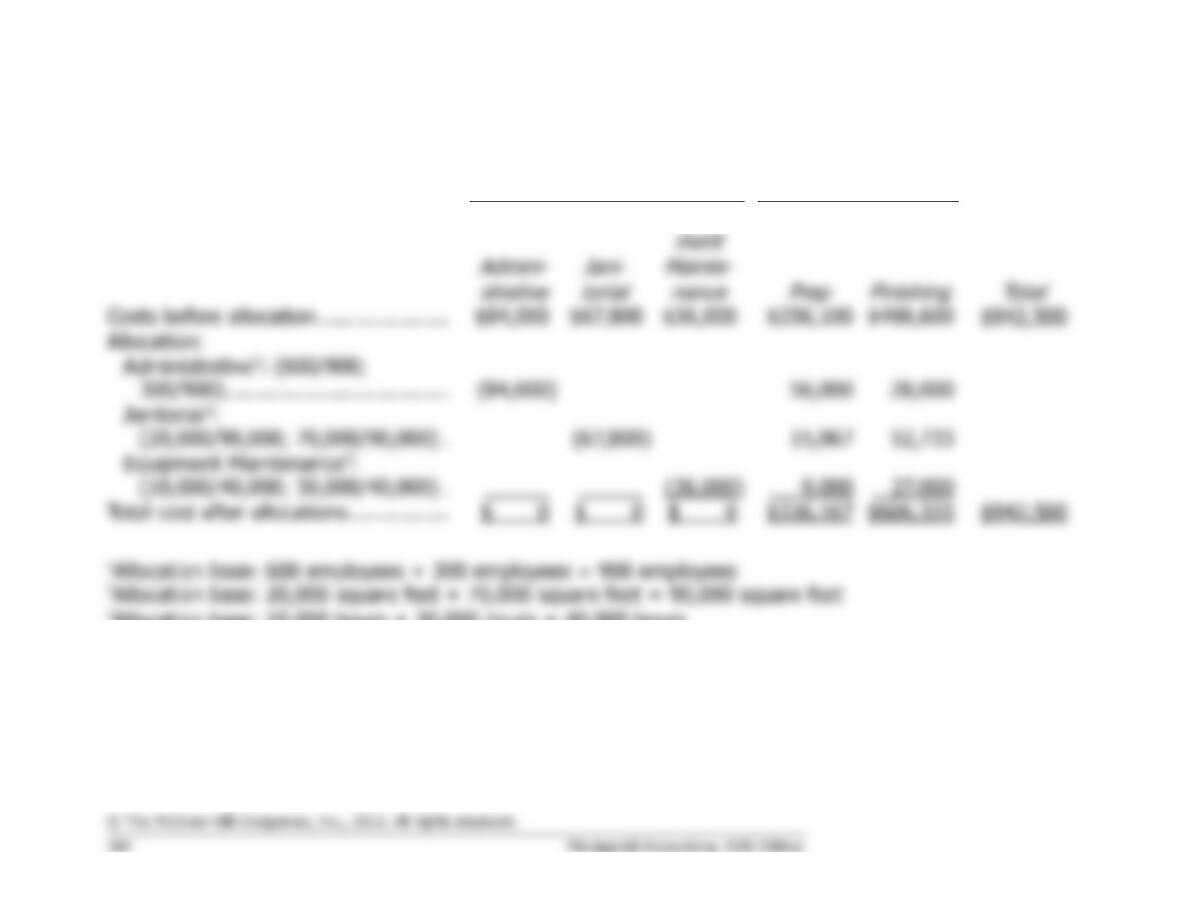
Exercise 4B-3 (20 minutes)
Service
Departments
Operating
Departments
Costs before allocation ……………………..
Allocation:
Total cost after allocations …………………
Admini-
Jani-
Mainte-
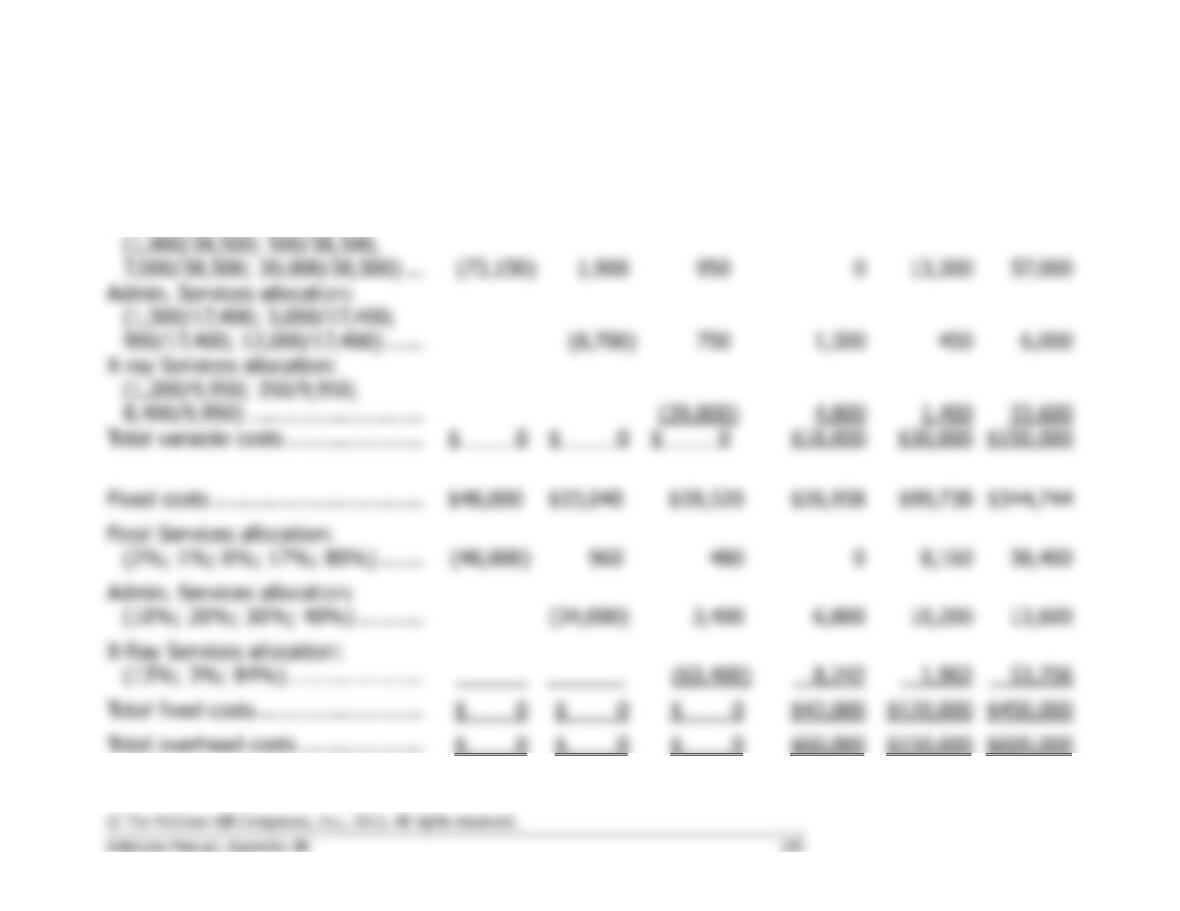
Exercise 4B-4 (20 minutes)
Service
Departments
Operating
Departments
Allocation:
Equip-
Problem 4B-5 (45 minutes)
Food
Services
Admin.
Services
X-Ray
Services
Outpatient
Clinic
OB Care
General
Hospital
Variable costs …………………………
$73,150
$6,800
$38,100
$11,700
$14,850
$ 53,400
1,900
Admin. Services allocation:
450
X–ray Services allocation:
Total variable costs ………………….
$18,000
$30,000
Food Services allocation:
Problem 4B-6 (60 minutes)
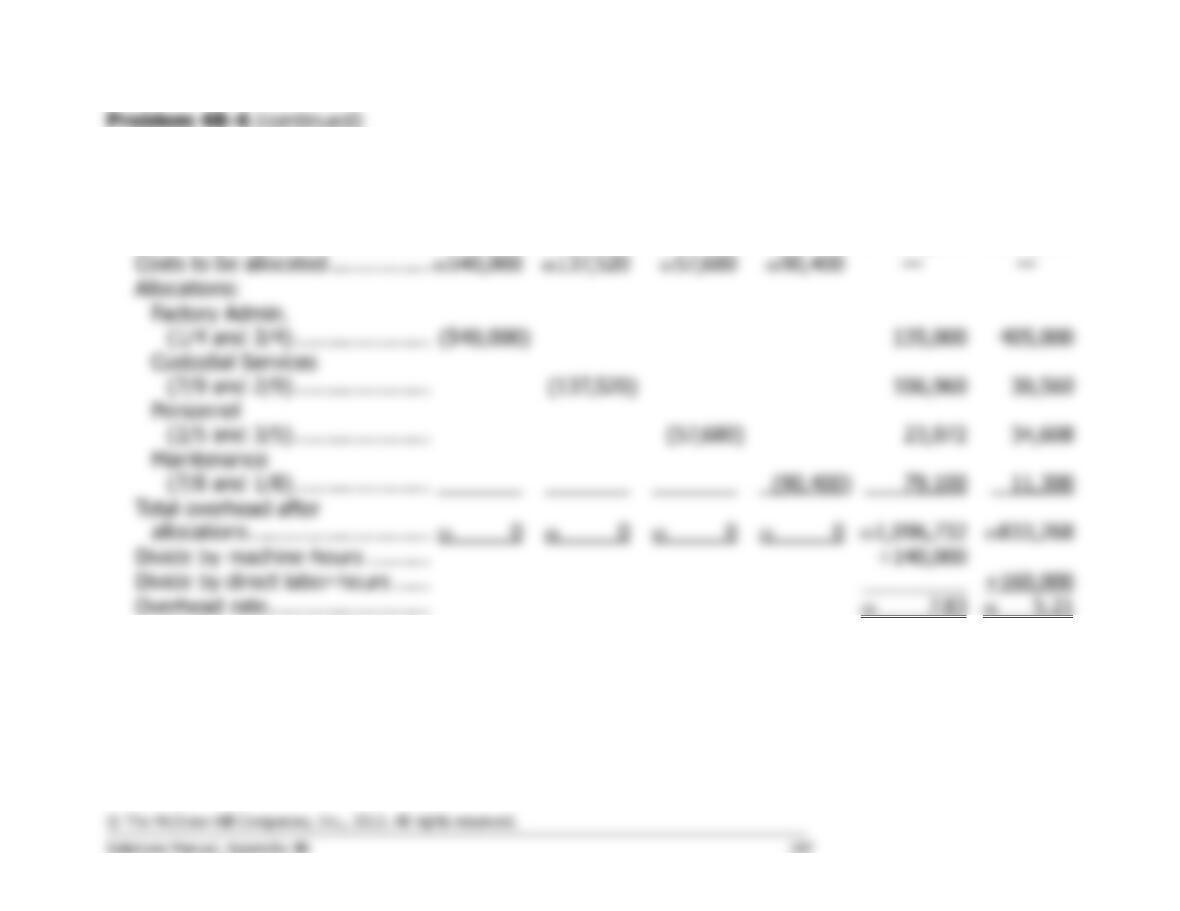
1.
Factory
Admin.
Custodial
Services
Personnel
Mainte-
nance
Stamping
Assembly
Step-down method
Operating department costs …………………………..
752,600
351,800
Costs to be allocated …………………………..
137,520
Allocations:
0
1,162,000
768,000
Divide by machine-hours …………………………..
Divide by direct labor-hours …………………………..
Overhead rate …………………………..
8.30
2.
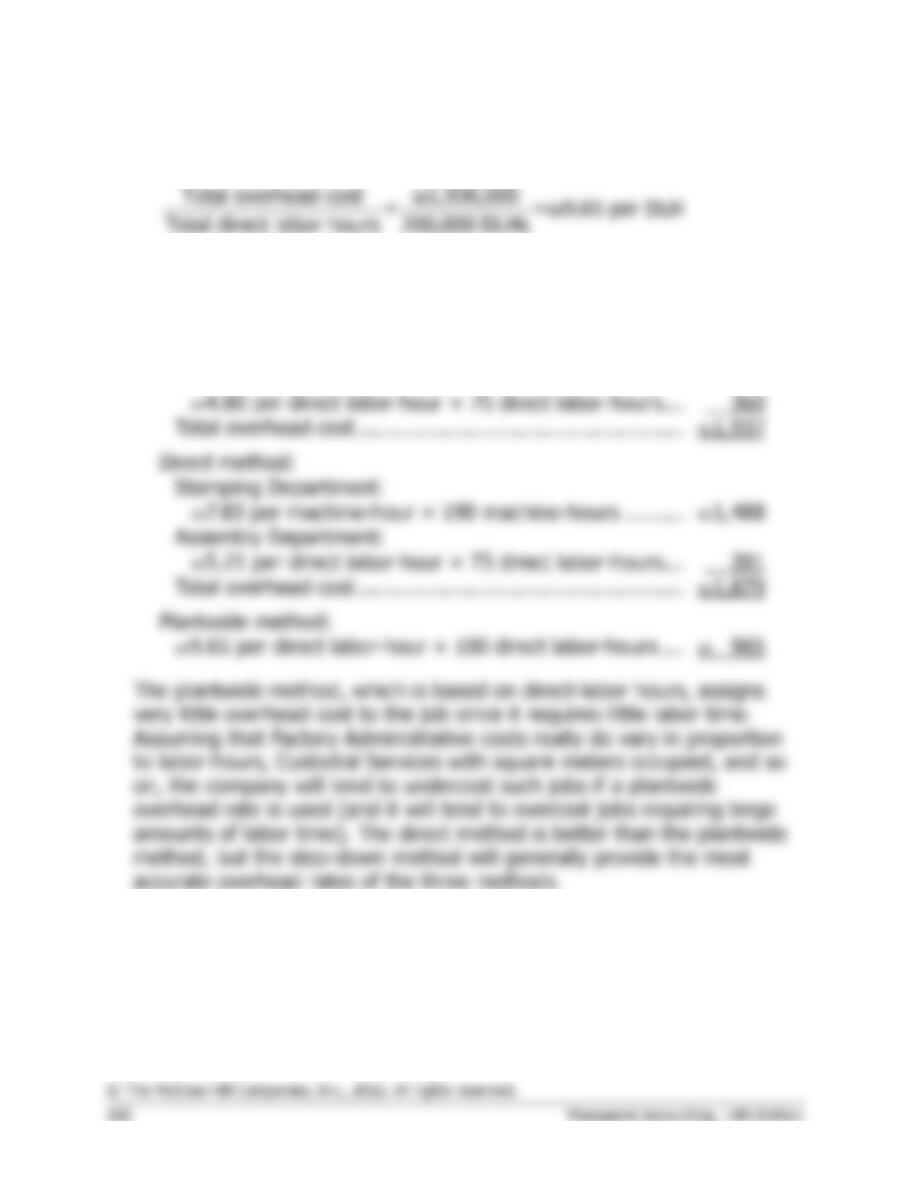
Factory
Admin.
Custodial
Services
Personnel
Mainte-
nance
Stamping
Assembly
Direct method
Operating department costs …………………………..
–
752,600
351,800
Costs to be allocated …………………………..
137,520
Allocations:
Divide by machine-hours …………………………..
Divide by direct labor-hours …………………………..
Overhead rate …………………………..
Problem 4B-6 (continued)
3.
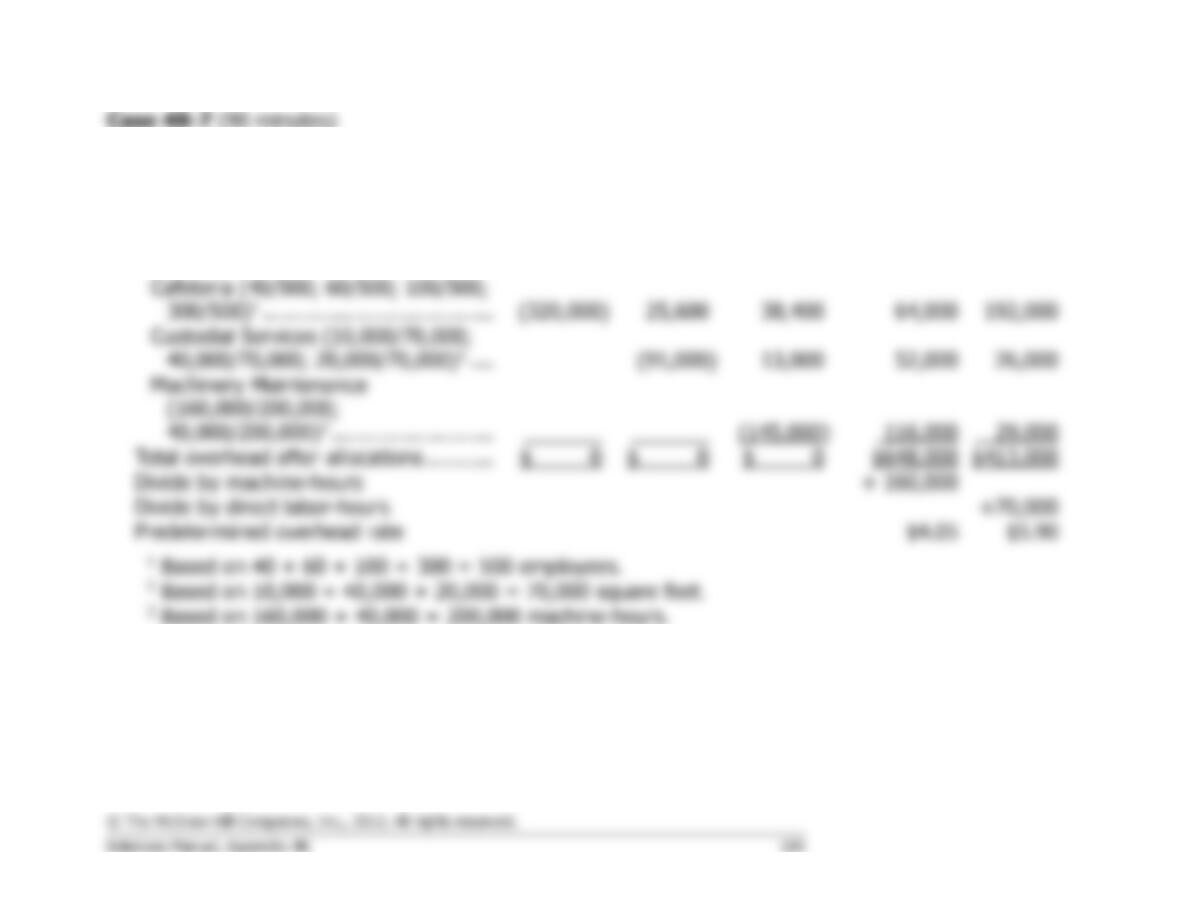
Plantwide rate
4. The amount of overhead cost assigned to the job would be:
Step-down method:
Stamping Department:
8.30 per machine-hour × 190 machine hours ………..
1,577
Assembly Department:
4.80 per direct labor–hour × 75 direct labor-hours …..
Total overhead cost ………………………………………………
1,937
Stamping Department:
Assembly Department:
5.21 per direct labor-hour × 75 direct labor-hours …..
Total overhead cost ………………………………………………
1,879
965
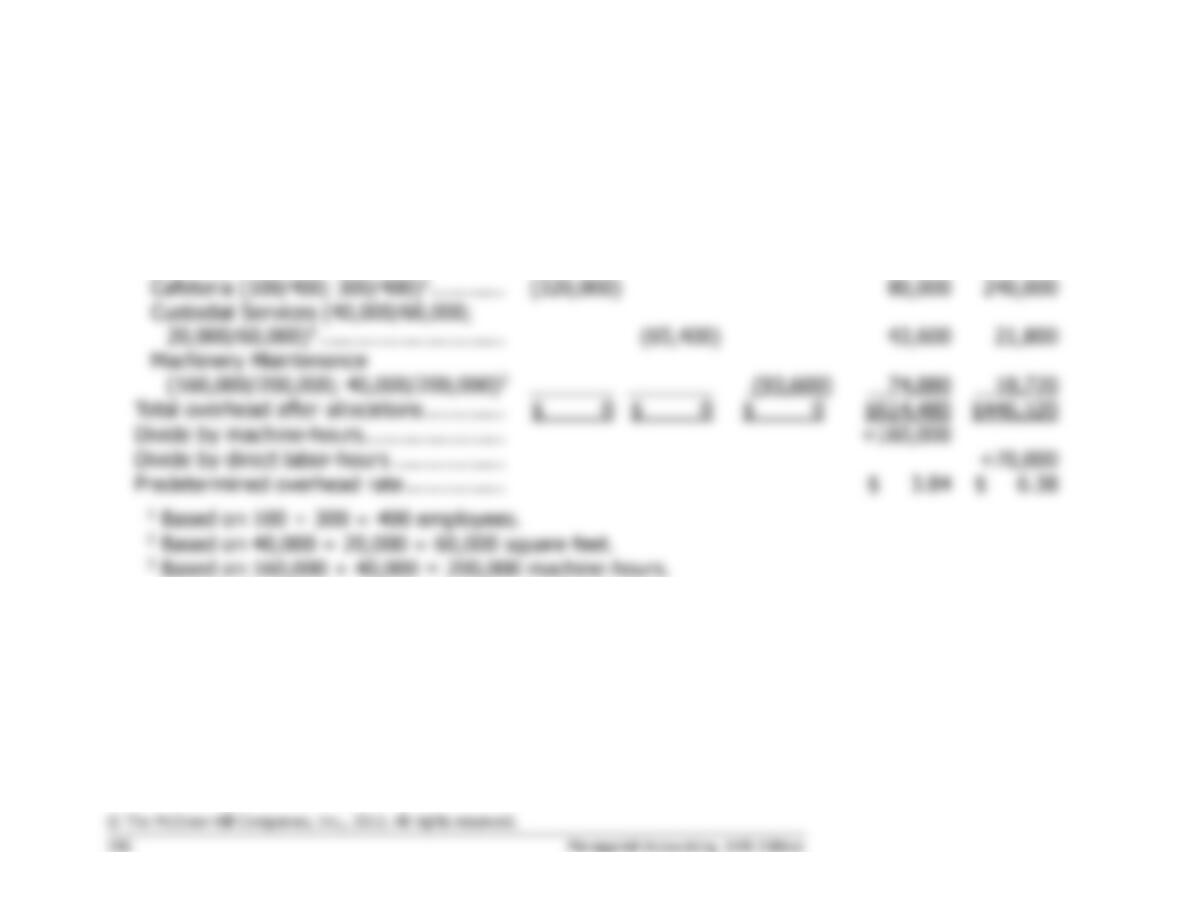
1. Step-down method:
Cafeteria
Custodial
Services
Machinery
Maintenance
Milling
Finishing
Total costs before allocations……………
$320,000
$65,400
$ 93,600
$416,000
$166,000
Allocations:
Total overhead after allocations ………..
Divide by machine-hours
Divide by direct labor-hours
Predetermined overhead rate
Based on 40 + 60 + 100 + 300 = 500 employees.
Based on 10,000 + 40,000 + 20,000 = 70,000 square feet.
Based on 160,000 + 40,000 = 200,000 machine-hours.
Case 4B-7 (continued)
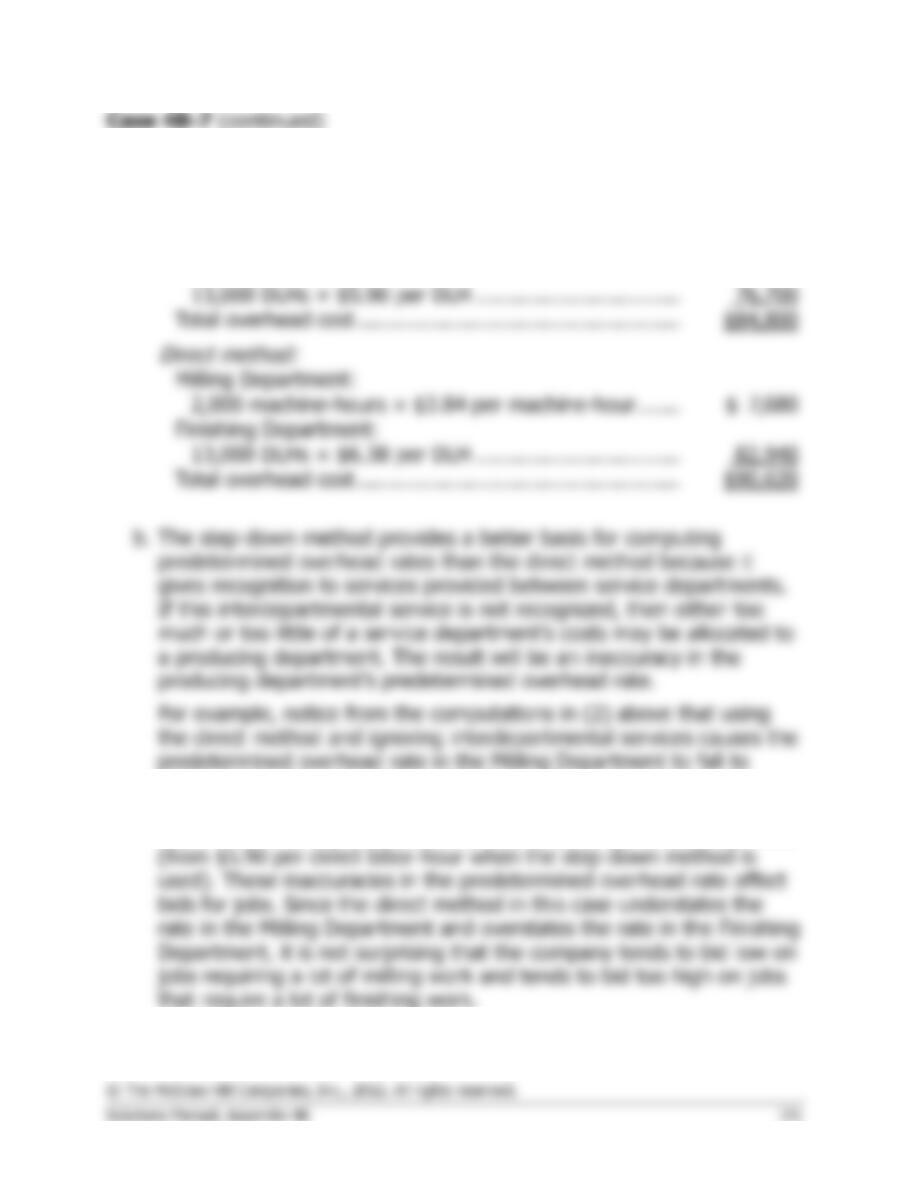
2. Direct method:
Cafeteria
Custodial
Services
Machinery
Maintenance
Milling
Finishing
Total costs before allocations……………..
$320,000
$65,400
$93,600
$416,000
$166,000
Allocations:
21,800
Total overhead after allocations ………….
Divide by machine-hours …………………..
÷160,000
Divide by direct labor-hours ………………
÷70,000
Predetermined overhead rate …………….
Based on 100 + 300 = 400 employees.
Based on 40,000 + 20,000 = 60,000 square feet.
Based on 160,000 + 40,000 = 200,000 machine-hours.
3. a. The amount of overhead cost assigned to the job would be:
Step-down method:
Milling Department:
2,000 machine-hours × $4.05 per machine-hour …….
$ 8,100
Finishing Department:
Total overhead cost …………………………………………….
Direct method:
Milling Department:
2,000 machine-hours × $3.84 per machine-hour …….
Finishing Department:
Total overhead cost …………………………………………….
$3.84 per machine-hour (from $4.05 per machine-hour when the
step-down method is used), and causes the predetermined overhead
rate in the Finishing Department to rise to $6.38 per direct labor-hour