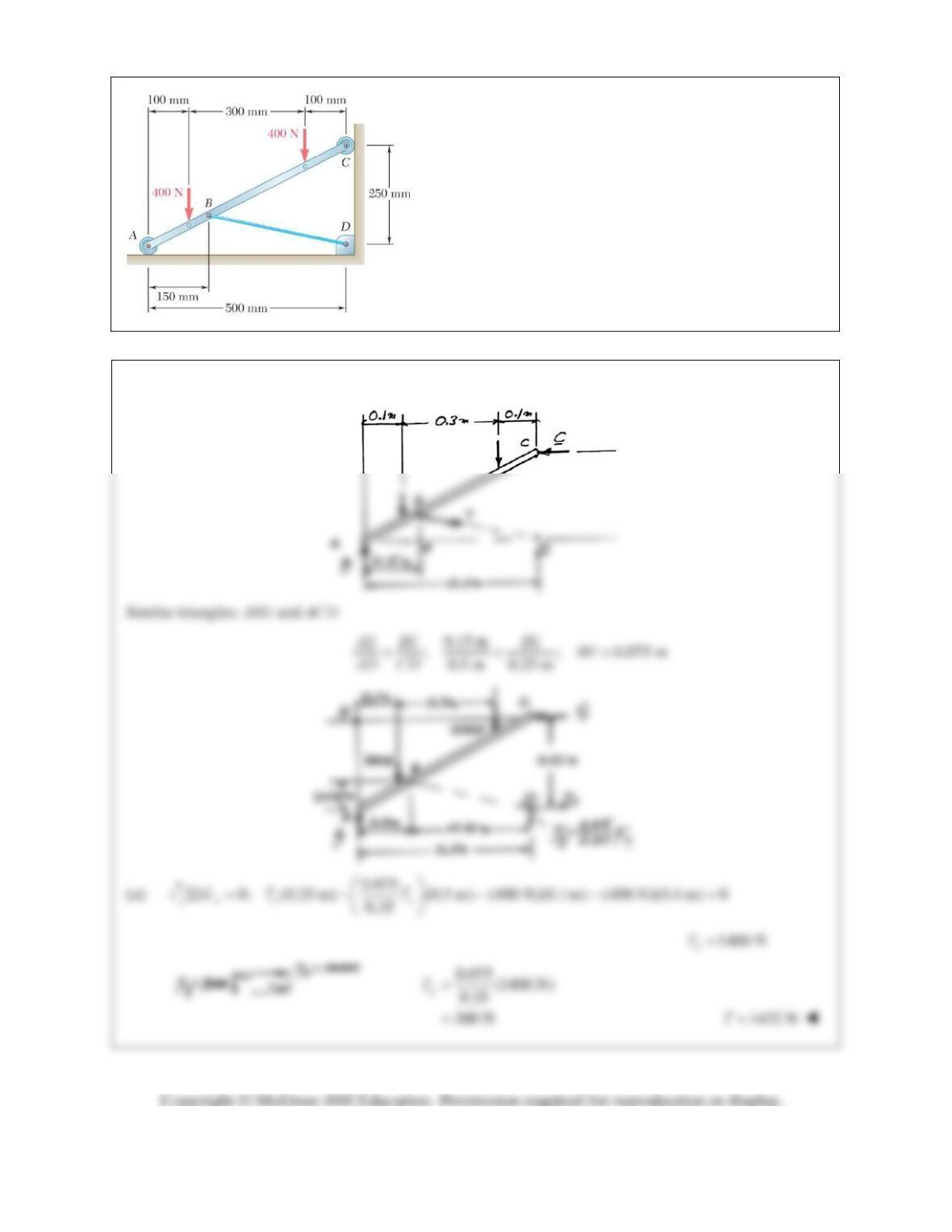
PROBLEM 4.35
Bar AC supports two 400-N loads as shown. Rollers at A
and C rest against frictionless surfaces and a cable BD is
attached at B. Determine (a) the tension in cable BD, (b) the
reaction at A, (c) the reaction at C.
SOLUTION
PROBLEM 4.35 (Continued)
(b)
0: 300 N 400 N 400 N 0
y
FA
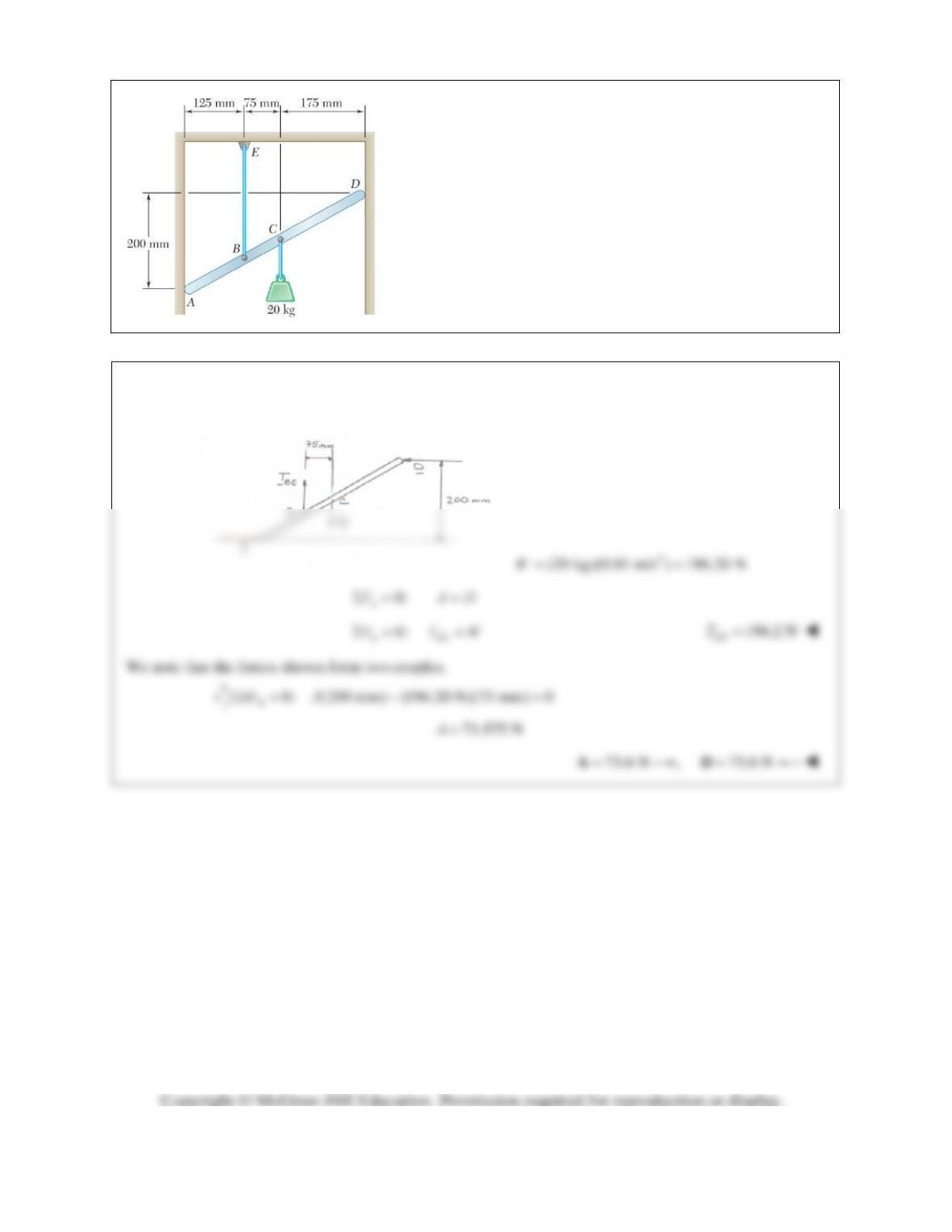
PROBLEM 4.36
A light bar AD is suspended from a cable BE and supports a
20-kg block at C. The ends A and D of the bar are in contact
with frictionless vertical walls. Determine the tension in cable
BE and the reactions at A and D.
SOLUTION
Free-Body Diagram:
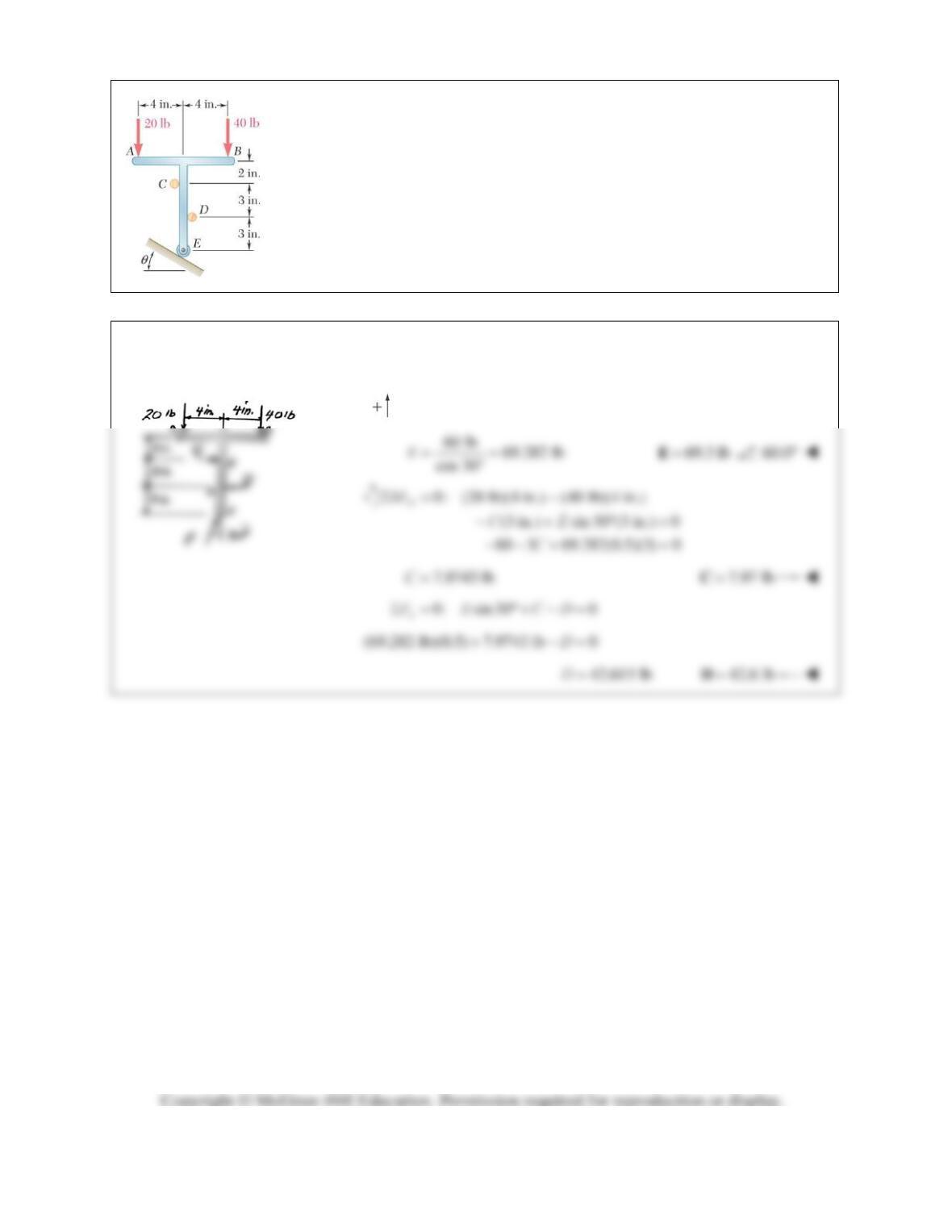
PROBLEM 4.37
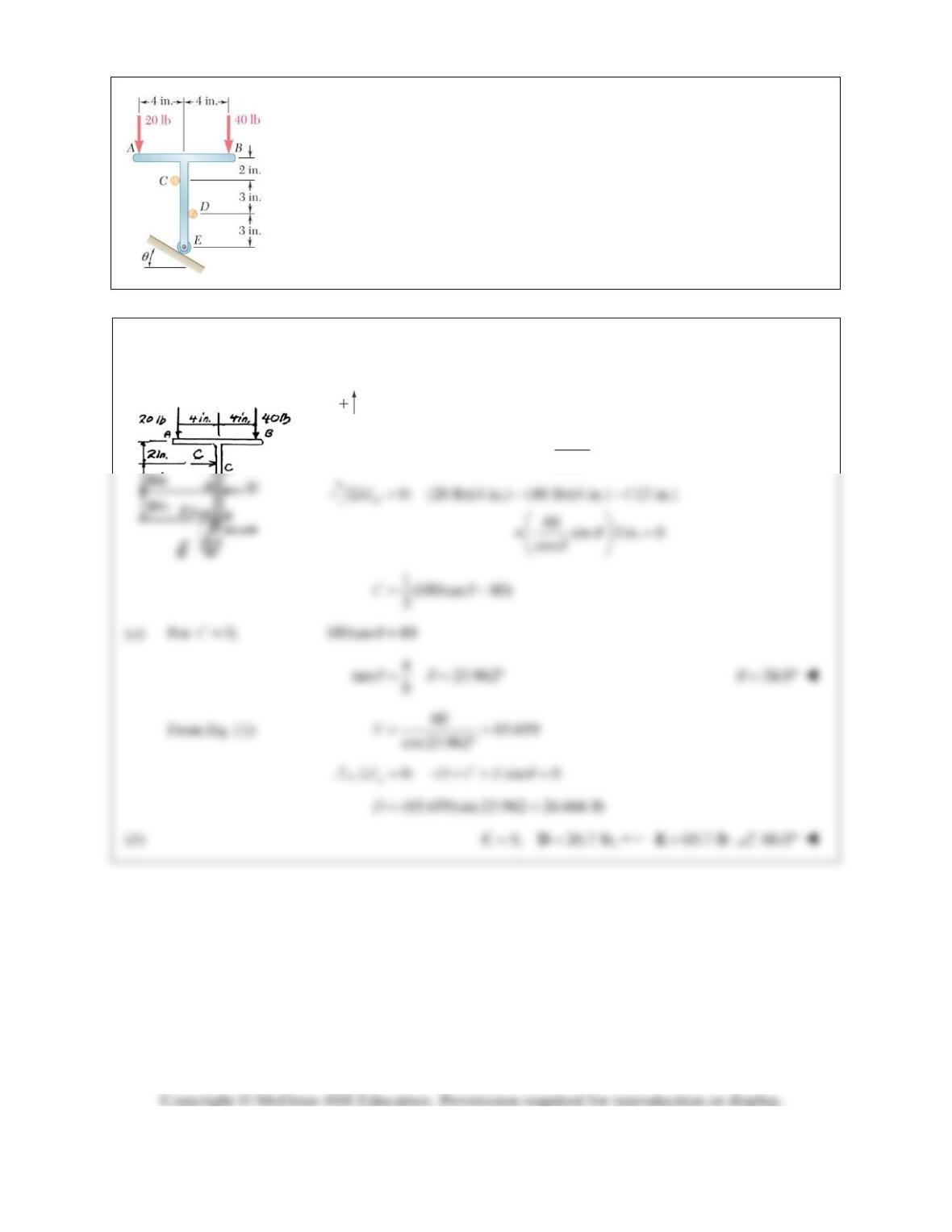
The T-shaped bracket shown is supported by a small wheel at E and pegs at C
and D. Neglecting the effect of friction, determine the reactions at C, D, and E
when
30 .
SOLUTION
Free-Body Diagram:
0: cos30 20 40 0
y
FE
PROBLEM 4.38
The T-shaped bracket shown is supported by a small wheel at E and pegs at C
and D. Neglecting the effect of friction, determine (a) the smallest value of
for
which the equilibrium of the bracket is maintained, (b) the corresponding reactions
at C, D, and E.
SOLUTION
Free-Body Diagram:
0: cos 20 40 0
y
FE
60
cos
E
(1)
PROBLEM 4.39
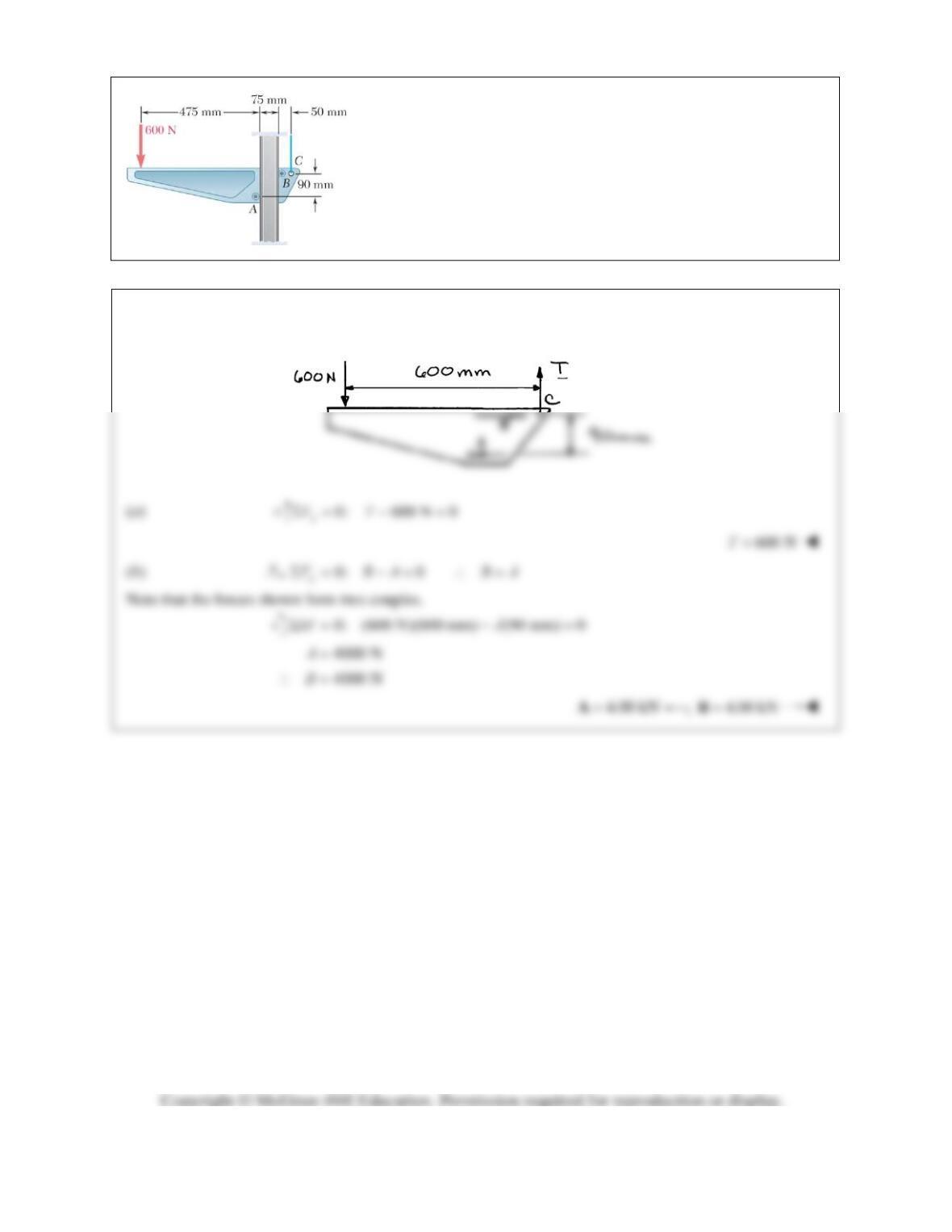
A movable bracket is held at rest by a cable attached at C and by
frictionless rollers at A and B. For the loading shown, determine
(a) the tension in the cable, (b) the reactions at A and B.
SOLUTION
Free-Body Diagram:
PROBLEM 4.40
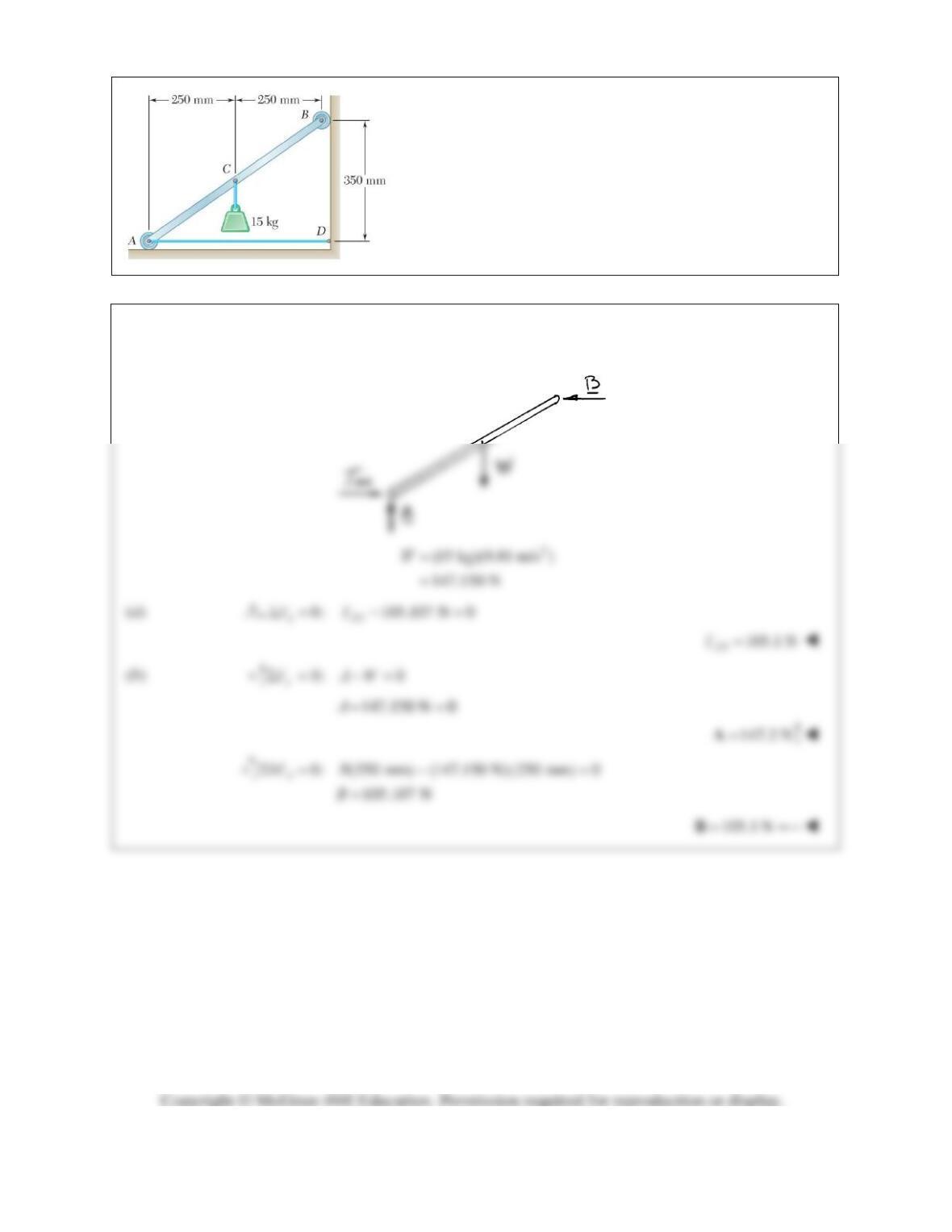
A light bar AB supports a 15-kg block at its midpoint C. Rollers at
A and B rest against frictionless surfaces, and a horizontal cable
AD is attached at A. Determine (a) the tension in cable AD, (b) the
reactions at A and B.
SOLUTION
Free-Body Diagram:
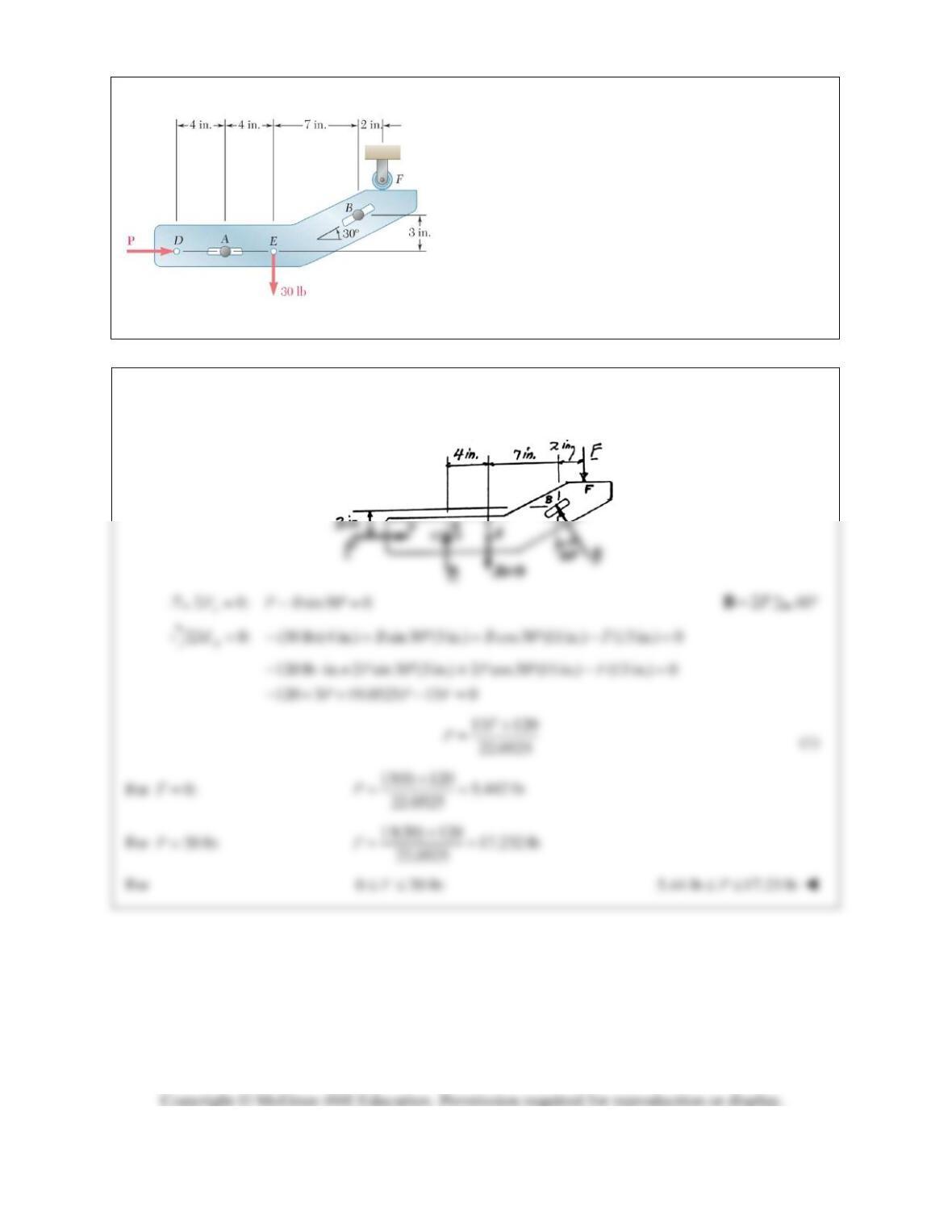
PROBLEM 4.41
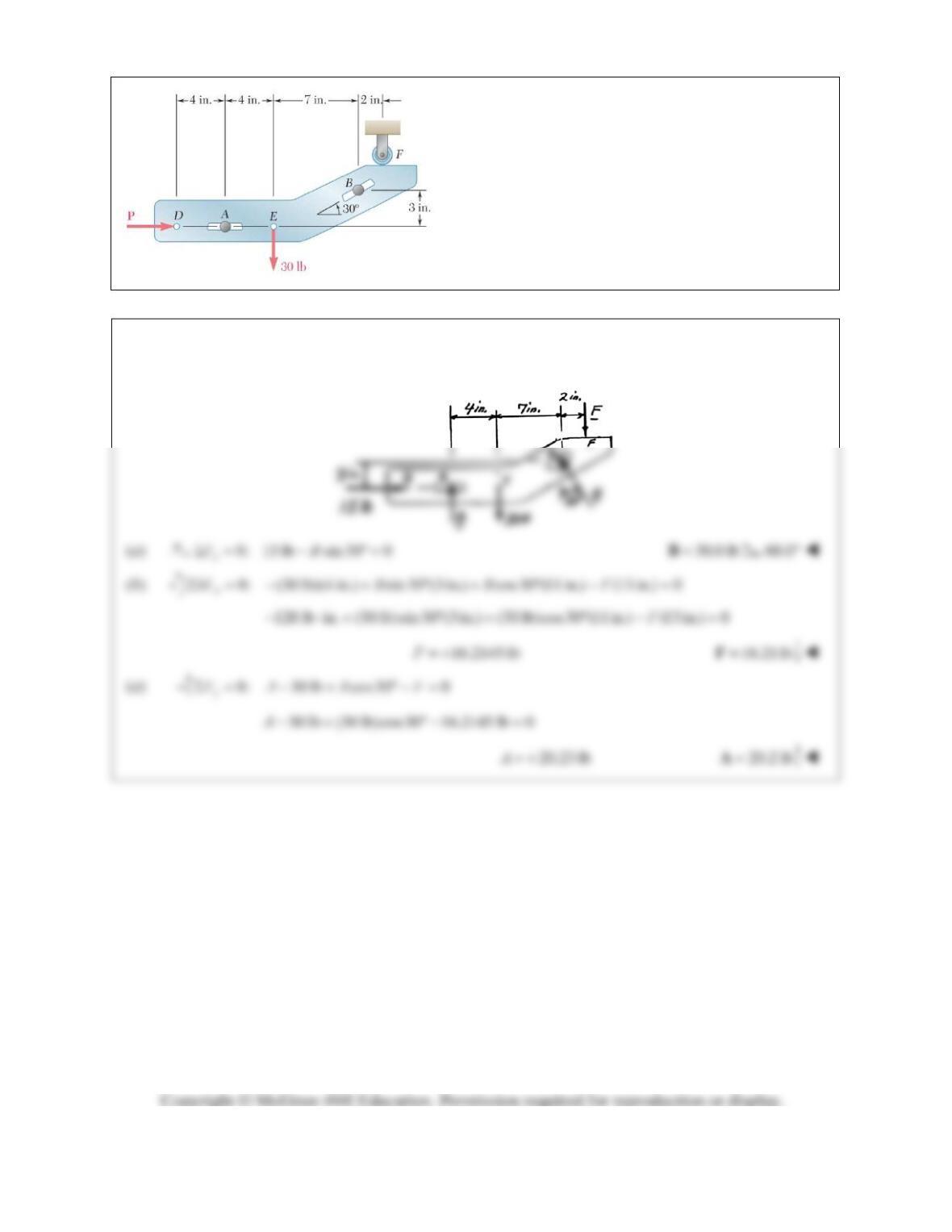
Two slots have been cut in plate DEF, and the plate has
been placed so that the slots fit two fixed, frictionless
pins A and B. Knowing that P 15 lb, determine (a) the
force each pin exerts on the plate, (b) the reaction at F.
SOLUTION
Free-Body Diagram:
PROBLEM 4.42
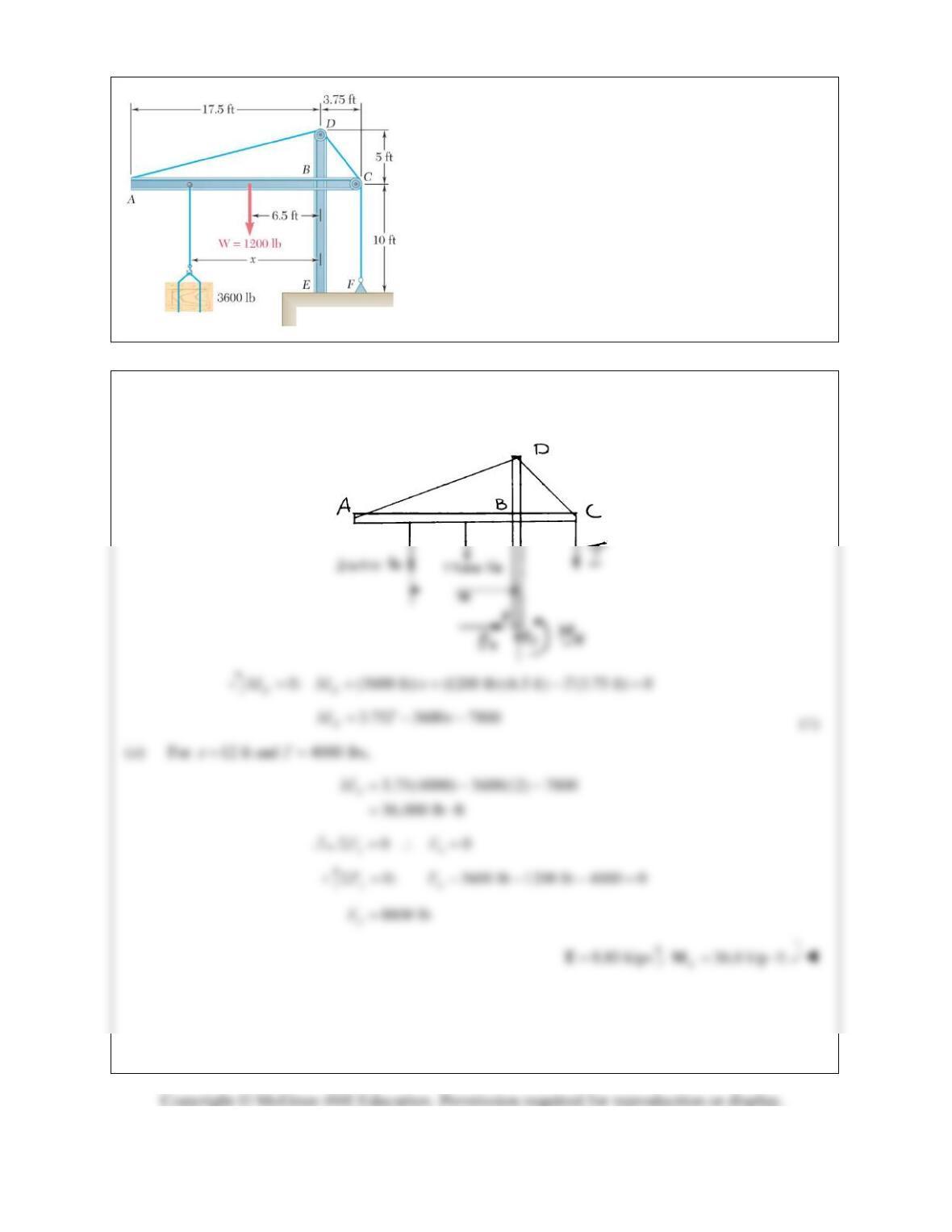
For the plate of Problem 4.41 the reaction at F must be
directed downward, and its maximum allowable value
is 20 lb. Neglecting friction at the pins, determine the
required range of values of P.
PROBLEM 4.41
Two slots have been cut in plate
DEF, and the plate has been placed so that the slots fit
two fixed, frictionless pins A and B. Knowing that
P 15 lb, determine (a) the force each pin exerts on the
plate, (b) the reaction at F.
SOLUTION
Free-Body Diagram:
PROBLEM 4.43
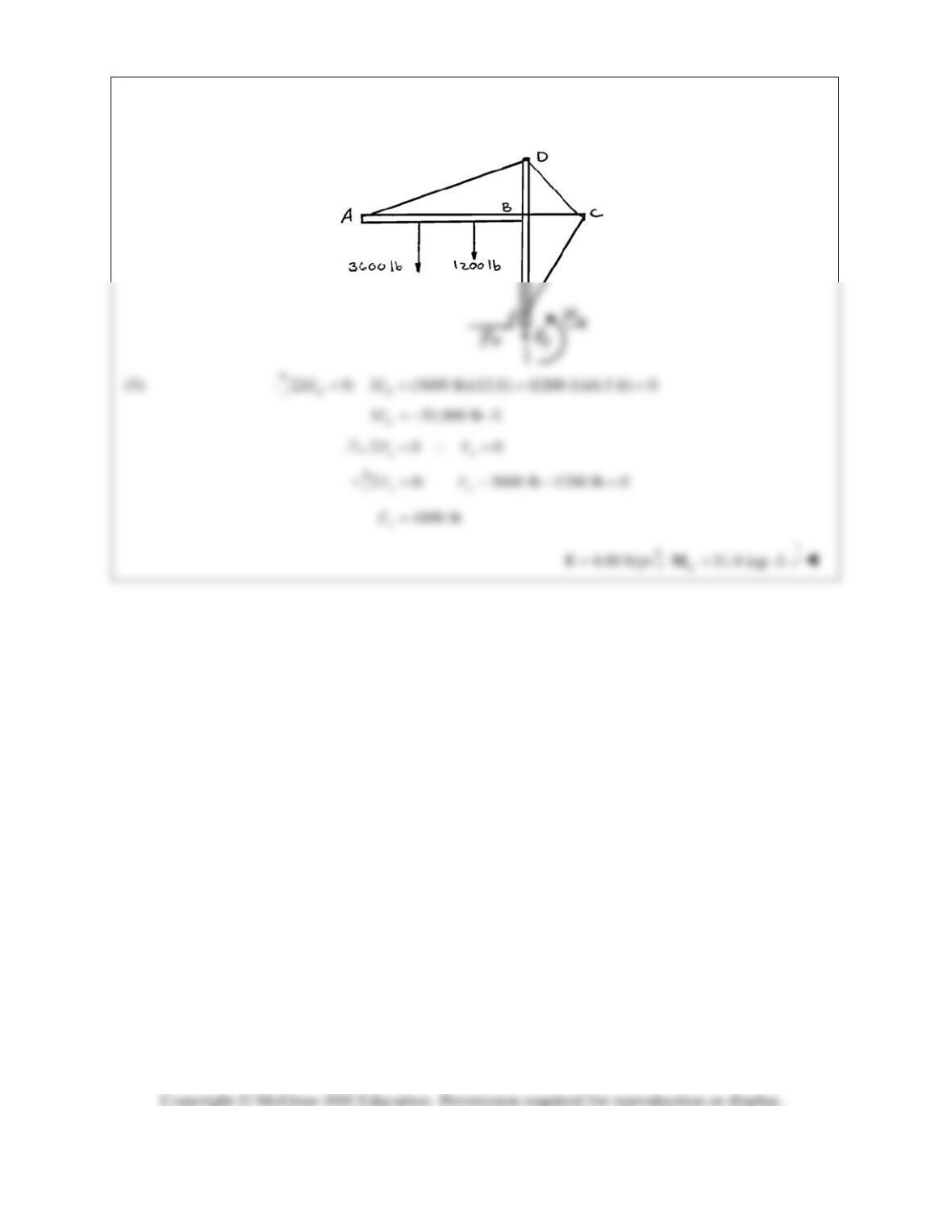
The rig shown consists of a 1200-lb horizontal member ABC
and a vertical member DBE welded together at B. The rig is
being used to raise a 3600-lb crate at a distance x 12 ft
from the vertical member DBE. If the tension in the cable is
4 kips, determine the reaction at E, assuming that the cable is
(a) anchored at F as shown in the figure, (b) attached to the
vertical member at a point located 1 ft above E.
SOLUTION
Free-Body Diagram:
PROBLEM 4.43 (Continued)
PROBLEM 4.44
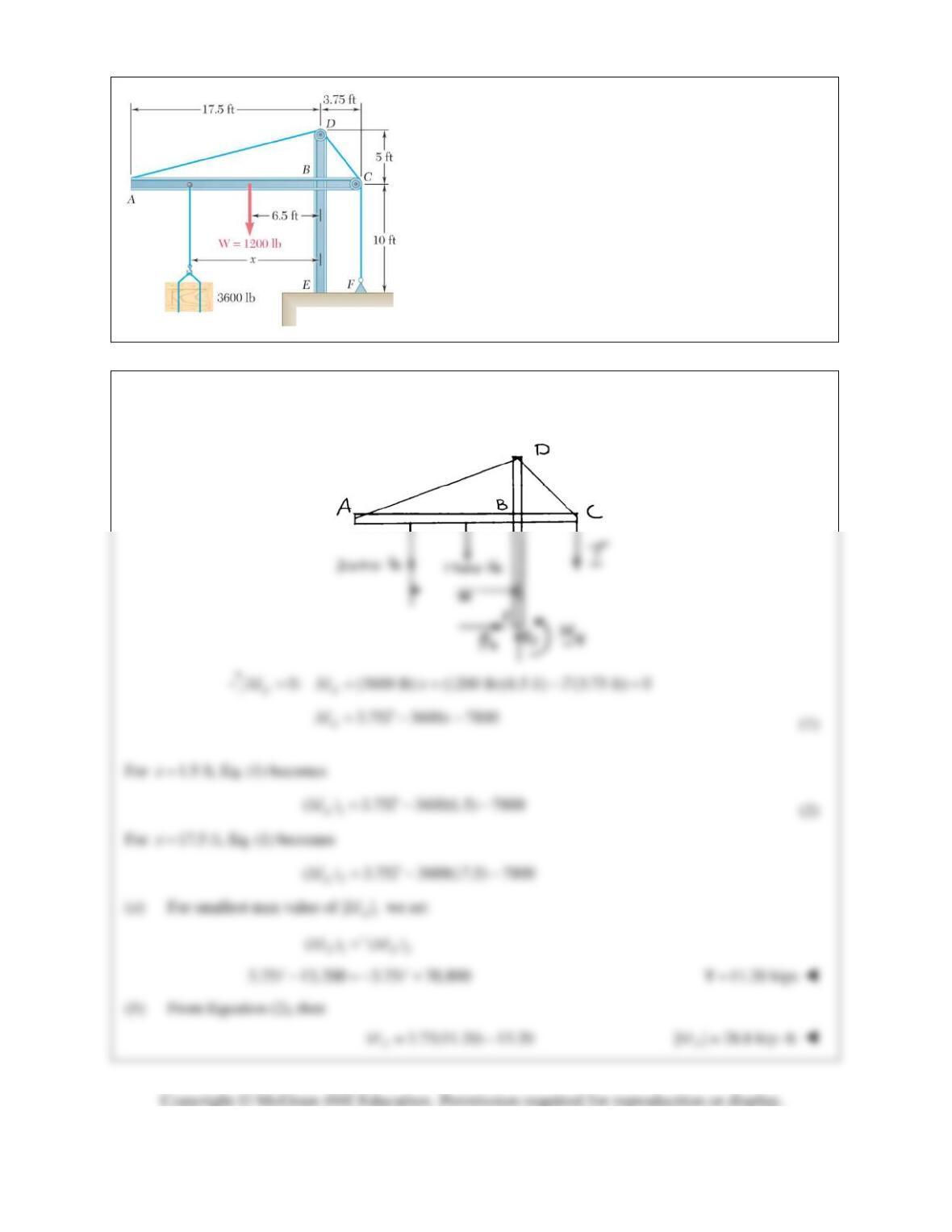
For the rig and crate of Prob. 4.43, and assuming that cable
is anchored at F as shown, determine (a) the required tension
in cable ADCF if the maximum value of the couple at E as x
varies from 1.5 to 17.5 ft is to be as small as possible, (b) the
corresponding maximum value of the couple.
SOLUTION
Free-Body Diagram:
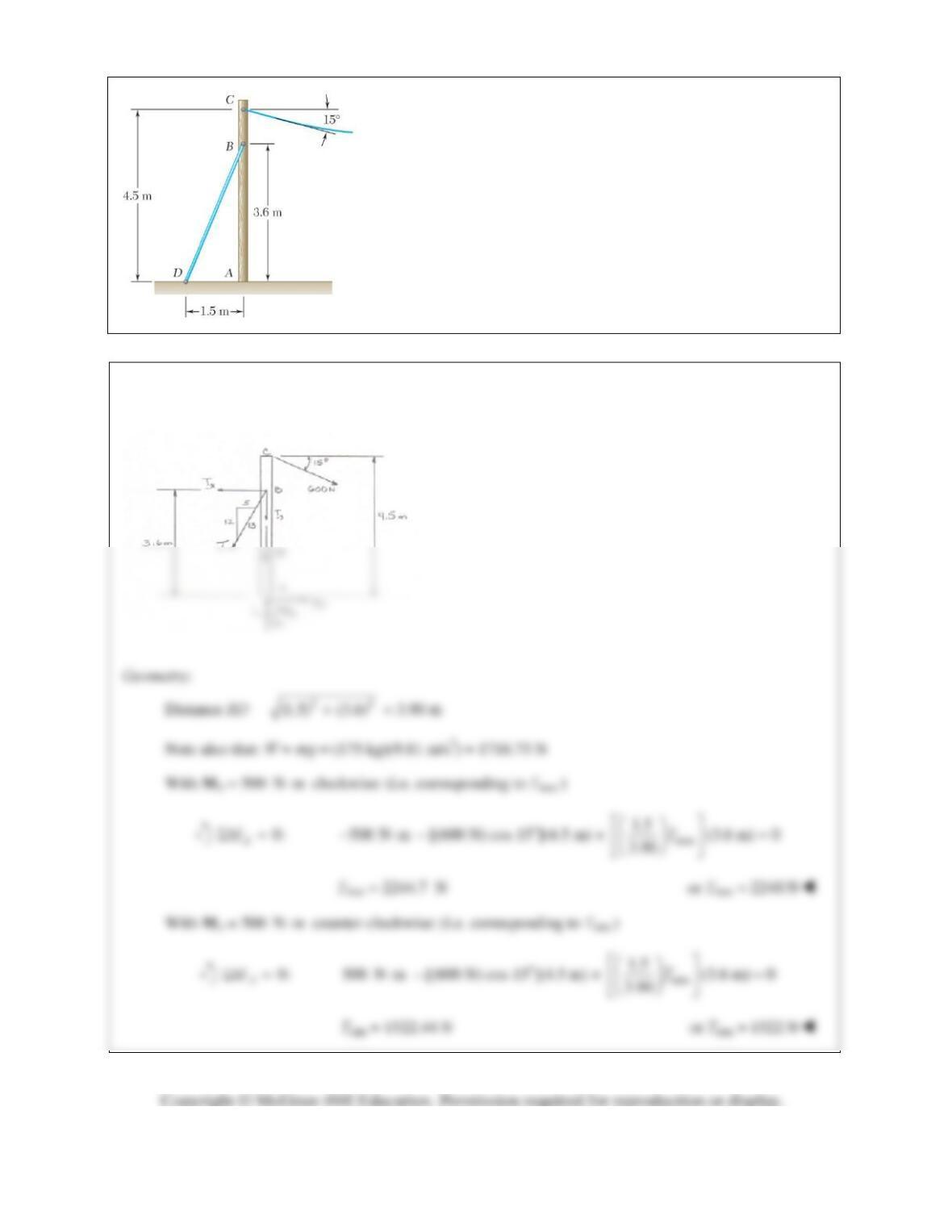
PROBLEM 4.45
A 175-kg utility pole is used to support at C the end of an electric
wire. The tension in the wire is 600 N, and the wire forms an angle
of 15° with the horizontal at C. Determine the largest and smallest
allowable tensions in the guy cable BD if the magnitude of the
couple at A may not exceed 500 N·m.
SOLUTION
Free-Body Diagram:
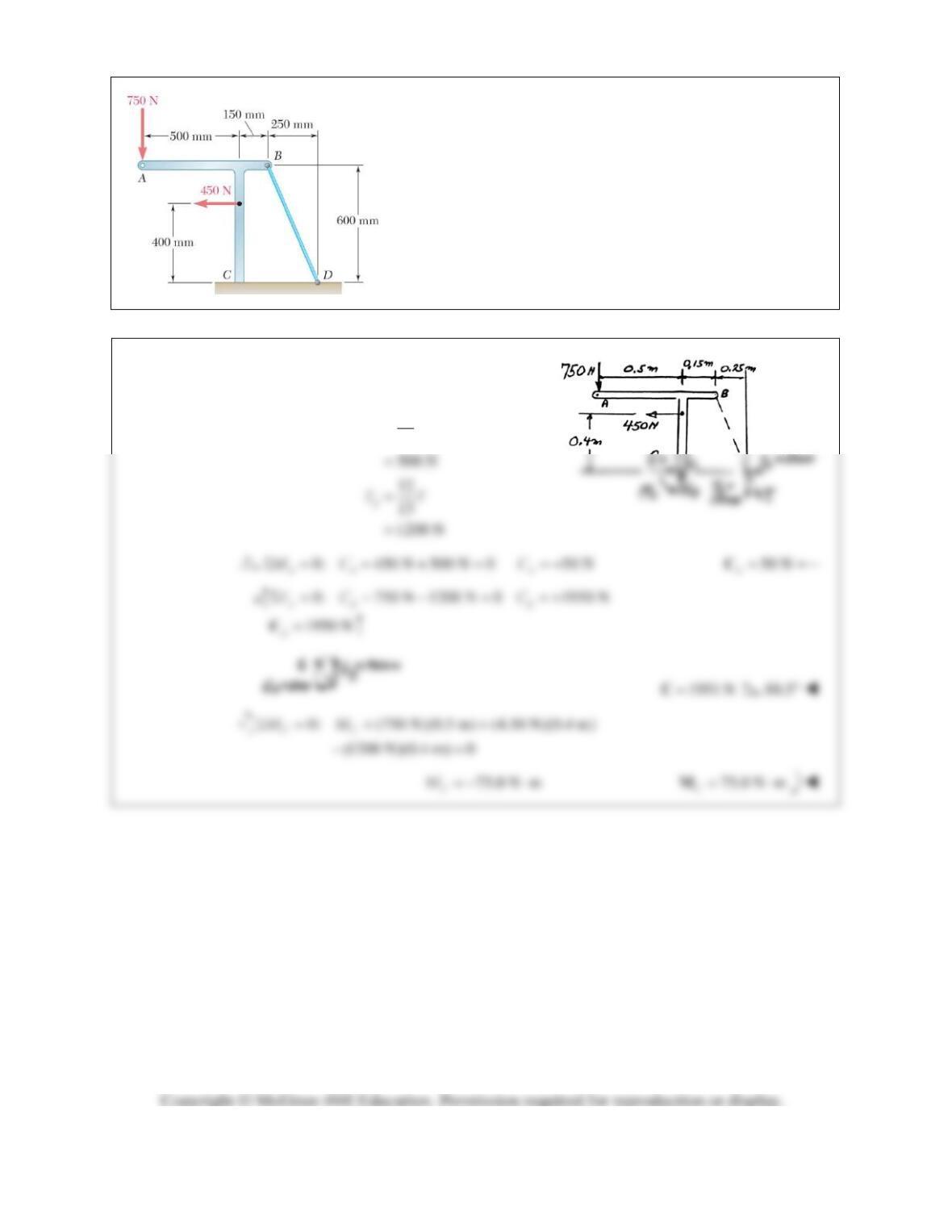
PROBLEM 4.46
Knowing that the tension in wire BD is 1300 N, determine the
reaction at the fixed support C of the frame shown.
SOLUTION
1300 N
5
13
x
T
TT
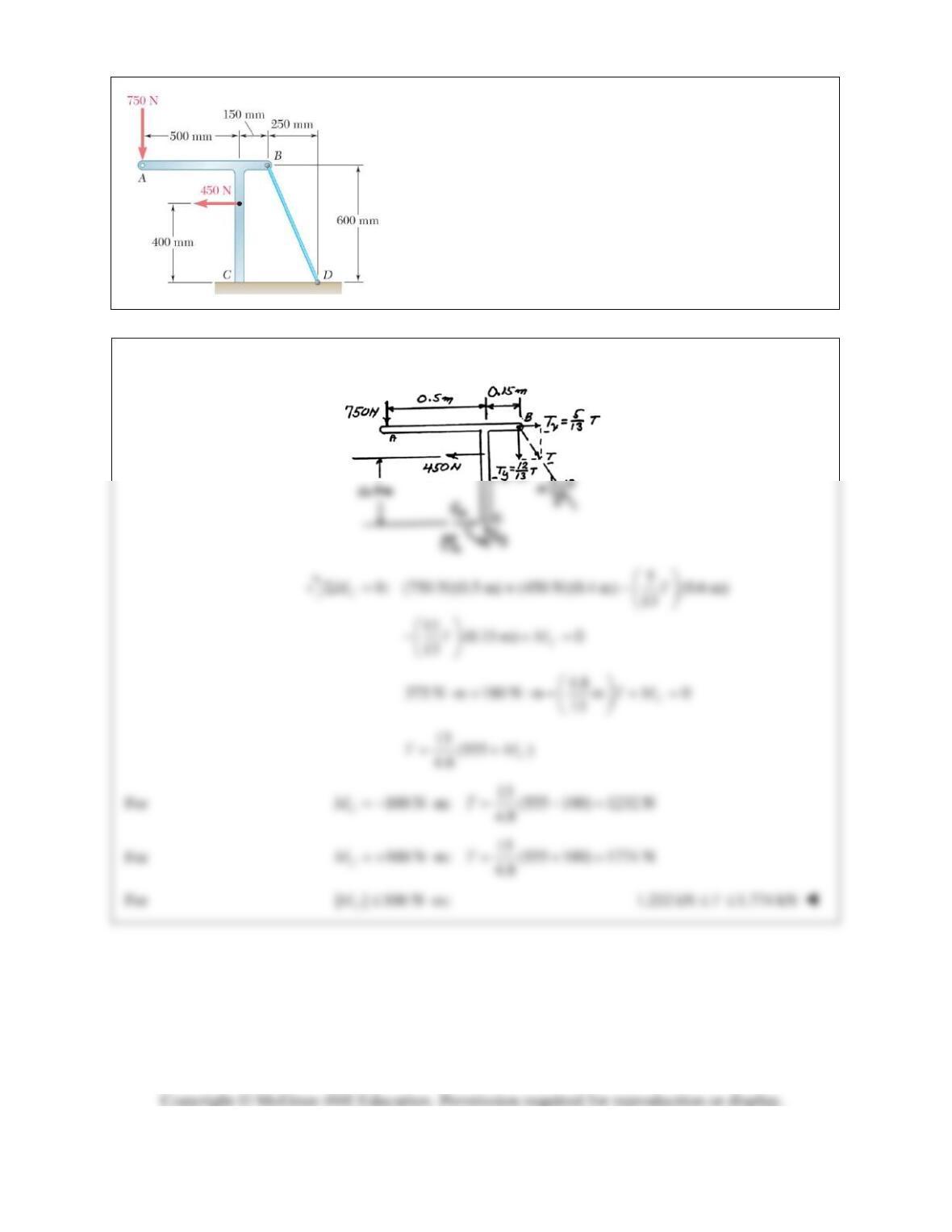
PROBLEM 4.47
Determine the range of allowable values of the tension in wire
BD if the magnitude of the couple at the fixed support C is not
to exceed
100 N · m.
SOLUTION
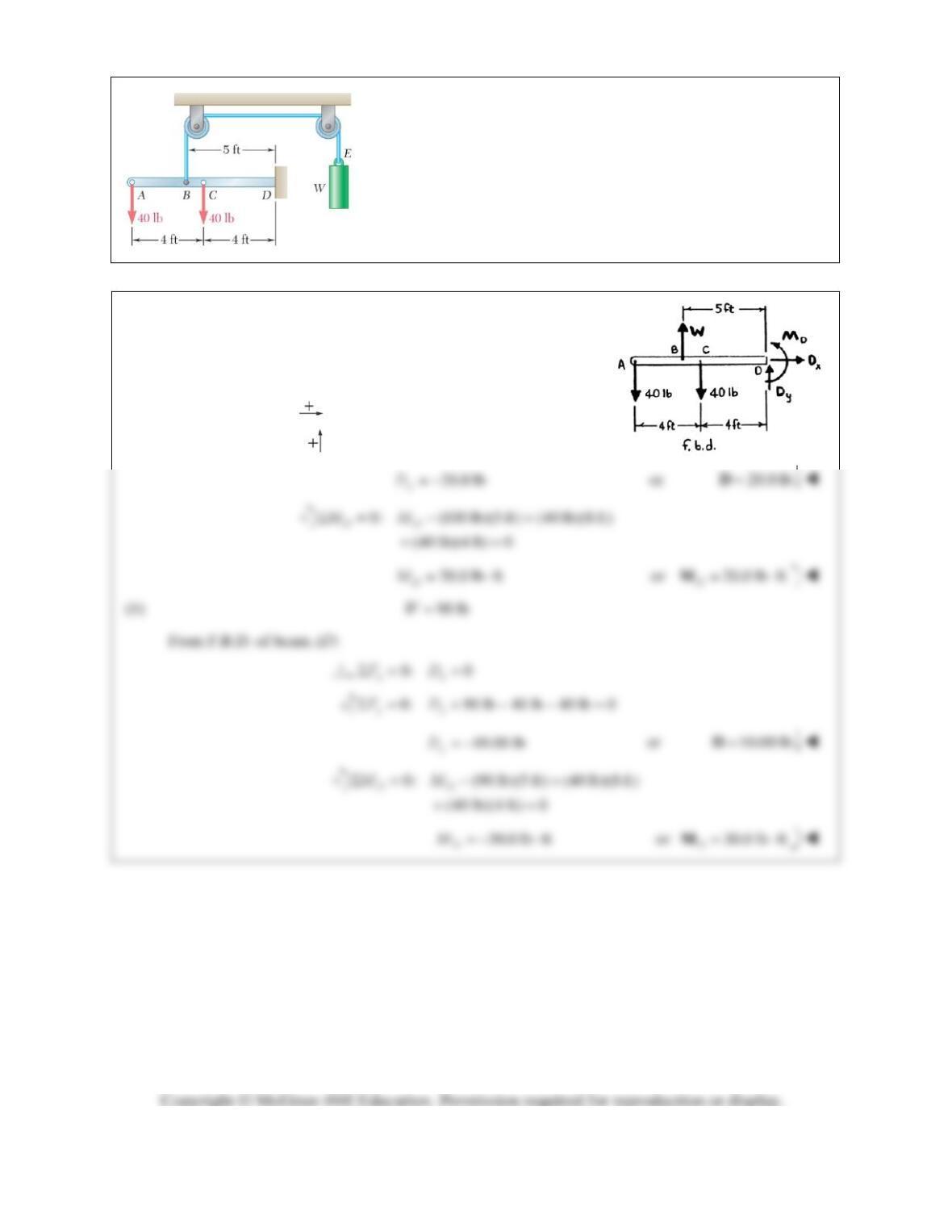
PROBLEM 4.48
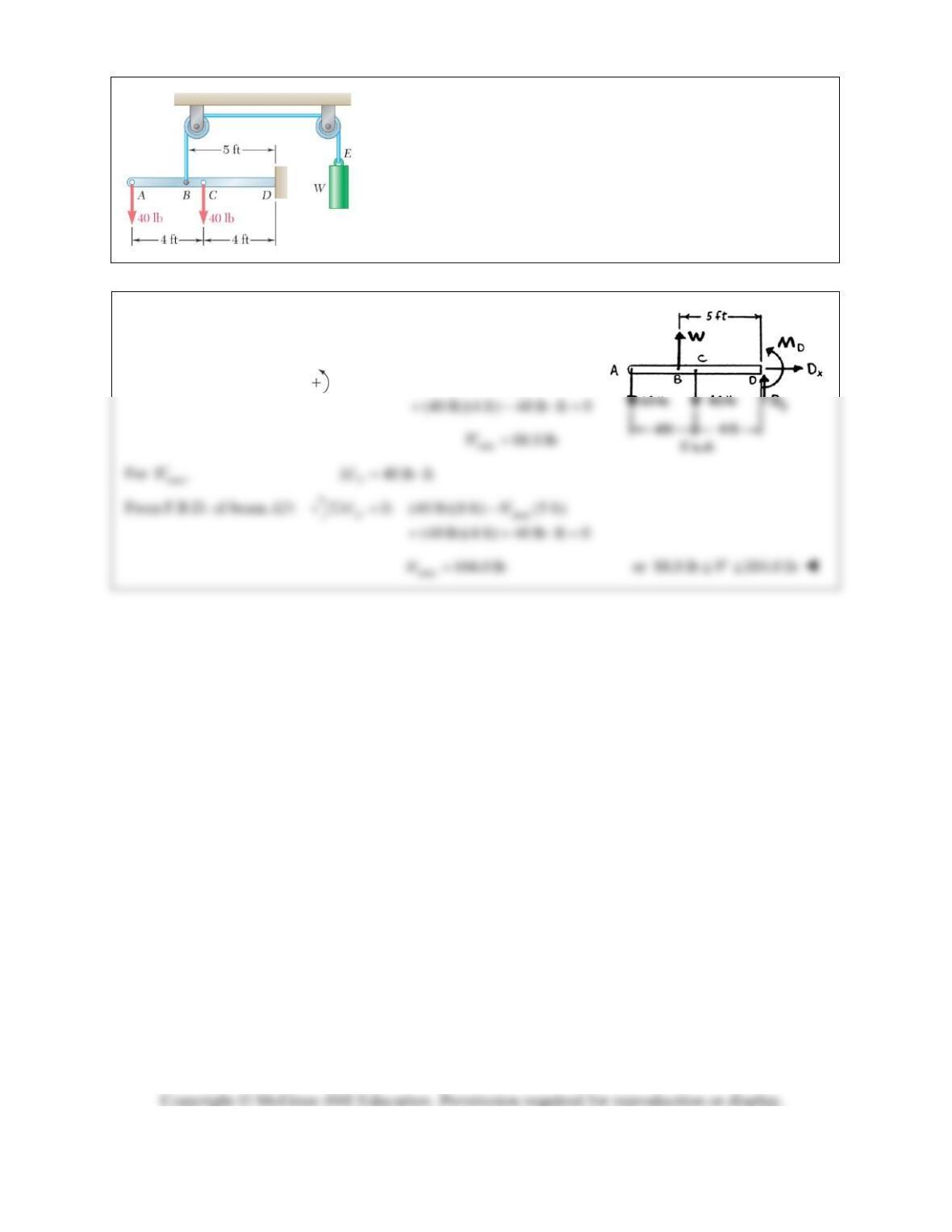
Beam AD carries the two 40-lb loads shown. The beam is held by a
fixed support at D and by the cable BE that is attached to the
counterweight W. Determine the reaction at D when (a) 100W
lb, (b)
90 lb.W
SOLUTION
(a) 100 lbW
From F.B.D. of beam AD:
0: 0
xx
FD
0: 40 lb 40 lb 100 lb 0
yy
FD
PROBLEM 4.49
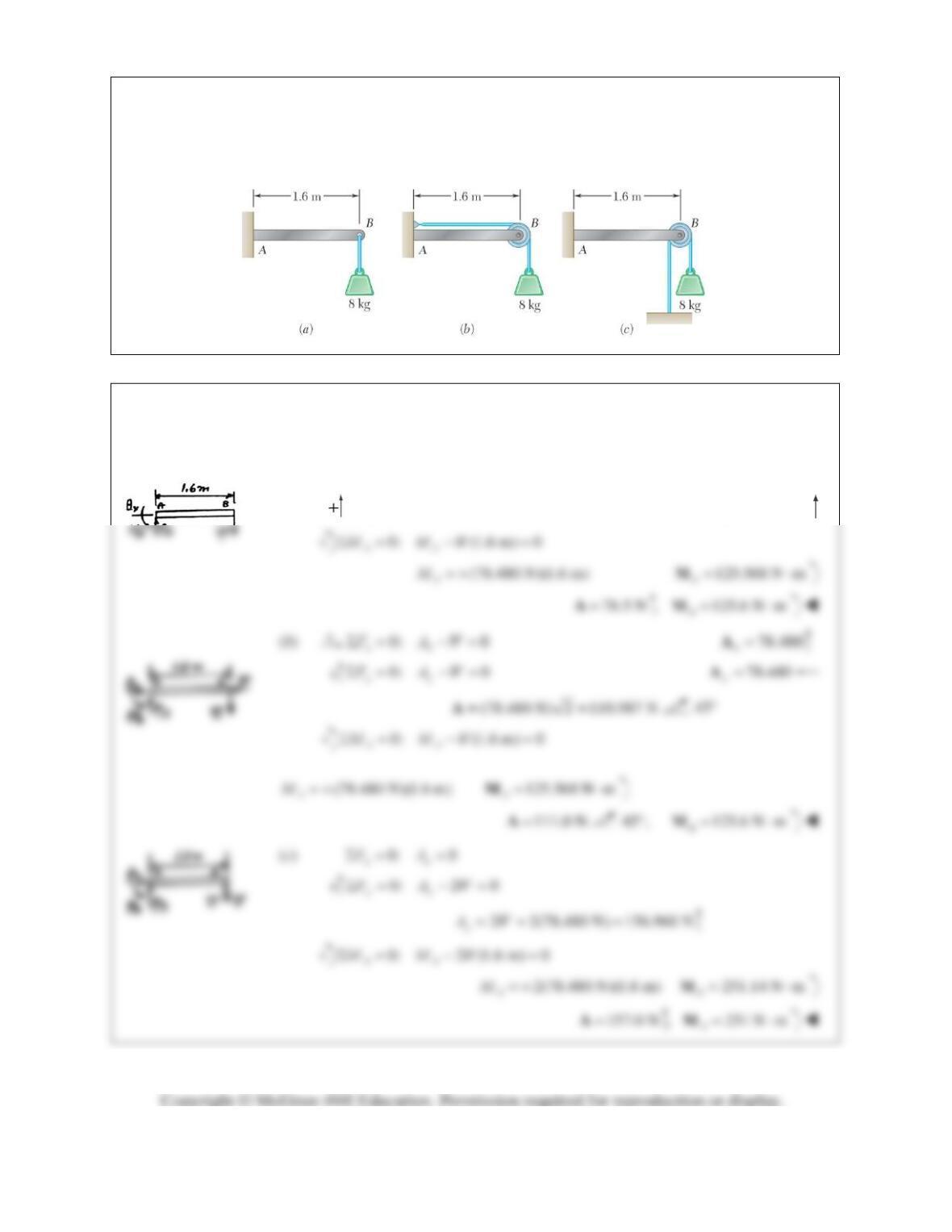
For the beam and loading shown, determine the range of values of
W for which the magnitude of the couple at D does not exceed 40
lb ft.
SOLUTION
For
min
,W
40 lb ft
D
M
From F.B.D. of beam AD: min
0: (40 lb)(8 ft) (5 ft)
D
MW
PROBLEM 4.50
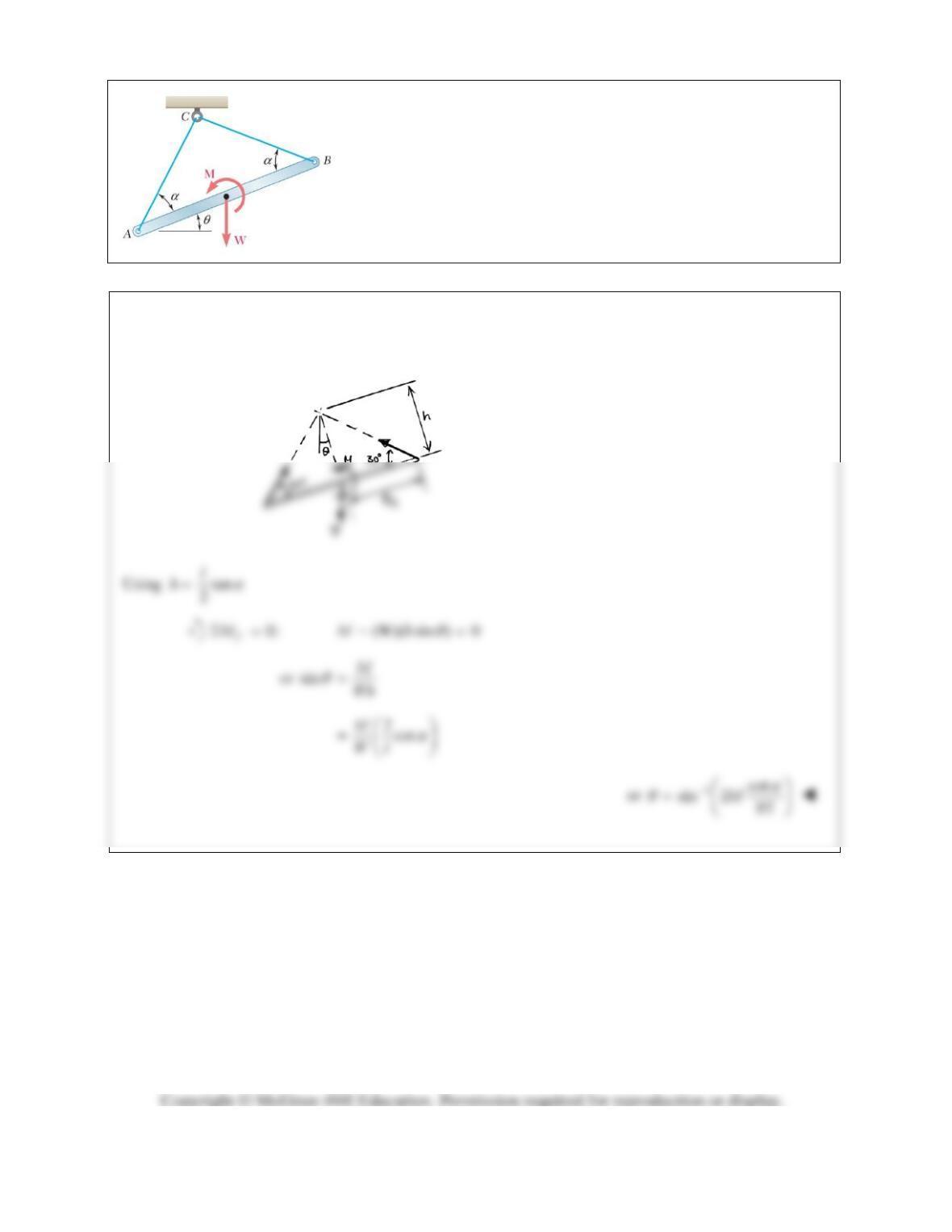
An 8-kg mass can be supported in the three different ways shown. Knowing that the pulleys have a
100-mm radius, determine the reaction at A in each case.
SOLUTION
2
(8 kg)(9.81 m/s ) 78.480 NWmg
(a)
0: 0
xx
FA
0: 0
yy
FAW
78.480 N
yA
PROBLEM 4.51
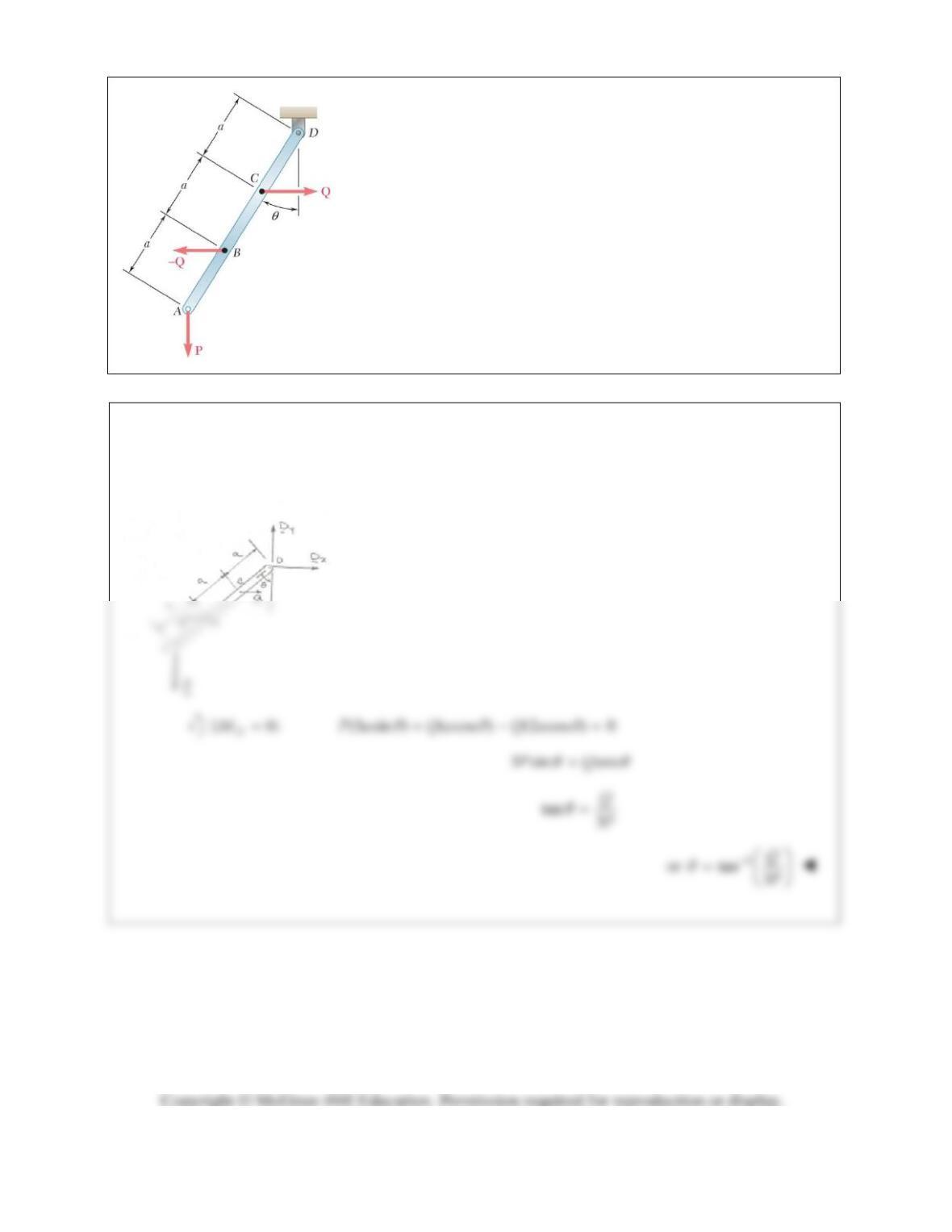
A uniform rod AB with a length of l and weight of W is suspended
from two cords AC and BC of equal length. Determine the angle θ
corresponding to the equilibrium position when a couple
M
is applied
to the rod.
SOLUTION
Free-Body Diagram:
PROBLEM 4.52
Rod AD is acted upon by a vertical force
P
at end A and by two equal
and opposite horizontal forces of magnitude Q at points B and C.
Neglecting the weight of the rod, express the angle
corresponding to
the equilibrium position in terms of P and Q.
SOLUTION
Free-Body Diagram: