Chap. 4 Soil Composition 4-15
The weathered tuff is the most well-graded soil because it has the flattest particle size
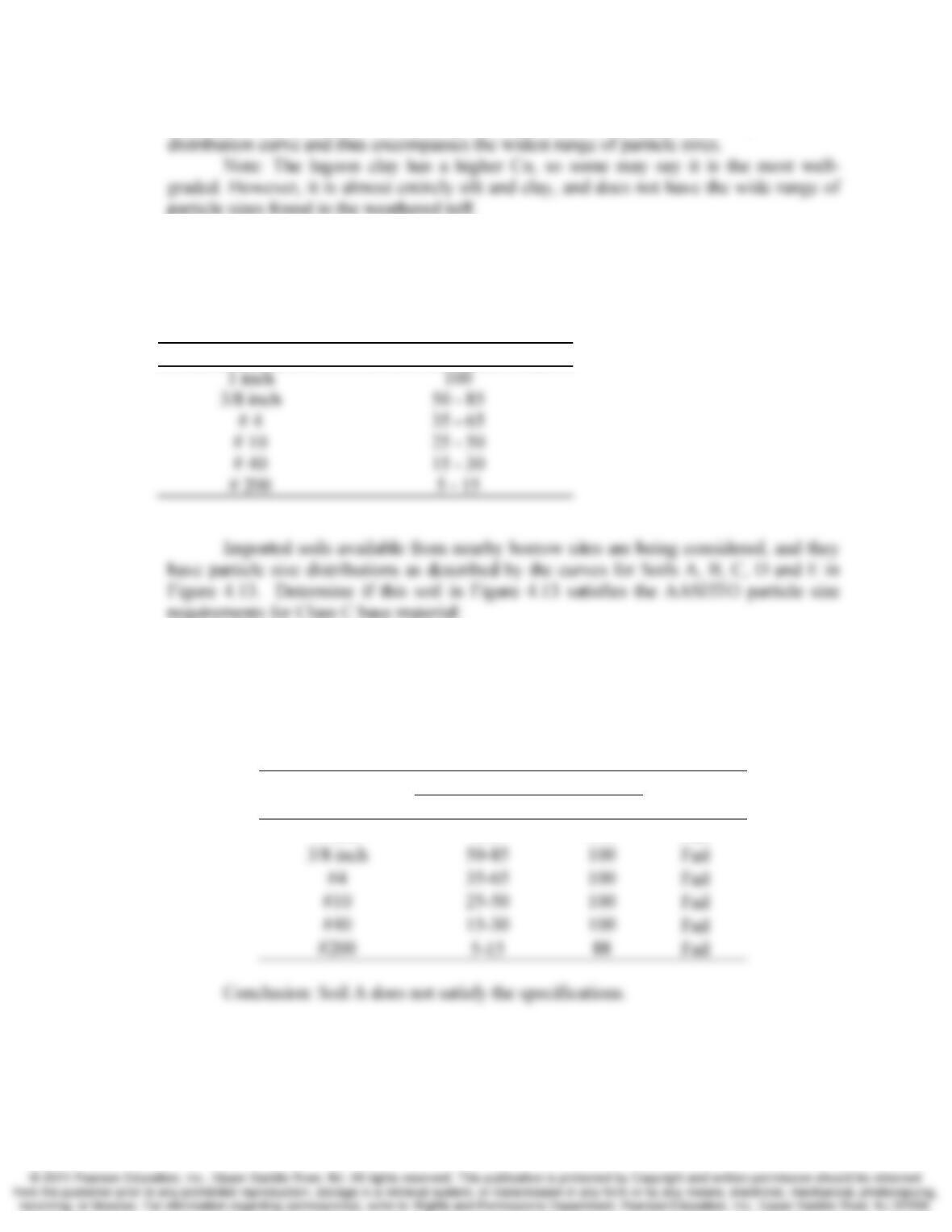
4.18 The American Association of State Highway and Transportation Officials (AASHTO)
has defined grading requirements for soils to be used as base courses under pavements
(AASHTO Designation M 147). The grading requirements for Class C base material are
as follows:
Sieve Designation Percent Passing by Weight
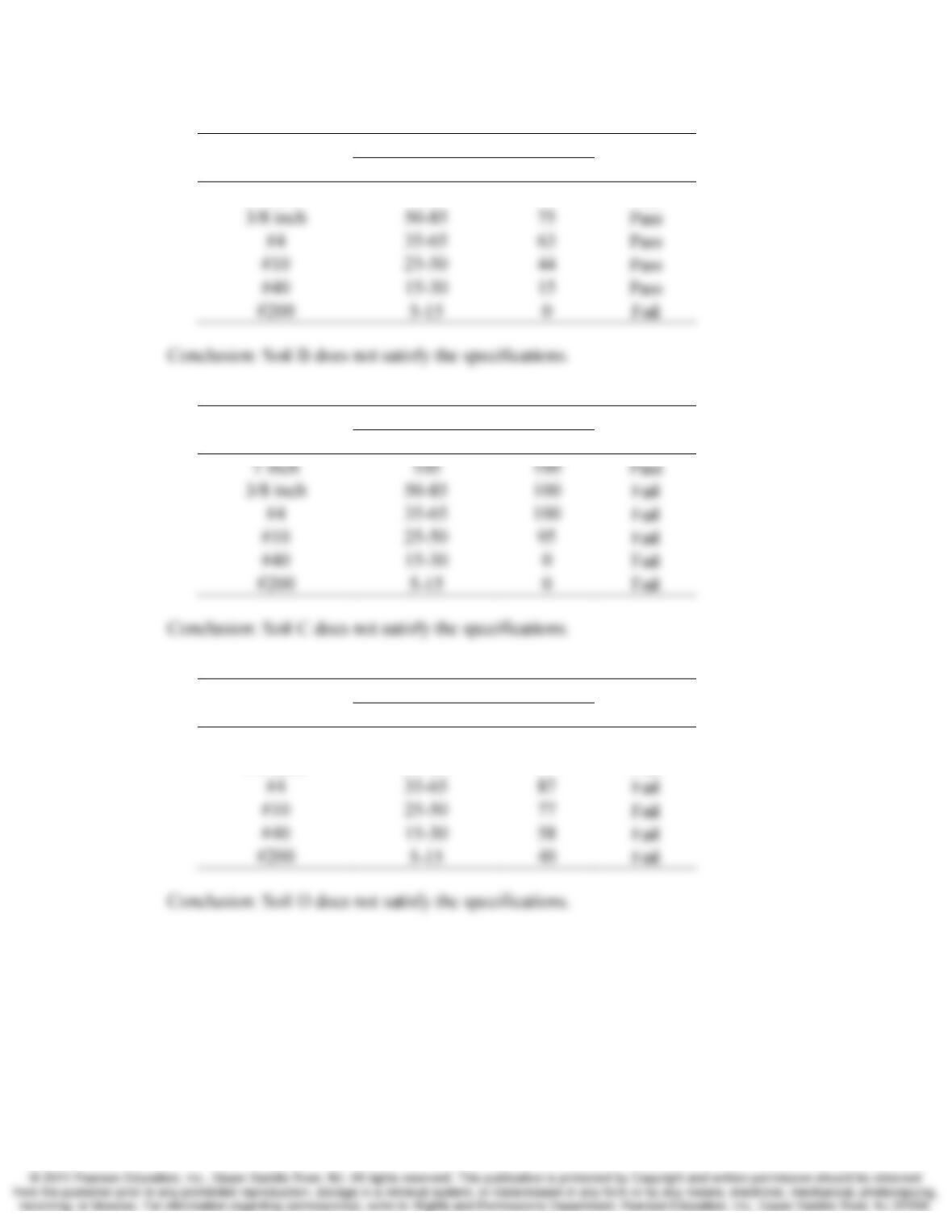
(a) Soil A.
(b) Soil B.
(c) Soil C.
(d) Soil D.
(e) Soil E.
a.
Sieve Designation Percent Passing by Weight Conclusion
Specification Soil A
1 inch 100 100 Fail
4-16 Soil Composition Chap. 4
b.
Sieve Designation Percent Passing by Weight Conclusion
Specification Soil B
1 inch 100 90 Fail
c.
Sieve Designation Percent Passing by Weight Conclusion
Specification Soil C
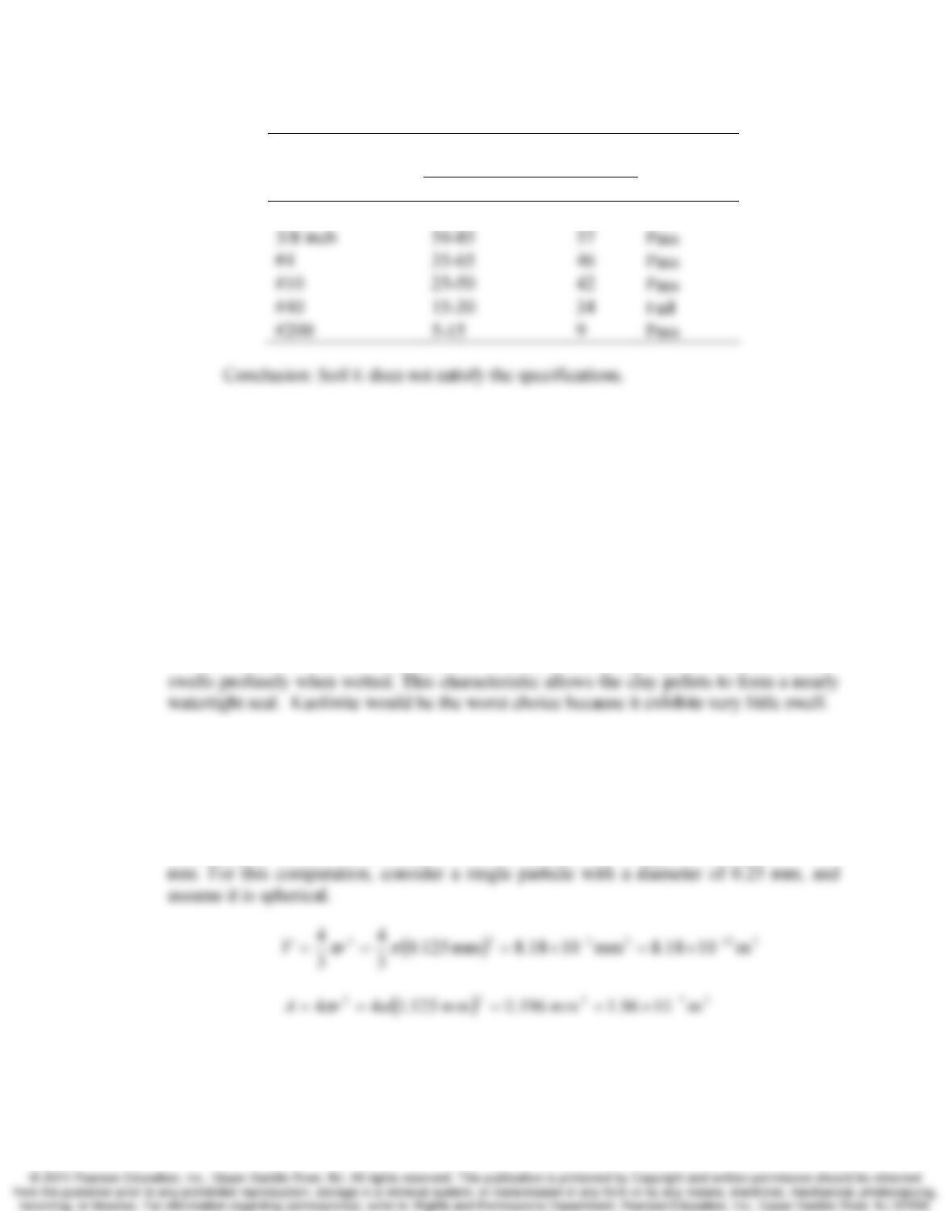
d.
Sieve Designation Percent Passing by Weight Conclusion
Specification Soil D
1 inch 100 99 Fail
3/8 inch 50-85 94 Fail
Chap. 4 Soil Composition 4-17
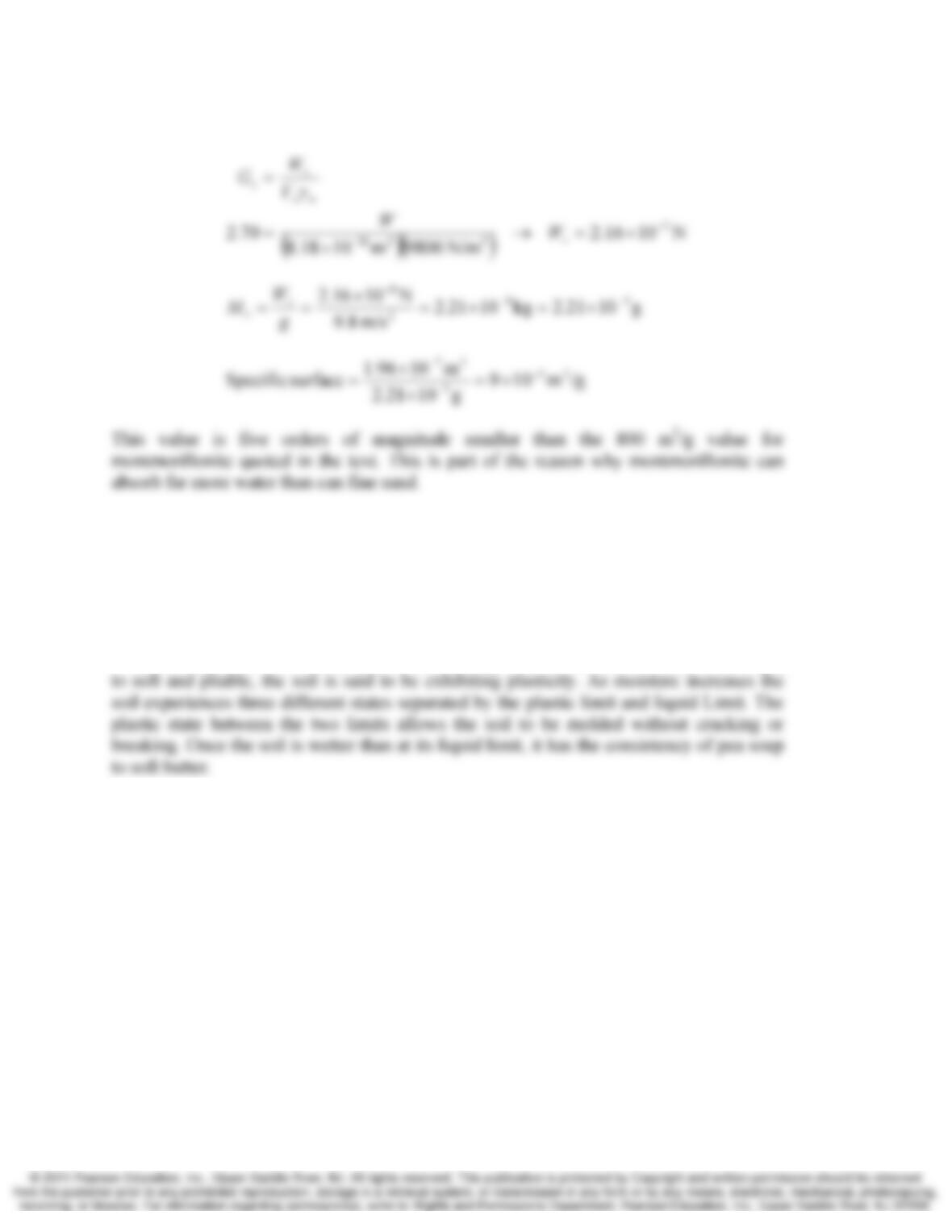
e.
Sieve Designation
Percent Passing by
Weight Conclusion
Specification Soil E
1 inch 100 95 Fail
Section 4.5 Clay Soils
4.19 Borings for observation wells, such as the one shown in Figure 3.21, are normally sealed
with an impervious cap near the ground surface. This cap prevents significant quantities
of surface water from seeping into the well. For convenience, manufacturers supply a
pelletized clay that has been dried and formed into 10 mm diameter balls. The driller
then pours these balls into the boring and adds water. As the clay absorbs the water, it
expands and seals the boring. What type of clay would be most appropriate for this
purpose? Why? Would other clays produce less satisfactory results? Why?
Solution
Montmorillonite is best for this because it has an extremely high specific surface and thus
4.20 Compute the specific surface (expressed in m2/g) for a typical fine sand. State any
assumptions, and compare your computed value with that quoted for montmorillonite
clay in Section 4.5. Discuss the significance of these two numbers.
Solution
According to Table 4.6, the diameter of fine sand particles ranges from 0.075 to 0.425
4-18 Soil Composition Chap. 4
Assume Gs=2.70
Section 4.6 Plasticity and the Atterberg Limits
4.21 Describe how the state and consistency of a very dry clay changes as water is added to it,
including its state and consistency at the liquid limit and the plastic limit.
Solution
When adding water to very dry clay the soil changes its consistency from hard and rigid
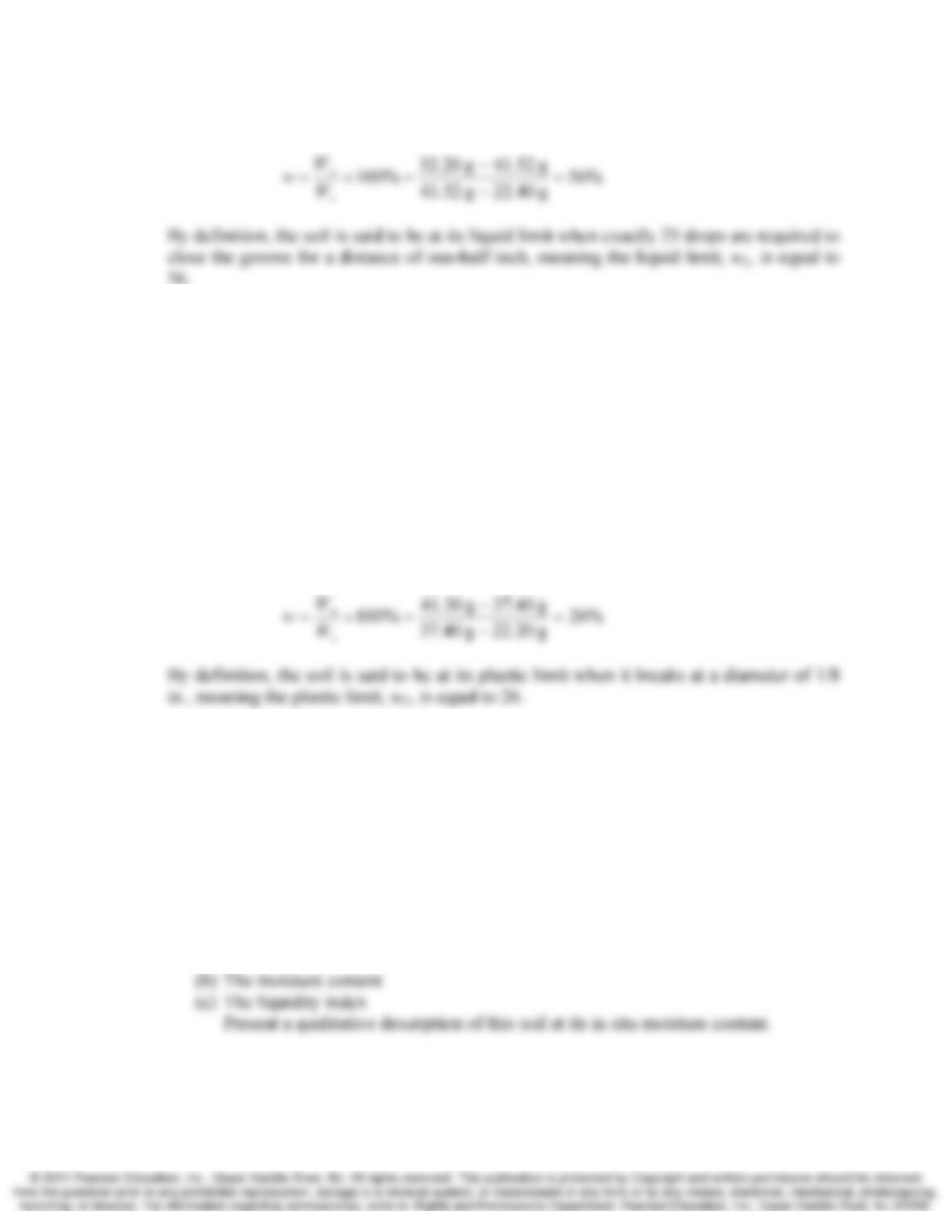
4.22 A liquid limit test has been performed on a soil using the Casagrande cup. In this test,
exactly 25 drops of the cup were required to close the bottom of the standard groove
along a longitudinal distance of 1/2 in. A moisture content test was then performed on
the tested soil and yielded the following results:
Mass of soil + can before placing in oven 52.20 g
Mass of soil + can after removal from oven 41.52 g
Mass of can 22.40 g
Based on this test only, compute the liquid limit of the soil.
Chap. 4 Soil Composition 4-19
Solution
56.
4.23 A plastic limit test has been performed on a soil. Threads of the soil that broke at a
diameter of 1/8 in. were collected for a moisture content test, which yield the following
results:
Mass of soil + can before placing in oven 41.30 g
Mass of soil + can after removal from oven 37.40 g
Mass of can 22.20 g
Compute the plastic limit of the soil.
Solution
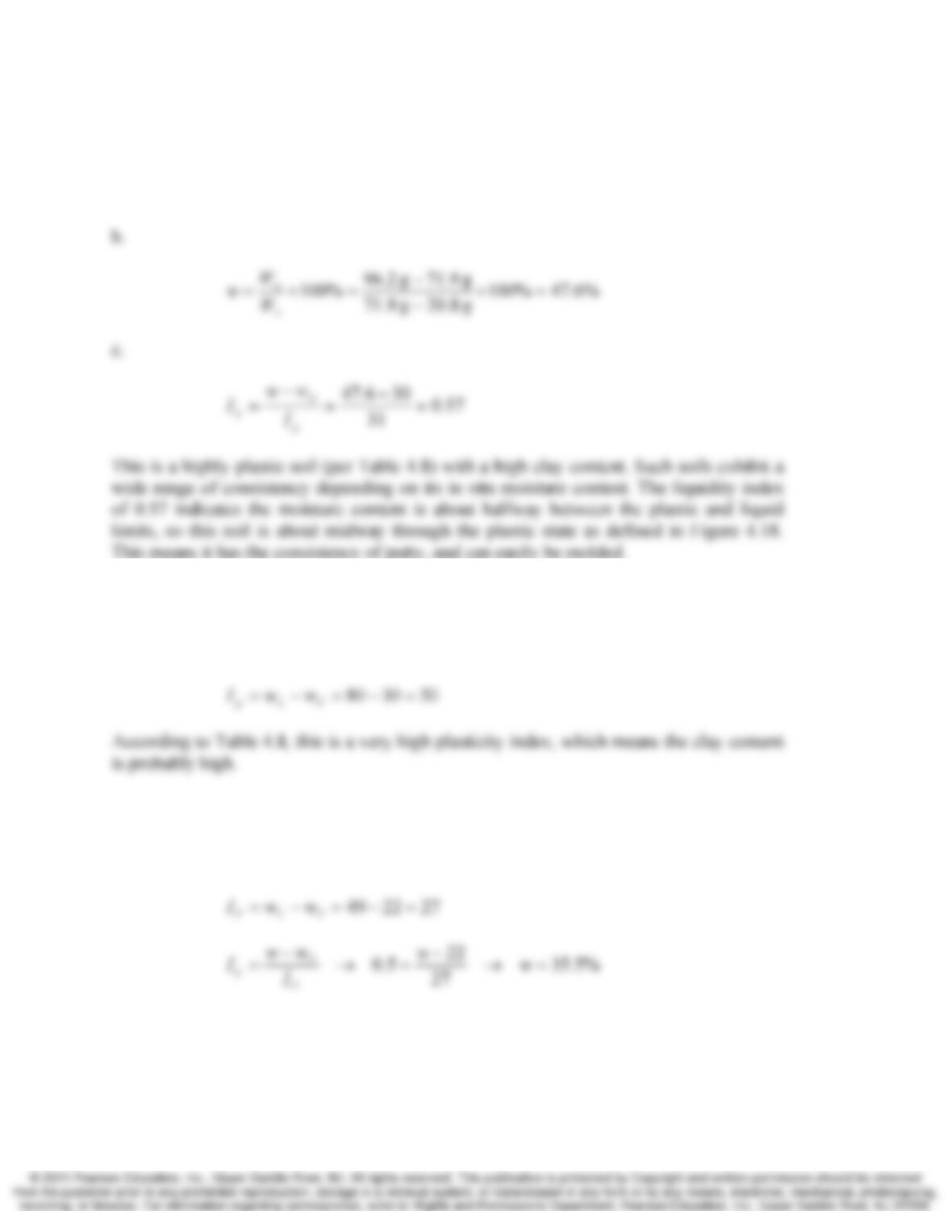
4.24 A soil has a liquid limit of 61 and a plastic limit of 30. A moisture content test performed
on an undisturbed sample of this soil yielded the following results:
Mass of soil + can before placing in oven 96.20 g
Mass of soil + can after removal from oven 71.90 g
Mass of can 20.80 g
Compute the following:
(a) The plasticity index
4-20 Soil Composition Chap. 4
Solution
a.
313061
=
−=−= pLp wwI
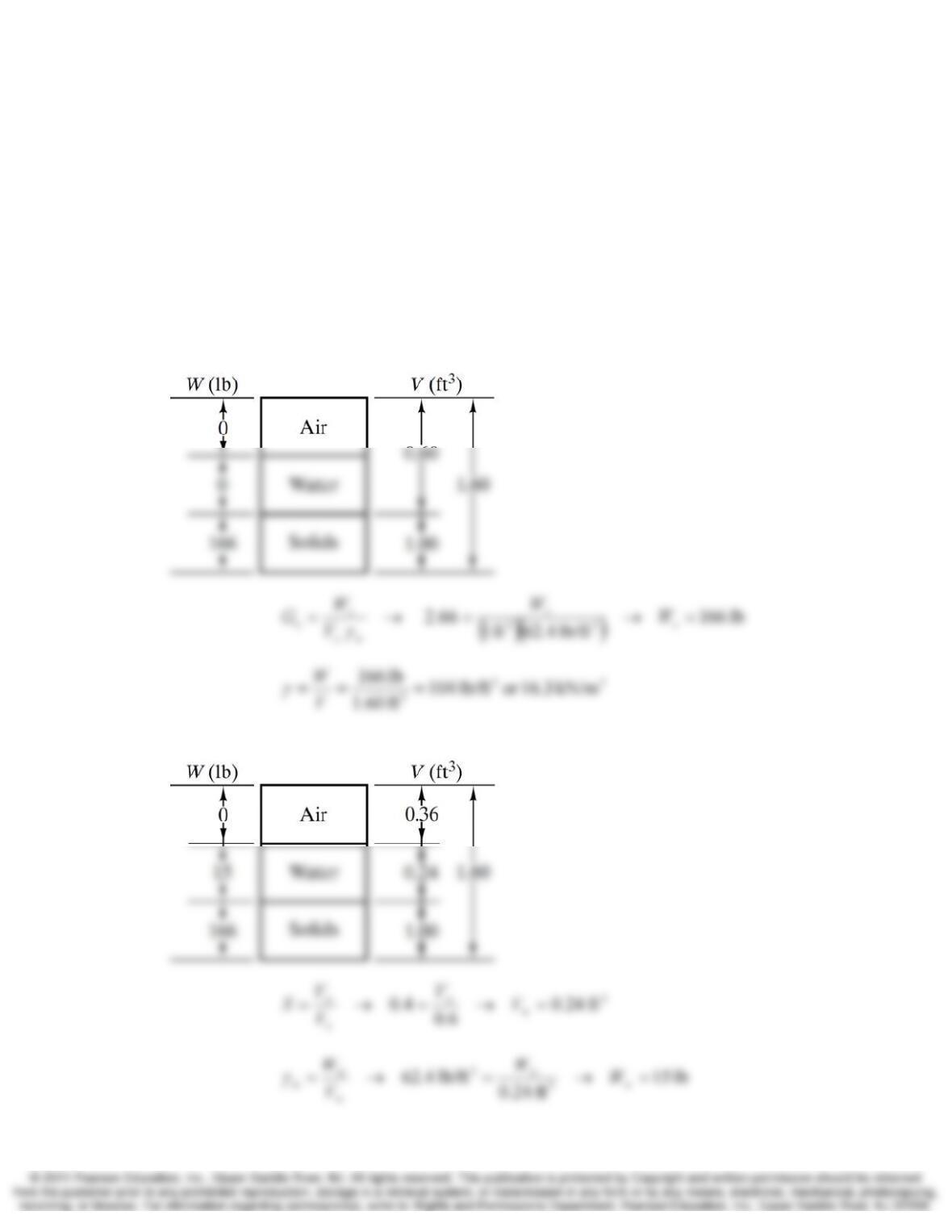
4.25 A soil has wP = 30 and wL = 80. Compute its plasticity index, and then describe the
probable clay content (i.e., small, moderate, or high).
Solution
=
4.26 A soil has wP = 22 and wL = 49. What moisture content corresponds to a liquidity index
of 0.5?
Solution
Chap. 4 Soil Composition 4-21
Comprehensive
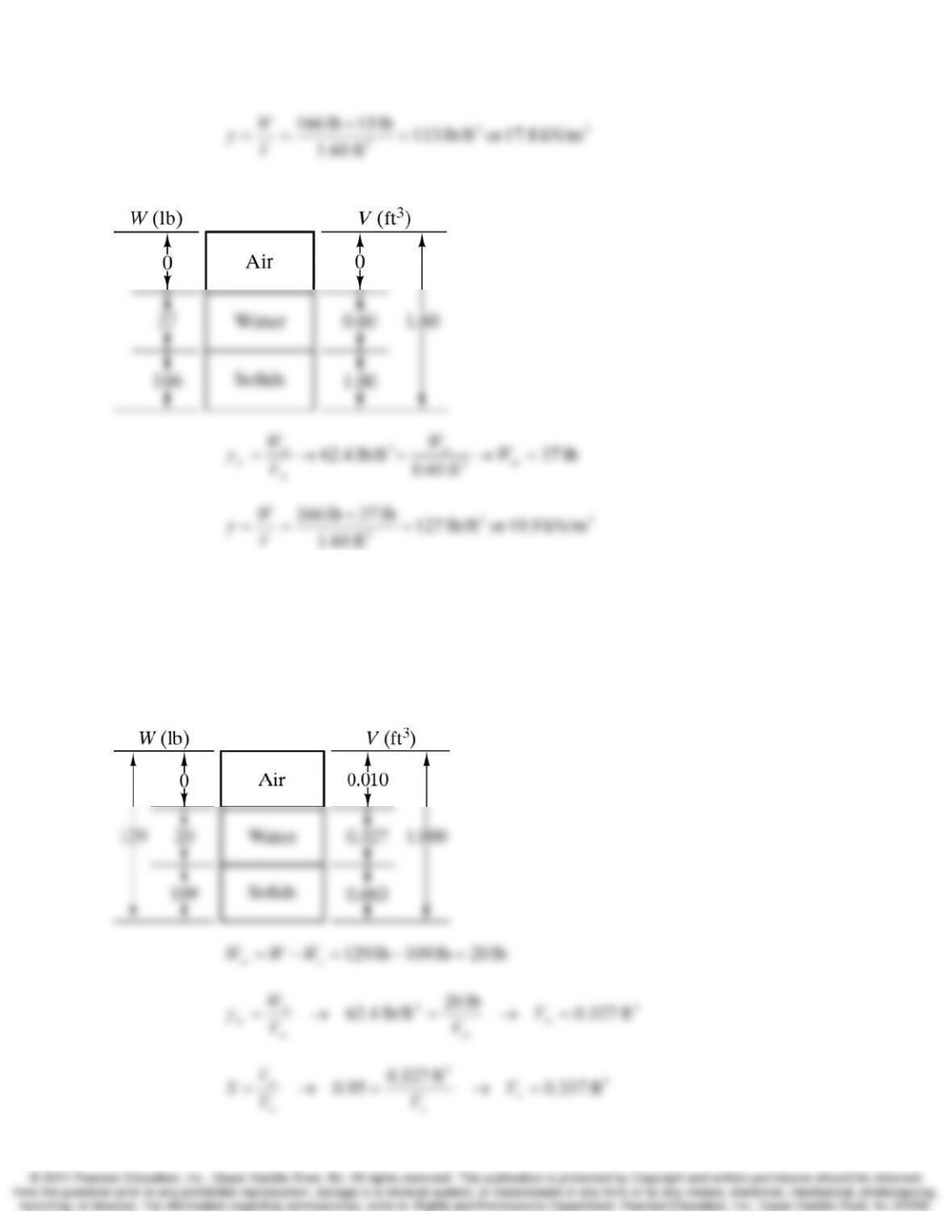
4.27 A sand with Gs = 2.66 and e = 0.60 is completely dry. It then becomes wetted by a rising
groundwater table. Compute the unit weight (lb/ft3 or kN/m3) under the following
conditions:
(a) When the sand is completely dry
(b) When the sand is 40% saturated (S = 40%)
(c) When the sand is completely saturated
Solution
a. Use phase diagram method with Vv=1
b.
4-22 Soil Composition Chap. 4
c.
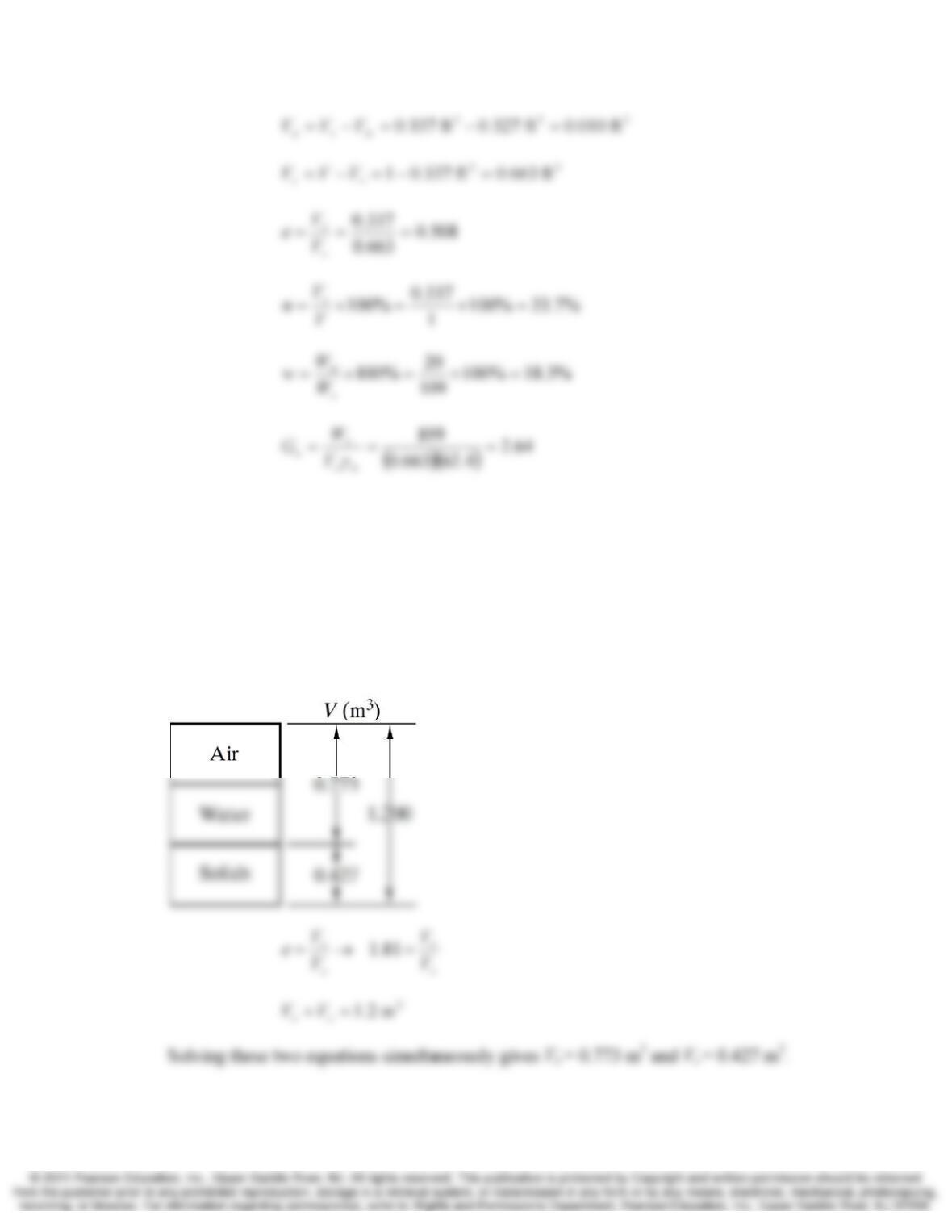
4.28 A soil initially has a degree of saturation of 95% and a unit weight of 129 lb/ft3. It is then
placed in an oven and dried. After removal from the oven, its unit weight is 109 lb/ft3.
Compute the void ratio, porosity, initial moisture content, and specific gravity of the soil,
assuming its volume did not change during the drying process.
Solution
Chap. 4 Soil Composition 4-23
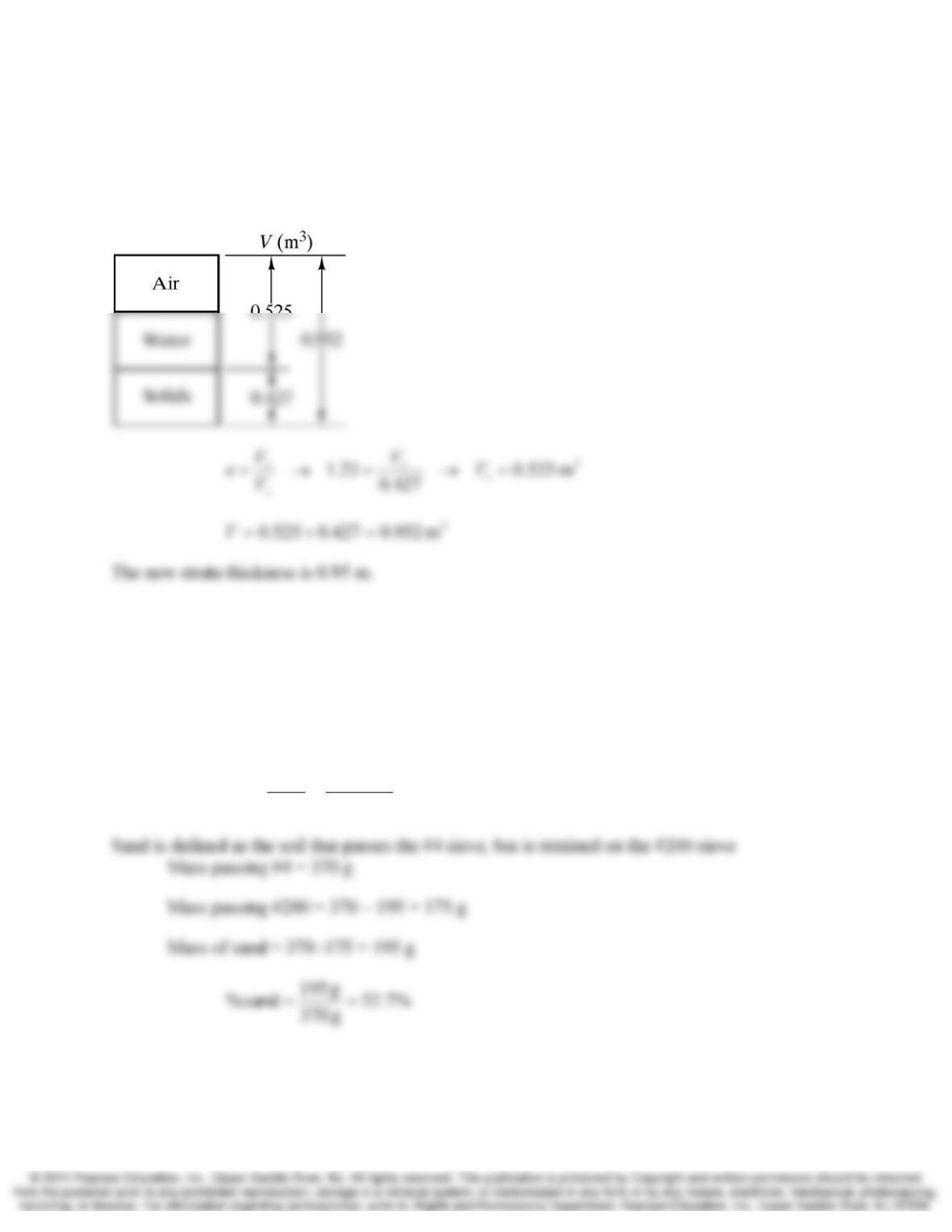
4.29 A 1.20 m thick strata of sand has a void ratio of 1.81. A contractor passes a vibratory
roller over this strata, which densifies it and reduces its void ratio to 1.23. Compute its
new thickness.
Solution
Consider a l m x 1 m column of soil
Initial condition
4-24 Soil Composition Chap. 4
Final Condition
The densification process reduces the volume of the voids. However, the volume of
solids remains constant.
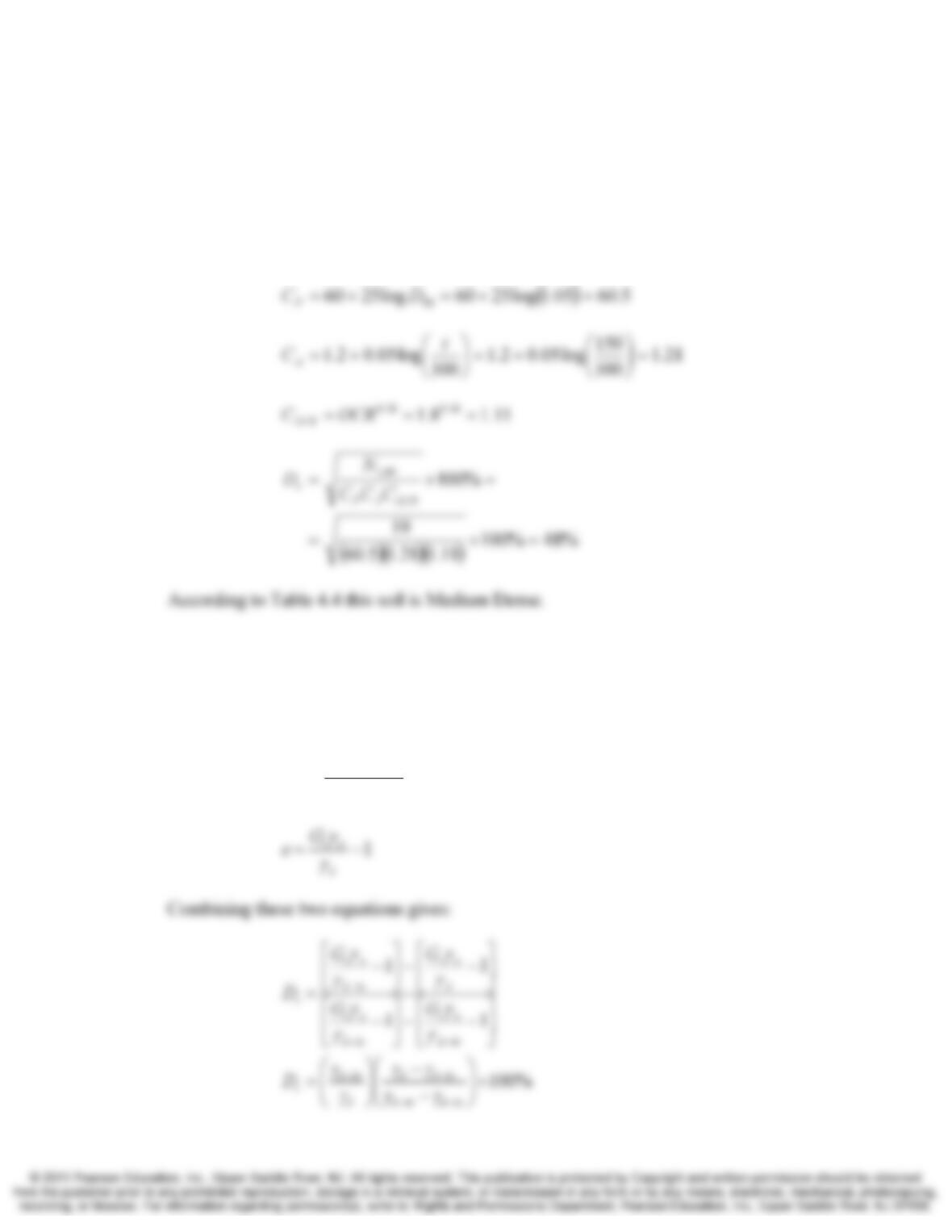
4.30 A 412-g sample of silty sand with a moisture content of 11.2% has been placed on a #200
sieve. The sample was then “washed” on the sieve, forcing the minus #200 particles to
pass through. The soil that remained on the sieve was then oven dried and found to have
a mass of 195 g. By visual inspection, it is obvious that all of this soil is smaller than the
#4 sieve. Compute the percent sand in the original sample.
Solution
g 370
0.1121
g 412
1=
+
=
+
=w
W
Ws
Chap. 4 Soil Composition 4-25
4.31 A standard penetration test has been performed on a soil, producing N1,60 = 19. A sieve
analysis was then performed on the sample obtained from the SPT sampler, producing
curve C in Figure 4.13. Assuming this soil is about 150 years old and has OCR = 1.8,
compute its relative density and determine its consistency.
Solution
Per Figure 4.13, D50=1.05 mm
4.32 Develop a formula for relative density as a function of γd, γd-hi, and γd-lo, where γd is the
dry unit weight in the field, γd-hi is the dry unit weight that corresponds to emin and γd–lo is
the dry unit weight that corresponds to emax.
Solution
%100
minmax
max ×
−
−
=ee
ee
Dr
4-26 Soil Composition Chap. 4
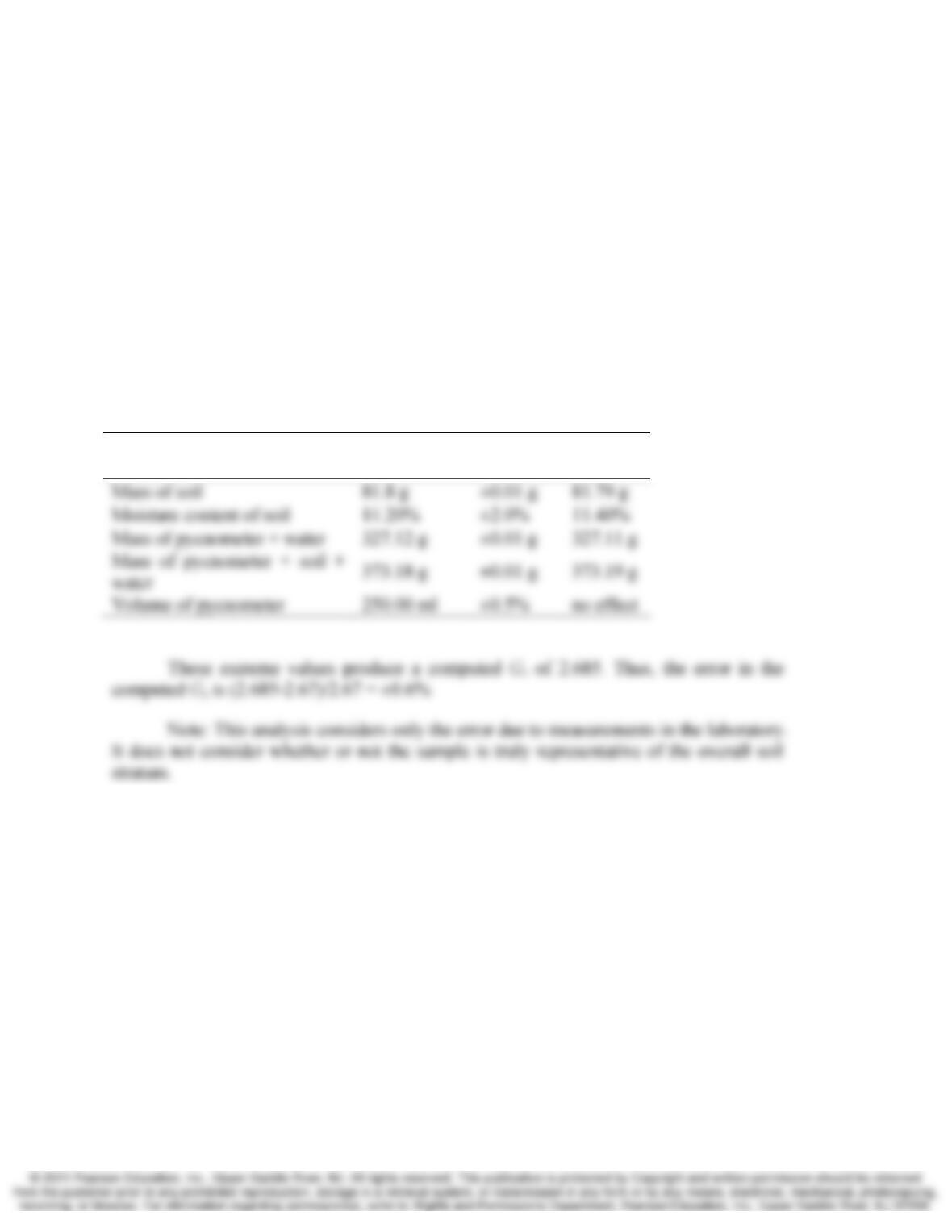
4.33 All masses for the specific gravity test described in Example 4.5 were determined using a
balance with a precision of ±0.01 g. The volume of the pycnometer is accurate to within
±0.5%, and the moisture content measurement is accurate to within ±2.0% (i.e., the real w
could be as low as 11.0% or as high as 11.4%). Assuming all measurement errors are
random, determine the precision of the computed Gs value.
Hint: All errors are random, so the worst case would be if none of the errors were
compensating (i.e., each measurement had the maximum possible error, and each
contributed to making the computed Gs farther from its true value). Therefore, compute
the highest possible value of Gs that is consistent with the stated uncertainties, then
compare it with the Gs obtained in Example 4.5.
Solution
Assess each measurement and determine which value would produce the largest
computed Gs
Measurement Measured
Value Precision Extreme
Value
4.34 A 10,000 ft3 mass of saturated clay had a void ratio of 0.962 and a specific gravity of
solids of 2.71. A fill was then placed over this clay, causing it to compress. This
compression is called consolidation, a topic we will discuss in Chapters 10 and 11.
During this process, some of the water was squeezed out of the voids. However, the
volume of the solids remained unchanged. After the consolidation was complete, the
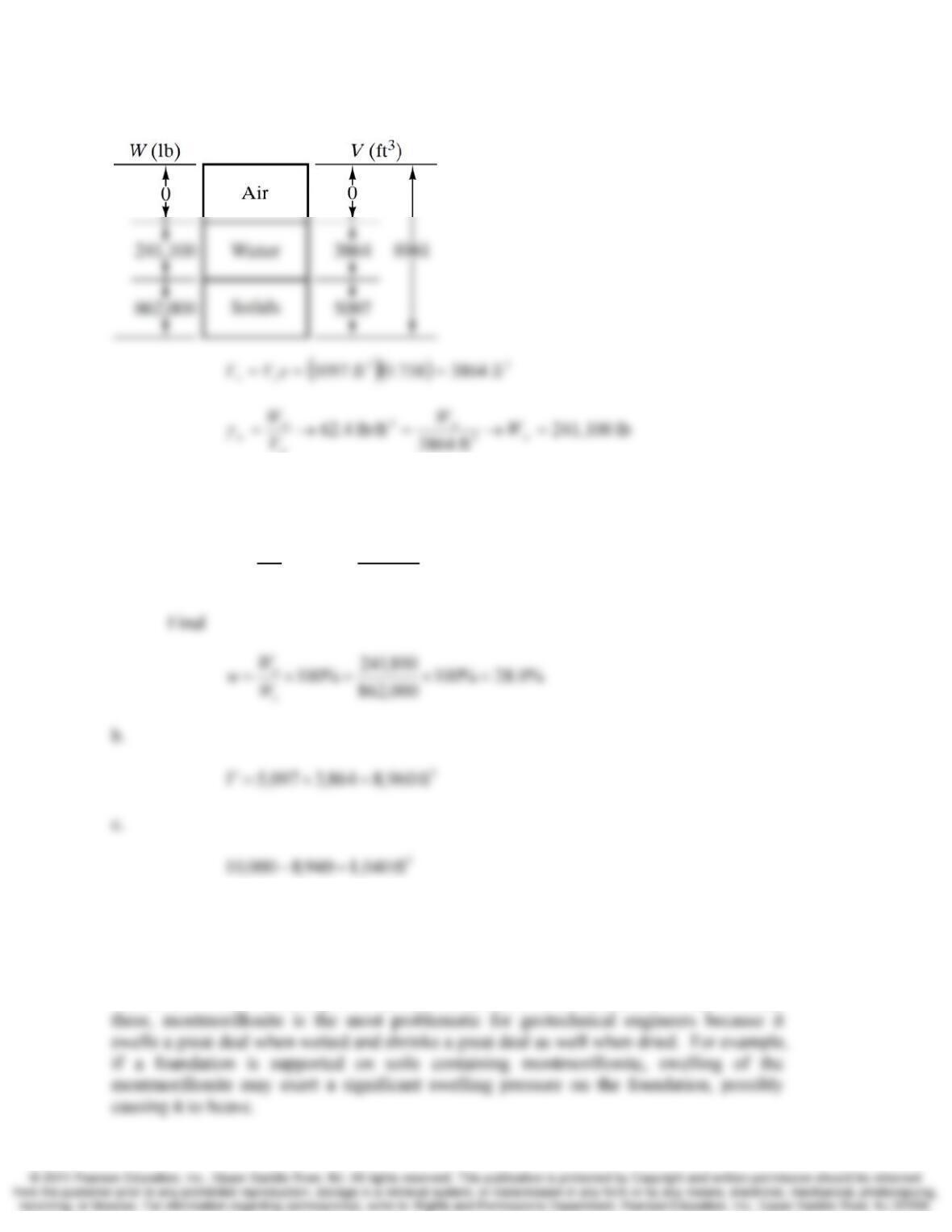
void ratio had become 0.758.
(a) Compute the initial and final moisture content of the clay.
(b) Compute the new volume of the clay.
(c) Compute the volume of water squeezed out of the clay.
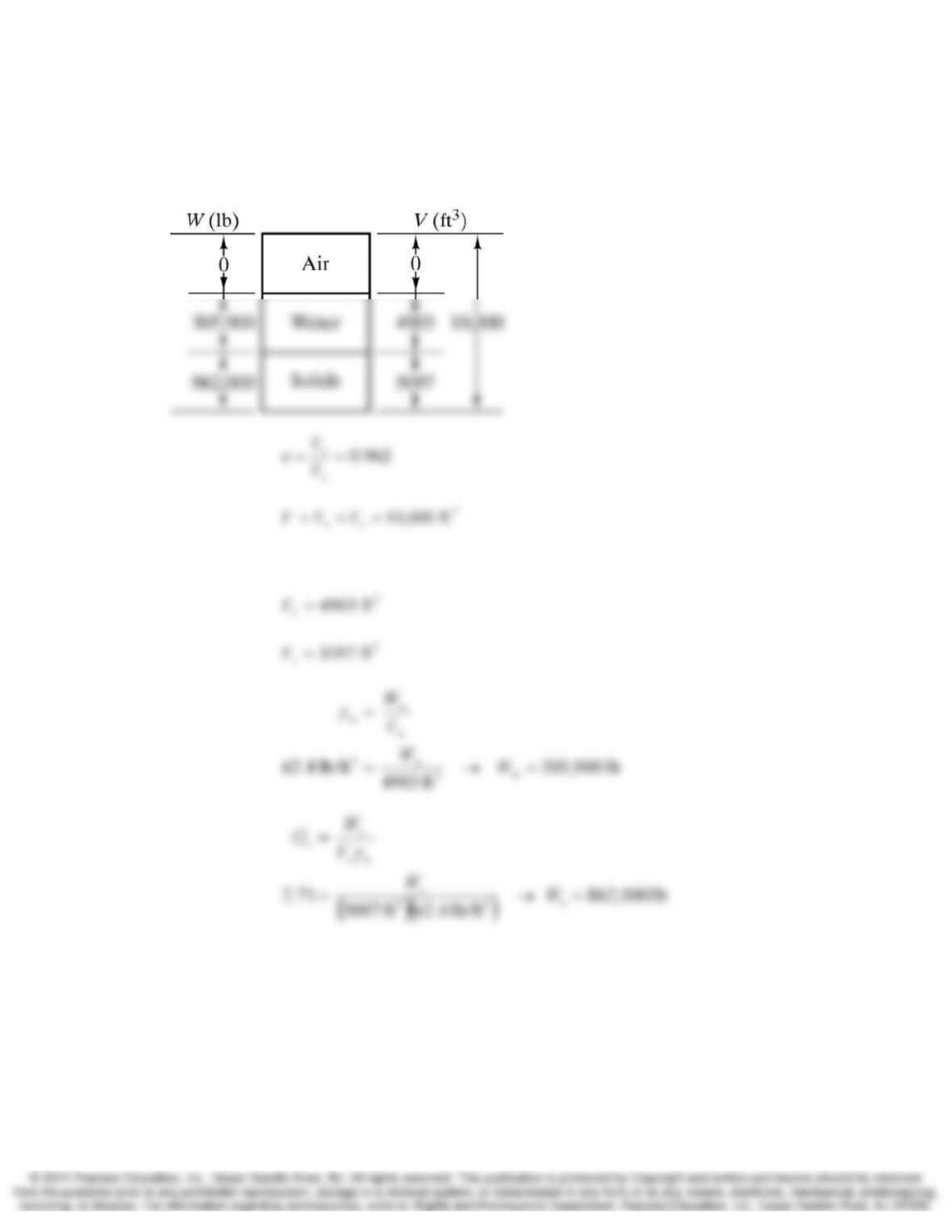
Chap. 4 Soil Composition 4-27
Solution
Initial Condition
Solving these two equations simultaneously gives
4-28 Soil Composition Chap. 4
Final Condition
w
a.
Initial
35.5%%100
000,862
900,305
%100 =×=×=
s
w
W
W
w
4.35 What are the three most common clay minerals? Which one usually causes the most
problems for geotechnical engineers? Why?
Solution
The three most common clay minerals are kaolinite, illite, and montmorillonite, Of these