27-1
Petersen Pottery
Teaching Commentary
OVERVIEW
This case on standard costs and variance analysis appears deceptively straightforward with a casual reading. Actually, it
is an “iceberg” case—many layers deep with most of the content lurking below the surface.
The case illustrates the calculation of standard costs in a fairly simple manufacturing setting—one product with
two linked manufacturing processes. It also involves practice in variance calculations for both prime costs and
manufacturing overhead. Beyond the calculations is the idea of tying together the variances into a coherent story about
operations for the period being studied. And beyond the “story” is the question of whether standard costing is even
appropriate for this business at all. What management controls seem appropriate, and is cost control via standards and
variances one of them?
ANSWERS TO ASSIGNMENT QUESTIONS
Question 1
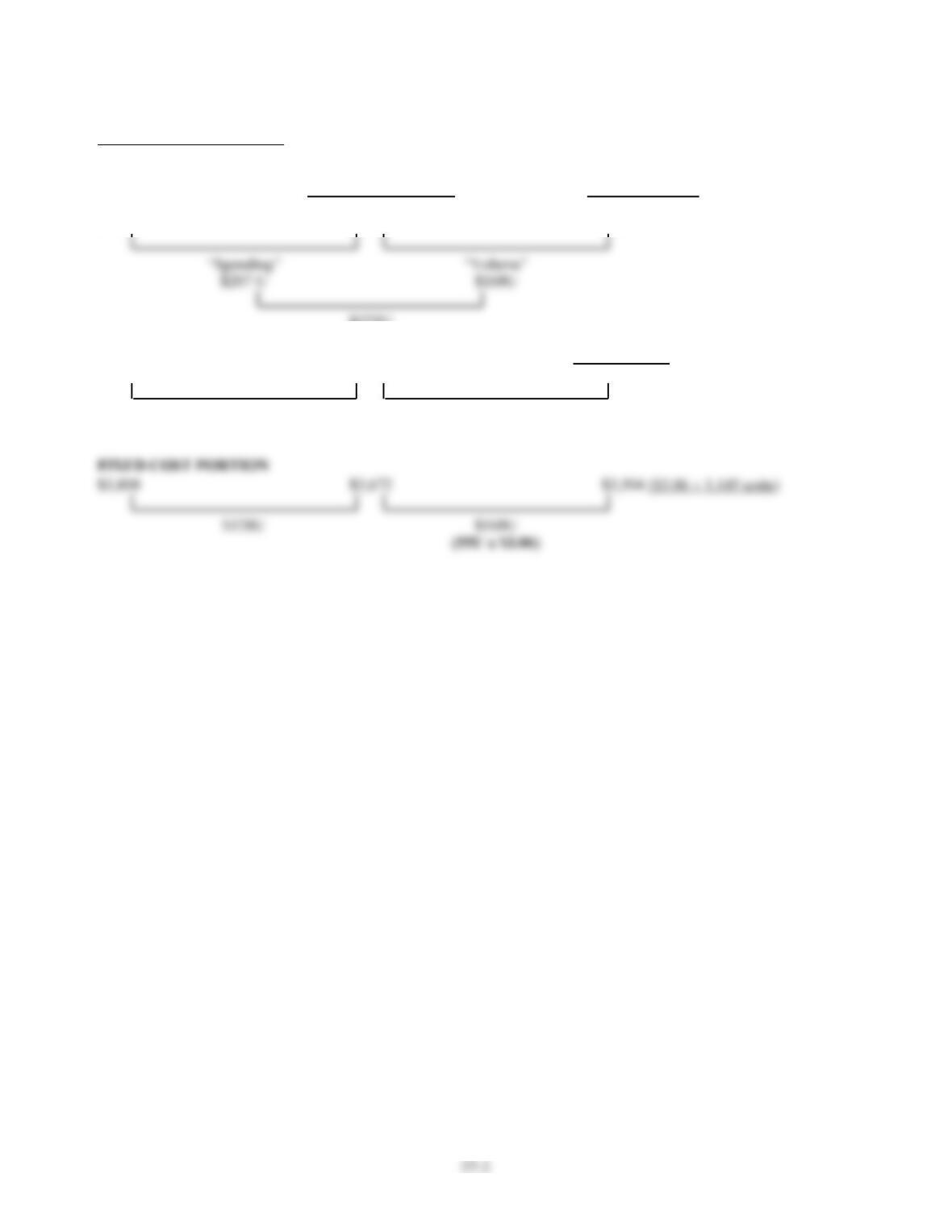
PRIME COST VARIANCES
MATERIAL PRICE VARIANCES Pounds Purchased Pounds Used
MATERIAL USAGE VARIANCES
Clay Std. 28,625 lbs. 275U $.95 = $261.25U
Act. 28,900 lbs.
LABOR USAGE VARIANCES
Molding Std. 1,145 hours 55U $15.00 = $825U
Act. 1,200
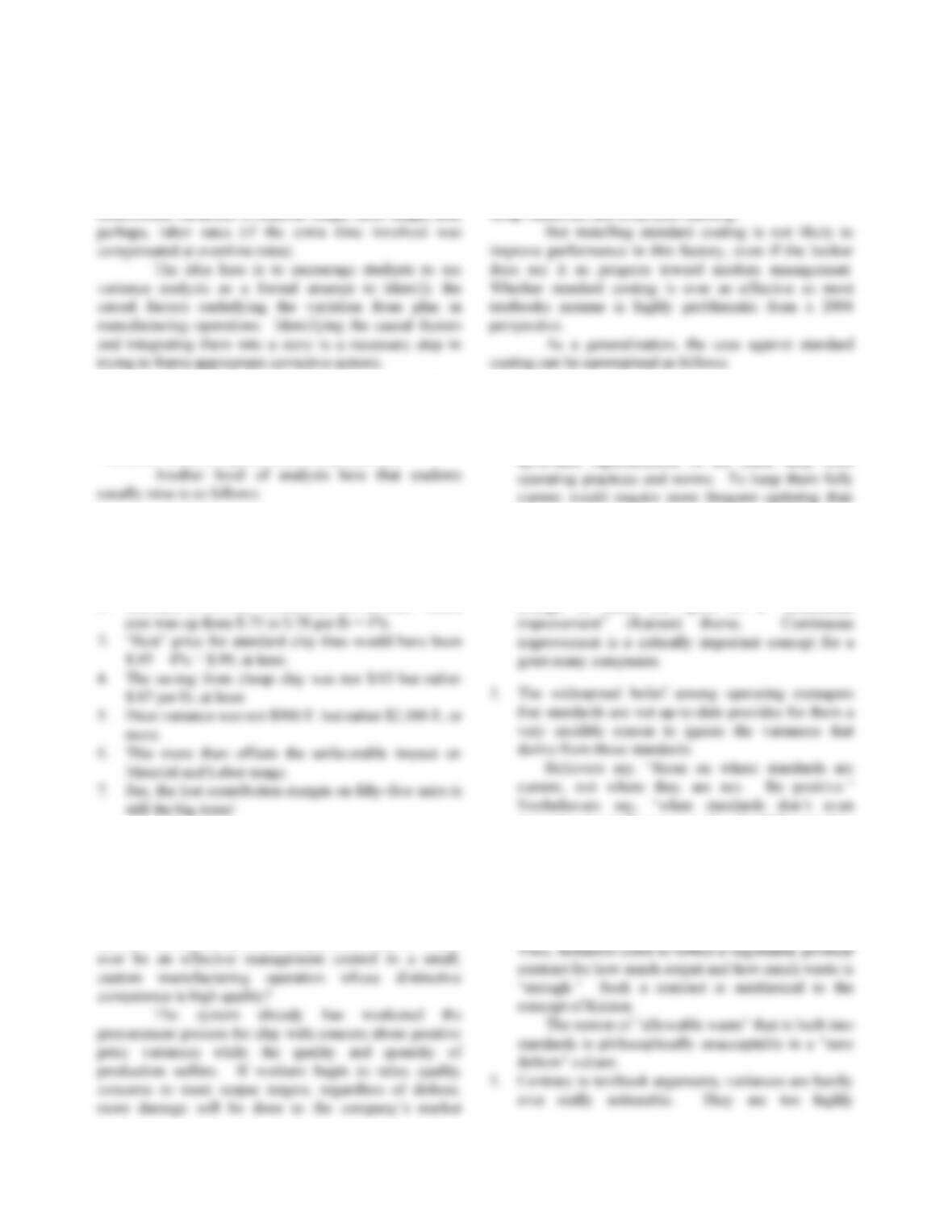
OVERHEAD VARIANCES
(1,145 x $1.94 + 3,672) (1,145 x $5.)
ACTUAL ALLOWED ABSORBED
$6,100 $5,893 $5,725
$375U
VARIABLE COST PORTION (1,145 x $1.94)
$2,300 $2,221 $2,221
79U 0
27-3
Question 2
The case is set up to make it fairly easy for
students to see that the “story” here is the cheap clay. A
“favorable” purchase price variance is more than offset by
unfavorable variances in material usage, labor usage, and,
The big point here is that this variance analysis
totally misses the real impact of the cheap clay—the lost
contribution margin from the fifty-five units not
produced. (1,200 versus 1,145) That is, the biggest
“variance” is the lost profit from lost production.
Regarding the Cheap Clay
1. Assume clay prices were rising along with everything
else in 1980 (CPI up 10%).
2. Standard of $.95/lb. would thus not be met. Glaze
Question 3
There is relevance here in the old adage that
“anything not worth doing is not worth doing better.”
Probably the best suggestion for Mr. Petersen
regarding his new standard cost system would be to get
rid of it! Should he try to fix the problems with it? Can it
position.
Effective management controls here might well
include measures of quality improvement, cycle time and
order lead time reduction, on-time delivery improvement,
scrap reduction, and employee learning.
THE PROBLEMS WITH STANDARD COSTS
1. As a generalization, standards hardly ever reflect an
up–to-date representation of the latest shop floor
virtually all companies are willing to accept. In fact,
there is often a belief that standards should be more
stable (once a year updates or twice at most).
2. As a corollary of (1), standards are not flexible
enough to catch the spirit of a “continuous
pretend to be really current, why should I pretend to
pay any real attention to them?”
4. The fundamental concept of standards serves to limit
an achievement motivation. The goal is to meet the
standard, not beat it. Good controllers say,
“standards that are regularly exceeded are too lax.”
27-4
aggregated and they arrive too late (even a week late
is too late). Also, they represent deviation from what
operating managers see as “straw man” norms.
Variances are a very pale substitute for real-time,
6. Standard costs are used to value inventory for
financial statement purposes, but GAAP requires
actual cost. There is thus a very strong tendency to
set standards close to where you expect overall actual
results to be. This avoids the need for big
7. Standards sanction an inside-out look at products and
services rather than an outside-in look. The internal
focus is often used to justify the idea that standard
costs can be a major input in pricing decisions.
8. Standard costs that include an allowance for “fixed”
costs present management with a strong inducement
to “earn” or “absorb” cost by building inventory
TEACHING STRATEGY
I use this case after standard cost mechanics have already
will easily support ninety minutes of discussion in this
approach as well.
Overall, there are five levels of analysis in the
case, as follows:
1. Illustrating how a “Standard Cost” system works
control tool at Petersen Pottery
yes/no/maybe
5. The Concept of Standard Cost
Whither and Whence?