Clay Minerals and Rock Classification Chapter 4
CHAPTER 4
CLAY MINERALS, SOIL AND ROCK STRUCTURES, AND
ROCK CLASSIFICATION
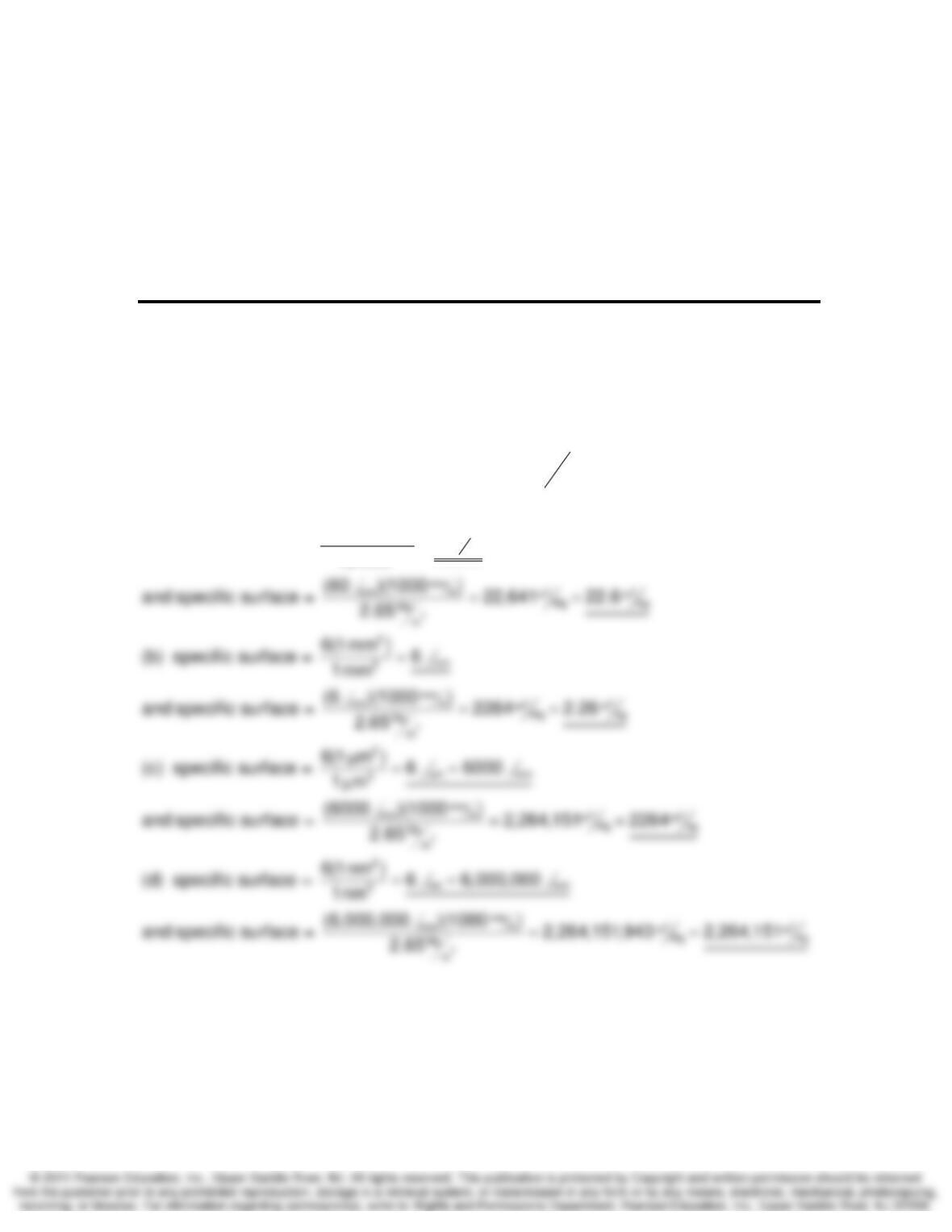
4-1. Calculate the specific surface of a cube (a) 10 mm, (b) 1 mm, (c) and (d) 1 nm on a side.
Calculate the specific surface in terms of both areas and m2/kg. Assume for the latter case that
ρ
s
= 2.65 Mg/m3.
SOLUTION:
2
mm
3
surface area
Solve using Eq. 4.2: specific surface = unit volume
6(100 mm )
(a) specific surface = 60
10 mm
=
Clay Minerals and Rock Classification Chapter 4
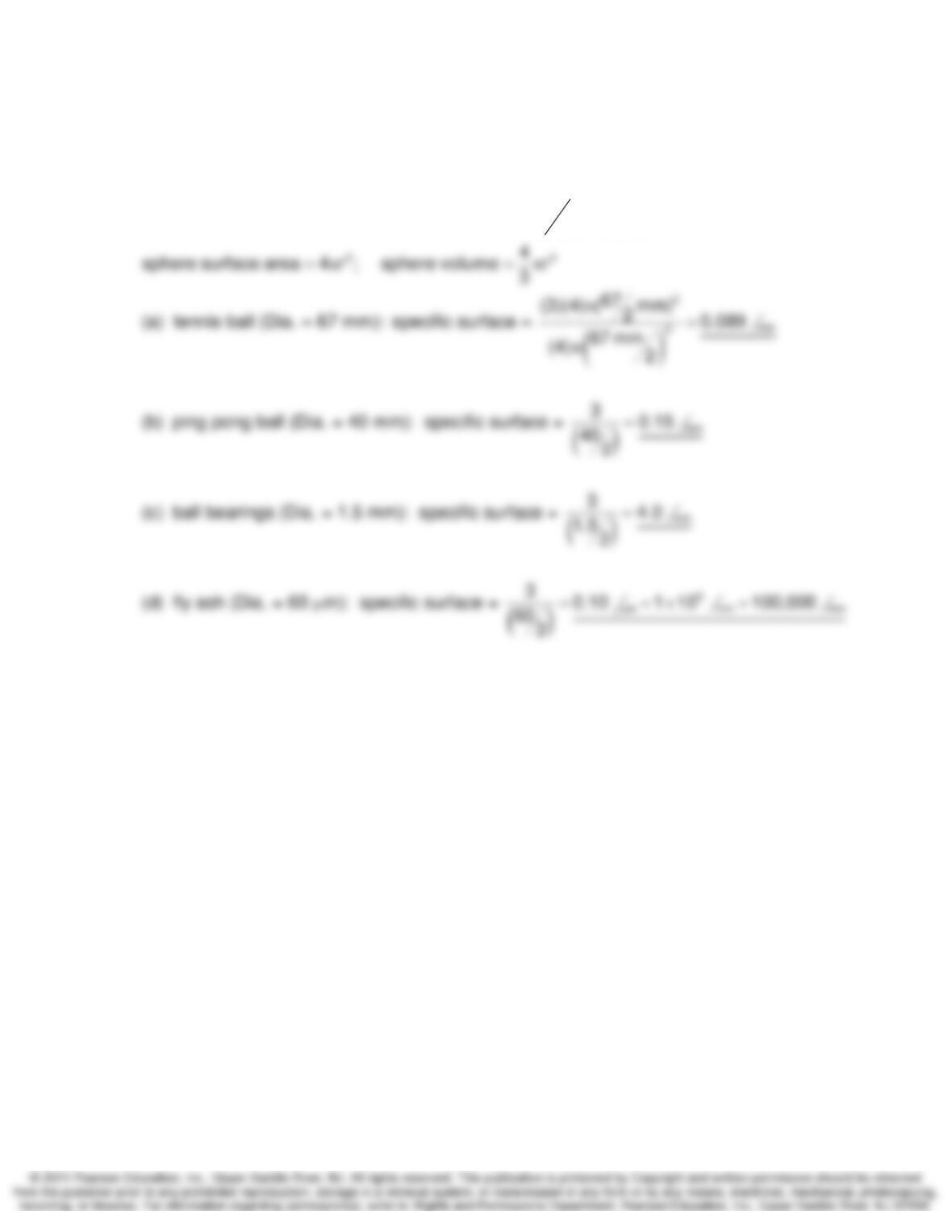
4-2. Calculate the specific surface of (a) tennis balls, (b) ping pong balls, (c) ball bearings 1.5
mm in diameter, and (d) fly ash with approximately spherical particles 60
υ
m in diameter.
SOLUTION:
surface area
Solve using Eq. 4.2: specific surface = unit volume
Clay Minerals and Rock Classification Chapter 4
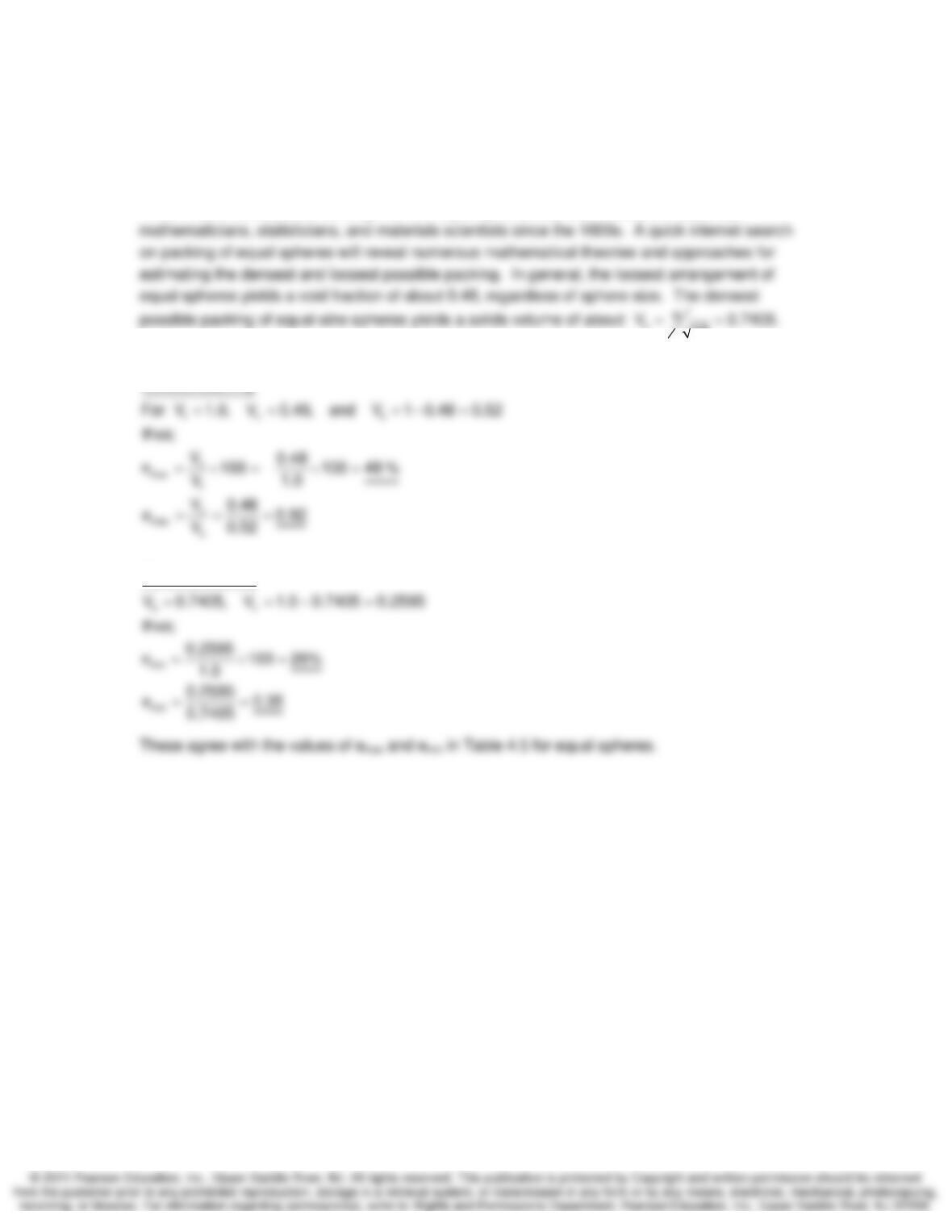
4-5. Verify that the maximum and minimum void ratios for perfect spheres given in Table 4.5 are
reasonable.
SOLUTION:
Three-dimensional particle arrangement of equal spheres has been studied in depth by
18
(These values are approximate – there is not a unified consensus in the literature.)
Loosest packing
Densest packing
Clay Minerals and Rock Classification Chapter 4
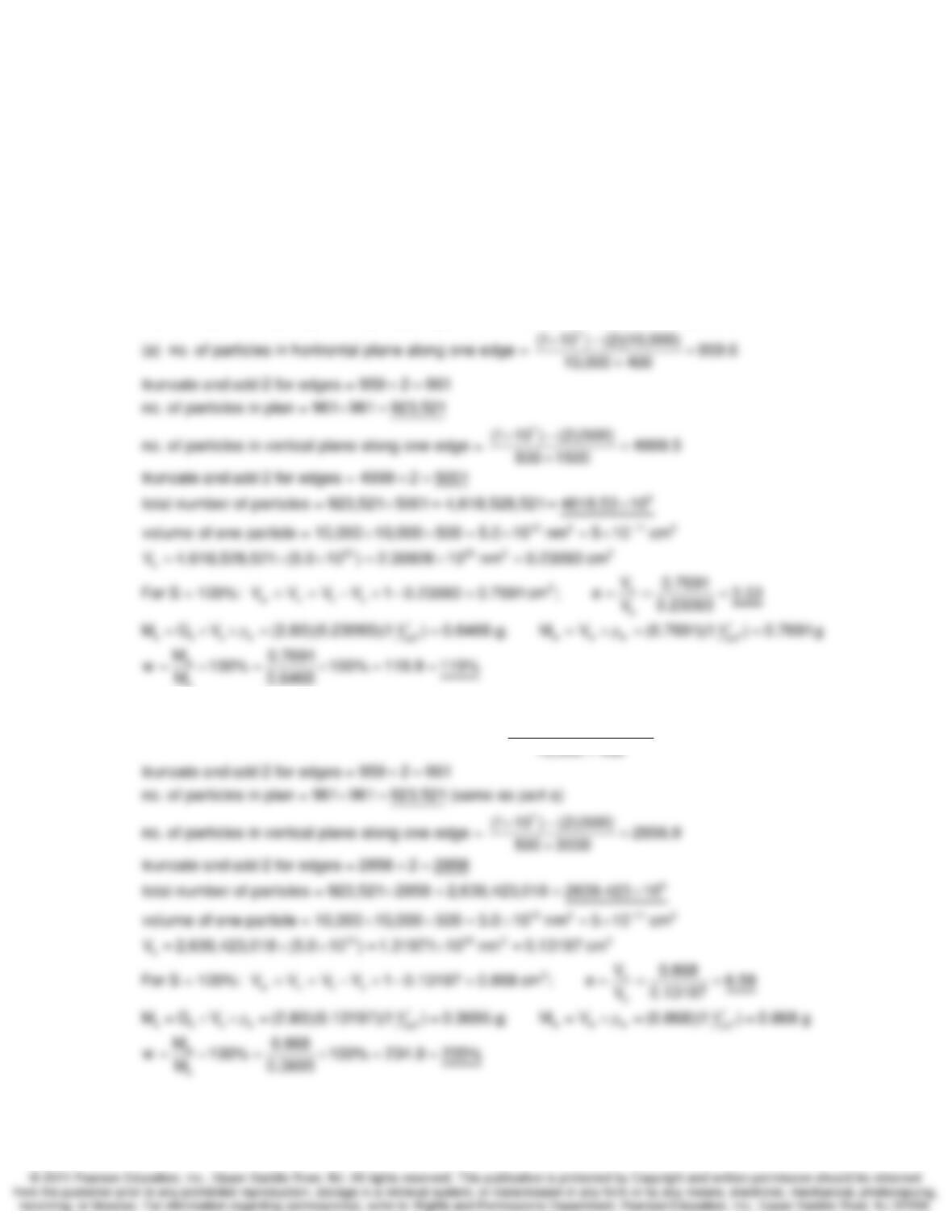
4-7. A specially processed clay has particles that are 500 nm thick and 10,000 nm x 10,000 nm
wide. The specific gravity of solids is 2.80. The particles lie perfectly parallel with an edge-to-edge
spacing of 400 nm (i.e., they look like thin bricks stacked perfectly parallel). (a) Initially, the cation
valence in the double layer is +1, resulting in a face-to-face spacing of 1500 nm. How many
particles per cm3 will there be at this spacing? What are the void ratio and water content,
assuming that the soil is at 100% saturation? (b) Another sample of the clay is mixed such that
the cation valence is +2. What are the new void ratio and water content under these conditions?
SOLUTION:
Assume symmetrical edge-to-edge spacing of 400 nm and only include whole particles.
s
7
(b) assume the-face-to-face spacing doubles for a cation valence of +2
(1 10 ) (2)(10,000)
no. of particles in horizontal plane along one edge = 959.6
×− =
Clay Minerals and Rock Classification Chapter 4
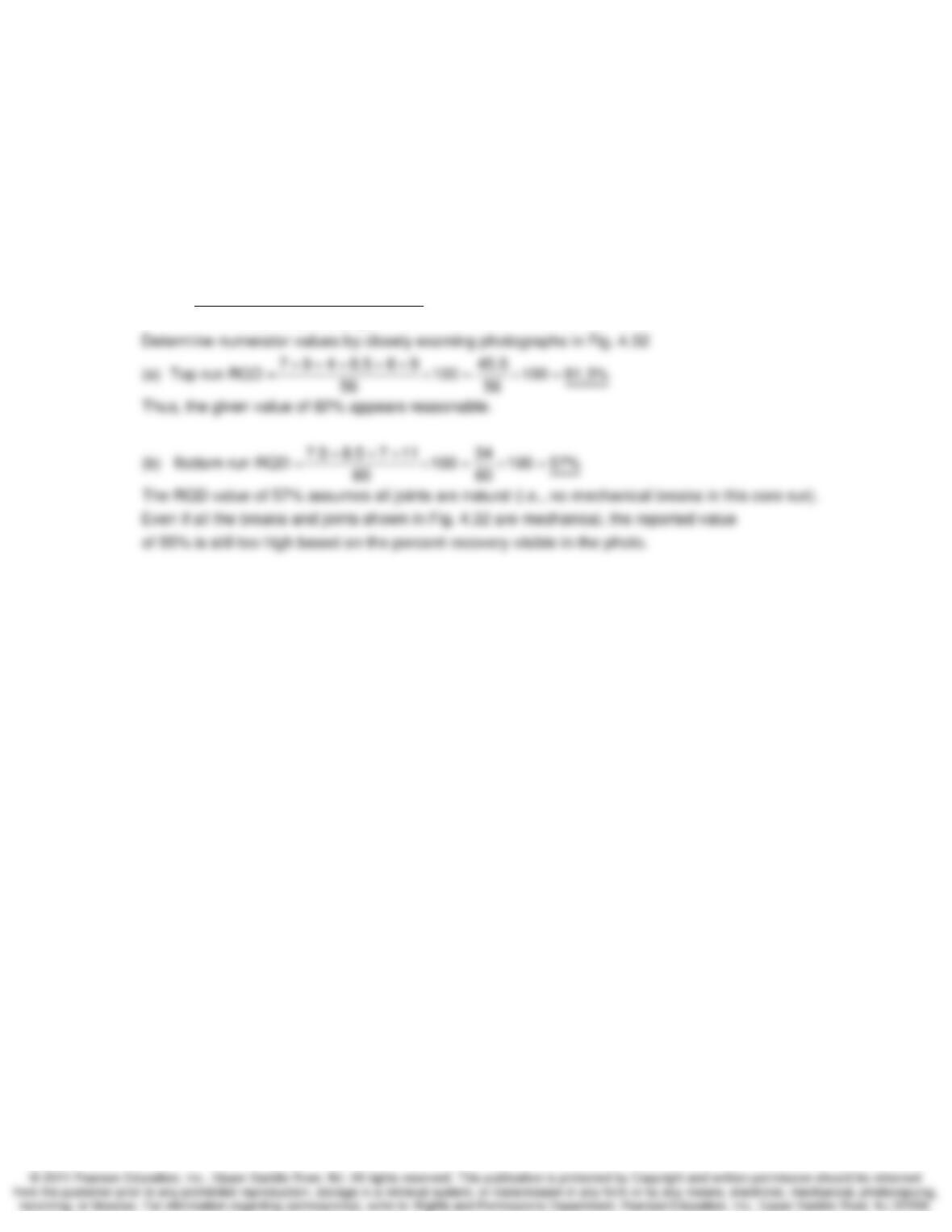
4-15. Three sections of rock core are shown in Fig. 4.32. The rock comes from near
Cumberland, RI, and is called Corbormite (Capt. James T. Kirk, personal communication, 2007).
The length of the first (top) run is 56 in. and the computed RQD is 82%. For the second run
(middle), a length of 60 in. was recovered and the RQD is 100%. Finally, the third run (bottom) is
also 5 ft long and the RQD is 95%.Verify that the calculated RQD values for the top and bottom
runs are correct.
SOLUTION:
Length of sound pieces > 4 in
RQD Total core run length
=
∑
Clay Minerals and Rock Classification Chapter 4
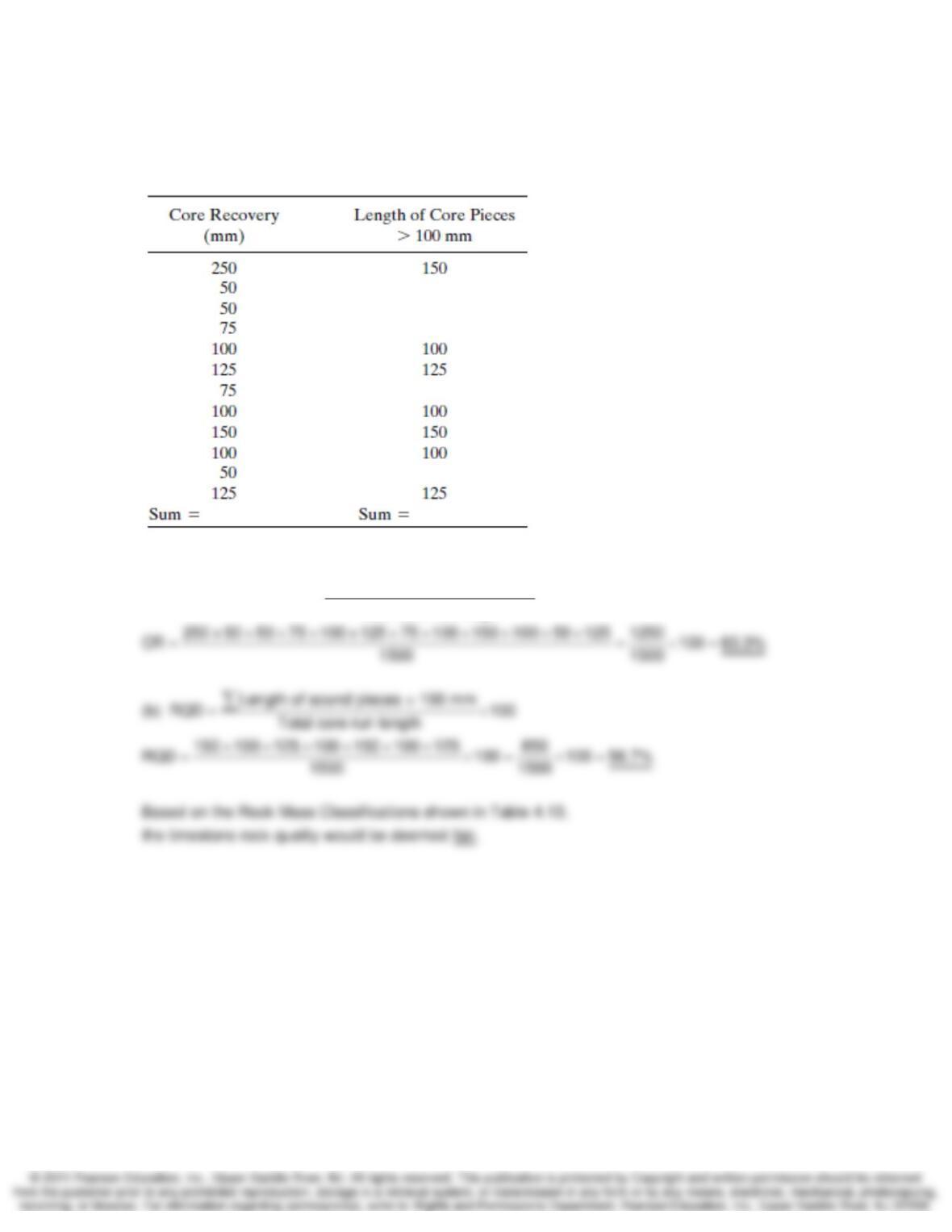
4-16. In one core run of 1500 mm selected from cores obtained during drilling for a bridge
foundation in hard limestone, the following core recovery information was obtained: Determine (a)
the percent core recovery, and (b) the RQD. Based on this RQD, what is the rock quality?
SOLUTION:
Total length of rock recovered
(a) Core Recovery, CR = 100
Total core run length
×