62
C H A P T E R 4
STRATEGIC PURPOSE
Introduction
This chapter has been fairly significantly revised since the last edition, to emphasise issues of
ownership, reflecting in particular the greater role of personal ownership and state ownership in
many emerging economies. Personal ownership in mature economies is also often
Illustration 4.1
Mozillas mission: beyond Firefox
Mozilla is a not-for-profit foundation, so creating a focusing, motivational and clear purpose is
particularly important. At one level, defining purpose is relatively simple in for-profit
organisations. However, just because Mozilla is not driven by profit, it does not mean that
revenues are not important; securing revenues is an underlying issue in the illustration.
1. Mozilla does not produce a formal vision statement. Based on the materials here, what do
you think Mozillas vision would be?
Mozillas vision: it should be easy for students to assemble the elements of a vision (as
2. How do Mozillas mission and principles influence its approach to new initiatives? Is there
any danger in its apparent priorities?
Influence on initiatives and dangers: it seems that Mozillas mission and principles do
influence its activities. Thus the pancake venture to counter fragmentation of the internet by
63
Illustration 4.2
A family affair? News Corporations governance crisis
News Corporation has had high visibility in recent years, with many appearances in front of
Parliamentary inquiries. There is plenty of YouTube footage of Rupert, James and Elisabeth
Murdoch if you want to put faces to names. In terms of Figure 4.2, News Corporation is
arguably a case of a family business masquerading, as a public corporation.
1. Referring to Figure 4.3 , at what levels did the governance chain at News Corporation seem
to fail?
Failures in the governance chain: there are two areas to point to in particular.
The first major failure is in the lack of control exercised by shareholders. With 46 per cent
of the voting shares held by the Murdoch family and friends, it is very hard to gather a
majority to vote against anything the family might do: thus, the failure of the 2011 vote for
2. Given that News Corporations share price was outperforming competitors, why would
shareholders vote against the Murdochs management at News Corporation? What else
could they do?
Why the shareholder revolt, despite outperformance? On a simple profit motive assumption,
shareholder unrest might be surprising (Rupert Murdoch seems surprised, at least):
shareholders are getting richer, so why should they complain? However, many shareholders
64
Illustration 4.3
ENRCs boardroom city or Soviet?
1. Ideally, what sort of companies and roles might Dalmans new non-executive directors have
worked in previously?
Previous roles and companies of new non-executive directors: the new non-executives will
need the personal authority to deal with the domineering entrepreneurial shareholders and
2. Should ENRCs governance not improve, what could (i) independent investors and (ii) the
London Stock Exchange do?
What could independent investors and the LSE do? Investors are relatively powerless,
Illustration 4.4
Conflict at the European Aeronautic Defence and Space Company
1. With reference to the power/interest matrix (Figure 4.5), how would powerful stakeholders
level of interest vary with regard to the location of the EADS headquarters and
internationalisation?
Stakeholder interest in EADS headquarters and internationalisation issues: the comparison
of the two issues shows how stakeholders positions differ according to the issues. Thus,
65
2. Given the ownership structure, is CEO Gallois right to assert the primacy of company
interests and reject German ministerial interference?
Is Gallois right to resist German protests? This is a tricky issue. If Gallois can show a strong
economic case for moving the Munich headquarters, then arguably it is unfair to the other
Illustration 4.5
H&Ms sustainability strategy
This illustration should touch close to home because many students will be avid consumers of
so-called fast-fashion, as sold by H&M, Primark, Zara and many others. The illustration will
have added poignancy for those who remember the 1,129 dead in April 2013 Rana plaza factory
fire in Dhaka, Bangladesh; the factory at fault was a supplier to Primark. Note that there is a full
case on H&M in the Text and Cases edition of Exploring Strategy.
1. Where would you place H&M in terms of the four stances on social responsibility in Table 4.2?
H&Ms stance towards social responsibility: in terms of the four categories of Table 4.2,
H&M probably has come close to an Enlightened self-interest stance, where it sees a good
reputation as important to long-term success. Consistent with this position, the company is
2. What are the kinds of triple-bottom-line measures that would be appropriate for asustainable
strategy in clothing retail (see also Section 11.2.1)?
Triple Bottom Line measures: the triple-bottom line is introduced under Forum for
Stakeholder Interaction but more fully discussed in Chapter 11. Economic measures such
66
© Pearson Education Limited 2014
Key Debate
Three views on the purpose of a business
The three views represented in this illustration should provide the basis for a lively debate. The
questions are designed not only to get a debate going between the students in the room but also
to challenge each individual student. Their views as a manager may very well be different from
their views as a shareholder, especially if you remind them that being a shareholder does not
necessarily mean having bought shares themselves; they are a shareholder if they have a pension
or an insurance policy, for example.
Handys views certainly meet the social need test. However, the responsibility of defining what
the something better lies with the managers. This arguably becomes the challenge of strategy.
It may also be that students, taking the view of the shareholder, may see this as a diminution of
their interests.
Be profitable and create values
Grow only where value can be created (and certainly do not do so without meeting the cost
of capital)
67
Video assignment
Mission and corporate social responsibility
It has become fashionable for companies to have mission statements and corporate social
responsibility policies but for some companies it is more than a fashion. Good mission
1. It is clear that there are a range of views on both the importance of corporate social
responsibility and what form it should take. Charles Bradys view perhaps best expresses
the dual nature of CSR it is partly about providing good jobs and looking after employees
(Brady sees this as the primary role of CSR) but he also recognises a secondary role of
engagement with, and contribution to, the wider society (Wilmington help local schools in
deprived areas and provide some free services to charities). As a CEO, Brady is clearly
aware that society (and that includes investors, customers and the media) expect companies
2. This question brings together CSR, governance and stakeholders as the three main factors in
determining organisation purpose (see Figure 4.1 and Section 4.1). The statements in the
video do not always refer directly to stakeholders but there are several examples of how the
organisations have adopted strategies aimed at meeting a variety of stakeholder
Assignment 4.1
Mission, vision and objectives
The purpose of this exercise is to get students to see that drafting mission and vision statements
and identifying relevant objectives is not an easy task. As far as the mission and vision
statements are concerned, it might be useful to supplement the text by providing a more detailed
discussion of what such statements might include. The key readings include reference to the
Collins and Porras book Built to Last. Their Chapter 11 is a quite specific set of guidelines on
the writing of what they call value and vision statements (they do not use the word mission,
though much of what they cover clearly relates to this). The text and notes on Illustration 4.1
above include a brief summary of their guidelines, though these are set out in much more detail
in their book.
Some key issues with regard to the setting of strategic objectives are to what extent they:
can encapsulate the key aspects of the strategy (e.g. as distinct from being standard financial
measures);
Assignments 4.2 and 4.3
Corporate governance
These assignments should allow students to reflect on the importance of corporate governance
to strategy development of organisations. Together they are designed to provide a test of both
Assignments 4.4 and 4.5
Social responsibility
These two assignments can be used together since Assignment 4.4 is concerned with the overall
stance and approach to social responsibility and Assignment 4.5 with more of an action agenda.
As such it can be useful to see how different stances will be reflected in the emphasis given to
different items on the agenda. It might be a good idea to choose an industry in which students
undertake the assignments. For example, with regard to the media industry (Illustration 4.2):
Observers might characterise Rupert Murdochs News Corporations taking a laissez faire
position in Table 4.2, that is, short-term shareholder interests are dominant. In the popular
In this context, an interesting issue worth pursuing is the role of government in relation to
corporate social responsibility (CSR). For example, in this context, whether the media is a
special case that requires additional regulation. This is an issue relevant to internet
companies such as Twitter and Facebook, which are used widely in different cultural
contexts around the world and whose data are stored in the US. What is seen as socially–
responsible and secure in the US might not be in Iran.
Assignment 4.6
Stakeholder mapping
Many students find the concept of stakeholders very useful in understanding the political
dimension of strategy. However, when they are asked to undertake an analysis of stakeholders,
they can find this to be more difficult than they expected. Assignment 4.6 is designed to allow
students to experience these practical difficulties and learn how to undertake a useful
stakeholder analysis using Figure 4.5. The problems students can encounter are typically as
follows:
Despite the reference to this in the text, students often try to map out stakeholders in a
position that would be correct for all circumstances and strategies over time. It is important
that they appreciate that the positioning of stakeholders is strongly determined by specific
Following the mapping exercise, the question is designed to encourage students to consider
strategies for managing stakeholders in terms of both maintenance activity and repositionings
that they feel would be crucial to the success of a strategy.
Integrative assignment 4.7
Governance, CSR and capabilities
This is a challenging assignment in the light of corporate scandals (Enron, Lehman, RBS, etc.),
the rise of shareholder activism and increasingly tough scrutiny of public sector organisations. It
71
The simplistic starting point might be that organisations should maximise returns for their
owners. However, the principalagent concept tells students that this may not happen
because managers (as the shareholders agents) may also work in their own self-interest. In
Case Example
Drinking partners: Indias United Breweries Holdings Ltd
This case focuses on ownership and control, but also raises issues to do with social
responsibility towards non-financial stakeholders. As a personally-controlled conglomerate,
UBHL is perhaps an extreme case of a common model, especially in emerging economies. In
terms of Figure 4.2, it would occupy the bottom-right box, as a personally-controlled business
with mixed motivations. Vijay Mallya is concerned for his own profits (not necessarily that of
his other shareholders), but also desires sufficient autonomy to pursue his various vanity
projects, ranging from his Kingfisher Airlines business to the risqué Kingfisher Calendar.
1. Consider the governance chain leading from the various shareholders of UBHL to the
managers in the main businesses, with particular reference to United Spirits. Why might
there be breakdowns in accountability and control in this chain?
The figure below gives a simplified governance chain for UBHL, with most detail provided
for United Spirits (compare with Figure 4.3 in the chapter). The two most important issues
to draw out are probably the following:
(i) The ultimate beneficiaries in the form of individual investors via investment funds have
very little control over UBHLs strategy; their investment funds (B class shares) have
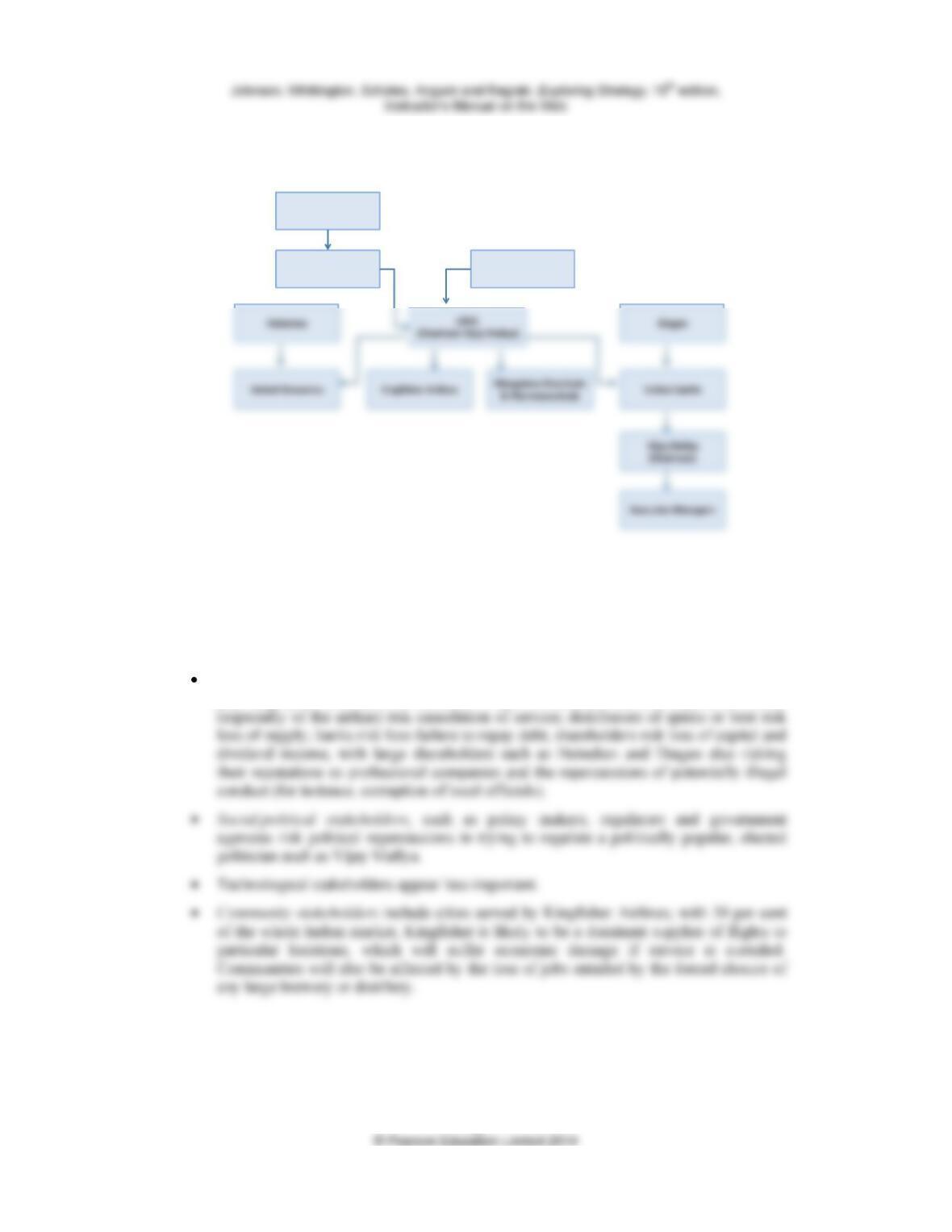
72
anxiety, given Diageos vulnerability to penalties in the US for any corrupt practices,
even in far away India.
Ultimate
beneficiaries
(individual investors)
Vijay Mallya
and associates
Investment funds/
Institutional investors
2. Group the various key stakeholders discussed in this case (economic, social/political,
community and technological). What risks do key stakeholder groups face (including
Diageo)?
Section 4.4.1 identifies four categories of external stakeholders, to which we can add
internal stakeholders such as employees.
Economic stakeholders: suppliers such as airports and fuel companies risk failure to
pay; employees from India to Scotland (Whyte & Mackay) risk loss of jobs; customers