CHAPTER 4
Soil Composition
QUESTIONS AND PRACTICE PROBLEMS
Section 4.3 Weight-Volume Relationships
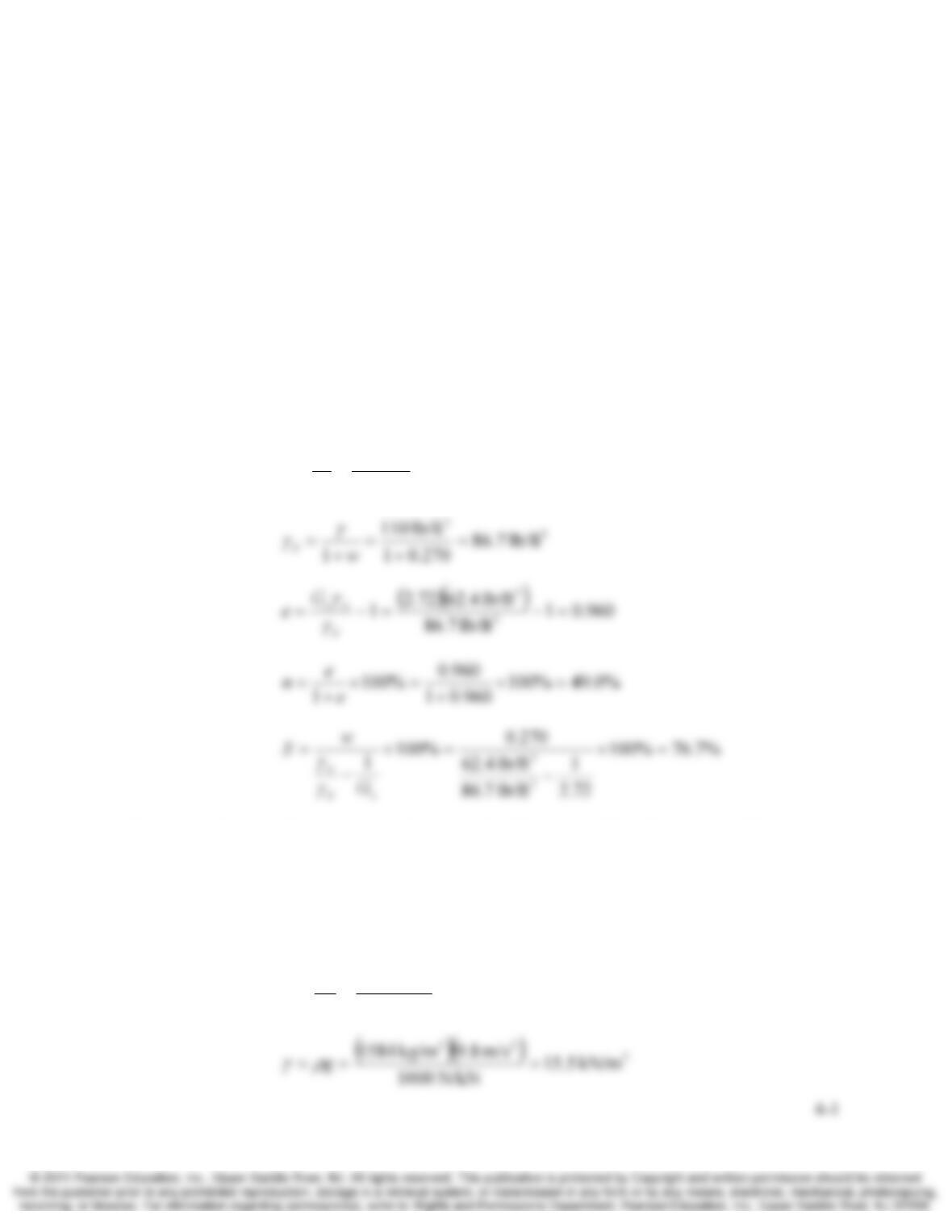
4.1 A cube of moist soil weighs 330 lb and has a volume of 3.00 ft3. Its moisture content is
27.0% and the specific gravity of solids is 2.72. Compute the void ratio, porosity, degree
of saturation, unit weight and dry unit weight of this soil.
Solution
3
3lb/ft 110
f
t
3.00
lb 330 === V
W
γ
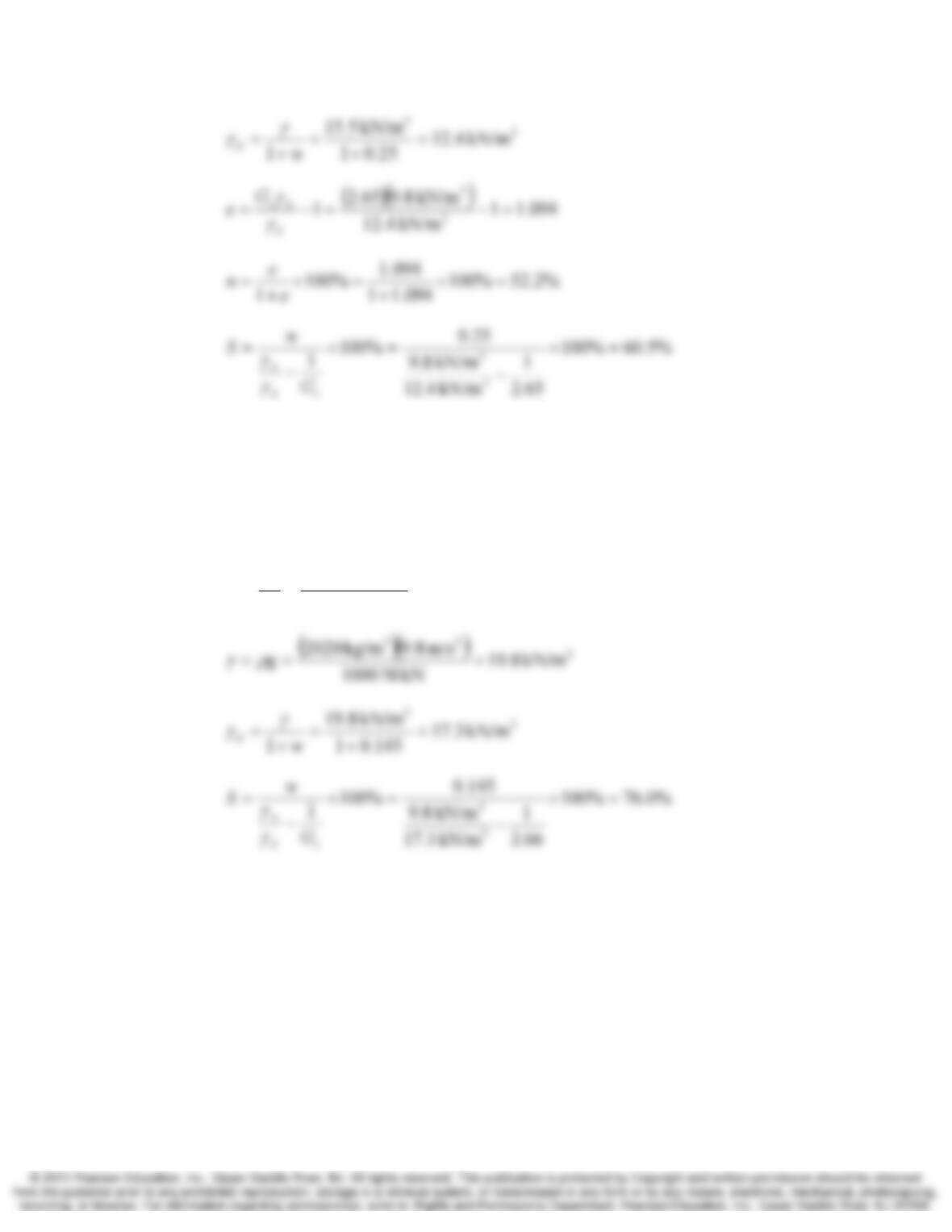
4.2 An undisturbed block sample of clay weighs 101.4 kg and has dimensions of 0.4 m × 0.4
m × 0.4 m. Its moisture content is 25.0%. Assuming a reasonable value of the specific
gravity of solids, compute the unit weight, dry unit weight, void ratio, porosity and
degree of saturation of the clay.
Solution
()
3
3kg/m 1584
m
0.064
kg 101.4 === V
M
ρ
4-2 Soil Composition Chap. 4
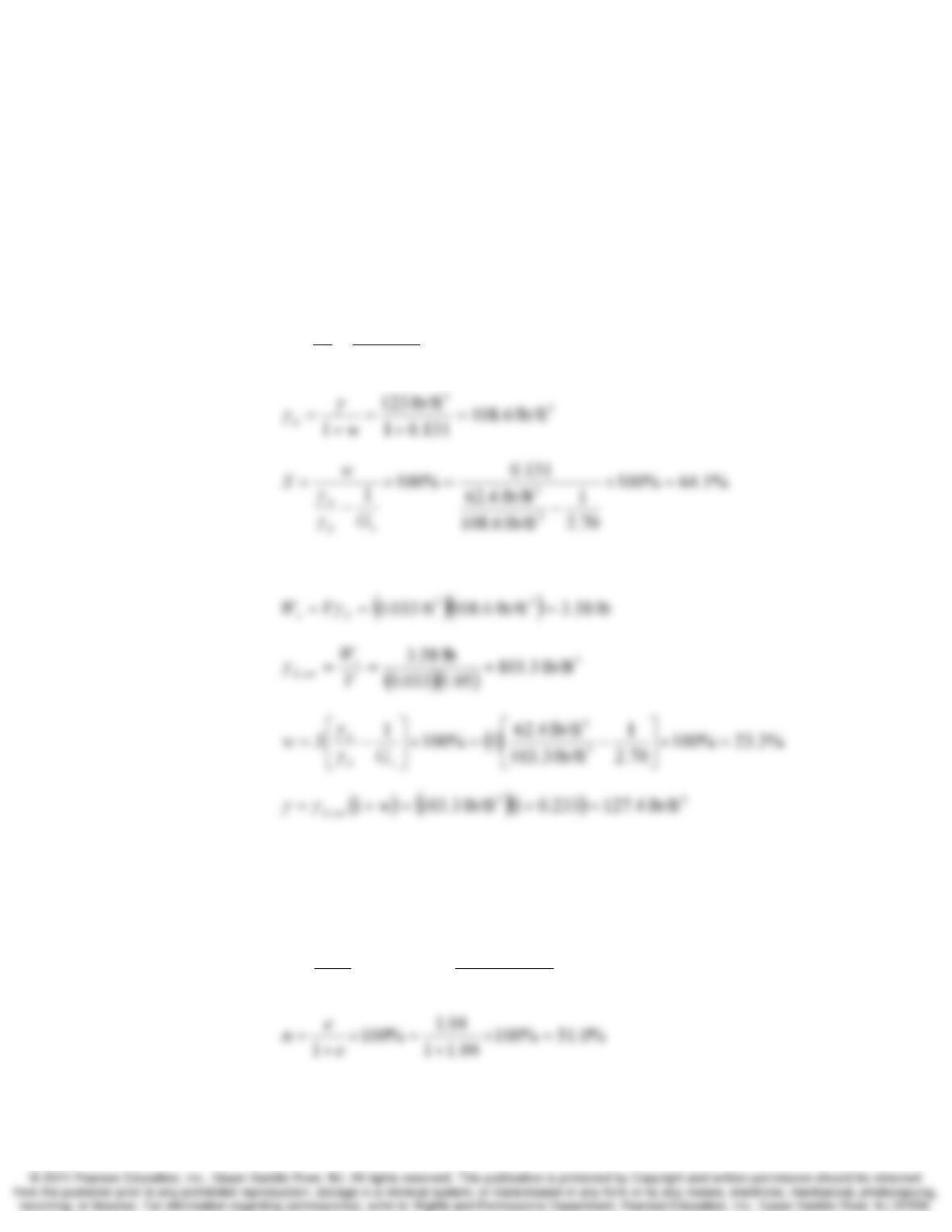
4.3 A sample of soil is compacted into a 9.44×10⁻⁴ m
3 laboratory mold. The mass of the
compacted soil is 1.91 kg and its moisture content is 14.5%. Using a specific gravity of
solids of 2.66, compute the degree of saturation, density (kg/m3), unit weight (kN/m3) and
dry unit weight of this compacted soil.
Solution
3
34– kg/m 2020
m
109.44
kg 1.91 =
×
== V
M
ρ
Chap. 4 Soil Composition 4-3
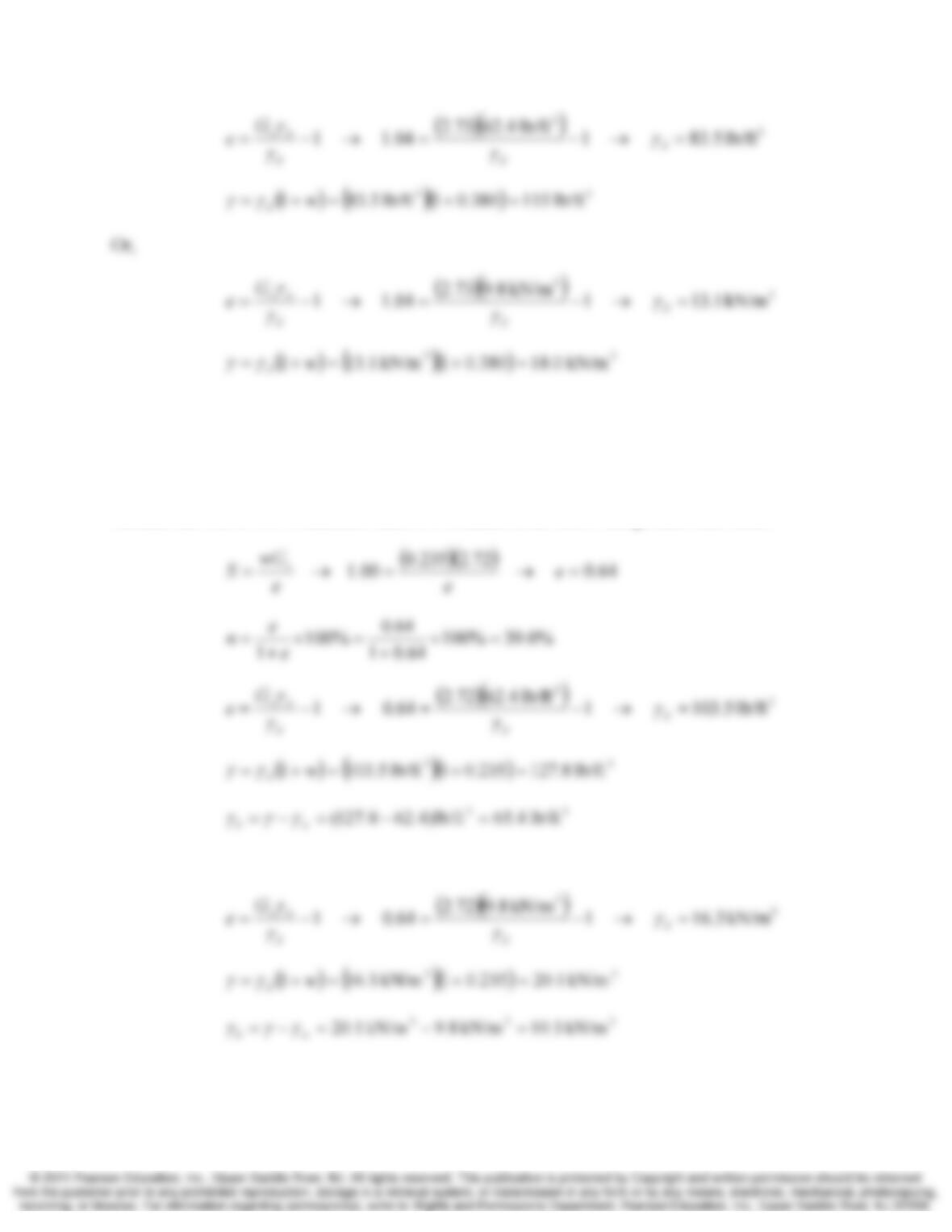
4.4 A sample of soil was compacted into a 1/30 ft3 laboratory mold. The weight of the
compacted soil was 4.1 lb and its moisture content 13.1%. Using a specific gravity of
solids of 2.70, compute the unit weight, dry unit weight and degree of saturation of this
compacted soil. This compacted soil sample was then submerged in water. After 2
weeks, it was found that the sample had swelled and its total volume had increased by 5%.
Compute the new unit weight and moisture content of the soil sample after 2 weeks of
submersion in water.
Solution
3
3lb/ft 123
f
t
0.033
lb 4.1 === V
W
γ
Assume 100% saturation:
4.5 A saturated soil has a moisture content of 38.0% and a specific gravity of solids of 2.73.
Compute the void ratio, porosity and unit weight (lb/ft3 or kN/m3) of this soil.
Solution
(
)
(
)
1.04
2.730.380
1.00 =→=→= e
ee
wG
Ss
4-4 Soil Composition Chap. 4
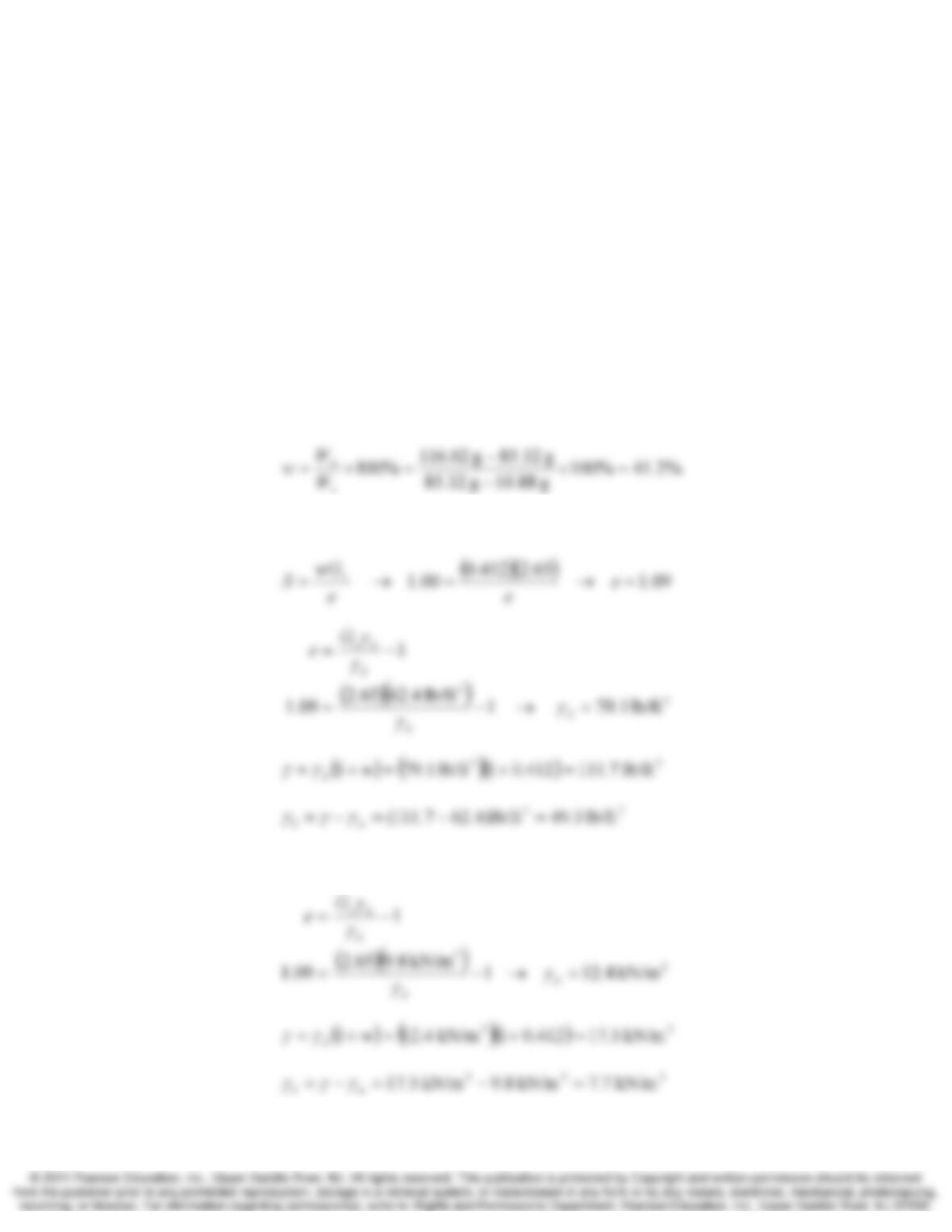
4.6 A soil sample obtained from below the groundwater table has a moisture content of 23.5%
and a specific gravity of solids of 2.72. Compute its unit weight, dry unit weight,
buoyant unit weight, void ratio, porosity, and degree of saturation.
Solution
Assume the soil is 100% saturated since it’s obtained from below the groundwater table.
Or,
Chap. 4 Soil Composition 4-5
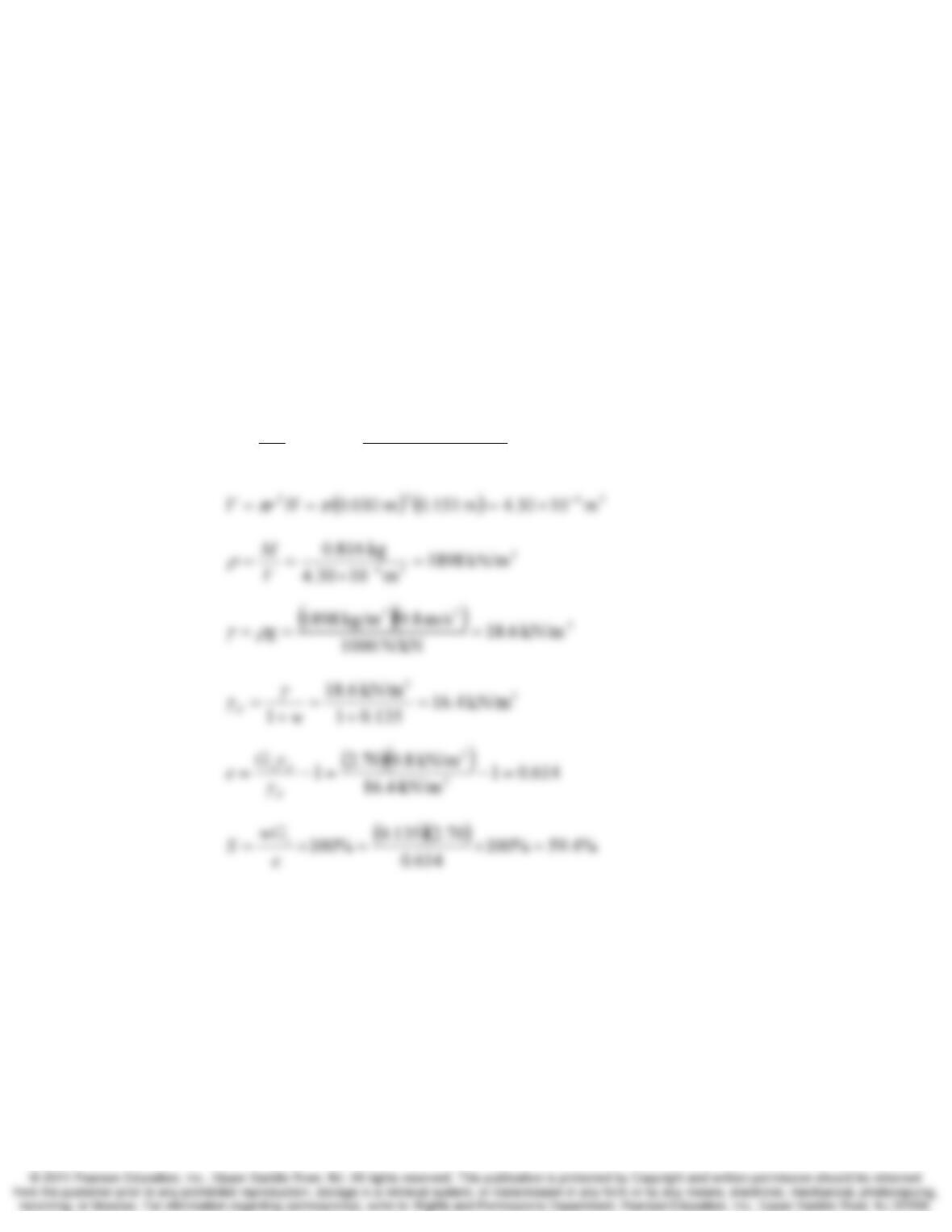
4.7 A sample of clay was obtained from a point below the groundwater table. A moisture
content test on this sample produced the following data:
Mass of can = 10.88 g
Mass of can + moist soil = 116.02 g
Mass of can + dry soil = 85.34 g
(a) Compute the moisture content.
(b) Assume a reasonable value for Gs, and then compute the void ratio, unit weight,
dry unit weight and buoyant unit weight.
Solution
a.
b. Assume Gs=2.65
Or,
4-6 Soil Composition Chap. 4
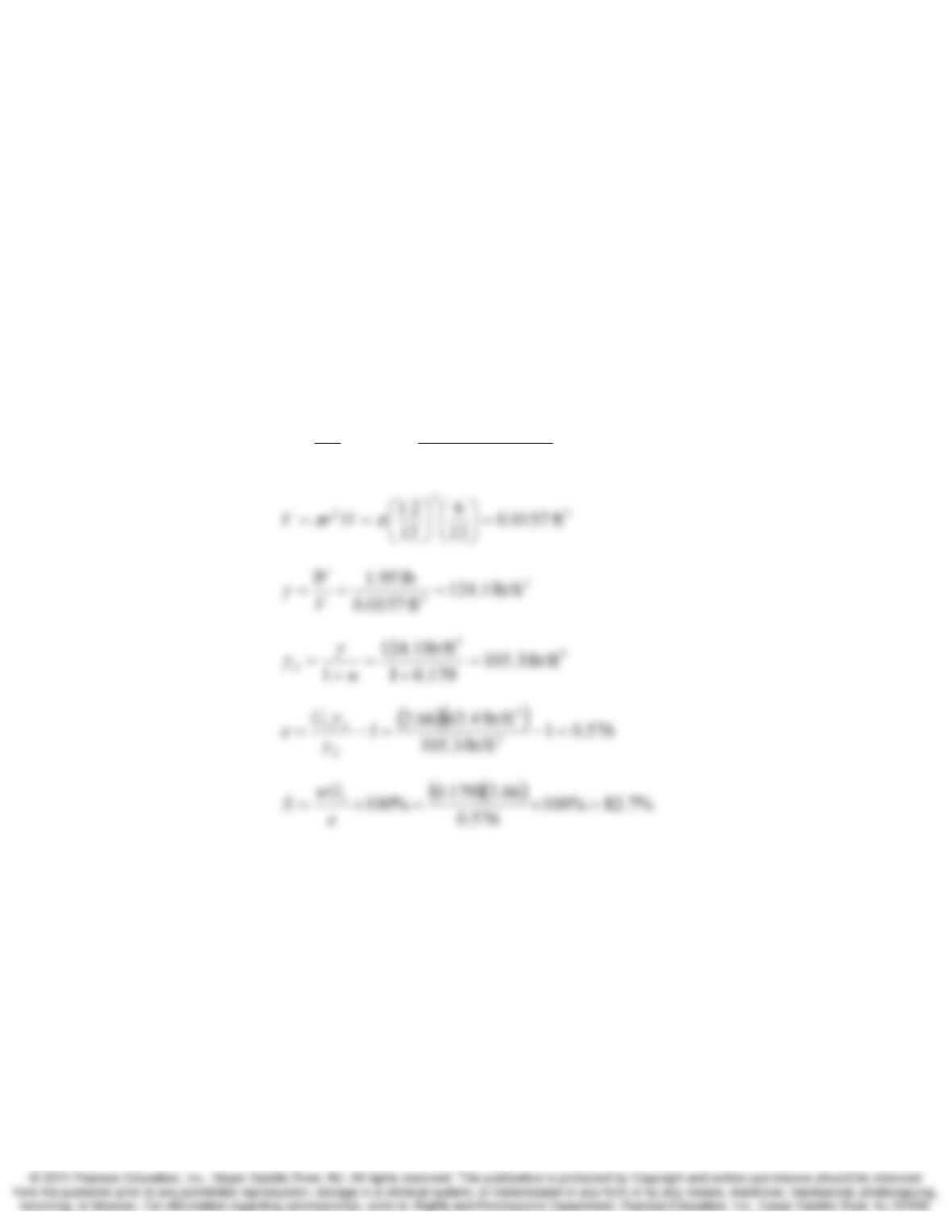
4.8 An undisturbed cylindrical soil sample is 60 mm in diameter and 152 mm long. It has a
mass of 816 g. After finding the mass of the entire sample, a small portion was removed
and a moisture content test was performed on it. The results of this test on the sub-
sample were:
Mass of can = 22.01 g
Mass of can + moist soil = 124.97 g
Mass of can + dry soil = 112.72 g
Using Gs = 2.70, compute w, γ, γd, e, and S.
Solution
13.5%100%
g 22.01g 112.72
g 112.72g 124.97
%100 =×
−
−
=×=
s
w
W
W
w
Chap. 4 Soil Composition 4-7
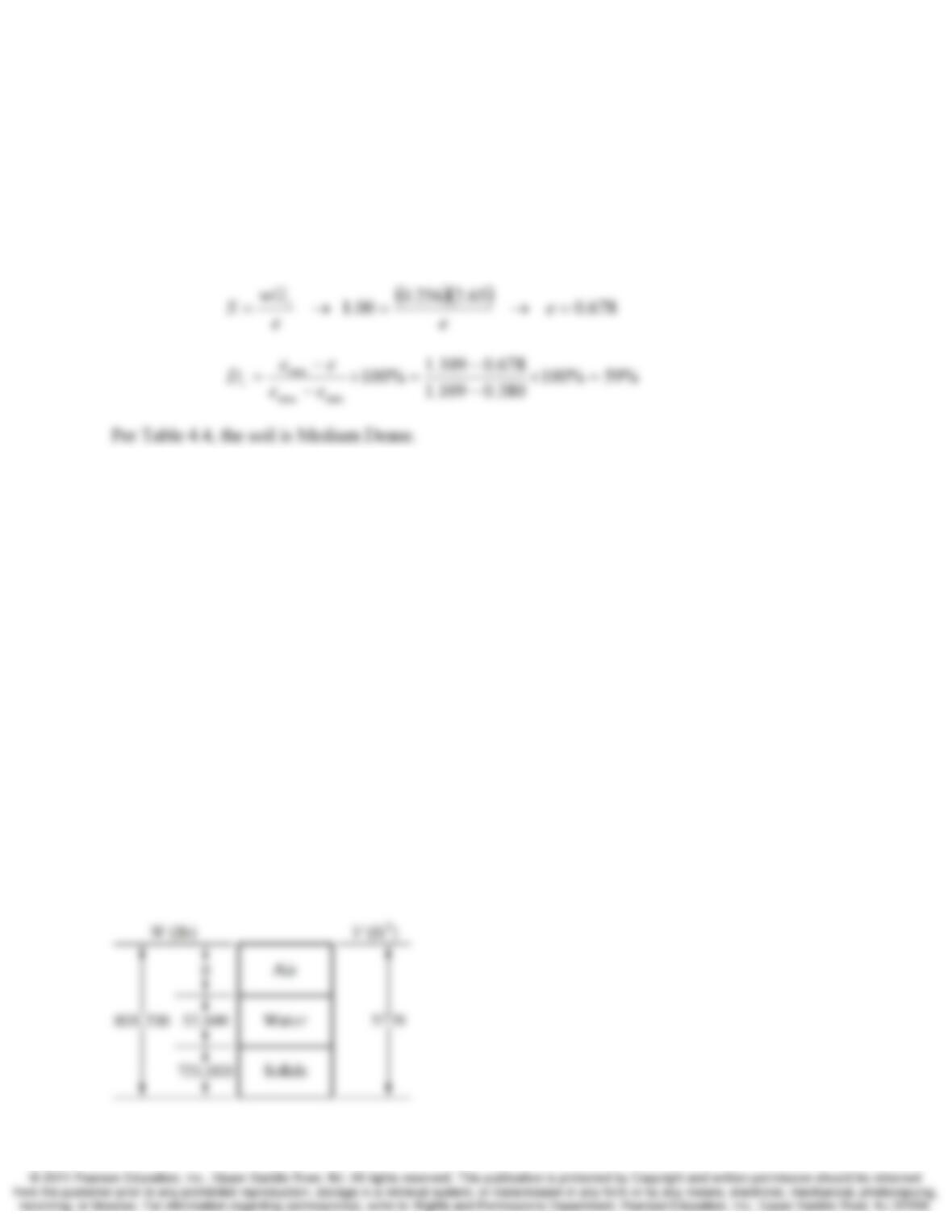
4.9 An undisturbed cylindrical soil sample is 2.4 in. in diameter and 6 in. long. It has a
weight of 1.95 lb. After finding the weight of the entire sample, a small portion was
removed and a moisture content test was performed on it. The results of this test on the
sub-sample were:
Mass of can = 20.50 g
Mass of can + moist soil = 110.46 g
Mass of can + dry soil = 96.81 g
Using Gs = 2.66, compute w, γ, γd, e, and S.
Solution
17.9%100%
g 20.50g 96.81
g 81.69g 110.46
%100 =×
−
−
=×=
s
w
W
W
w
4-8 Soil Composition Chap. 4
4.10 A strata of clean, light-colored quartz sand located below the groundwater table has a
moisture content of 25.6%. The minimum and maximum void ratios of this soil are 0.380
and 1.109, respectively. Select an appropriate value of Gs for this soil, compute its
relative density, and determine its consistency using Table 4.4.
Solution
Assume Gs=2.65
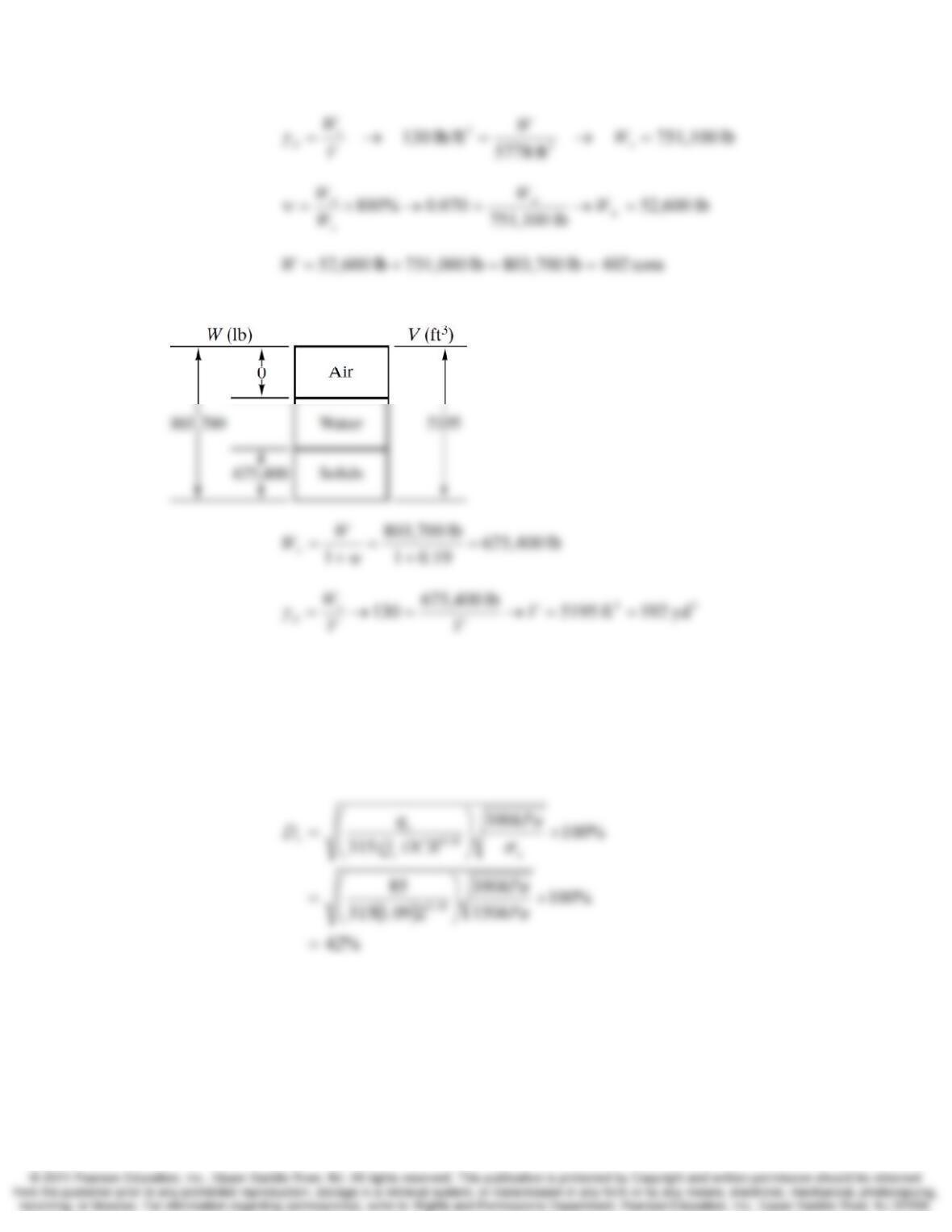
4.11 A contractor needs 214 yd3 of aggregate base material for a highway construction project.
It will be compacted to a dry unit weight of 130 lb/ft3. This material is available in a
stockpile at a local material supply yard, but is sold by the ton, not by the cubic yard.
The moisture content of the stockpile is 7.0%.
(a) How many tons of aggregate base material should the contractor purchase to have
exactly the correct volume of compacted material?
(b) The contractor purchased the material per the computation in part (a), and it
exactly met the needs at the project site. An intense rainstorm occurred the
following week, which delayed further construction and raised the moisture
content of the stockpile to 19.0%. Now, the contractor needs to prepare another
identical section of aggregate base and is ordering the same number of tons as
before. How many cubic yards of compacted aggregate base will be produced
from this second shipment? How will it compare with the first shipment?
Explain.
Solution
a.
(
)
(
)
3333 ft 5778/ydft 27yd 214 ==V
Chap. 4 Soil Composition 4-9
b.
4.12 A cone penetration test has been conducted, and has measured a cone resistance of 85
kg/cm2 at a depth of 10 m. The vertical effective stress at this depth is 150 kPa, and the
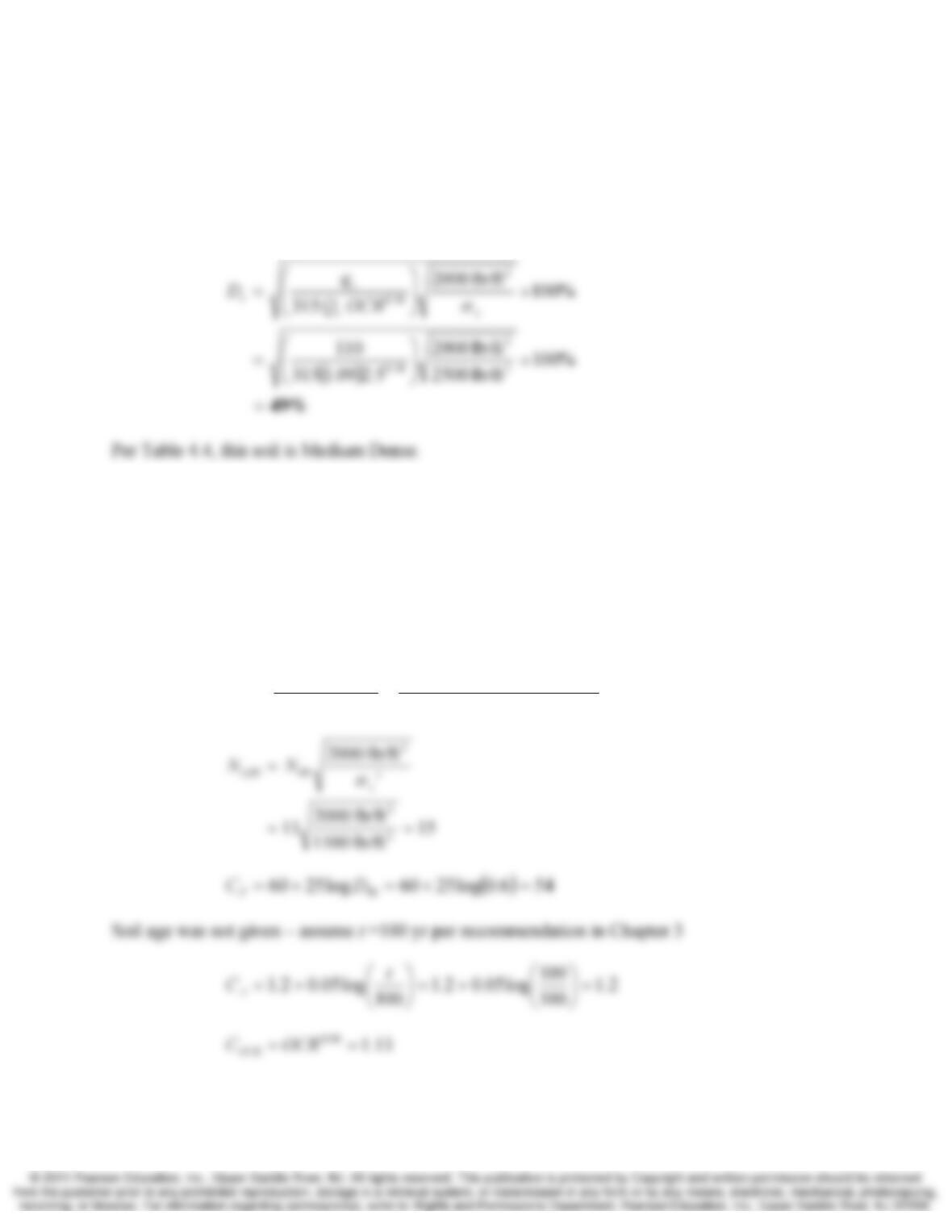
overconsolidation ratio is 2. The soils at this depth are quartz sands. Compute the
relative density, and classify the soil using Table 4.4.
Solution
Per Table 4.4, this soil is Medium Dense.
4-10 Soil Composition Chap. 4
4.13 A cone penetration test has been conducted, and has measured a cone resistance of 110
ton/ft2 at a depth of 20 ft. The vertical effective stress at this depth is 2500 lb/ft2, and the
overconsolidation ratio is 2.5. The soils at this depth are clayey sands. Estimate the
relative density, and classify the soil using Table 4.4.
Solution
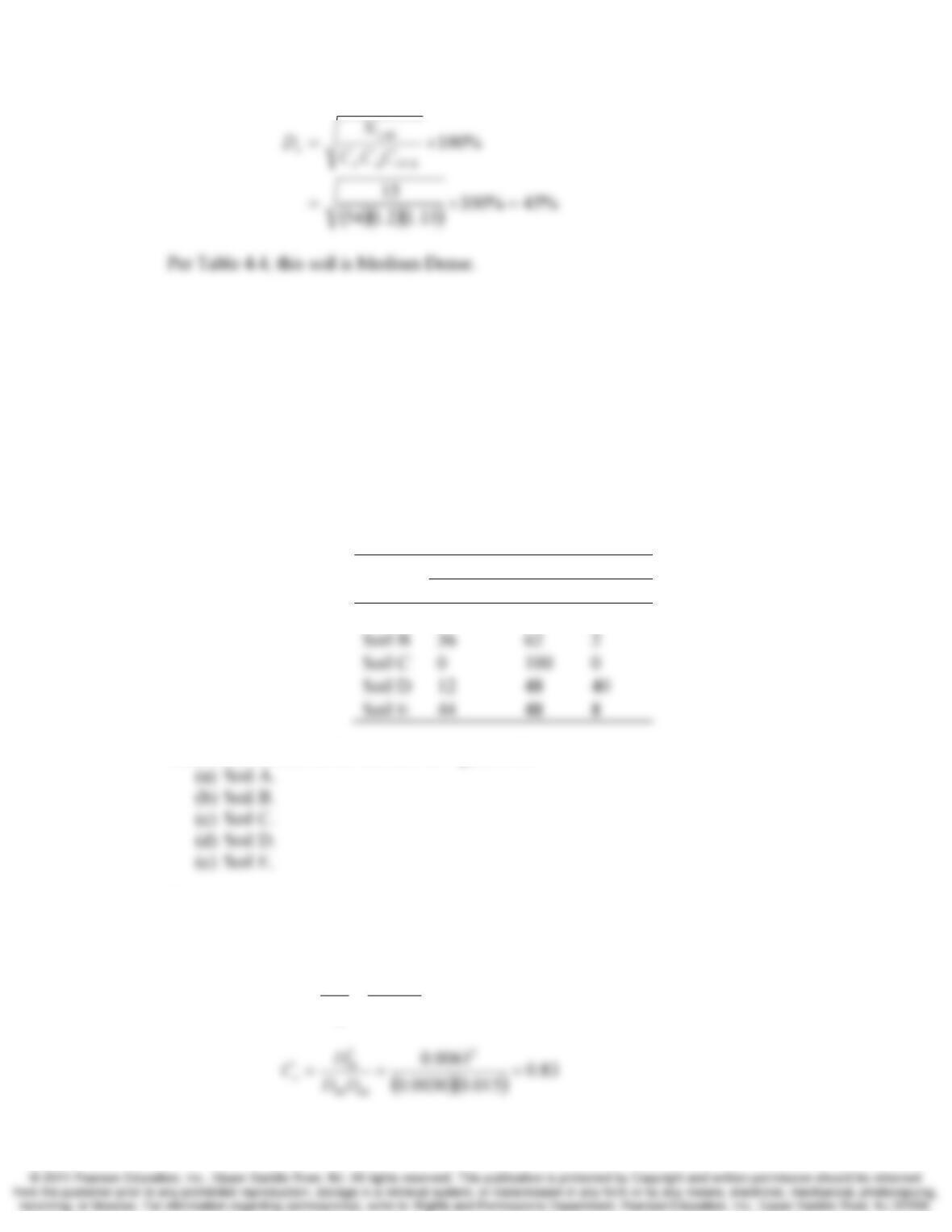
4.14 A standard penetration test has been conducted at a depth of 15 ft in an 8-inch diameter
exploratory boring using a USA-style safety hammer and a standard sampler. This test
produced an uncorrected N-value of 12. The soil inside the sampler was a fine-to-
medium sand with D50 = 0.6 mm. The vertical effective stress at this depth is 1100 lb/ft2.
Adjust the N-value as described in Chapter 3, then compute the relative density and
classify the soil using Table 4.4.
Solution
(
)
(
)
(
)
(
)
(
)
11
60.0
1285.000.115.157.0
60.0
60 === NCCCE
NRSBm
Chap. 4 Soil Composition 4-11
Section 4.4 Particle Size and Shape
4.15 Determine the percent gravel, percent sand, and percent fines for this soil in Figure 4.13:
(a) Soil A.
(b) Soil B.
(c) Soil C.
(d) Soil D.
(e) Soil E.
Solution
Percent
Gravel Sand Fines
Soil A 0 12 88
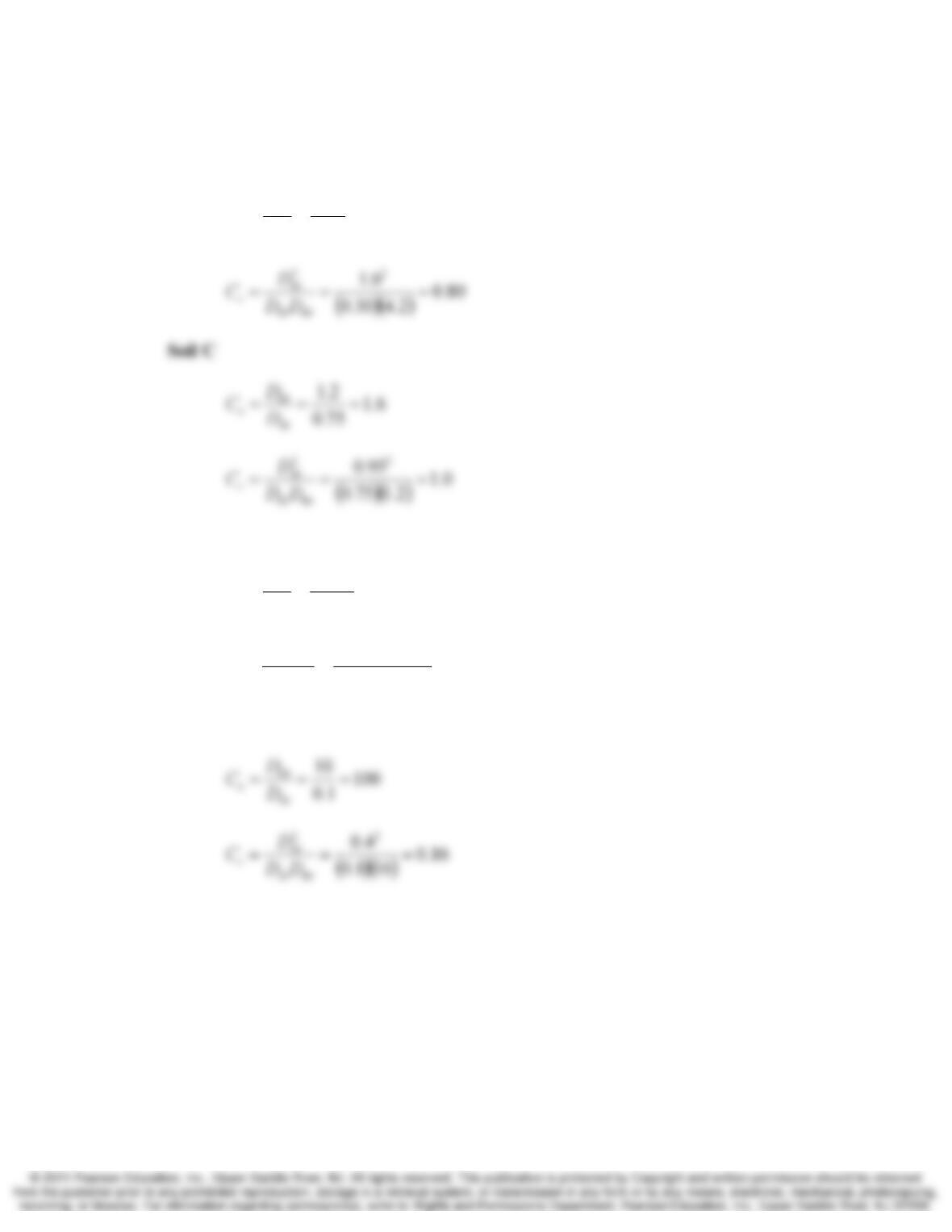
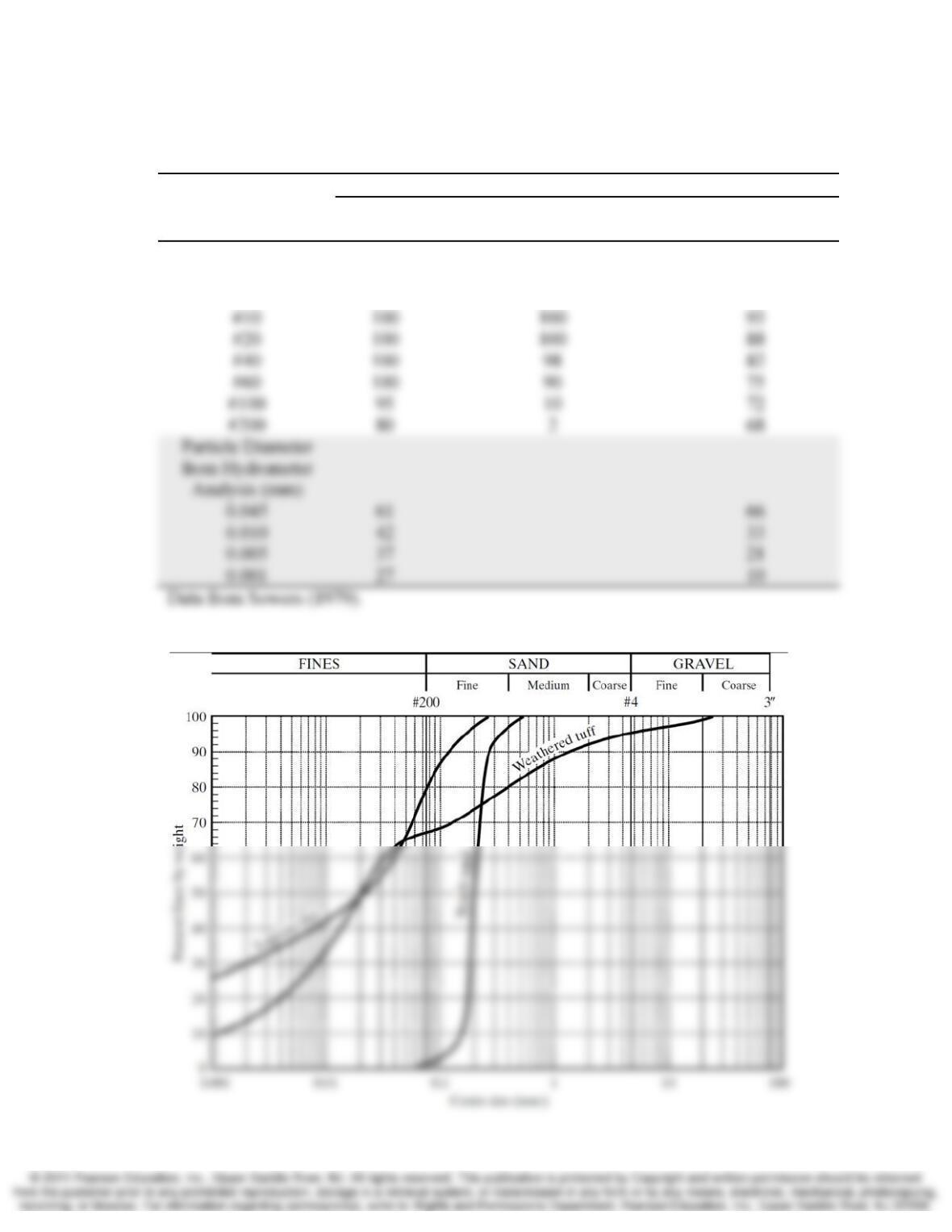
Determine Cu and Cc for this soil in Figure 4.13:
Solution
Soil A
5.0
0030.0
015.0
10
60 === D
D
Cu
4-12 Soil Composition Chap. 4
Soil B
14
30.0
2.4
10
60 === D
D
Cu
Soil D
250
002.0
50.0
10
60 === D
D
Cu
()()
0.9
50.0002.0
03.0 2
6010
2
30 === DD
D
Cc
Soil E
Chap. 4 Soil Composition 4-13
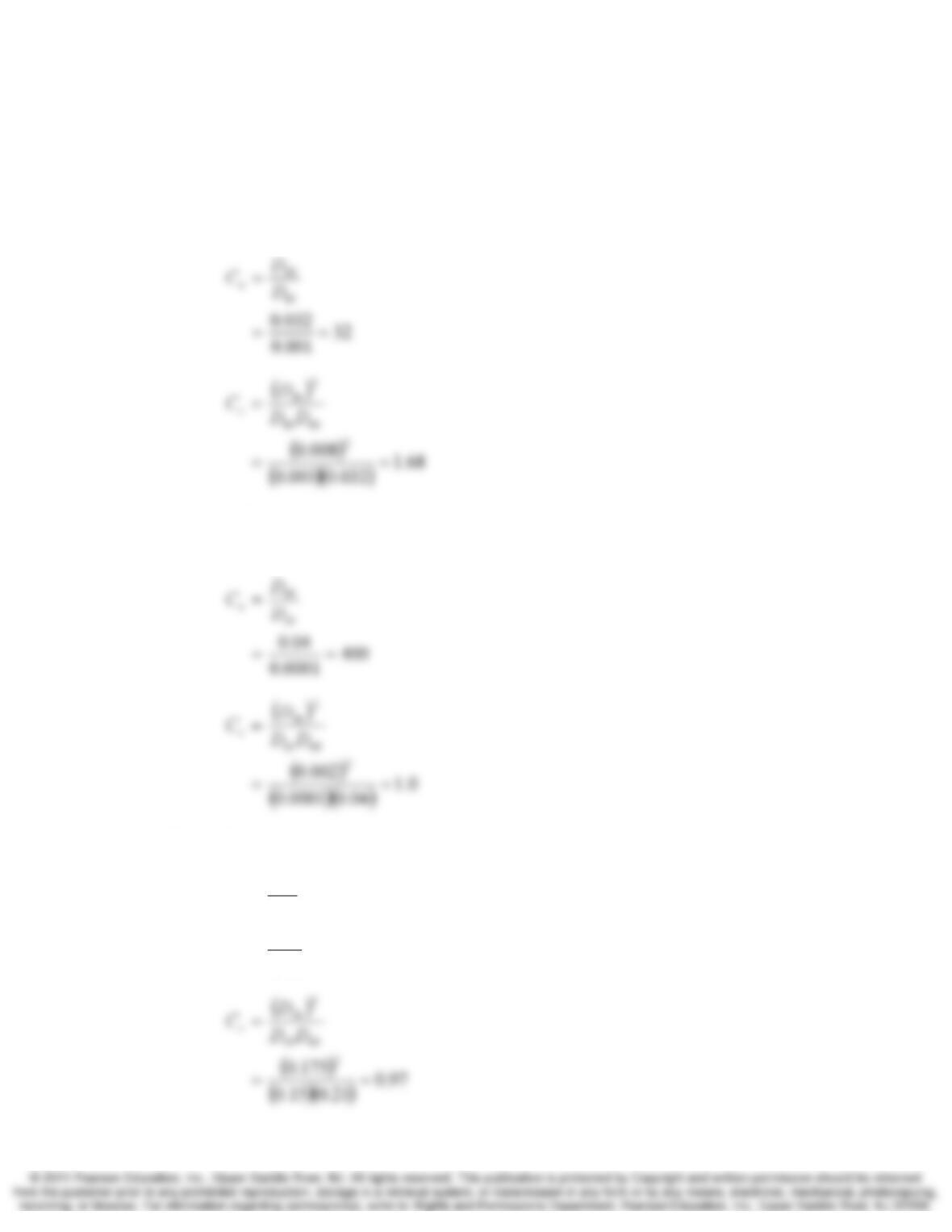
4.16 Plot the particle size distribution curve for each of the three soils the data for which are
given below. All three curves should be on the same semi logarithmic diagram.
Sieve Number
% Passing by Weight
Lagoon Clay
Beufort, SC
Beach Sand
Daytona Beach, FL
Weathered Tuff
Central America
3/4 in 100 100 100
½ in 100 100 98
#4 100 100 95
Solution
4-14 Soil Composition Chap. 4
4.17 Determine Cu and Cc for each of the three soils in Problem 4.17. Which of these soils is
most well-graded? Why?
Solution
Weathered Tuff
Lagoon Clay
Assume D10 = 0.0001 mm
Beach Sand
4.1
15.0
21.0
10
60
==
=D
D
Cu