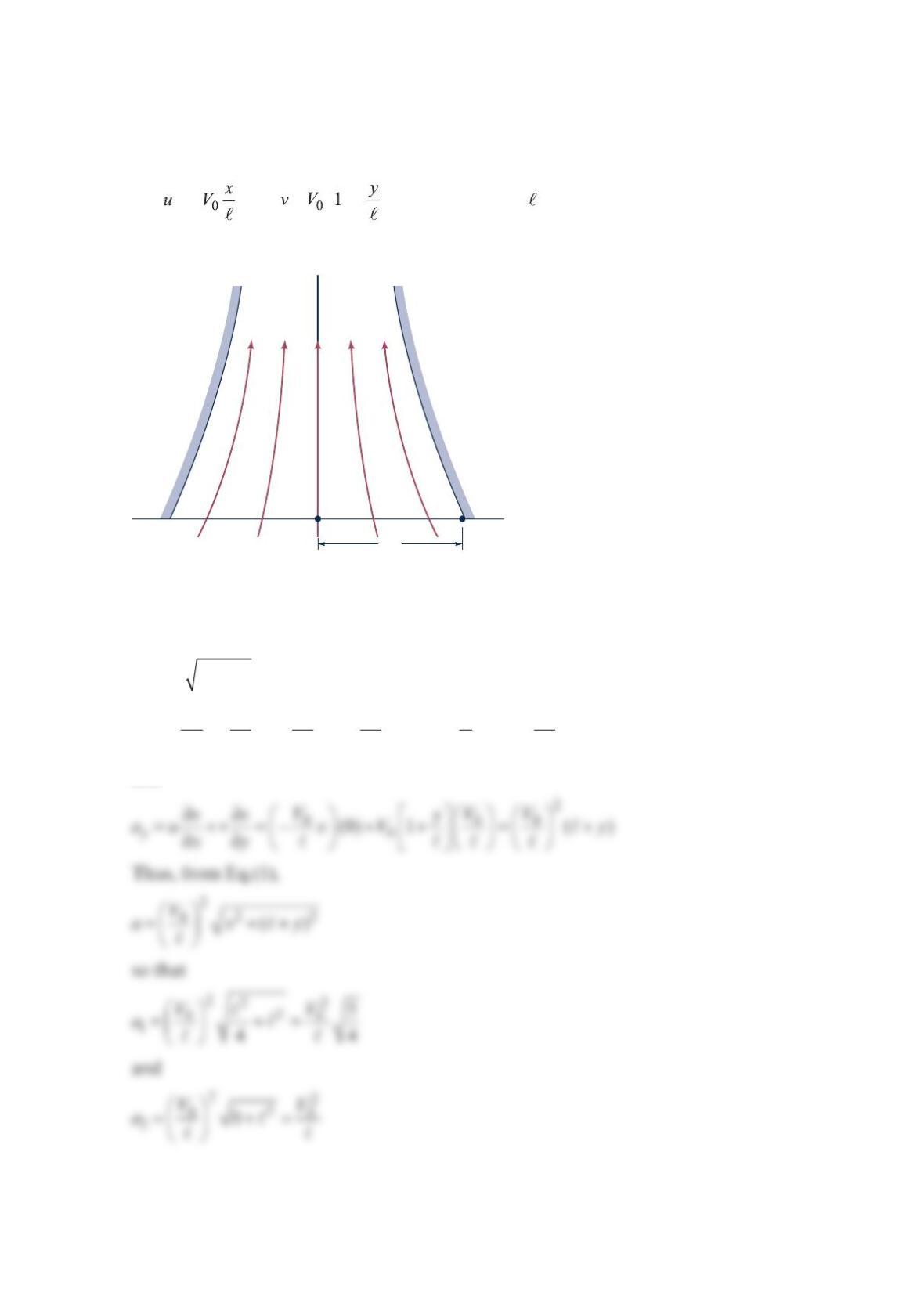
Problem 4.48
The velocity components for steady flow through the nozzle as shown in the figure below
are =−
and
=+
, where 0
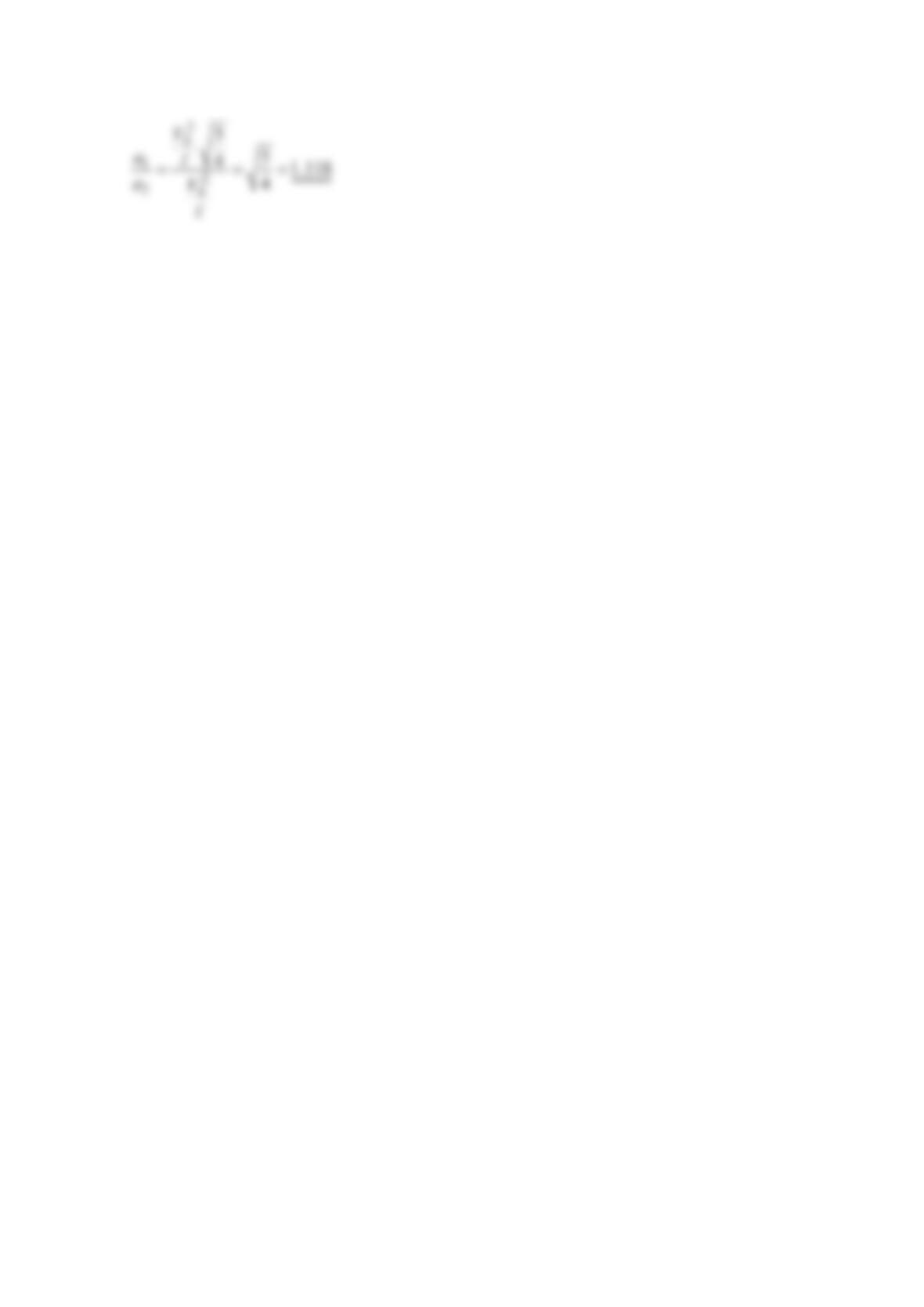
V and are constants. Determine the ratio of
the magnitude of the acceleration at point (1) to that at point (2).
Solution 4.48
(1) =+
22
xy
a
aa
, where
∂∂
=+=− −++ =
∂∂
2
00 0
01(0)
x
VV V
uu y
a
uv x V x
xy
and
x
y
(1)
(2)
ℓ/2
a
Hence,
Problem 4.49
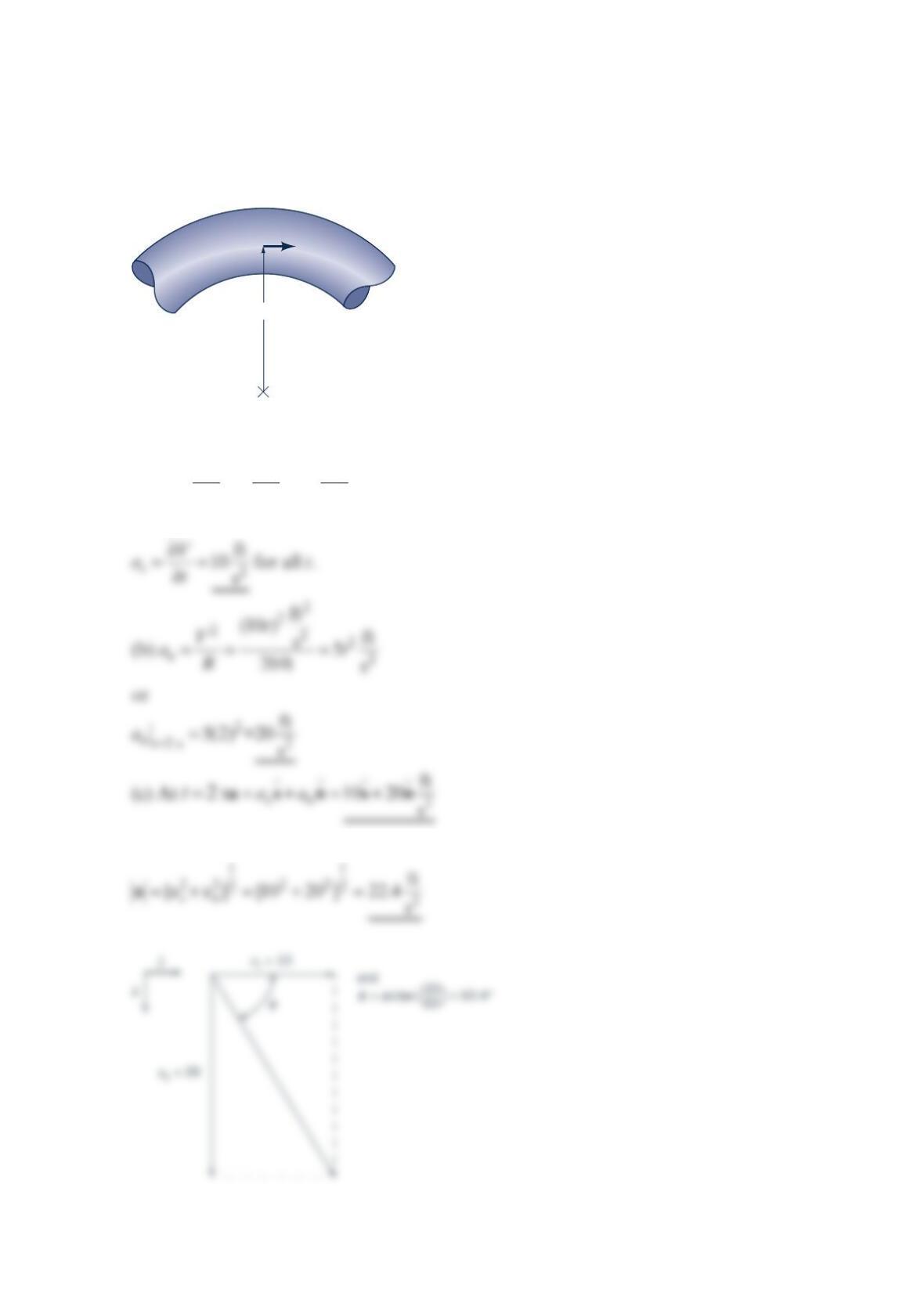
Water flows through the curved hose as shown in the figure below with an increasing speed
of =10 ft/sVt
, where
t
is in seconds. For =2 st, determine (a) the component of acceleration
along the streamline, (b) the component of acceleration normal to the streamline, and (c)
the net acceleration (magnitude and direction).
Solution 4.49
(a) ∂∂
=+
∂∂
s
VV
a
V
ts
, but ∂=
∂0
V
s
Thus,
or
V
ℛ
= 20 ft
Problem 4.50
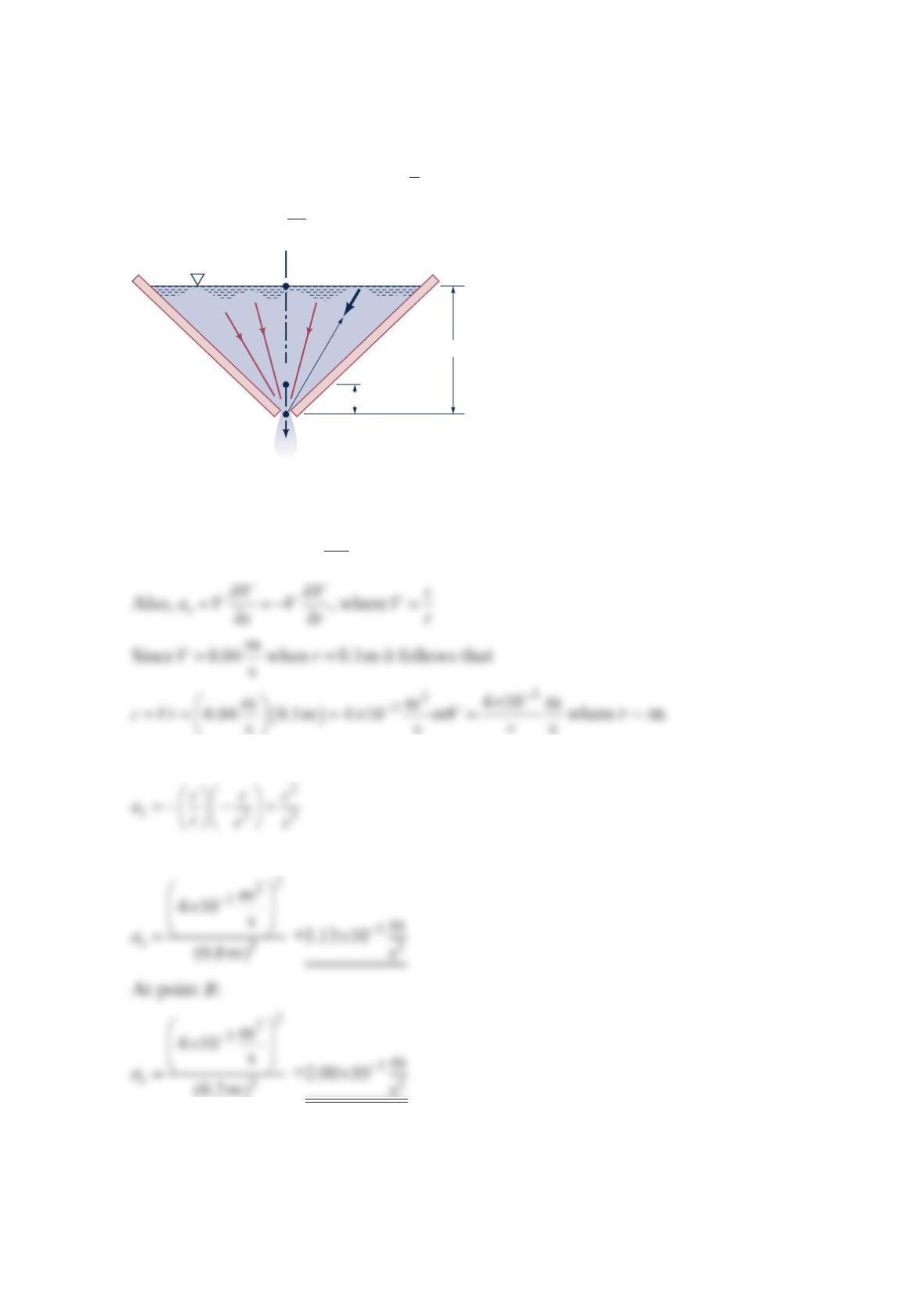
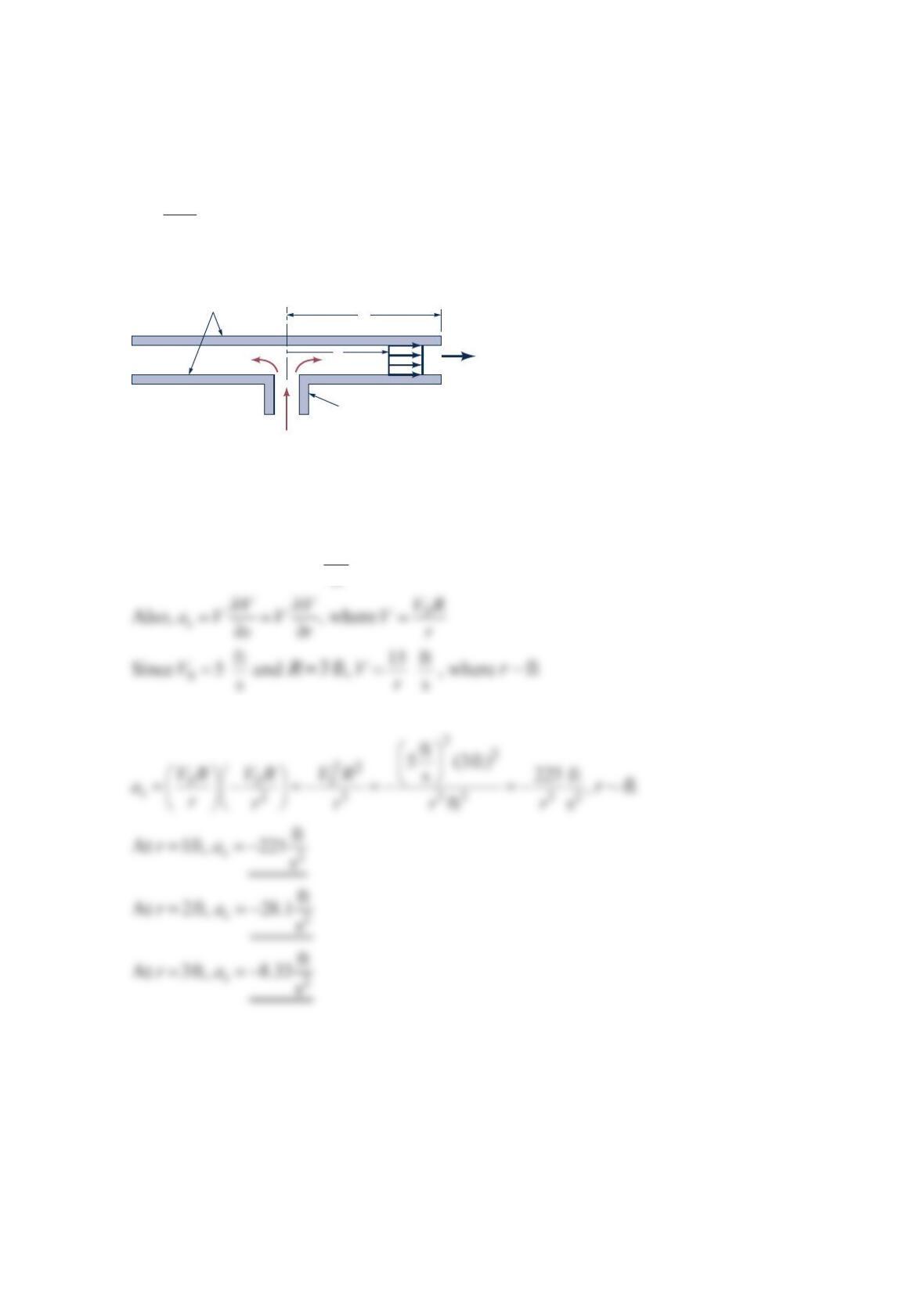
Water flows though the slit at the bottom of a two-dimensional water trough as shown in
the figure below. Throughout most of the trough the flow is approximately radial (along
rays from
O
) with a velocity of =c
V
r, where
r
is the radial coordinate and
c
is a constant. If
the velocity is m
0.04 swhen =0.1
m
r, determine the acceleration at points
A
and B.
Solution 4.50
=+
ns
aaans
, where ==
2
0
n
V
a
R since =∞
R
(i.e., the streamlines are straight)
Thus,
At point
A
:
A
r
V
B
O
0.2 m
0.8 m
V
V
m
Problem 4.51
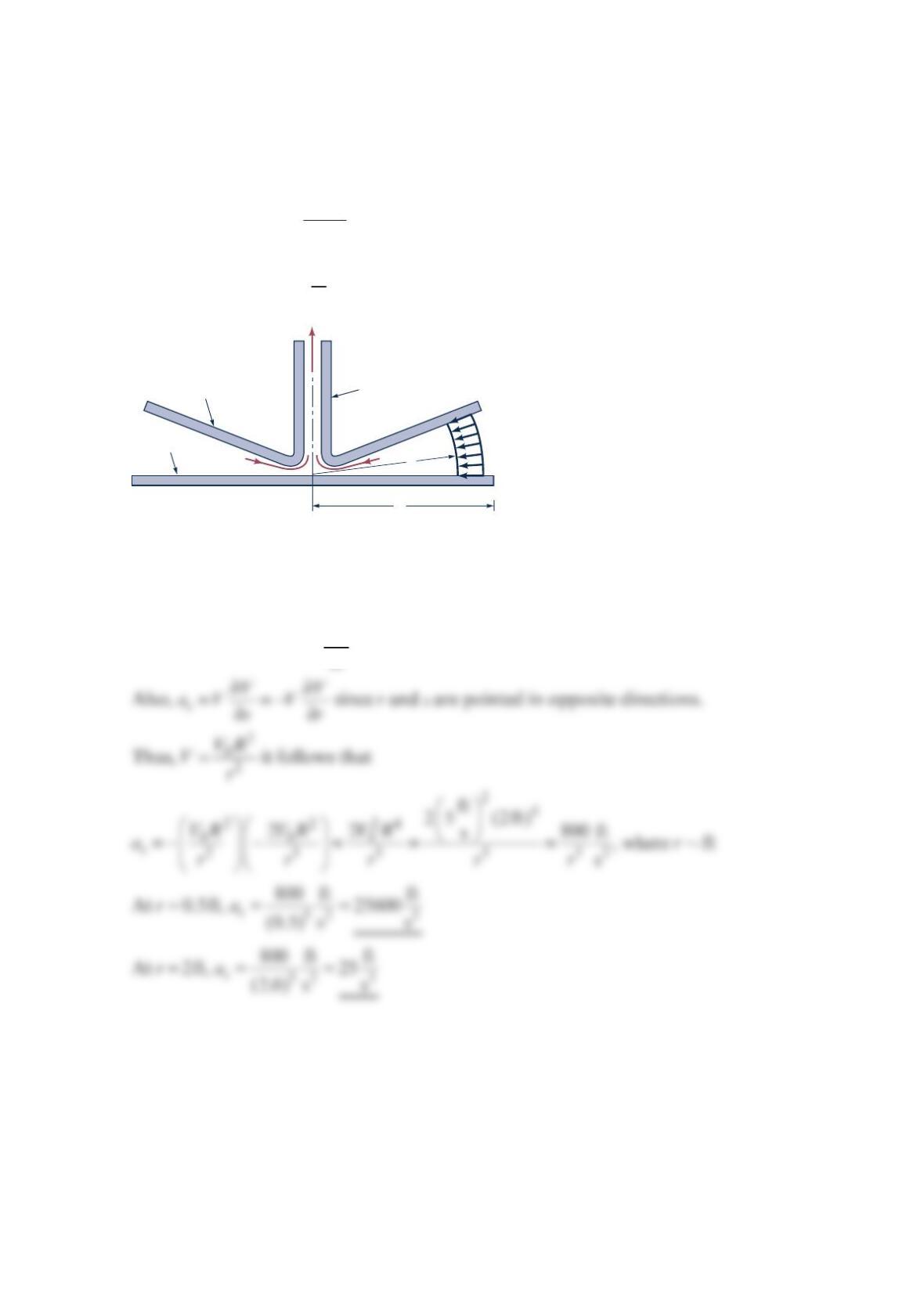
Air flows from a pipe into the region between two parallel circular disks as shown in the
figure below. The fluid velocity in the gap between the disks is closely approximated by
=0
VR
V
r, where
R
is the radius of the disk,
r
is the radial coordinate, and 0
V
is the fluid
velocity at the edge of the disk. Determine the acceleration for =1, 2 or 3 ftr if =
05 ft/sV
and =3 ft
R
.
Solution 4.51
=+
ns
aaans
, where ==
2
0
n
V
a
R since =∞
R
(i.e., the streamlines are straight)
Thus,
Disks
R
rV
0
V
Pipe
R
Problem 4.52
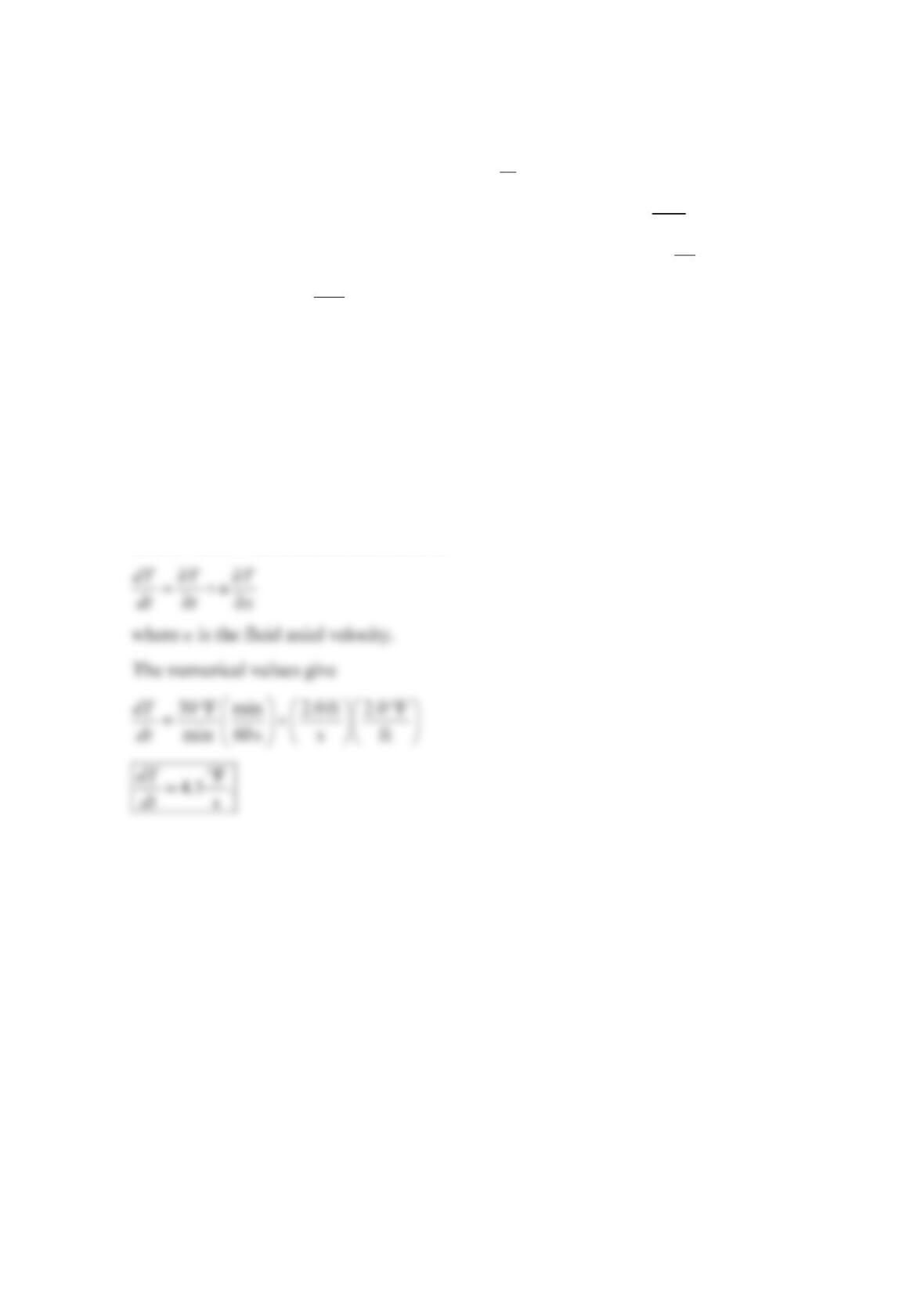
Air flows into a pipe from the region between a circular disk and a cone as shown in the
figure below. The fluid velocity in the gap between the disk and the cone is closely
approximated by =
2
0
2
VR
V
r, where
R
is the radius of the disk,
r
is the radial coordinate,
and 0
V
is the fluid velocity at the edge of the disk. Determine the acceleration for
=0.5 or 2 ftr if =
0
ft
5 s
V
and =2 f
t
R
.
Solution 4.52
=+
ns
aaans
, where ==
2
0
n
V
a
R since =∞
R
(i.e., the streamlines are straight)
Cone
Disk
Pipe
R
r
V
r
Problem 4.53
Fluid flows through a pipe with a velocity of ft
2
s and is being heated, so the fluid
temperature T at axial position x increases at a steady rate of °F
3
0.0 min. In addition, the
fluid temperature is increasing in the axial direction at the rate of °F
2
.0 ft . Find the value of
the material derivative DT
Dt at position x.
Solution 4.53
GIVEN: Fluid velocity in x direction is
2
.0ft/
s
where fluid temperature is increasing
at a steady rate of °
3
0F/mi
n
and fluid temperature increases in axial direction at rate
of °
2
.0 F/ft.
FIND: Value of Eulerian derivative at axial position x.
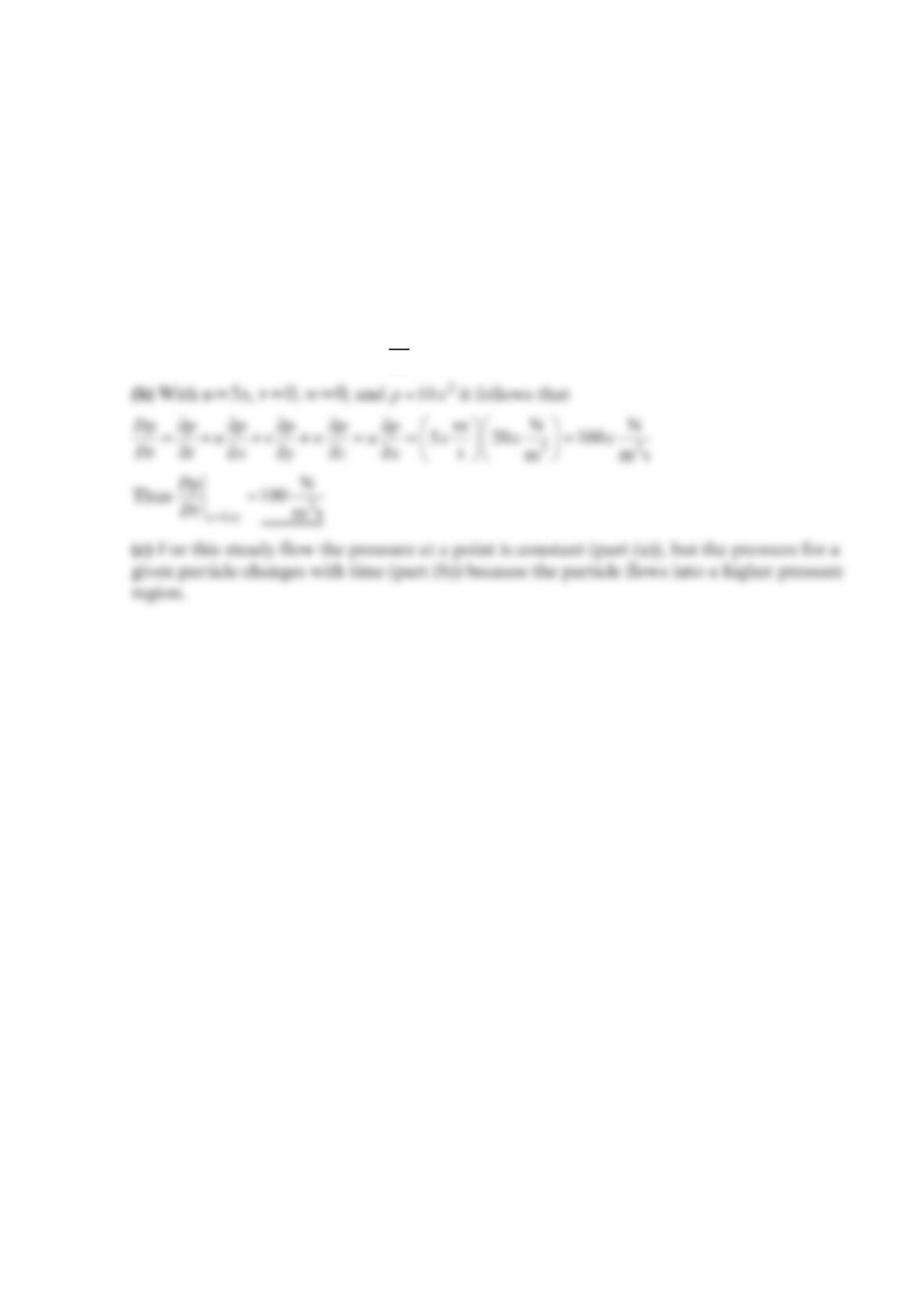
SOLUTION: The Eulerian derivative is
Problem 4.54
A gas flows along the x axis with a speed of =5m/s
V
x and a pressure of =22
10 N/m
p
x,
where x is in meters. (a) Determine the time rate of change of pressure at the fixed location
=
1
x. (b) Determine the time rate of change of pressure for a fluid particle flowing past =
1
x.
(c) Explain without using any equations why the answers to parts (a) and (b) are different.
Solution 4.54
(a) Since =2
10
p
x it follows that ∂=
∂0
p
t for all x.
0
p
Problem 4.55
Assume the temperature of the exhaust in an exhaust pipe can be approximated by
ω
−
=+ +
0(1 e )[1 cos( )]
bx
TT a c t
, where =
0100°CT, =
3
a
, −
=1
0.03m
b
, =0.0
5
c, and
ω
=100 rad/s. If the exhaust speed is a constant
3
m/s, determine the time rate of change of
temperature of the fluid particles at =0x and =4mx when =
0
t.
Solution 4.55
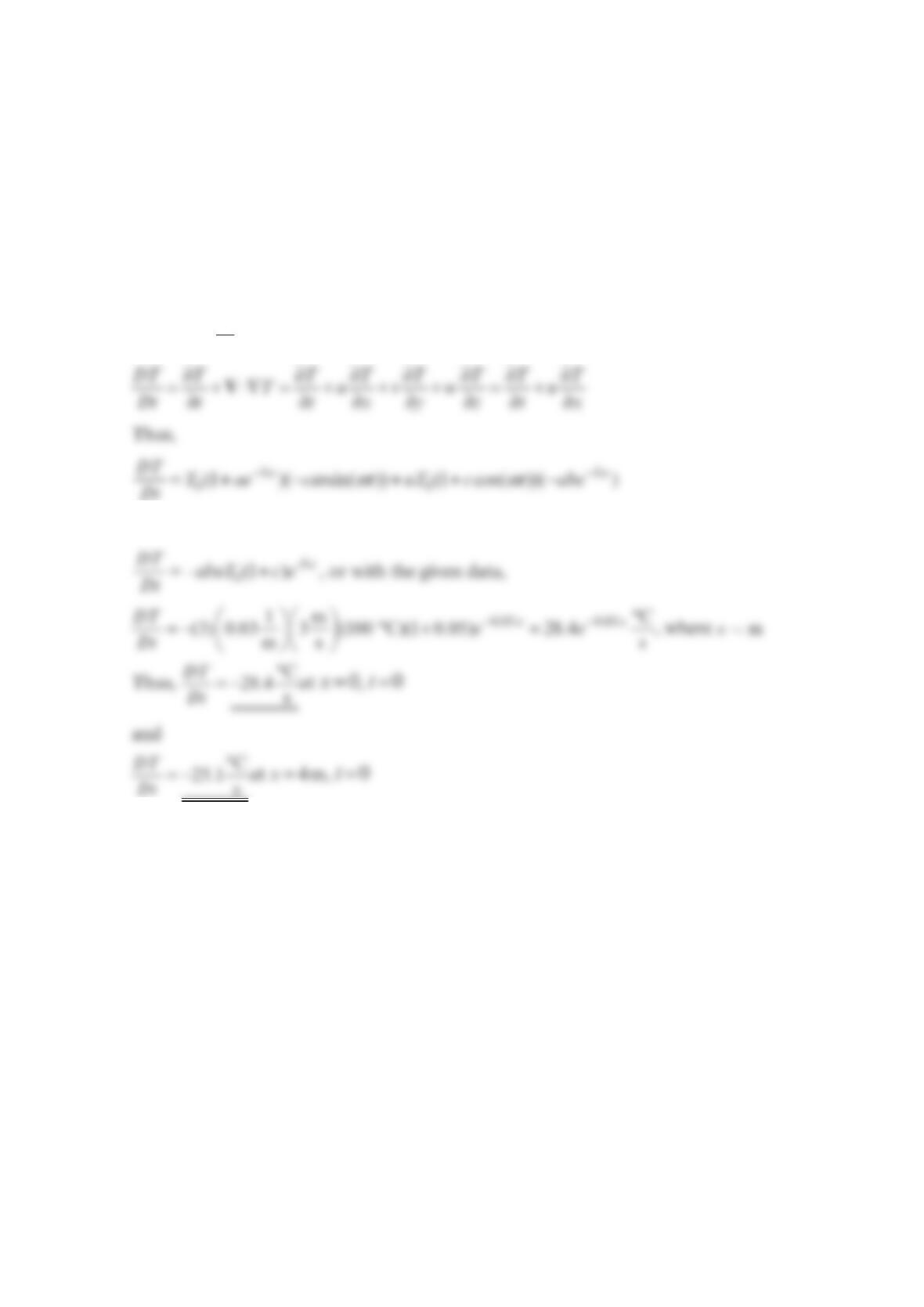
Since =m
3s
u, =0v, and =
0
w it follows that
when 0t=:
Problem 4.56
A bicyclist leaves from her home at
9
A.M. and rides to a beach 40 mi away. Because of a
breeze off the ocean, the temperature at the beach remains 60 °
F
throughout the day. At the
cyclist’s home the temperature increases linearly with time, going from 60 °
F
at
9
A.M. to
80 °
F
by
1 P.M. The temperature is assumed to vary linearly as a function of position
between the cyclist’s home and the beach. Determine the rate of change of temperature
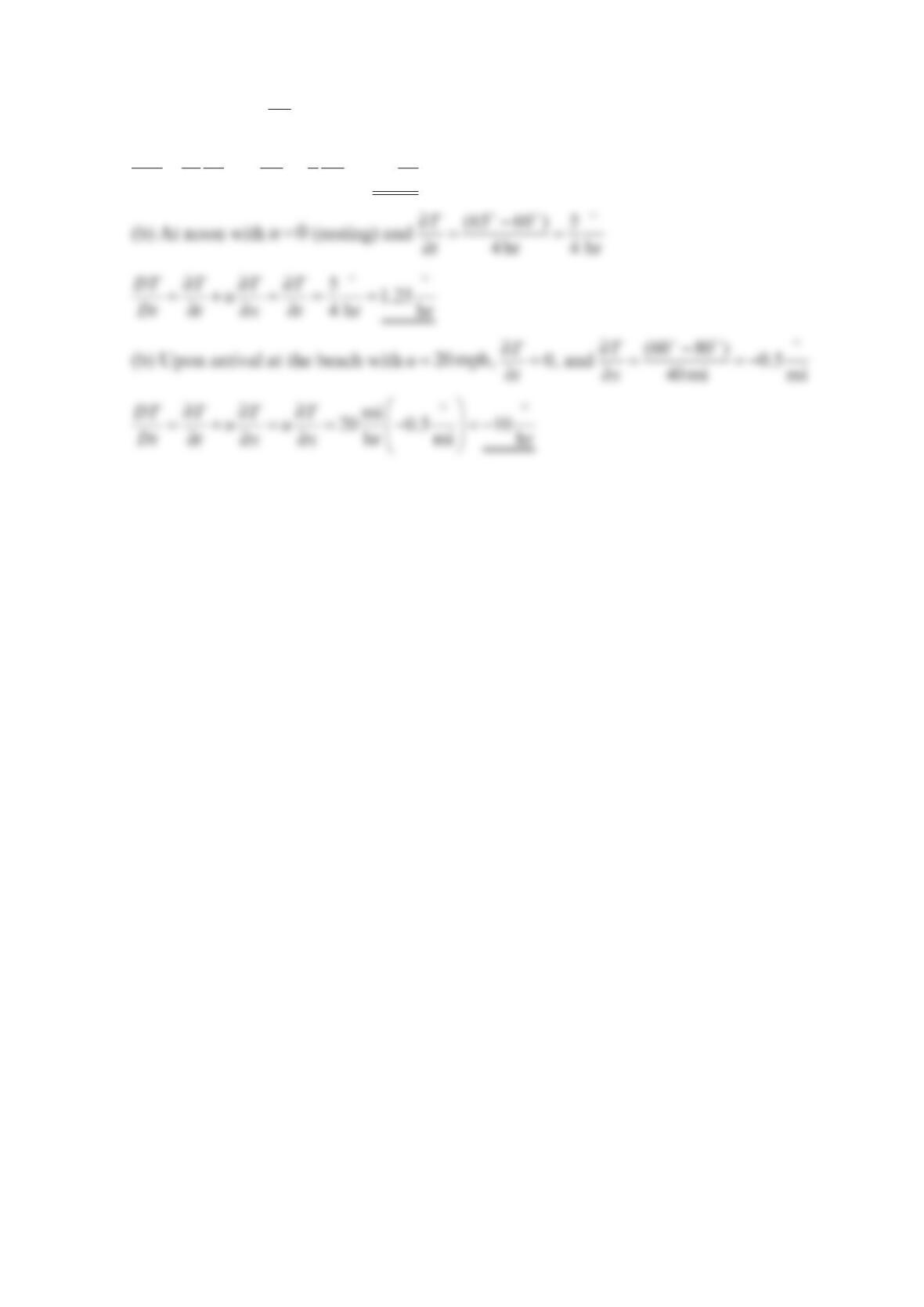
observed by the cyclist for the following conditions: (a) as she pedals
1
0 mp
h
through a
town
10 m
i
from her home at
10 A.M.; (b) as she eats lunch at a rest stop 30 m
i
from her
home at noon; (c) as she arrives enthusiastically at the beach at
1 P.M., pedaling
2
0 mph.
Solution 4.56
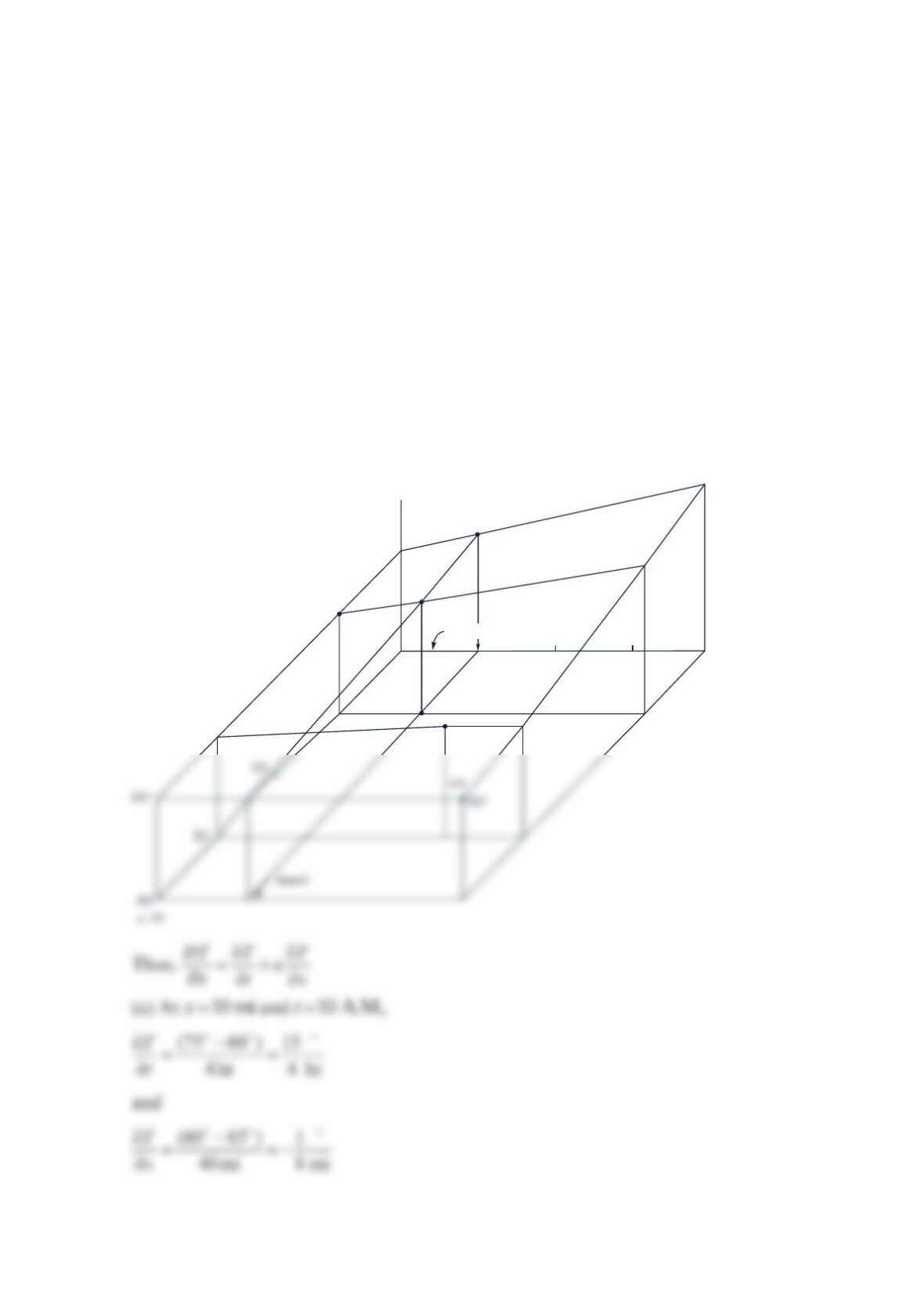
From the given data, the temperature, T, varies as a function of location, x, and time,
t
, as
shown in the figure.
60°
10
91011121
75°
80°
65°
60°
60°
65°
(b)
(a)
T
t
home
Thus, with =mi
10 hr
u,
=+ − =
15 mi 1
10 2.5
4hr hr 8mi hr
DT
Dt
Problem 4.57
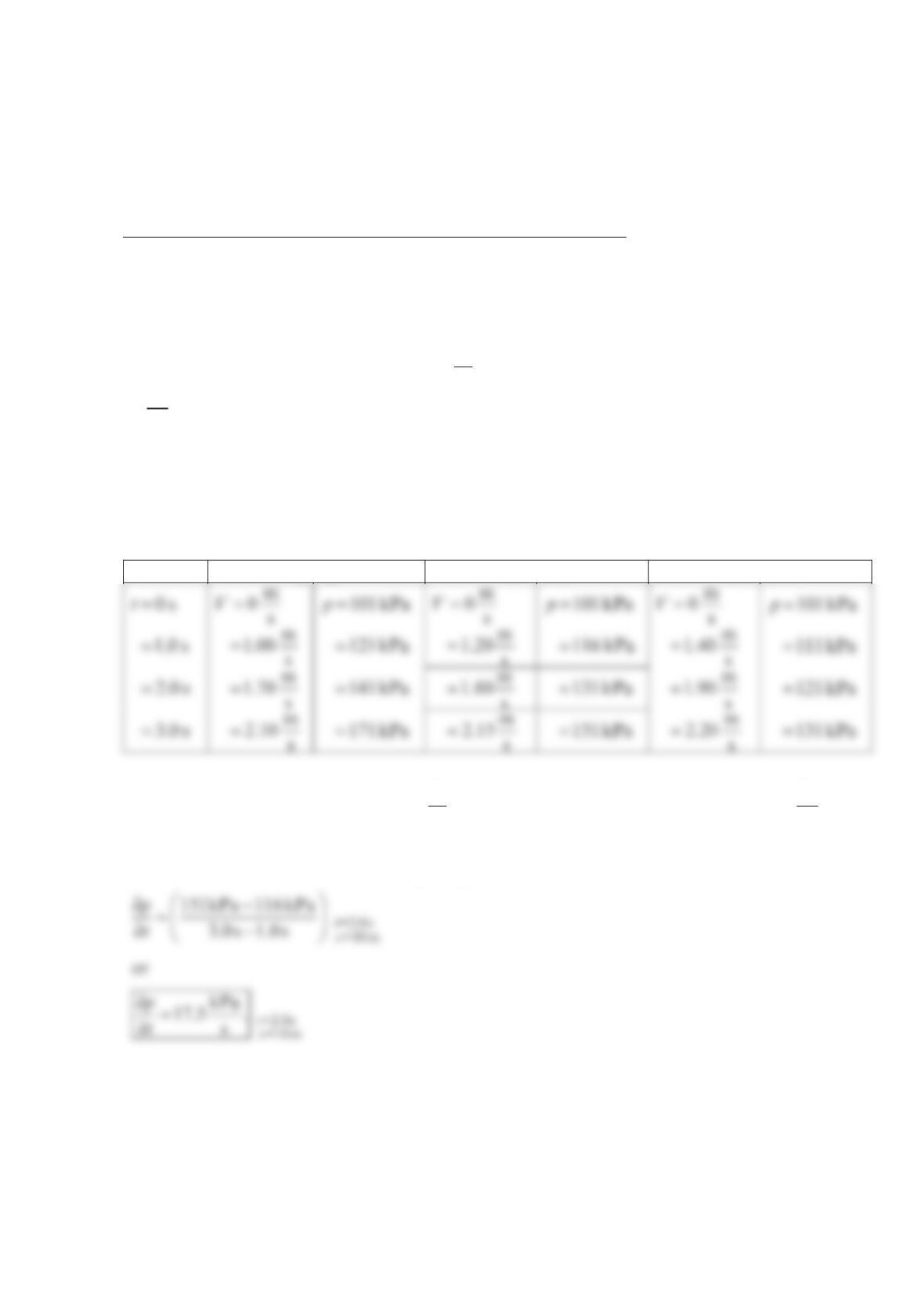
Air is delivered through a constant-diameter duct by a fan. The air is inviscid, so the fluid
velocity profile is “flat” across each cross section. During the fan start-up, the following
pressures for the air flow were measured at the time
t
and axial positions x:
=0x =10
m
x=20
m
x
0st= 101 kP
a
p
= 101 kP
a
p
=101 kP
a
p
=
1.0 st=121 kP
a
p
=116 kPa
p
=111 kP
a
p
=
2.0 st=141 kP
a
p
=131 kP
a
p
=121 kP
a
p
=
3.0 st=171 kP
a
p
=151 kP
a
p
=131 kP
a
p
=
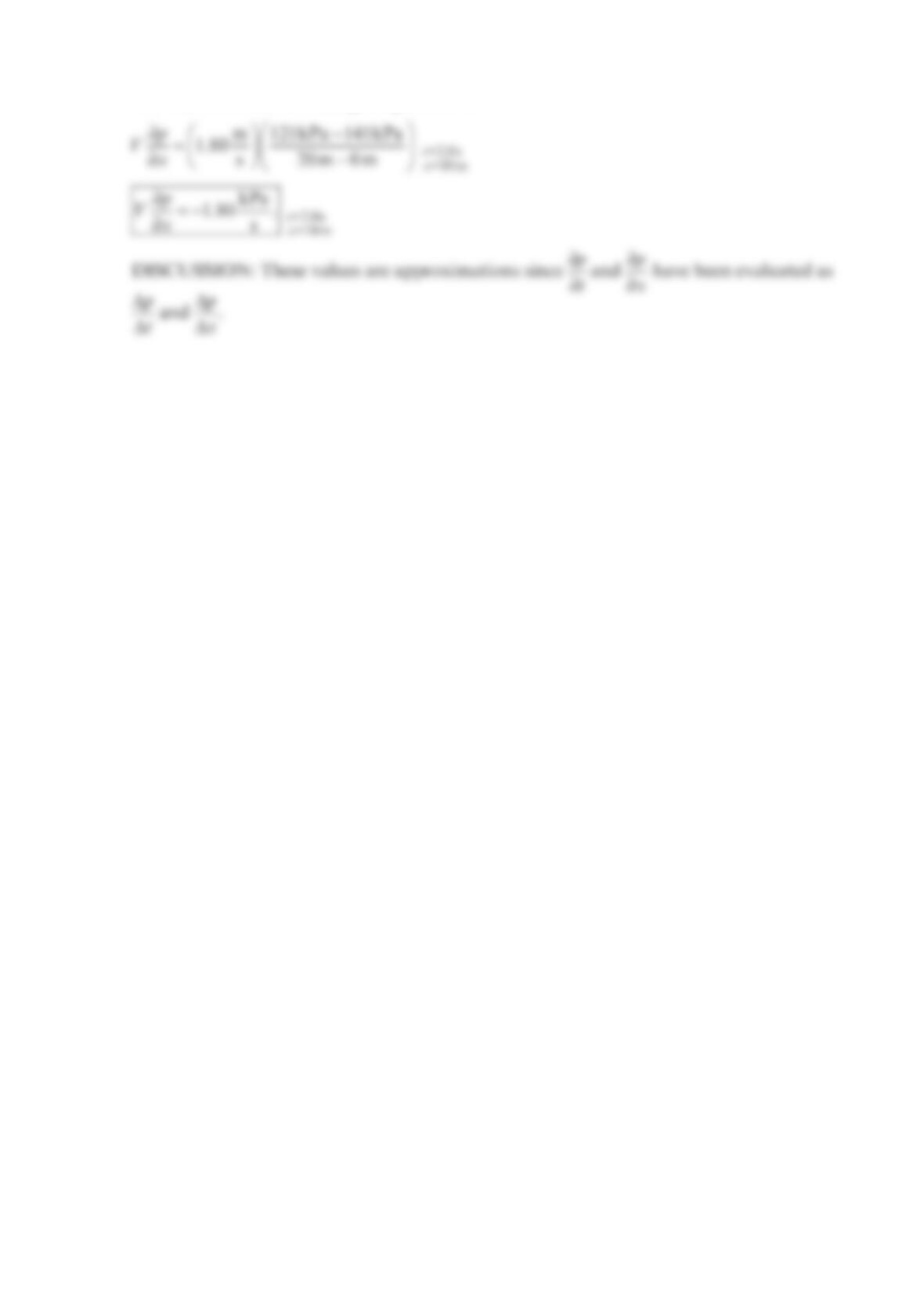
Find the local rate of change of pressure ∂
∂
p
t and the convective rate of change of pressure
∂
∂
p
V
xat =2.0st and =10
m
x.
Solution 4.57
GIVEN: Air velocity and pressure in duct.
Axial position x and time
t
=0x=10
m
x=20
m
x
FIND: Local rate of change pressure ∂
∂
p
t and convective rate of change of pressure ∂
∂
p
V
x at
=2.0 st and =10
m
x.
SOLUTION: The local rate of change of pressure is
V
a
p
V
a
p
V
a
p
The convective rate of change of pressure is