6-1
Baldwin Bicycle Company
Teaching Commentary
OVERVIEW
This short but very rich case is particularly useful for illustrating “strategic accounting” because the conclusions that
emerge from a “relevant cost” analysis diverge so widely from the conclusions suggested by a “strategic cost” analysis.
In order to contrast the two perspectives, we will first present the “relevant cost” analysis—an exercise in financial
analysis for a potential “extra chunk” of business. We then present the “strategic analysis” of the case.
This strategic analysis, based heavily on concepts articulated in marketing strategy and in competitive strategy
RELEVANT COST ANALYSIS OF THE HI-VALU OFFER
This perspective would typically consider cost behavior as a starting point. From case facts, it is not difficult to
deduce that the incremental cost of producing a Challenger bike is about $69 (material, direct labor, and about $9+ of
6-2
A second element of the relevant cost analysis
would typically be the cost of carrying the incremental
Raw Material (2 months stock)
~ 4,000 bikes x ~ $40 = ~ $160,000
Work in process (1000 units)
Finished units in the HV warehouse
per case “facts,” about 2 months
supply, on average
~ 4,000 bikes ~ $69 = ~ $280,000
(Less a trade credit offset)
Assume 45 days credit from
the materials suppliers
~ 3,000 bikes ~ $40 = (~ $120,000)
• Cost of Capital is some form of weighted average
across the debt and equity capital sources used by
the firm.
be 13%, assuming 1/3 debt and 2/3 equity in the
capital structure {[1/3 (18%x.5)] + 2/3(15%)}.
• Incremental carrying cost seems to be about 4% a
Combining these two components of the
carrying cost calculation produces an annual cost
bike to about $5 per bike. This is well below the
$11.50 after tax marginal contribution [($92 – $69)
.5], even at the high end of the investment and carry
cost range.
A third element of the relevant cost analysis
Whether or not an erosion charge is relevant is
6-3
arguable. Assuming that 3,000 customers who
otherwise would have bought a Baldwin bicycle do in
fact buy a Challenger bicycle, the lost profit is certainly
real to Baldwin. On the other hand, it probably is
them. In this context, focusing on the “erosion” is not
only arrogant (our products are impervious to decline
unless we cannibalize them), but also short sighted (we
lose the opportunity to sell new products but sales of
the old products decline anyway). Thus, a strong
argument can be made to exclude the erosion charge.
Summarizing the components of the cost
analysis, we can calculate the incremental profitability
as follows:
This is a very attractive return!
This is clearly only a first approximation of the
incremental return because it ignores the time value of
money. A multiperiod, discounted cash flow approach
would be preferable. Also, it leaves open the time
excess capacity, unused though it currently is, for
several years at well below normal prices?)
• the long-run/short-run cost issue (is it really
Only the last one of these five potential
concerns requires additional analysis. The other four
are more qualitative than quantitative. The debt
capacity issue does require explicit attention.
The $2.6 million level of short-term debt is
very high for a year-end balance sheet for a company
like Baldwin. December 31 should be a point in the
year of nearly maximum liquidity for a manufacturer of
a seasonal, consumer durable product like bicycles.
moving” or even obsolete product. And, it is all
financed with short-term debt!
Even though the incremental residual income
from the project looks very attractive, it is problematic
whether the firm could justify borrowing yet another
$600,000 or so for the HV project. One imaginative
thought in this regard is reworking some of these bikes
6-4
On balance, this analysis comes down to very
attractive incremental short-run profits, coupled with
some qualitative caveats that mitigate, somewhat, this
• long-run versus short-run product and customer
profitability
• inventory and receivables carrying cost
Also, it treats these themes in a context that
involves sufficient marketing complexity (the erosion
issue, and the private label volume enhancement idea
for makers of branded products) and sufficient
uncertainty (the short-term debt crunch and the
structure of the consigned inventory provision) that it
will support excellent discussion with senior
STRATEGIC ANALYSIS OF THE HV OFFER
We are not aware of many cases in which the
strategic cost analysis yields such totally different
case. This is not a criticism of these managers; rather,
it is a comment on the prevailing narrow conception of
cost analysis among American businesses.
totally silent on these issues is further evidence of what
contemporary managerial accounting authors see as
“relevant” concerns. Based on general knowledge of
retailers’ profit margins and some estimating of freight
costs, it is possible to construct the following strategic
Necessary (inde- (discount
margin as % pendent merchan-
of sales price retailer) 40% diser) 25%
Implied Retail Price $200 $133
Is this difference of $67 reflective of a
sale merchandising, service) or “per–ceived” value
(brand image, dealer image) do obviously differ
between the two products. But, do they differ by $67
worth on a $200 purchase? This is a real issue.
It is also possible to develop a simple market
6-5
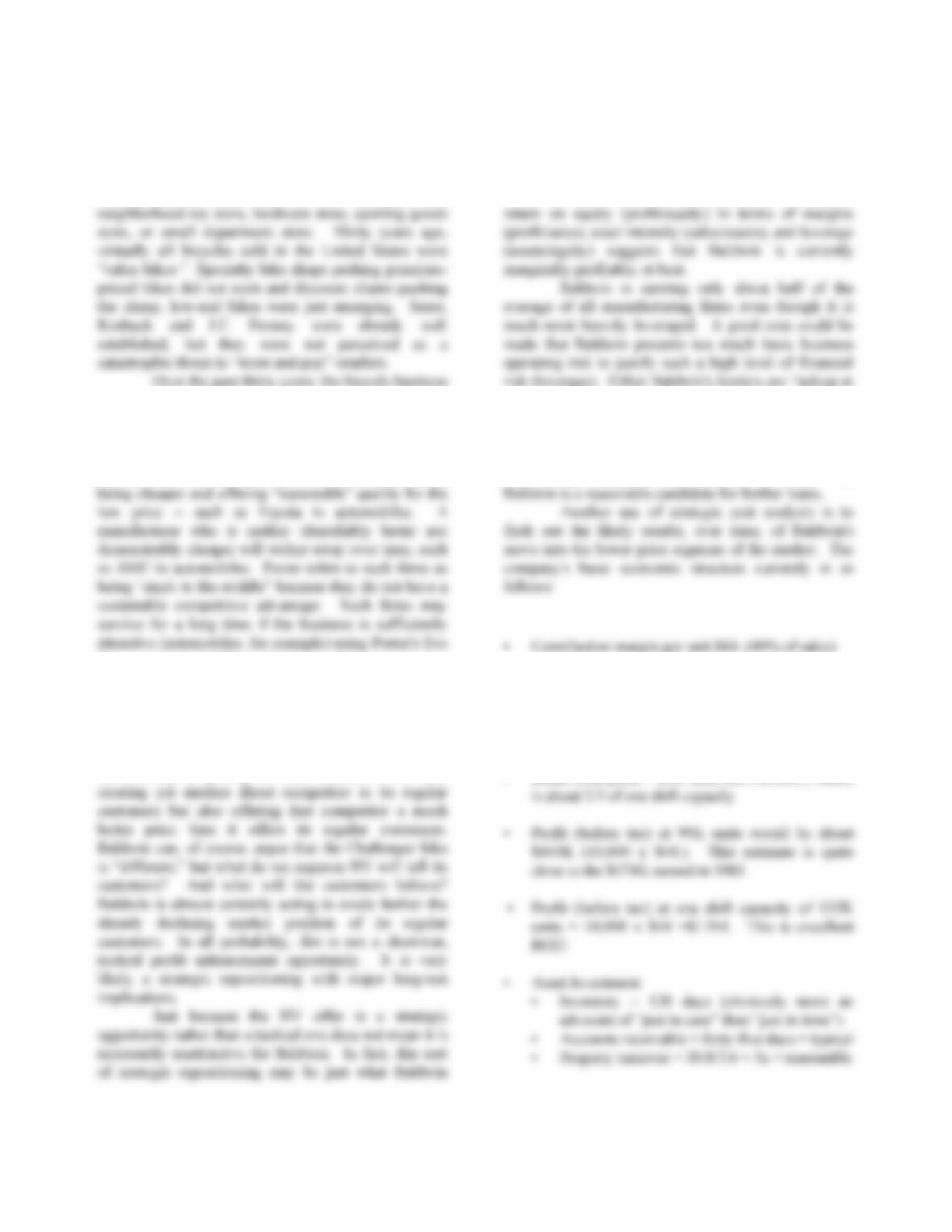
Exhibit A
Market Segmentation
Suppliers
Fuji
Bianci
Univega
Peugot
Trek
•
•
•
Reta il Pricin g
(1982)
$300 and
up fast
I. “P remium ” bike
High price/High quality
Sold through bike st ores
6-6
Drawing again upon general knowledge of
trends in retailing over the past few decades, it is very
likely that a big share of Challenger sales will come
from people who otherwise would have shopped in a
has developed almost exactly as Porter’s competitive
strategy framework would predict (Porter, 1980). One
can compete successfully by being different and by
commanding a premium price for that differentiation —
such as BMW in automobiles. Or, one can compete by
forces analysis and if growth rates and investment rates
do not force a quick shake out of the weaker players (as
they have done in microcomputers, for example). But
the firms that lack a sustainable competitive edge will
eventually wither. Their future is behind them!
This analysis suggests that what Baldwin is
really doing by putting HV into business is not only
needs. Cost analysis can play a significant role in
evaluating this strategic opportunity. Examining the
overall profitability of Baldwin is one way to assess the
attractiveness of its current strategic niche. Looking at
the switch” or they have been forced into the current
situation by supposedly short-term loans that became
long-term, de facto, when inventory was not converted
into sales. This strategic assessment of risk and return
relationships makes it much harder to argue that
• Fixed cost base (annually):
Manufacturing ~$1.5M
$3.9M
Selling & Administration ~2.4M }
• Break-even point = 89K units ($3.9M/$44.), which
6-7
• Fixed Cost % of Sales:
Manufacturing = 1.5/10.8 = ~14%
Selling & Administrative = 2.4/10.8 = ~22%
It is, in fact, true that bicycle sales in the
United States reached a peak of fifteen million units in
1973 and had declined to ten million units in 1982. It is
thus not surprising that Baldwin looks like a company
that sorely needs a lot more volume than it is getting.
they became so readily available in discount chains.
Chevrolet and Oldsmobile were totally different
automobiles in the 1950s. Many people believe that
supplying HV, but they do not have to cooperate with
HV’s strategy by offering the $200 Baldwin bike as the
“stalking horse” for the $133. Challenger bike. If they
normally stock two or three brands, to give their
customers a choice, they can add Huffy or Ross or
Murray or Schwinn and drop Baldwin from the set.
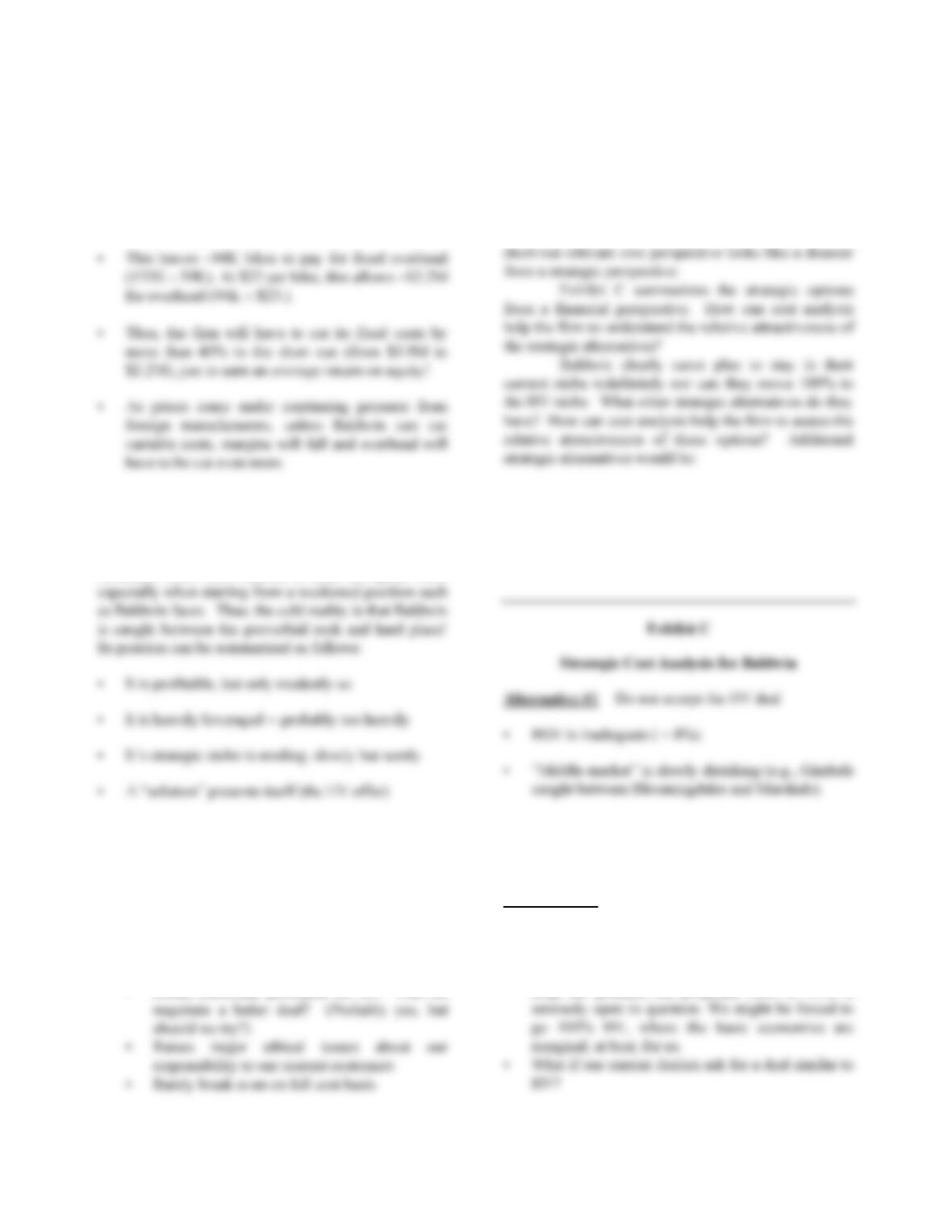
Exhibit B
Return on Equity
Margins (P/S) x Asset Intensity (S/A) x Leverage (A/E) = Return
deal in 1982, at best (3%) (1.49) (2.87)
6-8
• If there are good reasons to stay with a one-shift
operation and if the firm wants to earn 15% ROE
on a $3M equity base, it must earn $450K after tax
or $900K before tax. This requires ~39K bicycles
(at $23. contribution each).
Can Baldwin realistically expect to compete as
a supplier of low cost bikes once the attraction of its
mid-range brand image has eroded? What would be the
possible source of its cost advantage? Very few
American firms have learned to play this game well,
Plus
• Looks like great RI
• Utilizes excess capacity
• Opens new channel of distribution for Baldwin
that is a “growth market”
Minus
• Looks extremely profitable for HV. Can we
• Major cash flow crunch—can we borrow
$600K?
• At best, puts company ROE at “average” level
• Strategically very risky
What looks like a good opportunity from a
1. Go 100% to “Premium” segment.
2. Try to find new product opportunities in the value
niche (mountain bikes, etc.).
• Even if we reject the HV offer, someone else will
do it, thereby further eroding our current niche.
So, even our current ROE of 8% is vulnerable.
Alternative #2 Current Niche + HV Deal
• ROE is still average ( ~ 13%) at best.
• Great threat to the “core” business. If our dealers
drop our product, the projected ROE of 13% is
• Going private label is a strategic shift; what are the
organizational implications of diluting our strategic
thrust?
• Basic economics are marginal, unless able to cut
fixed costs by more than 40%, just in the short-run.
• Baldwin’s ability to compete long run against
foreign competition as a low cost producer is very
doubtful.
product development, market development, and
manufacturing retooling required to enter and succeed
in this new niche probably would take far more money
TEACHING STRATEGY
We use this case in an unusual way. We assign it for
day one of the required managerial accounting course.
We also distribute this teaching commentary in
advance.