
21-1
Levi’s Personal Pair™ Jeans
Teaching Commentary
OVERVIEW
This case series (A, B, and C) focuses on value chain reconfiguration in the women’s jeans business. It is set in
THE “PERSONAL PAIR™” STORY
Although Levi’s has long been a dominant brand in apparel, Levi Strauss is primarily a manufacturing company,
selling its products to wholesalers or retailers rather than end-use customers. As the apparel business evolves, firms
all along the industry value chain are continually presented with opportunities to create new ways to compete. This
requires the firm to position itself carefully within the industry structure, avoiding or mitigating the power of
existing players. Successful firms have the ability to differentiate an idea from an opportunity and can quickly
marshal physical resources, money, and people to take advantage of these windows of opportunity. Competitive
advantage is always a dynamic concept, continually shifting as firms either reposition within industries or position in
such a manner that existing industry boundaries are redrawn.
Strauss was as aggressive as most apparel manufacturers and retailers in investing in process improvements
and information technology to improve manufacturing and delivery cycle times and (pull–based) responsiveness to
actual buying patterns. But the overall supply chain from product design to retail sales was still complex, expensive,
and slow. In spite of substantial improvements in recent years (including extensive use of “EDI”) there was still an
eight–month lag, on average, between receiving cotton fabric and selling the final pair of Levi’s jeans. The industry
average lag was still well over twelve months in 1995.
Custom Clothing Technology Corp. (CCTC), a small Newton, MA-based software firm, offered Levi’s an

21-2
focusing on one particular strategic business initiative, one pair of Personal Pair™ jeans, is key to the strategic
$50. Assuming a typical retail gross margin of 30%, the Levi’s wholesale price is close to $35. In addition,
historically, approximately 1/3 of women’s jeans are sold at markdowns averaging approximately 30% off list. This
equates to net price allowances of about $5 (1/3 x 30% x $50). About 60% of this, or $3 per pair, is made good by
Levi’s in some type of co–op agreement. The result is a net sales price for Levi’s of $32 ($35 – $3).
The footprint gross margins are about 40%, which implies cost of goods sold is close to 60%. At the
The collection period for women’s jeans should not be that much different from the overall Levi’s collection period
of fifty-one days, which translates to a $4 receivable for each pair. In a like manner, the 5.33 fixed asset turn gives
us a total of $6 per pair ($32/5.33). Our field research indicates that this plant investment for the normal channel is
mostly in the factory rather than distribution. In total, we estimate that for this channel every pair sold requires
capital of approximately $13. With the above pre-tax operating profit of $4, this is an overall very healthy ROIC of
inventory, which turn approximately six times per year, yielding a store volume of
approximately 120,000 pairs/year.
• Store investment per pair sold – $2,400,000/120,000 pairs ~ $20 per pair.
Comparing the normal wholesale channel with the owned retail channel, profitability (ROIC) for
women’s jeans falls by about 50%, from 31% to 16%. Levi Strauss is paying a high price to gain customer
1995. About one-half the sales were repeat orders, which greatly simplifies the point–of-sale process. In October of
1996, Heidi LeBaron-Leupp, marketing director for the Personal Pair™ program, declared it a “phenomenal
success.” For the styles affected, unit sales were up 49%!
Two years into the program (fall 1994 to fall 1996), the company’s experience was that Personal Pair™
resulted in no change in cotton or conversion cost (up or down), but the virtual elimination of distribution costs and
distribution investment per pair. Although a financial comparison between the regular supply chain and the Personal

21-3
estimates summarized in the (C) case. If, indeed, CCTC can deliver what it has promised, the results would be
dramatic. More customer satisfaction could lead to higher prices. Custom fit also eliminates markdowns, driving
the net price up. Distribution costs would be transferred to FedEx for which the customer pays separately.
Operating costs per pair in the store would be cut by half if half the orders are repeat business with zero store
contact. Selling costs for the first pair would increase given the time spent on measuring and fitting each customer,
but this would happen only once (unless, of course, body dimensions were to change). Likewise, the inventory and
retail store investment would decrease substantially with only an offset of CCTC investment in computers and
software.
Studying the two different value delivery systems demonstrates clearly that non-material manufacturing
Nonmanufacturing PP&E is reduced by 40% (from $22 per pair to $13).
When the two components of profitability are combined, it becomes clear that a kiosk yields a greater than
ten-fold increase in profitability over an Original Levi’s store (from 16% to 200%) while still accomplishing the
strategic purpose of the store—to put Levi’s in closer touch with the ultimate customer.
As of 1999, there were sixty Personal Pair™ kiosks across the United States and Canada, one in each of the
Original Levi’s stores. The program in 1997 was responsible for 25% of all women’s jeans sales in the thirty U.S.
company-owned stores. Delivery was averaging only three to four days. The “promise date” has been cut from
three weeks to two. All orders are shipped via FedEx, which picks up daily at the factory, near the FedEx hub in
Memphis. Levi Strauss acquired CCTC for more than $2 million in October of 1995. The acquisition insured that
CCTC would continue to work with Levi’s, and only with Levi’s, to expand and improve this segment that is based
on computer-based custom fit, custom manufacturing, and direct distribution. In the fall of 1996, Levi’s introduced
Personal Pair™ in two stores in London as the first overseas locations. The price was £19 higher than the regular
£46 price. Manufacturing was still in the United States with distribution via FedEx.
TEACHING STRATEGY
I use this case in the core managerial accounting course at both Tuck and Babson. The assignment for class is to
read and study the (A) case and answer the five assigned questions. The answers to these questions are covered in
the preceding section of this commentary.

21-4
After reviewing carefully Exhibit 2, I ask for a volunteer to show his/her work on the new value chain that
replaces the one illustrated in case Exhibit 3. I let the class discuss the alternative value chain for about twenty
21-5
Levi’s Personal Pair™ Jeans (B)
The Personal Pair™ kiosks were very popular almost immediately. The experiment was extended to seven stores by
the summer of 1995. About one-half the sales were repeat orders, which greatly simplifies the point–of-sale process.
In October of 1996, Heidi LeBaron-Leupp, marketing director for the Personal Pair™ program, declared it a
“phenomenal success.” For the styles affected, unit sales were up 49%!
Assignment Questions
Construct the financial footprint for a single pair of jeans sold through the Personal PairTM kiosk channel.
What is the future of the regular value chain?
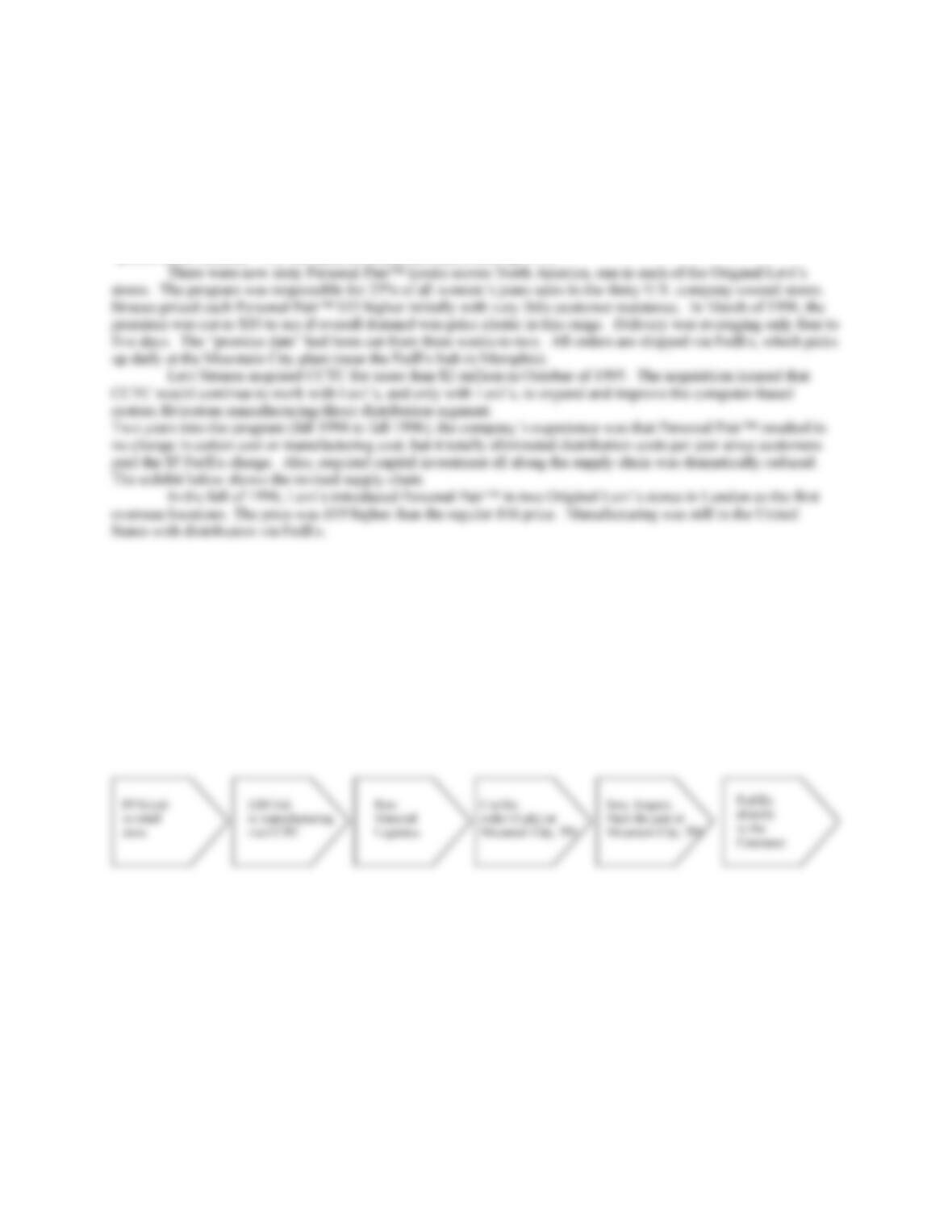
EXHIBIT
Levi’s Personal Pair™ Jeans Supply Chain

Levi’s Personal Pair™ Jeans (C)
The Personal Pair™ Financial Footprint
Operations, per pair
Gross Revenue
$60
Given, excluding $5 FedEx charge paid by customer
Less markdowns
—
No need for markdowns with “customer fit” jeans
Net Revenue
60
Costs
Cotton
Unchanged
Mfg. Conversion
Unchanged
Distribution
FedEx from factory to customer, paid by customer
TOTAL COGS
Gross Margin
S,G, & A
16
*
Investment, per pair
Inventory
$1
Raw material only, rounded to a generous $1
Less A/P
—
Probably insignificant
Factory PP&E
Probably minimal change
space
software
* The normal $8 for Strauss plus the normal $10 for the store (increase in personal selling offset by decrease in space