3-1
Chapter 3
Cost Behavior
Concept Questions
1. (LO 1—Cost behavior of direct material)
2. (LO 1—Cost behavior and the relevant range)
The relevant range of production is the normal range over which
3. (LO 1—Cost behavior of fixed costs)
When volume increases, fixed costs per unit will decrease. Likewise, when
4. (LO 1—Equation for mixed costs)
5. (LO 2—Regression analysis)
When used to estimate the fixed and variable components of a mixed
6. (LO 2—Regression analysis)
R2 is a measure of the goodness of fit or how well the regression line
7. (LO 2—High/low method)
Solutions Manual
8. (LO 3—Relevant costs and decision making)
9. (LO 3—Relevant costs and decision making)
Irrelevant costs relate to the past or do not differ under different
10. (LO 4—Impact of taxes on costs)
11. (LO 1—Absorption vs. variable costing)
If production exceeds sales, absorption costing will always show higher
12. (LO 1—Absorption vs. variable costing)
If sales exceed production, variable costing will show higher net income.
13. (LO 1—Absorption vs. variable costing)
14. (LO 1—Absorption vs. variable costing)
The basic difference between absorption and variable costing is the
Chapter 3: Cost Behavior
3-3
15. (LO 2—Income statement impact of absorption costing)
Under absorption costing, net income can be increased by increasing
16. (LO 2—Income statement impact of absorption costing)
17. (LO2—Income statement impact of absorption costing)
Under absorption costing, net income can be increased by increasing
18. (LO 2—Income statement impact of absorption costing)
Exercises
1. (LO 1—Cost behavior)
a.
FC
e.
VC
b.
VC
FC
FC
g.
VC
d.
VC
h.
VC
2. (LO 1—Calculation of total costs)
3. (LO 1—Cost behavior analysis)
A. Erin must have committed herself to a greater amount of fixed cost
Solutions Manual
4. (LO 2—Regression analysis: calculation of total cost)
5. (LO 2—Mixed costs using high/low method)
6. (LO 2—Mixed costs using high/low method)
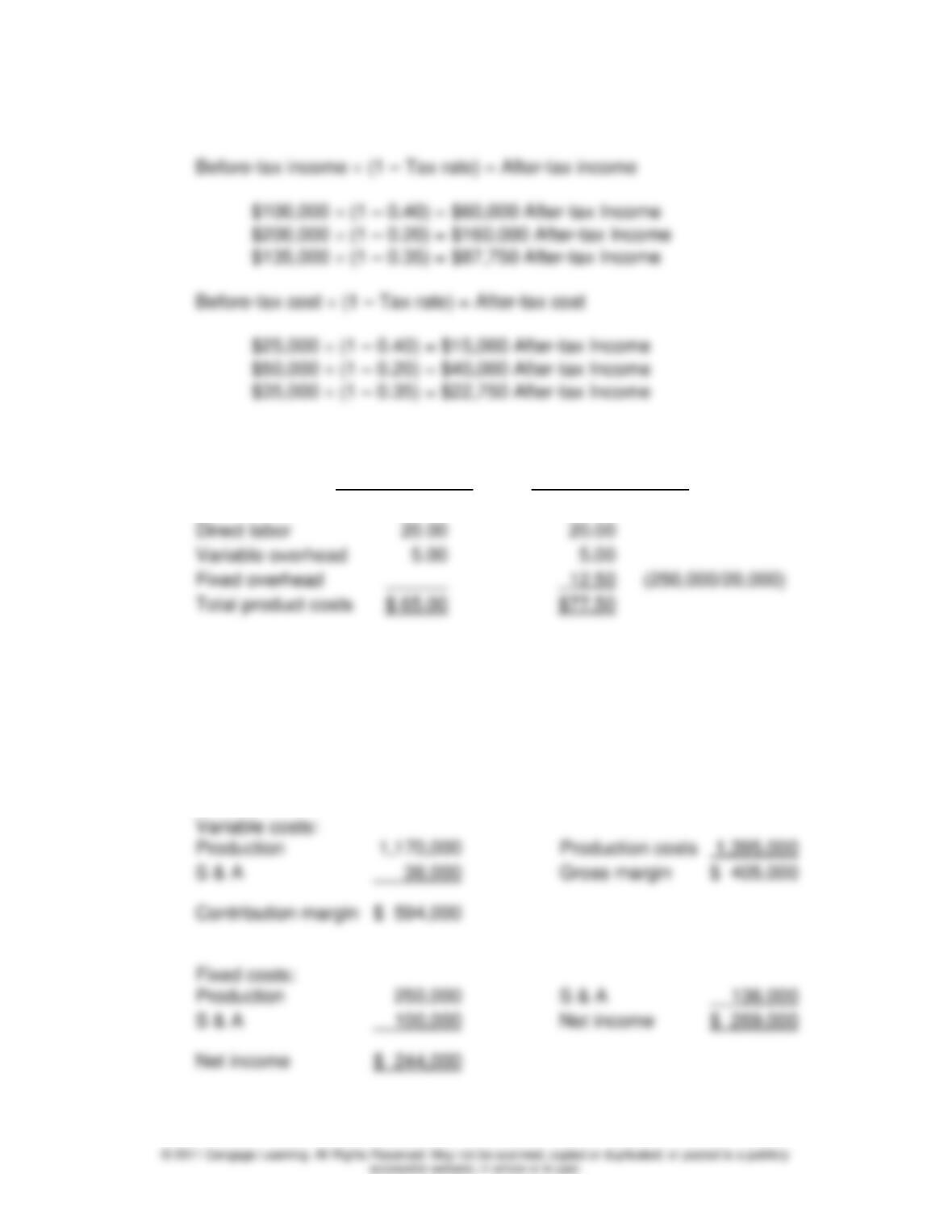
7. (LO 3—Impact of income taxes)
Chapter 3: Cost Behavior
3-5
8. (LO 3—Impact of income taxes)
9. (LO 4, 5, and 6—Absorption vs. variable costing)
Variable Costing Absorption Costing
Direct materials $ 40.00 $40.00
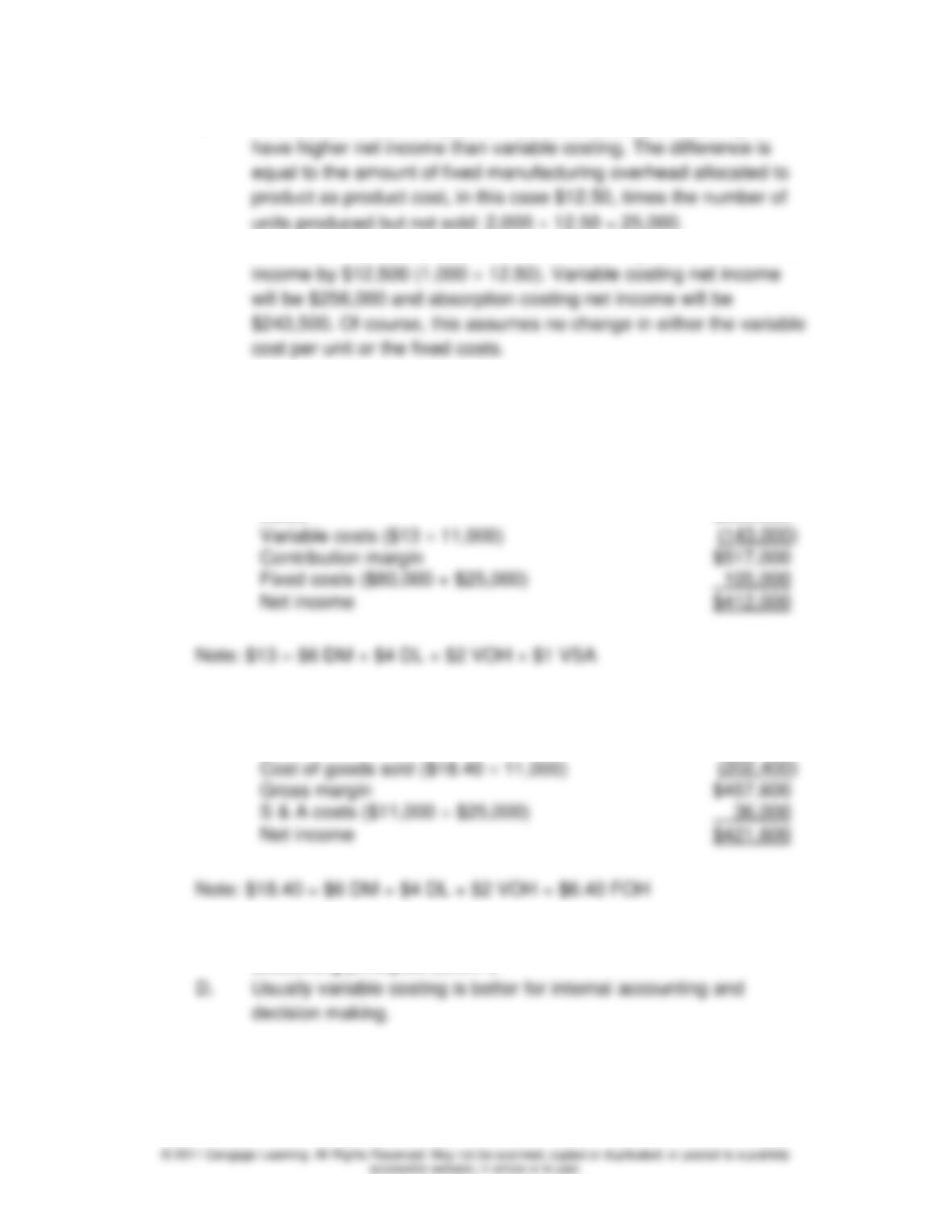
10. (LO 4, 5, and 6— Absorption vs. variable costing: Calculation of net
income)
A. Variable Costing Absorption Costing
Sales $1,800,000 Sales $1,800,000
Solutions Manual
3-6
B. Because production is greater than sales absorption costing will
C. When sales exceed production, variable costing will show more net
11. (LO 4, 5, and 6—Variable costing and absorption costing: Calculation of
net income)
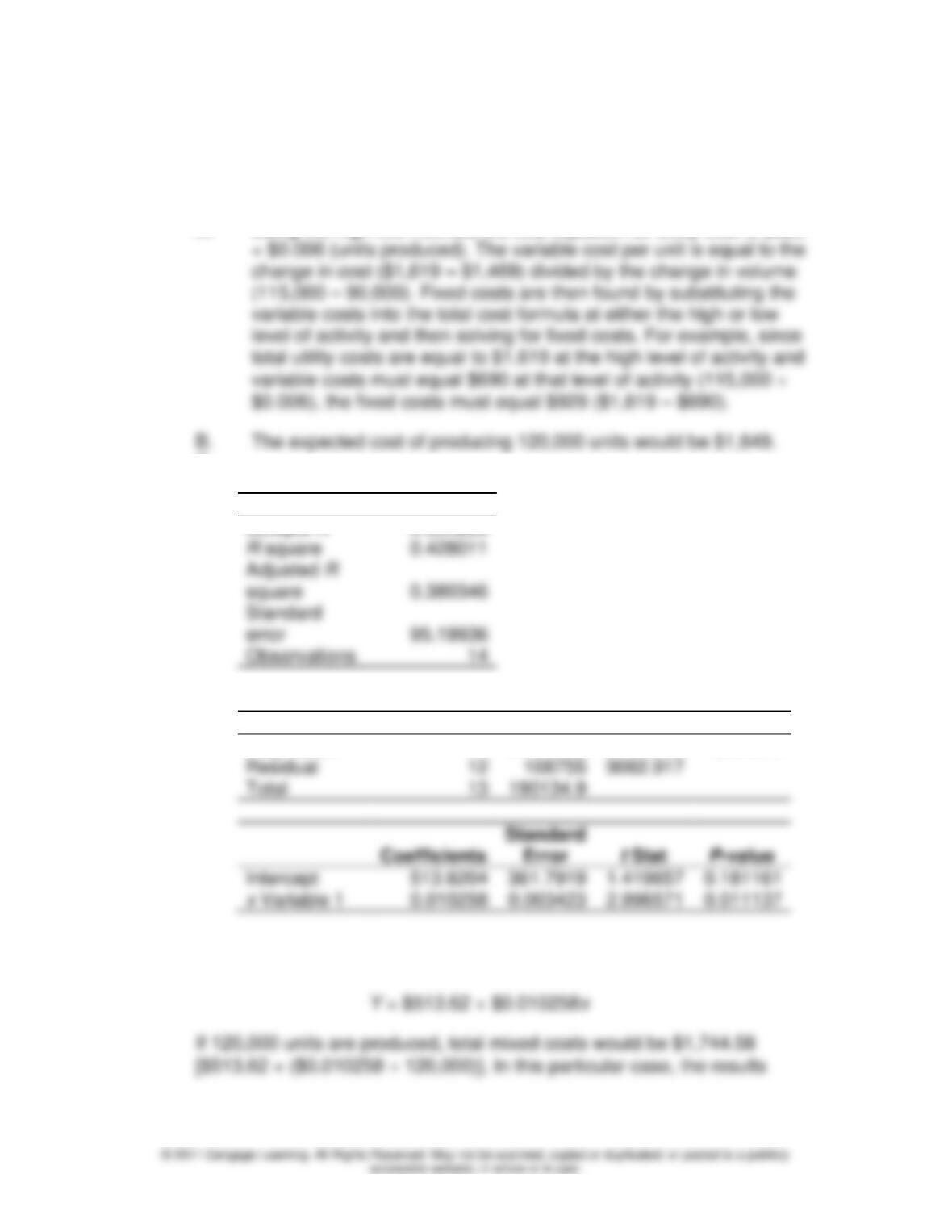
A. Variable costing
Sales
$660,000
Fixed costs ($80,000 + $25,000)
B. Absorption costing
Sales
$660,000
S & A costs ($11,000 + $25,000)
C. Absorption costing must be used to comply with generally accepted
accounting principles (GAAP).
Chapter 3: Cost Behavior
3-7
Problems
12. (LO 1 and 2—Regression vs. high/low method)
A. Using the high-low method, the cost equation for utility cost is $929
C.
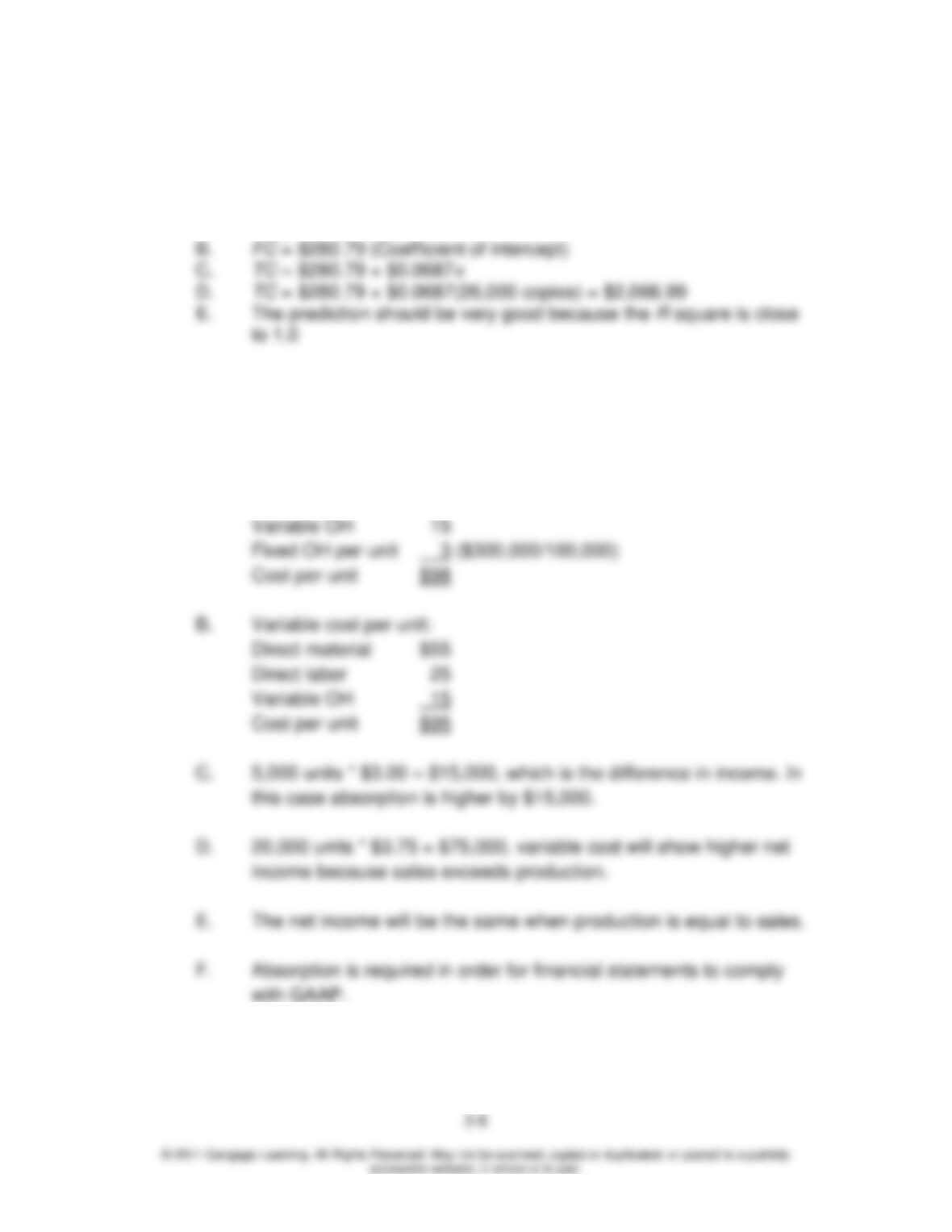
Regression Statistics
Multiple R
0.654226
0.428011
square
0.380346
error
95.19936
Observations
ANOVA
df
SS
MS
F
Regression
1
81379.92
81379.92
8.97944
Residual
9062.917
Total
Intercept
1.419657
0.181161
0.010258
0.003423
2.996571
0.011137
Using regression analysis, the cost formula would be:
Solutions Manual
when using the high-low method versus regression analysis are fairly
similar.
13. (LO 1 and 2—Regression analysis interpretation)
A. VC per unit = $0.0687 (X Coefficient)
14. (LO 4, 5, and 6—Absorption vs. Variable costing: Benefits & calculation of
net income)
A. Absorption cost per unit:
Direct material $55
Direct labor 25
Chapter 3: Cost Behavior
3-9
15. (LO 4, 5, and 6—Absorption vs. Variable costing: Benefits & calculation of
net income)
A. Direct material cost $25
Direct labor cost 35