3.95: PROBLEM DEFINITION
Situation:
Three spheres of the same diameter are submerged in the same body of water.
One sphere is steel, one is a spherical balloon filled with water, and one is a spherical
balloon filled with air.
a. Which sphere has the largest buoyant force?
b. If you move the steel sphere from a depth of 1 ft to 10 ft, what happens to the
magnitude of the buoyant force acting on that sphere?
c. If all 3 spheres are released from a cage at a depth of 1 m, what happens to the
3spheres,andwhy?
SOLUTION
Answers:
a. All 3 spheres have the same bouyant force, because they all have the same
141
3.96: PROBLEM DEFINITION
Situation:
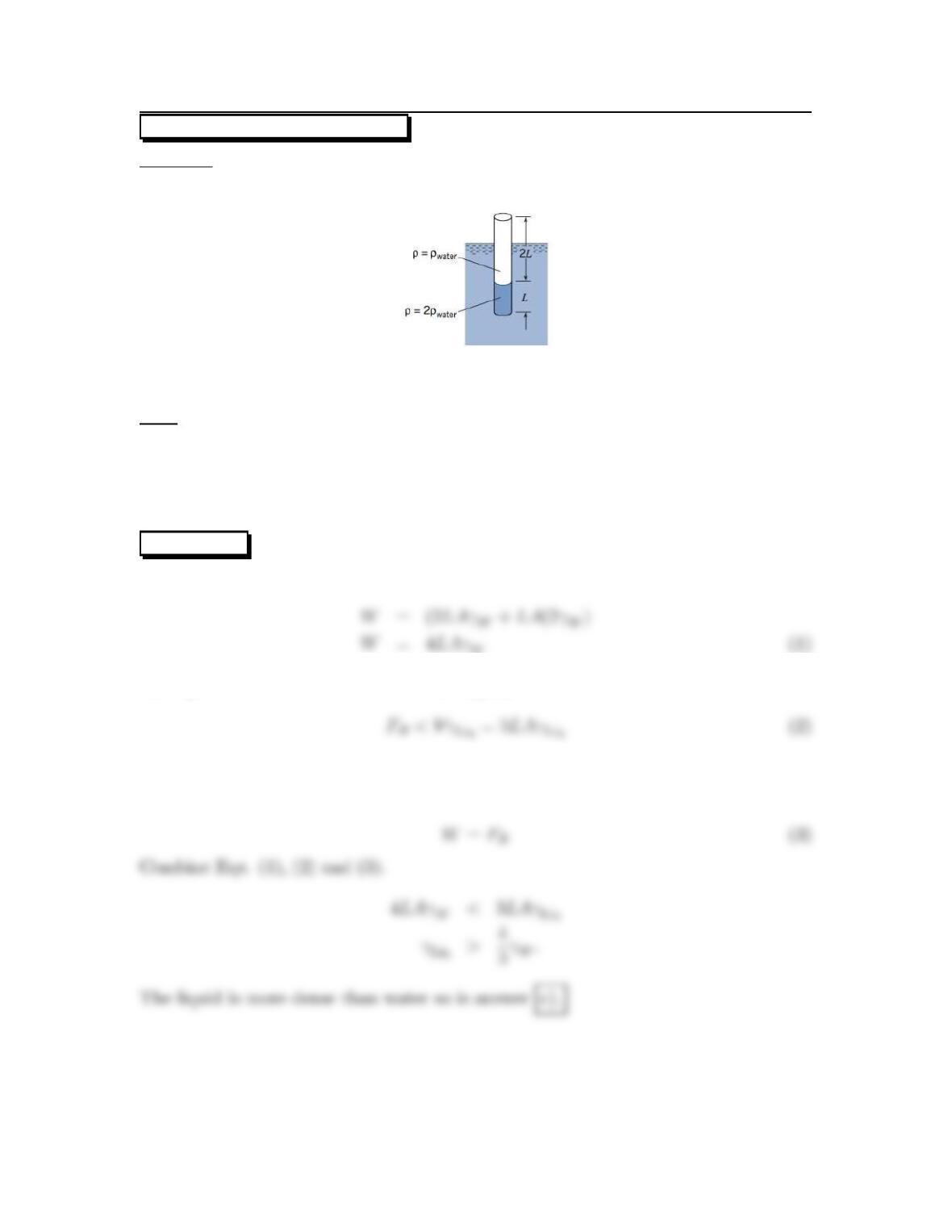
Arodisfloating in a liquid.
Find:
Determine if the liquid is
a. lighter than water
b. must be water
c. heavier than water.
SOLUTION
Rod weight
Since part of the rod extends above the liquid,
Equilibrium applied to the rod
142
3.97: PROBLEM DEFINITION
Situation:
A ship is sailing from salt to fresh water.
W= 35000 tons = 70 ×106lbf.
A= 38000 ft2,L=800ft.
Find:
Will the ship rise or settle?
Amount (ft) the ship will rise or settle.
PLAN
1. To establish whether the ship will rise or settle, apply the equilibrium equation.
2. Determine the volume displaced in both salt and fresh water.
3. Calculate the distance the ship moves.
SOLUTION
1. Equilibrium. The weight of the ship is balanced by the buoyant force
2. Volume displaced (salt water):
Volume displaced (fresh water):
3. Distance Moved. The distance moved ∆his given by
143
3.98: PROBLEM DEFINITION
Situation:
A spherical buoy is anchored in salt water.
W= 1200 N,D=1.2m.
T=4500N,y=20m.
Find:
Weight of scrap iron (N) to be sealed in the buoy.
Properties:
Seawater, Table A.4 γs= 10070 N/m3.
PLAN
1. Find the buoyant force using the buoyant force equation.
2. Find the weight of scrap iron by applying equilibrium.
SOLUTION
1. Buoyant force equation:
2. Equilibrium
144
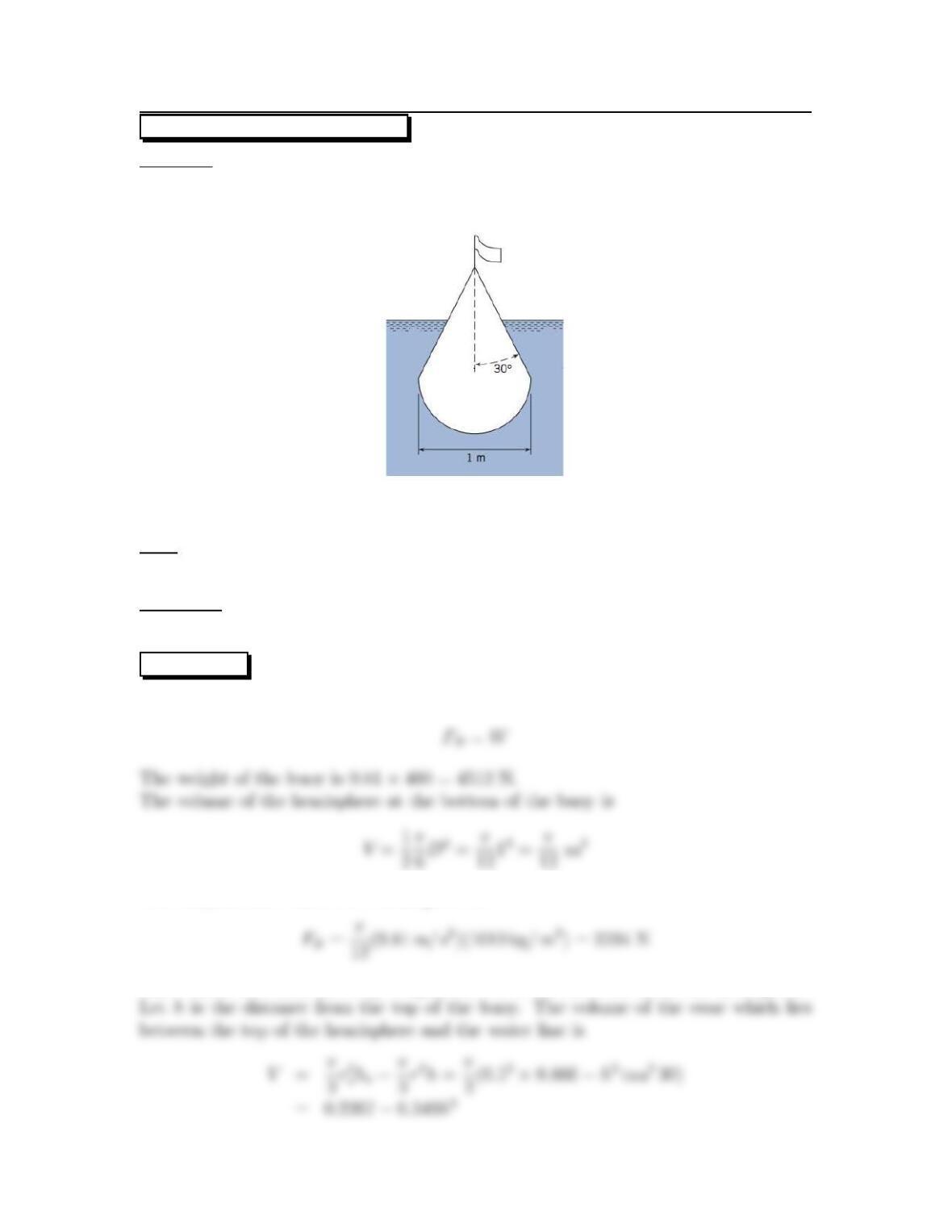
3.99: PROBLEM DEFINITION
Situation:
A buoy has a spherical top and conical bottom.
m=460kg,D=1m,θ=30◦.
Find:
Location of water level.
Properties:
ρ=1010kg/m3.
SOLUTION
Thebuoyantforceisequaltotheweight.
Thebuoyantforceduetothehemisphereis
Since this is less than the buoy weight, the water line must lie above the hemisphere.
145
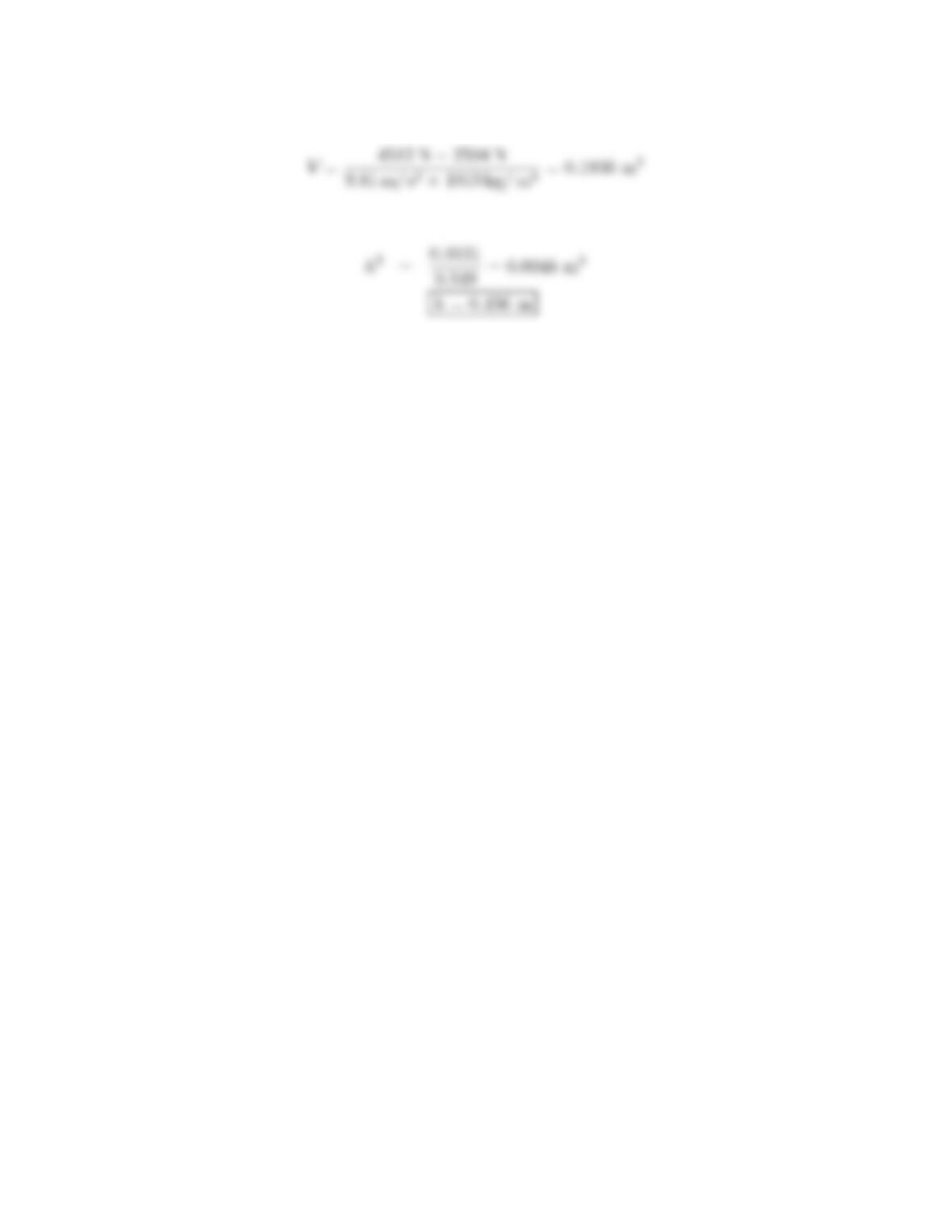
The additional volume needed to support the weight is
Equating the two volumes and solving for hgives
146
3.100: PROBLEM DEFINITION
Situation:
In air, a rock weighs Wair =925N.
In water, a rock weighs Wwater =781kg.
Find:
Thevolumeoftherock(liters).
Properties:
Water (15oC),Table A.5, γ=9800N/m3.
PLAN
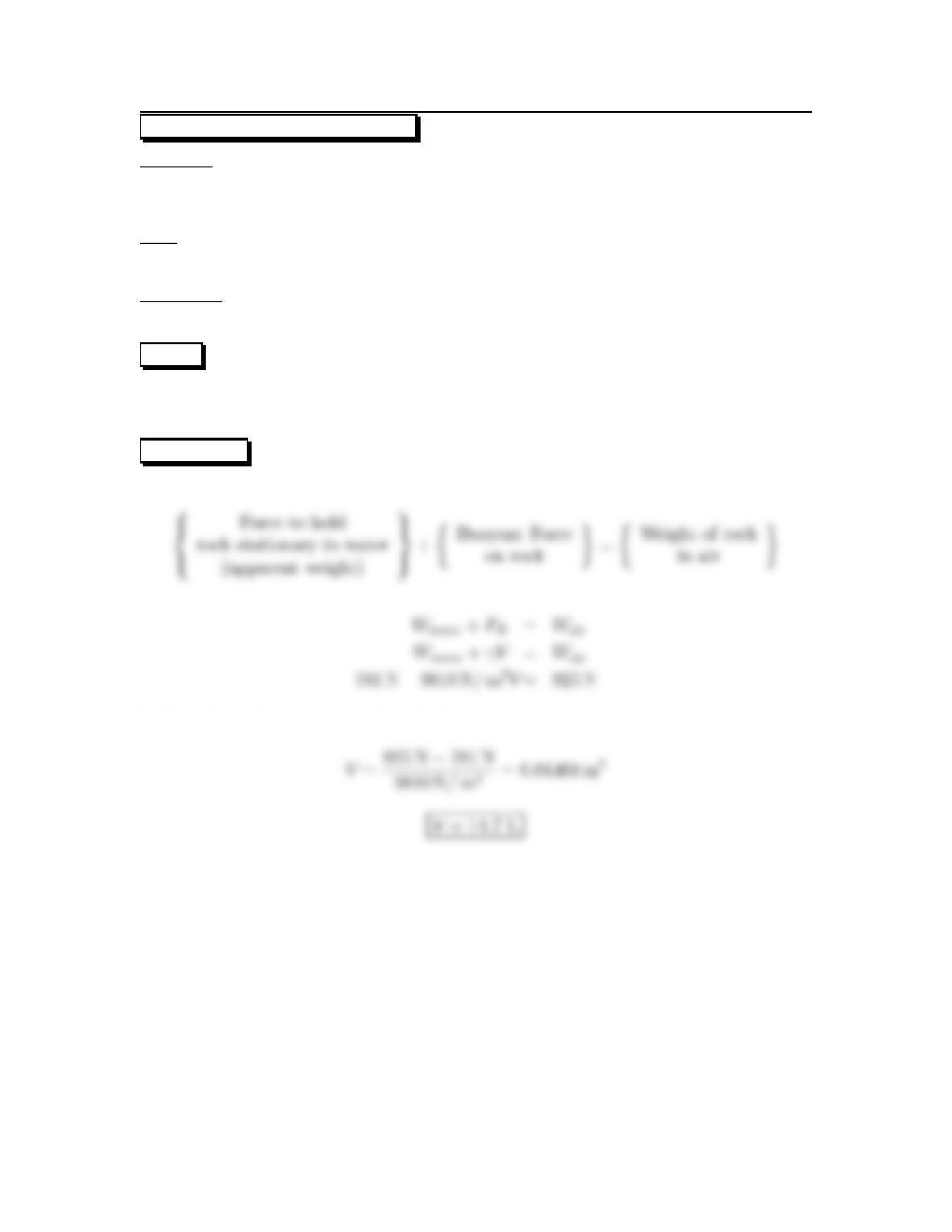
1. Apply equilibrium to the rock when it is submerged in water.
2. Solve the equation from step 1 for volume, convert volume to L.
SOLUTION
1. Equilibrium:
2. Solve for volume, report volume in L.
147
3.101: PROBLEM DEFINITION
Situation:
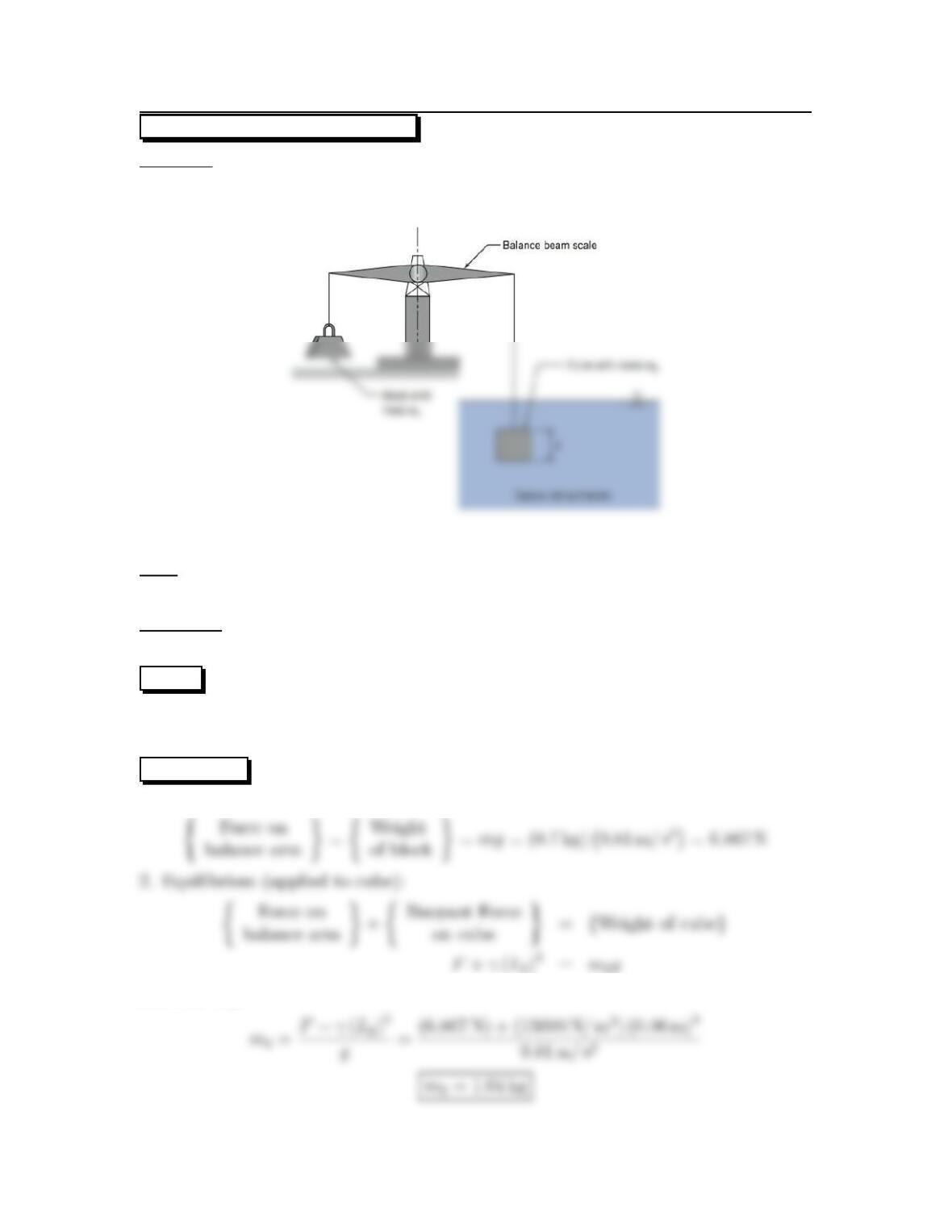
A cube is suspended in carbon tetrachloride.
m1=700g,L=0.06 m
Find:
Themassofthecube(kg).
Properties:
Carbon Tetrachloride (20oC),Table A.4, γ= 15600 N/m3.
PLAN
1. Find the force on the balance arm scale by finding the weight of the block.
2. Find m2by applying equilibrium to the cube.
SOLUTION
1. Force on balance arm:
Solve for m2:
148
3.102: PROBLEM DEFINITION
Situation:
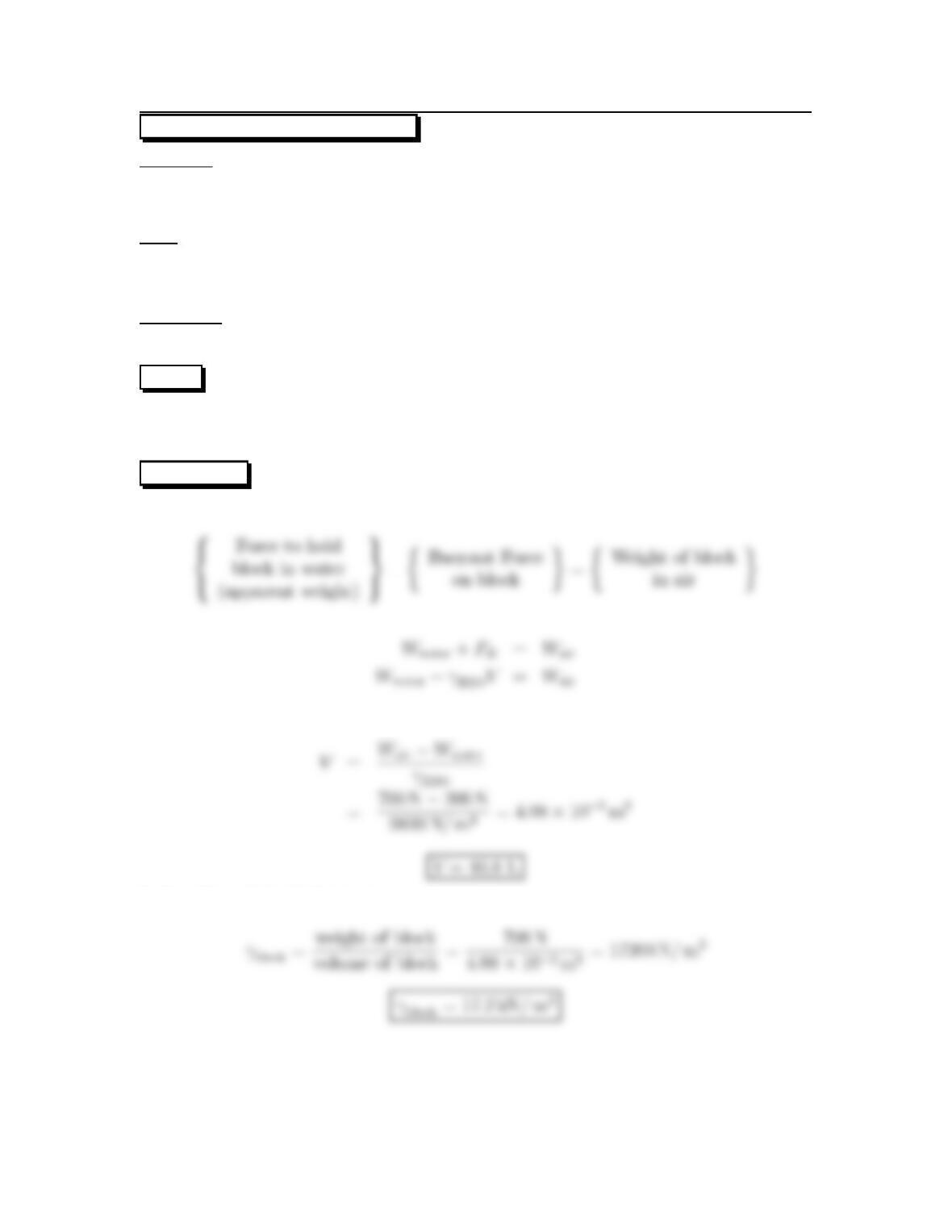
A block is submerged in water.
Wwater =300N,Wair =700N.
Find:
The volume of the block (liters).
The specific weight of the material that was used to make the block (N/m3).
Properties:
Water (15oC),Table A.5, γ=9800N/m3.
PLAN
1. Find the block’s volume by applying equilibrium to the block.
2. Find the specific weight by using the definition.
SOLUTION
1. Equilibrium (block submerged in water):
Solve for volume:
2. Specificweight(definition):
149
3.103: PROBLEM DEFINITION
Situation:
A cylindrical tank is filled with water.
A cylinder of wood is set afloat in the water.
Dtank =1ft,Dwood =5in.
Wwood =2lbf,Lwood =2.5in.
Find:
Change of water level in tank.
Properties:
Water, Table A.5: γ=62.4lbf/ft3.
PLAN
When the wood enters the tank, it will displace volume. This volume can be visualized
as adding extra water to the tank. Thus, find this volume and use it to determine
theincreaseinwaterlevel.
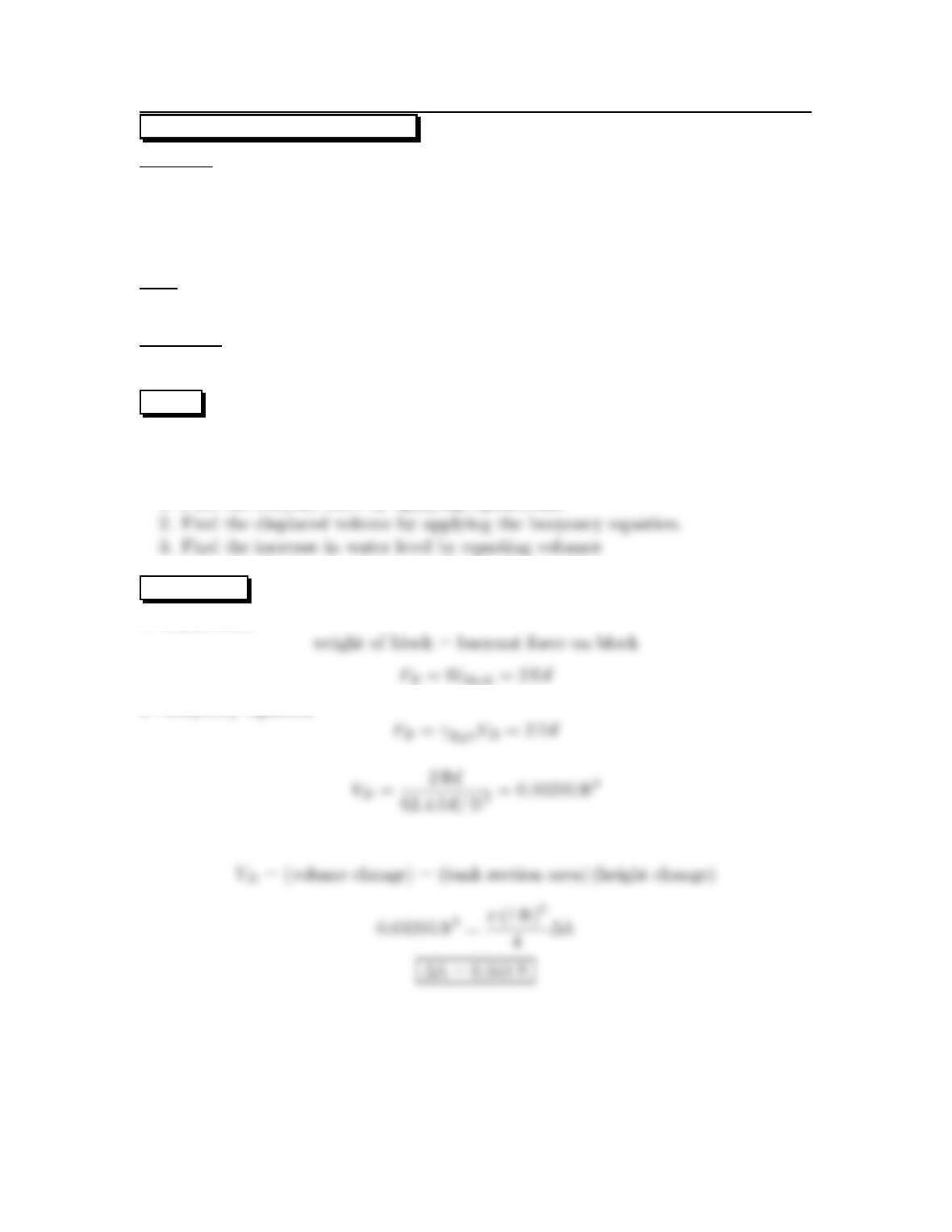
1. Find the buoyant force by applying equilibrium.
SOLUTION
1. Equilibrium
2. Buoyancy equation
3. Find ∆hof the tank resulting from volume change
150
3.104: PROBLEM DEFINITION
Situation:
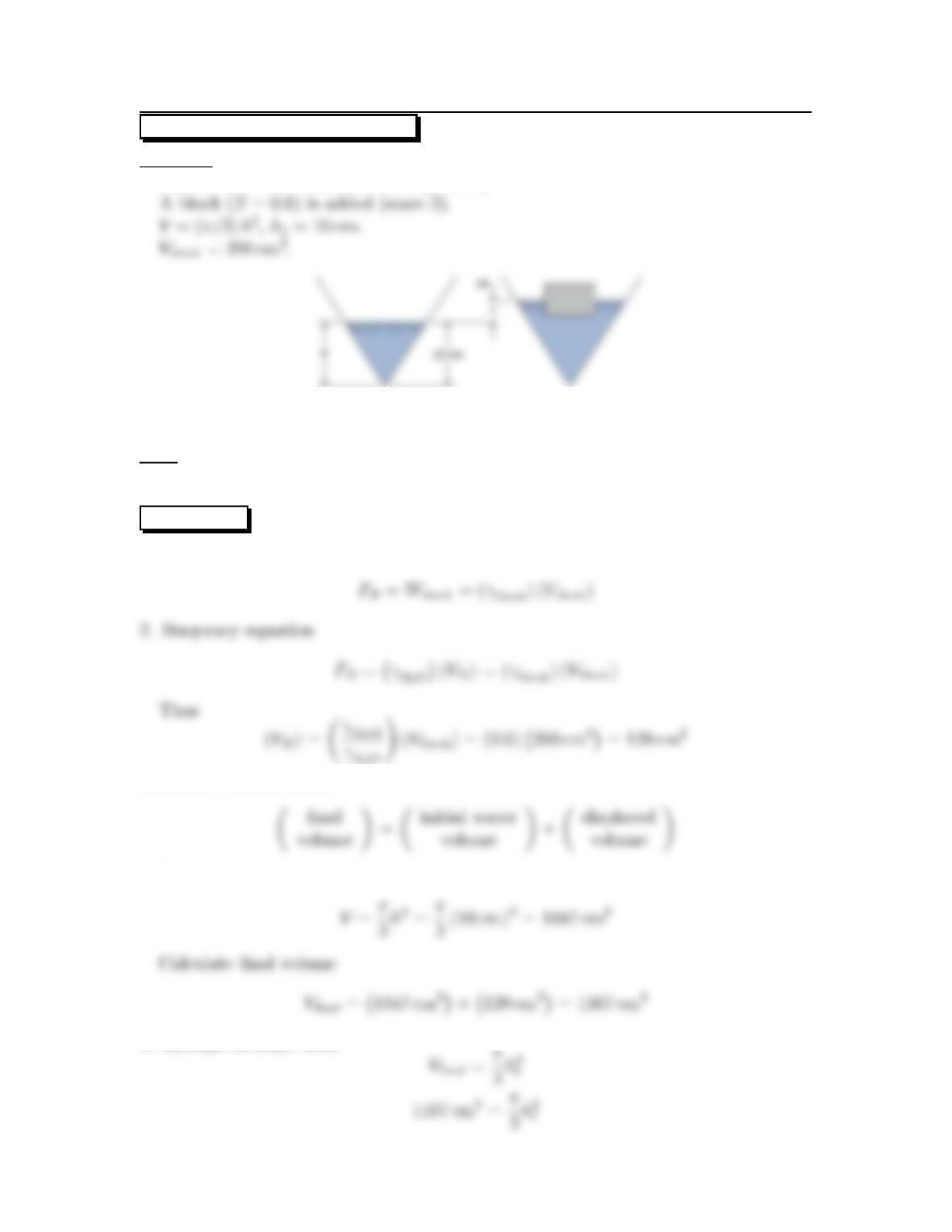
An inverted cone contains water (state 1).
Find:
Change of water level.
SOLUTION
1. Equilibrium (apply to block)
3.Volume considerations.
Calculate initial water volume
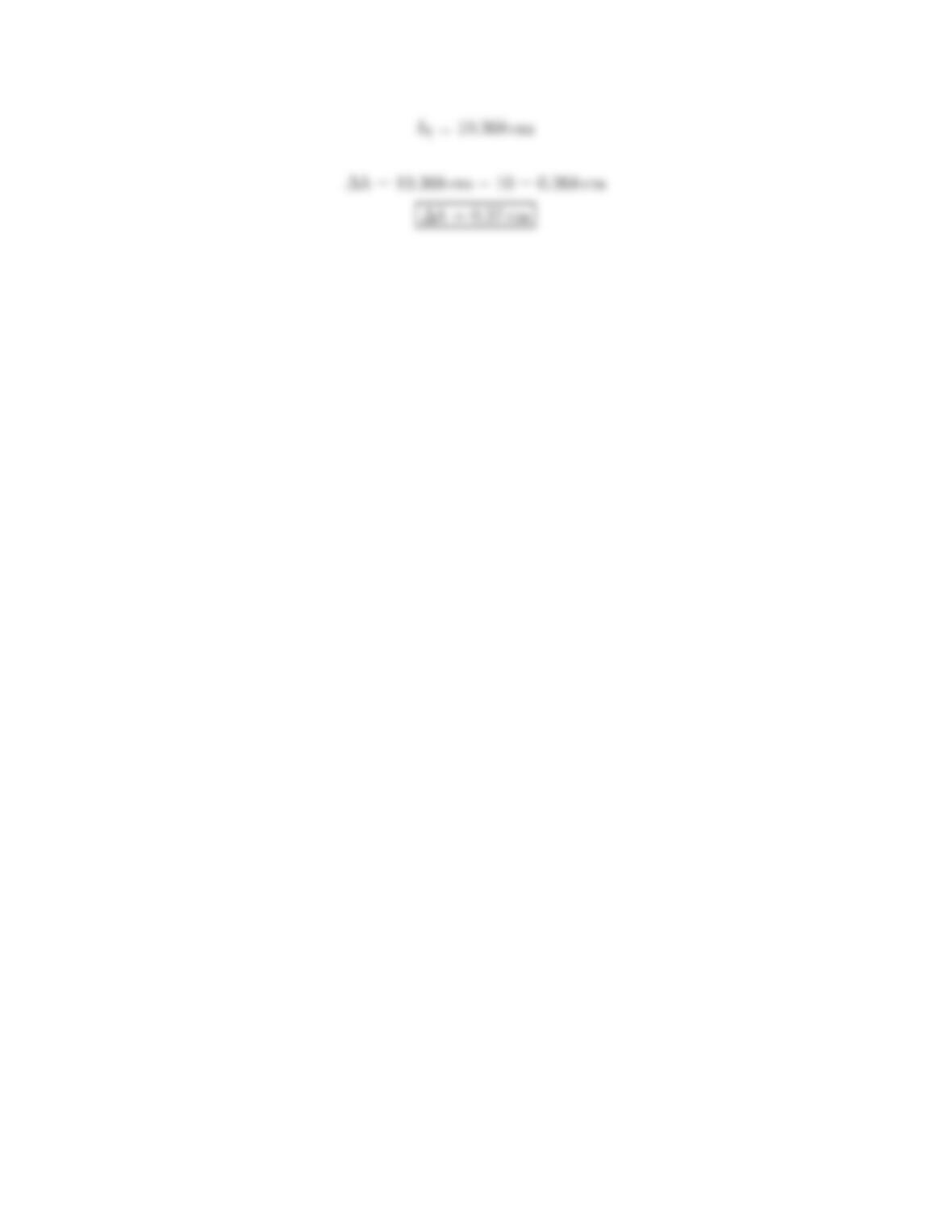
4. Increase in water level
151
152
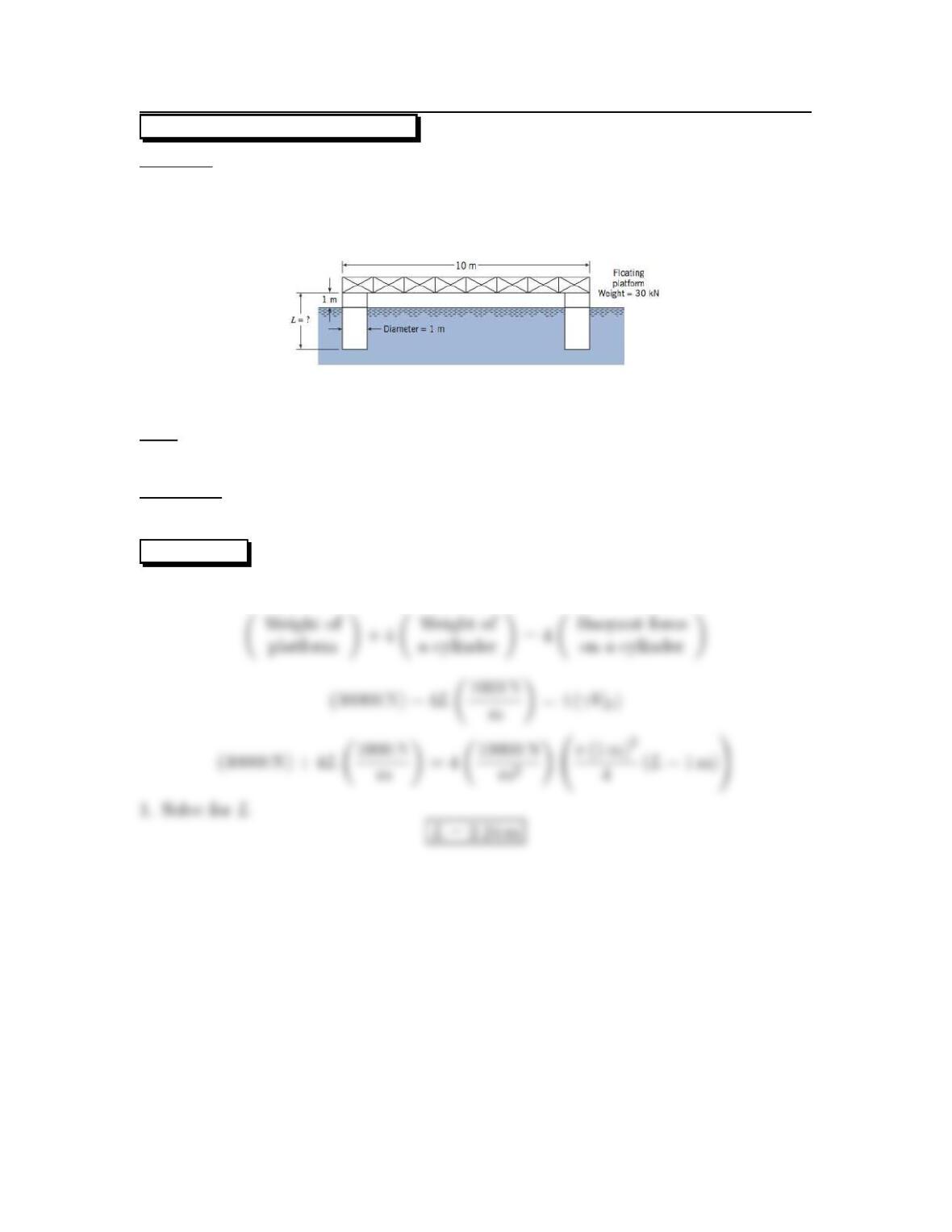
3.105: PROBLEM DEFINITION
Situation:
Aplatformfloats in water.
Wplatform =30kN,Wcylinder =1kN/m.
y=1m,Dcylinder =1m.
Find:
Length of cylinder so that the platform floats 1 m above water surface.
Properties:
γwater =10,000 N/m3.
SOLUTION
1.Equilibrium (vertical direction)
153
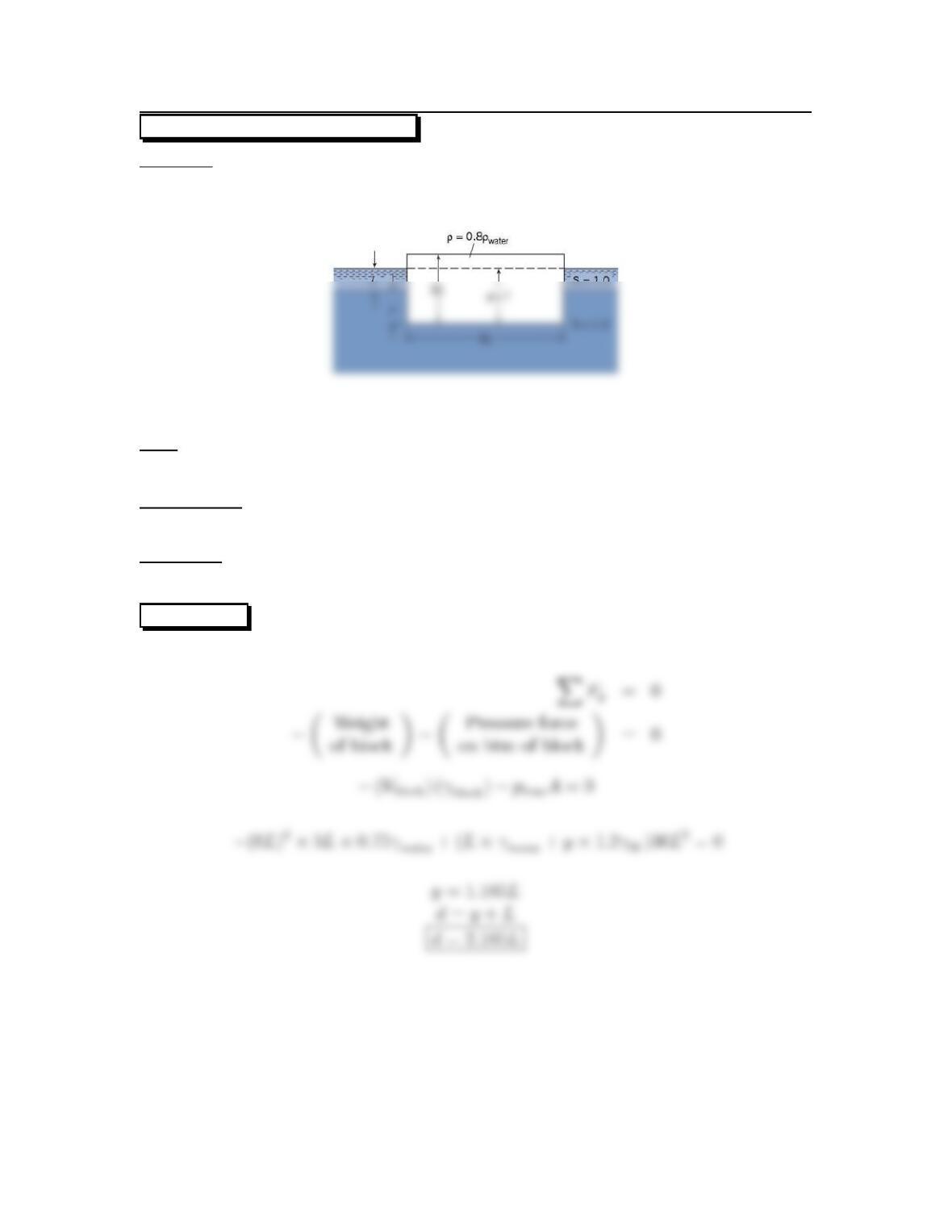
3.106: PROBLEM DEFINITION
Situation:
Ablockfloats in two layered liquids.
b=6L,h=3L.
Find:
Depth block will float.
Assumptions:
The block will sink a distance yinto the fluid with S=1.2.
Properties:
ρblock =0.75ρwater.
SOLUTION
1. Equilibrium.
154
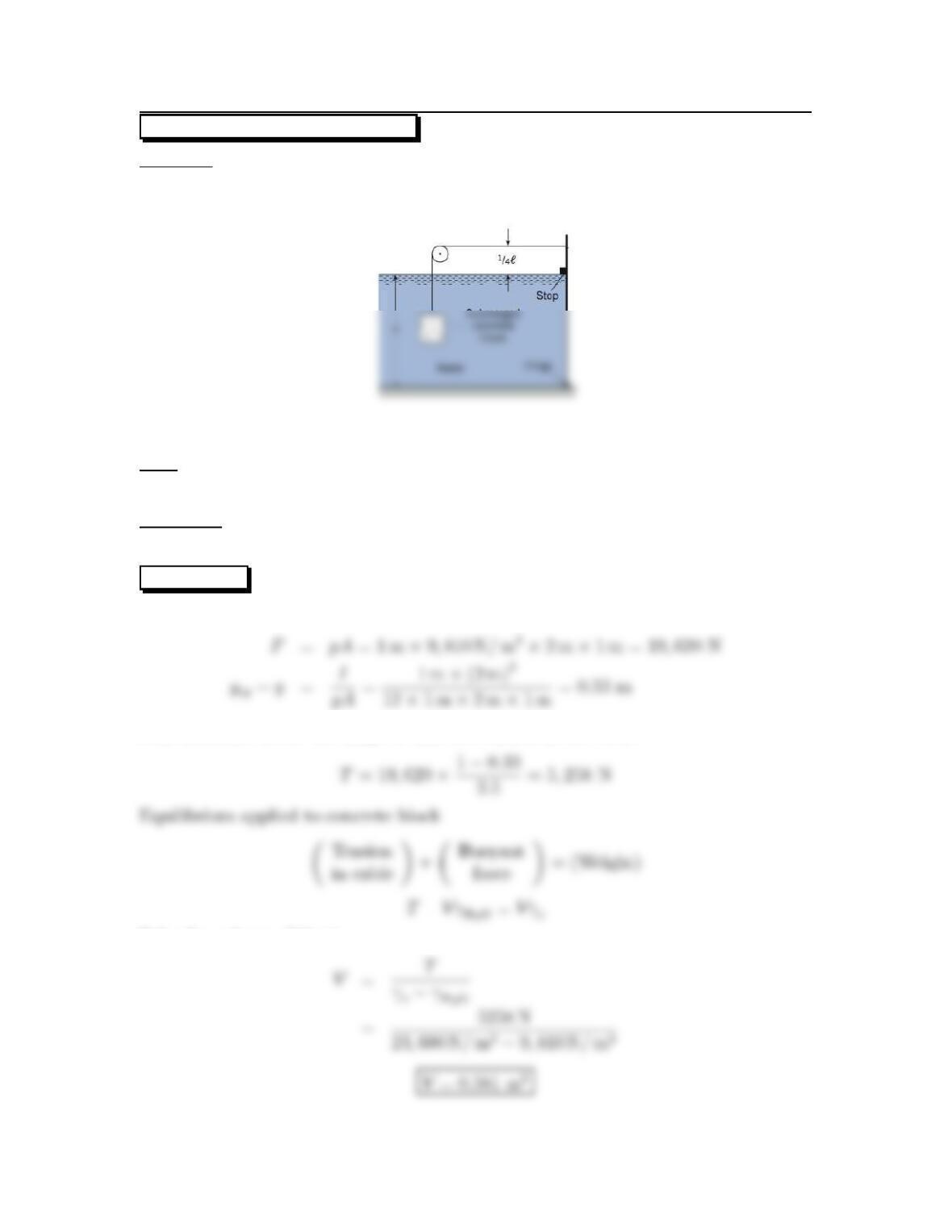
3.107: PROBLEM DEFINITION
Situation:
A submerged gate has a concrete block attached to it.
b=1m,=2m.
Find:
Minimum volume of concrete to keep gate in closed position (m3).
Properties:
Concrete γ=23.6kN/m3.
SOLUTION
Hydrostatic force on gate and CP
Sum moments about the hinge to find the tension in the cable
Solve for volume of block
155
3.108: PROBLEM DEFINITION
Situation:
Ice is added to a cylindrical tank holding water.
d=2ft,h=4ft.
Wice =5lb.
Find:
Change of water level in tank after ice is added.
Change in water level after the ice melts.
Explain all processes.
Properties:
γwater =62.4lbf/ft3.
SOLUTION
Change in water level (due to addition of ice)
Rise of water in tank (due to addition of ice)
156
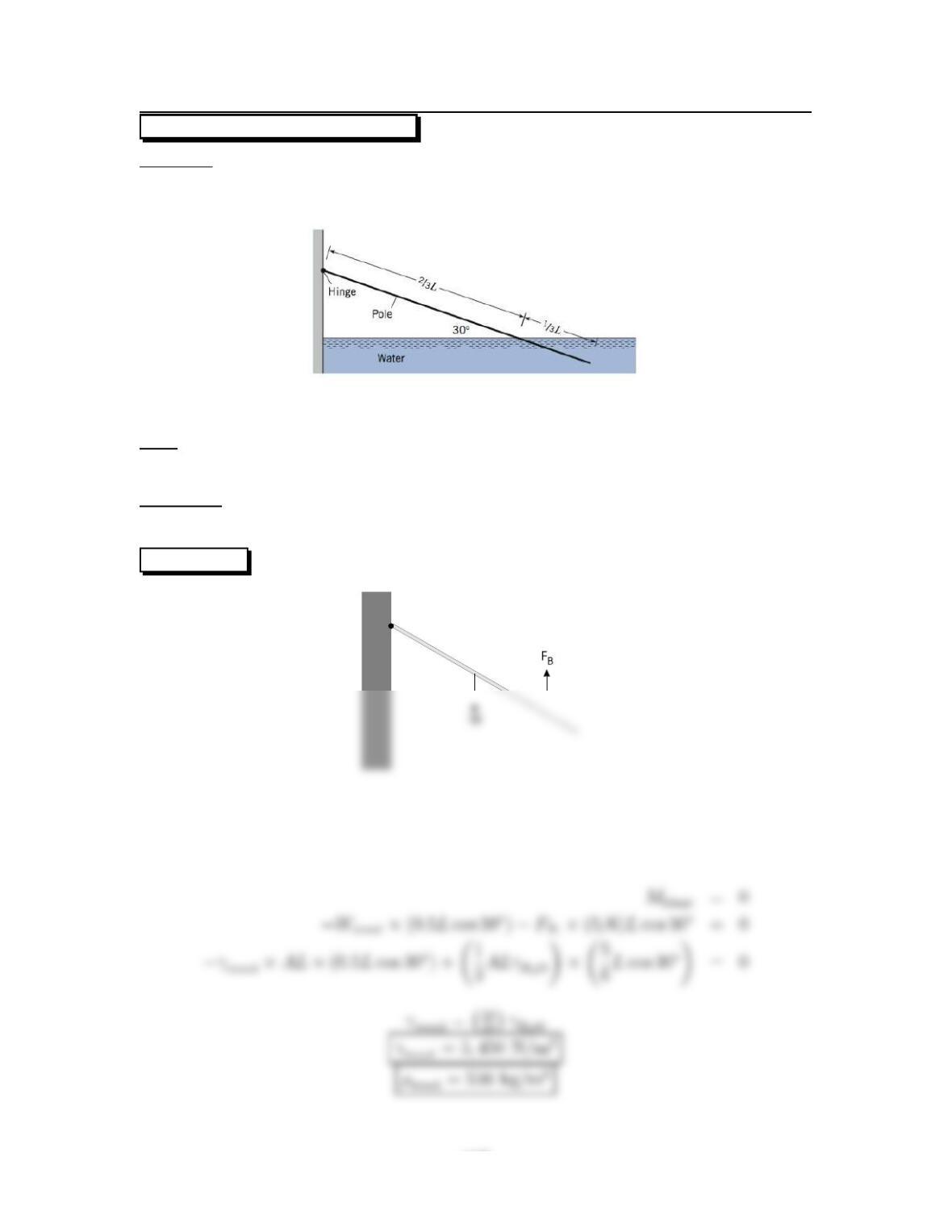
3.109: PROBLEM DEFINITION
Situation:
A partially submerged wood pole is attached to a wall.
θ=30◦.
Find:
Density of wood.
Properties:
γ=9810N/m3.
SOLUTION
157