Section 3.4
~x =c11
2+c2−2
1−−→
T T (~x) = A~x =c1A1
2+c2A−2
1
=c15
10 +c210
−5= 5c11
2−5c2−2
1
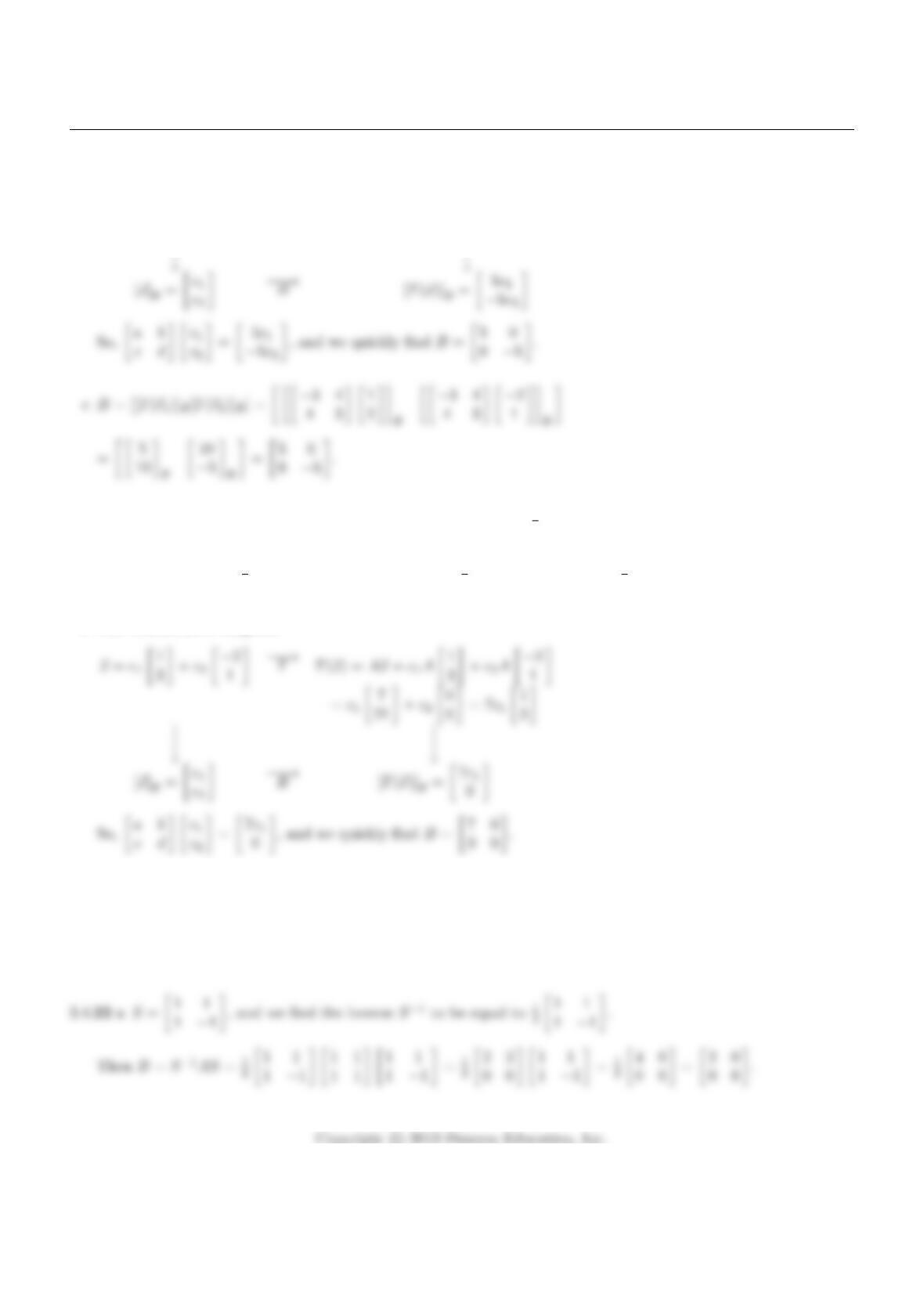
3.4.21 aS=1−2
3 1 , and we find the inverse S−1to be equal to 1
71 2
−3 1 .
Then B=S−1AS =1
71 2
−3 1 1 2
3 6 1−2
3 1 =1
77 14
0 0 1−2
3 1 =1
749 0
0 0 =7 0
0 0 .
b Our commutative diagram:
cB= [[T(~v1)]B[T(~v2)]B] = 1 2
3 6 1
3B1 2
3 6 −2
1B
=7
21 B0
0B=7 0
0 0 .
163
Chapter 3
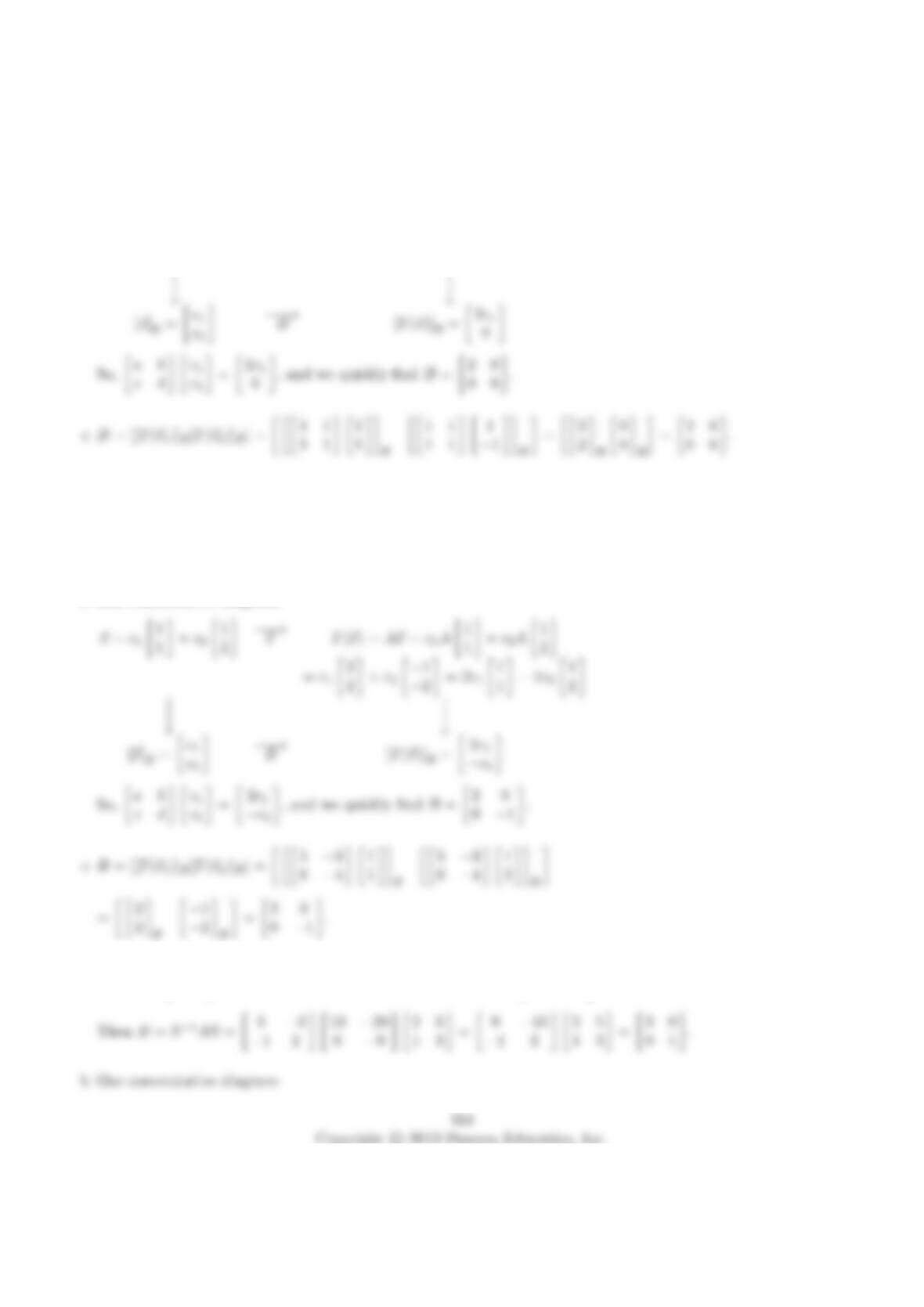
b Our commutative diagram:
~x =c11
1+c21
−1−−→
T T (~x) = A~x =c1A1
1+c2A1
−1
=c12
2+c20
0= 2c11
1+ 0 1
−1
3.4.23 aS=1 1
1 2 , and we find the inverse S−1to be equal to 2−1
−1 1 .
Then B=S−1AS =2−1
−1 1 5−3
6−41 1
1 2 =4−2
1−11 1
1 2 =2 0
0−1.
b Our commutative diagram:
3.4.24 aS=2 5
1 3 , and we find the inverse S−1to be equal to 3−5
−1 2 .
Section 3.4
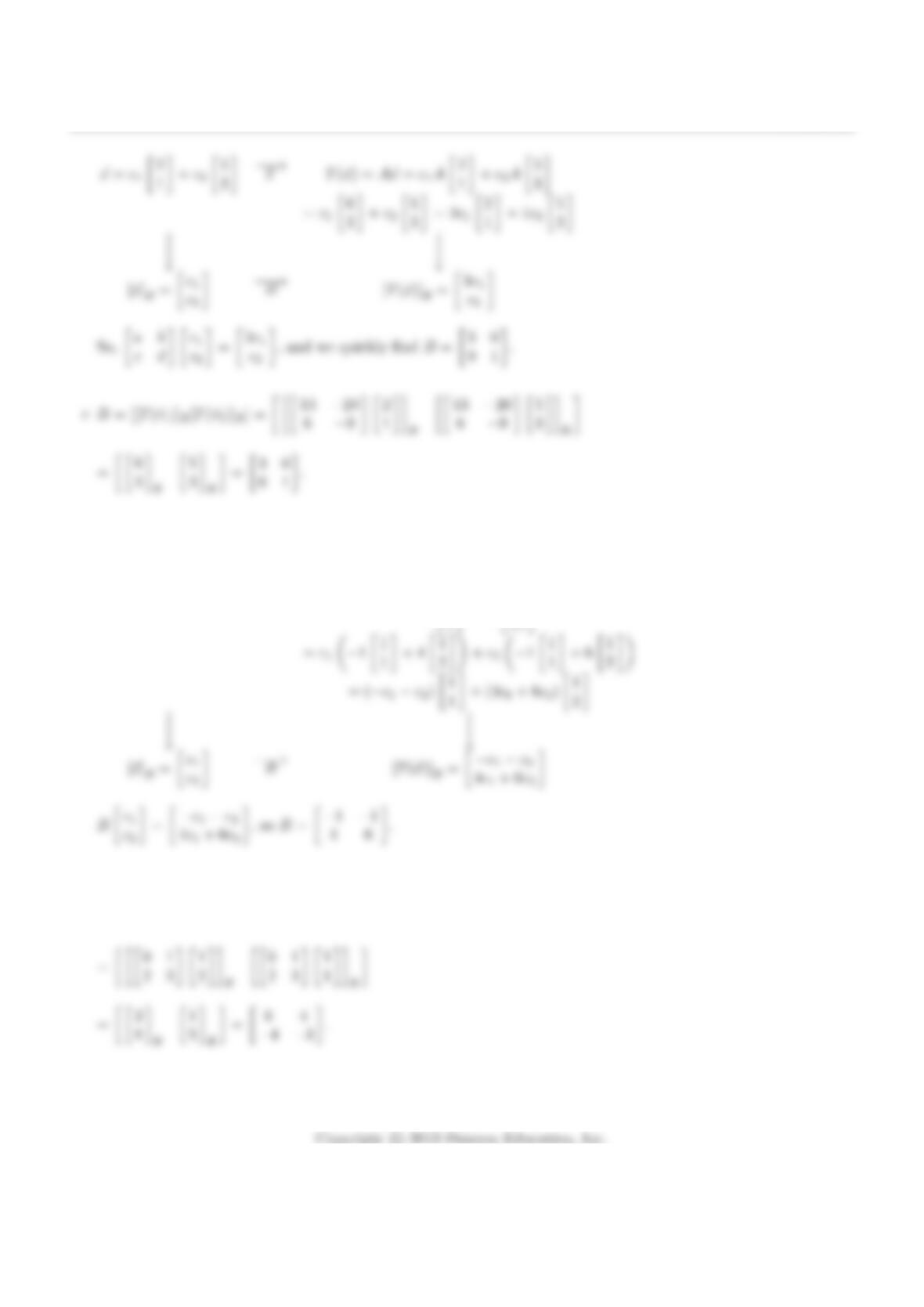
3.4.25 We will use the commutative diagram method here (though any method suffices).
~x =c11
1+c21
2−−→
T T (~x) = A~x =c11 2
3 4 1
1+c21 2
3 4 1
2
=c13
3.4.26 Let’s build B“column-by-column”:
B= [[T(~v1)]B[T(~v2)]B]
3.4.27 We use a commutative diagram:
165
Chapter 3
~x =c1
2
1
−2
+c2
0
2
1
+c3
1
0
1
−−→
T T (~x) = A~x
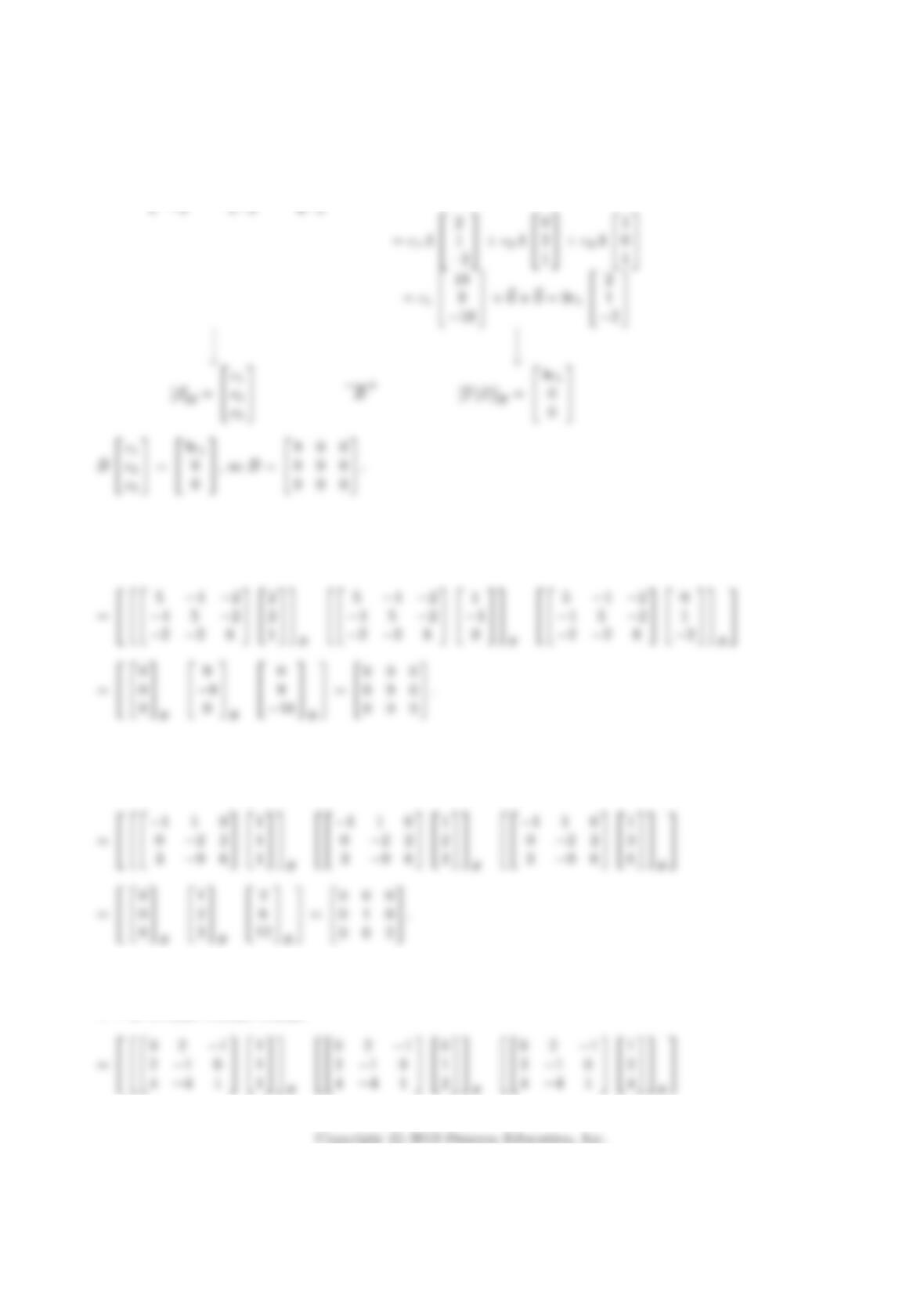
3.4.28 Let’s build B“column-by-column”:
B= [[T(~v1)]B[T(~v2)]B[T(~v3)]B]
3.4.29 Let’s build B“column-by-column”:
B= [[T(~v1)]B[T(~v2)]B[T(~v3)]B]
3.4.30 Let’s build B“column-by-column”:
B= [[T(~v1)]B[T(~v2)]B[T(~v3)]B]
166
Section 3.4
3.4.31 We can use a commutative diagram to see how this works:
~x =c1~v1+c2~v2+c3~v3−−→
T T (~x) = ~v2×~x =c1(~v2×~v1) + c2(~v2×~v2) + c3(~v2×~v3)
=c1(−~v3) + c2(~
0) + c3(~v1) = c3~v1−c1~v3
3.4.32 Here we will build Bcolumn-by-column:
B= [ [T(~v1)]B[T(~v2)]B[T(~v3)]B]
3.4.33 Here we will build Bcolumn-by-column:
B= [ [T(~v1)]B[T(~v2)]B[T(~v3)]B]
3.4.34 Here we will build Bcolumn-by-column:
B= [ [T(~v1)]B[T(~v2)]B[T(~v3)]B]
3.4.35 Using another commutative diagram:
167
Chapter 3
~x =c1~v1+c2~v2+c3~v3−−→
TT(~x) = c1T(~v1) + c2T(~v2) + c3T(~v3)
=c1(~v1−2(~v1·~v1)~v2) + c2(~v2−2(~v1·~v2)~v2)+
c3(~v3−2(~v1·~v3)~v2)
3.4.36 Here we will build Bcolumn-by-column:
B= [ [T(~v1)]B[T(~v2)]B[T(~v3)]B]
= [ [~v1×~v1+ (~v1·~v1)~v1]B[~v1×~v2+ (~v1·~v2)~v1]B[~v1×~v3+ (~v1·~v3)~v1]B]
3.4.37 By Theorem 3.4.7, we want a basis B= (~v1, ~v2) such that T(~v1) = a~v1and T(~v2) = b~v2for some scalars
aand b. Then the B-matrix of Twill be B= [ [T(~v1)]B[T(~v2)]B] = a0
3.4.38 By Theorem 3.4.7, we want a basis B= (~v1, ~v2) such that T(~v1) = a~v1and T(~v2) = b~v2for some scalars aand
b. Then the B-matrix of Twill be B= [ [T(~v1)]B[T(~v2)]B] = a0
3.4.39 Using the same approach as in Exercise 37, we want a basis, ~v1, ~v2, ~v3such that T(~v1) = a~v1, T (~v2) = b~v2and
168
Section 3.4
3.4.40 From Exercise 37, we see that we want one of our basis vectors to be parallel to the line, while the others
3.4.41 We will use the same approach as in Exercises 37 and 39. Any basis with 2 vectors in the plane and one
perpendicular to it will work nicely here! So, let ~v1, ~v2be in the plane. ~v1can be
−1
3
0
, and ~v2=
0
−2
1
(note
3.4.42 From Exercise 38, we deduce that one of our vectors should be perpendicular to this plane, while two should
3.4.43 By definition of coordinates (Definition 3.4.1), ~x = 2
−1
0
1
+ (−3)
−2
1
0
=
4
−3
2
.
3.4.46 As in Exercise 3.4.45, we can make ~v1any vector in the plane that is not parallel to ~x, and then let ~v2= 2~v1−~x.
For example, if we choose ~v1=
1
0
−1
, then ~v2=
1
1
−3
.
169
Chapter 3
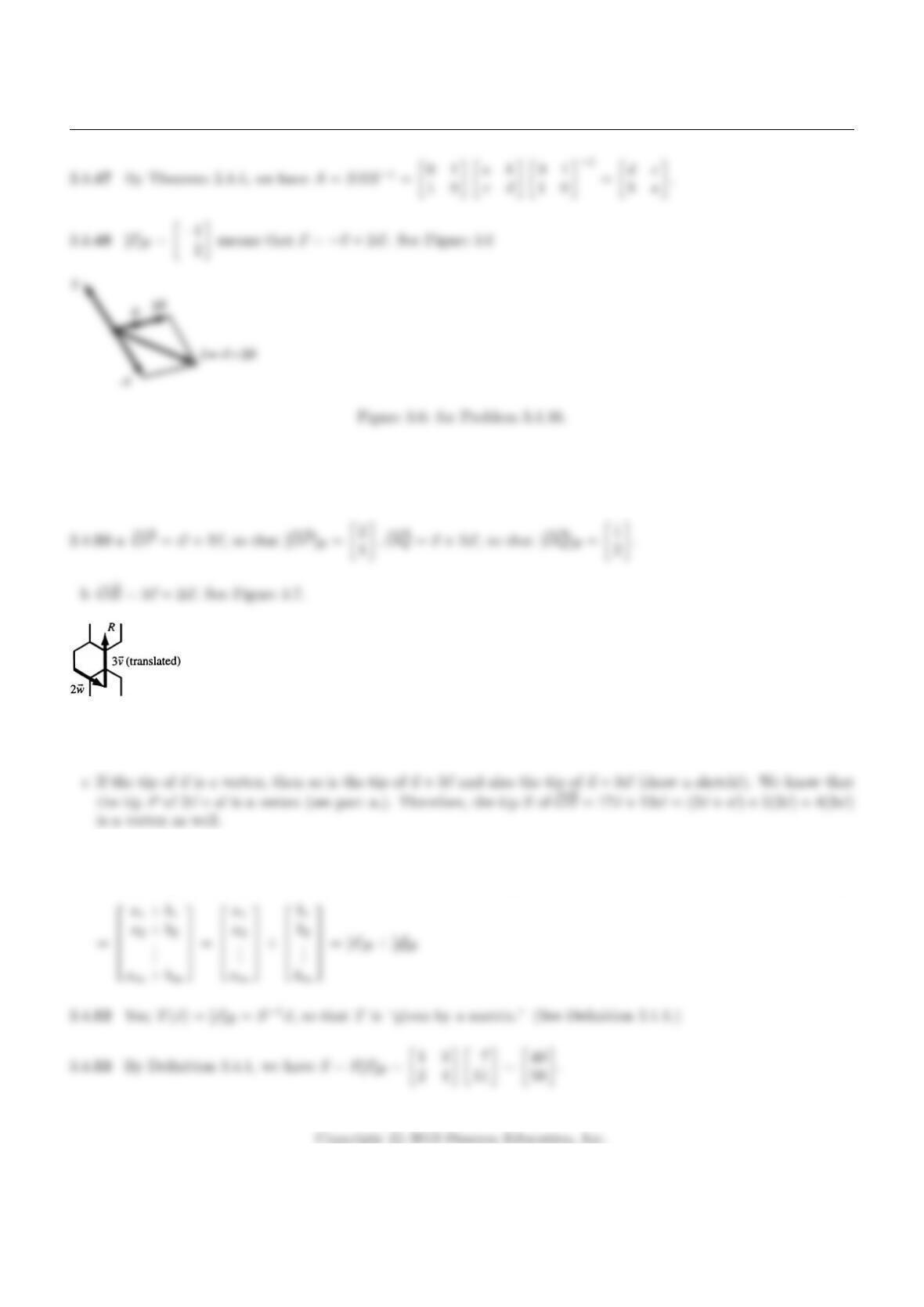
3.4.49 ~u +~v =−~w, so that ~w =−~u −~v, i.e., [ ~w]B=−1
−1.
Figure 3.7: for Problem 3.4.50.
3.4.51 Let B= (~v1, ~v2,···, ~vm). Then, let ~x =a1~v1+a2~v2+···+am~vmand ~y =b1~v1+b2~v2+···+bm~vm. Then
[~x +~y]B= [a1~v1+a2~v2+···+am~vm+b1~v1+b2~v2+···+bm~vm]B= [(a1+b1)~v1+ (a2+b2)~v2+···+(am+bm)~vm]B
170
Section 3.4
3.4.54 Let Qbe the matrix whose columns are the vectors of the basis T. Then [[~v1]T…[~vn]T] = [Q−1~v1. . . Q−1~vn] =
Q−1[~v1. . . ~vn] is an invertible matrix, so that the vectors [~v1]T…[~vn]Tform a basis of Rn.
P
3.4.56 Let S= [~v1~v2] where ~v1, ~v2is the desired basis. Then by Theorem 3.4.1, 1
2=S3
5and 3
4=S2
3,
i.e. S3 2
5 3 =1 3
2 4 . Hence S=1 3
2 4 3 2
5 3 −1
=12 −7
14 −8. The desired basis is 12
14 ,−7
−8.
bT(A2~v) = A3~v =~
0 so [T(A2~v)]B=
0
0
0
.
T(A~v) = A2~v so [T(A~v)]B=
1
0
0
.
3.4.59 First we find the matrices S=x y
z t such that 2 0
0 3 x y
z t =x y
z t 2 1
0 3 , or
171
Chapter 3
3.4.60 First we find the matrices S=x y
z t such that 1 0
0−1x y
z t =x y
z t 0 1
1 0 , or, x y
−z−t=
y x
t z . The solutions are of the form S=y y
−t t , where yand tare arbitrary constants. Since there are
invertible solutions S(for example, let y=t= 1), the matrices 1 0
0−1and 0 1
1 0 are indeed similar.
3.4.62 We seek a basis ~v1=x
z, ~v2=y
tsuch that the matrix S= [~v1~v2] = x y
z t satisfies the equation
1 2
4 3 x y
z t =x y
z t 5 0
0−1. Solving the ensuing linear system gives S=z
2−t
z t . We need to choose
both zand tnonzero to make Sinvertible. For example, if we let z= 2 and t= 1, then S=1−1
2 1 , so that
~v1=1
2, ~v2=−1
1.
3.4.64 If band care both zero, then the given matrices are equal, so that they are similar, by Theorem 3.4.6.a.
Let’s now assume that at least one of the scalars band cis nonzero; reversing the roles of band cif necessary,
we can assume that c6= 0.
172
Section 3.4
3.4.65 a If S=In, then S−1AS =A.
b If S−1AS =B, then SBS−1=A. If we let R=S−1, then R−1BR =A, showing that Bis similar to A.
3.4.66 We build B“column-by-column”:
3.4.67 The matrix we seek is T1
0BTa
cB=a
cBa2+bc
ac +cd B=0bc −ad
1a+d.
3.4.70 Suppose such a basis ~v1, ~v2exists. If B= [[T(~v1)]B[T(~v2)]B] is upper triangular, of the form a b
0c, then
[T(~v1)]B=a
0, so that T(~v1) = a~v1, that is, T(~v1) is parallel to ~v1. But this is impossible, since Tis a rotation
through π
2.
Chapter 3
3.4.73 a By inspection, we can find an orthonormal basis ~v1=~v, ~v2, ~v3of R3,~v1=~v =
0.6
0.8
0
,~v2=
0
0
1
,
~v3=
0.8
−0.6
0
.
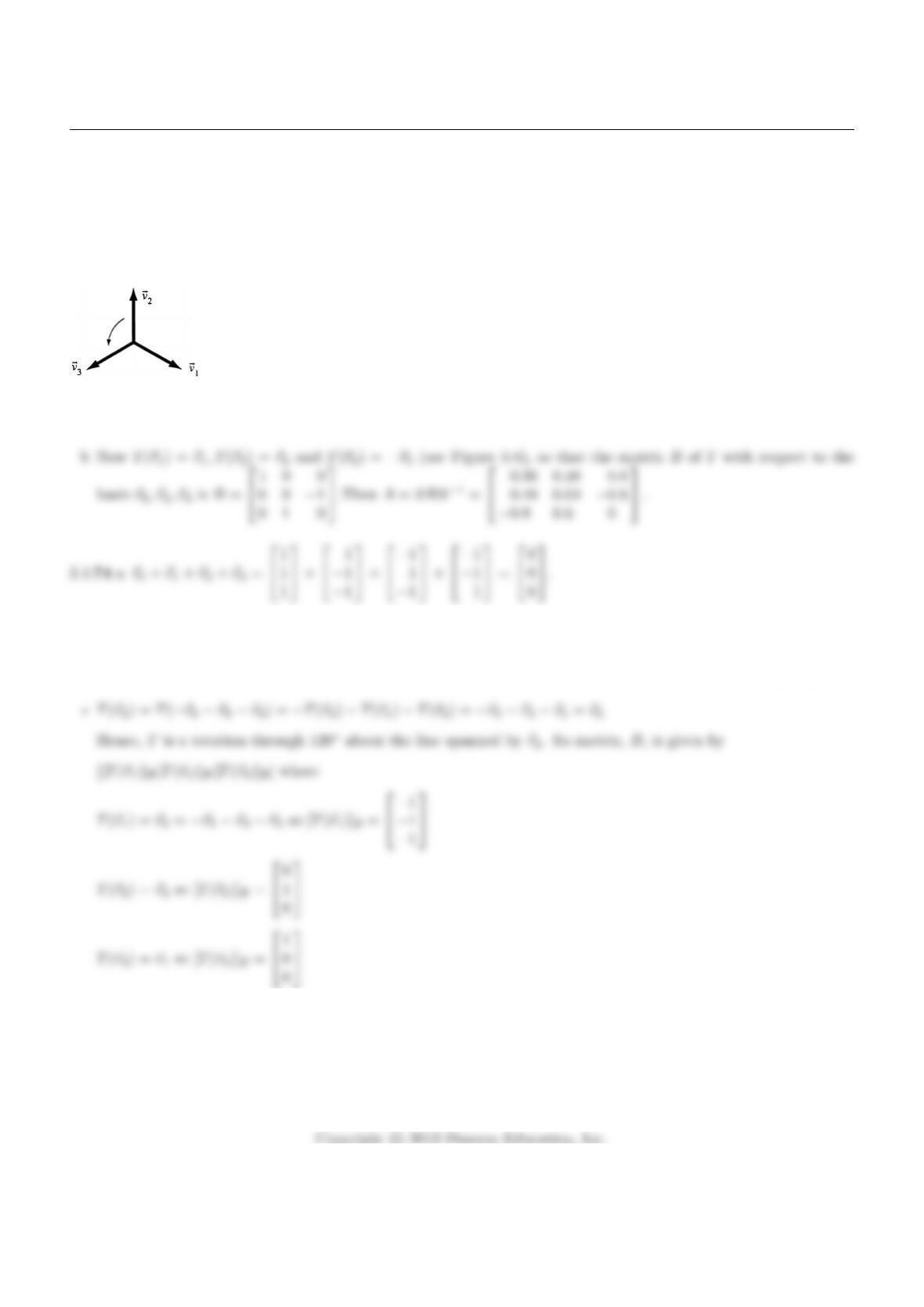
Figure 3.8: for Problem 3.4.73b.
b If Bis the basis ~v1, ~v2, ~v3, then ~v0+~v1+~v2+~v3=~
0 (by part a) so ~v0=−~v1−~v2−~v3, i.e. [~v0]B=
−1
−1
−1
.
and B=
−1 0 1
−1 1 0
1 0 0
.
B3=I3since if the tetrahedron rotates through 120◦three times, it returns to the original position.
174
Section 3.4
3.4.77 Let Sbe the n×nmatrix whose columns are ~en, ~en−1, . . . , ~e1. Note that Shas all 1’s on “the other diagonal”
and 0’s elsewhere:
sij =1 if i+j=n+ 1
0 otherwise
3.4.78 Note first that the diagonal entry sij of Sgives the unit price of good i.
If aij tells us how many dollars’ worth of good iare required to produce one dollar’s worth of good j, then
aij sjj tells us how many dollars’ worth of good iare required to produce one unit of good j, and s−1
ii aij sjj is the
number of units of good irequired to produce one unit of good j. Thus bij =s−1
ii aij sjj , and B=S−1AS.
3.4.79 By Theorem 3.4.7, we are looking for a basis ~v1, ~v2such that A~v1=~v1and A~v2=−~v2. Solving the linear
systems A~x =~x and A~x =−~x, we find ~v1=3t
3.4.81 a. We seek the real numbers x2, x3,and csuch that T
1
x2
x3
=
x2
x3
x2+x3
=c
1
x2
x3
. Examining the
components of this vector equation, we find x2=c,x3=x2
2and x2+x2
2=x3
2. Writing the last equation as
175
Chapter 3
3.4.82 a. We seek the real numbers x2, x3,and csuch that T
1
x2
x3
=
x2
x3
3x3−2x2
=c
1
x2
x3
. Examining
True or False
Ch 3.TF.1T, by Theorem 3.3.2.
Ch 3.TF.5T, by Summary 3.3.10.
Ch 3.TF.6F, by Theorem 3.3.7.
Ch 3.TF.10 F; The columns could be ~e1, ~e2, ~e3, ~e4in R5, for example.
Ch 3.TF.11 T, by Theorem 3.4.6, parts b and c.
176
True or False
Ch 3.TF.17 T, by Theorem 3.2.8.
Ch 3.TF.21 T, since A−1(AB)A=BA.
Ch 3.TF.22 T, since both kernels consist of the zero vector alone.
Ch 3.TF.23 F; There is no invertible matrix Sas required in the definition of similarity.
Ch 3.TF.24 F; Five vectors in R4must be dependent, by Theorem 3.2.8.
Ch 3.TF.28 T, by Definition 3.2.3.
Ch 3.TF.29 F; Suppose ~v2= 2~v1. Then T(~v2) = 2T(~v1) = 2~e1cannot be ~e2.
Ch 3.TF.33 T; for any ~v1, ~v2, ~v3of Valso k~v1, ~v2, ~v3is a basis too, for any nonzero scalar k.
Ch 3.TF.34 F; The identity matrix is similar only to itself.
Ch 3.TF.35 F; Consider 0 1
0 1 1 1
0 0 =0 0
0 0 , but 1 1
0 0 0 1
0 1 =0 2
0 0 .
Chapter 3
Ch 3.TF.40 F; Suppose Awere similar to B. Then A4=I2were similar to B4=−I2, by Example 7 of Section 3.4.
But this isn’t the case: I2is similar only to itself.
Ch 3.TF.41 T; Let A=0 1
0 0 , for example, with ker(A) = im(A) = span(~e1).
Ch 3.TF.45 T; Pick three vectors ~v1, ~v2, ~v3that span V. Then V= im[~v1~v2~v3].
Ch 3.TF.46 T; Check that 0 1
0 0 is similar to 0 2
0 0 .
Ch 3.TF.47 T; Pick a vector ~v that is neither on the line nor perpendicular to it. Then the matrix of the linear
transformation T(~x) = R~x with respect to the basis ~v,R~v is 0 1
1 0 , since R(R~v) = ~v.
Ch 3.TF.51 F; Suppose such a matrix Aexists. Then there is a vector ~v in R2such that A2~v 6=~
0 but A3~v =~
0. As
in Exercise 3.4.58a we can show that vectors ~v, A~v, A2~v are linearly independent, a contradiction (we are looking
at three vectors in R2).
Ch 3.TF.52 T; The ith column ~aiof A, being in the image of A, is also in the image of B, so that ~ai=B~cifor
some ~ciin Rm.If we let C= [~c1··· ~cm],then BC = [B~c1··· B~cm] = [~a1··· ~am] = A, as required.
178