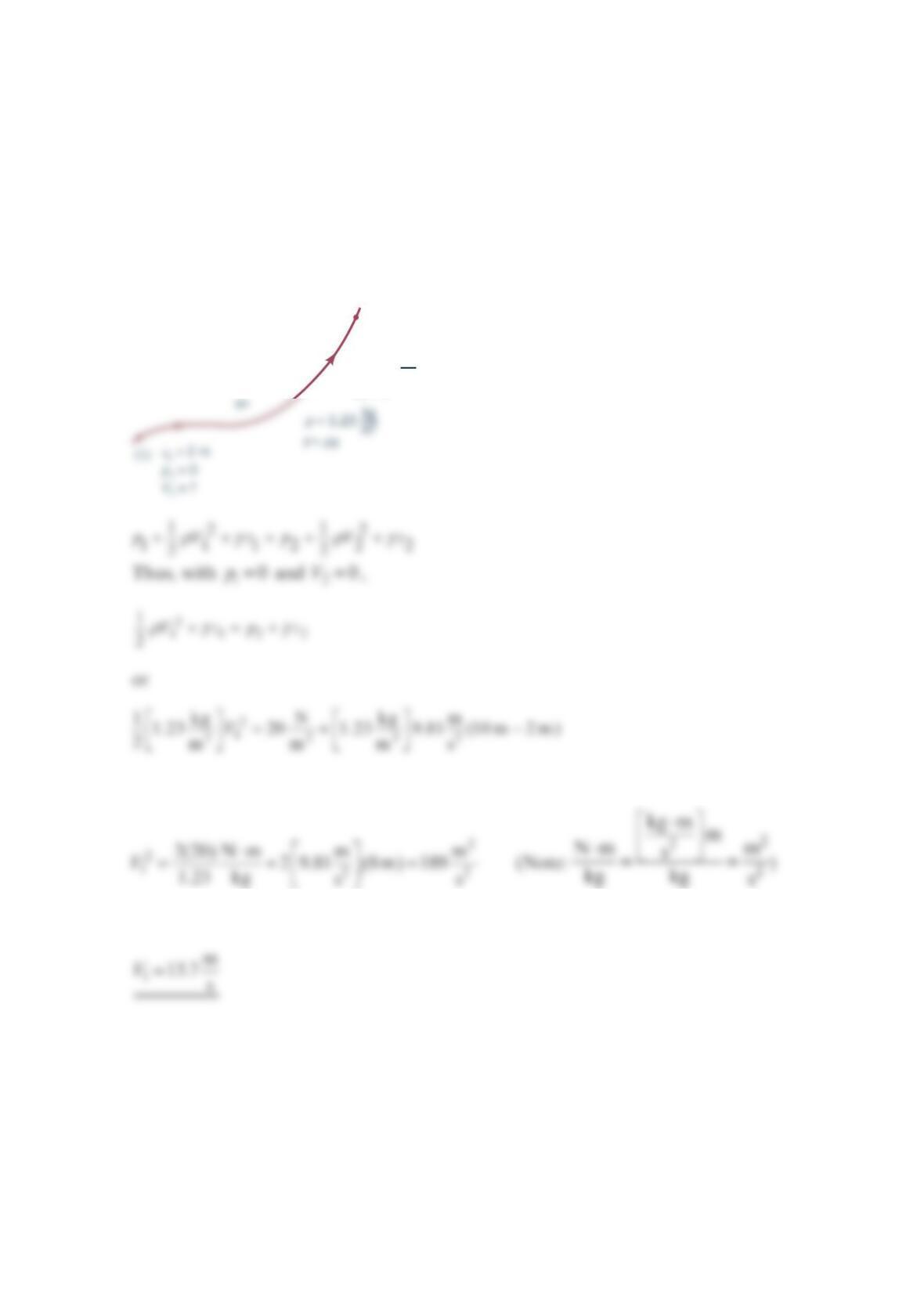
Problem 3.2
Air flows steadily along a streamline from point (1) to point (2) with negligible viscous
effects. The following conditions are measured: At point (1) 12mz= and 10kPa
p
= ; at
point (2) 210 mz=
, 2
220 N/mp=, and 20V=. Determine the velocity at point (1).
Solution 3.2
or
Thus,
(2)
z
2
= 10 m
V
2
= 0
p
2
= 20
m2
N
Problem 3.3
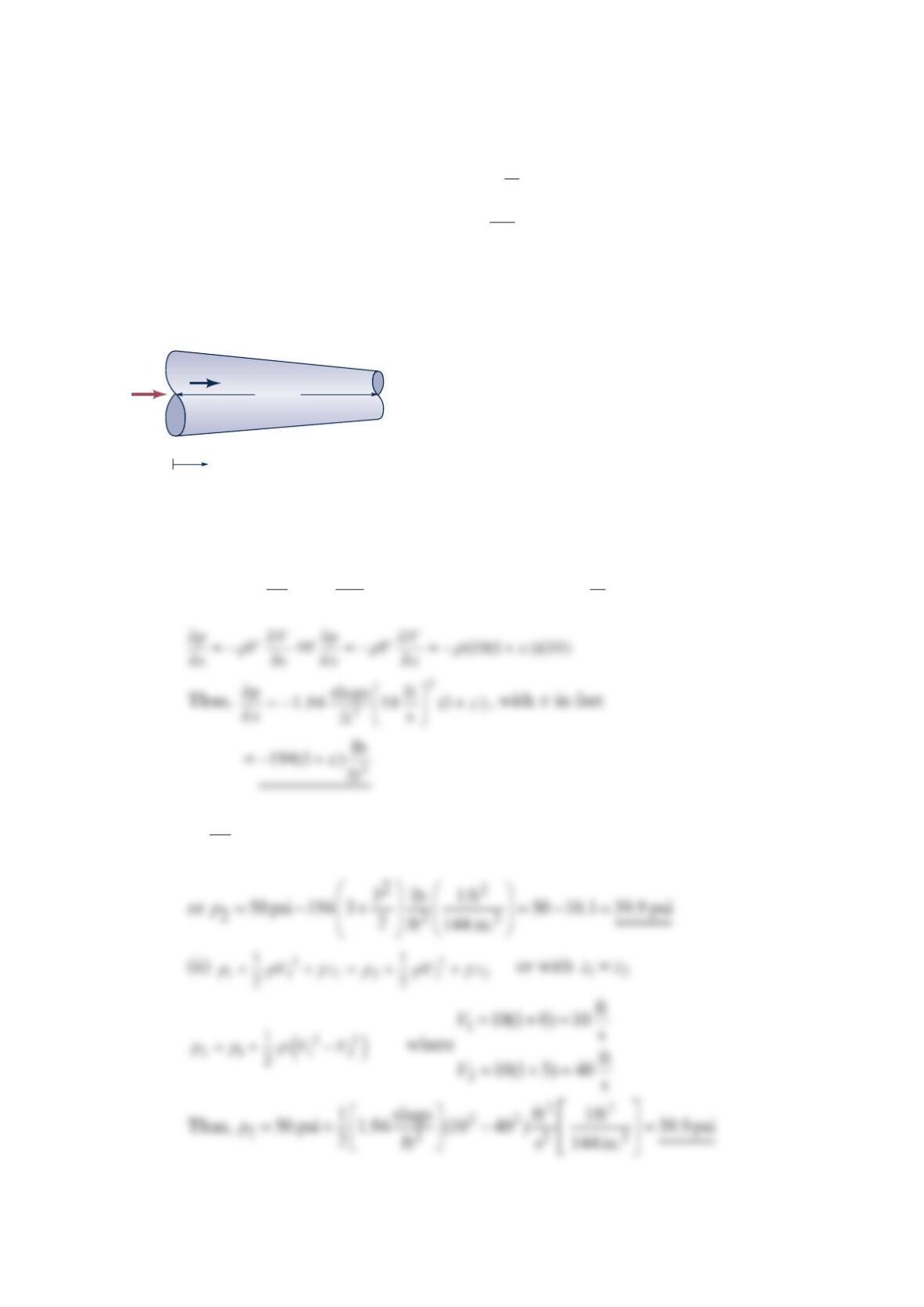
Water flows steadily through the variable area horizontal pipe shown in the figure below.
The centerline velocity is given by ft
ˆ
10(1 ) s
x=+Vi
, where x is in feet. Viscous effects are ne-
glected. (a) Determine the pressure gradient,
p
x
∂
∂(as a function of x), needed to produce
this flow. (b) If the pressure at section (1) is 50 psi, determine the pressure at (2) by
(i) integration of the pressure gradient obtained in (a), (ii) application of the Bernoulli’s
equation.
Solution 3.3
(a) sin
p
V
V
ss
γθ ρ
∂∂
−−=
∂∂
but 0
θ
= and ft
10(1 ) s
Vx=+
(b) (i) 194 (1 )
p
x
x
∂=− +
∂ so that
22
11
3
50psi 0
194 (1 )
px
px
dp x dx
=
==
=− +
p
p
Q
V(x)
(1)
(2)
ℓ
= 3 ft
x
p
p
Problem 3.4
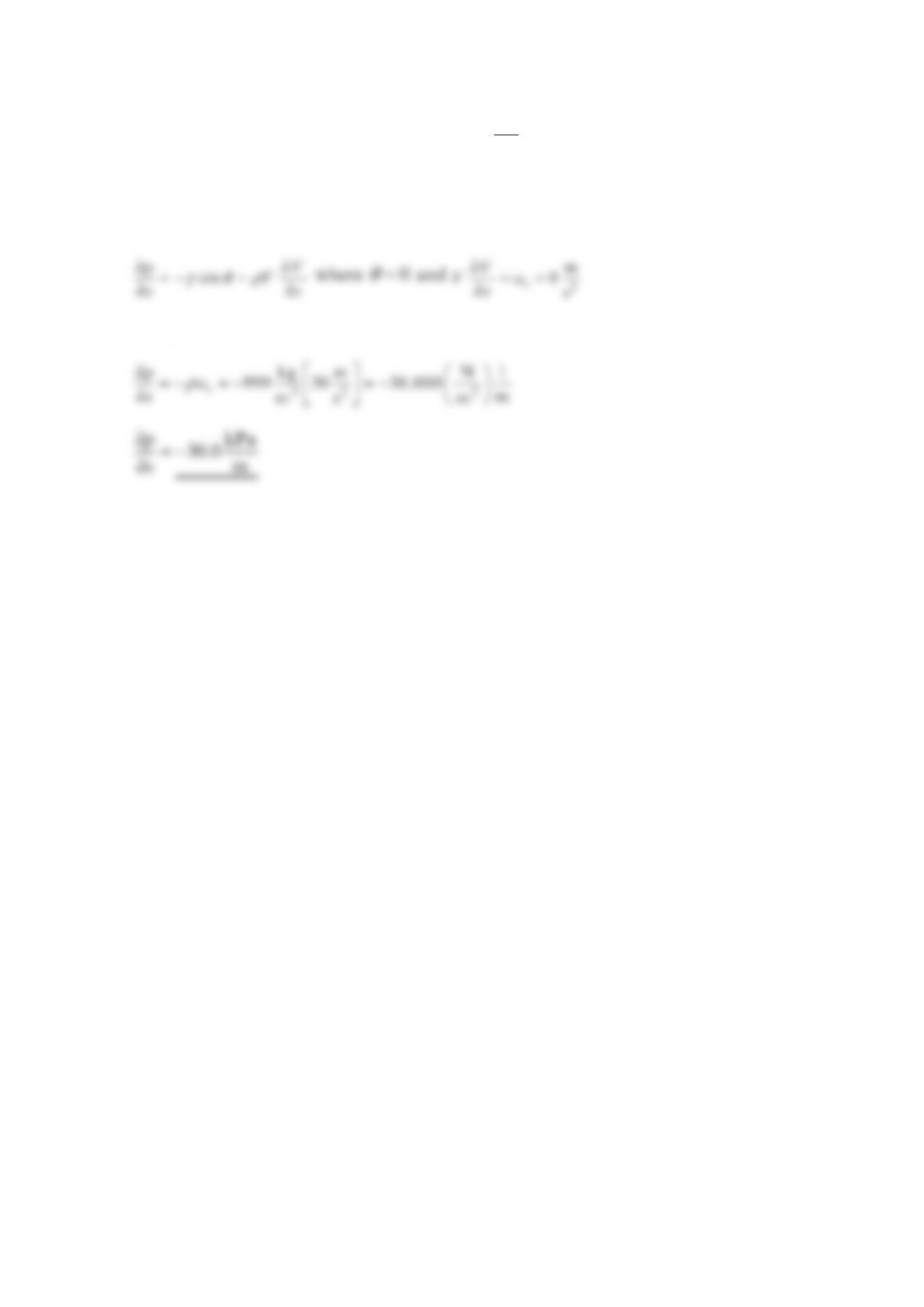
What pressure gradient along the streamline, dp
ds , is required to accelerate water in a
horizontal pipe at a rate of 30 m s2
/?
Solution 3.4
Thus,
Problem 3.5
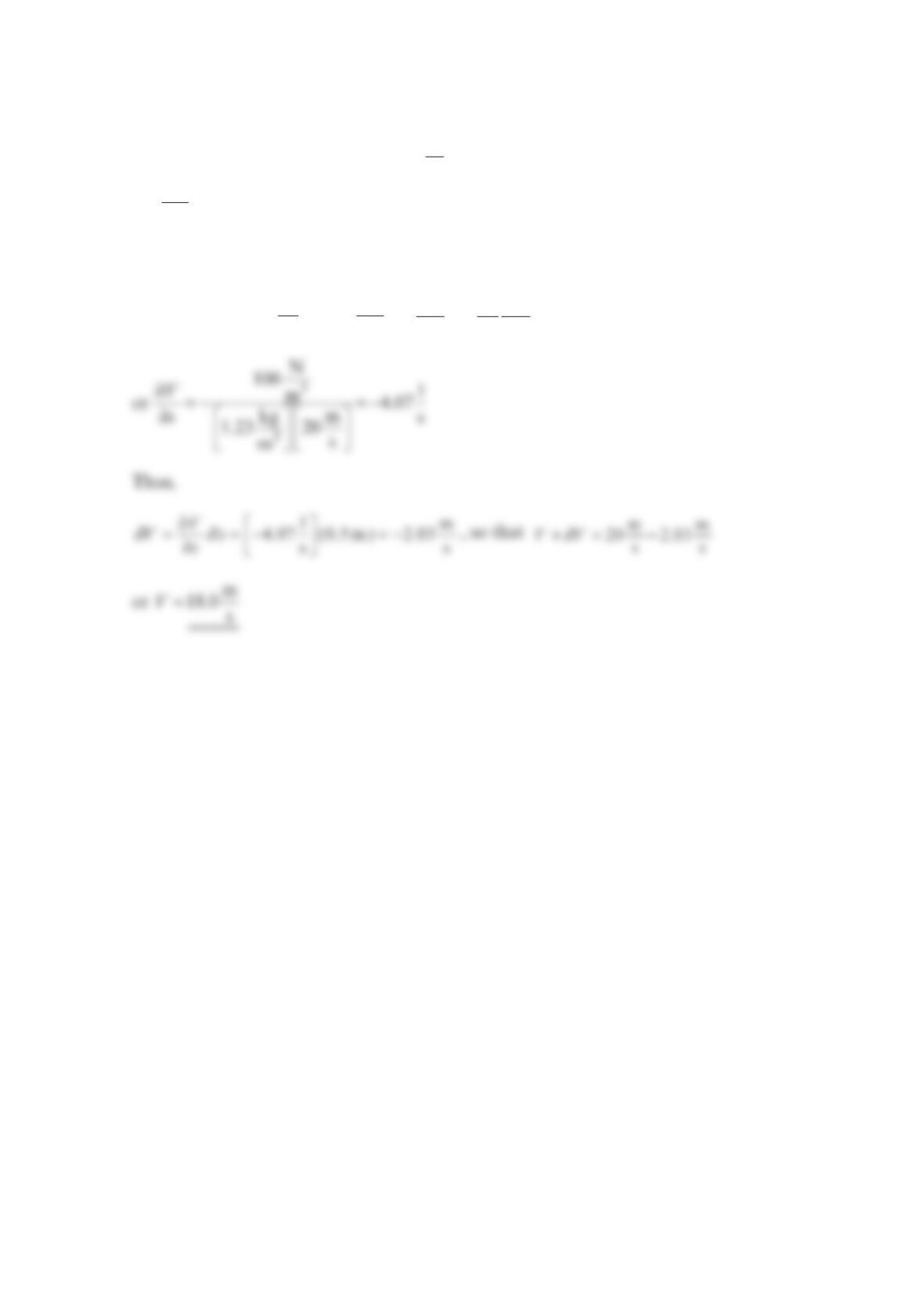
At a given location the airspeed is m
2
0s and the pressure gradient along the streamline is
3
N
1
00 m. Estimate the airspeed at a point 0.5 m farther along the streamline.
Solution 3.5
If neglect gravity,
p
V
V
ss
ρ
∂∂
=−
∂∂
or 1Vp
ssV
ρ
∂∂
=−
∂∂
Problem 3.6
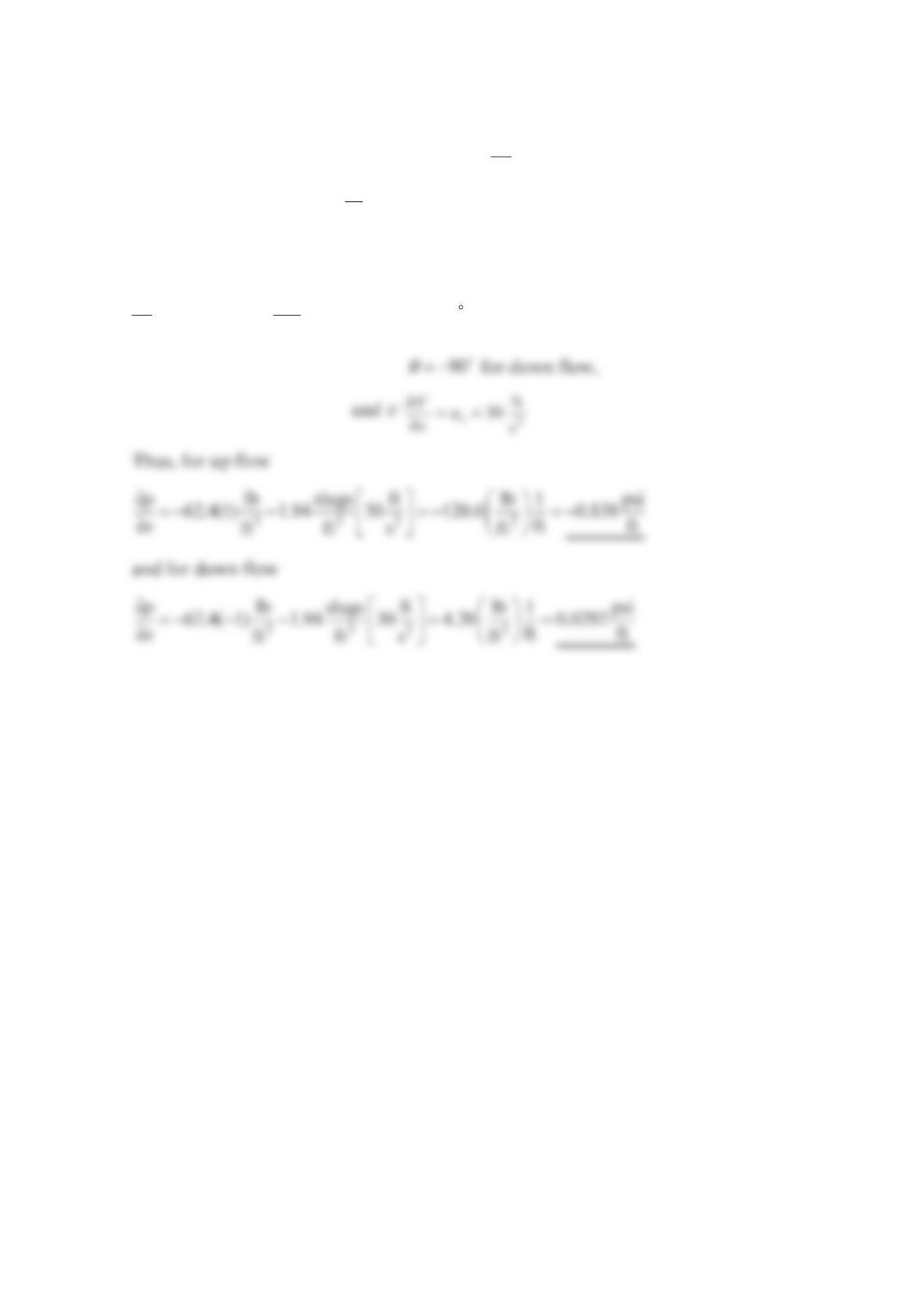
What pressure gradient along the streamline, dp
ds , is required to accelerate water upward in a
vertical pipe at a rate of 2
ft
3
0s? What is the answer if the flow is downward?
Solution 3.6
sin
p
V
V
ss
γθρ
∂∂
=− −
∂∂
where
90
θ
= for up flow,
Problem 3.7
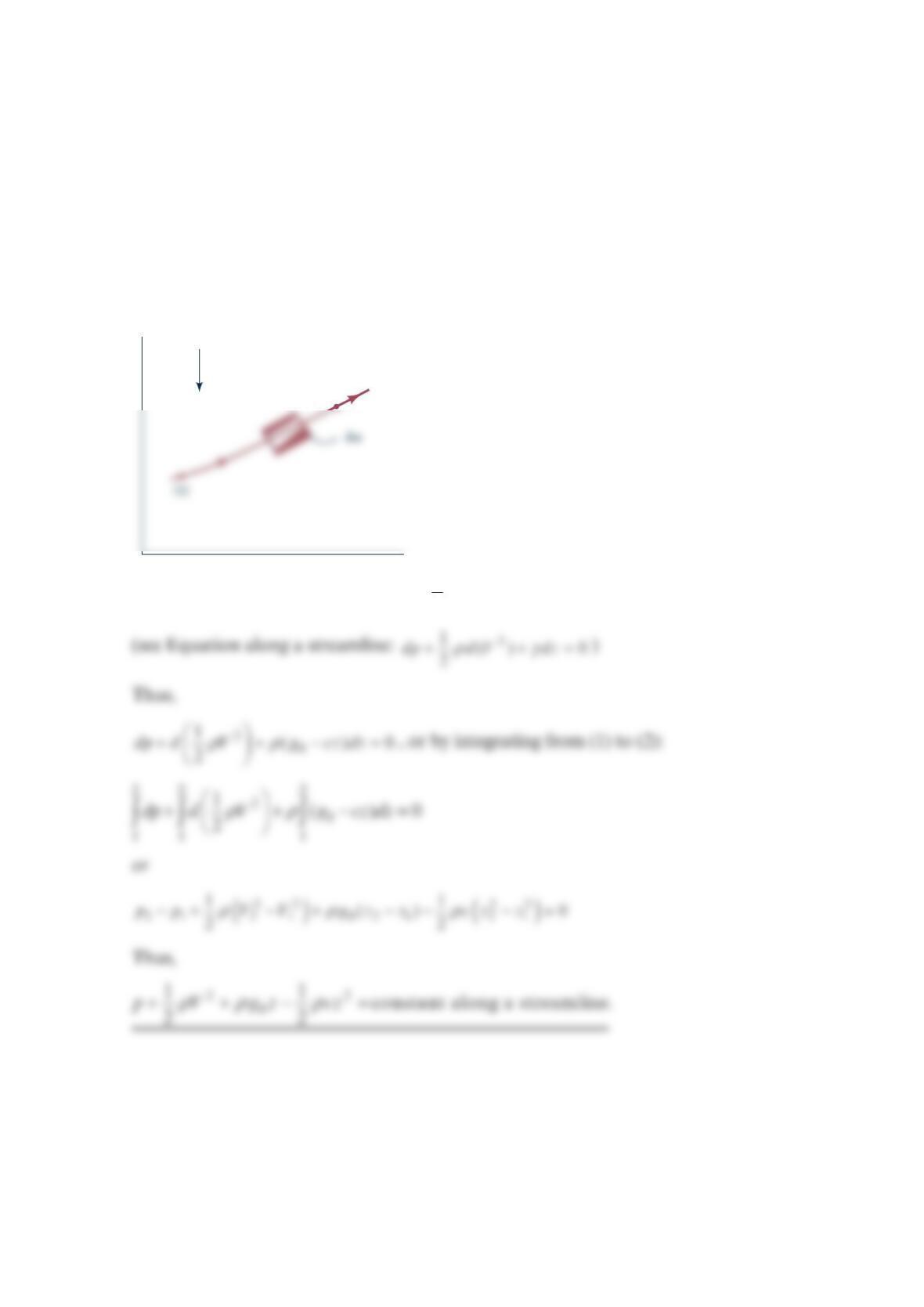
The Bernoulli’s equation is valid for steady, inviscid, and incompressible flows with con-
stant acceleration of gravity. Consider flow on a planet where the acceleration of gravity
varies with height so that 0
gg cz=−
, where 0
g and c are constants. Integrate “”m=Fa
along a streamline to obtain the equivalent of the Bernoulli’s equation for this flow.
Solution 3.7
From ss
Fma
δδ
=
one obtains 2
1()
2
dp d V dz
ργ
++
where g
γρ
=
(2)
S
z
g
Problem 3.8
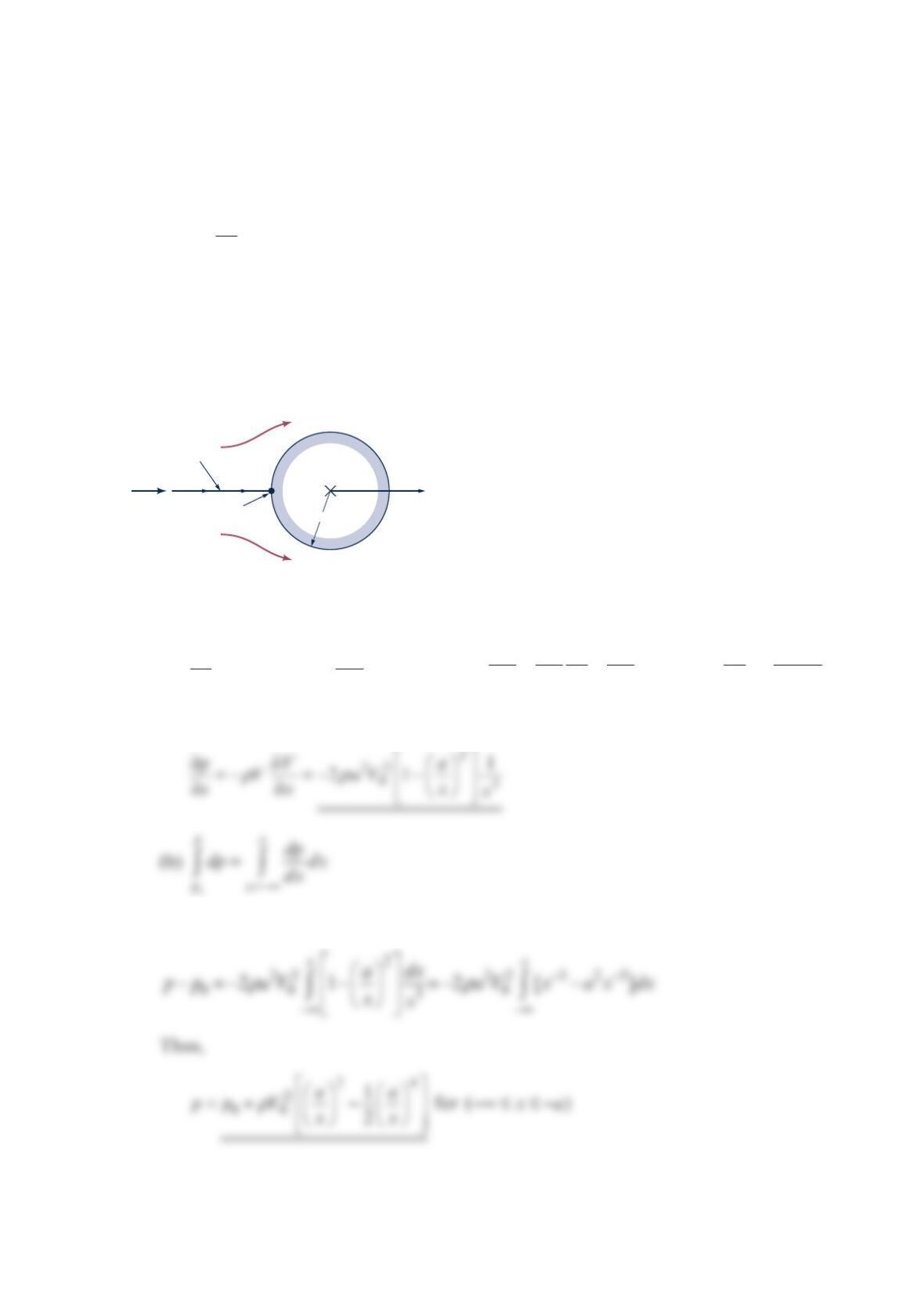
An incompressible fluid flows steadily past a circular cylinder as shown in the figure
below. The fluid velocity along the dividing streamline ()xa−∞ ≤ ≤ − is found to be
2
02
1a
VV x
=−
, where a is the radius of the cylinder and 0
V is the upstream velocity.
(a) Determine the pressure gradient along this streamline. (b) If the upstream pressure is
0
p
, integrate the pressure gradient to obtain the pressure ()
p
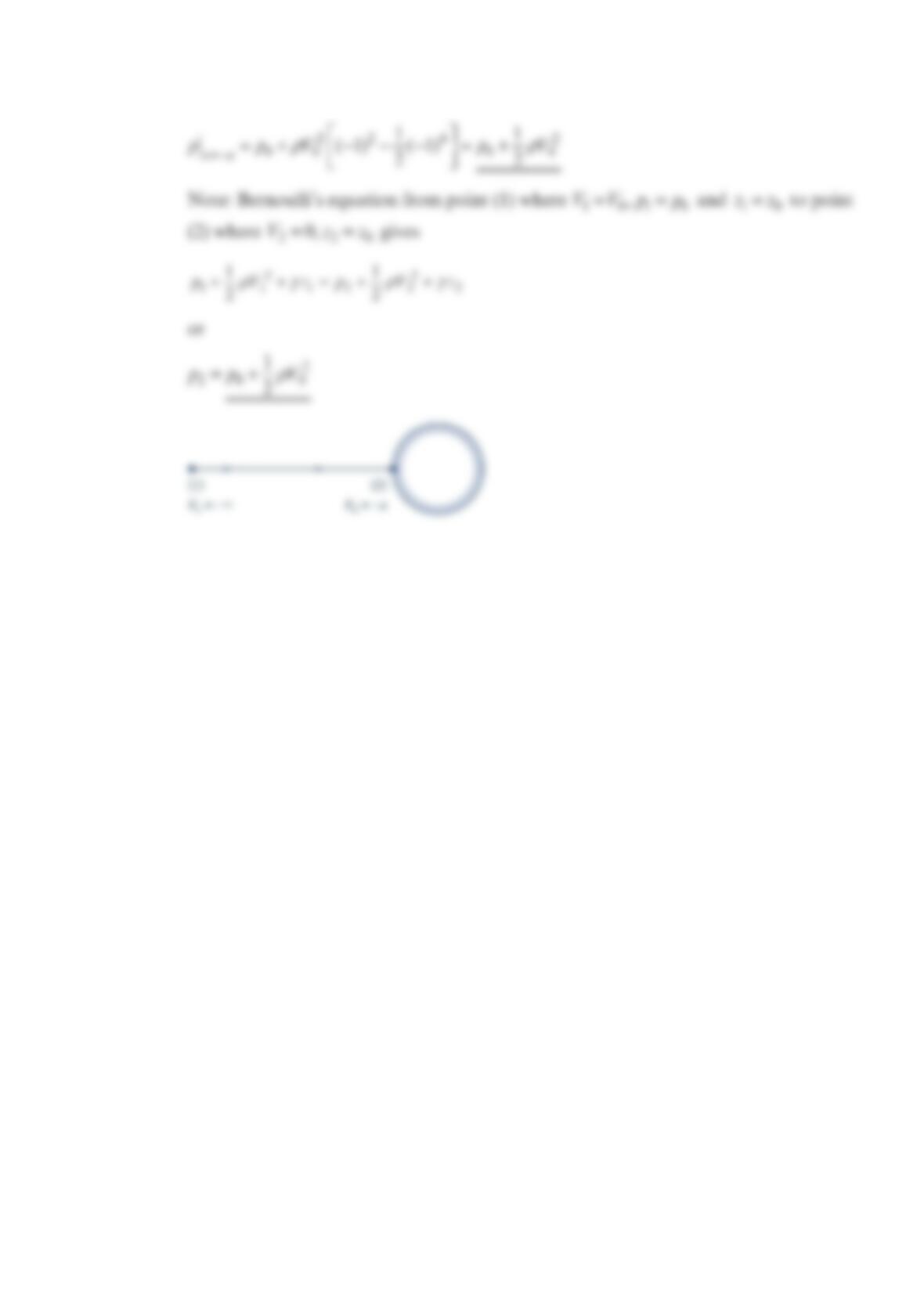
x for ()xa−∞ ≤ ≤ − . (c) Show
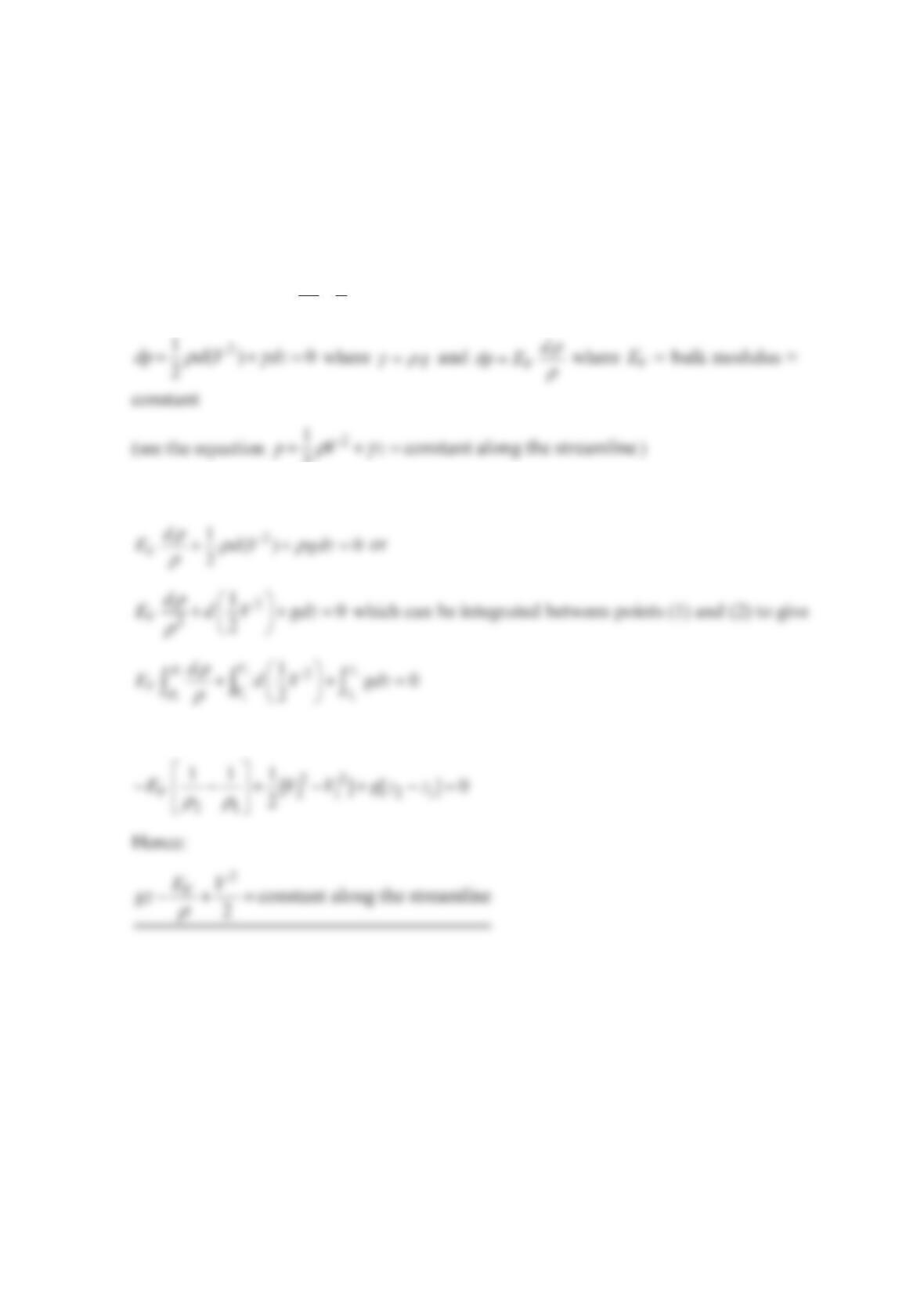
from the result of part (b) that the pressure at the stagnation point ()xa=− is 2
00
/
2pV
ρ
+,
as expected from the Bernoulli’s equation.
Solution 3.8
(a) sin
p
V
V
ss
γθρ
∂∂
=− −
∂∂
but 0
θ
= and
2
20
033
2
2
[] aV
VVxV
Va
sxsx xx
∂∂∂∂ −
===− =
∂∂∂∂
Thus,
Or
x
= 0
Stagnation
point
Dividing
streamline
a
x
V
0
p
0
(c) For xa=− , from part (b):
Problem 3.9
Consider a compressible liquid that has a constant bulk modulus. Integrate “”m=Fa
along
a streamline to obtain the equivalent of the Bernoulli’s equation for this flow. Assume
steady, inviscid flow.
Solution 3.9
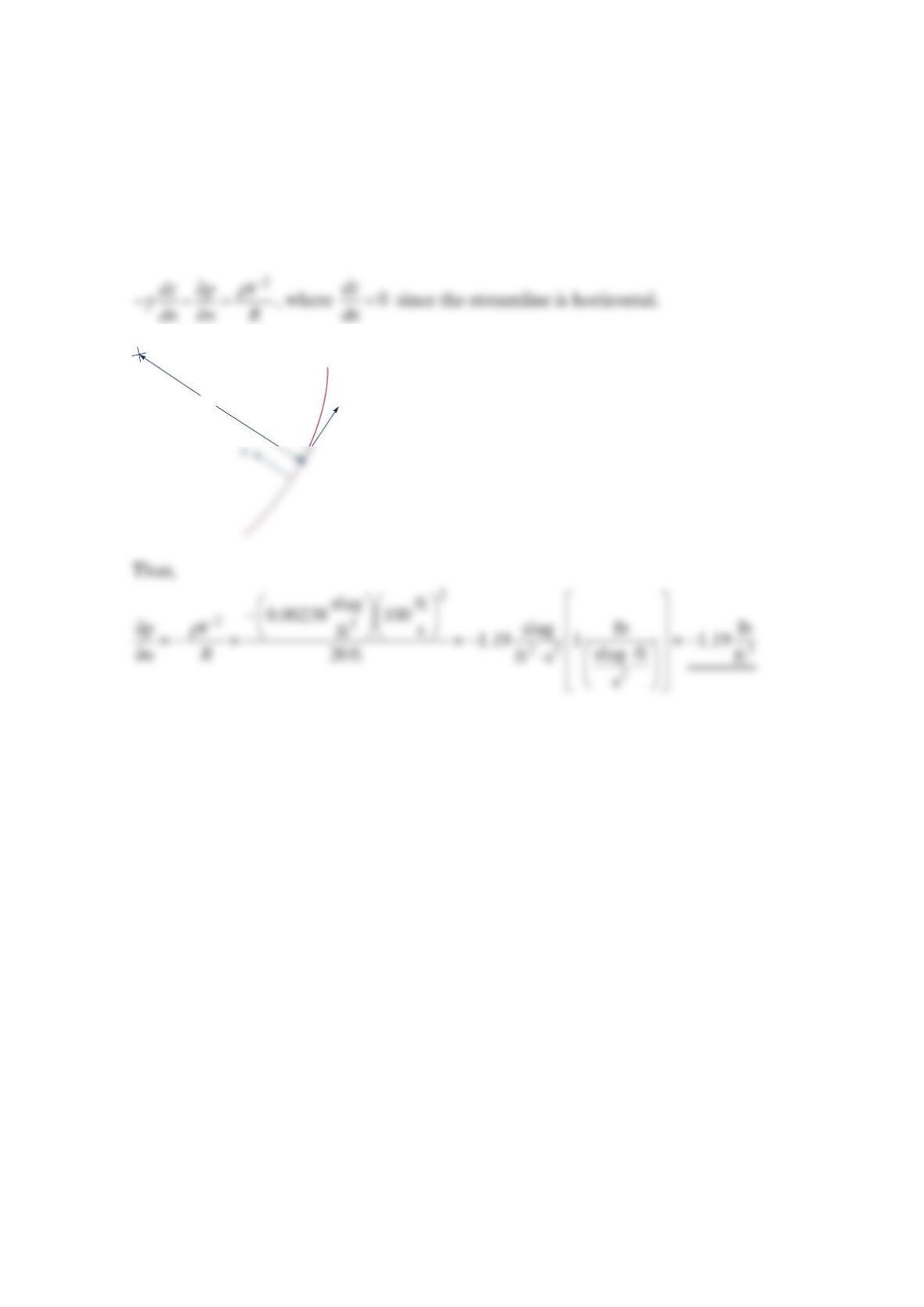
From the equation 2
1
2
dp VgzC
ρ
++=
2
Thus, along a streamline:
or
Problem 3.11
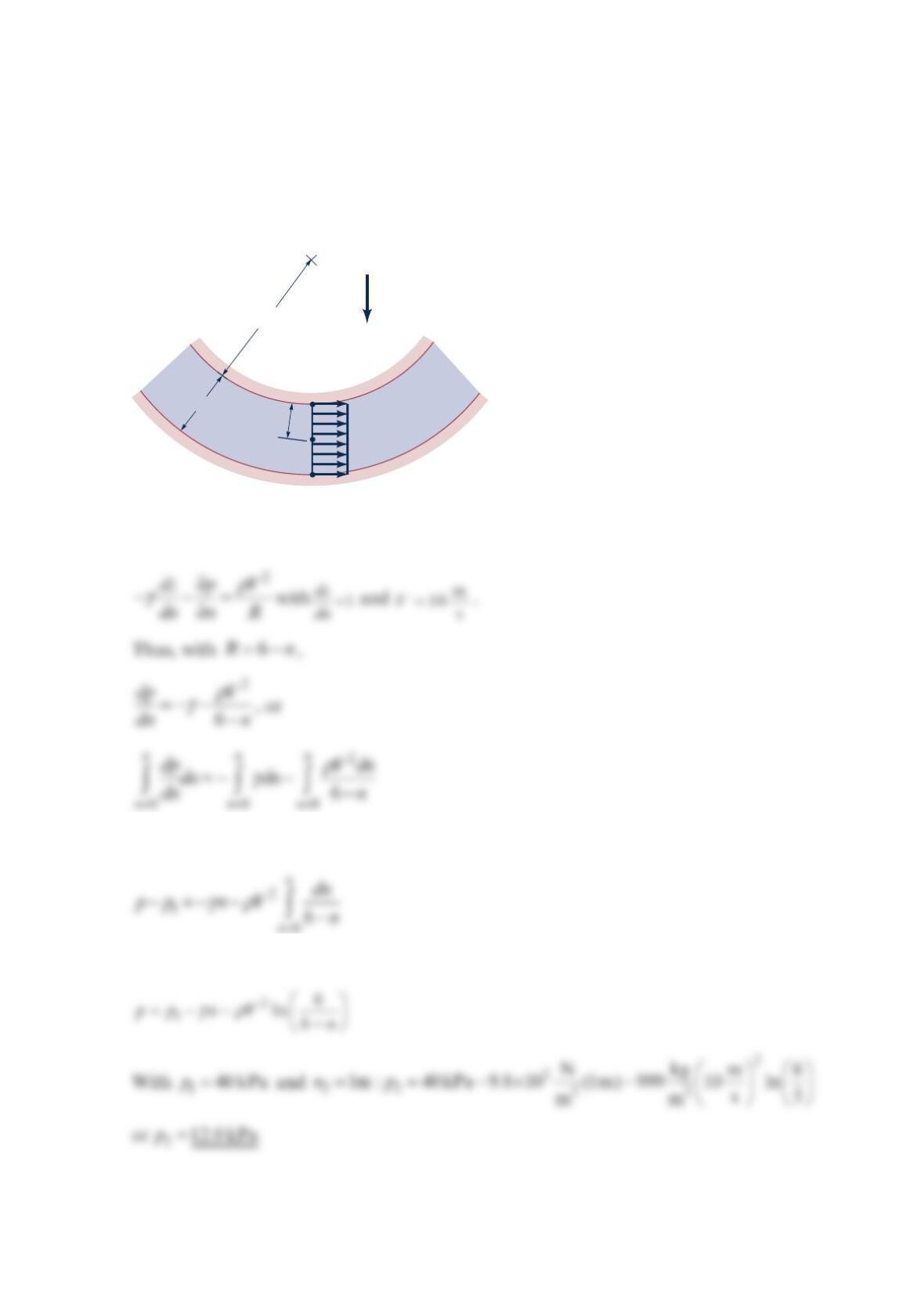
Air flows along a horizontal, curved streamline with a 20 ft radius with a speed of 110ft / s .
Determine the pressure gradient normal to the streamline.
Solution 3.11
V
R
Problem 3.12
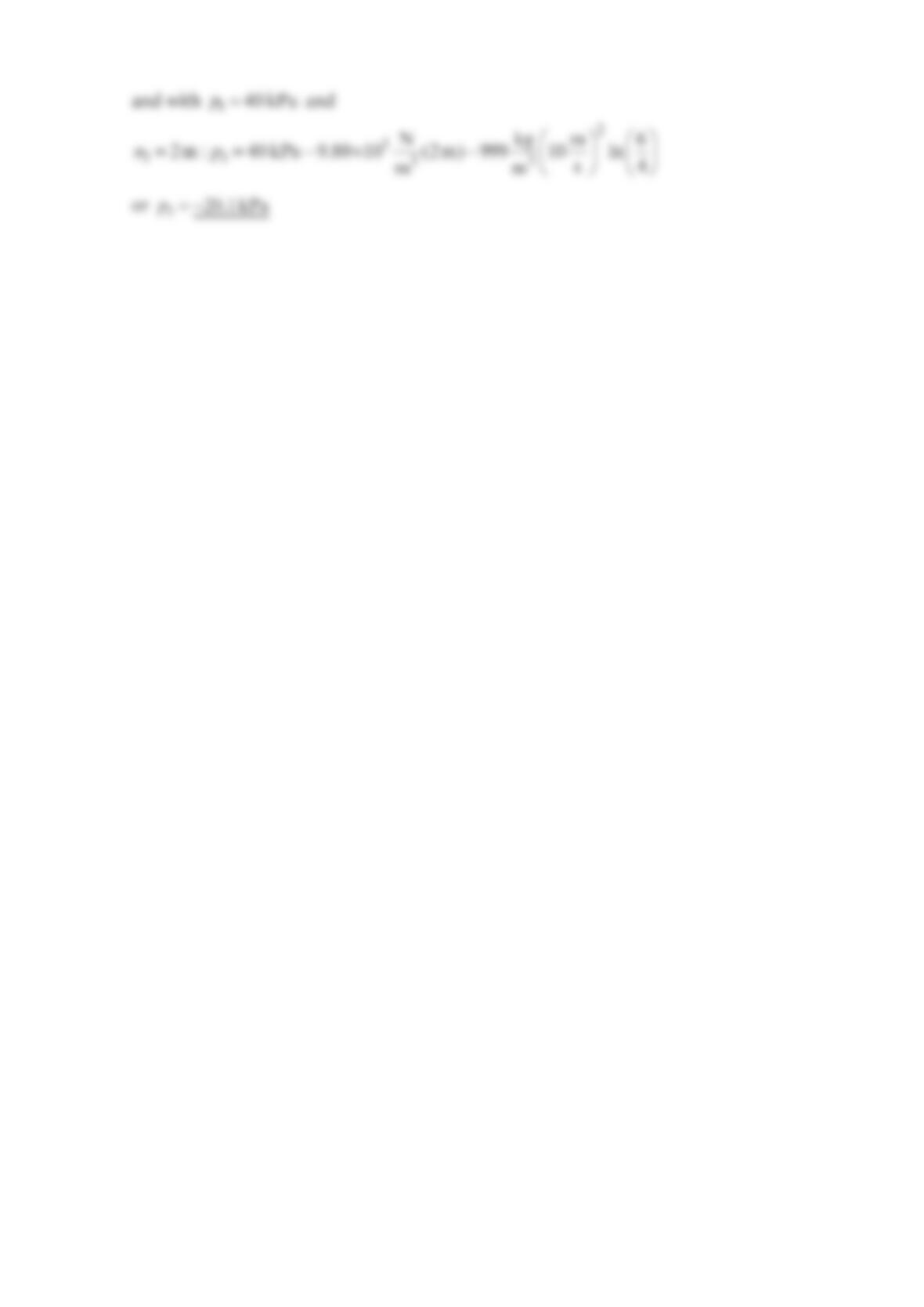
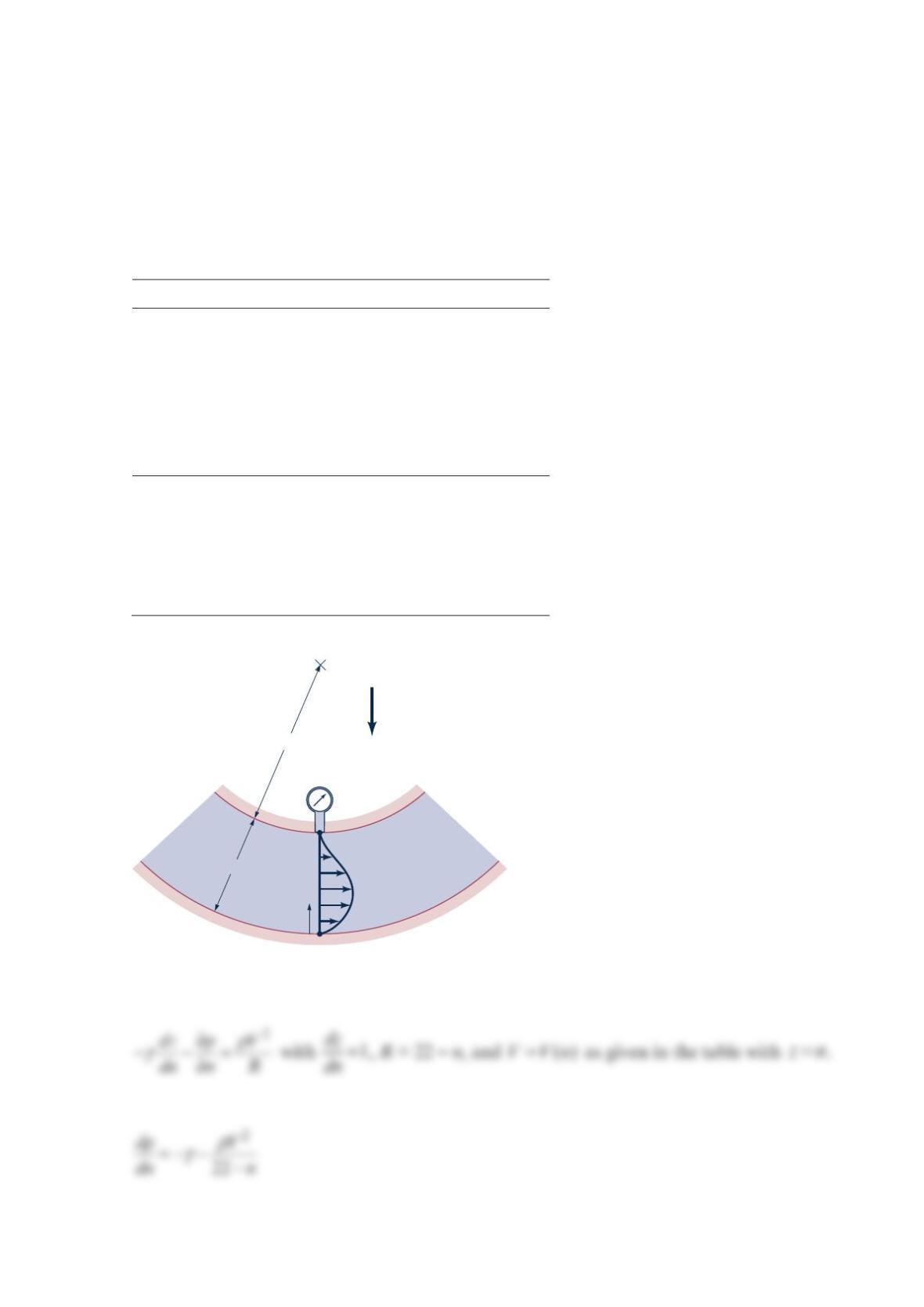
Water flows around the vertical two-dimensional bend with circular streamlines and con-
stant velocity as shown in the figure below. If the pressure is 40 kPa at point (1), determine
the pressures at points (2) and (3). Assume that the velocity profile is uniform as indicated.
Solution 3.12
So that since
γ
and V are constants
Thus,
(1)
(2)
(3)
1 m
2 m
4 m
g
V
= 10 m/s
Problem 3.13
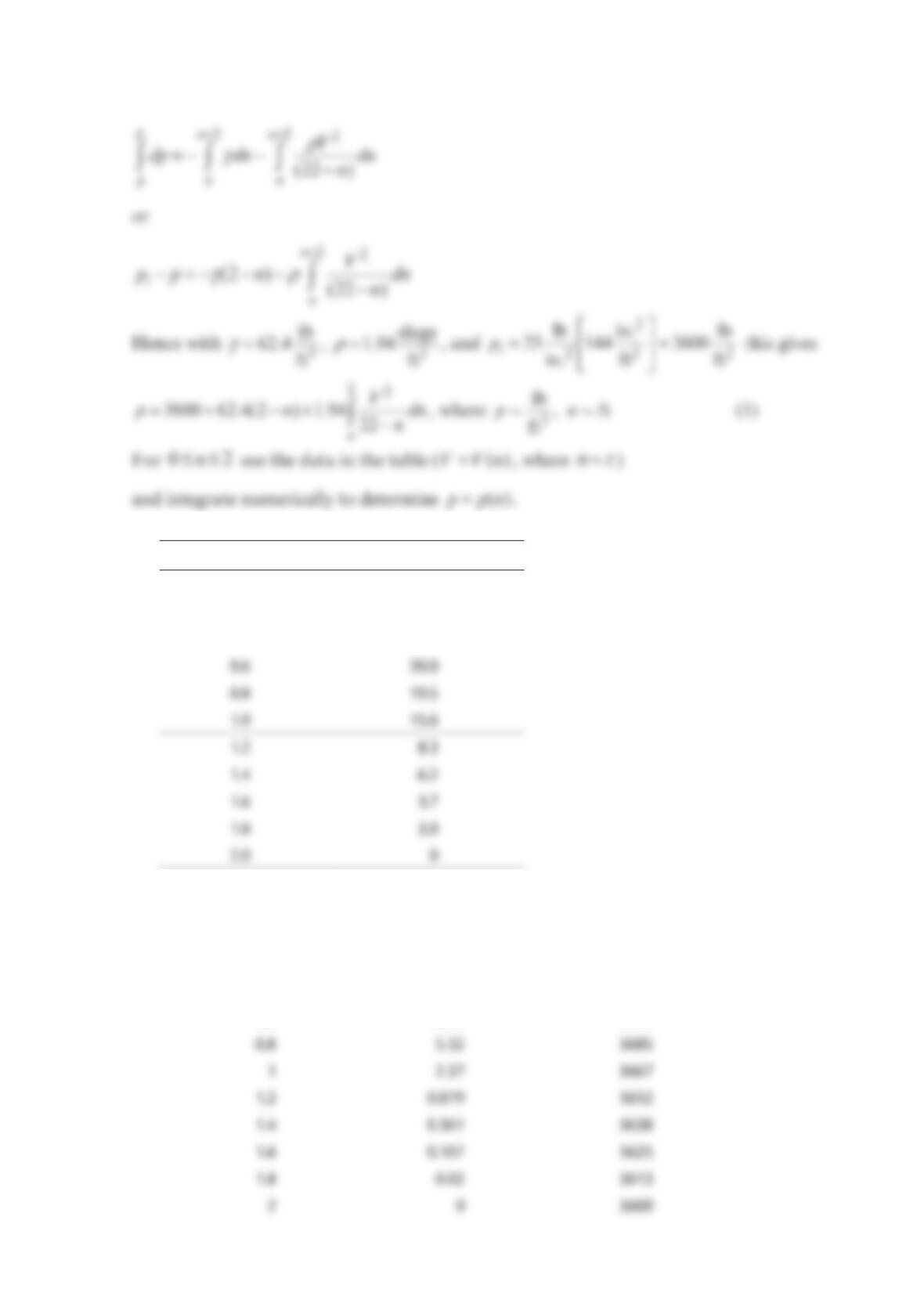
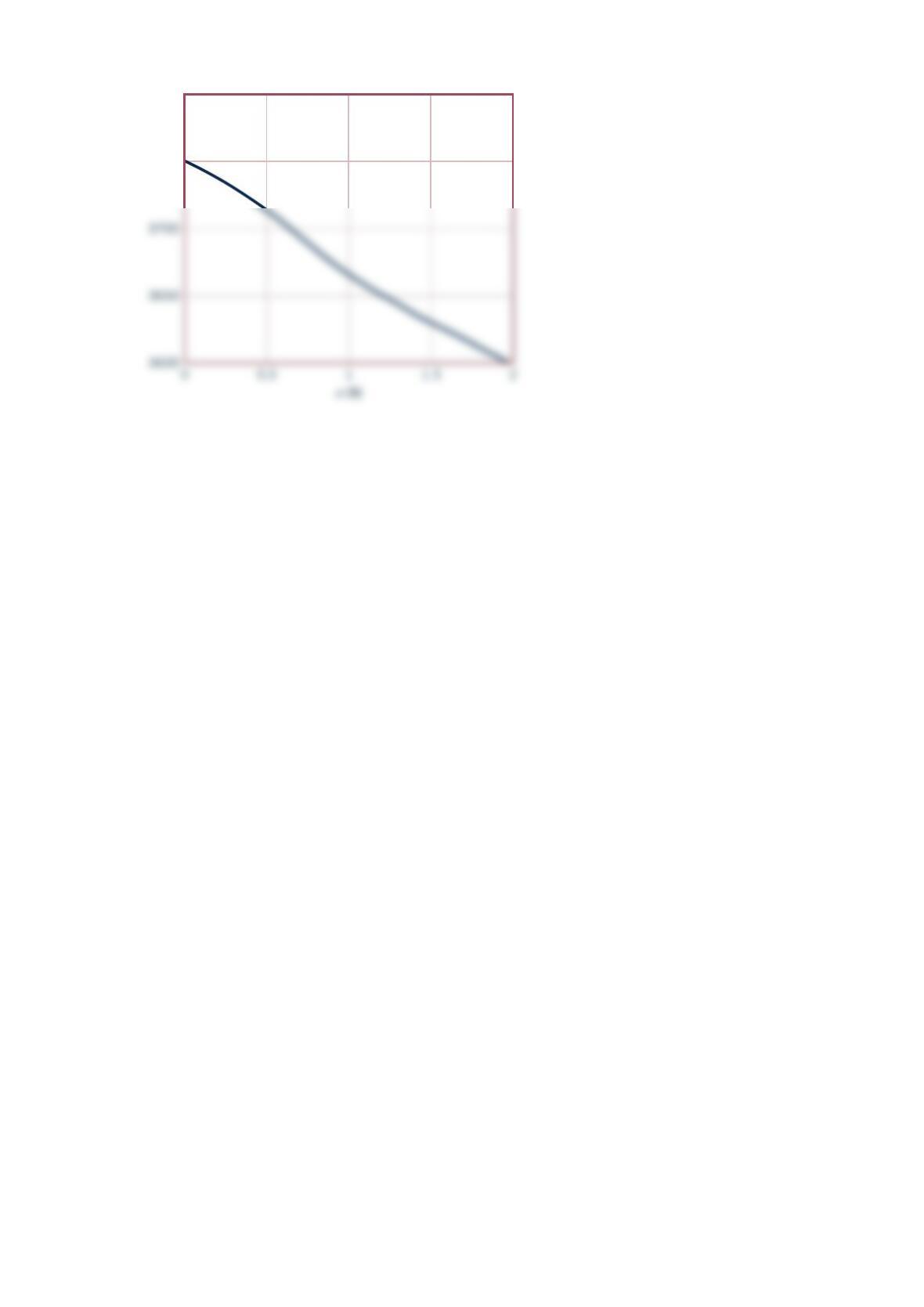
Water flows around the vertical two-dimensional bend with circular streamlines as is shown
in the figure below. The pressure at point (1) is measured to be 125 psip= and the velocity
across section aa− is as indicated in the table below. Calculate and plot the pressure across
section aa− of the channel [()0 2ft]ppzfor z= ≤≤
.
z (ft) V (ft/s)
0 0
0.2 8.0
0.4 14.3
0.6 20.0
0.8 19.5
1.0 15.6
1.2 8.3
1.4 6.2
1.6 3.7
1.8 2.0
2.0 0
Solution 3.13
Thus,
(1)
2 ft
20 ft
g
z
P
1
= 25 psi
V
= V(z)
a
a
or
z (ft) V (ft/s)
0 0
0.2 8.0
0.4 14.3
n, (ft) Value of integral p, (lb/ft2)
0 13.33 3751
0.2 13.04 3738
0.4 11.8 3723
0.6 8.98 3705
p (lb/ft
2
)
3800
3750
Problem 3.14
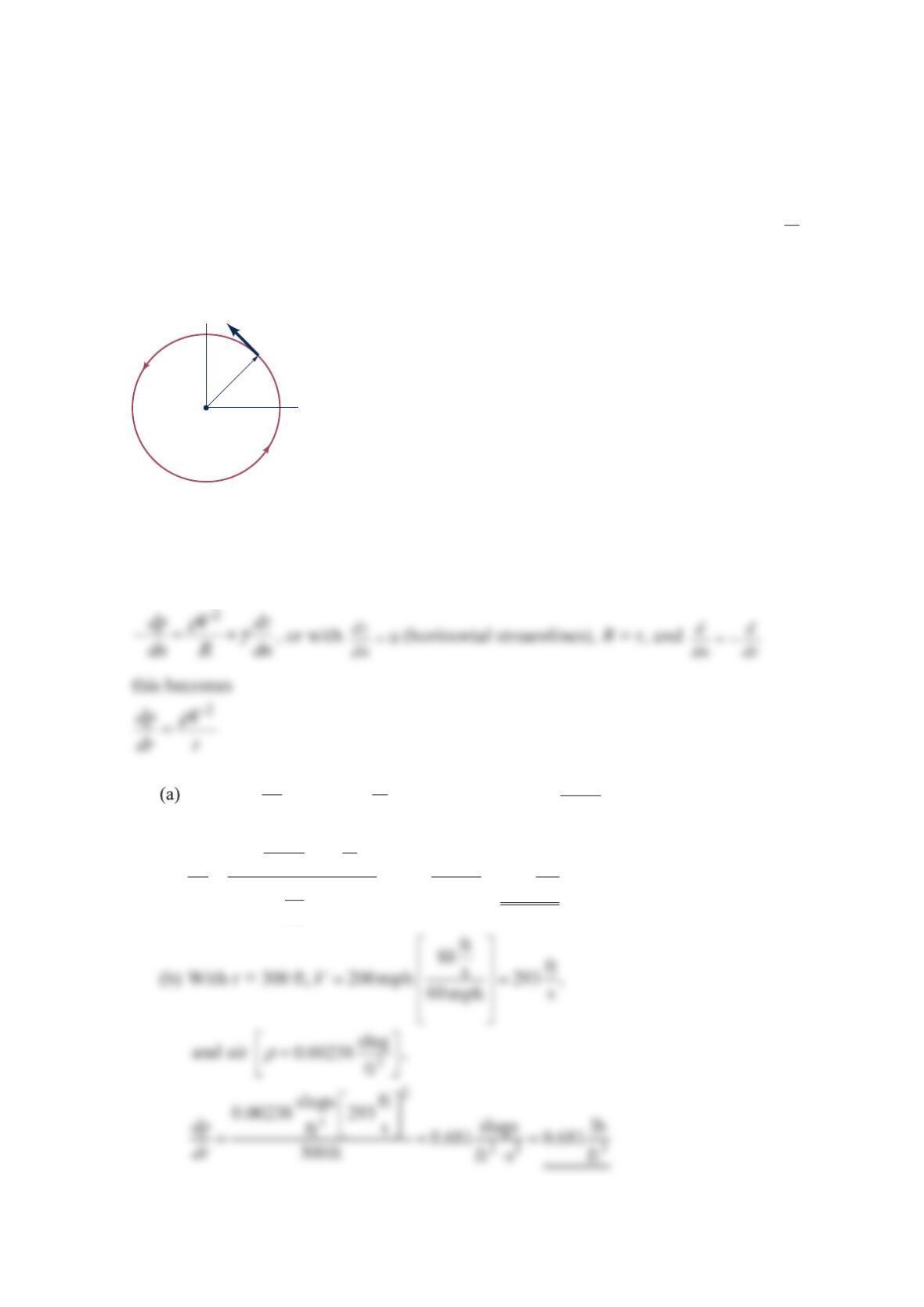
Water in a container and air in a tornado flow in horizontal circular streamlines of radius r
and speed V as shown in the figure below. Determine the radial pressure gradient,
/
dp dr ,
needed for the following situations: (a) The fluid is water with 3r=in. and ft
0.8 s
V
=.
(b) The fluid is air with r = 300 ft and 200 mphV=.
Solution 3.14
For curved streamlines,
With 3ft
12
r=, ft
0.8 s
V=, and water 3
slugs
1.94 ft
ρ
=
,
2
3
22 3
slugs ft
1.94 0.8 slugs lb
s
ft 4.97 4.97
3ft s ft
ft
12
dp
dr
===
⋅
y
x
r
V
Problem 3.15
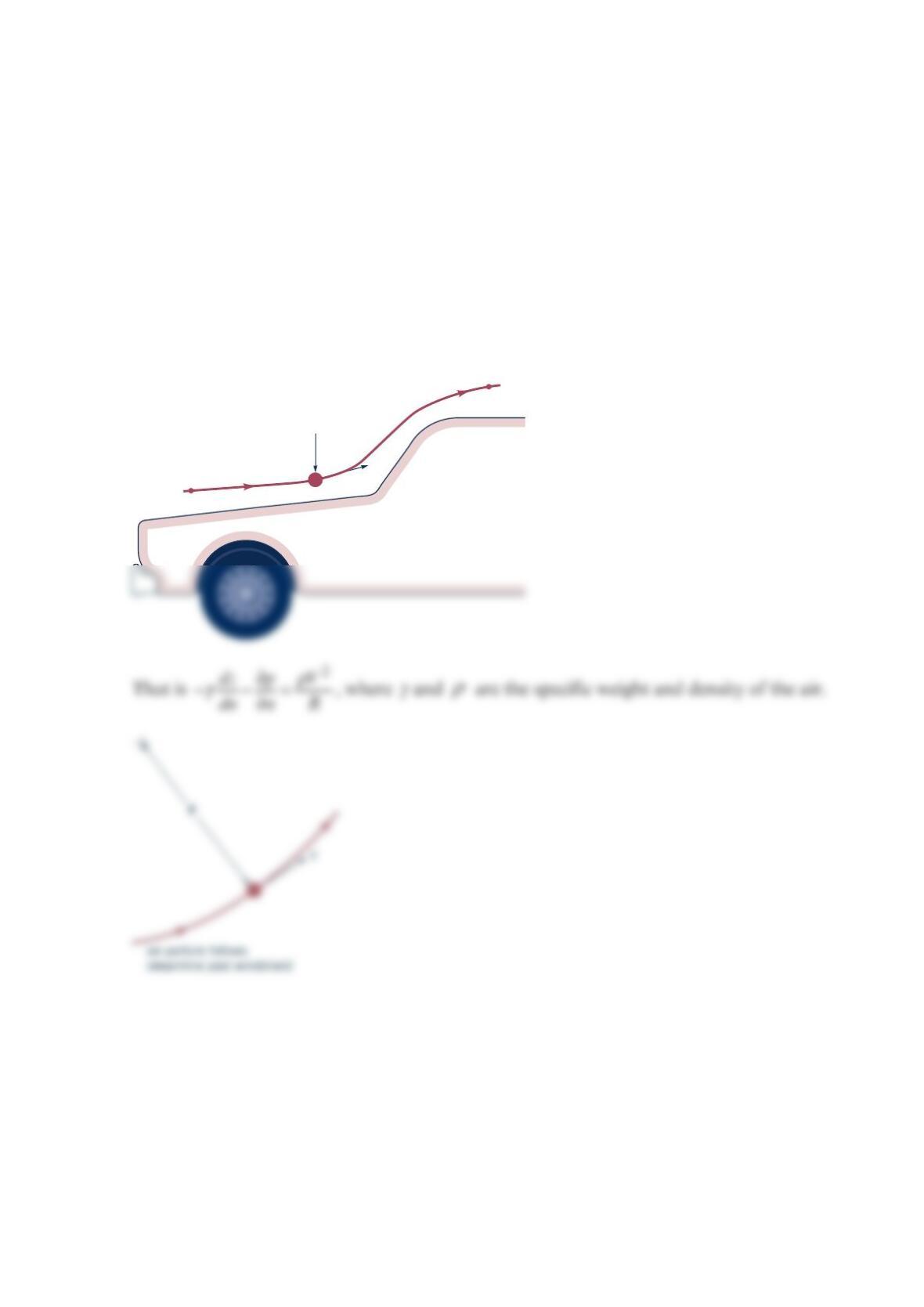
Air flows smoothly over the hood of your car and up past the windshield. However, a bug
in the air does not follow the same path; it becomes splattered against the windshield. Ex-
plain why this is so.
Solution 3.15
An air particle flowing along streamline (1)–(2) is immersed in a pressure field produced by
all of the surrounding air particles. Gravity and pressure effects precisely balance centrifu-
gal acceleration effects.
(1)
air particle
(2)
V
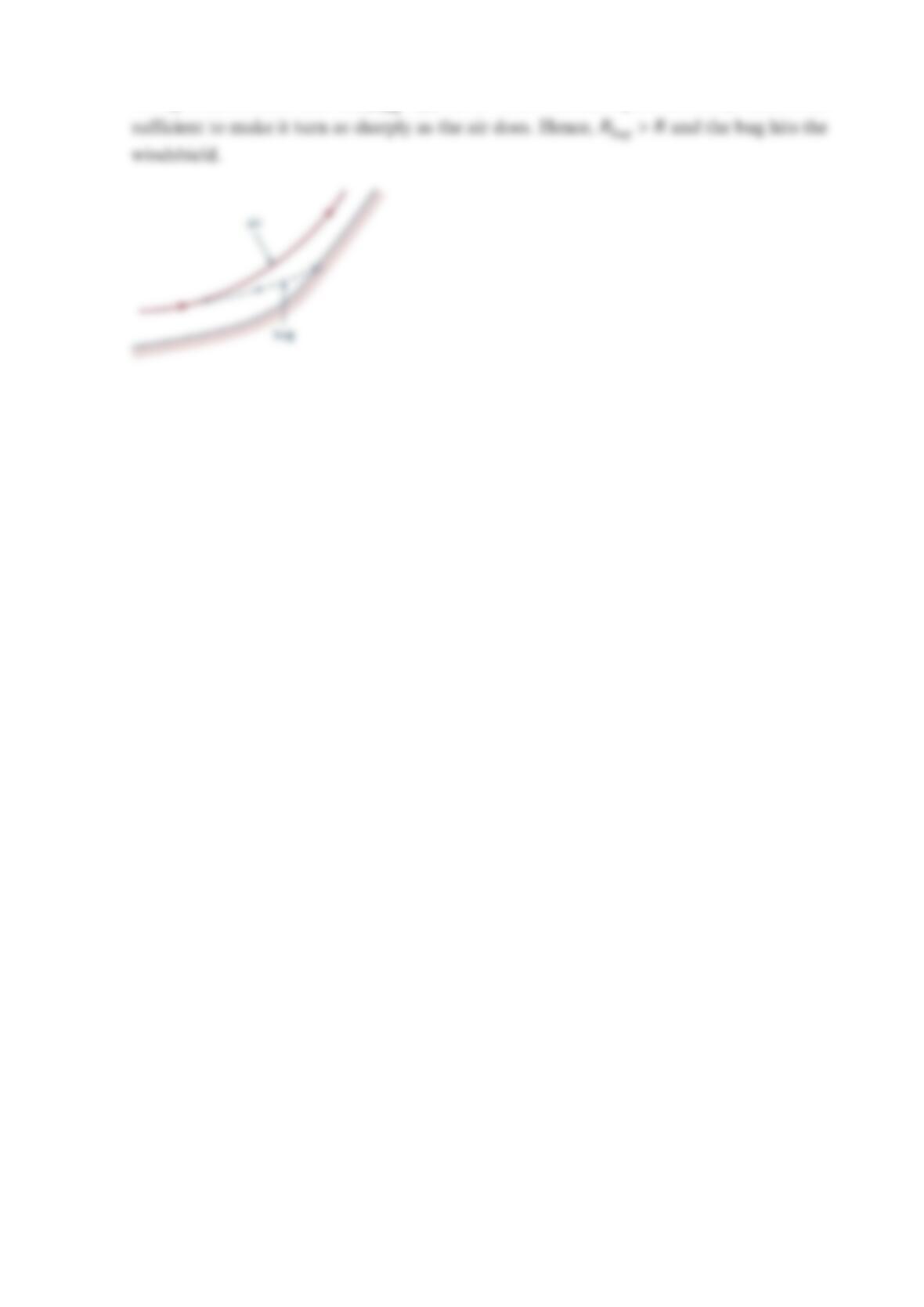
A bug is more dense than air, bug
ρρ
>, but it “feels” the same pressure field, which is not
Problem 3.17
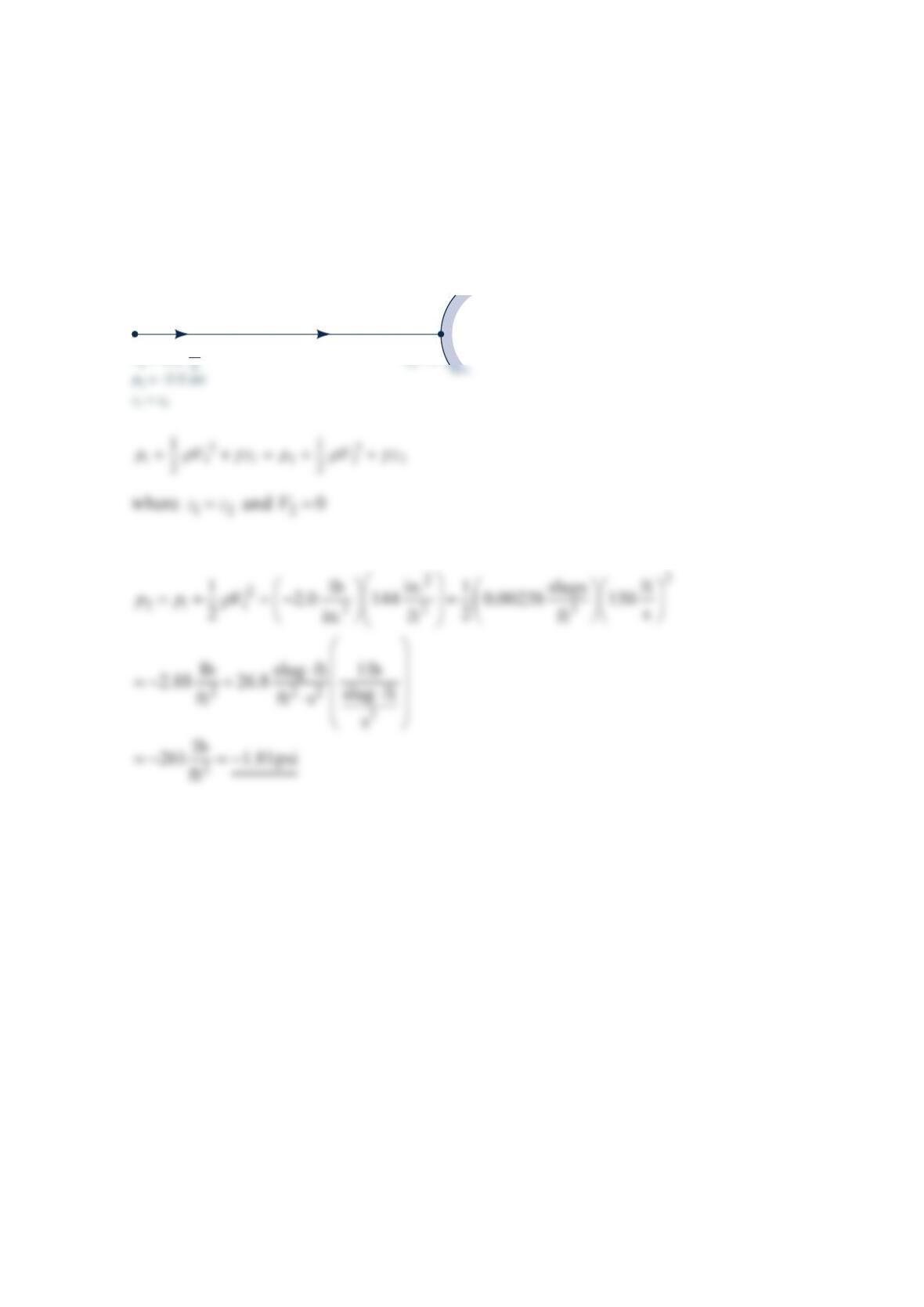
At a given point on a horizontal streamline in flowing air, the static pressure is 2.0 psi−
(i.e., a vacuum) and the velocity is 150 ft/s. Determine the pressure at a stagnation point on
that streamline.
Solution 3.17
Thus,
(1) (2)
V
= 0
V
= 150
ft
Problem 3.19
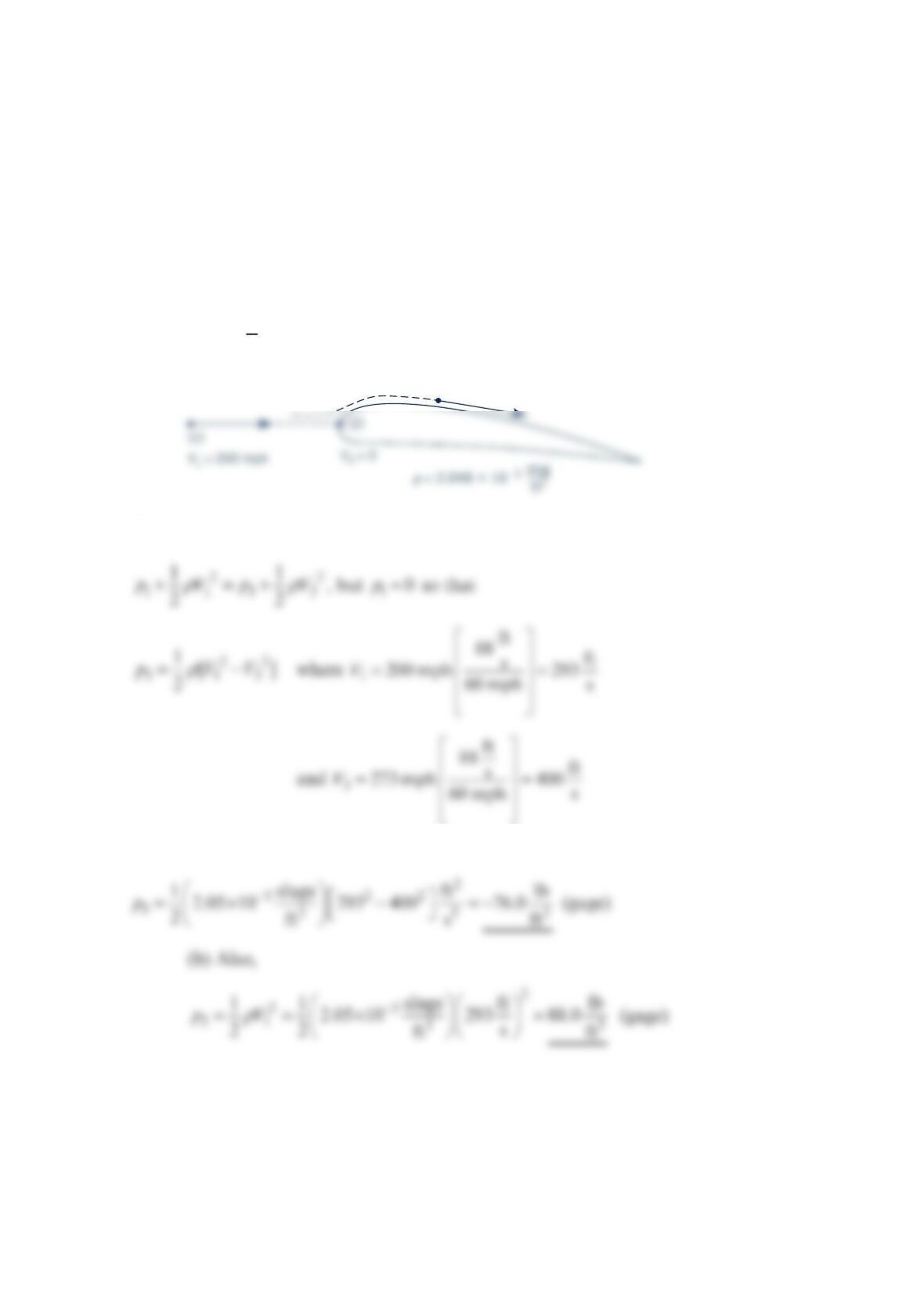
When an airplane is flying 200 mph at 5000 ft altitude in a standard atmosphere, the air
velocity at a certain point on the wing is 273 mph relative to the airplane. (a) What suction
pressure is developed on the wing at that point? (b) What is the pressure at the leading edge
(a stagnation point) of the wing?
Solution 3.19
(a) 2
1constant
2
pVz
ρ
++=
Thus, with 123
zz z≈≈
or
V
3
= 273 mph
(3)