
41
3.27: PROBLEM DEFINITION
Situation:
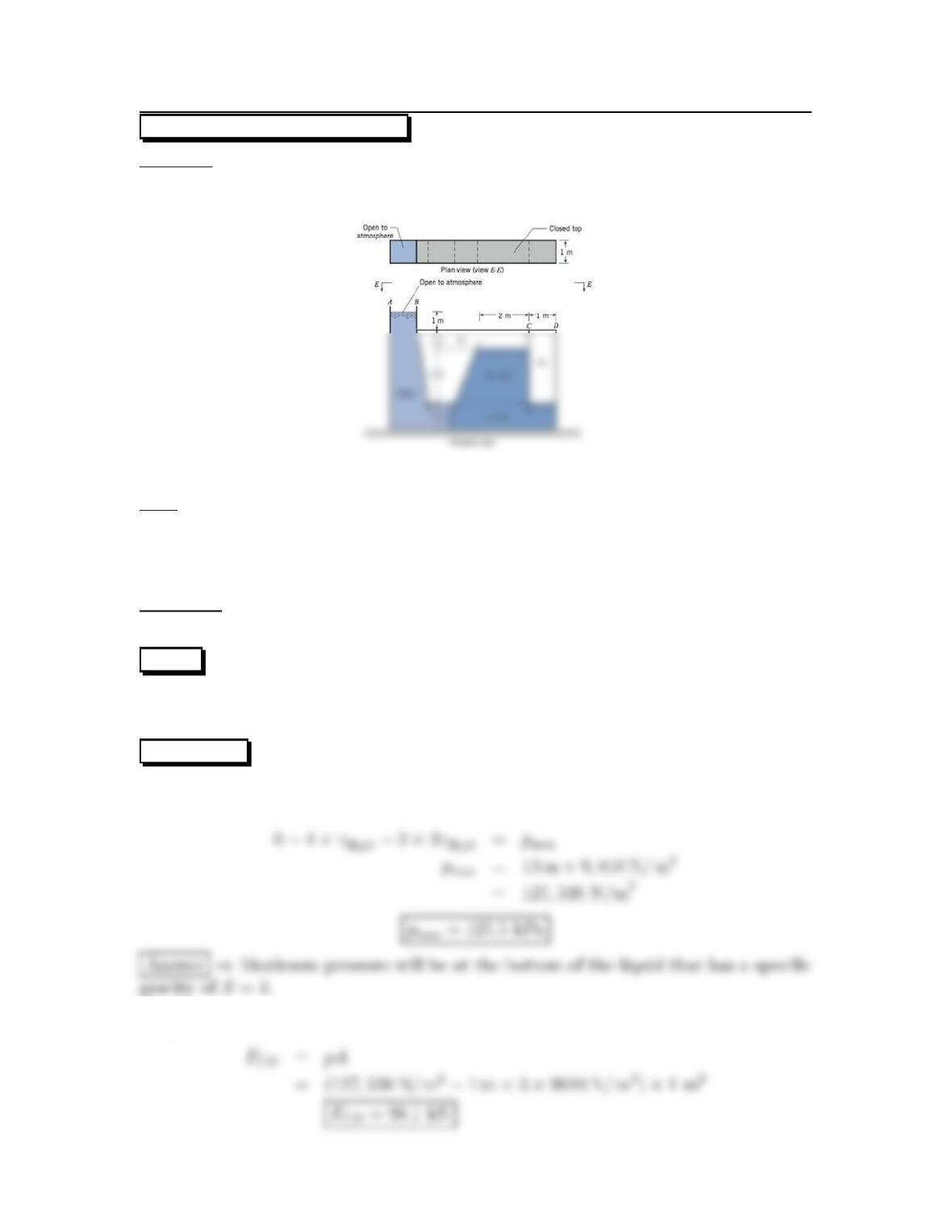
An odd tank contains water, air and a liquid.
.
Find:
Maximum gage pressure (kPa).
Where will maximum pressure occur.
Hydrostatic force (in kN) on top of the last chamber, surface CD.
Properties:
γwater= 9810 N/m3.
PLAN
1. To find the maximum pressure, apply the manometer equation.
2. To find the hydrostatic force, multiply pressure times area.
SOLUTION
1. Manometer eqn. (start at surface AB; neglect pressure changes in the air; end at
the bottom of the liquid reservoir)
2. Hydrostatic force
42

3.28: PROBLEM DEFINITION
Situation:
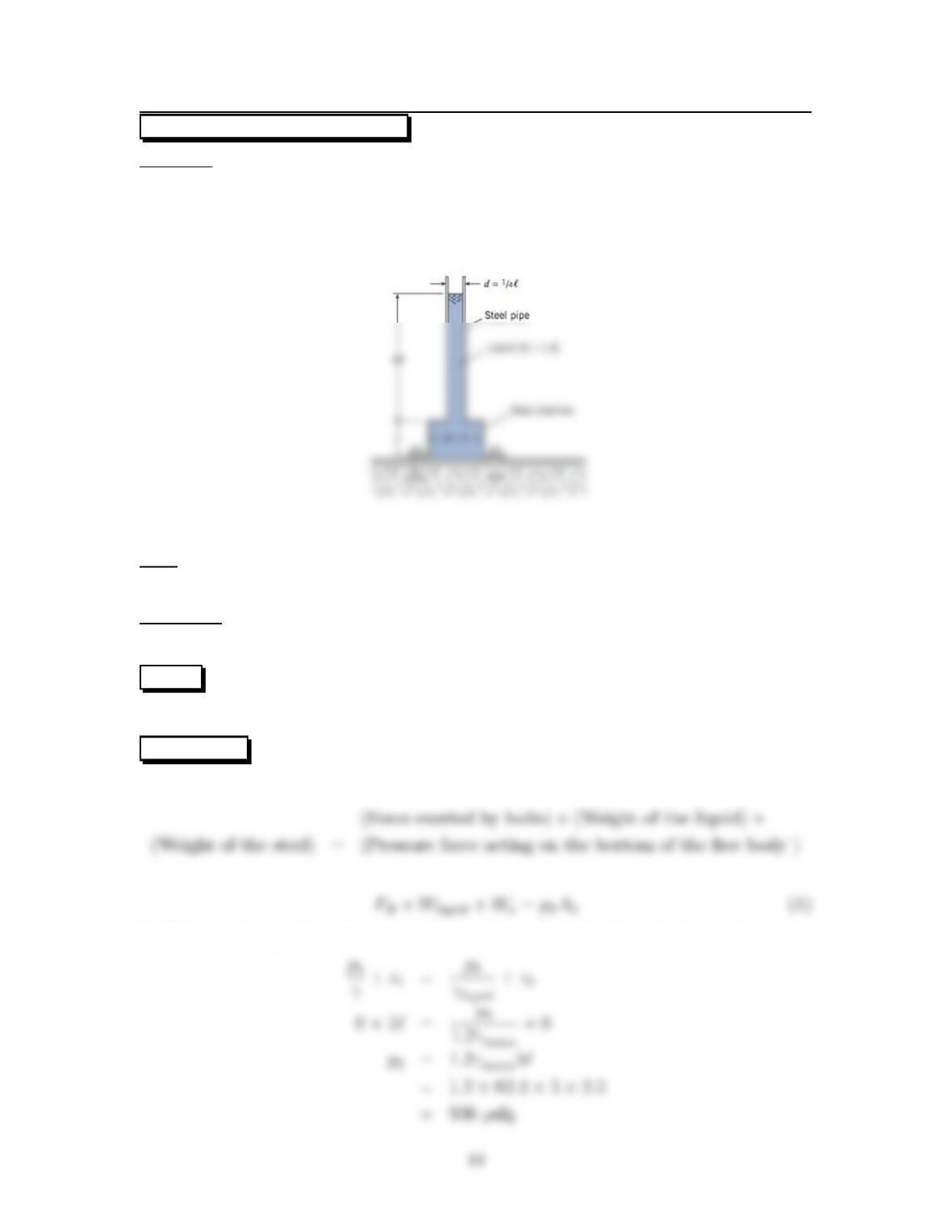
A steel pipe is connected to a steel chamber.
=2.5ft,W=600lbf.
D1=0.25,z1=5.
D2=,S=1.2.
Find:
Force exerted on chamber by bolts (lbf).
Properties:
γwater =62.4lbf/ft3.
PLAN
Apply equilibrium and the hydrostatic equation.
SOLUTION
1. Equilibrium. (system is the steel structure plus the liquid within)
2. Hydrostatic equation (location 1 is on surface; location 2 at the bottom)
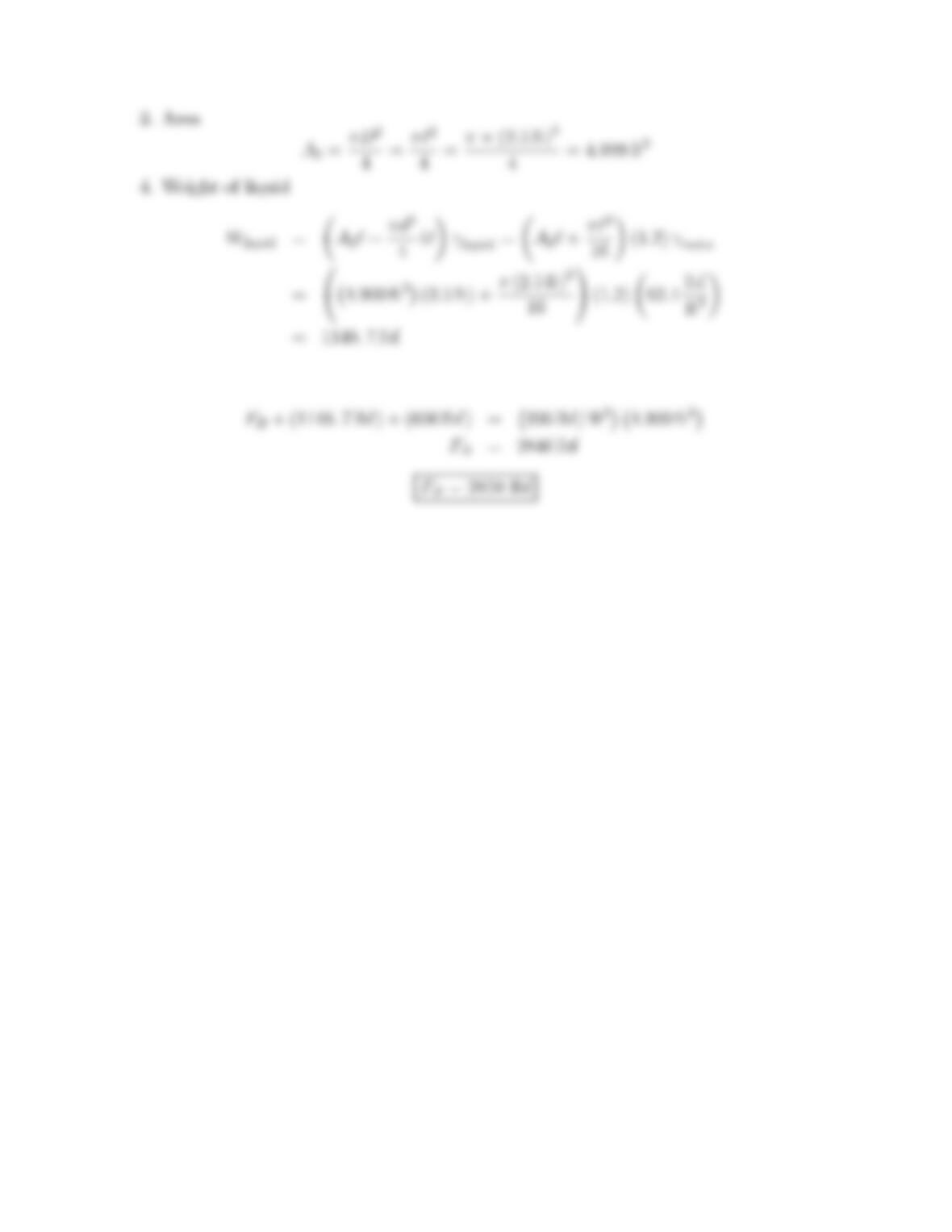
5. Substitute numbers into Eq. (1)
45
3.29: PROBLEM DEFINITION
Situation:
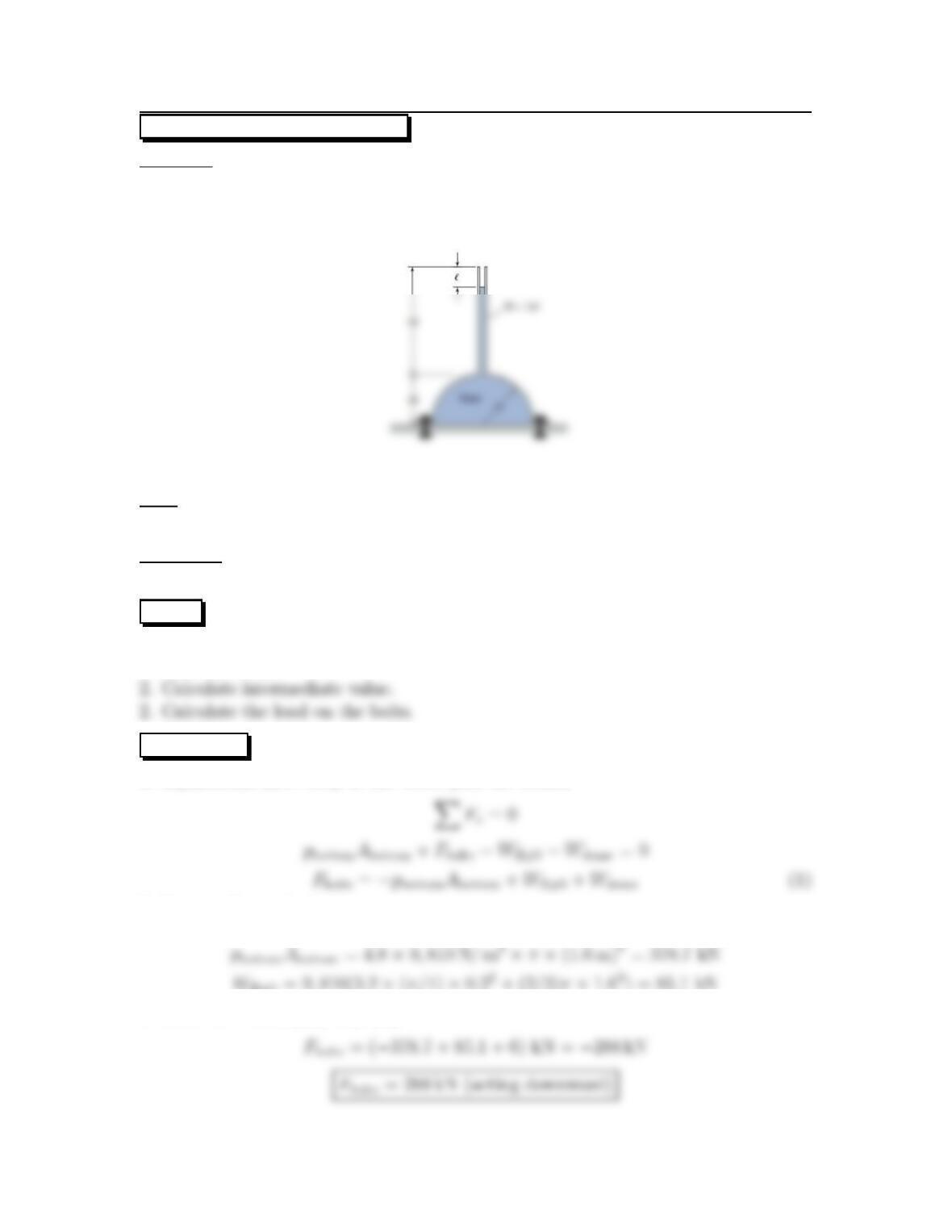
A metal dome with water is held down by bolts.
W=6kN,=80cm
Find:
Force exerted by the bolts (kN).
Properties:
γwater =9810N/m3.
PLAN
1. To derive an equation for the load on the bolts, apply force equilibrium in the
vertical direction.
SOLUTION
1. Equilibrium (free body is the water plus the dome)
2. Intermediate calculations
3. Load on bolts (apply Eq. (1))
46
3.30: PROBLEM DEFINITION
Situation:
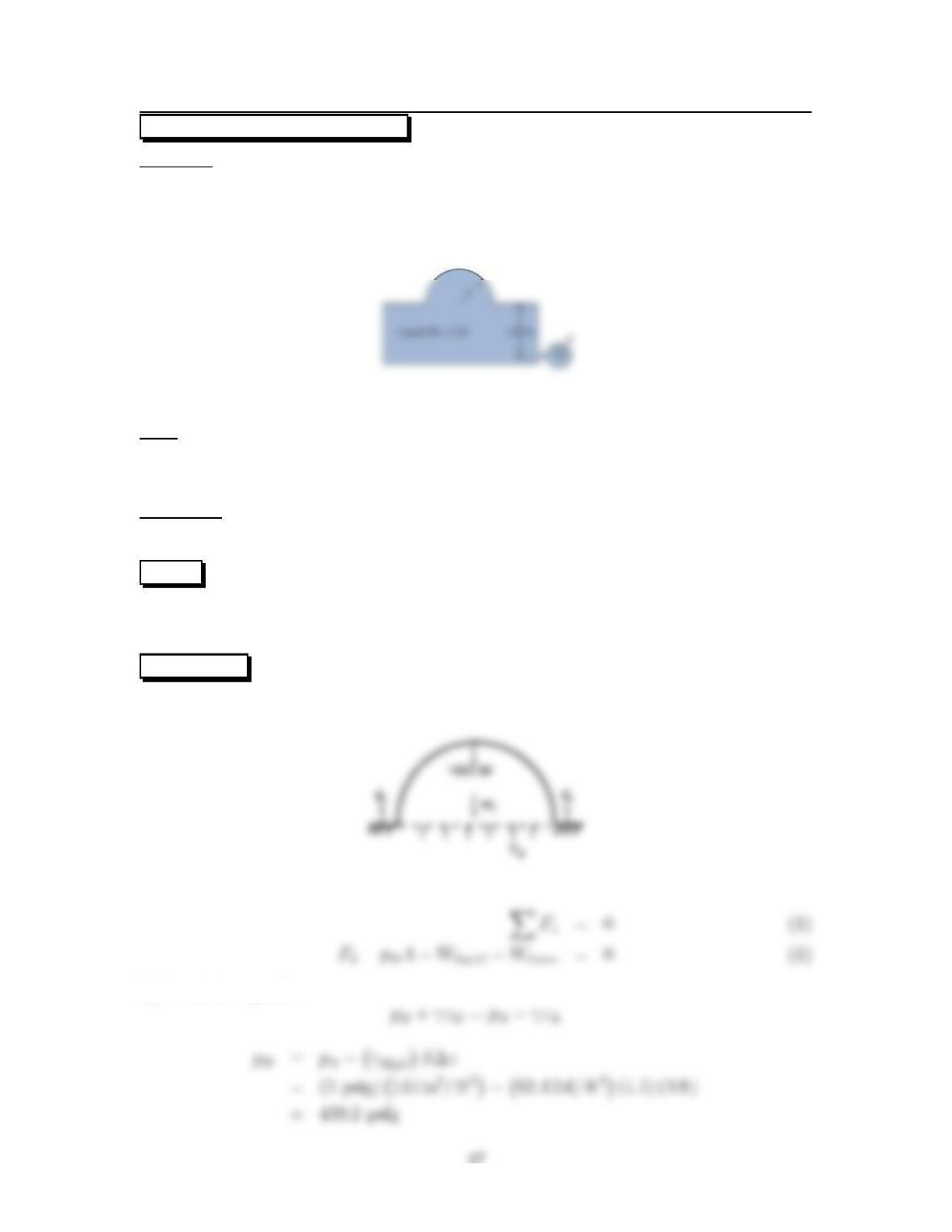
A tank under pressure with a dome on top.
L=2ft,Wdome =1000lbf.
Gage A reads 5 psig.
Find:
Vertical component of force in metal at the base of the dome (lbf).
Is the metal in tension or compression?
Properties:
γH2O=62.4lbf/ft3,S=1.5.
PLAN
Apply equilibrium to a free body comprised of the dome plus the water within. Apply
the hydrostatic principle to find the pressure at the base of the dome.
SOLUTION
Equilibrium
Hydrostatic equation
47
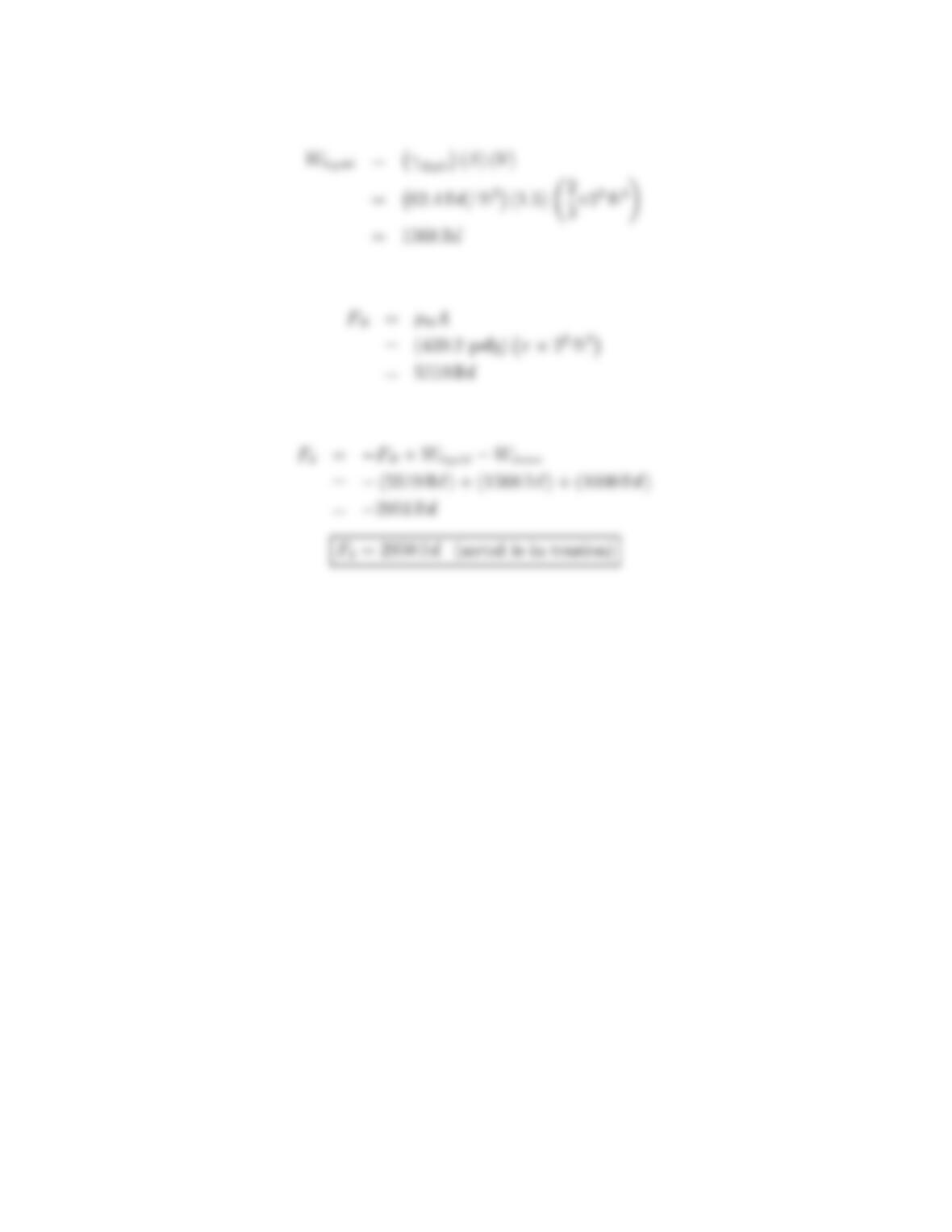
Weight of the liquid
Pressure Force
Substitute into Eq. (1).
48
3.31: PROBLEM DEFINITION
Situation:
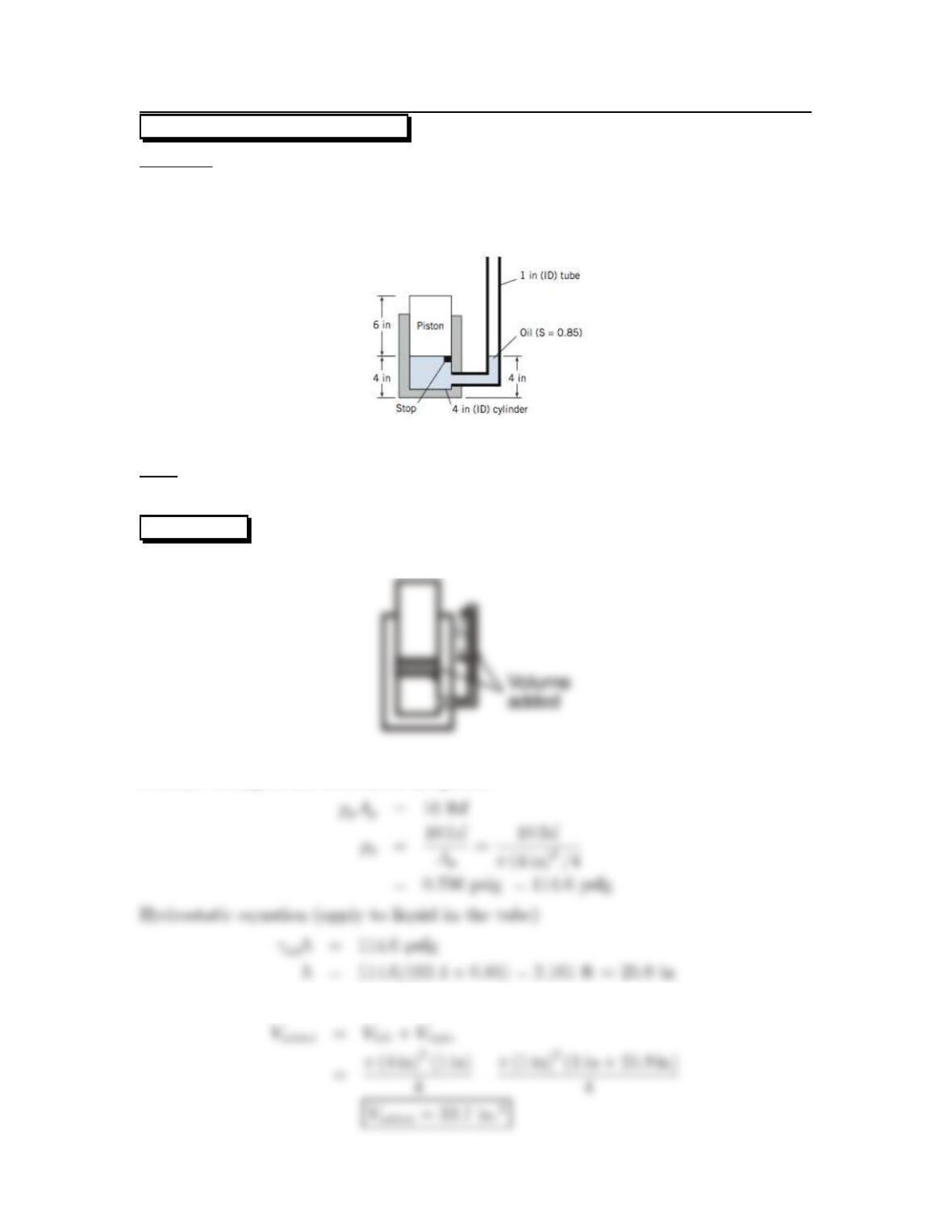
Oil is added to the tube so the piston rises 1 inch.
Wpiston =10lbf,S=0.85.
Dp=4in,Dtube =1in.
Find:
Volume of oil (in3) that is added.
SOLUTION
Notice that the oil fills the apparatus as shown below.
Pressure acting on the bottom of the piston
Calculate volume
49

3.32: PROBLEM DEFINITION
Situation:
An air bubble rises from the bottom of a lake.
z34 =34ft,z8=8ft.
Find:
Ratio of the density of air within the bubble at different depths.
Assumptions:
Air is ideal gas.
Temperature is constant.
Neglect surface tension effects.
Properties:
γ=62.4lbf/ft3.
PLAN
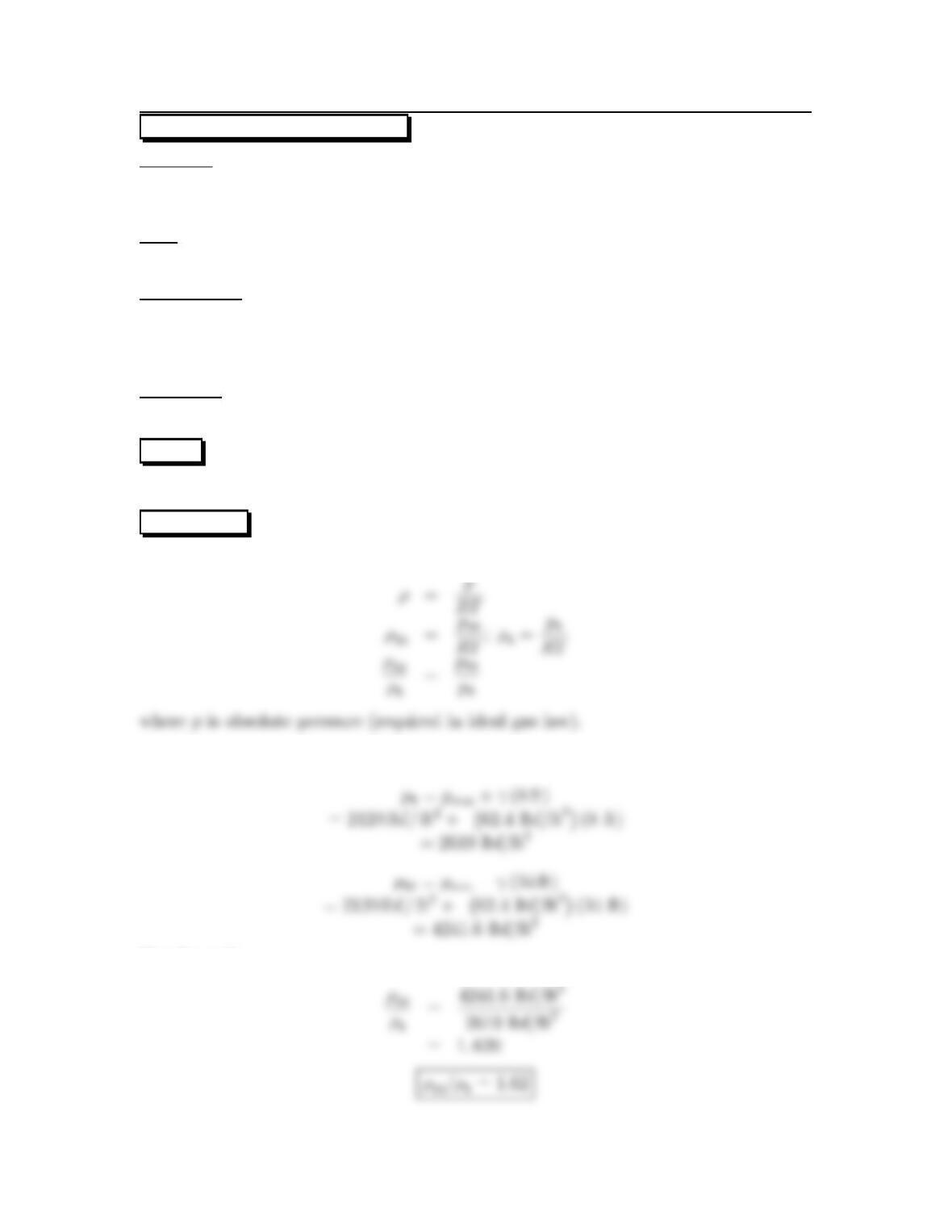
Apply the hydrostatic equation and the ideal gas law.
SOLUTION
Ideal gas law
Hydrostatic equation
Density ratio
51

3.33: PROBLEM DEFINITION
Situation:
Air is injected into a tank of liquid.
Pressure reading the Bourdon tube gage is pgage =15kPa
Find:
Depth dof liquid in tank (m).
Assumptions:
Neglect the change of pressure due to the column of air in the tube.
Properties:γ(water) = 9810 N/m3,S=0.85.
PLAN
1. Find the depth corresponding to p=15kPausing the hydrostatic equation.
2. Find dby adding 1.0 m to value from step 1.
SOLUTION
1. Hydrostatic equation
2. Depth of tank
52

3.34: PROBLEM DEFINITION
Situation:
For Figure 3.6 on p. 39 of §3.1 (of EFM 10e) that describes temperature variation
with altitude, answer the following questions.
Find:
a. Does the linear approximation relating temperature to altitude apply in the
troposphere or the stratosphere?
b. At approximately what altitude in the earth’s atmosphere does the linear ap-
proximation for temperature variation fail?
SOLUTION
a. The linear approximation applies in the trophosphere, which is the zone closer to
53
3.35: PROBLEM DEFINITION
Situation:
The boiling point of water decreases with elevation because patm decreases.
z1=2000m,z2=4000m.
Find:
Boiling point of water (◦C) at z1and z2.
Assumptions:
Tsea level =296K=23
◦C.
Standard atmosphere.
Properties:
Table A.2: R=287J/kg K.
PLAN
The pressure of boiling (pvapor)corresponds to local atmospheric pressure.
1. Find the atmospheric pressure by calculating the pressure in the troposphere.
SOLUTION
1. Atmospheric pressure:
(5.87 ×10⁻³)K/m×287 J/kg K =5.823
2. Boiling temperature @ 2000 m.
54

3.36: PROBLEM DEFINITION
Situation:
Pressure variation from a lake to atmosphere.
h=10m,z2=4000m.
Find:
Plot pressure variation.
Assumptions:
patm =101.3kPa.
The lake surface is at sea level.
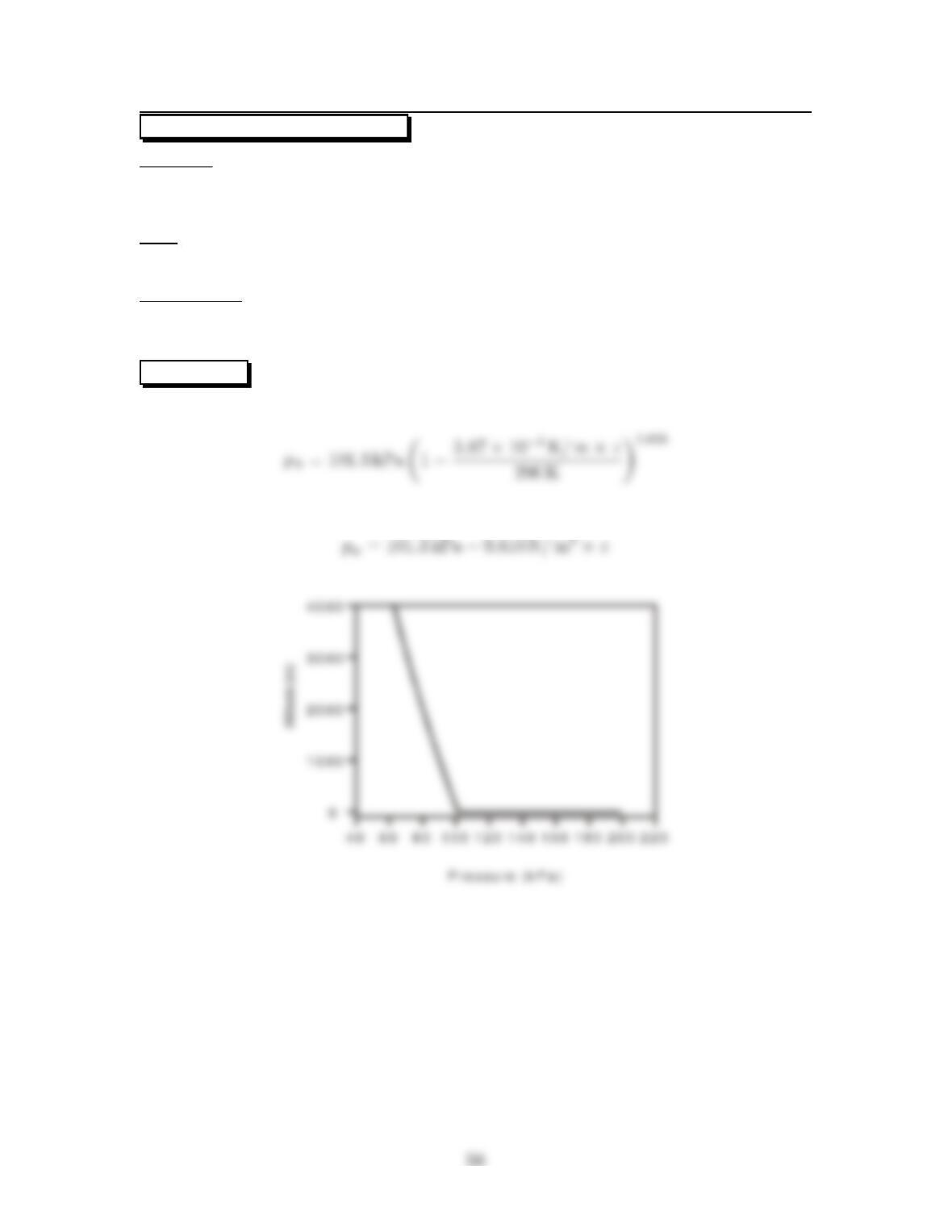
SOLUTION
Atmosphere pressure variation (troposphere)
Pressure in water
3.37: PROBLEM DEFINITION
Situation:
A woman breathing.
z= 18000 ft.
Find:
Breathing rate.
Assumptions:
Volume drawn in per breath is the same.
Air is an ideal gas.
Properties:
T=59◦F,patm =14.7psia.
SOLUTION Let bV–ρ=constant where b=breathing rate = number of breaths
for each unit of time, V–=volume per breath, and ρ=mass density of air. Assume
Since the volume drawn in per breath is the same
57

3.38: PROBLEM DEFINITION
Situation:
A pressure gage in an airplane.
z0=1km.
Find:
Elevation (km).
Temperature ( ◦C).
Properties:
a=5.87 ◦C/km,p0=95kPa.
T0=10◦C,p=75kPa.
SOLUTION Atmosphere pressure variation (troposphere)
58
3.39: PROBLEM DEFINITION
Situation:
Denver, CO (the mile-high city) is described in the problem statement.
Find:
Pressure in both SI and traditional units.
Temperature in both SI and traditional units.
Density in both SI and traditional units.
Properties:
Air, Table A.2: R=287J/kg K = 1716 ft lbf/slug◦R.
SOLUTION
Atmosphere pressure variation (troposphere)
Ideal gas law
59
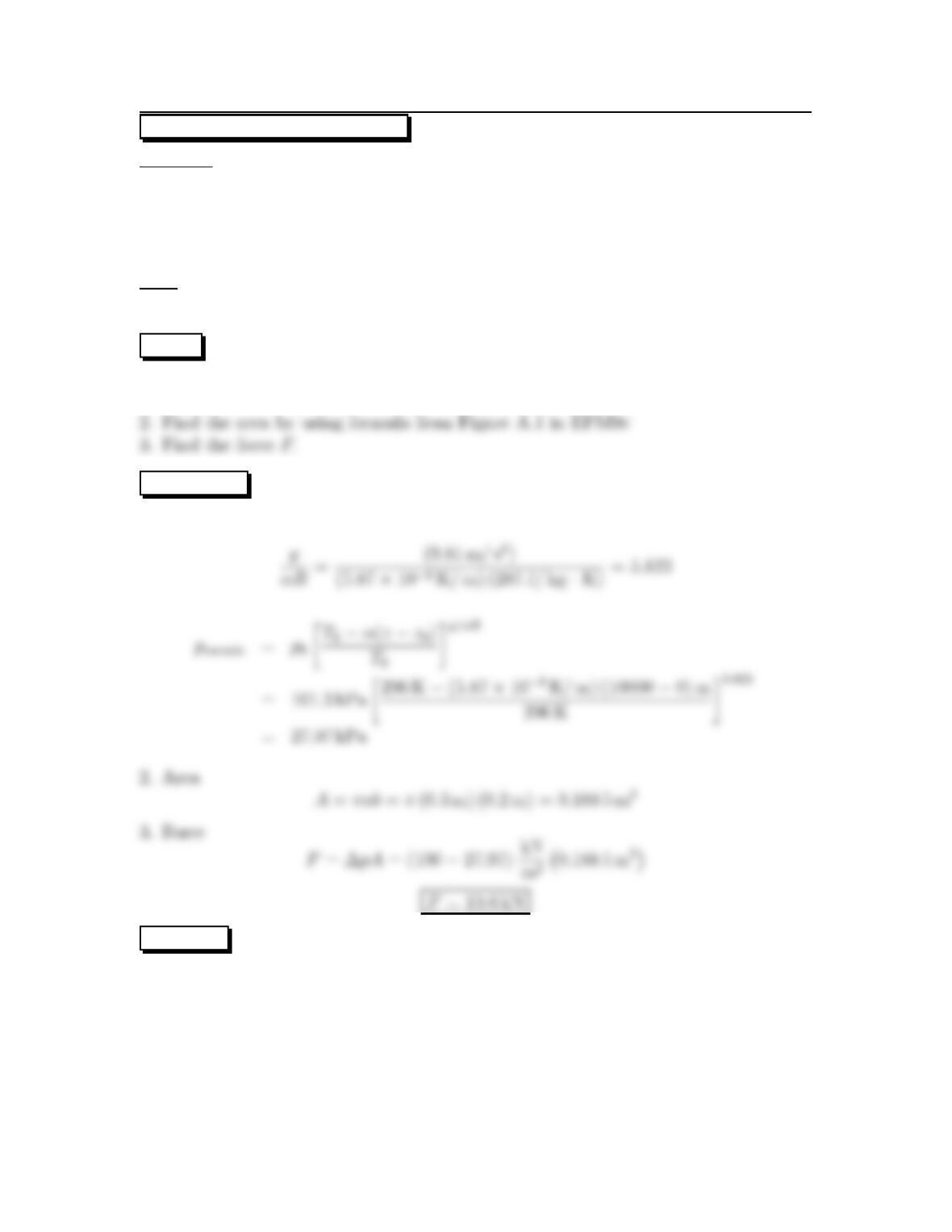
3.40: PROBLEM DEFINITION
Situation:
A force due to pressure is acting on an airplane window.
Window is flat & elliptical.
a=0.3m,b=0.2m.
pinside =100kPa,z=10km.
Find:
Outward force on the window (in N).
PLAN
Find the force on the window by using F=∆pA.Thestepsare
1. Find outside air pressure by applying Eq. (3.16) in EFM9e.
SOLUTION
1. Atmospheric pressure
REVIEW
•While the window is small, the force is surprisingly large. This force, which is
about 3100 lbf, is equal to the weight of a car!
60