FINANCIAL DISCLOSURES
Summary of Significant Accounting Policies
➢ A summary of the company’s significant accounting
Subsequent events
➢ A subsequent event is a significant occurrence between the
Related-party transactions
➢ Related-party transactions require disclosure of the nature
Management discussion and analysis
➢ The management discussion and analysis provides a biased
3-16 Intermediate Accounting, 8/e
FINANCIAL DISCLOSURES (continued)
Management responsibilities
➢ Annual reports include a management’s responsibility
section that:
Asserts the responsibility of management for the information
Auditors’ report
➢ The auditors’ report provides the analyst with an
Compensation of Directors and Top Executives
➢ The proxy statement reported each year to shareholders
LIQUIDITY RATIOS
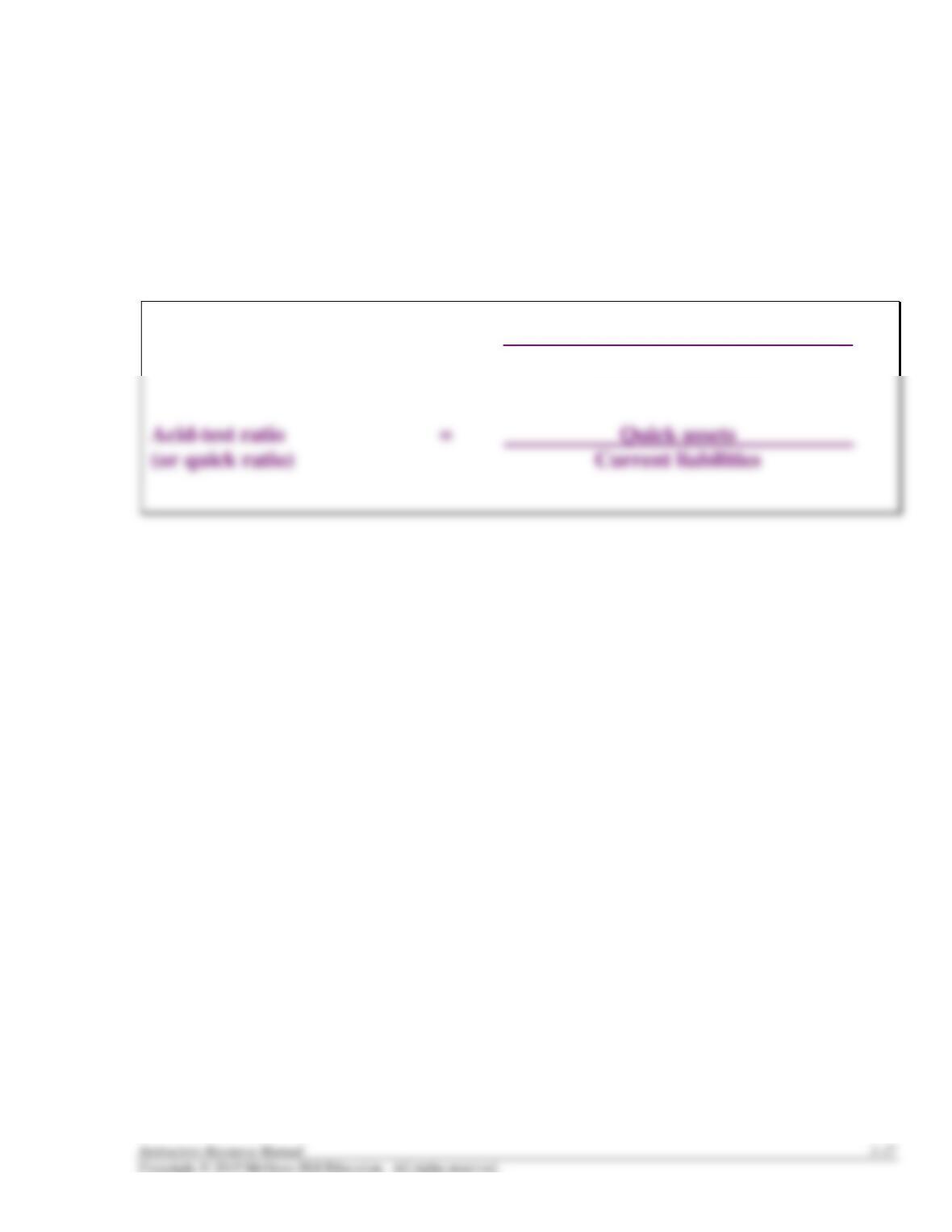
➢ Liquidity ratios provide measures of a company’s ability to
satisfy its short-term obligations.
Current ratio = Current assets
Current liabilities
3-18 Intermediate Accounting, 8/e
FINANCING RATIOS
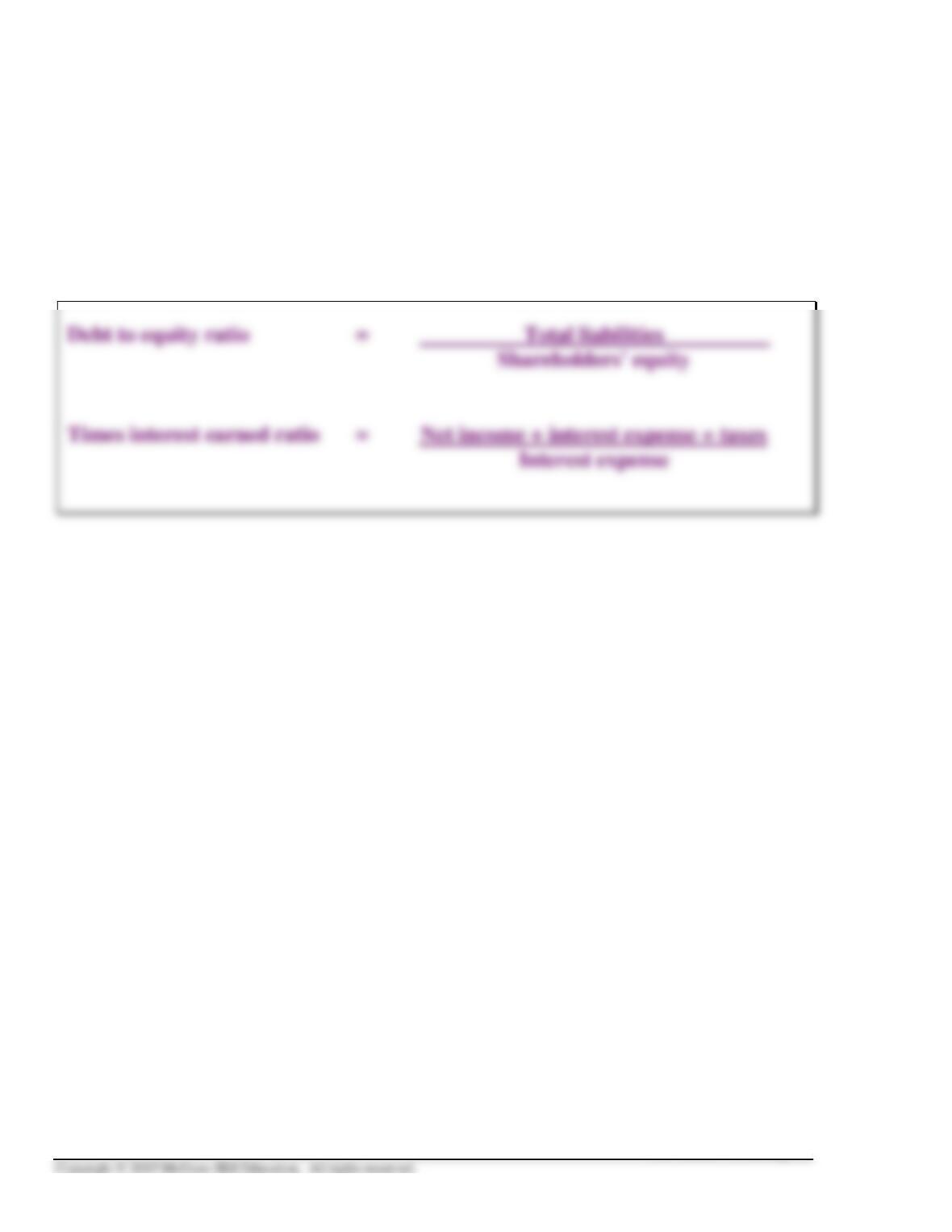
➢ Financing ratios provide some indication of the riskiness of a
company with regard to its ability to pay its long-term debts.
REPORTING SEGMENT INFORMATION
Information is reportable for identifiable operating segments.
An operating segment is a component of an enterprise
➢ That engages in business activities from which it may recognize revenues
Only segments of a certain size (10% or more of total
For areas determined to be operating segments, the following
disclosures are required:
➢ General information about the operating segments.
3-20 Intermediate Accounting, 8/e
Suggestions for Class Activities
1. Research Activity
The balance sheet does not portray the market value of the entity. A company’s book value
(shareholders’ equity) will likely be less than its market value as measured by the market value of its
Suggestions:
Have the class obtain and compare the book value and market value for a number of large
companies. Ask them to think of reasons why the ratios of market to book differ across their sample
2. Research Activity
The ratio of market-to-book for most oil and gas companies is significantly greater than 1.0.
Suggestions:
Have the class consider why an oil and gas company would have a ratio greater than 1.0. One
reason is that these companies have proven oil and gas reserves listed in their balance sheets that are
3. PetSmart Analysis
Have students, individually or in groups, go to the most recent PetSmart Inc. annual report using
1. Compare the balance sheet with that presented in the 2014 report in Appendix B of the text.
Are there any differences in the classifications used or the elements contained in those
classifications?
2. Compare the Summary of Significant Accounting Policies disclosure note with that presented
3. Compute the financing ratios discussed in the chapter for the most recent annual report year
and for the 2014 year and compare their results. Are there any discernible trends? How might
they be interpreted?
4. Professional Skills Development Activities
The following are suggested assignments from the end-of-chapter material that will help your
students develop their communication, research, analysis and judgment skills.
Communication Skills. In addition to Communication Case 3-1, Judgment Case 3-11 can be
Research Skills. In their careers, our graduates will be required to locate and extract relevant
information from available resource material to determine the correct accounting practice,
perhaps identifying the appropriate authoritative literature to support a decision. Research
Case 3-9 and Exercises 3-13 and 3-14 provide excellent opportunities to help students develop
this skill. In addition, Real World Case 3-10 can be adapted to require students to research the
authoritative literature on the required disclosures for subsequent events.
Analysis Skills. The “Broaden Your Perspective” section includes Analysis Cases that direct
5. Ethical Dilemma
The chapter contains the following ethical dilemma:
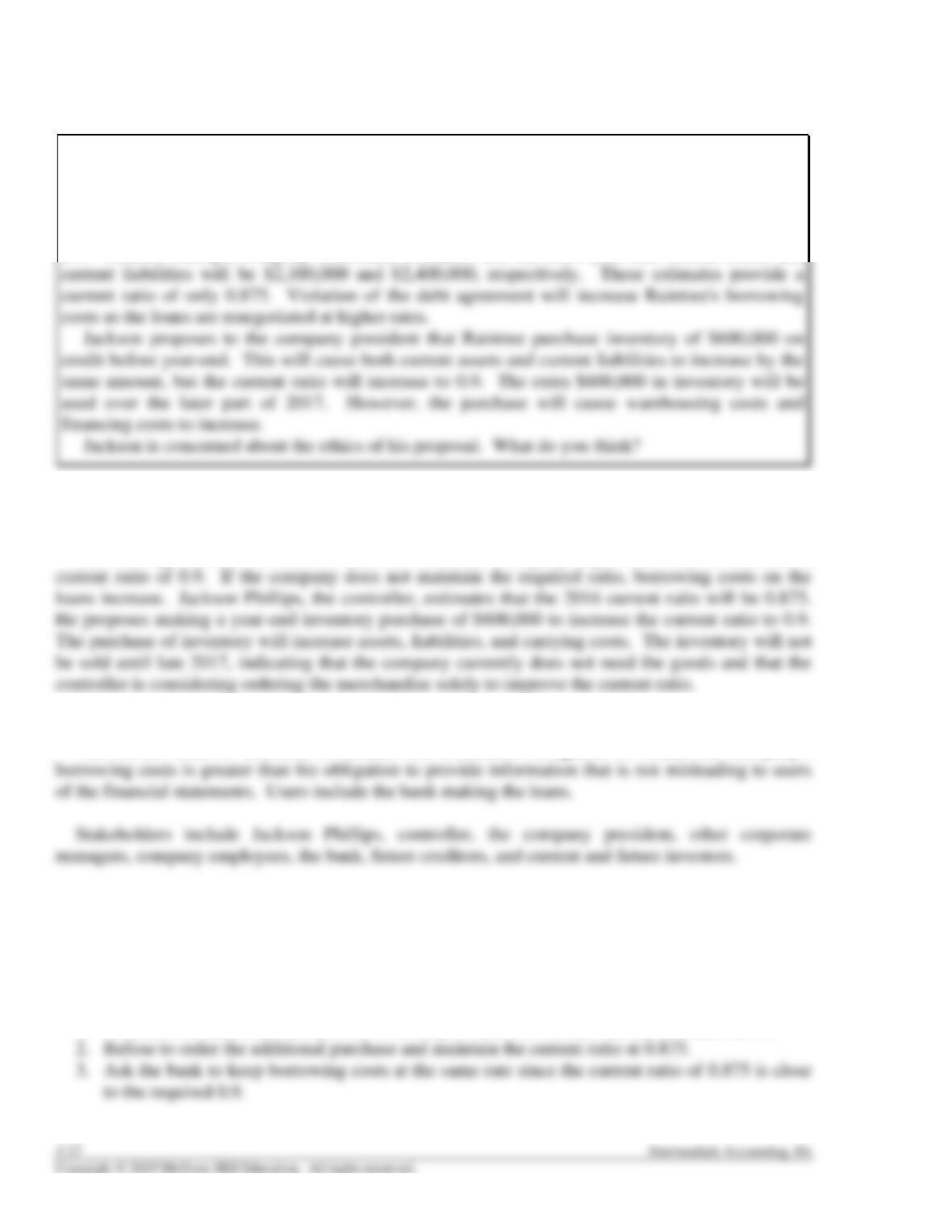
ETHICAL DILEMMA
The Raintree Cosmetic Company has several loans outstanding with a local bank. The debt
agreements all contain a covenant stipulating that Raintree must maintain a current ratio of at least
0.9. Jackson Phillips, company controller, estimates that the 2016 year-end current assets and
You may wish to discuss this in class. If so, discussion should include these elements.
Step 1—The Facts:
The debt agreements for loans of Raintree Cosmetic Company require the firm to maintain a
Step 2—The Ethical Issue and the Stakeholders:
The ethical issue or dilemma is whether the controller’s obligation to reduce the company’s
Step 3—Values:
Values include honesty, integrity, objectivity, loyalty to the company, and responsibility to users
of financial statements.
Step 4—Alternatives:
1. Purchase the additional $600,000 of inventory in order to maintain the current ratio at 0.9.
Step 5—Evaluation of Alternatives in Terms of Values:
1. Alternative 1 illustrates loyalty to the company’s effort to maintain the debt covenant and
reduce borrowing costs.
Step 6—Consequences:
Alternative 1
Positive consequences: Jackson may please the president and other top managers by enabling the
Alternative 2
Positive consequences: Users of financial statements would receive more relevant and reliable
information regarding the company’s current ratio and financial position. Jackson would maintain
Alternative 3
Positive consequences: The bank may agree to the lower current ratio and not renegotiate
borrowing costs. Jackson would receive the respect of the president and other managers.
may lose his job.
Step 7—Decision:
Student(s) must decide their course of action.
3-24 Intermediate Accounting, 8/e
Assignment Chart
Learning Est. time
Questions Objective(s) Topic (min.)
3-1
1
Purpose of the balance sheet
5
3-2
1
Usefulness of the balance sheet
5
3-3
2
Current assets
5
3-4
3
Current liabilities
5
3-5
2,3
Operating cycle
5
3-6
2
Current versus noncurrent—investments
5
3-8
2
Property, plant, and equipment versus intangibles
5
3-9
3
Liability classification
5
3-10
2,3
Paid-in capital and retained earnings
5
3-11
4
Disclosure notes
5
3-12
4
Significant accounting policies
5
3-13
4
Subsequent events
5
3-14
5
Management discussion and analysis
5
3-15
6
Audit report
5
3-16
4
Proxy statement
5
3-17
8
Liquidity ratios
5
8
Financing ratios
5
9
IFRS; balance sheet presentation
5
Segment reporting [Based on Appendix]
5
Segment reporting [Based on Appendix]
5
IFRS; segment reporting; [Based on Appendix]
5
Brief Learning Est. time
Exercises Objective(s) Topic (min.)
3-1
2,3
Current versus noncurrent classification
5
3-2
2,3
Balance sheet classification
10
3-3
2,3
Balance sheet classification
5
3-4
2,3
Balance sheet preparation
15
3-5
2,3
Balance sheet preparation
15
3-6
2,3
Balance sheet preparation; errors
10
3-7
2,3
Balance sheet preparation; missing elements
10
3-8
4
Financial disclosures
5
3-9
8
Calculating ratios
10
8
Effect of decisions on ratios
5
3-11
8
Calculating ratios; solving for unknowns
10
Learning Est. time
Exercises Objective(s) Topic (min.)
3-1
2,3,8
Balance sheet; missing elements
10
3-2
2,3
Balance sheet classification
10
3-3
2,3
Balance sheet classification
10
3-4
2,3
Balance sheet preparation
15
3-5
2,3
Balance sheet preparation
20
3-6
2,3
Current versus noncurrent classification
15
3-7
2,3
Balance sheet preparation; errors
20
classification
10
Chapters 2&3
30
3-10
4
Financial disclosures
10
3-11
4
Disclosures notes
15
3-12
4
Financial disclosures
10
3-13
4
FASB codification research
20
3-14
2,4
FASB codification research
20
3-15
Concepts; terminology
15
3-16
8
Calculating ratios
10
3-17
8
Calculating ratios; Best Buy
15
3-18
8
Calculating ratios; solve for unknowns
25
3-19
8
Calculating ratios; solve for unknowns
20
3-20
8
Effect of management decisions on ratios
20
3-21
Segment reporting [Based on Appendix]
10
3-22
IFRS; segment reporting [Based on Appendix]
10
3-26 Intermediate Accounting, 8/e
CPA/CMA Learning Est. time
Exam Questions Objective(s) Topic (min.)
CPA-1
2
Current versus noncurrent classification
3
CPA-2
3
Current versus noncurrent classification
3
CPA-3
4
Disclosure notes
3
CPA-4
6
3
CPA-5
8
Ratios
3
CPA-6
8
Ratios
3
CPA-7
9
IFRS
3
CPA-8
IFRS [Based on Appendix]
3
4
Related party transactions disclosure
3
5
3
8
Ratios
3
Learning Est. time
Problems Objective(s) Topic (min.)
3-1
2,3
Balance sheet preparation
15
3-2
2,3
Balance sheet preparation; missing elements
30
3-3
2,3
Balance sheet preparation
30
3-4
2,3
Balance sheet preparation
30
3-5
2,3
Balance sheet preparation
40
3-7
2,3
Balance sheet preparation; errors
35
3-9
2,3
Balance sheet preparation
30
Learning Est. time
Cases Objective(s) Topic (min.)
Communication Case 3-1
2
Current versus noncurrent classification
10
Analysis Case 3-2
2,3
Current versus noncurrent classification
15
Communication Case 3-3
2
Inventory or property, plant, and equipment
20
IFRS Case 3-4
2,3,9
IFRS; balance sheet presentation; Vodafone
20
Judgment Case 3-5
2,3,4
Balance sheet; errors
30
Judgment Case 3-6
4
Financial disclosures
15
Balance sheet and significant accounting policies
disclosure; Walmart
Judgment Case 3-8
4
Post fiscal year-end events
15
Research Case 3-9
FASB codification; disclosure of related party
Real World Case 3-10
4,6
Disclosures; proxy statement; Coca-Cola Co.
45
Judgment Case 3-11
7
Debt versus equity
25
Analysis Case 3-12
4,6,7,8
Obtain and critically evaluate an actual annual
report
50
Obtain and compare annual reports from
Analysis Case 3-14
2,3,4
Balance sheet information; Petsmart
15
Analysis Case 3-15
IFRS; segment reporting concepts [Based on
Appendix]
15
IFRS; balance sheet presentation; Air France-
15