2. (A) in the summary of significant policies note.
3. (C) on the face of the balance sheet.
Exercise 3–13
Requirement 1
The topic number that provides guidance on information contained in the notes to
Requirement 2
The specific citation that describes the information that companies must disclose
Requirement 3
Disclosure of accounting policies should identify and describe the accounting
principles the company follows and the methods of applying those principles that
a. A selection from existing acceptable alternatives.
Exercise 3–14
The FASB Accounting Standards Codification represents the single source of
authoritative U.S. generally accepted accounting principles. The specific
citation for each of the following items is:
1. What is the balance sheet classification for a note payable due in six
months that was used to purchase a building?
FASB ASC 210–10–45–9: “Notes to Financial Statements–Overall–
Other Presentation Matters–Other Liabilities.”
Other liabilities whose regular and ordinary liquidation is expected to
Exercise 3–14 (continued)
2. Which assets may be excluded from current assets?
FASB ASC 210–10–45–4: “Notes to Financial Statements–Overall–
Other Presentation Matters.”
The concept of the nature of current assets contemplates the exclusion
from that classification of such resources as the following:
a. Cash and claims to cash that are restricted as to withdrawal or use for
other than current operations, are designated for expenditure in the
b. Investments in securities (whether marketable or not) or advances that
have been made for the purposes of control, affiliation, or other
continuing business advantage.
c. Receivables arising from unusual transactions (such as the sale of
g. Long-term prepayments that are fairly chargeable to the operations of
several years, or deferred charges such as bonus payments under a long–
term lease, costs of rearrangement of factory layout or removal to a new
location.
Exercise 3–14 (continued)
3. Should a note receivable from a related party be included in the
balance sheet with notes receivable from customers?
FASB ASC 850–10–50–2: “Related Party Disclosures–Overall–
3–26 Intermediate Accounting, 8/e
Exercise 3–14 (concluded)
4. What items are nonrecognized subsequent events that require a
disclosure in the notes to the financial statements?
FASB ASC 855–10–55–2: “Subsequent Events–Overall–Implementation
Guidance and Illustrations–Nonrecognized Subsequent Events.”
The following are examples of nonrecognized subsequent events
c. Settlement of litigation when the event giving rise to the claim took
place after the balance sheet date but before financial statements are
issued or are available to be issued.
d. Loss of plant or inventories as a result of fire or natural disaster that
occurred after the balance sheet date but before financial statements are
issued or are available to be issued.
Exercise 3–15
List A List B
d 1. Balance sheet a. Will be satisfied through the use of current
assets.
equity.
a 5. Current liabilities e. Important to a user in comparing financial
information across companies.
k 6. Cash equivalent f. Scope limitation or a departure from GAAP.
m 7. Intangible asset g. Recorded when an expense is incurred but not
yet paid.
3–28 Intermediate Accounting, 8/e
Exercise 3–16
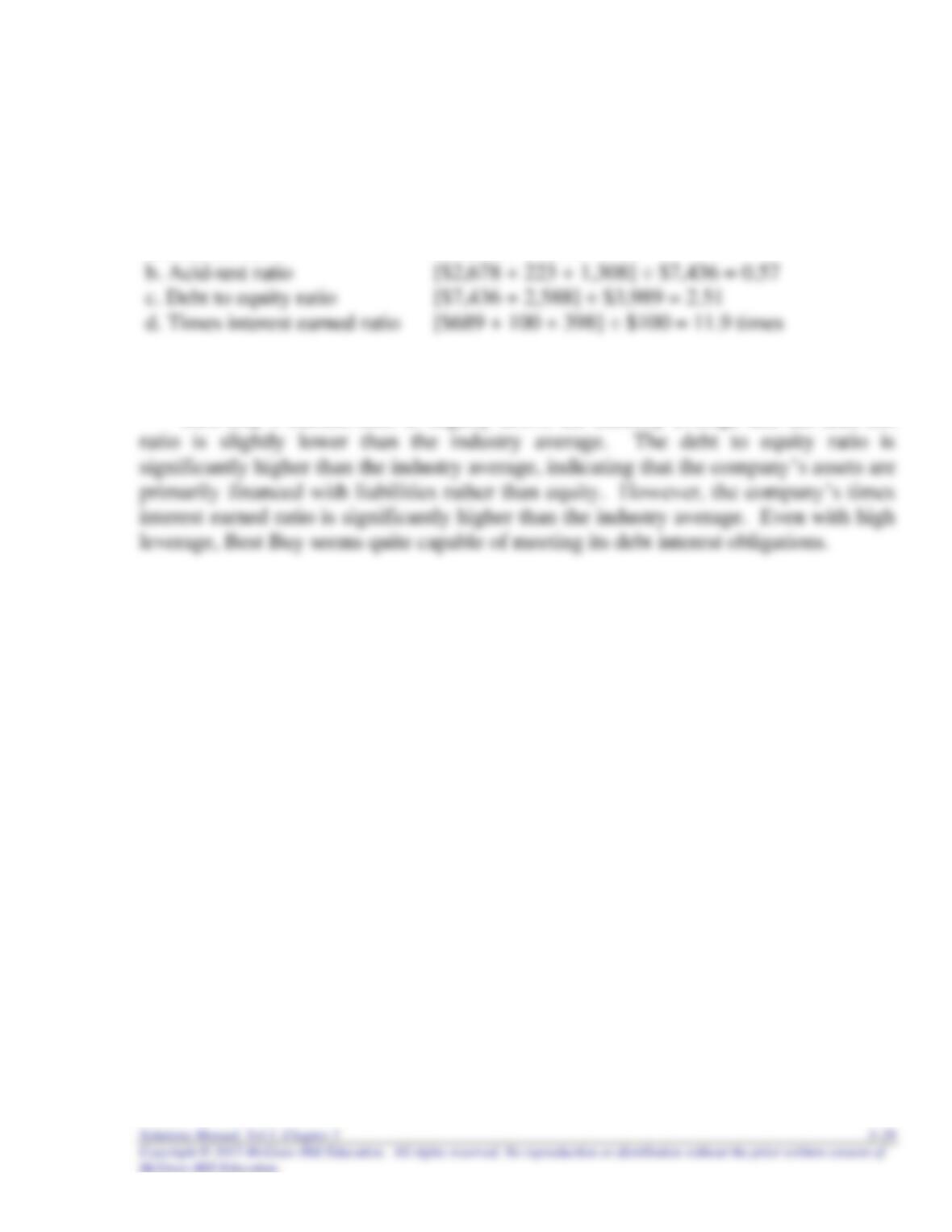
1. Current ratio [$200 + 150 + 200 + 350] ÷ $400 = 2.25
Exercise 3–17
Requirement 1
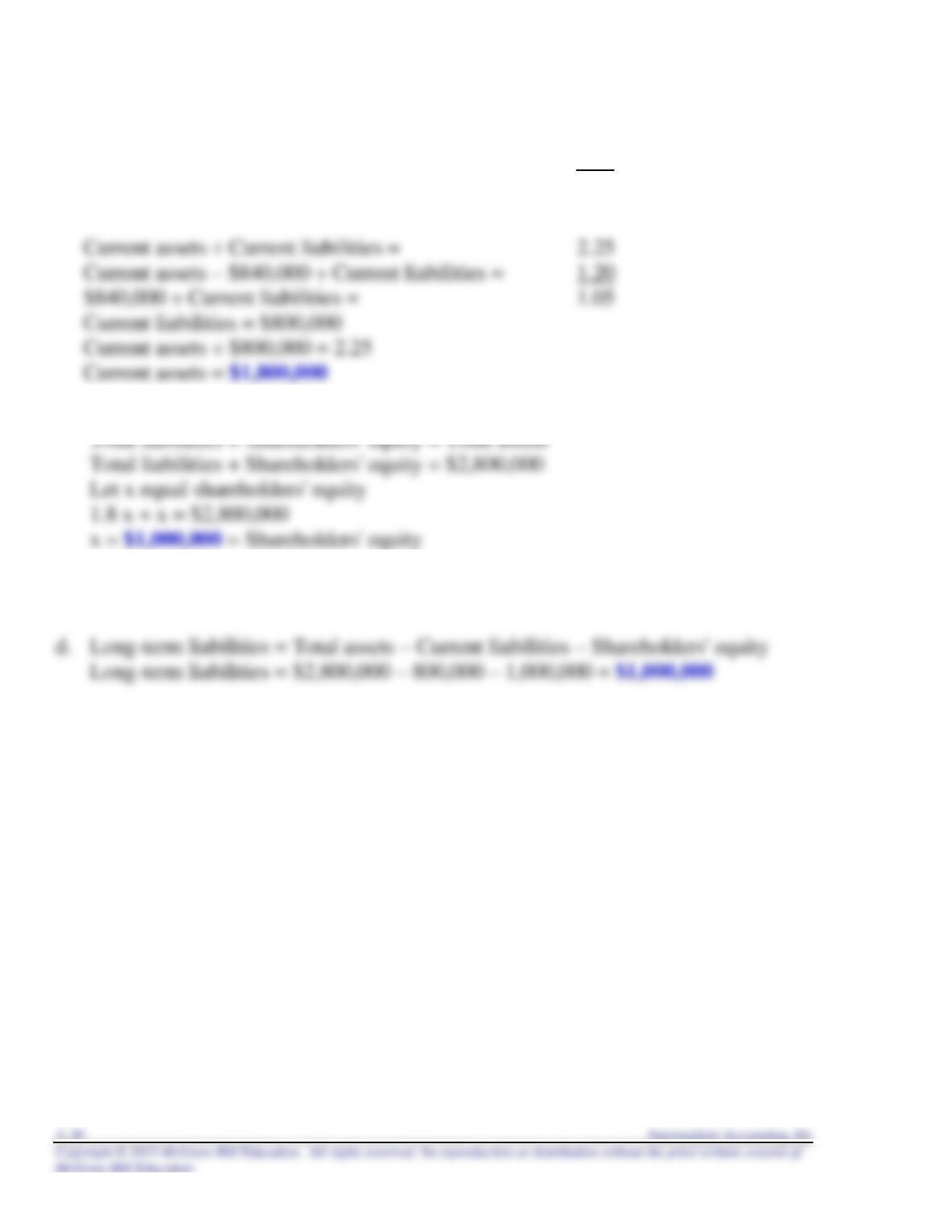
a. Current ratio $10,485÷ $7,436 = 1.41
Requirement 2
Best Buy’s current ratio is slightly above the industry average and the acid-test
Exercise 3–18
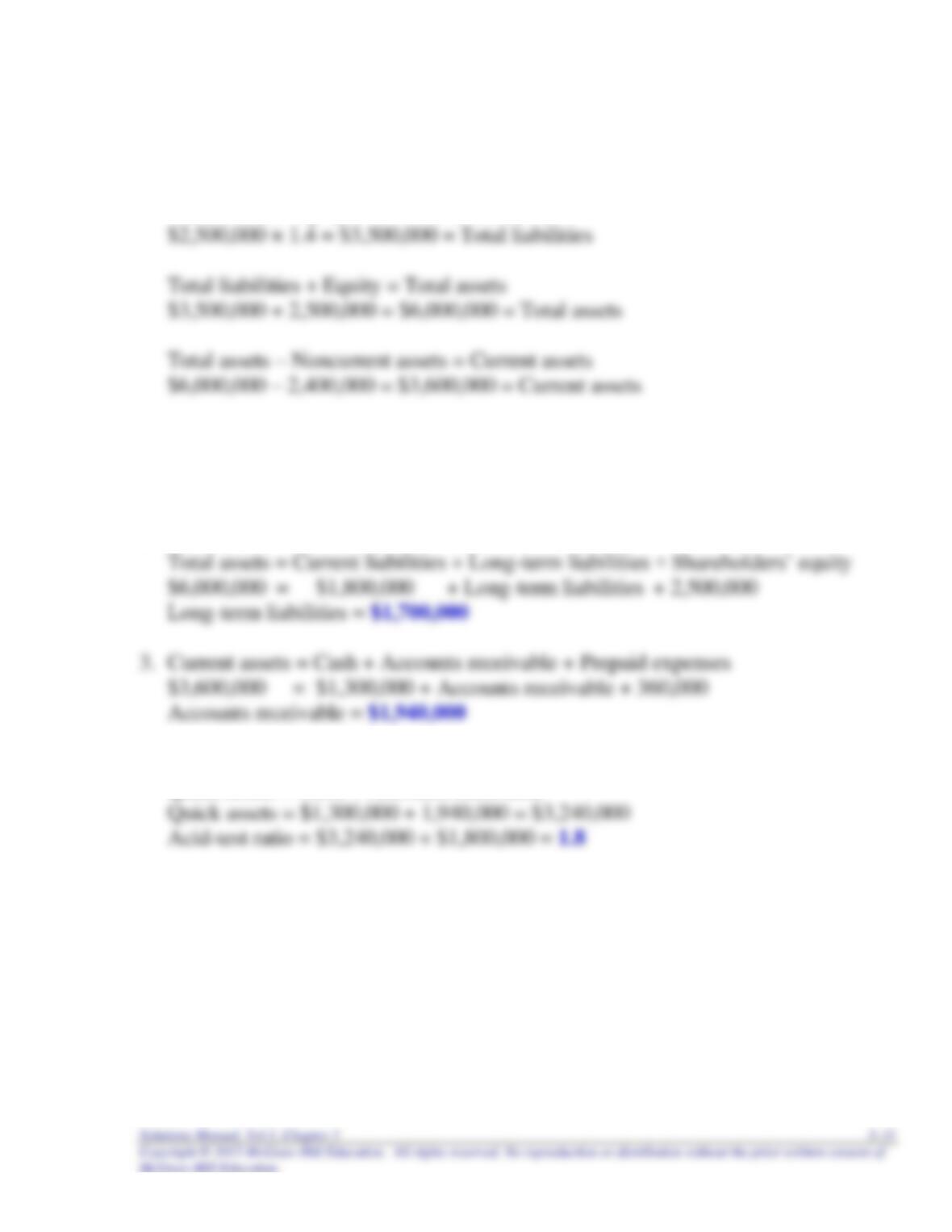
a. Acid-test ratio = Quick assets ÷ Current liabilities = 1.20
Quick assets = Current assets – Inventories
Quick assets = Current assets – $840,000
b. Debt to equity ratio = Total liabilities ÷ Shareholders’ equity = 1.8
c. Noncurrent assets = Total assets – Current assets
Noncurrent assets = $2,800,000 – 1,800,000 = $1,000,000
Exercise 3–19
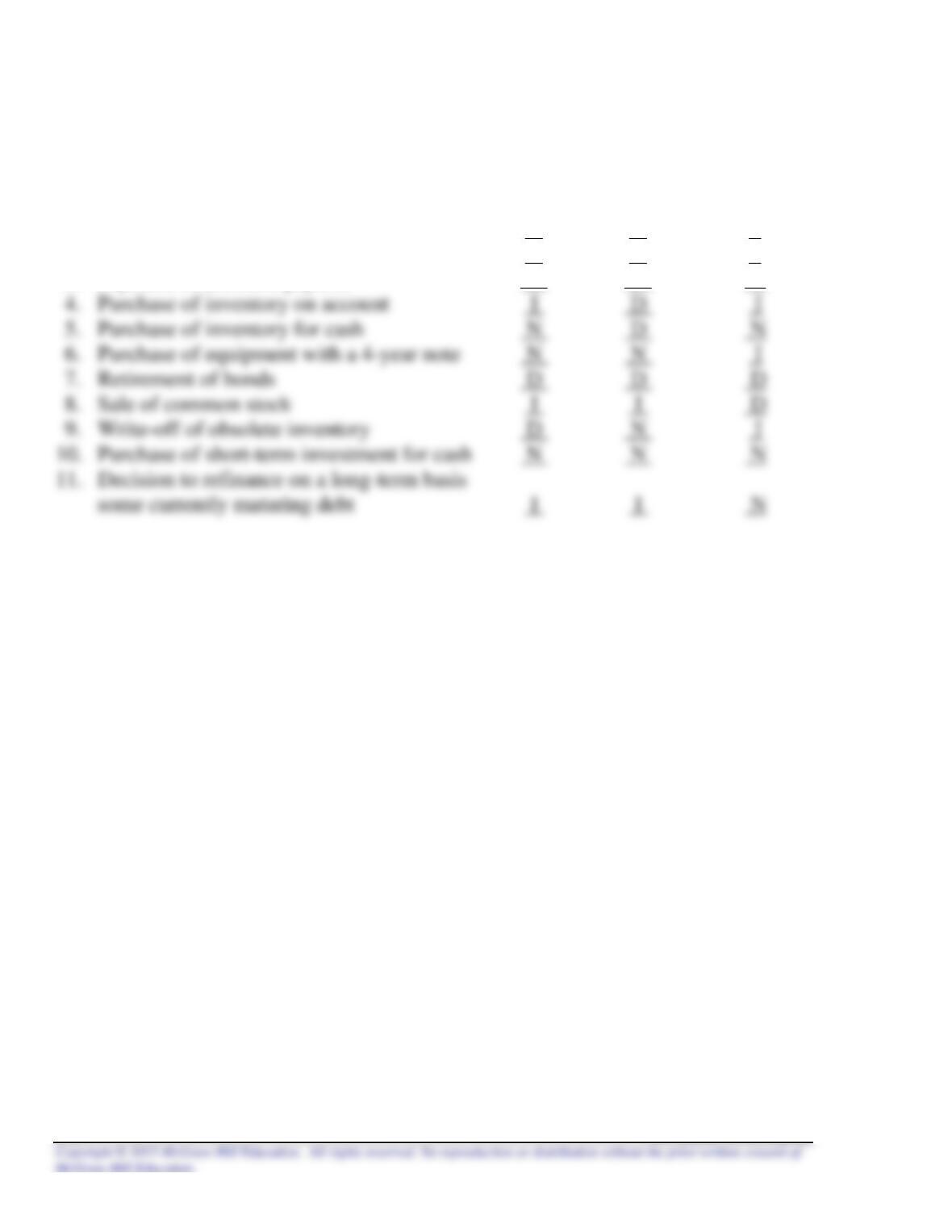
1. Debt to equity ratio = Total liabilities ÷ Shareholders’ equity = 1.4
Total liabilities ÷ $2,500,000 = 1.4
Shareholders’ equity × 1.4 = Total liabilities
Current ratio = Current assets ÷ Current liabilities
2.0 = $3,600,000 ÷ Current liabilities
Current liabilities = $3,600,000 2 = $1,800,000
2. Total assets = Total liabilities + Shareholders’ equity
4. Acid-test ratio = Quick assets ÷ Current liabilities
Quick assets = Cash + Accounts receivable
3–32 Intermediate Accounting, 8/e
Exercise 3–20
Current Acid-test Debt to
Action Ratio Ratio Equity Ratio
1. Issuance of long-term bonds I I I
2. Issuance of short-term notes I I I
3. Payment of accounts payable D D D
Exercise 3–21
Requirement 1
The pharmaceuticals, plastics, and farm equipment segments are reportable.
Requirement 2
For segments determined to be reportable, the following disclosures are required:
a. General information about the operating segment.
Exercise 3–22
In addition to revenues, profit or loss, and assets, IFRS also require the disclosure
CPA / CMA REVIEW QUESTIONS
CPA Exam Questions
1. b. The principal would have to be due after April 30, 2017, to be considered as
a noncurrent asset at April 30, 2016. The accrued interest for eight months
2. a. Current liabilities are obligations that are expected to be paid within one year
or the operating cycle, whichever is longer.
3. a. Inventory pricing is a significant accounting policy that should be disclosed
CPA Exam Questions (concluded)
4. c. The auditors’ standard report includes a statement that the financial
5. b. Current ratio—increased; Quick ratio—decreased.
Current ratio = Current assets ÷ Current liabilities.
When the current ratio is greater than 1 to 1, an equal decrease in current
6. a. Because inventory is not included in the quick ratio, the write-off of obsolete
7. d. Under U.S. GAAP, we present current assets and liabilities before
8. a. IFRS requires that companies disclose total liabilities of its reportable
segments. This disclosure is not required under U.S. GAAP.
3–36 Intermediate Accounting, 8/e
CMA Exam Questions
1 d. GAAP requires disclosure of related-party transactions except for
compensation agreements, expense allowances, and transactions eliminated
2 b. The MD&A section is included in SEC filings. It addresses in a
nonquantified manner the prospects of a company. The SEC examines it
3. a. The current ratio equals current assets divided by current liabilities. An
equal increase in both the numerator and denominator of a current ratio less
Solutions Manual, Vol.1, Chapter 3 3–37
Copyright © 2015 McGraw-Hill Education. All rights reserved. No reproduction or distribution without the prior written consent of
McGraw-Hill Education.
Problem 3–1
PROBLEMS
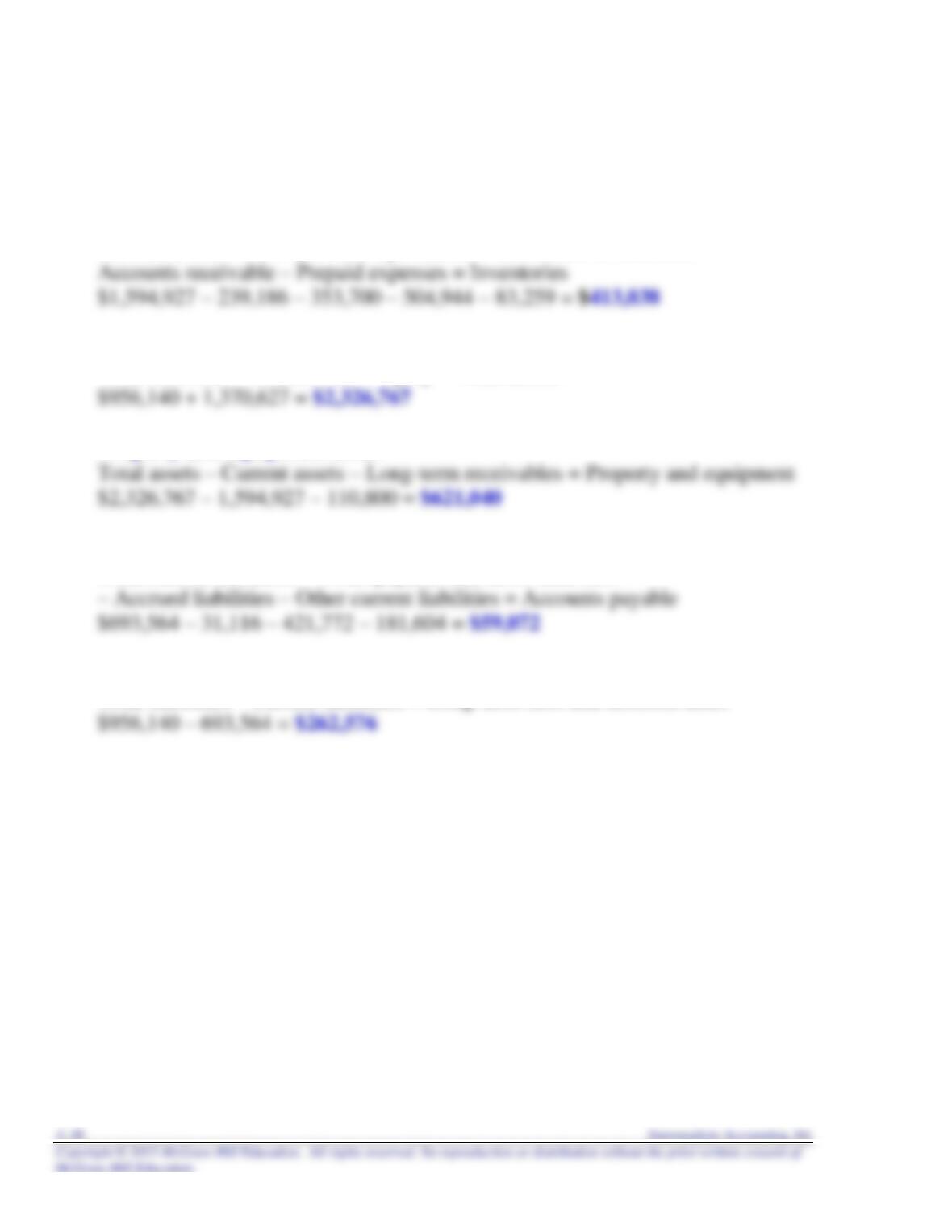
Name of Company
Balance Sheet
At [date]
Assets
Current assets:
Cash
Short-term investments
Investments:
Restricted cash
Long-term investments
Notes receivable
Total investments
Property, plant, and equipment:
Land
Buildings
Equipment
Less: Accumulated depreciation
Intangible assets:
Patent
Copyright
Total intangible assets
Total assets
Liabilities and Shareholders’ Equity
Current liabilities:
Accounts payable
Rent payable
Taxes payable
Wages payable
Notes payable
Total current liabilities
Long-term liabilities:
Bonds payable
Common stock
Preferred stock
Retained earnings
Accounts receivable, net of allowance for uncollectible accounts
Interest receivable
Inventories
Prepaid expenses
Total current assets
Problem 3–2
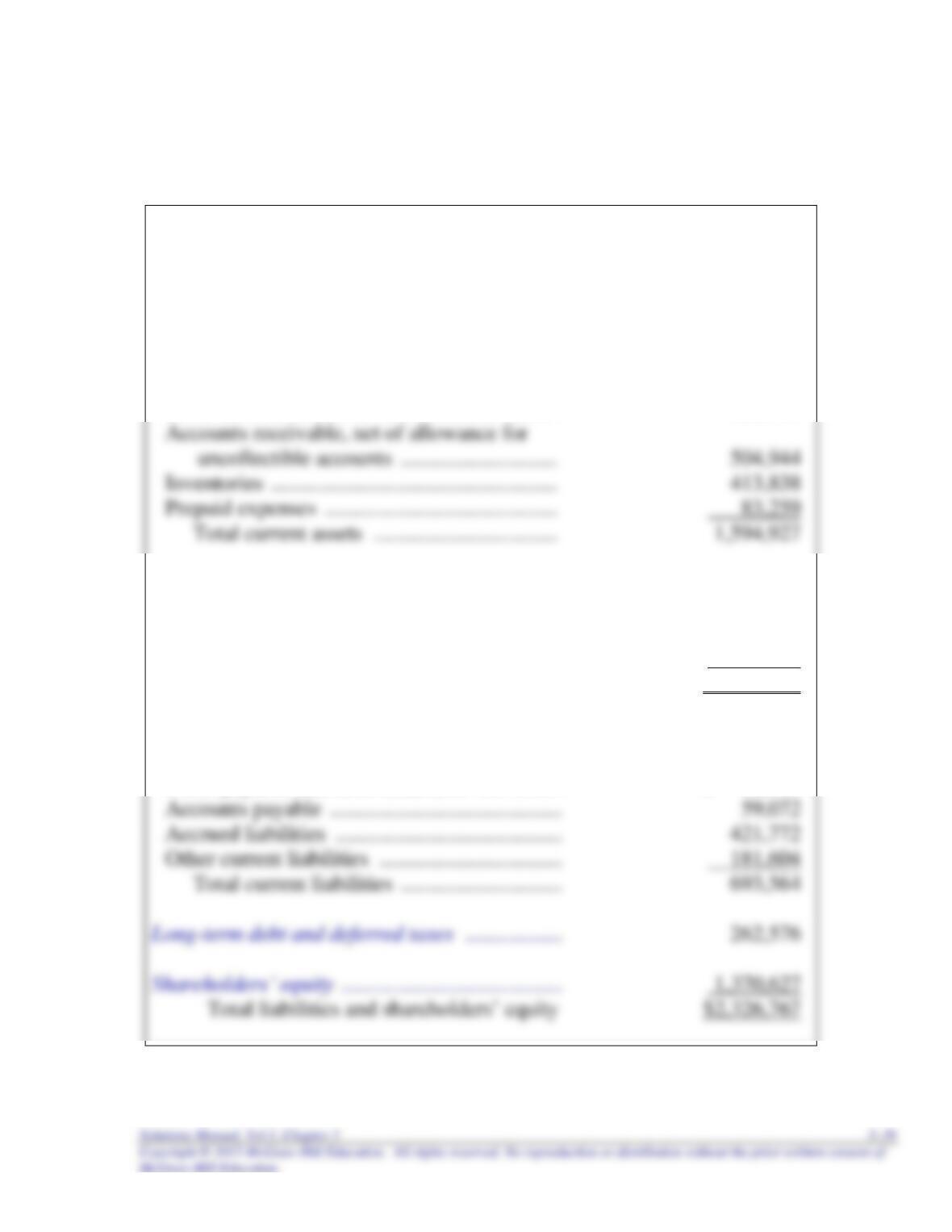
Requirement 1
Inventories:
Current assets – Cash and cash equivalents – Short-term investments –
Total assets:
Total liabilities + Shareholders’ equity = Total assets
Property and equipment (net):
Accounts payable:
Total current liabilities – Notes payable and short-term debt
Long-term debt and deferred taxes:
Total liabilities – Current liabilities = Long-term debt and deferred taxes
Problem 3–2 (concluded)
Requirement 2
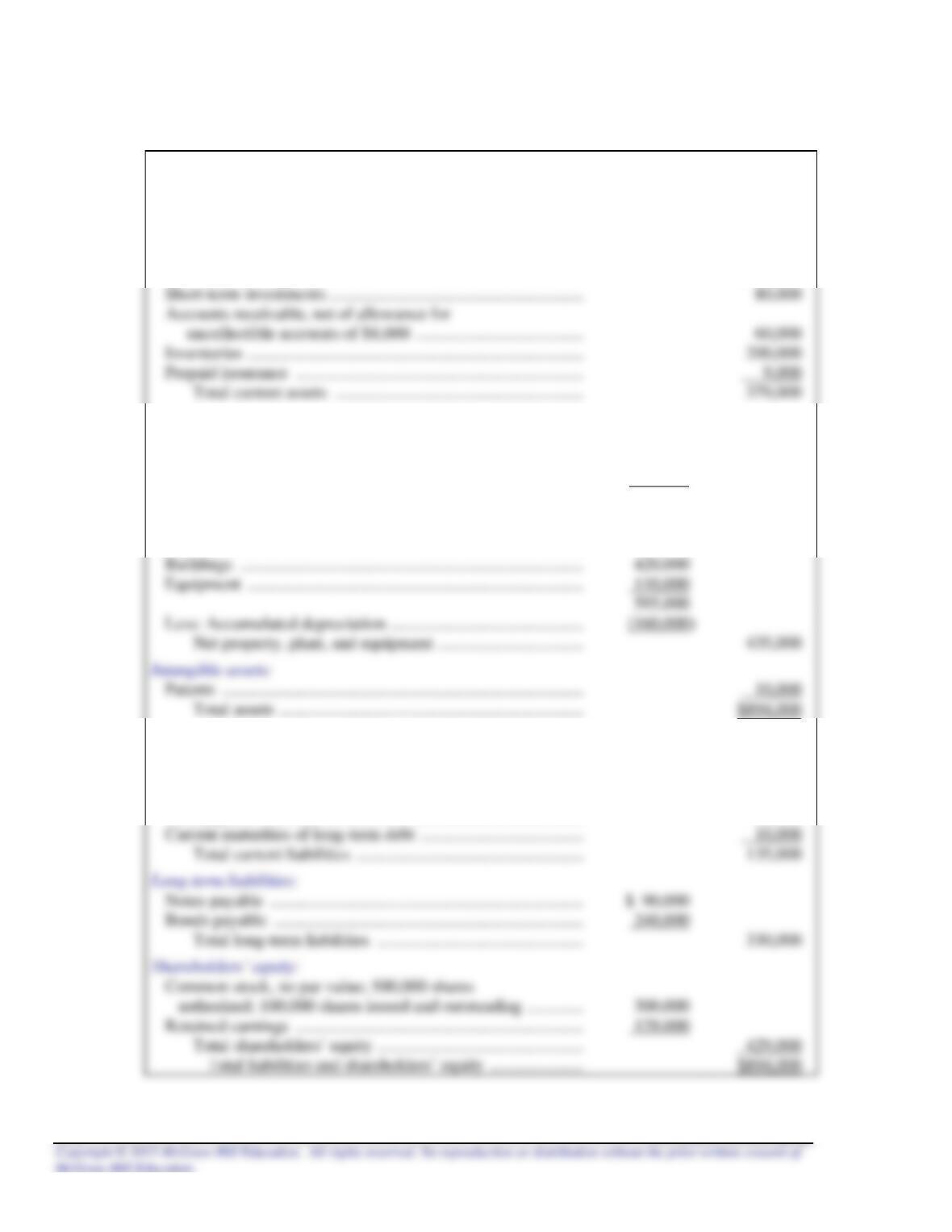
TRIDENT CORPORATION
Balance Sheet
At December 31, 2016
Assets
($ in thousands)
Current assets:
Cash and cash equivalents ………………………..
$ 239,186
Short-term investments …………………………...
353,700
Inventories ……………………………………………..
413,838
Prepaid expenses …………………………………….
83,259
Investments:
Long-term receivables ……………………………..
110,800
Property and equipment (net) ………………………
621,040
Total assets ……………………………………..
$2,326,767
Liabilities and Shareholders’ Equity
Current liabilities:
Notes payable and short-term debt …………….
$ 31,116
Accounts payable …………………………………….
Accrued liabilities ……………………………………
Other current liabilities …………………………….
Total current liabilities …………………………
Long-term debt and deferred taxes ………………
262,576
Total liabilities and shareholders’ equity
$2,326,767
3–40 Intermediate Accounting, 8/e
Problem 3–3
ALMWAY CORPORATION
Balance Sheet
At December 31, 2016
Assets
Current assets:
Cash and cash equivalents ………………………………………………
$ 30,000
Short-term investments …………………………………………………..
80,000
uncollectible accounts of $8,000 …………………………………
60,000
Inventories ……………………………………………………………………
Prepaid insurance ………………………………………………………….
9,000
Investments:
Marketable securities ……………………………………………………..
$ 30,000
Land held for sale ………………………………………………………….
25,000
Restricted cash ………………………………………………………………
15,000
Total investments …………………………………………………….
70,000
Property, plant, and equipment:
Land …………………………………………………………………………….
65,000
Buildings ……………………………………………………………………..
Equipment ……………………………………………………………………
110,000
Less: Accumulated depreciation …………………………..………….
Net property, plant, and equipment …………………………….
Intangible assets:
Patents …………………………………………………………………………
10,000
Total assets ……………………………………………………………..
$894,000
Liabilities and Shareholders’ Equity
Current liabilities:
Accounts payable ………………………………………………………….
$ 75,000
Interest payable ……………………………………………………….…….
20,000
Note payable …………………………………………………………………
30,000
Current maturities of long-term debt ………………………………..
10,000
Total current liabilities ……………………………………………..
135,000
Notes payable ……………………………………………………………….
Bonds payable ………………………………………………………………
240,000
Total long-term liabilities …………………………………………
330,000
authorized; 100,000 shares issued and outstanding ………….
Retained earnings ………………………………………………………….
129,000
429,000