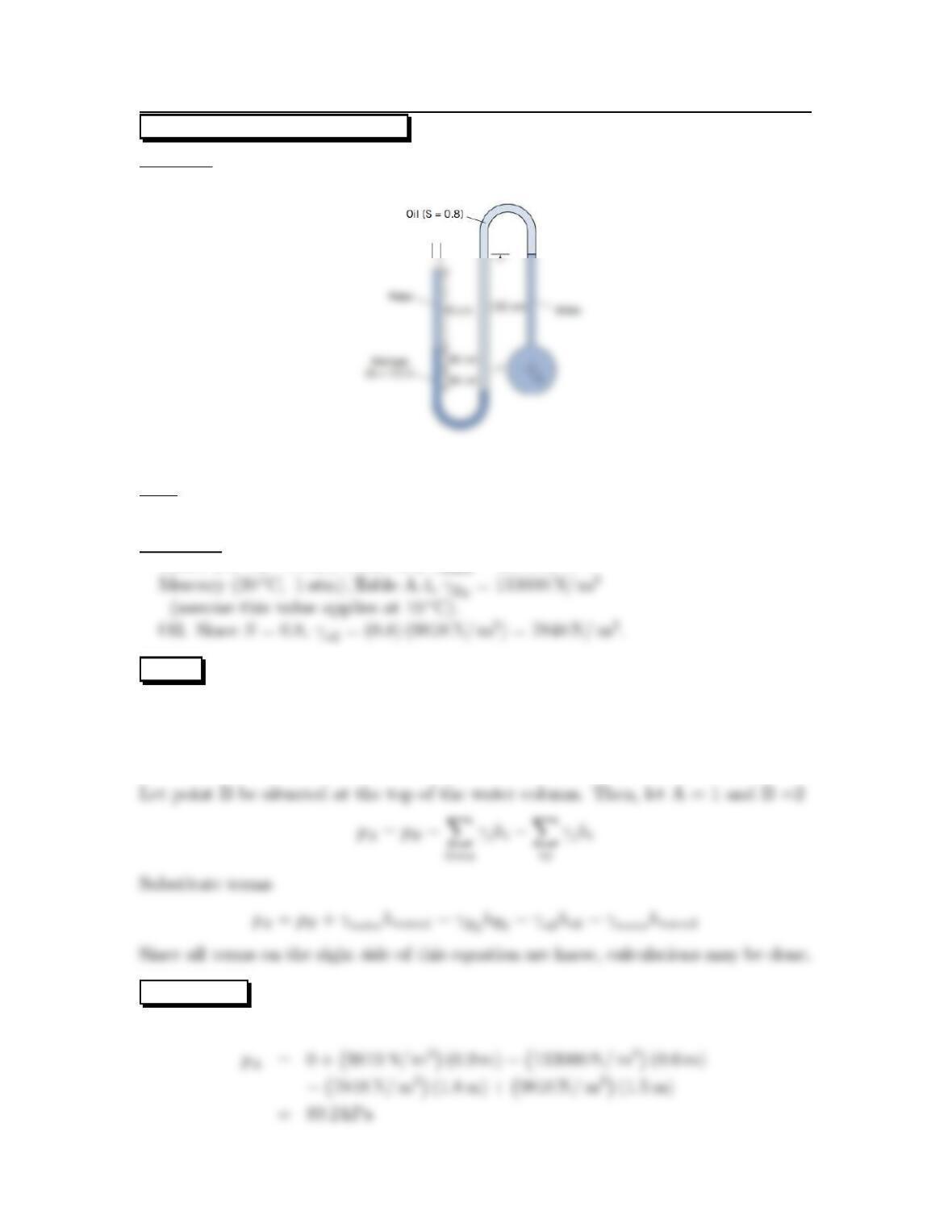
3.56: PROBLEM DEFINITION
Situation:
A manometer is used to measure pressure at the center of a pipe.
Find:
Pressure at center of pipe A (kPa).
Properties:
Water (10 ◦C,1atm),Table A.5, γwater =9810N/m3.
PLAN
Since the manometer is applied to measure pressure at point A, select Eq. (3.18) in
2.
p1=p2+X
down
γihi−X
up
γihi
SOLUTION
81
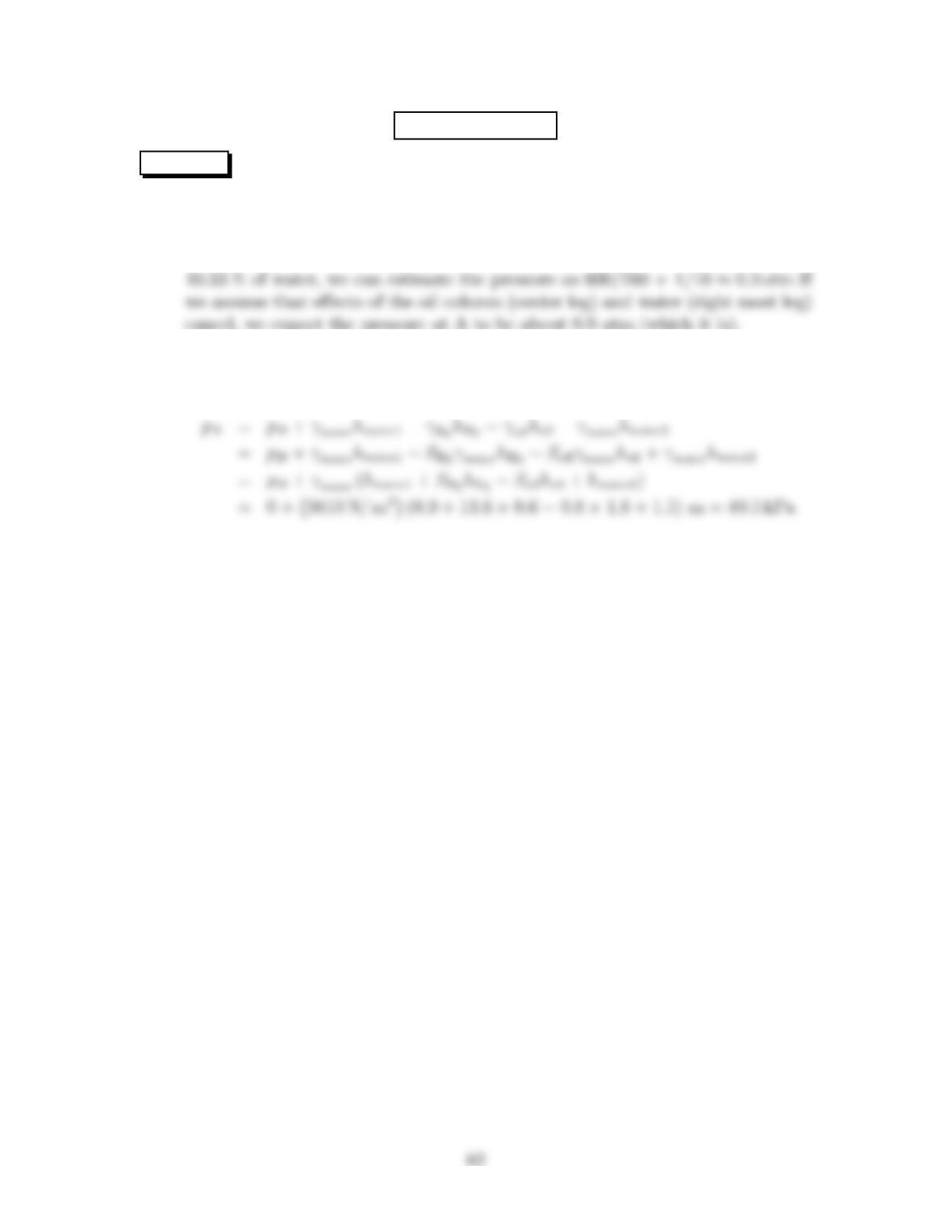
pA=89.2kPa gage
REVIEW
1. To validate, look at left most leg of manometer. The pressure in the pipe is
holding up 600 mm of Hg and 0.9 m of water. Since 1 atm = 760 mm Hg =
2. An alternative approach is to use specific gravity as shown below. This approach
makes calculations easier.
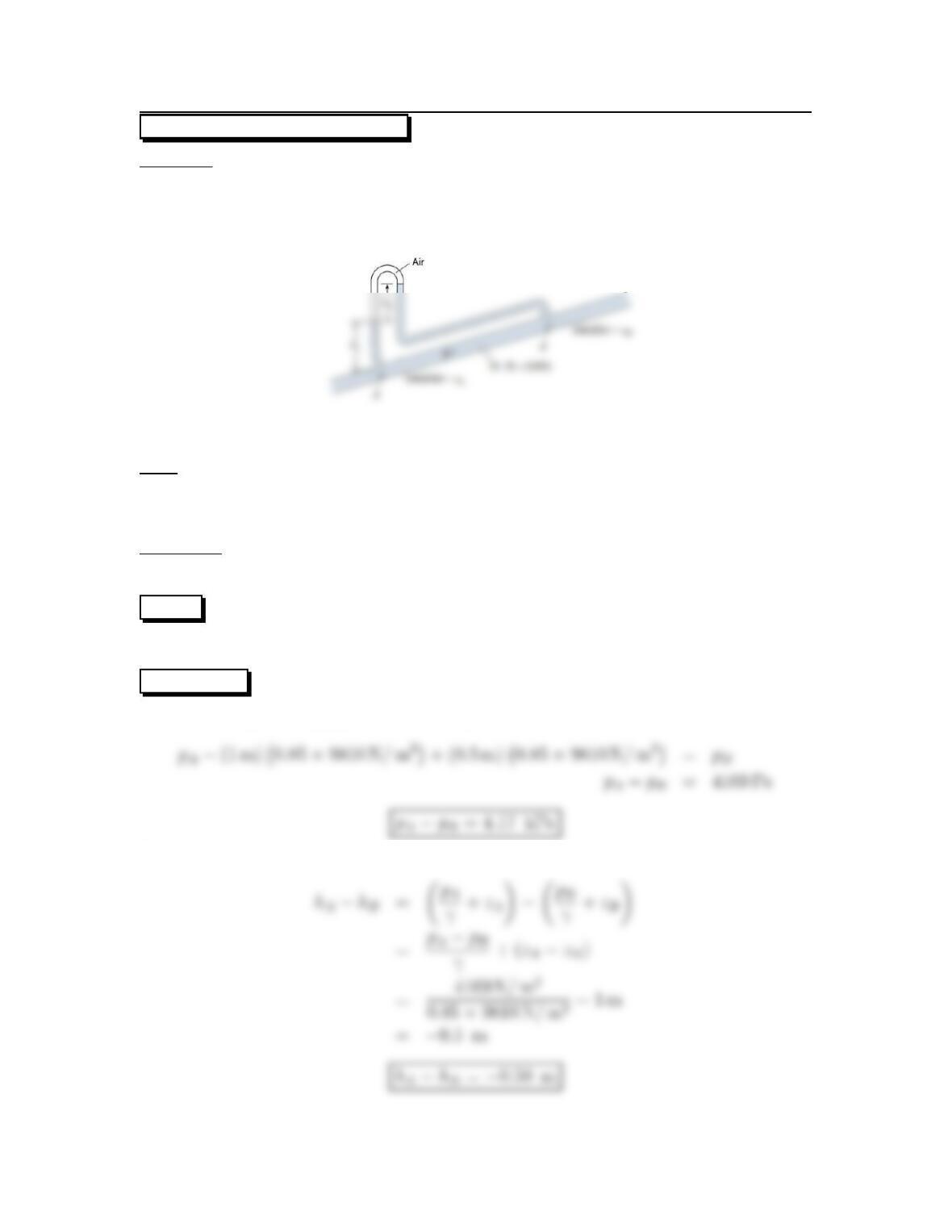
3.57: PROBLEM DEFINITION
Situation:
A system is described in the problem statement.
1=1m,2=0.5m.
zA=10m,zB=11m.
Find:
(a) Difference in pressure between points A and B (kPa).
(b) Difference in piezometric head between points A and B (m).
Properties:
γ=9810N/m3,S=0.85.
PLAN
Apply the manometer equation.
SOLUTION
Manometer equation (apply from A to B)
Piezometric head
83
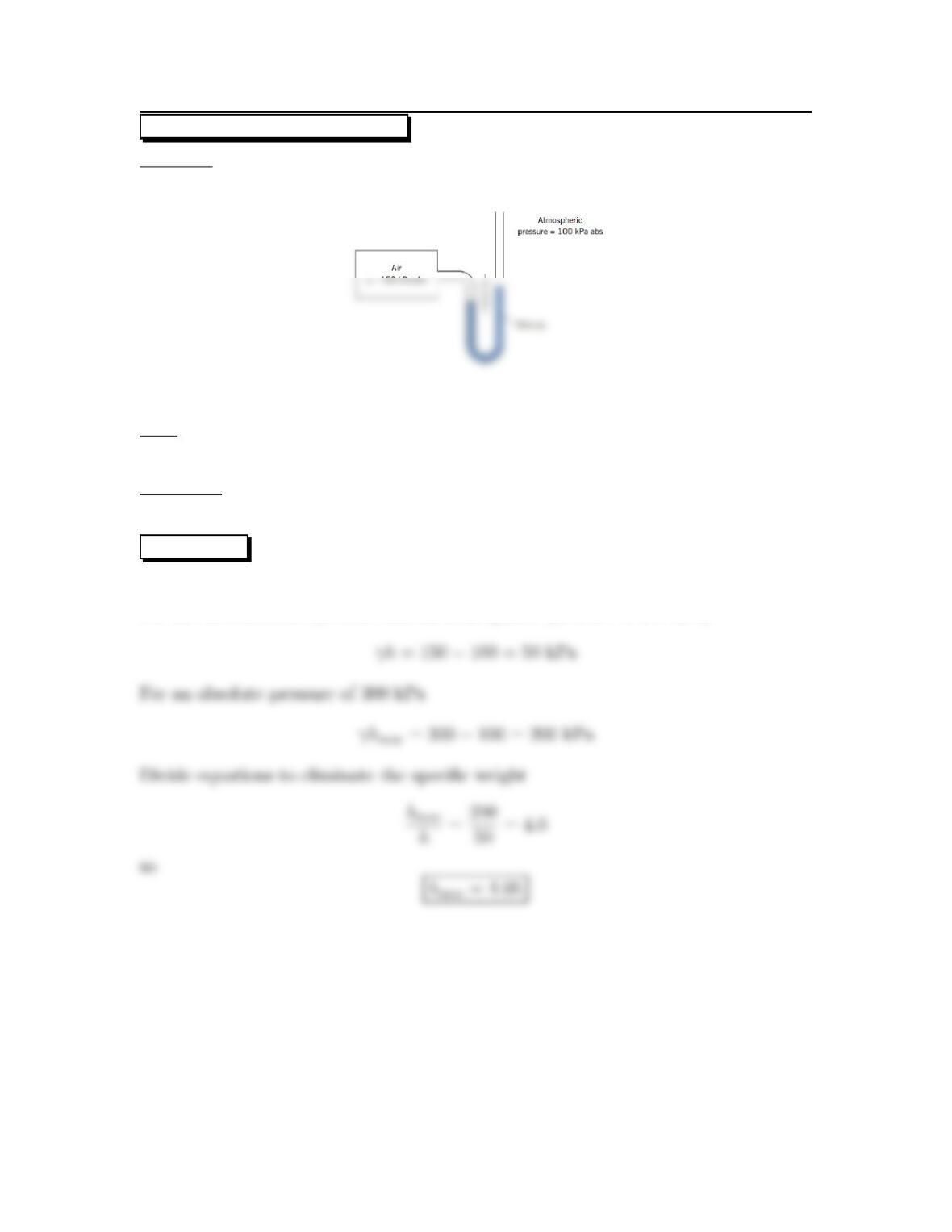
3.58: PROBLEM DEFINITION
Situation:
A manometer attached to a tank.
Find:
Manometer deflection when pressure in tank is doubled.
Properties:
patm =100kPa,p= 150 kPa.
SOLUTION
p−patm =γh
For 150 kPa absolute pressure and an atmospheric pressure of 100 kPa,
84
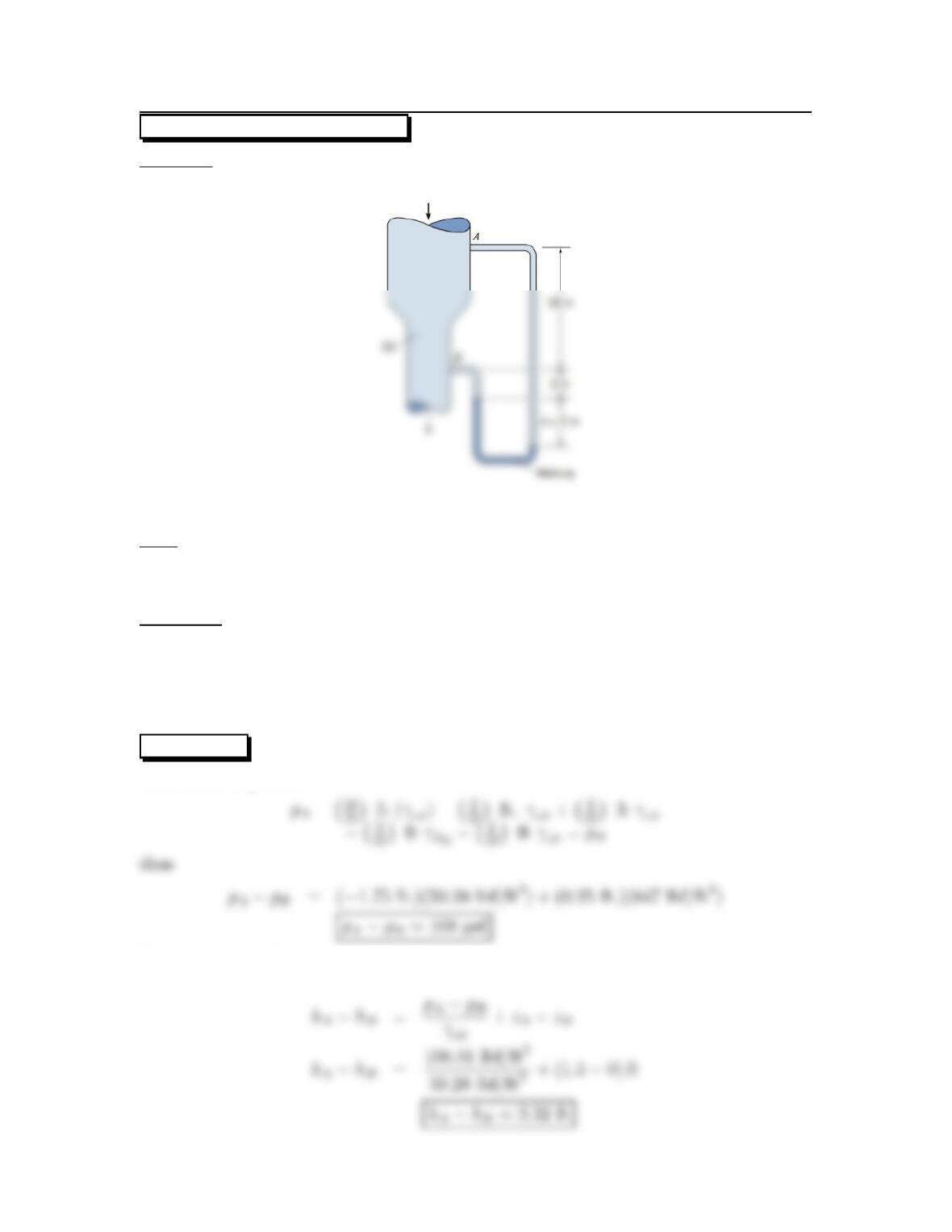
3.59: PROBLEM DEFINITION
Situation:
A manometer is tapped into a vertical conduit.
Find:
Difference in pressure between points A and B (psf).
Difference in piezometric head between points A and B (ft).
Properties:
From Table A.4, γHg=847lbf/ft3.
γoil =(0.95)(62.4lbf/ft3)
=59.28 lbf/ft3
SOLUTION
Manometer equation
Piezometric head
85

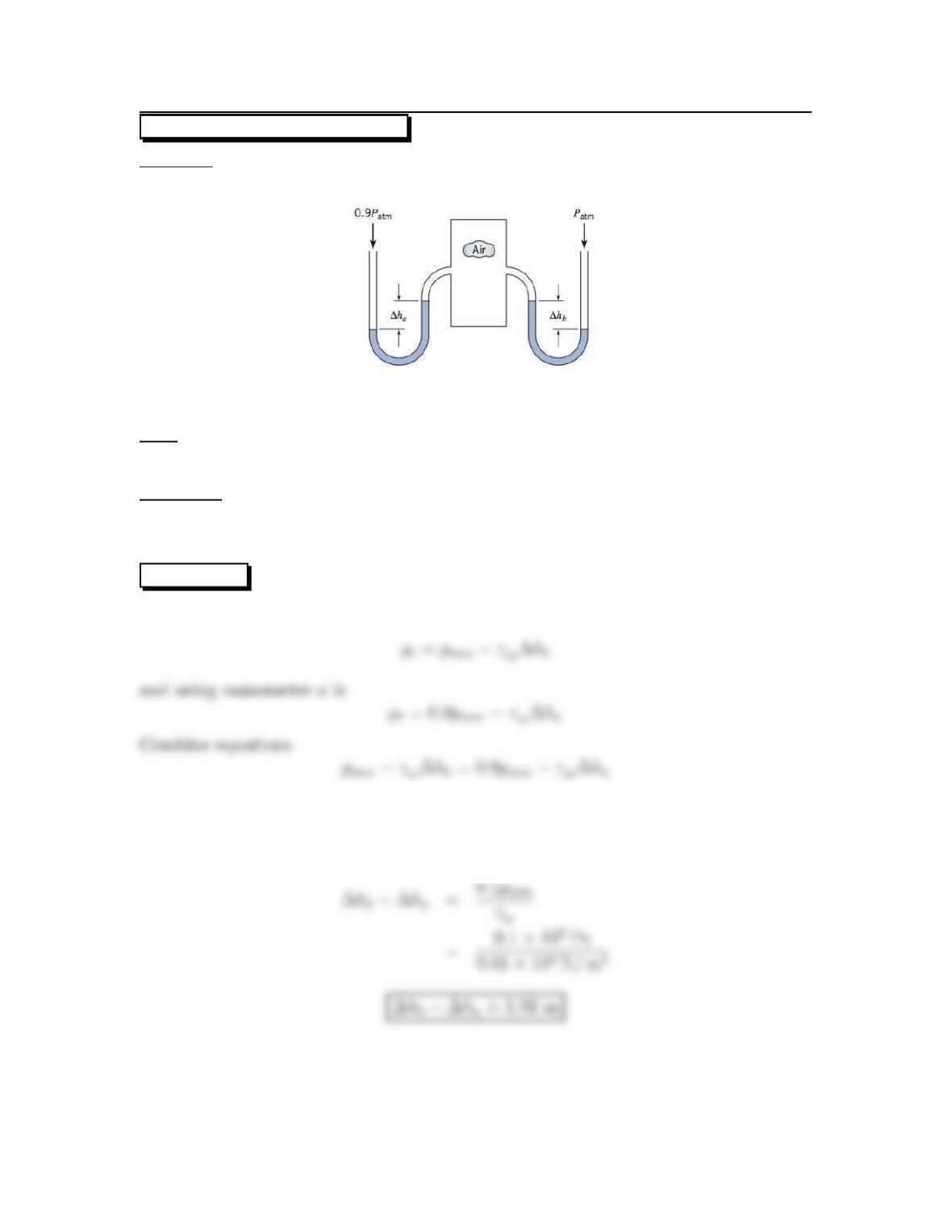
3.60: PROBLEM DEFINITION
Situation:
Two manometers attached to an air tank.
Find:
Difference in deflection between manometers (m).
Properties:
pleft =0.9patm,pright =patm = 100 kPa.
γw=9810N/m3.
SOLUTION
The pressure in the tank using manometer bis
or
0.1patm =γw(∆hb−∆ha)
Solveforthedifference in deflection
87
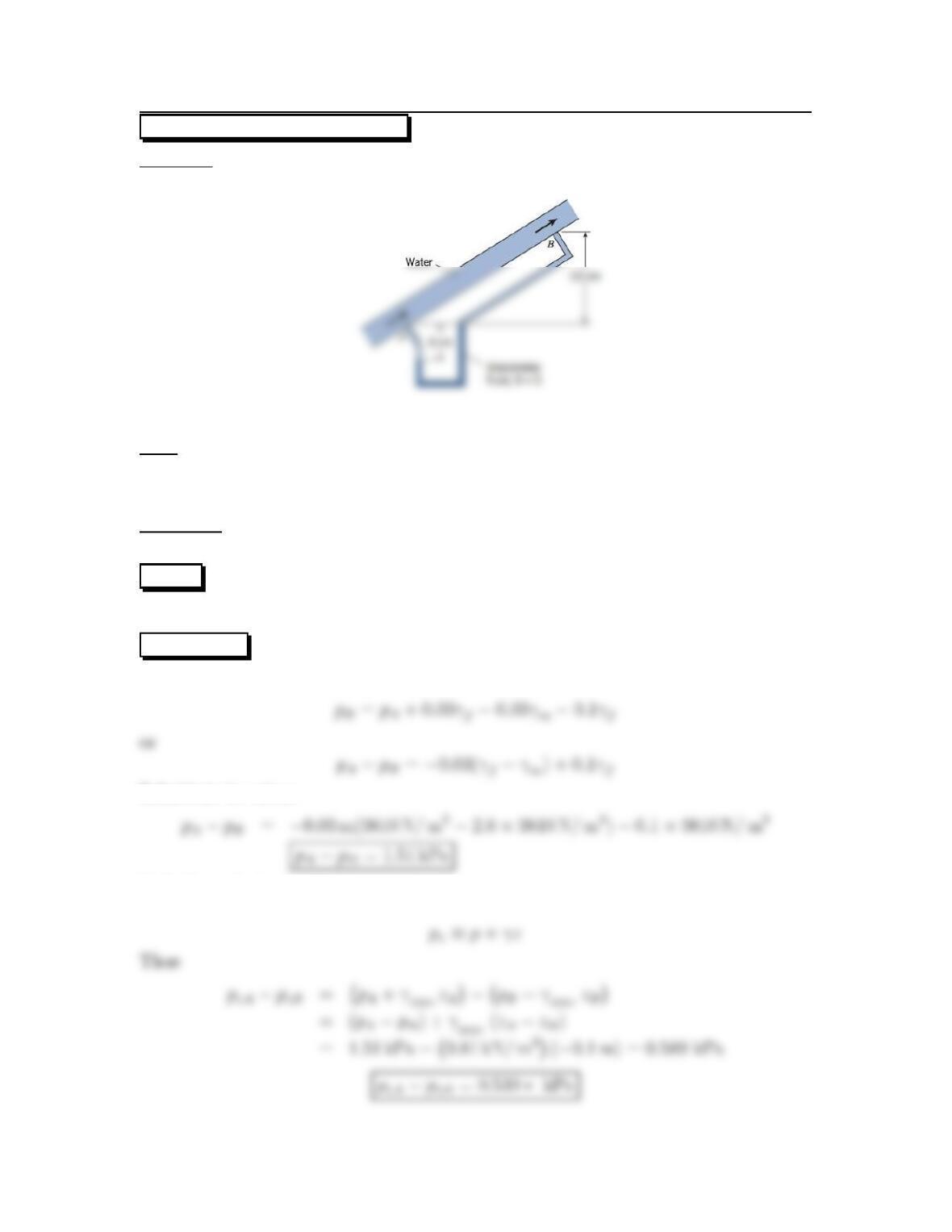
3.61: PROBLEM DEFINITION
Situation:
Manometer—measuring pressure difference in a pipe.
Find:
(a) Pressure difference (pA−pB)in kPa.
(b) Piezometric pressure difference (pzA −pzB)in kPa.
Properties:
S=2.8.
PLAN
Apply the manometer equation. Use the definition of piezometric pressure.
SOLUTION
Manometer equation (apply between points A & B)
Substitute in values
Definition of piezometric pressure
88
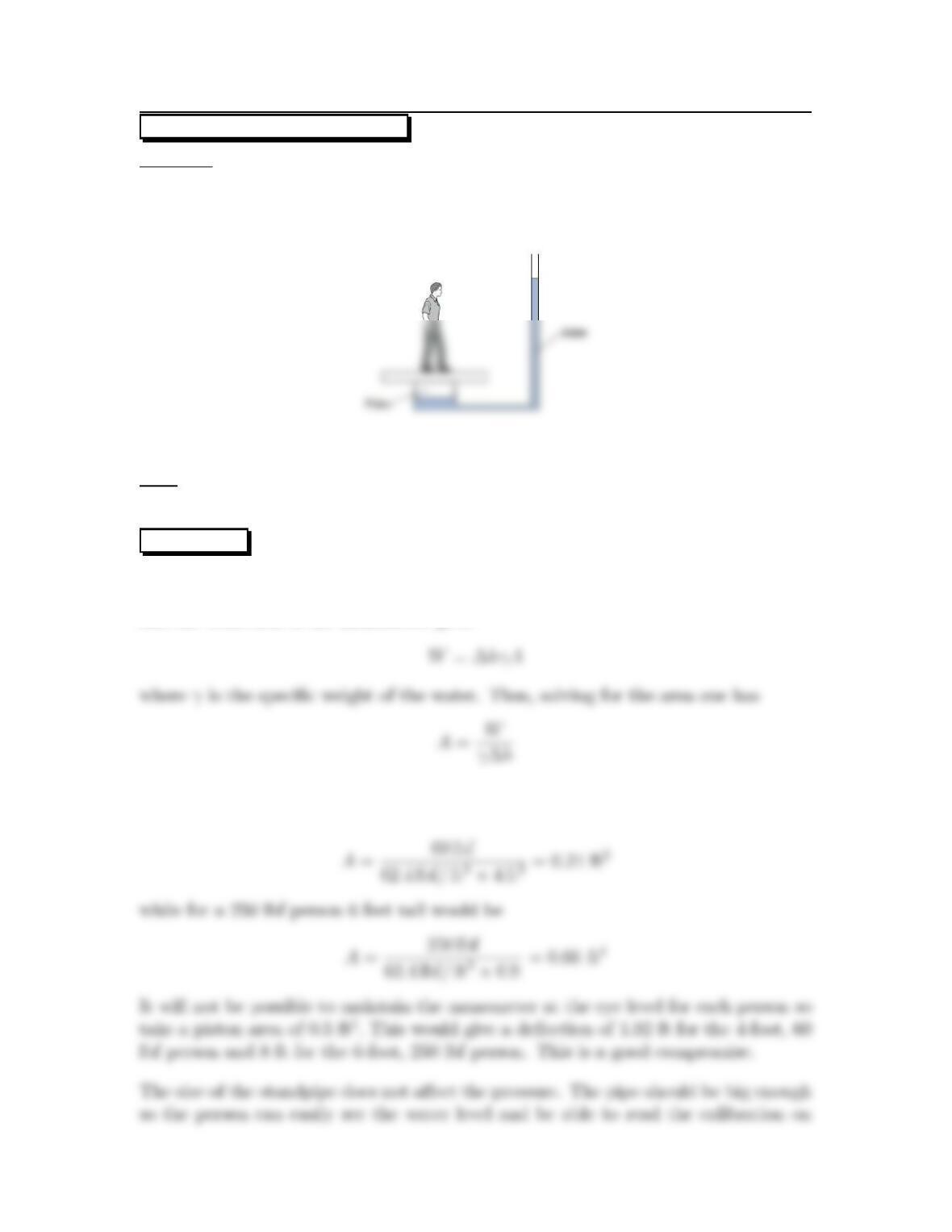
3.62: PROBLEM DEFINITION
Situation:
A piston scale is used to measure weight.
Weight range: 60 = 250 lbf.
Height range: 4−6ft tall.
Find:
Select a piston size and standpipe diameter.
SOLUTION
Firstofallneglecttheweightofthepistonandfind the piston area which will give
reasonable manometer deflections. Equating the force on the piston, the piston area
and the deflection of the manometer gives
For a four foot person weighing 60 lbf, the area for a 4 foot deflection (manometer
near eye level of person) would be
89
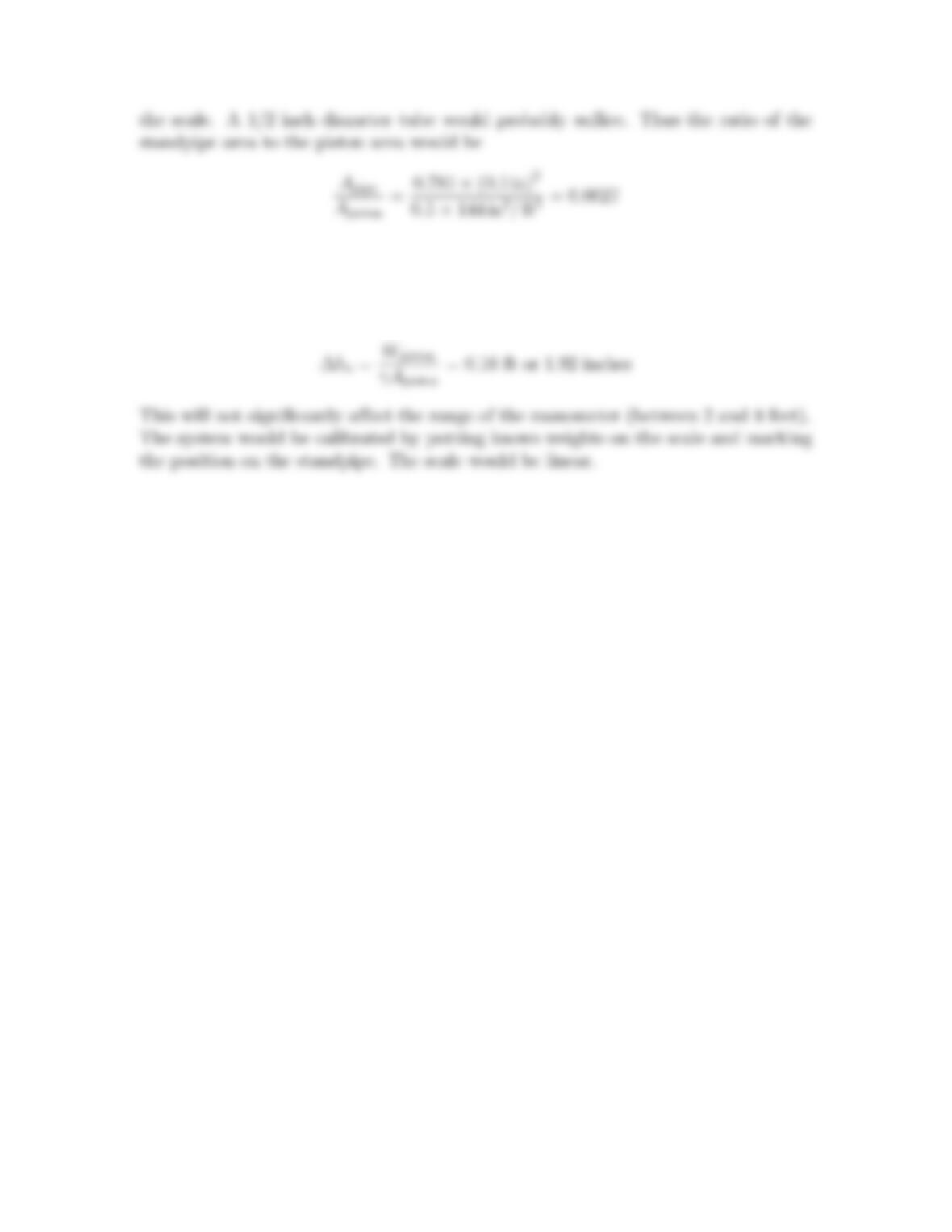
This means that when the water level rises to 8 ft, the piston will only have moved
by 0.0027 ×8=0.0216 ft or 0.26 inches.
The weight of the piston will cause an initial deflection of the manometer. If the
piston weight is 5 lbf or less, the initial deflection of the manometer would be
90
Problem 3.63
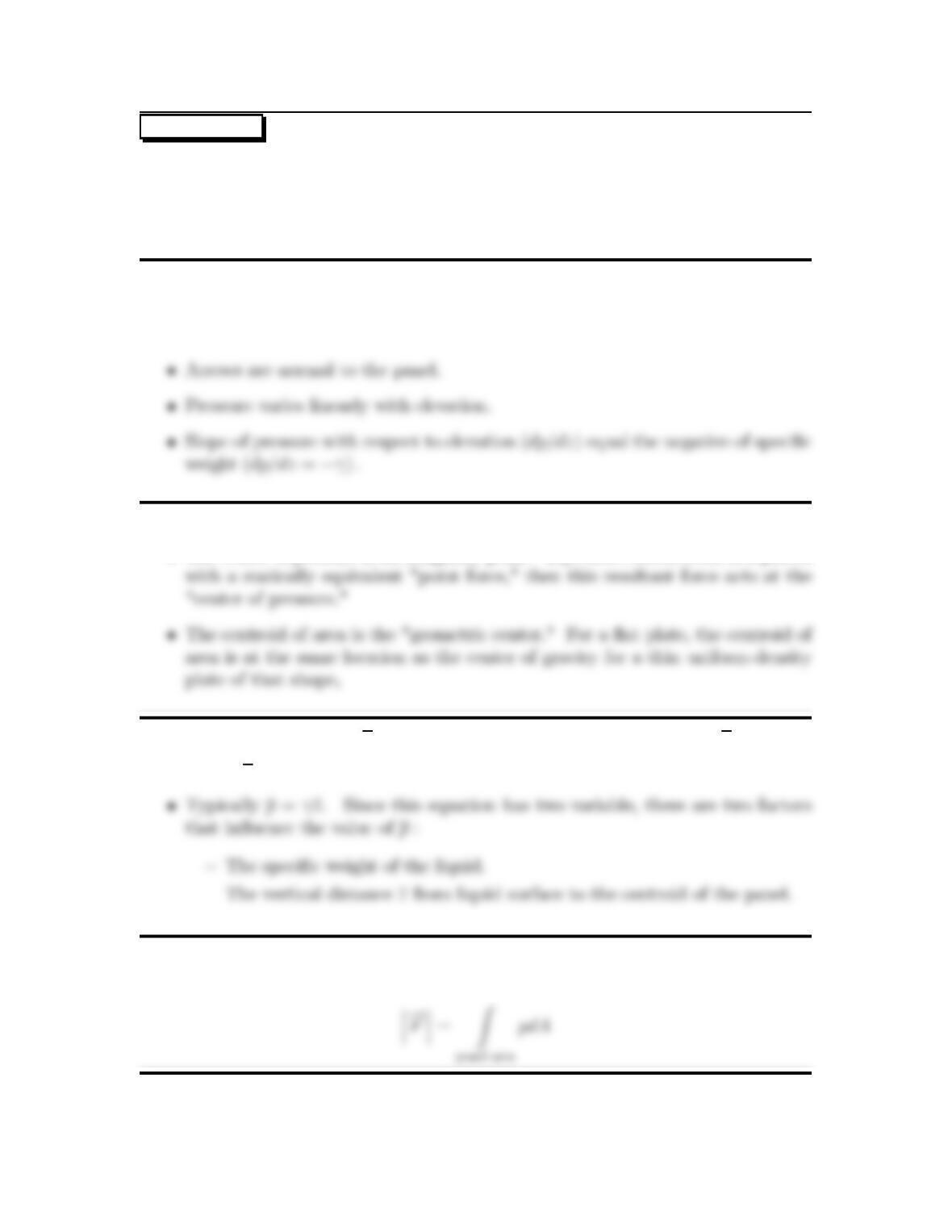
Using Section 3.4 and other resources, answer the questions below. Strive for depth,
clarity, and accuracy while also combining sketches, words and equations in ways
that enhance the effectiveness of your communication. There are many possible
good answers to these questions. Here, we give some examples.
a. For hydrostatic conditions, what do typical pressure distributions on a panel look
like? Sketch three examples that correspond to different situations.
•Arrows (which represent normal stress) are compressive.
b. What is a center of pressure? What is a centroid of area?
•The center of pressure is an imaginary point. If pressure distribution is replaced
c. In Eq. (3.23), what does pmean? What factors influence the value of p?
•P-bar (p)is the pressure evaluated at the elevation of the centroid of area.
d. What is the relationship between the pressure distribution on a panel and the
resultant force?
e. How far is the center of pressure from the centroid of area? What factors influence
this distance?
91
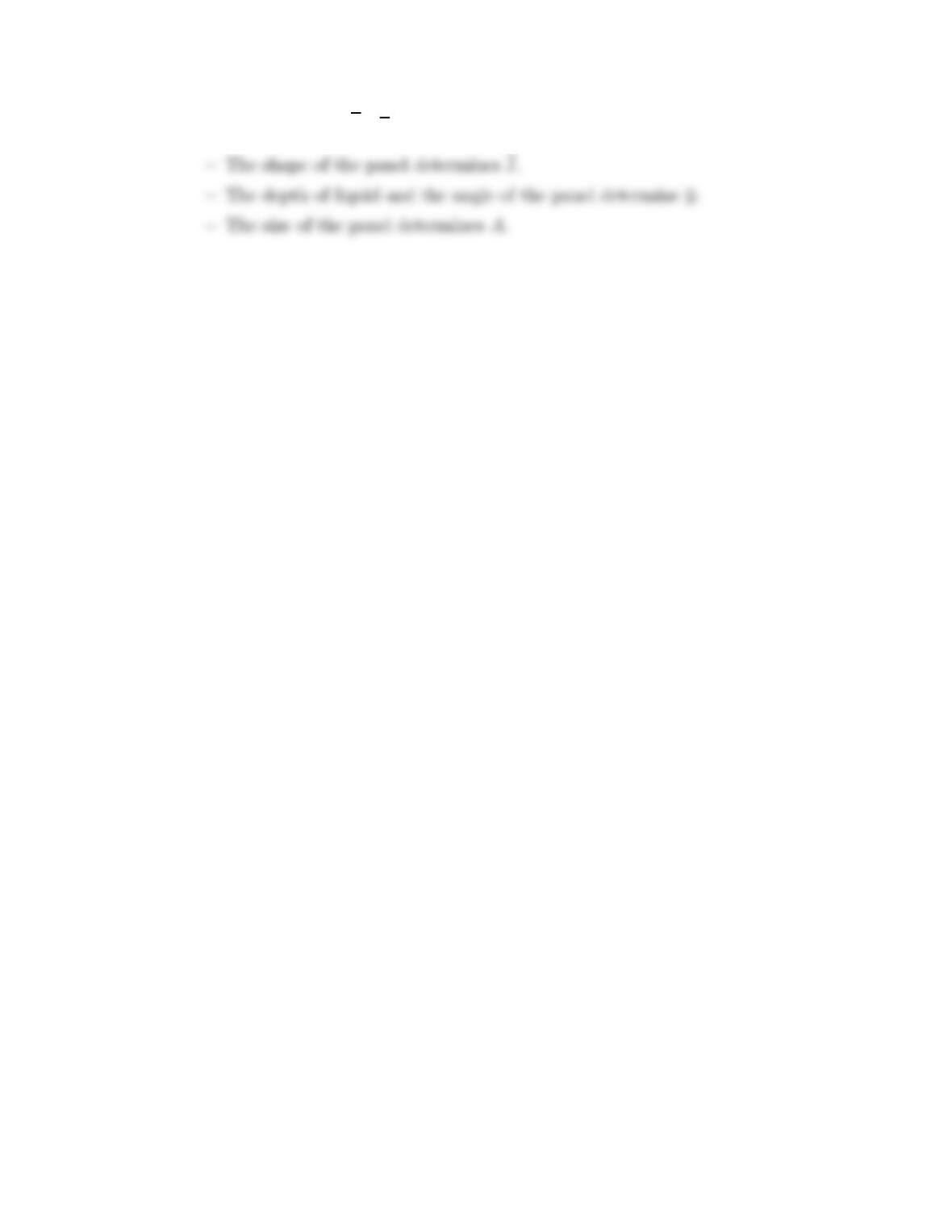
•Distance is given by I/(yA).Thus
92
3.64: PROBLEM DEFINITION
Situation:
Part1. ConsidertheequationforthedistancebetweentheCPandthecentroid
of a submerged panel (Eq. 3.30 in §3.4, 10e). In that equation, ycp is
a. the vertical distance from the water surface to the CP.
b. the slant distance from the water surface to the CP.
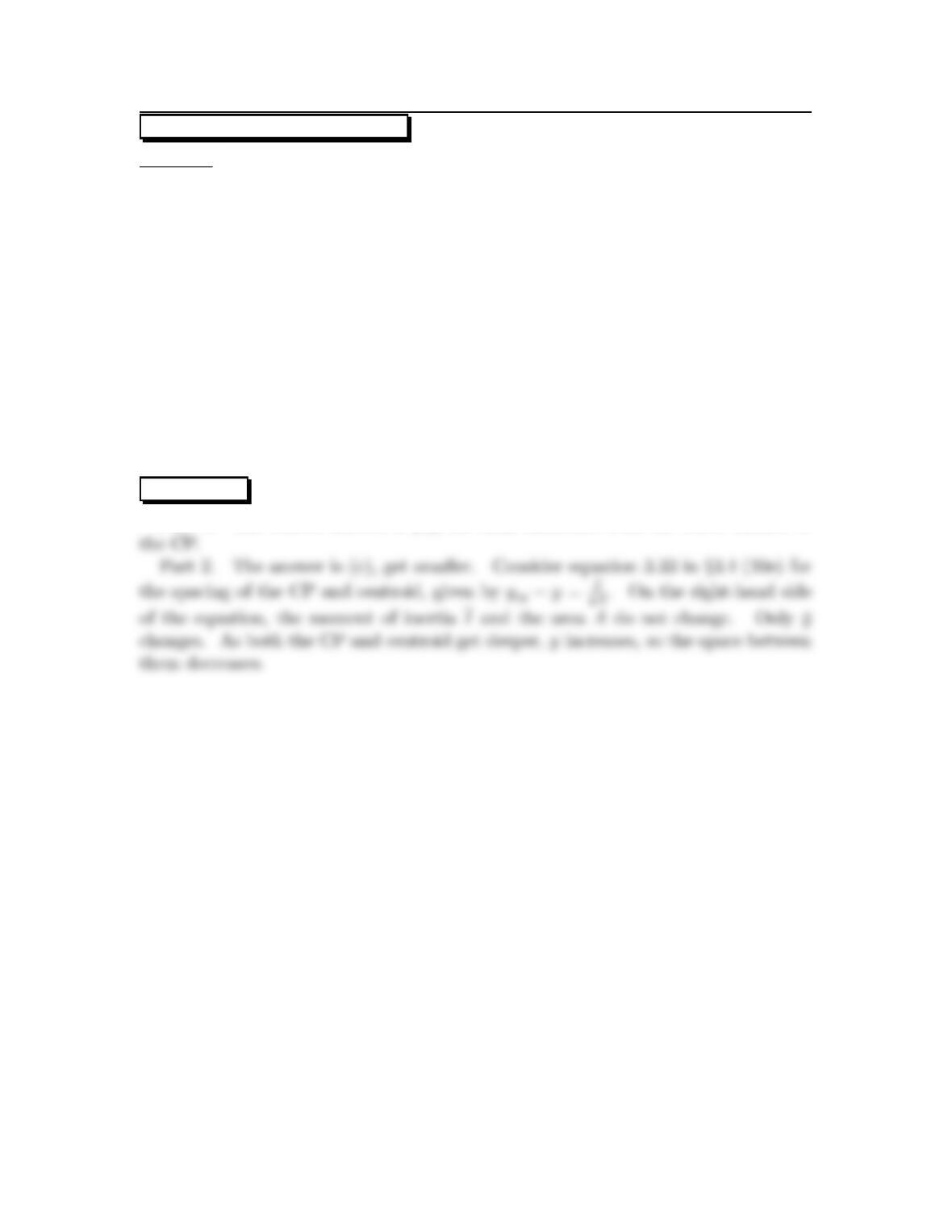
Part 2. Next, consider the figure shown. For case 1 as shown, the viewing window
on the front of a submersible exploration vehicle is at a depth of y1. For case 2,
the submersible has moved deeper in the ocean, to y2. As a result of this increased
overall depth of the submersible and its window, does the spacing between the CP
and centroid
(a) get larger,
(b) stay the same, or
(c) get smaller?
SOLUTION
Part 1. The correct answer is (b), the slant difference from the water surface to
93
3.65: PROBLEM DEFINITION
Situation:
Which of these assumptions and/or limitations must be known when using Eq. 3.30
(p. 57) of §3.4 for a submerged surface or panel to calculate the distance between
the centroid of the panel and the center of pressure of the hydrostatic force (select all
that apply):
a. The equation only applies to a single fluid of constant density
b. The pressure at the surface must be p=0gage
c. The panel must be vertical
d. The equation gives only the vertical location (as a slant distance) to the CP,
not the lateral distance from the edge of the body
SOLUTION
94
3.66: PROBLEM DEFINITION
Situation:
Two cylindrical tanks have bottom areas Aand 4A respectively, and are filled with
water to the depths shown in the problem statement.
Find:
a. Which tank has the higher pressure at the bottom of the tank?
b. Which tank has the greater force acting downward on the bottom circular
surface?
PLAN
Use the hydrostatic equation,
P=−γ∆z
SOLUTION
Part a) Which tank has the higher pressure at the bottom?
Ta n k 1
Ta n k 2
Solution:
Tank 1 has the higher pressure at the bottom
Part b) Which tank has the greater force acting downward at the bottom?
PLAN
SOLUTION
Ta n k 1
Ta n k 2
95
96
3.67: PROBLEM DEFINITION
Situation:
Irrigation ditch and gate
4 ft wide, 4 ft deep, and the ditch is competely full of water
There is no water on the other side of the gate
Hot weather, so the water is 70◦F
Find:
FHacting on the gate
Properties:
From Table A.5 (EFM 10e): γwater =62.3lbf at 70◦F
PLAN
Use the concept of calculating the magnitude of a force acting on a panel.
SOLUTION
Use Eq. 3.28 in §3.4
97
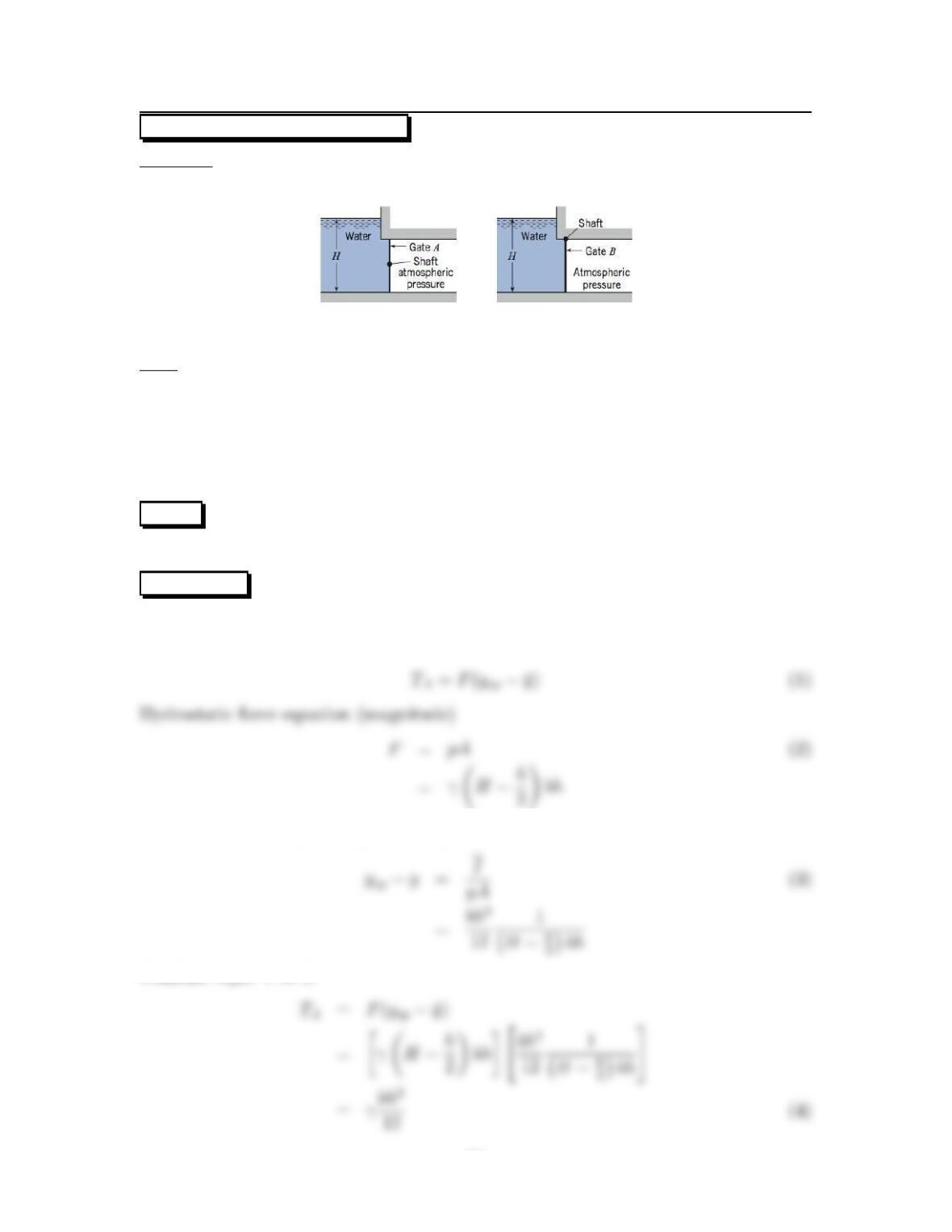
3.68: PROBLEM DEFINITION
Situation:
Two submerged gates are described in the problem statement.
Find:
Determine which statements are true.
(a) TAincreases with H.
(b) TBincreases with H.
(c) TAdoes not change with H.
(d) TBdoes not change with H.
PLAN
Apply equilibrium equations. Apply hydrostatic force equations.
SOLUTION
Let the horizontal gate dimension be given as band the vertical dimension, h.
Torque (Gate A). Equilibrium. Sum moments about the hinge:
Hydrostatic force equation (center of pressure)
Combine eqns. 1 to 3:
98
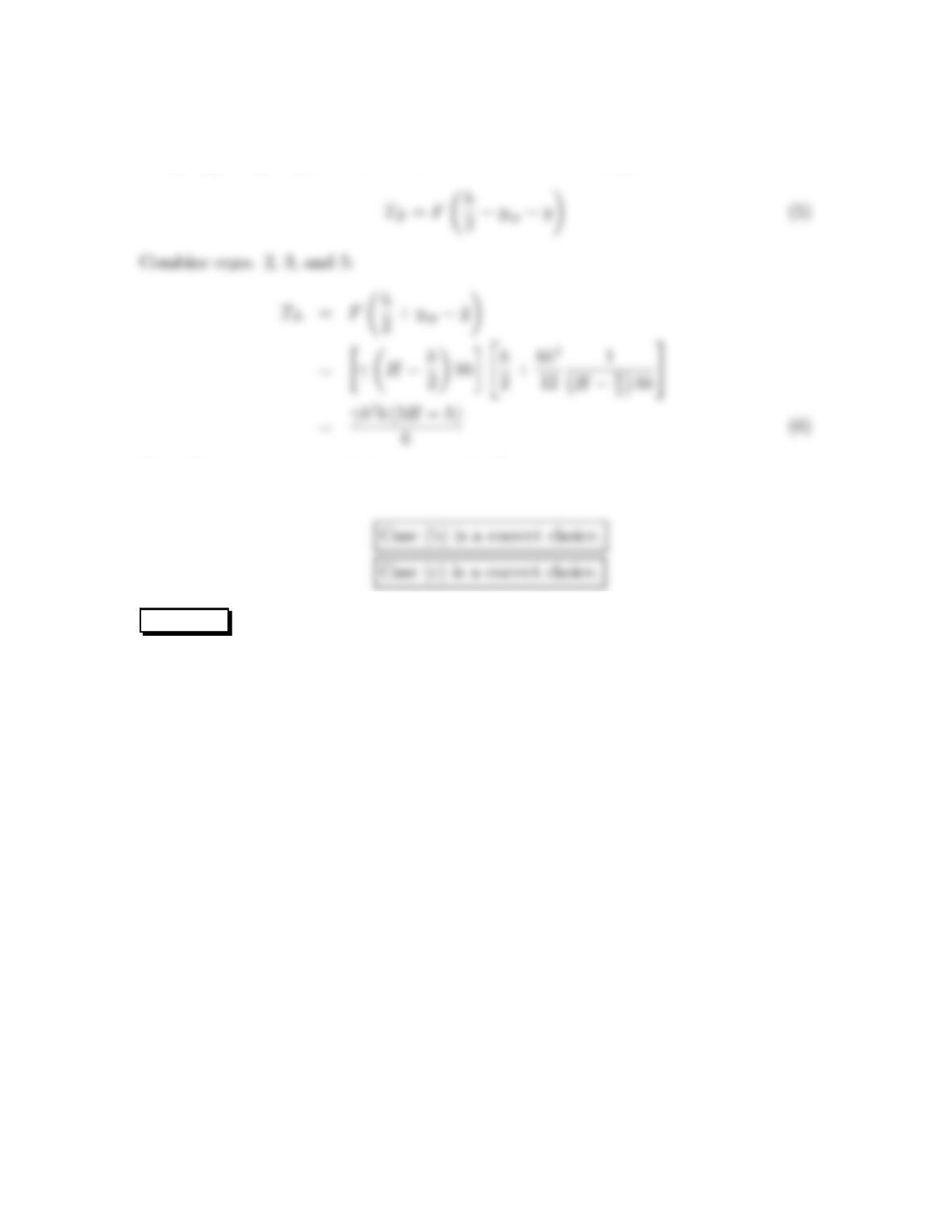
Therefore, TAdoes not change with H.
Torque (gate B). Equilibrium. Sum moments about the hinge:
Thus, TAis constant but TBincreases with H.
REVIEW
Case A provides an example of how to design a gate so that the torque to hold the
gate closed is independent of water depth.
99
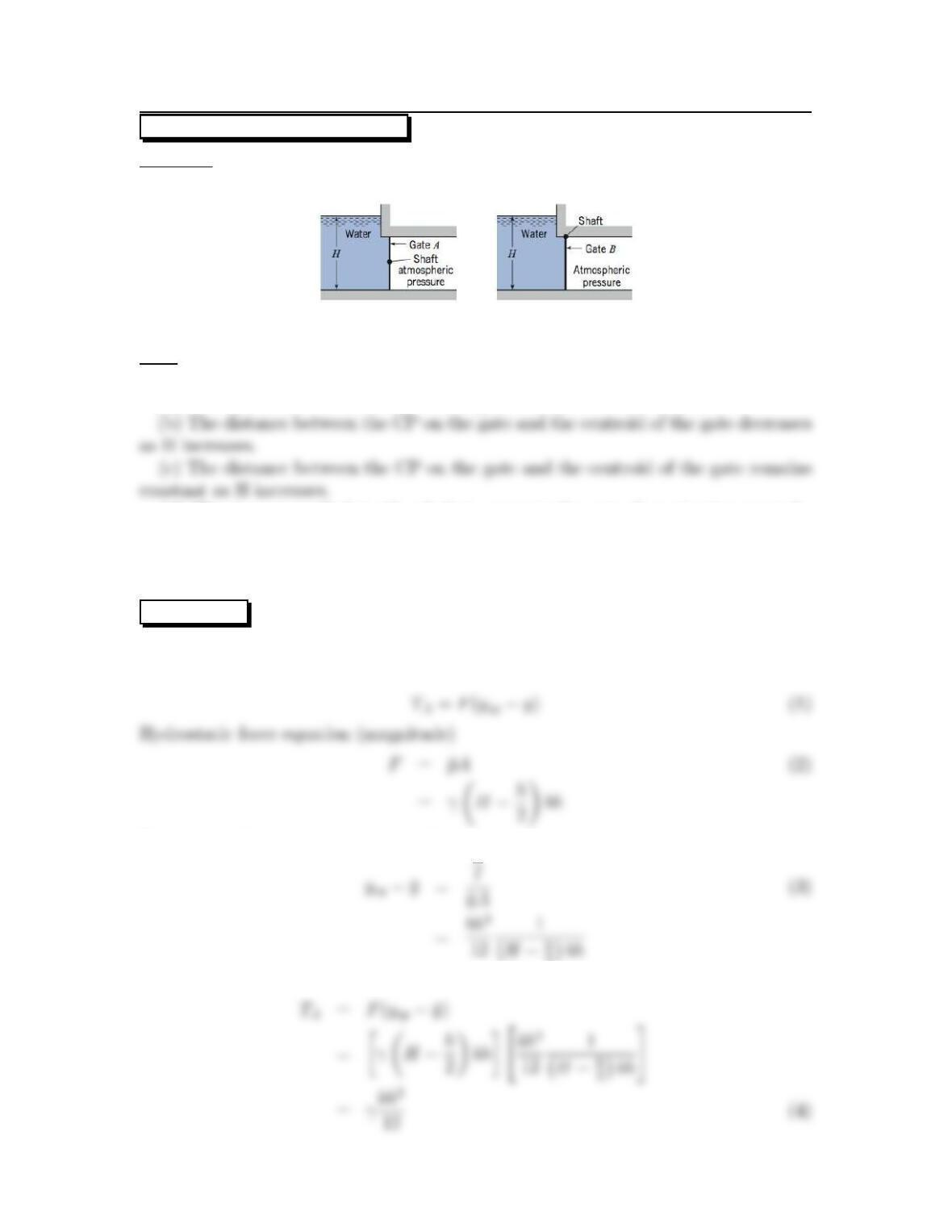
3.69: PROBLEM DEFINITION
Situation:
This problem involves Gate A (see sketch).
Find:
Choose the statements that are valid for Gate A.
(a) The hydrostatic force acting on the gate increases as H increases.
(d) The torque applied to the shaft to prevent the gate from turning must be
increased as H increases.
(e)Thetorqueappliedtotheshafttopreventthegatefromturningremains
constant as H increases.
SOLUTION
Let the horizontal gate dimension be given as band the vertical dimension, h.
Torque (Gate A). Sum moments about the hinge:
Hydrostatic force equation (center of pressure)
2¢bh
Combine eqns. 1 to 3:
100