46
C H A P T E R 3
STRATEGIC CAPABILITIES
Illustration 3.1
Strategic capabilities
1. Categorise the range of capabilities highlighted by the executives in terms of Section 3.2
and Table 3.1.
The question requires students to consider strategic capabilities as explained in Section 3.2
and summarised in Table 3.1. Such consideration might begin with a simple categorisation
exercise as suggested here. For example:
The physical resources that the Goddard Center laid, claim to be certainly impressive.
Presumably, they also have highly skilled people who can operate such equipment. So
those people are also an important resource and their competences are likely to play a
the arts.
2. To what extent and why might these capabilities be the basis of sustained competitive
advantage?
It prompts students to consider which of these is likely to provide competitive advantage,
thus providing a basis for moving onto Section 3.3. They may argue that all of the
47
Illustration 3.2
Dynamic capabilities (and rigidities) in mobile telephone companies
The primary aim of this illustration is to distinguish dynamic capabilities from ordinary
capabilities, show what dynamic capabilities can be, and provide some concrete examples of
them. In addition, it will help students realise that there is no guarantee that dynamic capabilities
will last forever.
1. What type of dynamic capabilities could help companies avoid becoming stuck in their old
capabilities?
This question points to David Teeces three forms of dynamic capabilities discussed in
Section 3.2.2 (sensing, seizing and reconfiguring). The important point is to distinguish
these kinds of meta capabilities from ordinary capabilities. However, it is also evident that
2. (a) What are the possible future opportunities in mobile telephones?
(b) How could they be sensed and seized?
(c) What type of ordinary capabilities could possibly address them?
The second question looks to the future and allows student to analyse the possible dynamic
capabilities of Apple and other mobile telephone and smart phone companies (Samsung,
Illustration 3.3
Groupon and the sincerest form of flattery
There has been an extensive debate among industry experts and financial analysts to what extent
Groupons capabilities are inimitable and this illustration exemplify core features of this debate.
The illustration can be used to make an initial VRIO analysis (Figure 3.2 and Table 3.2). It
48
illustrates the challenges in making these types of evaluations. Hence, it shows that while it is
rather easy to distinguish how some capabilities provide for sustained competitive advantage,
which is much more difficult for others. This is particularly true for completely new and
evolving businesses such as Groupons.
1. Andrew Mason admits that Groupon has thousands of copycats, yet his assessment is that
imitating Groupon is difficult. Do you agree?
This question refers to Andrew Masons various statements and his emphasis on Groupons
2. Assess the bases of Groupons strategic capabilities using the VRIO criteria (Figure 3.2 and
Table 3.2).
This question involves an analytical exercise in terms of VRIO: value, rarity, inimitability
and organisation support. Three capabilities can be distinguished in the illustration. First the
operational complexity that CEO Andrew Mason refers to, second Groupons technology
platform and third their customer base. In the tables below, each one of these is analysed
according to the VRIO criteria.
The next issue is Inimitability. The customer base is not easily imitable as it is subject to
network effects or externalities the more users in a network the better for every customer
(see Chapter 9). It will be difficult for competitors to catch up as long as Groupons
customer base keeps on growing. As the company grows it also becomes increasingly
49
3. Which is the most important strategic capability that provides, or could provide, Groupon
with sustainable competitive advantage?
This question concerns the overall question of sustained competitive advantage. The VRIO
analysis shows that Groupon has temporary competitive advantage in their customer base
and organisational complexity and of these two capabilities the former probably comprise a
Customer base
Valuable? Rare? Inimitable? Supported by the
Organisation?
Competitive implications
No No Competitive disadvantage
Yes No Competitive parity
Organisational complexity
Valuable? Rare? Inimitable? Supported by the
Organisation?
Competitive implications
No No Competitive disadvantage
50
Technology platform
Valuable? Rare? Inimitable? Supported by the
Organisation?
Competitive implications
No No Competitive disadvantage
Illustration 3.4
A value chain for Ugandan chilled fish fillet exports
The questions on this illustration are designed to encourage students to undertake a value chain
analysis similar to that shown in the illustration with a view to drawing conclusions and
implications from it.
The illustration shows how analysing a value chain raises the question of what value-creating
activities an organisation should be focusing on, and what activities it has which do not create a
value.
1. Draw up a value chain or value system for another business in terms of the activities within
its component parts.
2. Estimate the relative costs and/or assets associated with these activities.
Questions 1 and 2 may be pursued by the students following the guidance in Section 3.4.2,
3. What are the strategic implications of your analysis?
In relation to Question 3, as Shepherd points out in his chapter (see above), knowing what
your value chain does well is difficult to identify but is most important in the face of rising
Illustration 3.5
Activity systems at Geelmuyden.Kiese (GK)
The centrally important point about linkages as a basis of competitive advantage is picked up in
the GK illustration. Porter suggests that these linkages can be understood through activity maps.
The figure shows what an activity map might look like for GK though it should be noted that the
number of activities that might actually be included may be much greater than those shown in
the figure.
1. Assuming Geelmuyden.Kiese managers are correct that they have capabilities that provide
competitive advantage:
(a) What would competitors find difficult to imitate and why?
2. If disaggregation (see Section 3.4.3) is important, suggest what even more specific activities
underpinning those in the activity map might be important.
In relation to Question 2, there is of course not enough information provided for students to
base a disaggregation exercise on the illustration itself. However, it is worth pushing them
Illustration 3.6
SWOT analysis of Pharmcare
SWOT is often cited as the most widely used strategy tool. The questions are designed to
prompt critical thinking about its use
1. What does the SWOT analysis tell us about the competitive position of Pharmcare with the
industry as a whole?
52
3. Identify the benefits and dangers (other than those identified in the text) of a SWOT
analysis such as that in the illustration.
Question 1 should prompt consideration of scoring methods of analysis. Although the high
scores may indicate key strengths or weaknesses, care has to be taken about relying on the
significance of the numbers because of the following reasons:
Items in the analysis are not necessarily equally weighted. Indeed, a single factor could
dominate the whole analysis. Weighting of factors can be used to allow for this.
There are a number of other benefits and dangers than those identified in the text that
might be surfaced. For example, in terms of benefits:
SWOT provides the possibility of a structured summary drawing together many of
the insights from the sort of analyses outlined in Chapters 2 and 3.
If some sort of scoring mechanism is employed, it forces those undertaking the
analysis to concentrate on the specific sectors of environmental impact and specific
strengths and weaknesses. It forces a specific consideration of issues, rather than
Key Debate
How useful is the resource-based view?
The debate focuses on a key problem which is to do with a highly influential theoretical
perspective on strategy the RBV (resource-based view). Some of the thoughts and tools that
53
Question 1 invites students to think carefully about how easy or difficult it may be to identify
and imitate the strategic capabilities that give a firm competitive advantage. Students may wish
to refer to Illustrations 3.3, 3.4 and 3.5 here or a company of their choice with apparent
competitive advantage, for example, Google (see, for example, the end case in Chapter 12).
Might VRIO, value chain or activity mapping be sufficient bases upon which managers can
identify, and indeed manage strategic capabilities? If so, how readily could managers do this?
How often would they need to review it? If they identified such capabilities in such ways, is it
then possible to manage such detailed activities that are often embedded in organisational
culture? For example, would a competitor of Geelmuyden.Kiese (Illustration 3.5) be able to
imitate what, in effect, is a culture mapped out in elaborate detail if they wished to do so?
a difference between these two views.
Video assignment
CISCO
Cisco is an IT network and communications corporation founded in the USA in 1984 which has
now grown into a global giant with turnover in excess of $46bn. As a chief technical officer,
Iain Kennedy is in an excellent position to assess Ciscos distinct capabilities and sources of
competitive advantage. His views are supplemented by those of Michelle Selinger, a director in
Ciscos consultancy group.
54
1. The video interview provides the opportunity for students to hear how Iain Kennedy,
explains the strategic capabilities of Cisco. Students should be encouraged to content
analyse his explanation and, perhaps, add to their findings by referring to the annual reports
2. Students are encouraged to familiarise themselves with Section 3.3 in Exploring Strategy
and Figure 3.2 that summarises the VRIO criteria. The application of the VRIO criteria to
Ciscos capabilities may lead students to argue that, whilst these capabilities are valuable
and rare they are not necessarily inimitable. The capabilities are more likely to be inimitable
Assignments
A number of questions are designed to assist students in progressively developing their
understanding of the concept of strategic capability. It might be useful to ask students to base a
number of questions on one organisation such as Rocket Internet or (from the case book) H&M
(specifically written with these sort of assignments in mind), Formula 1 or the readers own
organisation. In doing so, it is important that students are able to identify the following:
Issues that are critical to the competitive advantage rather than simply a necessary part of
the companys activities.
Assignment 3.1
Resources and competences
The purpose of this assignment is to encourage students to understand the differences between
resources and competences and their different values to an organisation. A good way of doing
Assignment 3.2
Value, Rarity, Inimitability and Organisational support
This assignment goes beyond Assignment 3.1 in encouraging students to consider, more
substantially, the bases on which strategic capabilities might provide competitive advantage
using the VRIO framework. Illustration 3.3 (Groupon), the Rocket Internet end case and the
H&M case provide further descriptions of how to use the VRIO framework. There are a number
Assignment 3.3
Changes in strategic capabilities
It might be useful to encourage students to look at changing capabilities over time within a
particular industry. For example, if they chose the automobile industry, they might see that
strategic capabilities to do with the standardisation of production were an early form of
advantage. A number of them were turning to diversification as an answer by looking for
complementary, added-value services to support their range of cars. The students might further
note that many of the car manufacturers found it very difficult to achieve success in this and
may point out that this is not surprising, given that the historical development of their
capabilities has largely been to do with manufacturing excellence. This also raises the question
Assignment 3.4
Value chain analysis
In asking students to map the key value activities, the value chain framework is useful.
However, value chain analysis can get quite complex, especially if costs or asset values are
being allocated to value activities. Nonetheless, the sort of analysis shown in Illustration 3.4 can
be very valuable. In doing a similar exercise, invite students to consider the key value activities
in particular.
Assignment 3.5
Benchmarking
There are many examples of benchmarking that students could refer to. Indeed, many of these
have been the subject of fairly public (and sometimes academic) critique. In the UK, for
example, these include the Research Assessment Framework (RAF) in universities (or on an
international level the Financial Times (FT) rankings of business schools), school league tables
Integrative assignment 3.6
SWOT
The text explains our view that SWOT is most valuable as a summary/pooling together of
insights gained from the various concepts and frameworks discussed in Chapters 2 and 3. The
critical issue is, therefore, the justification of the items that students have chosen to be on their
shortlists. In particular, student groups should be encouraged to:
Avoid long lists. For example, the lists in Illustration 3.6 of main strengths and main
weaknesses would have been refined from a much longer list through a process of debate
and some redefinition and grouping. The focus should be on relative strengths and
In summarising answers to the question, it can be useful to ask students to explain in two or
three sentences their overall assessment of the organisations position. This is a good test as to
whether or not the points above have been addressed properly.
Case Example
Rocket Internet will the copycat be imitated?
This case focuses on the strategic capabilities of Rocket Internet including the key distinction
between threshold versus distinctive capabilities and an evaluation of them using the VRIO
framework.
1. Based on the data from the case (and any other sources available) use the frameworks from
Analyse the strategic capabilities of Rocket Internet
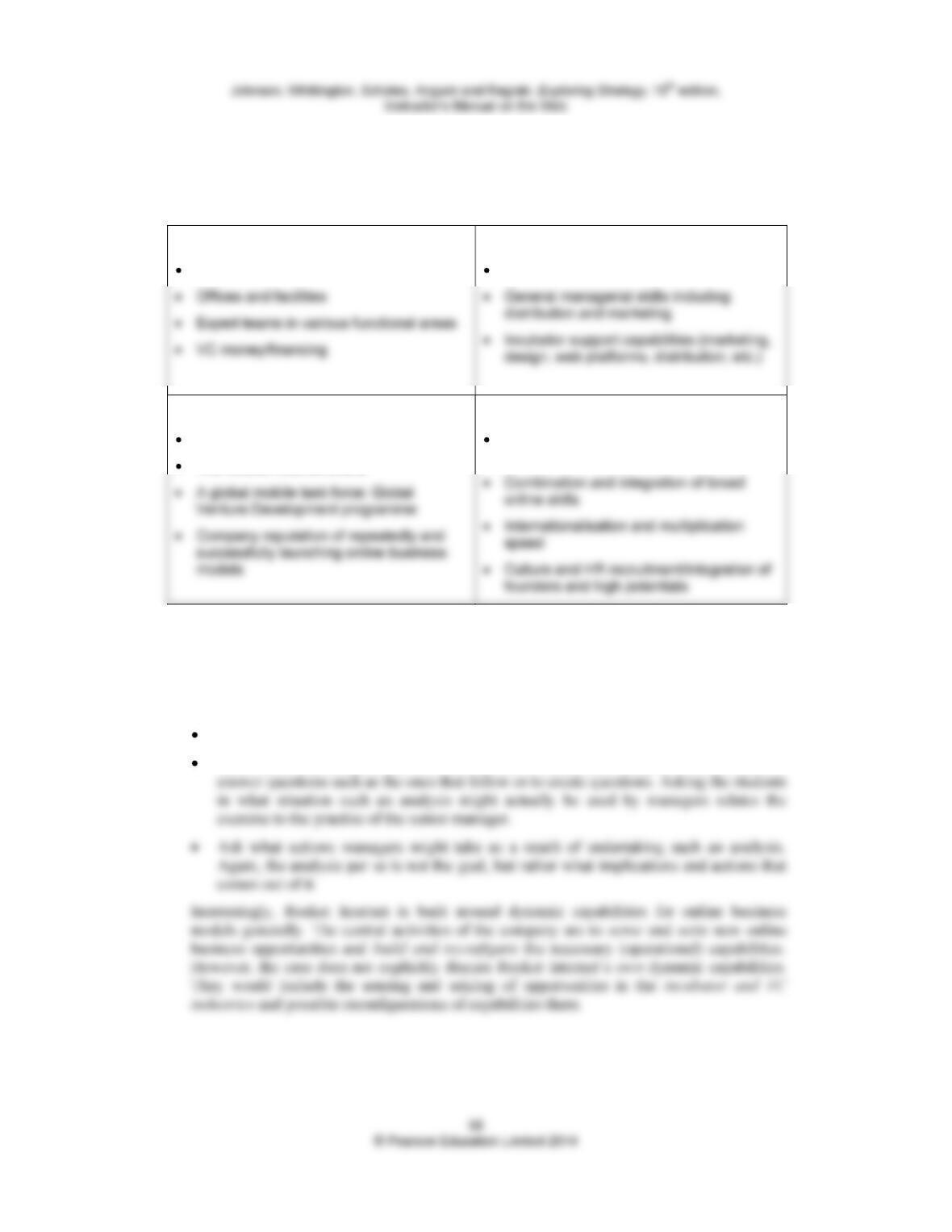
Typically a student would divide the components of strategic capabilities and analyse the
threshold and distinctive capabilities, which when compiled might look similar to the
example given below.
Threshold resources
Technology platforms
Threshold competencies
IT skills
Distinctive resources
The Samwer brothers
The Rocket Internet brand
Distinctive competencies
HQ identification, conceptualisation and
execution of new online business models
Activity mapping or value chain analysis might also be used for Question 1. If used
imaginatively, both help explain where and how capabilities are developed, employed and
managed. They can also help indicate why and how distinctiveness might arise.
Critical reflection on the choice and subsequent use of these tools to produce insights should
be promoted. For example:
Why did students choose the particular framework they used over alternatives?
Show them that analysis per se is not an end in itself; that analysis is done either to
59
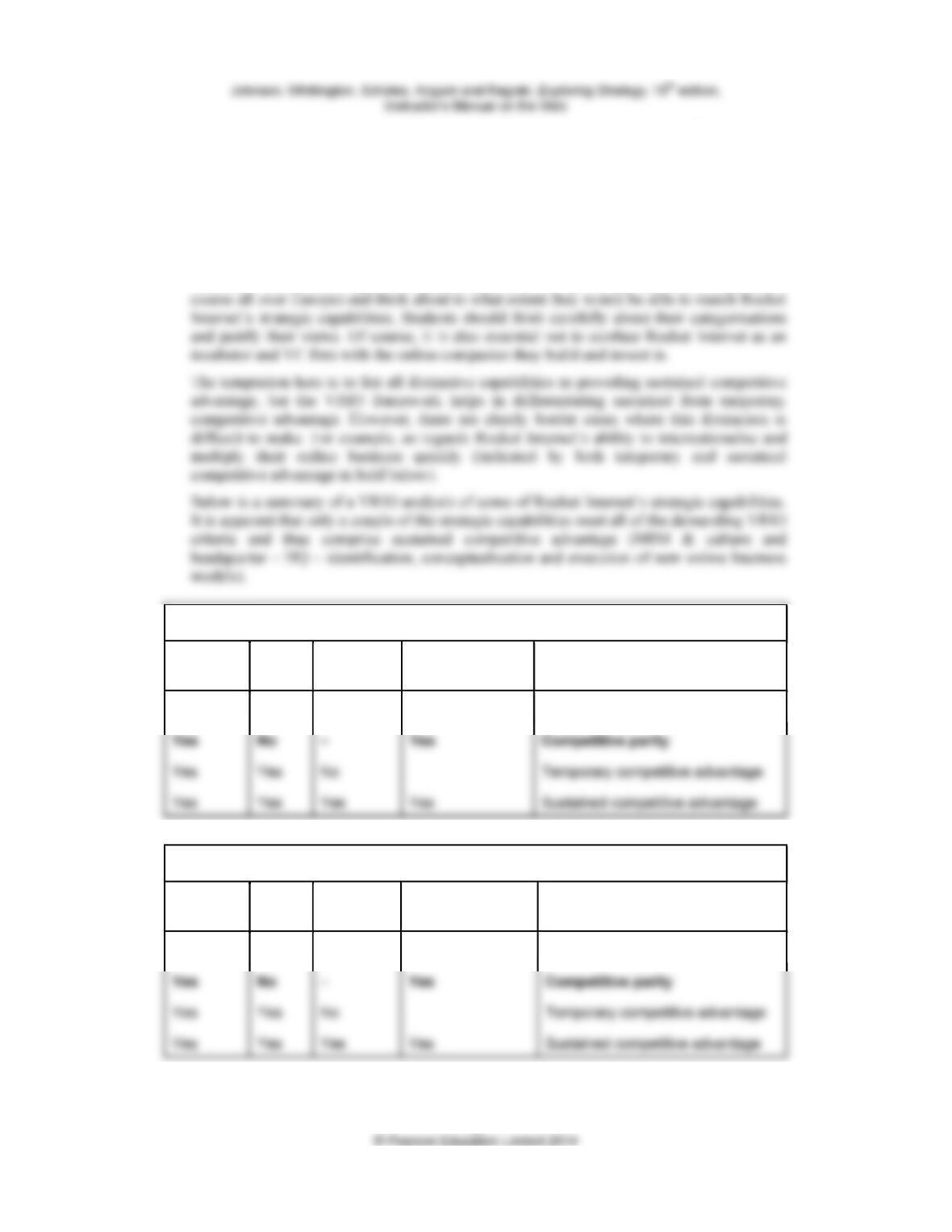
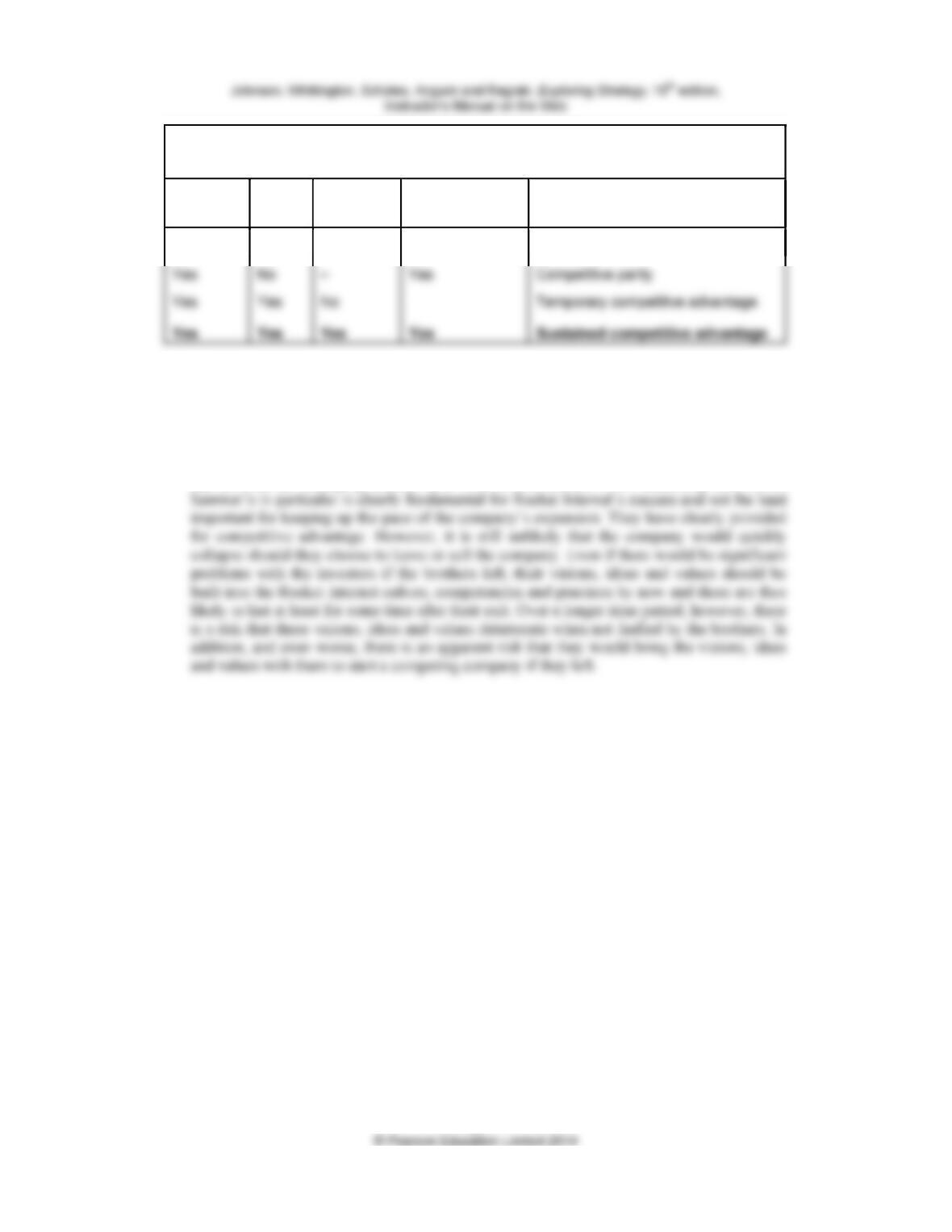
2. Based on your initial analysis and answers to Question 1, carry out a VRIO analysis for
Rocket Internet. What do you conclude? To what extent does Rocket Internet have strategic
capabilities with sustained competitive advantage?
Inimitability of capabilities and the VRIO framework
The aim here is to use the VRIO criteria technique to analyse Rocket Internets strategic
capabilities in depth and evaluate if they grant the company competitive advantage and if so
if they are sustainable. Here it is helpful for students to consider other Berlin based
incubators and venture capital companies (and there are plenty not only in Berlin, but of
IT Technology platforms
Valuable? Rare? Inimitable? Supported by the
Organisation?
Competitive implications
No No Competitive disadvantage
Expert teams
Valuable? Rare? Inimitable? Supported by the
Organisation?
Competitive implications
No No Competitive disadvantage
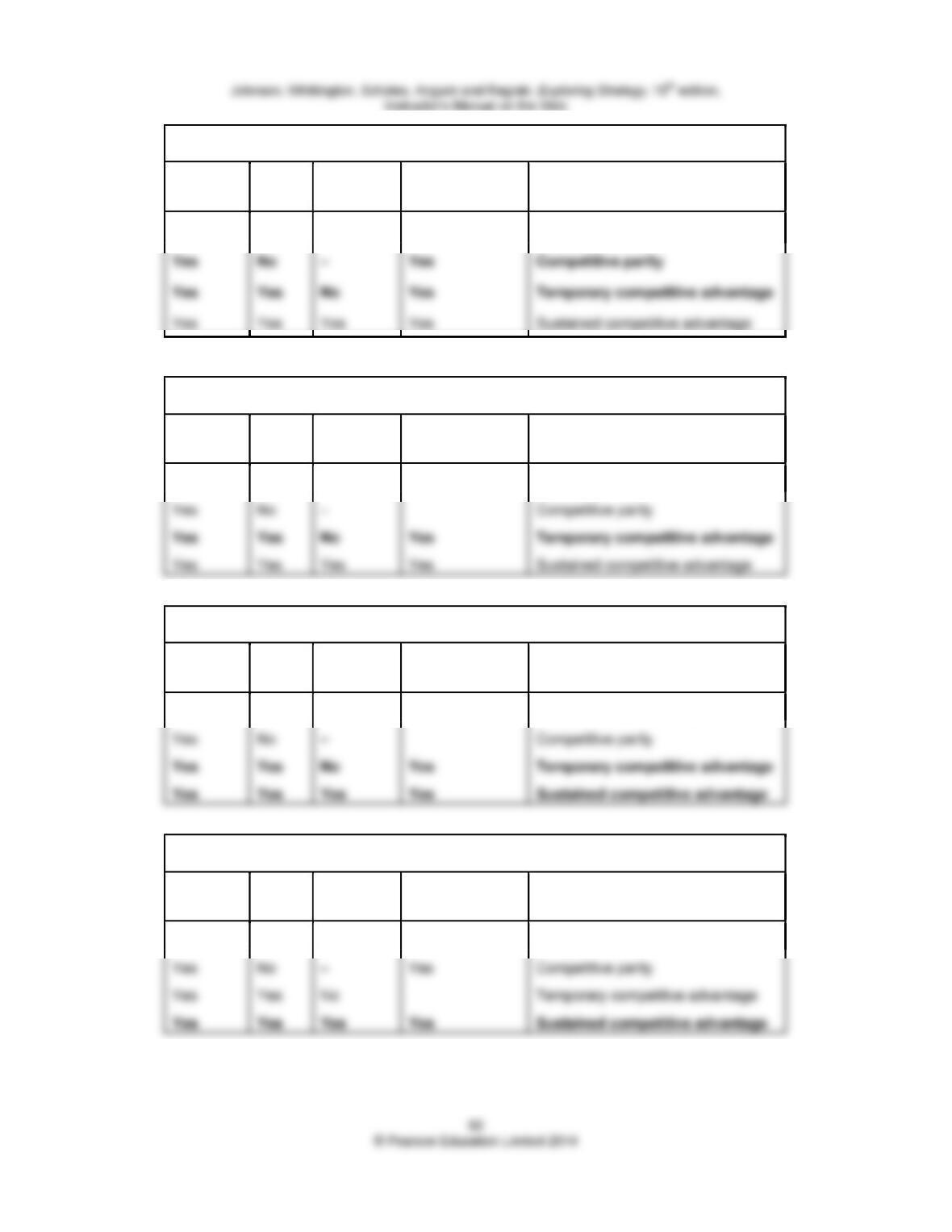
Finance
Valuable? Rare? Inimitable? Supported by the
Organisation?
Competitive implications
No No Competitive disadvantage
Global Venture Development programme: Global mobile task force
Valuable? Rare? Inimitable? Supported by the
Organisation?
Competitive implications
No No Competitive disadvantage
Internationalisation and multiplication speed
Valuable? Rare? Inimitable? Supported by the
Organisation?
Competitive implications
No No Competitive disadvantage
HQ: Identification, conceptualisation and execution of on-line business models
Valuable? Rare? Inimitable? Supported by the
Organisation?
Competitive implications
No No Competitive disadvantage
61
HRM & Culture : Recruitment and integration of founders, entrepreneurs and high
potentials
Valuable? Rare? Inimitable? Supported by the
Organisation?
Competitive implications
No No Competitive disadvantage
3. What is the importance of the Samwers brothers? What would happen if they left or sold the
company?
The importance of the Samwer brothers
The Samwer brothers with Oliver Samwer as the trios driving force still lead Rocket
Internet after more than a decade since they founded the company. Although the company
has an external managing director their role is still crucial. Their leadership and Oliver