3-1
CHAPTER 3
REVIEW OF A COMPANY’S ACCOUNTING SYSTEM
CONTENT ANALYSIS OF EXERCISES AND PROBLEMS
Number
Content
Time Range
(minutes)
E3-1
Financial Statement Interrelationship. (Easy) Diagram.
5-10
E3-2
Journal Entries. (Easy) Sales, purchases, accounts payable.
5-10
E3-7
Adjusting Entries. (Moderate) Bad debts, accruals, deferrals.
5-15
E3-8
Adjusting Entries. (Moderate) Recognizing necessary
adjustments, journal entries.
10-15
E3-9
Adjusting Entries. (Easy) Record changes in trial balance
accounts.
5-10
E3-10
Closing Entries. (Moderate) Prepare from ending account
balances.
5-15
3-2
Number
Content
Time Range
(minutes)
P3-1
Trial Balance. (Moderate) Journal entries, posting to general
ledger, preparing trial balance.
90-120
P3-4
Adjusting Entries. (Moderate) Recognize, calculate, journalize
adjustments. Accruals, deferrals, year-end.
15-30
P3-5
Adjusting Entries. (Challenging) Calculate and journalize
accruals, deferrals, and year-end adjustments.
20-40
P3-6
Adjusting Entries. (Moderate) Determine by comparing trial
balance and adjusted trial balance. Prepare necessary
reversing entries.
20-40
P3-11
Worksheet. (Challenging) Prepare and complete worksheet.
Financial statements, adjusting and closing entries.
60-90
P3-12
Worksheet. (Challenging) Complete worksheet. Prepare
financial statements, adjusting and closing entries.
75-105
Number
Content
Time Range
(minutes)
ANSWERS TO QUESTIONS
Q3-1 A primary objective of financial reporting is to provide information that is useful to
Q3-3 A double-entry system standardizes the method that a company uses to record
changes in its accounts resulting from various transactions or events. For each
Q3-4 A permanent account is an account whose balance at the end of the accounting
period is carried forward into the next accounting period. Examples: Cash,
Q3-5 The major financial statements of a company include:
a. The income statement, which summarizes the results of the company‘s income-
producing activities for the accounting period.
3-4
Q3-6 a. An account is used by a company to store the recorded monetary information
from its transactions and events. An account can be in several physical forms
such as a location on a computer disk or a standardized business paper.
Q3-7 The advantages to a company of initially recording each transaction in a journal
include the following.
Q3-8 A perpetual inventory system is one in which the inventory account is updated each
time a company makes a purchase or sale. When a company purchases inventory, it
Q3-9 a. Purchase of land on credit
b. Sale of capital stock for cash
Q3-10 a. Purchase of merchandise on credit
Q3-11 The steps that a company completes in the accounting cycle include:
a. Recording daily transactions or events in a journal. The daily transactions or
events are recorded in the general journal.
b. Posting journal entries to the accounts in the general ledger. The dates and debit
Q3-12 For most companies, not all of their accounts are up to date at the end of the
Q3-13 A prepaid expense is a good or service purchased by a company for use in its
operations, but which has not been fully used up by the end of the accounting
period.
Example: Assume the company paid for a two year insurance policy on July 1, in the
3-6
Q3-14 An accrued expense is an expense that a company has incurred during the
accounting period but has neither paid nor recorded.
Example: Assume a company pays employees’ salaries once a month on the 15th of
Q3-15 Examples of adjusting entries used to record estimated items include:
a. Estimation of bad debts: Assume a company adopts a policy of providing
b. Estimation of depreciation expense: The cost of a depreciable asset is
systematically allocated as an expense to each accounting period in which the
asset is used. This allocation process is called depreciation. Assume that on July 1
Q3-16 A trial balance lists all of the account balances of a company but does not include
the effect of adjusting entries on the accounts. An adjusted trial balance lists all of
Q3-17 A sales return occurs when a customer returns merchandise and receives a refund. A
Q3-18 When a company uses a periodic inventory system, the company records its
purchases of inventory using a purchases account. It does not reduce its inventory
when it makes a sale. Instead, it takes a physical inventory at the end of its
Q3-19 Closing entries are made by a company at the end of its accounting period to
reduce the balance in each temporary account to zero and to update the retained
Q3-20 Dec. 31 Sales Revenue
Interest Revenue
Income Summary
To close the temporary accounts with
3-8
Q3-20 (continued)
Q3-21 A worksheet is a large sheet of multicolumn accounting paper prepared by a
company at the end of an accounting period to minimize errors, simplify recording in
the general journal of the adjusting and closing entries, and make it easier to prepare
Q3-22 Reversing entries are the exact reverse (accounts and amounts) of adjusting entries.
They are usually made at the same time as closing entries but are dated the first day
of the next accounting period. The use of reversing entries is optional; reversing
entries are used to simplify the recording of a later transaction related to the
adjusting entry. The later transaction can be recorded routinely, without the need to
Q3-23 A subsidiary ledger is a group of accounts, all of which relate to one specific
company activity, such as the sale or purchase on credit. It is common to have an
Accounts Receivable subsidiary ledger and an Accounts Payable subsidiary ledger.
When a subsidiary ledger is used, a control account is kept in the general ledger. On
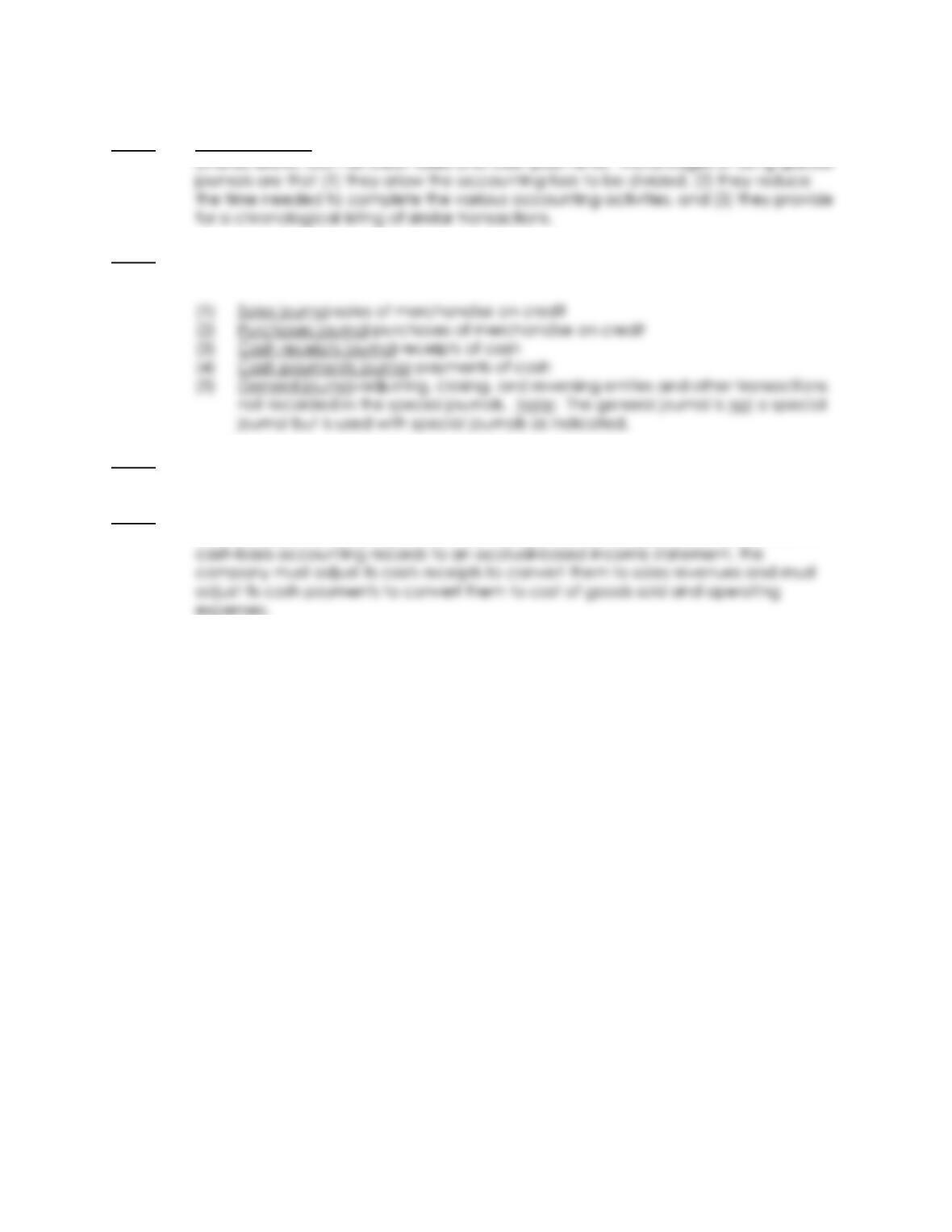
Example: Assume a company sells goods on account to three customers, A, B, and
C. During the year, the following transactions occurred and were recorded in a
general journal.
January 15 Sale to A $1,200
February 29 Sale to B 800
The Accounts Receivable control account in the general ledger and the Accounts
Receivable subsidiary ledger accounts will appear as follows:
General Ledger Accounts Receivable Subsidiary Ledger
Accounts Receivable Control Account A
01/15 1,200
04/25
500
01/14 1,200
04/25 500
3-10
Q3-24 Special journals are journals used by a company to record transactions with a similar
Q3-25 The major special journals and an example of the transactions that are recorded in
each of them are as follows:
Q3-26 The common software for the financial accounting functions include accounts
receivable, accounts payable, inventory, payroll, and general ledger software.
Q3-27 Under cash-basis accounting, a company records revenues when it collects cash
from sales and records expenses when it pays cash for its operations. To convert its
SOLUTIONS TO REVIEW EXERCISES
RE3-1
May 1 Inventory 40,000
RE3-2
RE3-3
RE3-4
Net income = Revenues – Expenses
= $250,000 – $225,000
= $25,000
3-12
RE3-5
Oct. 1 Note Receivable 35,000
RE3-6
RE3-7
Apr. 1 Cash 20,000
RE3-8
RE3-9
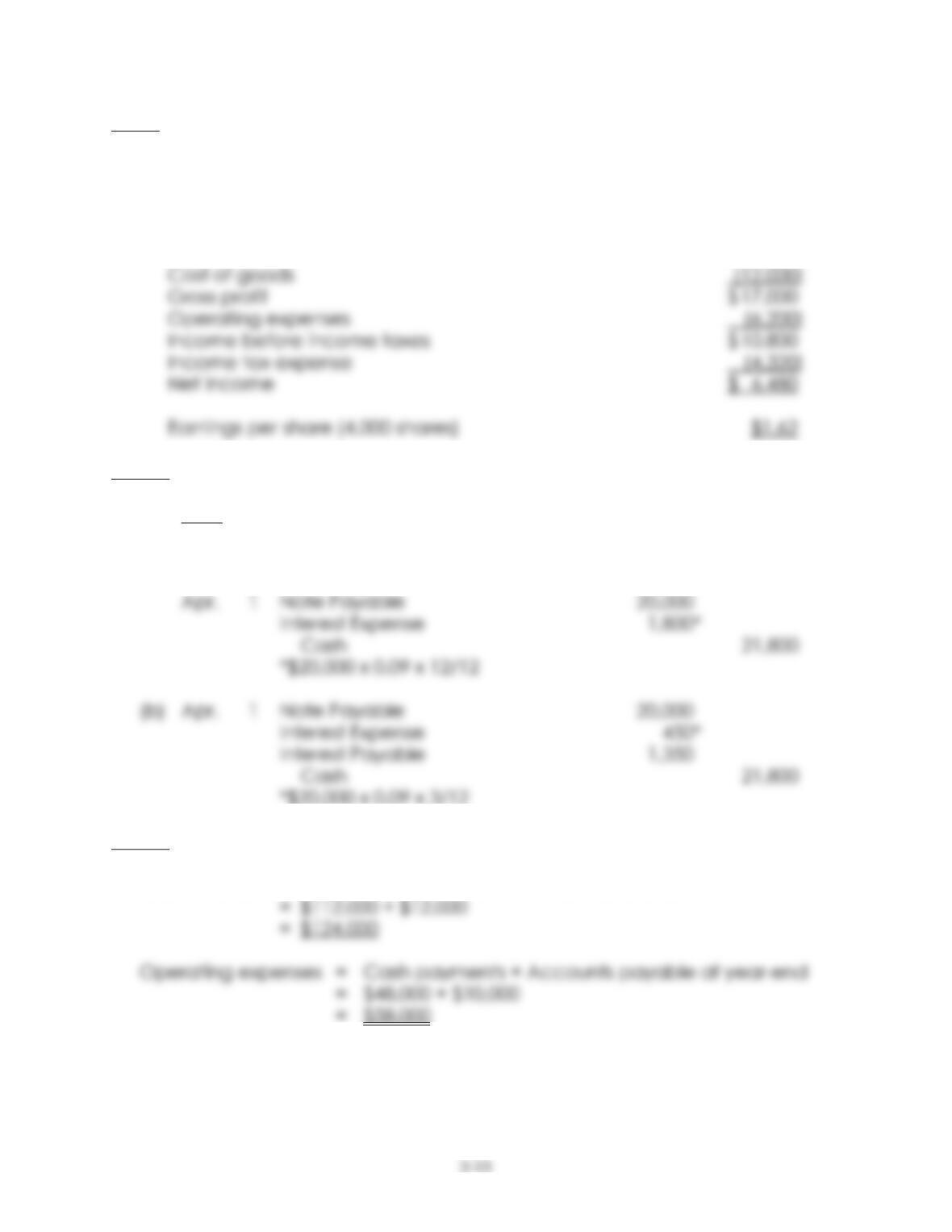
GODINGER CORPORATION
Income Statement
For Year Ended December 31, Current Year
Sales revenue $ 29,000
RE3-10
2011
(a) Jan. 1 Interest Payable 1,350
Interest Expense 1,350
RE3-11
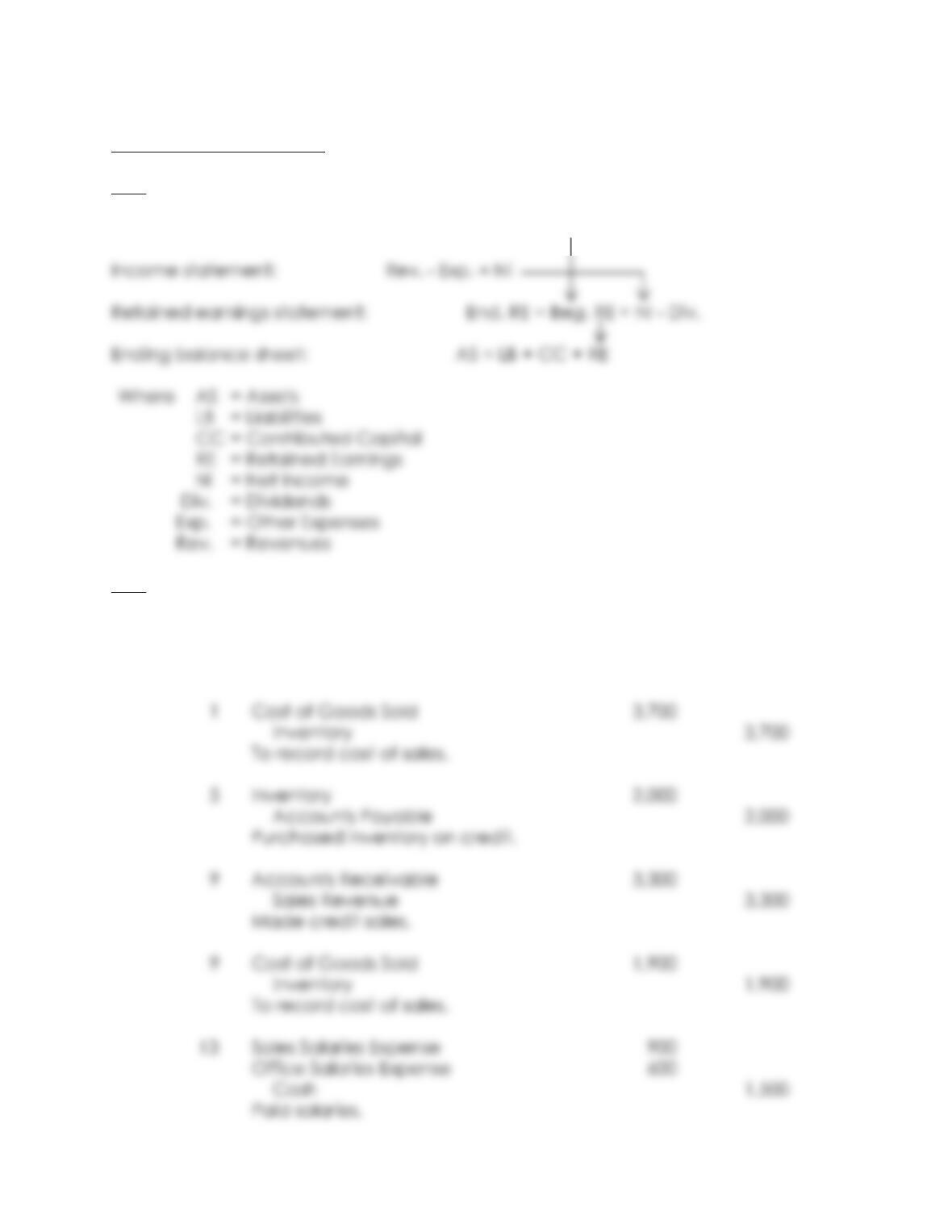
Sales revenue = Cash receipts + Accounts receivable at year-end
3-14
SOLUTIONS TO EXERCISES
E3-1
Beginning balance sheet: AS = LB + CC + RE
E3-2
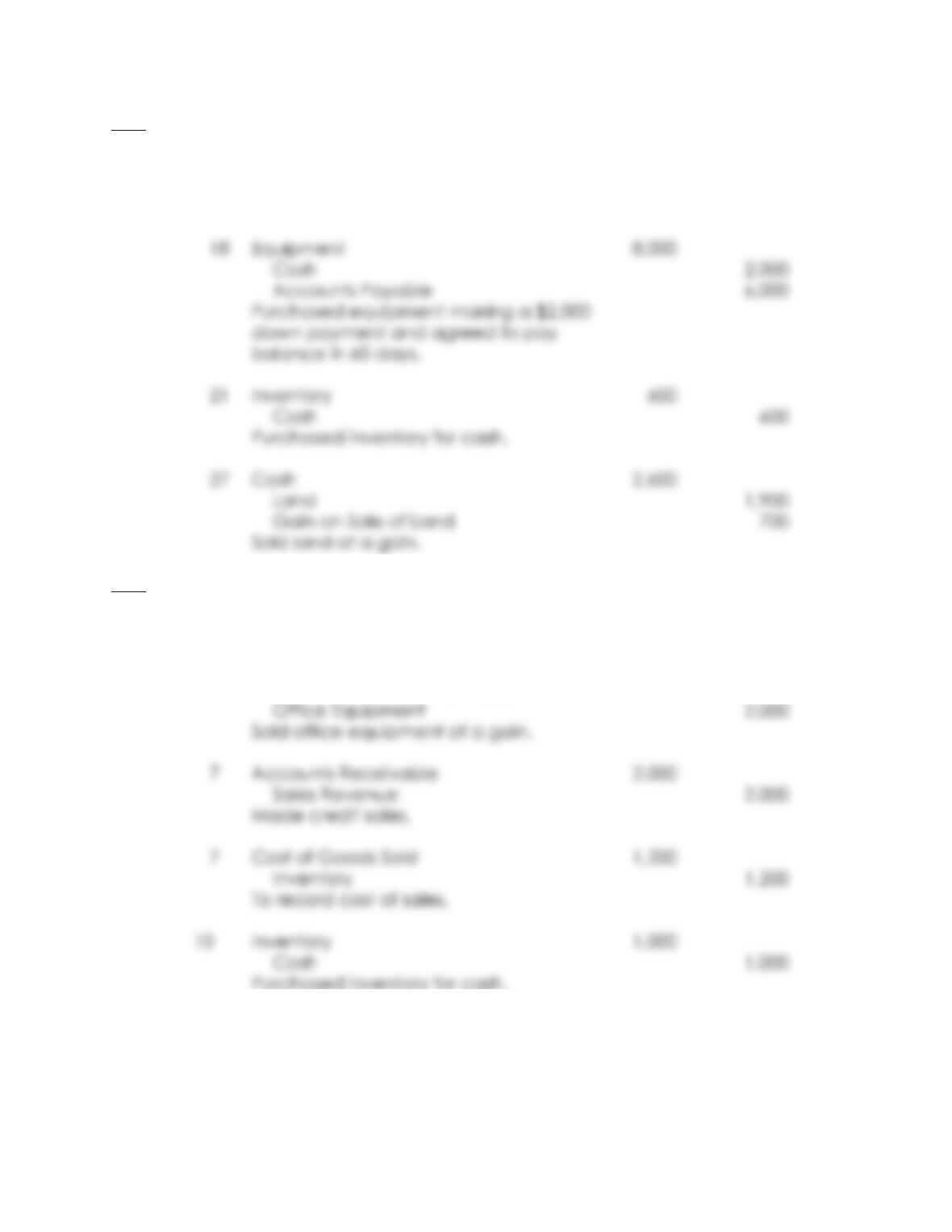
May 1 Cash 6,300
Sales Revenue 6,300
Made cash sales.
3-15
E3-2 (continued)
May 14 Accounts Payable 2,000
Cash 2,000
Paid for May 5 purchases.
E3-3
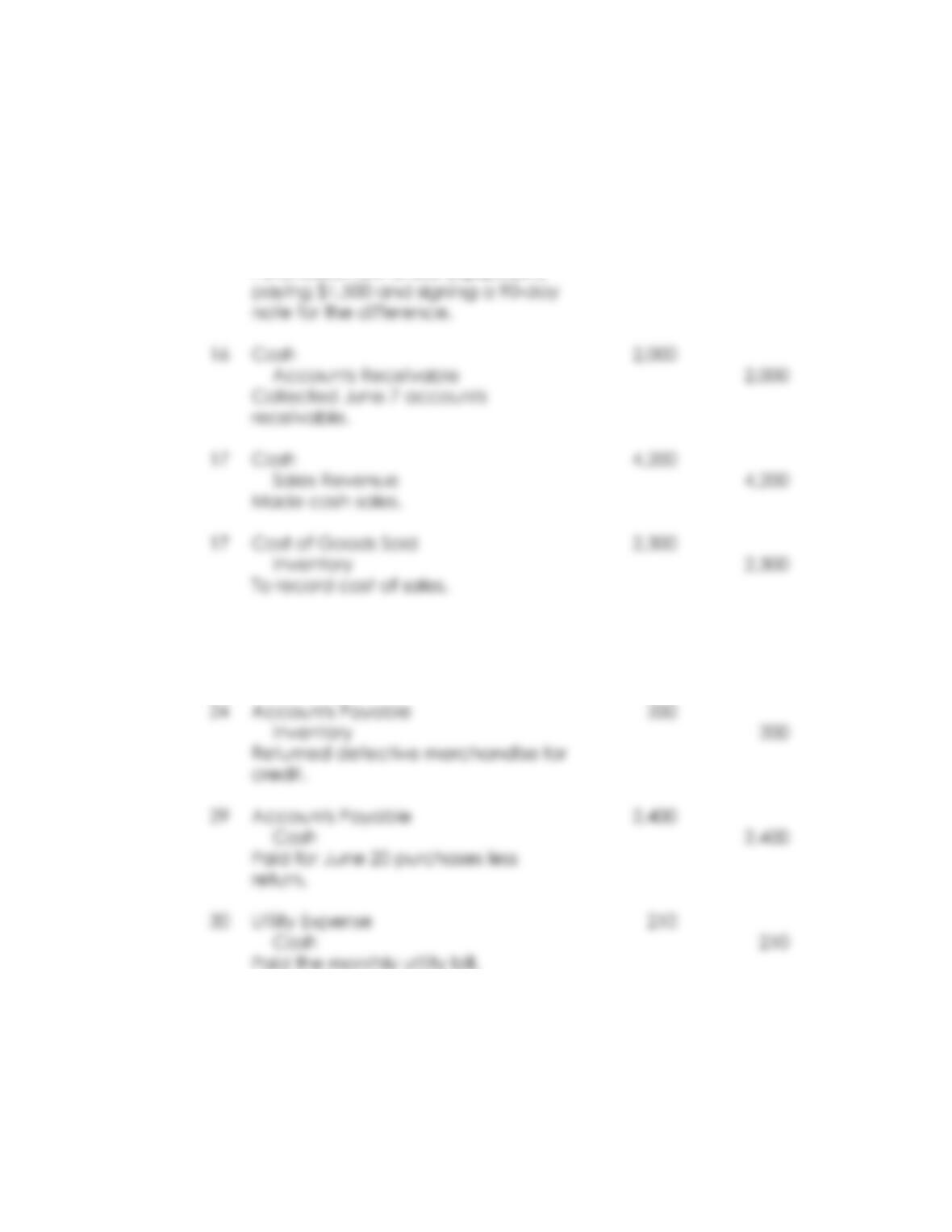
1. June 3 Cash 700
Accumulated Depreciation:
Office Equipment 1,500
Gain on Sale of Office Equipment 200
3-16
E3-3 (continued)
1. (continued)
June 15 Office Equipment 4,000
Cash 1,500
Notes Payable 2,500
Purchased new office equipment,
20 Inventory 2,600
Accounts Payable 2,600
Purchased merchandise on credit.
3-17
E3-3 (continued)
2. General Ledger
Cash Accounts Receivable
6/01
Bal 12,523
6/10
1,000
6/01
Bal 23,052
6/16
2,000
6/03
700
6/15
1,500
6/07
2,000
6/16
2,000
6/29
2,400
6/30
Bal 23,052
6/17
4,200
6/30
210
6/30
Bal 14,313
6/30
Bal 37,860
Notes Payable Accounts Payable
6/01
Bal 3,400
6/24
200
6/01
Bal 3,500
6/15
2,500
6/29
2,400
6/20
2,600
6/30
Bal 5,900
6/30
Bal 3,500
E3-4
RULE CORPORATION
Income Statement
For Year Ended December 31, 2010
Sales revenue (net of $600 returns) $ 15,600
Cost of goods sold (8,300)
E3-5
RAYNOLDE COMPANY
Cost of Goods Sold Schedule
For Year Ended December 31, 2010
Inventory, 1/1/2010 $ 10,800
E3-6
1. TURTLE COMPANY
Income Statement
For Year Ended December 31, 2010
Sales revenue $ 7,900
Cost of goods sold (4,300)
2. TURTLE COMPANY
Statement of Retained Earnings
For Year Ended December 31, 2010
E3-6 (continued)
3. TURTLE COMPANY
Balance Sheet
December 31, 2010
Assets
Current Assets
Cash $1,700
Liabilities
Current Liabilities
Accounts payable $2,300
4. 2010
Dec. 31 Sales Revenues 7,900
Income Summary 7,900