Chapter 3
Amino Acids and Peptides
SUMMARY
Section 3.1
The amino acids that occur in proteins consist of an amino group and a carboxyl
group bonded to the same carbon atom. The other two bonds of the carbon are
Section 3.2
Amino acids are classified according to two major criteria: the polarity of the side
chains and the presence of an acidic or basic group in the side chain.
Section 3.3
The carboxyl group of every amino acid is acidic, and the amino group is basic.
The carboxylate group is the conjugate base of the carboxyl group, and the
Section 3.4
When the carboxyl group of one amino acid reacts with the amino group of
another to give an amide linkage and eliminate water, a peptide bond is formed.
In a protein, upward of a hundred amino acids are so joined to form a polypeptide
Section 3.5
Small peptides play many roles in organisms. Some, such as oxytocin and
vasopressin, are important hormones.
2 Chapter 3
LECTURE NOTES
While students may have been introduced to amino acids in previous classes,
such as organic chemistry, it is unlikely that they will know this material to any
significant depth.
The structures and chemical natures of the twenty common amino acids is
presented, following an introduction reminding students of stereochemistry concepts.
LECTURE OUTLINE
I. Amino Acid Structure
A. Stereochemistry
1. Chirality
2. D and L stereoisomers
B. Survey of individual amino acids
II. Acid/Base properties
A. Independent ionization of carboxyl, amino, and side chain groups
B. Charge dependence on pH
1. Zwitterions
Amino Acids and Peptides 3
ANSWERS TO PROBLEMS
3.1 Amino Acids Exist in a Three-Dimensional World
1. D– and L-amino acids have different stereochemistry around the -carbon.
3.2 Individual Amino Acids: Their Structures and Properties
2. Proline is technically not an amino acid. Glycine contains no chiral carbon atoms.
3. Listed here are amino acids in which the R group contains the following: a
hydroxyl group (serine, threonine, or tyrosine); a sulfur atom (cysteine or
the sulfur-containing amino acids are Met and Cys.
5. In the peptide Glu—Thr—Val—Asp—Ile—Ser—Ala, the nonpolar amino acids
are Val, Ile, and Ala; the acidic amino acids are Glu and Asp.
6. Amino acids other than the usual 20 are produced by modification of one of the
3.3 Amino Acids Can Act as Both Acids and Bases
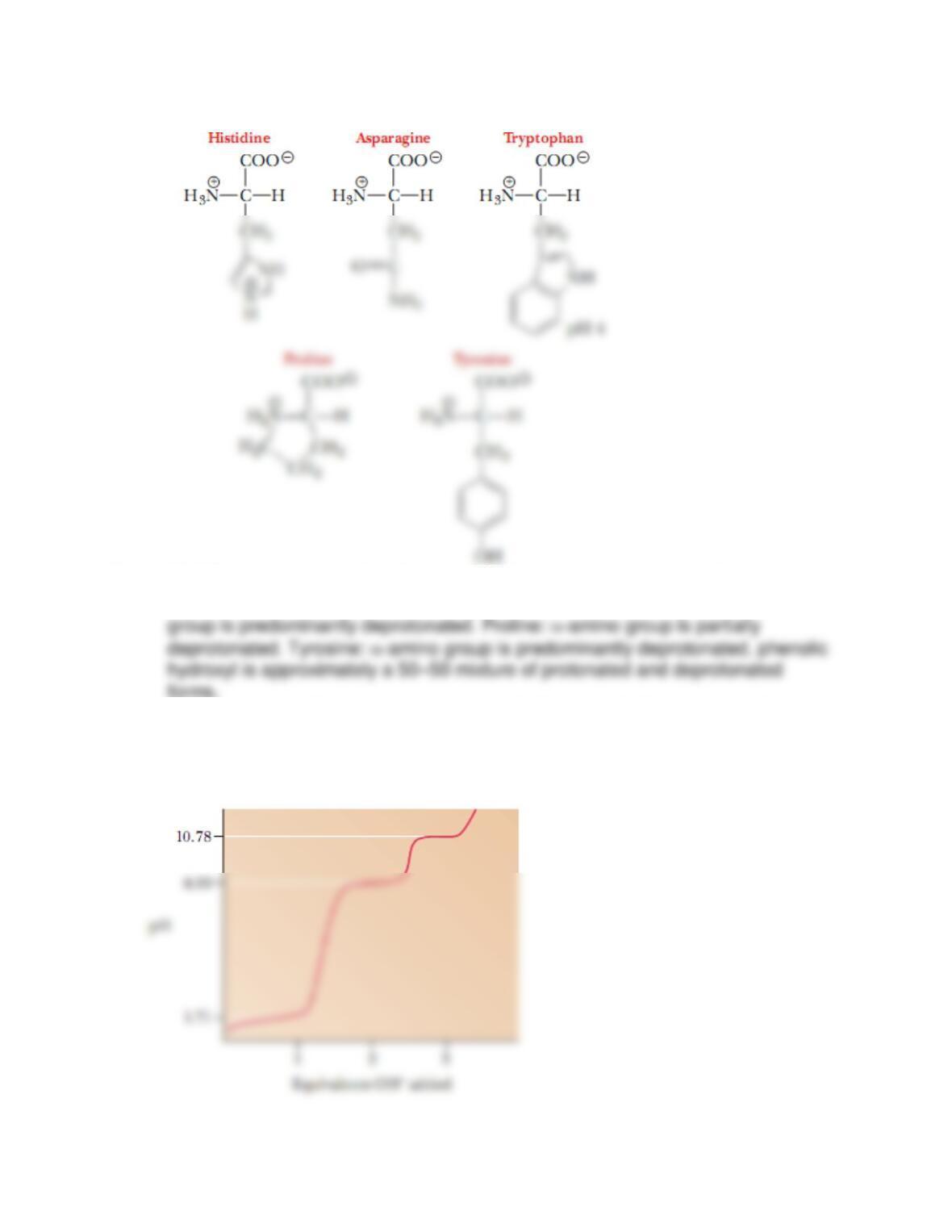
7. The ionized forms of each of the following amino acids at pH 7—glutamic acid,
leucine, threonine, histidine, and arginine—are as follows:
4 Chapter 3
8.
9. Histidine: imidazole is deprotonated, -amino group is predominantly
deprotonated. Asparagine: -amino group is deprotonated. Tryptophan: -amino
10. Glutamic acid, 3.25; serine, 5.7; histidine, 7.58; lysine, 9.75; tyrosine, 5.65;
arginine, 10.75.
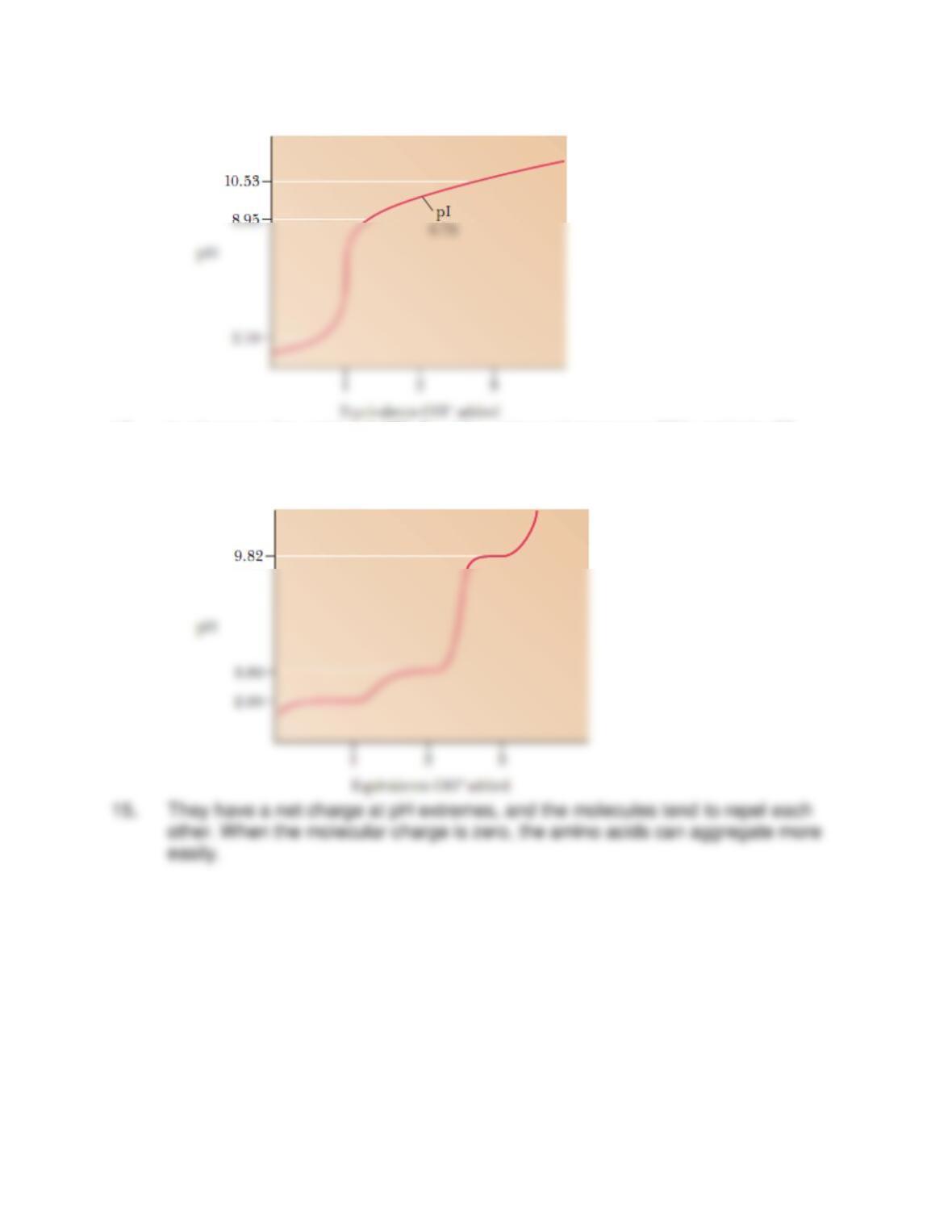
11. Cysteine has no net charge at pH 5.02 = (1.71 + 8.33)/2 (see titration curve
below).
Amino Acids and Peptides 5
12.
13. In all cases, the yield is 0.95n. For 10 residues, that means 60% yield; for 50
residues, 8%; and for 100 residues, 0.6%. These are not satisfactory yields.
Enzyme specificity gets around the problem.
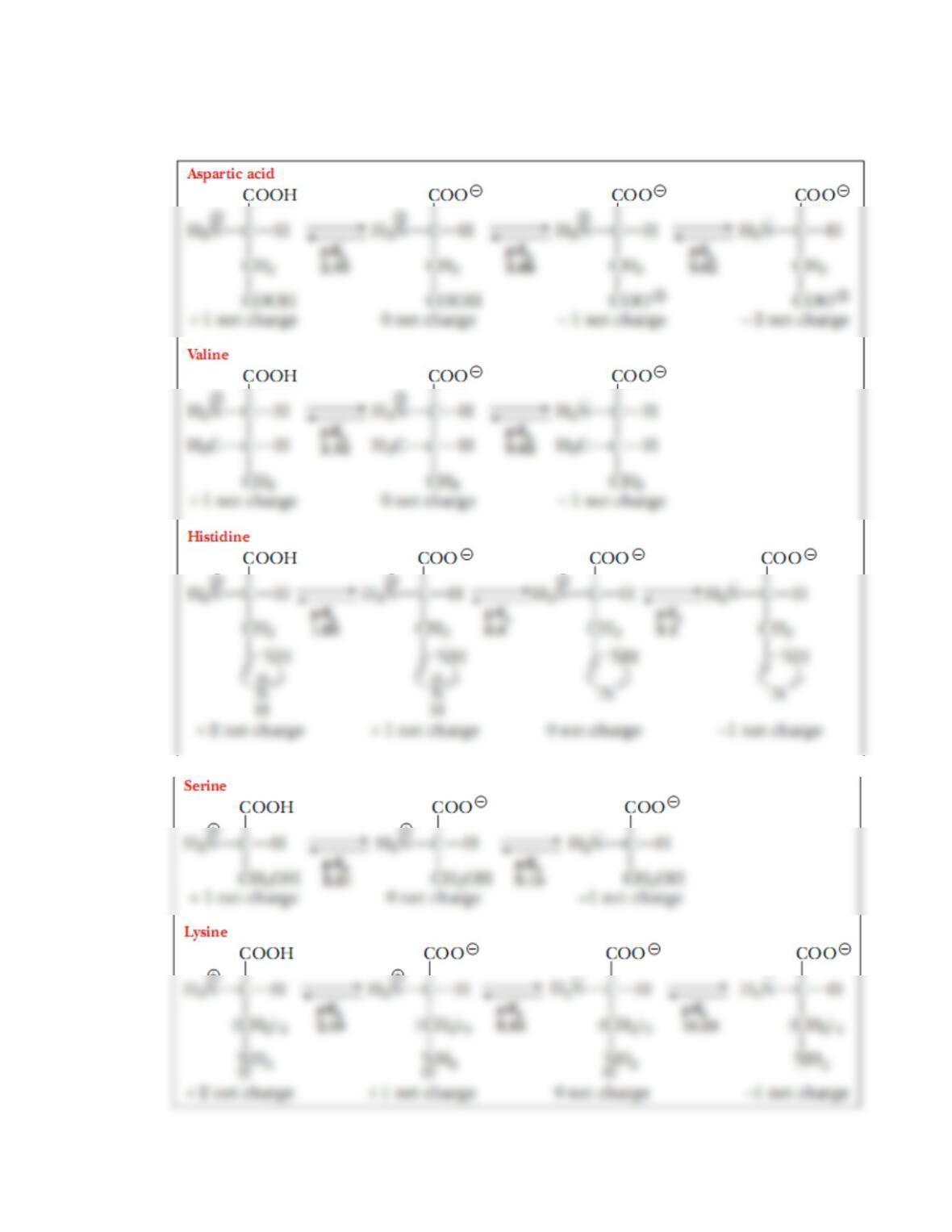
14. The conjugate acid–base pair acts as a buffer in the pH range 1.09–3.09.
6 Chapter 3
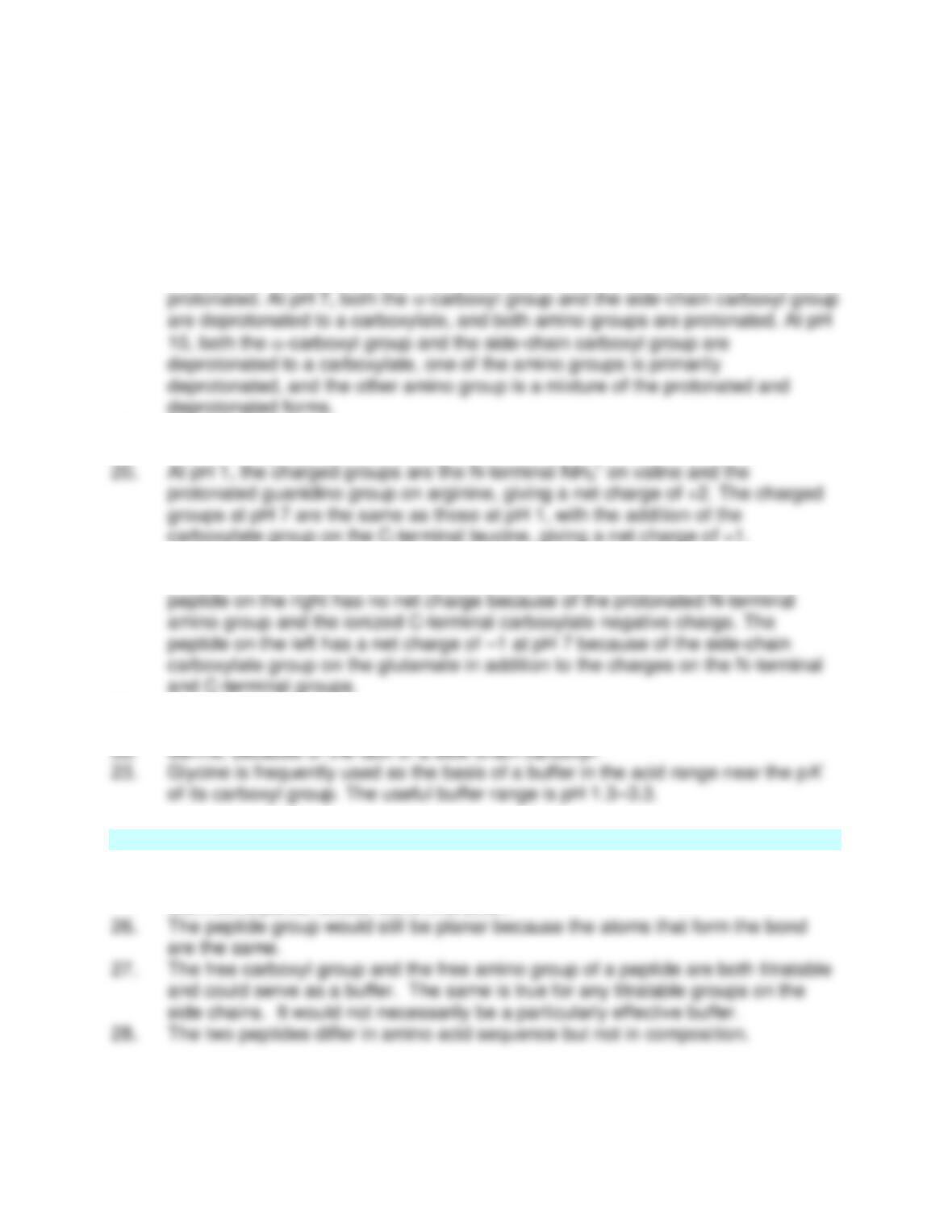
16. The ionic dissociation reactions of the amino acids aspartic acid, valine, histidine,
serine, and lysine are as follows:
Amino Acids and Peptides 7
17. The pKa for the ionization of the thiol group of cysteine is 8.33, so this amino acid
could serve as a buffer in the —SH and S2– forms over the pH range 7.33–9.33.
The -amino groups of asparagine and lysine have pKa values of 8.80 and 8.95,
respectively; these are also possible buffers, but they are both near the end of
their buffer ranges.
18. At pH 4, the -carboxyl group is deprotonated to a carboxylate, the side-chain
carboxyl is still more than 50% protonated, and both amino groups are
19. The pI refers to the form in which both carboxyl groups are deprotonated, and
both amino groups protonated at pH 6.96.
21. Both peptides, Phe—Glu—Ser—Met and Val—Trp—Cys—Leu, have a charge of
+1 at pH 1 because of the protonated N-terminal amino group. At pH 7, the
22.
(a) Lysine, because of the side-chain amino group.
3.4 The Peptide Bond
24. See Figure 3.10.
25. The resonance structures contribute to the planar arrangement by giving the
CON bond partial double-bond character.
8 Chapter 3
29. The titration curves of the two peptides have the same general shape. The pKa
30. Asp—Leu—Phe; Leu—Asp—Phe; Phe—Asp—Leu; Asp—Phe—Leu; Leu—
Phe—Asp; Phe—Leu—Asp
31. DLF; LDF; FDL; DFL; LFD; FLD
32. You would get 20100 ≈ f1.27 × 10130 molecules, which is about 1084 Earth
volumes. The same calculation for a pentapeptide gives more comprehensible
results.
chiral centers could sterically hinder bond formation.
36. They are relatively stable because they are zwitterions. They typically have high
melting points.
37. With very little doubt, no. Compare predicting the properties of water from those
of hydrogen and oxygen, in either atomic or molecular form. If you knew the
properties of the protein, you might be able to do the reverse to some extent.
38. The amino acids thyroxine and hydroxyproline occur in very few proteins. The
41. Carbohydrates are not a source of the nitrogen needed for biosynthesis of amino
acids.
42. Suggest that your friend shows the carboxyl group as a charged carboxylate (—
COO–) and the amino group in its charged form (—NH3+).
43. Very few side chains have functional groups to form crosslinks.
44. Many more conformations would be possible because of free rotation around the
Amino Acids and Peptides 9
3.5 Small Peptides with Physiological Activity
47. Oxytocin has an isoleucine at position 3 and a leucine at position 8; it stimulates
smooth muscle contraction in the uterus during labor and in the mammary glands
during lactation. Vasopressin has a phenylalanine at position 3 and an arginine at