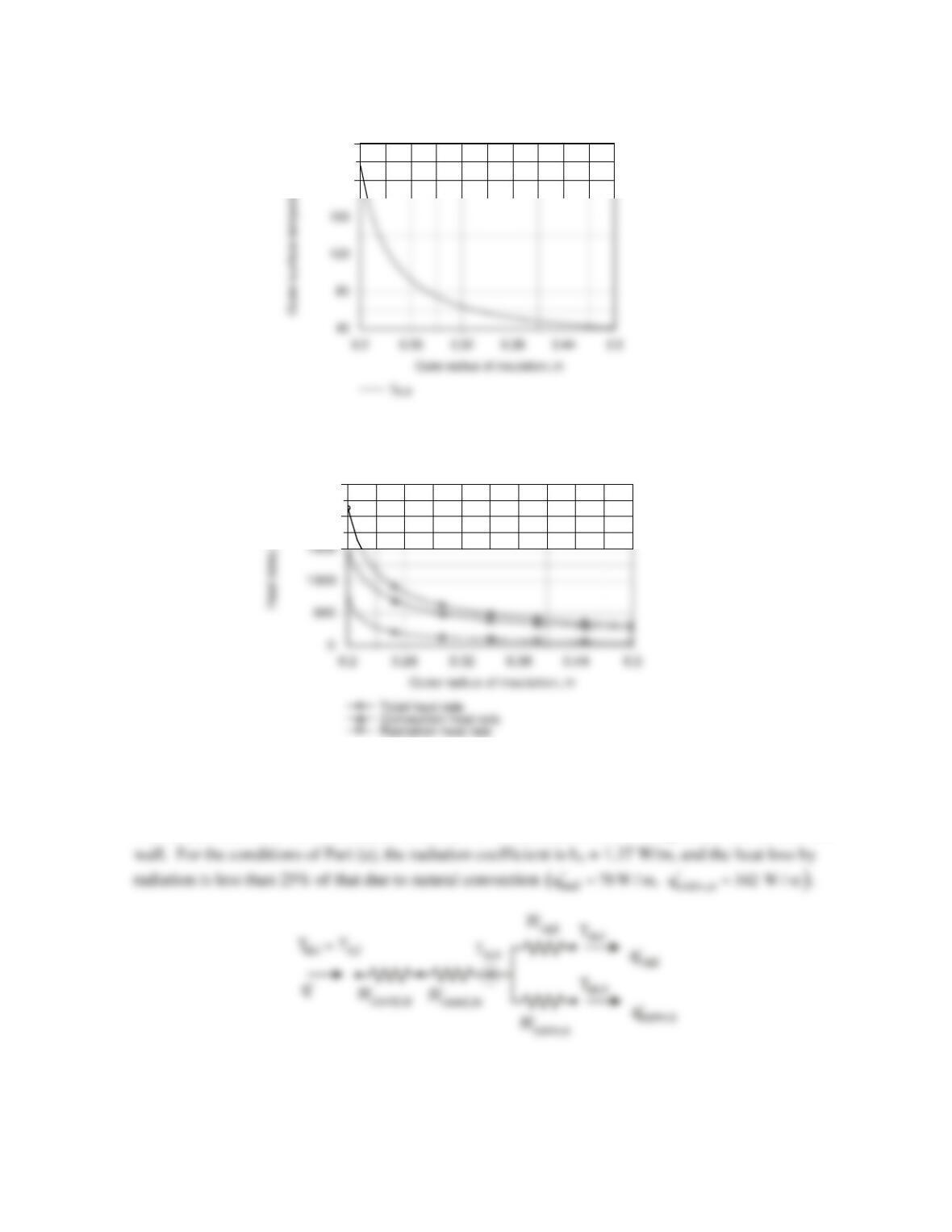
PROBLEM 3.42 (Cont.)
Beyond r3 ≈ 0.40 m, there are rapidly diminishing benefits associated with increasing the insulation
thickness.
COMMENTS: Note that the thermal resistance of the insulation is much larger than that for the tube
200
240
2000
2500
PROBLEM 3.43
KNOWN: Electric current and resistance of wire. Wire diameter and emissivity. Thickness,
emissivity and thermal conductivity of coating. Temperature of ambient air and surroundings.
Expression for heat transfer coefficient at surface of the wire or coating.
FIND: (a) Heat generation per unit length and volume of wire, (b) Temperature of uninsulated wire,
(c) Inner and outer surface temperatures of insulation, including the effect of insulation thickness.
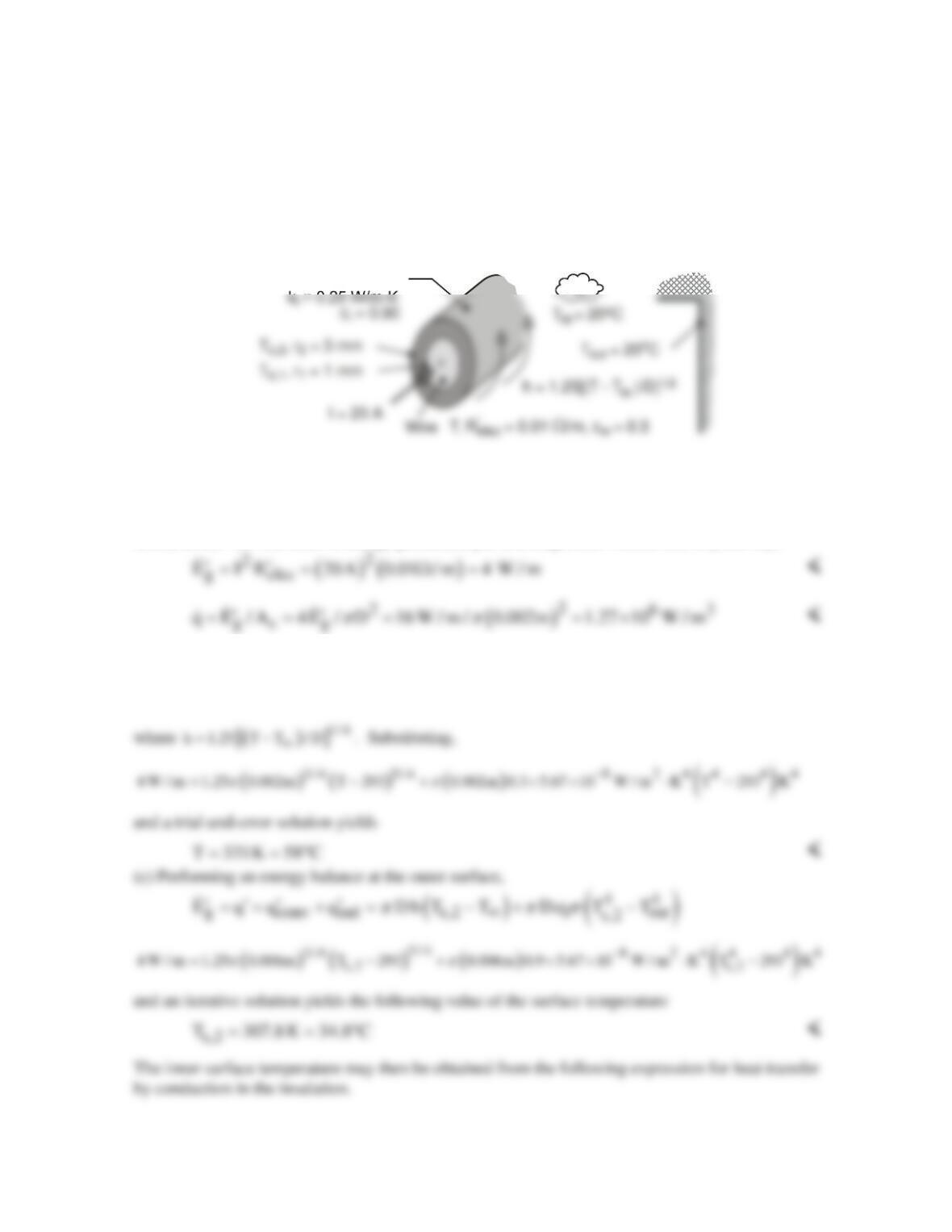
SCHEMATIC:
Insulation
Air
ASSUMPTIONS: (1) Steady-state, (2) One-dimensional radial conduction through insulation, (3)
Constant properties, (4) Negligible contact resistance between insulation and wire, (5) Negligible
radial temperature gradients in wire, (6) Large surroundings.
ANALYSIS: (a) The rates of energy generation per unit length and volume are, respectively,
(b) Without the insulation, an energy balance at the surface of the wire yields
( )
()
44
g conv rad w sur
E q q q Dh T T D T T
π π εs
∞
′ ′′ ′
== + = −+ −
Continued …
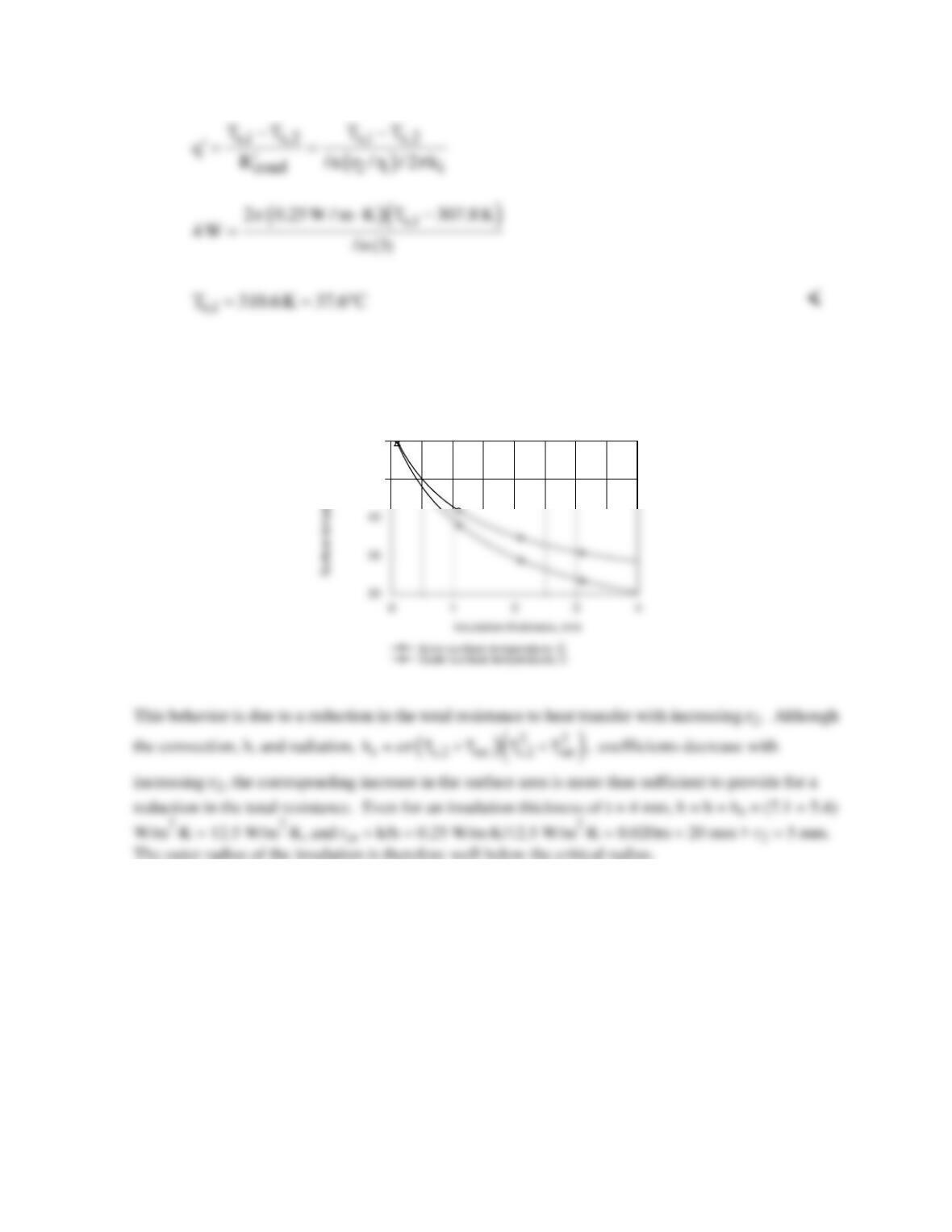
PROBLEM 3.43 (Cont.)
As shown below, the effect of increasing the insulation thickness is to reduce, not increase, the
surface temperatures.
45
50
PROBLEM 3.44
KNOWN: Diameter of electrical wire. Thickness and thermal conductivity of rubberized sheath.
Contact resistance between sheath and wire. Convection coefficient and ambient air temperature.
Maximum allowable sheath temperature.
FIND: Maximum allowable power dissipation per unit length of wire. Critical radius of insulation.
ASSUMPTIONS: (1) Steady-state, (2) One-dimensional radial conduction through insulation, (3)
Constant properties, (4) Negligible radiation exchange with surroundings.
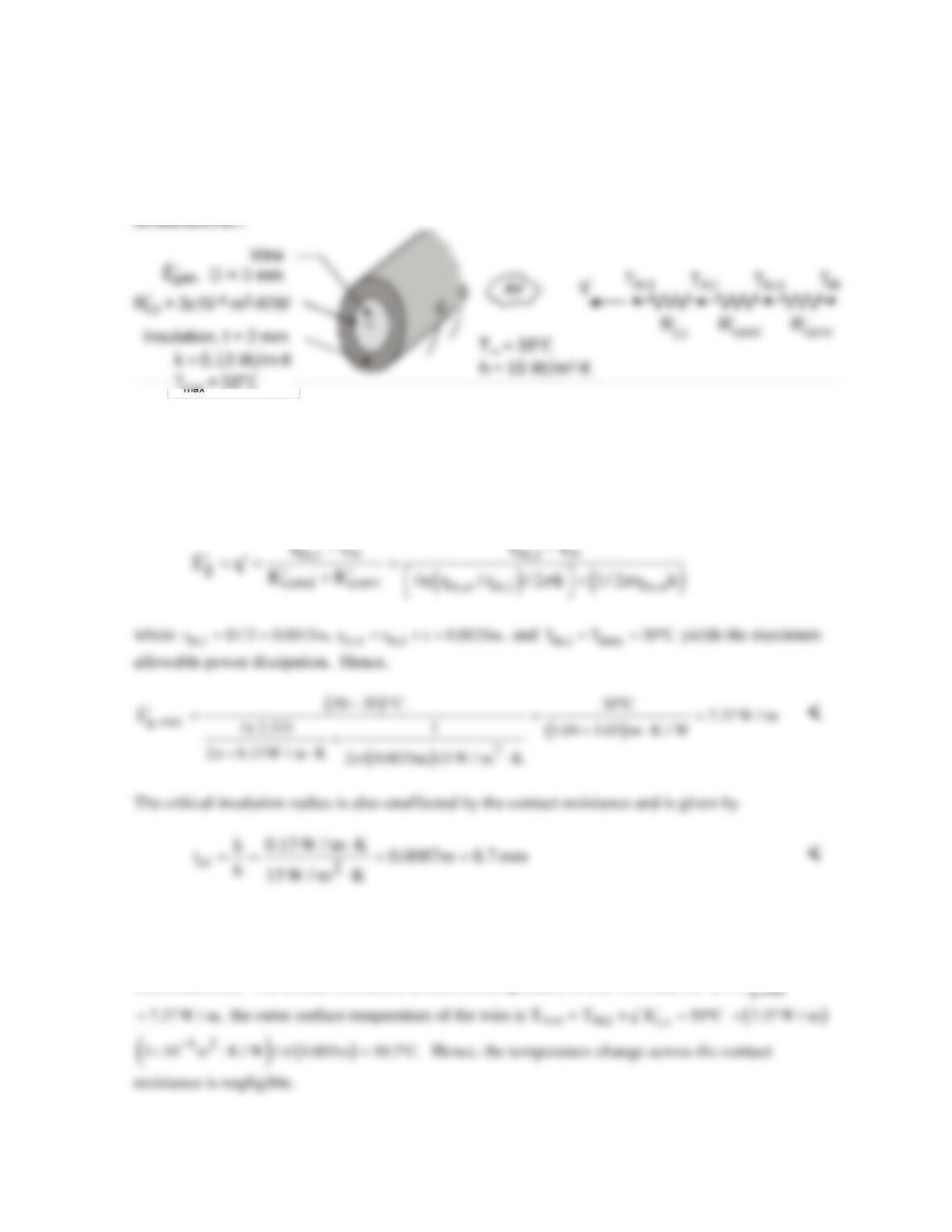
ANALYSIS: The maximum insulation temperature corresponds to its inner surface and is
independent of the contact resistance. From the thermal circuit, we may write
Hence, rin,o < rcr and
g,max
E′
could be increased by increasing rin,o up to a value of 8.7 mm (t = 7.2
mm).
COMMENTS: The contact resistance affects the temperature of the wire, and for
qE
′′
=
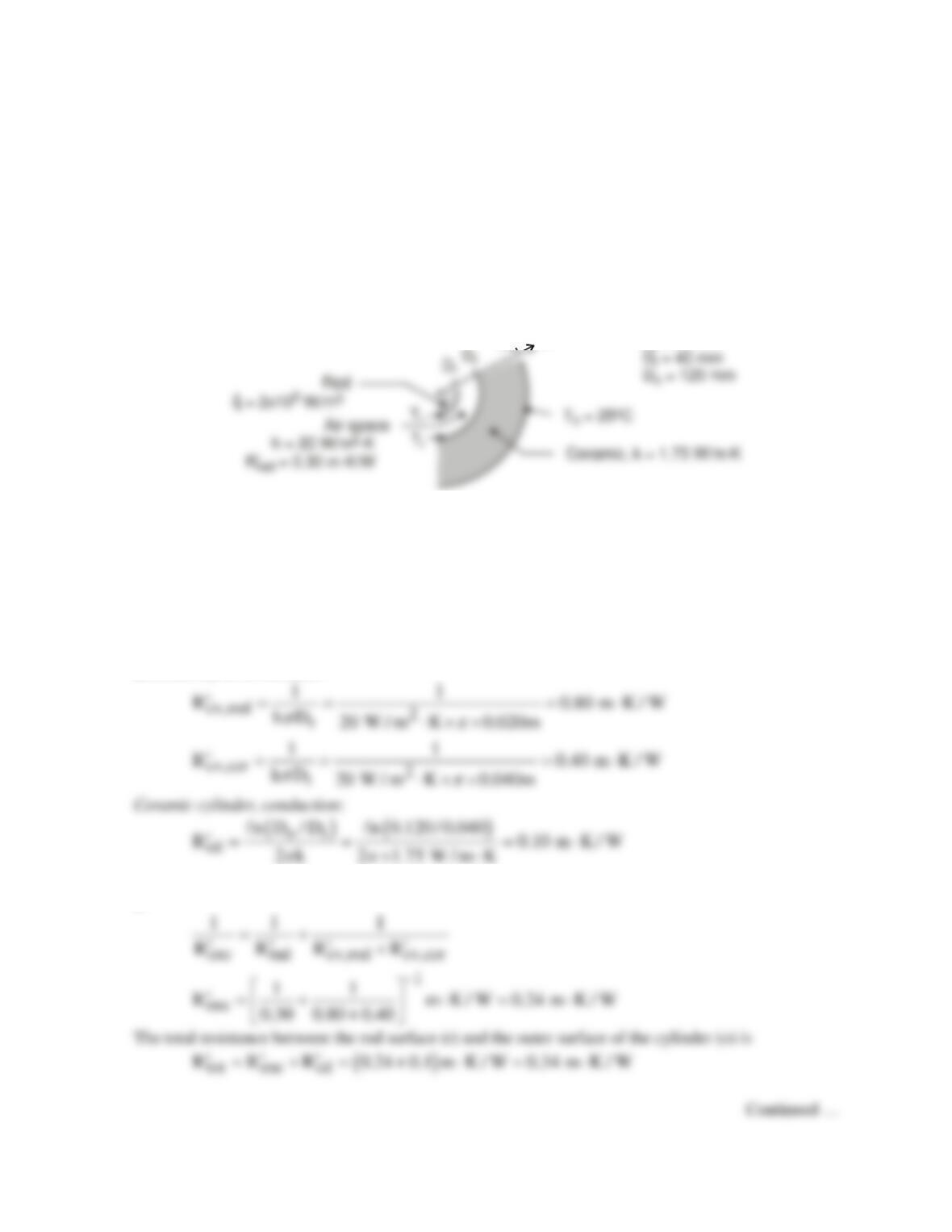
PROBLEM 3.45
KNOWN: Long rod experiencing uniform volumetric generation of thermal energy,
q,
concentric
with a hollow ceramic cylinder creating an enclosure filled with air. Thermal resistance per unit
length due to radiation exchange between enclosure surfaces is
rad
R.
′
The free convection
coefficient for the enclosure surfaces is h = 20 W/m2⋅K.
FIND: (a) Thermal circuit of the system that can be used to calculate the surface temperature of the
rod, Tr; label all temperatures, heat rates and thermal resistances; evaluate the thermal resistances;
and (b) Calculate the surface temperature of the rod.
SCHEMATIC:
D = 20 mm
r
D
o
D
ASSUMPTIONS: (1) Steady-state conditions, (2) One-dimensional, radial conduction through the
hollow cylinder, (3) The enclosure surfaces experience free convection and radiation exchange.
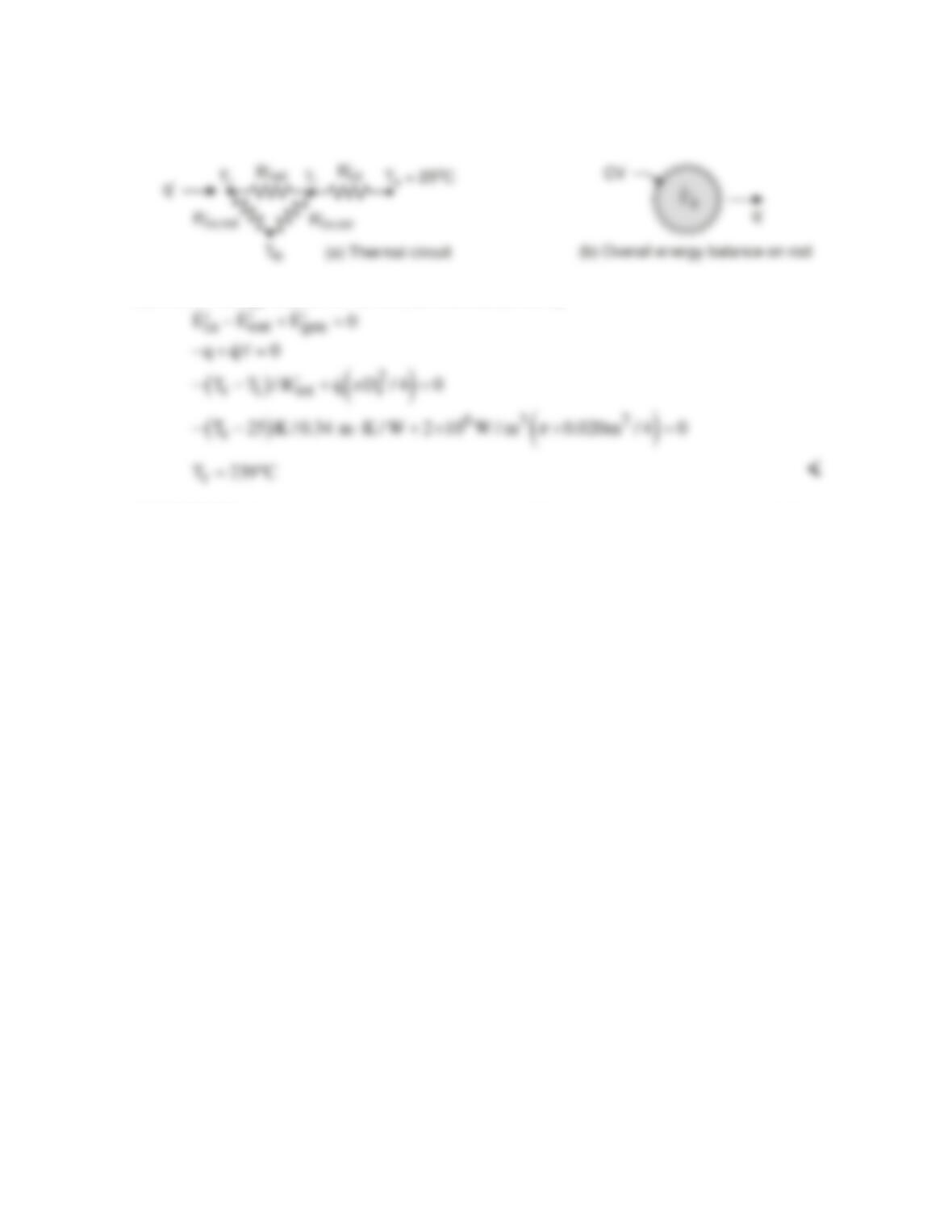
ANALYSIS: (a) The thermal circuit is shown below. Note labels for the temperatures, thermal
resistances and the relevant heat fluxes.
Enclosure, radiation exchange (given):
rad
R 0.30 m K / W
′= ⋅
Enclosure, free convection:
The thermal resistance between the enclosure surfaces (r–i) due to convection and radiation exchange
is
PROBLEM 3.45 (Cont.)
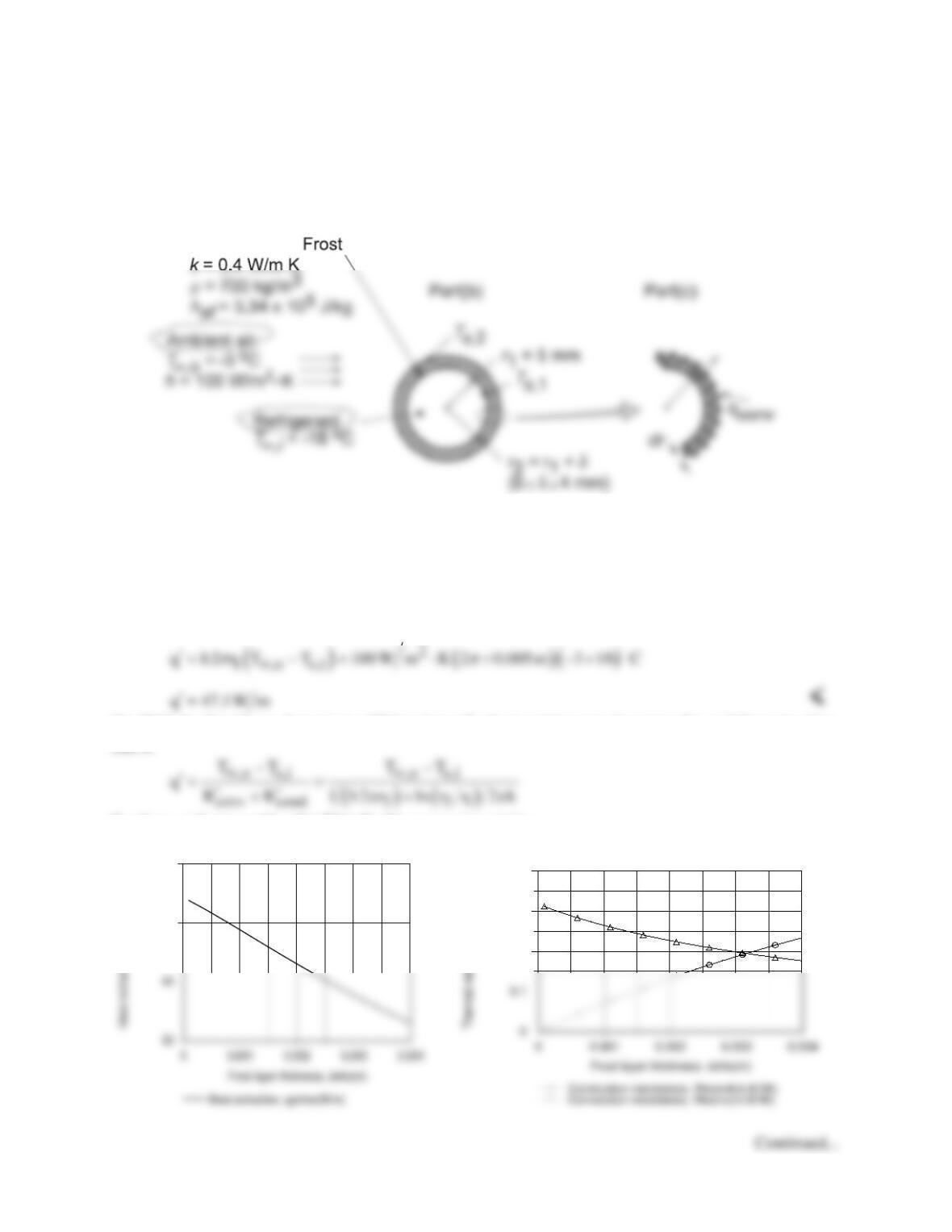
(b) From an energy balance on the rod (see schematic) find Tr.
COMMENTS: In evaluating the convection resistance of the air space, it was necessary to define an
average air temperature (T∞) and consider the convection coefficients for each of the space surfaces.
As you’ll learn later in Chapter 9, correlations are available for directly estimating the convection
coefficient (henc) for the enclosure so that qcv = henc (Tr – Ti).
PROBLEM 3.46
KNOWN: Tube diameter and refrigerant temperature for evaporator of a refrigerant system.
Convection coefficient and temperature of outside air.
FIND: (a) Rate of heat extraction without frost formation, (b) Effect of frost formation on heat rate, (c)
Time required for a 2 mm thick frost layer to melt in ambient air for which h = 2 W/m2⋅K and
T
¥
= 20°C.
SCHEMATIC:
ASSUMPTIONS: (1) One-dimensional, steady-state conditions, (2) Negligible convection resistance
for refrigerant flow
( )
,i s,1
TT
∞=
, (3) Negligible tube wall conduction resistance, (4) Negligible
radiation exchange at outer surface.
ANALYSIS: (a) The cooling capacity in the defrosted condition (δ = 0) corresponds to the rate of heat
extraction from the airflow. Hence,
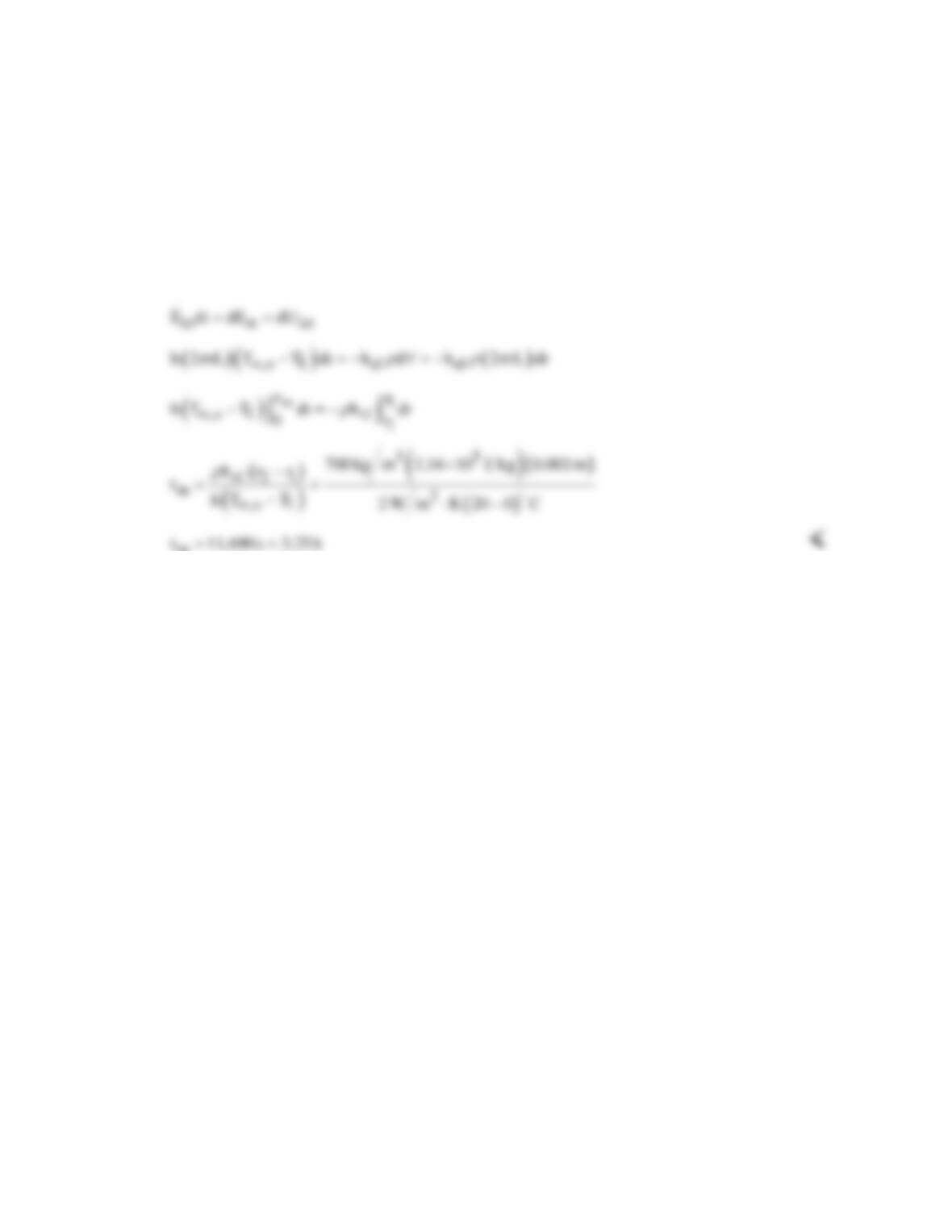
(b) With the frost layer, there is an additional (conduction) resistance to heat transfer, and the extraction
rate is
For 5 ≤ r2 ≤ 9 mm and k = 0.4 W/m⋅K, this expression yields
45
50
0.2
0.3
0.4
PROBLEM 3.46 (Cont.)
The heat extraction, and hence the performance of the evaporator coil, decreases with increasing frost
layer thickness due to an increase in the total resistance to heat transfer. Although the convection
resistance decreases with increasing δ, the reduction is exceeded by the increase in the conduction
resistance.
(c) The time tm required to melt a 2 mm thick frost layer may be determined by applying an energy
balance, Eq. 1.12c, over the differential time interval dt and to a differential control volume extending
inward from the surface of the layer.
m
COMMENTS: The tube radius r1 exceeds the critical radius rcr = k/h = 0.4 W/m⋅K/100 W/m2⋅K =
0.004 m, in which case any frost formation will reduce the performance of the coil.
PROBLEM 3.47
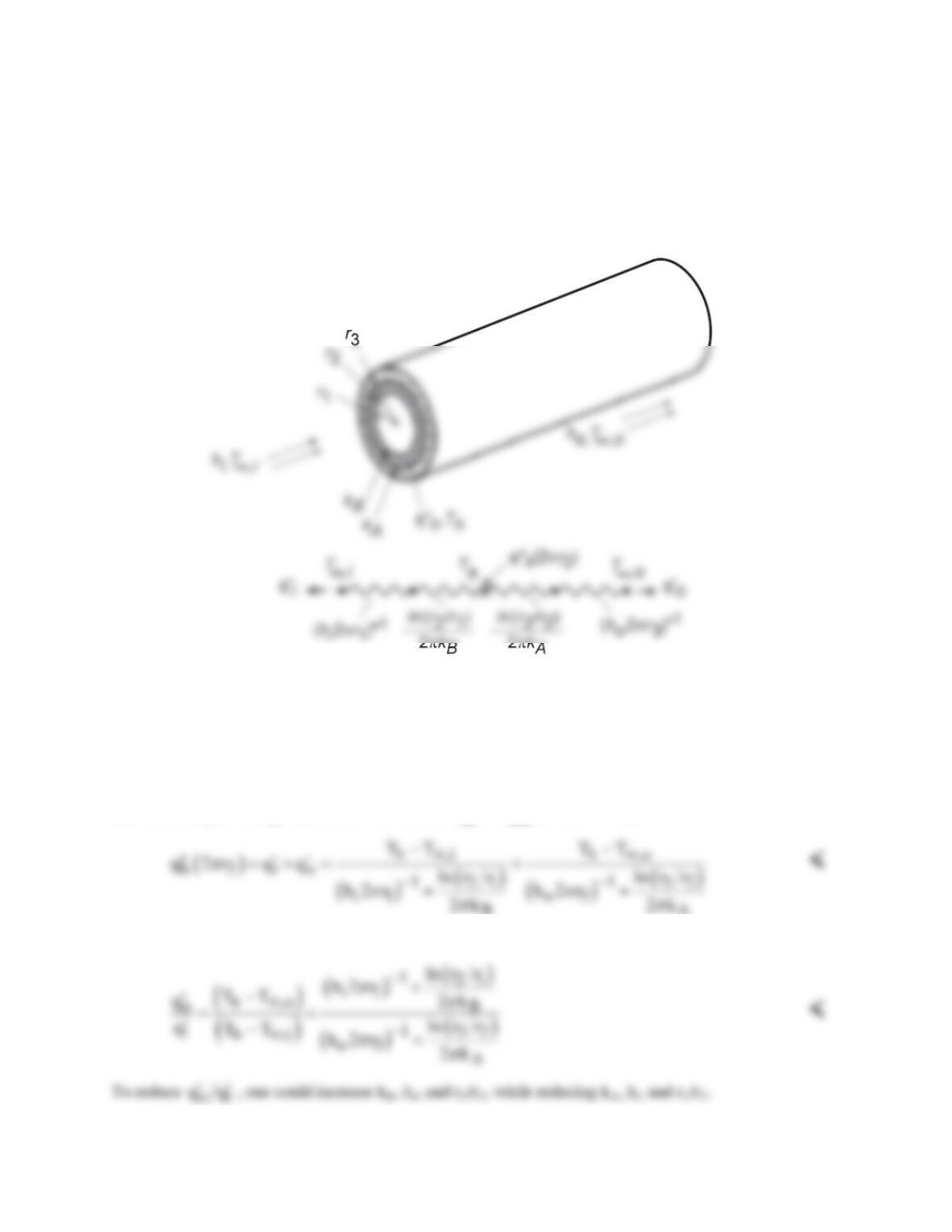
KNOWN: Conditions associated with a composite wall and a thin electric heater.
FIND: (a) Equivalent thermal circuit, (b) Expression for heater temperature, (c) Ratio of outer and inner
heat flows and conditions for which ratio is minimized.
SCHEMATIC:
ASSUMPTIONS: (1) One-dimensional, steady-state conduction, (2) Constant properties, (3) Isothermal
heater, (4) Negligible contact resistance(s).
ANALYSIS: (a) On the basis of a unit axial length, the circuit, thermal resistances, and heat rates are as
shown in the schematic.
(b) Performing an energy balance for the heater,
in out
EE=
, it follows that
BA
(c) From the circuit,
COMMENTS: Contact resistances between the heater and materials A and B could be important.
PROBLEM 3.48
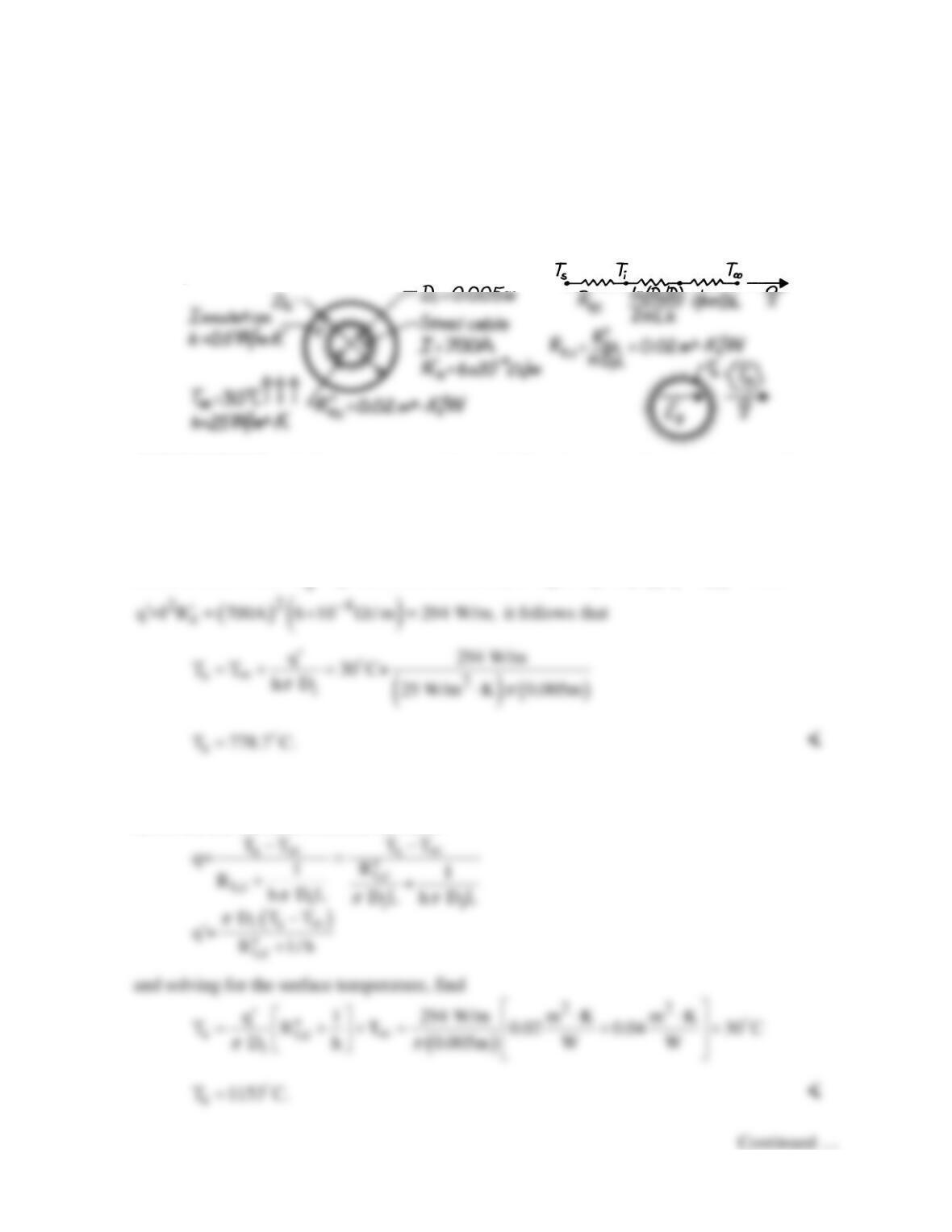
KNOWN: Electric current flow, resistance, diameter and environmental conditions
associated with a cable.
FIND: (a) Surface temperature of bare cable, (b) Cable surface and insulation temperatures
for a thin coating of insulation, (c) Insulation thickness which provides the lowest value of the
maximum insulation temperature. Corresponding value of this temperature.
SCHEMATIC:
ASSUMPTIONS: (1) Steady-state conditions, (2) One-dimensional conduction in r, (3)
Constant properties.
ANALYSIS: (a) The rate at which heat is transferred to the surroundings is fixed by the rate
of heat generation in the cable. Performing an energy balance for a control surface about the
cable, it follows that
g
Eq=
or, for the bare cable,
( )( )
2e is
IRL=h DL T T .
π
∞
′−
With
(b) With a thin coating of insulation, there exist contact and convection resistances to heat
transfer from the cable. The heat transfer rate is determined by heating within the cable,
however, and therefore remains the same.
PROBLEM 3.48 (Cont.)
The insulation temperature is then obtained from
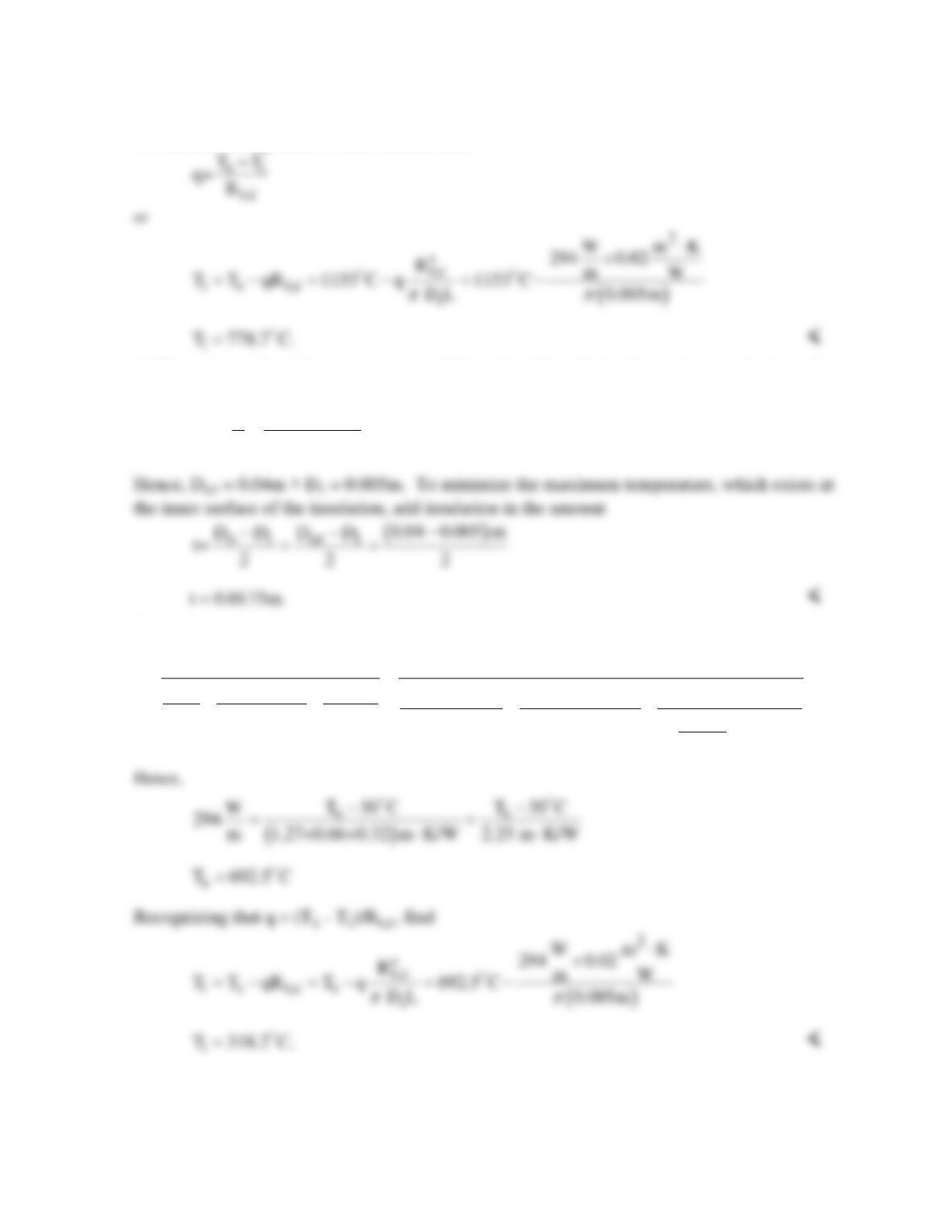
(c) The maximum insulation temperature could be reduced by reducing the resistance to heat transfer
from the outer surface of the insulation. Such a reduction is possible if Di < Dcr. From Example 3.6,
cr 2
k 0.5 W/m K
r 0.02m.
h25 W/m K
⋅
= = =
⋅
The cable surface temperature may then be obtained from
( )
( )
( )
( ) ( )
ss
2
t,c cr i
i cr
2
T T T 30 C
q= Rln D / D 1ln 0.04/0.005
0.02 m K/W 1
D 2 k h D W
0.005m 2 0.5 W/m K 25 0.04m
mK
π ππππ π
∞
−−
′=
′′ ⋅
++ ++
⋅
⋅
COMMENTS: Use of the critical insulation thickness in lieu of a thin coating has the effect of
reducing the maximum insulation temperature from 778.7°C to 318.2°C. Use of the critical insulation
thickness also reduces the cable surface temperature to 692.5°C from 778.7°C with no insulation or
from 1153°C with a thin coating.
PROBLEM 3.49
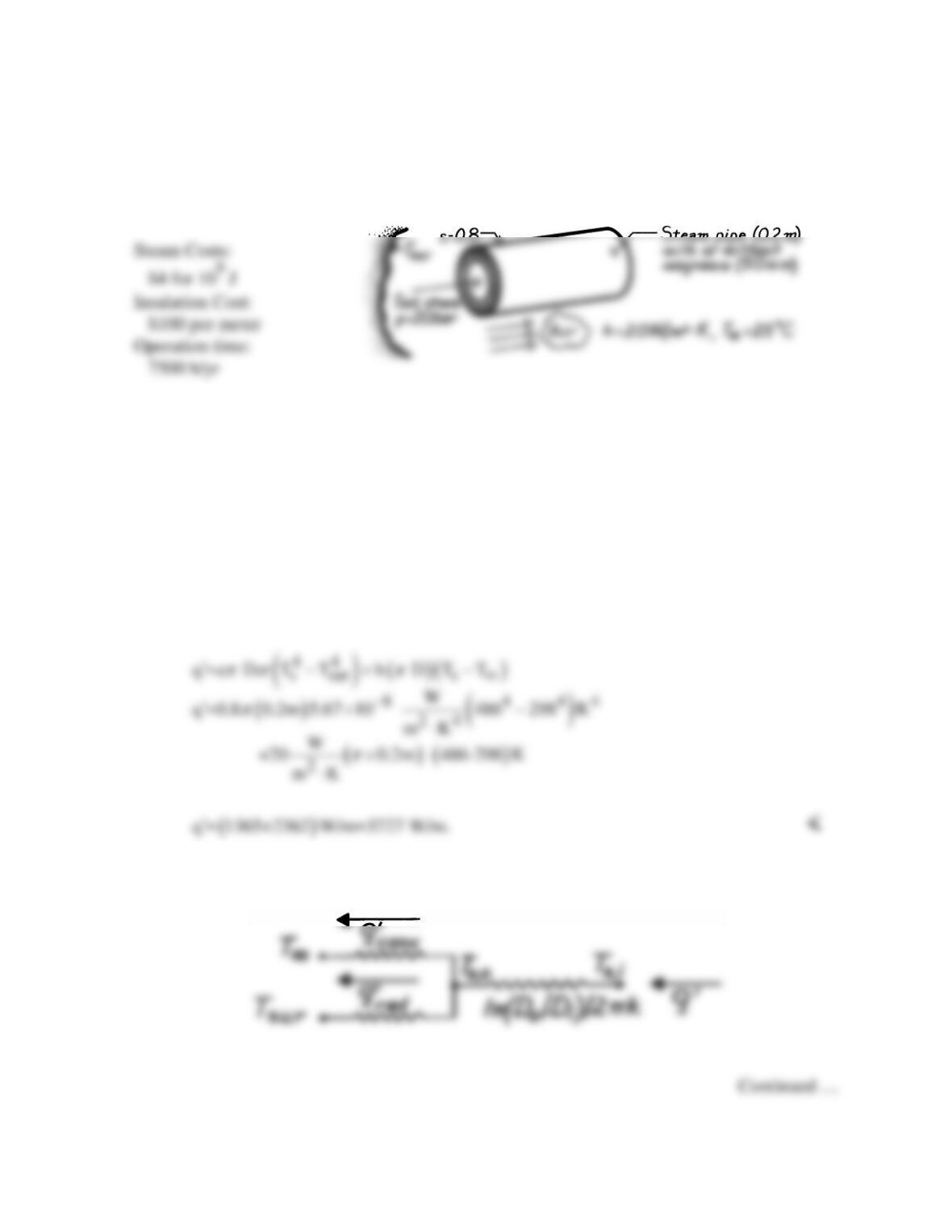
KNOWN: Saturated steam conditions in a pipe with prescribed surroundings.
FIND: (a) Heat loss per unit length from bare pipe and from insulated pipe, (b) Pay back
period for insulation.
SCHEMATIC:
ASSUMPTIONS: (1) Steady-state conditions, (2) One-dimensional heat transfer, (3)
Constant properties, (4) Negligible pipe wall resistance, (5) Negligible steam side convection
resistance (pipe inner surface temperature is equal to steam temperature), (6) Negligible
contact resistance, (7) Tsur = T∞.
PROPERTIES: Table A-6, Saturated water (p = 20 bar): Tsat = Ts = 486K; Table A-3,
Magnesia, 85% (T ≈ 392K): k = 0.058 W/m⋅K.
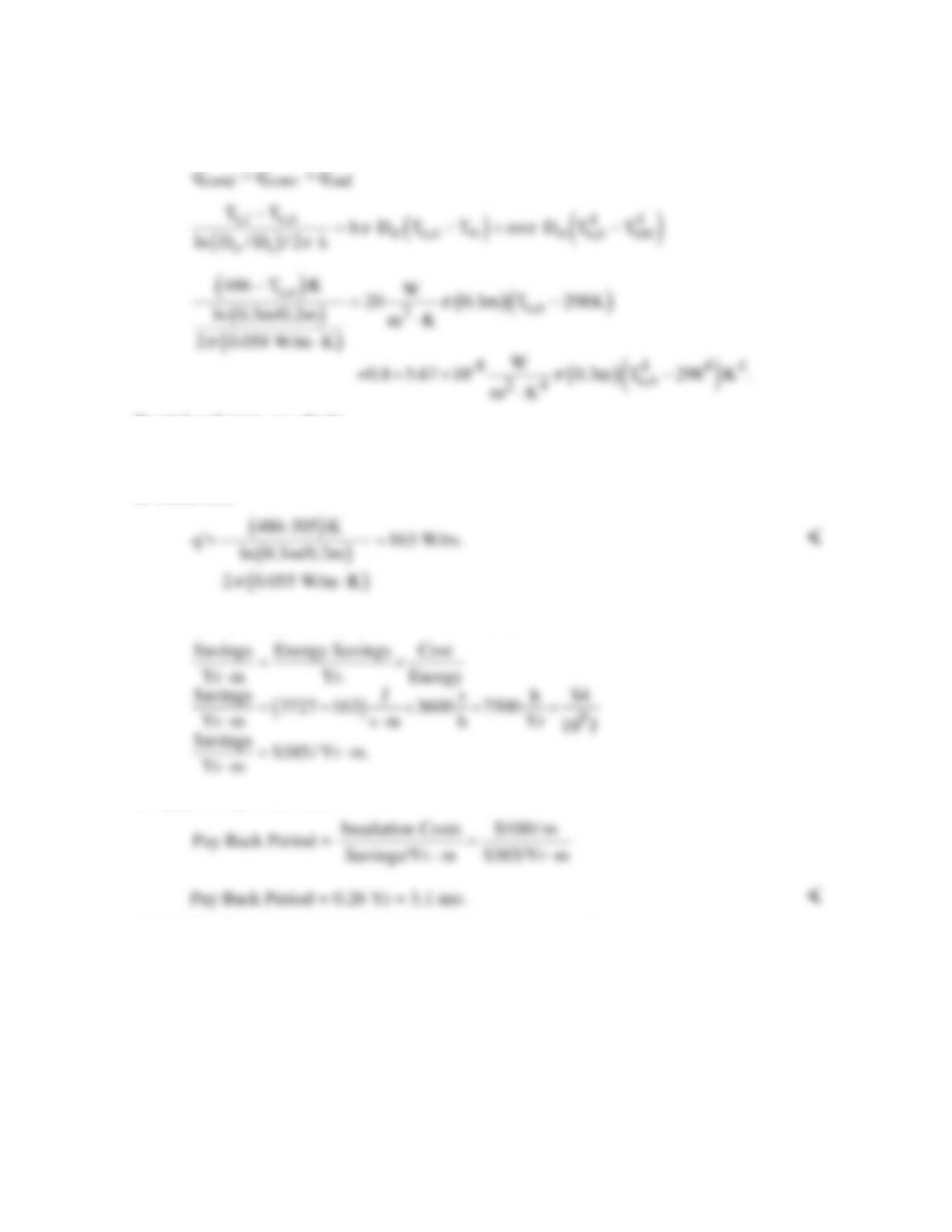
ANALYSIS: (a) Without the insulation, the heat loss may be expressed in terms of radiation
and convection rates,
With the insulation, the thermal circuit is of the form
PROBLEM 3.49 (Cont.)
From an energy balance at the outer surface of the insulation,
By trial and error, we obtain
Ts,o ≈ 305K
in which case
(b) The yearly energy savings per unit length of pipe due to use of the insulation is
The pay back period is then
COMMENTS: Such a low pay back period is more than sufficient to justify investing in the
insulation.
PROBLEM 3.50
KNOWN: Pipe wall temperature and convection conditions associated with water flow through the pipe
and ice layer formation on the inner surface.
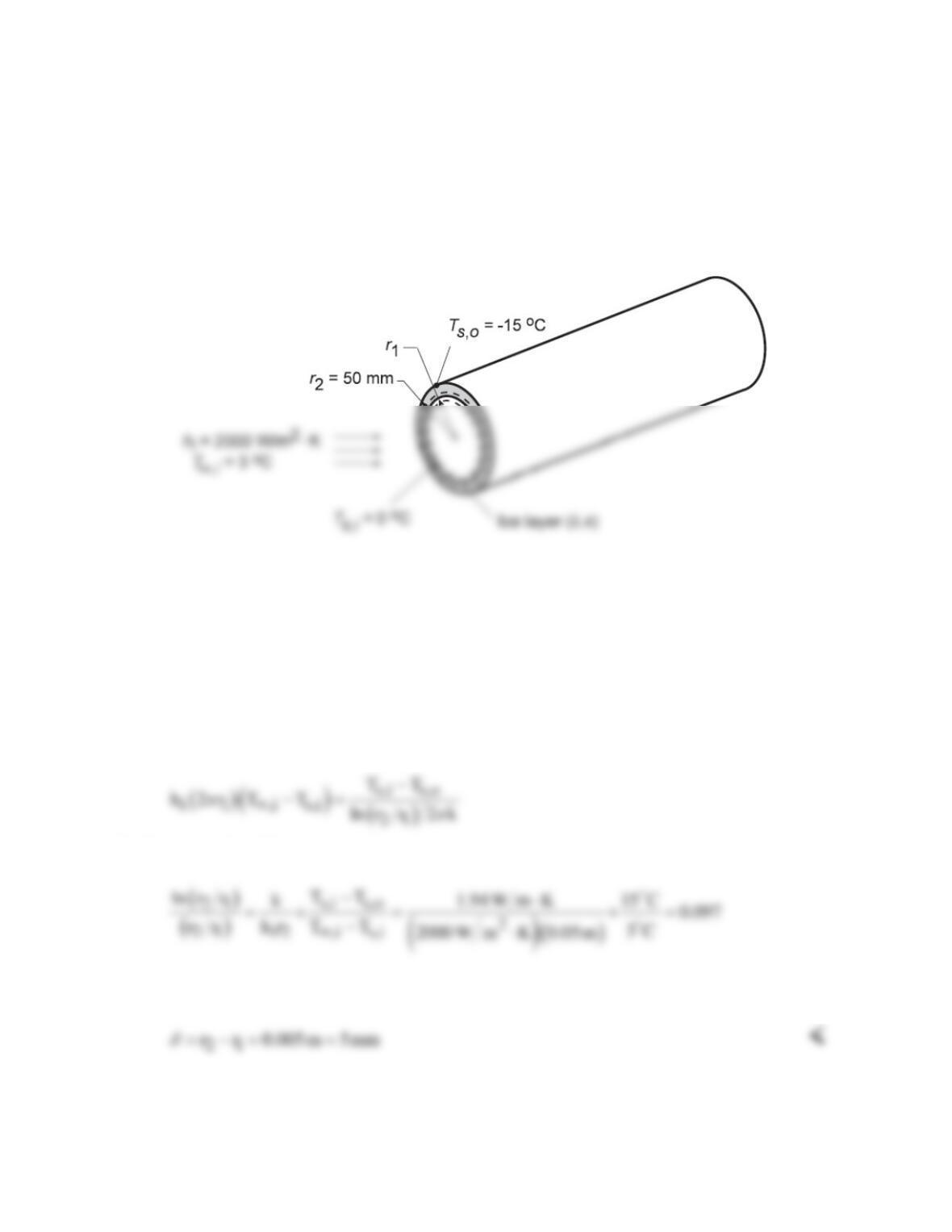
FIND: Ice layer thickness δ.
SCHEMATIC:
ASSUMPTIONS: (1) One-dimensional, steady-state conduction, (2) Negligible pipe wall thermal
resistance, (3) negligible ice/wall contact resistance, (4) Constant k.
PROPERTIES: Table A.3, Ice (T = 265 K): k ≈ 1.94 W/m⋅K.
ANALYSIS: Performing an energy balance for a control surface about the ice/water interface, it follows
that, for a unit length of pipe,
conv cond
qq
′′
=
Dividing both sides of the equation by r2,
The equation is satisfied by r2/r1 = 1.114, in which case r1 = 0.050 m/1.114 = 0.045 m, and the ice layer
thickness is
COMMENTS: With no flow, hi → 0, in which case r1 → 0 and complete blockage could occur. The
pipe should be insulated.
PROBLEM 3.51
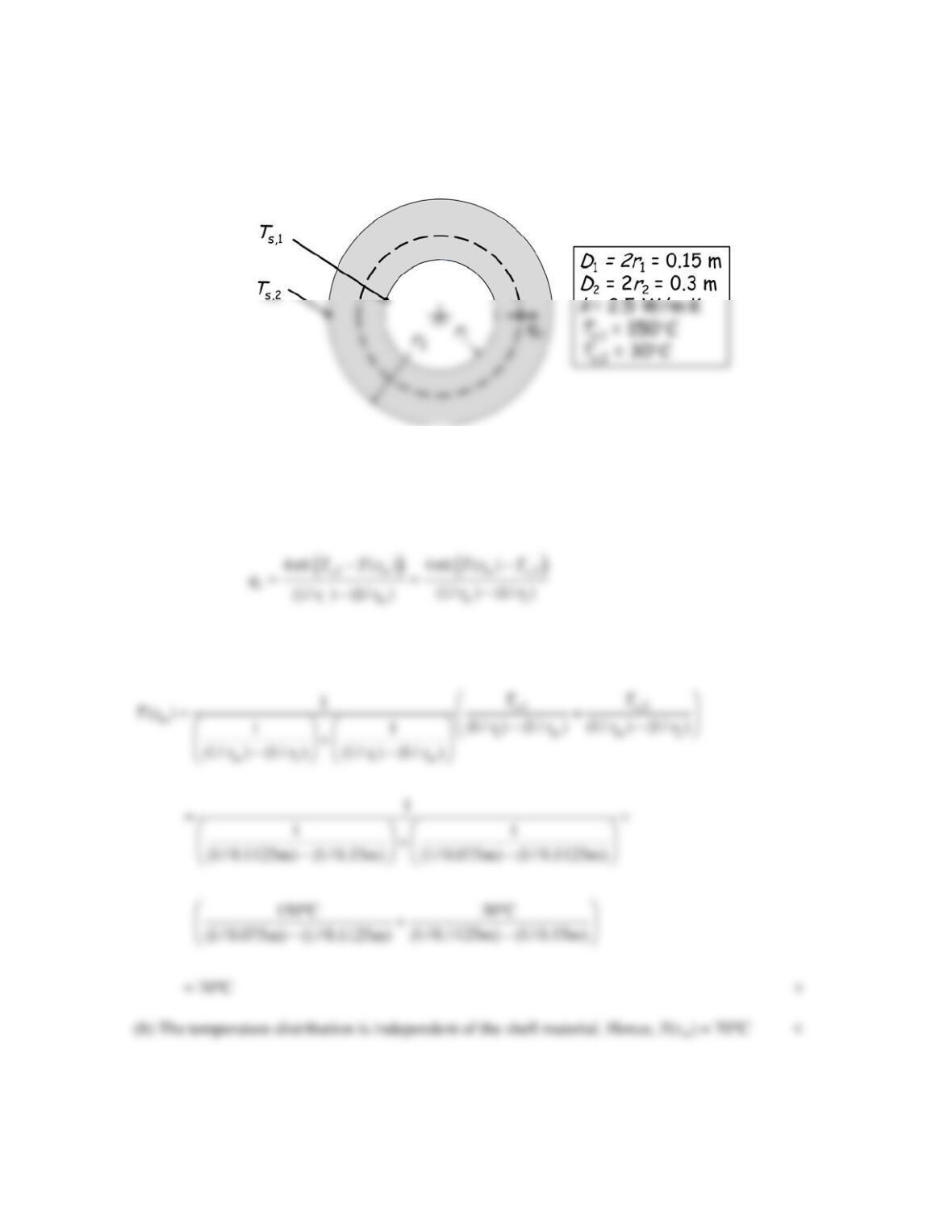
KNOWN: Dimensions and surface temperatures of a glass or aluminum spherical shell.
FIND: (a) Mid–point temperature within the shell for a glass shell, (b) Mid-point temperature within
the shell for an aluminum shell.
SCHEMATIC:
ASSUMPTIONS: (1) Steady–state conditions, (2) Constant properties, (3) One-dimensional heat
transfer, (4) No internal energy generation within the shell.
ANALYSIS: (a) The conduction heat rate into the dashed control surface must equal the conduction
heat rate out of the dashed control surface. Hence, from Eq. 3.40
or,
COMMENTS: (1) The temperature distribution is not linear. Assuming a linear distribution would be
a serious error. (2) The conduction heat rate through the sphere will be much higher for the aluminum
shell since the thermal conductivity of aluminum is much greater than that of glass.
PROBLEM 3.52
KNOWN: Sphere of radius ri, covered with insulation whose outer surface is exposed to a
convection process.
FIND: Critical insulation radius, rcr.
SCHEMATIC:
ASSUMPTIONS: (1) Steady-state conditions, (2) One-dimensional radial (spherical)
conduction, (3) Constant properties, (4) Negligible radiation at surface.
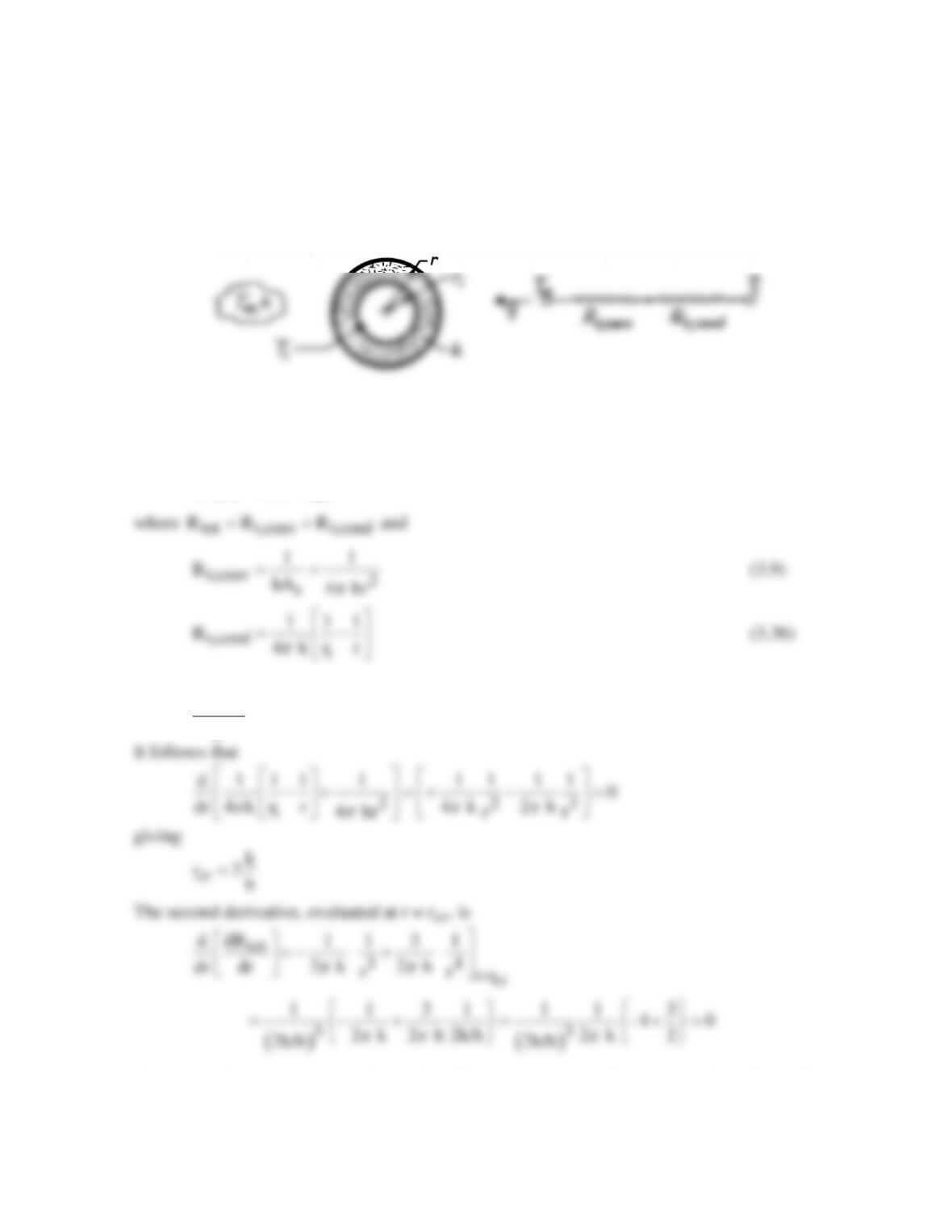
ANALYSIS: The heat rate follows from the thermal circuit shown in the schematic,
( )
i tot
q= T T / R
∞
−
If q is a maximum or minimum, we need to find the condition for which
tot
d R 0.
dr =
Hence, it follows no optimum Rtot exists. We refer to this condition as the critical insulation
radius. See Example 3.6 which considers this situation for a cylindrical system.
PROBLEM 3.53
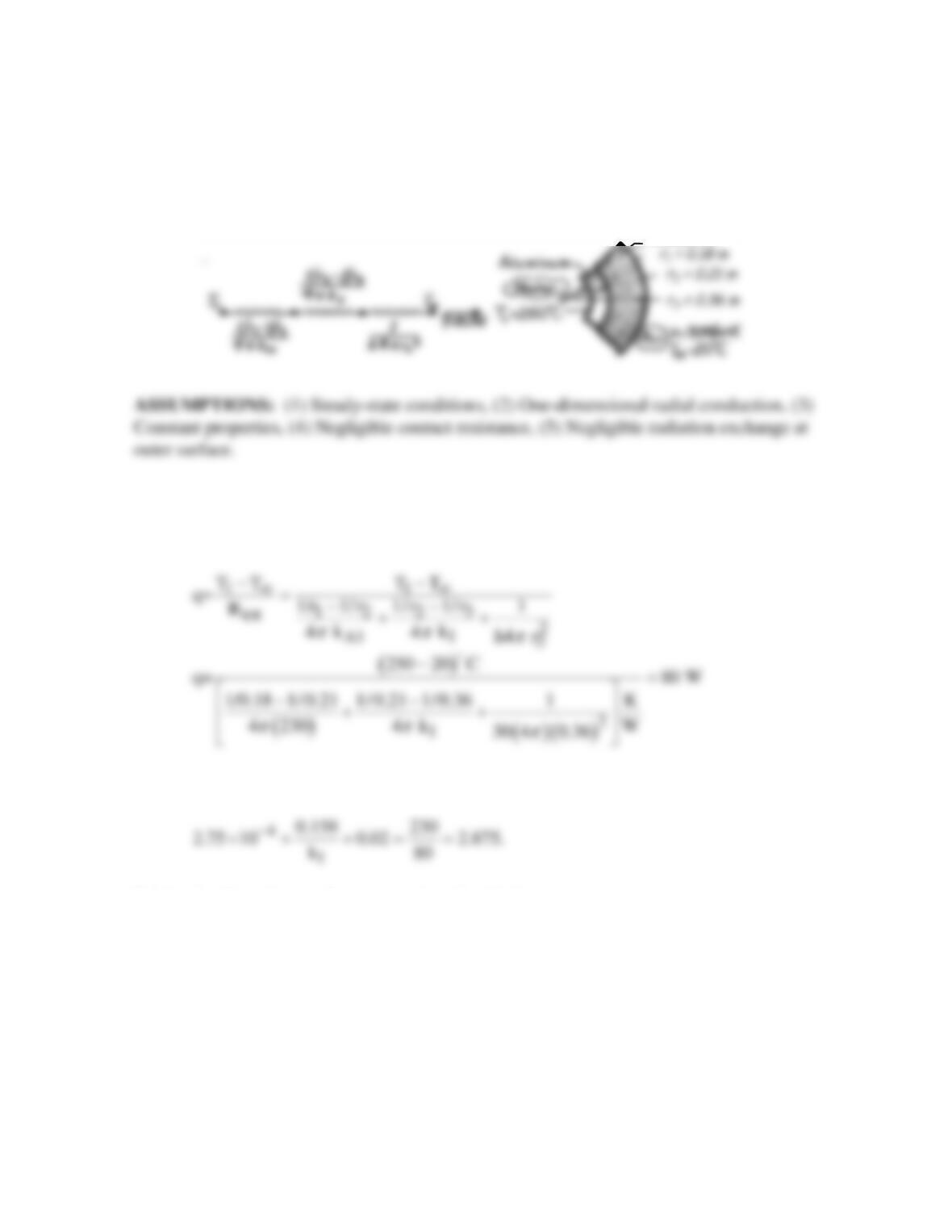
KNOWN: Thickness of hollow aluminum sphere and insulation layer. Heat rate and inner
surface temperature. Ambient air temperature and convection coefficient.
FIND: Thermal conductivity of insulation.
SCHEMATIC:
PROPERTIES: Table A-1, Aluminum (523K): k ≈ 230 W/m⋅K.
ANALYSIS: From the thermal circuit,
or
Solving for the unknown thermal conductivity, find
kI = 0.055 W/m⋅K. <
COMMENTS: The dominant contribution to the total thermal resistance is made by the
insulation. Hence uncertainties in knowledge of h or kA1 have a negligible effect on the
accuracy of the kI measurement.
Insulation
PROBLEM 3.54
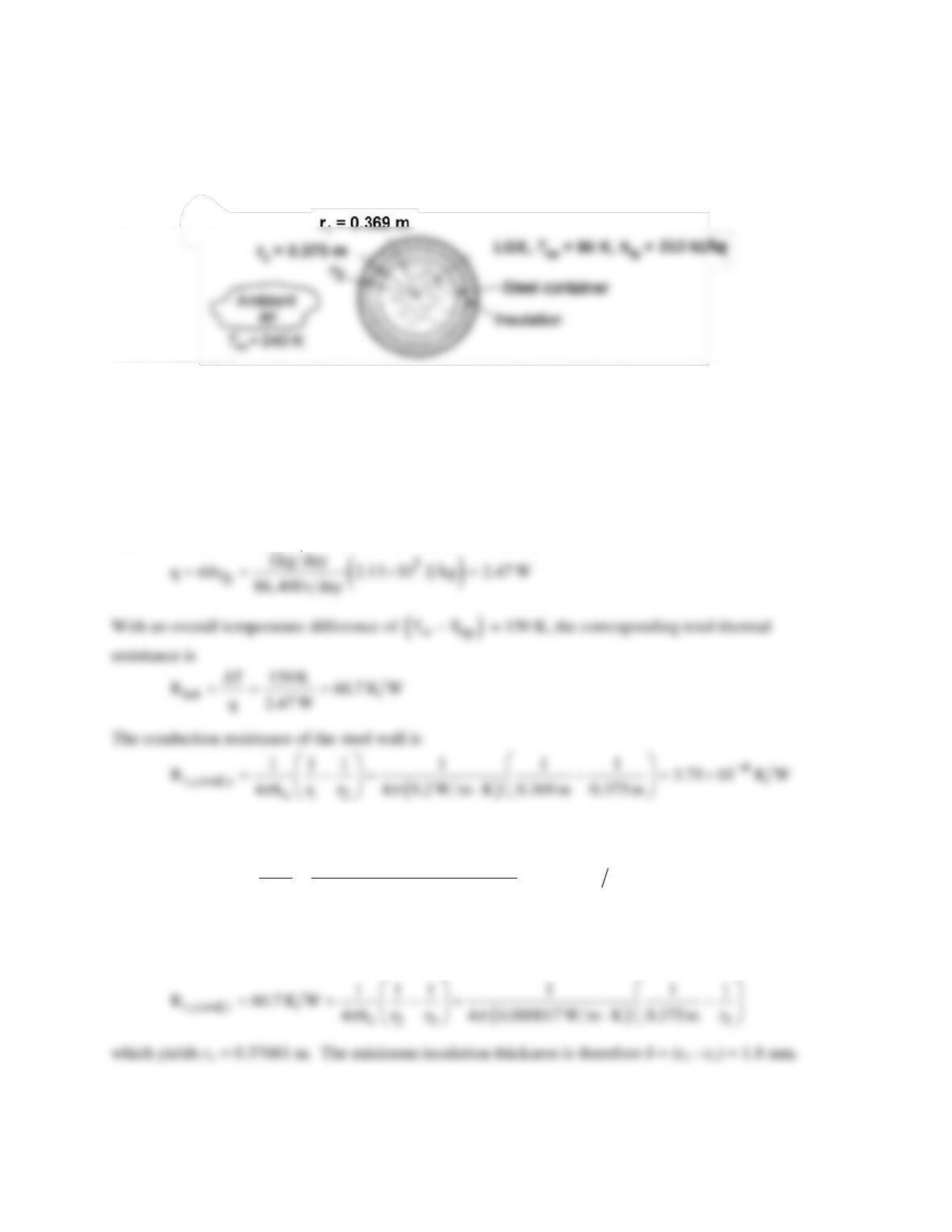
KNOWN: Dimensions of spherical, stainless steel liquid oxygen (LOX) storage container. Boiling
point and latent heat of fusion of LOX. Environmental temperature.
FIND: Thermal isolation system which maintains boil–off below 1 kg/day.
SCHEMATIC:
ASSUMPTIONS: (1) One-dimensional, steady-state conditions, (2) Negligible thermal resistances
associated with internal and external convection, conduction in the container wall, and contact between
wall and insulation, (3) Negligible radiation at exterior surface (due to low emissivity insulation
selected), (4) Constant insulation thermal conductivity.
PROPERTIES: Table A.1, 304 Stainless steel (T = 100 K): ks = 9.2 W/m⋅K; Table A.3, Reflective,
aluminum foil-glass paper insulation (T = 150 K): ki = 0.000017 W/m⋅K (see choice of insulation
below).
ANALYSIS: The heat gain associated with a loss of 1 kg/day is
With a typical combined radiation and convection heat transfer coefficient of h = 10 W/m2·K, the
resistance between the surface and the environment can be estimated as
( )
conv,rad 2
11
R KW
2
10 W/m K 4 0.375m
s
0.0566
hA
π
= = =
⋅×
It is clear that these resistances are insufficient, and reliance must be placed on the insulation. A special
insulation of very low thermal conductivity should be selected. The best choice is a highly reflective
foil/glass matted insulation which was developed for cryogenic applications. It follows that
COMMENTS: The heat loss could be reduced well below the maximum allowable by adding more
insulation. Also, in view of weight restrictions associated with launching space vehicles, consideration
should be given to fabricating the LOX container from a lighter material.
PROBLEM 3.55
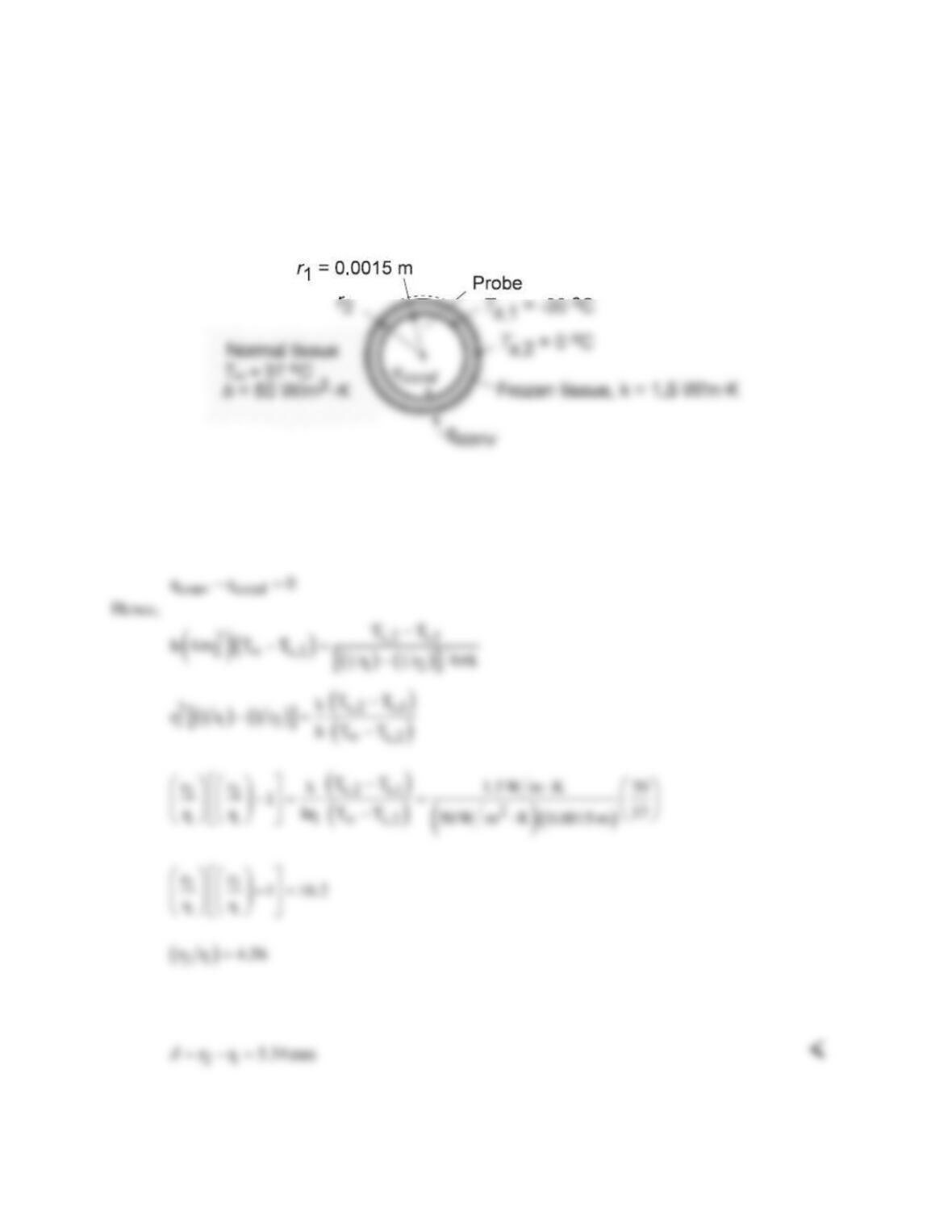
KNOWN: Diameter and surface temperature of a spherical cryoprobe. Temperature of surrounding
tissue and effective convection coefficient at interface between frozen and normal tissue.
FIND: Thickness of frozen tissue layer.
SCHEMATIC:
ASSUMPTIONS: (1) One-dimensional, steady-state conditions, (2) Negligible contact resistance
between probe and frozen tissue, (3) Constant properties, (4) Negligible perfusion effects.
ANALYSIS: Performing an energy balance for a control surface about the phase front, it follows that
It follows that r2 = 6.84 mm and the thickness of the frozen tissue is
COMMENTS: Inclusion of a contact resistance between the probe and the frozen tissue would reduce
the frozen tissue layer thickness, as would increasing the effective convection coefficient between the
frozen and normal tissue.
PROBLEM 3.56
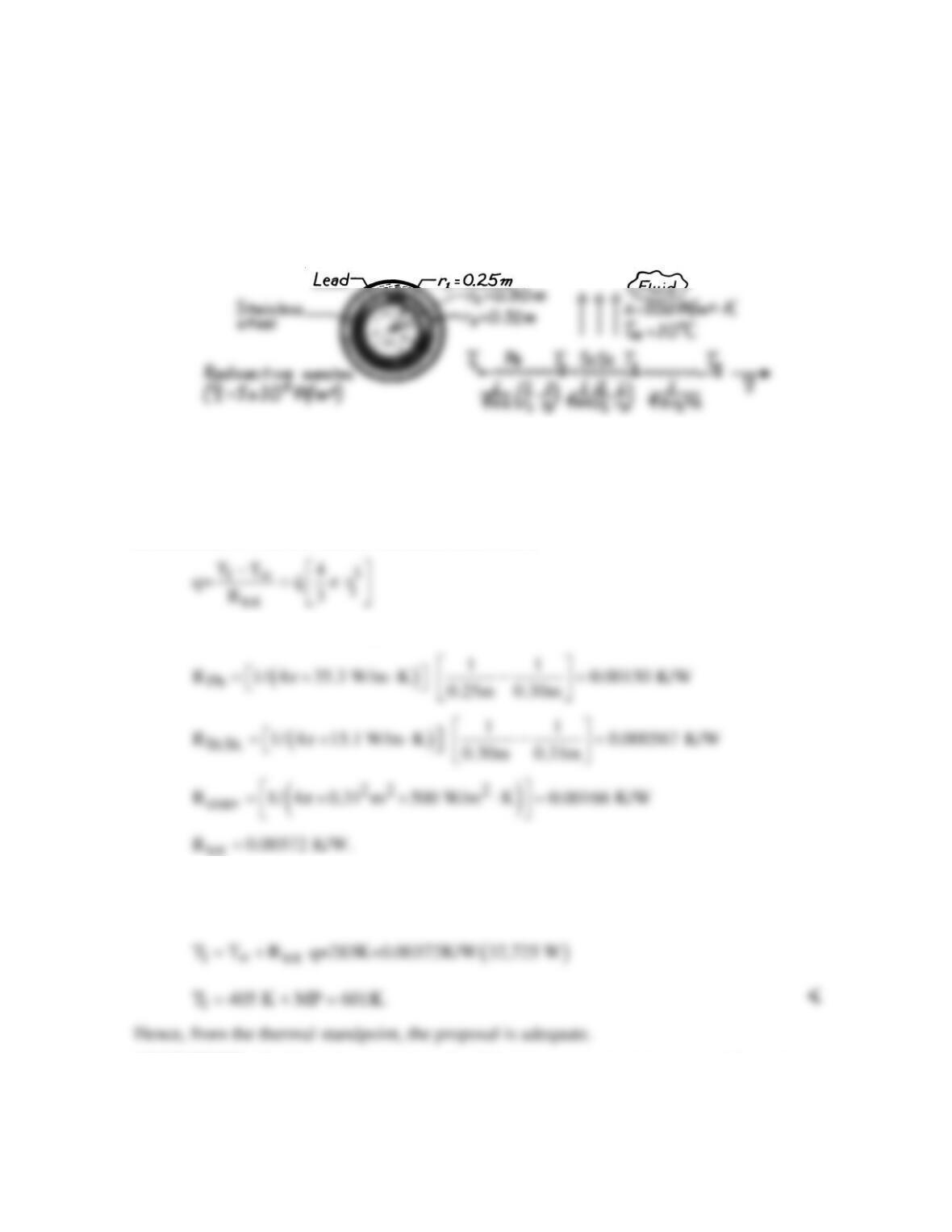
KNOWN: Dimensions and materials used for composite spherical shell. Heat generation
associated with stored material.
FIND: Inner surface temperature, T1, of lead (proposal is flawed if this temperature exceeds
the melting point).
SCHEMATIC:
ASSUMPTIONS: (1) One-dimensional conduction, (2) Steady-state conditions, (3) Constant
properties at 300K, (4) Negligible contact resistance.
PROPERTIES: Table A-1, Lead: k = 35.3 W/m⋅K, MP = 601K; St.St.: 15.1 W/m⋅K.
ANALYSIS: From the thermal circuit, it follows that
Evaluate the thermal resistances,
The heat rate is
( )( )
3
53
q=5 10 W/m 4 / 3 0.25m 32,725 W.
π
×=
The inner surface
temperature is
COMMENTS: In fabrication, attention should be given to maintaining a good thermal
contact. A protective outer coating should be applied to prevent long term corrosion of the
stainless steel.