PROBLEM 3.136 (Cont.)
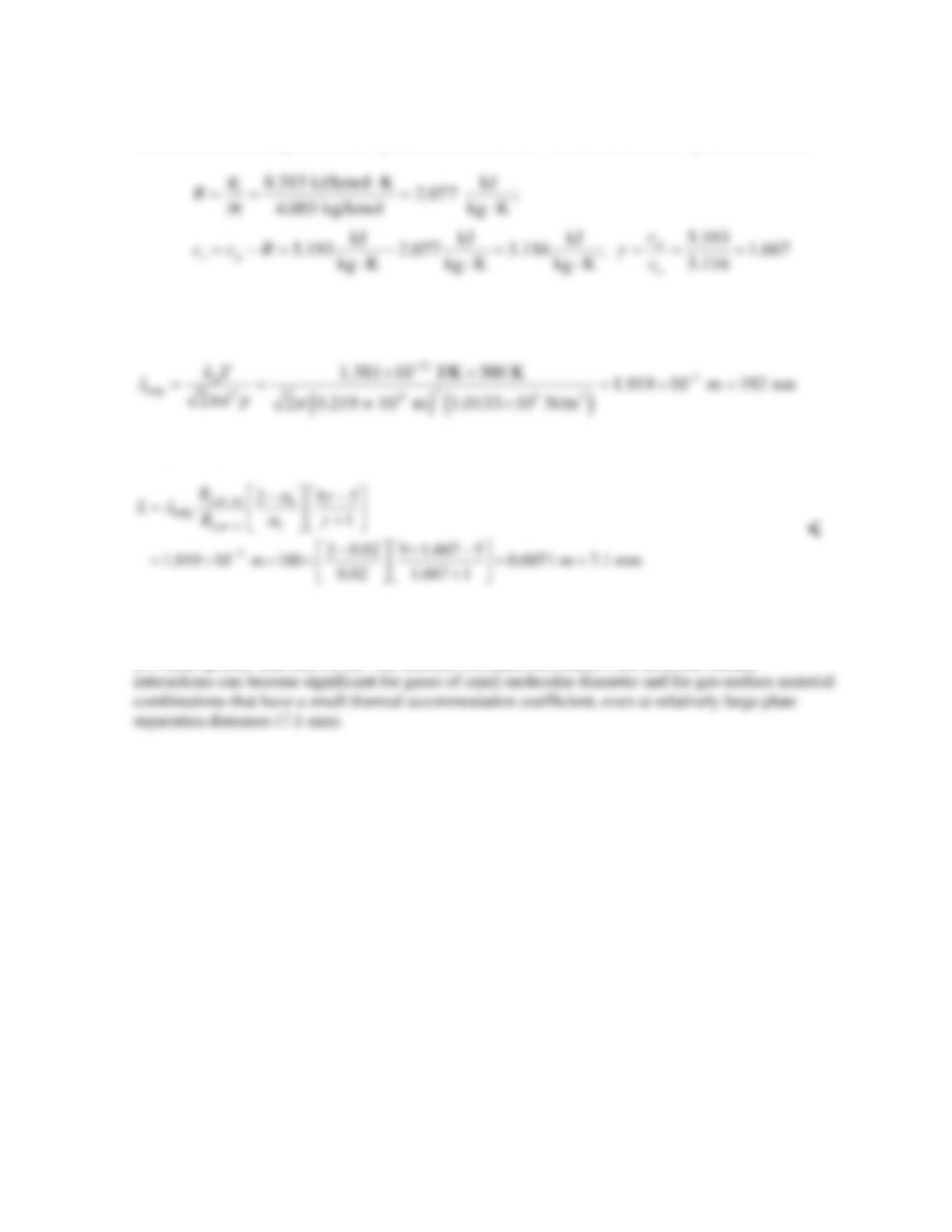
(ii) For He, the ideal gas constant, specific heat at constant volume, and ratio of specific heats are:
The mean free path is
The plate separation, L, is
COMMENTS: The critical plate separation associated with helium is 7.1 × 10⁻³ m/ 24.7 × 10⁻⁶ m =
290 times greater than that for air. The thermal resistance associated with molecule–surface
PROBLEM 3.137
KNOWN: Thickness of of parallel aluminum plates and air layers. Wall surface temperatures.
FIND: The conduction heat flux through (a) aluminum wall, (b) air layer, (c) air layer contained
between two aluminum sheets and (d) composite wall consisting of 8 aluminum sheets and 7 air
layers.
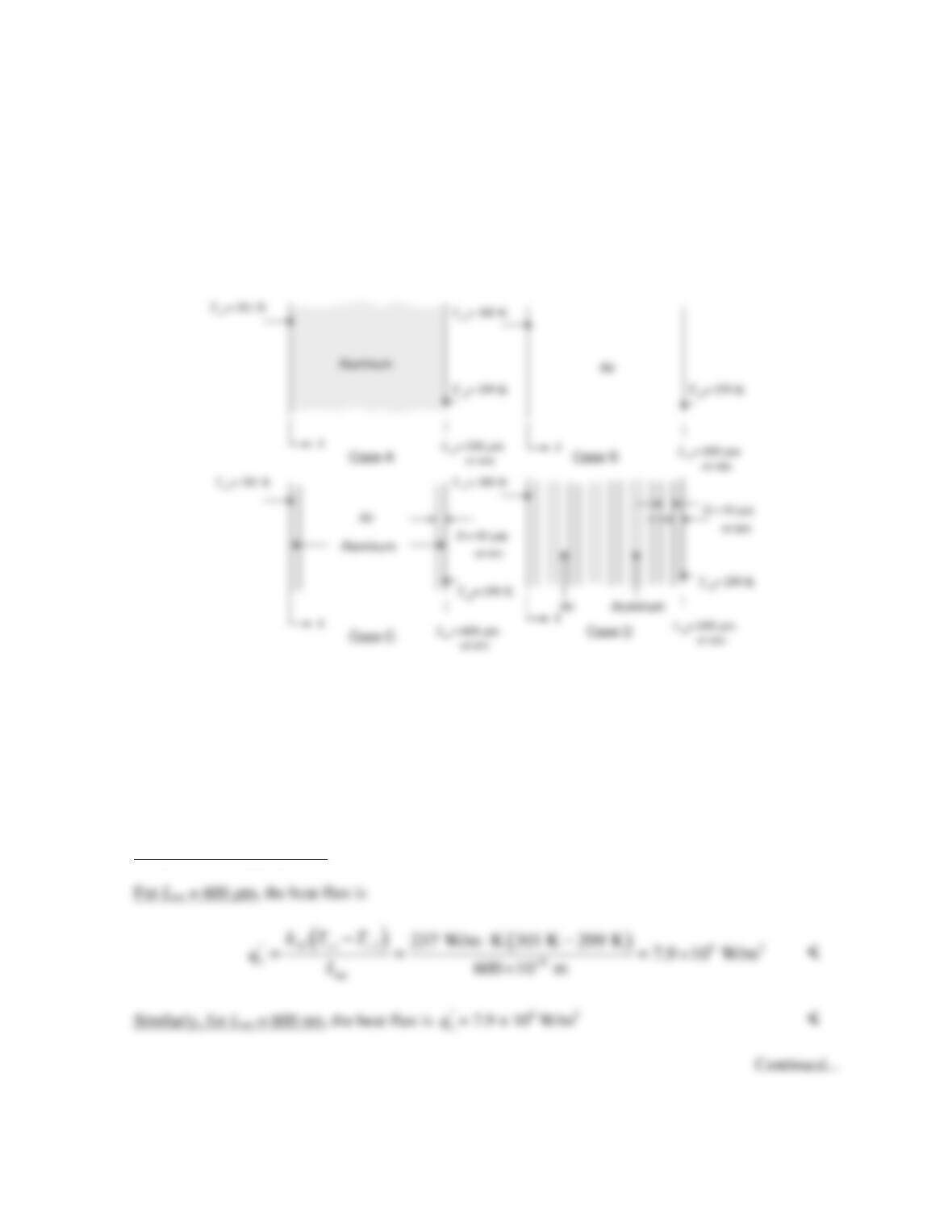
SCHEMATIC:
ASSUMPTIONS: (1) Ideal gas behavior. (2) Nanoscale effects within the solid are not important.
PROPERTIES: Table A.4 (T = 300 K): Air; cp = 1007 J/kg⋅K, kAir = 0.0263 W/m∙K. Figure 2.8: Air;
M = 28.97 kg/kmol, d = 0.372 × 10⁻⁹ m. Table A.1 (T = 300 K): Pure Aluminum, kAl = 237 W/m∙K.
ANALYSIS:
(a) Case A: Aluminum Wall
PROBLEM 3.137 (Cont.)
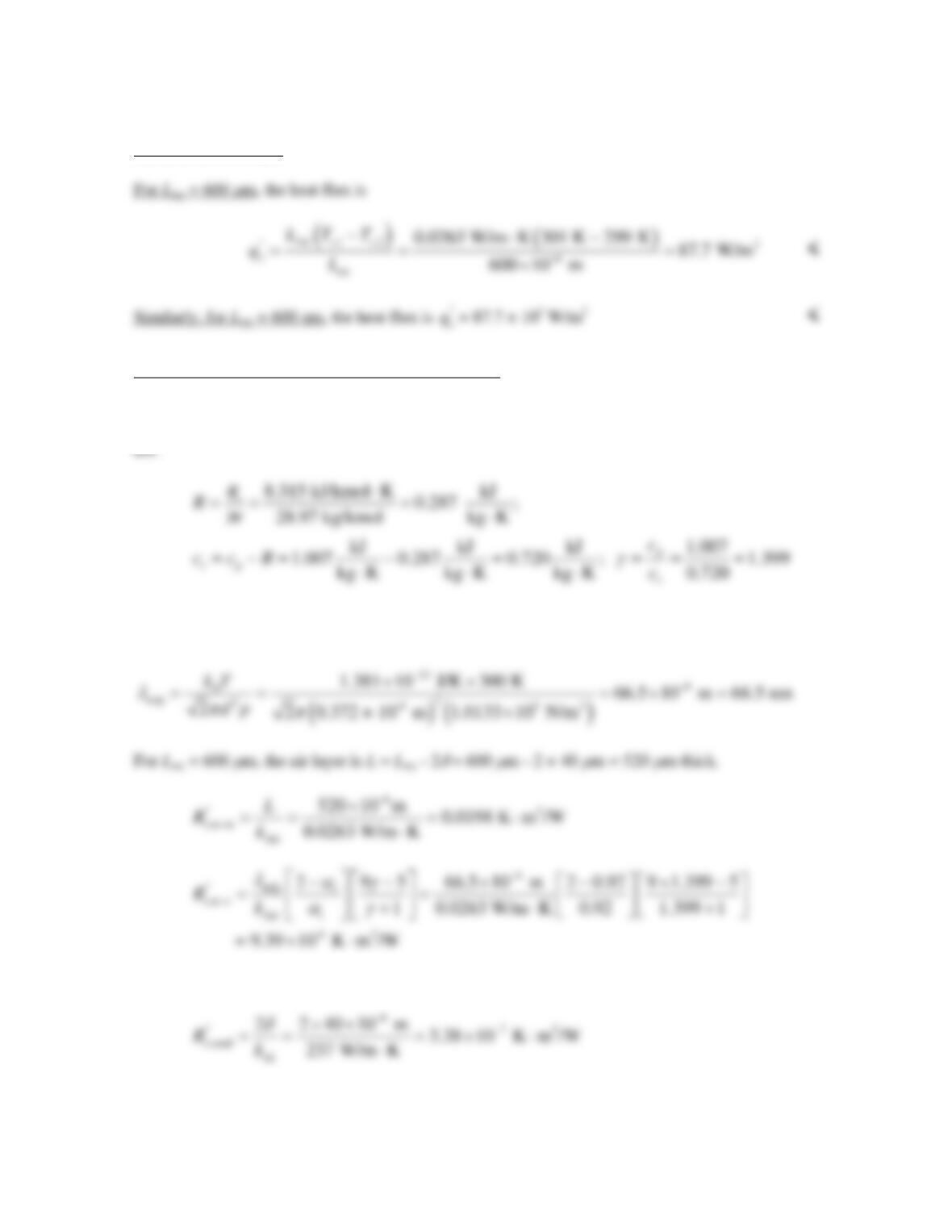
(b) Case B: Air Layer
(c) Case C: Air Layer between two Aluminum Sheets
This case involves a resistance due to molecule–molecule interactions, as well as molecule–surface
collisions. For air, the ideal gas constant, specific heat at constant volume, and ratio of specific heats
From Equation 2.11 the mean free path of air is
In addition, the aluminum sheets pose a cumulative thermal resistance of
Hence, the conduction heat flux is
Continued…
PROBLEM 3.137 (Cont.)
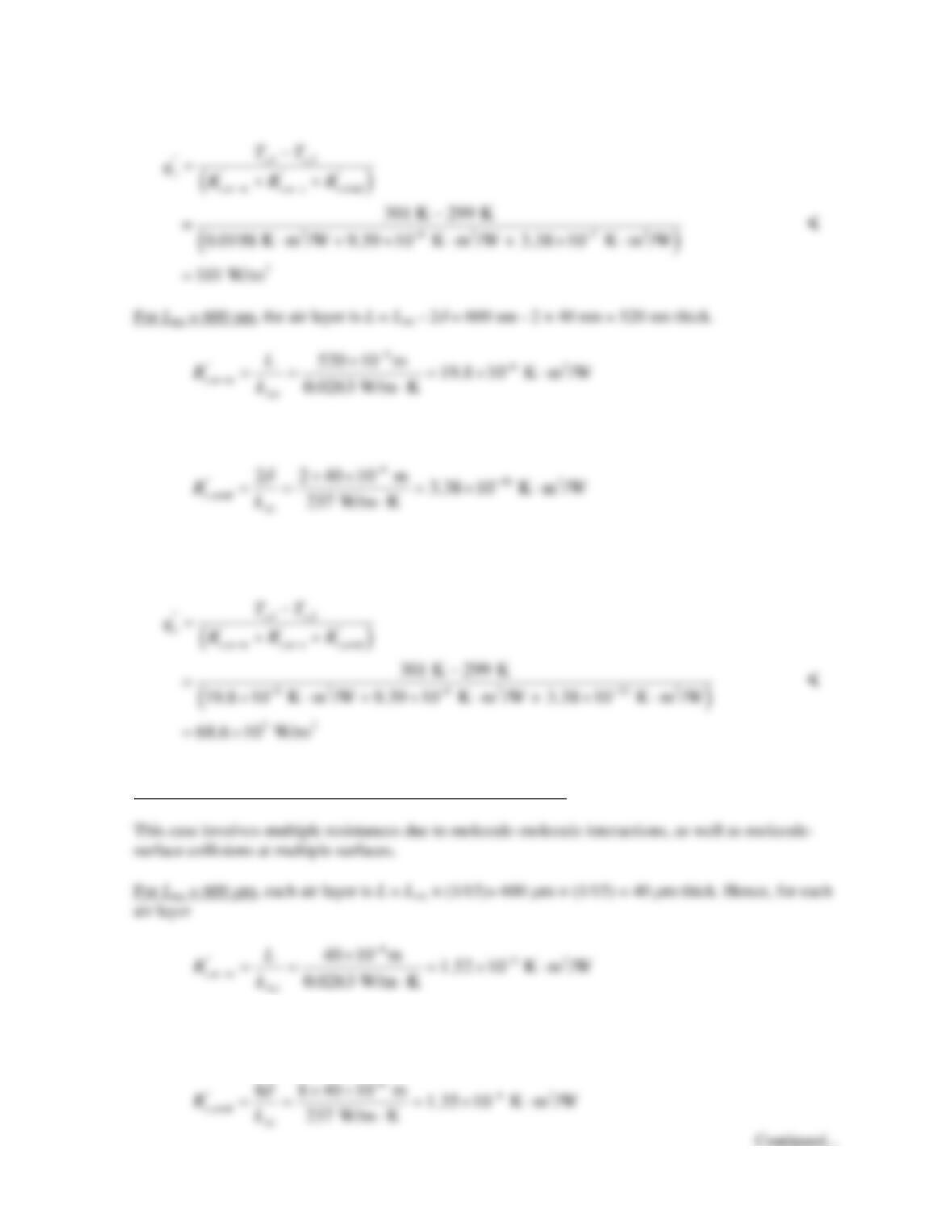
The aluminum sheets pose a cumulative thermal resistance of
Hence, the conduction heat flux is
(d) Case D: Seven Air Layers between Eight Aluminum Sheets
In addition, the aluminum sheets pose a cumulative thermal resistance of
Problem 3.137 (Cont.)
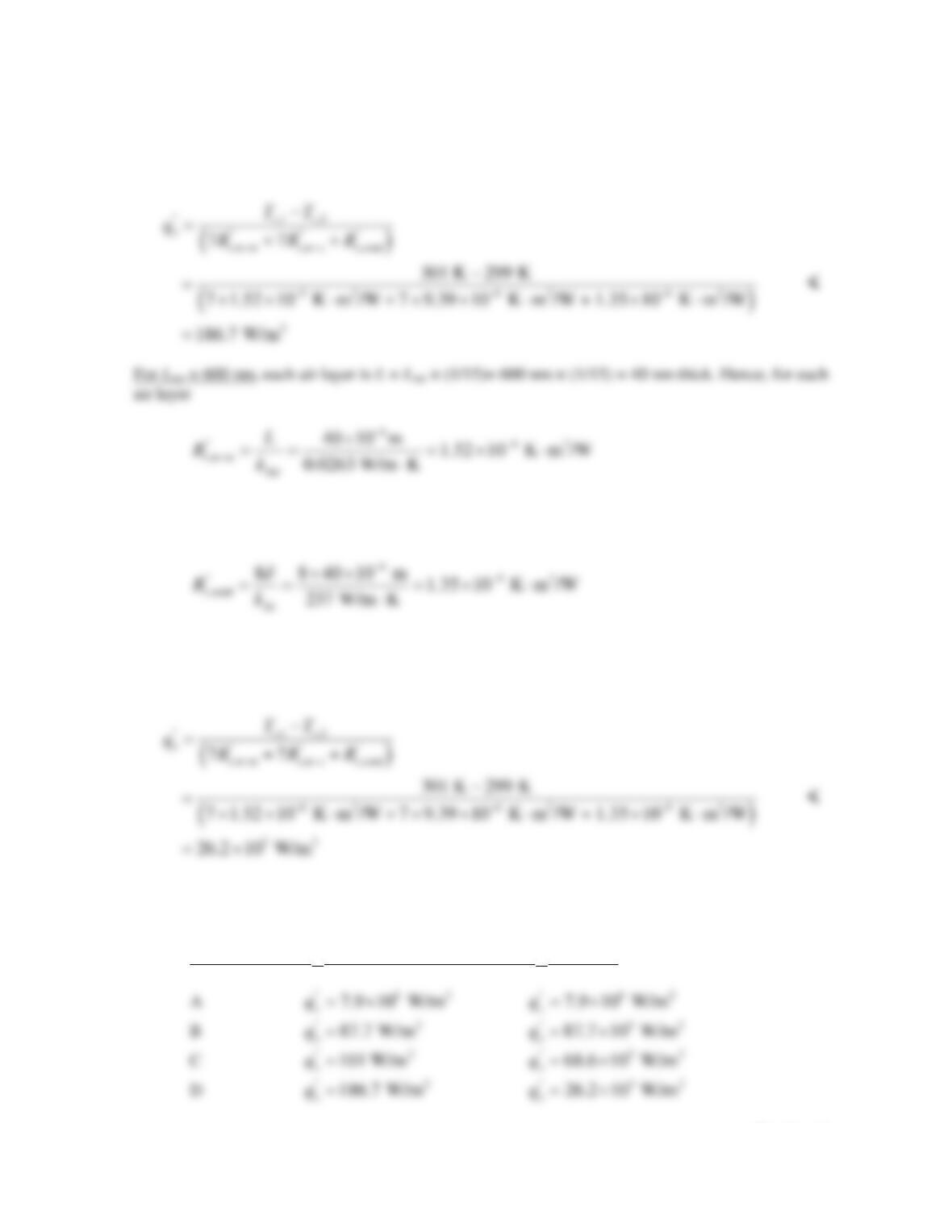
Hence, the conduction heat flux is
In addition, the aluminum sheets pose a cumulative thermal resistance of
Hence, the conduction heat flux is
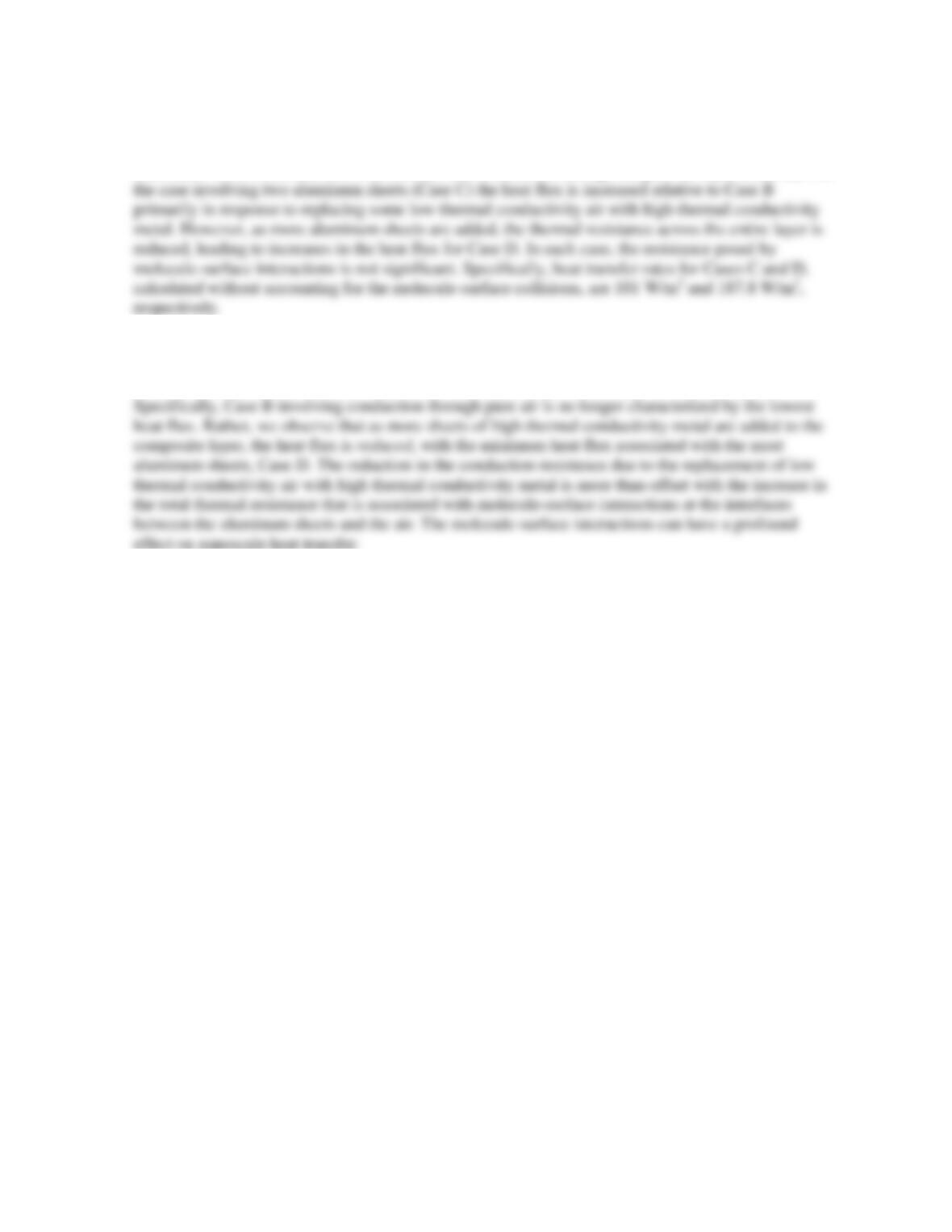
The predicted heat fluxes are summarized below.
Case Ltot = 600
µ
m Ltot = 600 nm
Continued…
PROBLEM 3.137 (Cont.)
COMMENTS: (1) For the Ltot = 600
µ
m cases, it is readily evident that the highest heat flux
corresponds to Case A in which conduction occurs exclusively through the high thermal conductivity
aluminum. The lowest heat flux is associated with conduction through the pure air layer (Case B). For
(2) For the Ltot = 600 nm cases, we again observe that the largest heat flux is associated with
conduction exclusively within the aluminum (Case A). However, consideration of the other three
cases reveals nanoscale behavior that would be unexpected from the macroscale point–of–view.
(3) Nanoscale effects could become important in the solid as the thickness of the solid approaches the
mean free path. See Table 2.1.
PROBLEM 3.138
KNOWN: Knudsen number, specific heat ratio and thermal accommodation coefficient for an ideal
gas and solid surface.
FIND: Expression for the the ratio of the thermal resistance due to molecule-surface collisions to the
thermal resistance associated with molecule-molecule collisions, Rt,m-s/Rt,m-m .
ASSUMPTIONS: (1) Ideal gas behavior.
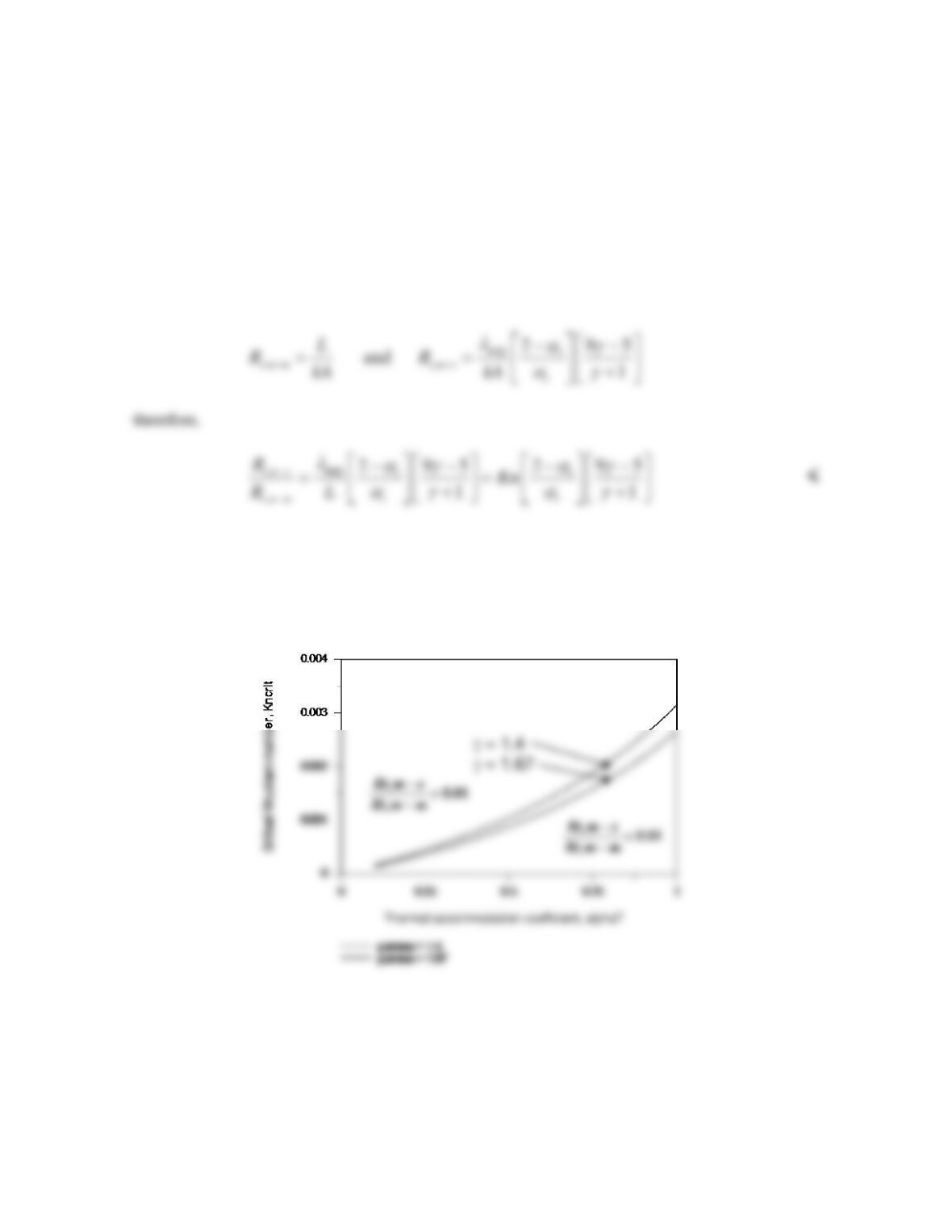
ANALYSIS: The expressions for Rt,m-m and Rt,m-s are
Associating the critical Knudsen number, Kncrit, with Rt,m-s/Rt,m-m = 0.01, we may plot the value of the
critical Knudsen number for
γ
= 1.4 and 1.67 over the range 0.01 ≤
a
t ≤ 1 as shown below.
COMMENTS: (1) Relatively large Knudsen numbers are associated with more significant surface–
molecule collisions. (2) The critical Knudsen number is relatively insensitive to the specific heat ratio,
γ
.
PROBLEM 3.139
KNOWN: Thickness of alternating tungsten and aluminum oxide layers, interface thermal resistance,
thermal conductivities of tungsten and aluminum oxide thin films.
FIND: (a) Effective thermal conductivity of the nanolaminate. Comparison with bulk thermal
conductivities of aluminum oxide and tungsten, (b) Effective thermal conductivity of the nanolaminate
using bulk values of the thermal conductivity of aluminum oxide and tungsten.
SCHEMATIC:
Aluminum oxide
Aluminum oxide
ASSUMPTIONS: (1) Steady–state, one–dimensional conditions, (2) Constant properties.
PROPERTIES: Table A.1, tungsten (300 K): kT = 174 W/m⋅K. Table A.2, aluminum oxide (300 K):
kA = 36 W/m⋅K.
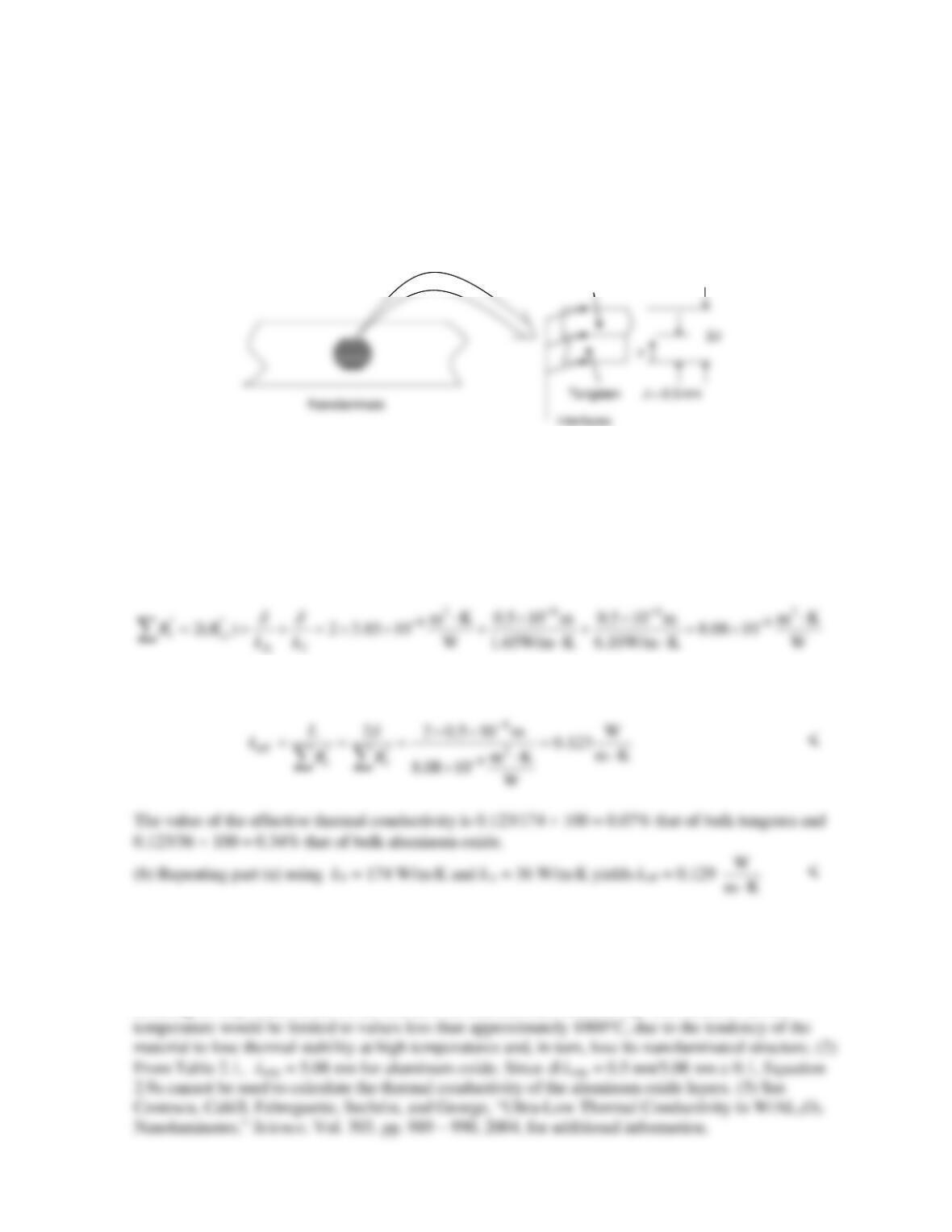
ANALYSIS: (a) Consider a unit cell consisting of one layer of aluminum oxide, one layer of
tungsten, and two interfaces of unit cell thickness 2
d
= 1.0 nm as shown in the schematic. The sum of
the thermal resistances is
The effective thermal conductivity is
COMMENTS: (1) The effective thermal conductivity is dominated by the interface resistances and
is relatively insensitive to the thermal conductivity of the two materials. Although the interface
resistance is very small compared to typical contact resistance values (see Table 3.2), by using
extremely thin layer thicknesses, many such interfaces may be packed into the laminated structure,
resulting in very small values of the effective or bulk thermal conductivity. The material service
PROBLEM 3.140
KNOWN: Dimensions of and temperature difference applied across thin gold film.
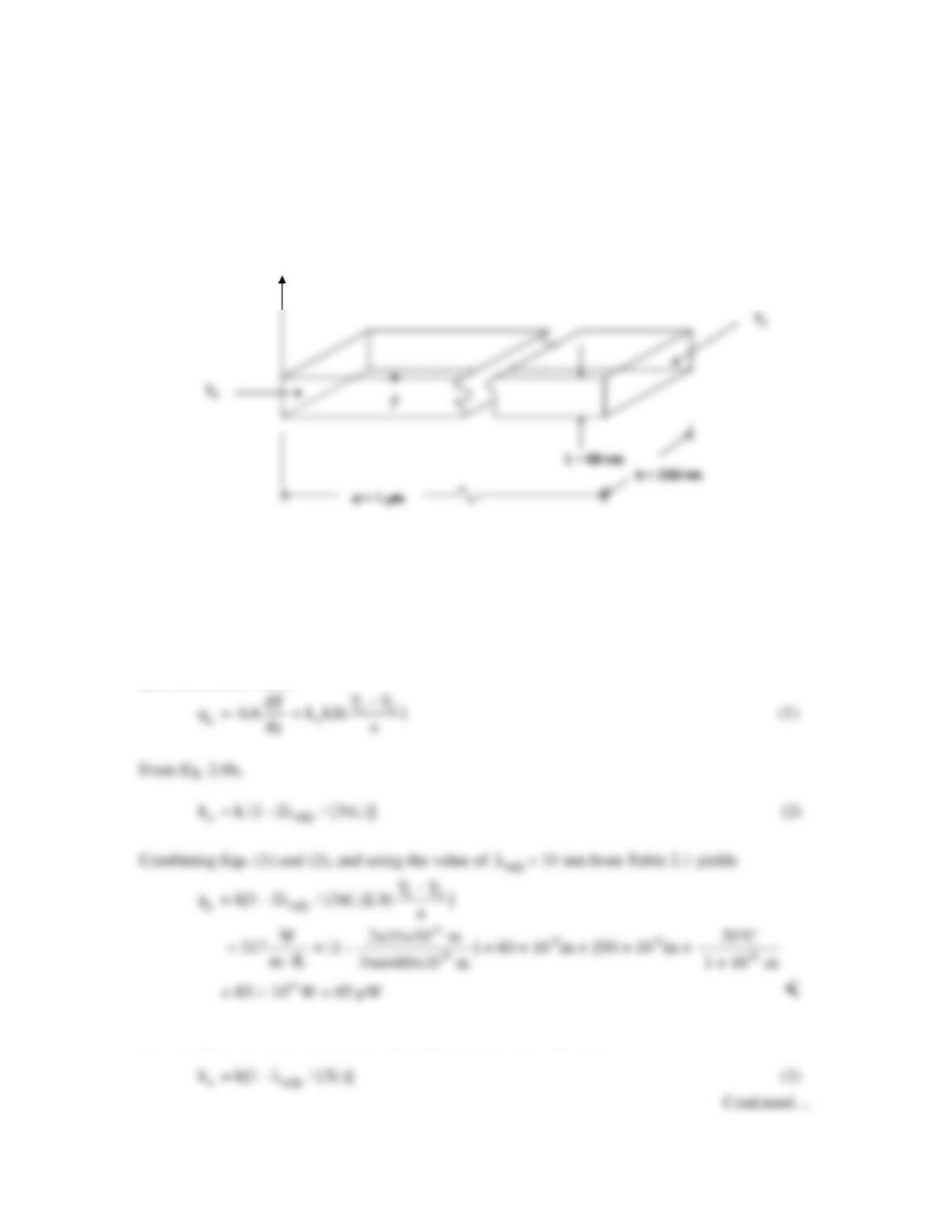
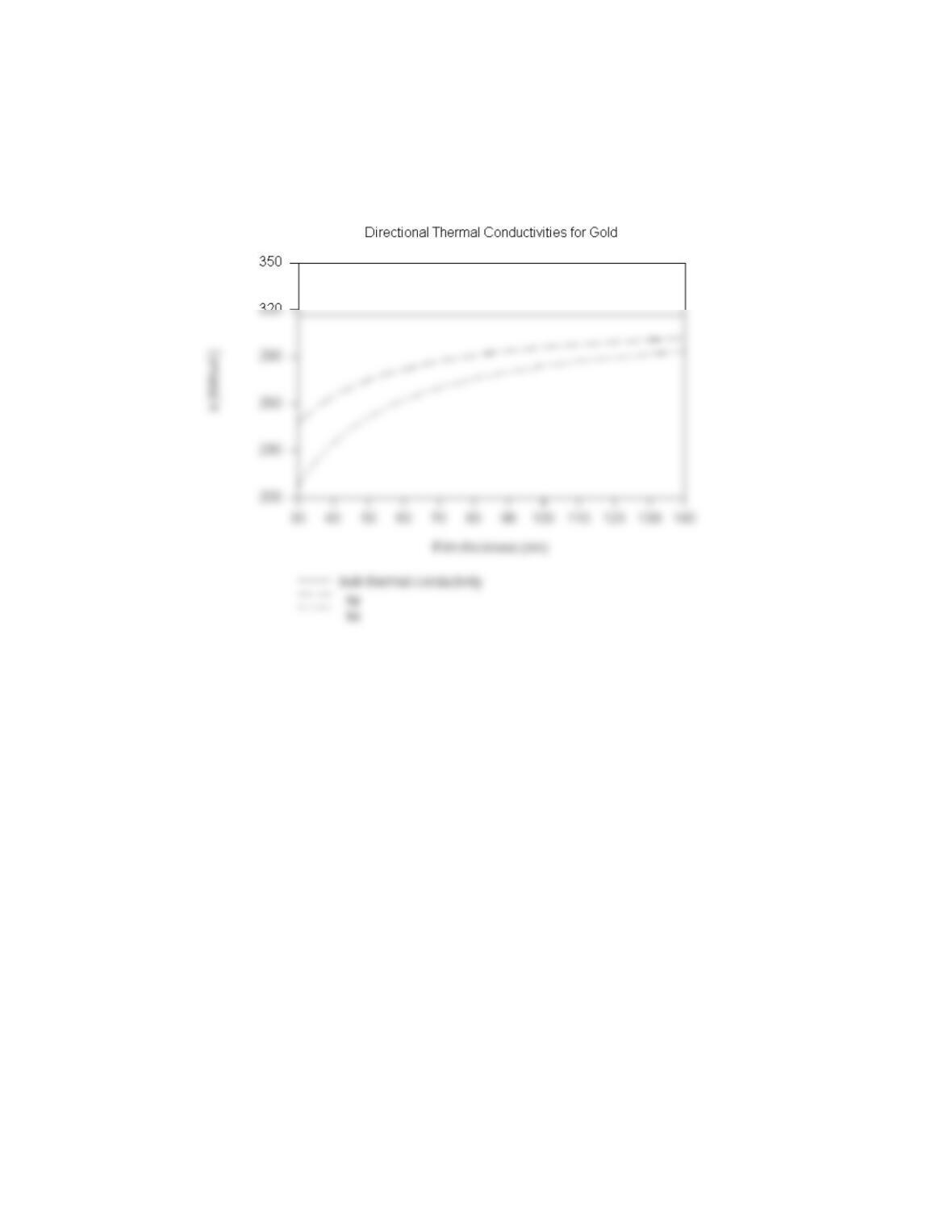
FIND: (a) Energy conducted along the film, (b) Plot the thermal conductivity along and across
the thin dimension of the film, for film thicknesses 30 ≤ L ≤ 140 nm.
SCHEMATIC:
ASSUMPTIONS: (1) One-dimensional conduction in the x– and y-directions, (2) Steady-state
conditions, (3) Constant properties, (4) Thermal conductivity not affected by nanoscale effects
associated with 250 nm dimension.
PROPERTIES: Table A.1, gold (bulk, 300 K): k = 317 W/m⋅K.
ANALYSIS:
a) From Fourier’s law,
(b) The spanwise thermal conductivity may be found from Eq. 2.9a,
x
PROBLEM 3.140 (Cont.)
The plot is shown below.
COMMENT: Nanoscale effects become less significant as the thickness of the film is increased.
PROBLEM 3.141
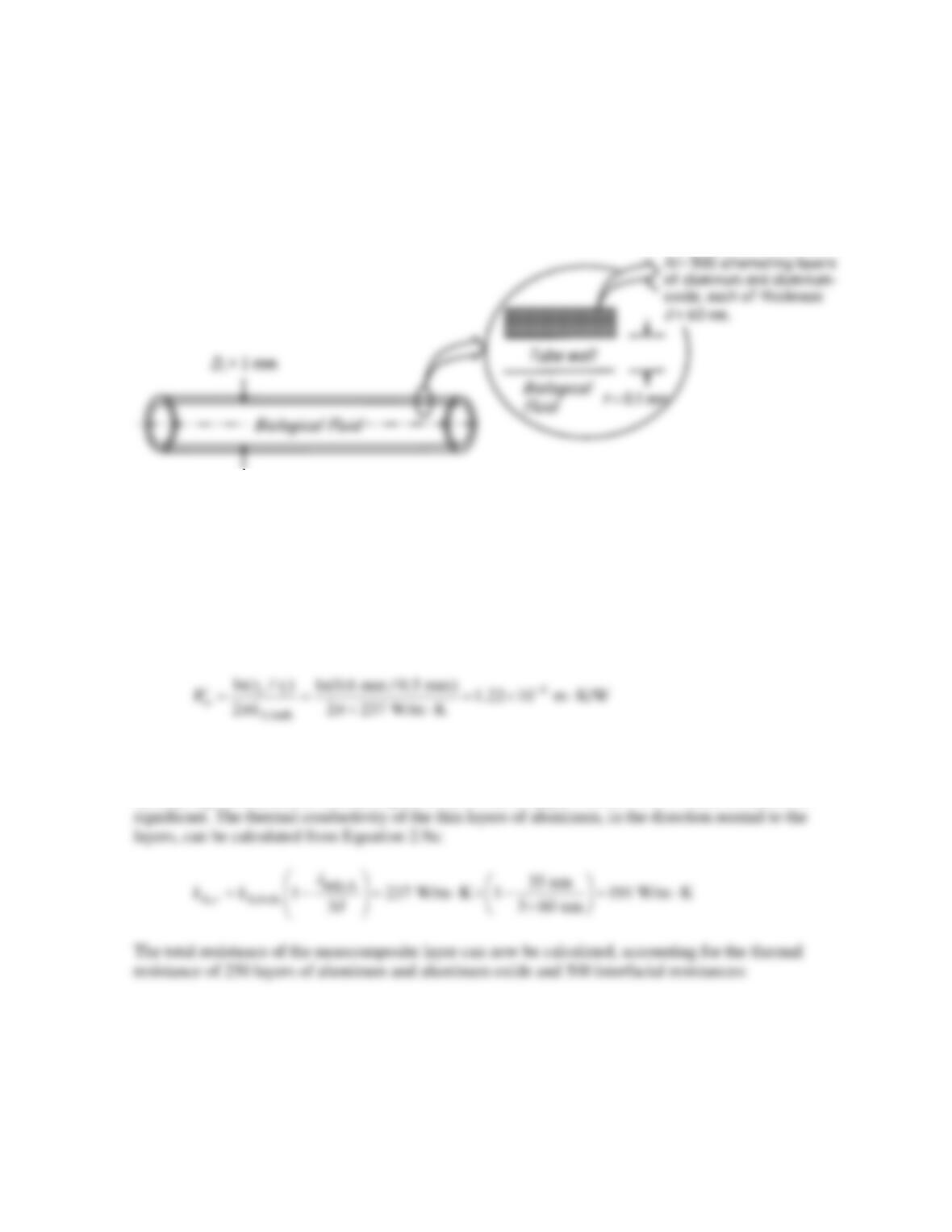
KNOWN: Dimensions of an aluminum tube. Thickness and number of alternating aluminum and
aluminum oxide layers used as insulating coating. Aluminum mean free path.
FIND: Thermal resistance for unit tube length for wall of aluminum tube and nanocomposite coating.
Comment on effectiveness of coating as thermal insulator.
SCHEMATIC:
ASSUMPTIONS: (1) Steady–state, one–dimensional conditions, (2) Constant properties, (3) The
coating can be treated as a plane wall since it is thin in relation to the tube diameter.
PROPERTIES: Table 3.6, Aluminum/aluminum oxide:
,
′′
tb
R
= 95 × 10–10 m2⋅K/W. Table A.1, pure
aluminum (300 K): kA,bulk = 237 W/m⋅K; Table A.2, sapphire (300 K): kS,bulk = 46 W/m⋅K. Given,
l
mfp,A = 35 nm.
ANALYSIS: The thermal resistance of the tube wall (for a unit length) is:
Referring to Table 2.1, for aluminum oxide the layer thickness of 60 nm is greater than the critical
value Lcrit,x, therefore no correction is needed to its bulk thermal conductivity. For aluminum, however,
considering the discussion beneath Equations 2.9, with
d
/
l
mfp,A = 60/35 = 1.7 < 7, the correction is
Continued …
PROBLEM 3.141 (Cont.)
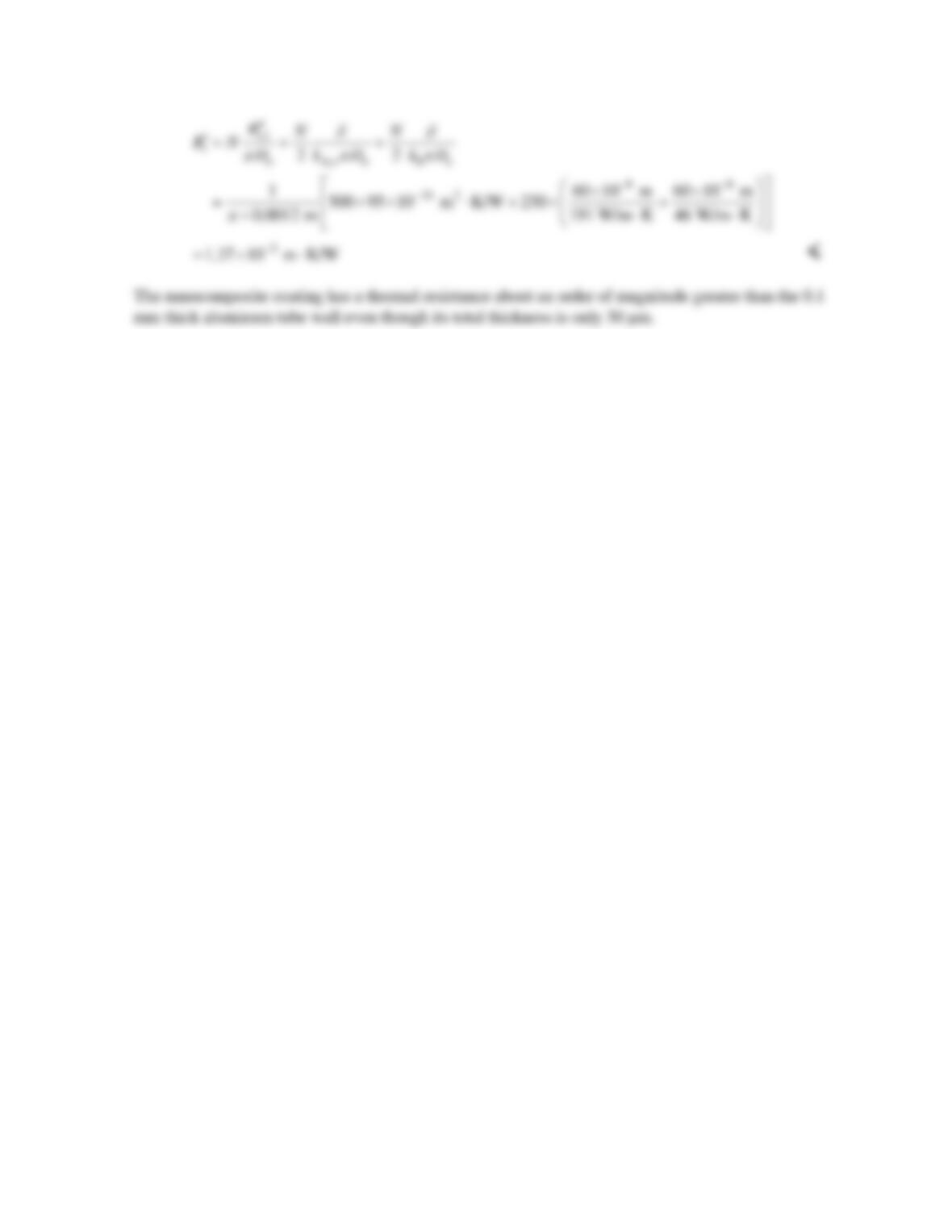
COMMENTS: The thermal resistance of the nanocomposite is dominated by the interface
resistances and is relatively insensitive to the thermal conductivity of the two materials. Although the
interface resistance is very small compared to typical contact resistance values (see Table 3.2), by
using extremely thin layer thicknesses, many such interfaces may be packed into the nanocomposite
structure, resulting in a large total thermal resistance.