Problem 3.20
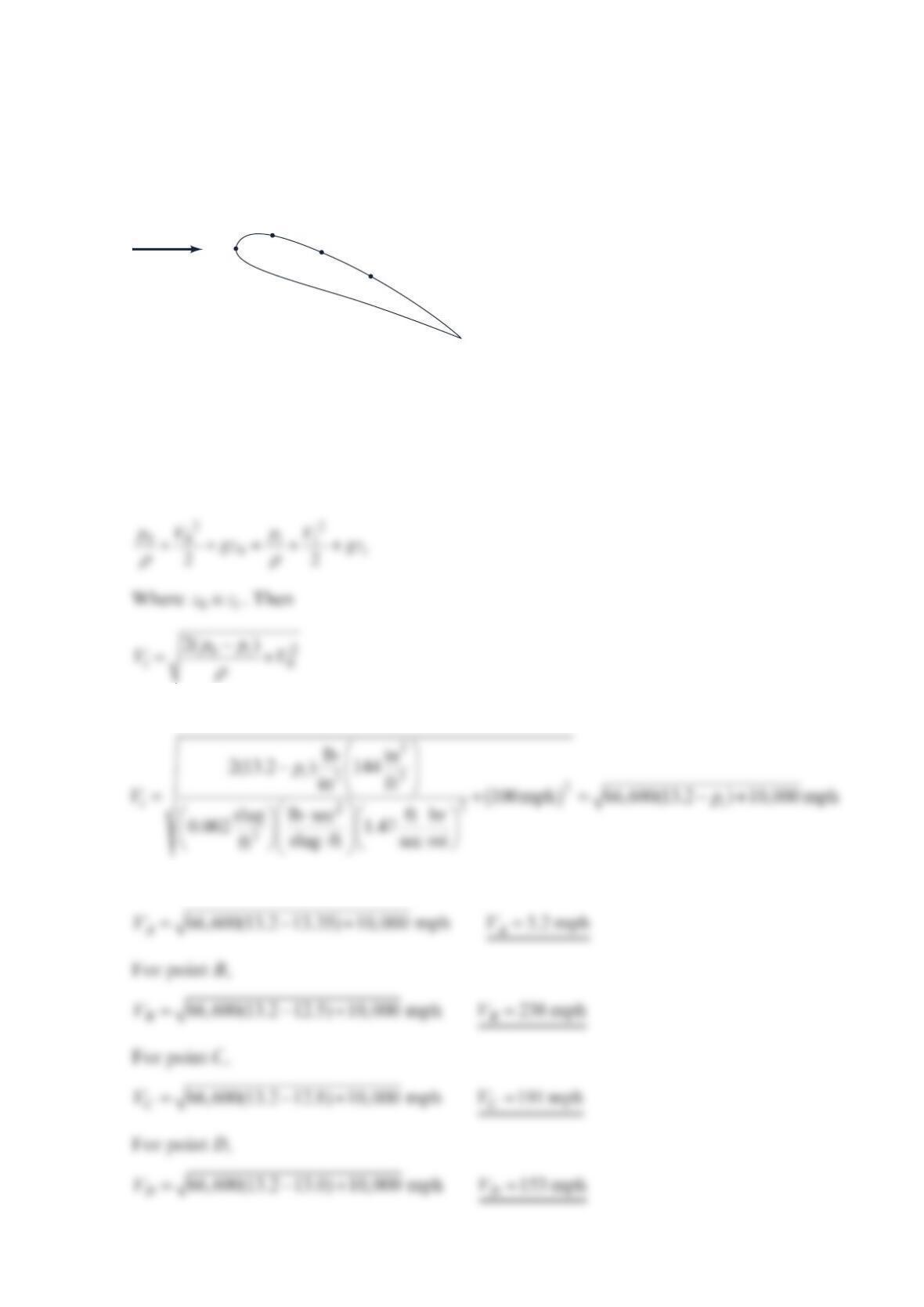
Air flows over the airfoil shown in the figure below. Sensors give the pressures shown at
points ,,ABC
, and D. Find the air velocities just above points ,,ABC
, and D. The air
density is 3
0.0020slug / ft .
Solution 3.20
Assume inviscid, constant air density. Apply Bernoulli’s equation between point 0 and
point ( ,,, )ii ABCD=,
The known values give
For point
A
,
AB
C
D
p
A = 13.35 psia
p
B = 12.5 psia
p
C = 12.8 psia
p
D = 13.0 psia
V
0 = 100 mph
p
0 = 13.20 psia
Problem 3.21
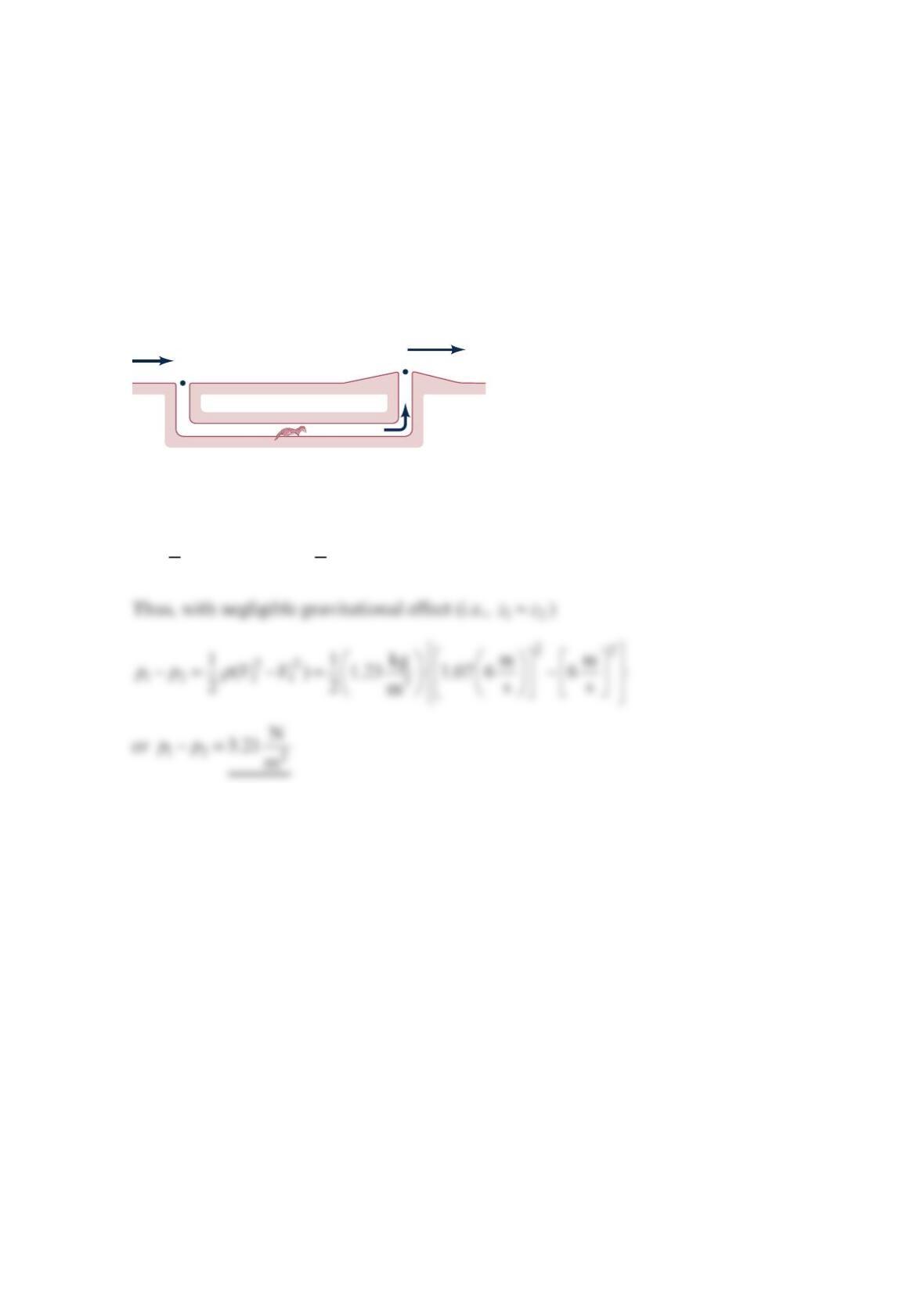
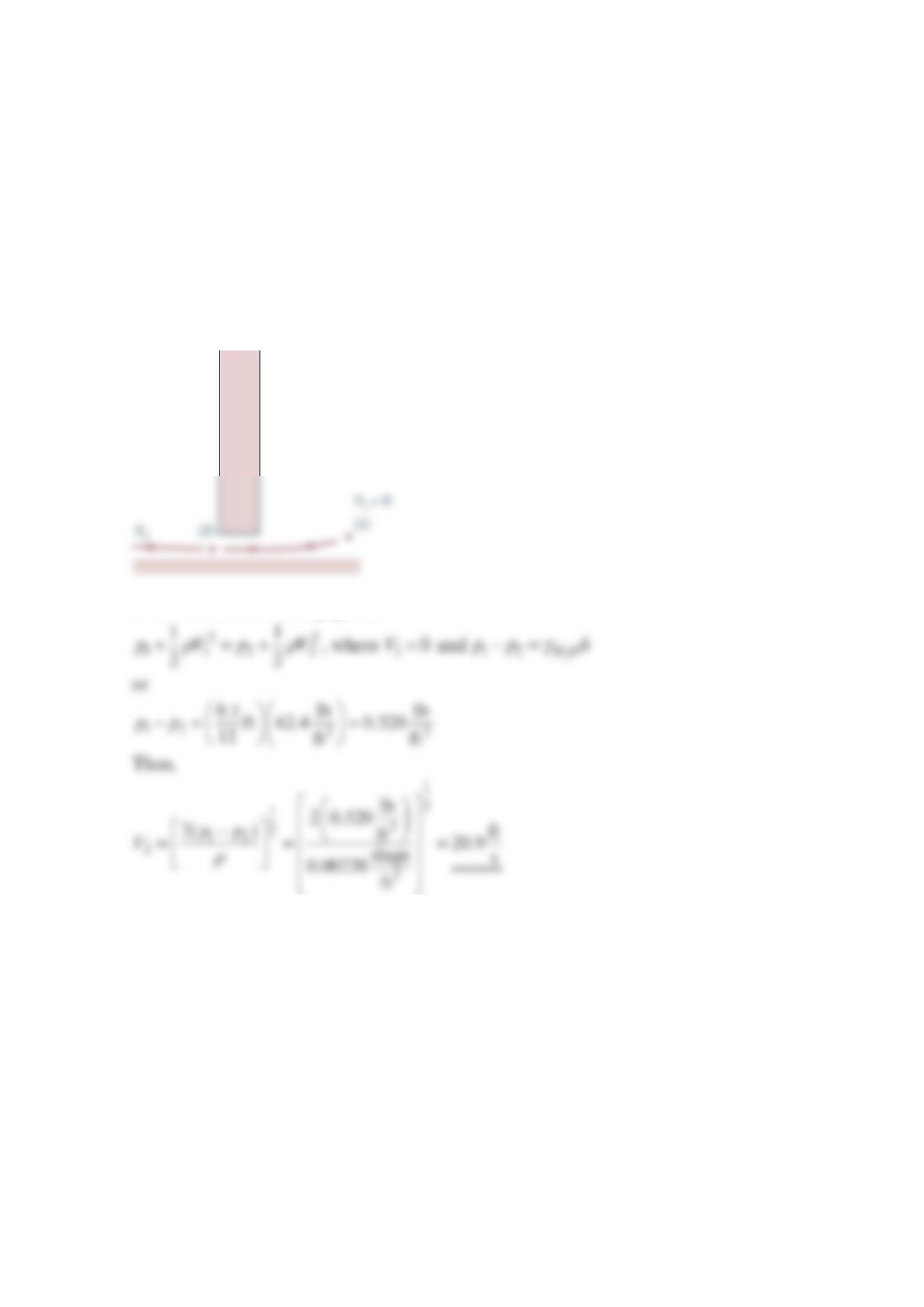
Some animals have learned to take advantage of the Bernoulli’s effect without having read
a fluid mechanics book. For example, a typical prairie dog burrow contains two entranc-
es—a flat front door and a mounded back door as shown in the figure below. When the
wind blows with velocity 0
V across the front door, the average velocity across the back
door is greater than 0
V because of the mound. Assume the air velocity across the back door
is 0
1.07V. For a wind velocity of 6 m/s, what pressure differences, 12
p
p−, are generated to
provide a fresh airflow within the burrow?
Solution 3.21
22
1112 22
11
22
p
Vzp Vz
ργ ργ
++=++
1.07
V
0
(1) (2)
V
0
Q
Problem 3.23
2013 Indianapolis 500 champion Tony Kanaan holds his hand out of his IndyCar while
driving through still air with standard atmospheric conditions. (a) For safety, the pit lane
speed limit is 60 mph . At this speed, what is the maximum pressure on his hand? (b) Back
on the race track, what is the maximum pressure when he is driving his IndyCar at 225 mph ?
(c) On the straightaways, the IndyCar reaches speeds in excess of 235 mph . For this speed,
is your solution method for parts (a) and (b) reasonable? Explain.
Solution 3.23
(a)
22
11 2 2
12
22
pV p V
zz
gg
γγ
++=++
with
12
zz=
Problem 3.24
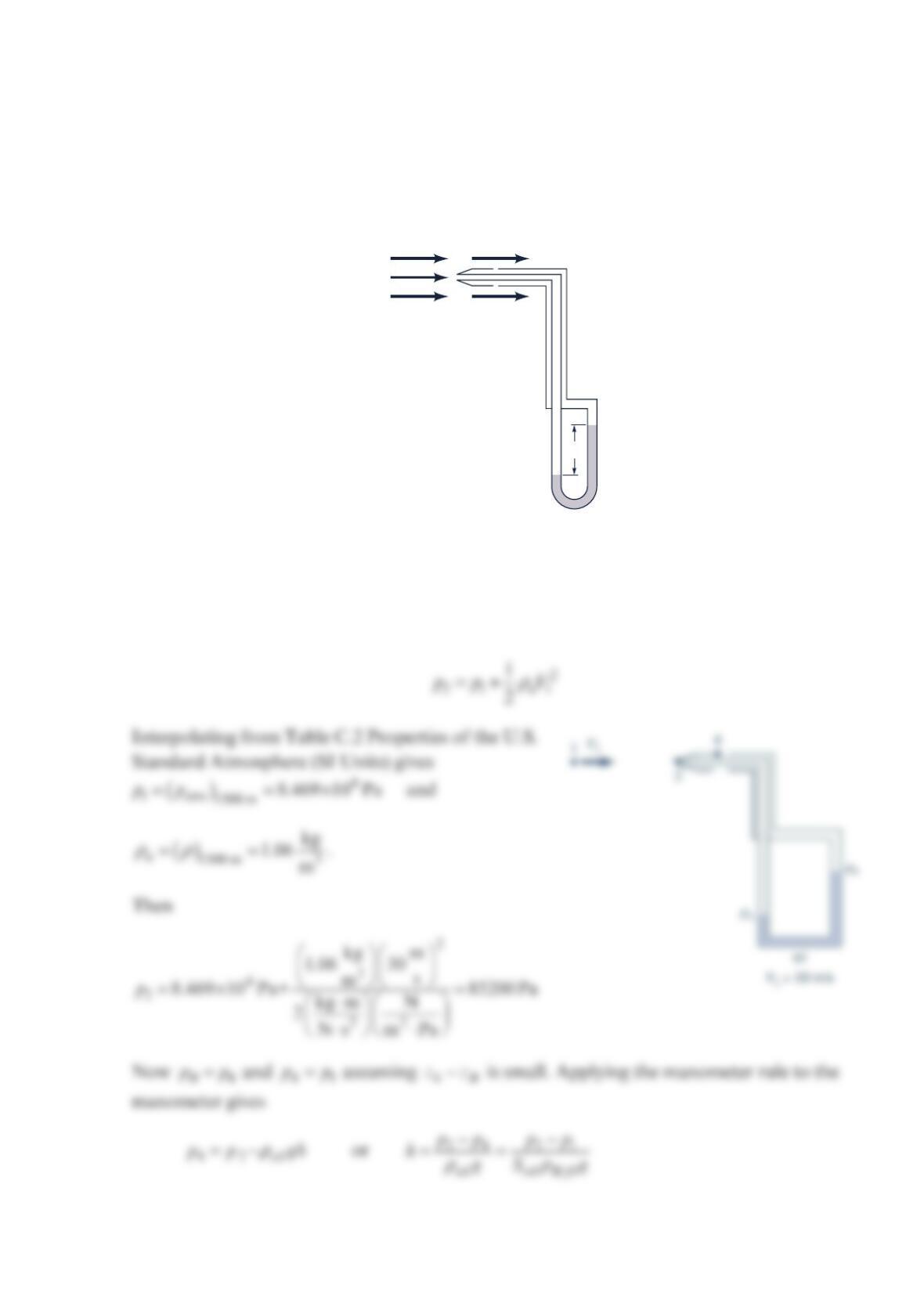
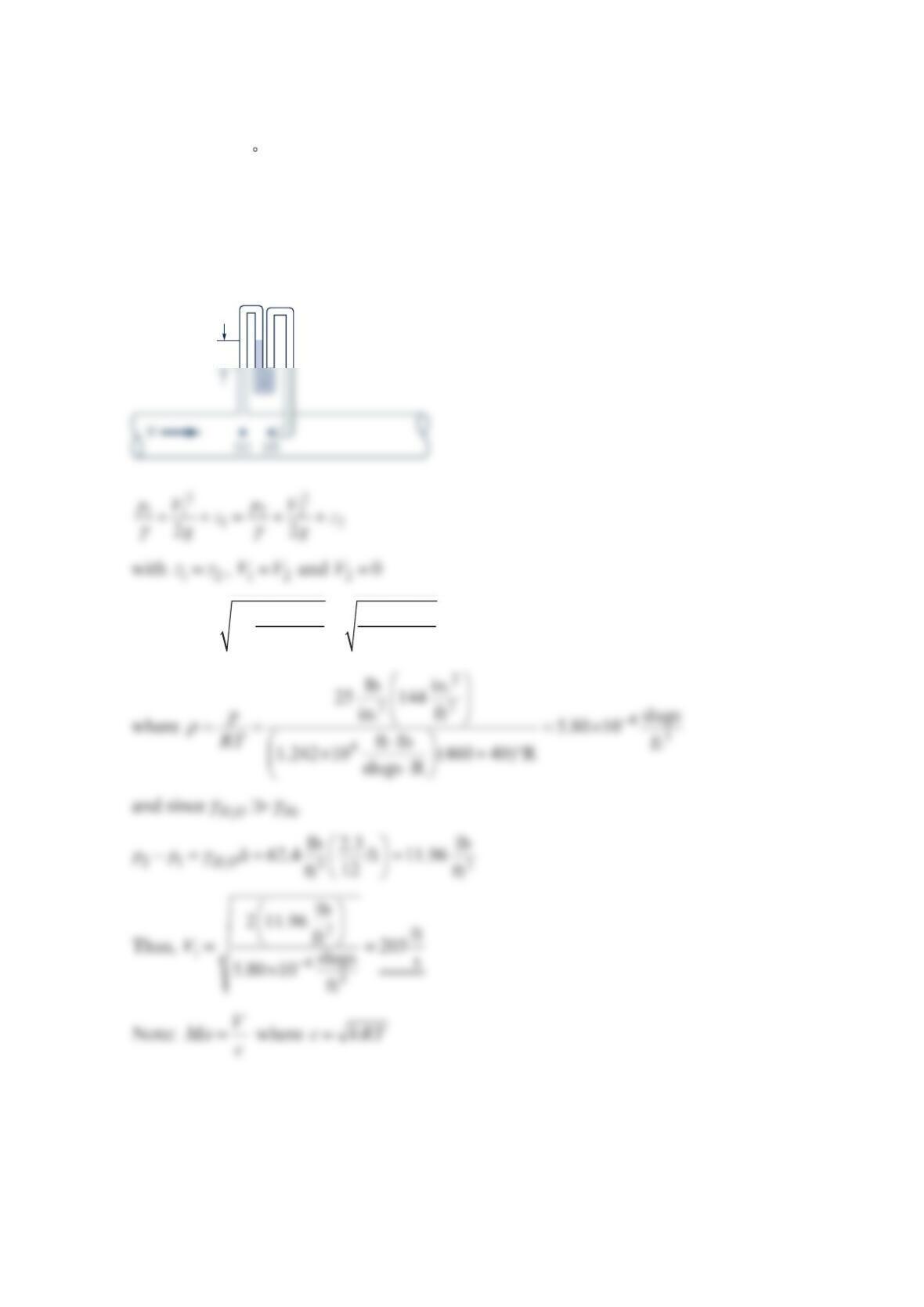
What is the minimum height for an oil ( 0.75SG =) manometer to measure airplane speeds
up to 30 m / s at altitudes up to 1500 m ? The manometer is connected to a Pitot-static tube
as shown in the figure below.
Solution 3.24
Assume the air incompressible for these low speeds. Assuming frictionless flow, Bernoulli’s
equation gives from 1 to 2 (the stagnation point) for an observer on the airplane.
h
V = 30 m/s
SG = 0.75
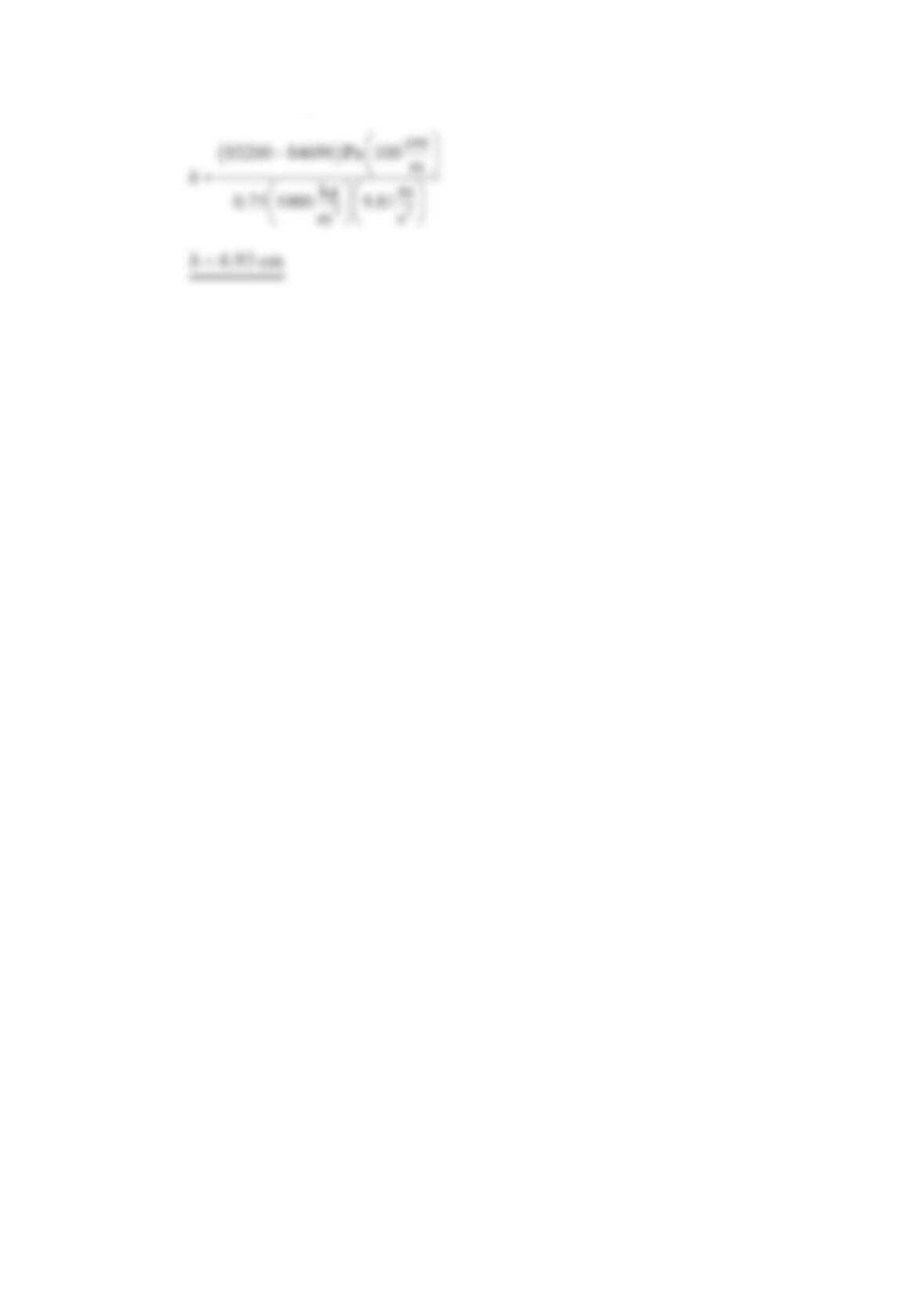
The numerical values give
Problem 3.25
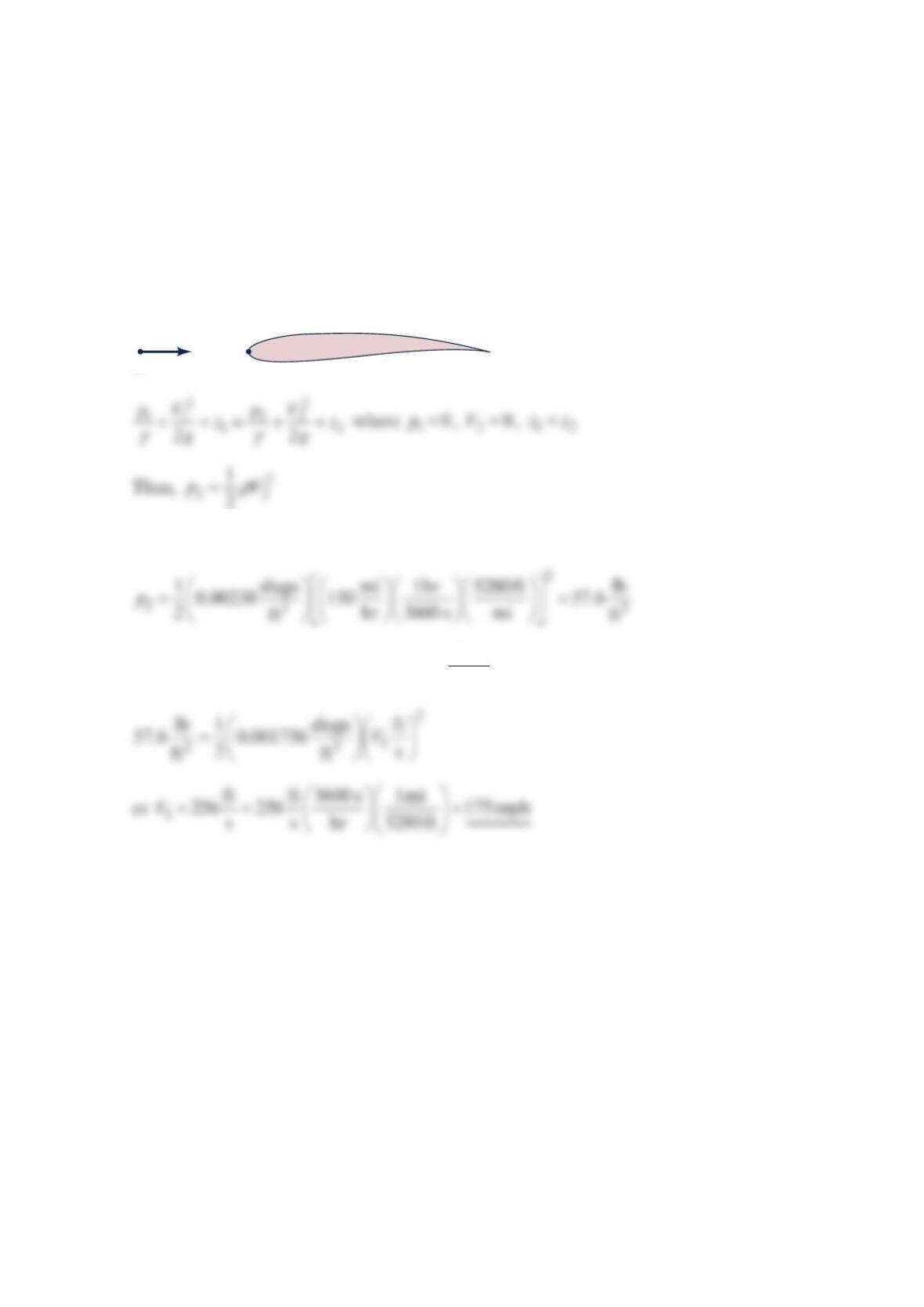
A Pitot-static tube is used to measure the velocity of helium in a pipe. The temperature and
pressure are 40 F and 25 psia . A water manometer connected to the Pitot-static tube indi-
cates a reading of 23 in. Determine the helium velocity. Is it reasonable to consider the flow
as incompressible? Explain.
Solution 3.25
Thus, 21 21
1
()2()
2
p
ppp
Vg
γρ
−−
==
h
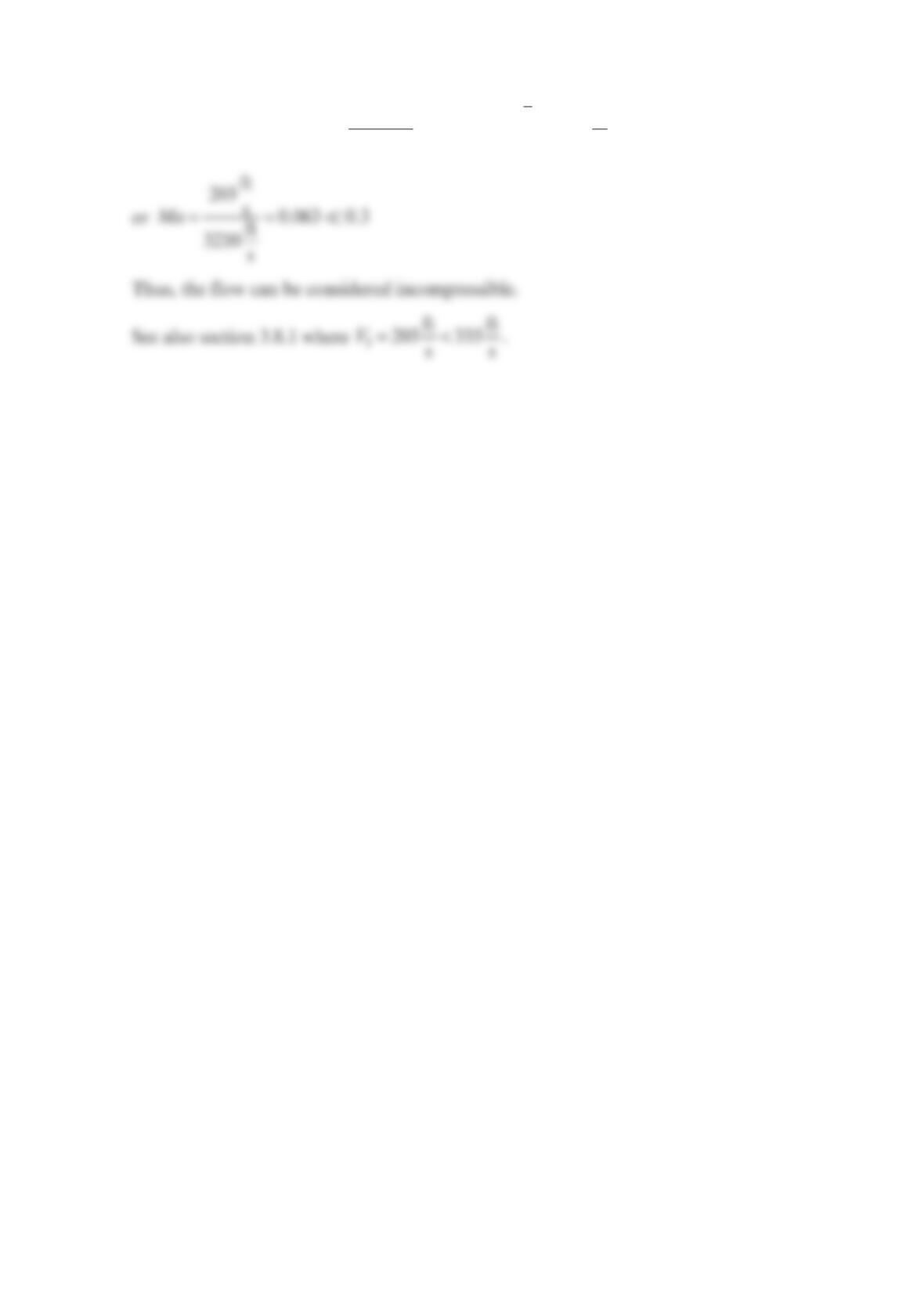
Thus,
1
2
4ft lb ft
1.66(1.242 10 ) (460 40) R 3210
slug R s
c
⋅
=× +°=
⋅°
Problem 3.26
A Bourdon-type pressure gage is used to measure the pressure from a Pitot tube attached to
the leading edge of an airplane wing. The gage is calibrated to read in miles per hour at
standard sea level conditions (rather than psi). If the airspeed meter indicates 150 mph
when flying at an altitude of 10,000ft , what is the true airspeed?
Solution 3.26
If the gage reads 150 mph then, since it is calibrated at sea level,
Hence, at 10,000 ft where 3
slugs
0.001756 ft
ρ
=
this pressure corresponds to
V
1
(2)
(1)
Problem 3.28
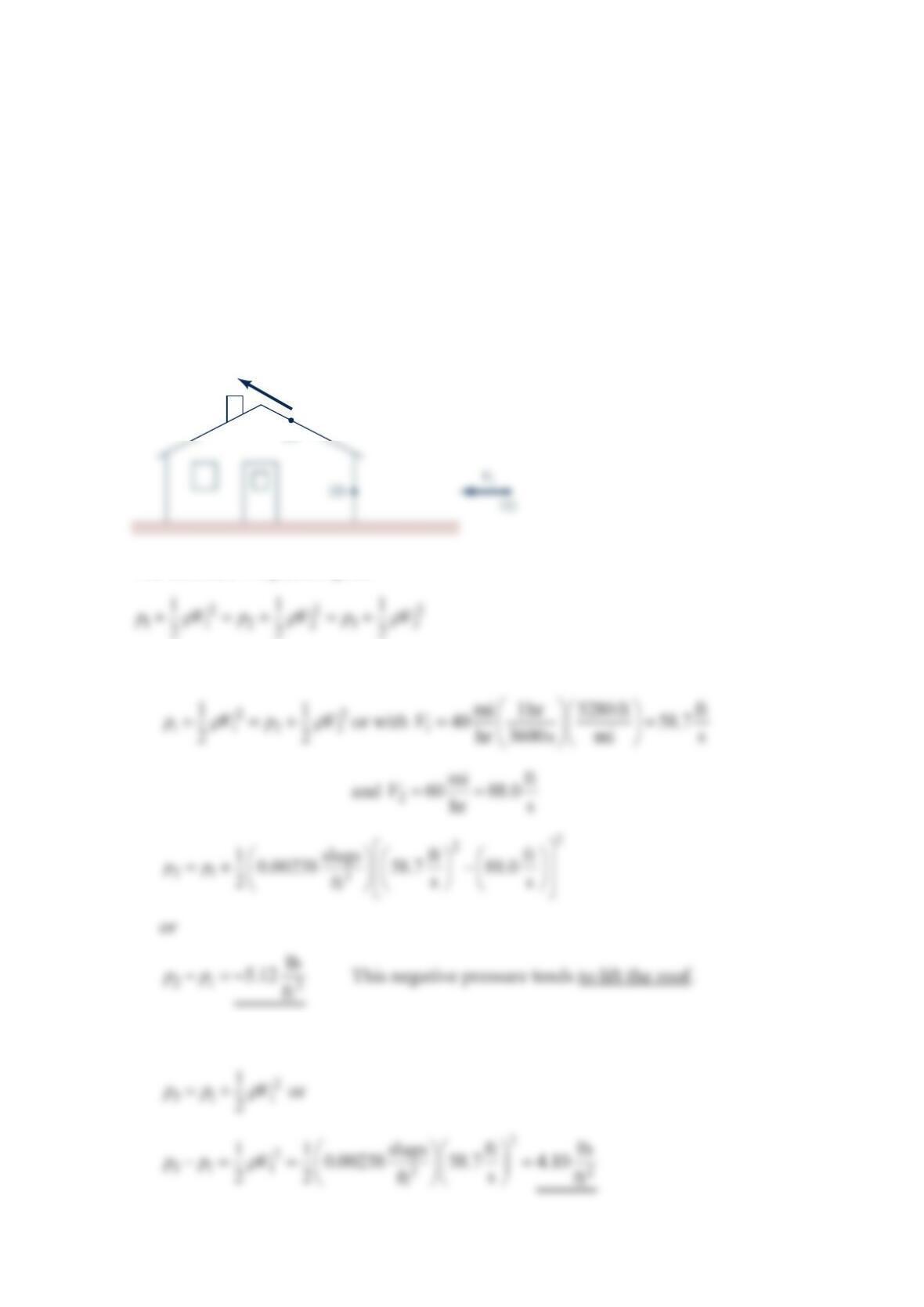
A 40-mph wind blowing past your house speeds up as it flows up and over the roof. If ele-
vation effects are negligible, determine (a) the pressure at the point on the roof where the
speed is 60 mph if the pressure in the free stream blowing toward your house is 14.7 psia .
Would this effect tend to push the roof down against the house, or would it tend to lift the
roof? (b) Determine the pressure on a window facing the wind if the window is assumed to
be a stagnation point.
Solution 3.28
The Bernoulli’s equation gives
a) Thus, from (1) to (2):
b) From (1) to (3): Since 30V=,
(2)
V2
Problem 3.29
Pressurized eyes Our eyes need a certain amount of internal pressure in order to work
properly, with the normal range being between 10 and 20 mm of mercury. The pressure is
determined by a balance between the fluid entering and leaving the eye. If the pressure is
above the normal level, damage may occur to the optic nerve where it leaves the eye,
leading to a loss of the visual field termed glaucoma. Measurement of the pressure within
the eye can be done by several different noninvasive types of instruments, all of which
measure the slight deformation of the eyeball when a force is put on it. Some methods use a
physical probe that makes contact with the front of the eye, applies a known force, and
measures the deformation. One noncontact method uses a calibrated “puff” of air that is
blown against the eye. The stagnation pressure resulting from the air blowing against the
eyeball causes a slight deformation, the magnitude of which is correlated with the pressure
within the eyeball. (See Problem 3.29.)
Determine the air velocity needed to produce a stagnation pressure equal to 10 mm of
mercury.
Solution 3.29
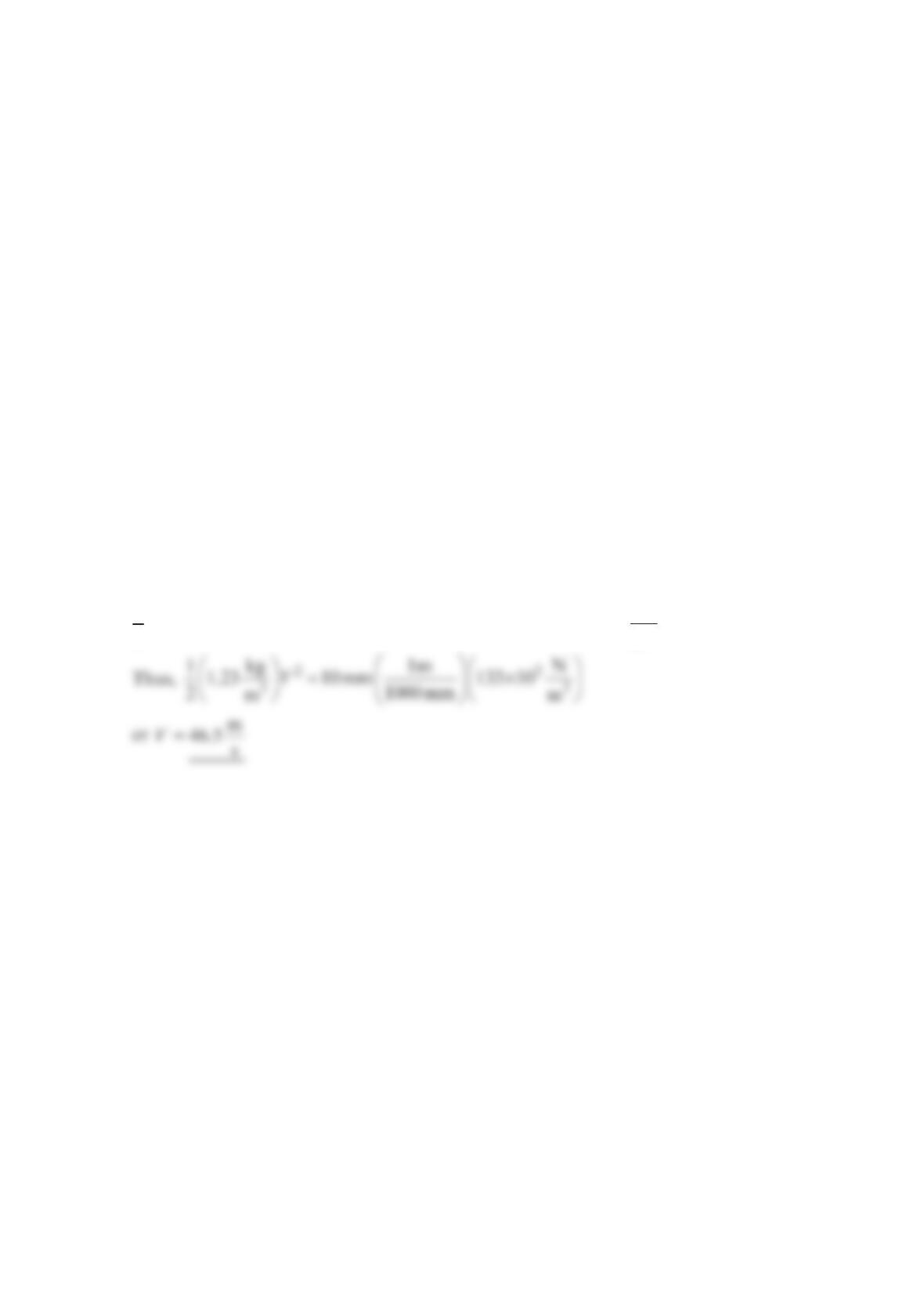
2
110 mm of mercury=
2stag Hg
Vp h
ργ
== , where 3
3
N
133 10 m
Hg
γ
=×
Problem 3.30
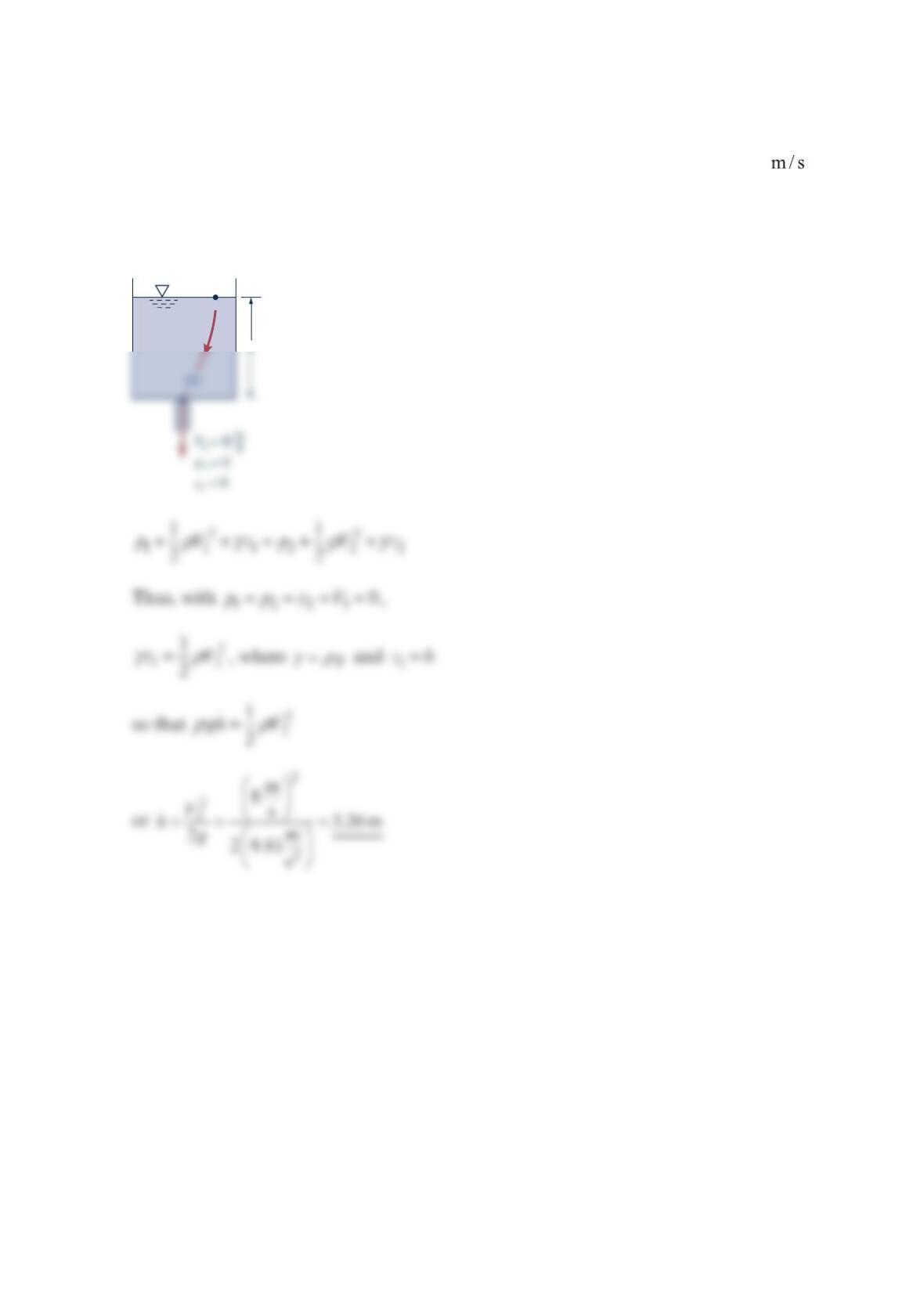
Water flows through a hole in the bottom of a large, open tank with a speed of 8.
Determine the depth of water in the tank. Viscous effects are negligible.
Solution 3.30
(1)
p
1
= 0
V
1
= 0
z
1
=
h
Problem 3.32
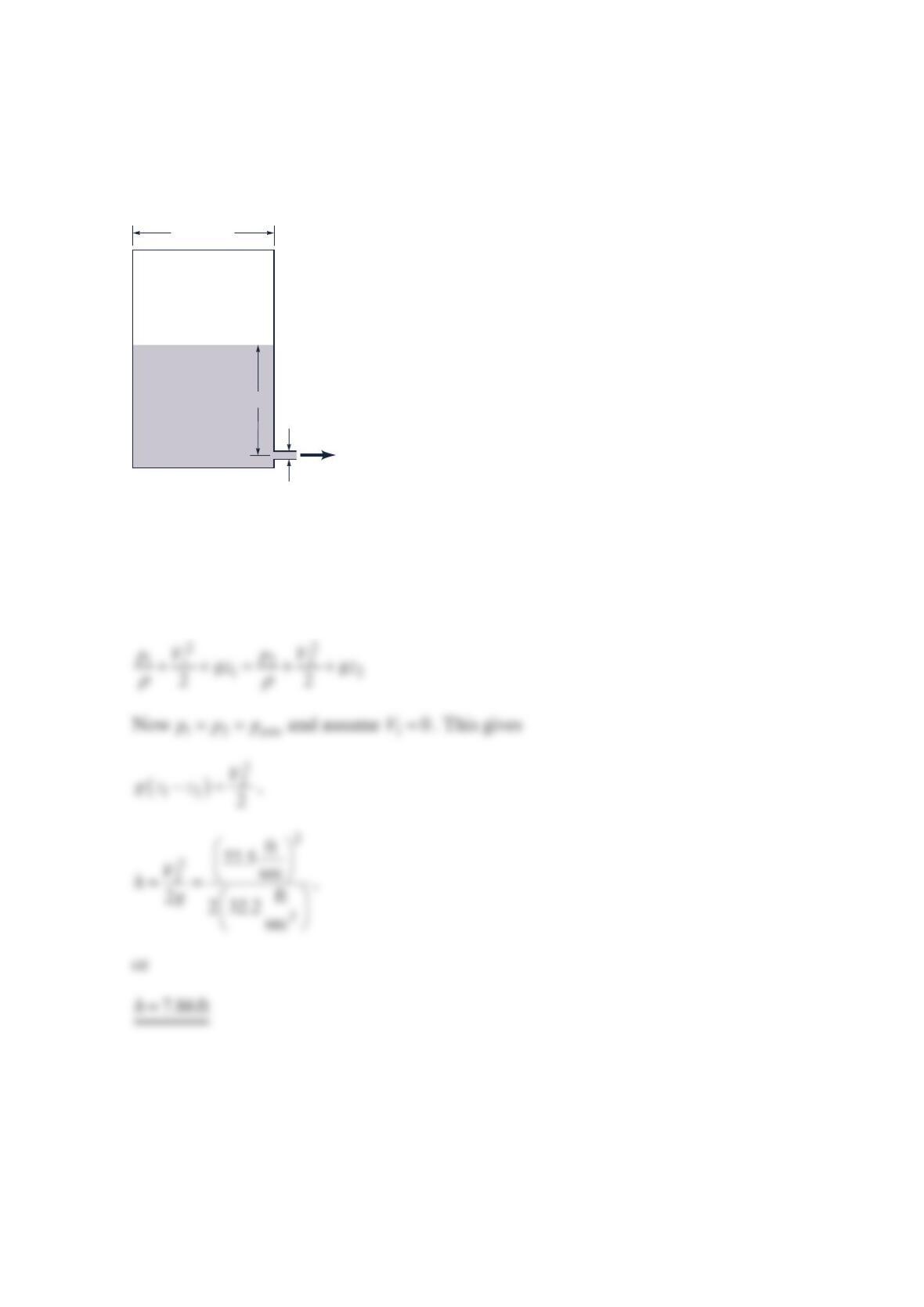
The tank shown in the figure below contains air at atmospheric pressure above the water
surface. The velocity of the water flowing from the tank is 22.5ft / sec . Determine the water
level ( h).
Solution 3.32
Assume quasi-steady state and constant water density. Apply Bernoulli’s equation to a
streamline connecting the water surface (1) to the exit (2),
V
2
= 22.5 ft/sec
h
d
2
Air
p
= 14.7 psia
D
= 12 in.
Problem 3.33
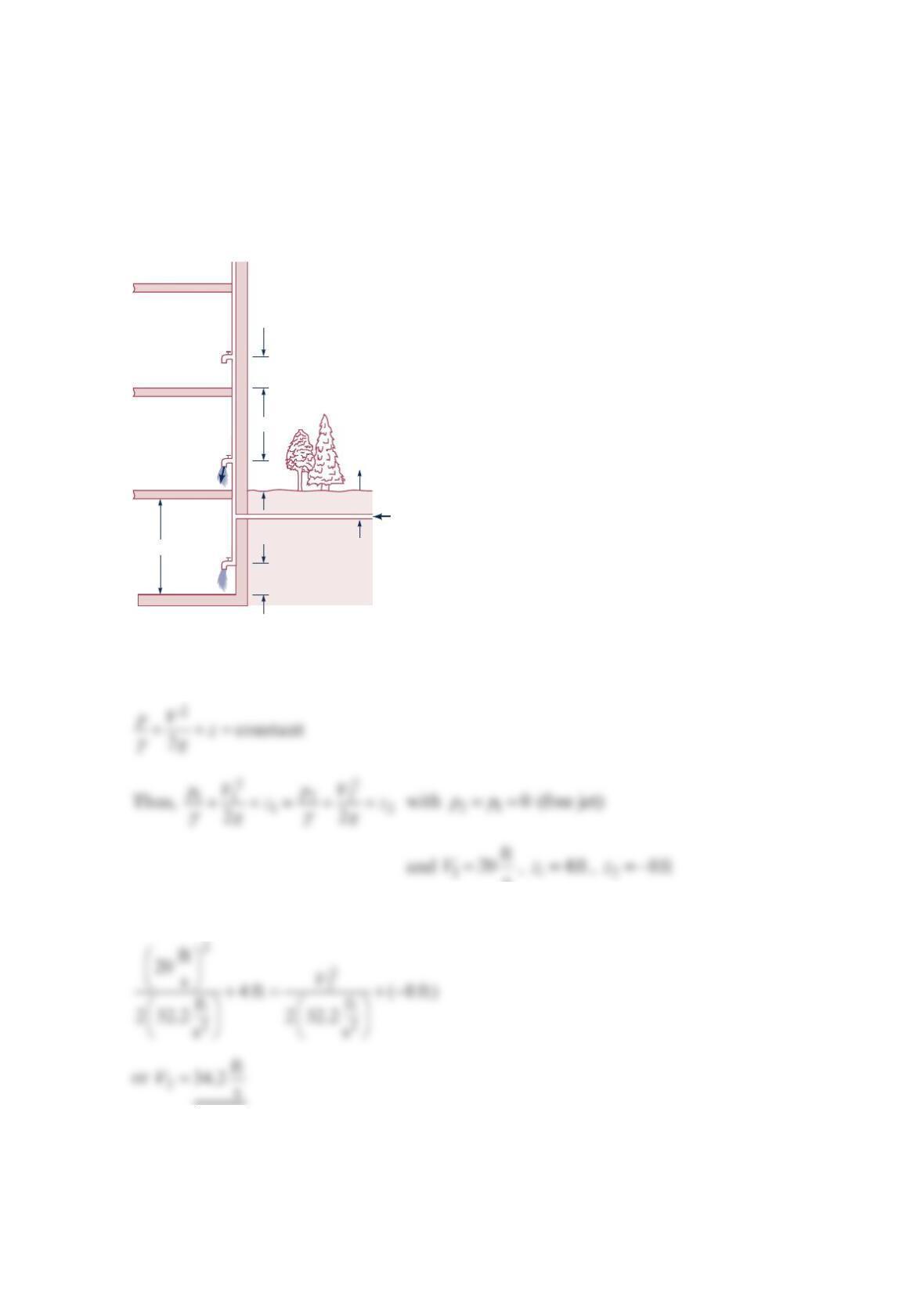
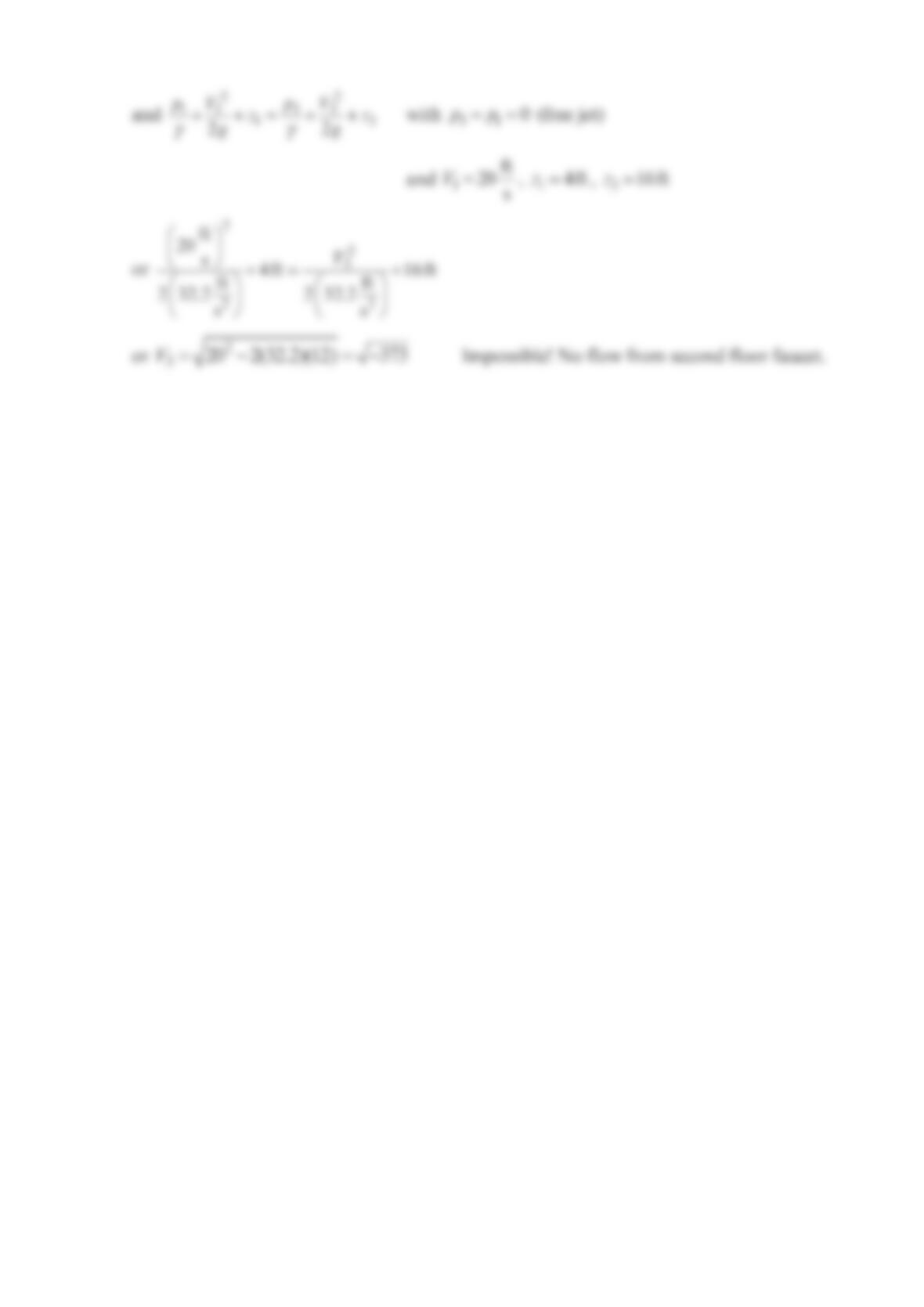
Water flows from the faucet on the first floor of the building shown in the figure below with
a maximum velocity of 20ft/s . For steady inviscid flow, determine the maximum water
velocity from the basement faucet and from the faucet on the second floor (assume each
floor is 12 ft tall).
Solution 3.33
or
V
= 20 ft/s
12 ft
4 ft
4 ft
4 ft
8 ft
Problem 3.34
Laboratories containing dangerous materials are often kept at a pressure slightly less than
ambient pressure so that contaminants can be filtered through an exhaust system rather
than leaked through cracks around doors, etc. If the pressure in such a room is 0.1in. of
water below that of the surrounding rooms, with what velocity will air enter the room
through an opening? Assume viscous effects are negligible.
Solution 3.34
If viscous effects are negligible,
Problem 3.36
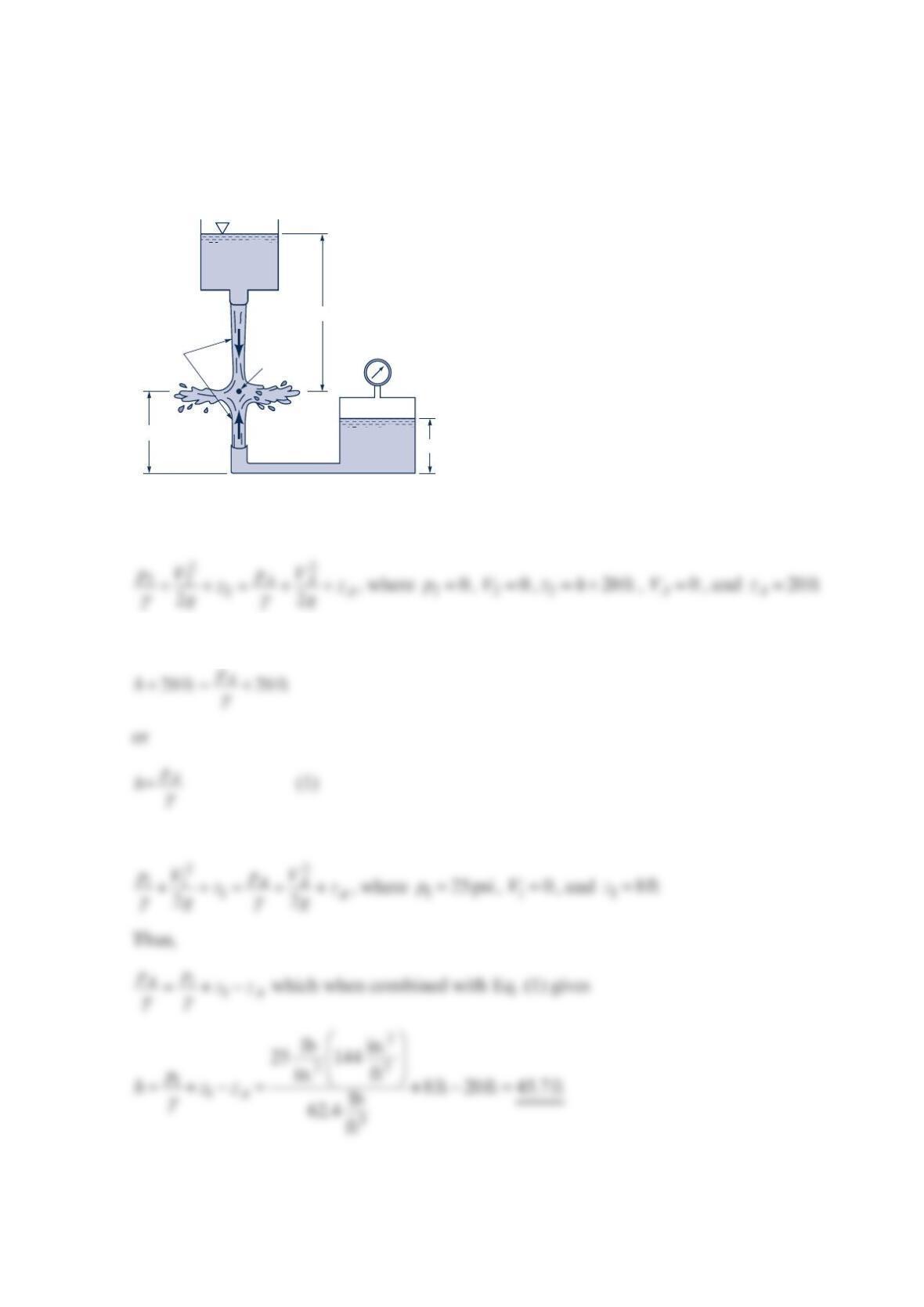
Streams of water from two tanks impinge upon each other as shown in the figure below. If
viscous effects are negligible and point A is a stagnation point, determine the height
h
.
Solution 3.36
Thus,
Also,
20 ft
8 ft
h
Ap
1
= 25 psi
Air
Free jets
Problem 3.37
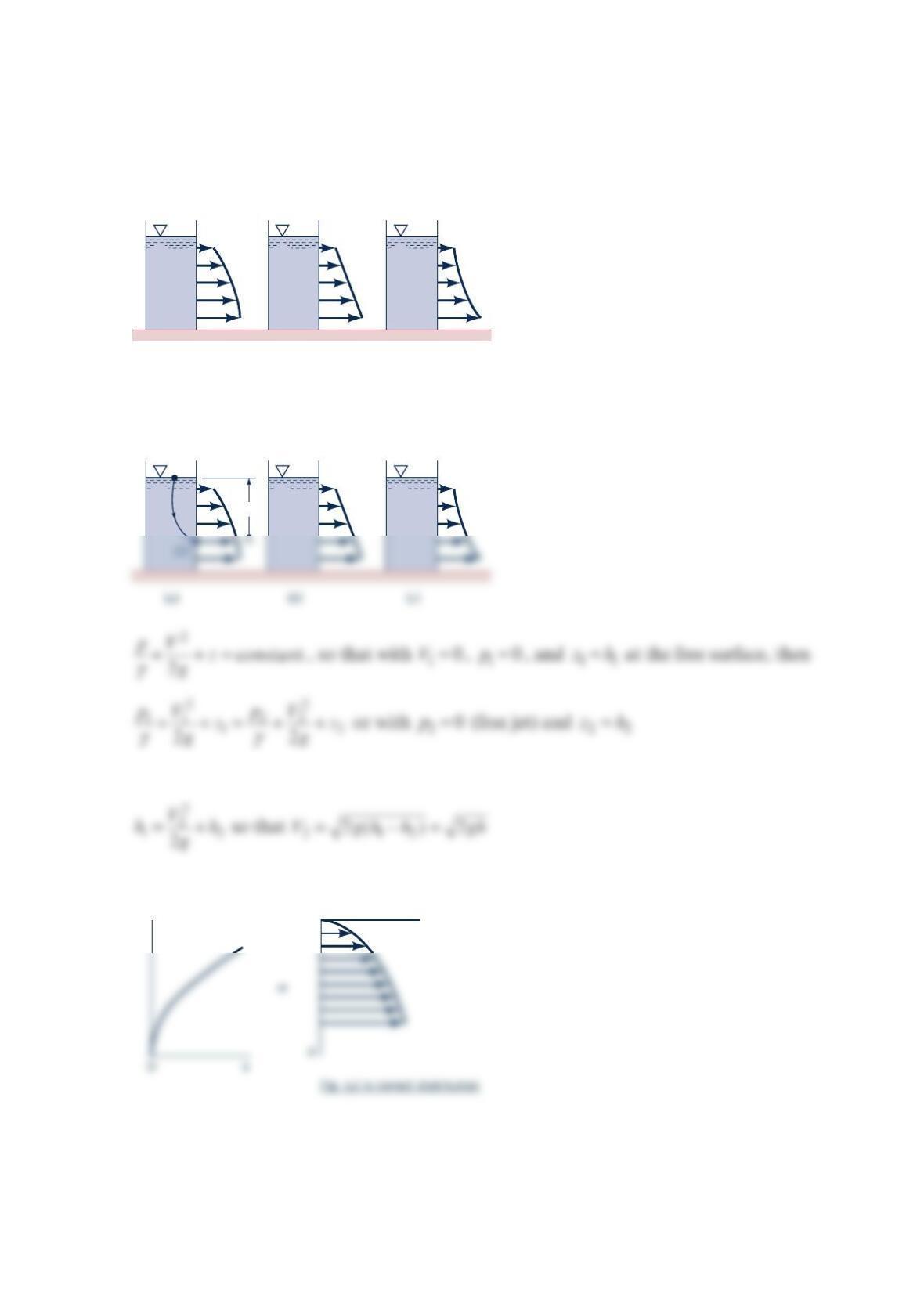
Several holes are punched into a tin can as shown in the figures below. Which of the figures
represents the variation of the water velocity as it leaves the holes? Justify your choice.
Solution 3.37
or
Thus,
(
a
)(
b
)(
c
)
(1)
h
O
V2V2
Problem 3.38
Water flows from a pressurized tank, through a 6-in. -diameter pipe, exits from a 2-in. –
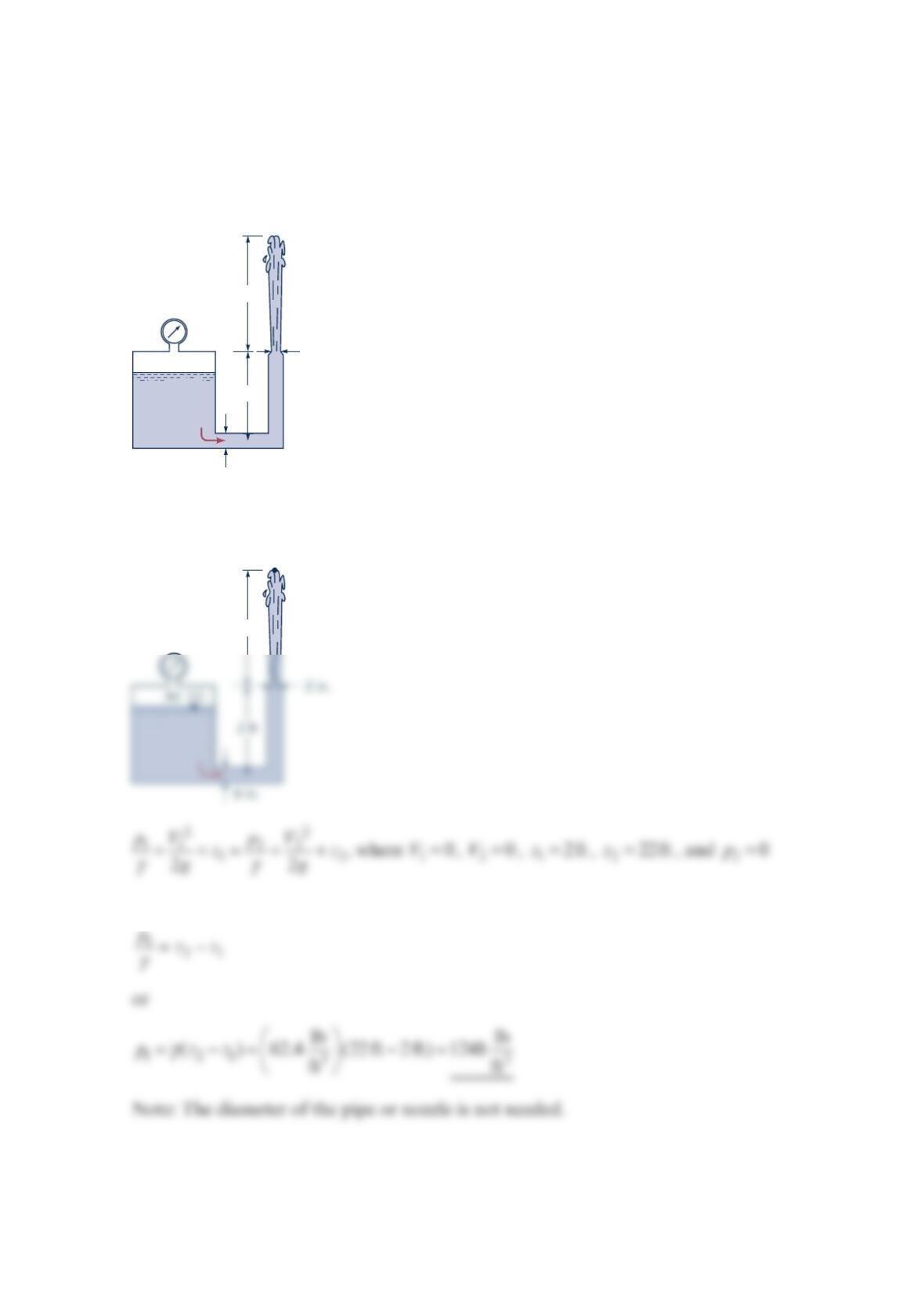
diameter nozzle, and rises 20 ft above the nozzle as shown in the figure below. Determine
the pressure in the tank if the flow is steady, frictionless, and incompressible.
Solution 3.38
Thus,
Air
20 ft
2 ft
2 in.
6 in.
20 ft
(2)
Problem 3.39
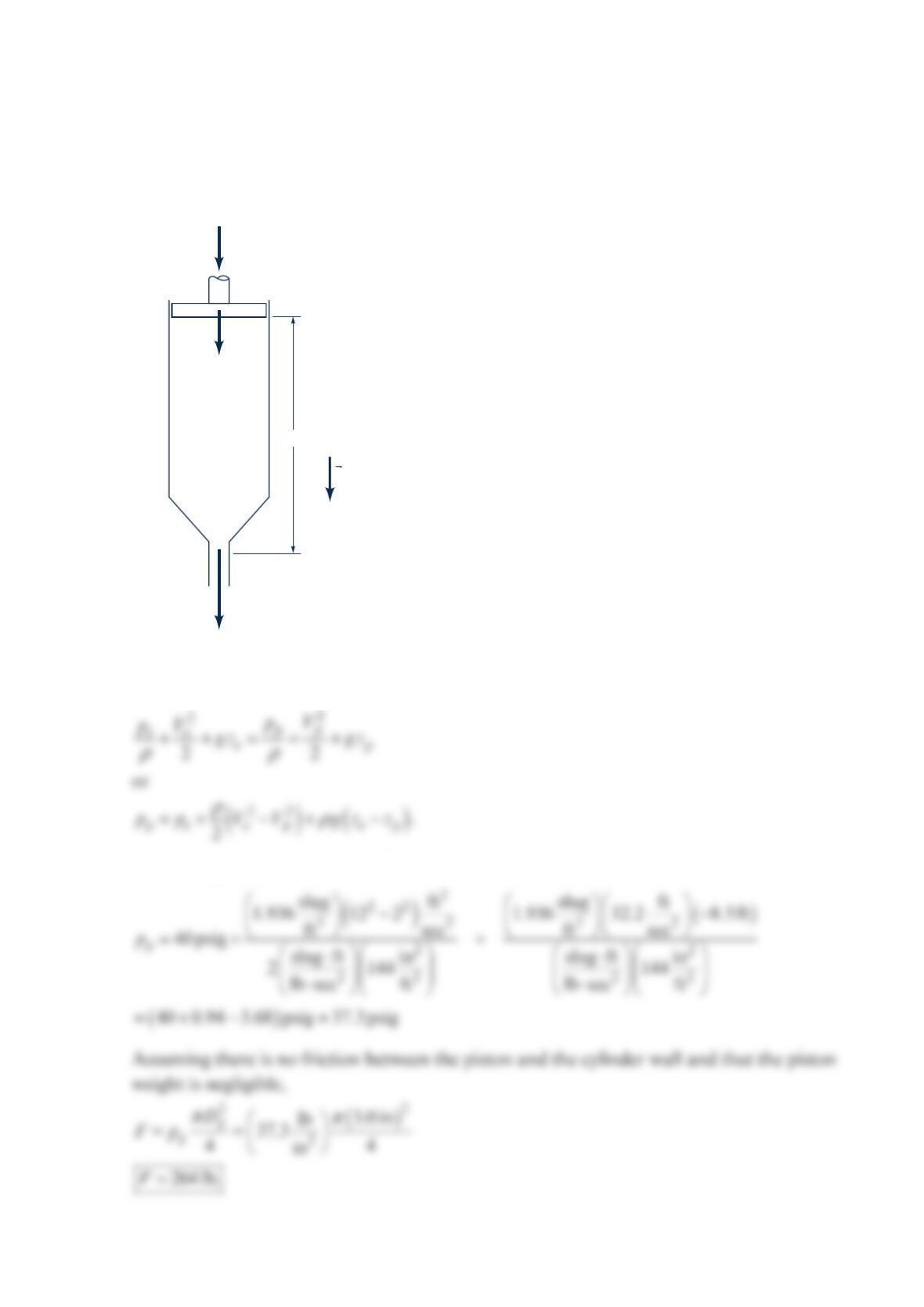
The piston shown in the figure below is forcing 70 F° water out the exit at 12 ft/sec. The exit
pressure has been measured as 40 psig
e
p=. Determine the force on the piston for a piston
diameter 3.0 in
p
D=.
Assume constant density and inviscid flow and apply Bernoulli’s equation to a streamline
from a point just below the piston (
p
) to exit (e),
Table B.1 gives 3
1.936 lbm/ft
ρ
= so
h = 8.5 ft
V = 2 ft/sec
p
e
= 40 psig
g
F
Problem 3.41
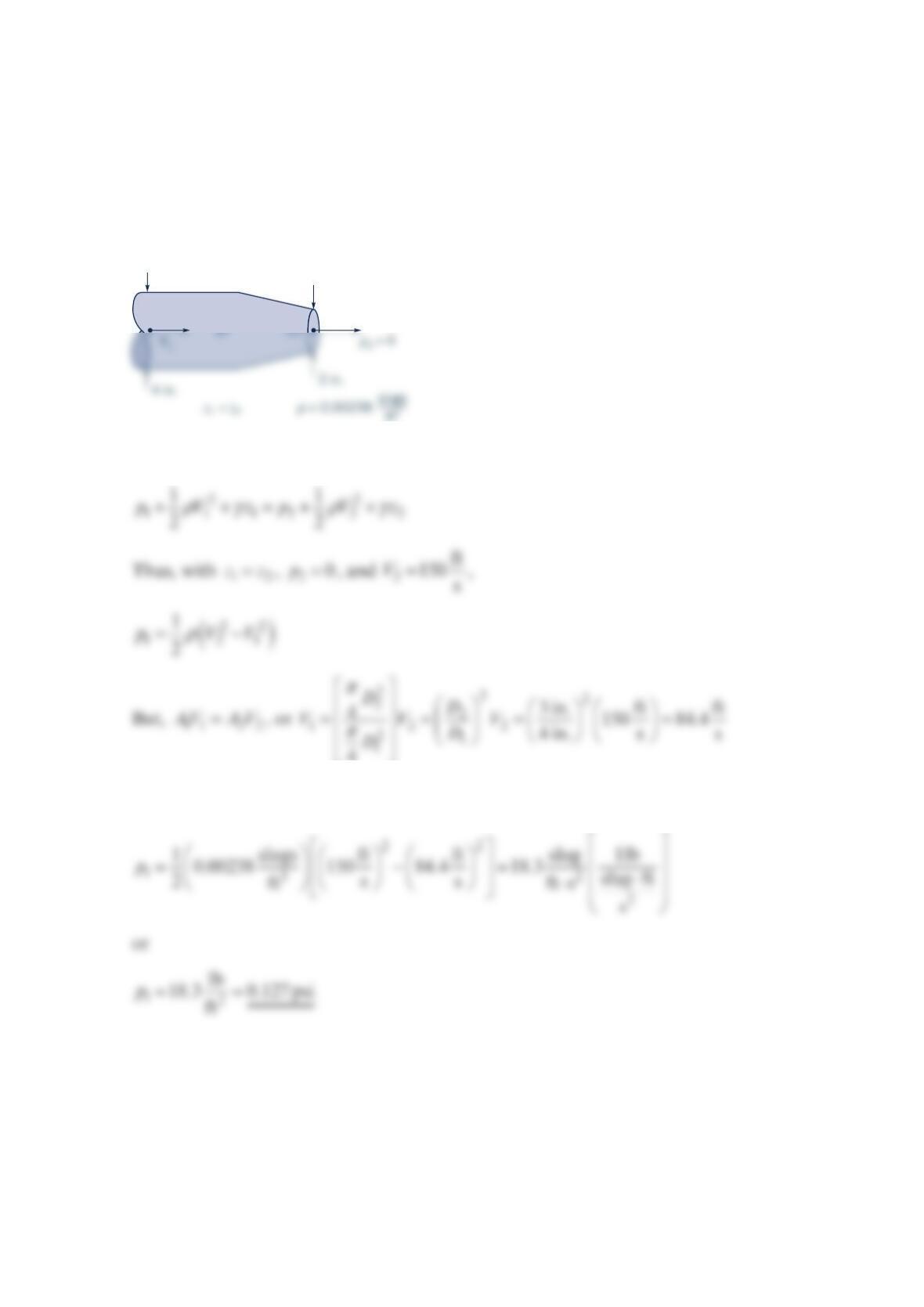
Air flows steadily through a horizontal 4-in.-diameter pipe and exits into the atmosphere
through a 3-in. -diameter nozzle. The velocity at the nozzle exit is 150ft/s . Determine the
pressure in the pipe if viscous effects are negligible.
Solution 3.41
From Bernoulli’s equation,
4
Thus,
(1) air
V
2 = 150
ft/s