Section 3.1
Chapter 3
Section 3.1
3.1.1Find all ~x such that A~x =~
0:
“1 2.
.
. 0
3 4.
.
. 0 #−→ “1 0.
.
. 0
0 1.
.
. 0 #, so that x1=x2= 0.
ker(A) = {~
0}.
3.1.2Find all ~x such that A~x =~
0, or x1+ 2x2+ 3x2= 0.
3.1.3Find all ~x such that A~x =~
0; note that all ~x in R2satisfy the equation, so that ker(A) = R2= span(~e1, ~e2).
3.1.4Find all ~x such that A~x =~
0:
3.1.5Find all ~x such that A~x =~
0.
3.1.6Find all ~x such that A~x =~
0. Solving this system yields ker(A) = span
1
−2
1
.
127
Chapter 3
1 1 1.
.
. 0
1 1 1.
.
. 0
1 1 1.
.
. 0
−→
1 1 1.
.
. 0
0 0 0.
.
. 0
0 0 0.
.
. 0
;x1+x2+x3= 0
3.1.9Find all ~x such that A~x =~
0. Solving this system yields ker(A) = {~
0}.
3.1.10 Solving the system A~x =~
0 we find that ker(A) = span
1
1
0
0
0
,
−2
0
−1
1
0
.
3.1.13 Solving the system A~x =~
0 we find that ker(A) = span
−2
1
0
0
0
0
,
−3
0
−2
−1
1
0
,
0
0
0
0
0
1
.
3.1.14 By Theorem 3.1.3, the image of Ais the span of the column vectors of A:
128
Section 3.1
3.1.15 By Theorem 3.1.3, the image of Ais the span of the columns of A:
3.1.16 By Theorem 3.1.3, the image of Ais the span of the column vectors of A:
3.1.17 By Theorem 3.1.3, im(A) = span 1
3,2
4=R2(the whole plane).
3.1.19 Since the four column vectors of Aare parallel, we have im(A) = span 1
−2, a line in R2.
3.1.20 Compare with the solution to Exercise 21.
3.1.21 By Theorem 3.1.3, im(A) = span
4
1
5
,
7
9
6
,
3
2
8
.
3.1.22 Since the three column vectors of Aare parallel, we have im(A) = span
1
1
1
, a line in R3.
129
Chapter 3
3.1.23 im(T) = R2and ker(T) = {~
0}, since Tis invertible (see Summary 3.1.8).
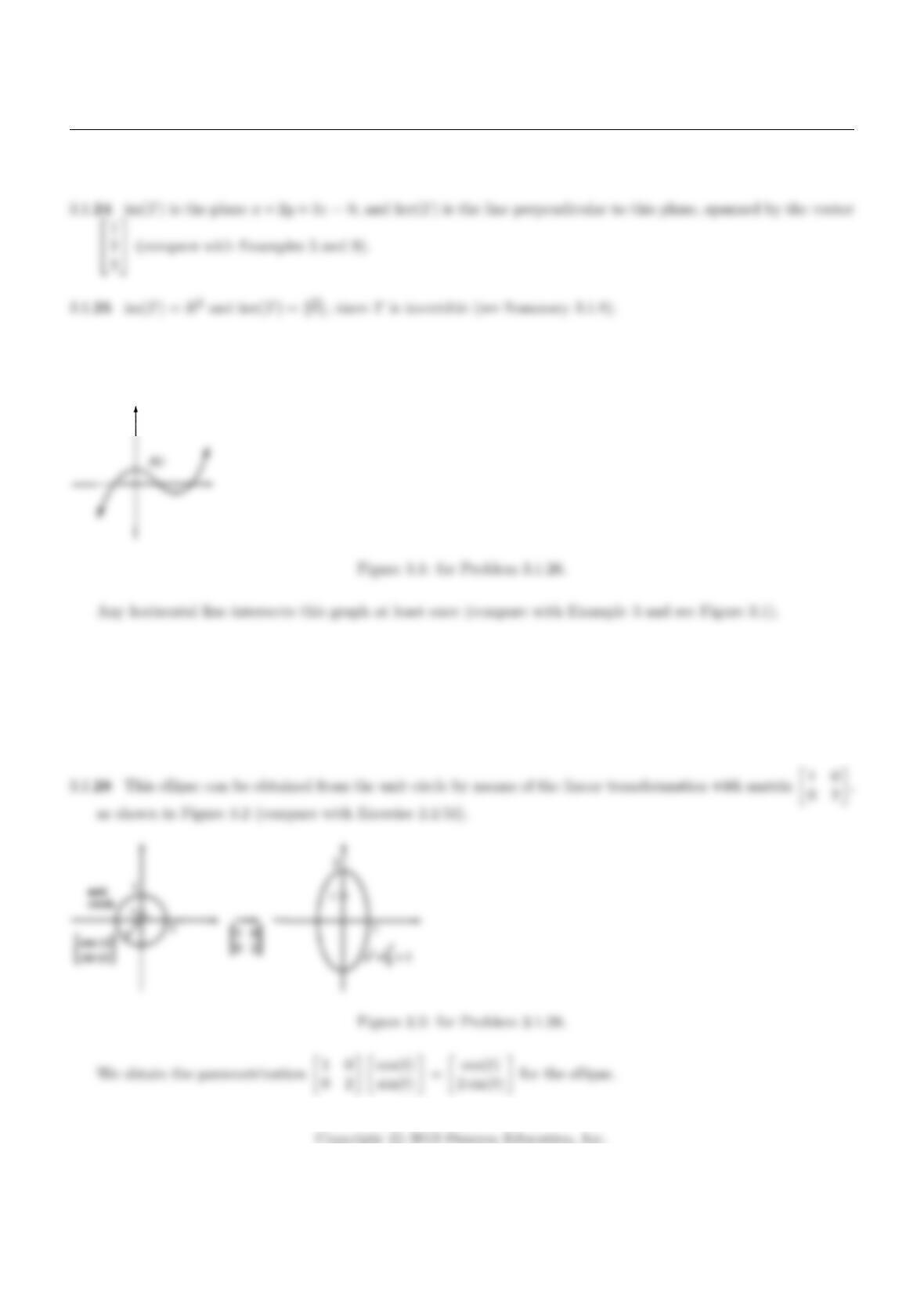
3.1.26 Since limt→∞ f(t) = ∞and limt→−∞ f(t) = −∞, we have im(f) = R.
A careful proof involves the intermediate value theorem (see Exercise 2.2.47),
3.1.27 Let f(x) = x3−x=x(x2−1) = x(x−1)(x+ 1).
Then im(f) = R, since
lim
x→∞ f(x) = ∞and lim
x→−∞ f(x) = −∞
but the function fails to be invertible since the equation f(x) = 0 has three solutions, x= 0, 1, and −1.
130
Section 3.1
We can check that x2+y2
4= cos2(t) + 4 sin2(t)
4= 1.
3.1.29 Use spherical coordinates (see any good text on multivariable calculus): fφ
θ=
sin(φ) cos(θ)
sin(φ) sin(θ)
cos(φ)
3.1.32 By Theorem 3.1.3, A=
7
6
5
does the job. There are many other correct answers: any nonzero 3 ×nmatrix
Awhose column vectors are scalar multiples of
7
6
5
.
3.1.35 ker(T) = {~x :T(~x) = ~v ·~x = 0}= the plane with normal vector ~v.
im(T) = R, since for every real number kthere is a vector ~x such that T(~x) = k, for example, ~x =k
~v·~v ~v.
Chapter 3
3.1.37 A=
0 1 0
0 0 1
0 0 0
, A2=
001
000
000
, A3=
0 0 0
0 0 0
0 0 0
, so that
3.1.38 a If a vector ~x is in ker(Ak), that is, Ak~x =~
0, then ~x is also in ker(Ak+1), since Ak+1~x =AAk~x =A~
0 = ~
0.
Therefore, ker(A)⊆ker(A2)⊆ker(A3)⊆…
Exercise 37 shows that these kernels need not be equal.
3.1.39 a If a vector ~x is in ker(B), that is, B~x =~
0, then ~x is also in ker(AB), since AB(~x) = A(B~x) = A~
0 = ~
0:
ker(B)⊆ker(AB).
Exercise 37 (with A=B) illustrates that these kernels need not be equal.
3.1.40 For any ~x in Rm, the vector B~x is in im(B) = ker(A), so that AB~x =~
0. If we apply this fact to ~x =
~e1, ~e2, . . . , ~em, we find that all the columns of the matrix AB are zero, so that AB = 0.
Section 3.1
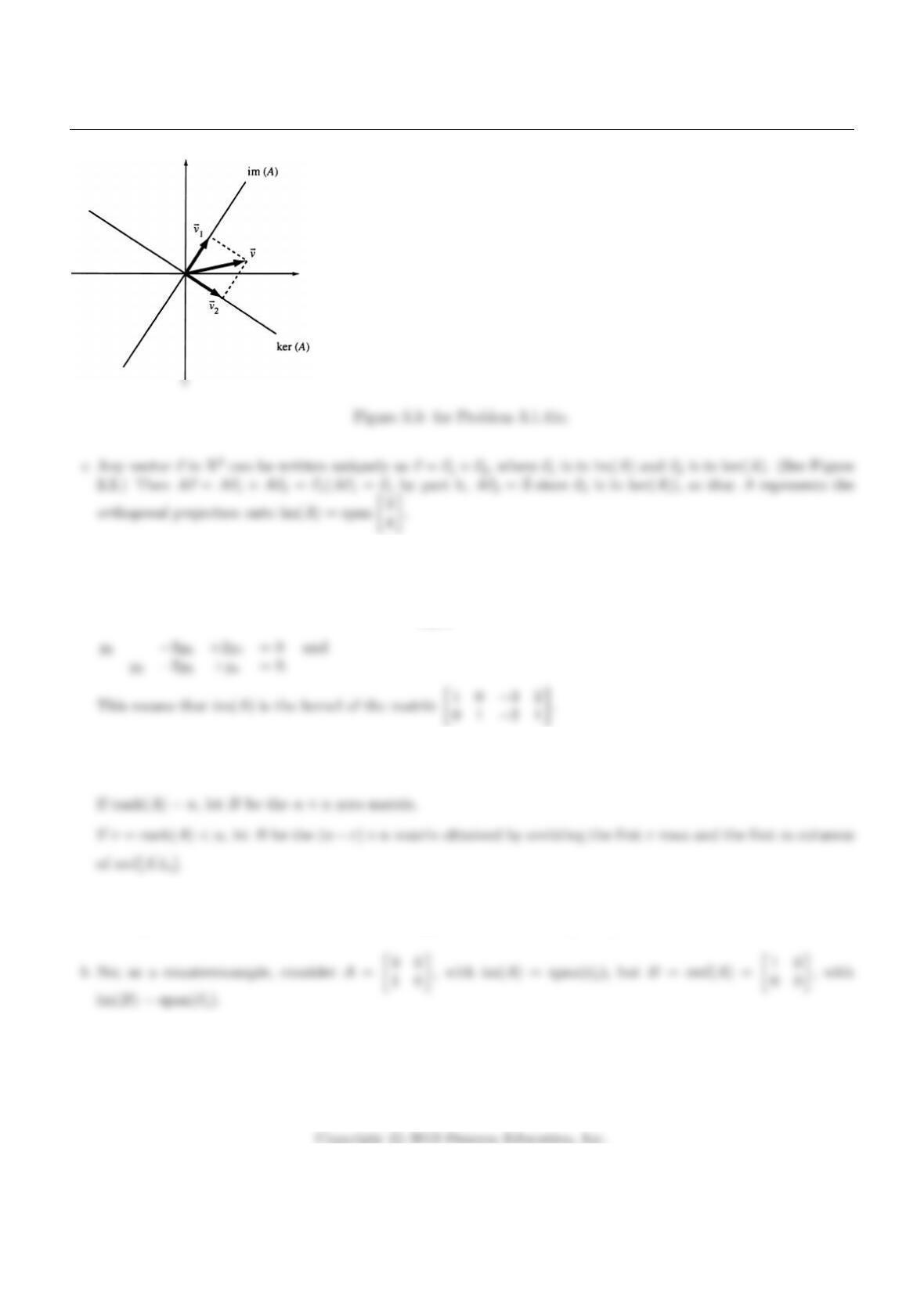
3.1.42 Using the hint, we see that the vector ~y =
y1
y2
y3
y4
is in the image of Aif
3.1.43 Using our work in Exercise 42 as a guide, we come up with the following procedure to express the image of
an n×mmatrix Aas the kernel of a matrix B:
3.1.44 a Yes; by construction of the echelon form, the systems A~x =~
0 and B~x =~
0 have the same solutions (it is the
whole point of Gaussian elimination not to change the solutions of a system).
3.1.45 As we solve the system A~x =~
0, we obtain rleading variables and m−rfree variables. The “general vector”
in ker(A) can be written as a linear combination of m−rvectors, with the free variables as coefficients. (See
Example 11, where m−r= 5 −3 = 2.)
133
Chapter 3
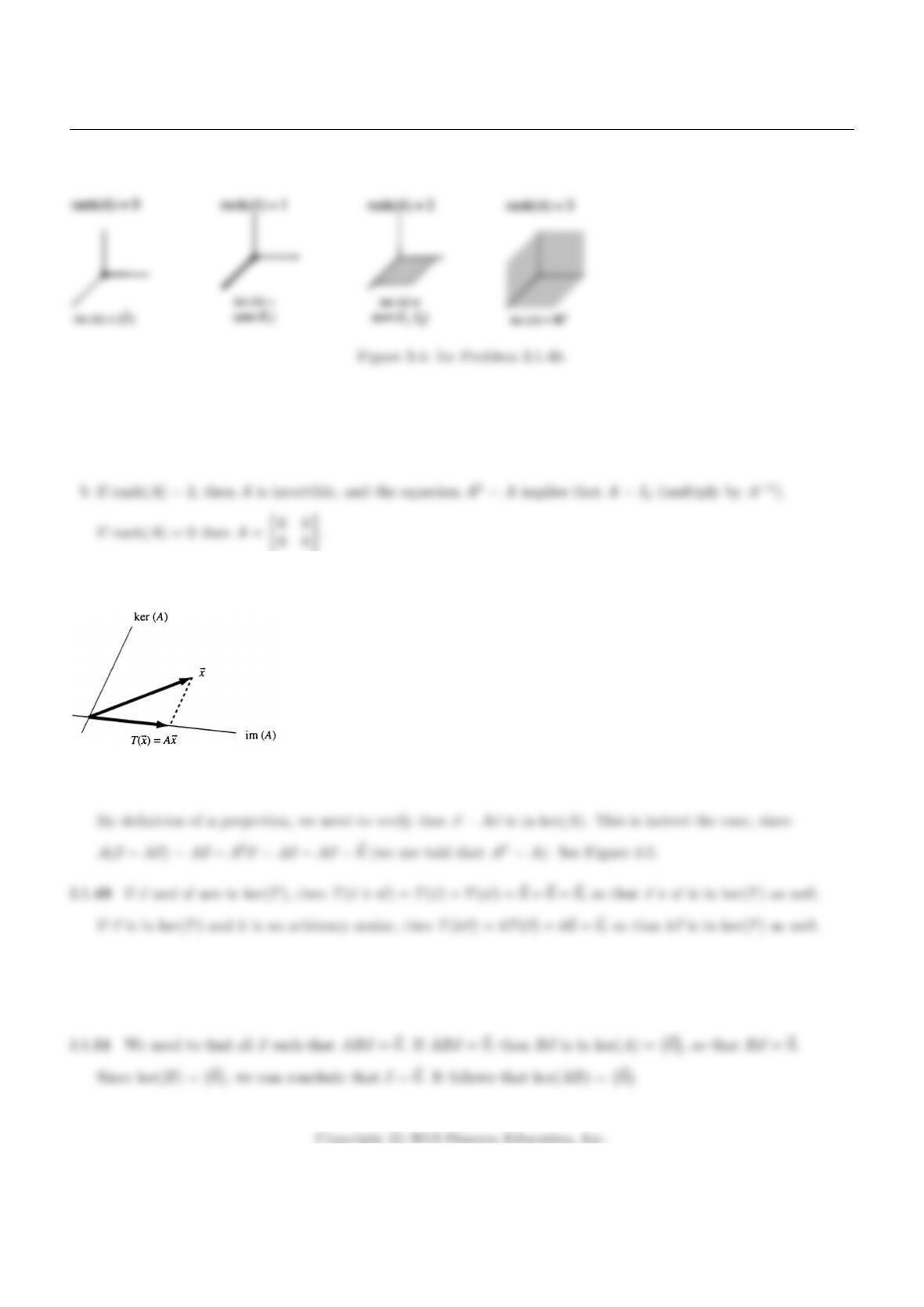
3.1.46 If rank(A) = r, then im(A) = span(~e1, . . . , ~er). See Figure 3.4.
3.1.47 im(T) = L2and ker(T) = L1.
3.1.48 a~w =A~x, for some ~x, so that A ~w =A2~x =A~x =~w.
c First note that im(A) and ker(A) are lines (there is one nonleading variable).
Figure 3.5: for Problem 3.1.48c.
3.1.50 From Exercise 38 we know that ker(A3)⊆ker(A4). Conversely, if ~x is in ker(A4), then A4~x =A3(A~x) = ~
0,
so that A~x is in ker(A3) = ker(A2), which implies that A2(A~x) = A3~x =~
0, that is, ~x is in ker(A3). We have
shown that ker(A3) = ker(A4).
134
Section 3.2
3.1.52 Since C~x =A
B~x =A~x
B~x , we can conclude that C~x =~
0 if (and only if) both A~x =~
0 and B~x =~
0. It
follows that ker(C) is the intersection of ker(A) and ker(B): ker(C) = ker(A)∩ker(B).
3.1.53 a Using the equation 1 + 1 = 0 (or −1 = 1), we can write the general vector ~x in ker(H) as
b ker(H) = span(~v1, ~v2, ~v3, ~v4) by part (a), and im(M) = span(~v1, ~v2, ~v3, ~v4) by Theorem 3.1.3, so that im(M) =
ker(H). M~x is in im(M) = ker(H), so that H(M~x) = ~
0.
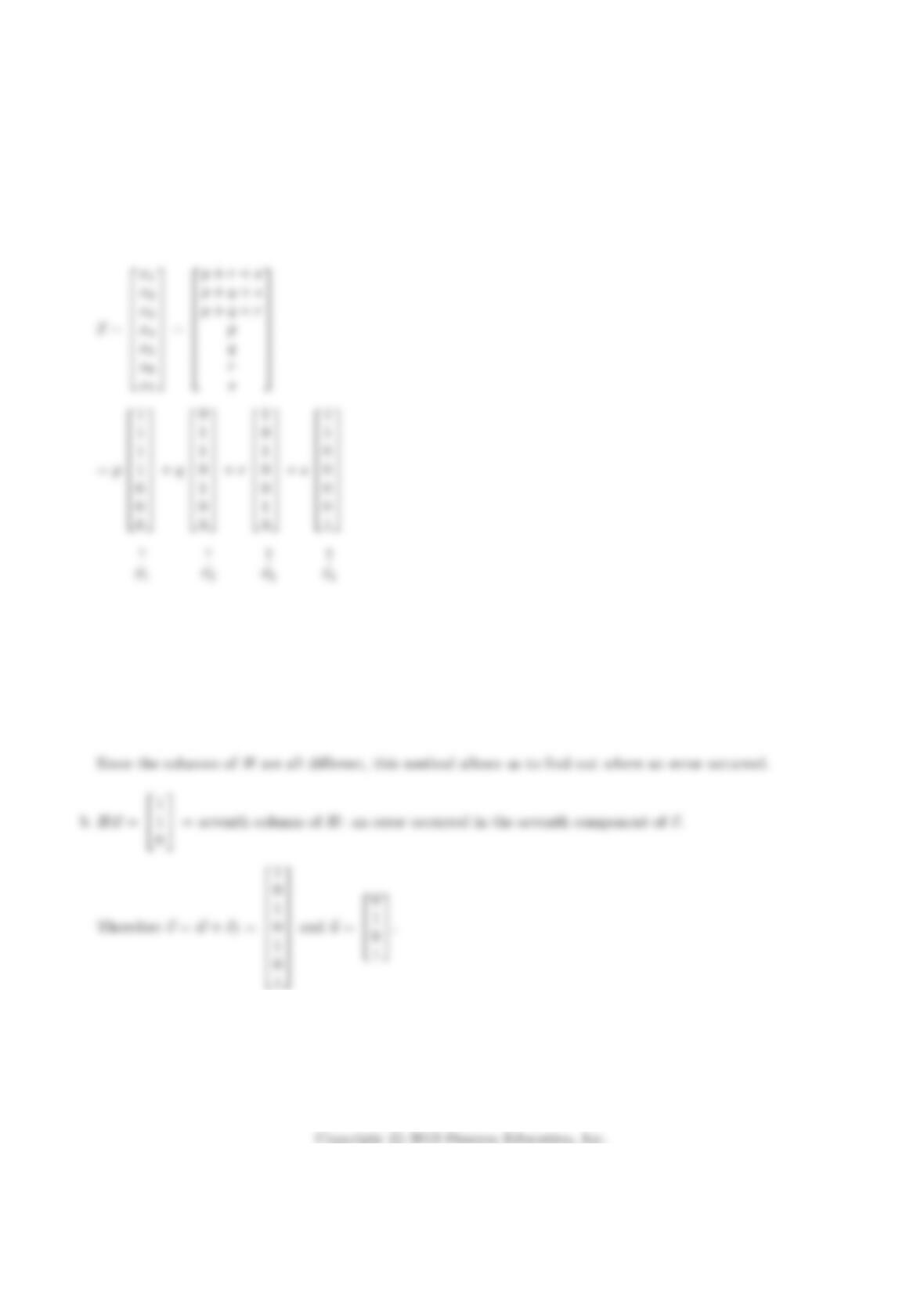
3.1.54 a If no error occurred, then ~w =~v =M~u, and H ~w =H(M~u) = ~
0, by Exercise 53b.
If an error occurred in the ith component, then ~w =~v +~ei=M~u +~ei, so that
H ~w =H(M~u) + H~ei=ith column of H.
Section 3.2
3.2.1Not a subspace, since Wdoes not contain the zero vector.
135
Chapter 3
3.2.2Not a subspace, since Wcontains the vector ~v =
1
2
3
but not the vector (−1)~v =
−1
−2
−3
.
3.2.5We have subspaces {~
0},R3, and all lines and planes (through the origin). To prove this, mimic the reasoning
in Example 2.
3.2.6a Yes!
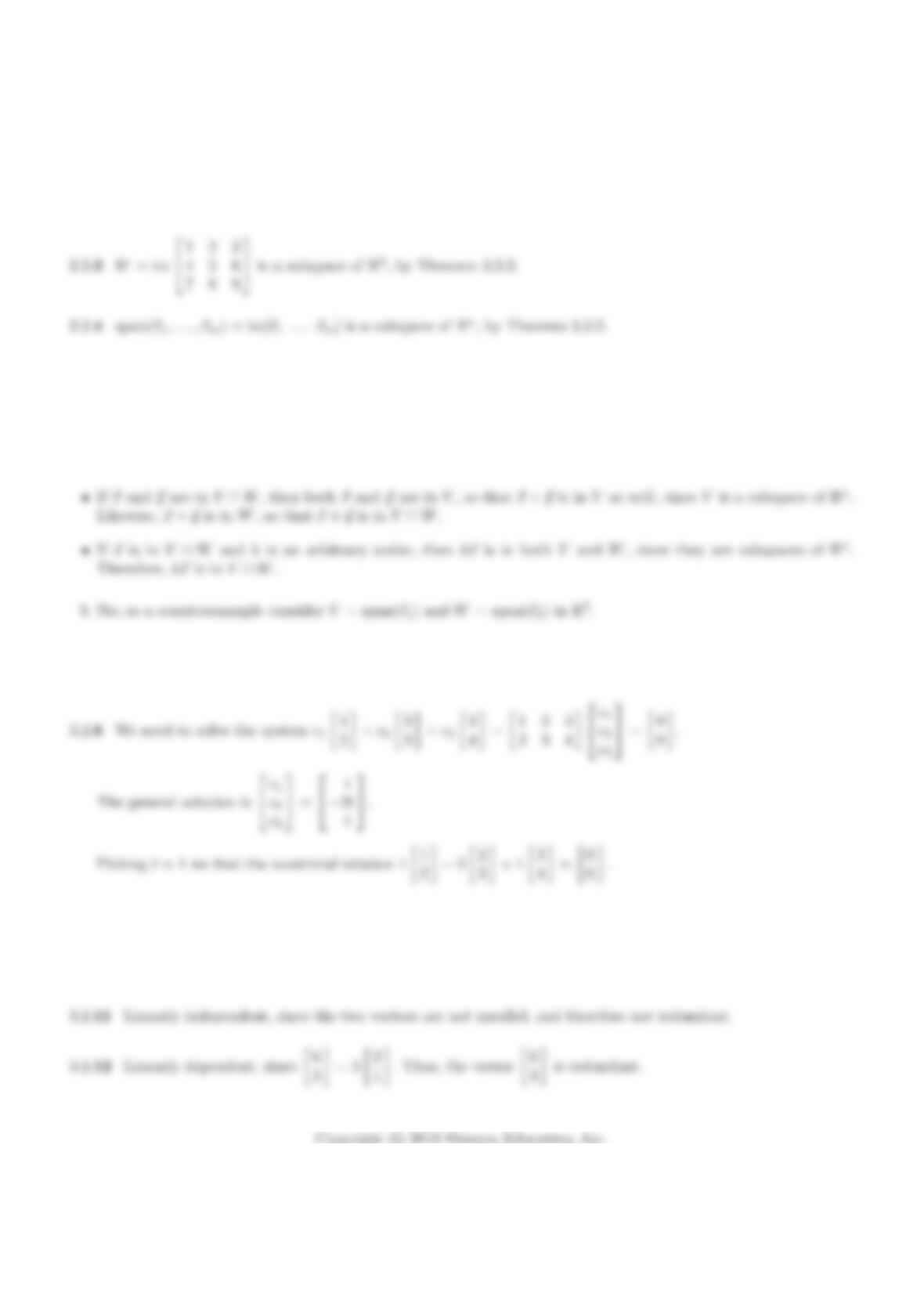
•The zero vector is in V∩W, since ~
0 is in both Vand W.
3.2.7Yes; we need to show that Wcontains the zero vector. We are told that Wis nonempty, so that it contains
some vector ~v. Since Wis closed under scalar multiplication, it will contain the vector 0~v =~
0, as claimed.
3.2.9These vectors are linearly dependent, since ~vm= 0~v1+ 0~v2+···+ 0~vm−1.
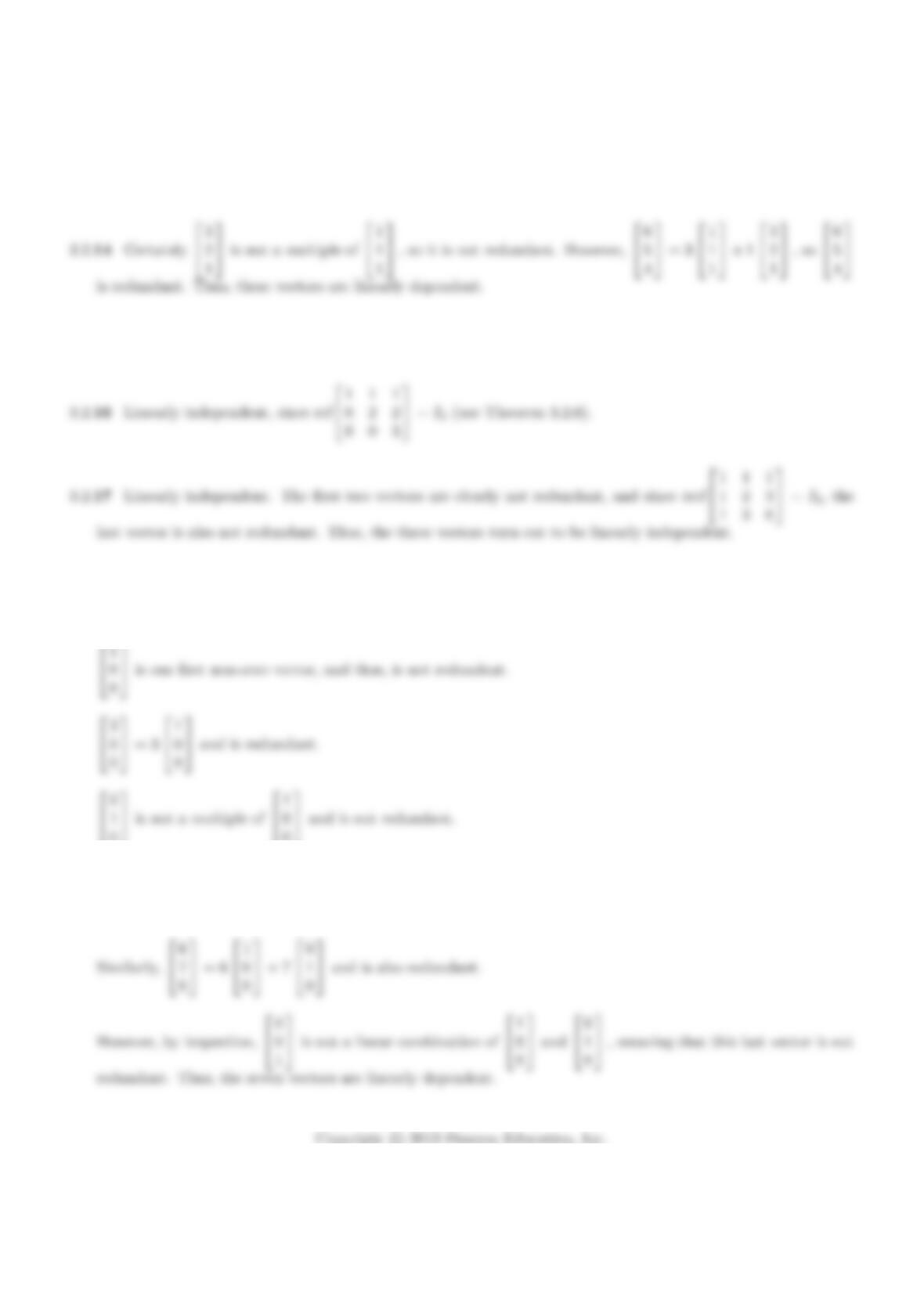
3.2.10 Linearly dependent, since 0
0= 0 7
11 . Thus, the vector ~
0 is redundant.
136
Section 3.2
3.2.13 Linearly dependent, since the second vector is redundant 1
2= 1 1
2.
3.2.15 Linearly dependent. By Theorem 3.2.8, since we have three vectors in R2, at least one must be redundant.
We can perform a straightforward computation to reveal that ~v3=−~v1+ 2~v2.
3.2.18
0
0
0
is redundant, simply because it is the zero vector.
0
0
4
5
0
= 4
1
0
0
+ 5
0
1
0
and is redundant.
137
Chapter 3
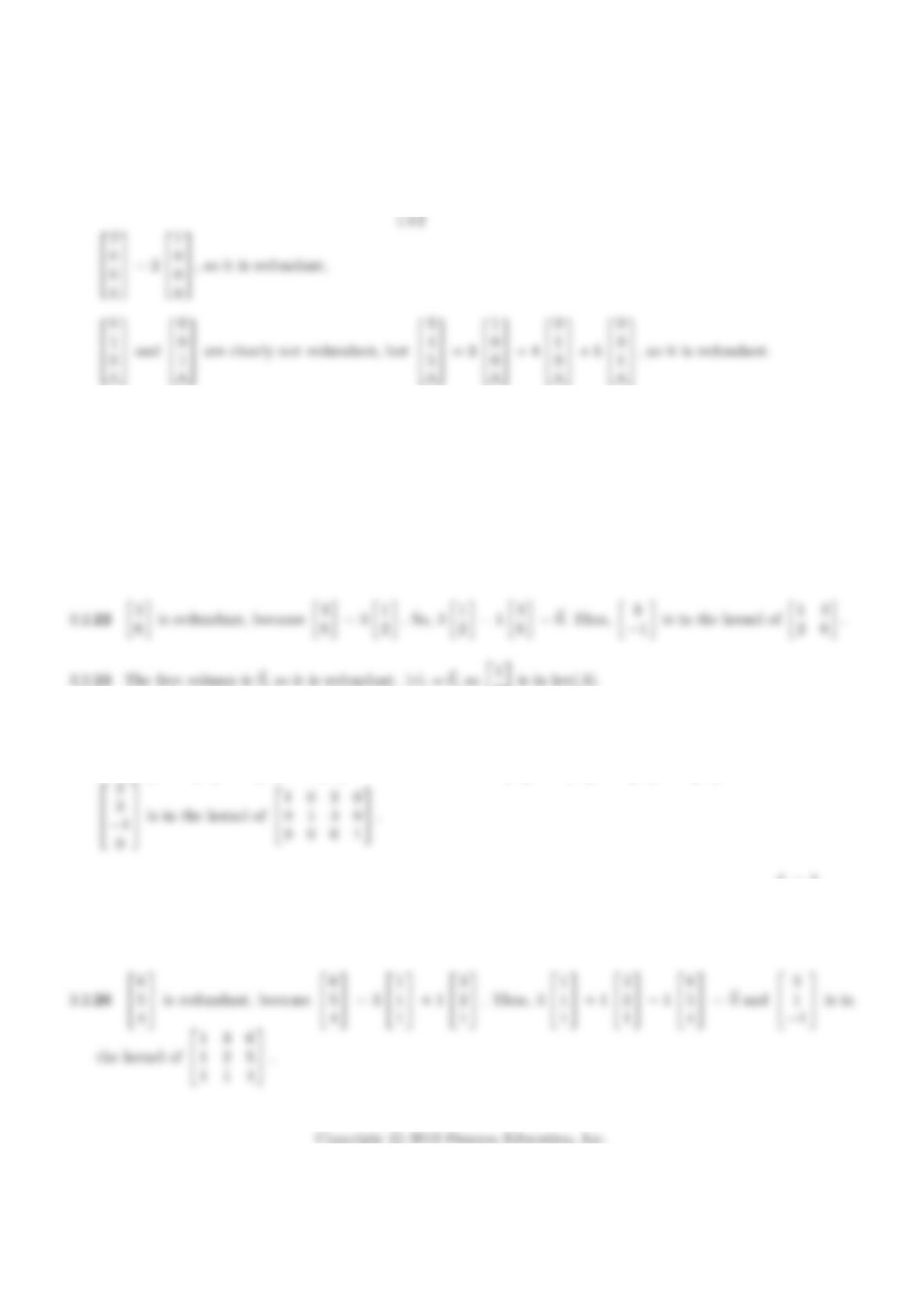
3.2.19 Linearly dependent. First we see that
1
0
0
is not redundant, because it is first, and non-zero. However,
3.2.20 Linearly dependent, since rref
1 1 1
1 2 4
1 3 7
1 4 10
=
1 0 −2
0 1 3
0 0 0
0 0 0
. So, we find that the vector
1
4
7
10
turns out to
be redundant.
3.2.21 Certainly, since the second vector equals the first, the second is redundant. So ~v1=~v2, 1~v1−1~v2=~
0,
revealing that 1
−1is in ker(A).
0is in ker(A).
3.2.24
2
3
0
= 2
1
0
0
+ 3
0
1
0
,so
2
3
0
is redundant. Now, 2
1
0
0
+ 3
0
1
0
−1
2
3
0
+ 0
0
0
1
=~
0,revealing that
3.2.25 The third column equals the first, so it is redundant and ~v1=~v3, or 1~v1+ 0~v2−1~v3=~
0. Thus,
1
0
−1
is in
ker(A).
138
Section 3.2
3.2.29 The three column vectors of Aspan all of R2, so that im(A) = R2. We can choose any two of the columns
of Ato form a basis of im(A); another sensible choice is ~e1, ~e2.
3.2.31 The two column vectors of the given matrix Aare linearly independent (they are not parallel), so that they
form a basis of im(A).
3.2.33 im(A) = span(~e1, ~e2, ~e3), so that ~e1, ~e2, ~e3is a basis of im(A).
3.2.34 The fact that
1
2
3
4
is in ker(A) means that
139
Chapter 3
3.2.37 No; as a counterexample, consider the extreme case when Tis the zero transformation, that is, T(~x) = ~
0 for
all ~x. Then the vectors T(~v1), . . . , T (~vm) will all be zero, so that they are linearly dependent.
3.2.38 a Using the terminology introduced in the exercise, we need to show that any vector ~v in Vis a linear
combination of ~v1, . . . , ~vm. Choose a specific vector ~v in V. Since we can find no more than mlinearly independent
3.2.39 Yes; the vectors are linearly independent. The vectors in the list ~v1, . . . , ~vmare linearly independent (and
therefore non-redundant), and ~v is non-redundant since it fails to be in the span of ~v1, . . . , ~vm.
3.2.41 To show that the columns of Bare linearly independent, we show that ker(B) = {~
0}. Indeed, if B~x =~
0,
then AB~x =A~
0 = ~
0, so that ~x =~
0 (since AB =Im).
3.2.42 We can use the hint and form the dot product of ~viand both sides of the relation
c1~v1+···+ci~vi+···+cm~vm=~
0:
(c1~v1+···+ci~vi+···+cm~vm)·~vi=~
0·~vi, so that c1(~v1·~vi) + ···+ci(~vi·~vi) + ···+cm(~vm·~vi)= 0.
3.2.44 Yes; this is a special case of Exercise 40 (recall that ker(A) = {~
0}, by Theorem 3.1.7b).
3.2.45 Yes; if Ais invertible, then ker(A) = {~
0}, so that the columns of Aare linearly independent, by Theorem 3.2.8.
140
Section 3.2
3.2.46 Solve the system x1+ 2x2+ 3x4+ 5x5= 0
x3+ 4x4+ 6x5= 0 .
The solutions are of the form
3.2.48 We can write 3x1+ 4x2+ 5x3= [3 4 5]
x1
x2
x3
= 0, so that V= ker[3 4 5].
To express Vas an image, choose a basis of V, for example,
4
−3
,
0
5
.
3.2.49 L= im
1
1
1
3.2.50 The verification of the three properties listed in Definition 3.2.1 is straightforward. Alternatively, we
can choose a basis ~v1, . . . , ~vpof Vand a basis ~w1, . . . , ~wqof W(see Exercise 38a) and show that V+W=
span(~v1, . . . , ~vp, ~w1, . . . , ~wq) (compare with Exercise 4).
141
Chapter 3
3.2.51 a Consider a relation c1~v1+· · · +cp~vp+d1~w1+···+dq~wq=~
0.
Then the vector c1~v1+··· +cp~vp=−d1~w1− · · · − dq~wqis both in Vand in W, so that this vector is ~
0 :
c1~v1+···+cp~vp=~
0 and d1~w1+···+dq~wq=~
0.
3.2.52 If a, c and fare nonzero, then rref
a b d
0c e
0 0 f
0 0 0
=
1 0 0
0 1 0
0 0 1
0 0 0
, and the three vectors are linearly independent,
by Theorem 3.2.6. If at least one of the constants a, c or fis zero, then at least one column of rref will not
contain a leading one, so that the three vectors are linearly dependent.
3.2.54 We need to find all vectors
x
y
z
in R3such that
x
y
z
·
1
2
3
=x+ 2y+ 3z= 0.
These vectors have the form
x
y
z
=
−2s−3t
s
t
=s
−2
1
0
+t
−3
0
1
.
142
Section 3.2
These vectors are of the form
x1
x2
−2a−3b−4c−5d
a
−2
1
−3
0
−4
0
−5
0
dent, regardless of the values of the constants a, b . . . , m.
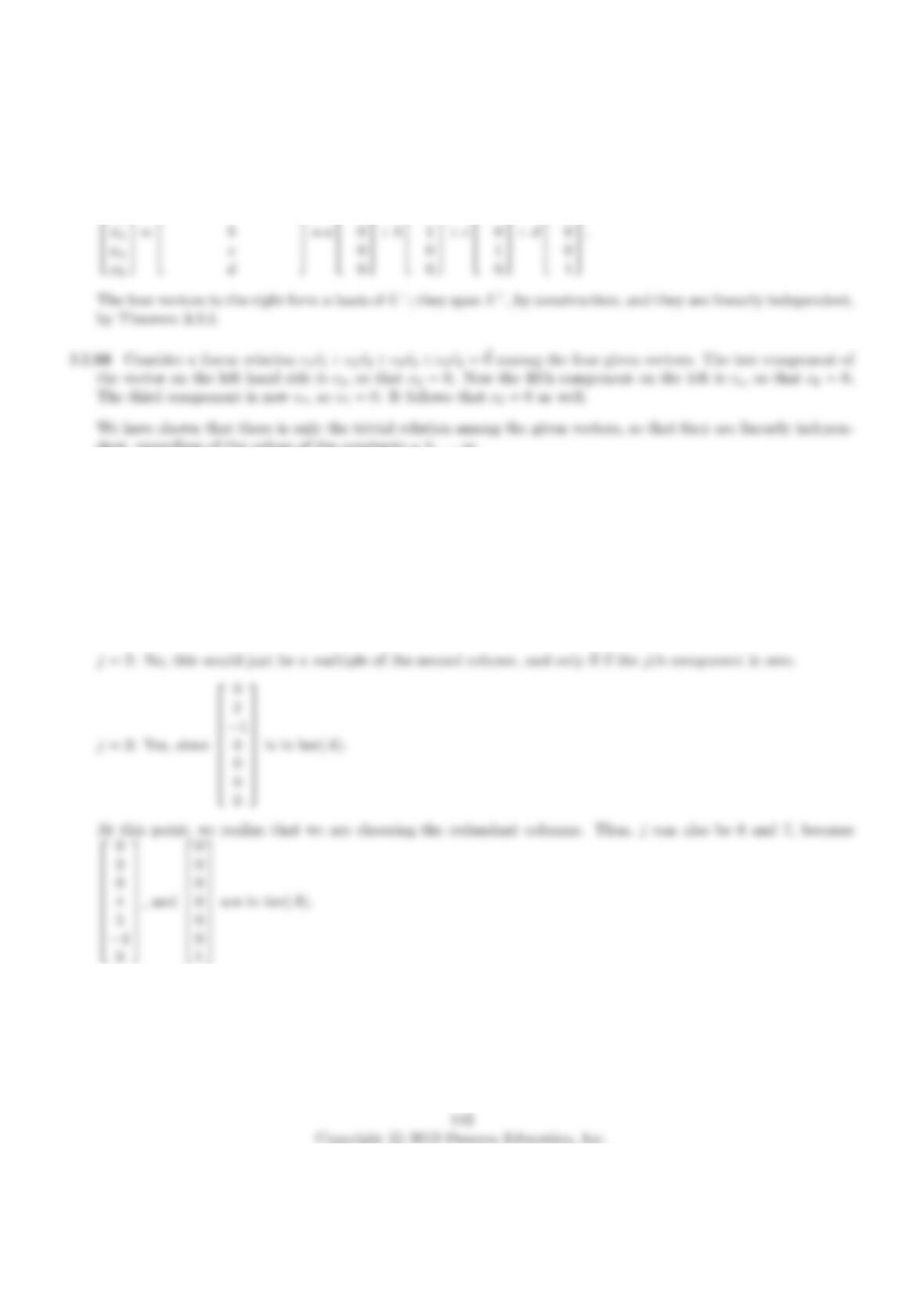
3.2.57 We will begin to go through the possibilties for juntil we see a pattern:
j= 1: Yes, because
1
0
0
0
0
0
0
is in ker(A) (the first column is ~
0).
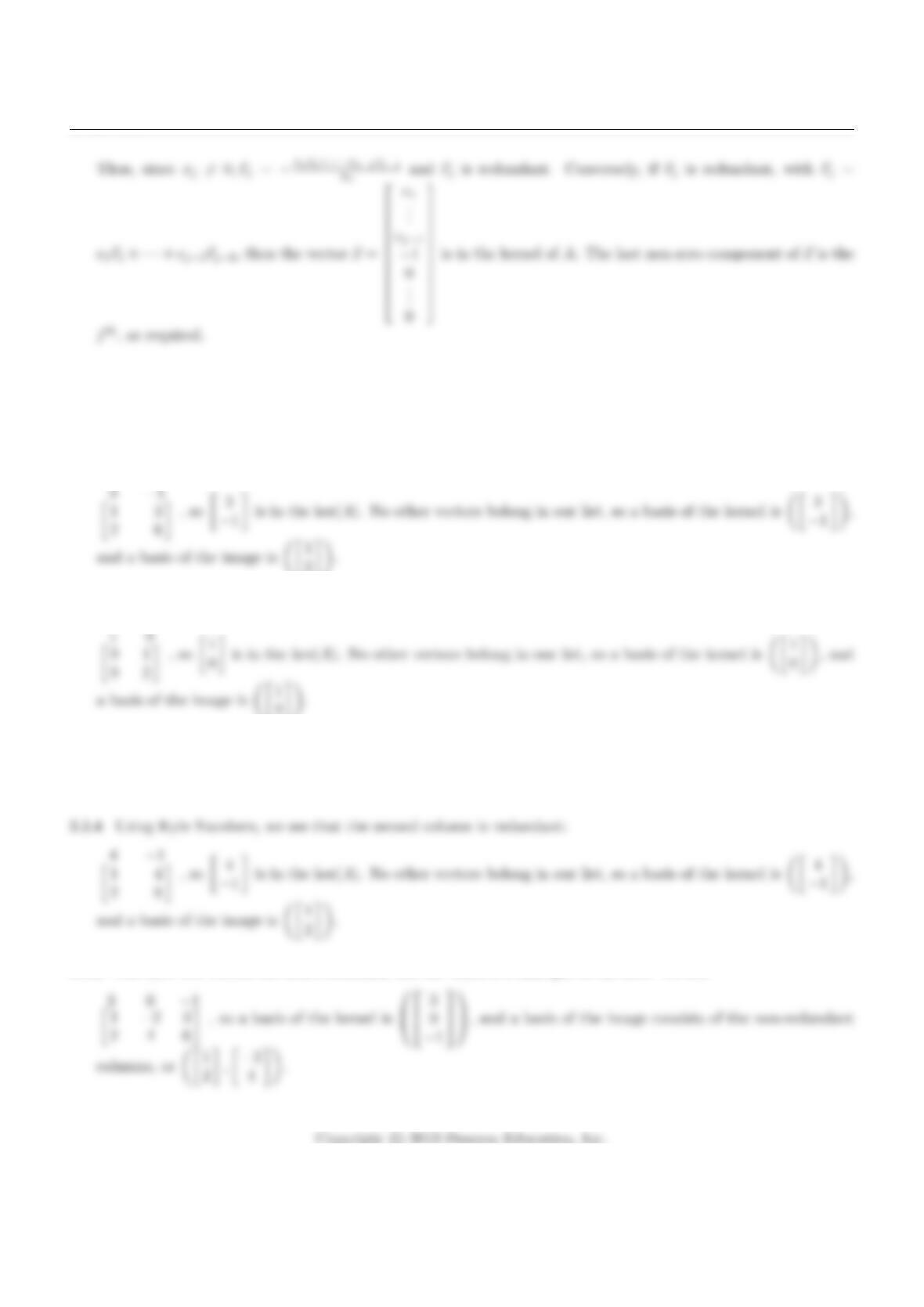
3.2.58 This occurs for each column, j, that is redundant. If ~x is in the kernel, and the jth component of ~x is the
last non-zero component, then
x1~v1+···+xj~vj+xj+1~vj+1 +· · · +xm~vm=~
0,but xj+1 =···=xm= 0,so
x1~v1+···+xj~vj=~
0.
Chapter 3
Section 3.3
3.3.1Clearly the second column is just three time the first, and thus is redundant. Applying the notion of Kyle
Numbers, we see:
3.3.2The first column is redundant. We use the following Kyle Numbers:
3.3.3The two columns here are independent, so there are no redundant vectors. Thus, ∅is a basis of the kernel,
and the two columns form a basis of the image: 1
3,2
4.
3.3.5The first two vectors are non-redundant, but the third is a multiple of the first. We see:
144
Section 3.3
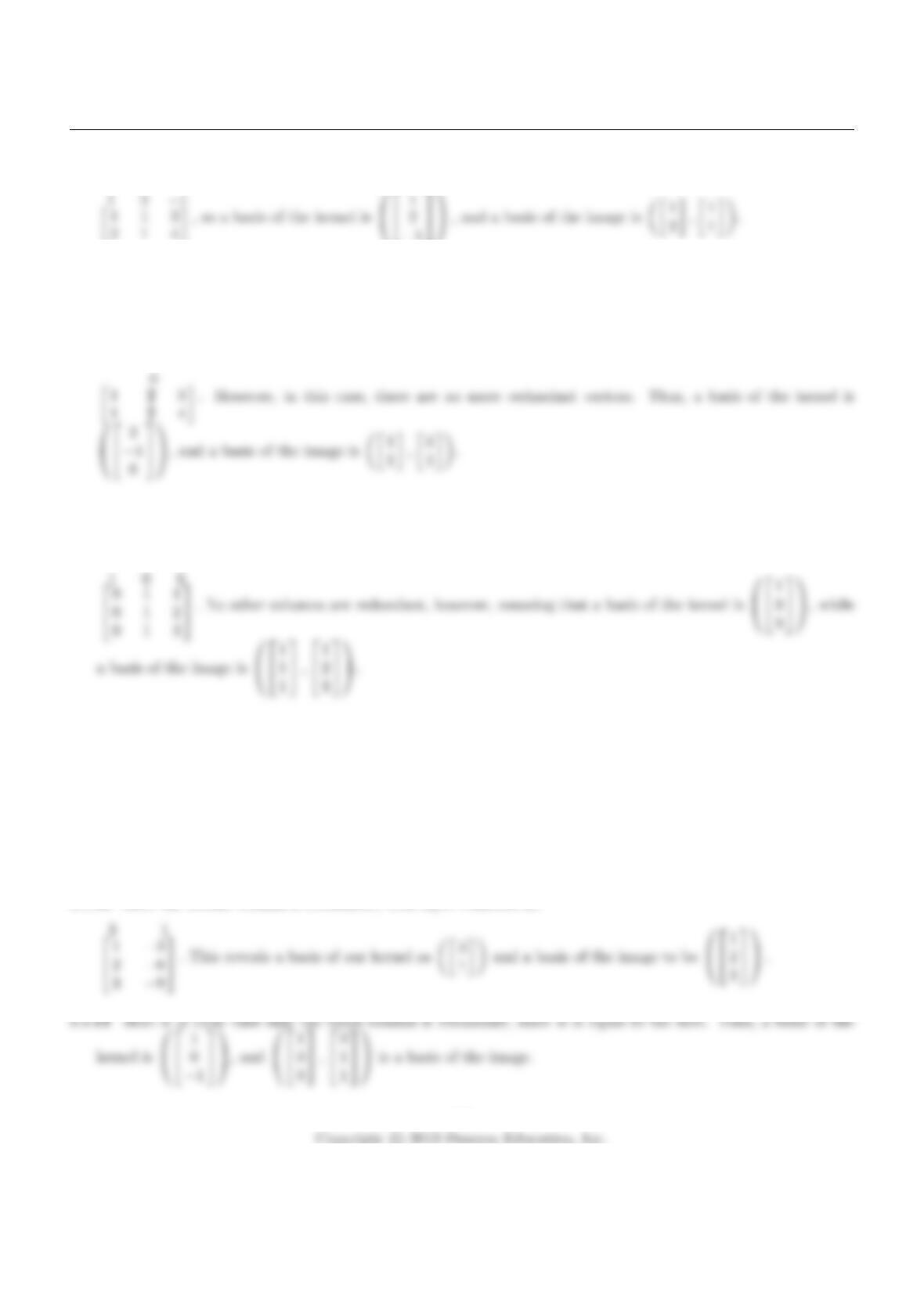
3.3.6The first two vectors are non-redundant, but the third is a combination of the first two:
3.3.7We immediately see fitting Kyle numbers for one relation:
2−1 0
1
1
2
2
3
4. Now, since the second column is redundant, we remove it from further inspection and keep a
zero above it:
3.3.8The first column is redundant, and
1
0
0
is in the kernel:
3.3.9The second column is redundant, and we can choose Kyle numbers as follows:
2−1 0
1
1
1
2
2
2
1
2
3
, but the third column is non-redundant. Thus, a basis of the kernel is
2
−1
0
, while a basis
of the image is
1
1
1
,
1
2
3
.
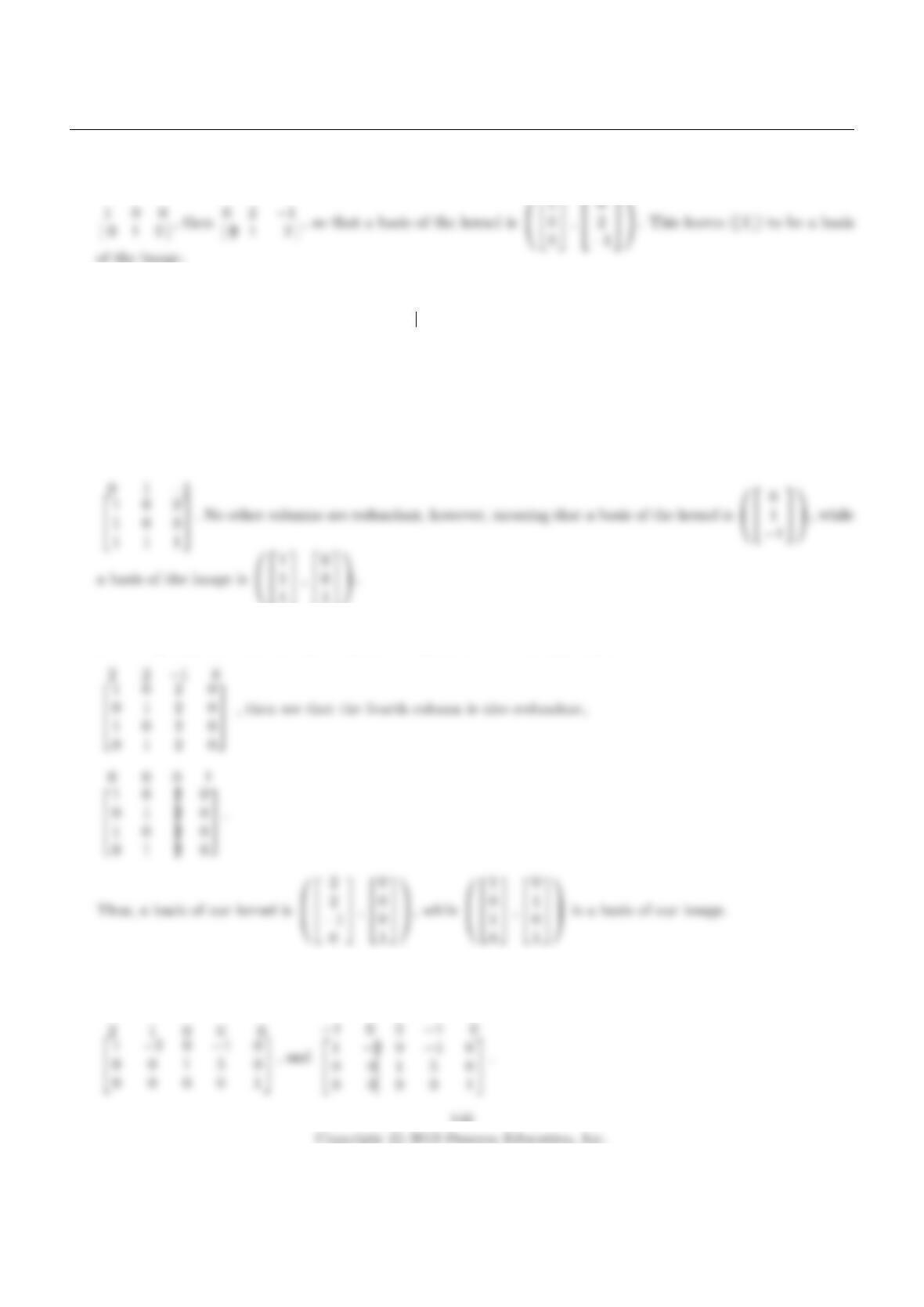
3.3.10 Here the second column is redundant, with Kyle Numbers as:
145
Chapter 3
3.3.12 The first and the third columns are redundant, as the Kyle Numbers show us:
3.3.13 Here we first see 2−1 0
[ 1 2 3 ] , then 3 0 −1
[ 1 2 3 ] ,
so both the second and third columns are redundant, and a basis of the kernel is
2
−1
0
,
3
0
−1
. This leaves
([ 1 ]) to be a basis of the image.
3.3.14 The third vector is the only redundant vector here, shown by:
3.3.15 We quickly find that the third column is redundant, with the Kyle numbers
3.3.16 This matrix is already in rref, and we see that there are two columns without leading ones. These will be
our redundant columns. Thus we see
146