3 – 1
CHAPTER THREE
Cost Behavior
This chapter introduces concepts and tools that will be used in future Chapters
to make decisions using cost-based information. This chapter is very important
in this section of the textbook, as it is a “tools” chapter. Understanding the
nature of costs is of vital importance to managers. Managers need to know how
costs behave, which costs are relevant to specific decisions, the impact of
income taxes on costs, and the impact of time on the value of costs used in
decision making.
Key Concepts
• Costs behave in predictable ways.
• Within the relevant range, fixed costs are constant in total and vary per
unit, and variable costs vary in total and are constant per unit.
Learning Objectives
LO1-– Describe the nature and behavior of fixed and variable costs
LO2— Define and analyze mixed costs using regression analysis and the
high/low method
Instructor’s Manual
3 – 2
LO6— Recognize the benefits of using variable costing for decision making
Lecture Outline
A. Fixed and Variable Costs (LO1)
1. Fixed costs remain the same in total but vary per unit when production
2. Variable Costs: Variable costs vary in direct proportion to changes in
production volume but are fixed when expressed as per unit amounts.
Examples include direct material, direct labor (if paid per unit of
3. Step Costs vary with relatively large changes in production volume.
MAKING IT REAL
It Pays to Count Your Beans
Key Concept
Within the relevant range, fixed costs are constant in total and vary per
unit, and variable costs vary in total and are constant per unit.
Chapter 3- Cost Behavior and Relevant Costs
3 – 3
o Relevant costs (differential or incremental costs) are
alternative over another.
5. The Cost Equation
o The equation for a straight line is: y = a + bx
B. Mixed Costs (LO2)
o Mixed costs include both a fixed and a variable component.
1. Regression Analysis
o Least squares regression analysis is used to estimate the
fixed and variable components of a mixed cost.
a. Using a Spreadsheet Program to Perform Regression Analysis
Key Concept
Key Concept
It can be misleading to always view variable costs as relevant and fixed
costs as not relevant.
Instructor’s Manual
3 – 4
b. Regression Statistics
o The multiple R is a measure of the proximity of the data
points to the regression line. The sign tells us the direction
2. Estimating Regression Results Using the High/Low Method
o Step 1: Identify the highest and lowest volume and take the
values from just those two observations.
C. The Impact of Income Taxes on Costs and Decision Making (LO3)
Key Formula
Change in cost/Change in Volume=Variable cost per unit
Chapter 3- Cost Behavior and Relevant Costs
3 – 5
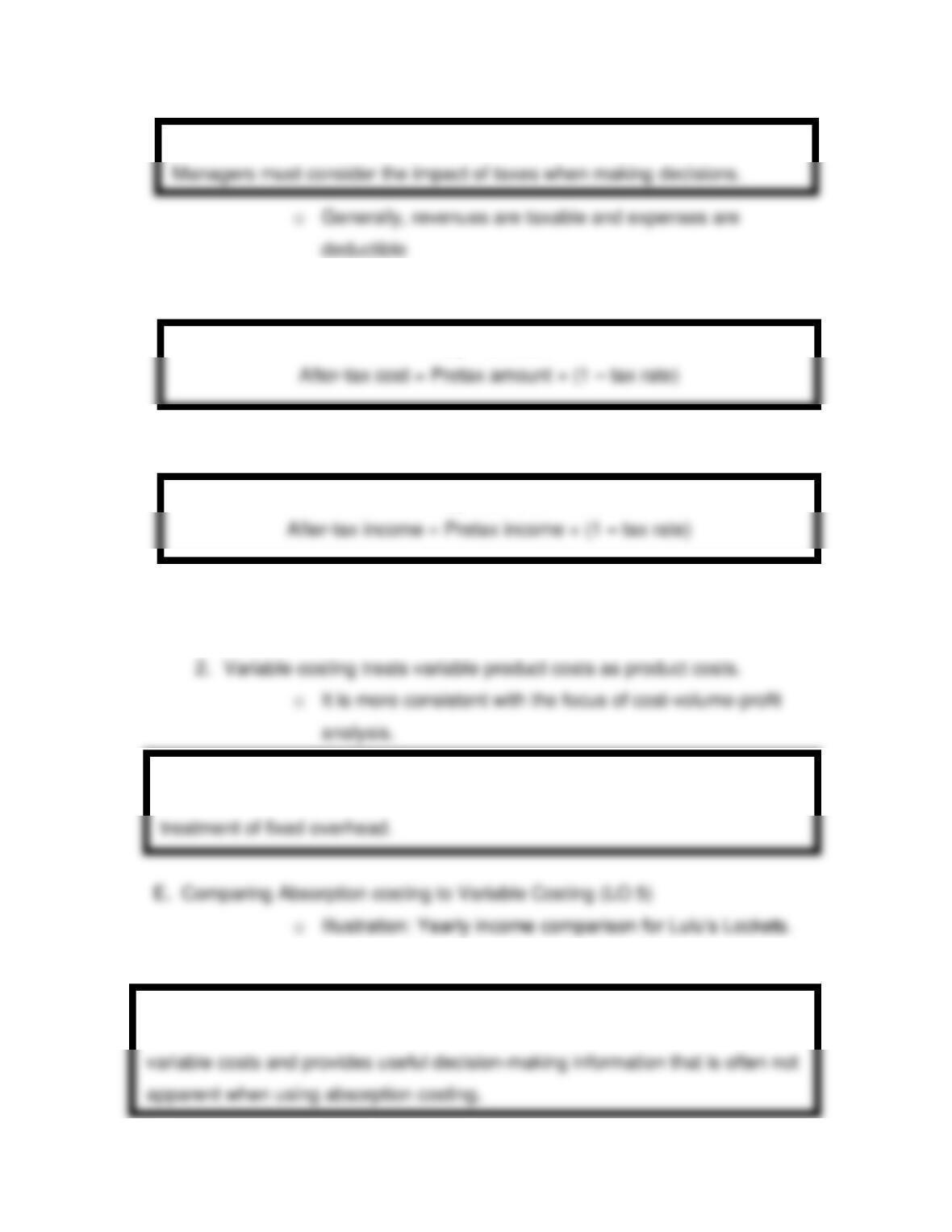
1. After-Tax Costs and Revenues
2. Before- and After-Tax Income
D. A Comparison of Absorption Costing and Variable Costing (LO4)
1. Absorption Costing treats fixed overhead as a product cost.
F. Variable Costing and Decision Making (LO6)
Key Concept
Key Concept
The only difference between variable and absorption costing is the
Key Concept
Variable costing is consistent with CVP’s focus on differentiating fixed from
Key Formula
Key Formula
Instructor’s Manual
3 – 6
1. Choosing the Best Method for Performance Evaluation
o For external reporting, managers use absorption costing,
2. Advantages of Variable Costing
o Changes in production and inventory levels do not impact
the calculation of profits.
End-of-Chapter Material
The chapter contains numerous good exercises dealing with using spreadsheets
Key Concept
Variable costing offers many benefits that focus on managerial performance
and cost behavior.