Assumptions:
Density of air is constant.
Properties:
Air, ρ=1.1kg/m3.
Solution:
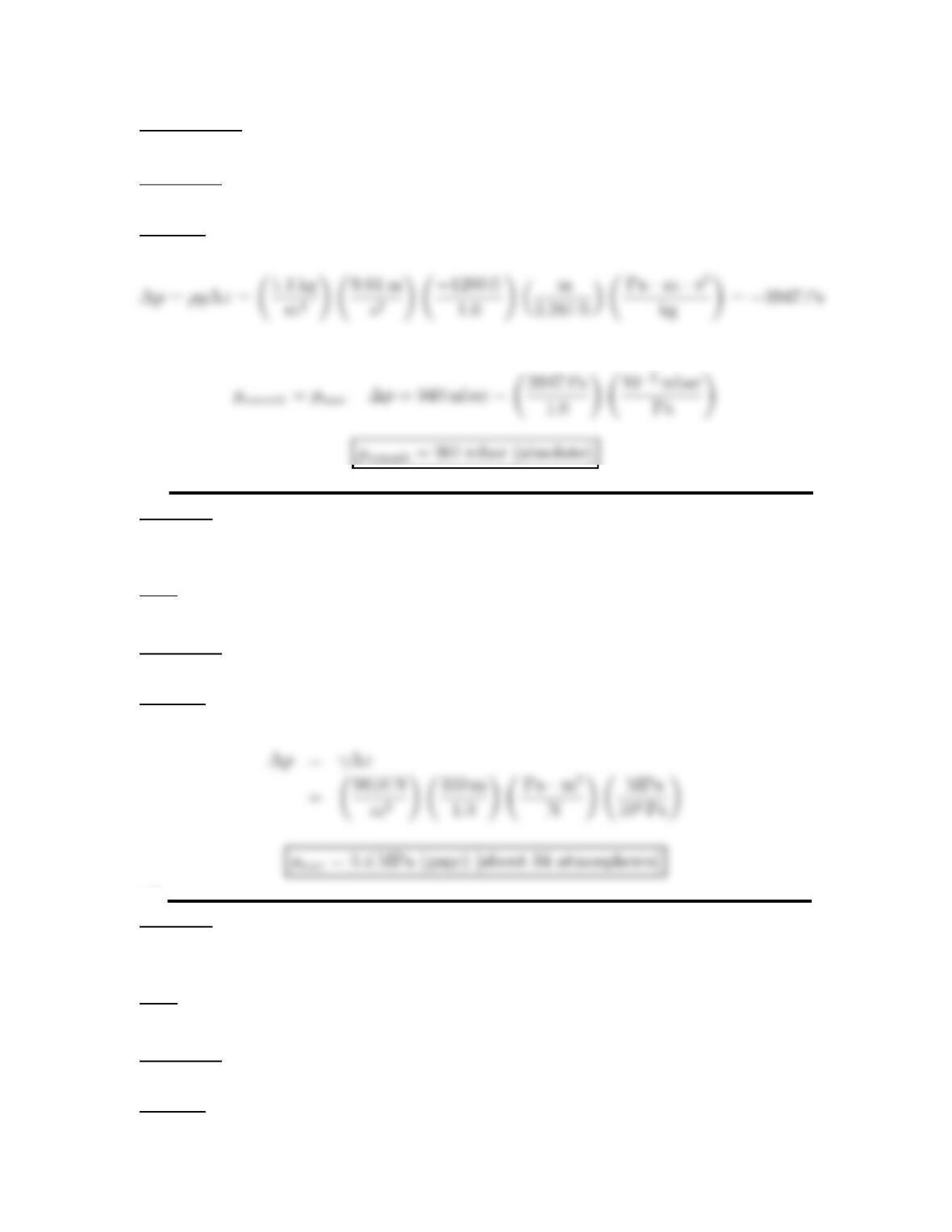
Pressure at summit:
d.)
Situation:
Pressure increases with depth in a lake.
∆z=350m.
Find:
Pressure (MPa).
Properties:
Water, γ=9810N/m3.
Solution:
e.)
Situation:
Pressure increase with water depth in a standpipe.
∆z=70m.
Find:
Pressure (kPa).
Properties:
Water, γ=9810N/m3.
Solution:
21

3.15: PROBLEM DEFINITION
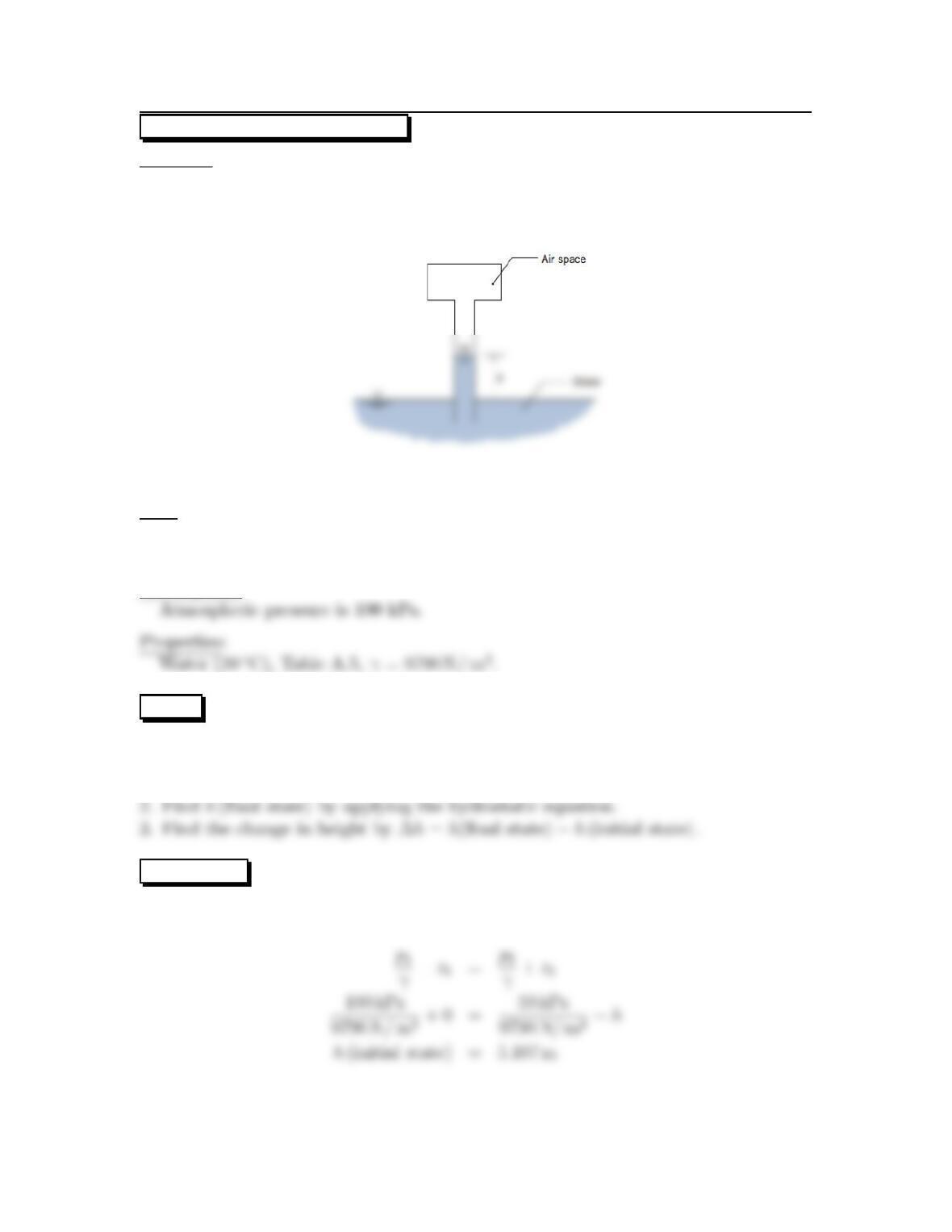
Situation:
Airabovealongtubeispressurized.
Initial state: pair1 =50kPa-vacuum
Final state: pair2 =25kPa-vacuum.
Find:
Will hincrease or decrease?
The change in water column height (∆h)in meters.
Assumptions:
PLAN
Since pressure increases, the water column height will decrease. Use absolute pressure
in the hydrostatic equation.
1. Find h(initial state)by applying the hydrostatic equation.
SOLUTION
1. Initial State. Locate point 1 on the reservoir surface; point 2 on the water surface
inside the tube:
23
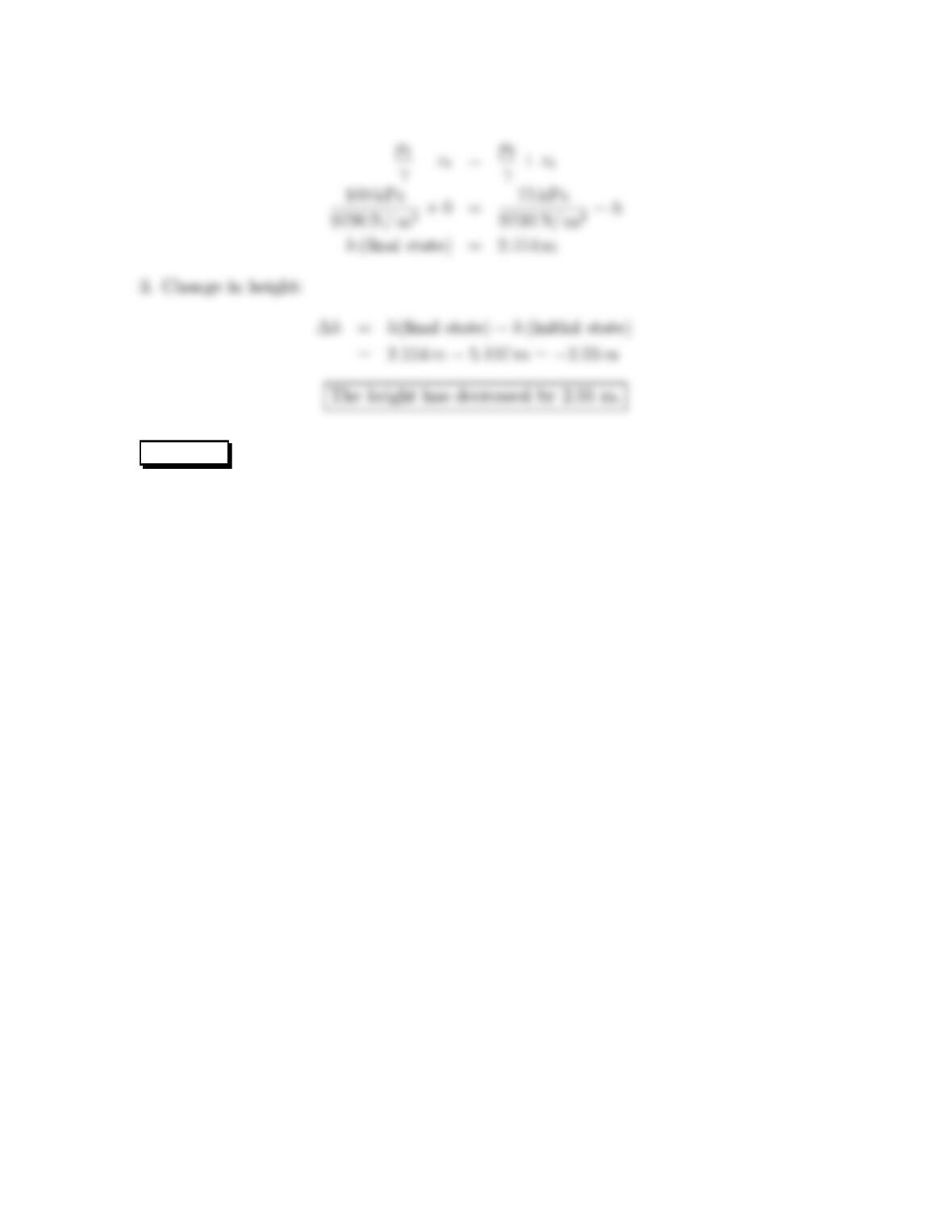
2. Final State:
REVIEW
Tip! In the hydrostatic equation, use gage pressure or absolute pressure. Using
vacuum pressure will give a wrong answer.
24
3.16: PROBLEM DEFINITION
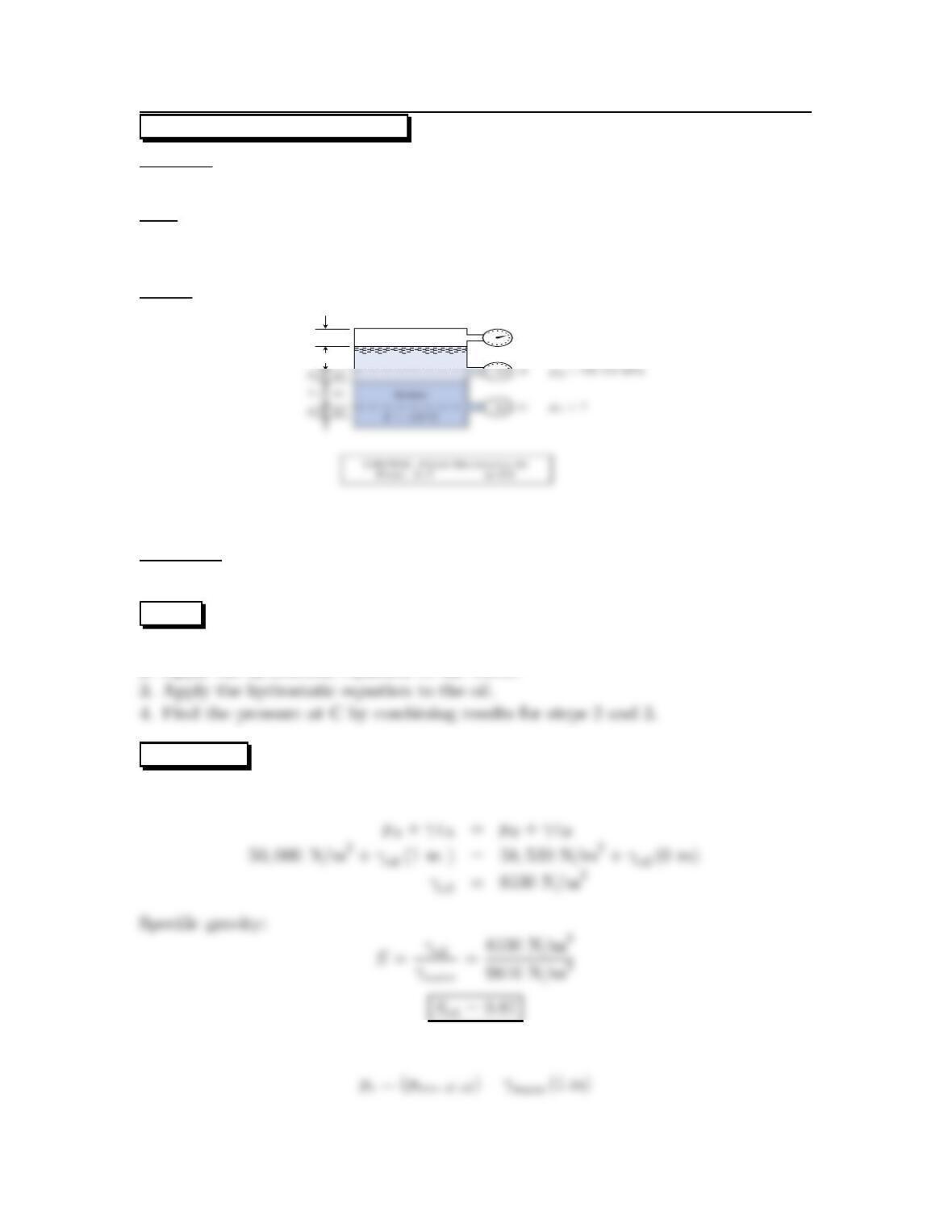
Situation:
A closed tank contains air, oil, and water.
Find:
Specific gravity of oil.
Pressure at C (kPa-gage).
Sketch:
0.5 m
1.0 m
Air
A
p
A
= 50.0 kPa
Oil
Properties:
Water (10 ◦C), Table A.5, γ=9810N/m3.
PLAN
1. Find the oil specific gravity by applying the hydrostatic equation from A to B.
2. Apply the hydrostatic equation to the water.
SOLUTION
1. Hydrostatic equation (from oil surface to elevation B):
2. Hydrostatic equation (in water):
25
3. Hydrostatic equation (in oil):
26
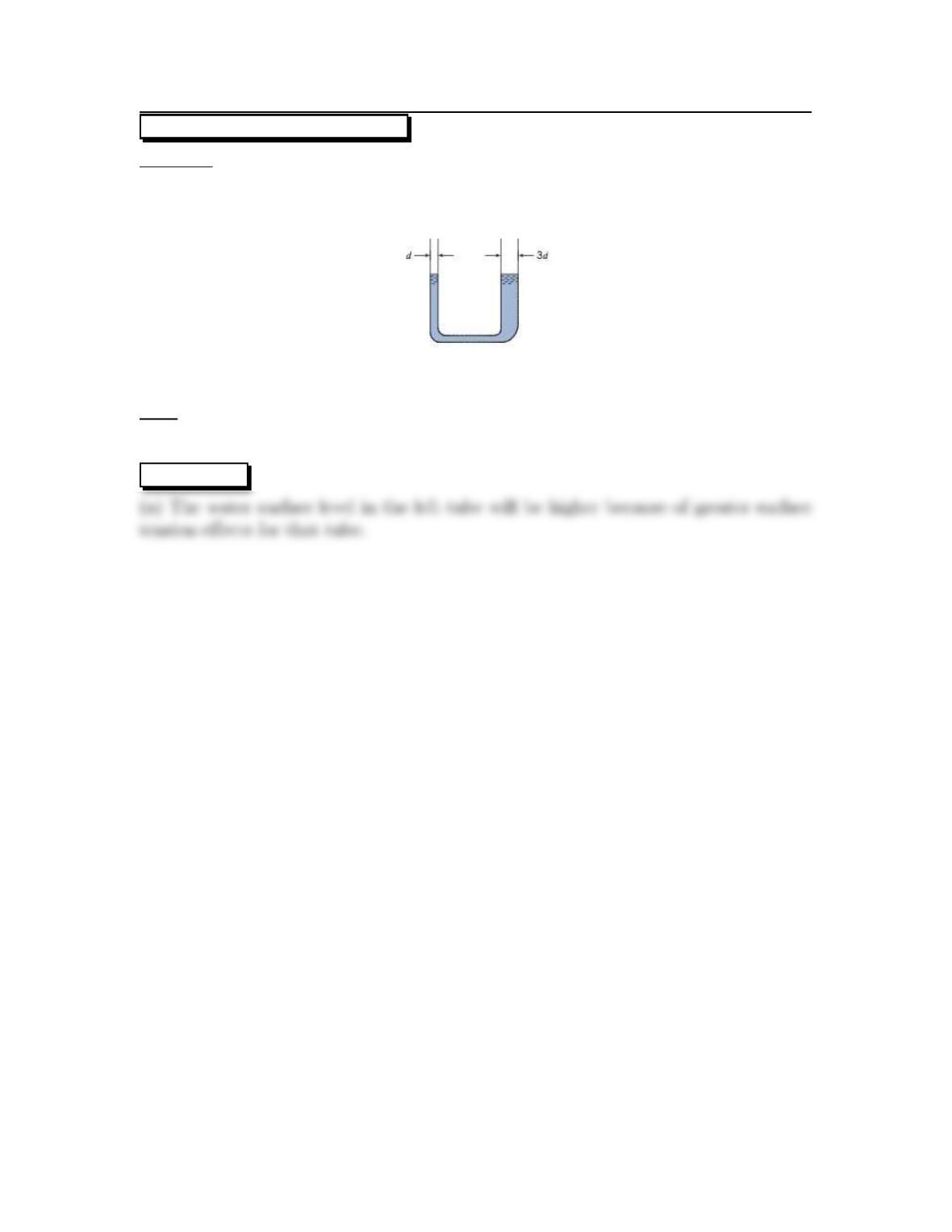
3.17: PROBLEM DEFINITION
Situation:
A manometer is described in the problem statement.
dleft =1mm,d
right =3mm.
Find:
Water surface level in the left tube as compared to the right tube.
SOLUTION
27
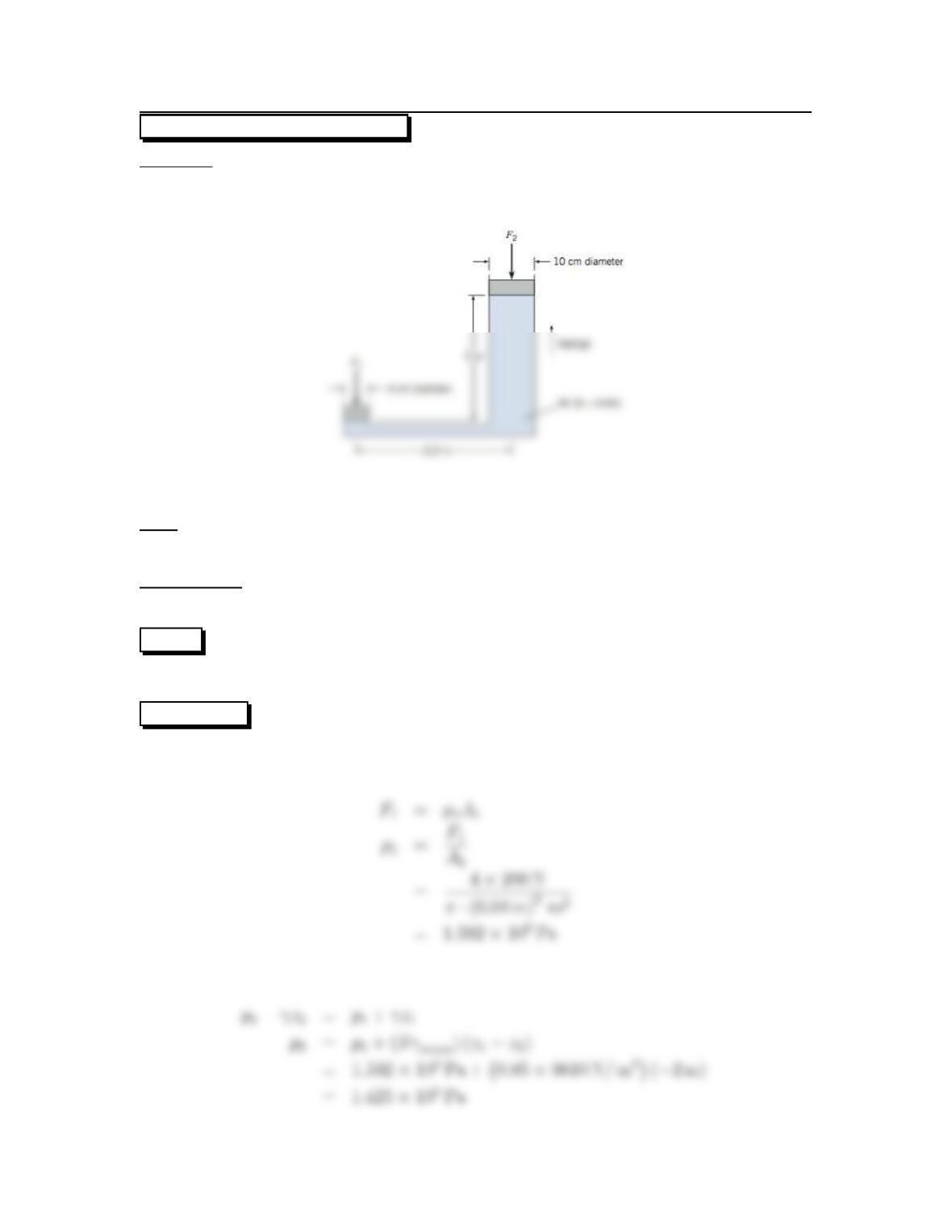
3.18: PROBLEM DEFINITION
Situation:
A force is applied to a piston.
F1=200N,d1=4cm,d2=10cm.
Find:
Force resisted by piston.
Assumptions:
Neglect piston weight.
PLAN
Apply the hydrostatic equation and equilibrium.
SOLUTION
1. Equilibrium (piston 1)
2. Hydrostatic equation
28

3. Equilibrium (piston 2)
29
3.19: PROBLEM DEFINITION
Situation:
Regarding the hydraulic jack in Problem 3.18 (EFM 10e), which ideas were used
to analyze the jack? (select all that apply)
a. pressure = (force)(area)
b. pressure increases linearly with depth in a hydrostatic fluid
c. the pressure at the very bottom of the 4-cm chamber is larger than the pressure
at the very bottom of the 10-cm chamber
d. when a body is stationary, the sum of forces on the object is zero
e. when a body is stationary, the sum of moments on the object is zero
f. pressure = (weight/volume)(change in elevation)
SOLUTION
Correct answers are a, b, d, e and f.
30
3.20: PROBLEM DEFINITION
Situation:
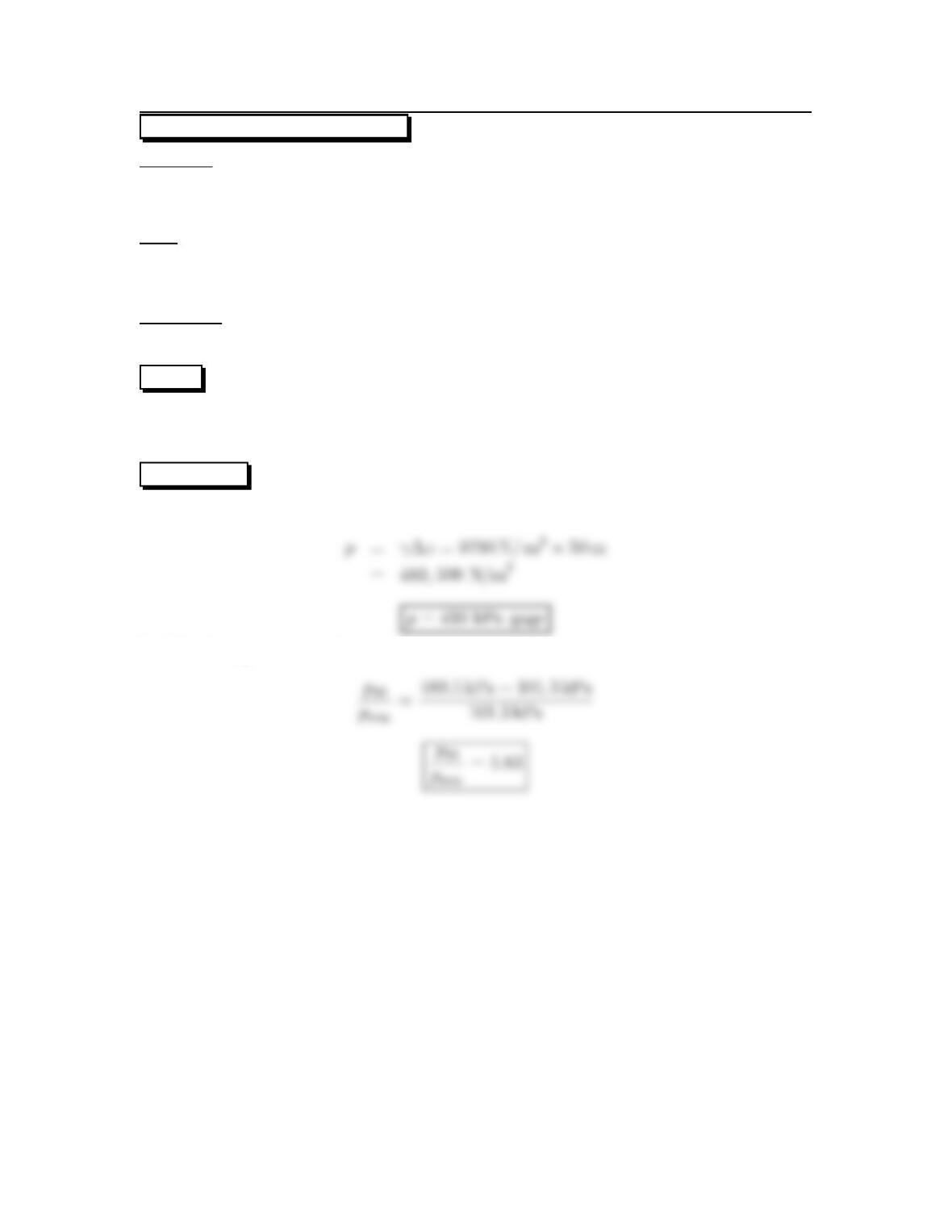
A diver goes underwater.
∆z=50m.
Find:
Gage pressure (kPa).
Ratio of pressure to normal atmospheric pressure.
Properties:
Water (20 ◦C), Table A.5, γ=9790N/m3.
PLAN
1. Apply the hydrostatic equation.
2. Calculate the pressure ratio (use absolute pressure values).
SOLUTION
1. Hydrostatic equation
2. Calculate pressure ratio
31
3.21: PROBLEM DEFINITION
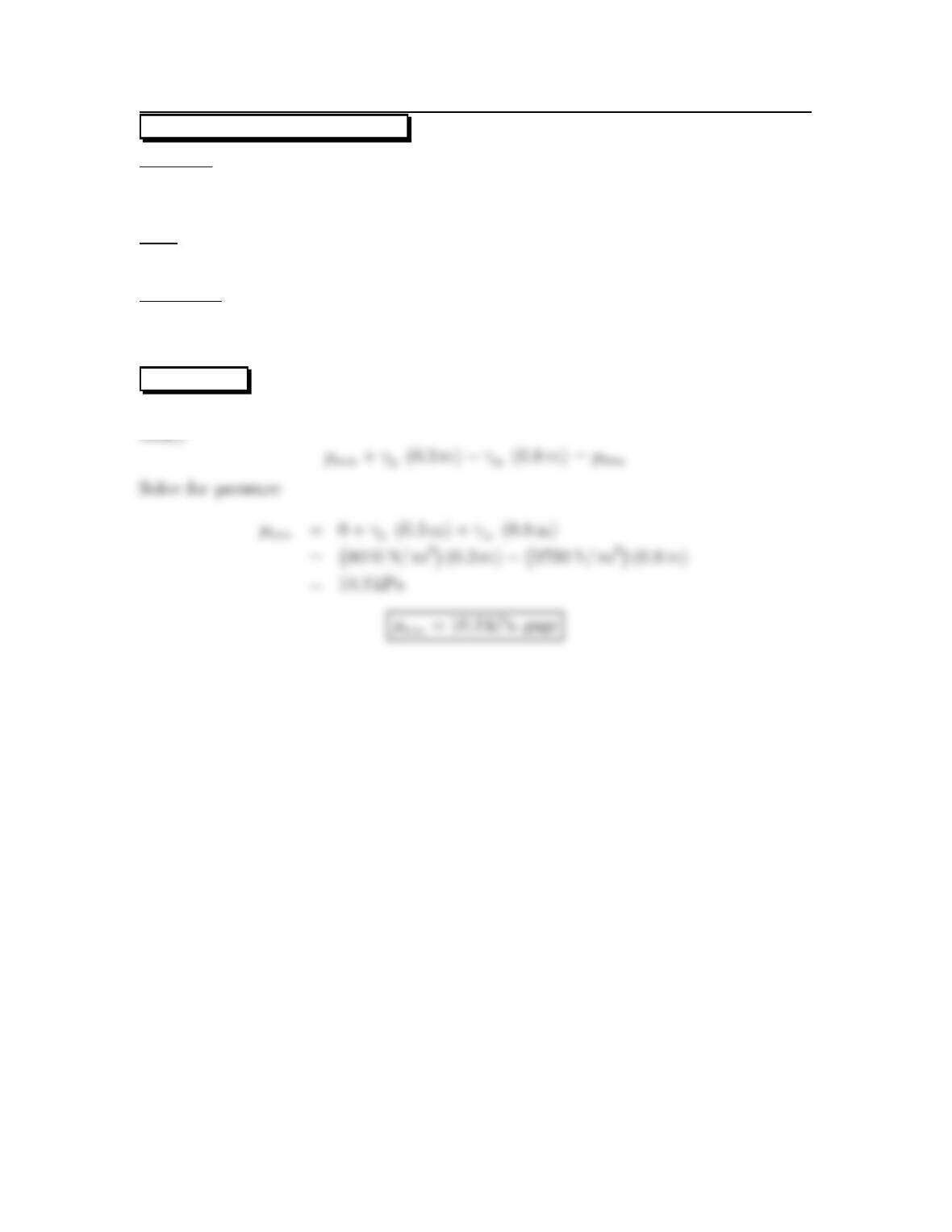
Situation:
Water and kerosene are in a tank.
zwater =0.8m,zkerosene =0.3m.
Find:
Gage pressure at bottom of tank (kPa-gage).
Properties:
Water (20 ◦C),TableA.5,γw= 9790 N/m3.
Kerosene (20 ◦C) ,Table A.4, γk=8010N/m3.
SOLUTION
Manometer equation (add up pressure from the top of the tank to the bottom of the
32
3.22: PROBLEM DEFINITION
Situation:
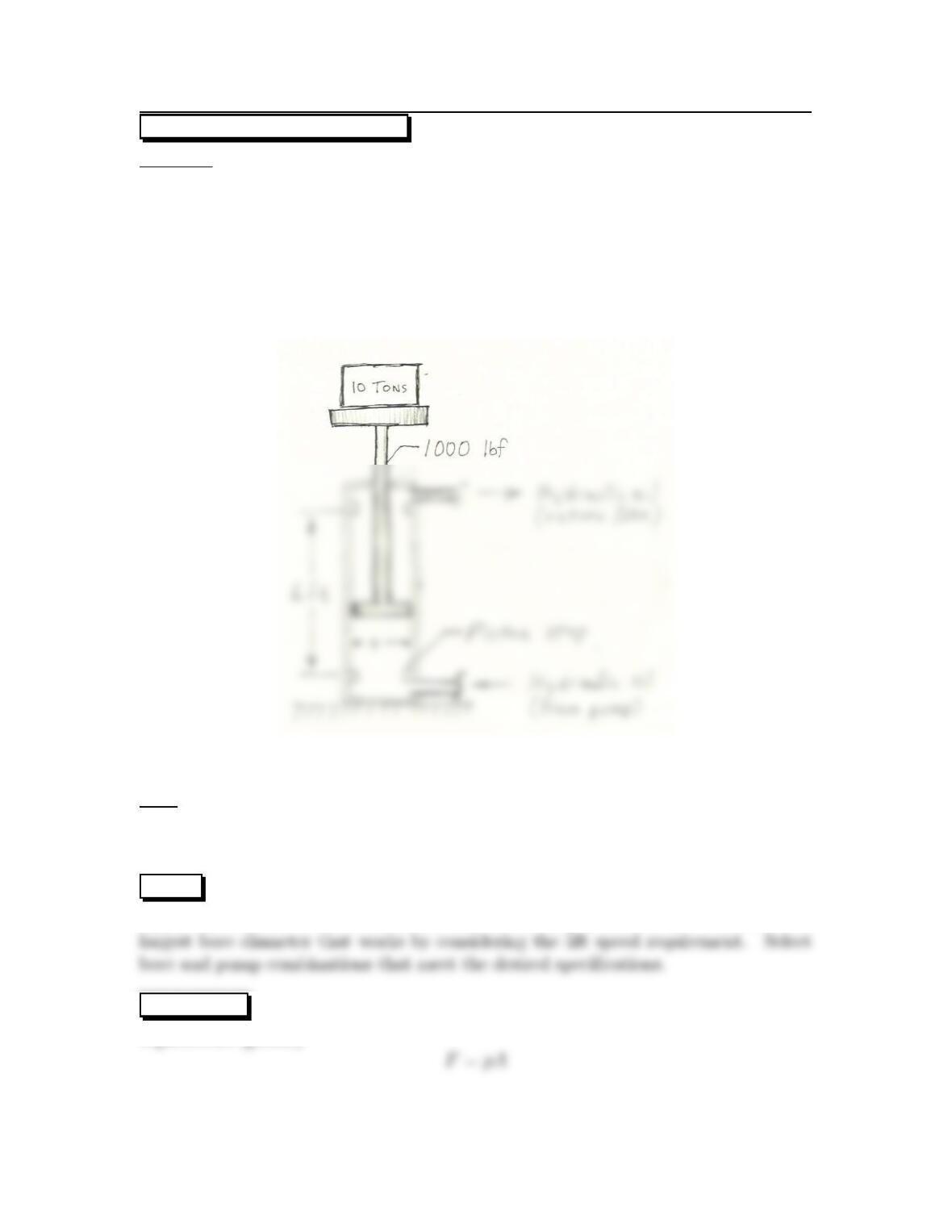
A hydraulic lift is being designed.
Wmax =10ton = 20000 lbf,Wparts =1000lbf.
∆L=6ft,∆t=20s.
Diameter range: 2−8in.
Pressure range: 200 −3000 psig.
Available pumping capacity: 5,10,15 gpm.
Find:
Select a hydraulic pump capacity (gpm).
Select a cylinder diameter (D).
PLAN
Apply equilibrium to find the smallest bore diameter (D) that works. Then find the
SOLUTION
Equilibrium (piston)
33
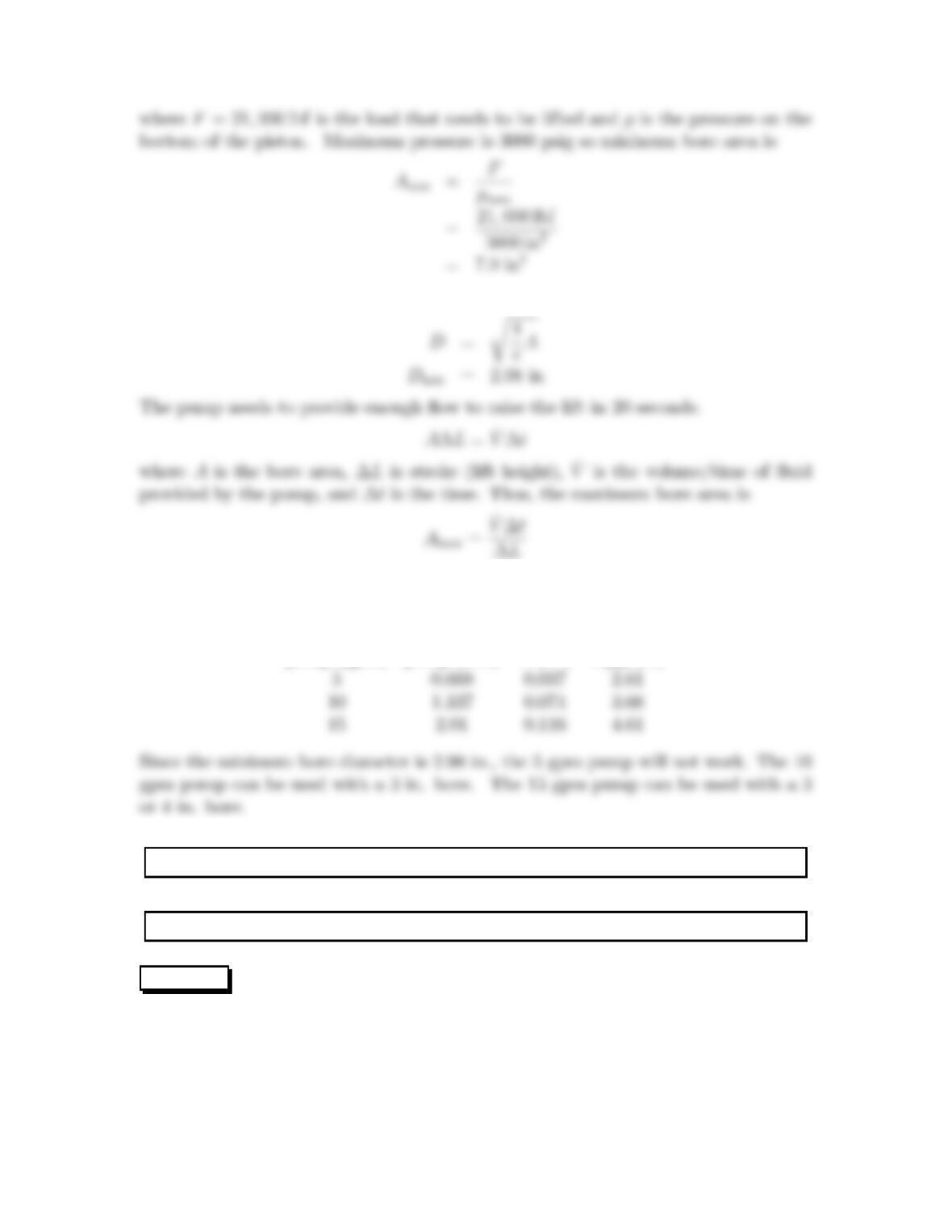
Corresponding minimum bore diameter is
Conversion from gallons to cubic feet ¡ft3¢:7.48gal=1ft
3.Thus, the maximum
bore diameter for three pumps (to meet the lift speed specification) is given in the
table below.
pump (gpm) pump (cfm) A (ft2)D
max (in)
1.) The 10 gpm pump will work with a bore diameter between 3.0 and 3.6 inches.
2.) The 15 gpm pump will work with a bore diameter between 3.0 and 4.6 inches.
REVIEW
1. These are preliminary design values. Other issues such as pressure drop in the
hydraulic lines and valves would have to be considered.
2. We recommend selecting the 15 gpm pump and a 4.5 inch bore to provide
latitude to handle pressure losses, and to reduce the maximum system pressure.
34
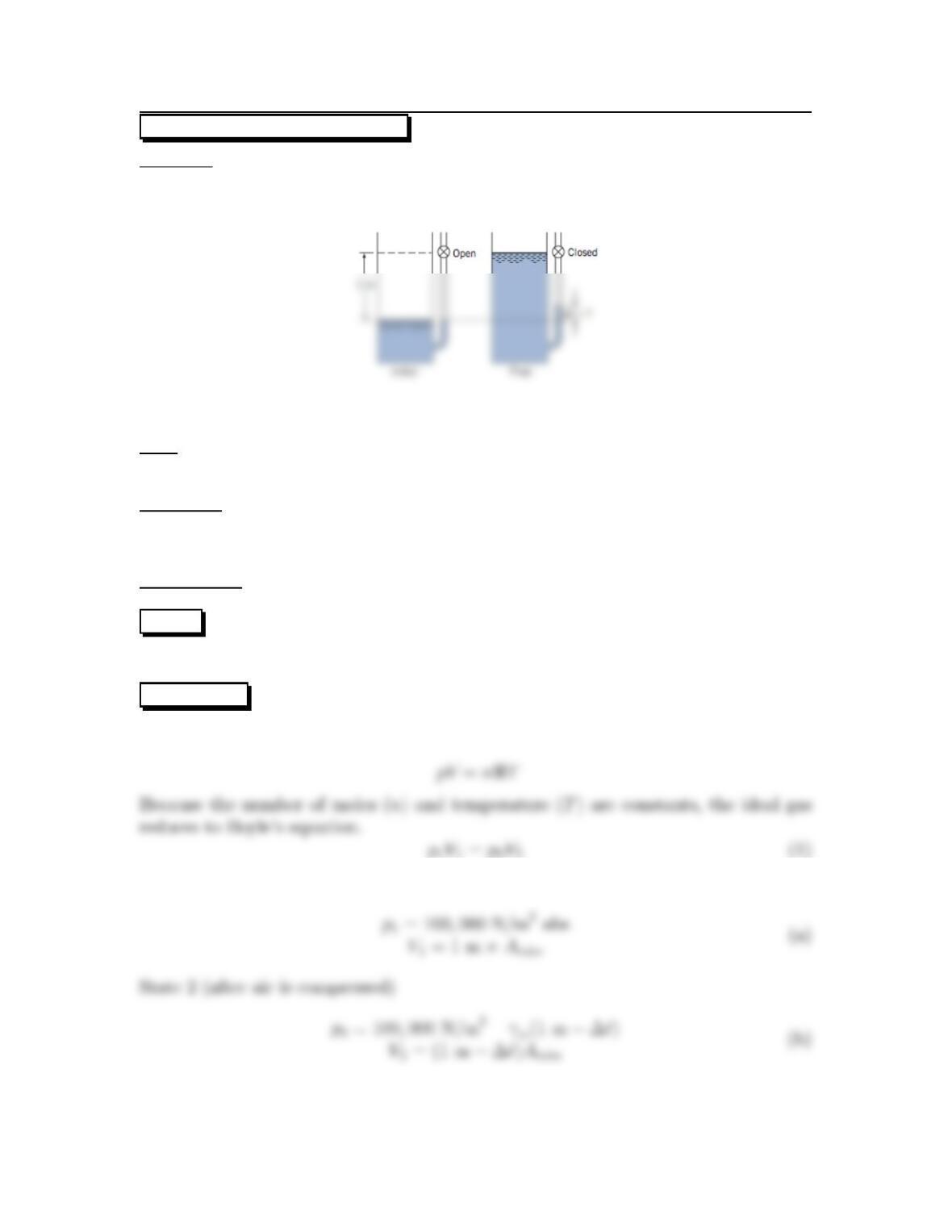
3.23: PROBLEM DEFINITION
Situation:
Initial State: Water levels as shown. Valve in open.
Final State: Water is added to the tank with the valve closed.
Find:
Increase of water level ∆in manometer (in meters).
Properties:
Water (20 ◦C),TableA.5,γw=9790 N/m3.
patm =100kPa.
Assumptions:Idealgas.
PLAN
Apply the hydrostatic equation and the ideal gas law.
SOLUTION
Ideal gas law (mole form; apply to air in the manometer tube)
State 1 (before air is compressed)
35

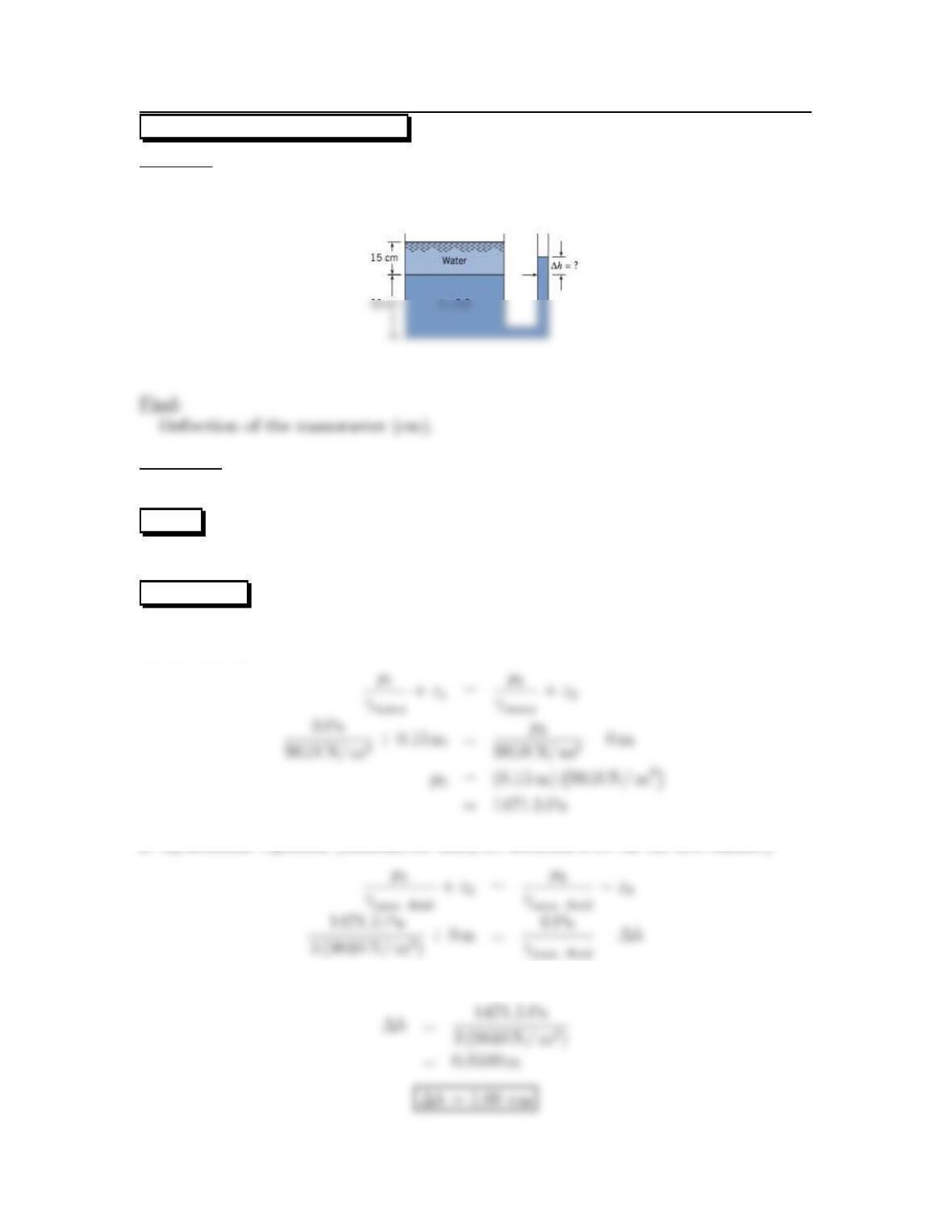
3.24: PROBLEM DEFINITION
Situation:
Atankisfitted with a manometer.
S=3,z1=0.15 m.
Properties:
γwater=9810 N/m3.
PLAN
Apply the hydrostatic principle to the water and then to the manometer fluid.
SOLUTION
1. Hydrostatic equation (location 1 is on the free surface of the water; location 2 is
the interface)
2. Hydrostatic equation (manometer fluid; let location 3 be on the free surface)
3. Solve for ∆h
37
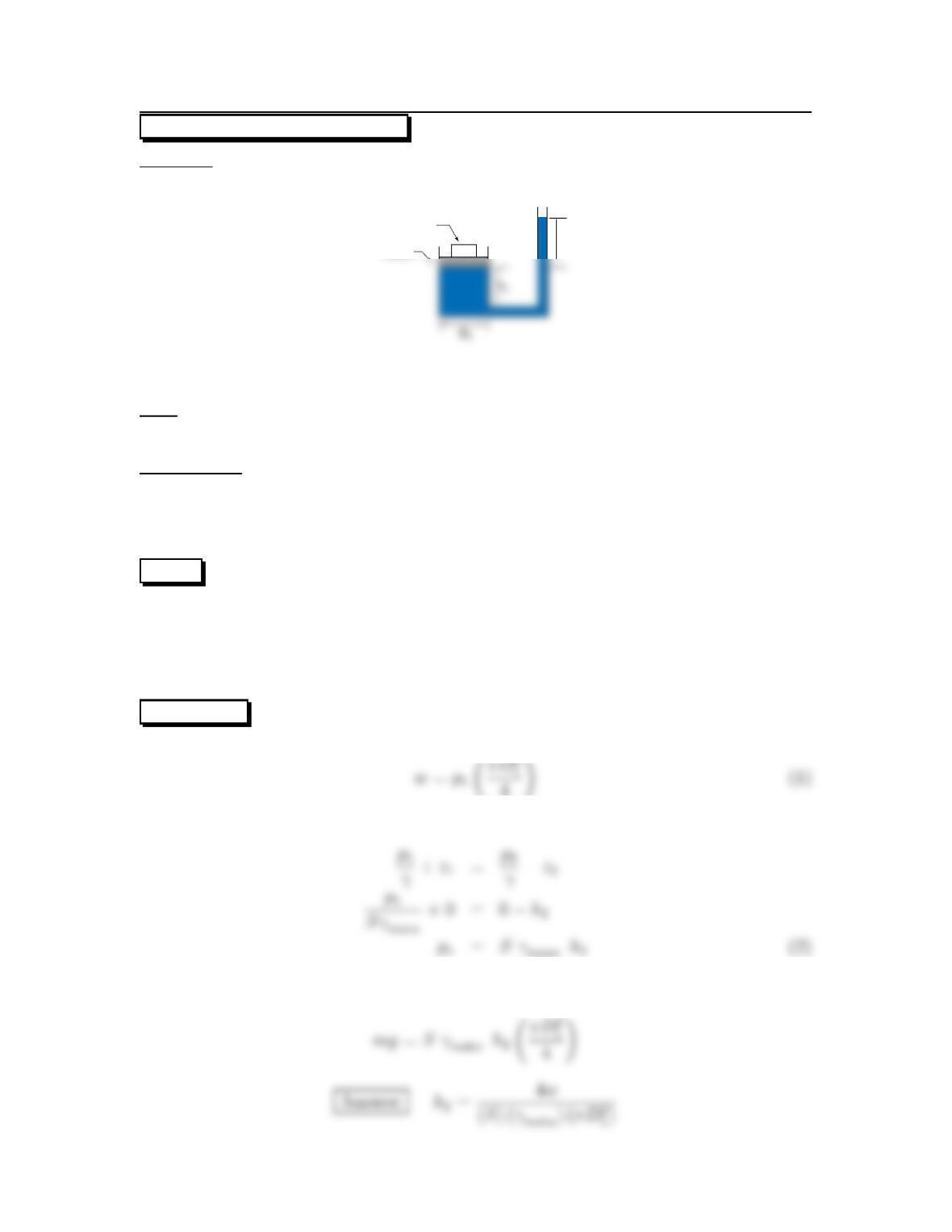
3.25: PROBLEM DEFINITION
Situation:
A mass sits on top of a piston situated above a reservoir of oil.
Weight
Piston
h
2
w
Find:
Derive an equation for h2in terms of the specified parameters.
Assumptions:
Neglect the mass of the piston.
Neglect friction between the piston and the cylinder wall.
The pressure at the top of the oil column is 0 kPa-gage.
PLAN
1. Relate wto pressure acting on the bottom of the piston using equilibrium.
2. Related pressure on the bottom of the piston to the oil column height using the
hydrostatic equation.
3. Find h2bycombiningsteps1and2.
SOLUTION
1. Equilibrium (piston):
2. Hydrostatic equation. (point 1 at btm of piston; point 2 at top of oil column):
water h2(2)
3. Combine Eqs. (1) and (2):
38

REVIEW
1. Notice. Column height h2increases linearly with increasing weight w.Similarly, h2
decreases linearly with Sand decreases quadratically with D1.
2. Notice. The apparatus involved in the problem could be used to create an instru-
ment for weighing an object.
39
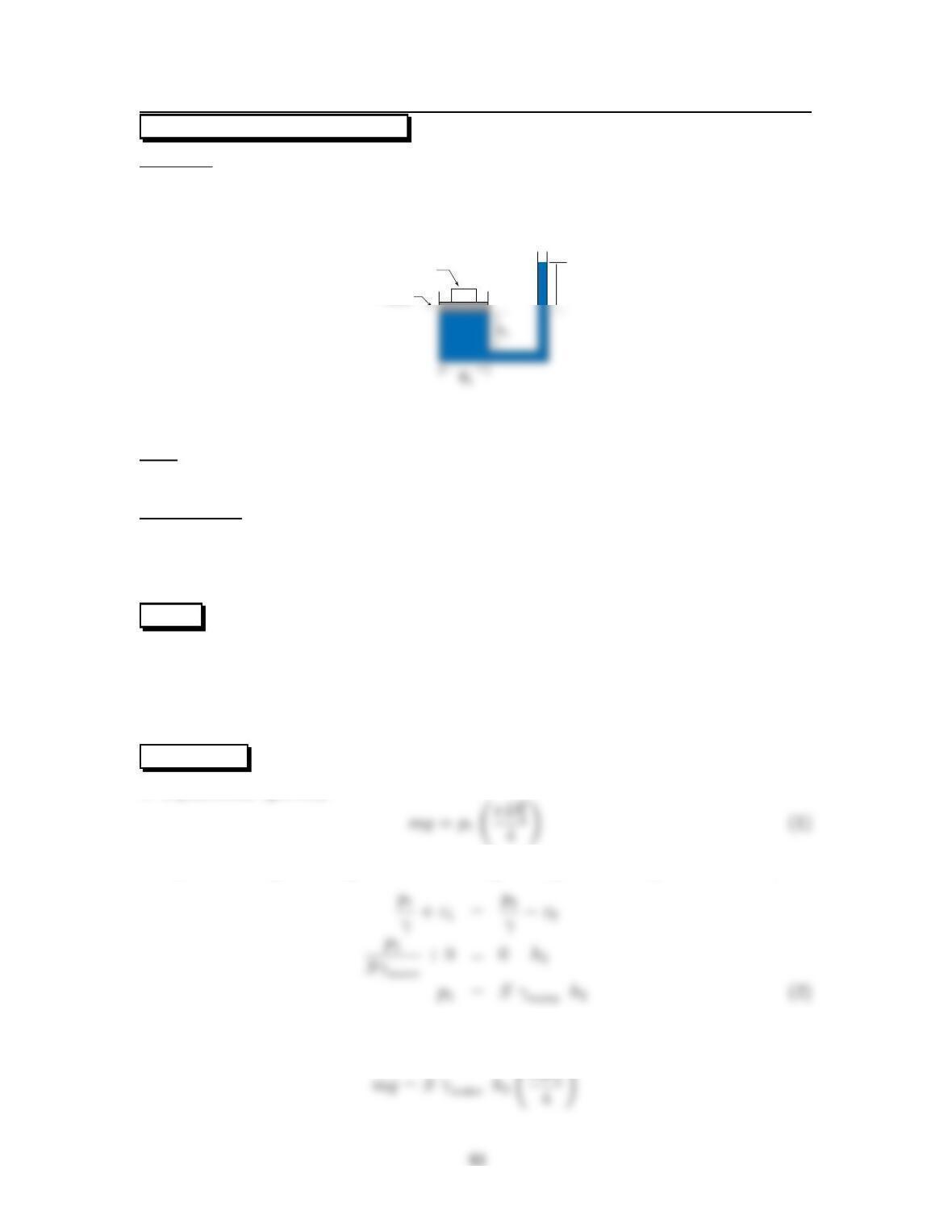
3.26: PROBLEM DEFINITION
Situation:
A mass sits on top of a piston situated above a reservoir of oil.
m=5kg,S=0.8,h1=42mm.
D1=120mm,D2=5mm.
Weight
Piston
h
2
w
Find:
Calculate h2(m).
Assumptions:
Neglect the mass of the piston.
Neglect friction between the piston and the cylinder wall.
The pressure at the top of the oil column is 0 kPa-gage.
PLAN
1. Relate mass mto pressure acting on the bottom of the piston using equilibrium.
2. Related pressure on the bottom of the piston to the oil column height using the
hydrostatic equation.
3. Find h2bycombiningsteps1and2.
SOLUTION
1. Equilibrium (piston):
2. Hydrostatic equation. (point 1 at btm of piston; point 2 at top of oil column):
3. Combine Eqs. (1) and (2):