COMPARATIVE ANALYSIS CASE (Continued)
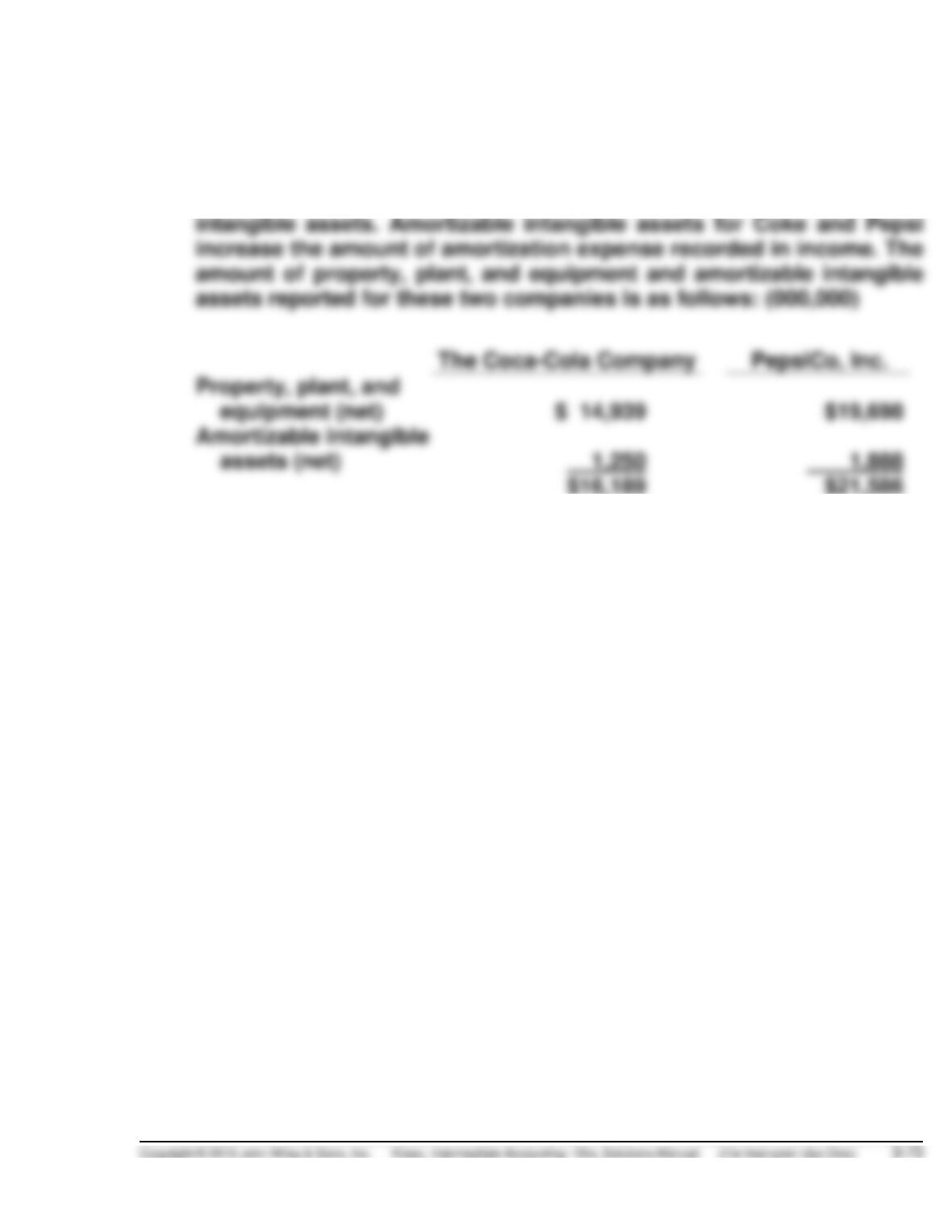
PepsiCo has substantially more property, plant, and equipment than
does Coca-Cola. PepsiCo is engaged in three different types of
businesses: soft drinks, snack-food, and juices. As a result, it has more
tangible fixed assets. PepsiCo also has substantially more amortizable
FINANCIAL STATEMENT ANALYSIS
(a)
2011
2010
2009
%
Change
2011
%
Change
2010
Sales
$13,198
$12,397
$12,575
6.46%
-1.42%
Gross Profit %
41.28%
42.66%
42.87%
-3.23%
-0.49%
Operating Profit
1,976
2,001
-0.70%
-0.55%
Capital Expenditures
1,001
1,266
Net Earnings
1,231
1,212
-1.28%
2.89%
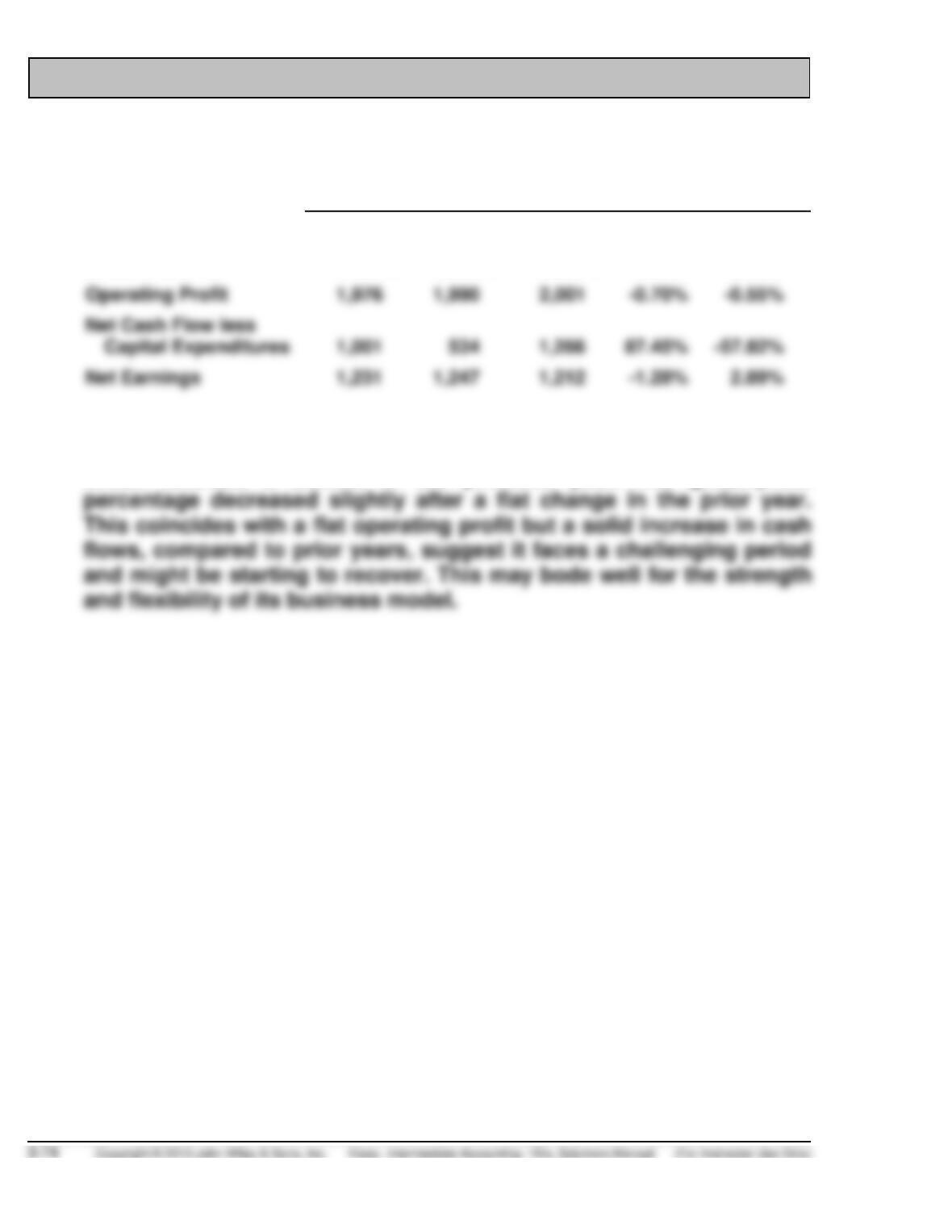
(b) Kellogg experienced an improvement in sales in the current year
which followed a decline in the previous year. The gross-profit
ACCOUNTING, ANALYSIS, AND PRINCIPLES
Accounting
Depreciation Expense ……………………………………………………….
9,500
Accumulated Depreciation—Equipment …………………………..
9,500
($9,500 = ($192,000 – $40,000) ÷ 16)
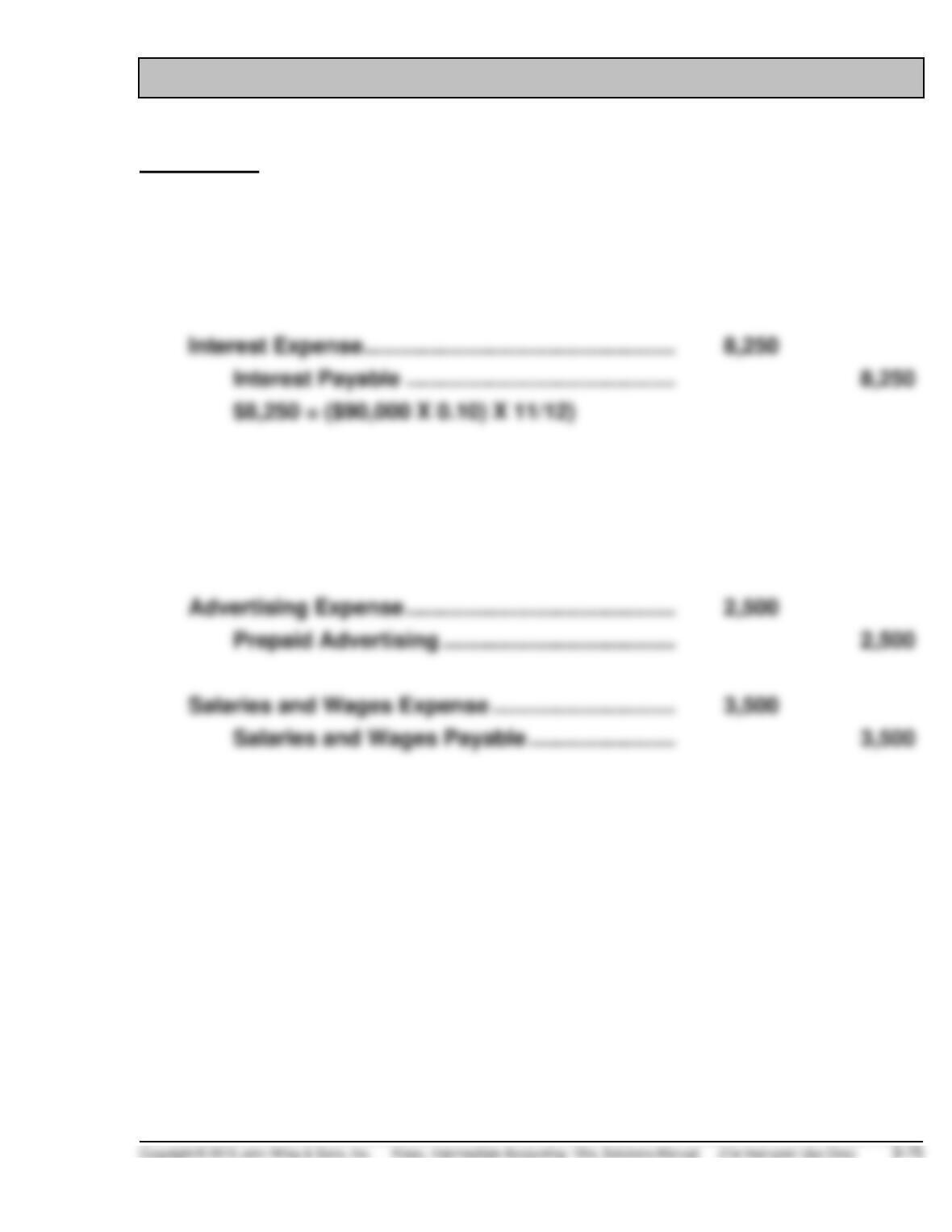
Interest Expense ……………………………………………………….
8,250
$8,250 = ($90,000 X 0.10) X 11/12)
Unearned Service Revenue ……………………………………………………..
10,000
Service Revenue ……………………………………………………….
10,000
($10,000 = ($50 X 200))
Advertising Expense ……………………………………………………….
2,500
Salaries and Wages Expense …………………………..
3,500
Salaries and Wages Payable …………………………..
3,500
ACCOUNTING, ANALYSIS, AND PRINCIPLES (Continued)
Analysis
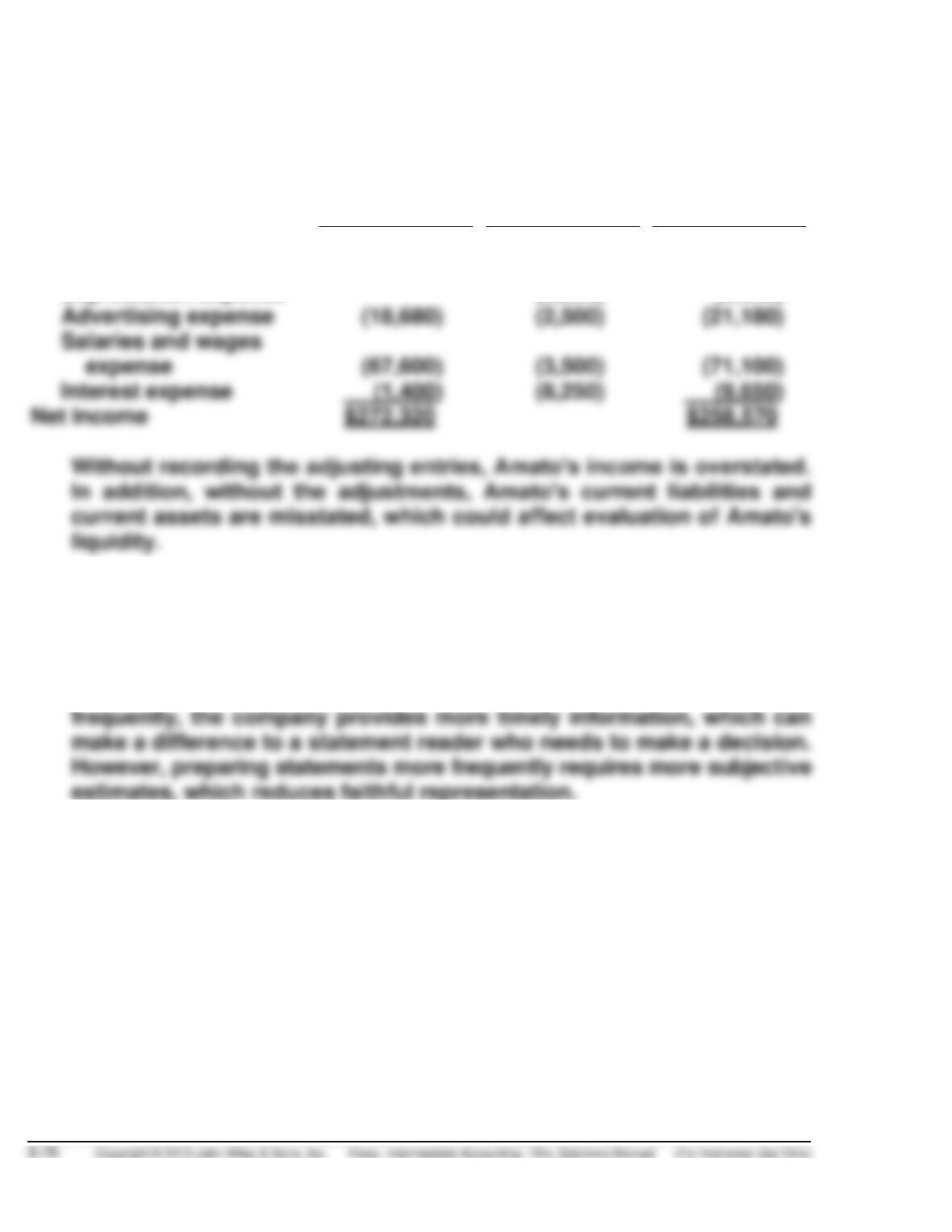
Income before
Adjustments
Adjustments
Income after
Adjustments
Service revenue
$360,000
$10,000
$370,000
Less:
Depreciation expense
(9,500)
(9,500)
Advertising expense
(2,500)
Interest expense
(8,250)
Principles
The tradeoffs are between the timeliness of the reports, which
contributes to relevance, and verifiability, the lack of which detracts
from faithful representation. That is, by preparing reports more
PROFESSIONAL RESEARCH
(a) The three essential characteristics of assets.
Search String: asset and characteristics.
CON6, Par26. An asset has three essential characteristics: (a) it
(b) Three essential characteristics of liabilities.
Search String: liability and characteristic.
CON6, Par36. A liability has three essential characteristics: (a) it
(c) Uncertainty, and its effects on financial statements.
Search Strings: “uncertainty”, effect of uncertainty.
CON6, Par44. Uncertainty about economic and business activities and
PROFESSIONAL RESEARCH (Continued)
remained unrecognized in its financial statements because of uncertainty
about whether they qualified as assets or liabilities of the entity or
CON6, Par45. An effect of uncertainty is to increase the costs of finan-
cial reporting in general and the costs of recognition and measurement
Note to instructors: The FASB codification does not contain the
Concepts Statements. However, the Concepts Statements can be
accessed at another link on the FASB website.
(d) The difference between realization and recognition
Search String: realization, recognition.
CON6, Par143. Realization in the most precise sense means the
process of converting noncash resources and rights into money and is
PROFESSIONAL SIMULATION
Journal Entries
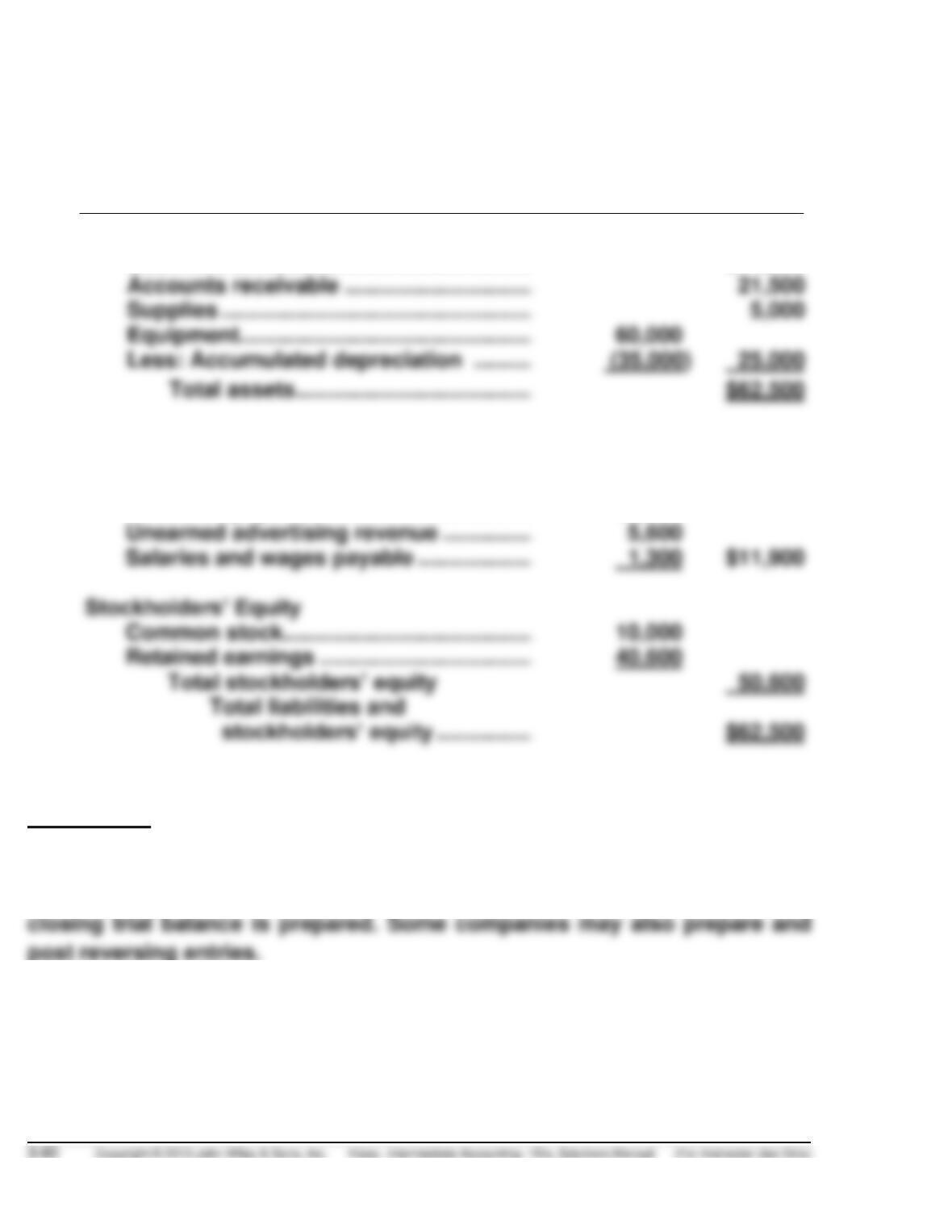
Depreciation Expense …………………………..…………………………..
7,000
Accumulated Depreciation—Equipment …………………………..
7,000
Unearned Advertising Revenue …………………………..
1,400
Advertising Revenue ……………………………………………………….
1,400
Advertising Revenue ……………………………………………………….
1,500
Supplies Expense (Art) ……………………………………………………….
3,400
Supplies ……………………………………………………….
3,400
Salaries and Wages Expense ……………………………………………………
1,300
Salaries and Wages Payable …………………………..
1,300
Financial Statements
BUTLER ADVERTISING AGENCY
Income Statement
For the Year Ended December 31, 2014
Revenues
Advertising revenue ……………………………………………..
$61,500
Expenses
Salaries and wages expense …………………………..
$11,300
Depreciation expense …………………………………………..
Rent expense ……………………………………………………….
Supplies expense …………………………………………………
3,400
Total expenses ………………………………………………..
PROFESSIONAL SIMULATION (Continued)
BUTLER ADVERTISING AGENCY
Balance Sheet
December 31, 2014
Assets
Cash ……………………………………………………….
$11,000
Equipment ……………………………………………………….
60,000
Liabilities and Stockholders’ Equity
Liabilities
Accounts payable ……………………………………………..
$5,000
Unearned advertising revenue …………………………..
Salaries and wages payable …………………………..
Common stock………………………………………………….
Retained earnings …………………………………………….
40,600
Total stockholders’ equity
Explanation
After the financial statements are prepared, Butler must prepare the closing
entries and post the journal entries to the general ledger. Then, a post–
IFRS CONCEPTS AND APPLICATION
IFRS3-1
The date of transition is the beginning of the earliest period for which full
IFRS3-2
When countries accept IFRS for use as accepted accounting policies,
IFRS3-3
A company follows these steps:
1. Identify the timing of its first IFRS statements.
4. Make extensive disclosures to explain the transition to IFRS
IFRS3-4
The date of the opening balance sheet is January 1, 2014. The IFRS financial
statements will include years ended December 31, 2015 and 2014.
IFRS3-5
(a) Assets
53 The future economic benefit embodied in an asset is the potential
IFRS3-5 (Continued)
54 An entity usually employs its assets to produce goods or services
capable of satisfying the wants or needs of customers; because
55 The future economic benefits embodied in an asset may flow to
the entity in a number of ways. For example, an asset may be:
a. used singly or in combination with other assets in the
(b) Liabilities
60 An essential characteristic of a liability is that the entity has a
present obligation. An obligation is a duty or responsibility to act
or perform in a certain way. Obligations may be legally enforce–
61 A distinction needs to be drawn between a present obligation
and a future commitment. A decision by the management of an
entity to acquire assets in the future does not, of itself, give rise
IFRS3-5 (continued)
62 The settlement of a present obligation usually involves the entity
giving up resources embodying economic benefits in order to
satisfy the claim of the other party. Settlement of a present
obligation may occur in a number of ways, for example, by:
a. payment of cash;
(c) Accrual basis
22 In order to meet their objectives, financial statements are prepared
on the accrual basis of accounting. Under this basis, the effects of
transactions and other events are recognised when they occur
IFRS3-6
(a) March 31, 2012 total assets: £7,273.3 million.
April 2, 2011 total assets: £7,344.1 million.
IFRS3-6 (Continued)
(e) An adjusting entry for deferrals is necessary when the receipt/disburse-
ment precedes the recognition in the financial statements. Accounts
such as prepaid pension contributions and prepaid leasehold premiums
(f) 2012 Depreciation and amortization expense: £479.70 million