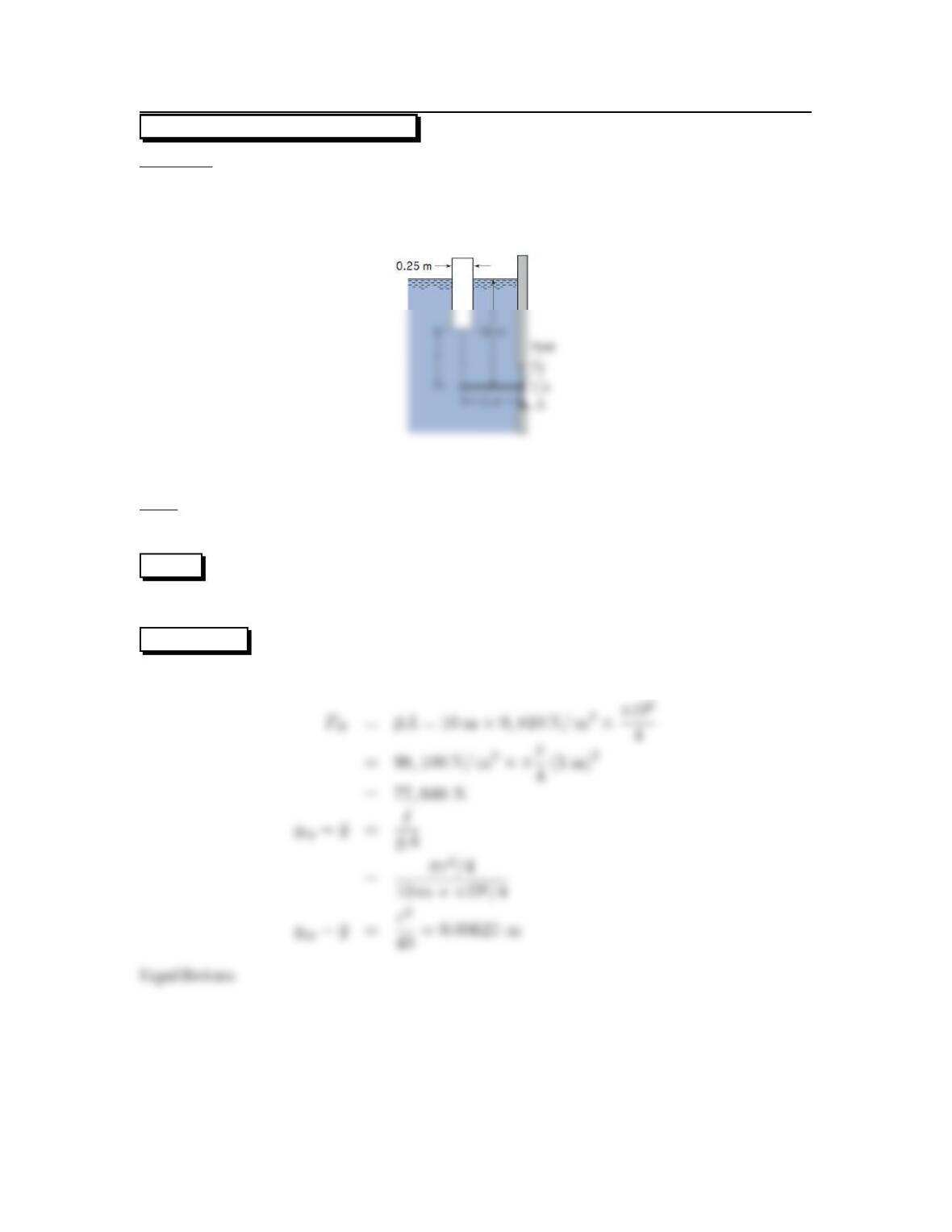
3.110: PROBLEM DEFINITION
Situation:
A submerged gate is described in the problem statement.
d=25cm,W=200N.
y=10m,L=1m.
Find:
Length of chain so that gate just on verge of opening.
PLAN
Apply hydrostatic force equations and then sum moments about the hinge.
SOLUTION
Hydrostatic force
158
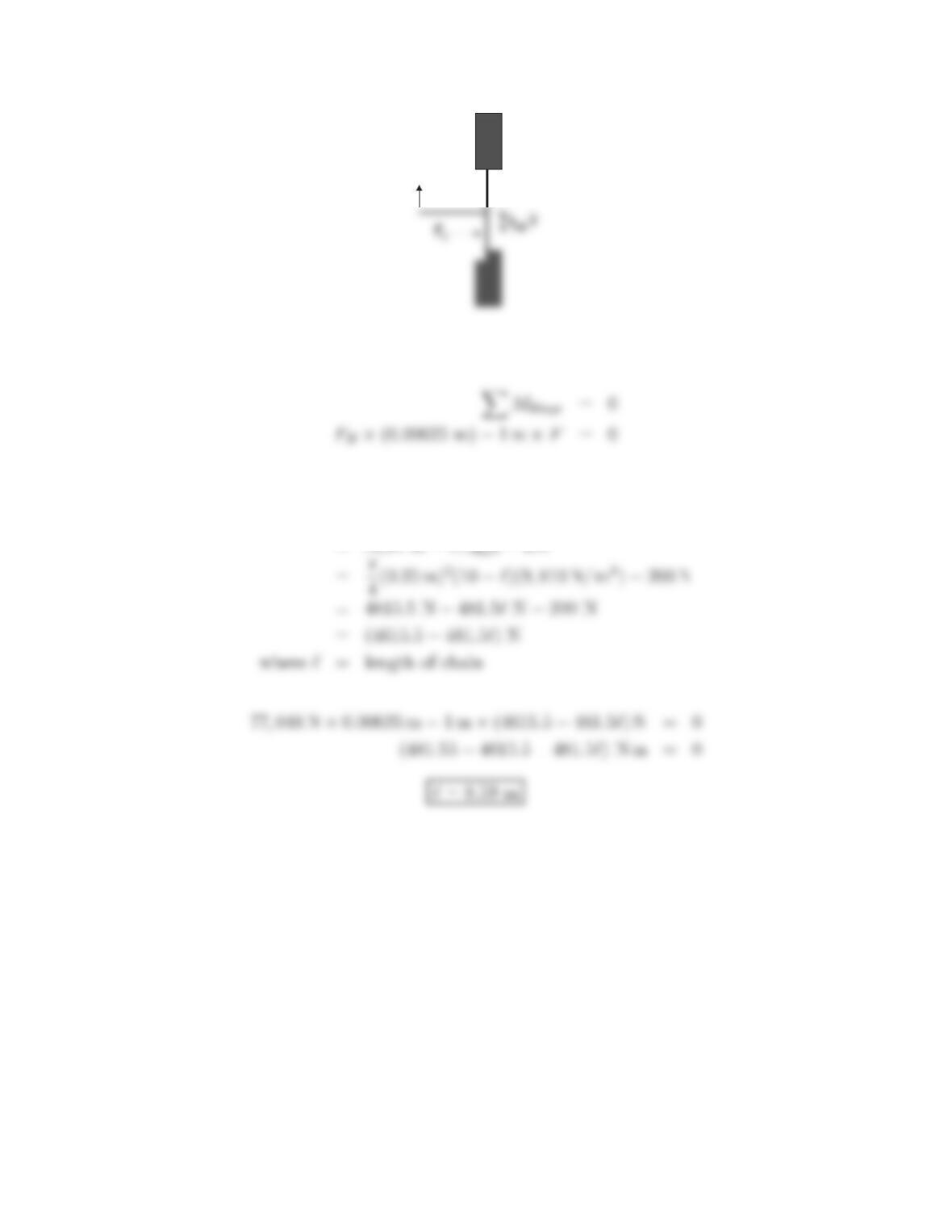
F
But F=Fbuoy −W
=A(10 m−)γH2O−200
159
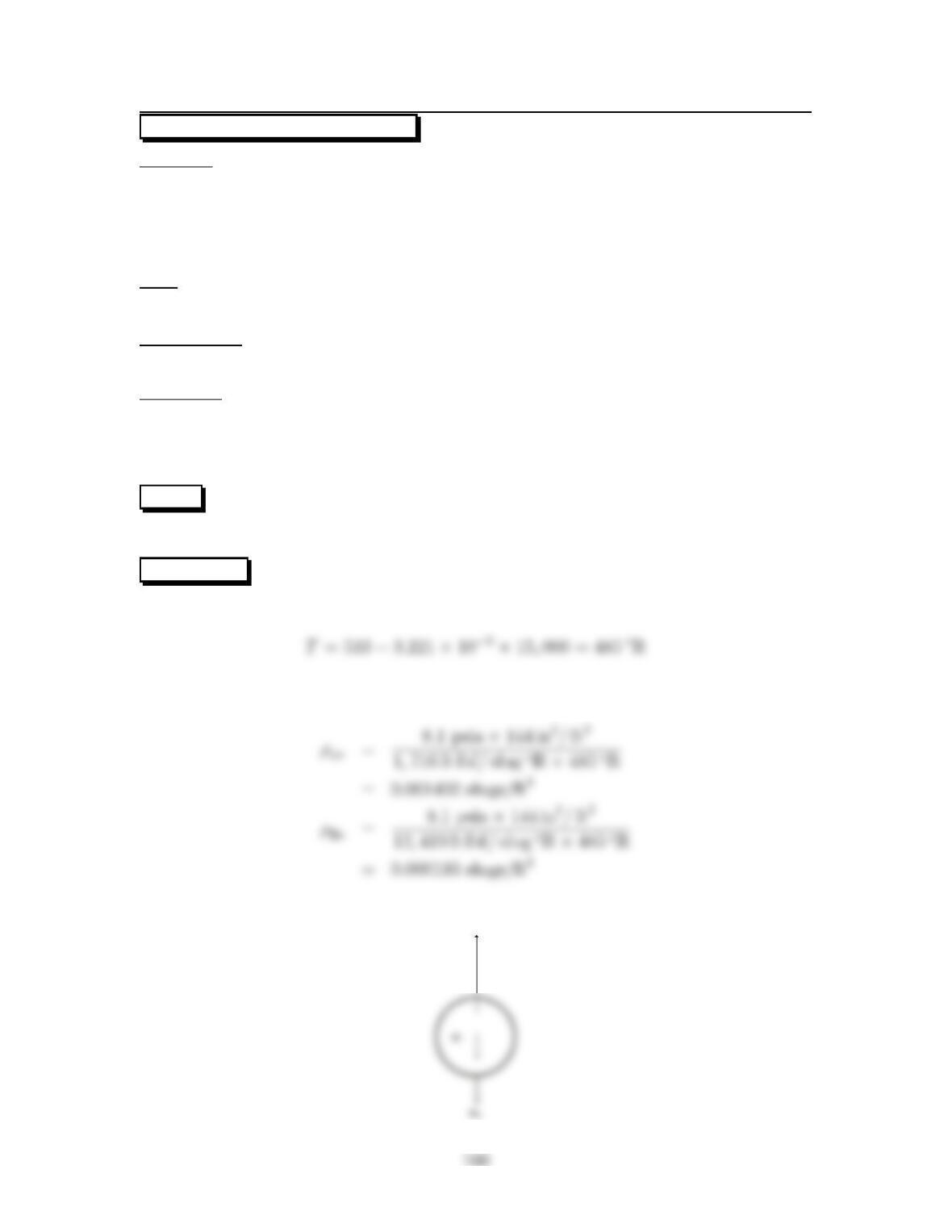
3.111: PROBLEM DEFINITION
Situation:
A balloon is used to carry instruments.
z= 15000 ft,
p15,000 =8.1psia.
Winstruments =8lbf.
Find:
Diameter of spherical balloon.
Assumptions:
Standard atmospheric temperature condition.
Properties:
pair =phelium =8.1psia.
Rair =1,716 ft lbf/slug ◦R (From Table A.2 of EFM 10e)
Rhelium =12,419 ft lbf/slug ◦R (From Table A.2 of EFM 10e)
PLAN
Apply buoyancy force and the ideal gas law.
SOLUTION
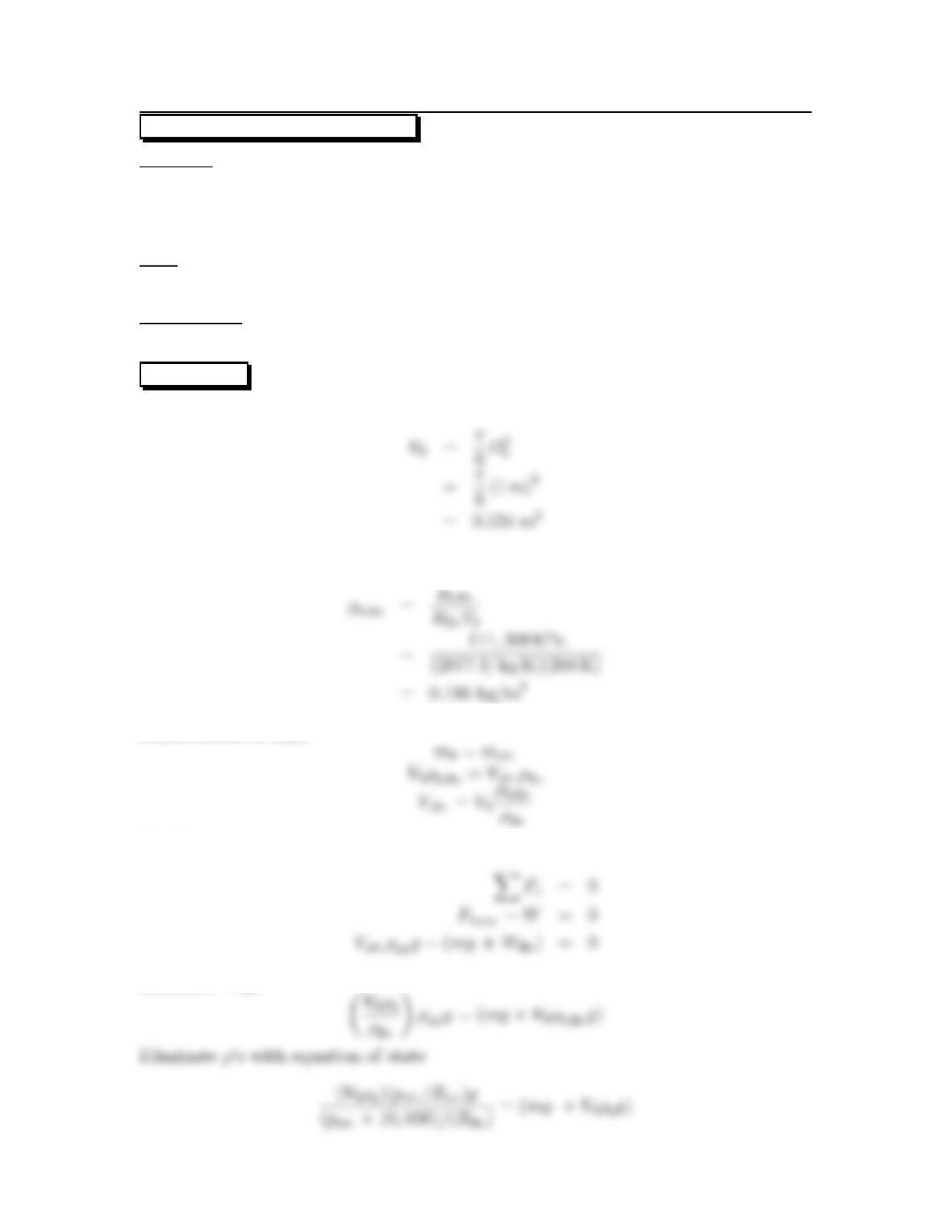
Temperature in the atmosphere
Ideal gas law
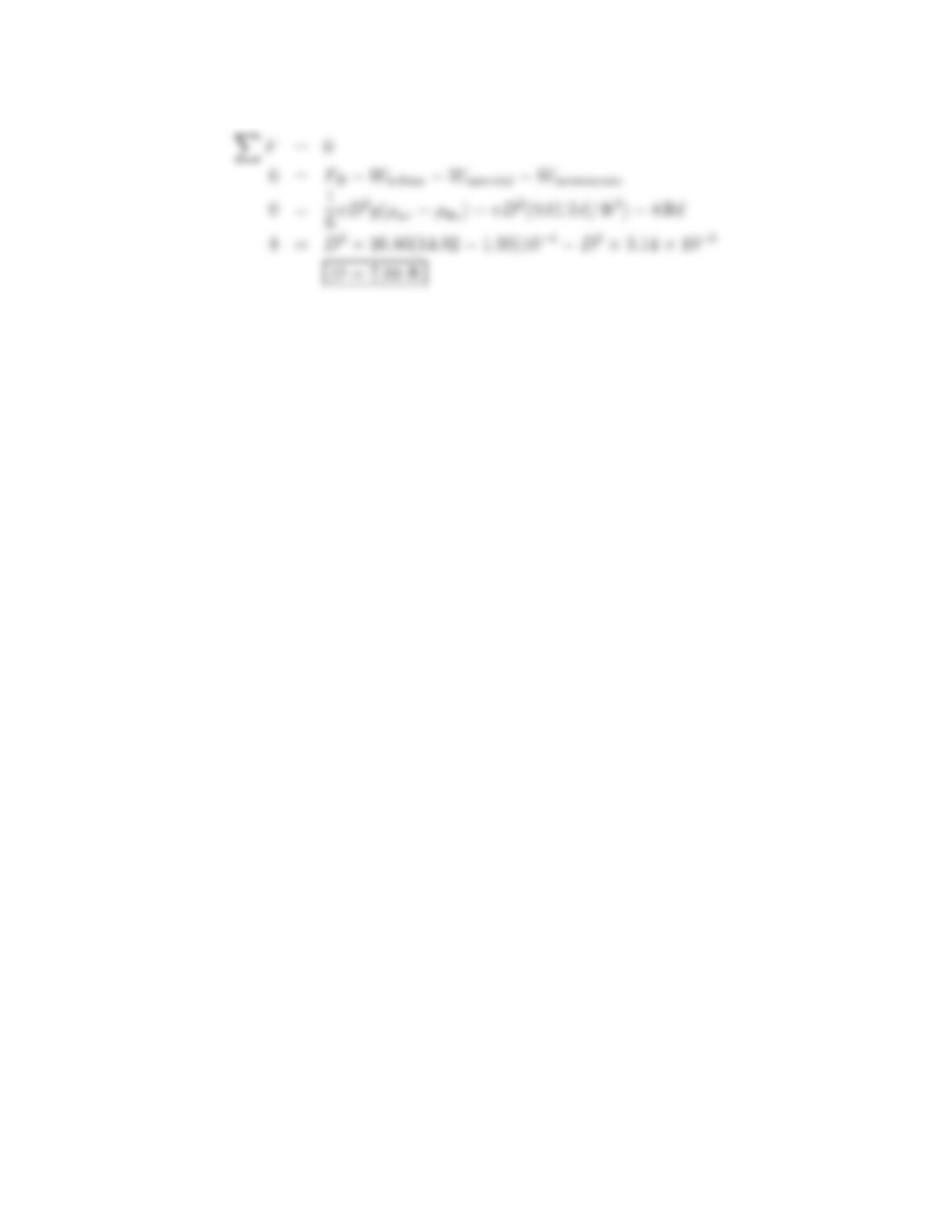
Equilibrium
F
B
161
3.112: PROBLEM DEFINITION
Situation:
A helium weather balloon is made of flexible material.
pballoon =10kPa+patm.
dsea =1m,m=100g.
Find:
Maximum altitude of balloon.
Assumptions:
T0= 288 K
SOLUTION
Initial Volume
Ideal gas law
Conservation of mass m0=malt.
Equilibrium
Eliminate V–alt. µV0ρ0
162
Solve
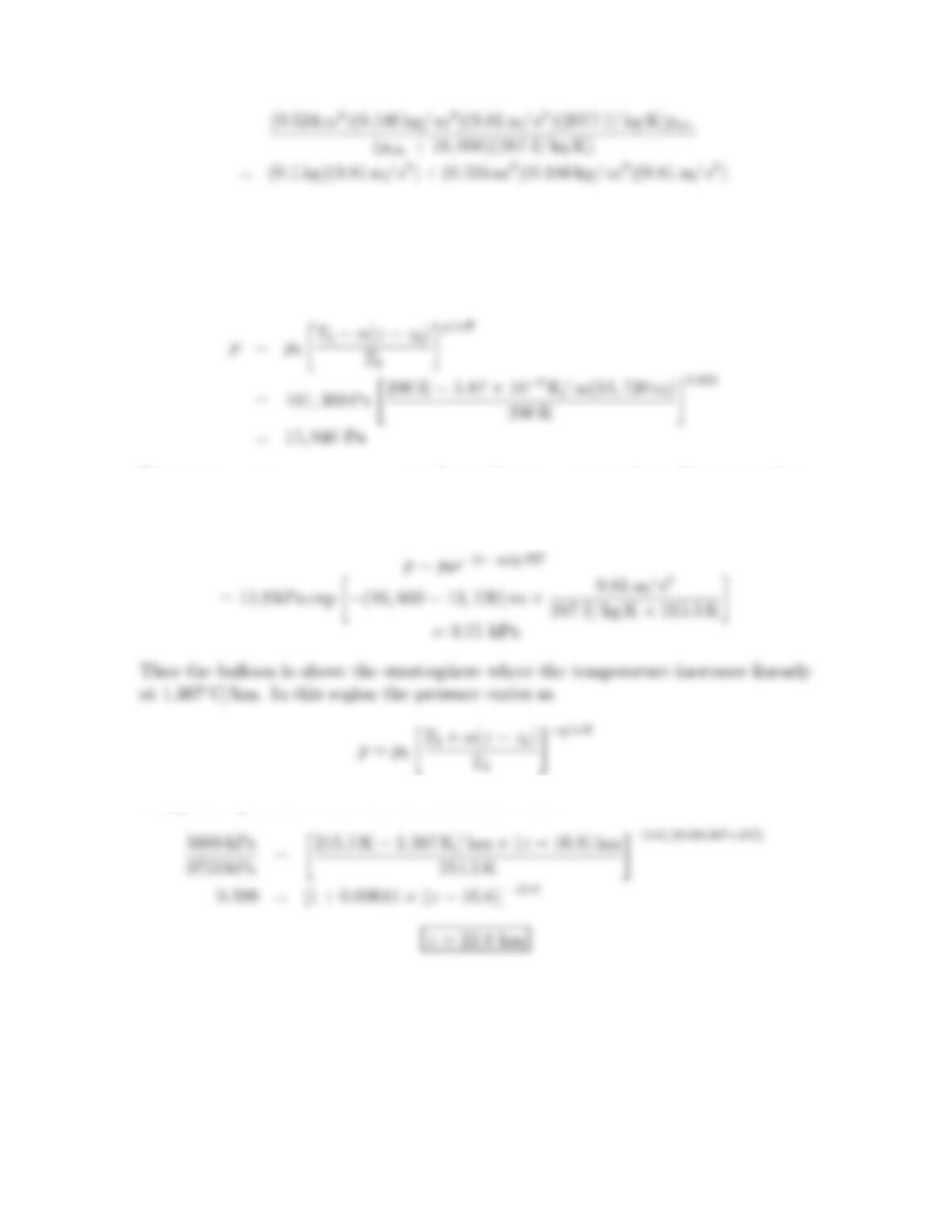
palt. =3888Pa
Check to see if palt. is in the troposphere or stratosphere. Using Eq. (3.15) solve for
pressure at top of troposphere.
Because palt. <p
at top of troposphere we know that palt. occurs above the stratosphere.
The stratosphere extends to 16.8 km where the temperature is constant at -57.5oC.
The pressure at the top of the stratosphere is given by Eq. (3.16)
Using this equation to solve for the altitude, we have
163
3.113: PROBLEM DEFINITION
Situation:
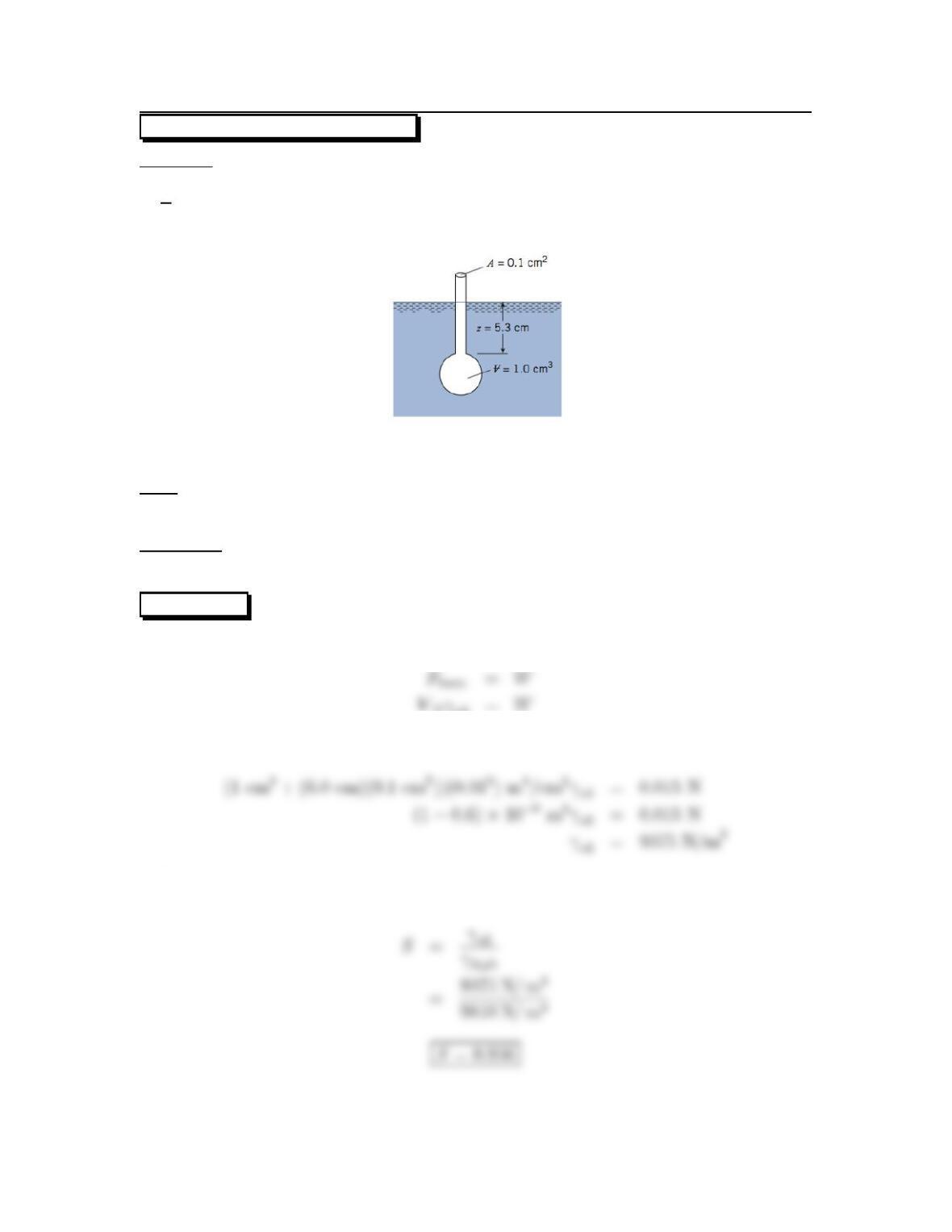
A hydrometer is floating in oil.
Vbulb =1cm
3,Astem =0.1cm
2.
z=6.0cm (not 5.3 cm as shown in sketch), W=0.015 N.
Find:
Specific gravity of oil.
Properties:
γW=9810N/m3.
SOLUTION
1. Equilibrium
2. Calculations
3. Definition of S
164
3.114: PROBLEM DEFINITION
Situation:
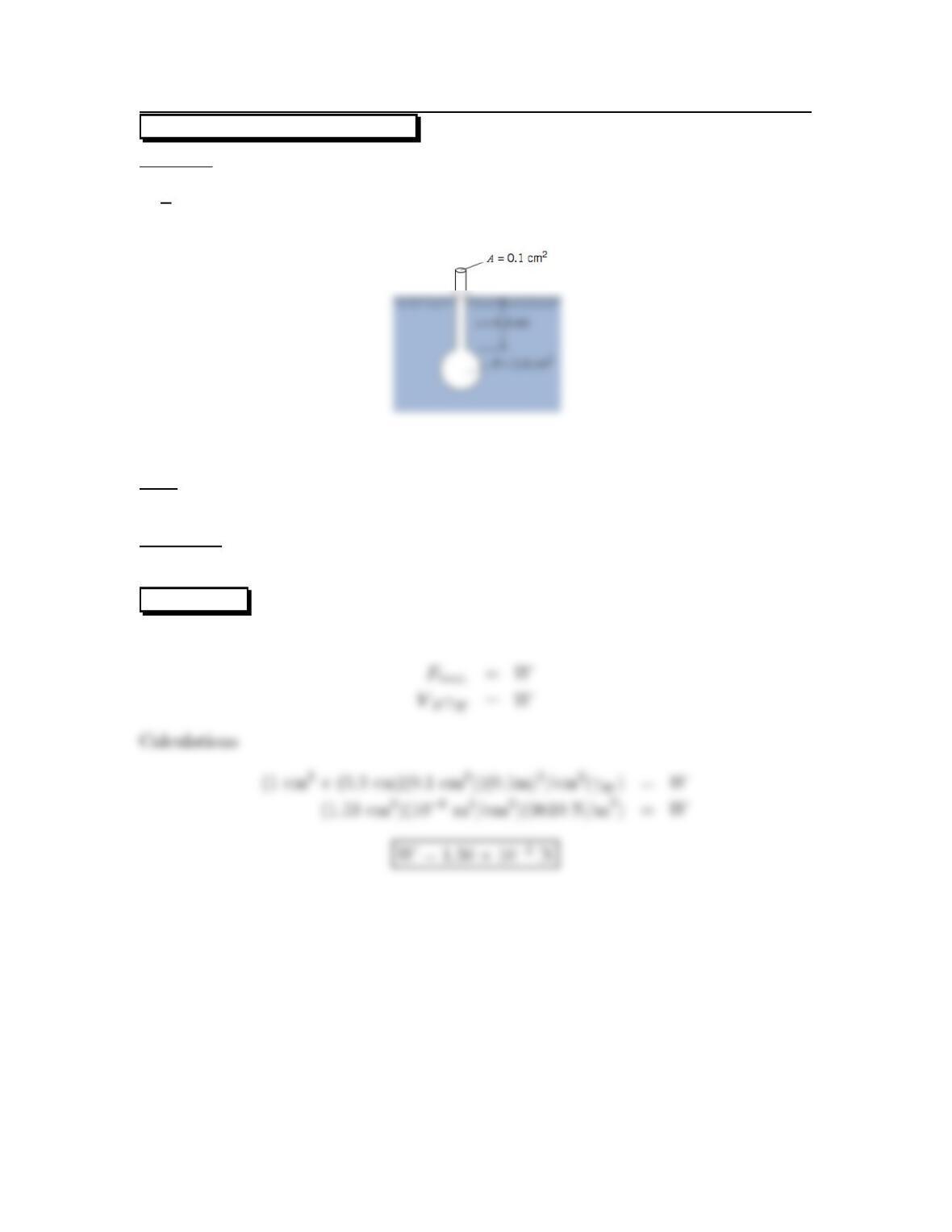
A hydrometer in water.
Vbulb =1cm
3,Astem =0.1cm
2.
z=5.3cm.
Find:
Weight of hydrometer.
Properties:
Water, γW=9810N/m3.
SOLUTION
Equilibrium
165
3.115: PROBLEM DEFINITION
Situation:
A hydrometer is described in the problem statement.
Find:
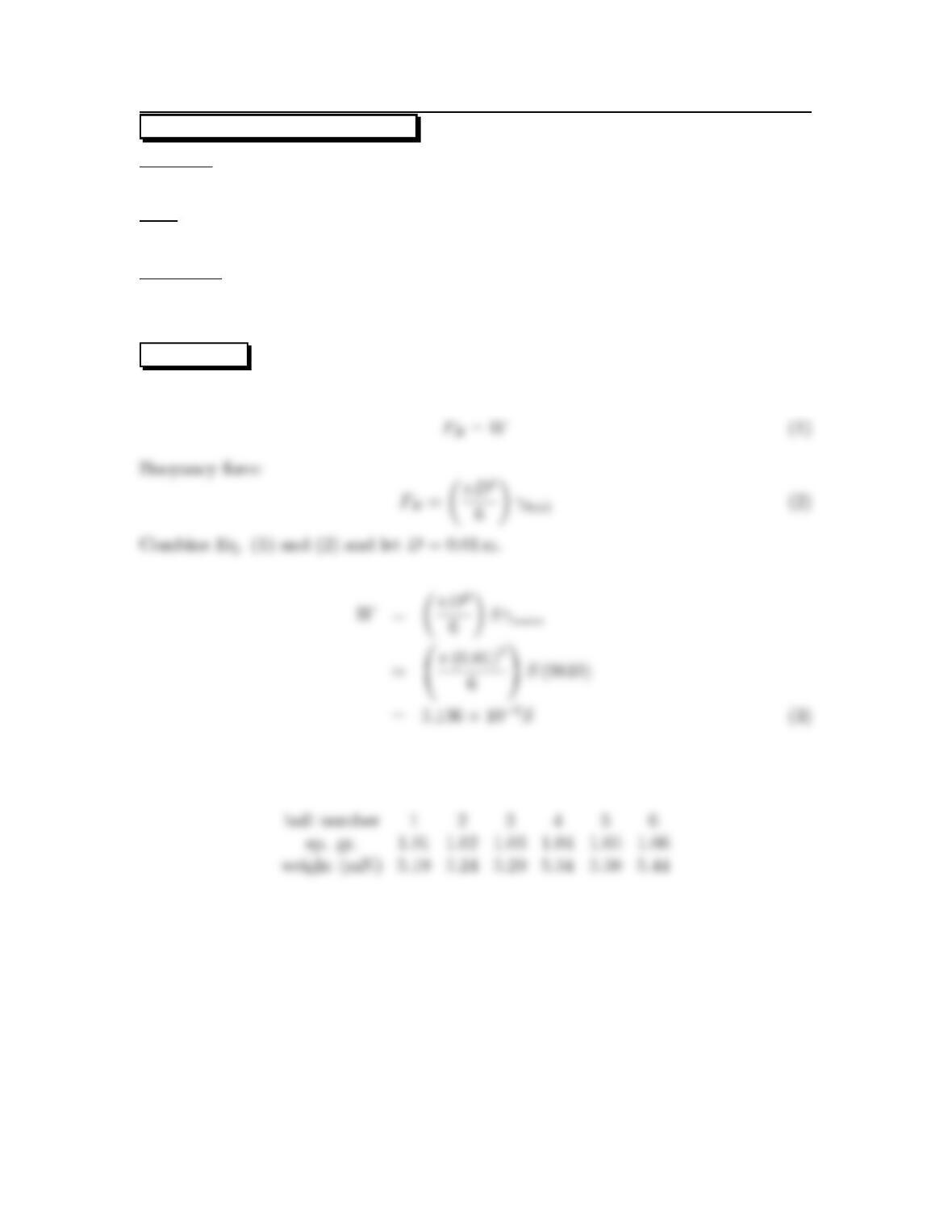
Weight of each ball.
Properties:
S10% =1.012,S50% =1.065.
γwater = 9810 N/m3.
SOLUTION
Equilibrium (for a ball to just float, the buoyant force equals the weight)
Thefollowingtable(fromEq. 3)showstheweightsoftheballsneededfortherequired
specific gravity intervals.
166
3.116: PROBLEM DEFINITION
Situation:
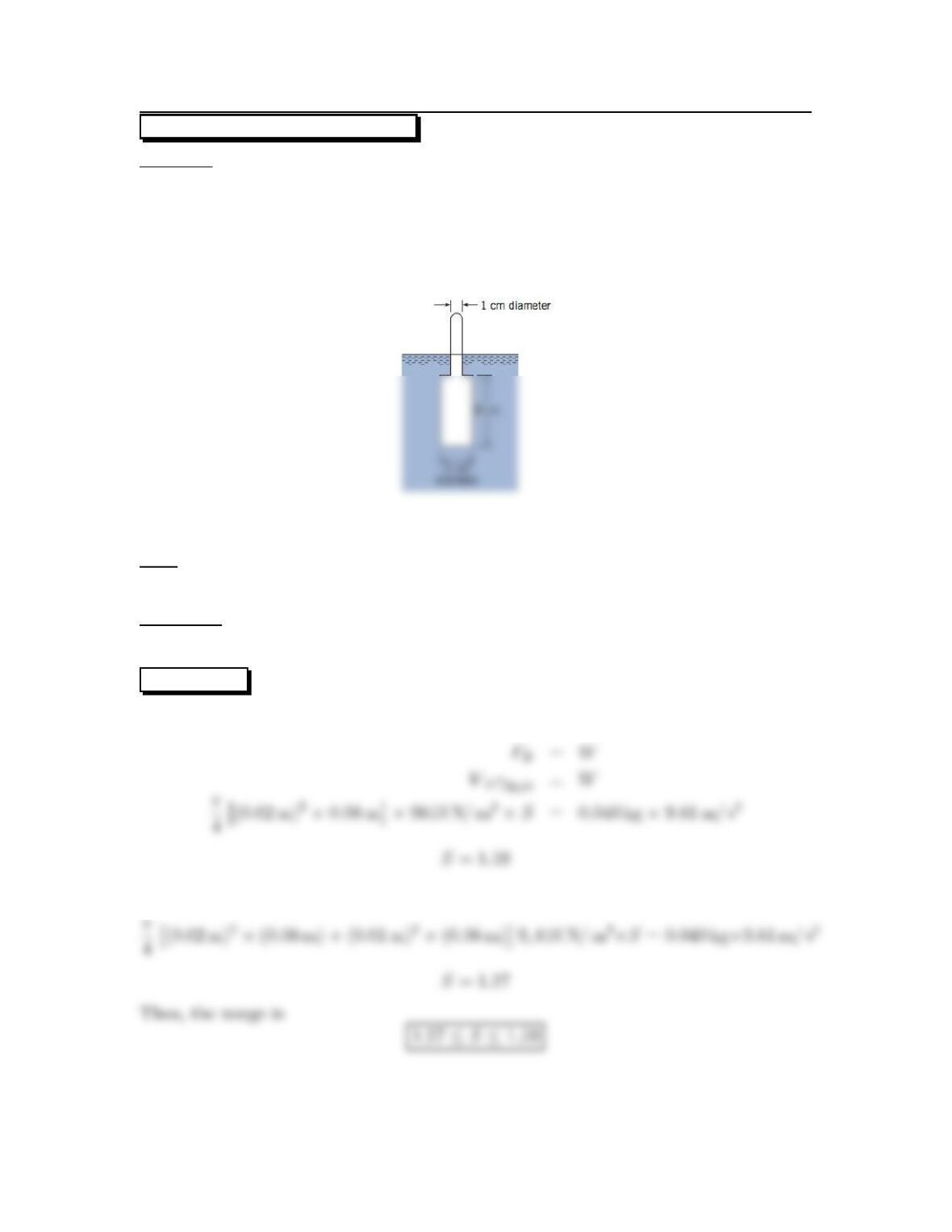
A hydrometer floats in a liquid.
Liquid levels range from btm to top of stem.
d1=1cm,d2=2cm.
L1=8cm,L2=8cm.
W=40g.
Find:
Range of specific gravities.
Properties:
γH2O=9810N/m3.
SOLUTION
Whenonlythebulbissubmerged
When the full stem is submerged
167
3.117: PROBLEM DEFINITION
Situation:
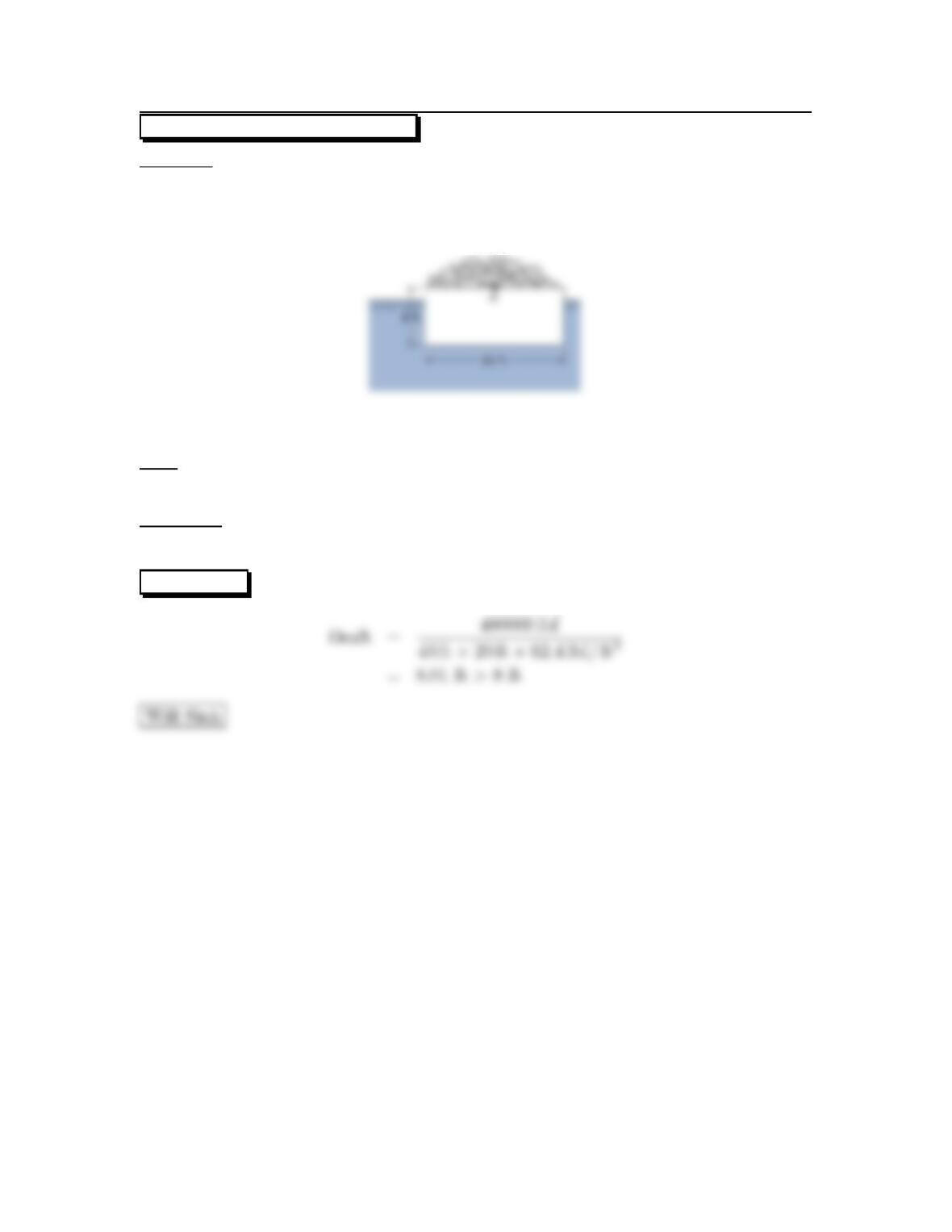
Abargeisfloating in water.
l=40ft,b=20ft.
W= 400,000 lbf.
Find:
Stability of barge.
Properties:
γwater =62.4lbf/ft3.
SOLUTION
168
3.118: PROBLEM DEFINITION
Situation:
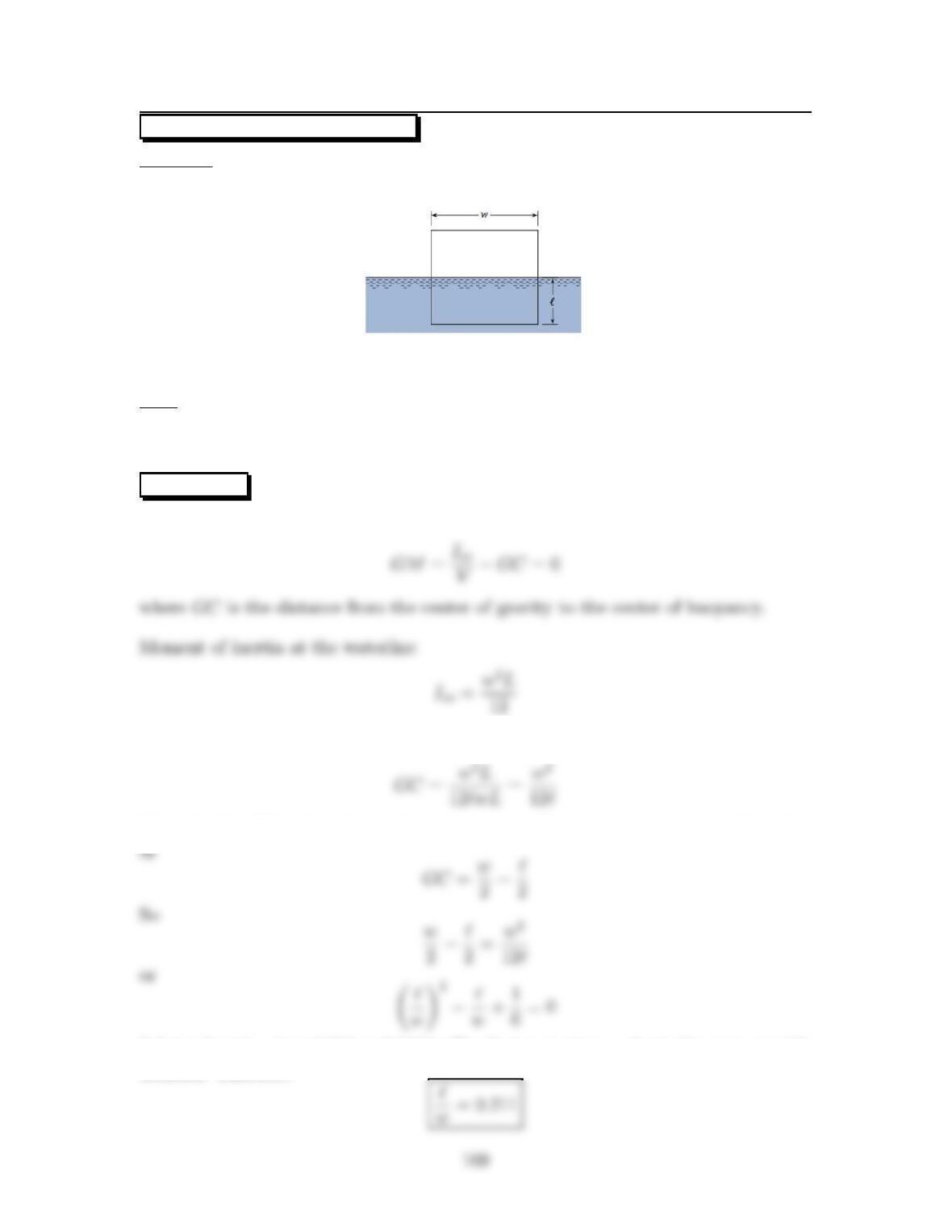
Afloating body is in water.
Find:
Location of water line for stability.
Specific gravity of material.
SOLUTION
For neutral stability, the distance to the metacenter is zero. In other words
where Lis the length of the body. The volume of liquid displaced is wL so
The value for GC is the distance from the center of buoyancy to the center of gravity,
Solving for /w gives 0.789 and 0.211. The first root gives a physically unreasonable
solution. Therefore
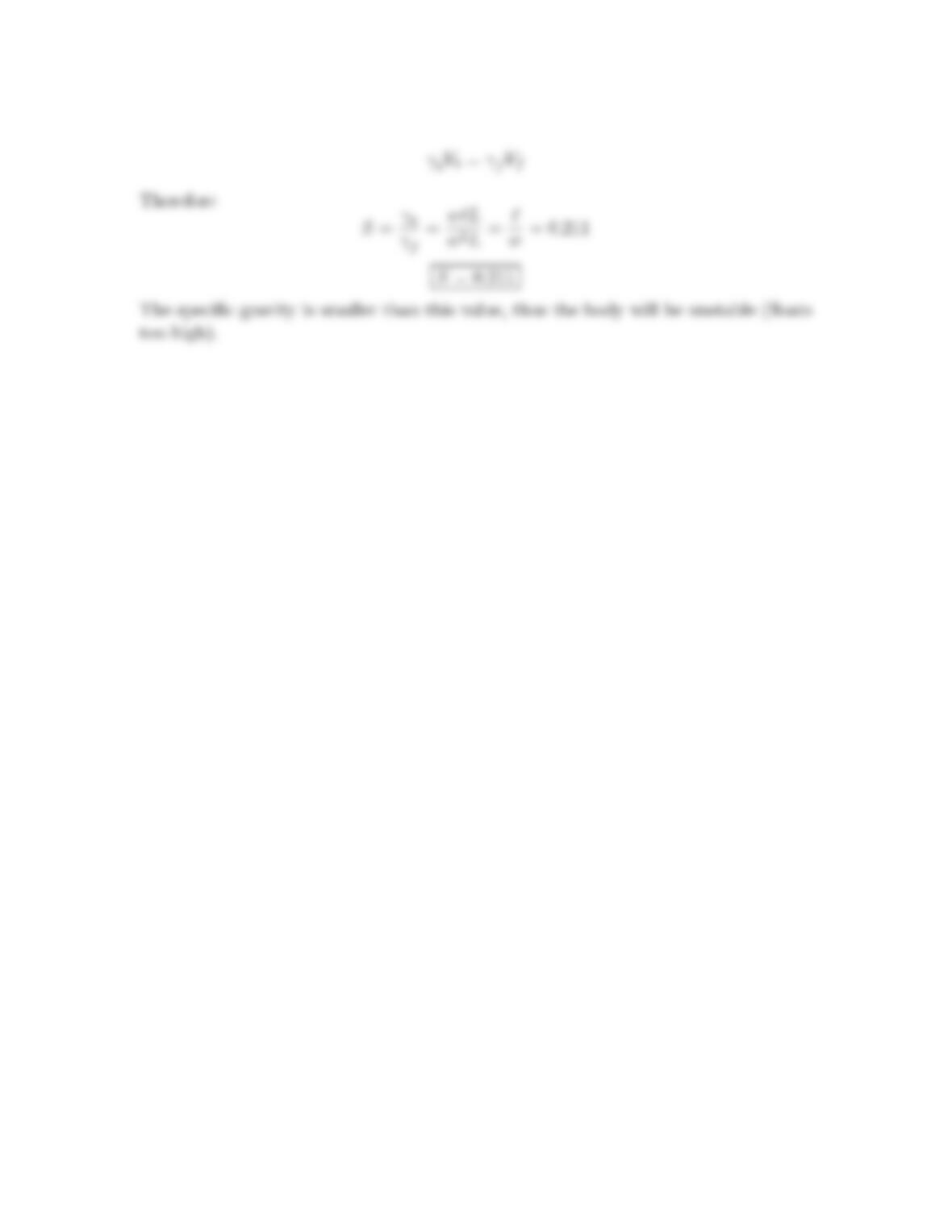
The weight of the body is equal to the weight of water displaced.
170
3.119: PROBLEM DEFINITION
Situation:
A block of wood.
d=1m,L=1m.
Find:
Stability.
Properties:
γwood = 7500 N/m3.
SOLUTION
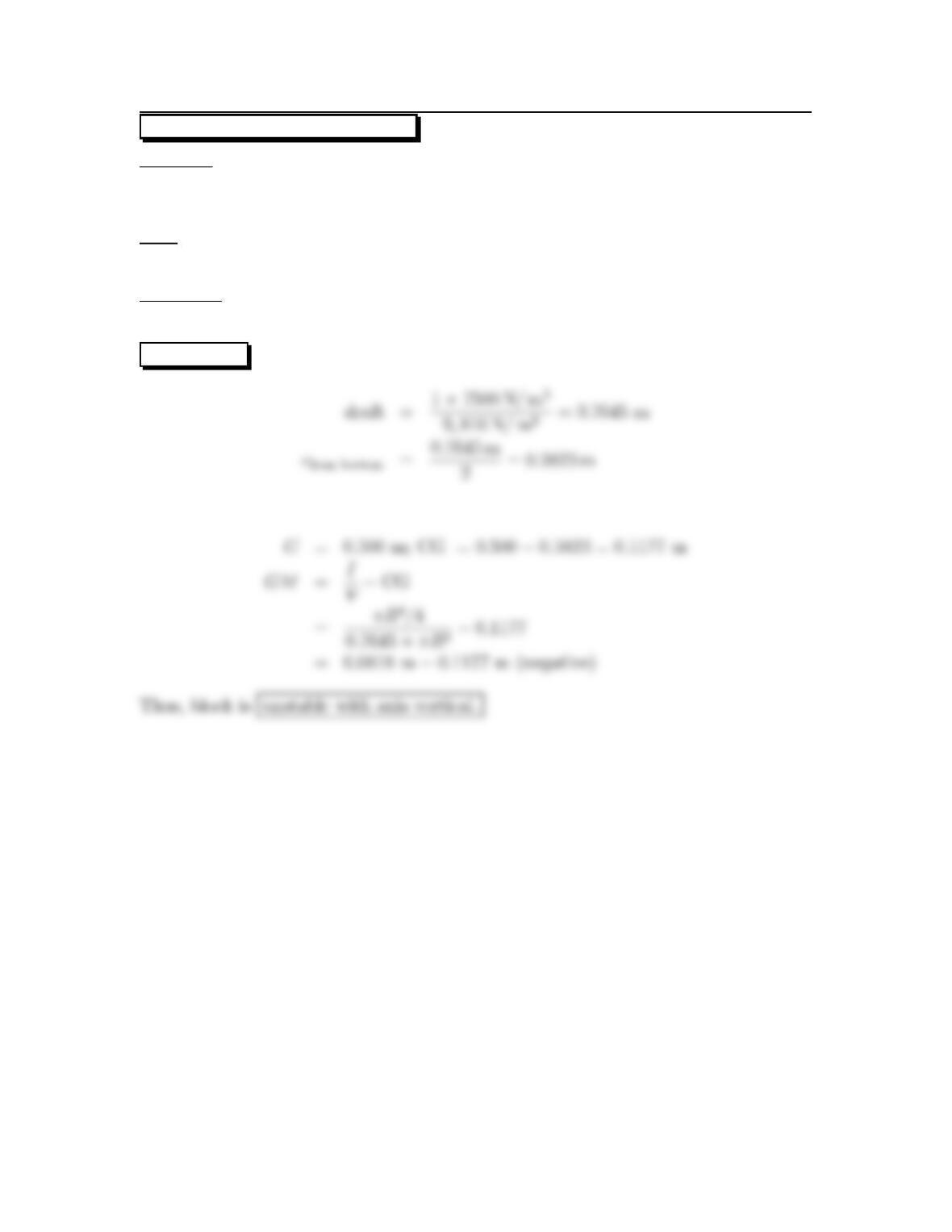
Metacentric height
171
3.120: PROBLEM DEFINITION
Situation: A block of wood.
d=1m,L=1m.
Find:
Stability.
Properties:
γwood = 5000 N/m3.
SOLUTION
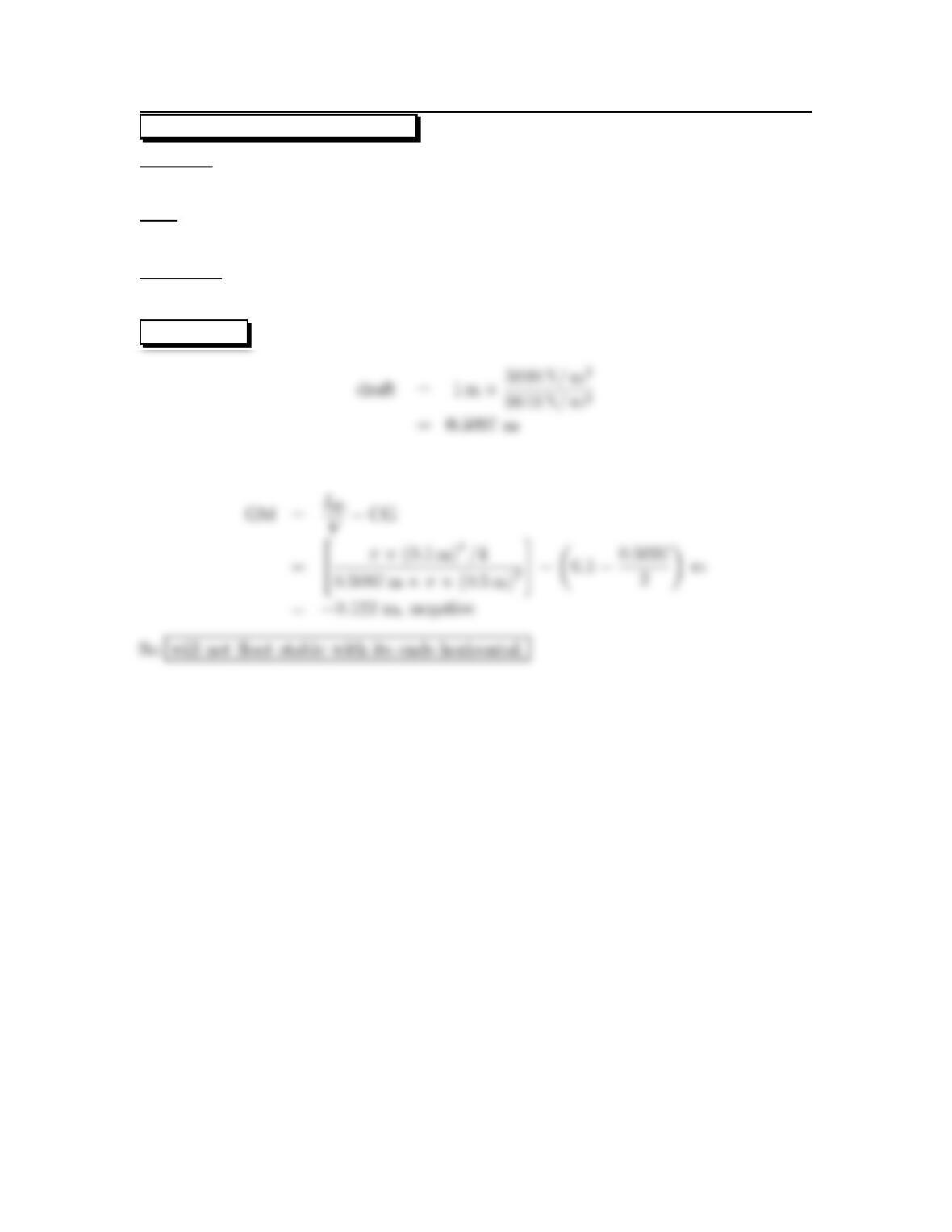
Metacentric height
172
3.121: PROBLEM DEFINITION
Situation:
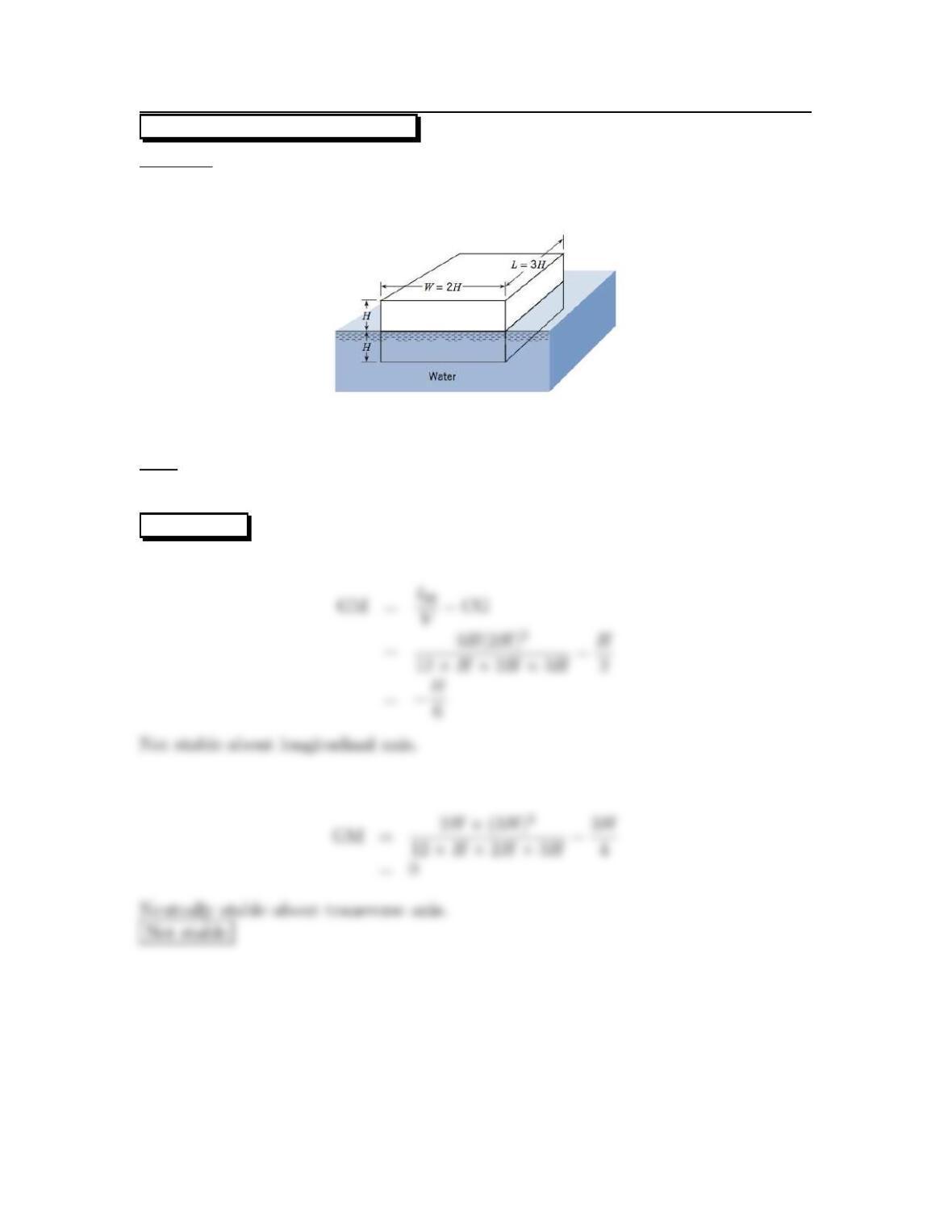
Afloating block is described in the problem statement.
W=2H,L=3H.
Find:
Stability.
SOLUTION
Analyze longitudinal axis
Analyze transverse axis.
173