Question 3–1
The purpose of the balance sheet, also known as the statement of financial position, is to
Question 3–2
The balance sheet does not portray the market value of the entity (number of common stock
Question 3–3
Current assets include cash and other assets that are reasonably expected to be converted to
cash or consumed during one year, or within the normal operating cycle of the business if the
Question 3–4
Current liabilities are those obligations that are expected to be satisfied through the use of
current assets or the creation of other current liabilities. So, this classification will include all
Chapter 3 The Balance Sheet and Financial Disclosures
QUESTIONS FOR REVIEW OF KEY TOPICS
3–2 Intermediate Accounting, 8/e
Answers to Questions (continued)
Question 3–5
The operating cycle for a typical manufacturing company refers to the period of time required
Question 3–6
Investments in equity securities are classified as current if the company’s management (1)
Question 3–7
The common characteristics that these assets have in common are that they are tangible, long-
Question 3–8
Property, plant, and equipment and intangible assets each represent assets that are long-lived
Question 3–9
A note payable of $100,000 due in five years would be classified as a long-term liability. A
Question 3–10
Paid-in capital consists of amounts invested by shareholders in the corporation. Retained
Answers to Questions (continued)
Question 3–11
Disclosure notes provide additional detail concerning specific financial statement items.
Question 3–12
The disclosure of the company’s significant accounting policies is extremely important to
Question 3–13
A subsequent event is an event that occurs after the date of the financial statements but prior to
Question 3–14
The discussion provides management’s views on significant events, trends, and uncertainties
Answers to Questions (continued)
Question 3–15
Depending on the circumstances, the auditor will issue a (an):
1. Unqualified opinion—The auditors are satisfied that the financial statements “present fairly” the
financial position, results of operations, and cash flows and are “prepared in accordance with
Question 3–16
A proxy statement must be reported each year to all shareholders. It is usually reported at the
Question 3–17
Working capital is the difference between current assets and current liabilities. The current
Question 3–18
Debt to equity ratio = Total liabilities
Shareholders’ equity
Answers to Questions (concluded)
Question 3–19
Question 3–20
Differences in balance sheet presentation between U.S. GAAP and IFRS include:
1. International standards specify a minimum list of items to be presented in the balance sheet.
Question 3–21
An operating segment is a component of an enterprise:
1. That engages in business activities from which it may earn revenues and incur expenses
Question 3–22
For areas determined to be reportable operating segments, the following disclosures are required:
1. General information about the operating segment.
Question 3–23
U.S. GAAP requires companies to report information about reported segment profit or loss,
3–6 Intermediate Accounting, 8/e
Brief Exercise 3–1
(a) Current
Brief Exercise 3–2
Current assets:
Brief Exercise 3–3
Assets: $ 52,000 current assets
80,000 equipment
$132,000 total assets
BRIEF EXERCISES
Brief Exercise 3–4
Retained earnings* ………………………………………
K AND J NURSERY, INC.
Balance Sheet
At December 31, 2016
Assets
Current assets:
Cash ………………………………………………………….
$ 16,000
Accounts receivable …………………………………….
Inventories …………………………………………………
Property, plant, and equipment:
Equipment ………………………………………………….
$140,000
Less: Accumulated depreciation ……………………
$132,000
Liabilities and Shareholders’ Equity
Current liabilities:
Accounts payable ………………………………………..
$ 14,000
Wages payable ……………………………………………
Interest payable …………………………………………..
Long-term liabilities:
Note payable ………………………………………………
30,000
Shareholders’ equity:
Common stock …………………………..……………….
$50,000
Brief Exercise 3–5
CULVER CITY LIGHTING, INC.
Balance Sheet
At December 31, 2016
Assets
Current assets:
Cash ………………………………………………………….
$ 55,000
Accounts receivable …………………………..………..
39,000
Inventories …………………………..…………………….
45,000
Prepaid insurance ………………………………………..
15,000
Property, plant, and equipment:
Equipment ………………………………………………….
Less: Accumulated depreciation ……………………
40,000
Liabilities and Shareholders’ Equity
Current liabilities:
Accounts payable ………………………………………..
$ 12,000
Interest payable ……………………………………………
2,000
Current maturities of long-term debt ……………..
10,000
Note payable ………………………………………………
Common stock ……………………………………………
Retained earnings ………………………………………..
Brief Exercise 3–6
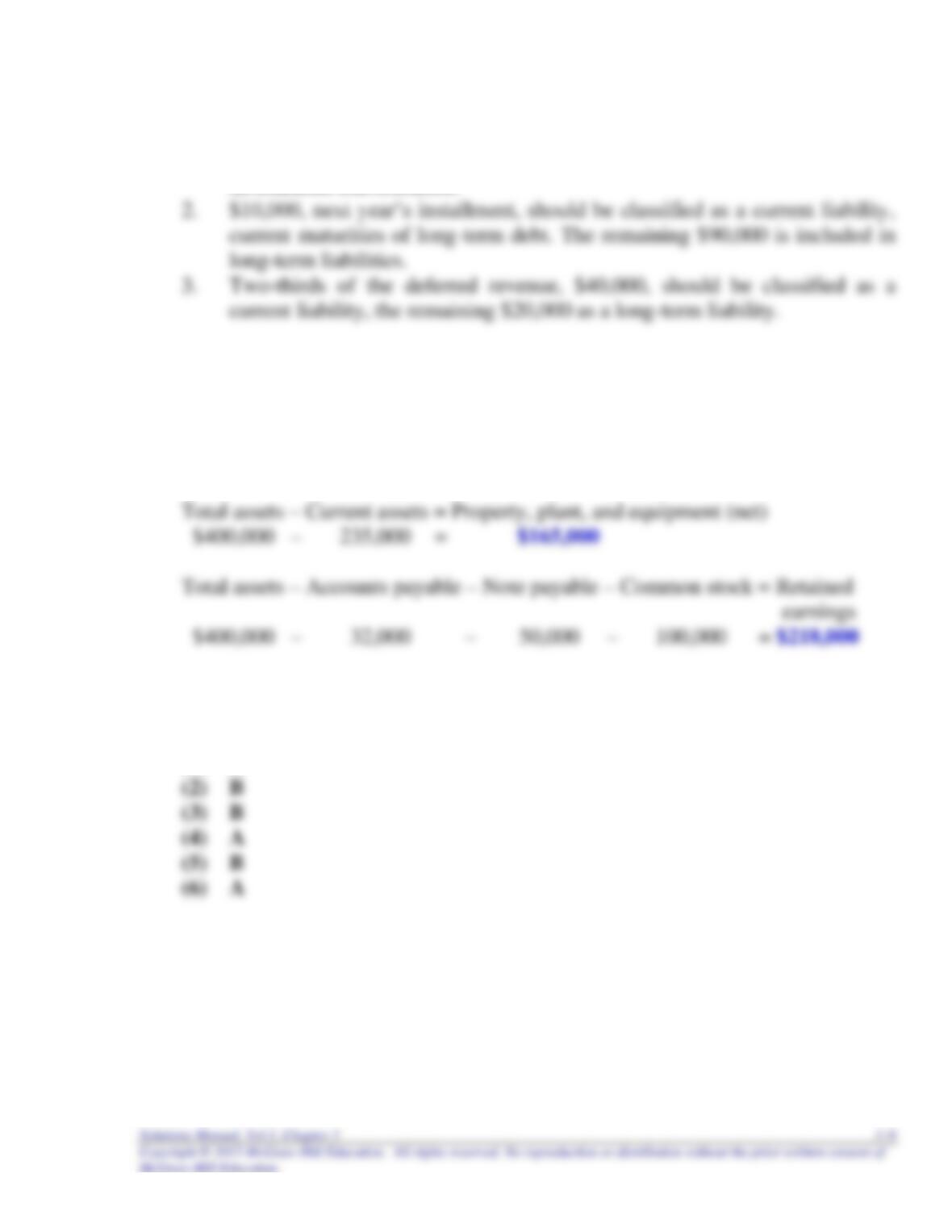
1. The $30,000 should be classified as a noncurrent asset, under the
investments classification.
Brief Exercise 3–7
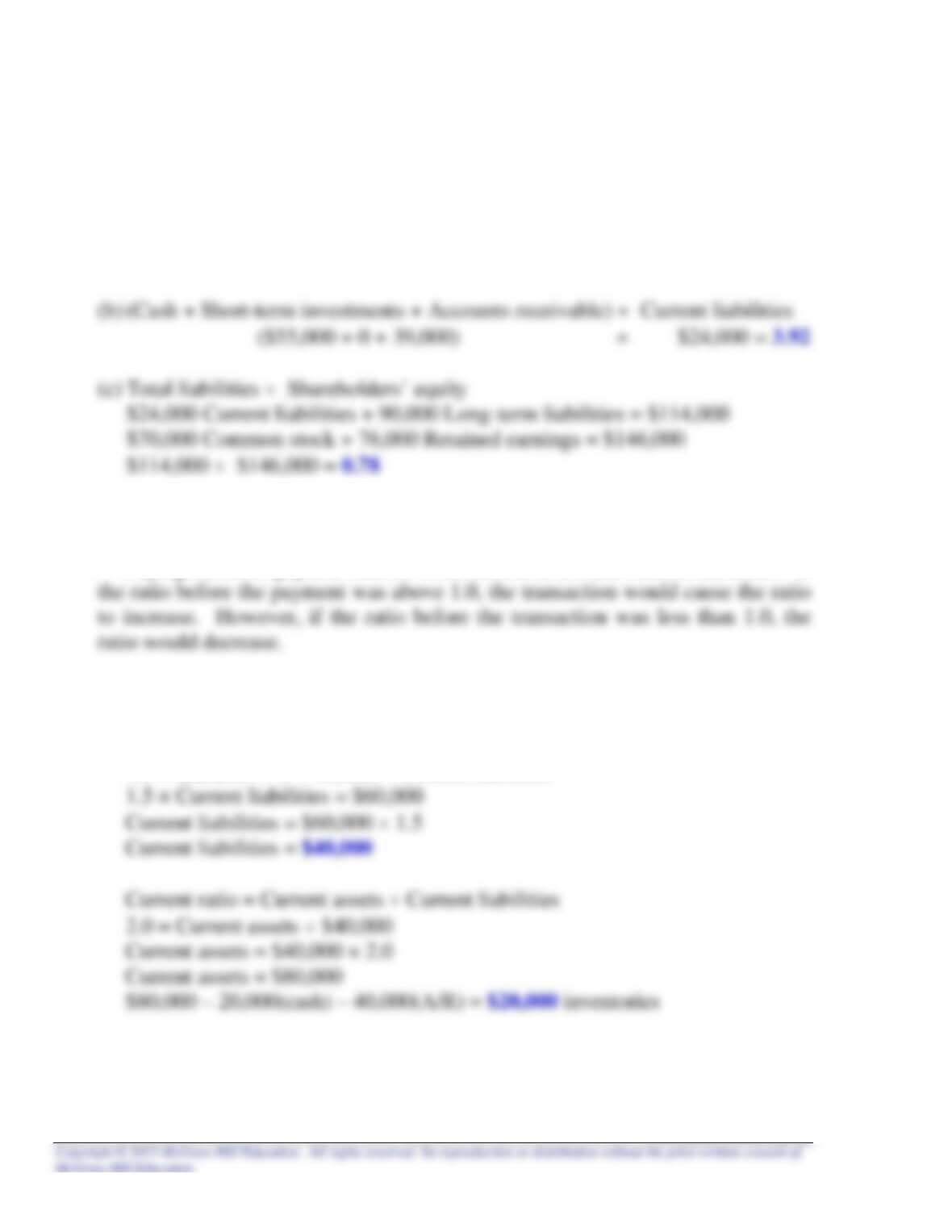
Current assets – Cash and cash equivalents – Accounts receivable = Inventories
$235,000 – 40,000 – 120,000 = $75,000
Brief Exercise 3–8
(1) A
3–10 Intermediate Accounting, 8/e
Brief Exercise 3–9
(a) Current assets Current liabilities
($55,000 + 39,000 + 45,000 + 15,000) ($12,000 + 2,000 + 10,000)
$154,000 $24,000 = 6.42
Brief Exercise 3–10
Paying accounts payable reduces both current assets and current liabilities. If
Brief Exercise 3–11
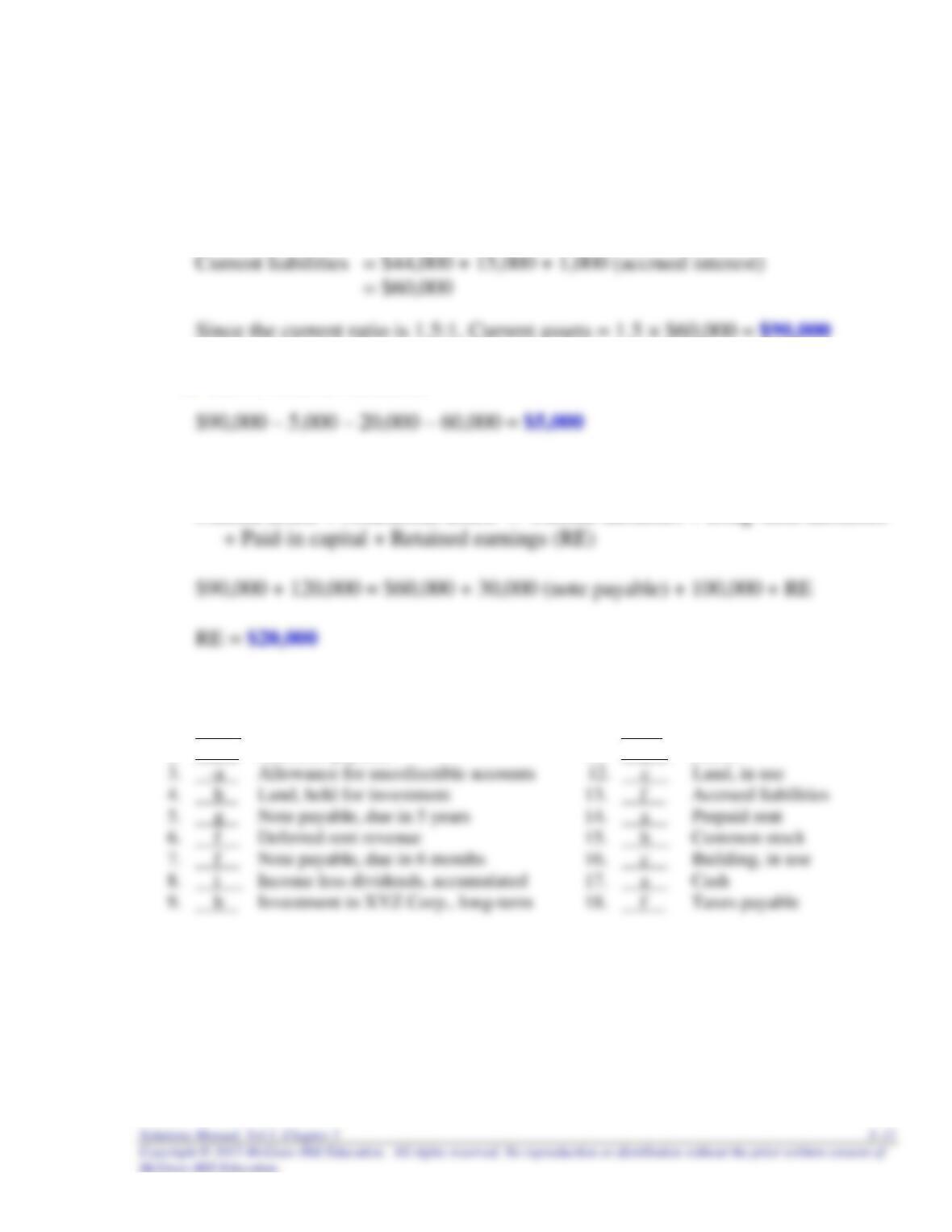
Acid-test ratio = (Cash + Short-term investments + A/R) Current liabilities
1.5 = ($20,000 + 0 + 40,000) Current liabilities
Exercise 3–1
1. Total current assets
2. Short-term investments
3. Retained earnings
Current assets + Noncurrent assets = Current liabilities + Long-term liabilities
Exercise 3–2
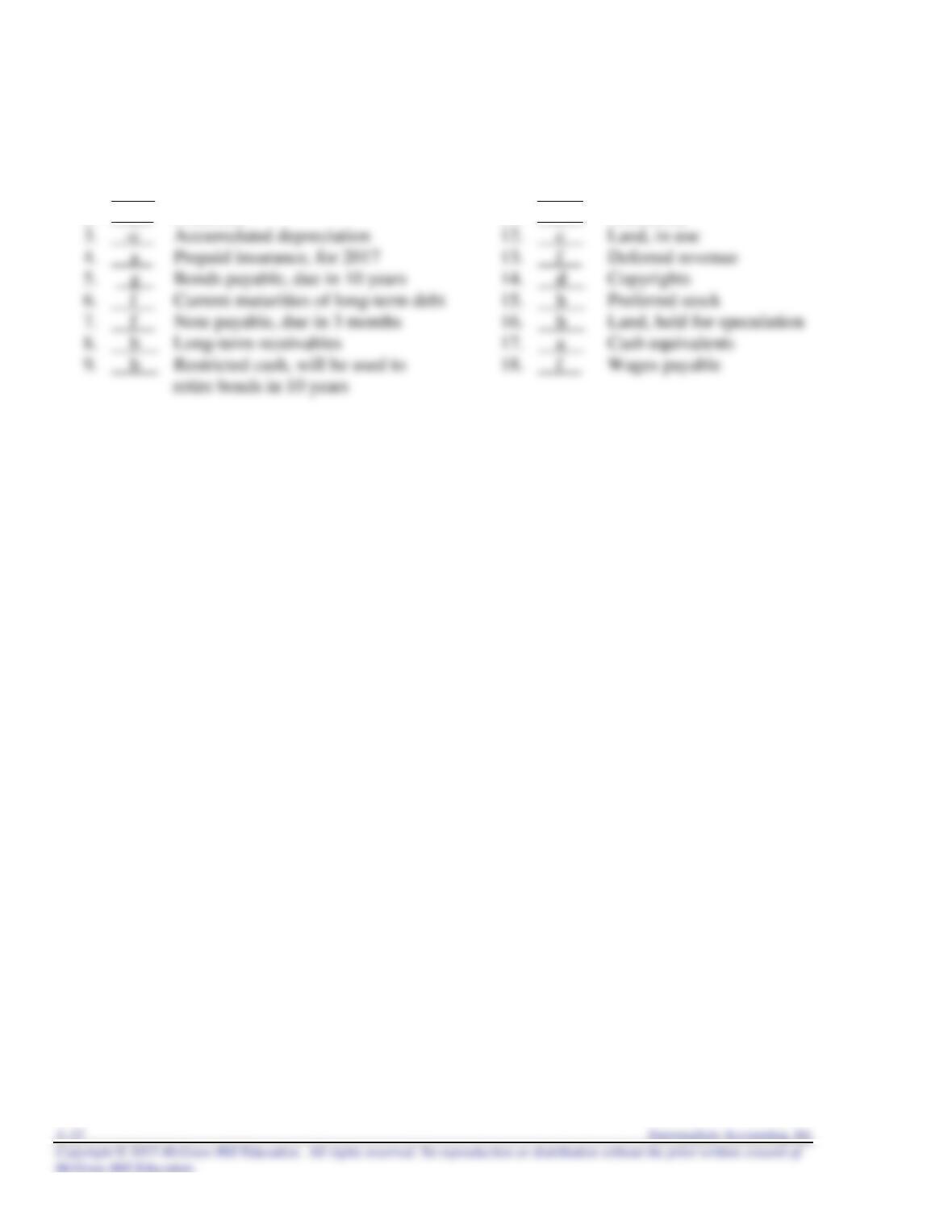
1. c Equipment 10. a Inventories
2. f Accounts payable 11. d Patent
EXERCISES
Exercise 3–3
1. f Accrued interest payable 10. a Supplies
2. d Franchise 11. c Machinery
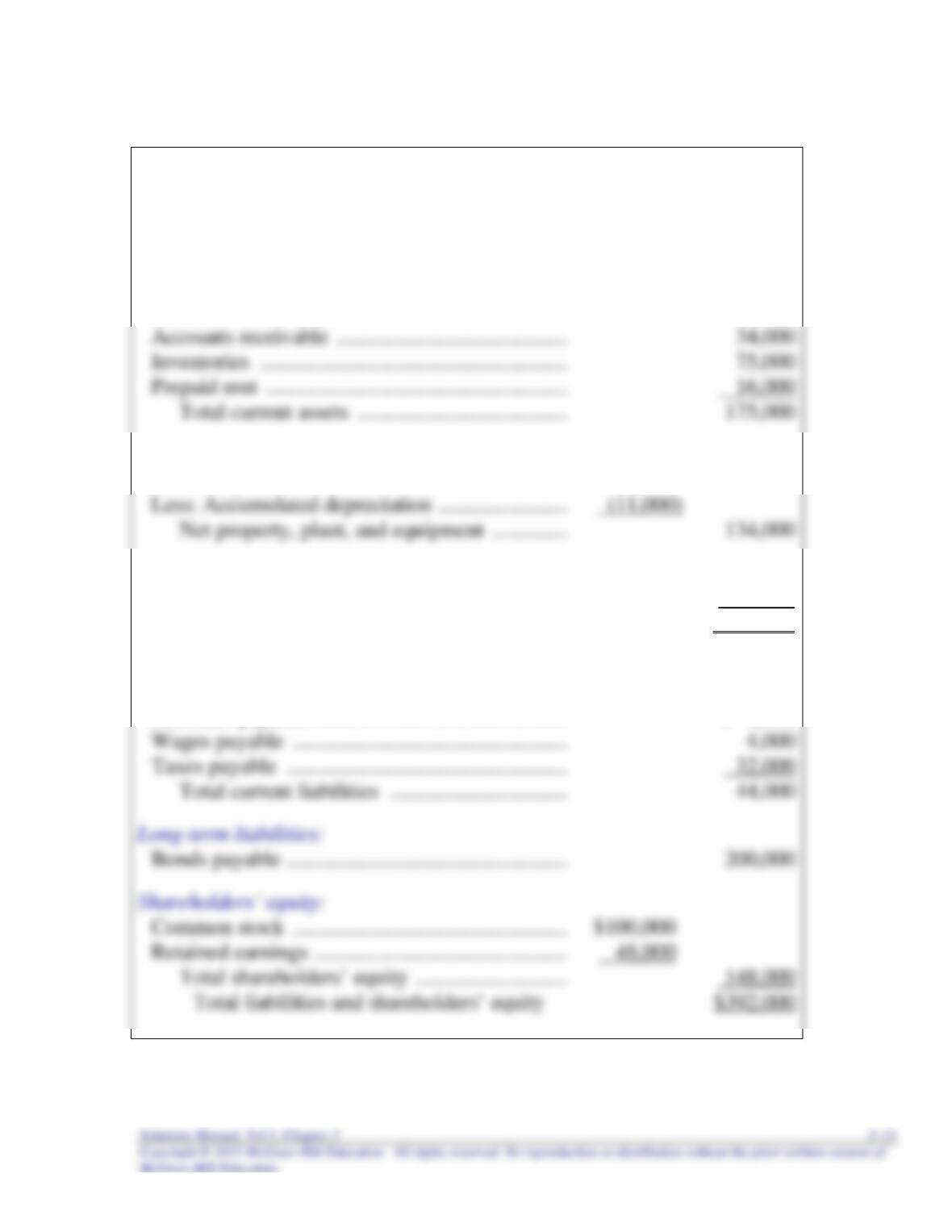
Exercise 3–4
JACKSON CORPORATION
Balance Sheet
At December 31, 2016
Assets
Current assets:
Cash ………………………………………………………….
$ 40,000
Marketable securities …………………………………..
10,000
Accounts receivable …………………………………….
Inventories …………………………………………………
Prepaid rent ………………………………………………..
16,000
175,000
Property, plant, and equipment:
Machinery ………………………………………………….
$145,000
Less: Accumulated depreciation ……………………
Intangible assets:
Patent ………………………………………………………
83,000
Total assets ………………………………………….
$392,000
Liabilities and Shareholders’ Equity
Current liabilities:
Accounts payable ………………………………………..
$ 8,000
Taxes payable …………………………………………….
44,000
Long-term liabilities:
Bonds payable …………………………………………….
Common stock …………………………..……………….
$100,000
Retained earnings ………………………………………..
148,000
$392,000
3–14 Intermediate Accounting, 8/e
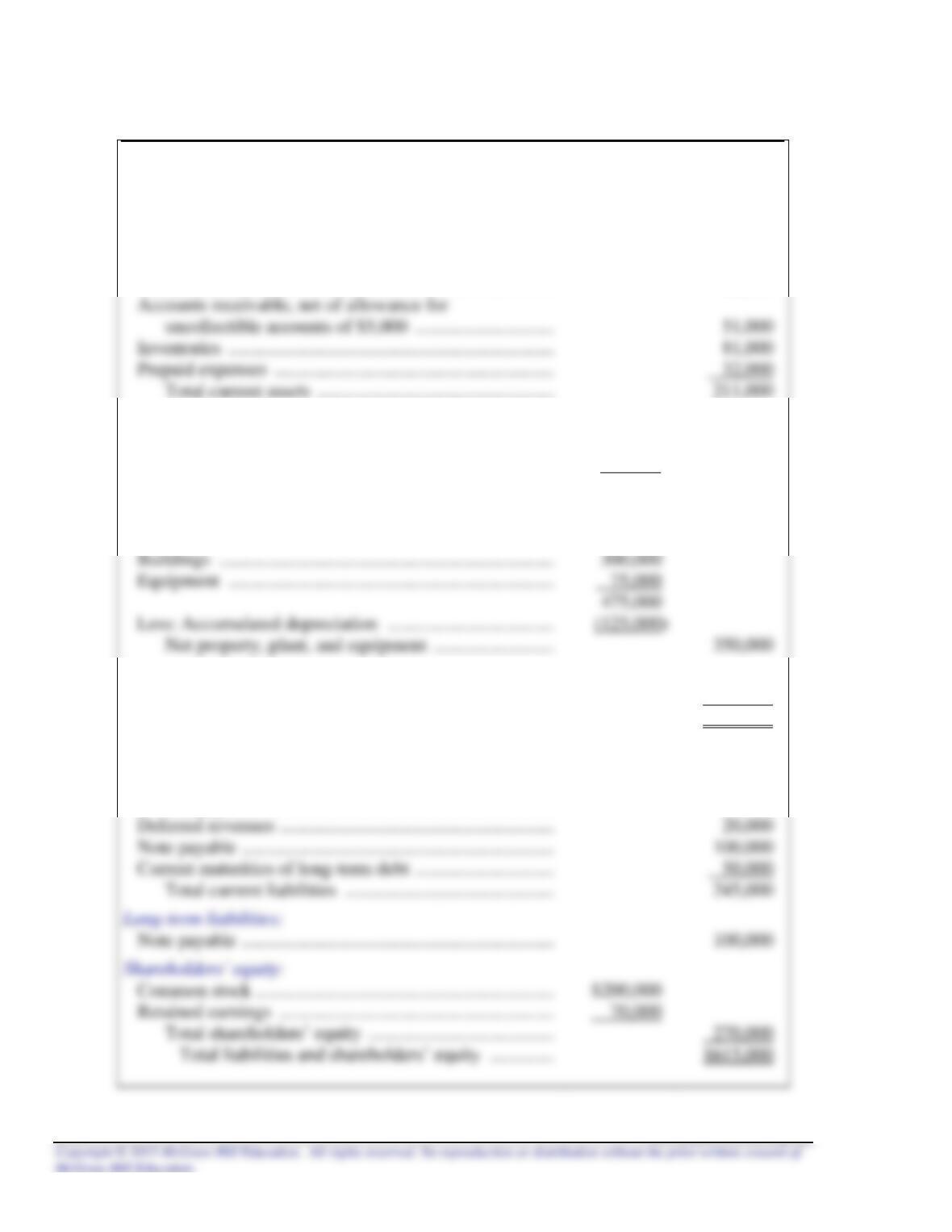
Exercise 3–5
VALLEY PUMP CORPORATION
Balance Sheet
At December 31, 2016
Assets
Current assets:
Cash ……………………………………………………………………..
$ 25,000
Marketable securities ………………………………………………
22,000
Inventories ……………………………………………………….……
81,000
Prepaid expenses ……………………………………………………
Total current assets ……………………………………………
211,000
Investments:
Marketable securities ………………………………………………
$22,000
Land ……………………………………………………………………..
20,000
Total investments ……………………………………………..
42,000
Property, plant, and equipment:
Land ……………………………………………………………………..
100,000
Buildings ………………………………………………………………
300,000
Equipment …………………………………………………………….
475,000
Less: Accumulated depreciation ………………………………
Net property, plant, and equipment ……………………..
350,000
Intangible assets:
Copyright ………………………………………………………………
12,000
Total assets …………………………..……………………….
$615,000
Liabilities and Shareholders’ Equity
Current liabilities:
Accounts payable …………………………………………………..
$ 65,000
Interest payable ………………………………………………………
10,000
Deferred revenues …………………………………………………..
20,000
Note payable ………………………………………………………….
100,000
Current maturities of long-term debt …………………………
Total current liabilities ………………………………………
Note payable ………………………………………………………….
Common stock ……………………………………………………….
$200,000
Retained earnings …………………………..………………………
70,000
Total shareholders’ equity ………………………………….
270,000
$615,000
Exercise 3–6
Current assets:
Cash $20,000
Accounts receivable 130,000
Less: Allowance for uncollectible accounts (13,000)
Note receivable 100,000
Current liabilities:
Deferred revenue (one half of $36,000) 18,000
Accounts payable 180,000
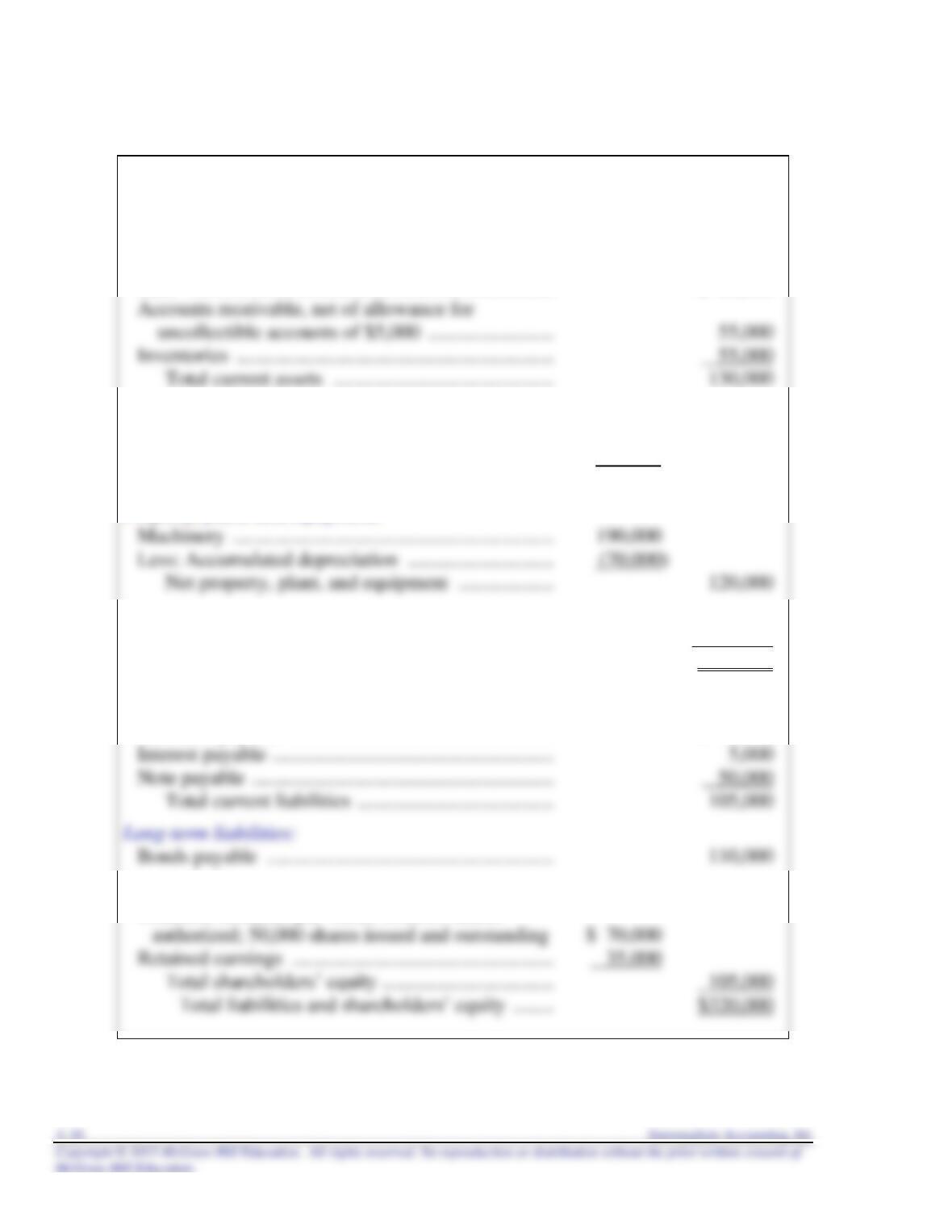
Exercise 3–7
LOS GATOS CORPORATION
Balance Sheet
At December 31, 2016
Assets
Current assets:
Cash ……………………………………………………………….
$ 20,000
uncollectible accounts of $5,000 …………………….
55,000
Total current assets ……………………………………..
130,000
Investments:
Restricted cash …………………………………………………
$ 20,000
Note receivable …………………………..……………………
20,000
Total investments ………………………………………..
40,000
Property, plant, and equipment:
190,000
120,000
Intangible assets:
Franchise …………………………………………………………
30,000
Total assets ………………………………………………
$320,000
Liabilities and Shareholders’ Equity
Current liabilities:
Accounts payable ……………………………………………..
$ 50,000
Note payable …………………………..……………………….
50,000
Total current liabilities …………………………………
105,000
Long-term liabilities:
110,000
Shareholders’ equity:
authorized; 50,000 shares issued and outstanding
$ 70,000
Retained earnings …………………………………………….
35,000
105,000
$320,000
Common stock, no par value; 100,000 shares
Exercise 3–8
CONE CORPORATION
Balance Sheet (Partial)
At December 31, 2016
Assets
Current assets:
Marketable securities …………………………………..
$ 40,000
Prepaid rent ………………………………………………..
Restricted cash ……………………………………………
Marketable securities …………………………………..
Other assets:
Liabilities and Shareholders’ Equity
Current liabilities:
Interest payable …………………………………………..
$ 12,000
Current maturities of long-term debt ……………..
Note payable ……………………………………………….
Exercise 3–9
See calculations below the balance sheet.
KORVER SUPPLY COMPANY
Balance Sheet
At December 31, 2016
Assets
Current assets:
Cash ………………………………………………………….
$168,000
Accounts receivable …………………………………….
Inventories …………………………………………………
Property, plant, and equipment:
Furniture and fixtures ………………………………….
$300,000
Less: Accumulated depreciation …………………..
Liabilities and Shareholders’ Equity
Current liabilities:
Accounts payable ………………………………………..
$180,000
Interest payable …………………………………………..
Note payable ………………………………………………
Shareholders’ equity:
Common stock ……………………………………………
$100,000
Retained earnings ……………………………………….
$868,000
Exercise 3–9 (concluded)
Beginning balance in cash $120,000
+ Cash collected from customers 780,000
Beginning balance in accounts receivable $300,000
+ Credit sales 800,000
– Cash collected from customers (780,000)
Ending balance in accounts receivable $320,000
Beginning balance in accounts payable $190,000
+ Purchases on account 550,000
– Cash paid to suppliers (560,000)
Ending balance in accounts payable $180,000
Beginning balance in retained earnings $274,000
+ Sales revenue 800,000
Exercise 3–10
1. Inventory costing method A
2. Information on related-party transactions B
Exercise 3–11
1. When related-party transactions occur, companies must disclose the nature of the
relationship, provide a description of the transaction, and report the dollar
amounts of the transactions and any amounts due from or to related parties.
2. When an event that has a material effect on the company’s financial position
Exercise 3–12
1. (B) in a separate disclosure note.