CHAPTER
Probability
103
3
3.1 BASIC CONCEPTS OF PROBABILITY AND COUNTING
3.1 Try It Yourself Solutions
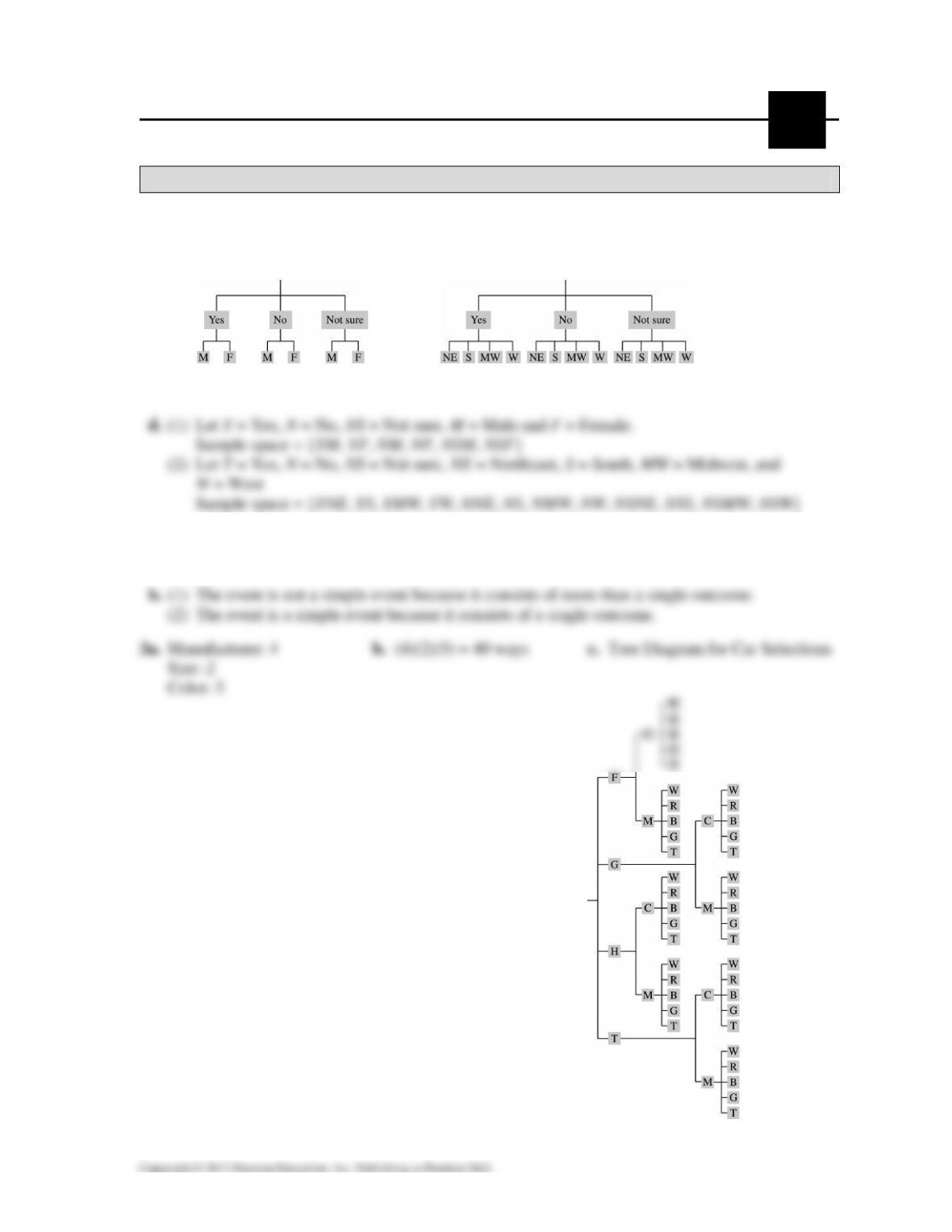
1ab. (1) (2)
c. (1) 6 outcomes (2) 12 outcomes
2a. (1) Event C has six outcomes: choosing the ages 18, 19, 20, 21, 22, and 23.
(2) Event D has one outcome: choosing the age 20.
104 CHAPTER 3 │ PROBABILITY
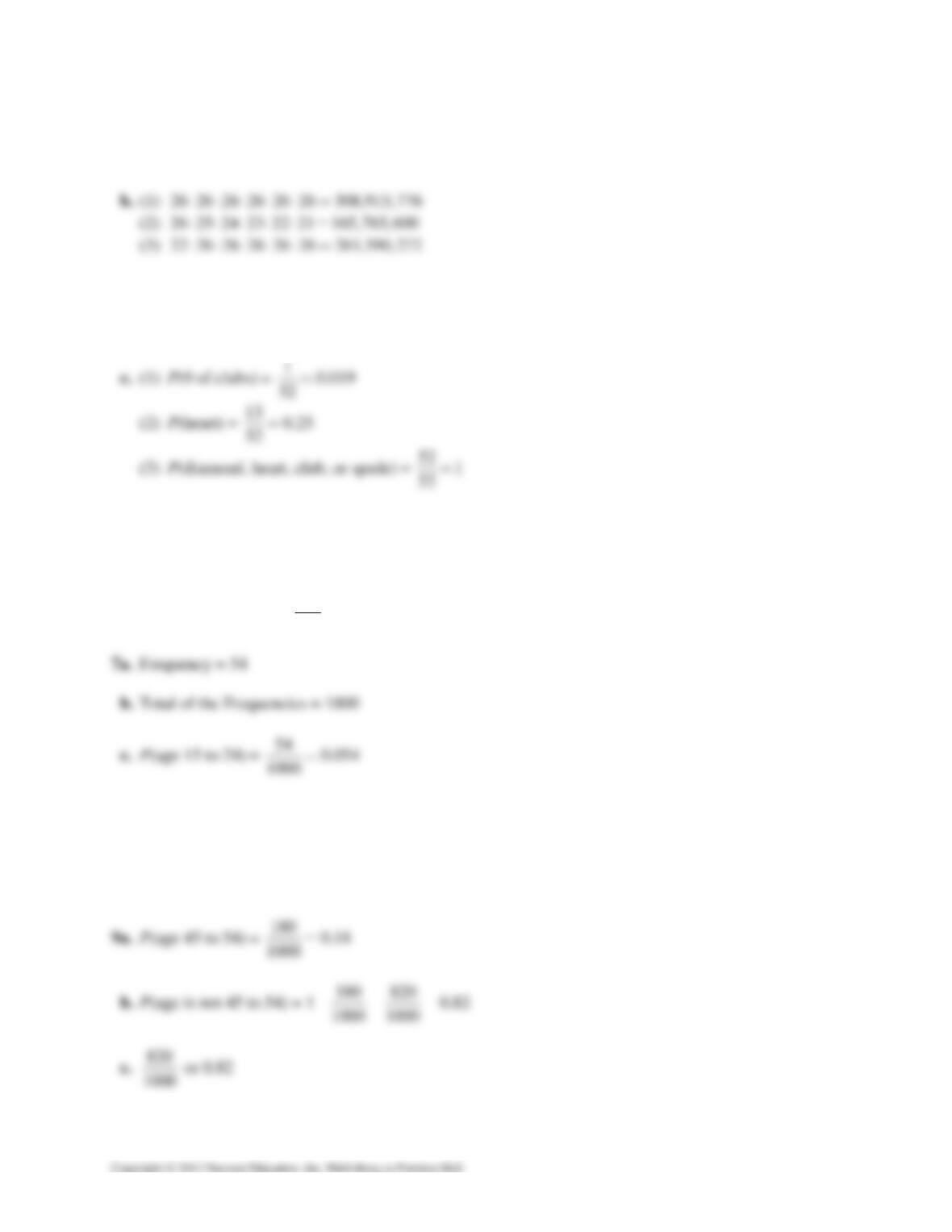
4a. (1) Each letter is an event (26 choices for each).
(2) Each letter is an event (26, 25, 24, 23, 22, and 21 choices).
(3) Each letter is an event (22, 26, 26, 26, 26, and 26 choices).
5a. (1) 52 (2) 52 (3) 52
b. (1) 1 (2) 13 (3) 52
6a. The event is “the next claim processed is fraudulent.” The frequency is 4.
b. Total Frequency = 100
c. P(fraudulent claim) = 40.04
100 =
8a. The event is “salmon successfully passing through a dam on the Columbia River.”
b. The probability is estimated from the results of an experiment.
c. Empirical probability
CHAPTER 3 │ PROBABILITY 105
3.1 EXERCISE SOLUTIONS
1. An outcome is the result of a single trial in a probability experiment, whereas an event is a set of
one or more outcomes.
2. (a) Yes, the probability of an event occurring must be contained in the interval [0, 1] or
[0%, 100%].
(b) No, the probability of an event occurring cannot be less than 0.
3. It is impossible to have more than a 100% chance of rain.
4. The Fundamental Counting Principle counts the number of ways that two or more events can
occur in sequence.
8. False. You flip a fair coin nine times and it lands tails up each time. The probability it will land
heads up on the tenth flip is 0.5.
9. False. A probability of less than 0.05 indicates an unusual event.
106 CHAPTER 3 │ PROBABILITY
10. True
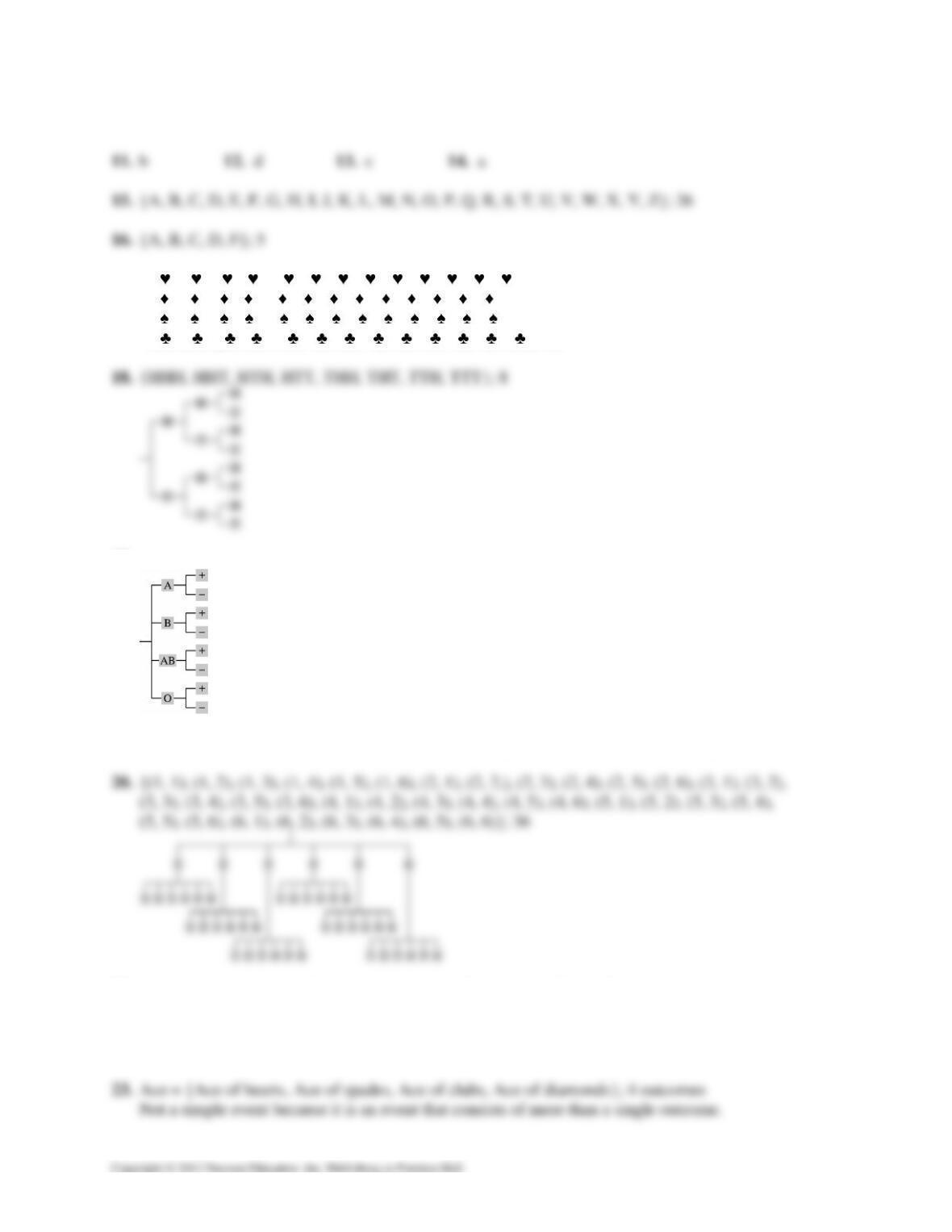
17. {A , K , Q , J , 10 , 9 , 8 , 7 , 6 , 5 , 4 , 3 , 2 ,
A , K , Q , J , 10 , 9 , 8 , 7 , 6 , 5 , 4 , 3 , 2 ,
A , K , Q , J , 10 , 9 , 8 , 7 , 6 , 5 , 4 , 3 , 2 ,
A , K , Q , J , 10 , 9 , 8 , 7 , 6 , 5 , 4 , 3 , 2 }; 52
19.
{(A, +), (B, +), (AB, +), (O, +), (A, –), (B, –), (AB, –), (O, –)}, where (A, +) represents positive
Rh-factor with blood type A and (A, –) represents negative Rh-factor with blood type A; 8.
21. 1 outcome; simple event because it is an event that consists of a single outcome.
22. Number less than 500 = {1, 2, 3 . . . 499}; 499 outcomes
Not a simple event because it is an event that consists of more than a single outcome.
CHAPTER 3 │ PROBABILITY 107
29. 1
() 0.083
12
PA=≈ 30. 1
() 0.083
12
PB=≈
35. Empirical probability because company records were used to calculate the frequency of a
washing machine breaking down.
36. Classical probability because each outcome is equally likely to occur.
40. P(number not divisible by 1000) = 6290 0.999
6296 ≈
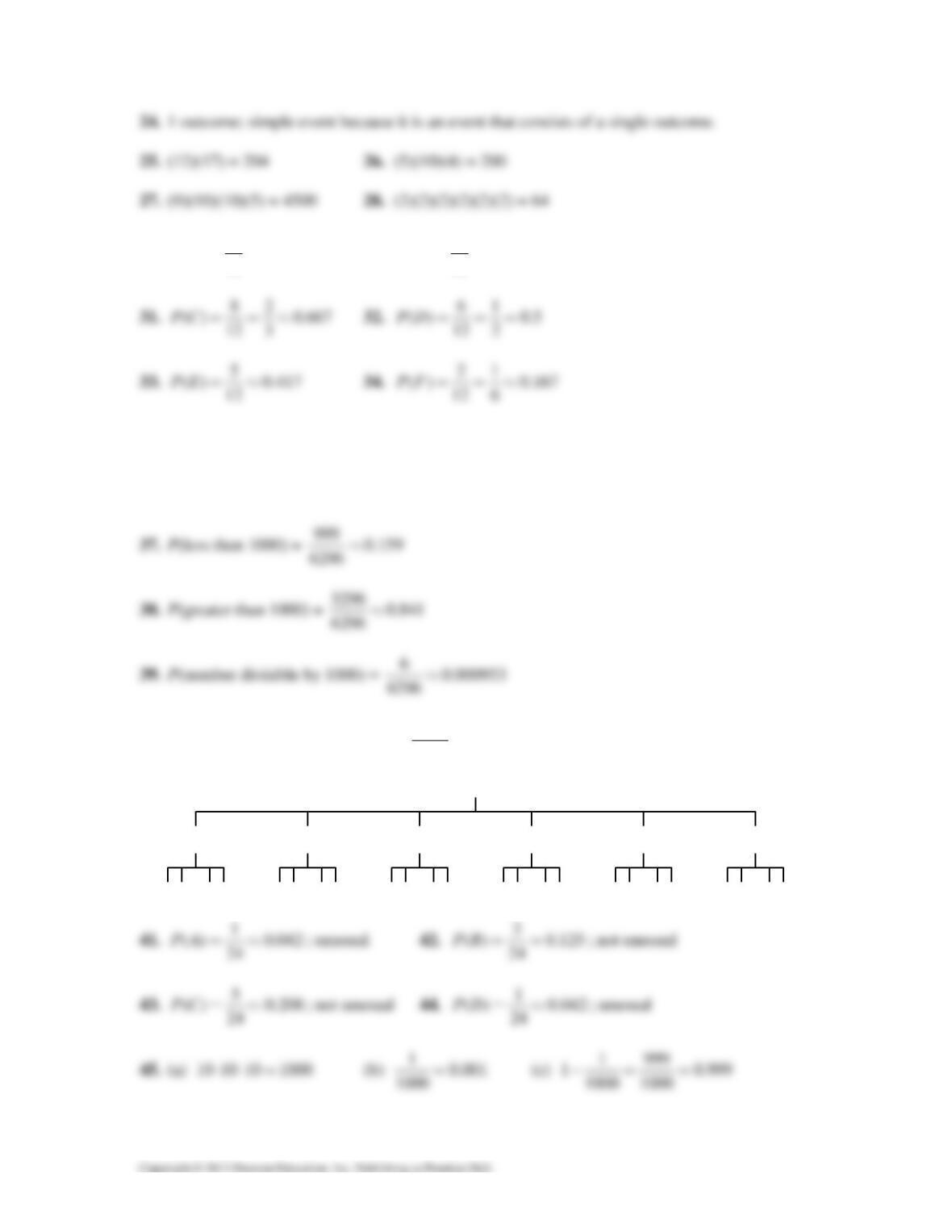
41-44.
1 2 3 4 5 6
R B G Y R B G Y R B G Y R B G Y R B G Y R B G Y
108 CHAPTER 3 │ PROBABILITY
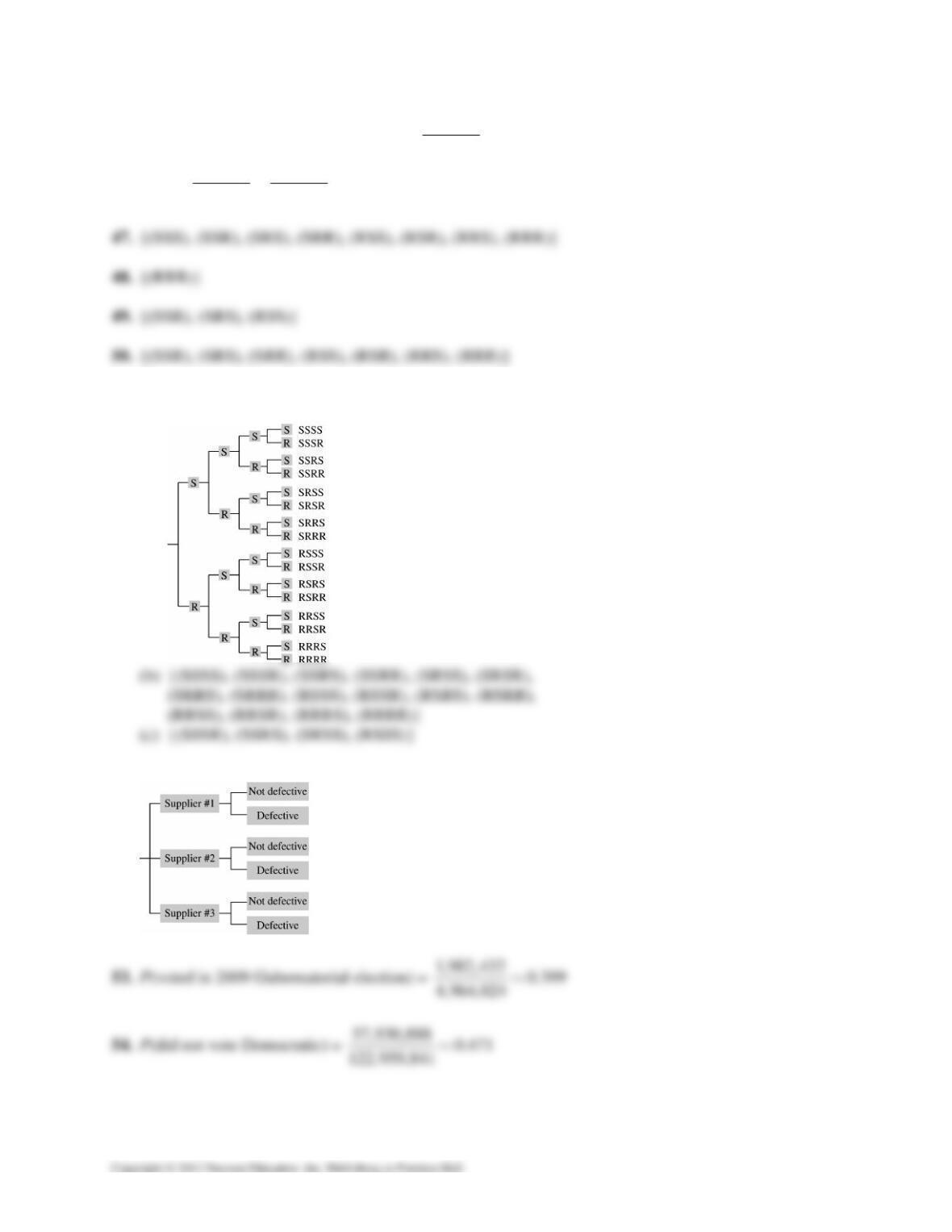
46. (a) 26 9 10 10 5 117,000⋅⋅⋅⋅= (b)
10.00000855
117,000 ≈
(c) 1 116,999
1 0.99999
117,000 117,000
−=≈
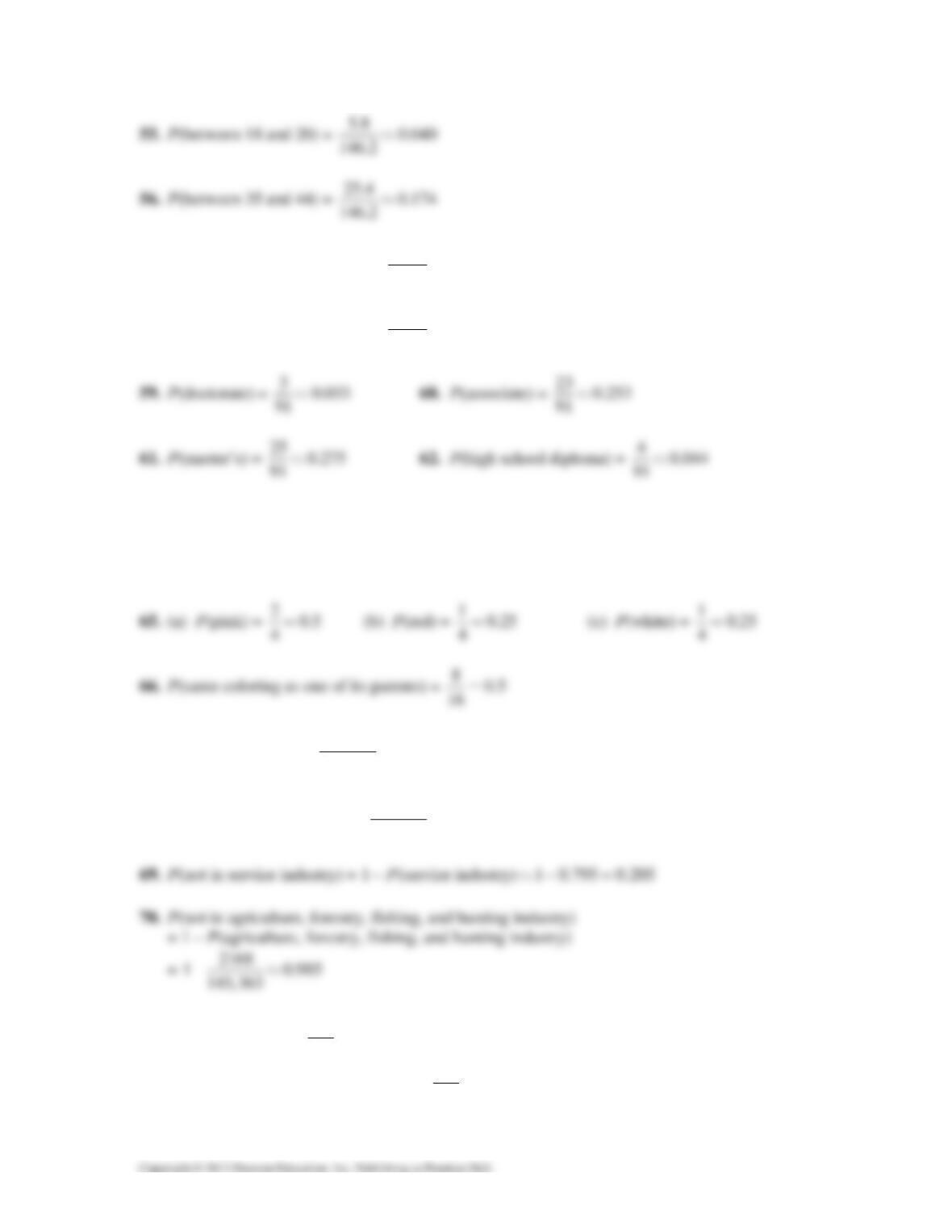
51. Let S = sunny day and R = rainy day.
(a)
52.
CHAPTER 3 │ PROBABILITY 109
57. P(not between 21 and 24) = 9.3
1 1 0.064 0.936
146.2
−≈−≈
58. P(not between 45 and 64) = 54.9
1 1 0.396 0.624
146.2
−≈−≈
63. Yes; the event in Exercise 55 can be considered unusual because its probability is 0.05 or less.
64. Yes; the events in Exercises 59 and 62 can be considered unusual because their probabilities are
0.05 or less.
67. P(service industry) = 115,498 0.795
145,363 ≈
68. P(manufacturing industry) = 15,904 0.109
145,363 ≈
71. (a) P(at least 51) = 27 0.225
120 =
(b) P(between 20 and 30 inclusive) = 16 0.133
120 ≈
110 CHAPTER 3 │ PROBABILITY
(c) P(more than 69) = 20.017
120 ≈; This event is unusual because its probability is 0.05 or less.
74. The probability of randomly choosing a smoker whose mother did not smoke
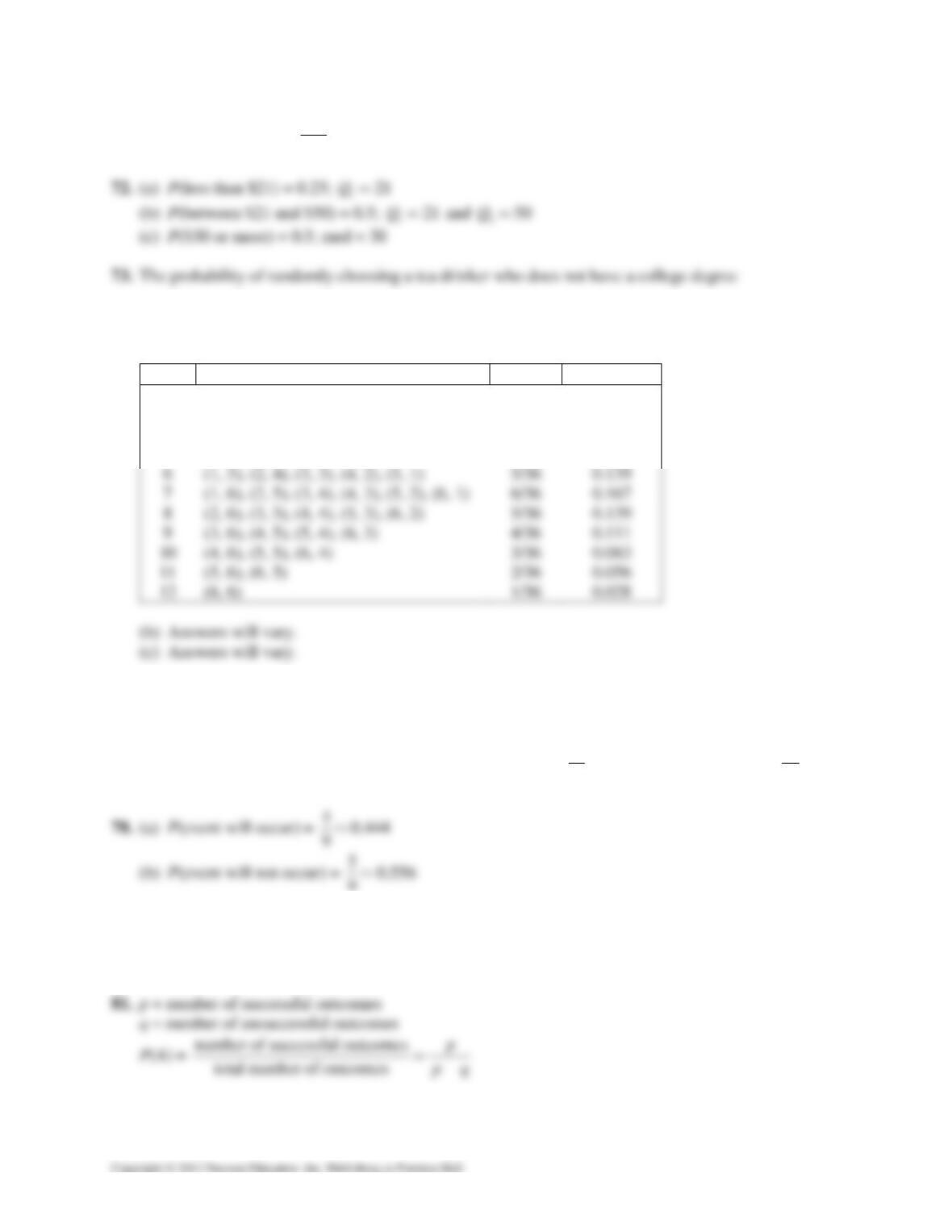
75. (a)
Sum Outcomes P(sum) Probability
2 (1, 1) 1/36 0.028
3 (1, 2), (2, 1) 2/36 0.056
4 (1, 3), (2, 2,), (3, 1) 3/36 0.083
5 (1, 4), (2, 3), (3, 2), (4, 1) 4/36 0.111
76. No, the odds of winning a prize are 1 : 6 (one winning cap and six losing caps). So, the statement
should read, “one in seven game pieces win a prize.”
77. The first game; the probability of winning the second game is 10.091
11 ≈, which is less than 1
10 .
9≈
79. 13 : 39 = 1 : 3
80. 39 : 13 = 3 : 1
CHAPTER 3 │ PROBABILITY 111
3.2 CONDITIONAL PROBABILITY AND THE MULTIPLICATION RULE
3.2 Try It Yourself Solutions
1a. (a) 30 and 102 (2) 11 and 50
b. P(does not have gene) = 30 0.294
102 ≈ (2) P(does not have gene normal IQ) = 11 0.22
50 =
b. (1) Let A = {first salmon swims successfully through the dam}
B = {second salmon swims successfully through the dam}
P(A and B) = () () (0.85)(0.85) 0.723PA PB⋅= ⋅ ≈
(2) Let A = {selecting a heart}
4a. (1) Find probability of the event (2) Find probability of the event
(3) Find probability of the compliment of the event
b. (1) P(3 surgeries are successful) = (0.90) (0.90) (0.90) 0.729⋅⋅=
(2) P(none are successful) = (0.10) (0.10) (0.10) 0.001⋅⋅=
(3) P(at least one rotator cuff surgery is successful) = 1 (none are successful)P−
1 0.001 0.999=− =
c. (1) The event cannot be considered unusual because its probability is not less than or equal to
0.05.
5a. (1),(2) A = {is female}; B = {works in health field}
112 CHAPTER 3 │ PROBABILITY
3.2 EXERCISE SOLUTIONS
1. Two events are independent if the occurrence of one of the events does not affect the probability
2. Answers will vary. Sample answers are given.
(a) Roll a die twice. The outcome of the second roll is independent of the outcome of the first
3. The notation ()PBA means the probability of B, given A.
5. False. If two events are independent, () ()PAB PA=.
6. False. If events A and B are independent, then P(A and B) = () ()PA PB⋅.
9. These events are dependent because the outcome of a father having hazel eyes affects the
outcome of a daughter having hazel eyes.
10. These events are dependent because the outcome of not putting money in a parking meter affects
the outcome of getting a parking ticket.
14. Events: stress, ulcers
These events are independent because stress only irritates already existing ulcers.
15. Events: exposure to aluminum, Alzheimer’s disease
CHAPTER 3 │ PROBABILITY 113
16. Events: diabetes, obesity
17. Let A = {have mutated BRCA gene} and B = {develop breast cancer}.
So, 1
() 8
PB=, 1
() 600
PA=, and ()PBA =6
10 .
18. Let A = {drives pickup truck} and B = {drives a Ford}.
So, 1
() 6
PA=, 3
() 10
PB =, and ()PAB=2
9.
19. Let A = {own a computer} and B = {summer vacation this year}.
(a) 45
(‘) 0.308
146
PB =≈
(b) 115
( ) 0.788
PA=≈
20. Let A = {male} and B = {nursing major}.
(a) 1167
( ) 0.294
3964
PB =≈ (b) 1255
( ) 0.317
3964
PA=≈
114 CHAPTER 3 │ PROBABILITY
21. Let A = {pregnant} and B = {multiple births}. So, P(A) = 0.37 and ()0.25PBA=.
22. Let A = {has the opinion that the U.S. government is broken} and B = {has the opinion that the
government can be fixed}.
23. Let A = {household in U.S. has a computer} and B = {has Internet access}.
P(A and B) () ( )PA PBA=⋅ (0.8) (0.92) 0.745=⋅ ≈
24. Let A = {survives bypass surgery} and B = {heart damage will heal}.
P(A and B) () ( )PA PBA=⋅ (0.6) (0.5) 0.3=⋅=
25. Let A = {first person can wiggle their ears} and B = {second person can wiggle their ears}.
⎛⎞⎛⎞
26. Let A = {first battery fails} and B = {second battery fails}.
⎛⎞⎛⎞
= 0.45
(d) The event in part (a) is unusual because its probability is less than or equal to 0.05.
27. Let A = {have one month’s income or more} and B = {male}.
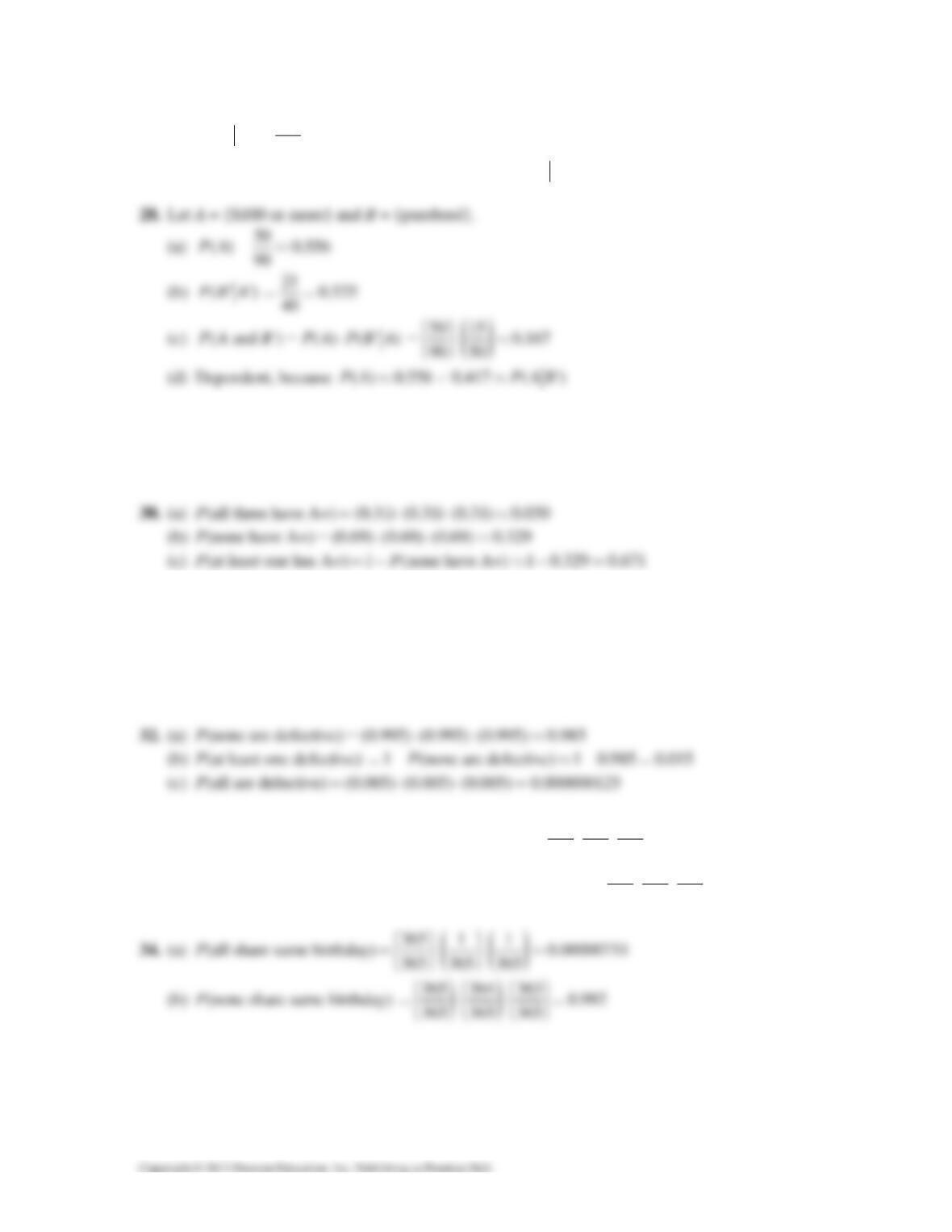
(a) 138
( ) 0.481
287
PA=≈
(b)
(‘ )PAB 66 0.465
142
=≈
CHAPTER 3 │ PROBABILITY 115
(c)
(‘ )PB A 62 0.449
138
=≈
(d) Dependent, because
( ‘) 0.519 0.465 ( ‘ )PA PAB≈≠≈
29. (a) P(all five have B+) (0.09) (0.09) (0.09) (0.09) (0.09) 0.00000590=⋅⋅⋅⋅≈
(b) P(none have B+) (0.91) (0.91) (0.91) (0.91) (0.91) 0.624=⋅⋅⋅⋅≈
(c) P(at least one has B+) 1 (none have B+) 1 0.624 0.376P=− ≈− =
31. (a) P(first question correct) = 0.25
(b) P(first two questions correct) (0.25) (0.25) 0.063=⋅≈
(c) P(all five questions correct) (0.25) (0.25) (0.25) (0.25) (0.25) 0.000977=⋅⋅⋅⋅≈
(d) P(none correct) (0.75) (0.75) (0.75) (0.75) (0.75) 0.237=⋅⋅⋅⋅≈
(e) P(at least one correct) = 1 – P(none correct) 1 0.237 0.763≈− =
33. (a) P(all three products came form the third factory) 25 24 23 0.011
110 109 108
=⋅⋅≈
(b) P(none of the three products came from the third factory) 85 84 83 0.458
110 109 108
=⋅⋅≈
116 CHAPTER 3 │ PROBABILITY
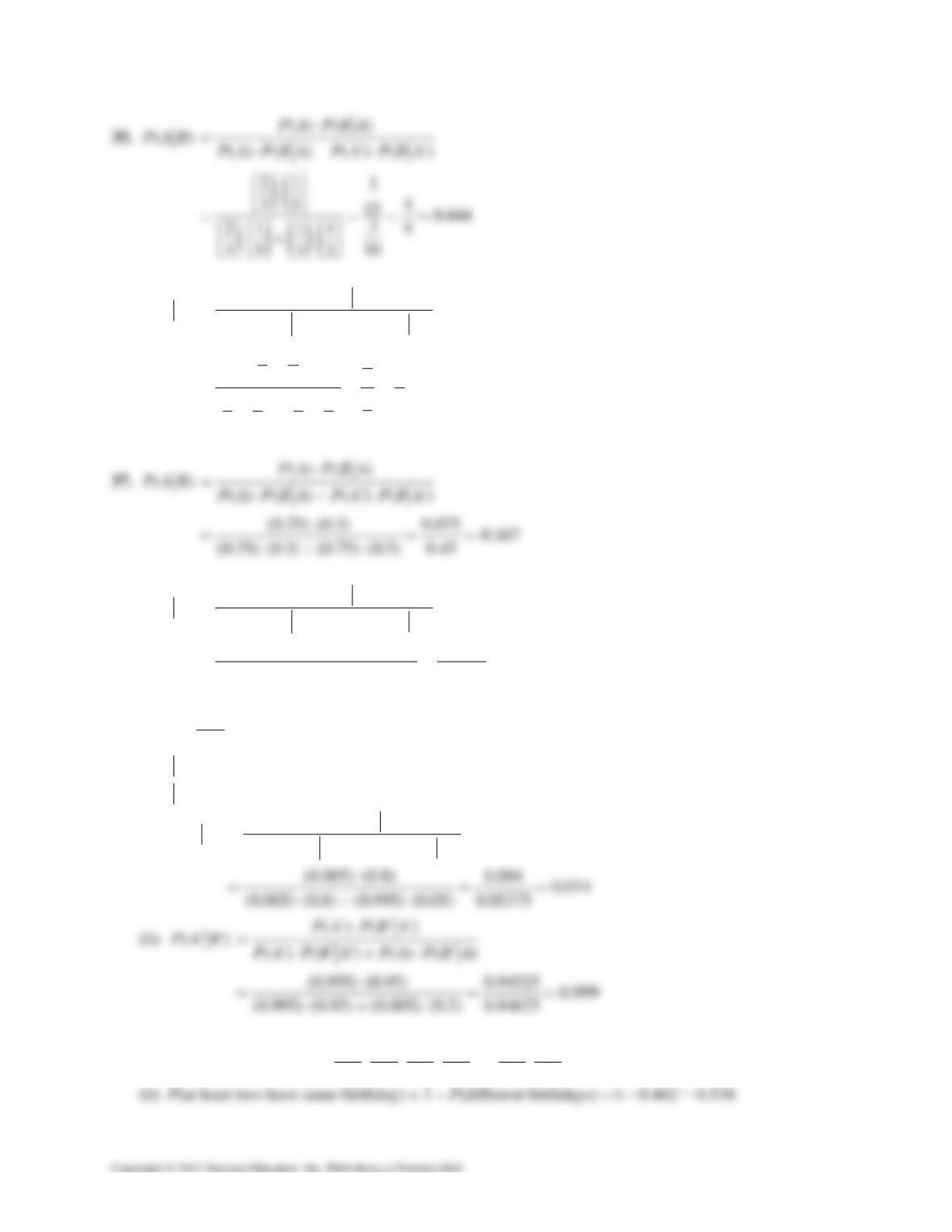
36. ()PAB () ( )
() ( ) (‘) ( ‘)
32 1
2
83 40.4
5
32 53 5
8
83 85
PA PBA
PA PBA PA PBA
⋅
=⋅+⋅
⎛⎞⎛⎞
⎟⎟
⎜⎜
⋅
⎟⎟
⎜⎜
⎟⎟
⎜⎜
⎝⎠⎝⎠
====
⎛⎞⎛⎞ ⎛⎞⎛⎞
⎟⎟ ⎟⎟
⎜⎜ ⎜⎜
⋅+⋅
⎟⎟ ⎟⎟
⎜⎜ ⎜⎜
⎟⎟ ⎟⎟
⎜⎜ ⎜⎜
⎝⎠⎝⎠ ⎝⎠⎝⎠
38. ()PAB () ( )
() ( ) (‘) ( ‘)
(0.62) (0.41) 0.2542 0.797
(0.62) (0.41) (0.38) (0.17) 0.3188
PA PBA
PA PBA PA PBA
⋅
=⋅+⋅
⋅
==≈
⋅+⋅
39. 1
( ) 0.005
200
PA==
()0.8PBA=
(‘)0.05PBA =
(a) ()PAB () ( )
() ( ) (‘) ( ‘)
PA PBA
PA PBA PA PBA
⋅
=⋅+⋅
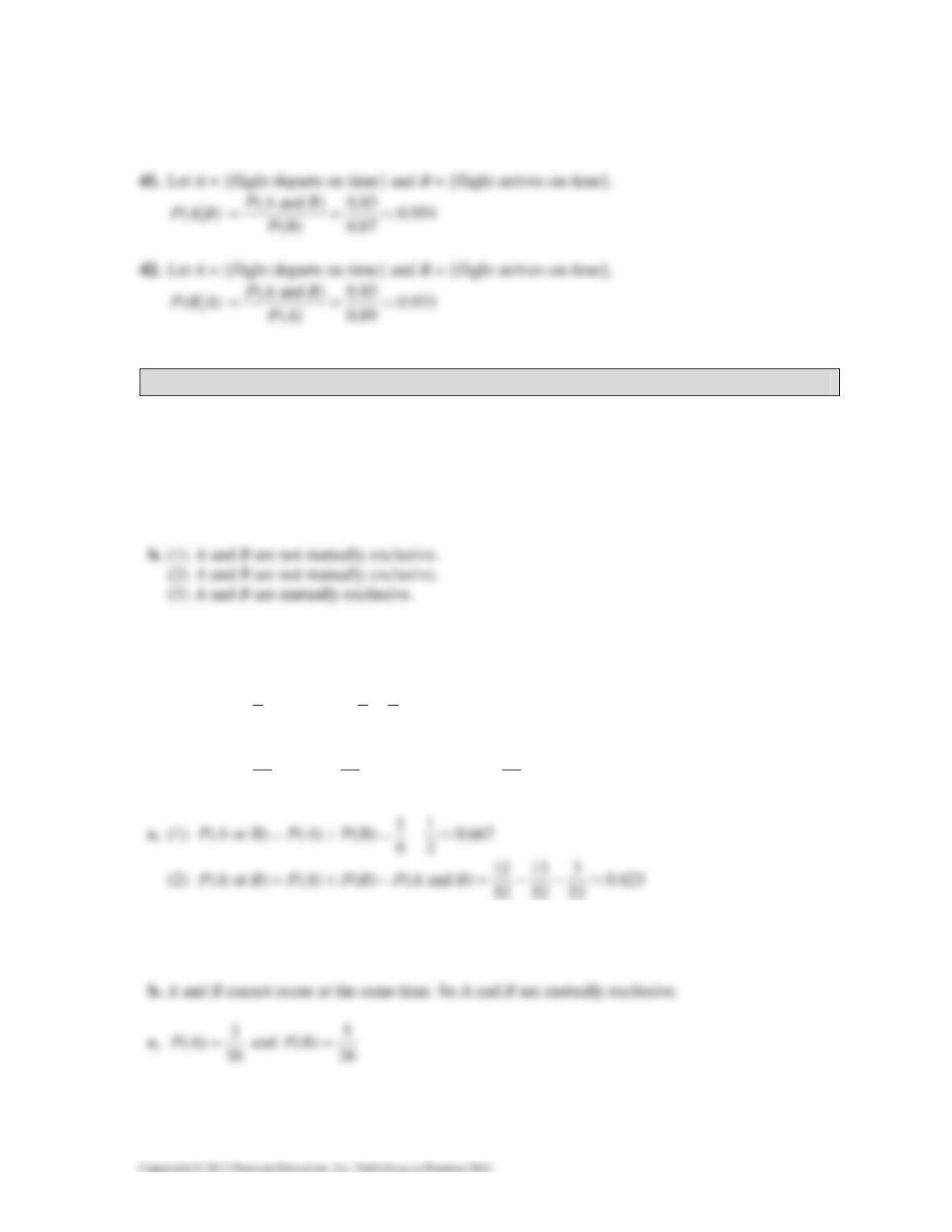
40. (a) P(different birthdays) 365 364 363 362 343 342
… 0.462
365 365 365 365 365 365
=⋅⋅⋅⋅⋅⋅≈
CHAPTER 3 │ PROBABILITY 117
(c) Yes, there were 2 birthdays on the 118th day.
(d) Answers will vary.
3.3 THE ADDITION RULE
3.3 Try It Yourself Solutions
1a. (1) None of the statements are true.
(2) None of the statements are true.
(3) All of the statements are true.
2a. (1) Mutually exclusive (2) Not mutually exclusive
b. (1) Let A = {6} and B = {odd}.
1
() 6
PA= and 31
() 62
PB==
(2) Let A = {face card} and B = {heart}.
12
() 52
PA=, 13
() 52
PB=, and 3
( and ) 52
PA B=
3a. Let A = {sales between $0 and $24,999}
Let B = {sales between $25,000 and $49,999}.
118 CHAPTER 3 │ PROBABILITY
d. 35
( or ) ( ) ( ) 0.222
36 36
PA B PA PB=+=+≈
4a. (1) Let A = {type B} and B = {type AB}.
(2) Let A = {type O} and B = {Rh-positive}.
d. (1) 45 16
( or ) ( ) ( ) 0.149
409 409
PA B PA PB= + =+≈
(2) 184 344 156
( or ) ( ) ( ) ( and ) 0.910
409 409 409
PA B PA PB PA B=+− =+−≈
3.3 EXERCISE SOLUTIONS
1. P(A and B) = 0 because A and B cannot occur at the same time.
2. Answers will vary. Sample answers are given.
(a) Toss coin once: A = {head} and B = {tail}
(b) Draw one card: A = {ace} and B = {spade}
exclusive.
5. False. The probability that event A or event B will occur is
( or ) ( ) ( ) ( and )PA B PA PB PA B=+−
CHAPTER 3 │ PROBABILITY 119
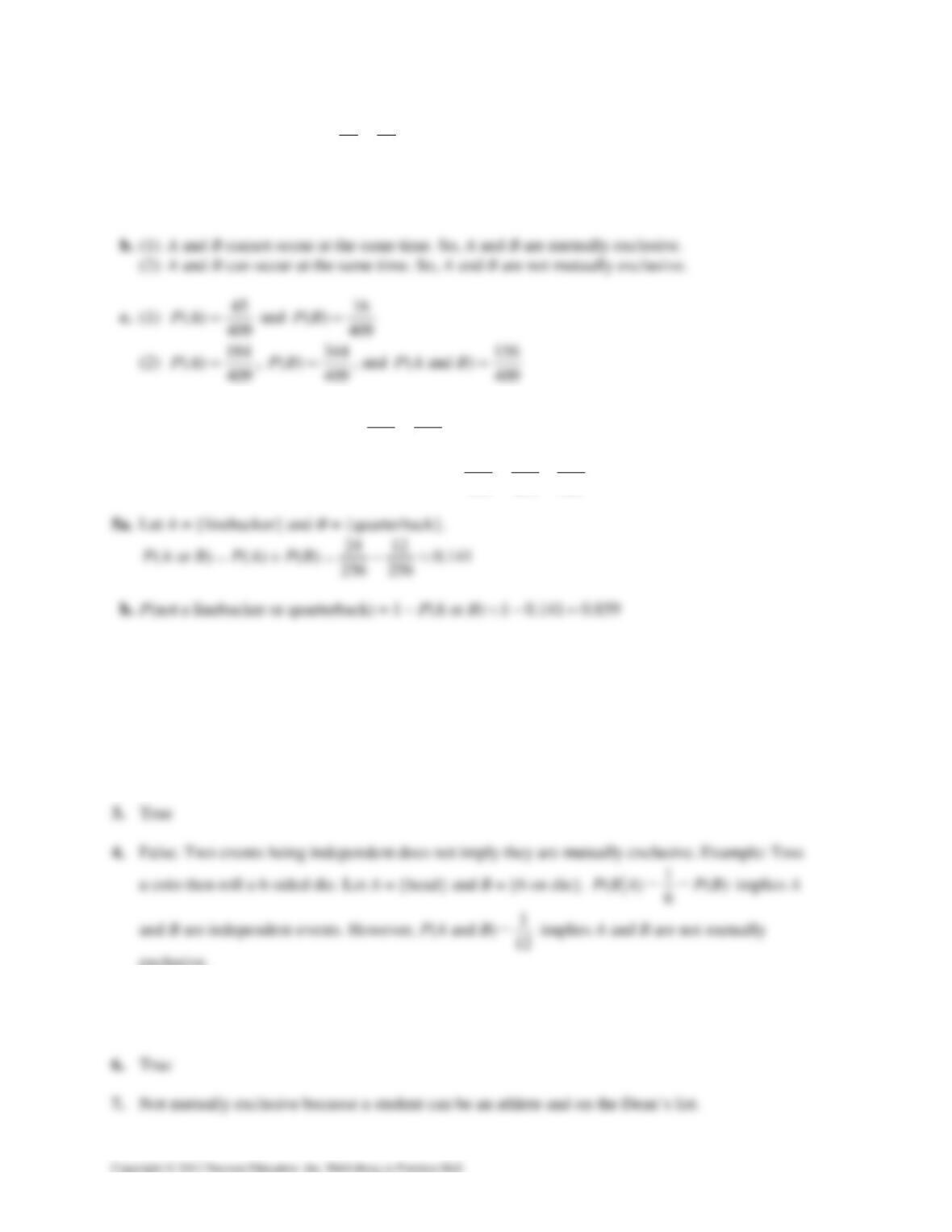
8. Mutually exclusive because a movie cannot have two ratings.
12. Not mutually exclusive because a person can be between 18 and 24 years old and drive a
convertible.
13. (a) Not mutually exclusive because for five weeks the events overlapped.
(b) P(OT or temp) = P(OT) + P(temp) – P(OT and temp) 18 9 5 0.423
52 52 52
=+−≈
15. (a) Not mutually exclusive because a carton can have a puncture and a smashed corner.
(b) P(puncture or corner) = P(puncture) + P(corner) – P(puncture and corner)
0.05 0.08 0.004 0.126=+− =
16. (a) Not mutually exclusive because a can may have no punctures and no smashed edges.
(b) P(does not have puncture or does not have smashed edge)
= P(does not have puncture) + P(does not have smashed edge)
– P(does not have puncture and does not have smashed edge)
0.96 0.93 0.893 0.997=+− =