Special Matrices 13
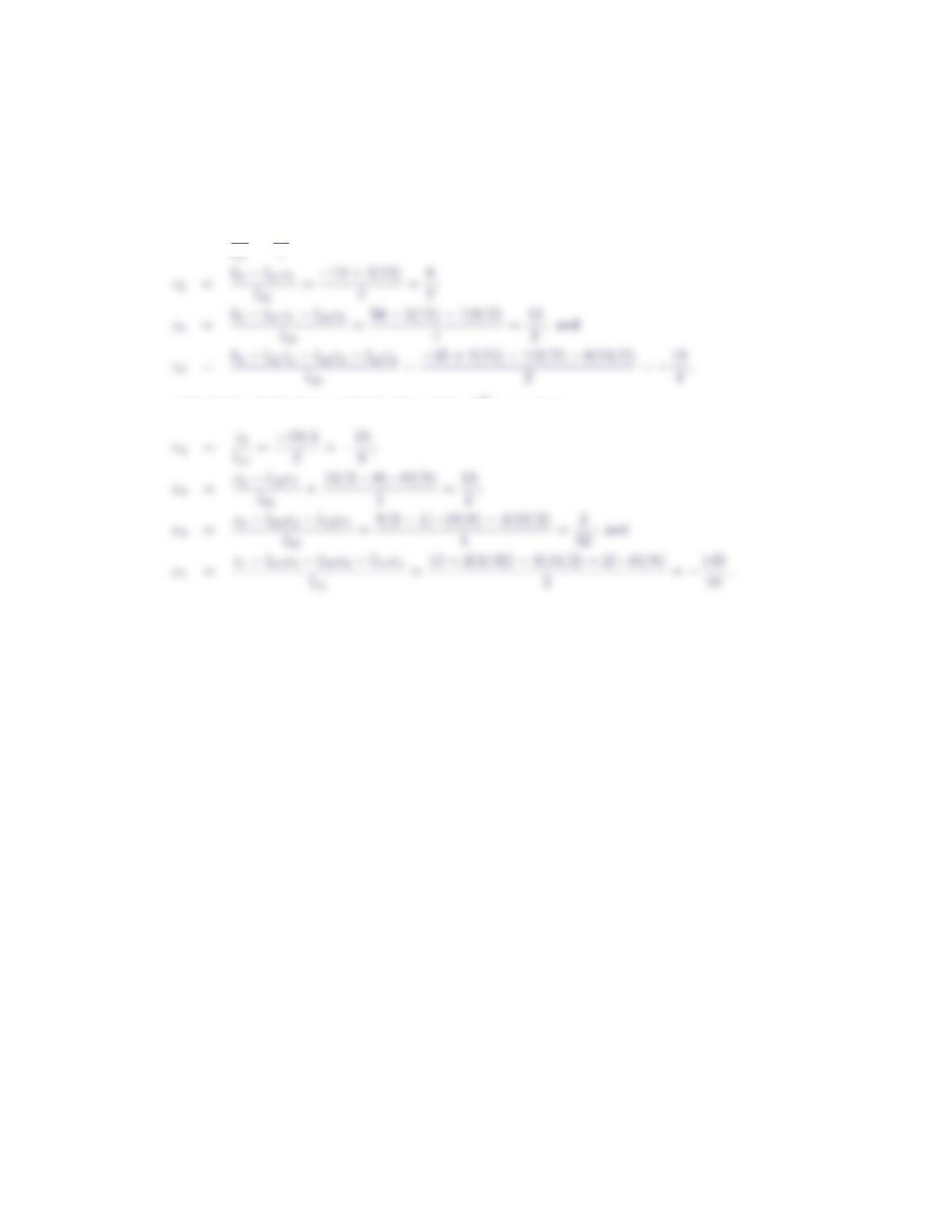
Thus, forward substitution applied to the system Lz=byields
z1=b1
=15
while back substitution applied to the system LTx=zgives
14. Solve each of the following systems of equations. Note that each system has a
tridiagonal coefficient matrix.
(a)
3x1−x2= 4
x1+ 4x2+ 2x3=−7
3x2+ 5x3−x4=−15
−2x3+ 7x4= 18
(b)
2x1−x2= 0
−x1+ 2x2−x3= 0
−x2+ 2x3−x4= 0
−x3+ 2x4= 5
(c)
4x1−x2= 3
−x1−5x2+ 6x3= 0
x2−3x3+ 2x4=−4
x3+ 3x4=−2
14 Section 3.7
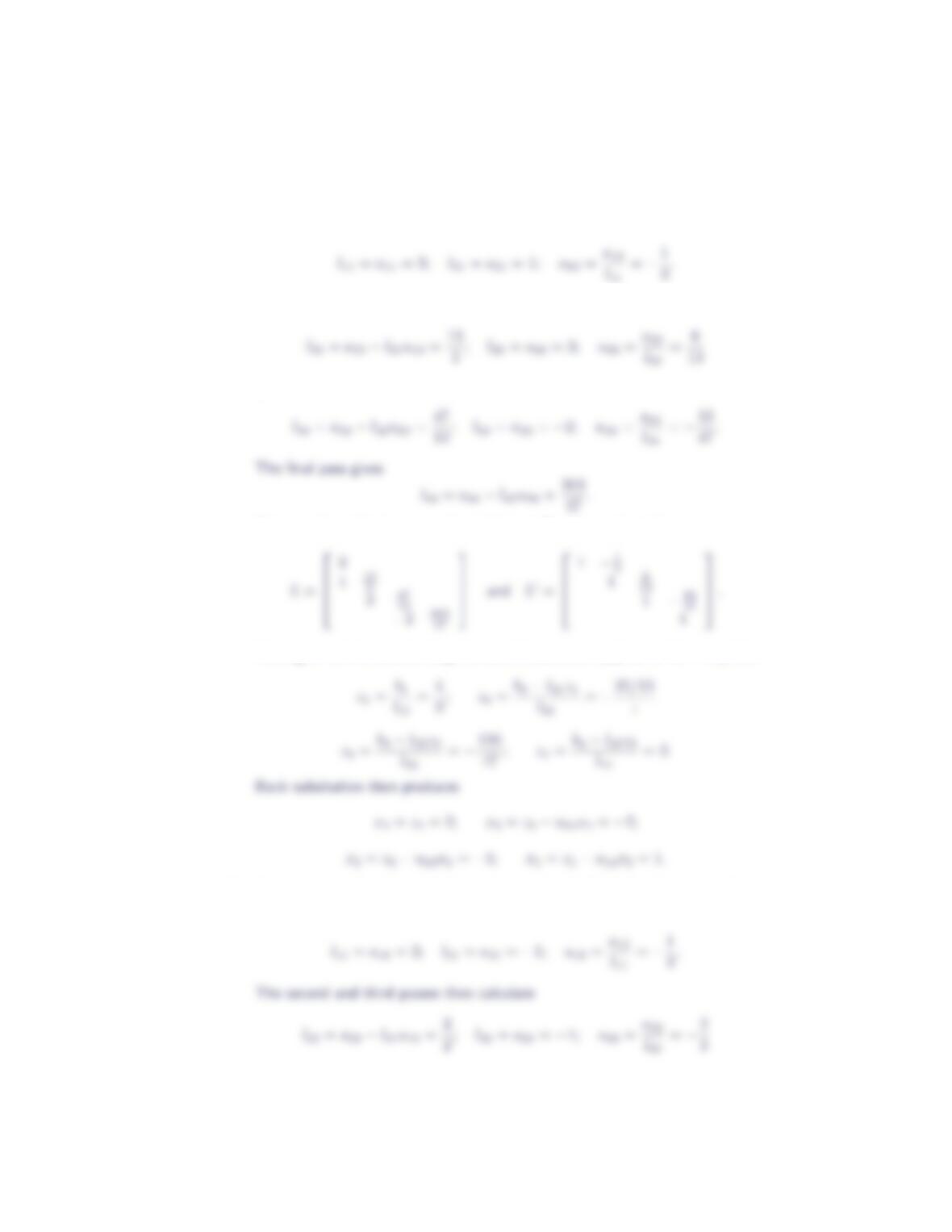
(a) To solve this system, we start by factoring the coefficient matrix. In the first
pass, we calculate
The second and third passes then calculate
and
The complete LU decomposition of the coefficient matrix is then
Moving on to the solution step, forward substitution applied to Lz=byields
(b) To solve this system, we start by factoring the coefficient matrix. In the first
pass, we calculate
Special Matrices 15
and
4.
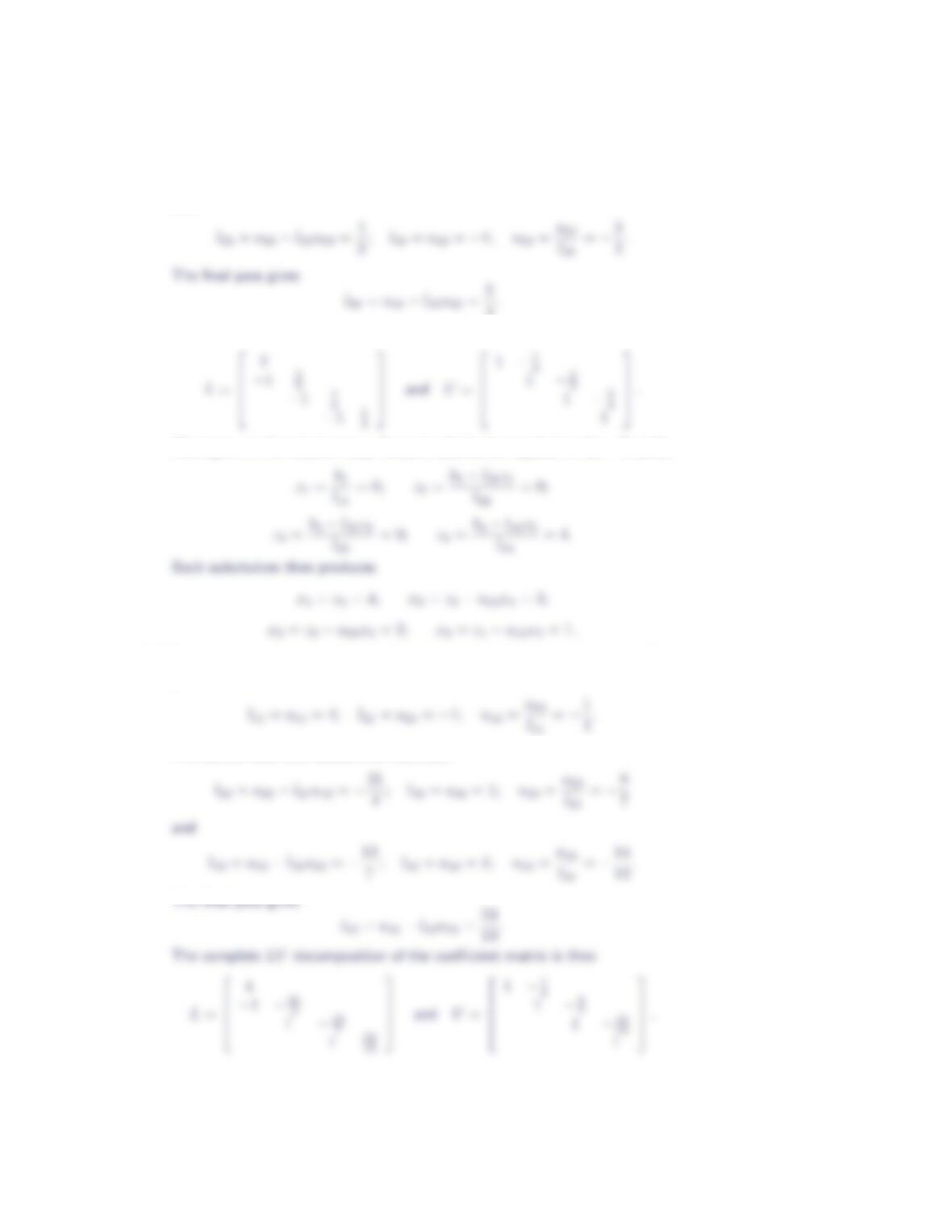
The complete LU decomposition of the coefficient matrix is then
Moving on to the solution step, forward substitution applied to Lz=byields
(c) To solve this system, we start by factoring the coefficient matrix. In the first
pass, we calculate
The second and third passes then calculate
16 Section 3.7
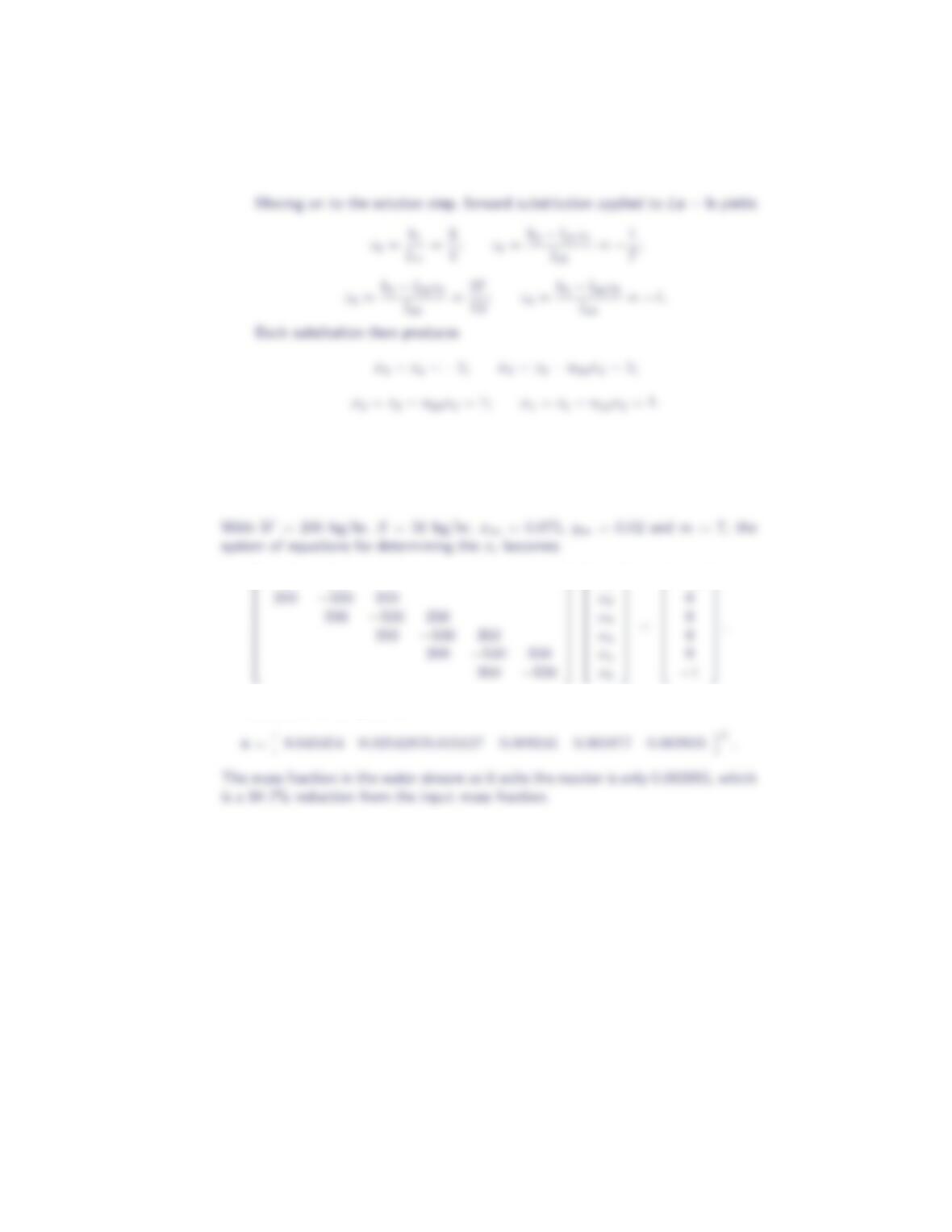
15. Repeat the “Multistage Chemical Extraction” problem with a solvent stream
input mass fraction of yin = 0.02. By what percentage is the mass fraction in
the water stream reduced?
−550 350
x1
−15
The solution of this system is
16. An absorption column works much like an extraction reactor (see page 139). A
gas stream with flow rate Gand input mass fraction yin of a chemical is used
to transfer the chemical to a liquid stream which has a flow rate Land an input
mass fraction xin. At equilibrium, it is assumed that yi=mxi, where xiand
yiare the mass fractions of the chemical within the liquid and gas streams,
respectively, as they exit the i-th stage of the column.
(a) Set up the system of equations for an nstage absorption column.
(b) If L= 2500 kg/hr, G= 4000 kg/hr, xin = 0, yin = 0.05 and m= 1.46,
what is the mass fraction in the liquid stream as it exits an eight stage
column?
Special Matrices 17
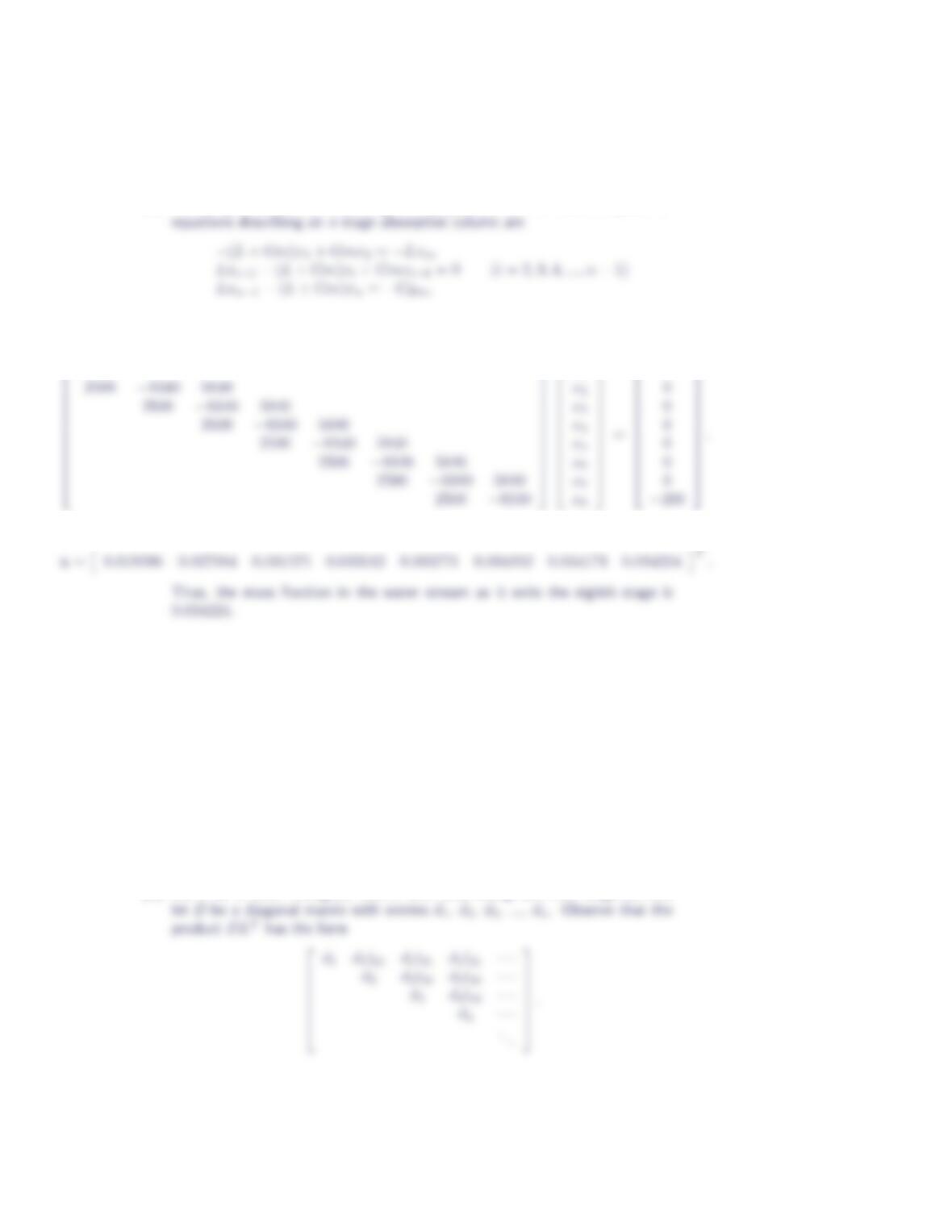
(a) Following the derivation that begins on page 139, we find that the system of
(b) With L= 2500 kg/hr, G= 4000 kg/hr, xin = 0,yin = 0.05 and m= 1.46,
the system of equations describing an eight stage absorption column is
−8340 5840
x1
0
The solution of this system is
17. (a) Construct an algorithm to factor an n×nsymmetric positive definite
matrix into the form LDLT, where Lis a lower triangular matrix with
ones along its diagonal and Dis a diagonal matrix. How many arithmetic
operations are required to compute the LDLTdecomposition? How does
this compare with the number of operations needed to compute a Cholesky
decomposition?
(b) Construct an algorithm to solve the system Ax=bgiven an LDLTde-
composition of the coefficient matrix. How many arithmetic operations
does this solve step require? How does this compare with the number of
operations required by the solve step associated with a Cholesky decom-
position?
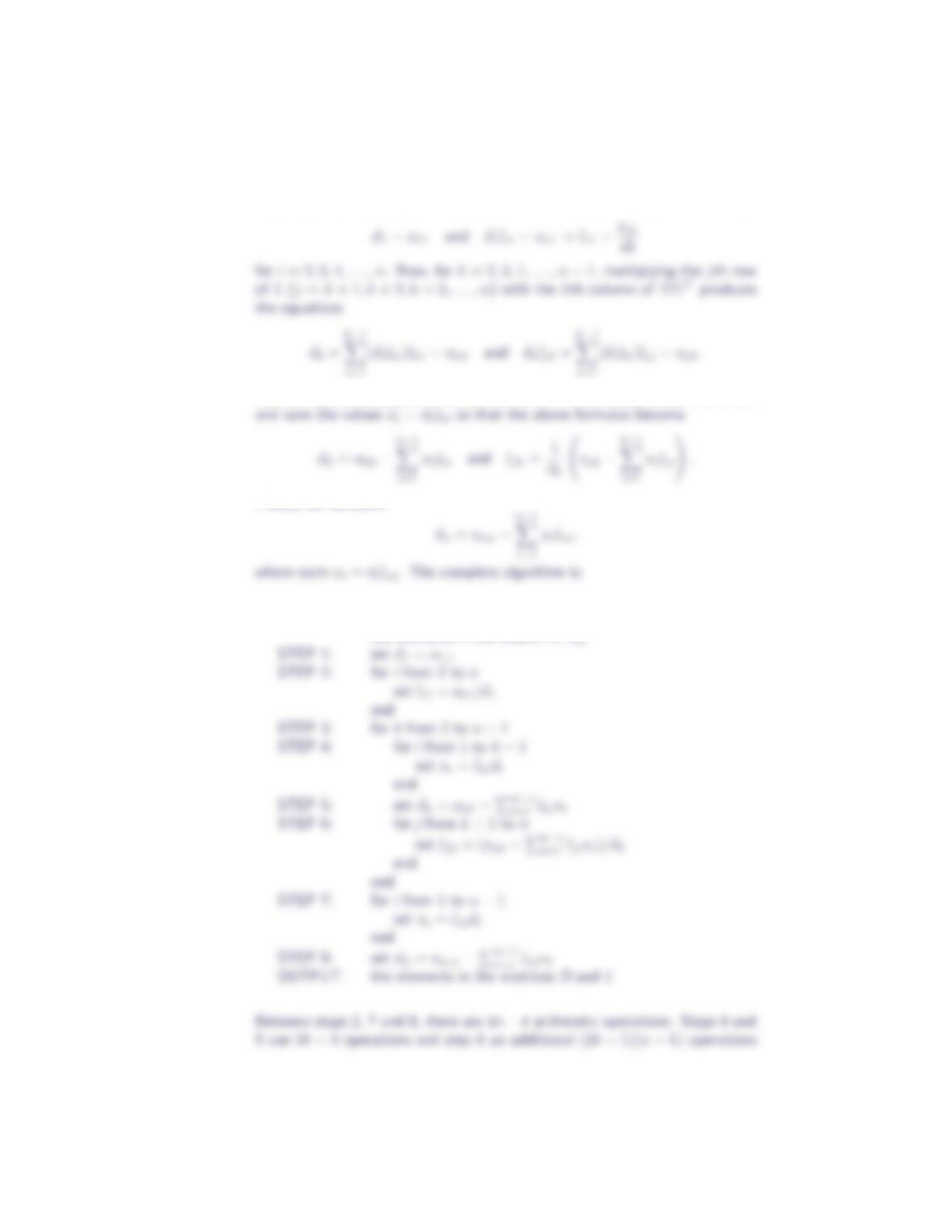
(a) Let Lbe a lower triangular matrix with ones along the main diagonal, and
18 Section 3.7
Thus, upon multiplying each row of Lwith the first column of DLT, we find
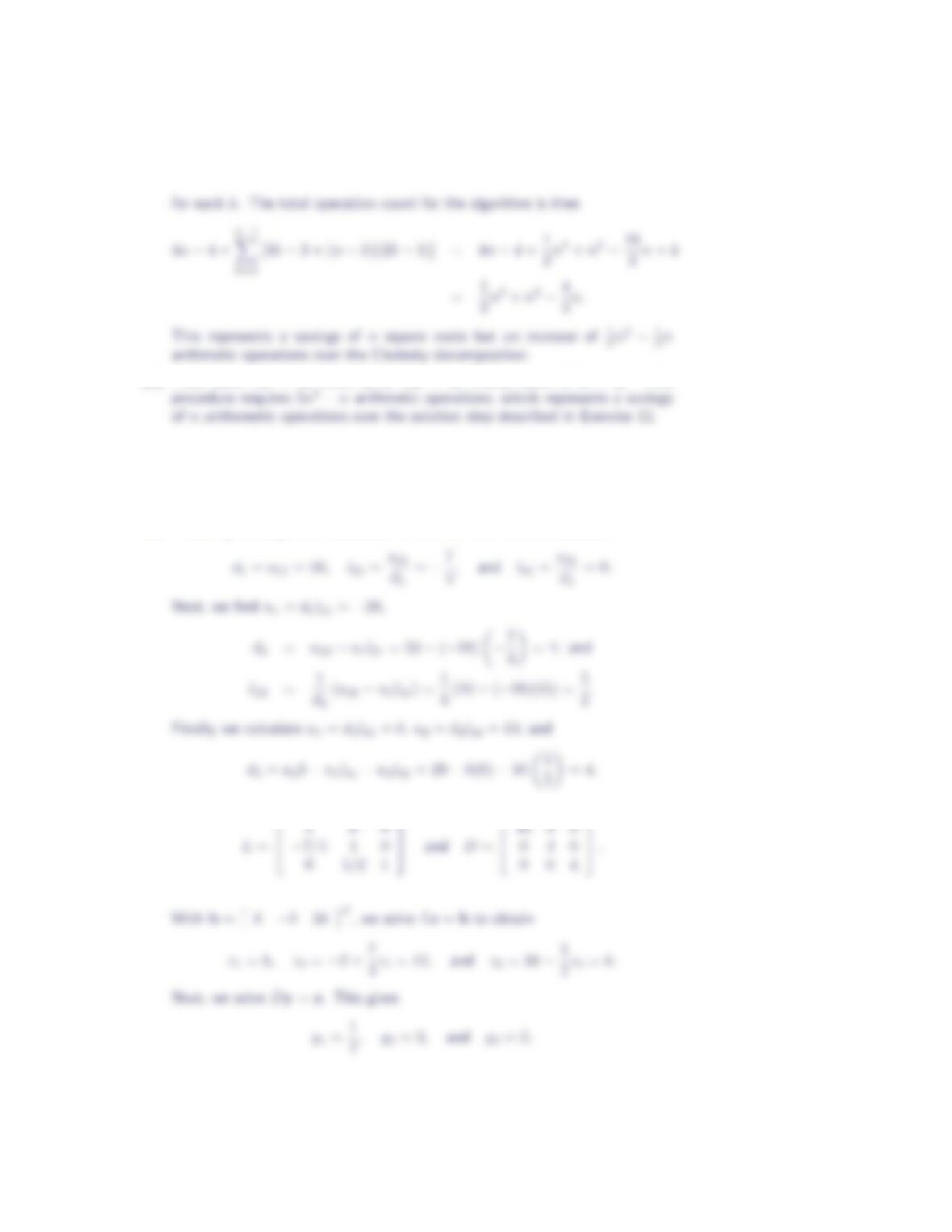
Note the products dilki are used several times. For efficiency, we will calculate
Finally, we calculate
GIVEN: the integer n
the elements in the matrix A,aij
Special Matrices 19
(b) First, solve Lz=b; then, solve Dy=z; finally, solve LTx=y. This
18. Repeat Exercise 13 using an LDLTdecomposition rather than a Cholesky de-
composition.
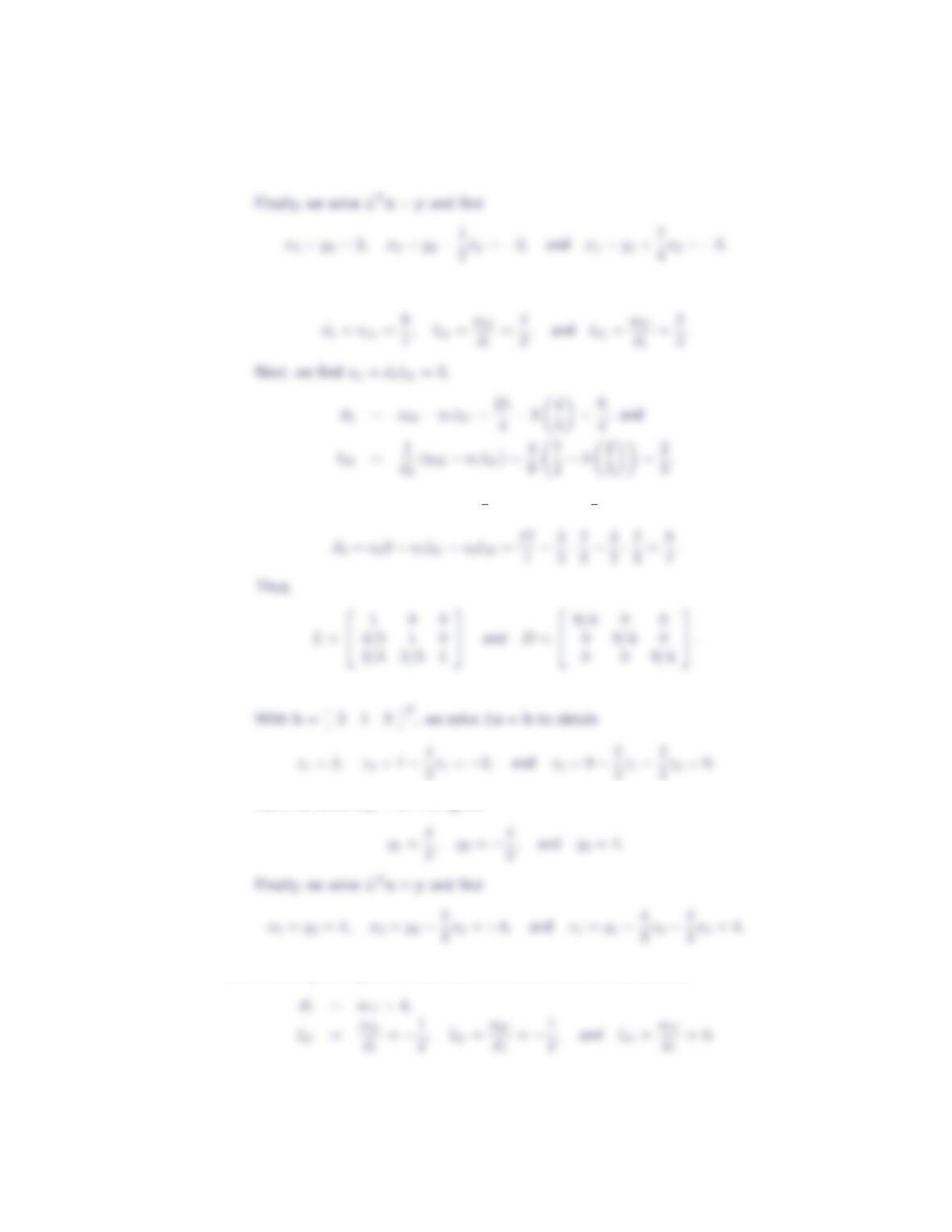
(a) Following the algorithm described in Exercise 17a, we first calculate
Thus,
20 Section 3.7
(b) Following the algorithm described in Exercise 17a, we first calculate
Finally, we calculate u1=d1l31 =3
2,u2=d2l32 =3
2, and
Next, we solve Dy=z. This gives
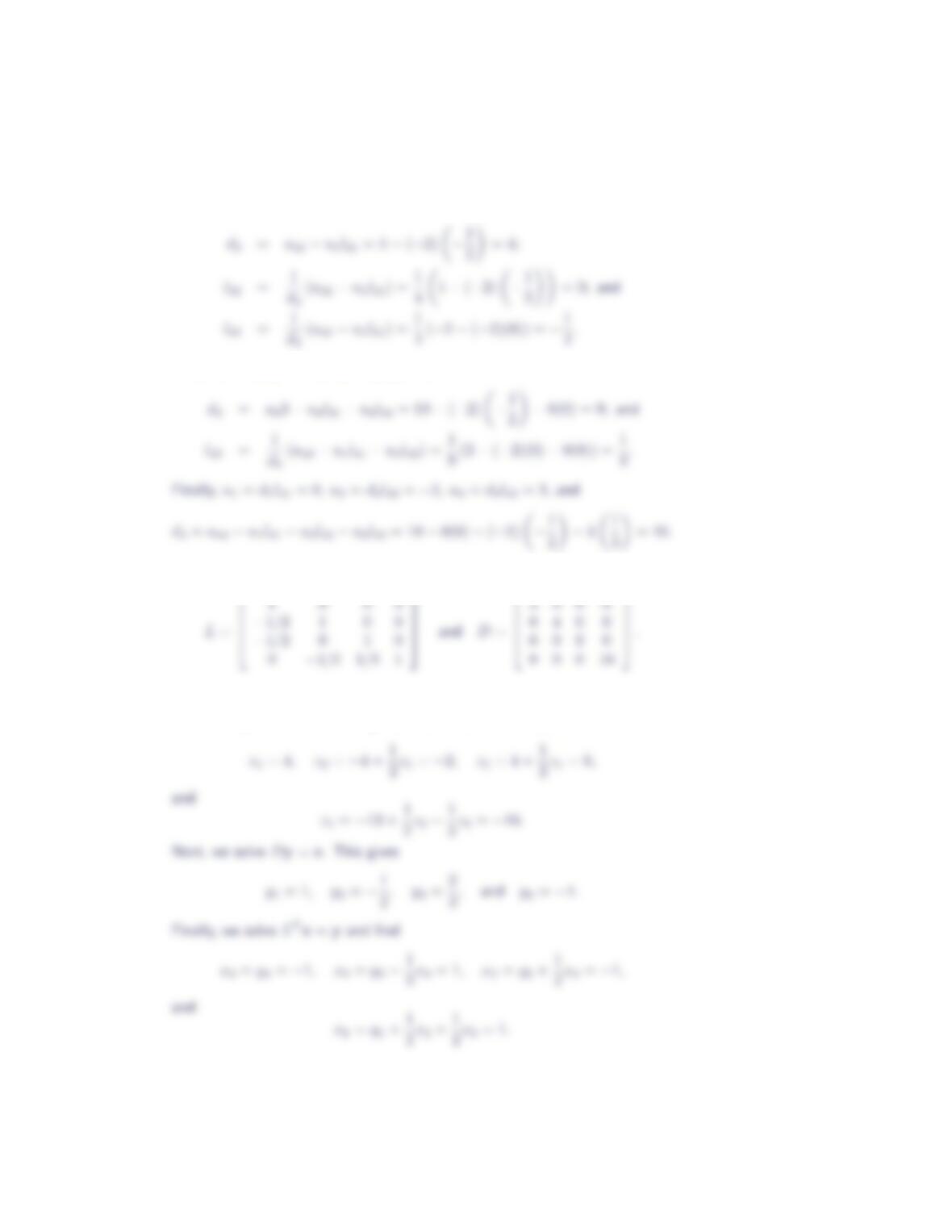
(c) Following the algorithm described in Exercise 17a, we first calculate
Special Matrices 21
Now, we find u1=d1l21 =−2,
Next, u1=d1l31 =−2,u2=d2l32 = 0,
Thus,
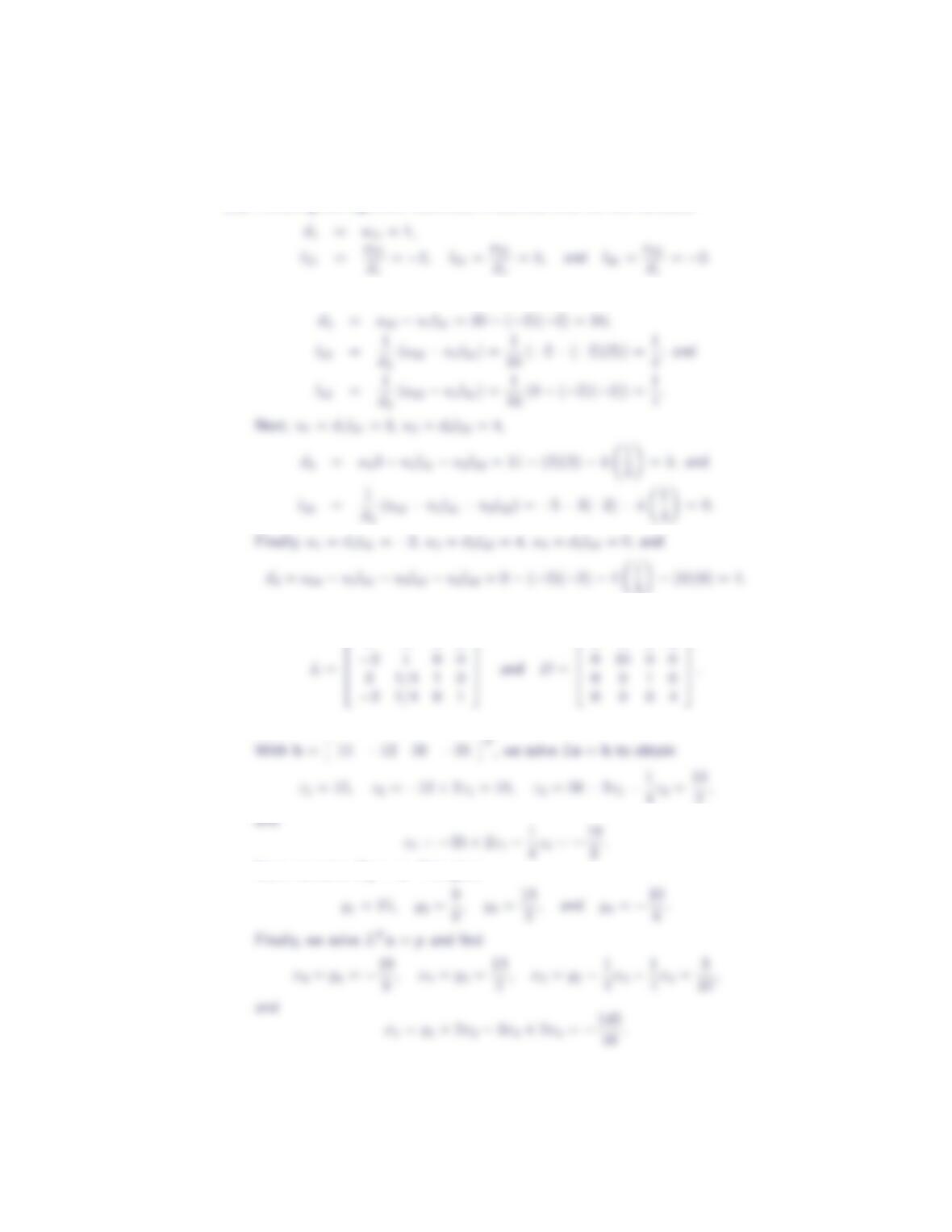
With b=4−4 4 −13 T, we solve Lz=bto obtain
22 Section 3.7
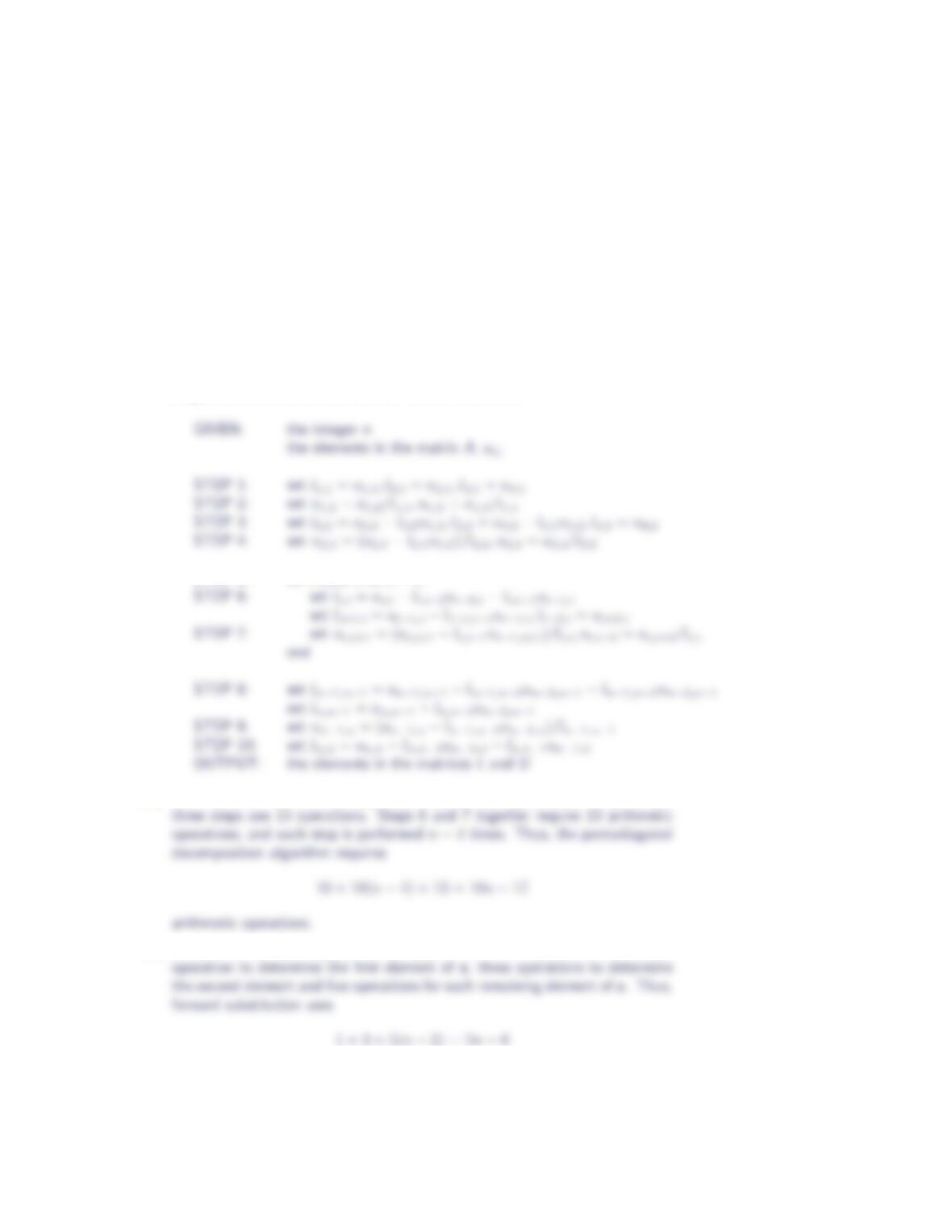
(d) Following the algorithm described in Exercise 17a, we first calculate
Now, we find u1=d1l21 =−2,
4−(0)(0) = 4.
Thus,
1 0 0 0
1 0 0 0
Next, we solve Dy=z. This gives
Special Matrices 23
19. A matrix Ais pentadiagonal if aij = 0 whenever |i−j|>2.
(a) Construct an algorithm to efficiently compute the Crout decomposition of
a pentadiagonal matrix?
(b) How many operations are required by the algorithm from part (a)?
(c) How many operations are needed to carry out forward and backward sub-
stitution using the decomposition obtained from part (a)?
(a) Modifying the Crout decomposition algorithm to take into account the penta-
diagonal structure of the coefficient matrix, we obtain:
STEP 5: for ifrom 3 to n−2
(b) We note that the first four steps use 10 arithmetic operations, while the last
(c) Forward substitution applied to the system Lz=brequires one arithmetic
24 Section 3.7
operations. Back substitution applied to the system Ux=zdoes not require
any operations to obtain the first element of x, uses two operations to ob-
tain the second element and four operations to obtain each of the remaining
elements of x. Thus, back substitution uses
2 + 4(n−2) = 4n−6
operations, and the complete solve step requires 9n−12 arithmetic operations.