Vector and Matrix Norms 1
3.3 Vector and Matrix Norms
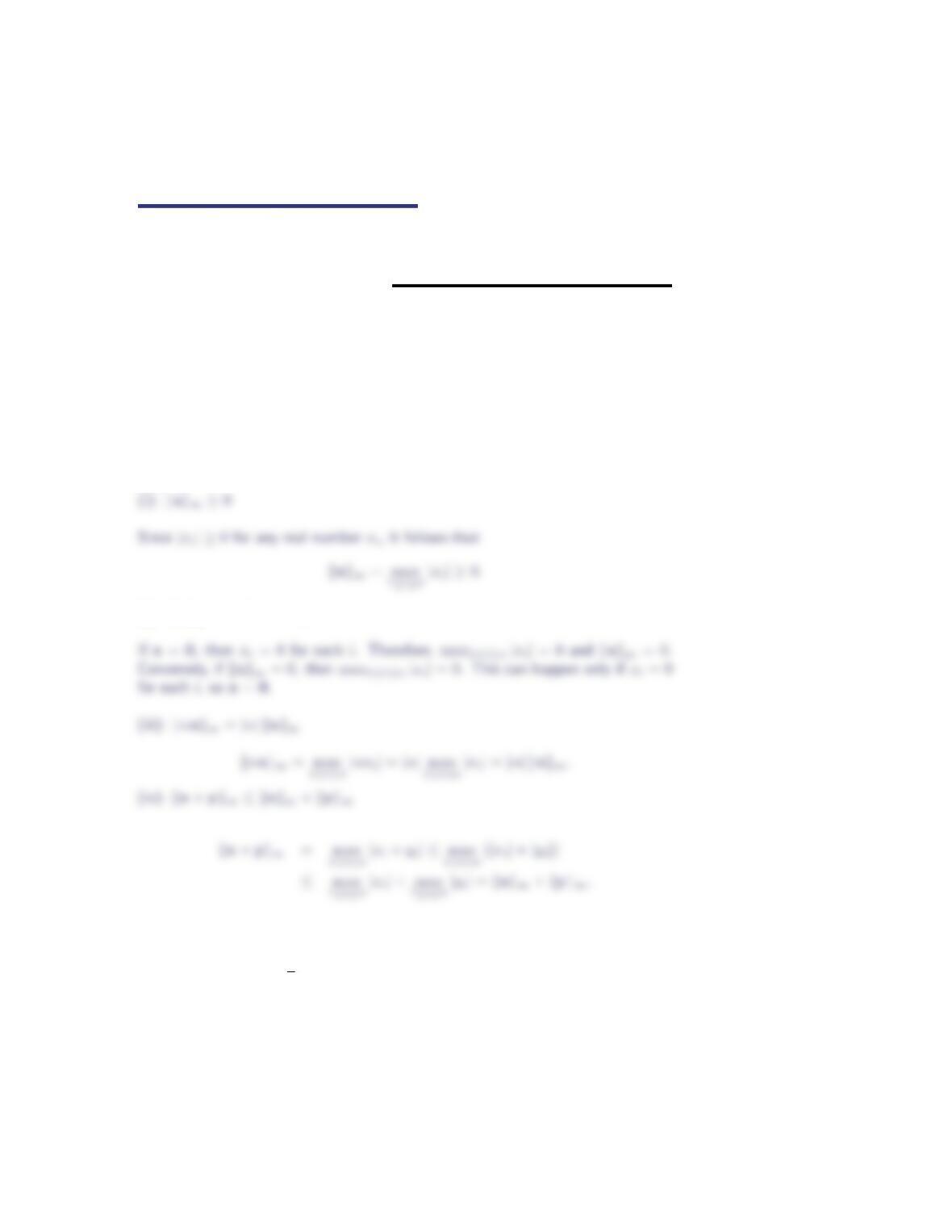
1. Verify that the l∞-norm,
kxk∞= max
1≤i≤n|xi|,
satisfies the properties of a vector norm.
In what follows, let xand ybe arbitrary n-vectors, and let αbe an arbitrary real
number.
(ii): kxk∞= 0 if and only if x=0
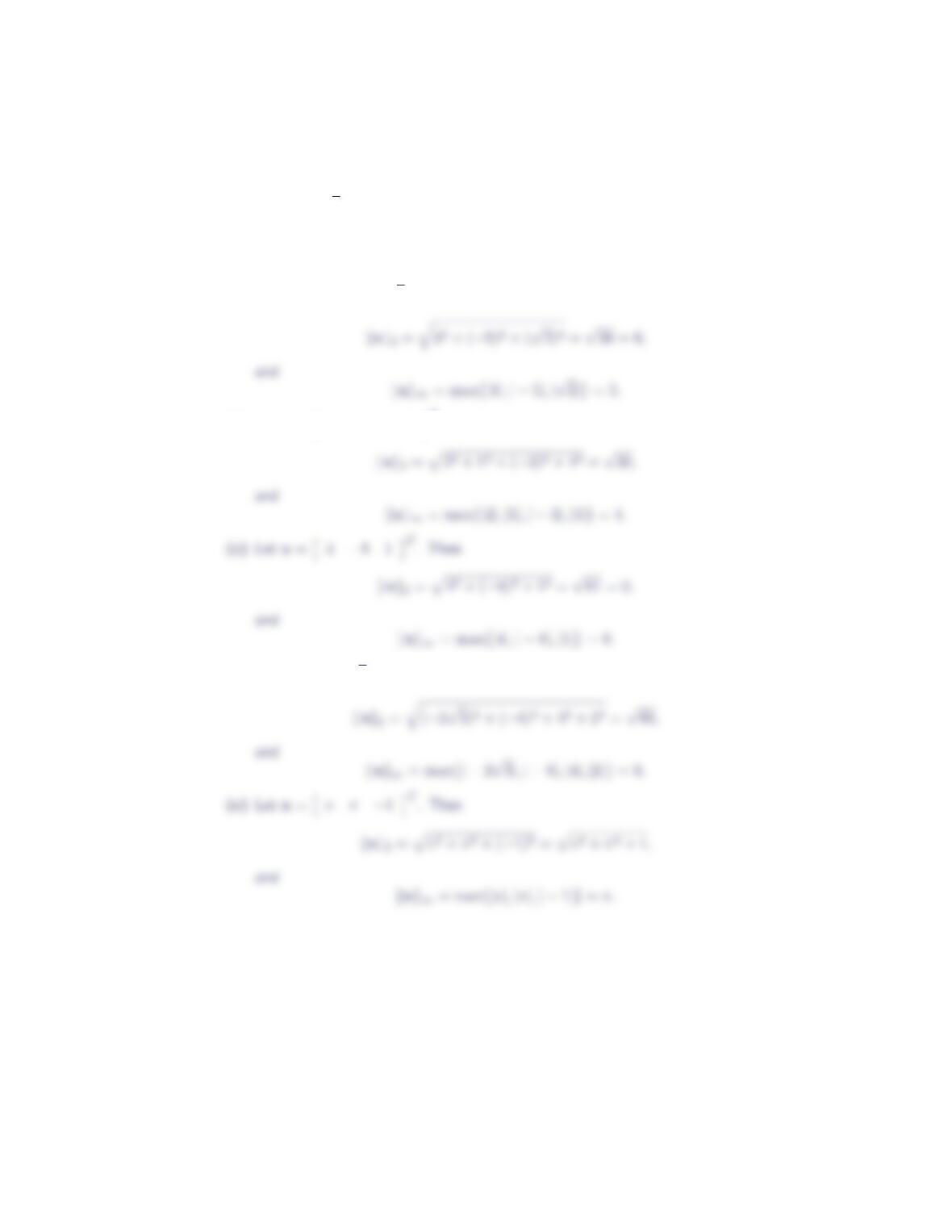
2. Compute the l2-norm and the l∞-norm for each of the following vectors.
(a) x =3−5√2T
(b) x =2 1 −3 4 T
(c) x =4−8 1 T
2Section 3.3
(d) x =−2√3−642T
(e) x =e π −1T
(a) Let x=3−5√2T. Then
(b) Let x=2 1 −3 4 T. Then
(d) Let x=−2√3−642T. Then
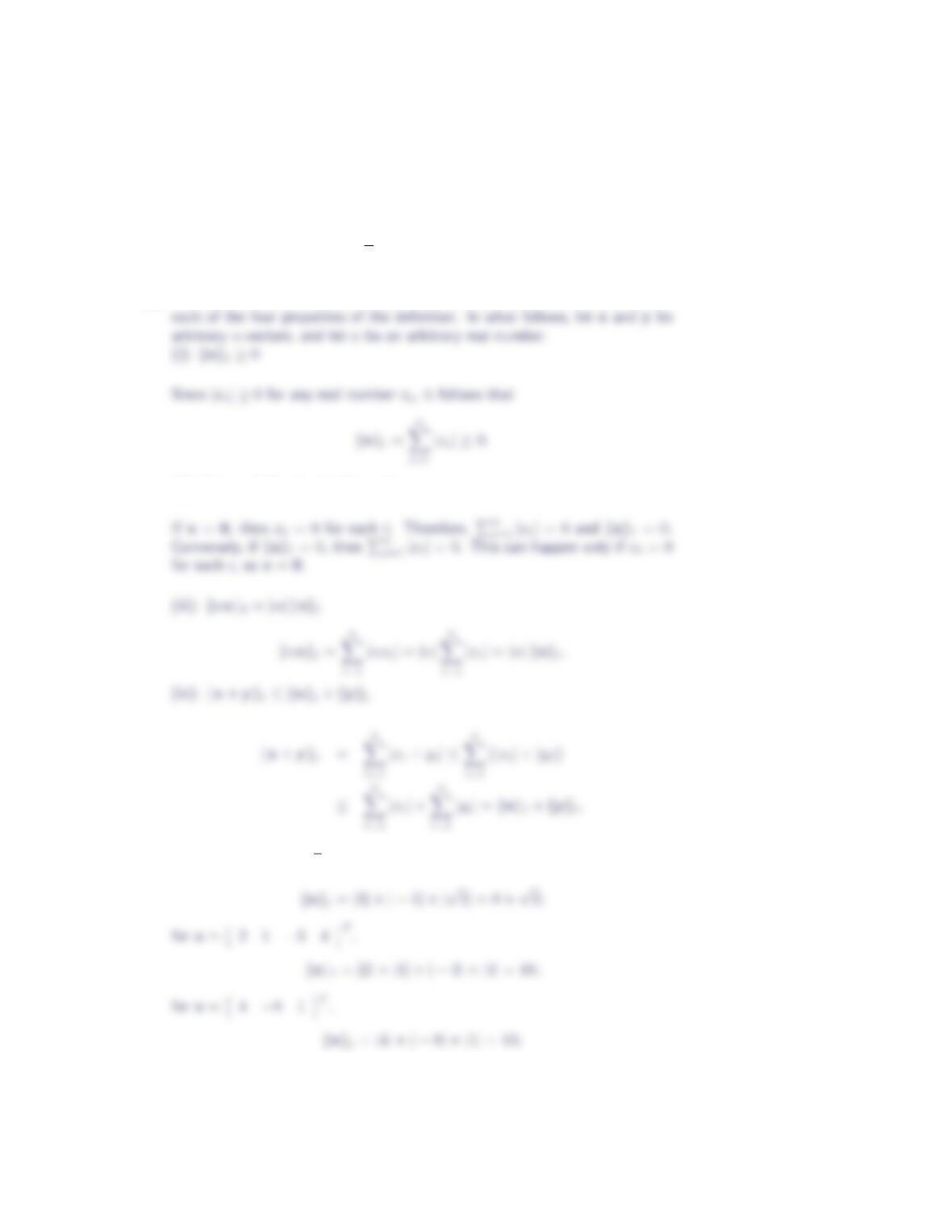
3. (a) Show that the function k · k1:Rn→Rdefined by
kxk1=
n
X
i=1 |xi|
is a vector norm. The operator k · k1is known as the l1-norm.
Vector and Matrix Norms 3
(b) Compute the l1-norm for each of the vectors in Exercise 2.
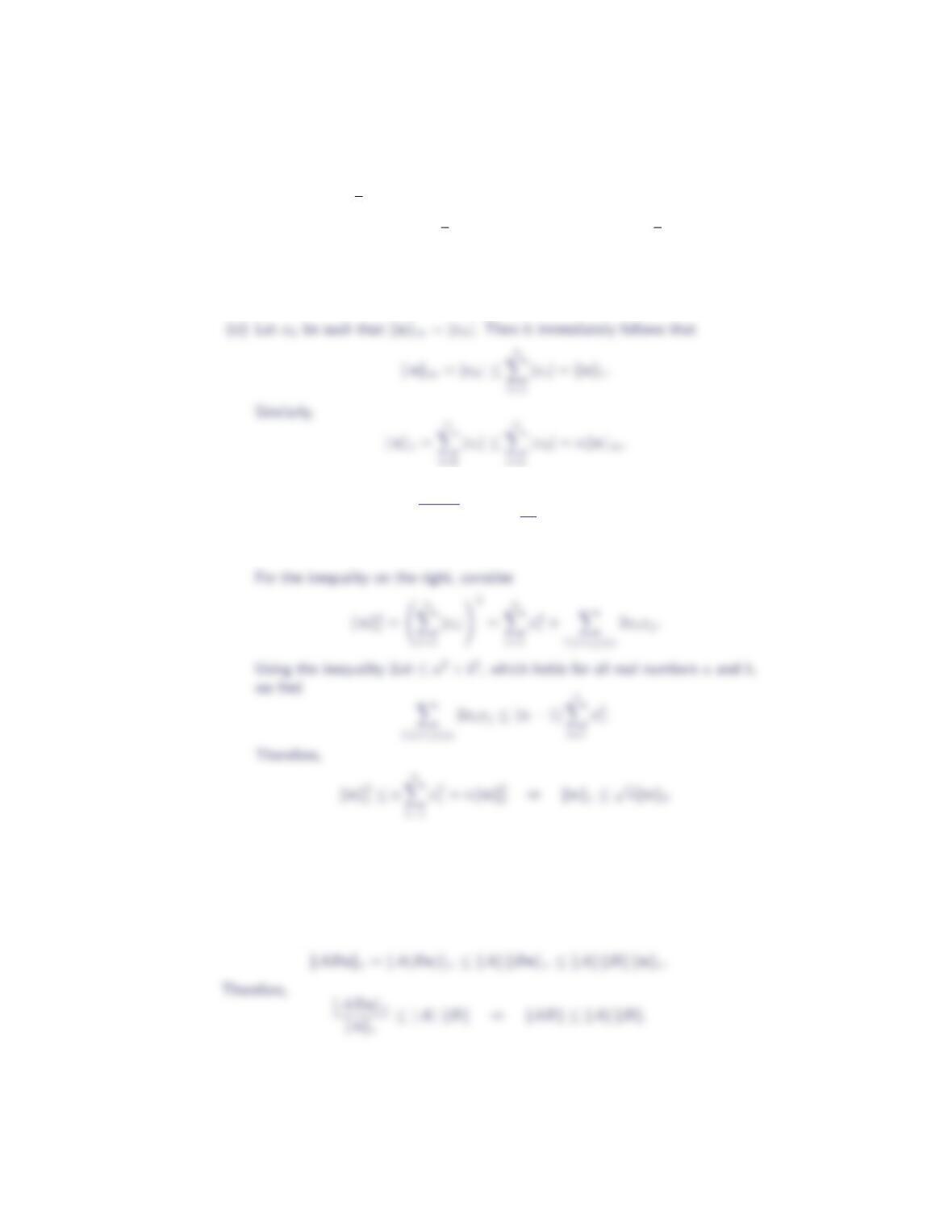
(c) Show that kxk∞≤ kxk1≤nkxk∞for all x∈Rn.
(d) Show that kxk2≤ kxk1≤√nkxk2for all x∈Rn.
(a) To establish that k·k1is a vector norm, we must show that k·k1satisfies
(ii): kxk1= 0 if and only if x=0
(b) For x=3−5√2T,
4Section 3.3
for x=−2√3−642T,
kxk1=| − 2√3|+| − 6|+|4|+|2|= 12 + 2√3;
and for x=e π −1T,
kxk1=|e|+|π|+| − 1|=e+π+ 1.
(d) For the inequality on the left,
kxk2=v
u
u
t
n
X
i=1
x2
i≤
n
X
i=1 qx2
i=
n
X
i=1 |xi|=kxk1.
4. Let k·kvbe a vector norm. Show that the natural norm associated with k·kv
satisfies kABk ≤ kAkkBkfor all A, B ∈Rn×n.
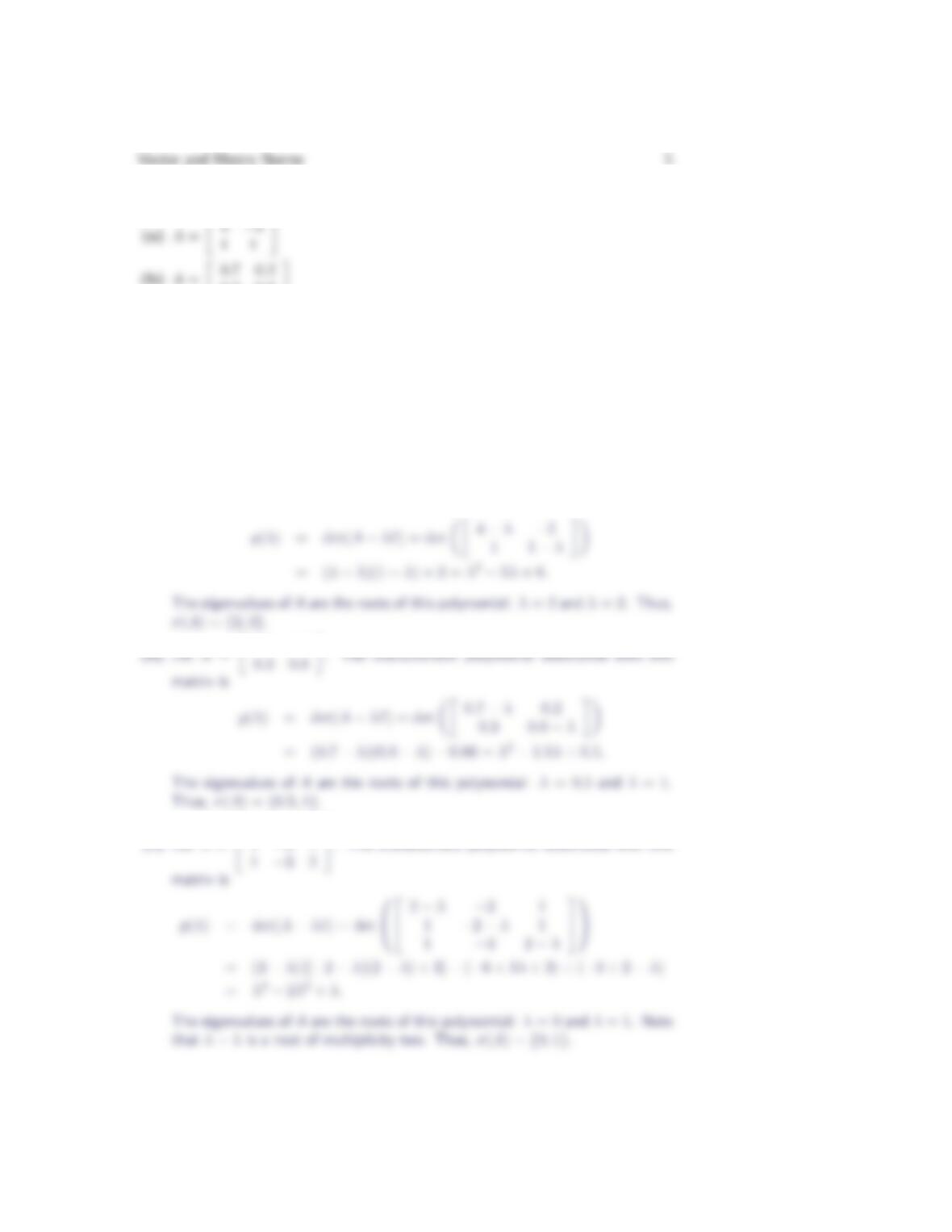
Let xbe any non-zero n-vector. Using the consistency property of the natural norm
twice, we find
5. Compute the spectrum of each of the following matrices.
0.3 0.8
(c) A=
2−3 1
1−2 1
1−3 2
(d) A=
1 2 1
0 3 1
0 5 −1
(a) Let A=4−2
1 1 . The characteristic polynomial associated with this ma-
trix is
2−3 1
1−2 1
. The characteristic polynomial associated with this
6Section 3.3
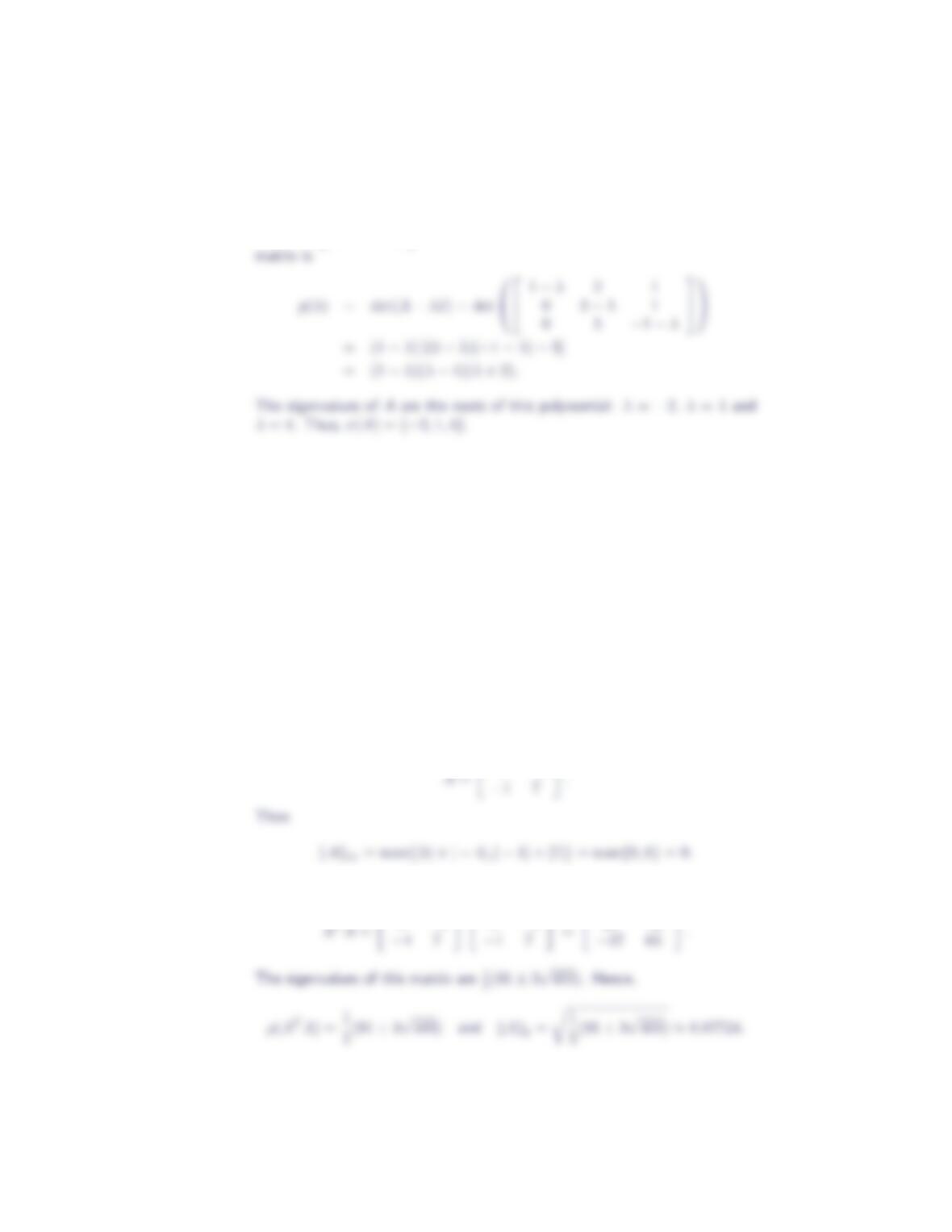
(d) Let A=
1 2 1
0 3 1
0 5 −1
. The characteristic polynomial associated with this
6. Compute the l2-norm and the l∞-norm for each of the following matrices.
(a) A=5−4
−1 7
(b) A=4 2
1 3
(c) A=
4−1−2
1 2 −3
0 0 4
(d) A=
210
−1 2 −1
−3 4 −4
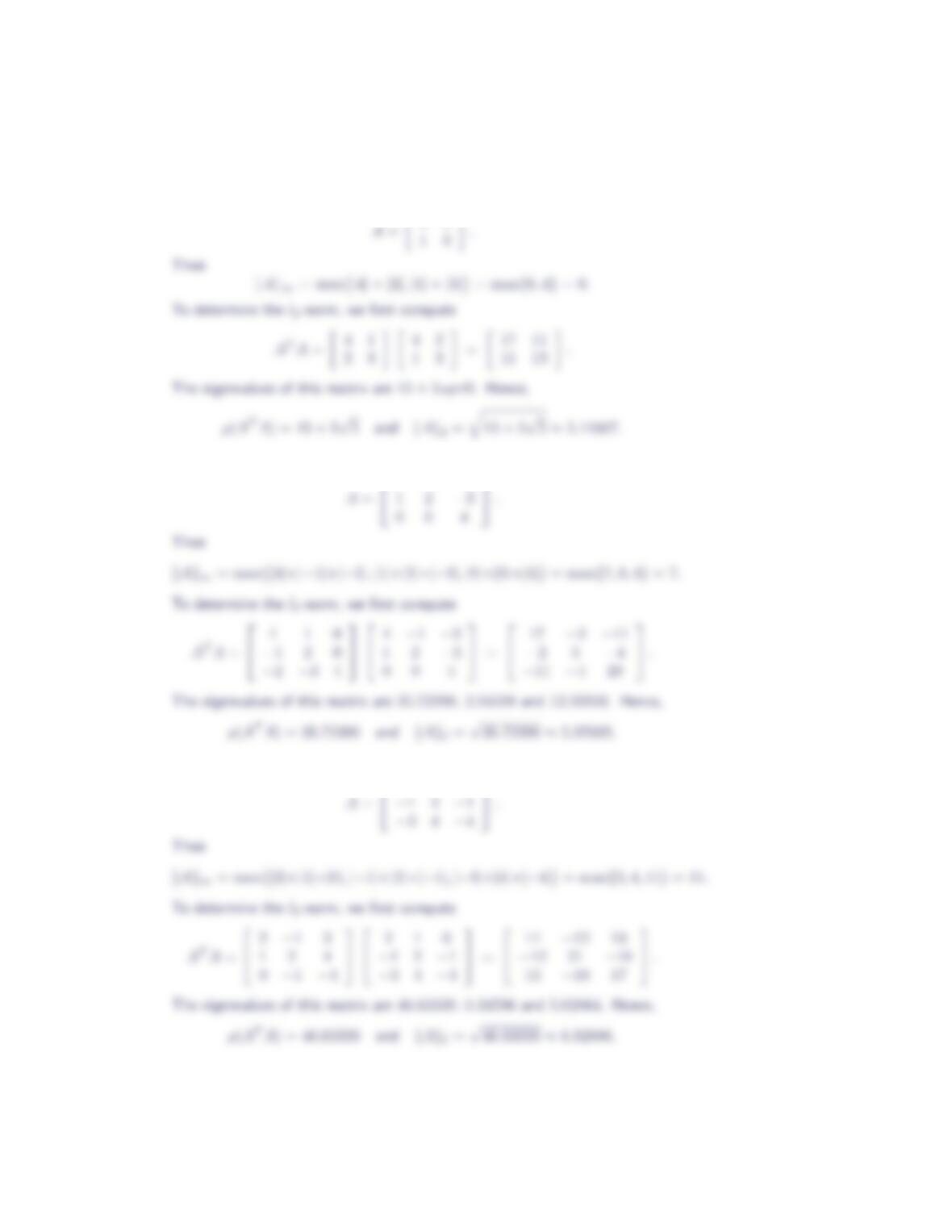
(a) Let
To determine the l2-norm, we first compute
Vector and Matrix Norms 7
(b) Let
(c) Let
4−1−2
(d) Let
210
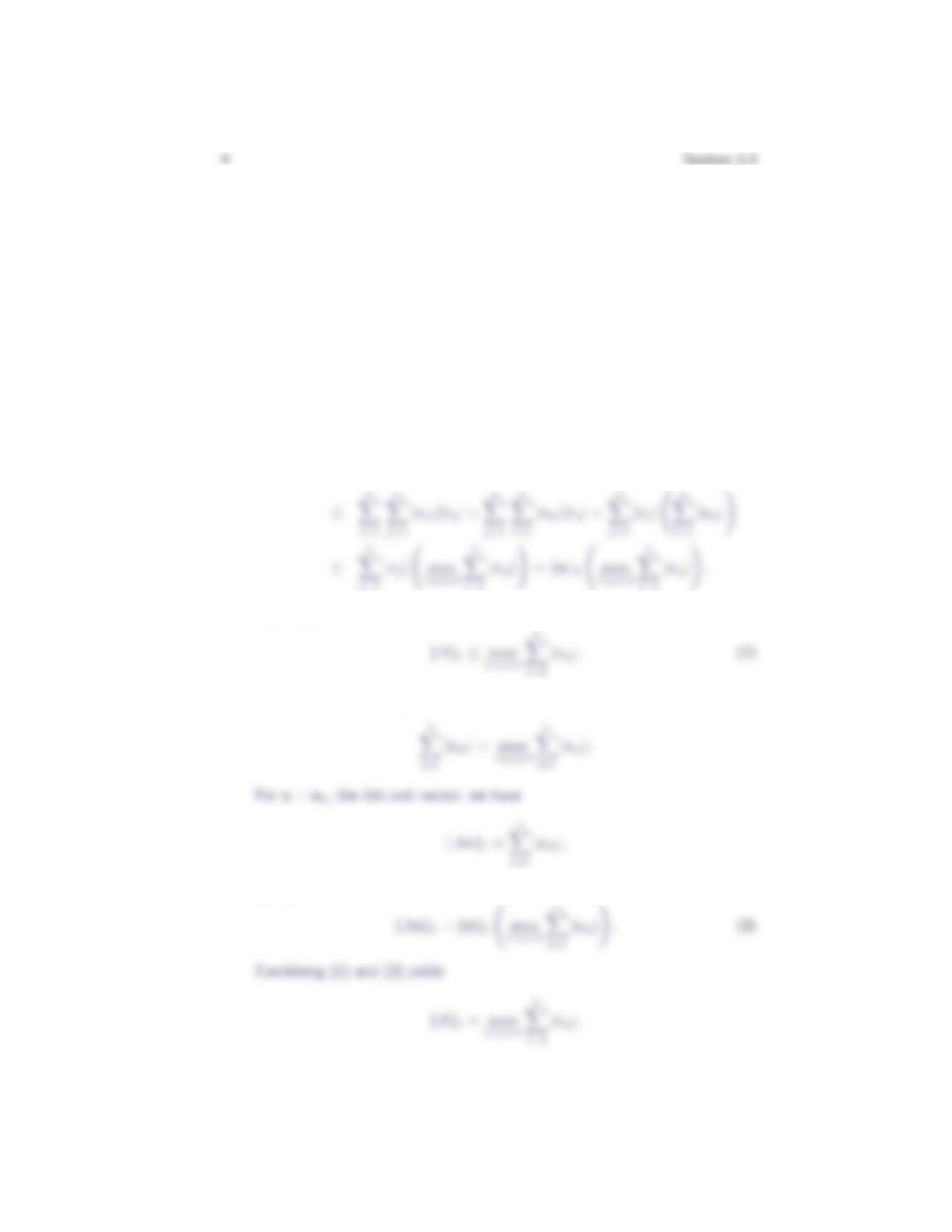
7. (a) Prove that the natural matrix norm associated with the l1vector norm
(see Exercise 3) is given by
kAk1= max
1≤j≤n
n
X
i=1 |aij |
for all A∈Rn×n. This is also known as the column norm of A.
(b) Compute k · k1for each of the matrices in Exercise 6.
(a) Let xbe an arbitrary n-vector. Then
kAxk1=
n
X
i=1
n
X
j=1
aij xj
Therefore,
Now, let kbe an integer such that
so that
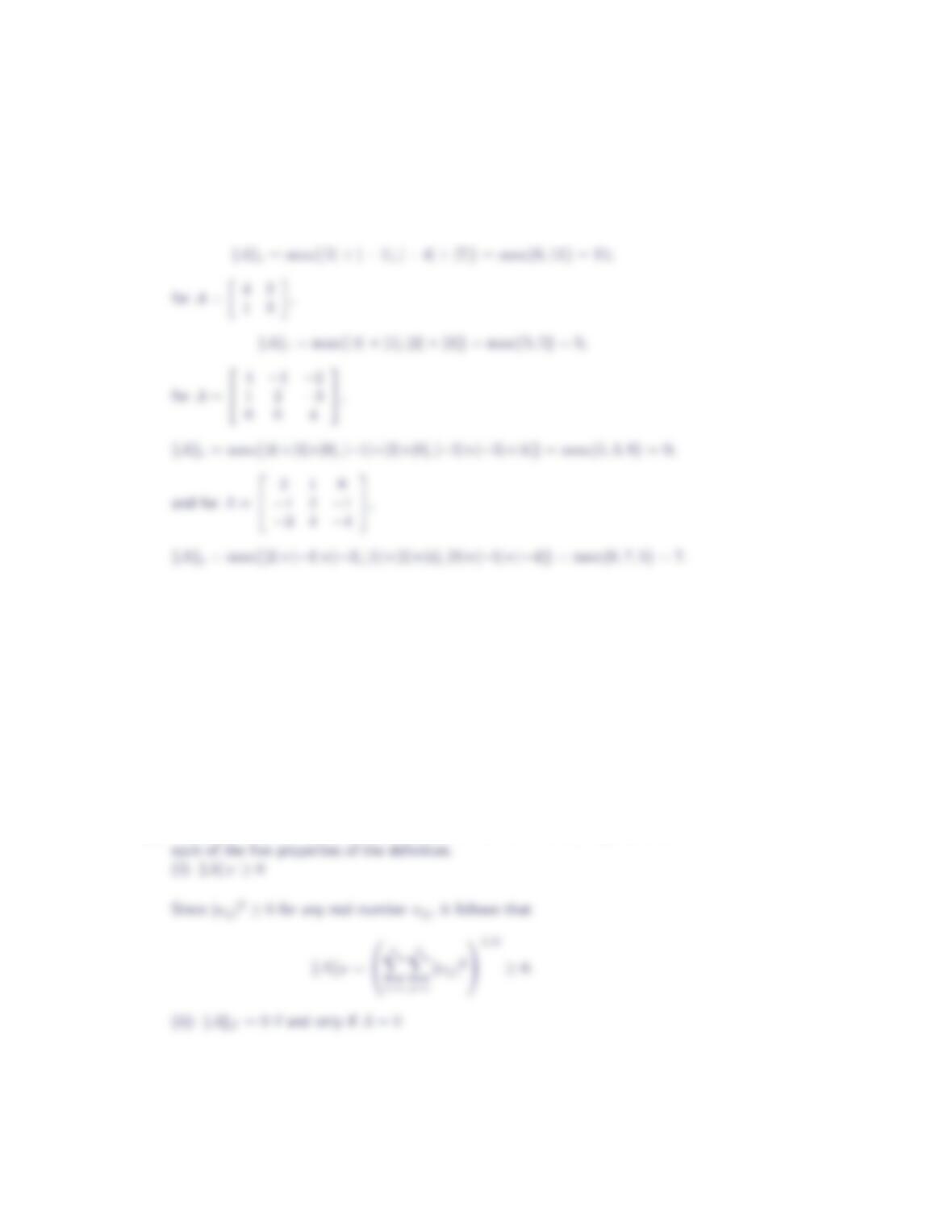
Vector and Matrix Norms 9
(b) For A=5−4
−1 7 ,
8. The Frobenius norm (which is not a natural matrix norm) is defined by
kAkF=
n
X
i=1
n
X
j=1 |aij |2
1/2
for all A∈Rn×n.
(a) Show that k · kFis a matrix norm.
(b) Compute the Frobenius norm for each of the matrices in Exercise 6.
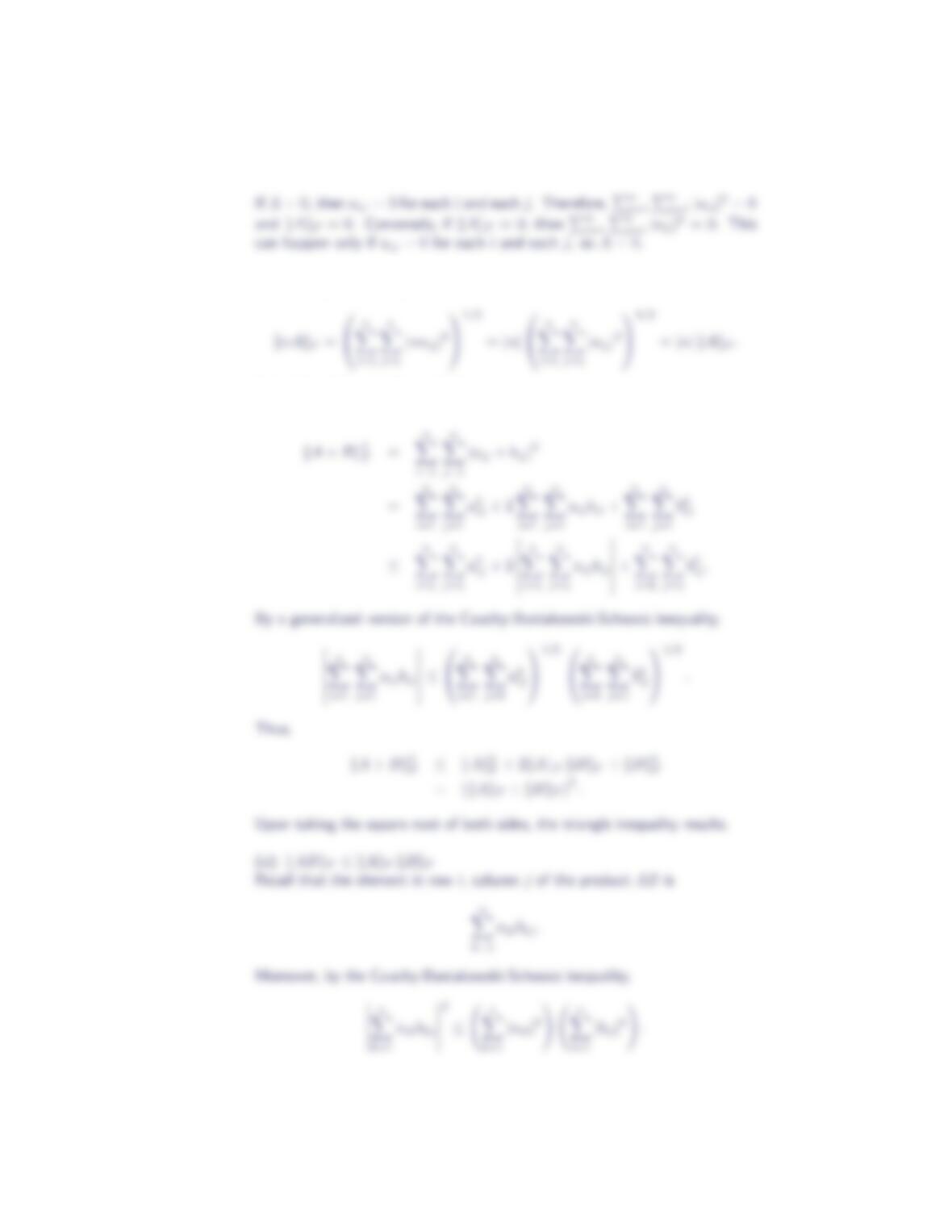
(a) To establish that k·kFis a matrix norm, we must show that k·kFsatisfies
10 Section 3.3
(iii): kαAkF=|α|kAkF
(iv): kA+BkF≤ kAkF+kBkF
Vector and Matrix Norms 11
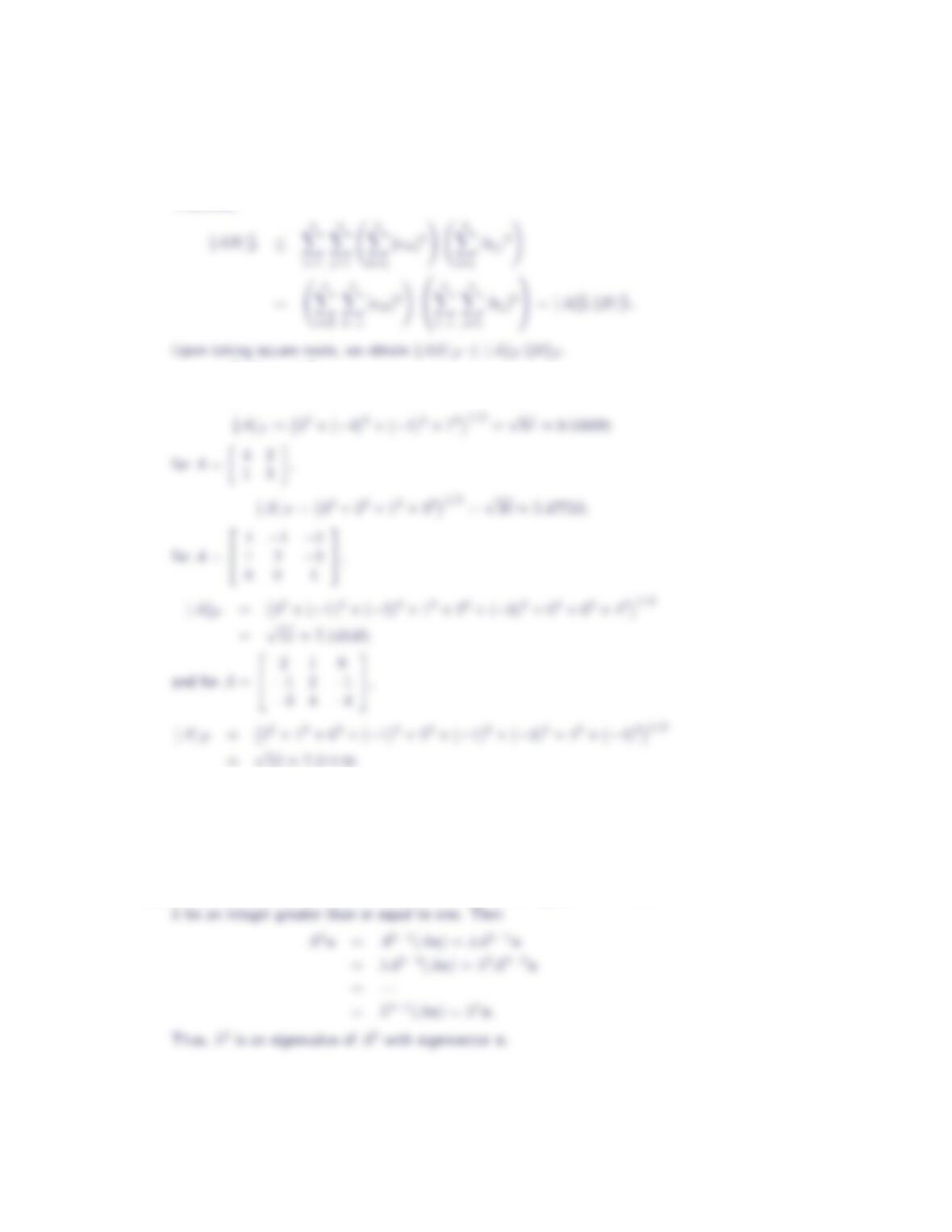
Therefore,
(b) For A=5−4
−1 7 ,
9. (a) Let λbe an eigenvalue of the matrix Awith associated eigenvector x. For
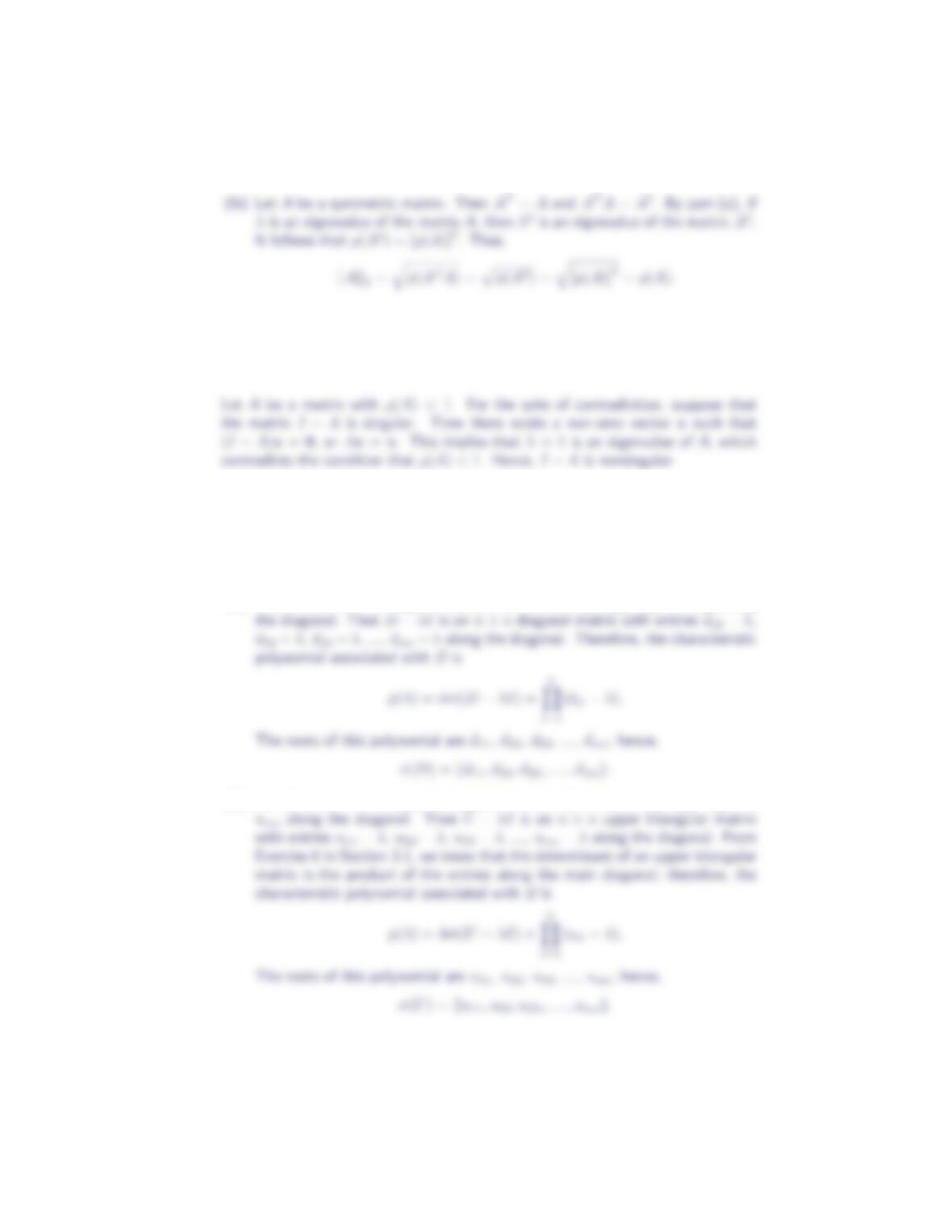
any integer k≥1, show that λkis an eigenvalue of Akwith eigenvector x.
(b) Let Abe a symmetric matrix. Show that kAk2=ρ(A).
(a) Let λbe an eigenvalue of the matrix Awith associated eigenvector x, and let
12 Section 3.3
10. Show that if Ais a matrix with ρ(A)<1, then the matrix I−Ais nonsingular.
(Hint: Assume that I−Ais singular and show this leads to the conclusion that
λ= 1 is an eignevalue of A.)
11. (a) Let Dbe an n×ndiagonal matrix. Show that the eigenvalues of Dare the
diagonal elements d11,d22 ,d33 , …, dnn.
(b) Let Ube an n×nupper triangular matrix. Show that the eigenvalues of
Uare the diagonal elements u11,u22 ,u33 , …, unn.
(a) Let Dbe an n×ndiagonal matrix with entries d11,d22 ,d33 , …, dnn along
(b) Let Ube an n×nupper triangular matrix with entries u11 ,u22 ,u33 , …,