CHAPTER 3
RATIOS AND FINANCIAL PLANNING AT
S&S AIR
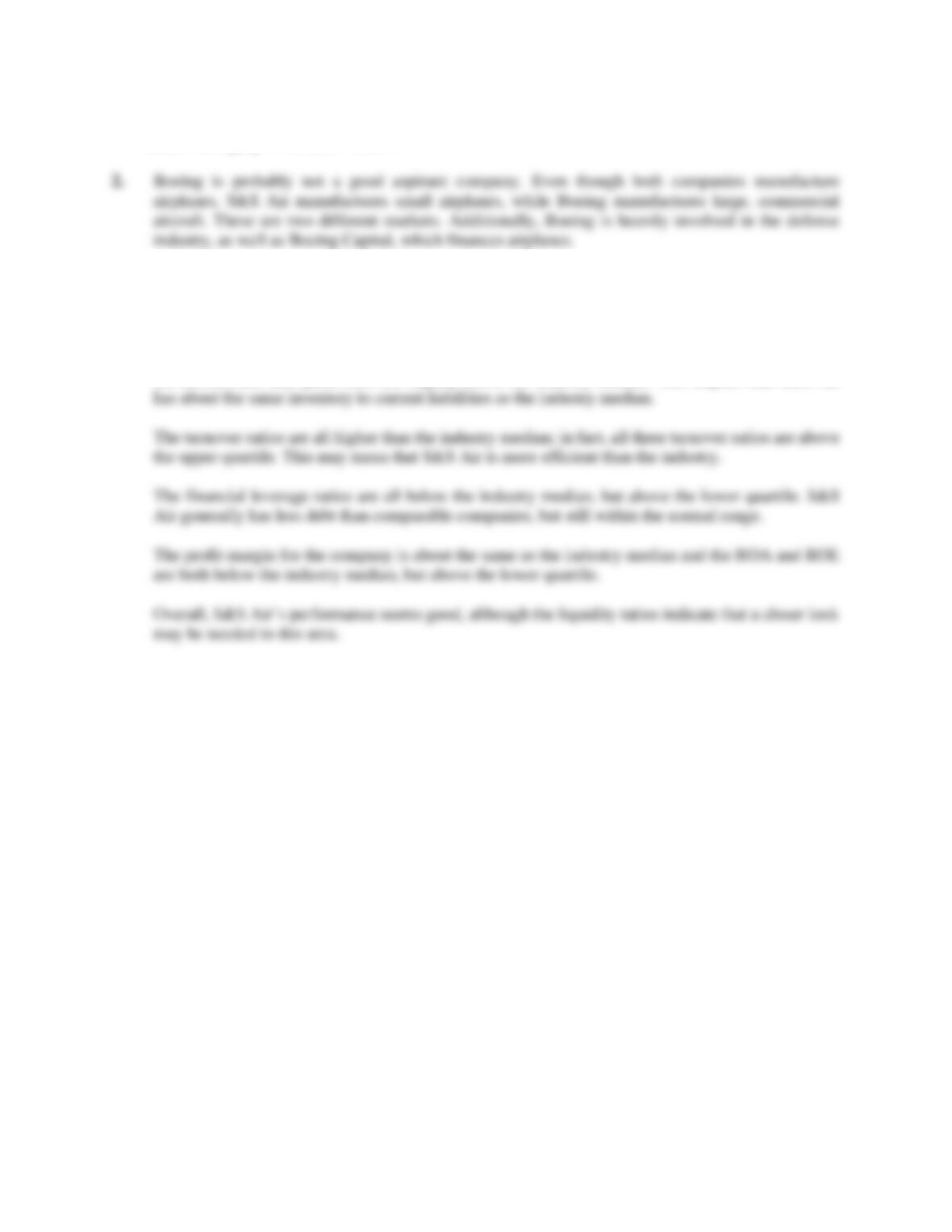
1. The calculations for the ratios listed are:
Current ratio = $3,765,864 / $2,594,496
Current ratio = 1.45 times
Total asset turnover = $24,092,400 / $18,544,680
Total asset turnover = 1.30 times
Inventory turnover = $17,982,000 / $1,486,200
Inventory turnover = 12.10 times
Receivables turnover = $24,092,400 / $1,841,616
Receivables turnover = 13.08 times
Cash coverage = ($2,445,600 + 786,000) / $434,400
Cash coverage = 7.44 times
Profit margin = $1,206,720 / $24,092,400
Profit margin = .0501, or 5.01%
Return on assets = $1,206,720 / $18,544,680
Return on assets = .0651, or 6.51%
Return on equity = $1,206,720 / $11,360,184
Return on equity = .1062, or 10.62%
3. S&S is above the median industry ratios for the current and quick ratios. This implies the company
has more liquidity than the industry in general. However, both ratios are below the upper quartile, so
there are companies in the industry with higher liquidity ratios than S&S Air. The company may have
more predictable cash flows, or more access to short-term borrowing. If you created an inventory to
current liabilities ratio, S&S Air would have a ratio that is about the same as industry median. Both
the current ratio and quick ratio are slightly above the industry median. This implies that S&S Air
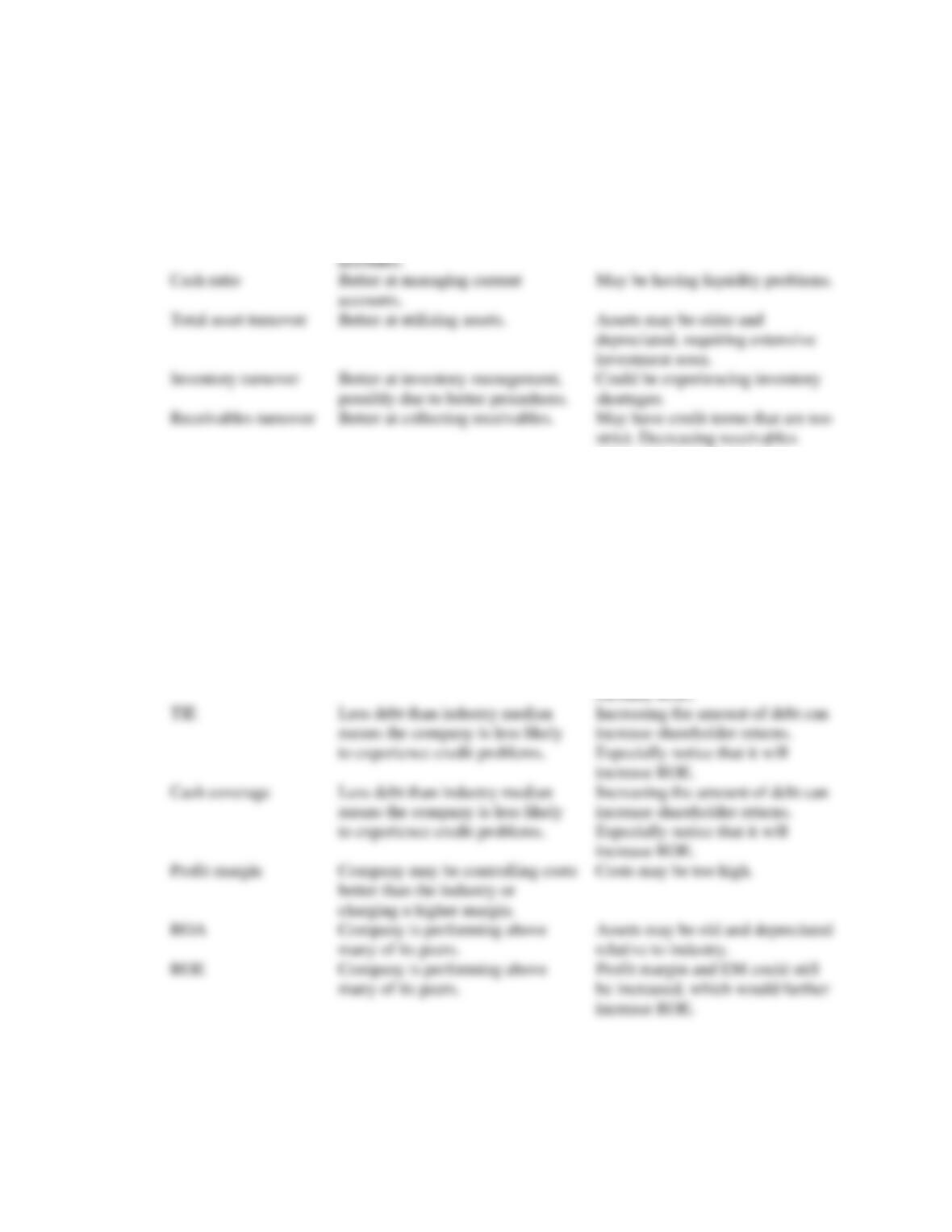
Below is a list of possible reasons it may be good or bad that each ratio is higher or lower than the
industry. Note that the list is not exhaustive, but merely one possible explanation for each ratio.
Ratio
Good
Bad
Current ratio
Better at managing current
accounts.
May be having liquidity problems.
Quick ratio
Better at managing current
May be having liquidity problems.
turnover may increase sales.
Total debt ratio
Less debt than industry median
means the company is less likely
to experience credit problems.
Increasing the amount of debt can
increase shareholder returns.
Especially notice that it will
increase ROE.
Debt-equity ratio
Less debt than industry median
means the company is less likely
to experience credit problems.
Increasing the amount of debt can
increase shareholder returns.
Especially notice that it will
increase ROE.
Equity multiplier
Less debt than industry median
means the company is less likely
to experience credit problems.
increase ROE.
TIE
Less debt than industry median
means the company is less likely
to experience credit problems.
Increasing the amount of debt can
increase shareholder returns.
Especially notice that it will
increase ROE.
Cash coverage
Less debt than industry median
to experience credit problems.
Increasing the amount of debt can
Especially notice that it will
increase ROE.
charging a higher margin.
Company is performing above
many of its peers.
Assets may be old and depreciated
relative to industry.
Company is performing above
many of its peers.
Profit margin and EM could still
be increased, which would further
increase ROE.
Increasing the amount of debt can
increase shareholder returns.
Especially notice that it will
accounts.
Cash ratio
Better at managing current
accounts.
May be having liquidity problems.
Total asset turnover
Better at utilizing assets.
Assets may be older and
depreciated, requiring extensive
investment soon.
possibly due to better procedures.
shortages.
strict. Decreasing receivables
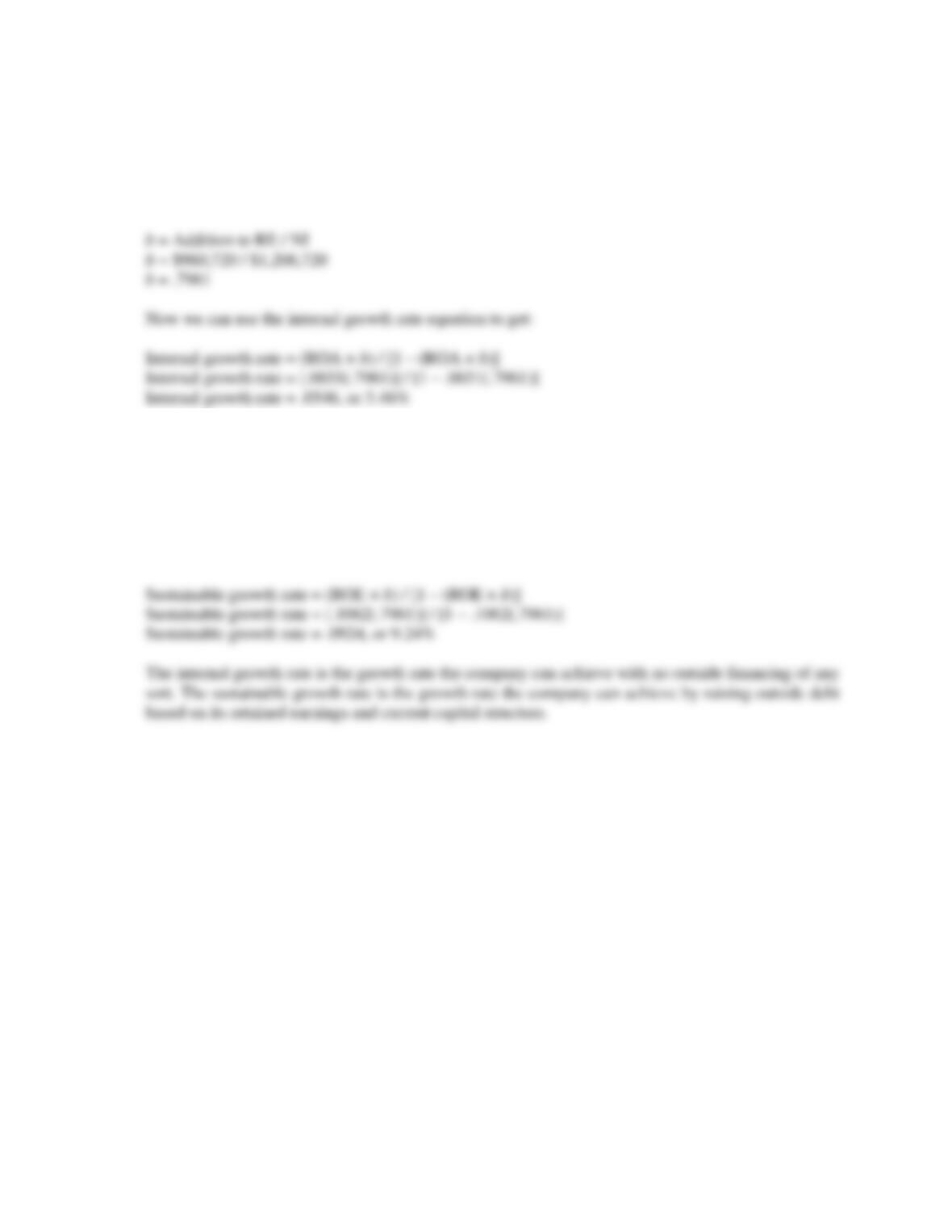
4. To calculate the internal growth rate, we first need to find the ROA and the retention ratio, so:
ROA = NI / TA
ROA = $1,206,720 / $18,544,680
ROA = .0651, or 6.51%
To find the sustainable growth rate, we need the ROE, which is:
ROE = NI / TE
ROE = $1,206,720 / $11,360,184
ROE = .1062, or 10.62%
Using the retention ratio we previously calculated, the sustainable growth rate is: