Special Matrices 1
3.7 Special Matrices
1. Classify each of the following matrices as strictly diagonally dominant, symmet-
ric positive definite, both or neither.
(a)
2−1 0
−142
0 2 6
(b)
120
4 6 −1
−3 2 0
(c)
5−3 2
−310
2 0 6
(d)
4−2 2
−264
2 4 7
(e)
8 2 4 1
0−311
0 0 6 2
0 0 0 1
(f)
4 1 1 1
1 3 0 −1
1 0 −2 0
1−1 0 4
(a) This matrix is strictly diagonally dominant because
(b) This matrix is not strictly diagonally dominant because in the first row
(c) This matrix is not strictly diagonally dominant because in the first row
2Section 3.7
(d) This matrix is not strictly diagonally dominant because in the first row
(e) This matrix is strictly diagonally dominant because
|8|= 8 >7 = |2|+|4|+|1|;
(f) This matrix is strictly diagonally dominant becayse
|4|= 4 >3 = |1|+|1|+|1|;
2. Consider the 2 ×2 symmetric matrix
a b
b c .
What conditions must the elements a,band csatisfy to guarantee that the
matrix is positive definite?
3. Consider the matrix
a−1 0
−141
0 1 5
.
(a) For what values of awill this matrix be positive definite?
(b) For what values of awill this matrix be strictly diagonally dominant?
(a) We check the determinant of each of the leading principal submatrices:
(b) Along the second and third rows, we have
4. Repeat Exercise 3 for the matrix
5−2 2
−2 6 a
2a7
.
(a) We check the determinant of each of the leading principal submatrices:
All three determinants will be positive, and the given matrix will be symmetric
positive definite, provided
4Section 3.7
(b) Along the first row of the matrix
5. Consider the matrix
b−1a
−1 3 0
a0 4
.
(a) What conditions must aand bsatisfy for this matrix to be symmetric
positive definite?
(b) What conditions must aand bsatisfy for this matrix to be strictly diago-
nally dominant?
(a) We check the determinant of each of the leading principal submatrices:
(b) Along the second row,
6. (a) Suppose that Ais a strictly diagonally dominant matrix. Show that the
matrix −Ais strictly diagonally dominant, but that the matrix ATneed
not be strictly diagonally dominant.
(b) Suppose that Aand Bare both strictly diagonally dominant matrices.
Show that A+B,A−B, and AB need not be strictly diagonally dominant.
Special Matrices 5
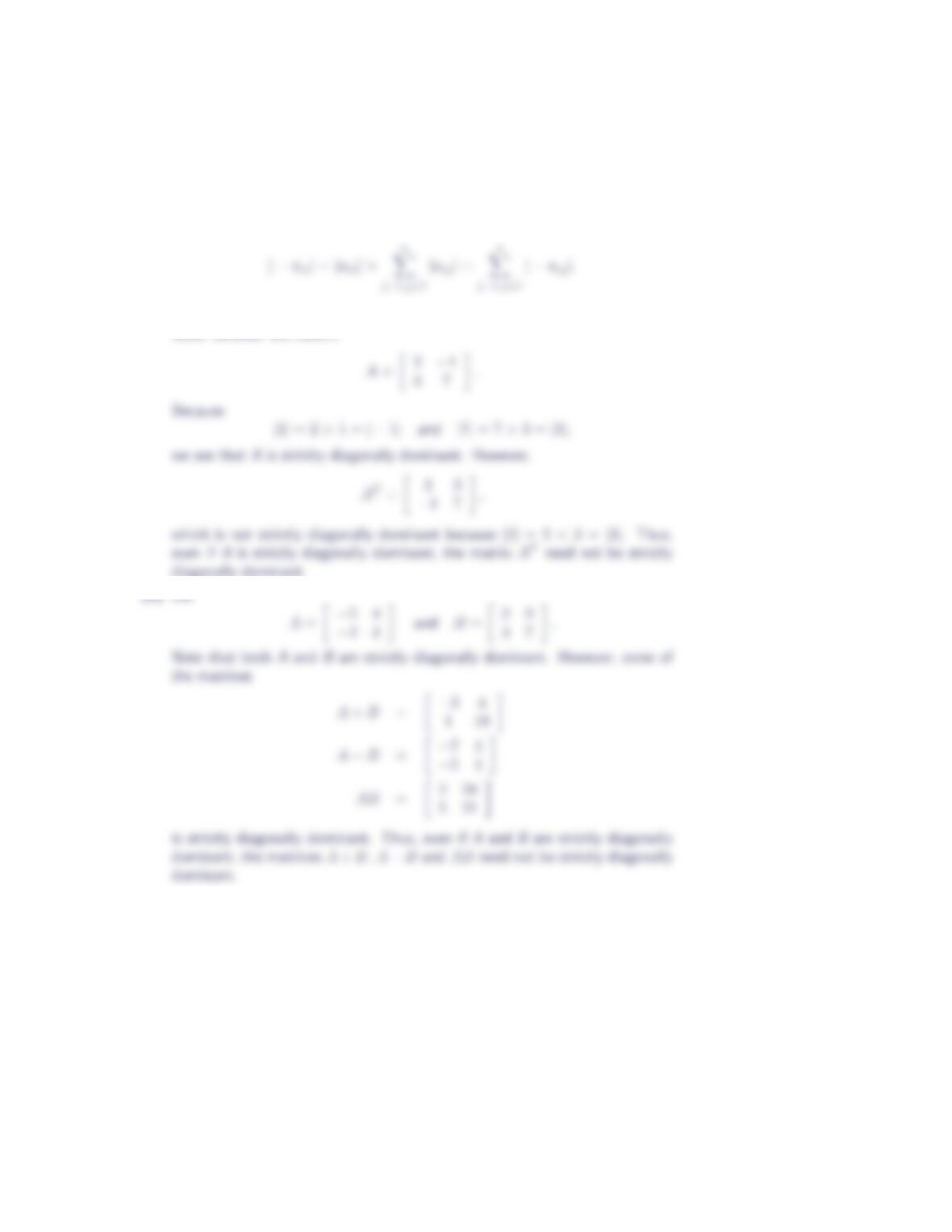
(a) Let Abe a strictly diagonally dominant matrix. Then, the elements of the
matrix −Aare −aij , and
Hence, the matrix −Ais also strictly diagonally dominant.
Next, consider the matrix
diagonally dominant.
7. (a) Suppose that Ais a symmetric positive definite matrix. Show that the
matrix −Ais not symmetric positive definite, but that the matrix ATis
symmetric positive definite.
(b) Suppose that Aand Bare both symmetric positive definite matrices. Show
that A+Bis symmetric positive definite, but that A−Bneed not be
symmetric positive definite.
6Section 3.7
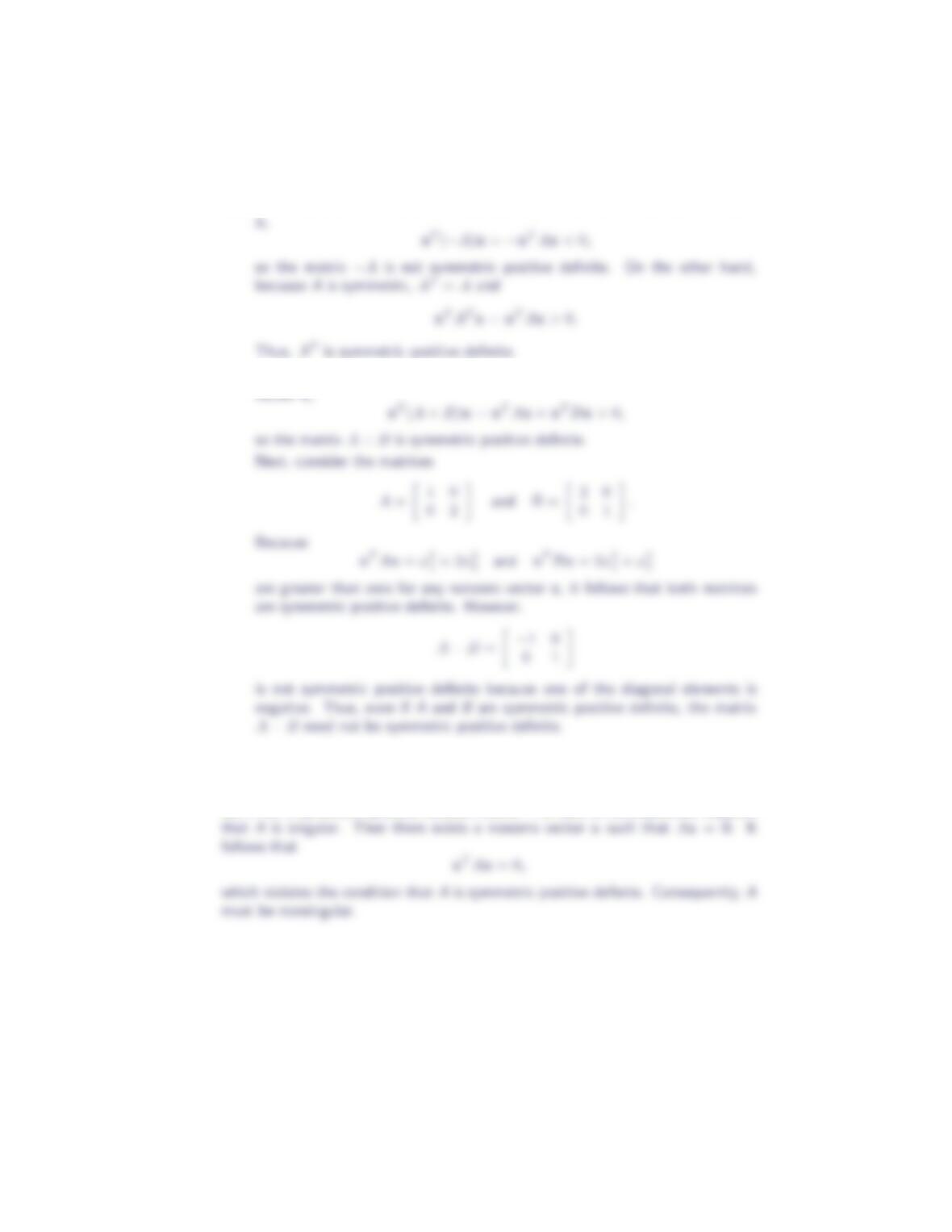
(a) Let Abe a symmetric positive definite matrix. Then, for any nonzero vector
(b) Let Aand Bbe symmetric positive definite matrices. Then, for any nonzero
8. Show that if the matrix Ais symmetric positive definite, then Ais nonsingular.
Let Abe a symmetric positive definite matrix. For sake of contradiction, suppose
9. Let Abe an n×nsymmetric positive definite matrix.
(a) Show that aii >0 for each i= 1,2,3, …, n.
(b) Show that a2
ij < aiiajj for i6=j.
Let Abe an n×nsymmetric positive definite matrix.
Special Matrices 7
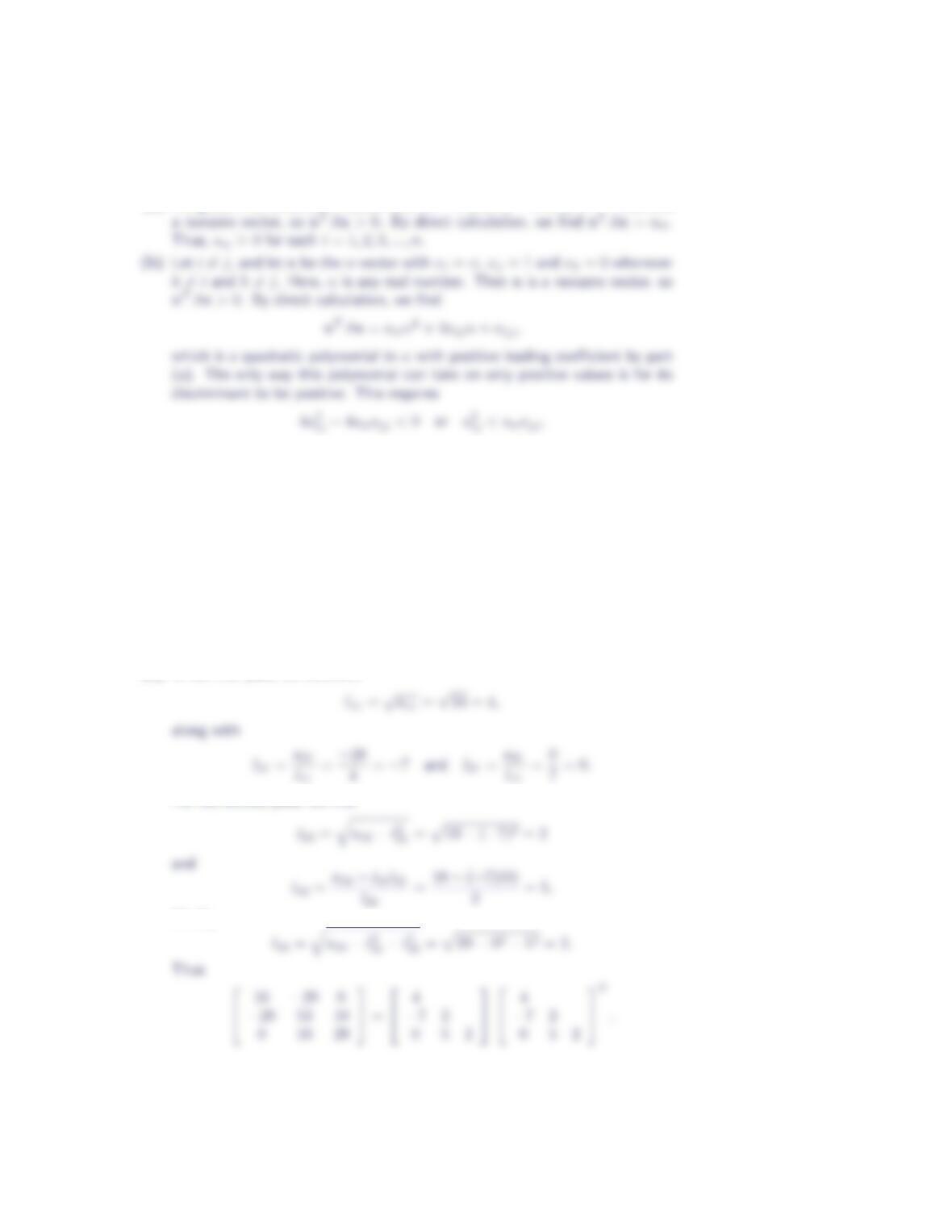
(a) For given i, let xbe the n-vector with xi= 1 and xj= 0 for j6=i. Then xis
10. Compute the Cholesky decomposition for each of the following matrices.
(a)
16 −28 0
−28 53 10
0 10 29
(b)
9/4 3 3/2
3 25/4 7/2
3/2 7/2 17/4
(c)
4−2−2 0
−2 5 1 −2
−2 1 10 3
0−2 3 18
(d)
1−2 3 −2
−2 20 −2 8
3−2 11 −5
−2 8 −5 9
(a) In the first pass, we calculate
For the second pass, we find
Finally,
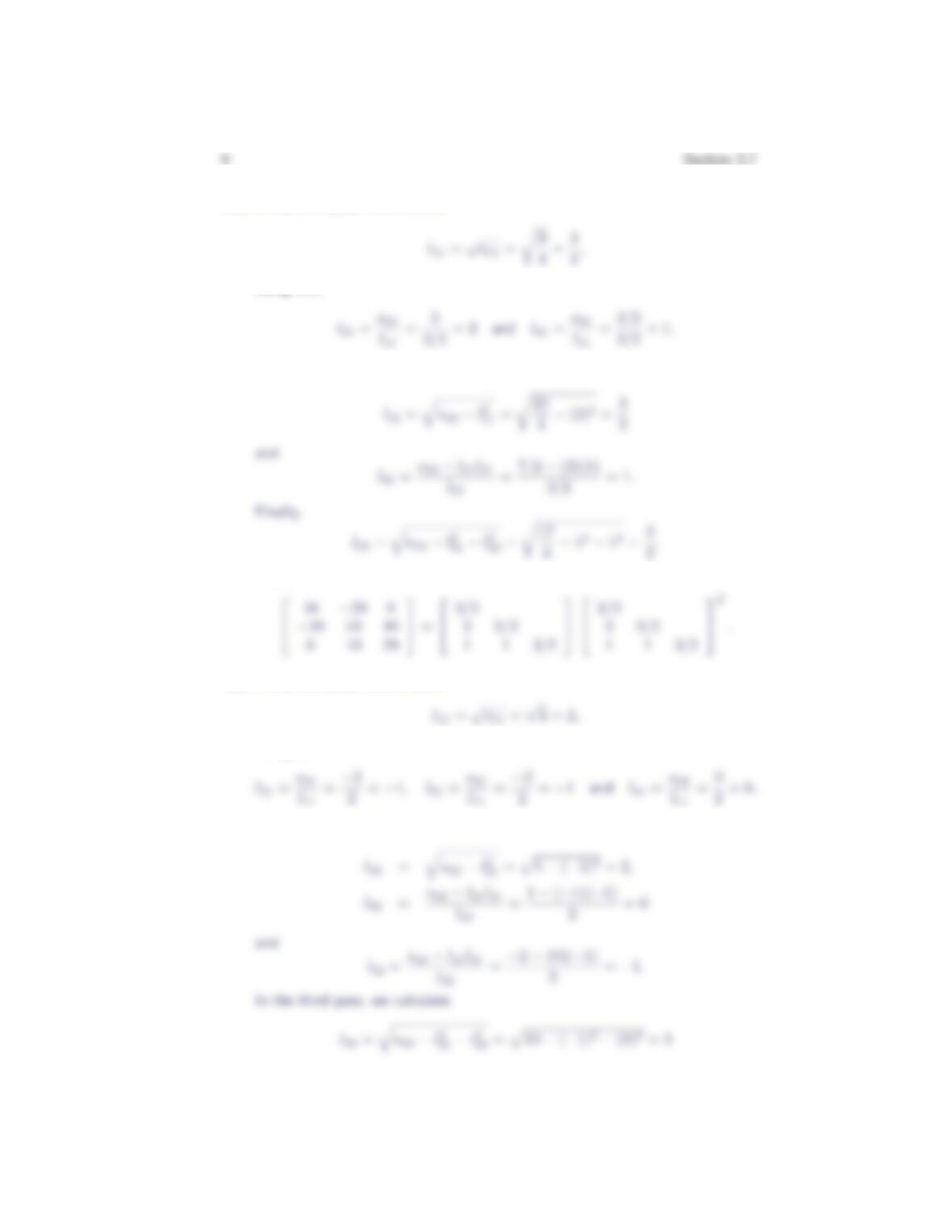
(b) In the first pass, we calculate
along with
For the second pass, we find
Thus
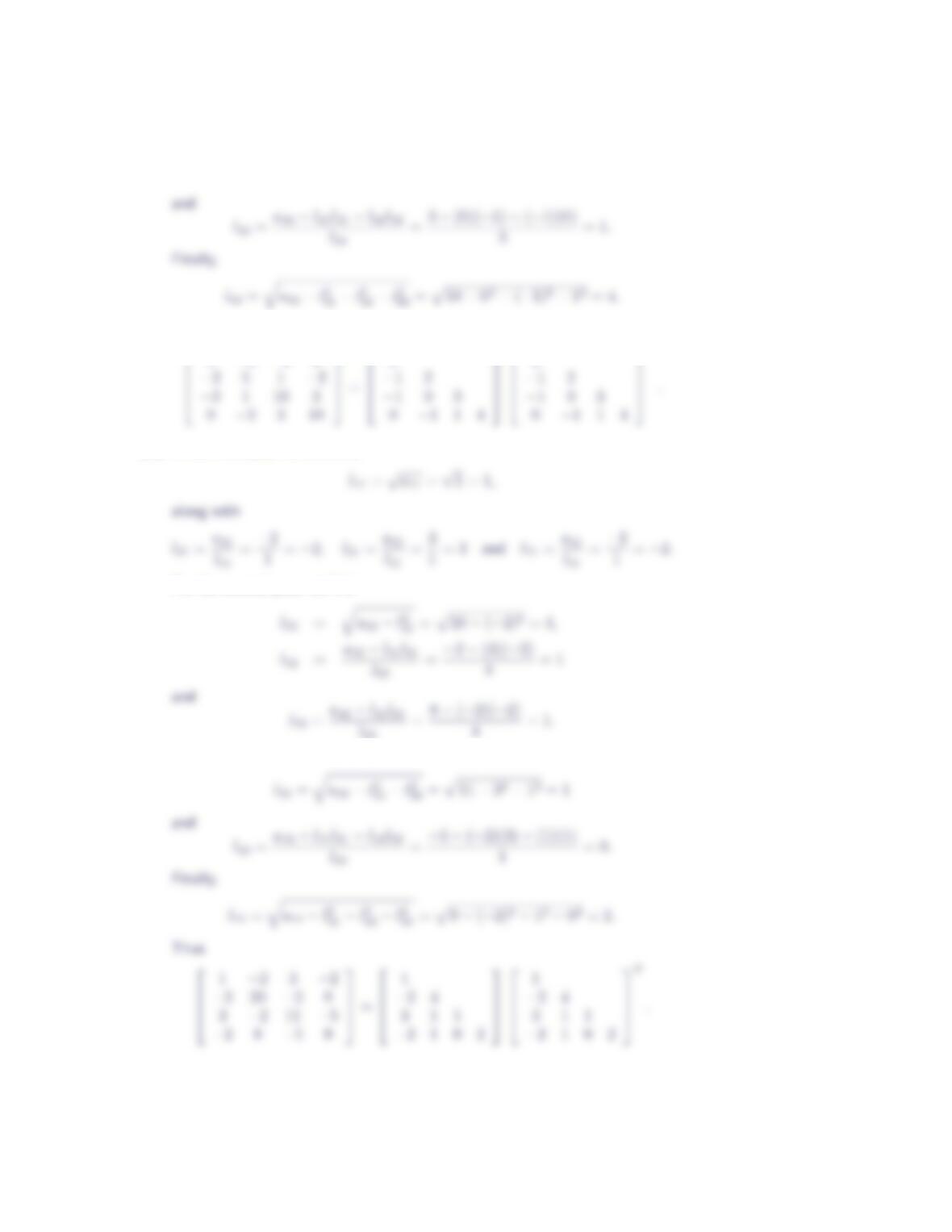
(c) In the first pass, we calculate
along with
For the second pass, we find
Special Matrices 9
Thus
4−2−2 0
2
2
T
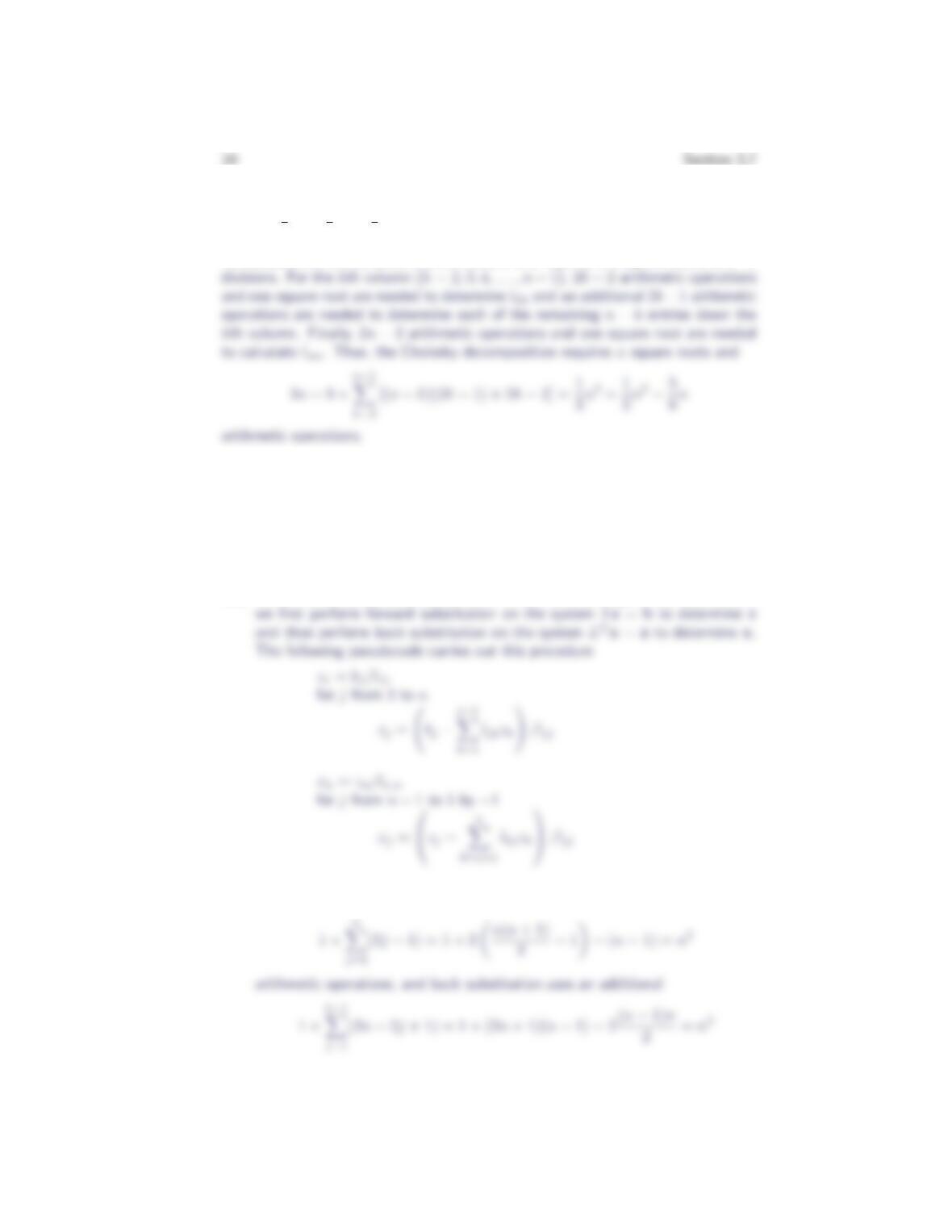
(d) In the first pass, we calculate
For the second pass, we find
In the third pass, we calculate
11. Show that the computation of a Cholesky decomposition for an n×nmatrix
requires 1
3n3+1
2n2−5
6narithmetic operations plus nsquare roots.
To calculate the entries down the first column of Lrequires one square root and n−1
12. (a) Construct an algorithm to perform forward and backward substitution on
the system Ax=b, given a Cholesky decomposition (A=LLT) for the
coefficient matrix?
(b) How many arithmetic operations are required by the algorithm from part
(a)?
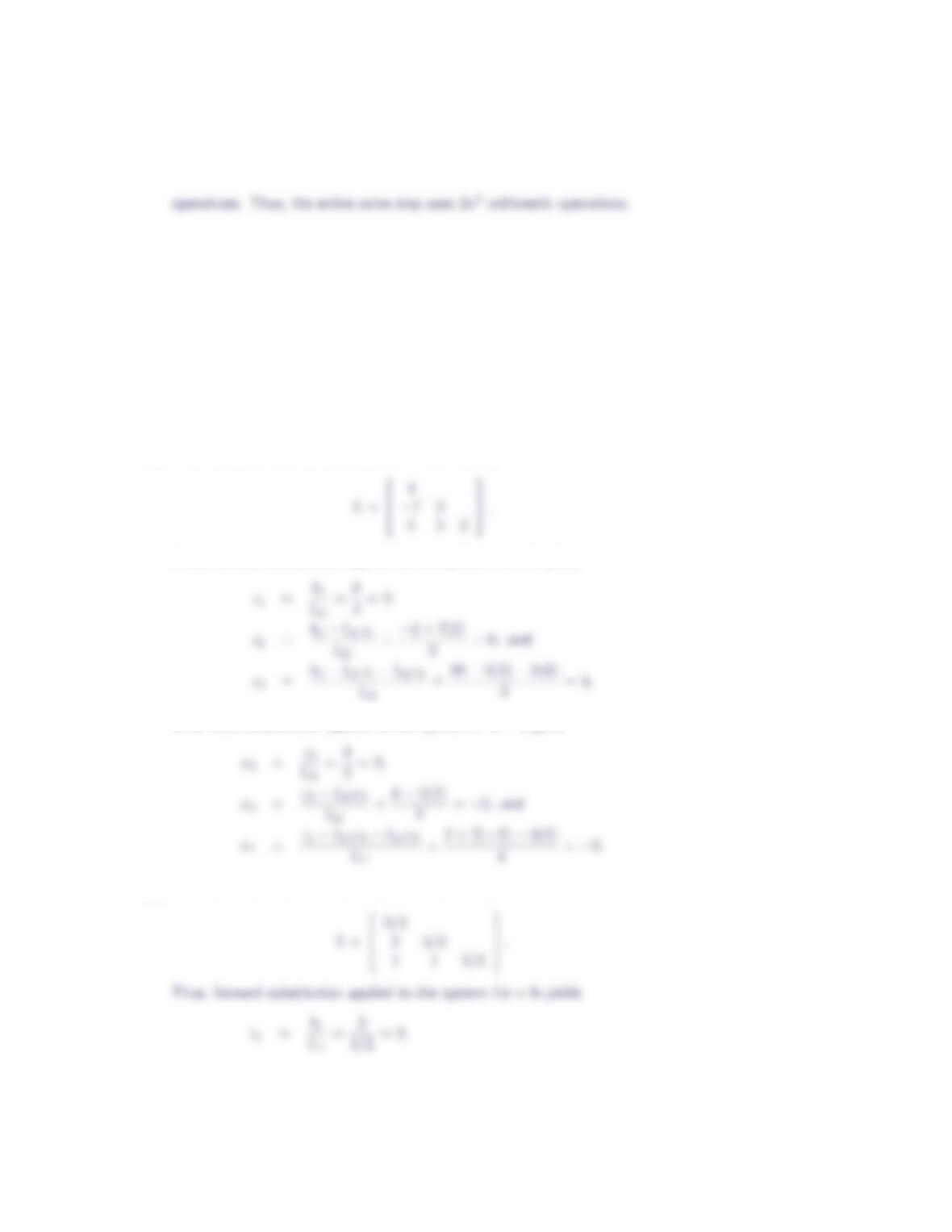
(a) Given the Cholesky decomposition A=LLTand the right-hand side vector,
(b) Forward substitution uses
Special Matrices 11
13. Solve each of the following systems by computing a Cholesky decomposition for
the coefficient matrix and then performing forward and backward substitution
(see Exercise 12a).
(a) A= matrix given in Exercise 10a, b=8−2 38 T
(b) A= matrix given in Exercise 10b, b=319T
(c) A= matrix given in Exercise 10c, b=4−4 4 −13 T
(d) A= matrix given in Exercise 10d, b=15 −12 56 −35 T
(a) From Exercise 10a, we know that A=LLT, where
Thus, forward substitution applied to the system Lz=byields
while back substitution applied to the system LTx=zgives
(b) From Exercise 10b, we know that A=LLT, where
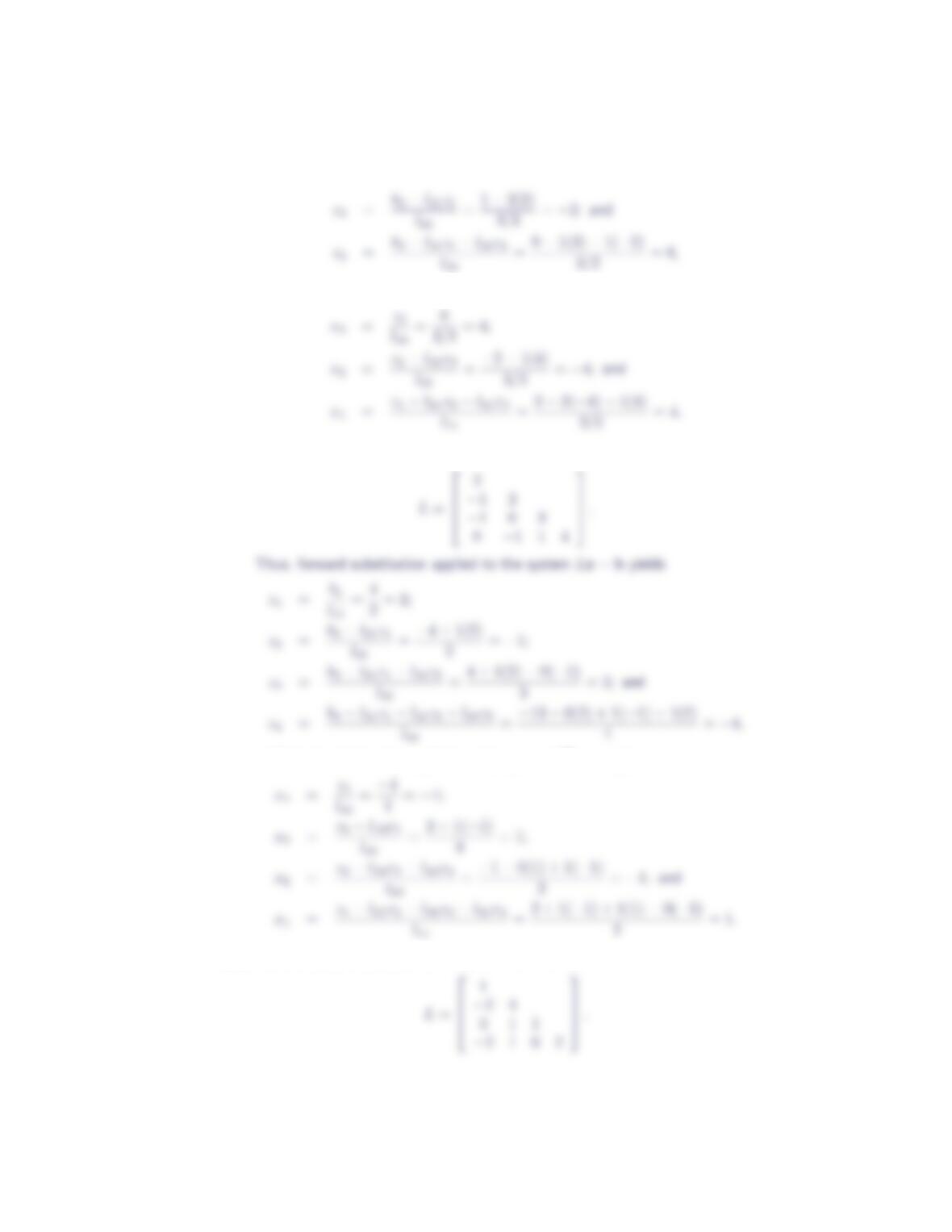
12 Section 3.7
while back substitution applied to the system LTx=zgives
(c) From Exercise 10c, we know that A=LLT, where
while back substitution applied to the system LTx=zgives
(d) From Exercise 10d, we know that A=LLT, where