PROBLEM 3.96
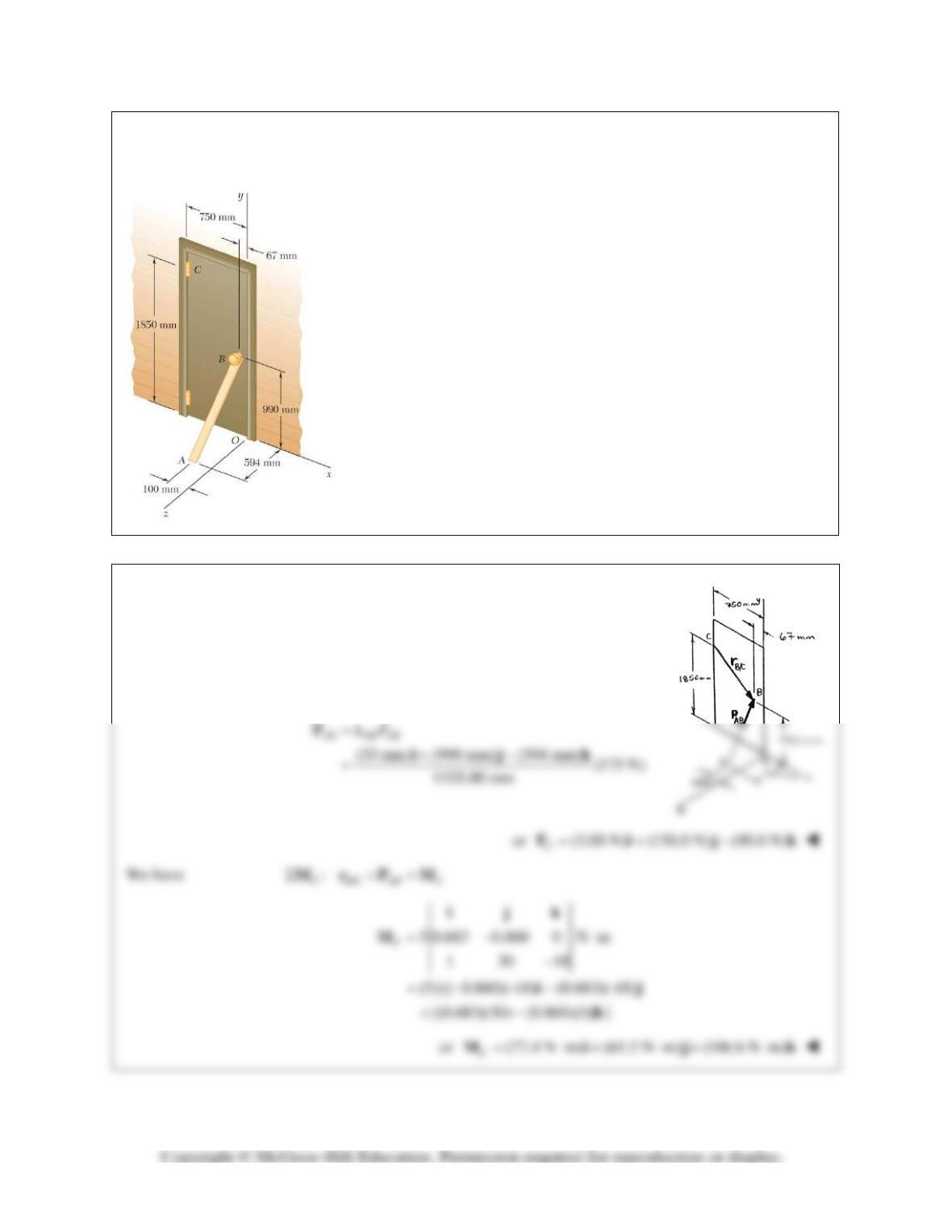
To keep a door closed, a wooden stick is wedged between the
floor and the doorknob. The stick exerts at B a 175–N force
directed along line AB. Replace that force with an equivalent
force–couple system at C.
SOLUTION
We have
:AB C
Σ=FP F
where
PROBLEM 3.97
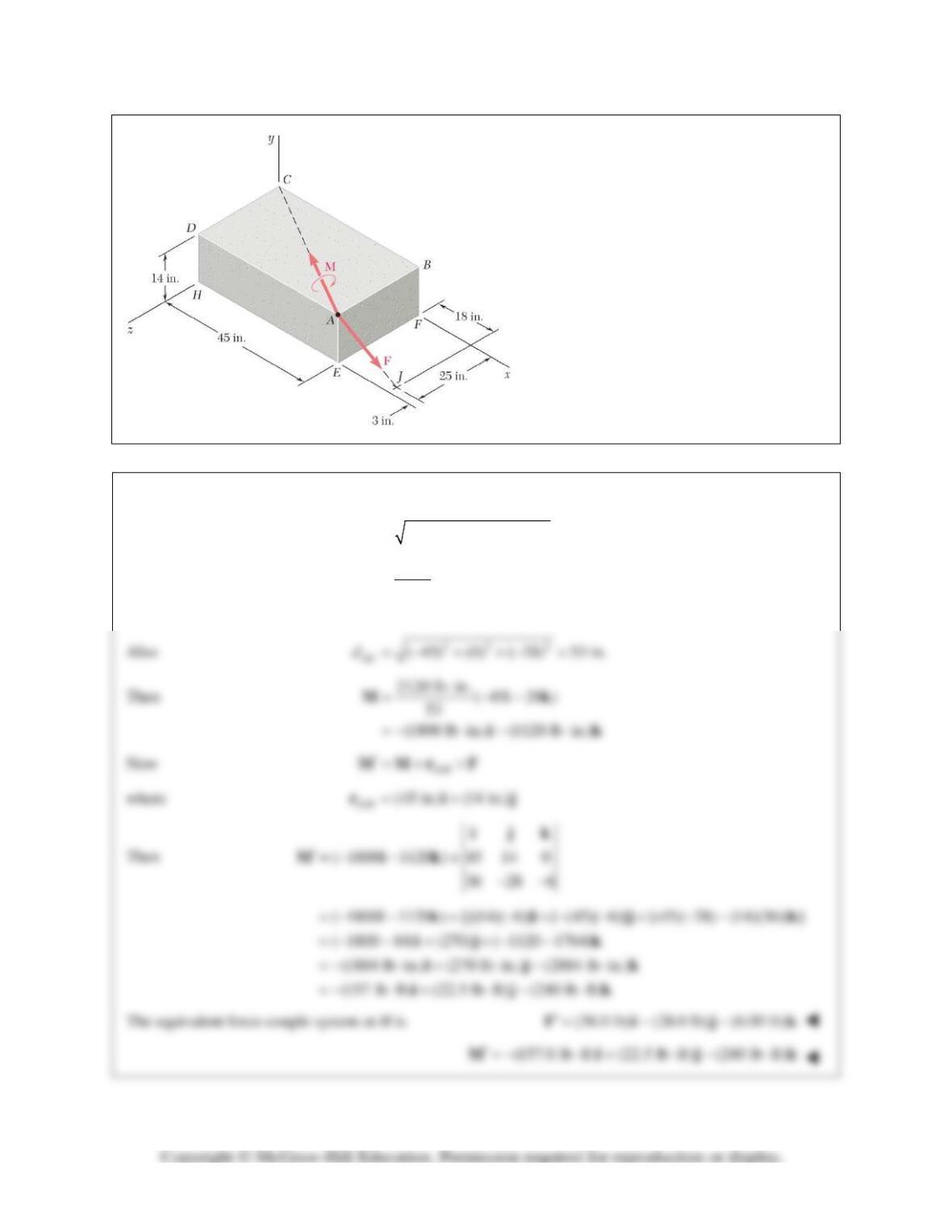
A 46-lb force F and a 2120-lb⋅in. couple
M are applied to corner A of the block
shown. Replace the given force–couple
system with an equivalent force–couple
system at corner H.
SOLUTION
We have
2 22
(18) ( 14) ( 3) 23 in.
AJ
d= +− +− =
Then
46 lb (18 14 3 )
23
(36 lb) (28 lb) (6 lb)
= −−
=−−
F i jk
i jk
PROBLEM 3.98
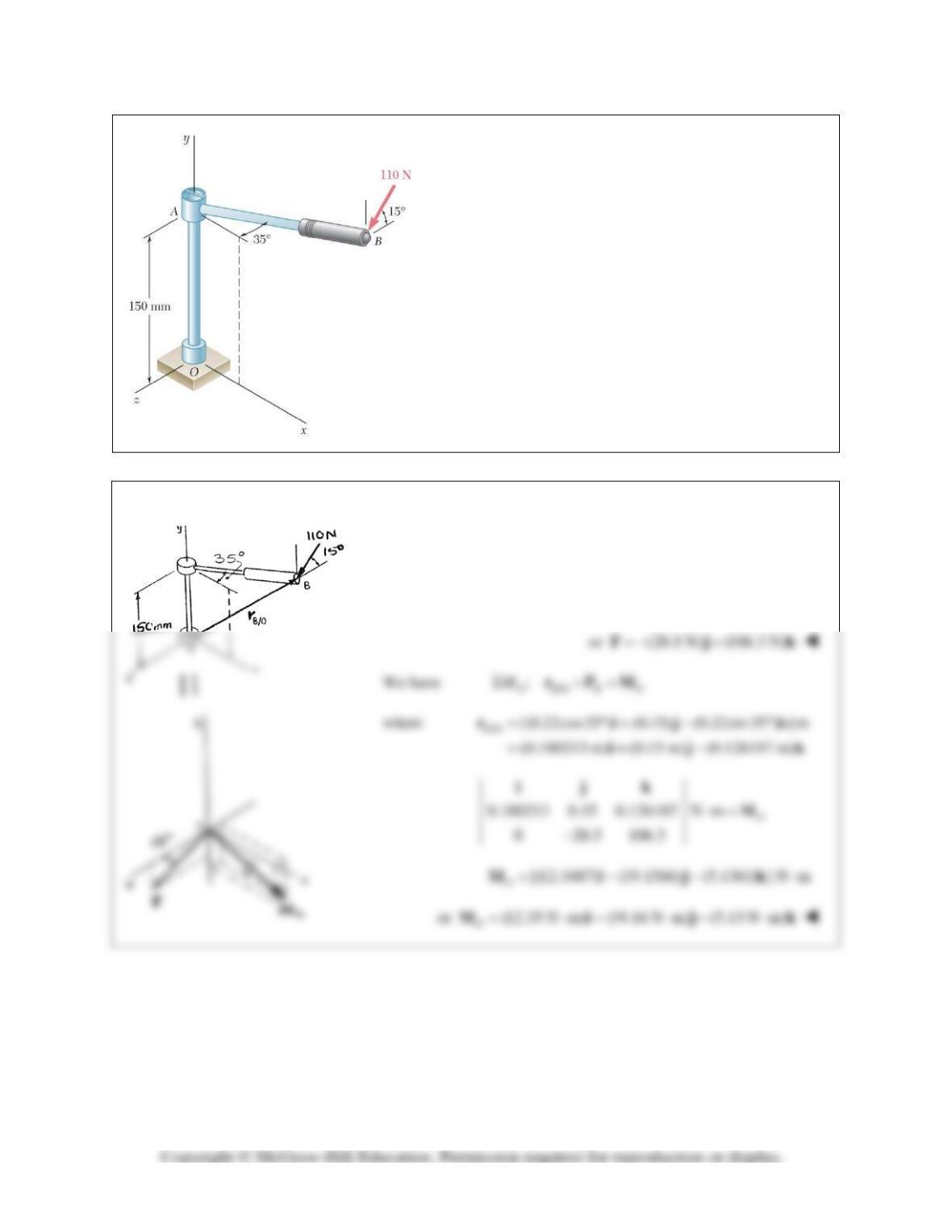
A 110–N force acting in a vertical plane parallel to the yz–
plane is applied to the 220-mm-long horizontal handle AB
of a socket wrench. Replace the force with an equivalent
force–couple system at the origin O of the coordinate
system.
SOLUTION
We have
:
B
Σ=FP F
where
110 N[ (sin15 ) (cos15 ) ]
(28.470 N) (106.252 N)
B
= − °+ °
=−+
P jk
jk
PROBLEM 3.99
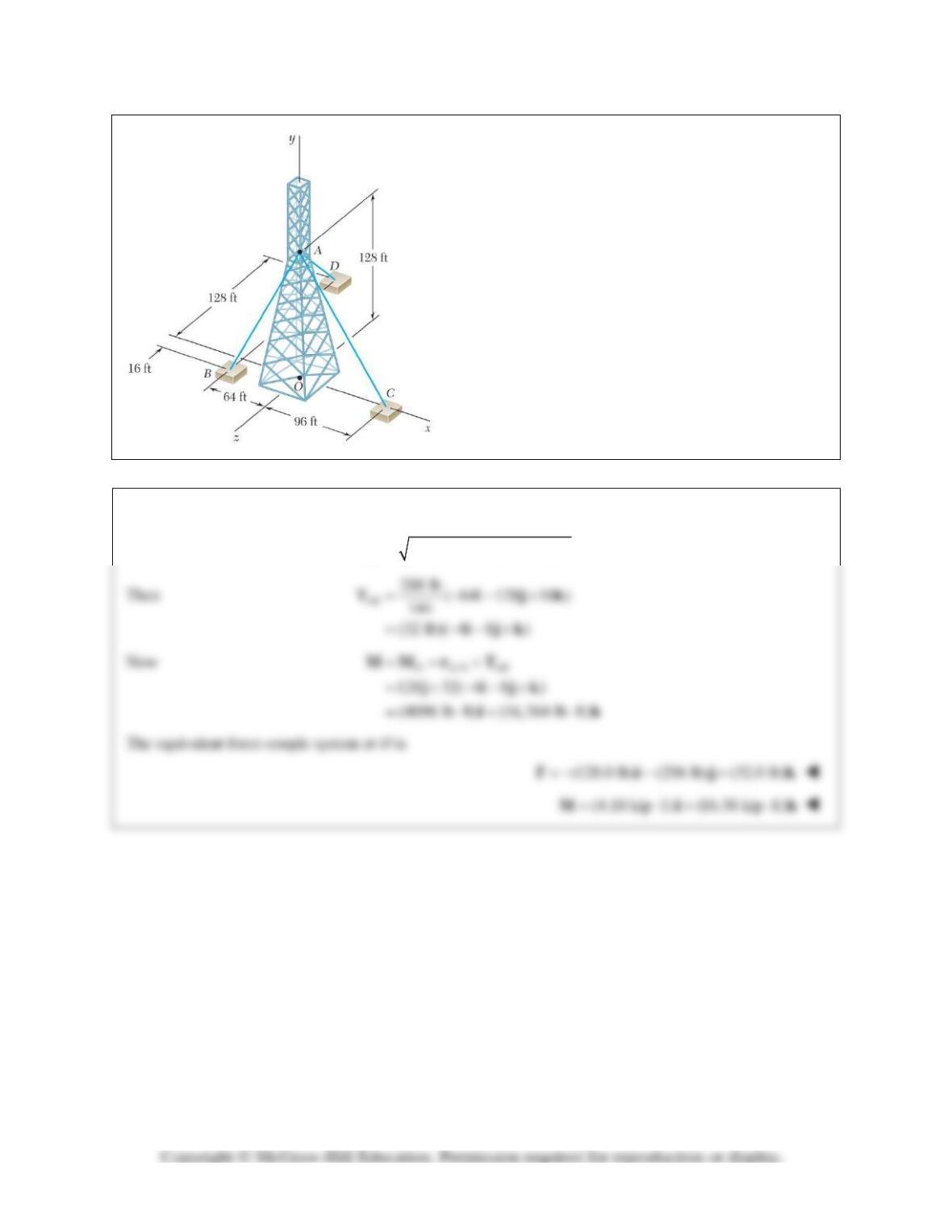
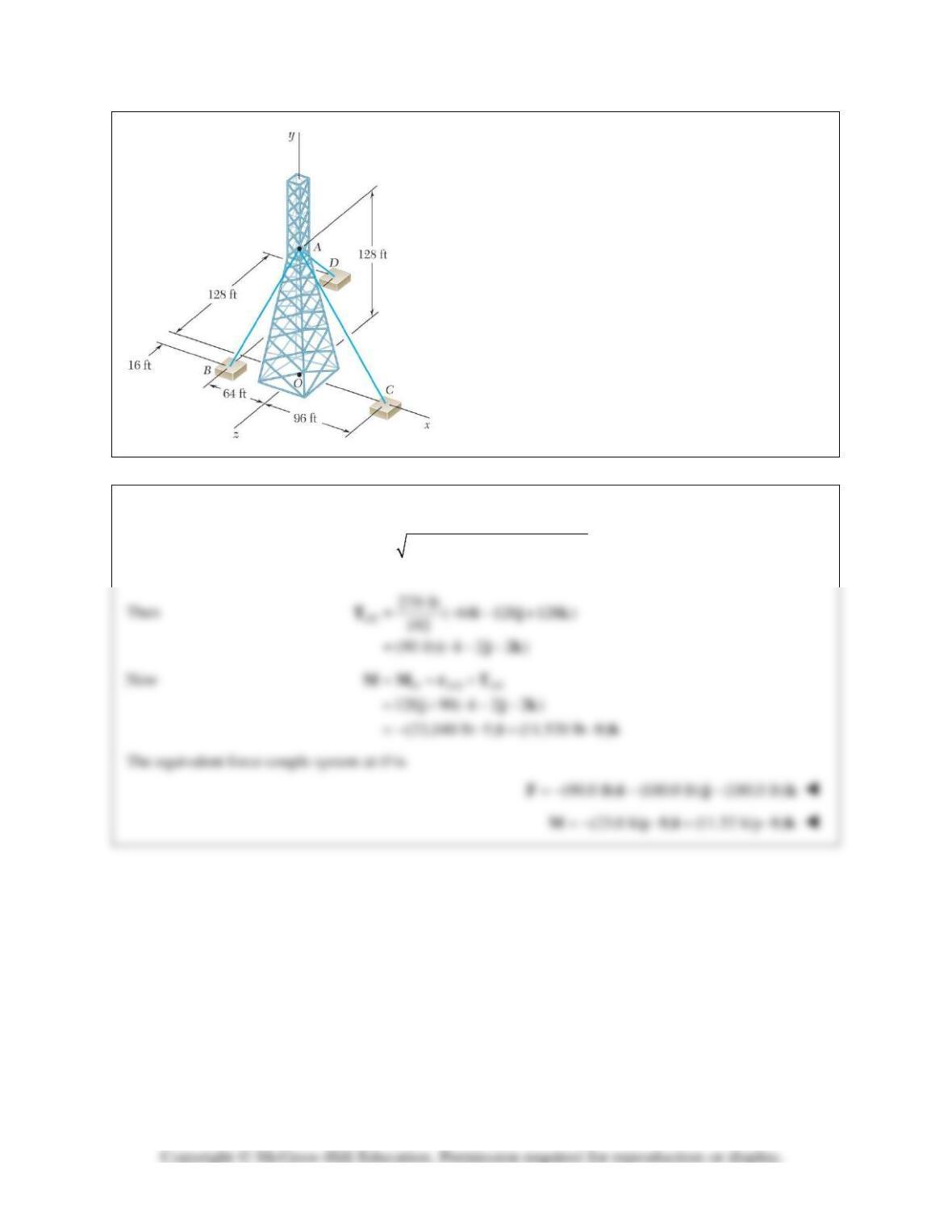
An antenna is guyed by three cables as shown.
Knowing that the tension in cable AB is 288 lb, replace
the force exerted at A by cable AB with an equivalent
force–couple system at the center O of the base of the
antenna.
SOLUTION
We have
2 22
( 64) ( 128) (16) 144 ft
AB
d= − +− + =
PROBLEM 3.100
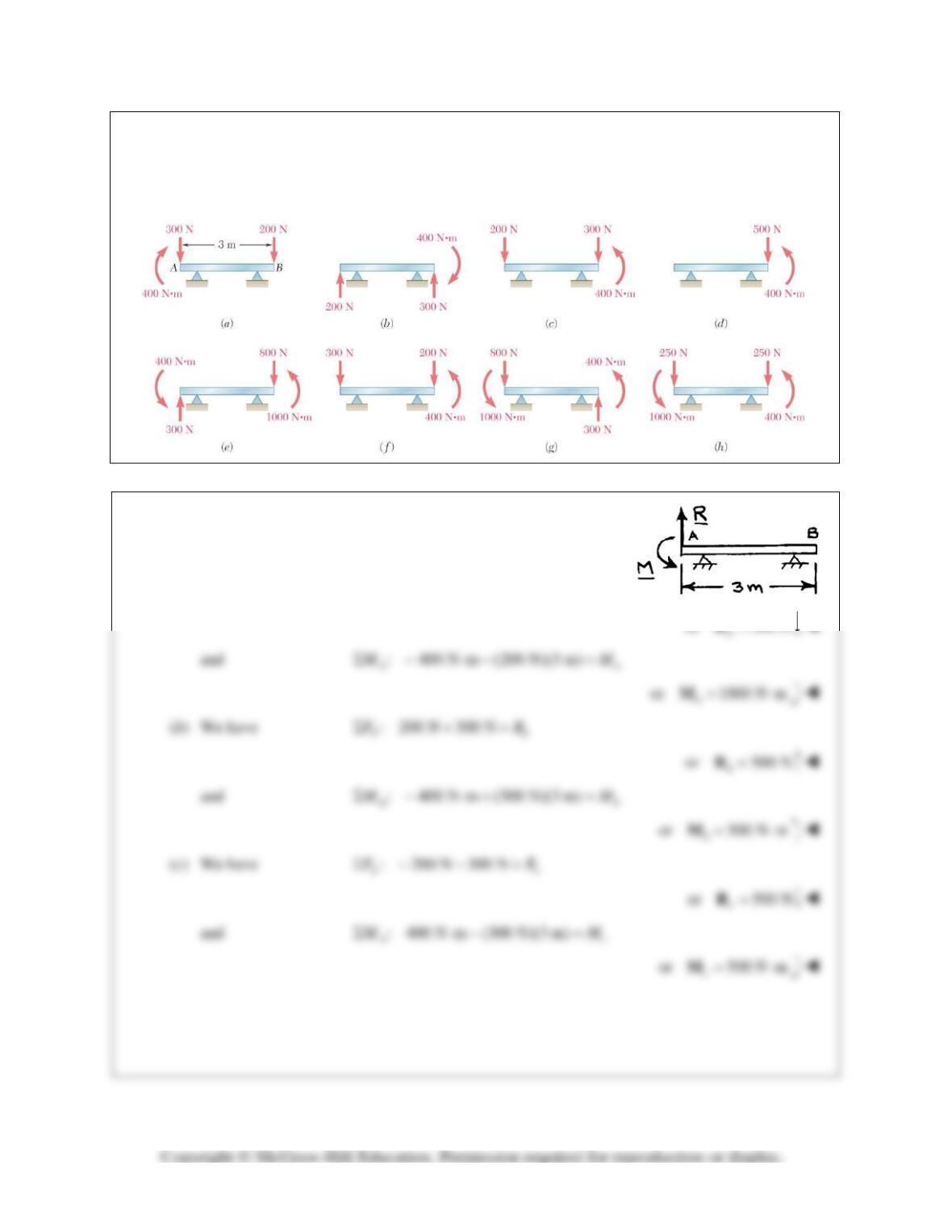
An antenna is guyed by three cables as shown.
Knowing that the tension in cable AD is 270 lb, replace
the force exerted at A by cable AD with an equivalent
force–couple system at the center O of the base of the
antenna.
SOLUTION
We have
222
( 64) ( 128) ( 128)
192 ft
AD
d= − +− +−
=
PROBLEM 3.101
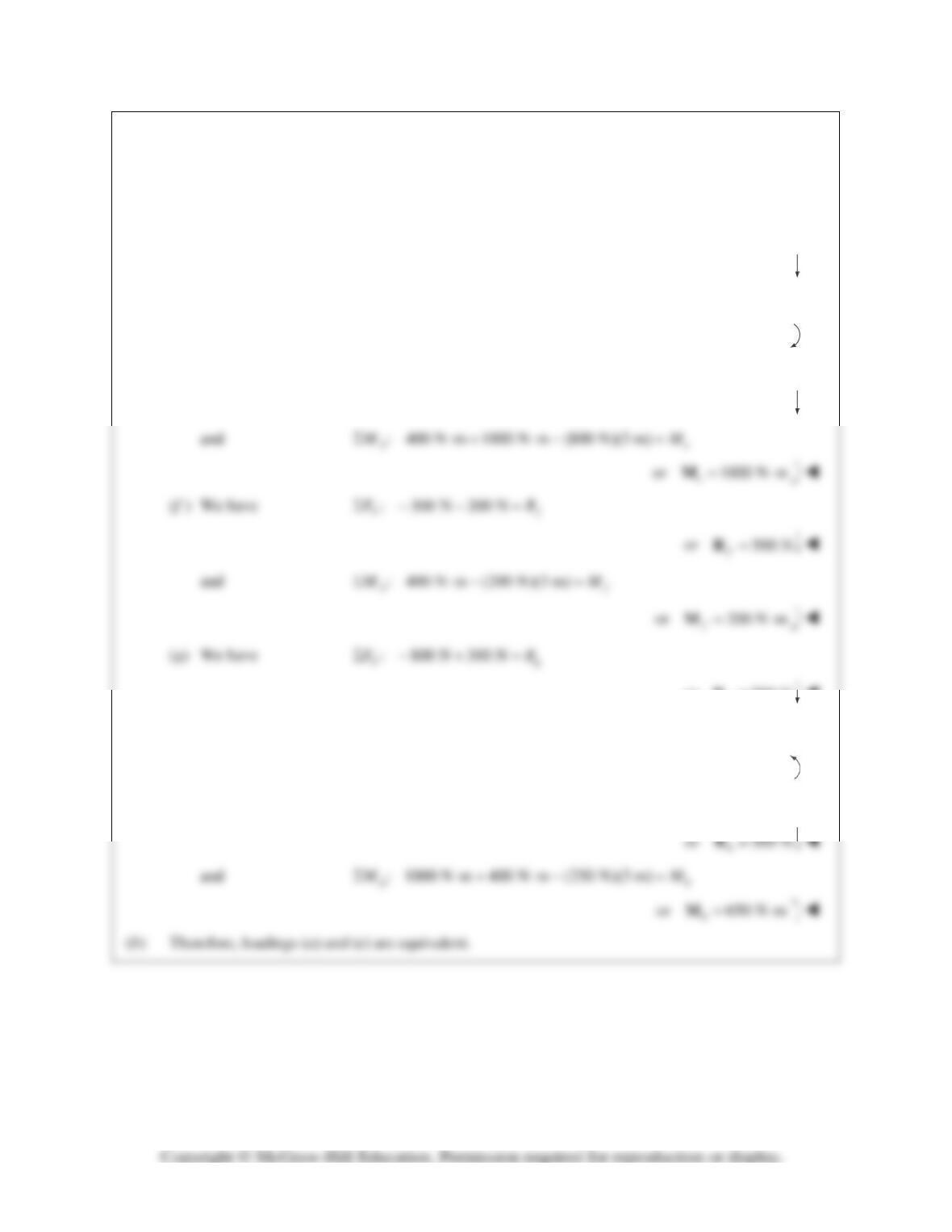
A 3-m–long beam is subjected to a variety of loadings. (a) Replace each loading with an equivalent force–
couple system at end A of the beam. (b) Which of the loadings are equivalent?
SOLUTION
(a) (a) We have
: 300 N 200 N
Ya
FRΣ− − =
PROBLEM 3.101 (Continued)
(d) We have
: 500 N
Yd
FRΣ− =
or
500 N
d
=R
and
: 400 N m (500 N)(3 m)
Ad
MMΣ ⋅− =
or
1100 N m
d
= ⋅M
(e) We have
: 300 N 800 N
Ye
FRΣ −=
or
500 N
e
=R
or
500 N
g
=R
and
: 1000 N m 400 N m (300 N)(3 m)
Ag
MMΣ ⋅+ ⋅+ =
or
2300 N m
g= ⋅M
(h) We have
: 250 N 250 N
Yh
FRΣ− − =
PROBLEM 3.102
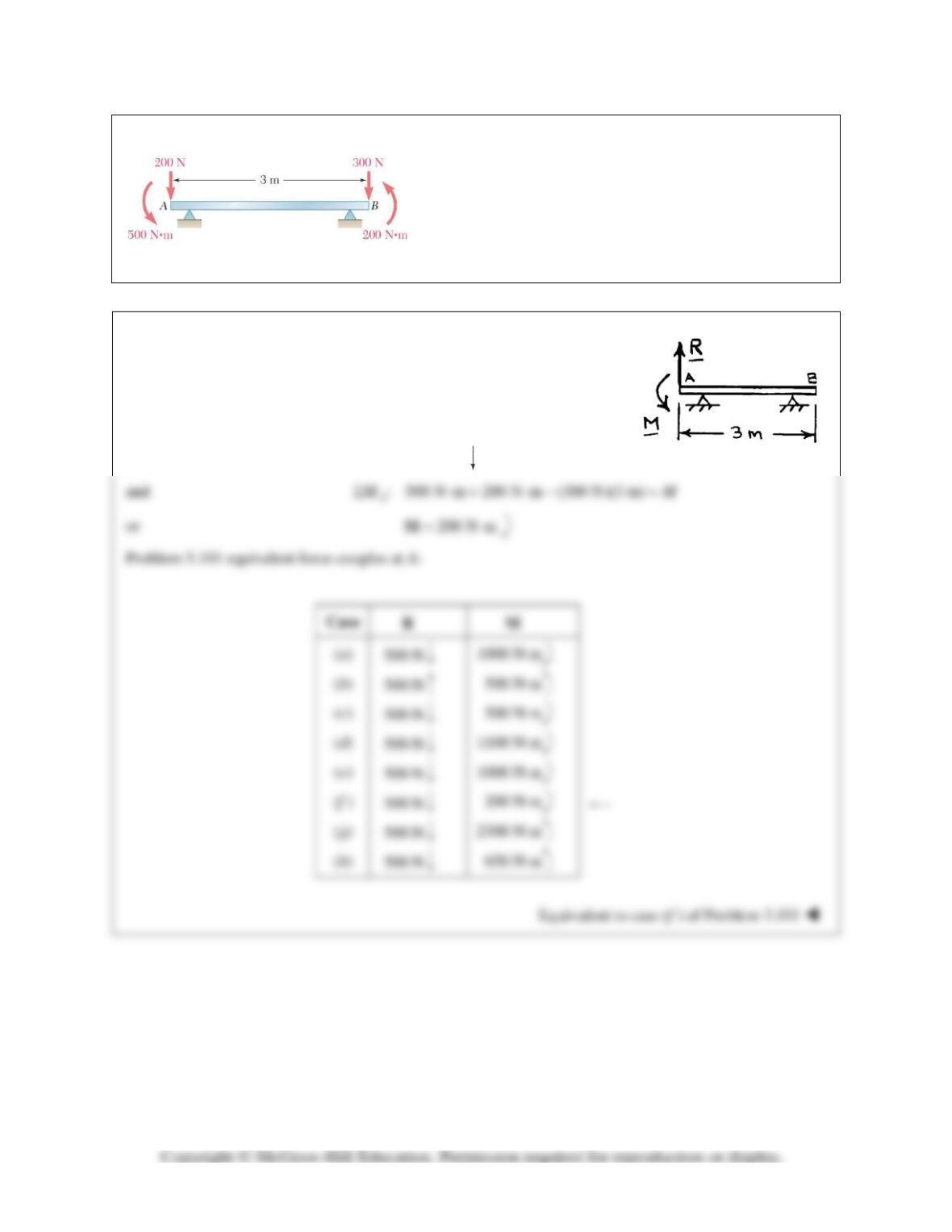
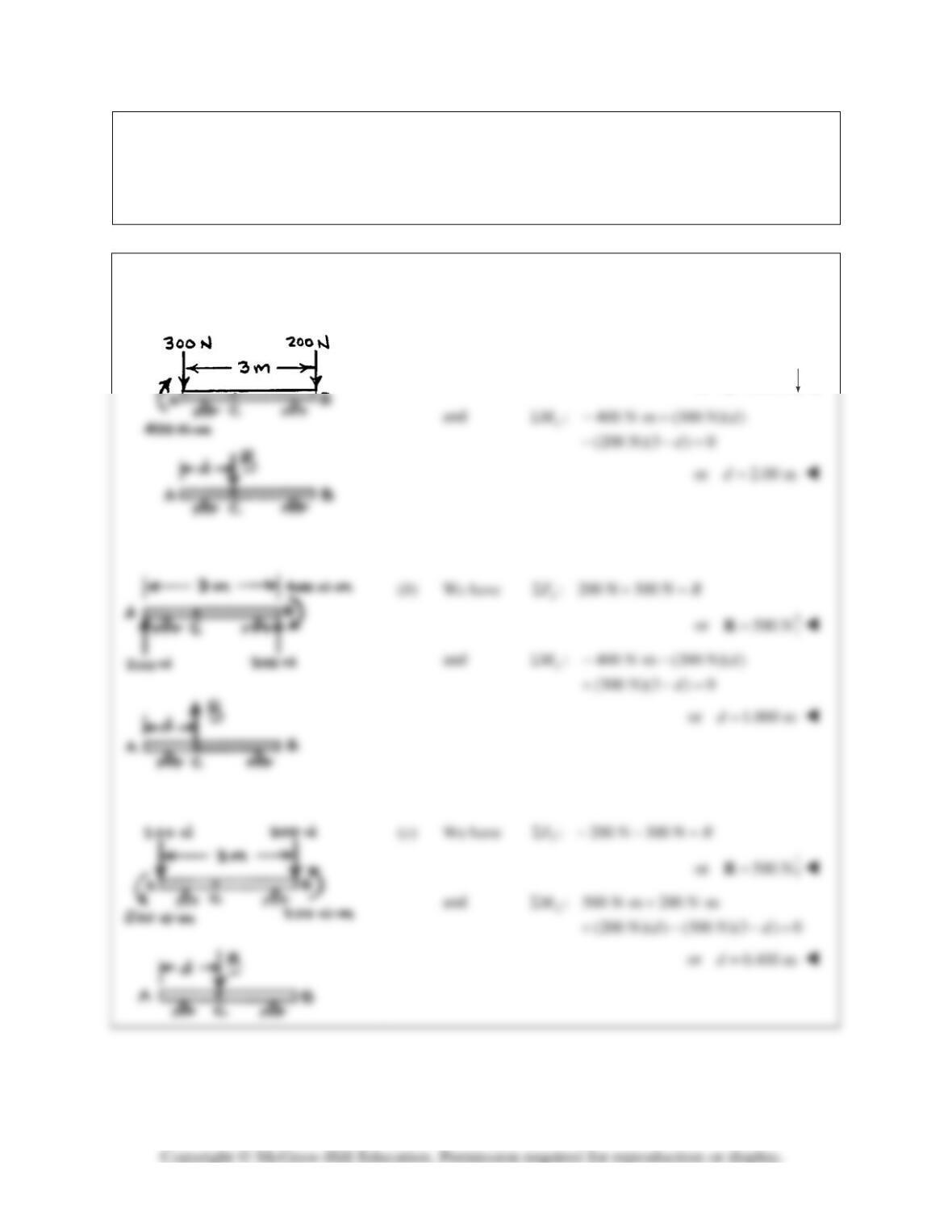
A 3-m–long beam is loaded as shown. Determine the
loading of Prob. 3.101 that is equivalent to this loading.
SOLUTION
We have
: 200 N 300 N
Y
FRΣ− − =
or
500 N=R
PROBLEM 3.103
Determine the single equivalent force and the distance from Point A to its line of action for the beam and
loading of (a) Prob. 3.101a, (b) Prob. 3.101b, (c) Prob. 3.102.
SOLUTION
500 N=R
Y
500 N=R
For equivalent single force at distance d from A:
(a) We have
: 300 N 200 N
Y
FRΣ− − =
or
500 N=R
PROBLEM 3.104
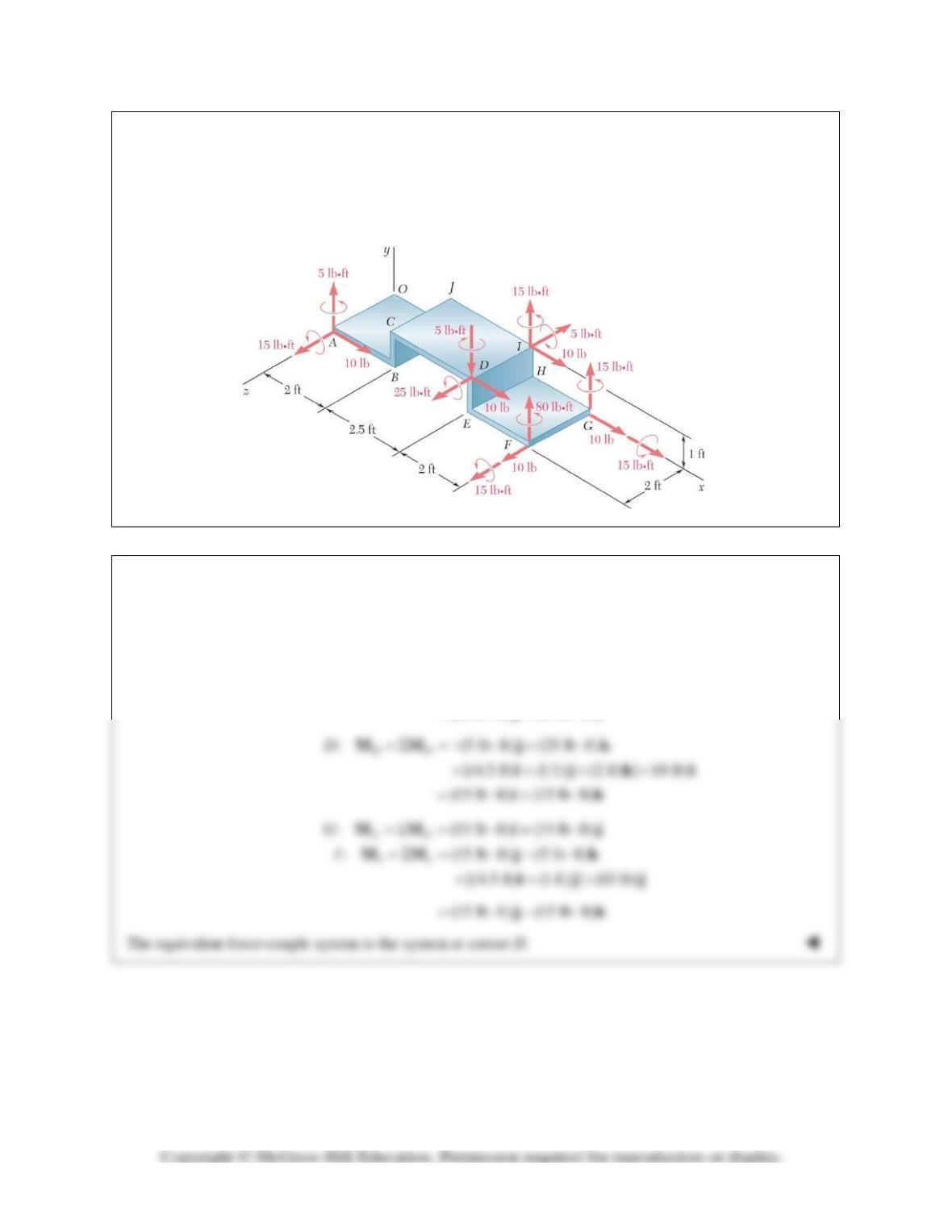
Five separate force–couple systems act at the corners of a piece of sheet metal, which has been bent into
the shape shown. Determine which of these systems is equivalent to a force F = (10 lb)i and a couple of
moment M = (15 lb ⋅ ft)j + (15 lb ⋅ ft)k located at the origin.
SOLUTION
First note that the force–couple system at F cannot be equivalent because of the direction of the force [The
force of the other four systems is (10 lb)i]. Next, move each of the systems to the origin O; the forces
remain unchanged.
: (5 lb ft) (15 lb ft) (2 ft) (10 lb)
AO
A=Σ = ⋅+ ⋅ + ×MM j k k i
(25 lb ft) (15 lb ft)= ⋅+ ⋅jk
PROBLEM 3.105
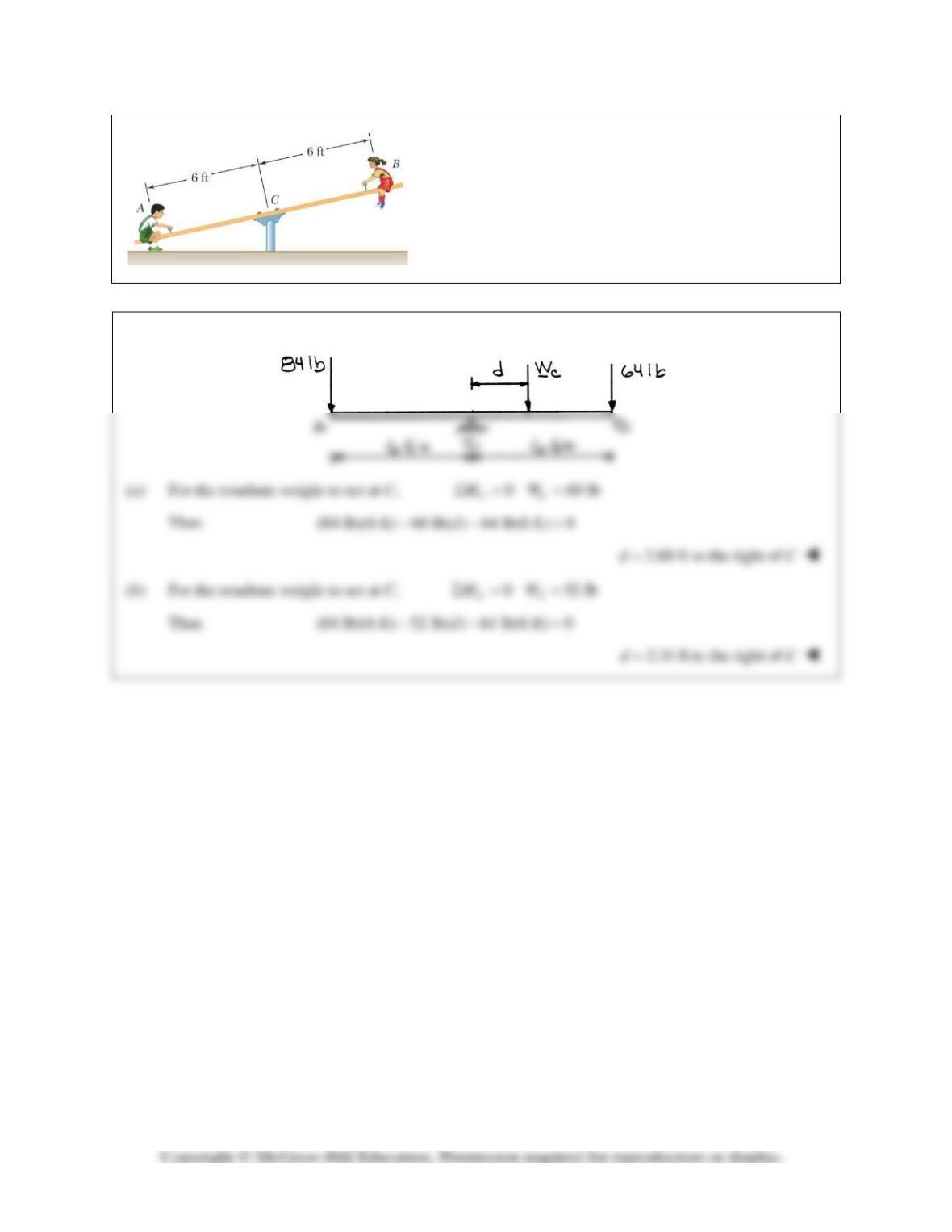
The weights of two children sitting at ends A and B of a
seesaw are 84 lb and 64 lb, respectively. Where should a
third child sit so that the resultant of the weights of the
three children will pass through C if she weighs (a) 60 lb,
(b) 52 lb.
SOLUTION
PROBLEM 3.106
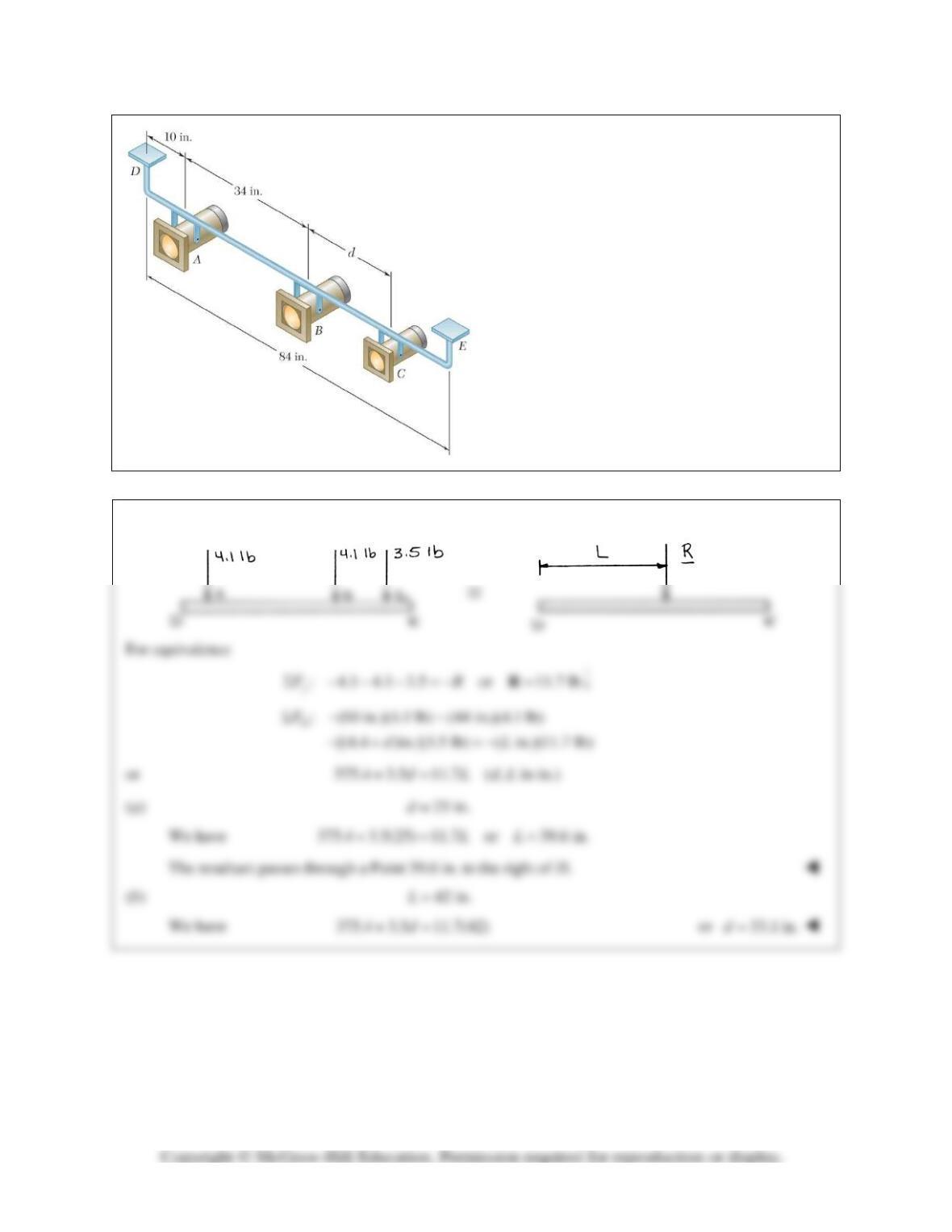
Three stage lights are mounted on a pipe as
shown. The lights at A and B each weigh 4.1 lb,
while the one at C weighs 3.5 lb. (a) If d = 25 in.,
determine the distance from D to the line of
action of the resultant of the weights of the three
lights. (b) Determine the value of d so that the
resultant of the weights passes through the
midpoint of the pipe.
SOLUTION
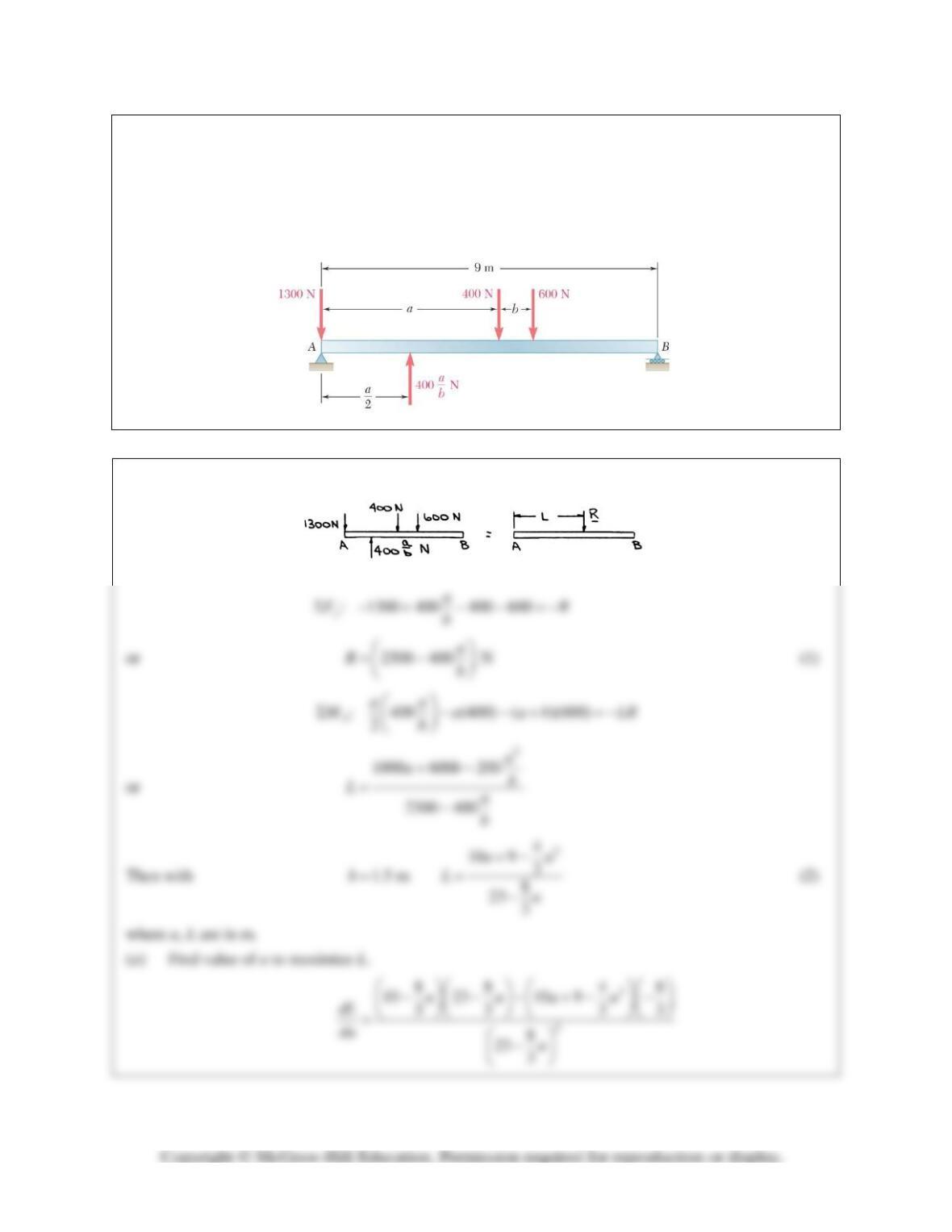
PROBLEM 3.107
A beam supports three loads of given magnitude and a fourth load whose magnitude is a function of
position. If b = 1.5 m and the loads are to be replaced with a single equivalent force, determine (a) the
value of a so that the distance from support A to the line of action of the equivalent force is maximum,
(b) the magnitude of the equivalent force and its point of application on the beam.
SOLUTION
For equivalence,
PROBLEM 3.107 (Continued)
or
22
184 80 64 80 32
230 24 0
3 39 3 9
aaa a a− − + + +− =
or
2
16 276 1143 0aa− +=
PROBLEM 3.108
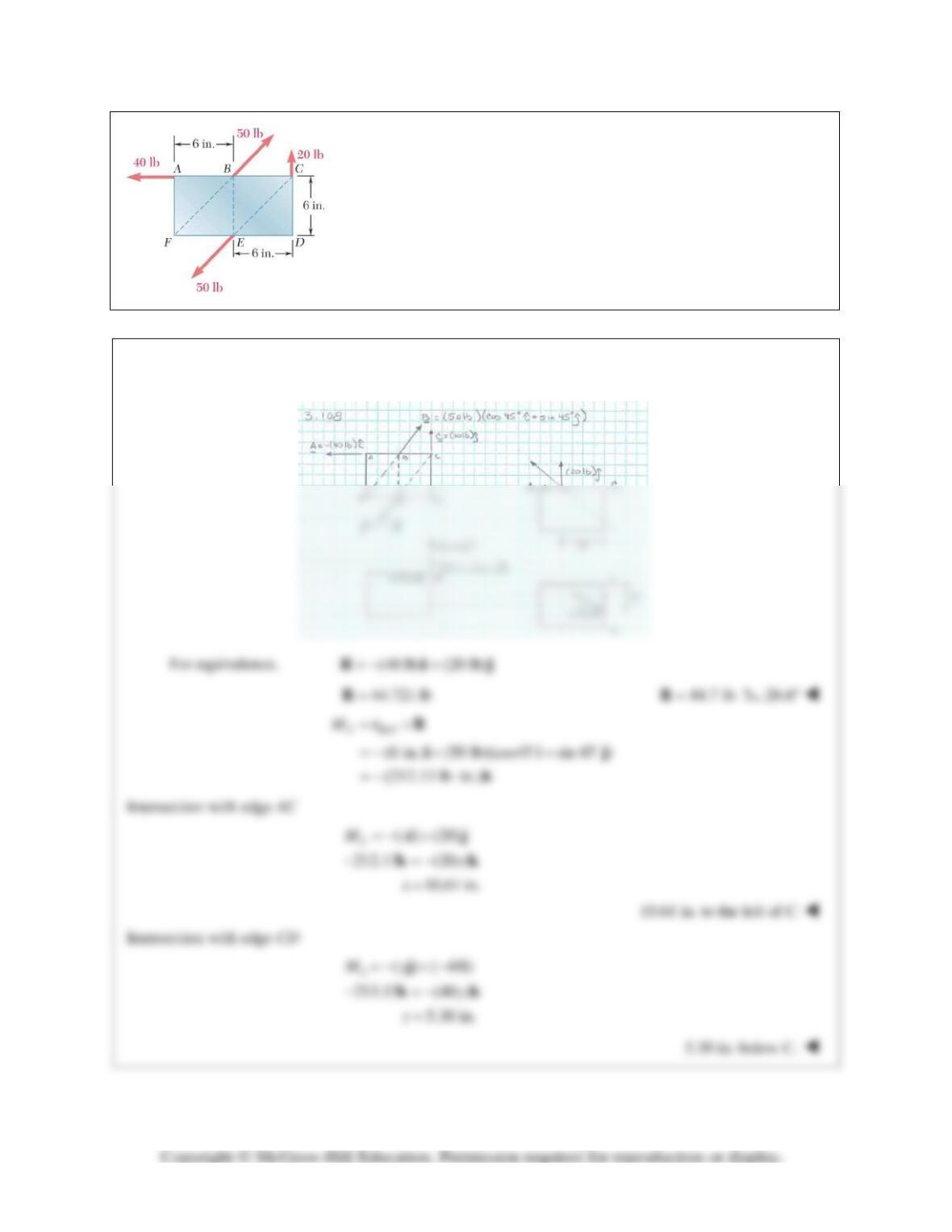
A 6 × 12-in. plate is subjected to four loads as shown. Find the resultant
of the four loads and the two points at which the line of action of the
resultant intersects the edge of the plate.
SOLUTION
We have
PROBLEM 3.109
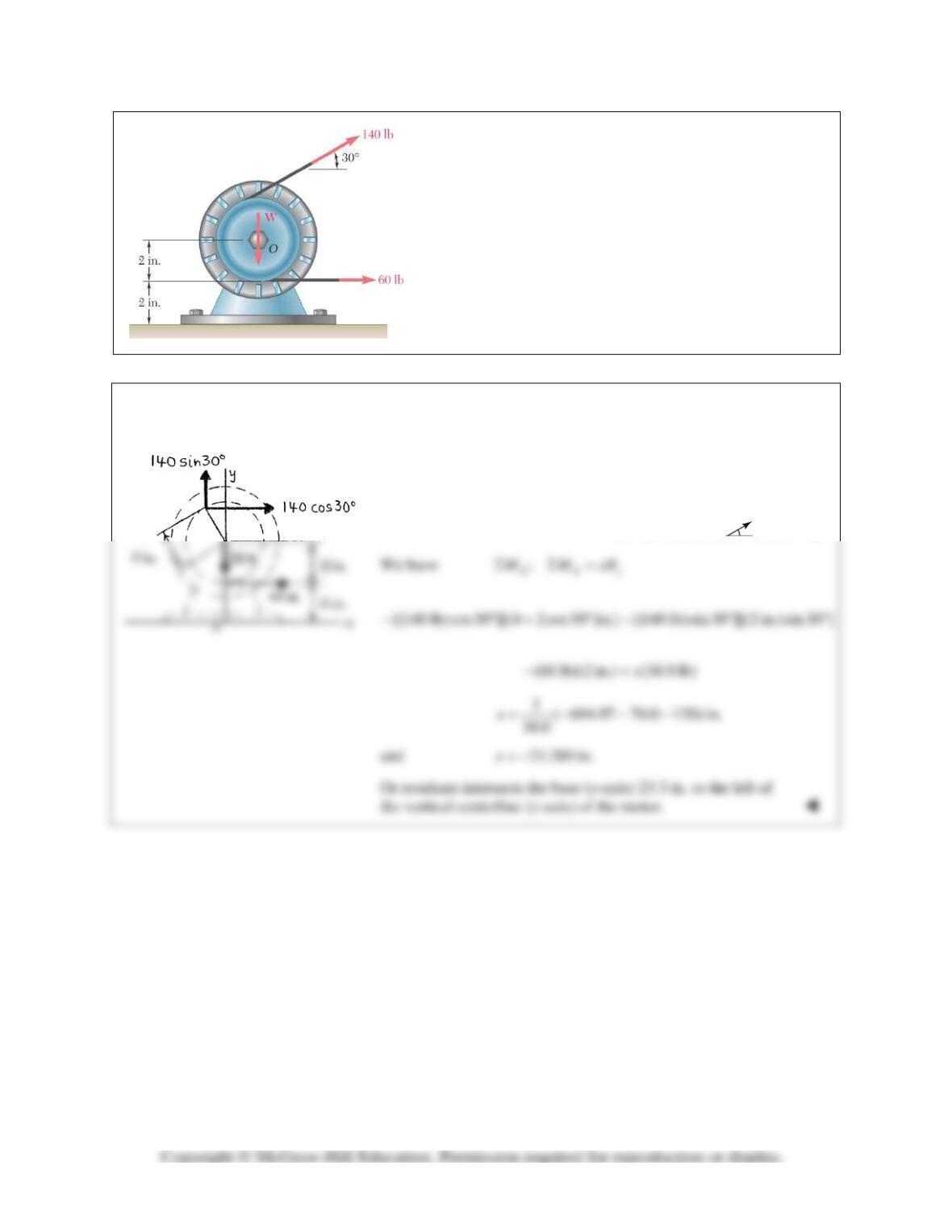
A 32-lb motor is mounted on the floor. Find the resultant of
the weight and the forces exerted on the belt, and determine
where the line of action of the resultant intersects the floor.
SOLUTION
We have
: (60 lb) (32 lb) (140 lb)(cos30 sin 30 )Σ − + °+ ° =F i j i jR
(181.244 lb) (38.0 lb)= +R ij
or
185.2 lb=R
11.84°
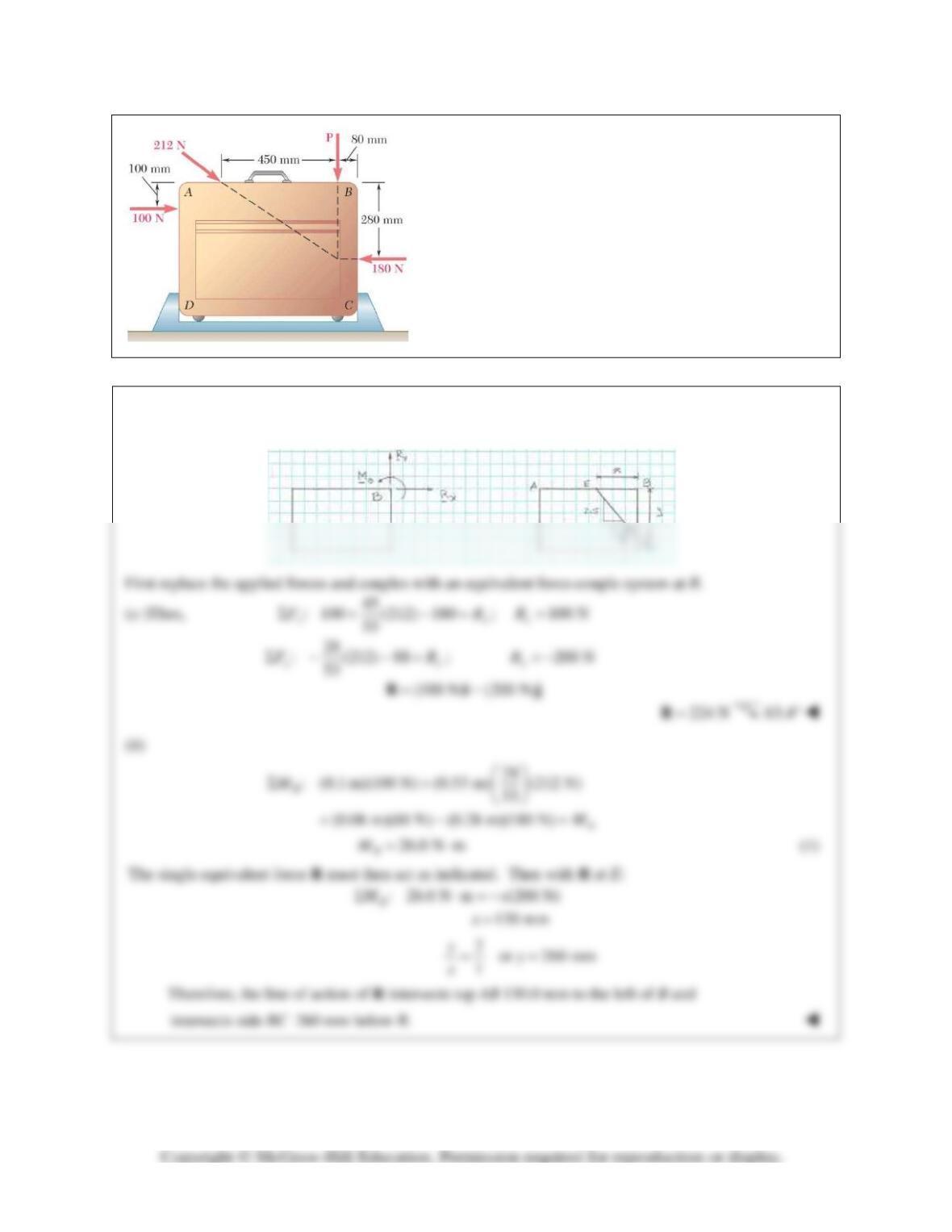
PROBLEM 3.110
To test the strength of a 625 × 500-mm suitcase, forces are
applied as shown. If P = 88 N, (a) determine the resultant of
the applied forces, (b) locate the two points where the line
of action of the resultant intersects the edge of the suitcase.
SOLUTION
We have
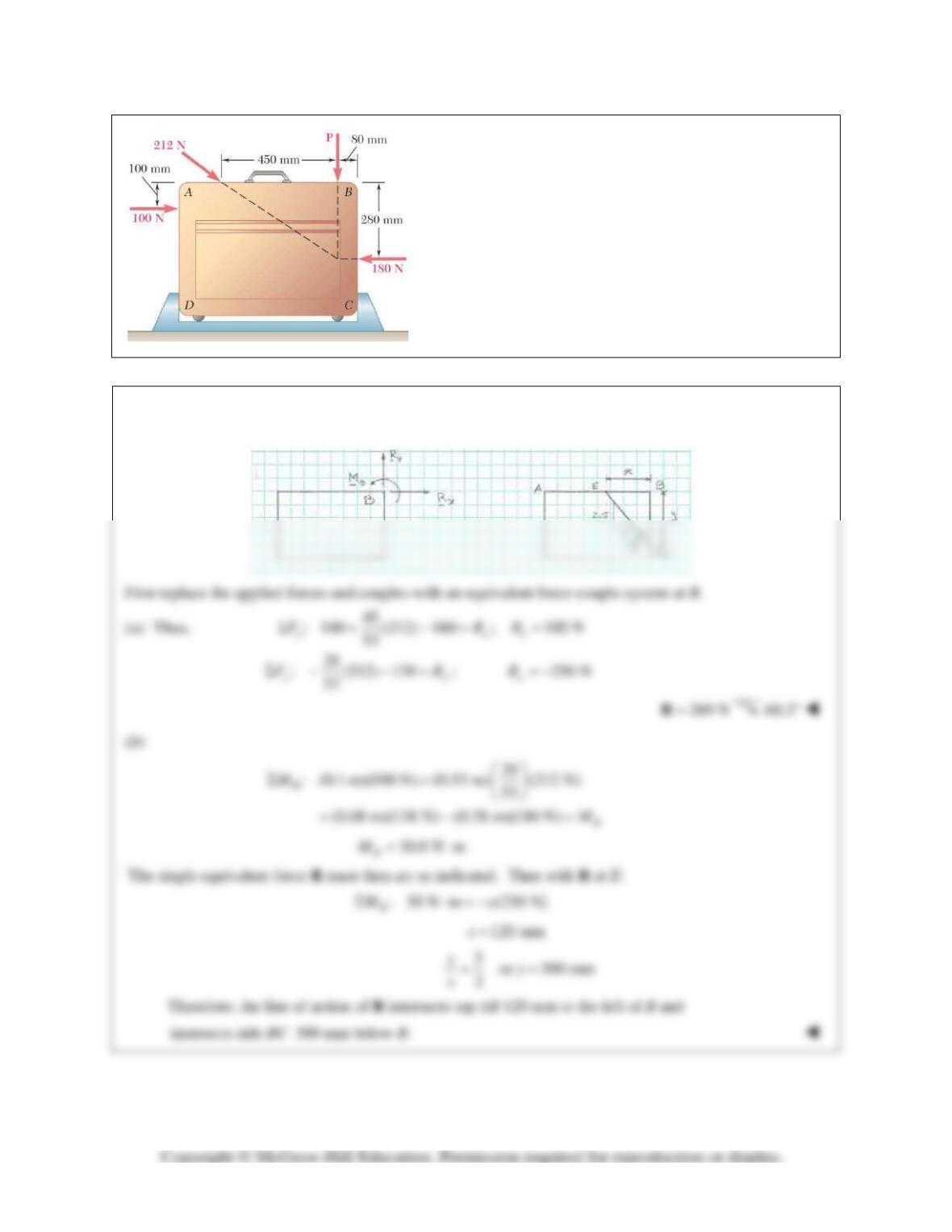
PROBLEM 3.111
Solve Prob. 3.110, assuming that P = 138 N.
Problem 3.110 To test the strength of a 625 × 500-mm
suitcase, forces are applied as shown. If P = 88 N, (a)
determine the resultant of the applied forces, (b) locate the
two points where the line of action of the resultant
intersects the edge of the suitcase.
SOLUTION
We have
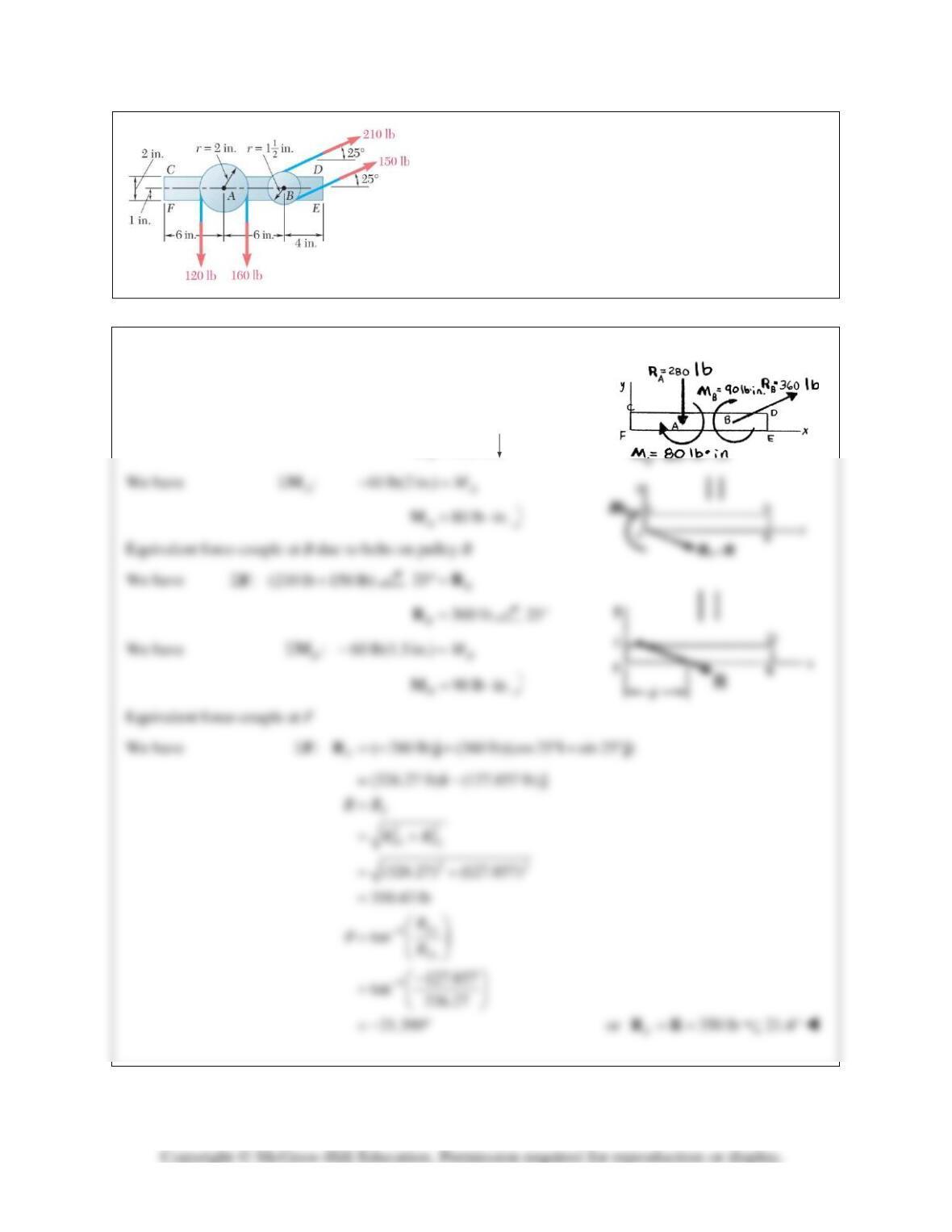
PROBLEM 3.112
Pulleys A and B are mounted on bracket CDEF. The
tension on each side of the two belts is as shown. Replace
the four forces with a single equivalent force, and
determine where its line of action intersects the bottom
edge of the bracket.
SOLUTION
Equivalent force-couple at A due to belts on pulley A
We have
: 120 lb 160 lb A
RΣ− − =F
PROBLEM 3.112 (Continued)
We have
: (280 lb)(6 in.) 80 lb in.
FF
MΣ =− −⋅M
[(360 lb) cos 25 ](1.0 in.)
[(360 lb) sin 25 ](12 in.) 90 lb in.
−°
+ ° −⋅
(350.56 lb in.)
F
=−⋅Mk
To determine where a single resultant force will intersect line FE,
350.56 lb in.
127 857 lb
2.7418 in.
Fy
F
y
M dR
M
dR
=
=
−⋅
=−⋅
=
or
2.74 in.d=