Direct Factorization 21
For the second pass, we multiply the second row of Lwith the second and third
columns of U. Equating each product with the corresponding element from Agen-
erates the equations
Substituting the values determined from the previous passes, we find u33 =109
18 .
Thus,
Now, back substitution applied to the system Ux=zgives
22 Section 3.6
Now, back substitution applied to the system Ux=zgives
With b3=17 −19 −35 T, forward substitution applied to the system Lz=
b3yields
12. Use the matrix and right-hand side vectors from Exercise 4.
The Doolittle decomposition will consist of the matrices
Direct Factorization 23
The first column of Lis obtained by multiplying the second and third rows of Lwith
the first column of Uand then equating the result with the corresponding element
from A. This yields the equations
For the second pass, we multiply the second row of Lwith the second and third
columns of U. Equating each product with the corresponding element from Agen-
erates the equations
Solving for l32, we find l32 =−1. Finally, multiplying the third row of Lwith the
third column of Ugenerates the equation
24 Section 3.6
With b2=−10 −10 −10 T, forward substitution applied to the system
With b3=−21 −14 −17 T, forward substitution applied to the system
Lz=b3yields
13. Use the matrix and right-hand side vectors from Exercise 5.
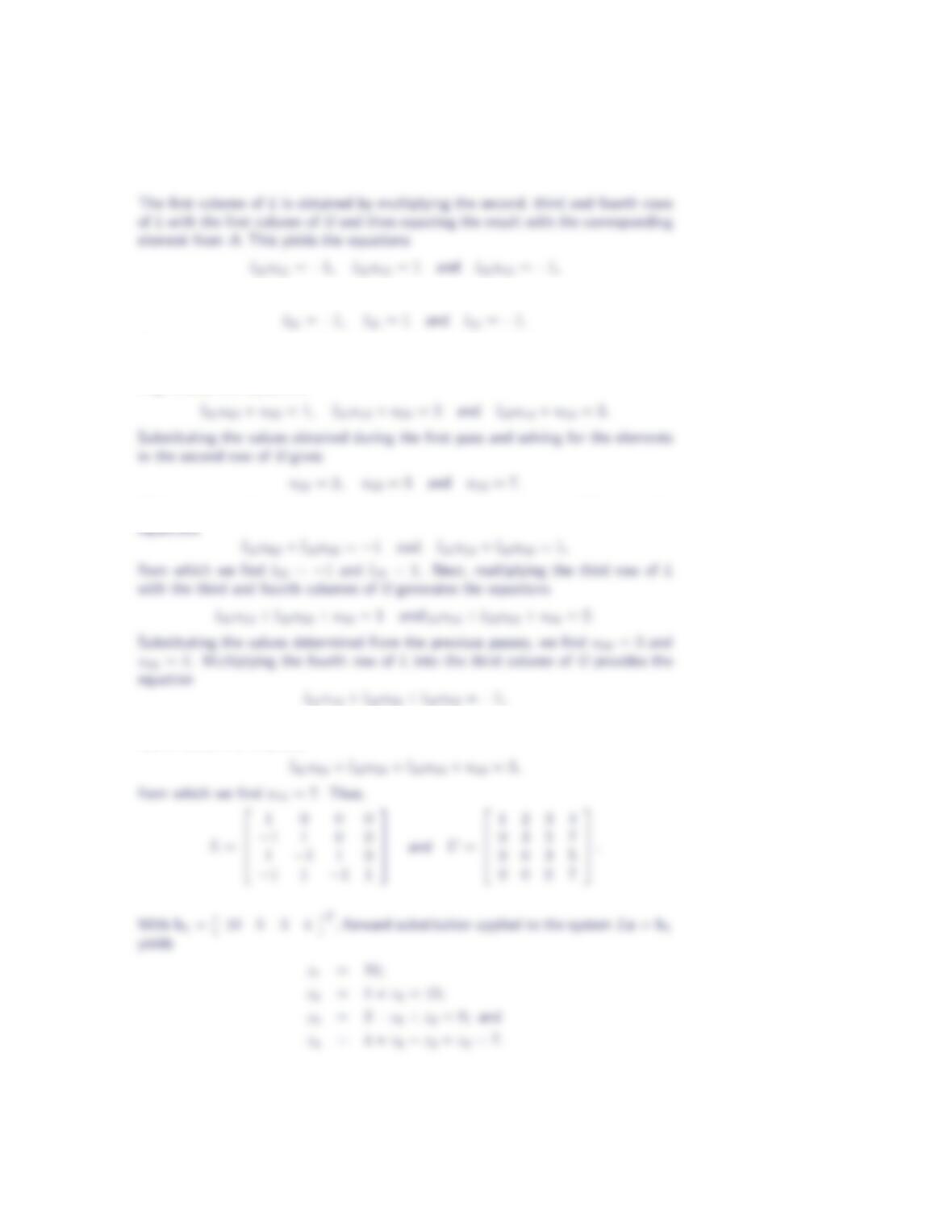
The Doolittle decomposition will consist of the matrices
1 0 0 0
u11 u12 u13 u14
Direct Factorization 25
whose solutions are
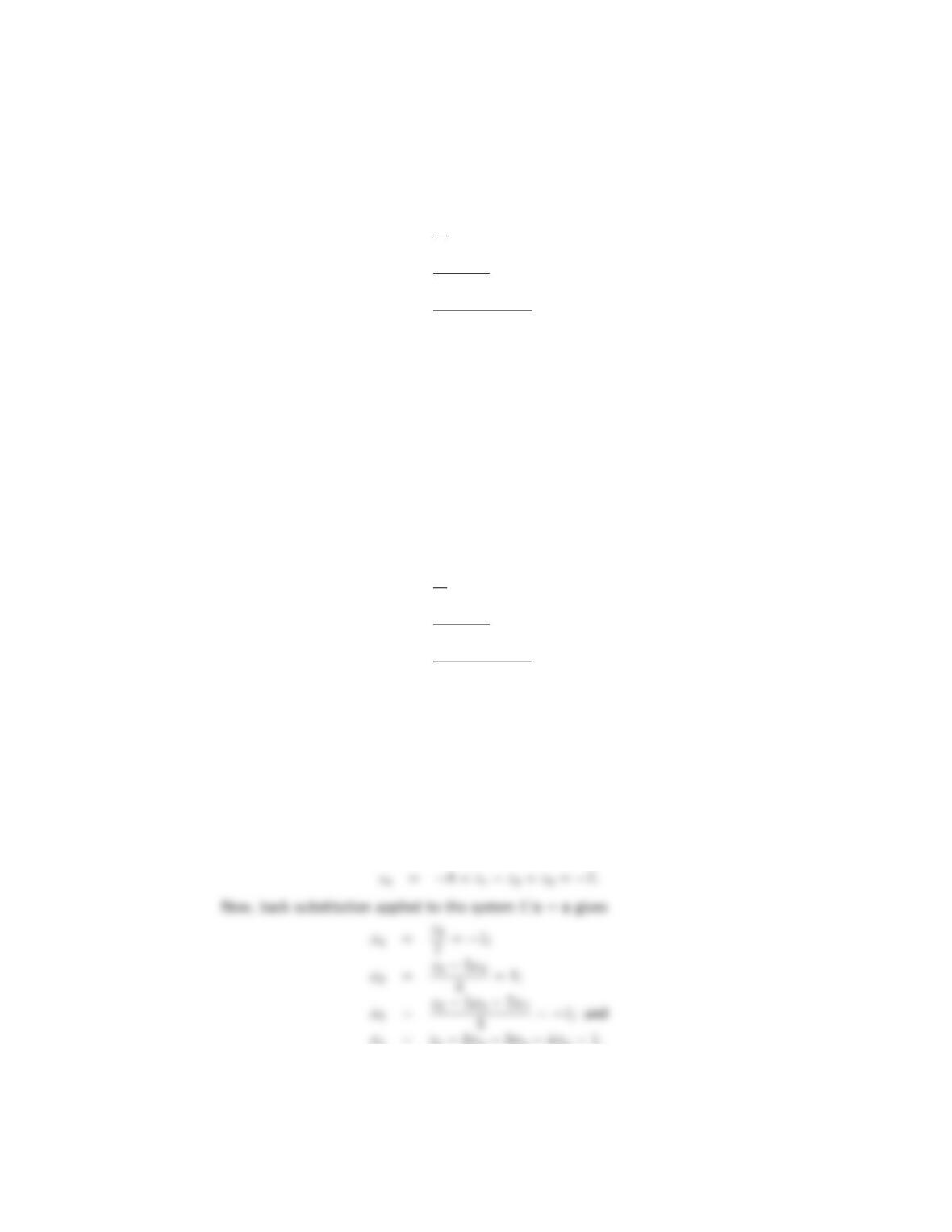
For the second pass, we multiply the second row of Lwith the second, third and
fourth columns of U. Equating each product with the corresponding element from
Agenerates the equations
Multiplying the third and fourth rows of Linto the second column of Uderives the
whose solution for l43 is l43 =−1. Finally, multiplying the fourth row of Lwith the
fourth column of Uyields
26 Section 3.6
Now, back substitution applied to the system Ux=zgives
x4=z4
7= 1;
x3=z3−5x4
3= 1;
x2=z2−5x3−7x4
3= 1; and
x1=z1−2x2−3x3−4x4= 1.
Hence, x=1111T.
With b2=−4−5−3−4T, forward substitution applied to the system
Lz=b2yields
z1=−4;
z2=−5 + z1=−9;
z3=−3−z1+z2=−8; and
z4=−4 + z1−z2+z3=−7.
Now, back substitution applied to the system Ux=zgives
x4=z4
7=−1;
x3=z3−5x4
3=−1;
x2=z2−5x3−7x4
3= 1; and
x1=z1−2x2−3x3−4x4= 1.
Hence, x=1 1 −1−1T.
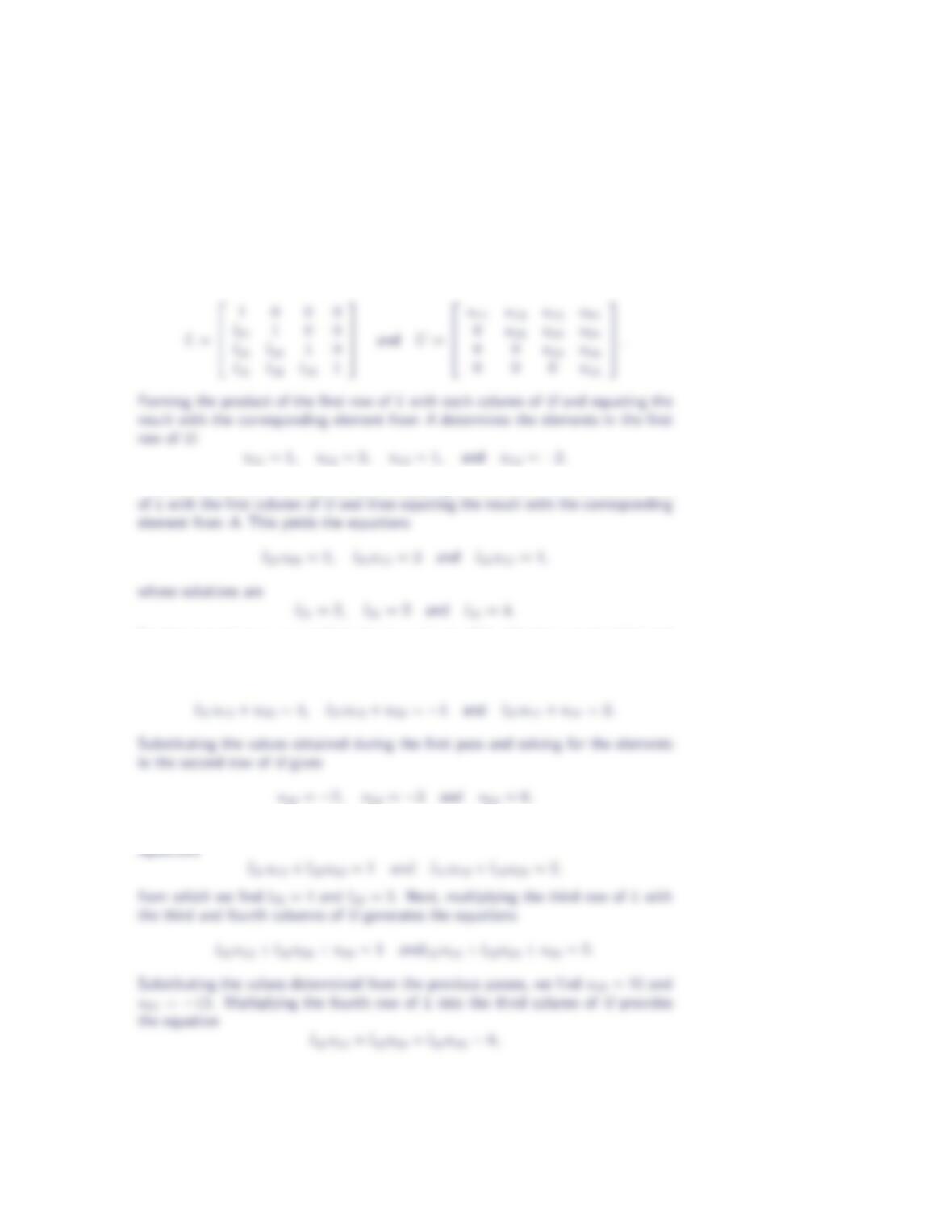
With b3=−2−3 1 −8T, forward substitution applied to the system
Lz=b3yields
z1=−2;
z2=−3 + z1=−5;
z3= 1 −z1+z2=−2; and
Direct Factorization 27
Hence, x=1−1 1 −1T.
14. Use the matrix and right-hand side vectors from Exercise 6.
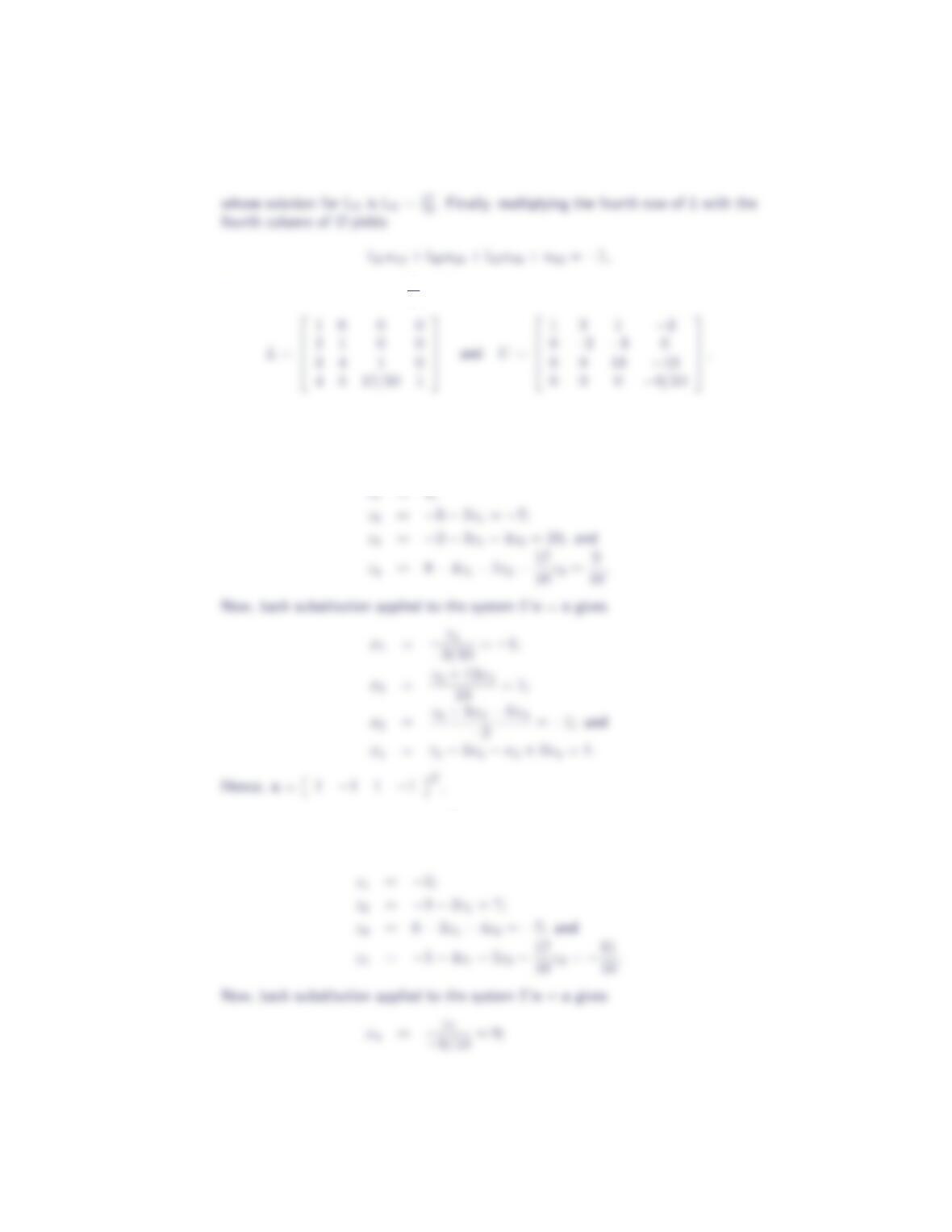
The Doolittle decomposition will consist of the matrices
The first column of Lis obtained by multiplying the second, third and fourth rows
For the second pass, we multiply the second row of Lwith the second, third and
fourth columns of U. Equating each product with the corresponding element from
Agenerates the equations
Multiplying the third and fourth rows of Linto the second column of Uderives the
28 Section 3.6
from which we find u44 =−9
10 . Thus,
With b1=1−5−2 9 T, forward substitution applied to the system Lz=
b1yields
With b2=−5−3 6 −5T, forward substitution applied to the system
Lz=b2yields
Direct Factorization 29
With b3=5 5 −2 1 T, forward substitution applied to the system Lz=b3
yields
Now, back substitution applied to the system Ux=zgives
15. (a) Construct an algorithm to factor an n×nmatrix into the product LDU ,
where Lis a lower triangular matrix with ones along its diagonal, Dis a
diagonal matrix and Uis an upper triangular matrix with ones along its
diagonal.
(b) Suppose the matrix Ahas been factored into the product LDU , where the
matrices L,Dand Uhave the form specified in part (a). Construct an
algorithm to use this factorization to solve the system Ax=b.
(c) How many arithmetic operations are required to compute the factorization
in part (a)? How does this total compare to the number of operations
needed to compute an LU decomposition?
(d) How many arithmetic operations are required by the algorithm in part (b)
to solve a system given an LDU decomposition of the coefficient matrix?
How does this total compare to the number of operations needed by forward
and backward substitution?
(e) How does the total number of arithmetic operations needed to solve a
system of equations using an LDU decomposition compare to the number
of operations needed to solve a system using an LU decomposition?
30 Section 3.6
(a) One approach is to determine a Crout decomposition and then factor the diag-
triangular matrix.
(b) Suppose the matrix Ahas been factored into the product LDU, where Lis a
of D. Finally, solve the system Ux=yfor xby back substitution.
(c) Starting from either a Crout decomposition or a Doolittle decomposition re-
(d) Because the matrices Land Uhave ones along the diagonal, forward and
In Exercises 16 – 21, determine the LDU decomposition (see Exercise 15) of the
given matrix, and then solve the system Ax=bfor each of the given right-hand
side vectors.
16. Use the matrix and right-hand side vectors from Exercise 1.
The Crout decomposition of the matrix Aconsists of the lower and upper triangular
matrices
2 0 0
1 7/2 5/2
Direct Factorization 31
Factoring the diagonal elements from the lower triangular matrix produces the LDU
decomposition consisting of
Solving Dy=z, we find
Finally, back substitution applied to the system Ux=ygives
Solving Dy=z, we find
32 Section 3.6
Solving Dy=z, we find
17. Use the matrix and right-hand side vectors from Exercise 2.
The Crout decomposition of the matrix Aconsists of the lower and upper triangular
matrices
1 0 0
112
Factoring the diagonal elements from the lower triangular matrix produces the LDU
decomposition consisting of
1 0 0
1 0 0
112
Solving Dy=z, we find
Direct Factorization 33
Solving Dy=z, we find
Finally, back substitution applied to the system Ux=ygives
x3=y3=−5;
18. Use the matrix and right-hand side vectors from Exercise 3.
The Crout decomposition of the matrix Aconsists of the lower and upper triangular
matrices
−3 0 0
1−2/3 1/3
Factoring the diagonal elements from the lower triangular matrix produces the LDU
decomposition consisting of
1 0 0
−3 0 0
34 Section 3.6
With b1=7 3 −33 T, forward substitution applied to the system Lz=b1
yields
Solving Dy=z, we find
Solving Dy=z, we find
Direct Factorization 35
Finally, back substitution applied to the system Ux=ygives
19. Use the matrix and right-hand side vectors from Exercise 4.
The Crout decomposition of the matrix Aconsists of the lower and upper triangular
matrices
1 0 0
145
With b1=−15 −14 −7T, forward substitution applied to the system Lz=
b1yields
Finally, back substitution applied to the system Ux=ygives
36 Section 3.6
Solving Dy=z, we find
Solving Dy=z, we find
20. Use the matrix and right-hand side vectors from Exercise 5.
The Crout decomposition of the matrix Aconsists of the lower and upper triangular
matrices
Factoring the diagonal elements from the lower triangular matrix produces the LDU
decomposition consisting of
1 0 0 0
1000
and
1 2 3 4
Solving Dy=z, we find
38 Section 3.6
Hence, x=1 1 −1−1T.
Finally, back substitution applied to the system Ux=ygives
x4=y4=−1;
21. Use the matrix and right-hand side vectors from Exercise 6.
The Crout decomposition of the matrix Aconsists of the lower and upper triangular
matrices
Factoring the diagonal elements from the lower triangular matrix produces the LDU
decomposition consisting of
1 0 0 0
1 0 0 0
Direct Factorization 39
Solving Dy=z, we find
Finally, back substitution applied to the system Ux=ygives
x4=y4= 9;
40 Section 3.6
With b3=5 5 −2 1 T, forward substitution applied to the system Lz=b3
yields