12 Section 3.10
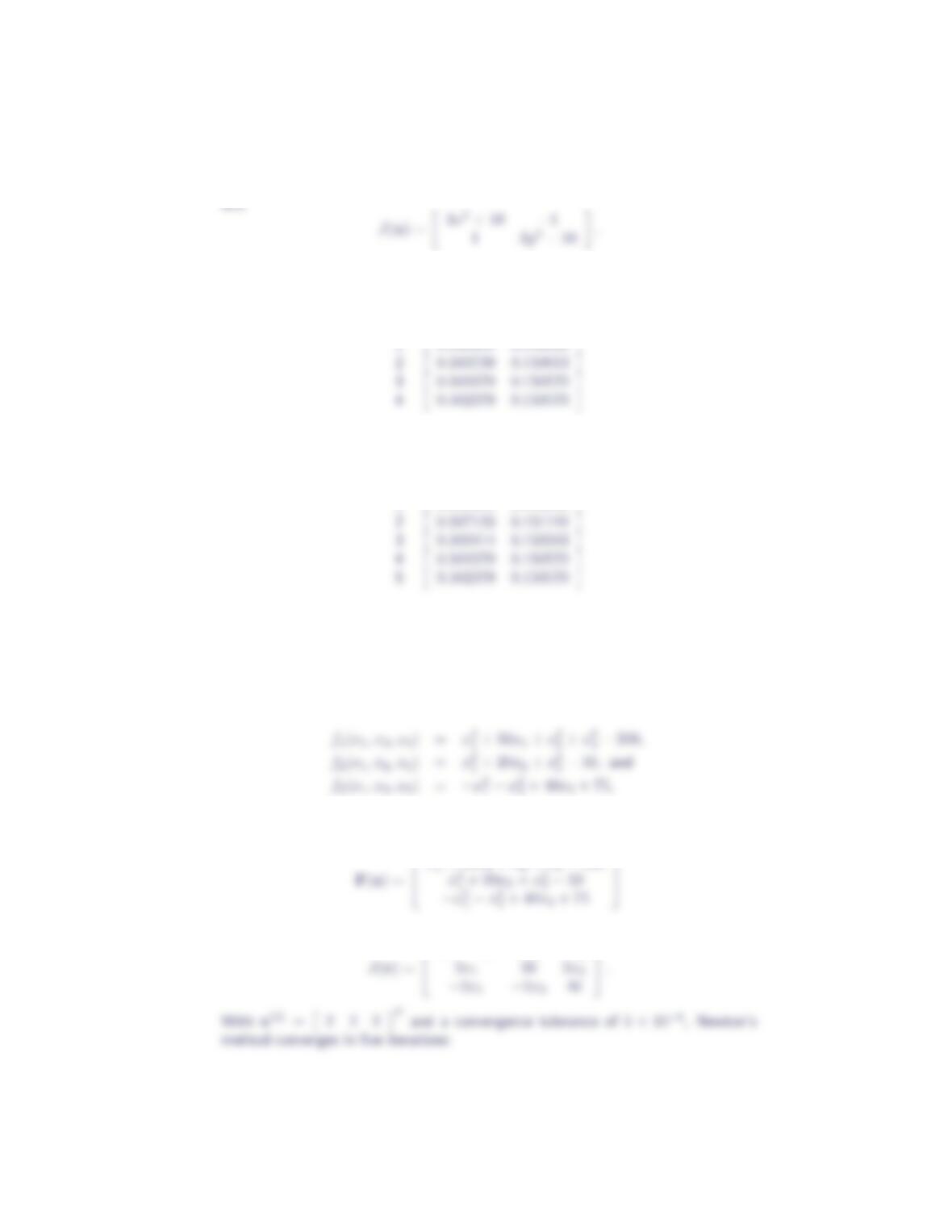
With x(0) =1 0 Tand a convergence tolerance of 5×10⁻⁶, Newton’s method
converges in four iterations:
nx(n)T
With the same initial vector and convergence tolerance, Broyden’s method requires
five iterations to achieve convergence:
nx(n)T
10.550388 0.155039
8.
x2
1+ 50x1+x2
2+x2
3−200 = 0
x2
1+ 20x2+x2
3−50 = 0
−x2
1−x2
2+ 40x3+ 75 = 0
x(0) =222T
Define
and let x=x1x2x3T. Then
x2
and
2x1+ 50 2x22x3
Nonlinear Systems of Equations 13
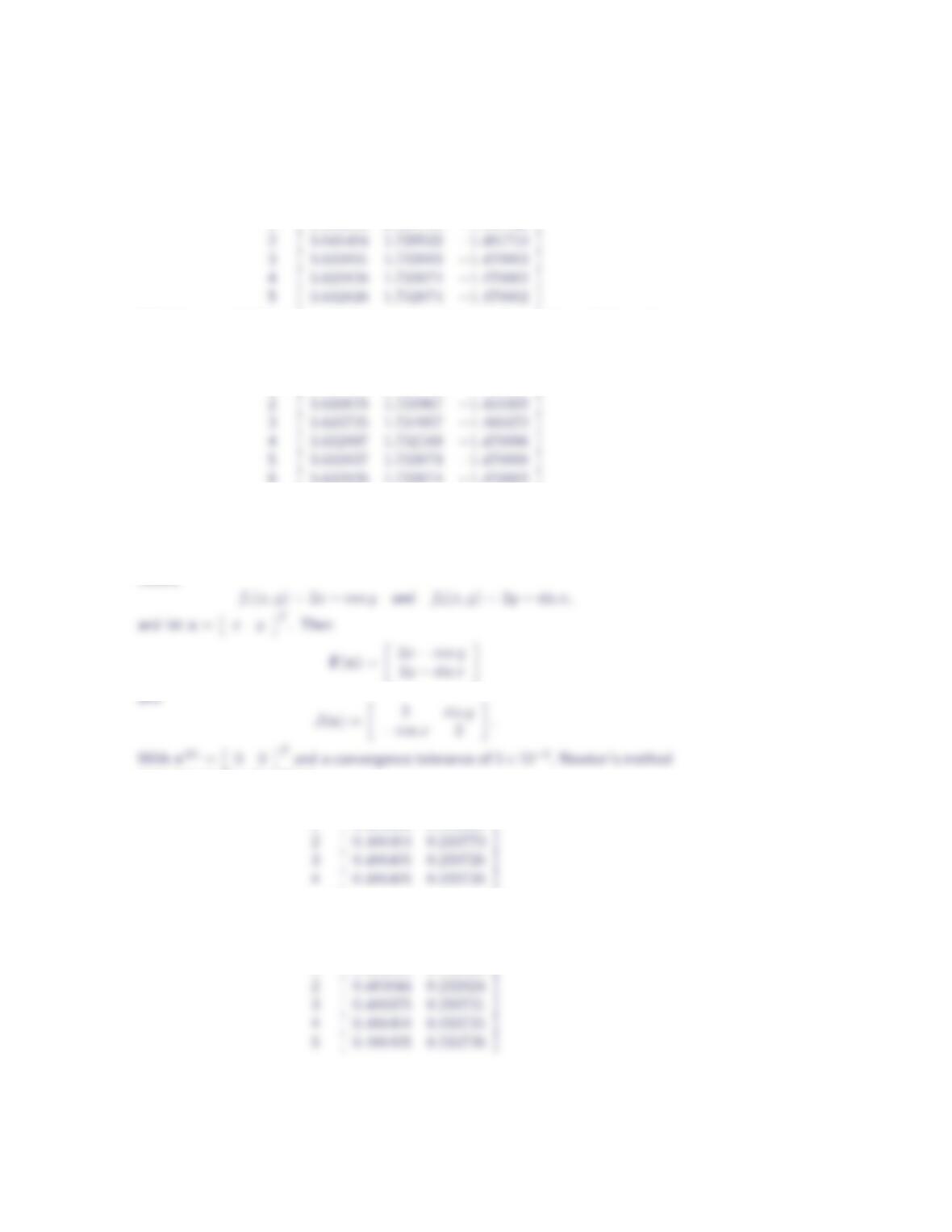
nx(n)T
13.853999 2.418745 −1.447726
With the same initial vector and convergence tolerance, Broyden’s method requires
six iterations to achieve convergence:
nx(n)T
13.853999 2.418745 −1.447726
9. 2x−cos y= 0
2y−sin x= 0 x(0) =0 0 T
Define
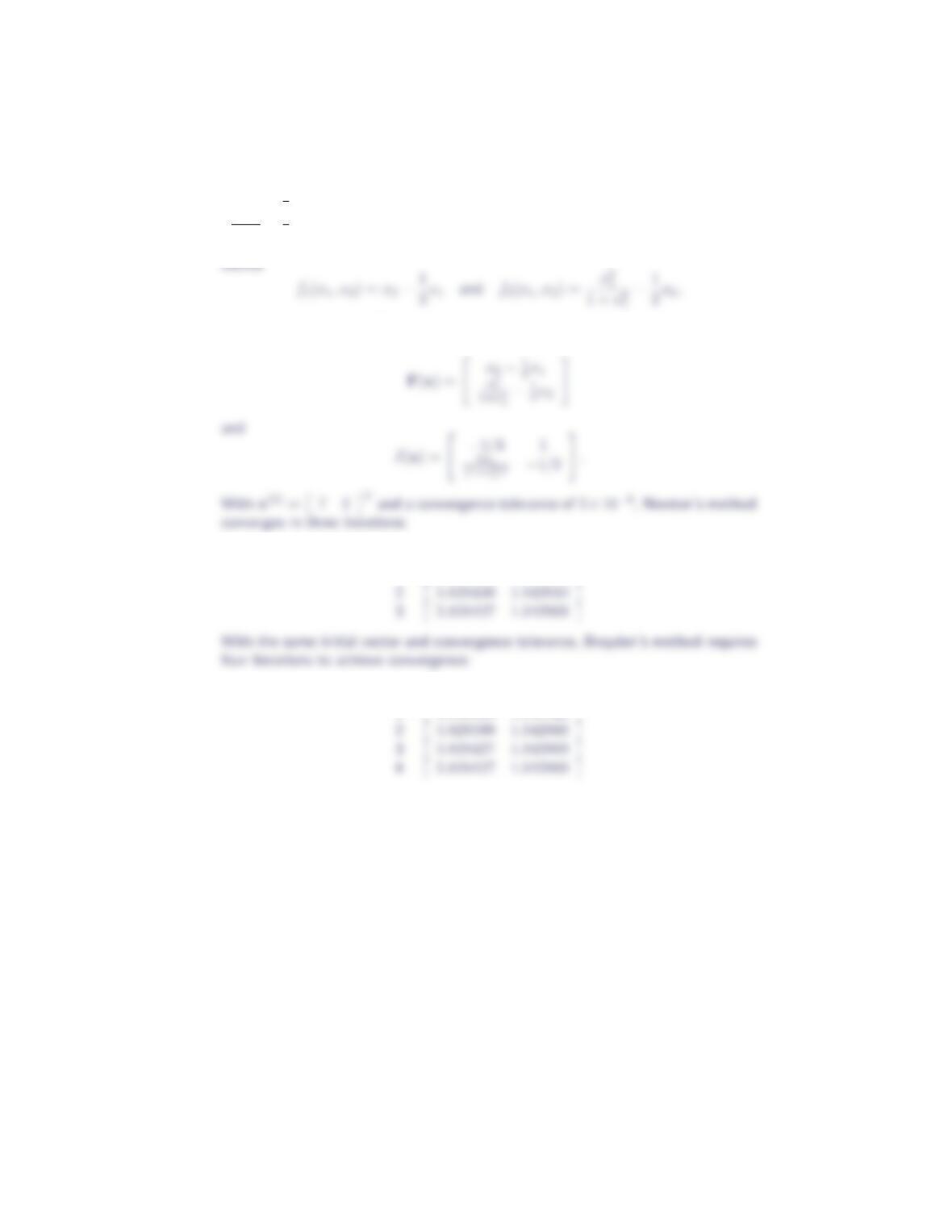
converges in four iterations:
nx(n)T
10.500000 0.250000
With the same initial vector and convergence tolerance, Broyden’s method requires
five iterations to achieve convergence:
nx(n)T
10.500000 0.250000
14 Section 3.10
10. x2−1
3x1= 0
x2
1
1+x2
1−1
2x2= 0 x(0) =7 2 T
and let x=x1x2T. Then
nx(n)T
15.841060 1.947020
nx(n)T
15.841060 1.947020
11. The following systems have the indicated number of solutions. Approximate
each of the solutions to within a convergence tolerance of 5 ×10⁻⁵.
(a)
ex−y= 0
ey2−6x−4 = 0 2 solutions
(b)
4x1−x2+x3−x1x4= 0
−x1+ 3x2−2x3−x2x4= 0
x1−2x2+ 3x3−x3x4= 0
x2
1+x2
2+x2
3−1 = 0
4 solutions
Nonlinear Systems of Equations 15
(c)
x2+y2−5 = 0
x3+y3−2 = 0 2 solutions
(a) Let x=x y T. Then
(b) Let x=x1x2x3x4T. Then
4x1−x2+x3−x1x4
16 Section 3.10
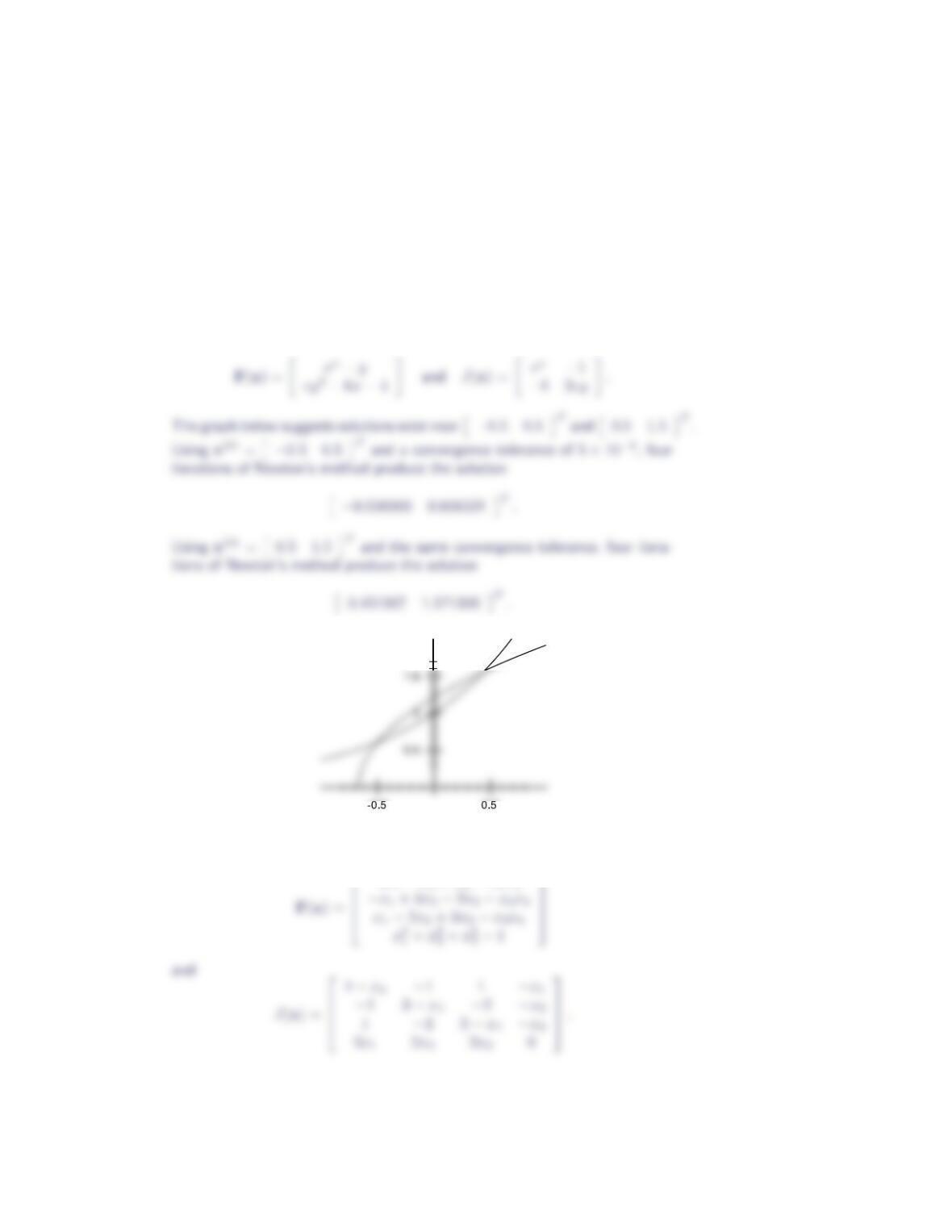
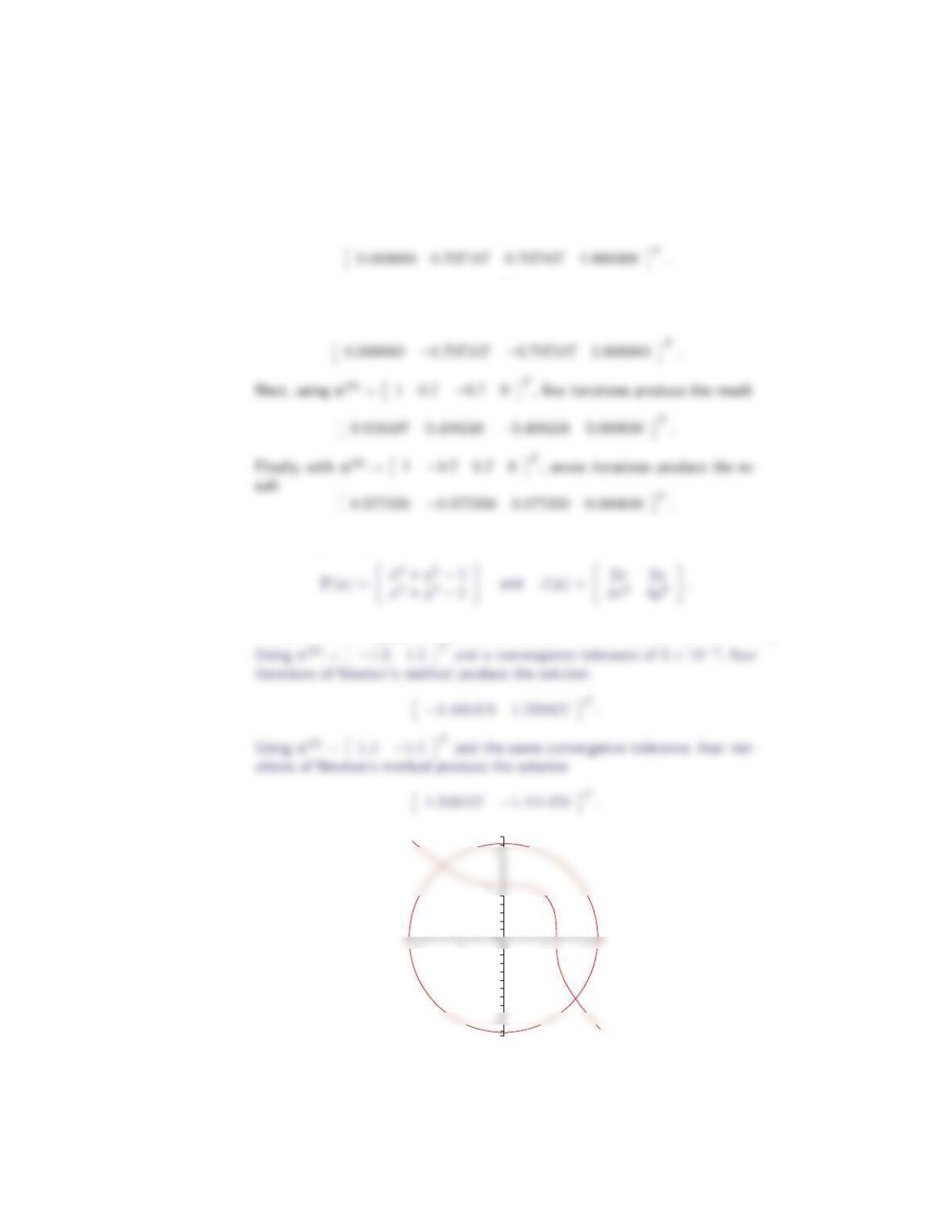
Using x(0) =0100Tand a convergence tolerance of 5×10⁻⁶, six
iterations of Newton’s method produce the solution
Using x(0) =0−0.7−0.7 1 Tand the same convergence tolerance,
three iterations of Newton’s method produce the solution
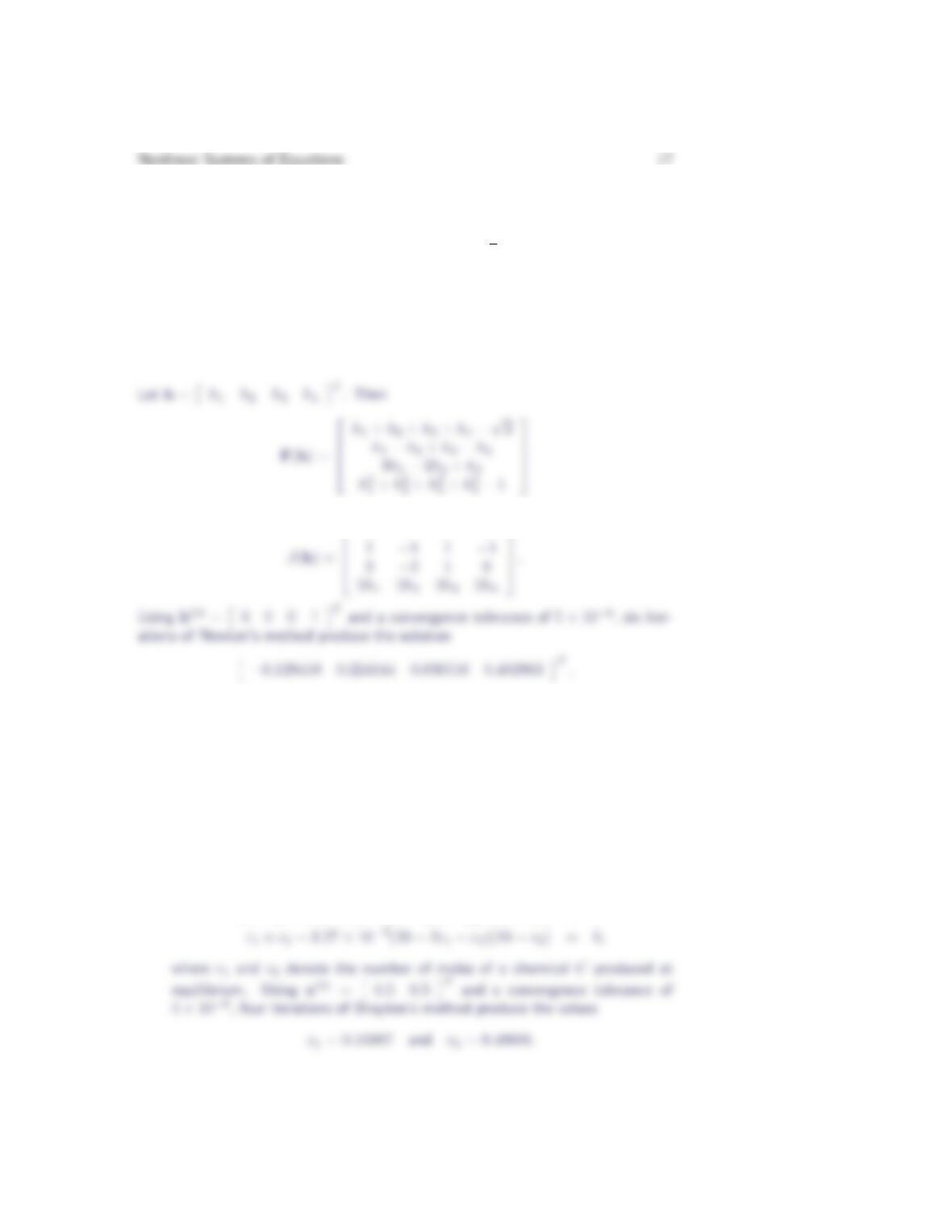
(c) Let x=x y T. Then
The graph below suggests solutions exist near −1.5 1.5Tand 1.5−1.5T.
1
x
-1
12. The filter coefficients – h1,h2,h3and h4– for the Daubechies wavelet of length
4 are solutions of the system
h1+h2+h3+h4=√2
h1−h2+h3−h4= 0
3h1−2h2+h3= 0
h2
1+h2
2+h2
3+h2
4= 1
Determine h1,h2,h3and h4.
and
1 1 1 1
13. (a) Repeat the “Coupled Reversible Chemical Reactions” application problem
from the text using Broyden’s method. Use the same initial vector and
convergence tolerance as were used in the example.
(b) Repeat the “Flow Distribution in a Pipe Flow Network” application prob-
lem from the text using Newton’s method. Use the same initial vector and
convergence tolerance as were used in the example.
(a) Recall that the equations are
c1+c2−1.63 ×10⁻⁴(20 −2c1−c2)2(10 −c1) = 0
18 Section 3.10
(b) Recall that the equations are
q1−q2−q6= 0;
14. Repeat the “Coupled Reversible Chemical Reactions” application problem chang-
ing the parameter values to A0= 5 moles, B0= 2 moles, D0= 1 mole,
k1= 4.25 ×10⁻²and k2= 0.286.
With A0= 5 moles, B0= 2 moles, D0= 1 mole, k1= 4.25×10⁻²and k2= 0.286,
15. Suppose 3 moles of chemical A, 2 moles of chemical Band 1 mole of chemical D
are injected into a one-liter reaction chamber and the coupled chemical reactions
A+ 2B⇀
↽2C
2A+D⇀
↽C
are allowed to proceed to equilibrium. The equilibrium constants for the reac-
tions are k1= 1.00 ×10⁻²and k2= 5.12 ×10⁻². How many moles of Care
present at equilibrium?
Nonlinear Systems of Equations 19
Let c1denote the number of moles of Cproduced by the first reaction and c2denote
the number of moles of Cproduced by the second reaction. From the equation for
An equilibrium constant measures the ratio of the concentrations of products to
where [·]denotes the concentration of the indicated chemical. Since the reaction
chamber has a volume of one liter, it follows that at equilibrium
Suppose A0= 3 moles, B0= 2 moles, D0= 1 mole, k1= 1.00 ×10⁻²and
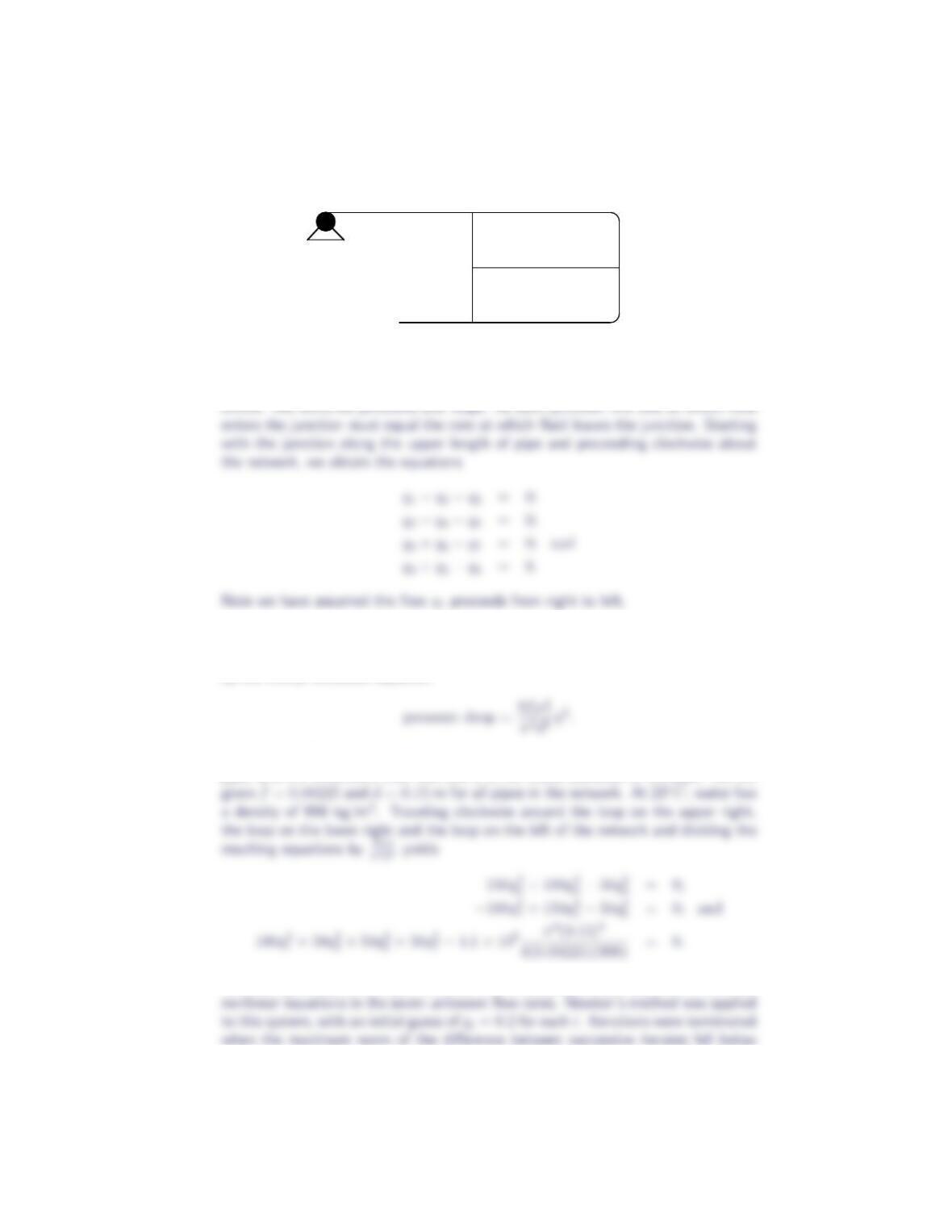
16. The diagram given below shows a pipe network through which water at 20◦Cis
flowing. Given that the pump produces an outlet pressure of 4.1×10⁵Pa and
that all of the pipes have a friction factor of f= 0.00225 and an inside diameter
of d= 0.15 m, determine the volumetric flow rates (measured in m3/s) through
each pipe in the network.
20 Section 3.10
q1
q2
q3
q4
q6
q5
q7
100 m
100 m
150 m
50 m
4.1 × 10⁵ Pa
50 m
50 m
150 m
The analysis of a pipe network such as this is similar to the analysis of an electric
Around any loop in the network, the sum of the pressure drops around the loop
must equal zero. The pressure drop along each pipe is due to friction and is given
by the Darcy-Weisbach equation
Here, fis the Darcy friction factor, ρis the density of the fluid, Lis the length of the
pipe, qis the volumetric flow rate and dis the inside diameter of the pipe. We are
Combining the junction equations with the loop equations produces a set of seven

Nonlinear Systems of Equations 21
5×10⁻⁶. A total of five iterations were required to compute
q=
0.1098
0.0000
0.1901
.