120 CHAPTER 3 │ PROBABILITY
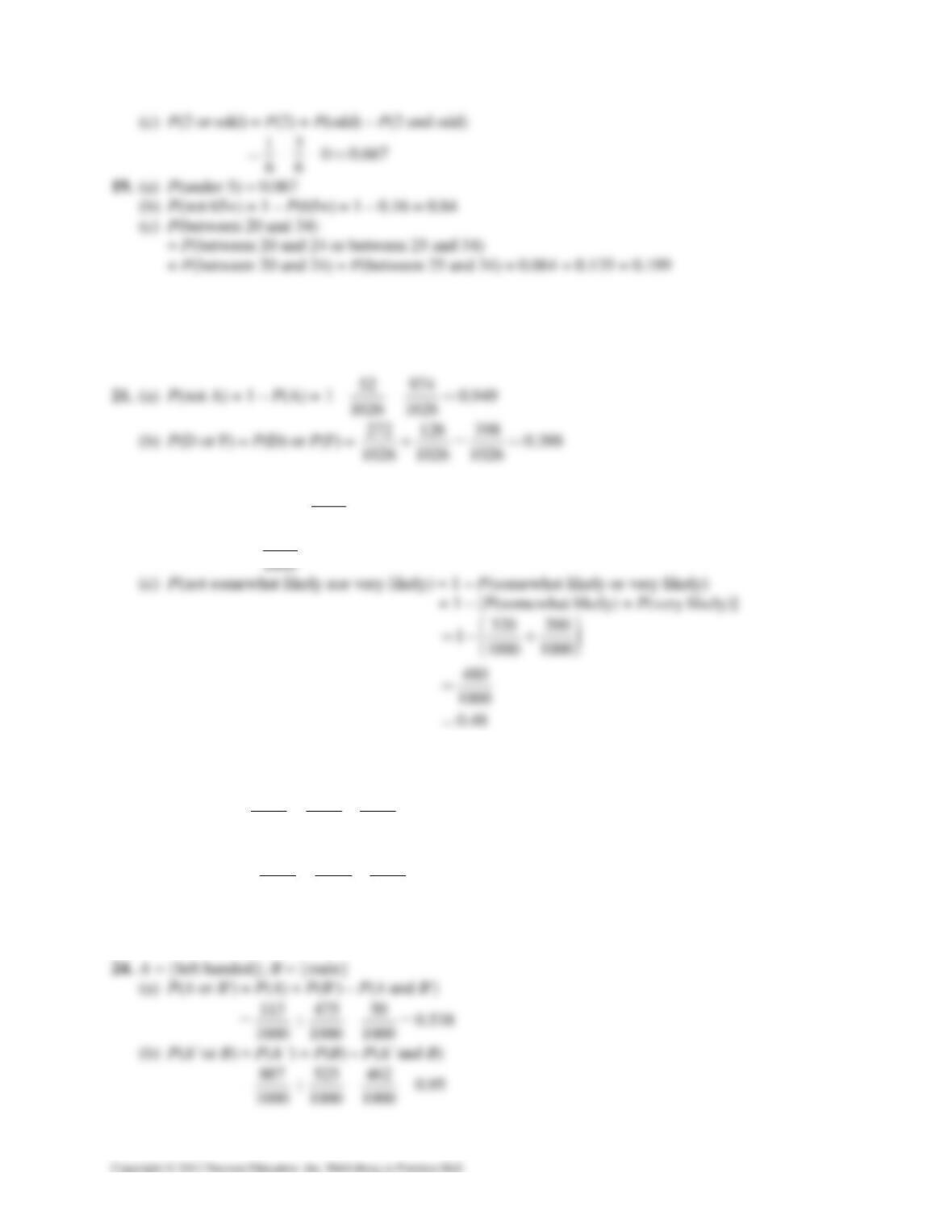
20. (a) P(2) = 0.298
(b) P(2 or more) = 1 – P(1) = 1 – 0.555=0.445
(c) P(between 2 and 5) = P(2) + P(3) + P(4) + P(5) = 0.298 + 0.076 + 0.047 + 0.014 = 0.435
22. (a) P(not at all likely) 190 0.19
1000
==
(b) P(not sure) 10 0.01
==
23. A = {male}; B = {nursing major}
(a) P(A or B) = P(A) + P(B) – P(A and B)
1255 1167 151 0.573
3964 3964 3964
=+−=
(b) P(A’ or B’) = P(A ‘) + P(B’) – P(A’ and B’)
2709 2797 1693 0.962
3964 3964 3964
=+−=
(c) P(A or B)0.573≈
(d) Not mutually exclusive. A male can be a nursing major.
CHAPTER 3 │ PROBABILITY 121
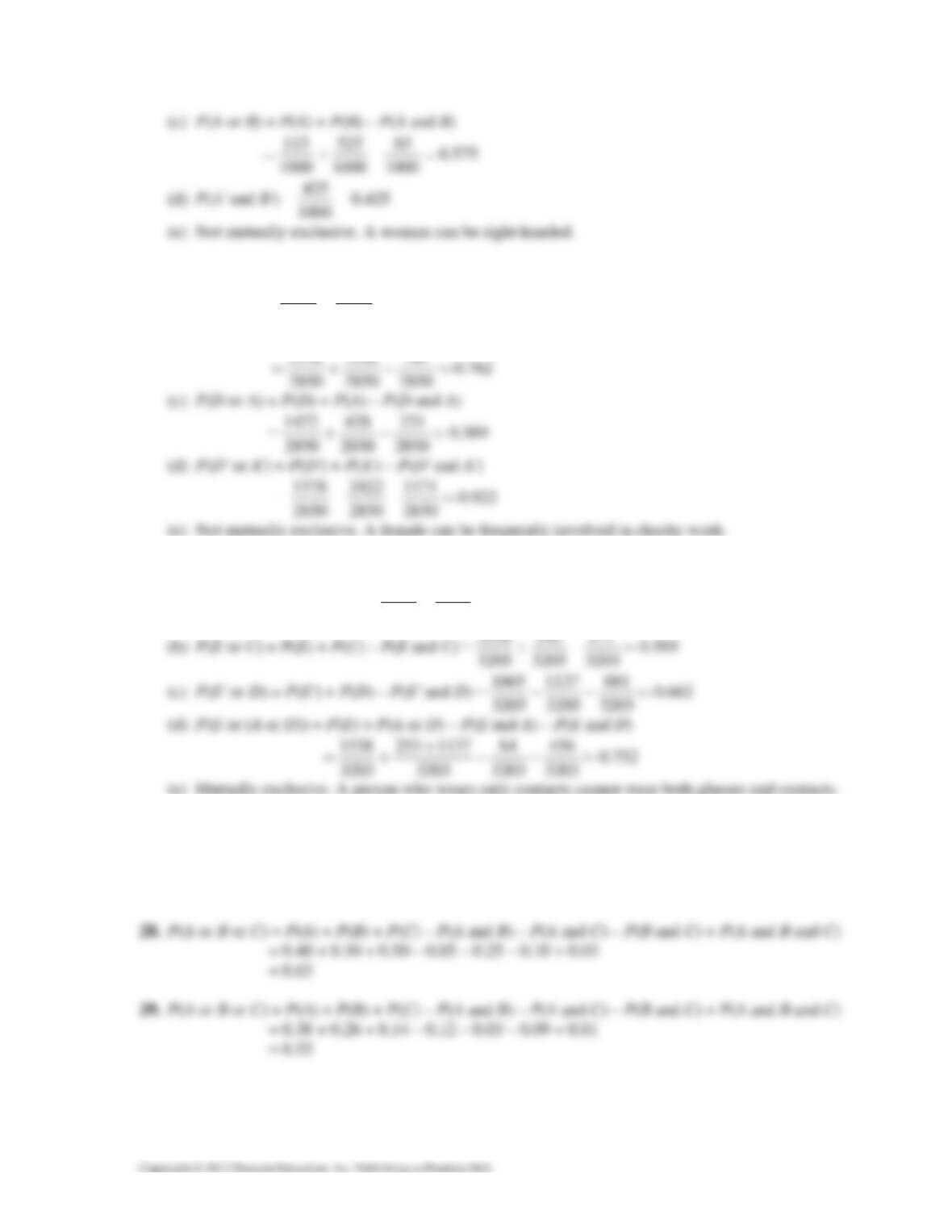
25. A = {frequently}; B = {occasionally}; C = {not at all}; D = {male}
(a) P(A or B)428 886 0.461
2850 2850
=+≈
(b) P(D’ or C) = P(D’) + P(C) – P(D’ and C)
26. A = {only contacts}, B = {only glasses}, C = {both}, D = {neither}, E = {male}
(a) P(A or B) = P(A) + P(B)253 1268 0.475
3203 3203
=+≈
27. Answers will vary.
Conclusion: If two events, A and B, are independent, P(A and B) = () ()PA PB⋅. If two events are
mutually exclusive, P (A and B) = 0. The only scenario when two events can be independent and
mutually exclusive is if P(A) = 0 or P(B) = 0.
122 CHAPTER 3 │ PROBABILITY
30. If events A, B, and C are not mutually exclusive, P(A and B and C) must be added because
P(A) + P(B) + P(C) counts the intersection of all three events three times and
– P(A and B) – P(A and C) – P(B and C) subtracts the intersection of all three events three times.
So, if P(A and B and C) is not added at the end, it will not be counted.
3.4 ADDITIONAL TOPICS IN PROBABILITY AND COUNTING
3.4 Try It Yourself Solutions
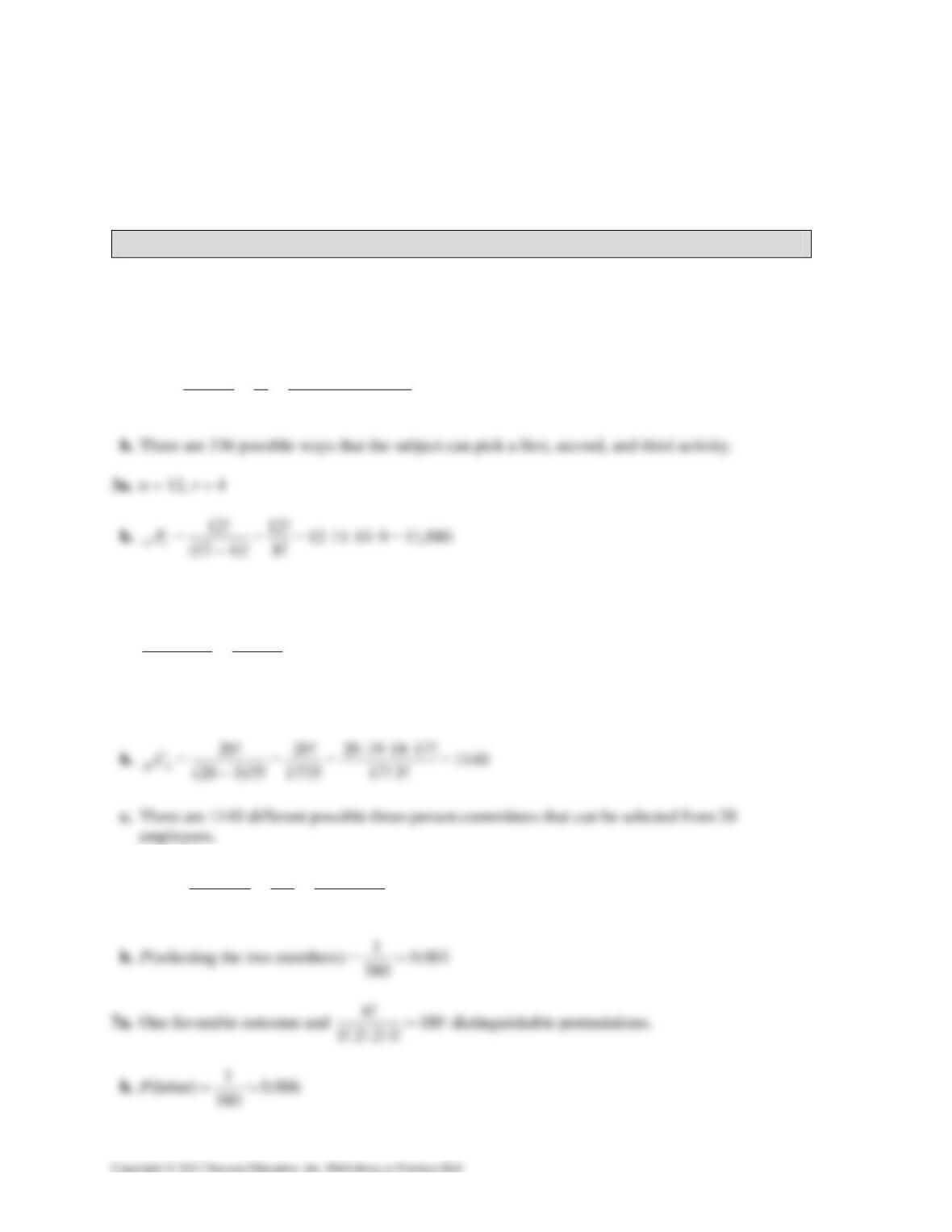
1a. n = 8 teams b. 8! = 40,320
2a. 83
8! 8! 87654321 8 7 6 336
(8 3)! 5! 54321
P⋅⋅⋅⋅⋅⋅⋅
=== =⋅⋅=
−⋅⋅⋅⋅
4a. n = 20, 16n=, 29n
=
, 35n
=
b.
123
!20!
77,597,520
!!!6!9!5!
n
nn n==
⋅⋅ ⋅⋅
5a. n = 20, r = 3
6a. 20 2
20! 20! 20 19 18! 20 19 380
(20 2)! 18! 18!
P⋅⋅
=== =⋅=
−
CHAPTER 3 │ PROBABILITY 123
3.4 EXERCISE SOLUTIONS
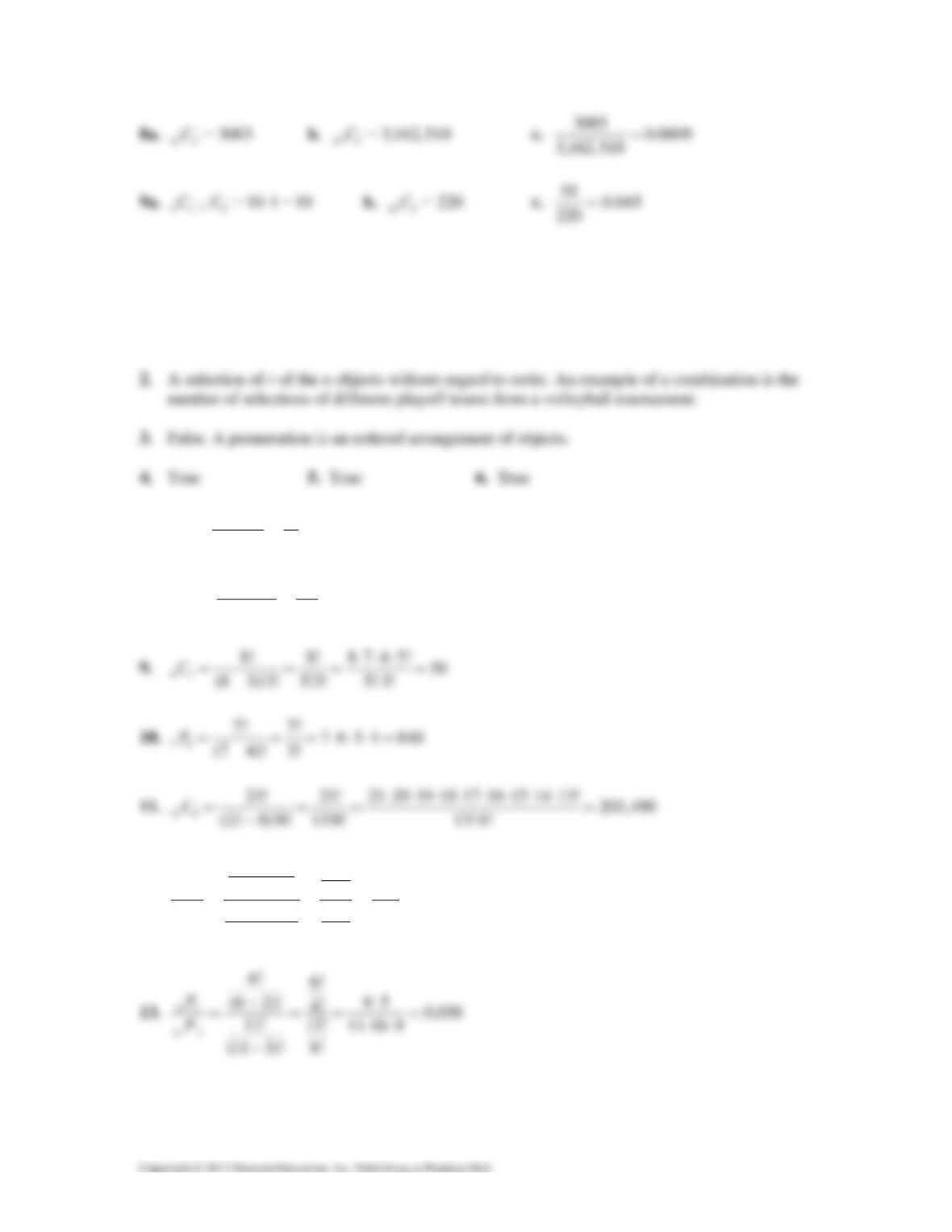
1. The number of ordered arrangements of n objects taken r at a time. An example of a permutation
is the number of seating arrangements of you and three friends.
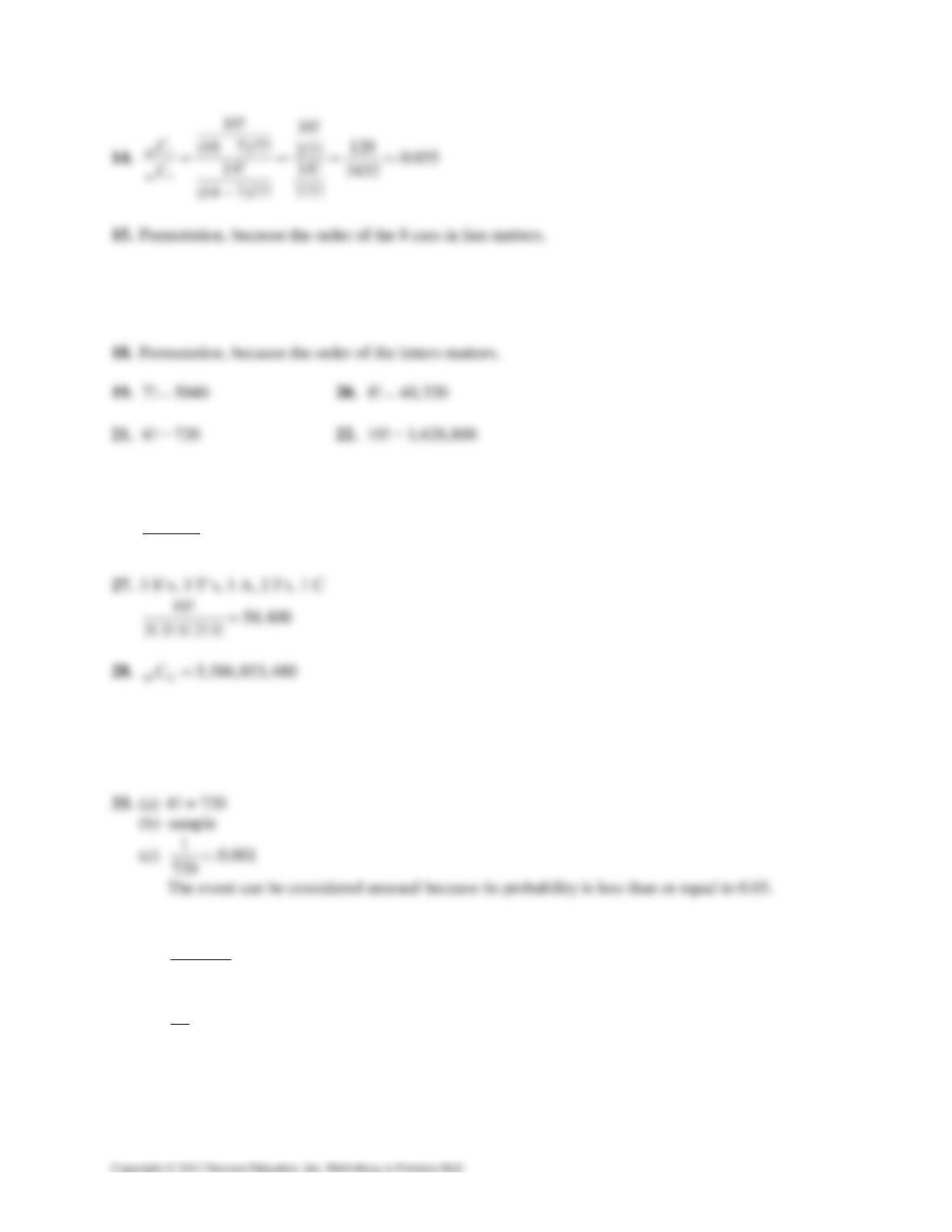
7. 95
9! 9! 98765 15,120
(9 5)! 4!
P===⋅⋅⋅⋅=
−
8. 16 2
16! 16! 16 15 240
(16 2) ! 14!
P===⋅=
−
12. 84
12 6
8! 8!
70
(8 4)!4! 4!4! 0.076
12! 12! 924
(12 6)!6! 6!6!
C
C
−
===≈
−
124 CHAPTER 3 │ PROBABILITY
16. Combination, because the order of the committee members does not matter.
17. Combination, because the order of the captains does not matter.
23. 52 6 20,358,520C= 24. 4! 24=
25. 22! 320,089,770
4!10! 8! =
⋅⋅ 26.
20 4 4845C=
29. 13 2
10 8 6240C⋅⋅ = 30. 10 2
12 6 3240C⋅⋅=
31. 5175 5 86,296,950CC⋅= 32.
8242 8 3,304,845,180CC⋅=
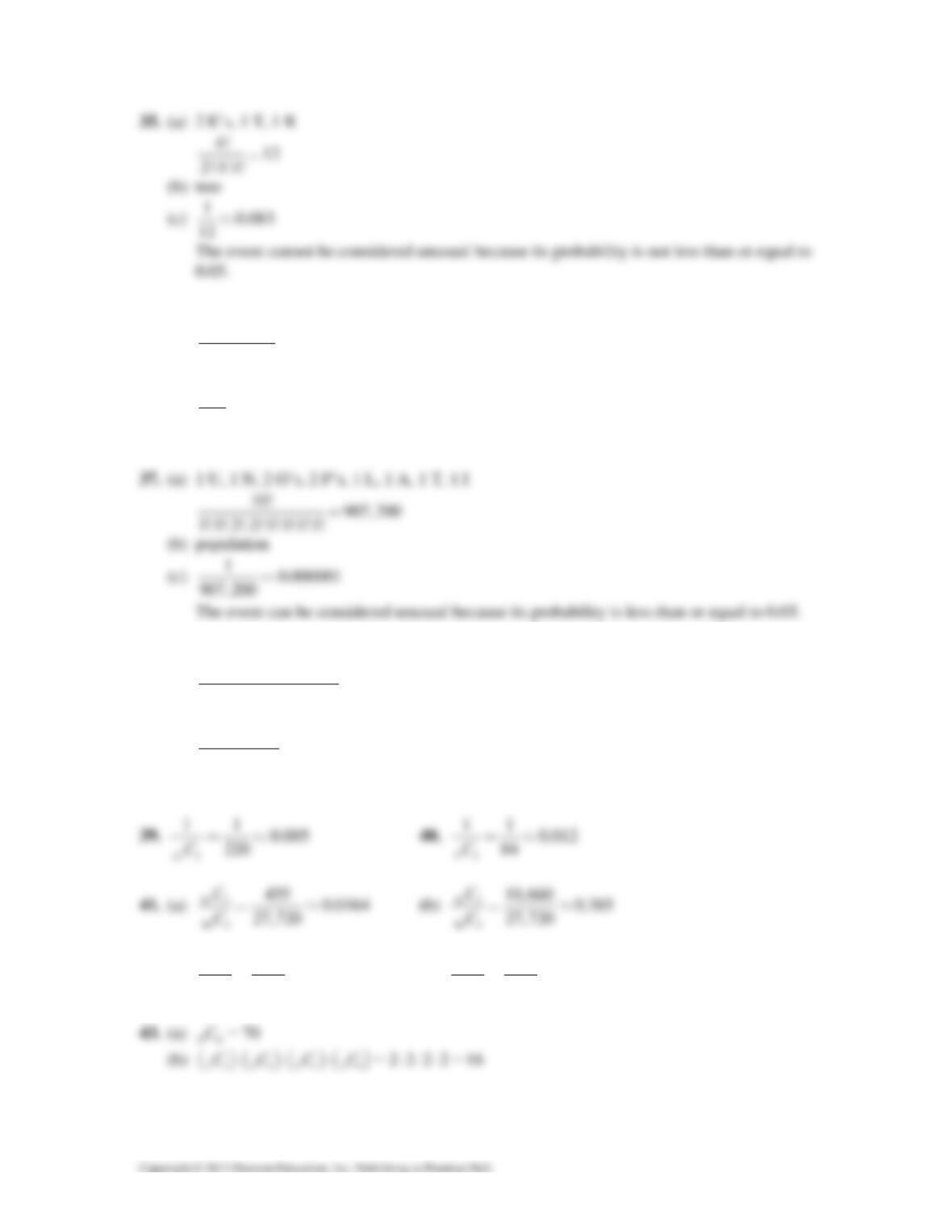
34. (a) 1 N, 2 E’s, 1 V, 1 T
5! 60
1! 2! 1! 1! =
⋅⋅⋅
(b) event
(c)
10.017
60 =
The event can be considered unusual because its probability is less than or equal to 0.05.
CHAPTER 3 │ PROBABILITY 125
36. (a) 1 R, 1 N, 1 C, 1 T, 2 E’s
6! 360
1! 1! 1! 1! 2! =
⋅⋅⋅⋅
(b) center
(c)
10.003
360 ≈
The event can be considered unusual because its probability is less than or equal to 0.05.
38. (a) 1 S, 3 I’s, 1 D, 2 T’s, 1 B, 1 O, 1 U, 1 R, 1 N
12! 39,916,800
1! 3! 1! 2! 1! 1! 1! 1! 1! =
⋅ ⋅⋅ ⋅⋅⋅⋅⋅
(b) distribution
(c) 10.00000003
39,916,800 ≈
The event can be considered unusual because its probability is less than or equal to 0.05.
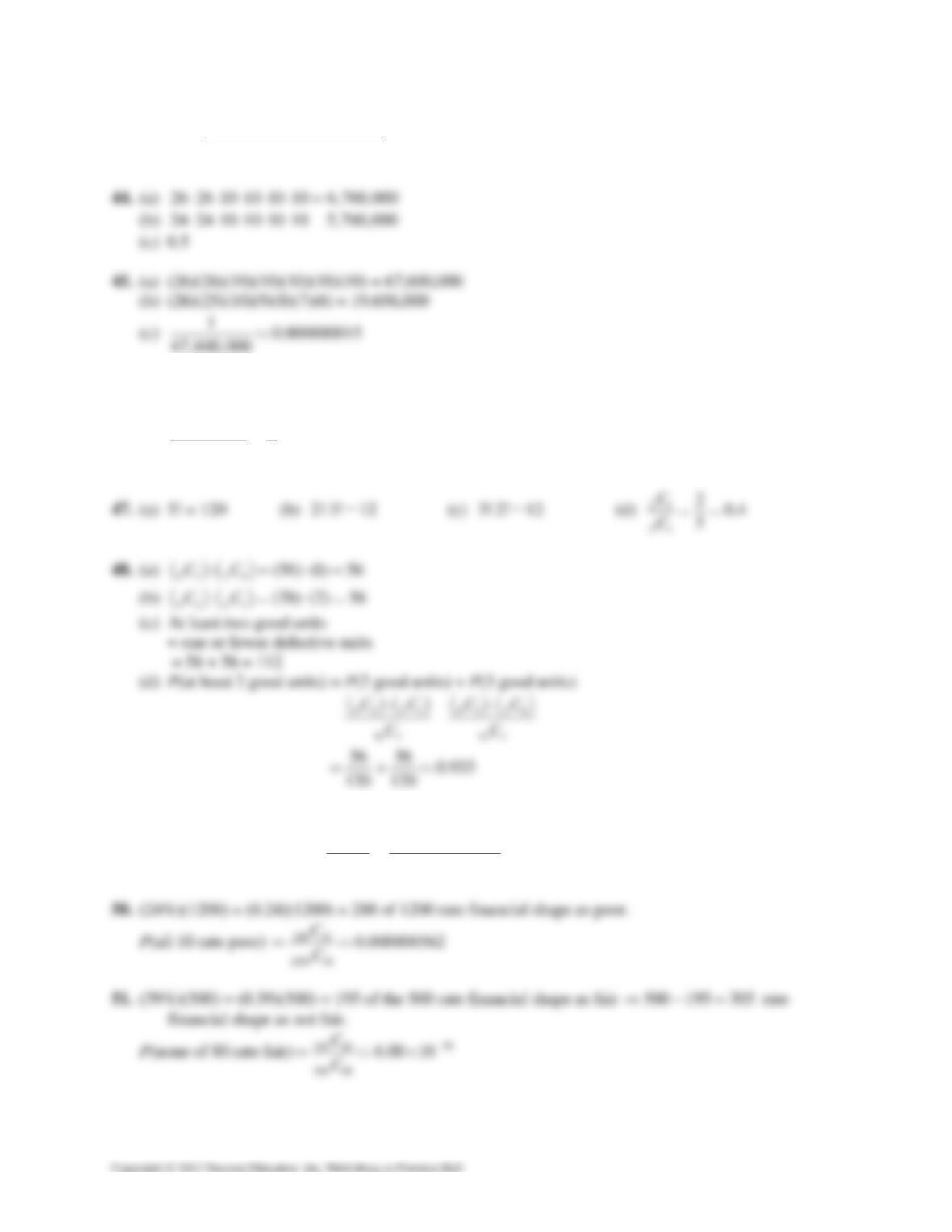
42. (a) 64
14 4
15 0.015
1001
C
C=≈ (b)
84
14 4
70 0.070
1001
C
C=≈
126 CHAPTER 3 │ PROBABILITY
(c)
()()()()
20 20 22 22
42
84
0.086
CCCC
C
C
⎡⎤
⋅⋅⋅
⎢⎥
≈
⎢⎥
⎣⎦
46. (a) (10)(10)(10) = 1000
(b) (8)(10)(10) = 800
(c)
(8)(10)(5) 1 0.5
(8)(10)(10) 2
==
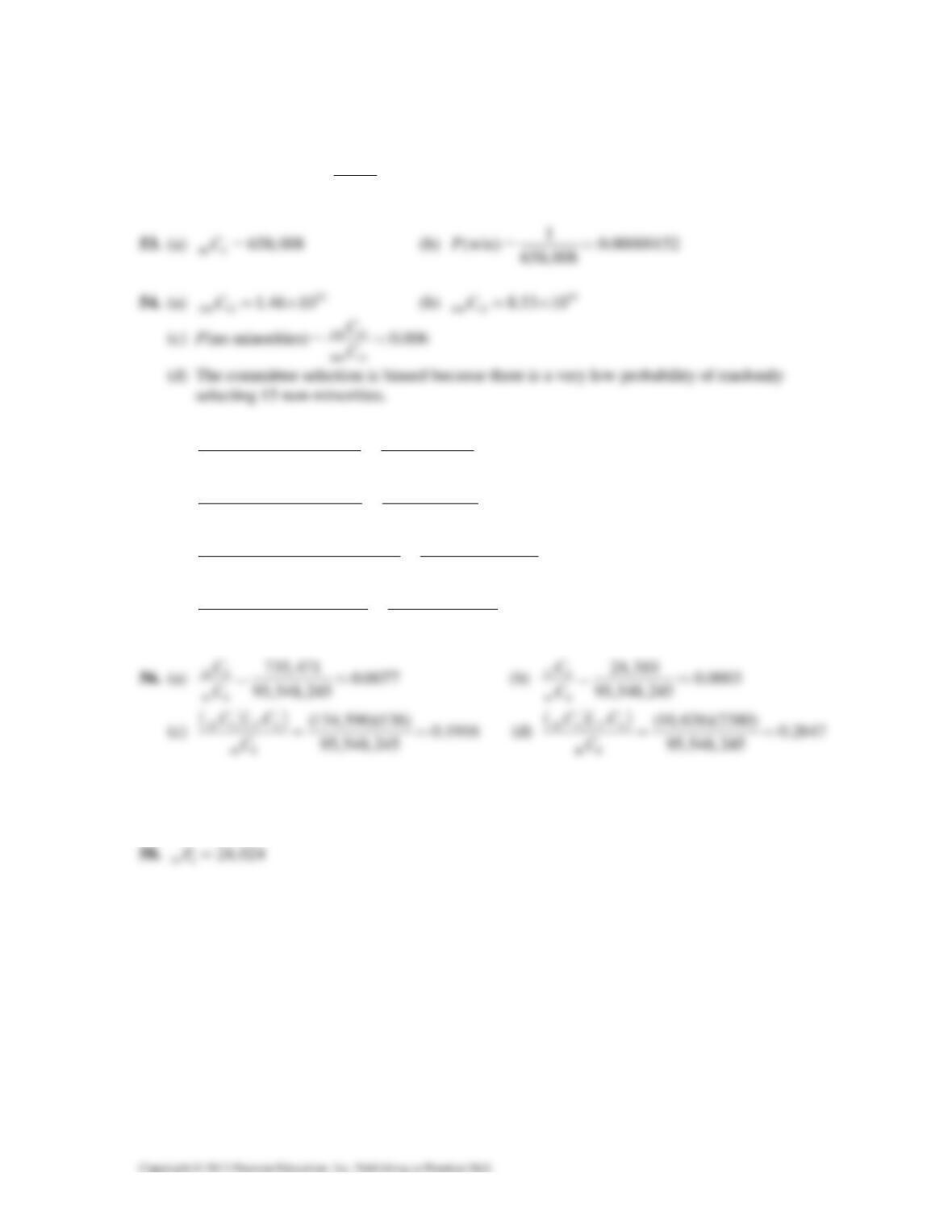
49. (7%)(1200) = (0.07)(1200) = 84 of the 1200 rate financial shape as excellent.
P(all four rate excellent) 84 4
1200 4
1,929,501 0.000022
85,968,659,700
C
C
== ≈
CHAPTER 3 │ PROBABILITY 127
52. (28%)(500) = (0.28)(500) = 140 of 500 rate financial shape as good 500 140 360⇒−= rate
financial shape as not good.
P(none of 55 rate good) 360 55
500 55
0.00000000401
C
C≈
55. (a)
()()()()
131 44 121 41
52 5
(13)(1)(12)( 4) 0.0002
2,598,960
CC CC
C=≈
(b)
()()()()
13 1 4 3 12 1 4 2
52 5
(13)(4)(12)(6) 0.0014
2,598,960
CC CC
C=≈
(c)
( )()( )()()
131 43 122 41 41
52 5
(13)(4)(66)(4)(4) 0.0211
2,598,960
CC C CC
C=≈
(d)
()()()()
132 131 131 131
52 5
(78)(13)(13)(13) 0.0659
2,598,960
C CCC
C=≈
57. 14 4 1001C= possible 4 digit arrangements if order is not important.
Assign 1000 of the 4 digit arrangements to the 13 teams since 1 arrangement is excluded.
128 CHAPTER 3 │ PROBABILITY
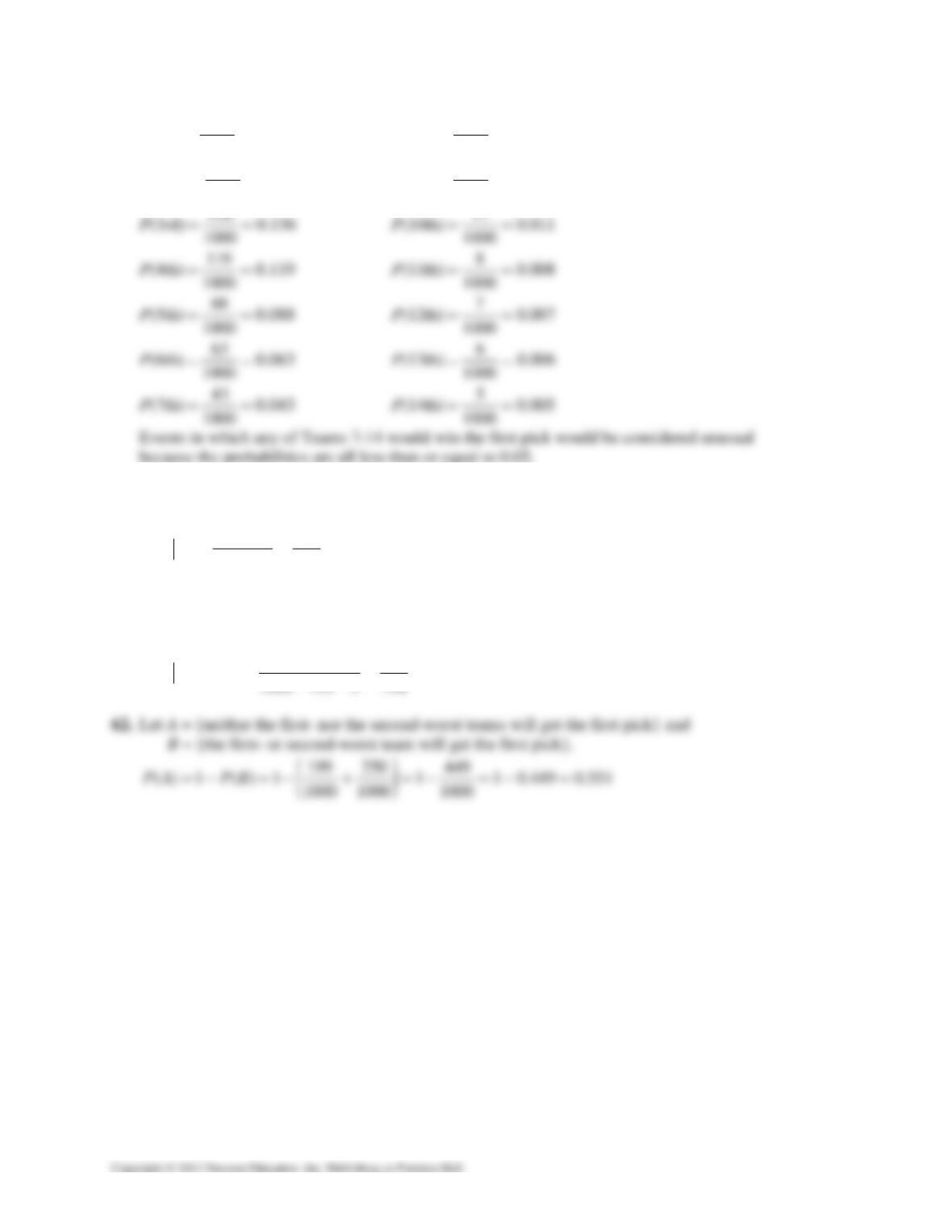
59. P(1st) 250 0.250
1000
== P(8th) 28 0.028
1000
==
P(2nd) 199 0.199
1000
== P(9th) 17 0.017
1000
==
60. Let A = {team with the worst record wins second pick} and B = {team with the best record,
ranked 14th, wins first pick}.
250 250
( ) 0.251
1000 5 995
PAB ==≈
−
61. Let A = {team with the worst record wins third pick} and
B = {team with the best record, ranked 14th, wins first pick} and
C = {team ranked 2nd wins the second pick}.
250 250
( and ) 0.314
PAB C ==≈
CHAPTER 3 │ PROBABILITY 129
CHAPTER 3 REVIEW EXERCISE SOLUTIONS
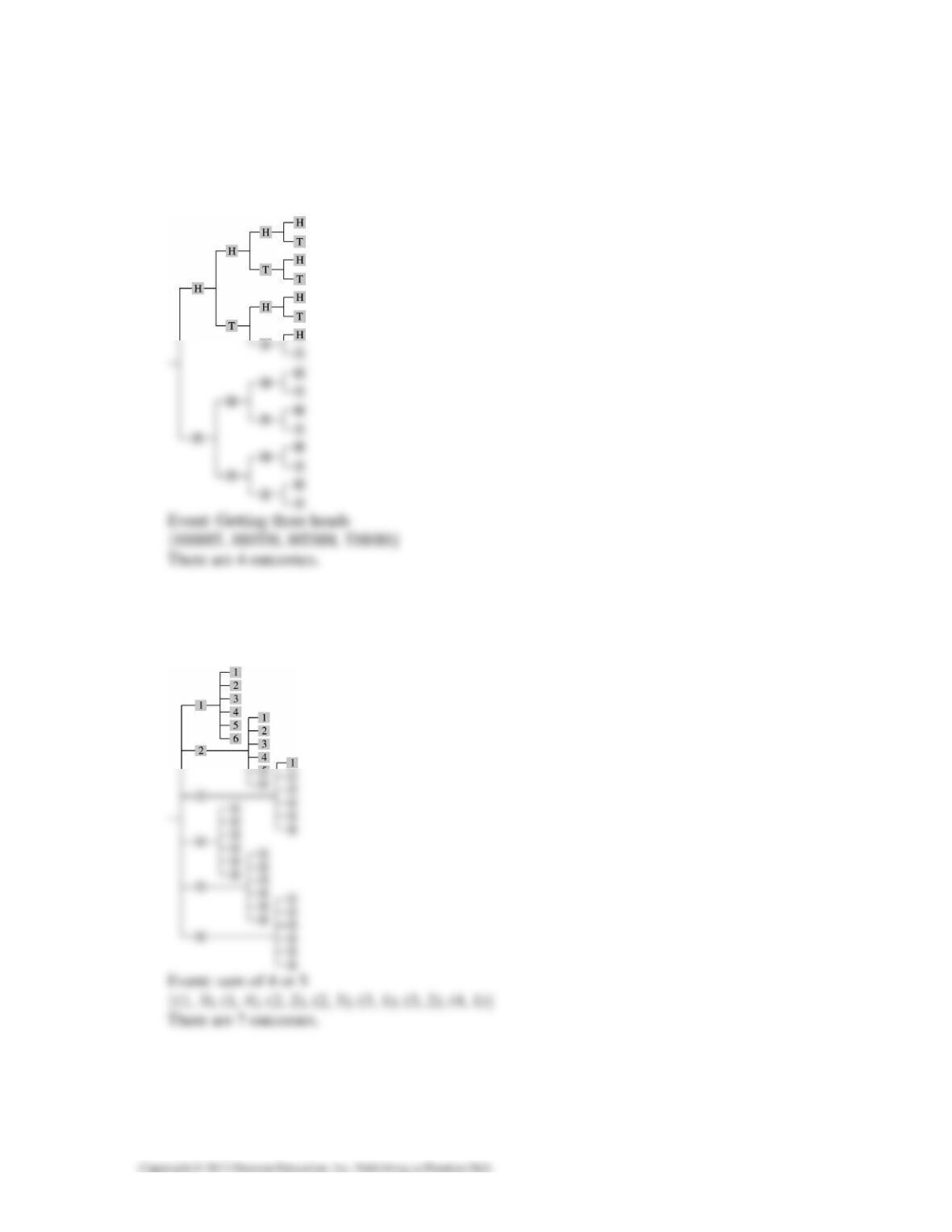
1. Sample space:
{HHHH, HHHT, HHTH, HHTT, HTHH, HTHT, HTTH, HTTT, THHH, THHT, THTH,
THTT, TTHH, TTHT, TTTH, TTTT}
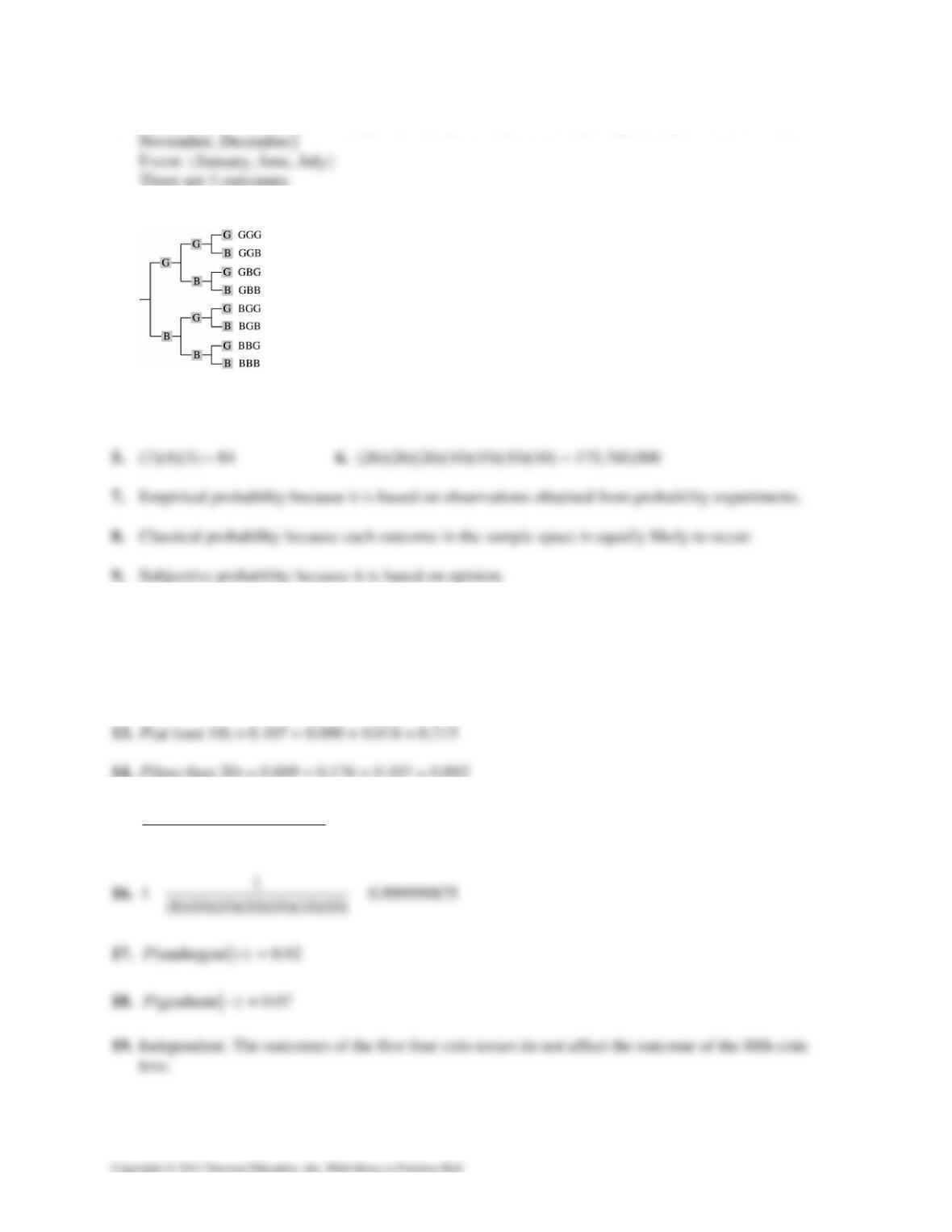
2. Sample space:
{(1, 1), (1, 2), (1, 3), (1, 4), (1, 5), (1, 6), (2, 1), (2, 2,), (2, 3), (2, 4), (2, 5), (2, 6), (3, 1), (3, 2),
(3, 3), (3, 4), (3, 5), (3, 6), (4, 1), (4, 2), (4, 3), (4, 4), (4, 5), (4, 6), (5, 1), (5, 2), (5, 3), (5, 4),
(5, 5), (5, 6), (6, 1), (6, 2), (6, 3), (6, 4), (6, 5), (6, 6)}
130 CHAPTER 3 │ PROBABILITY
3. Sample space: {January, February, March, April, May, June, July, August, September, October,
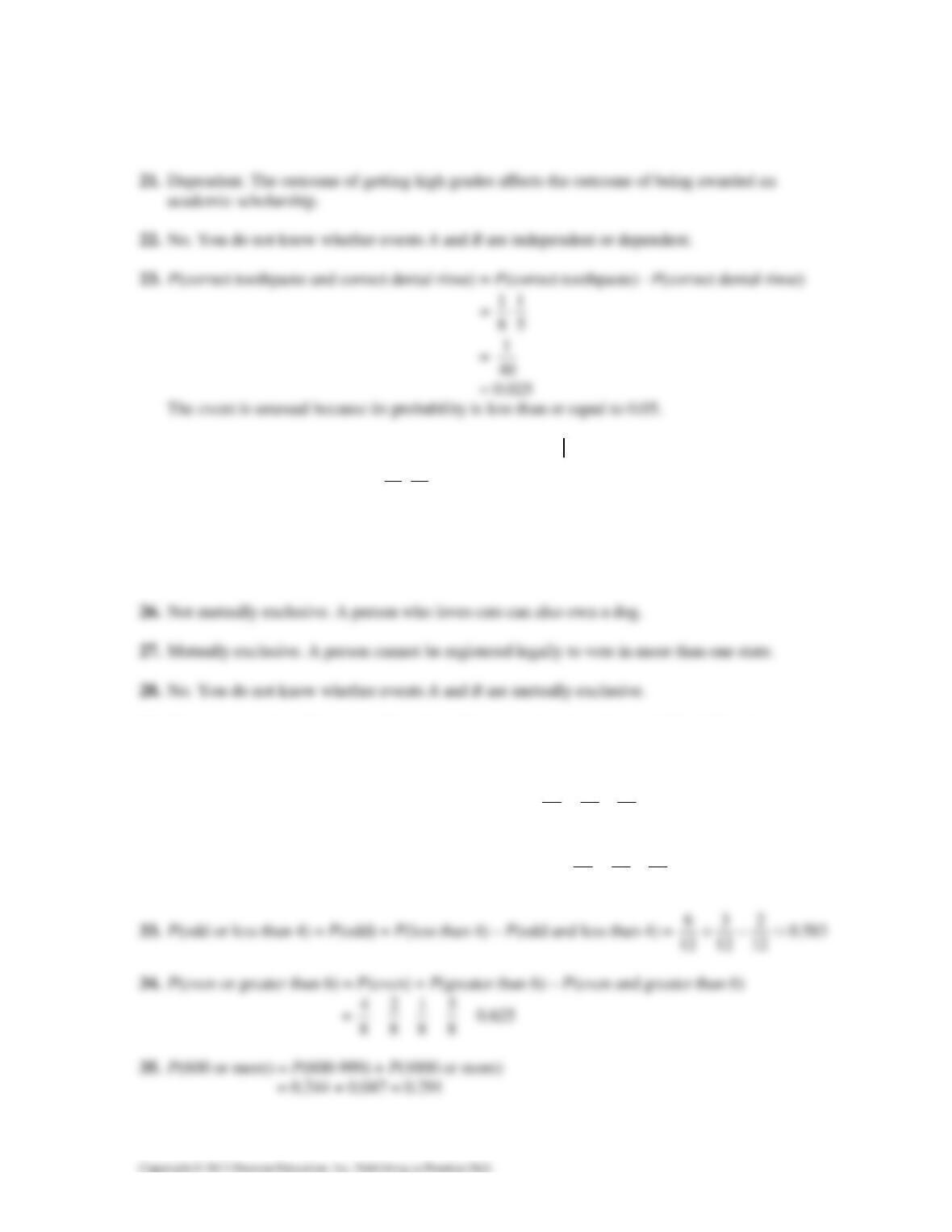
4. Sample space: {GGG, GGB, GBG, GBB, BGG, BGB, BBG, BBB}
Event: The family has two boys.
{BGB, BBG, GBB}
There are 3 outcomes.
10. Empirical probability because it is based on observations obtained from probability experiments.
11. Classical probability because each outcome in the sample space is equally likely to occur.
12. Empirical probability because it is based on observations obtained from probability experiments.
15. 7
11.25 10
(8)(10)(10)(10)(10)(10)(10)
−
=×
CHAPTER 3 │ PROBABILITY 131
20. Dependent. The outcome of taking a driver’s education course affects the outcome of passing the
driver’s license exam.
24. P(black and (blue or white)) = P(black) · P(blue or white black)
= 612
18 17
⋅
0.235≈
The event is not unusual because its probability is not less than or equal to 0.05.
25. Mutually exclusive. A jelly bean cannot be both completely red and completely yellow.
29. P(home or work) = P(home) + P(work) – P(home and work) = 0.44 + 0.37 – 0.21 = 0.6
30. P(silver or SUV) = P(silver) + P(SUV) – P(silver and SUV) = 0.19 + 0.22 – 0.16 = 0.25
31. P(4-8 or club) = P(4-8) + P(club) – P(4-8 and club) = 20 13 5 0.538
52 52 52
+−≈
32. Pfired or queen) = Pfired) + P(queen) – P(red and queen) = 26 4 2 0.538
52 52 52
+−≈
132 CHAPTER 3 │ PROBABILITY
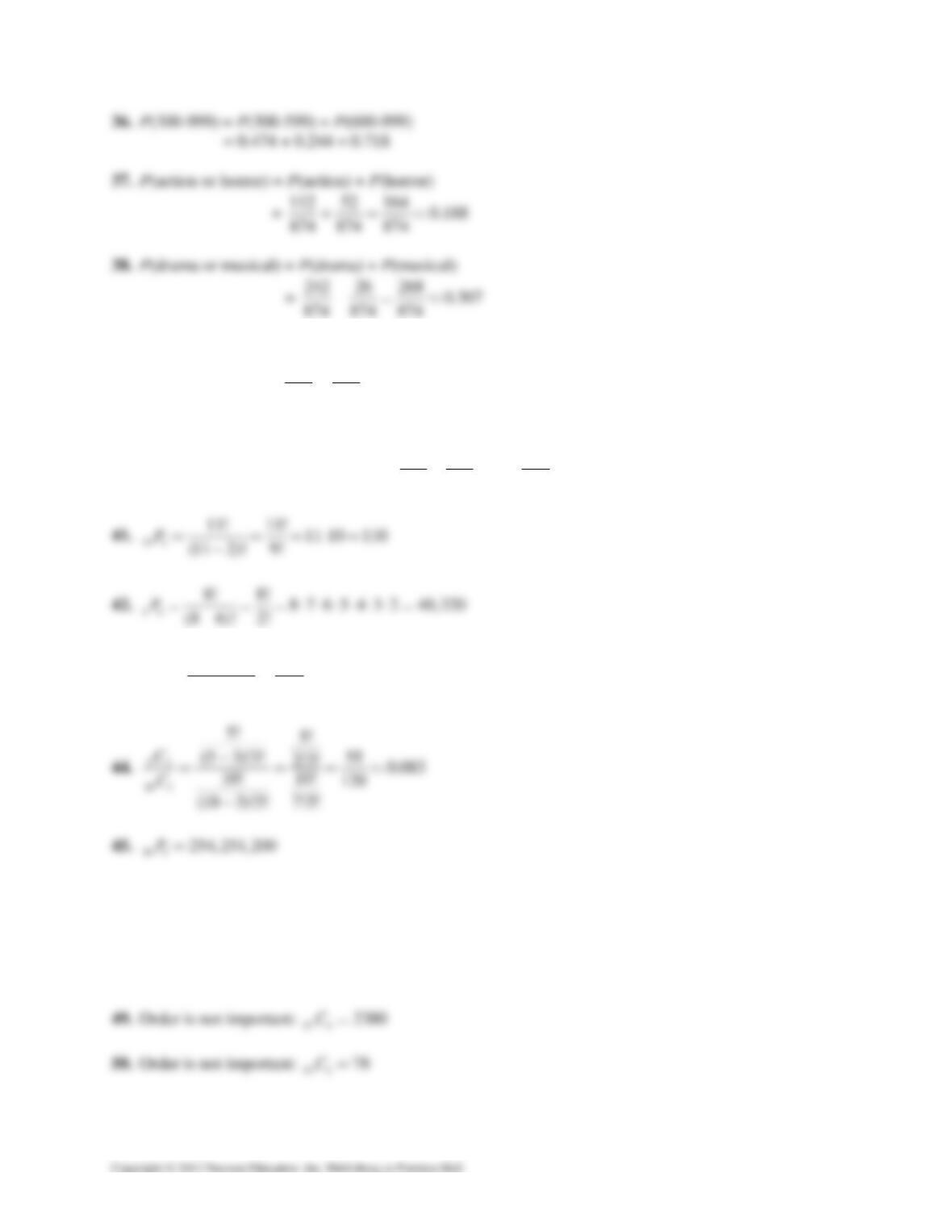
39. P(not comedy) = 1 – P(comedy)
= 260 614
10.703
874 874
−=≈
40. P(not science fiction or action) = 1 – P(science fiction or action)
= 95 112 207
1 1 0.763
874 874 874
⎛⎞
⎟
⎜
−+=−≈
⎟
⎜⎟
⎜
⎝⎠
43. 74
7! 7! 35
(7 4)!4! 3!4!
C===
−
46. 38 25 5, 414,950,296C=
47. Order is important: 15 3 2730P=
48. 5! = 120
CHAPTER 3 │ PROBABILITY 133
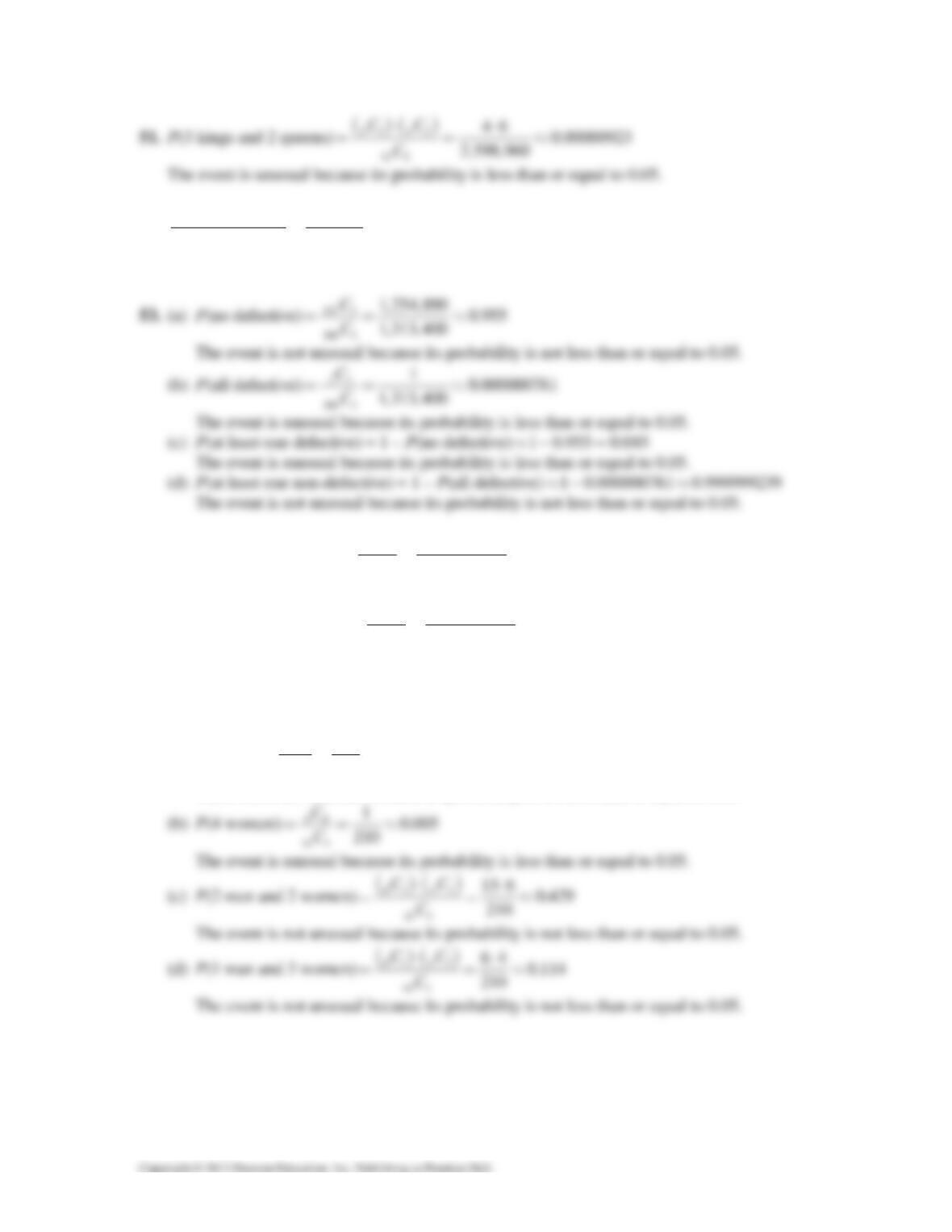
52. 11
0.00000643
(23)(26)(26)(10) 155,480
=≈
The event is unusual because its probability is less than or equal to 0.05.
54. (a) P(no winning tickets) 346 4
350 4
586,862,710 0.955
614,597,725
C
C
== ≈
The event is not unusual because its probability is not less than or equal to 0.05.
(b) P(all winning tickets) 44
350 4
10.000000002
614,597,725
C
C
== ≈
(c) P(at least one winner) = 1 – P(no winning tickets) 1 0.955 0.045≈− =
The event is unusual because its probability is less than or equal to 0.05.
(d) P(at least one non-winner) = 1 – P(all winning tickets) 1 0.000000002 0.999999998≈− =
The event is not unusual because its probability is not less than or equal to 0.05.
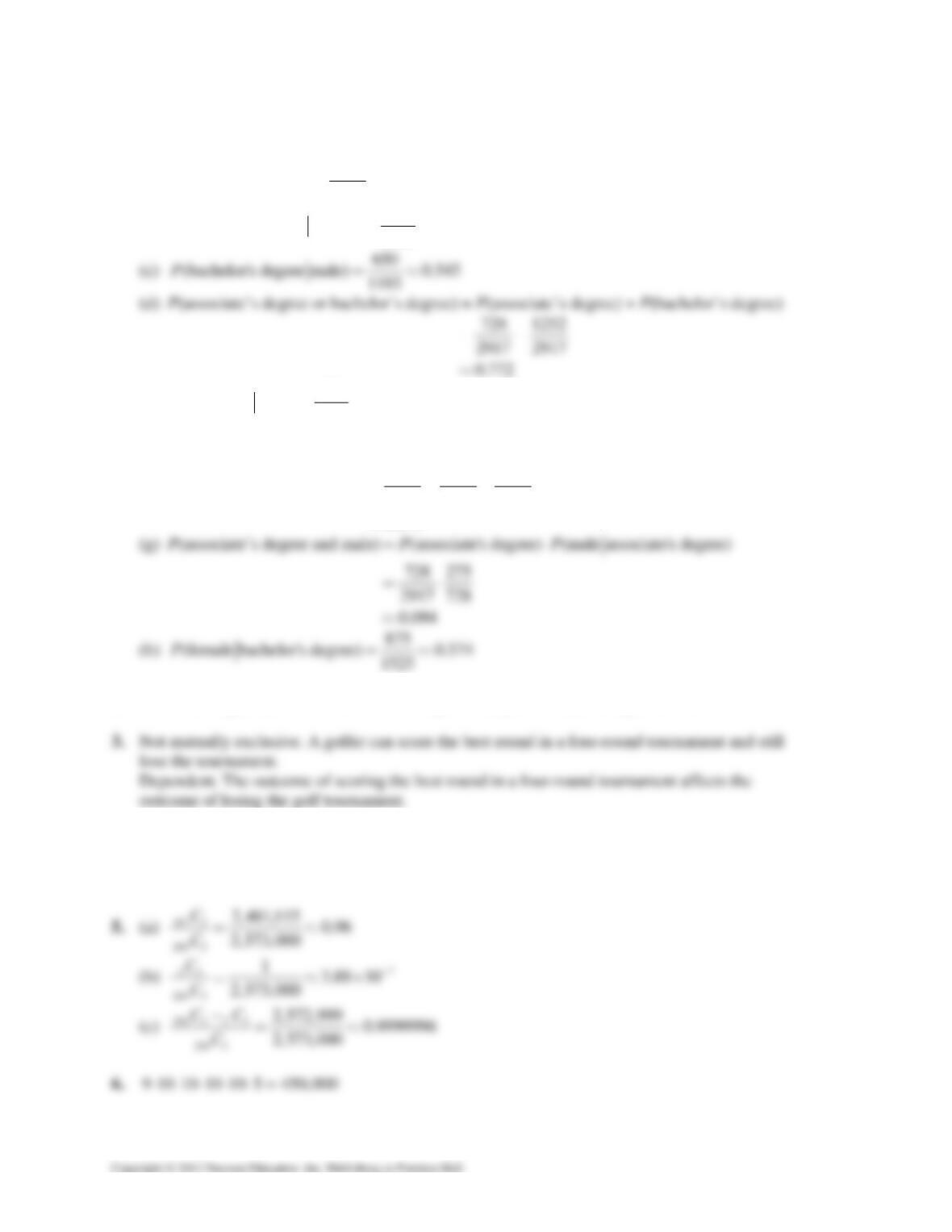
55. (a) P(4 men) 64
10 4
15 0.071
210
C
C
==≈
The event is not unusual because its probability is not less than or equal to 0.05.
134 CHAPTER 3 │ PROBABILITY
CHAPTER 3 QUIZ SOLUTIONS
1. (a) P(bachelor’s degree) 1525 0.523
2917
=≈
(b) 875
(bachelor‘s degree female) 0.508
1724
P=≈
(e) 30
(doctorate male) 0.025
1193
P=≈
(f) P(master’s degree or female) = P(master’s degree) + P(female)
– P(master’s degree and female)
604 1724 366
2917 2917 2917
0.673
=+−
≈
2. The event in part (e) is unusual because its probability is less than or equal to 0.05.
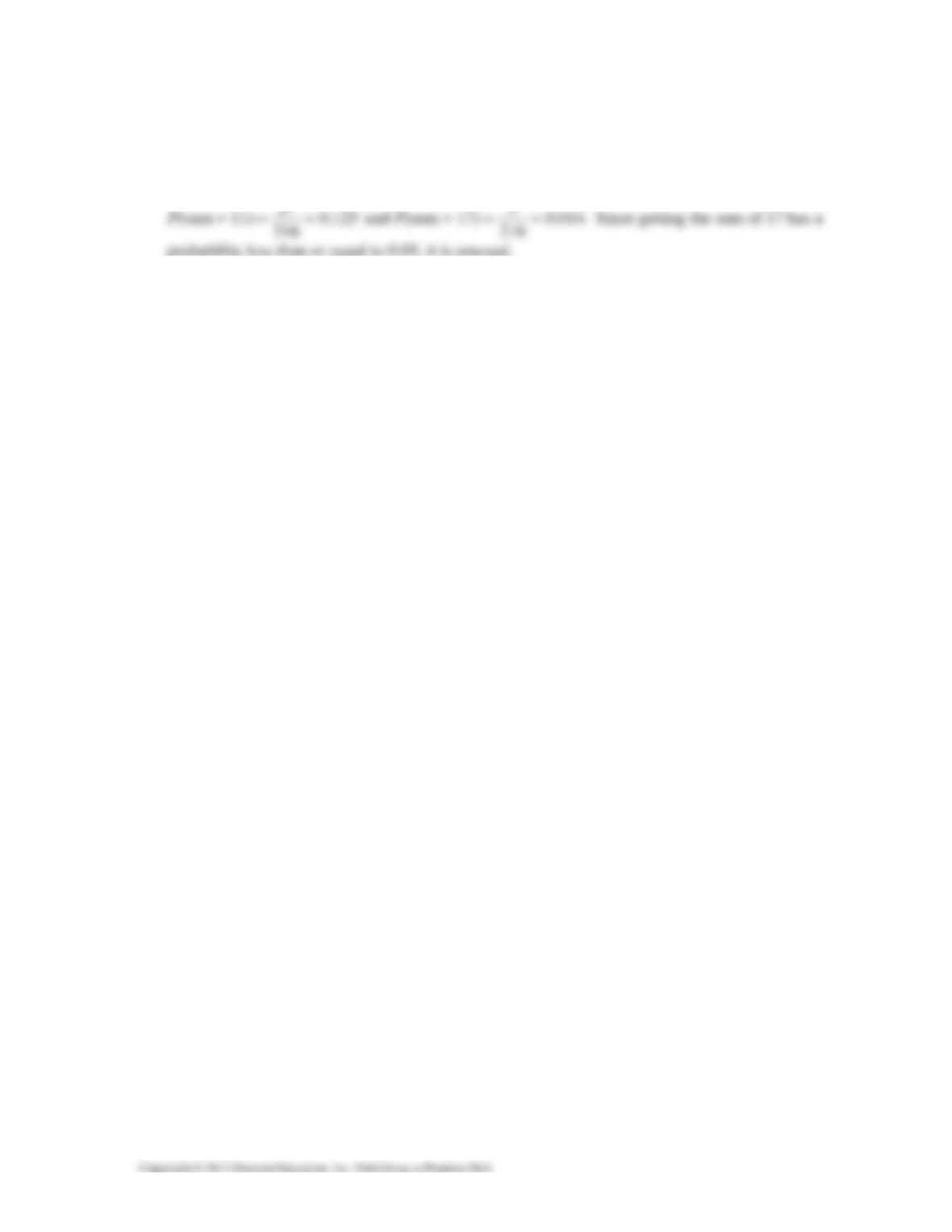
4. (a) 247 3 2, 481,115C=
(b) 33 1C=
(c)
250 3 3 3 2,573,000 1 2,572,999CC−= −=
CHAPTER 3 │ PROBABILITY 135
7. 30 4 657,720P=
8. There are 27 ways of getting a sum of 11 and 3 ways of getting a sum of 17, out of 216 different
outcomes when you roll three dice. Thus the corresponding probabilities