Chapter 3
Lecture Notes
Chapter theme: Managers need to assign costs to products
to facilitate external financial reporting and internal
decision making. This chapter illustrates an absorption
costing approach to calculating product costs known as
job-order costing.
I. Job-order costing: an overview
A. Job-order costing systems are used when:
i. Many different products are produced each
period.
B. Examples of companies that would use job-order
costing include:
2
1
II. Job-order costing−an example
A. Types of manufacturing costs that are assigned to
products using a job-order costing system:
i. Direct costs
ii. Indirect costs
B. The job cost sheet − The accounting department relies
upon a job cost sheet for tracking the direct and
indirect costs associated with a given job.
i. An overview of a job cost sheet for a hypothetical
company called PearCo:
ii. Measuring direct materials cost
1. Once a sales order has been received and a
production order issued, the Production
Department prepares a materials requisition
form to specify the type, quantity, and total
2. The Accounting Department records the total
direct material cost (e.g., $116) on the
appropriate job cost sheet. Notice, the
material requisition number (e.g., X7-
6890) is included on the job cost sheet to
provide easy access to the source document.
iii. Measuring direct labor costs
8
iv. Computing predetermined overhead rates
1. An allocation base, such as direct labor
hours, direct labor dollars, or machine hours,
is used to assign manufacturing overhead to
products. Allocation bases are used because:
a. It is impossible or difficult to trace
these costs to particular jobs (i.e.,
2. The predetermined overhead rate is
calculated by dividing the estimated amount
of manufacturing overhead for the coming
(1). Actual overhead costs for the
period are not known until the
end of the period, thus
misleading decision makers.
3. Predetermined overhead rates are calculated
using a four-step process.
(1). The first step is to estimate the
total amount of the allocation
base required for next period’s
estimated level of production.
(3). The third step is to use a cost
formula to estimate the total
manufacturing overhead cost
v. Applying manufacturing overhead
Learning Objective 2: Apply overhead costs to jobs
using a predetermined overhead rate.
16
1. Manufacturing overhead is applied to jobs
using the predetermined overhead rate
multiplied by the actual amount of the
allocation base used completing the job (this
is called a normal costing system). For
example, assume PearCo:
a. Applies overhead to jobs based on
direct labor hours.
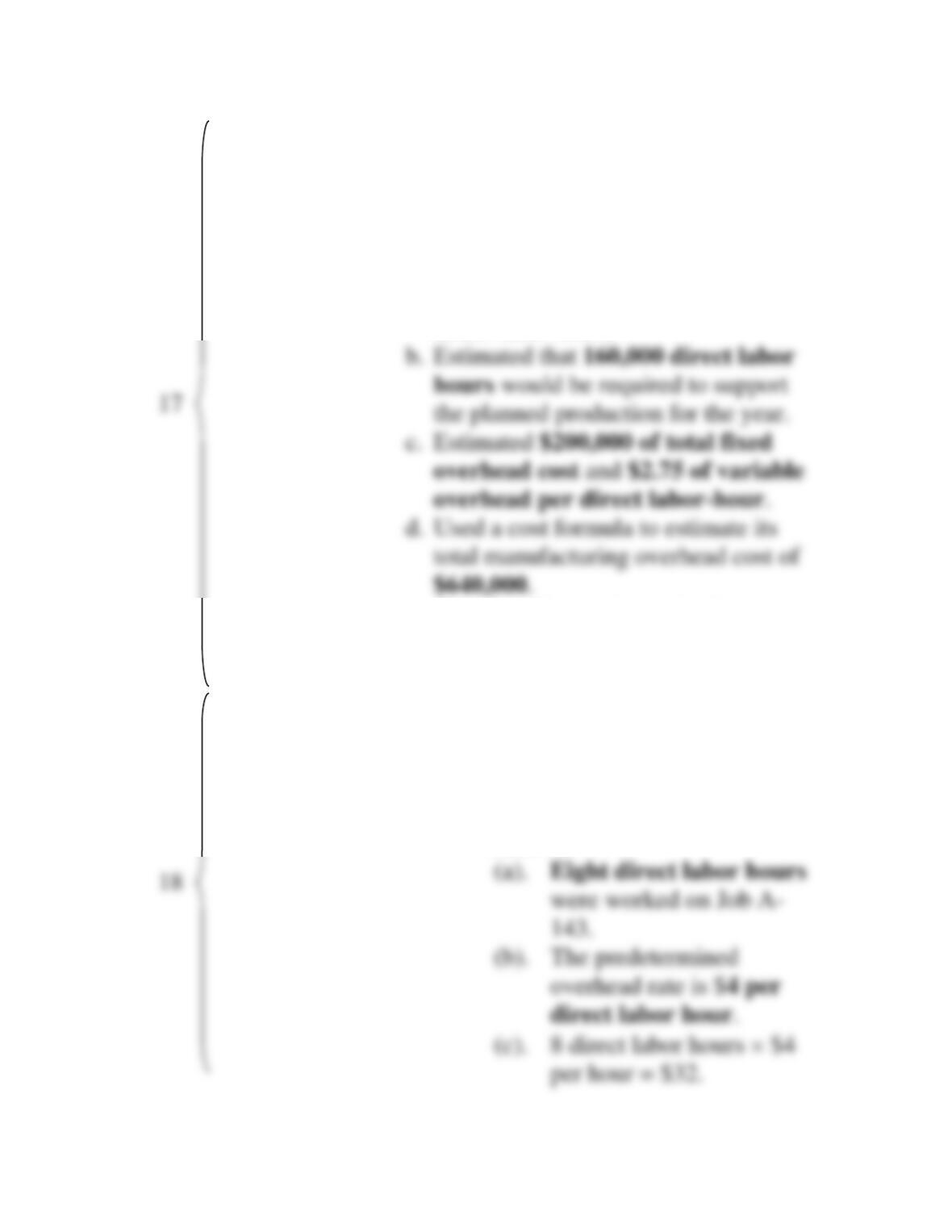
e. Calculated its predetermined
overhead rate of $4 per direct labor
hour.
(1). The amount of overhead that
would be applied to the job cost
sheet that we have been
working with related to Job A–
143 is $32, calculated as
follows:
Learning Objective 3: Compute the total cost and
average cost per unit of a job.
vi. Completing the job cost sheet
1. The total direct material, direct labor, and
manufacturing overhead costs assigned to
Job A-143 is $236.
Quick Check
−
job cost accounting
III. Job-order costing−the flow of costs
Learning Objectives 4 and 5: Understand the flow of
costs in a job-order costing system and prepare
22–23
20
19
that are only partially complete and will require
further work before they are ready for sale to
customers.
iii. Finished goods consist of completed units of
product that have not yet been sold to customers.
B. Flow of cost: a conceptual overview
iii. Direct labor costs are added directly to Work in
Process—they do not flow through Raw Materials
inventory.
iv. Manufacturing overhead costs are applied to
25
26
v. When goods are completed, their costs are
transferred from Work in Process to Finished
Goods.
manufactured.
vii. As goods are sold, their costs are transferred from
Finished Goods to Cost of Goods Sold.
C. The transactions (in T-account and journal entry form)
that capture the flow of costs in a job-order costing
system are as follows:
i. The purchase and issue of raw materials
1. In T-account form:
a. The cost of raw material purchases is
debited, and although not shown, the
credit side of the transaction would
27
26
2. In journal entry form:
a. Debit Raw Materials and credit
ii. The recording of labor costs
1. In T-account form:
a. Direct labor costs are debited to
iii. Recording actual manufacturing overhead costs
(other than indirect materials and indirect labor)
1. In T-account form:
a. The manufacturing overhead costs
are debited to Manufacturing
Overhead.
29
2. In journal entry form:
iv. Applying manufacturing overhead costs to
work in process
1. In T-account form:
a. Work in process is debited and
Manufacturing Overhead is credited
by the amount of the actual quantity
of the allocation base multiplied by
2. In journal entry form:
a. Debit Work in Process and Credit
Manufacturing Overhead.
36
Helpful Hint: Students sometimes have difficulty
understanding the use of Manufacturing Overhead as a
clearing account. Explain that the purpose of the
v. Accounting for nonmanufacturing costs
Helpful Hint: Review the concepts of product and
period costs at this point. Since period costs are not
directly related to the actual manufacture of the
products, they are expensed as incurred.
1. Companies that use job-order cost systems to
assign manufacturing costs to products also
incur nonmanufacturing costs.