
Pr1
P1
Pc
:= Tr2
T2
Tc
:= Pr2
P2
Pc
:=
Tr1 0.62=Pr1 0.03=Tr2 0.88=Pr2 3.561=
From Fig. (3.16): ρr1 2.69:= ρr2 2.27:=
3.54 For ethanol: Tc513.9 K⋅:= T 453.15 K⋅:= Tr
T
Tc
:= Tr0.882=
Pc61.48 bar⋅:= P 200 bar⋅:= Pr
P
Pc
:= Pr3.253=
Vc167 cm3
mol
⋅:= molwt 46.069 gm
mol
⋅:=
From Fig. (3.17): ρr1 2.45:=
The final T > Tc, and Fig. 3.16 probably should not be used. One can easily
show that
with Z from Eq. (3.57) and
Tables E.3 and E.4. Thus
ρr
PV
c
⋅
ZR⋅T⋅
=
Vc262.7 cm3
mol
⋅:= ω 0.181:= Z00.3356:= Z10.0756−:=
3.53 For n-pentane: Tc469.7 K⋅:= Pc33.7 bar⋅:= ρ10.63 gm
cm3
⋅:=
T1291.15 K⋅:= P11 bar⋅:= T2413.15 K⋅:= P2120 bar⋅:=
Tr1
T1
Tc
:=
59

Vvapor 2616 cm3
mol
=Vvapor
RT⋅
PB0ωB1
⋅+
()
R⋅Tc
Pc
⋅+:=
B10.534−=B10.139 0.172
Tr4.2
−:=
B00.627−=
B00.083 0.422
Tr1.6
−:=
Vliquid 27.11 cm3
mol
=Vliquid VcZc
1T
r
−
()
0.2857
⎡
⎣
⎤
⎦
⋅:=
Eq. (3.72):
ω0.253:=Zc0.242:=Vc72.5 cm3
mol
⋅:=
From Fig. 3.16: ρr2.28:= ρρ
rρc
⋅=
ρr
Vc
=
3.55 For ammonia:
Tc405.7 K⋅:= T 293.15 K⋅:= Tr
T
Tc
:= Tr0.723=
Pc112.8 bar⋅:= P 857 kPa⋅:= Pr
P
Pc
:= Pr0.076=
60

For methane at 3000 psi and 60 degF:
Tc190.6 1.8⋅rankine⋅:= T 519.67 rankine⋅:= Tr
T
Tc
:= Tr1.515=
Pc45.99 bar⋅:= P 3000 psi⋅:= Pr
P
Pc
:= Pr4.498=
ω0.012:=
From Tables E.3 & E.4:
Alternatively, use Tables E.1 & E.2 to get the vapor volume:
Z00.929:= Z10.071−:= ZZ
0ωZ1
⋅+:= Z 0.911=
Vvapor
ZR⋅T⋅
P
:= Vvapor 2591 cm3
mol
=
3.58 10 gal. of gasoline is equivalent to 1400 cu ft. of methane at 60 degF and 1
atm. Assume at these conditions that methane is an ideal gas:
R 0.7302 ft3atm⋅
lbmol rankine⋅
=T 519.67 rankine⋅:= P 1 atm⋅:=
V 1400 ft3
⋅:= nPV⋅
RT⋅
:= n 3.689 lbmol=
61

For Redlich/Kwong EOS:
σ1:= ε 0:= Ω 0.08664:= Ψ 0.42748:= Table 3.1
αTr
()
Tr0.5−
:= Table 3.1 qT
r
()
Ψα Tr
()
⋅
ΩTr
⋅
:= Eq. (3.54)
βTrPr
,
()
ΩPr
⋅
Tr
:= Eq. (3.53)
3.59 T 25K:= P 3.213bar:=
Calculate the effective critical parameters for hydrogen by equations (3.58)
and (3.56)
Tc
43.6
121.8K
2.016T
+
K⋅:= Tc30.435 K=
Pc
20.5
144.2K
2.016T
+
bar⋅:= Pc10.922 bar=
ω0:=
Pr
P
Pc
:= Pr0.294=Tr
T
Tc
:= Tr0.821=
Initial guess of volume: VRT⋅
P
:= V 646.903 cm3
mol
=
Use the generalized Pitzer correlation
62

B00.134−= B10.139 0.172
Tr4.2
−:= B10.109=
Z01B
0
Pr
Tr
⋅+:= Z00.998=Z1B1
Pr
Tr
⋅:= Z10.00158=
ZZ
0ωZ1
⋅+:= Z 0.998=V1
ZR⋅T⋅
P
:= V10.024 m3
mol
=
(a) At actual condition: T5032−()
5
9
⋅273.15+
⎡
⎢
⎣
⎤
⎥
⎦K:= P 300psi:=
Pitzer correlations: T 283.15 K=
Tr
T
Tc
:= Tr1.486=Pr
P
Pc
:= Pr0.45=
B00.083 0.422
Tr1.6
−:= B00.141−=
B10.139 0.172
Tr4.2
−:= B10.106=
Calculate Z Guess: Z 0.9:=
Given Eq. (3.52)
3.61 For methane: ω0.012:= Tc190.6K:= Pc45.99bar:=
At standard condition: T6032−()
5
9
⋅273.15+
⎡
⎢
⎣
⎤
⎥
⎦K:= T 288.706 K=
Pitzer correlations: P 1atm:=
Tr
T
Tc
:= Tr1.515=Pr
P
Pc
:= Pr0.022=
B00.083 0.422
Tr1.6
−:=
63
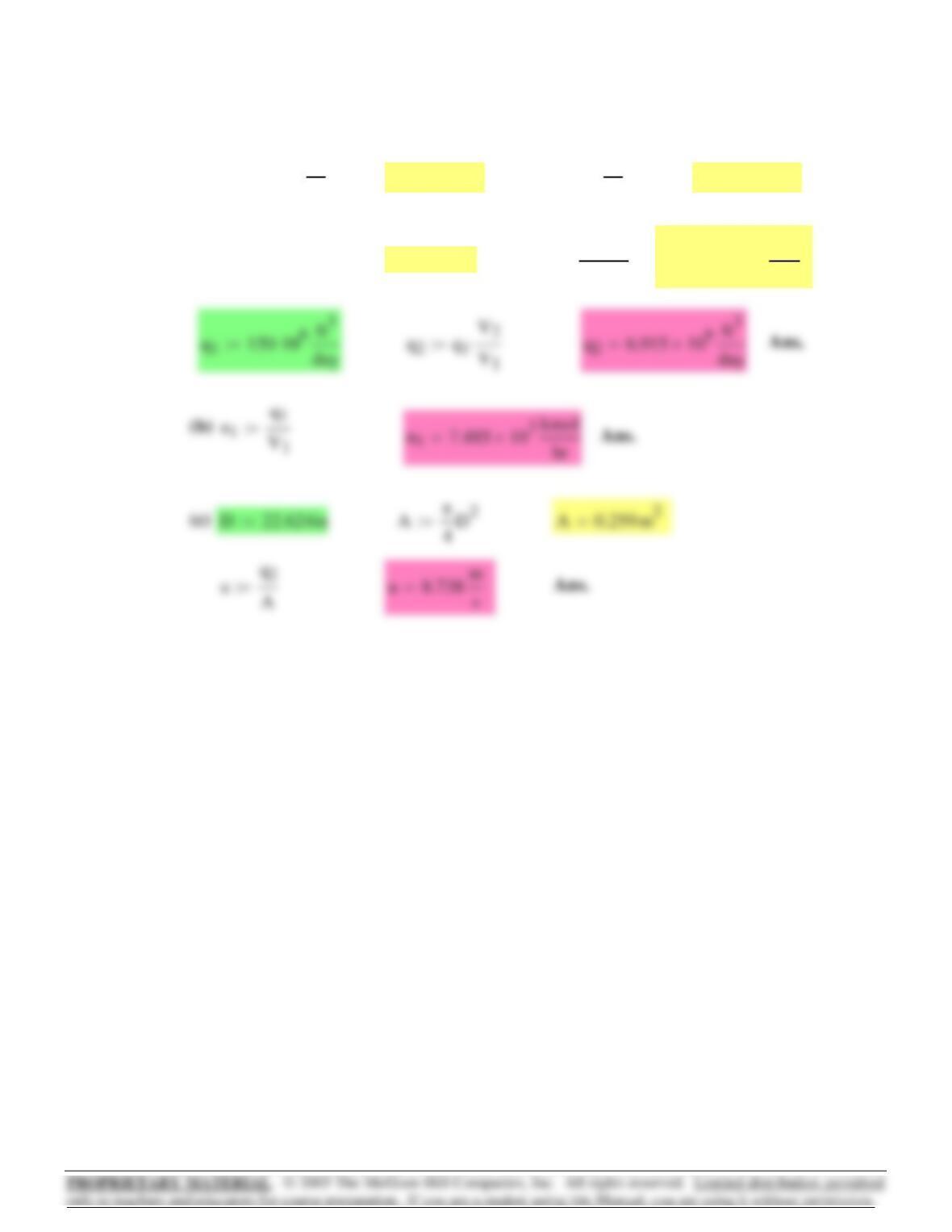
V20.00109 m3
mol
=V2
ZR⋅T⋅
P
:=Z 0.958=ZZ
0ωZ1
⋅+:=
Z10.0322=Z1B1
Pr
Tr
⋅:=Z00.957=Z01B
0
Pr
Tr
⋅+:=
64
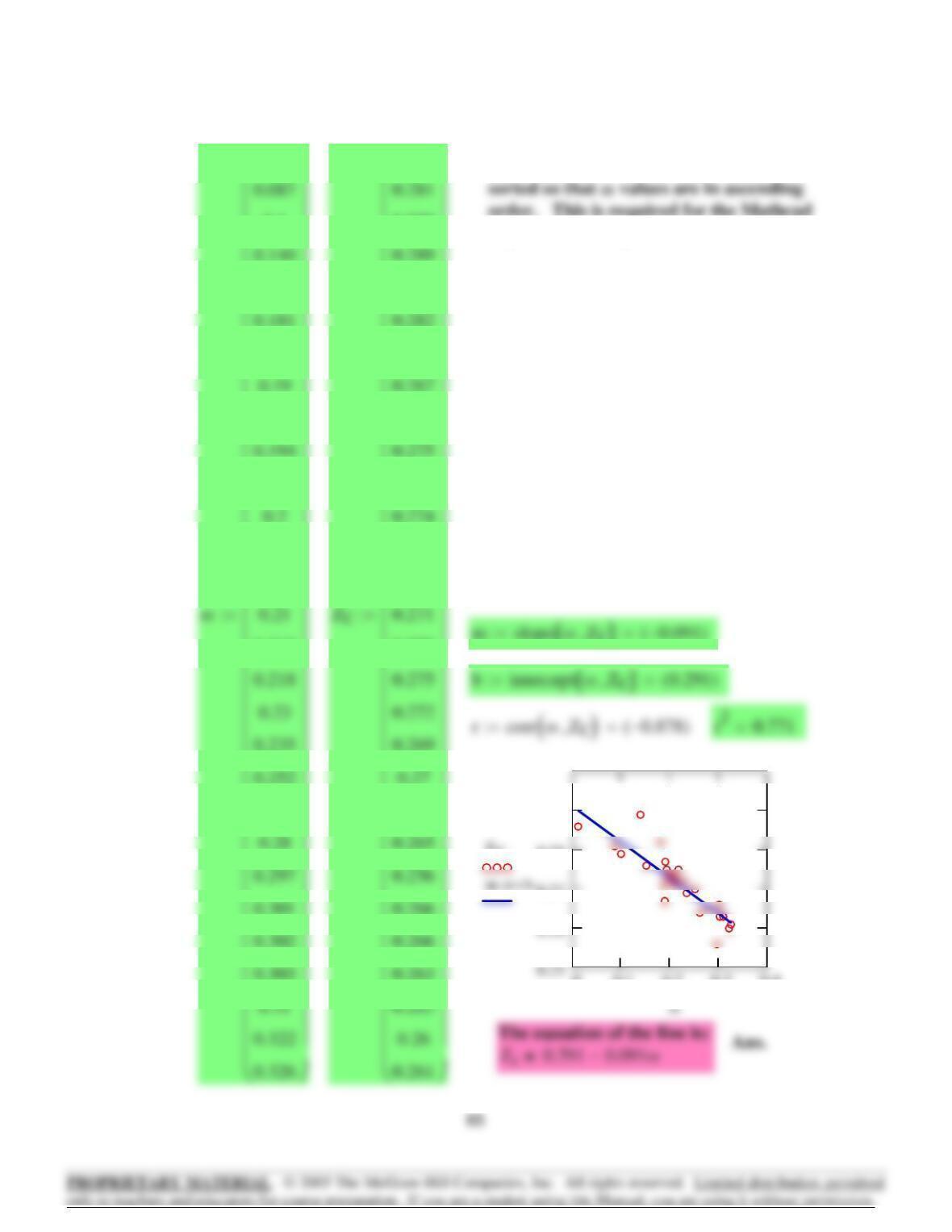
3.62 Use the first 29 components in Table B.1
slope and intercept functions.
0.012
0.1
0.152
0.187
0.191
0.196
0.205
0.21
0.212
0.235
0.262
⎛
⎜
⎜
⎜
⎜
⎜
⎜
⎜
⎜
⎜
⎜
⎜
⎜
⎜
⎜
⎜
⎜
⎜
⎜
⎜
⎜
⎜
⎜
⎜
⎜
⎜
⎞
⎟
⎟
⎟
⎟
⎟
⎟
⎟
⎟
⎟
⎟
⎟
⎟
⎟
⎟
⎟
⎟
⎟
⎟
⎟
⎟
⎟
⎟
⎟
⎟
0.286
0.279
0.276
0.271
0.277
0.273
0.273
0.273
0.272
0.269
0.264
⎛
⎜
⎜
⎜
⎜
⎜
⎜
⎜
⎜
⎜
⎜
⎜
⎜
⎜
⎜
⎜
⎜
⎜
⎜
⎜
⎜
⎜
⎜
⎜
⎜
⎜
⎞
⎟
⎟
⎟
⎟
⎟
⎟
⎟
⎟
⎟
⎟
⎟
⎟
⎟
⎟
⎟
⎟
⎟
⎟
⎟
⎟
⎟
⎟
⎟
⎟
()
0 0.1 0.2 0.3 0.4
0.27
0.28
0.29
ZC
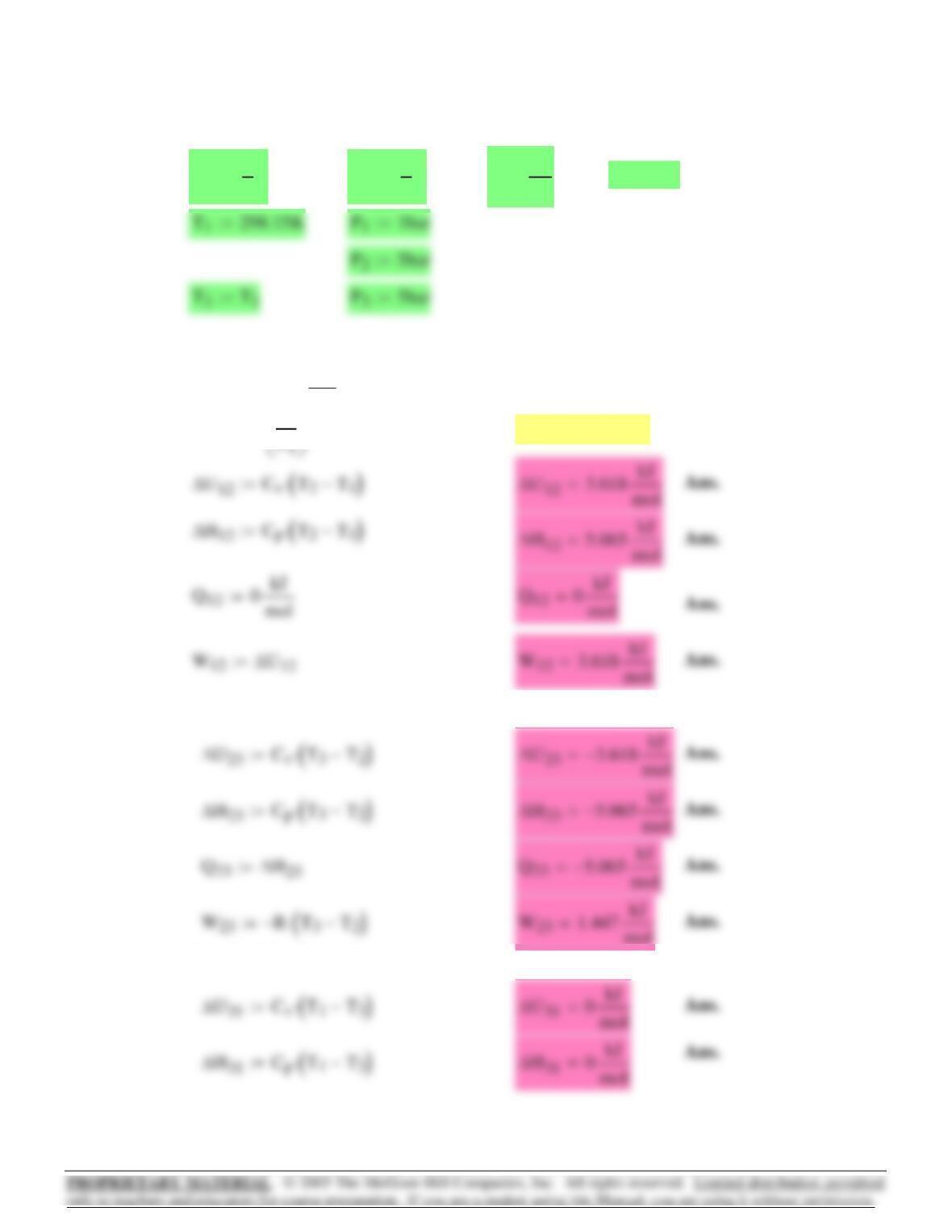
Step 2->3 Isobaric cooling
Step 3->1 Isothermal expansion
3.65 Cp
7
2R:= Cv
5
2R:= γ Cp
Cv
:= γ 1.4=
Step 1->2 Adiabatic compression
T2T1
P2
⎛
⎜
⎞
γ1−
γ
⋅:= T2472.216 K=
66
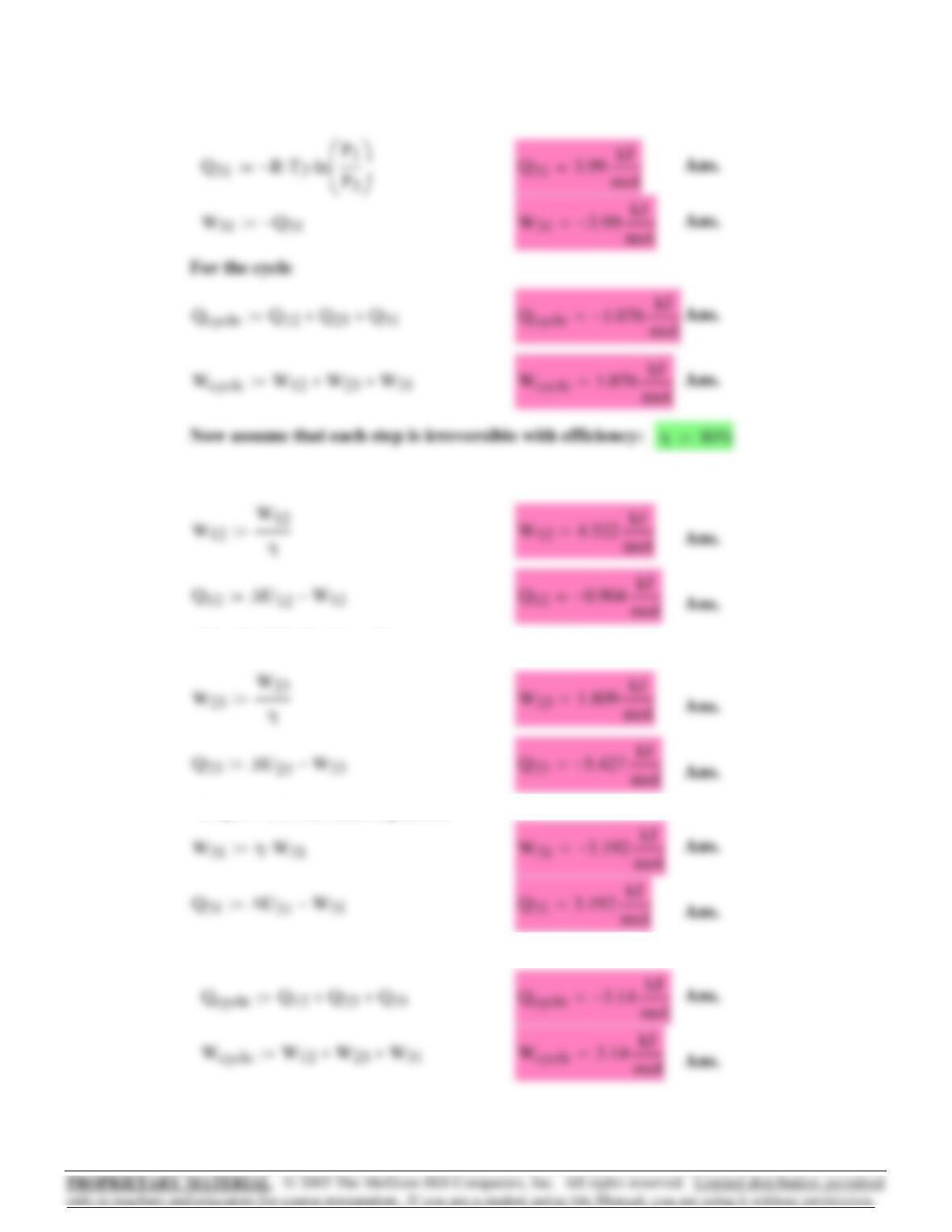
Step 2->3 Isobaric cooling
Step 3->1 Isothermal expansion
For the cycle
Step 1->2 Adiabatic compression
67
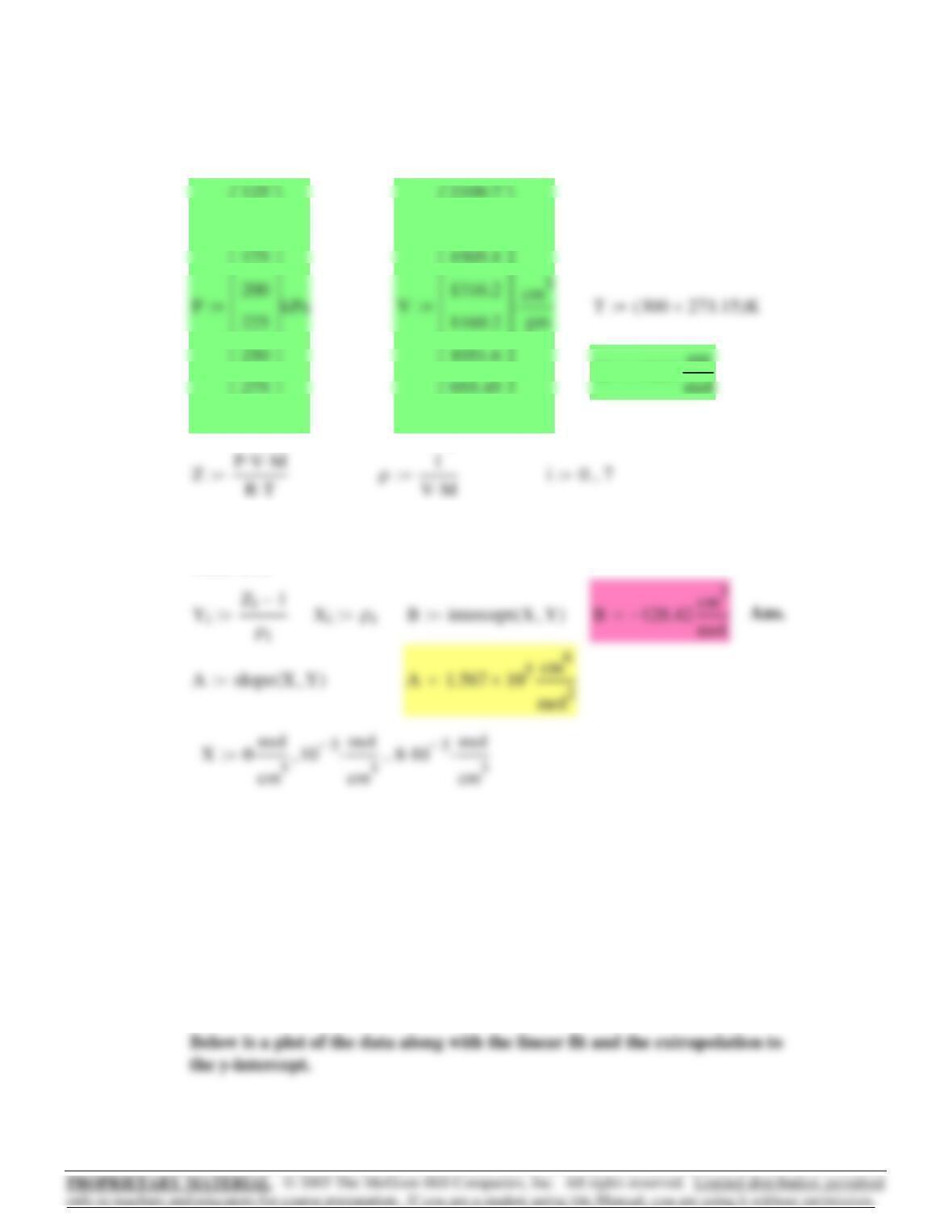
If a linear equation is fit to the points then the value of B is the y-intercept.
Use the Mathcad intercept function to find the y-intercept and hence, the
value of B
→
⎯
⎯
→
⎯
⎯
⎯
M 18.01 gm
:=
1757.0
875.29
⎛
⎜
⎜
⎜
⎜
⎝
⎞
⎟
⎟
⎠
150
300
⎛
⎜
⎜
⎜
⎜
⎝
⎞
⎟
⎟
⎠
a) PV data are taken from Table F.2 at pressures above 1atm.3.67
68
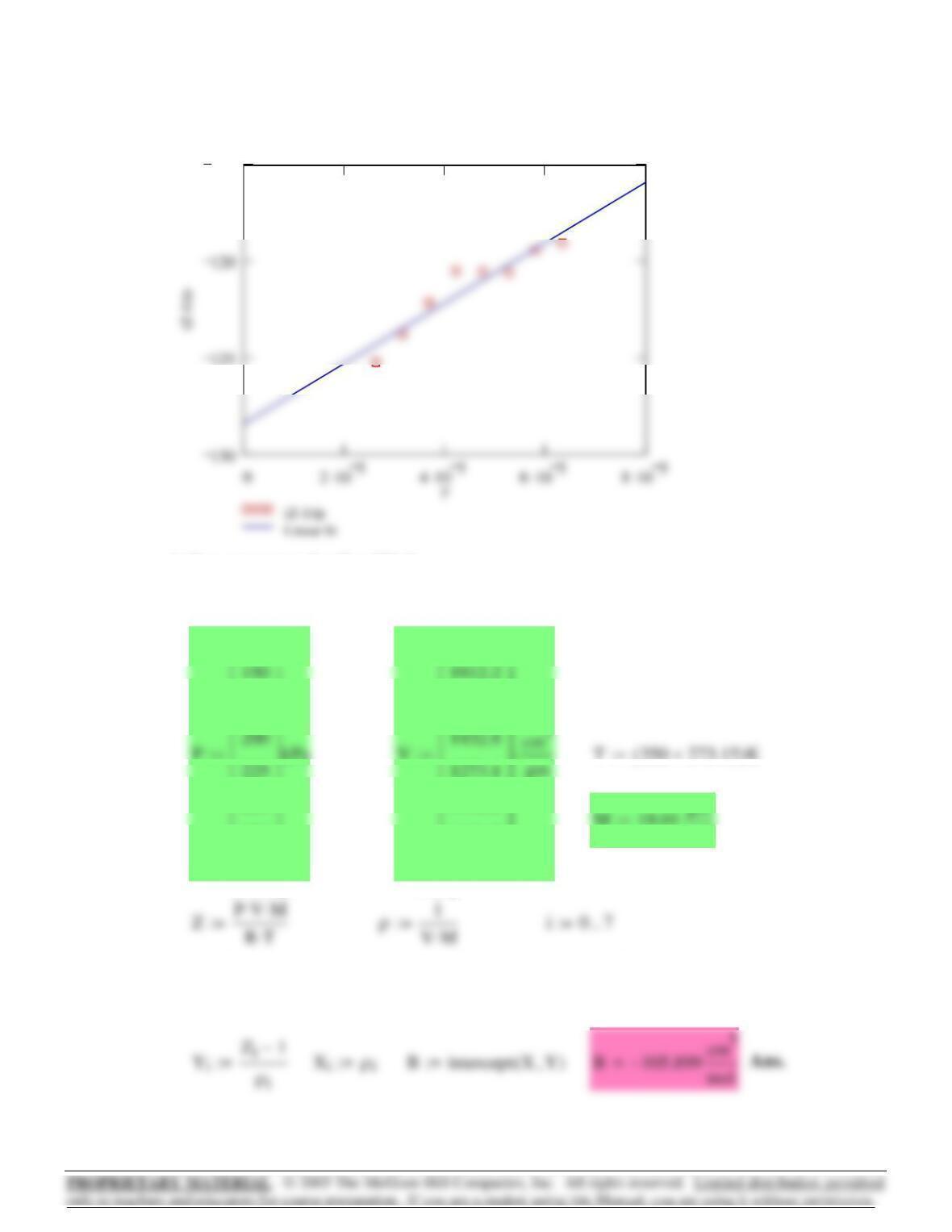
If a linear equation is fit to the points then the value of B is the y-intercept.
Use the Mathcad intercept function to find the y-intercept and hence, the
value of B
→
⎯
⎯
→
⎯
⎯
⎯
mol
2295.6
1638.3
1145.2
1040.7
953.52
⎛
⎜
⎜
⎜
⎜
⎜
⎜
⎜
⎝
⎞
⎟
⎟
⎟
⎟
⎟
⎠
125
175
250
275
300
⎛
⎜
⎜
⎜
⎜
⎜
⎜
⎜
⎝
⎞
⎟
⎟
⎟
⎟
⎟
⎠
PV data are taken from Table F.2 at pressures above 1atm.
Repeat part a) for T = 350 Cb)
125
115
69
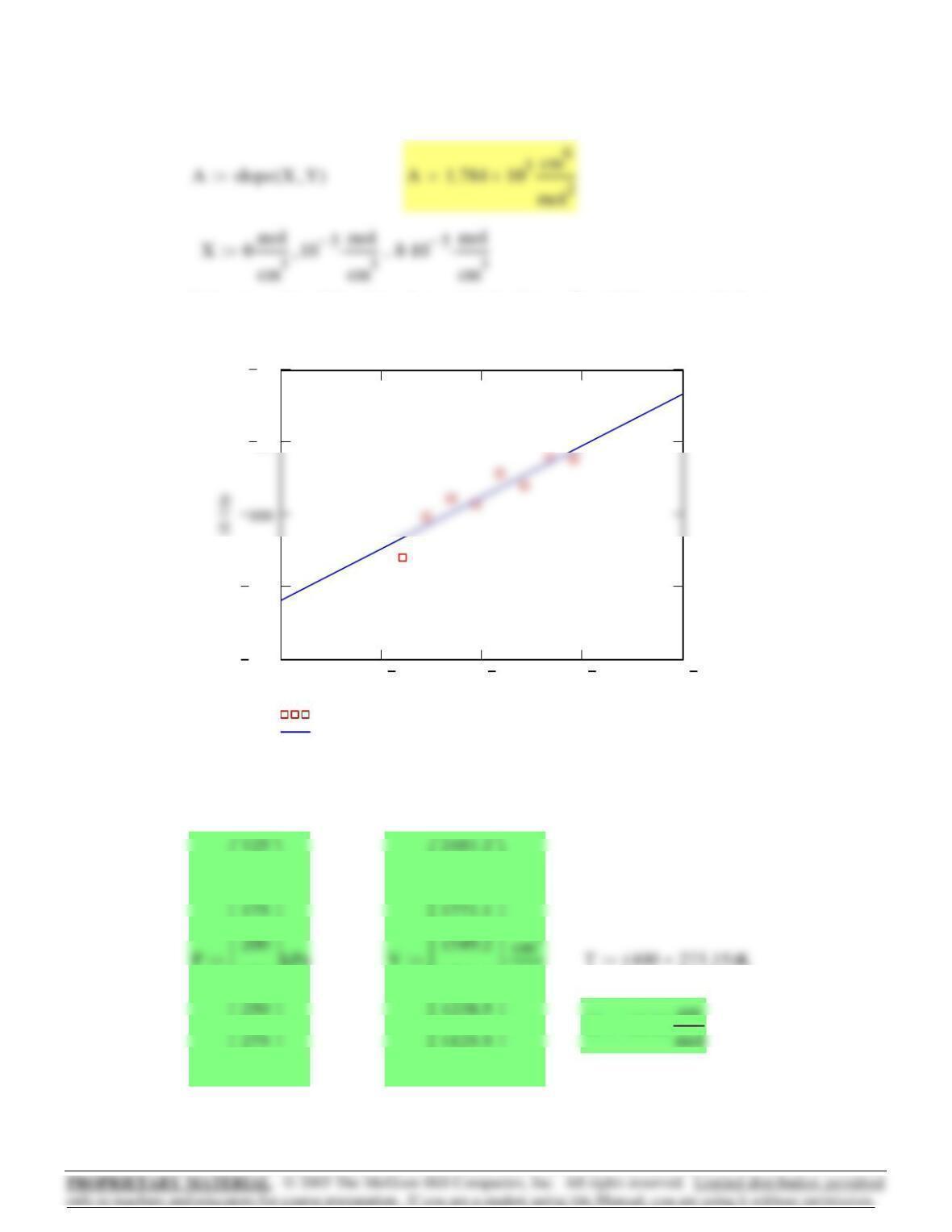
Below is a plot of the data along with the linear fit and the extrapolation to
the y-intercept.
02
.10 54.10 56.10 58.10 5
110
105
95
90
(Z-1)/p
Linear fit
p
c) Repeat part a) for T = 400 C
PV data are taken from Table F.2 at pressures above 1atm.
150
225
300
⎛
⎜
⎜
⎜
⎜
⎜
⎜
⎝
⎞
⎟
⎟
⎟
⎟
⎠
2066.9
1376.6
1031.4
⎛
⎜
⎜
⎜
⎜
⎜
⎜
⎝
⎞
⎟
⎟
⎟
⎟
⎠
gm
M 18.01 gm
:=
70
ZPV⋅M⋅
RT⋅
→
⎯
⎯
⎯
:= ρ 1
VM⋅
→
⎯
⎯
:= i07..:=
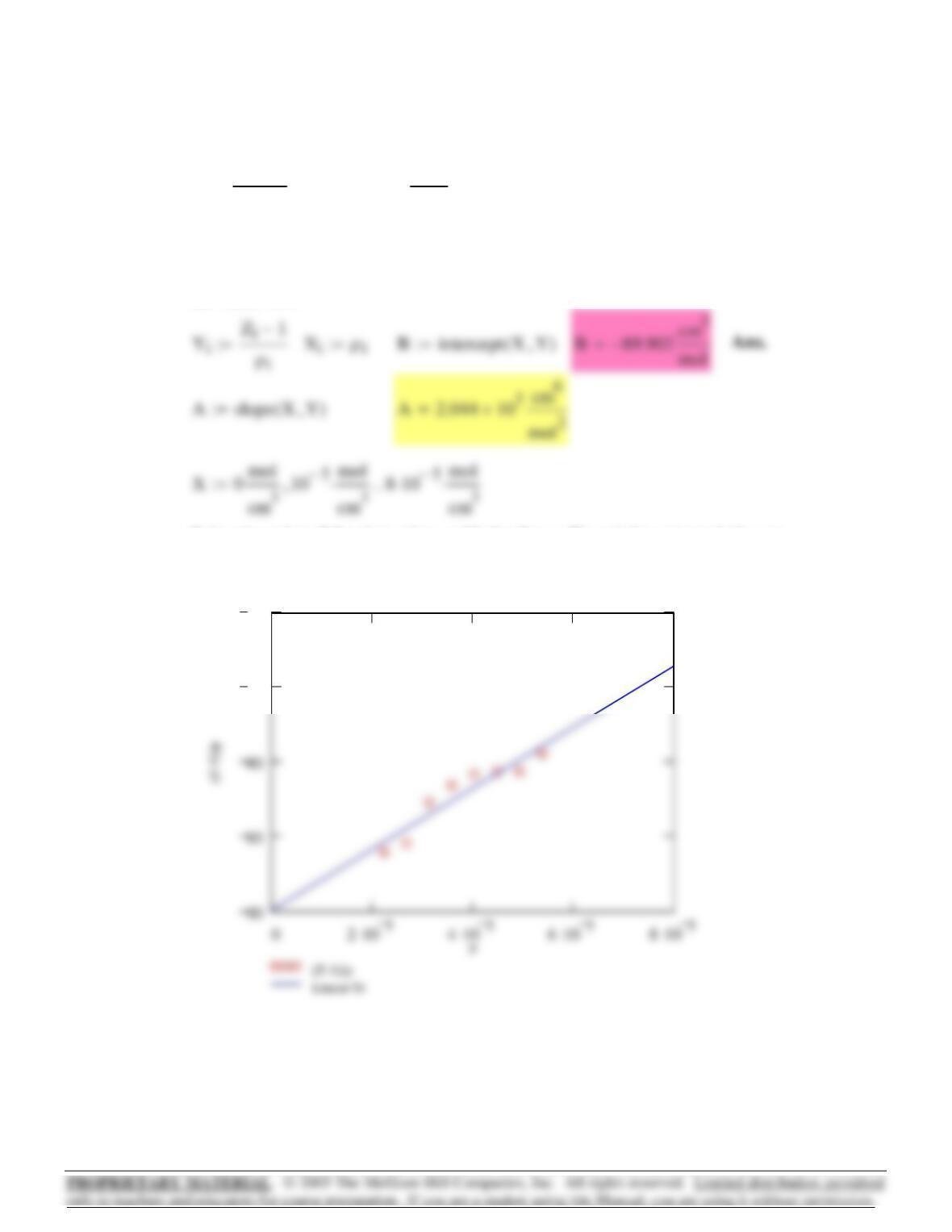
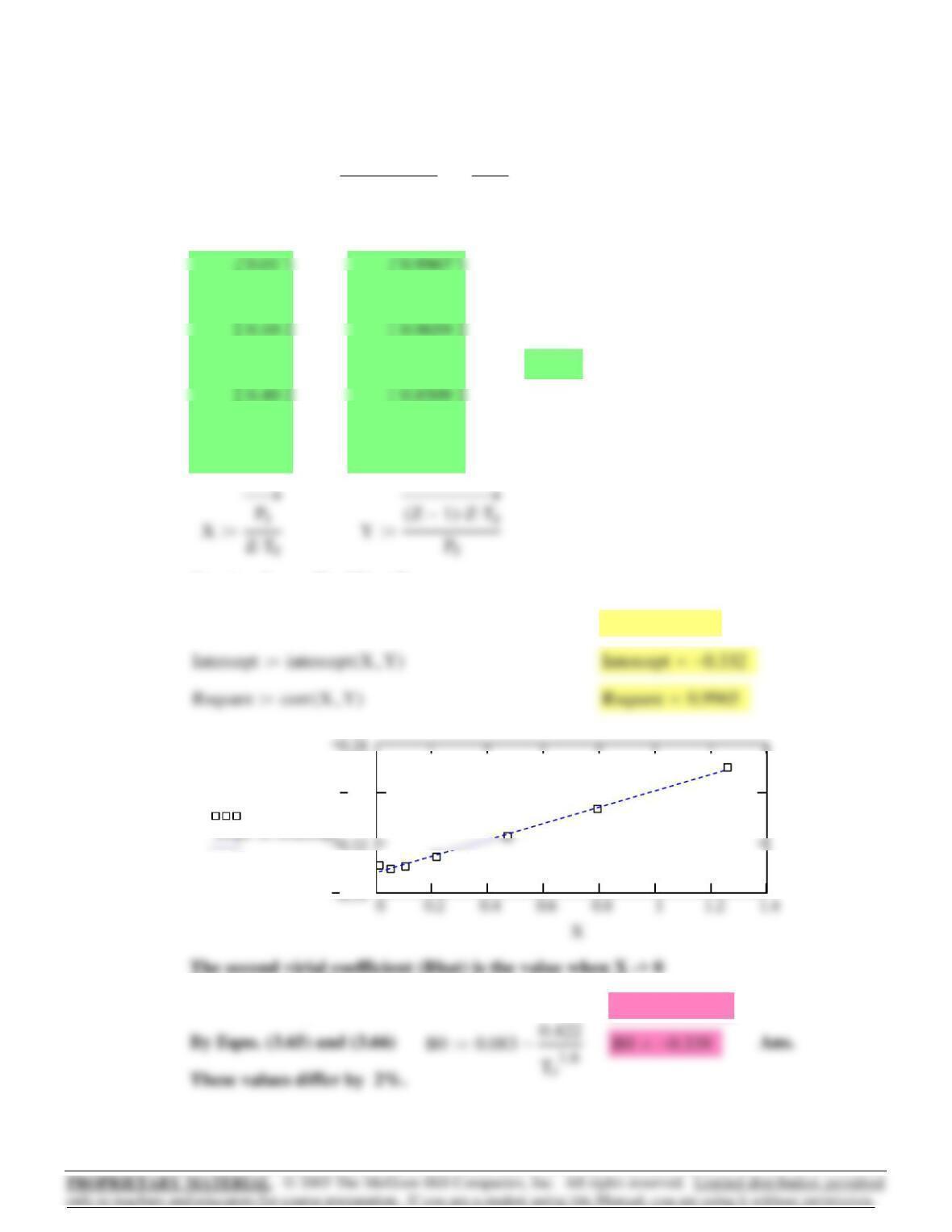
If a linear equation is fit to the points then the value of B is the
y-intercept.
Use the Mathcad intercept function to find the y-intercept and hence,
the value of B
Below is a plot of the data along with the linear fit and the extrapolation to
the y-intercept.
75
70
71
Ans.
Bhat 0.332−=Bhat Intercept:=
0.3
Y
Slope 0.033=Slope slope X Y,():=
Create a linear fit of Y vs X
Tr1:=Z
0.9832
0.9300
0.7574
0.6355
⎛
⎜
⎜
⎜
⎜
⎜
⎜
⎜
⎜
⎝
⎞
⎟
⎟
⎟
⎟
⎟
⎟
⎠
:=
Pr
0.05
0.20
0.60
0.80
⎛
⎜
⎜
⎜
⎜
⎜
⎜
⎜
⎜
⎝
⎞
⎟
⎟
⎟
⎟
⎟
⎟
⎠
:=
Data from Appendix E at Tr = 1
Create a plot of Z1−()Z⋅Tr
⋅
Pr
vs Pr
ZT
r
⋅
3.70
72
Eq. (3.53)
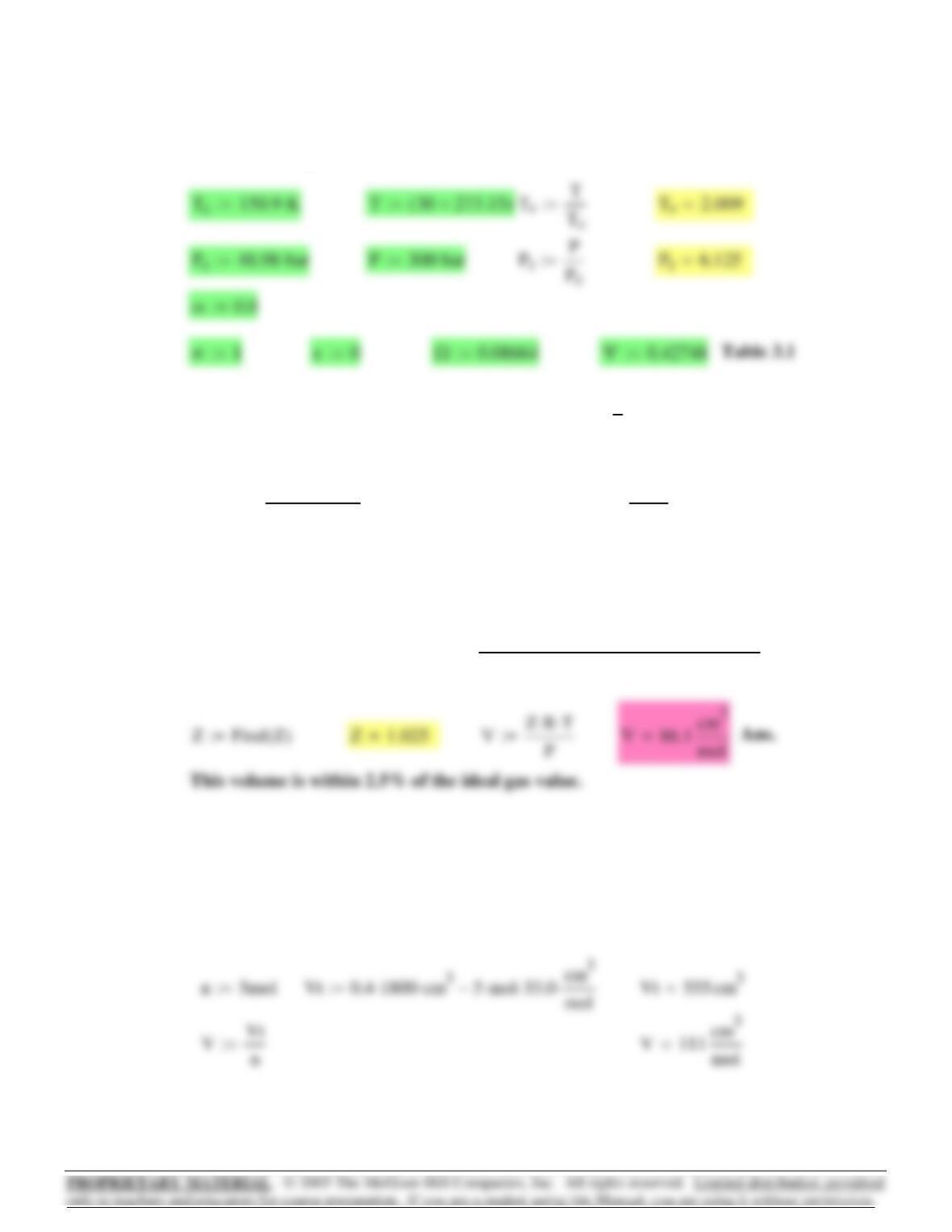
Calculate Z Guess: Z 0.9:=
Given Eq. (3.52)
Z1βTrPr
,
()
+qT
r
()
βTrPr
,
()
⋅ZβTrPr
,
()
−
Zεβ TrPr
,
()
⋅+
()
Zσβ TrPr
,
()
⋅+
()
⋅
⋅−=
3.72 After the reaction is complete, there will be 5 moles of C2H2 and 5 moles of
Ca(OH)2.
First calculate the volume available for the gas.
3.71 Use the SRK equation to calculate Z
Table 3.1
αTrω,
()
1 0.480 1.574ω+ 0.176ω2
−
()
1T
r
1
2
−
⎛
⎜
⎝
⎞
⎠
⋅+
⎡
⎢
⎣
⎤
⎥
⎦
2
:=
qT
r
()
Ψα Trω,
()
⋅
ΩTr
⋅
:= Eq. (3.54) βTrPr
,
()
ΩPr
⋅
Tr
:=
73

3.73 mass 35000kg:= T 10 273.15+()K:=
ω0.152:= Tc369.8K:= Pc42.48bar:= M 44.097 gm
mol
:=
Zc0.276:= Vc200.0 cm3
mol
:= nmass
M
:= n 7.937 105
×mol=
a) Estimate the volume of gas using the truncated virial equation
Tr
T
Tc
:= Tr0.766=P 1atm:= Pr
P
Pc
:=
Use SRK equation to calculate pressure.
Table 3.1
αTrω,
()
1 0.480 1.574ω+ 0.176ω2
−
()
1T
r
1
2
−
⎛
⎜
⎝
⎞
⎠
⋅+
⎡
⎢
⎣
⎤
⎥
⎦
2
:=
qT
r
()
Ψα Trω,
()
⋅
ΩTr
⋅
:= Eq. (3.54)
aΨαTrω,
()
R2
⋅Tc2
⋅
Pc
⋅:= Eq. (3.45) bΩRT
c
⋅
Pc
⋅:= Eq. (3.46)
74
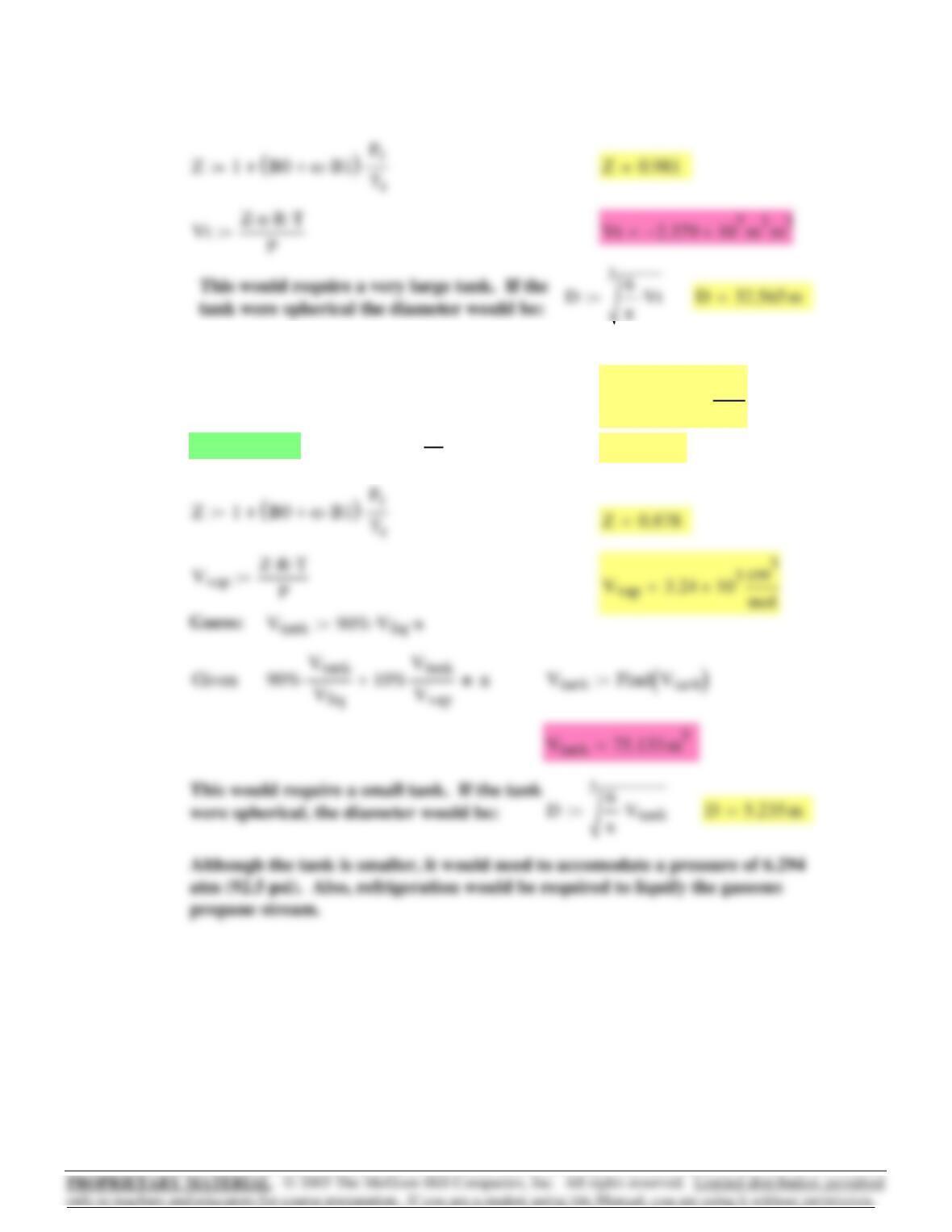
Pr0.15=Pr
P
Pc
:=P 6.294atm:=
Vliq 85.444 cm3
mol
=
Vliq VcZc
1T
r
−
()
0.2857
⋅:=
Calculate the molar volume of the liquid with the Rackett equation(3.72)b)
75