General Instructions
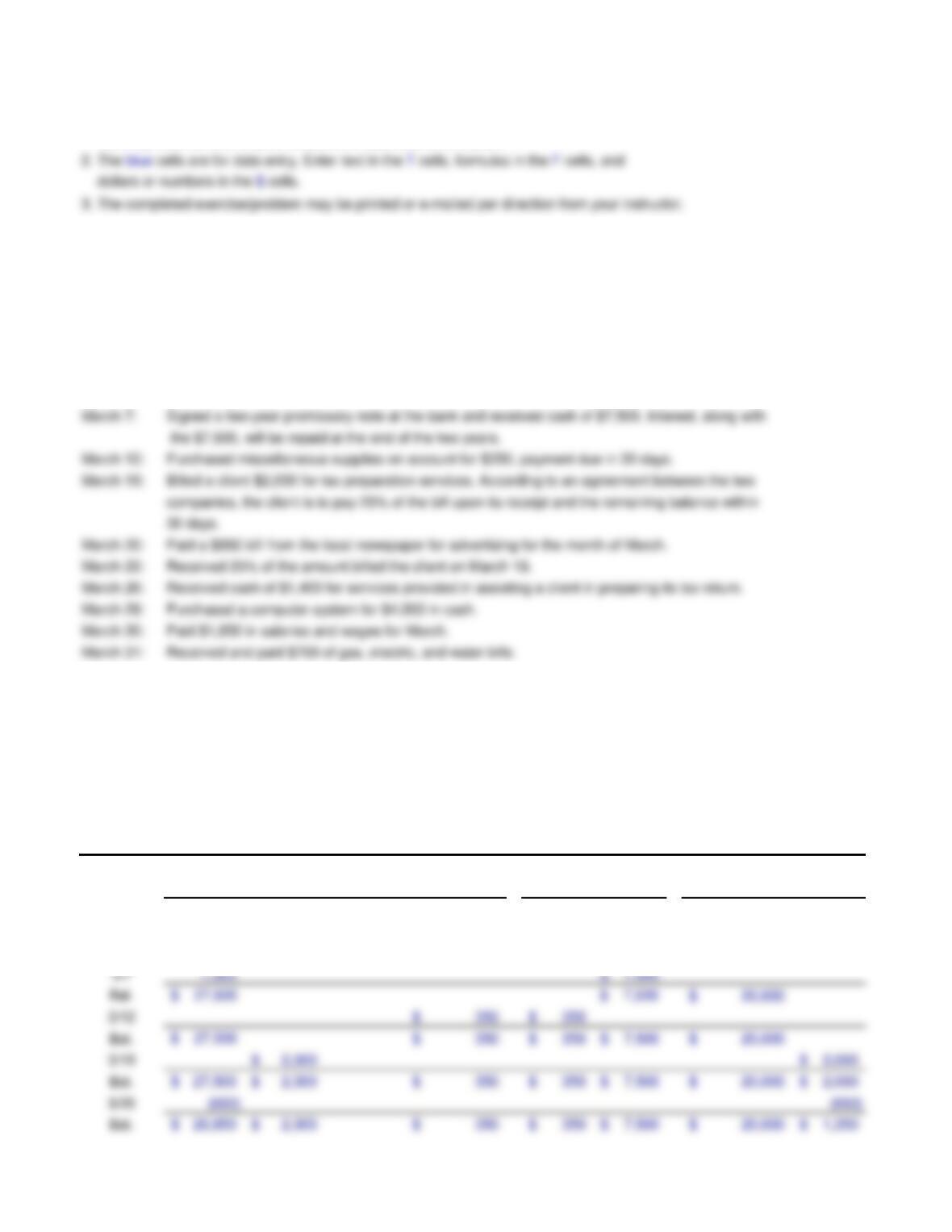
Paid $1,650 in salaries and wages for March.
Received and paid $700 of gas, electric, and water bills.
companies, the client is to pay 25% of the bill upon its receipt and the remaining balance within
30 days.
Paid a $650 bill from the local newspaper for advertising for the month of March.
Received 25% of the amount billed the client on March 19.
Received cash of $1,400 for services provided in assisting a client in preparing its tax return.
Purchased a computer system for $4,000 in cash.
Signed a two-year promissory note at the bank and received cash of $7,500. Interest, along with
the $7,500, will be repaid at the end of the two years.
Purchased miscellaneous supplies on account for $350, payment due in 30 days.
Billed a client $2,000 for tax preparation services. According to an agreement between the two
P3-3A
March 2:
Required
Assets = Liabilities + Stockholders’ Equity
Accounts Accounts Notes Capital Retained
Date Cash Receivable Computer Supplies Payable Payable Stock Earnings
3/2
$ 20,000 20,000$
$ 27,500 350$ 350$ 7,500$ 20,000$
1. Prepare a table to summarize the preceding transactions as they affect the accounting equation.
Identify each transaction with the date.
DYNAMIC SERVICES INC.
TRANSACTIONS FOR THE MONTH OF MARCH
Received contributions of $10,000 from each of the two principal owners
in exchange for shares of stock.
1. The following worksheet may be used to complete the exercise/problem.
You may need to refer to your textbook for additional information.
Dynamic Services Inc. was organized on March 1 by two former college roommates. The corporation will
provide computer tax services to small businesses. The following transactions occurred during the first month
of operations:
dollars or numbers in the $ cells.
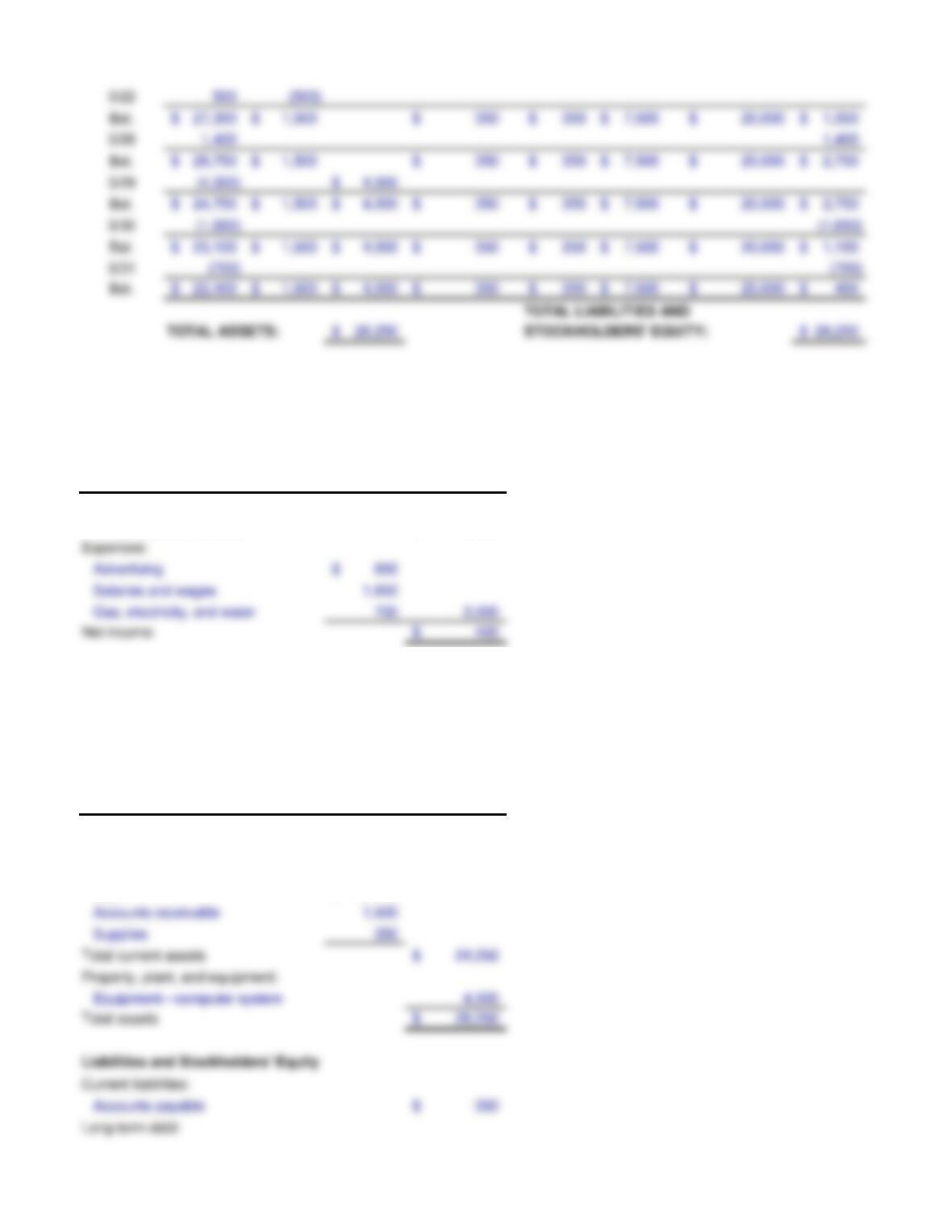
2. Prepare an income statement for the month of March.
Revenues:
Tax preparation revenue 3,400$
3. Prepare a classified balance sheet at March 31.
Note: List current assets and liabilities in the order of liquidity.
Assets
Current assets:
Cash 22,400$
DYNAMIC SERVICES INC.
INCOME STATEMENT
FOR THE MONTH OF MARCH
DYNAMIC SERVICES INC.
BALANCE SHEET
MARCH 31
4. From reading the balance sheet you prepared in part (3), what events would you expect to take place
in April? Explain your answer.
Trade accounts often have a 30-day collection or payment period. For example, cash should be received from the
accounts receivable and cash paid for the accounts payable during the month of April.
General Instructions
1. The following worksheet may be used to complete the exercise/problem.
You may need to refer to your textbook for additional information.
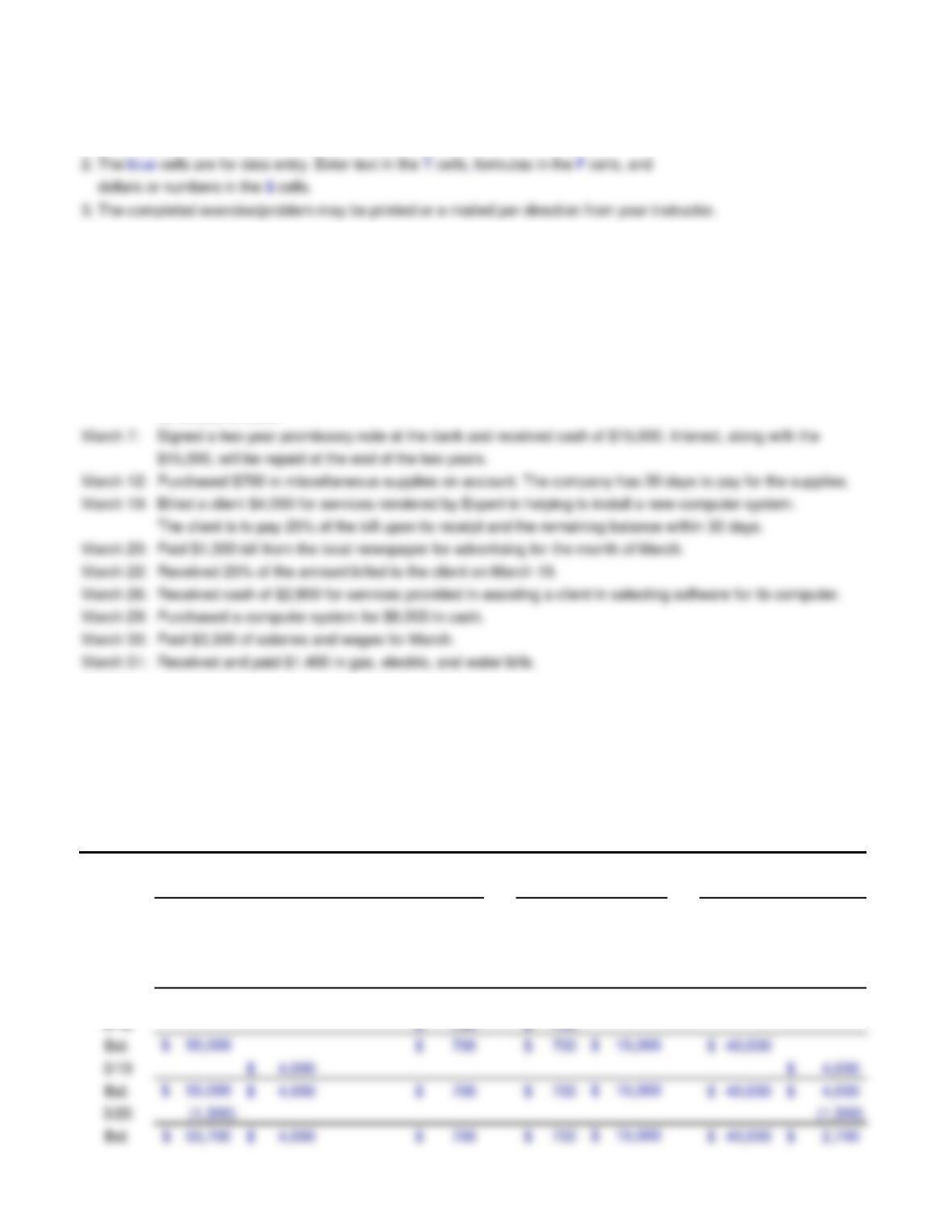
Received cash of $2,800 for services provided in assisting a client in selecting software for its computer.
Purchased a computer system for $8,000 in cash.
Paid $3,300 of salaries and wages for March.
Received and paid $1,400 in gas, electric, and water bills.
$15,000, will be repaid at the end of the two years.
Purchased $700 in miscellaneous supplies on account. The company has 30 days to pay for the supplies.
Billed a client $4,000 for services rendered by Expert in helping to install a new computer system.
The client is to pay 25% of the bill upon its receipt and the remaining balance within 30 days.
Paid $1,300 bill from the local newspaper for advertising for the month of March.
Received 25% of the amount billed to the client on March 19.
Signed a two-year promissory note at the bank and received cash of $15,000. Interest, along with the
P3-3
March 2:
Required
= +
Accounts
Accounts
Notes Capital Retained
Date Cash Receivable Computer Supplies Payable Payable Stock Earnings
3/2 40,000$ 40,000$
3/7 15,000 15,000$
Bal. $ 55,000 $ 15,000 40,000$
EXPERT CONSULTING SERVICES INC.
TRANSACTIONS FOR THE MONTH OF MARCH
Assets
Liabilities
Stockholders’ Equity
1. Prepare a table to summarize the preceding transactions as they affect the accounting equation.
Identify each transaction with the date.
Expert Consulting Services Inc. was organized on March 1 by two former college roommates. The
corporation provides computer consulting services to small businesses. The following transactions
occurred during the first month of operations:
Received contributions of $20,000 from each of the two principal owners of the new business in exchange
for shares of stock.
2. The blue cells are for data entry. Enter text in the T cells, formulas in the F cells, and
dollars or numbers in the $ cells.
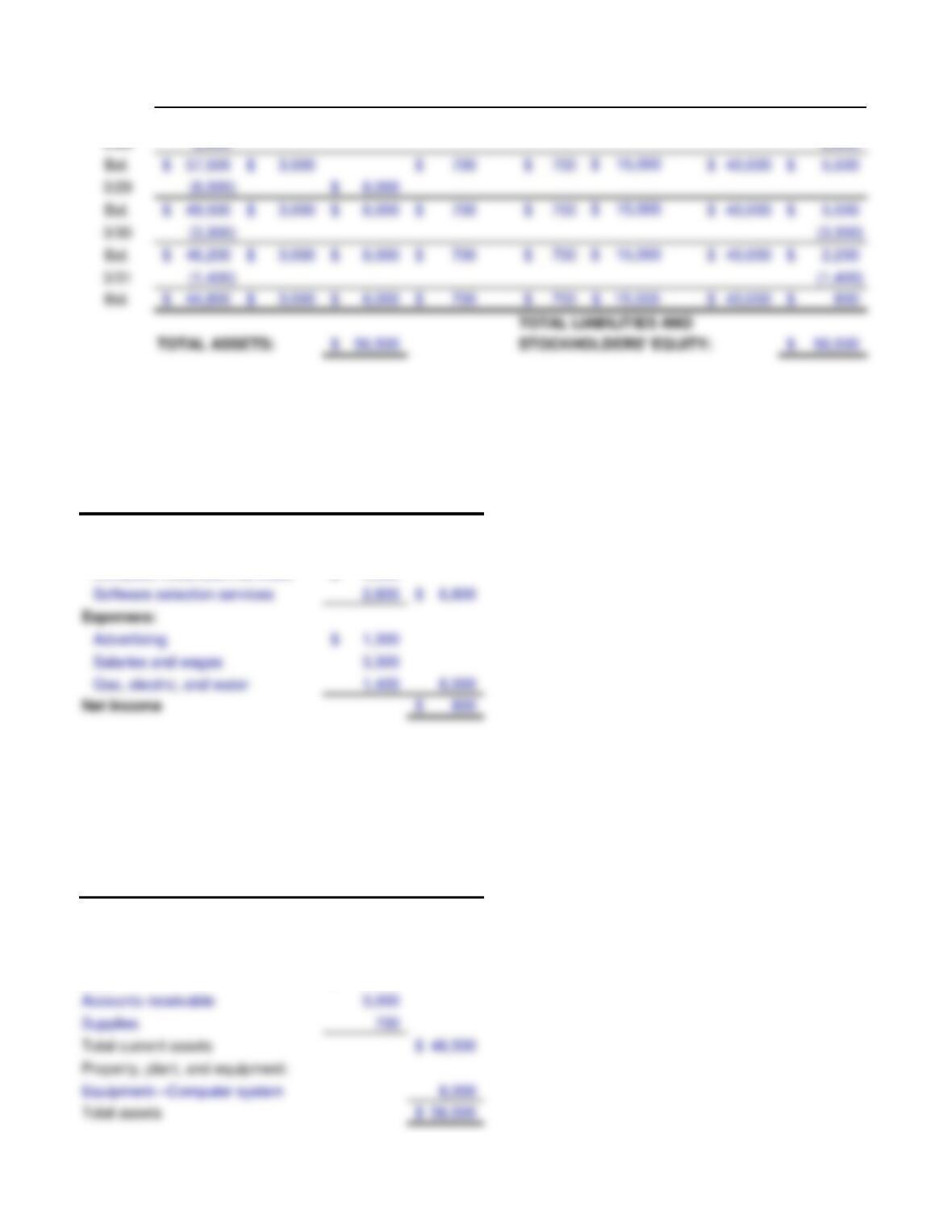
3/22 1,000 (1,000)
Bal. 54,700$ 3,000$ 700$ 700$
$ 15,000 40,000$ 2,700$
2. Prepare an income statement for the month ended March 31.
Revenues:
Computer installation services 4,000$
3. Prepare a classified balance sheet at March 31.
Note: Classify Assets and Liabilities in the order of Liquidity
Assets
Current assets:
Cash 44,800$
INCOME STATEMENT
FOR THE MONTH ENDED MARCH
EXPERT CONSULTING SERVICES INC.
BALANCE SHEET
MARCH 31
EXPERT CONSULTING SERVICES INC.
$ 15,000 40,000$ 5,500$
$ 15,000 40,000$ 5,500$
$ 15,000 40,000$ 2,200$
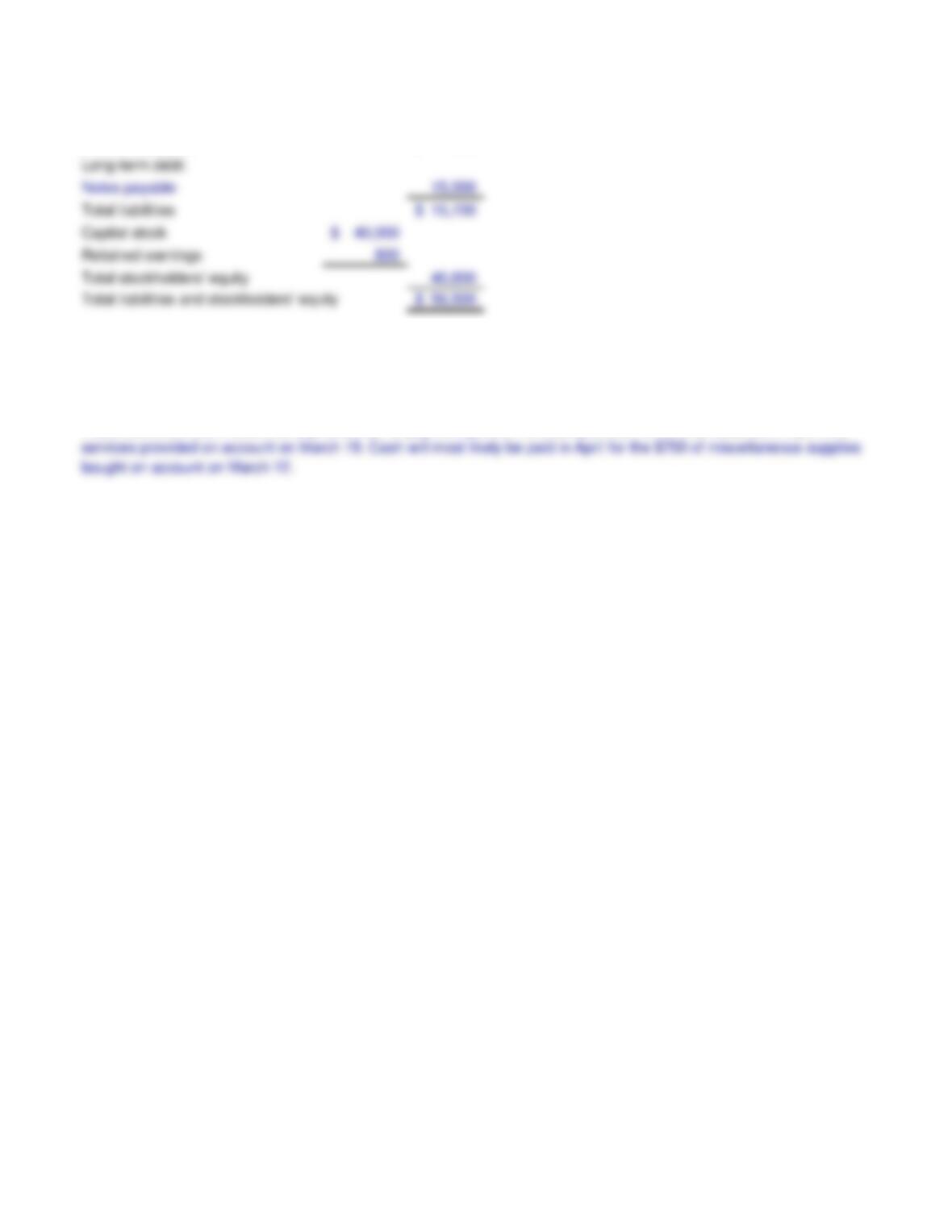
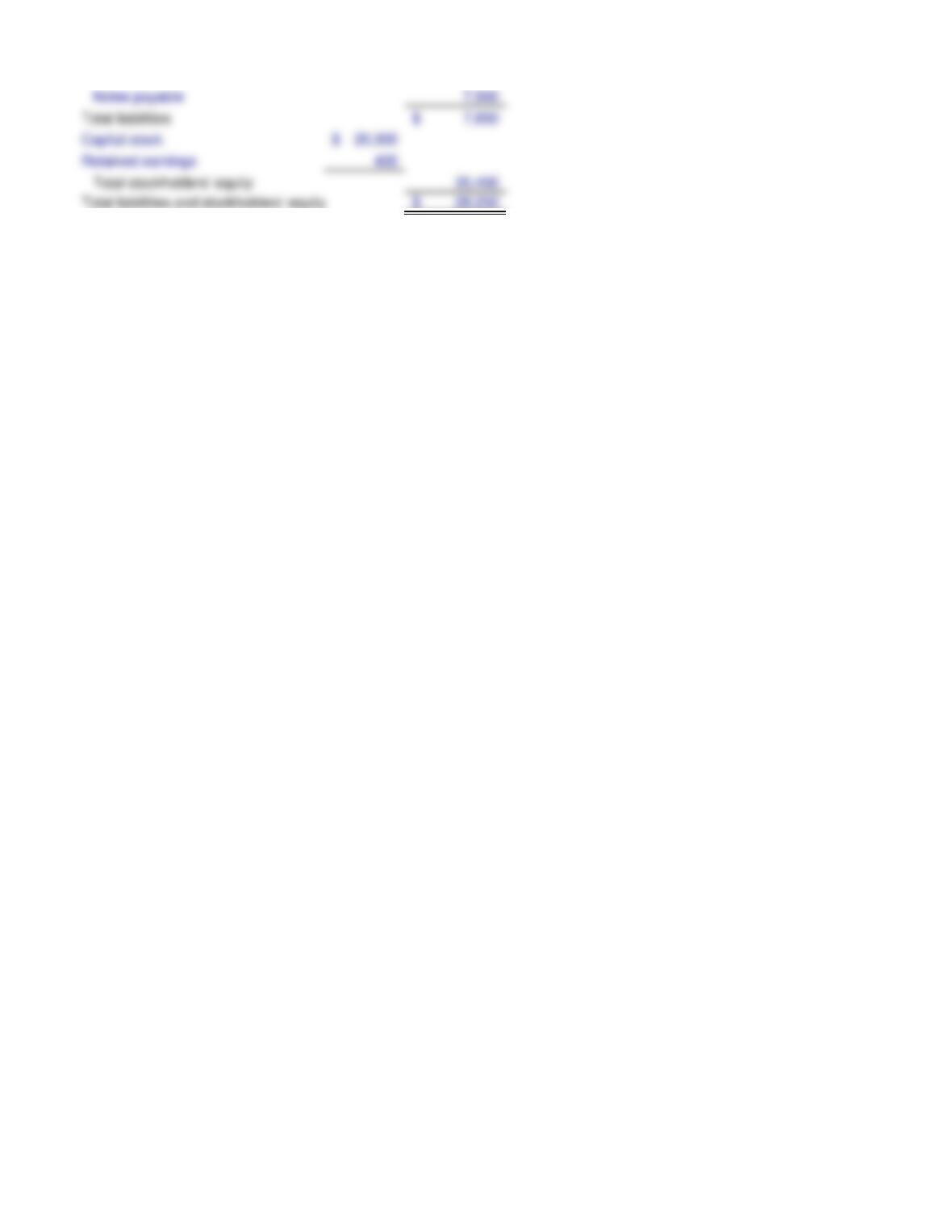
Current liabilities:
Accounts payable 700$
4. From reading the balance sheet you prepared in part (3), what events would you expect to take place in
April?
Explain your answer.
Trade accounts often have a 30-day collection or payment period. For example, cash should be received in April from
services provided on account on March 19. Cash will most likely be paid in April for the $700 of miscellaneous supplies
bought on account on March 12.
Liabilities and Stockholders‘ Equity
General Instructions
1. The following worksheet may be used to complete the exercise/problem.
You may need to refer to your textbook for additional information.
Paid $1,275 for utilities.
Paid wages and salaries of $2,250.
Sold tickets for cash of $700 and took in $1,300 at the concession stand.
Rented out the roller rink to a local community group for $750. The community group is to pay one-half
of the bill within five working days and has 30 days to pay the remainder.
Received 50% of the amount billed to the community group.
Sold tickets for cash of $500 and took in $1,200 at the concession stand.
The three friends, acting on behalf of Rapid City Roller Rink, paid a dividend of $250 on the shares of
stock owned by each of them, or $750 in total.
Purchased new tables and chairs for the lounge at the roller rink at a cost of $25,000, paying $5,000
down and agreeing to pay for the remainder in 60 days.
Purchased 100 pairs of roller skates for cash at $35 per pair.
concession supplies.
Sold tickets for cash of $400 and took in $750 at the concession stand.
P3-7A
October 1:
October 2:
Required
= +
Accounts Concession Accounts Notes Capital Retained
Date Cash Receivable Supplies Land Building Equipment Payable Payable Stock Earnings
10/1 66,000$ 66,000$
10/2 (9,000) 15,000$ 75,000$ 81,000$
Bal. 57,000$ 15,000$ 75,000$ 81,000$ 66,000$
10/3 (5,000) 25,000$ 20,000$
Bal. 52,000$ 15,000$ 75,000$ 25,000$ 20,000$ 81,000$ 66,000$
10/9 (3,500) 3,500
RAPID CITY ROLLER RINK
TRANSACTIONS FOR THE MONTH OF OCTOBER
Assets
Liabilities
Owners’ Equity
1. Prepare a table to summarize the preceding transactions as they affect the accounting
equation. Identify each transaction with a date.
Three friends organized Rapid City Roller Rink on October 1. The following transactions
occurred during the first month of operations:
Received contribution of $22,000 from each of the three principal owners of the new business in
exchange for shares of stock.
Purchased land valued at $15,000 and a building valued at $75,000. The seller agreed to accept a down
payment of $9,000 and a five-year promissory note for the balance.
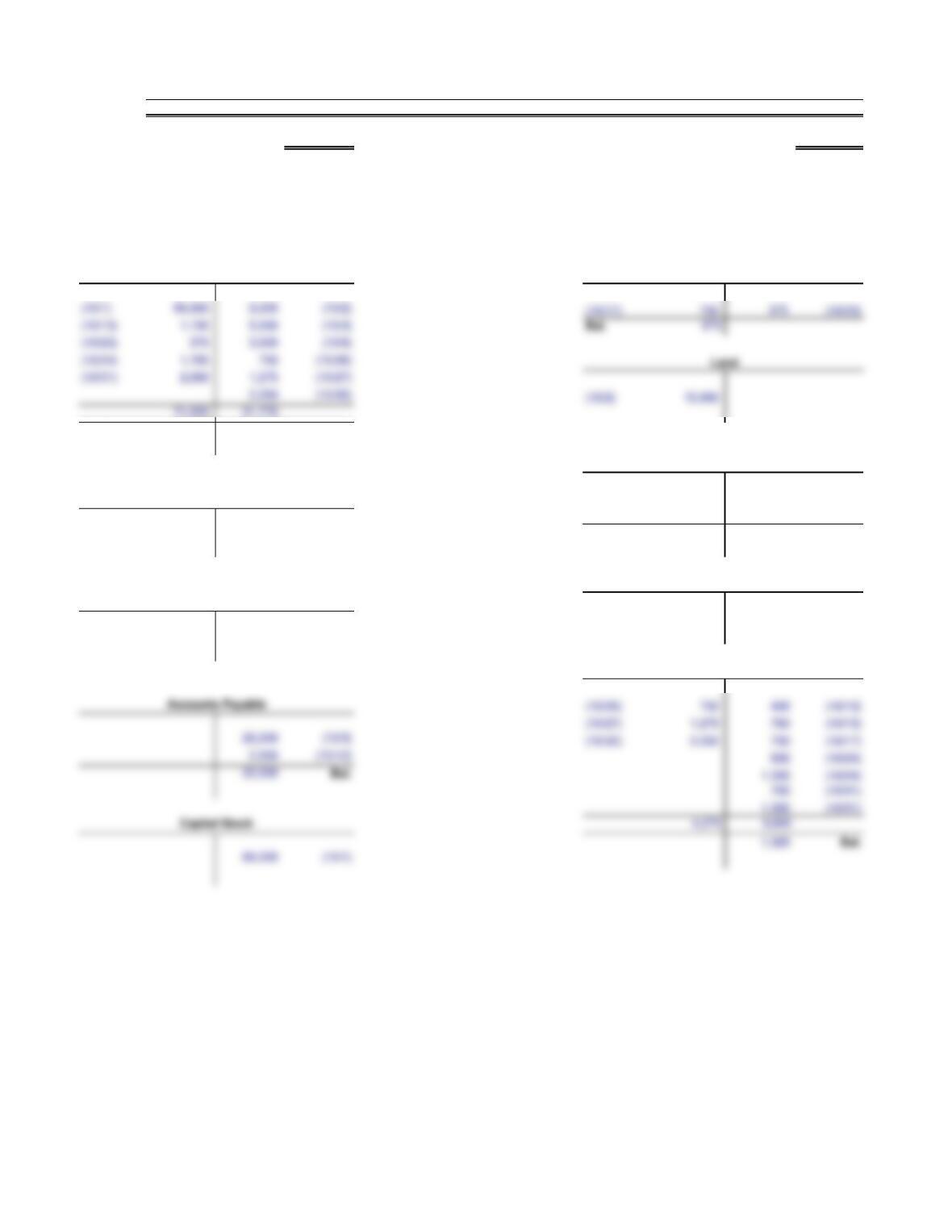
1,300
Bal. 49,450$ 375$ 2,500$ 15,000$ 75,000$ 28,500$ 22,500$ 81,000$ 66,000$ 1,325$
TOTAL LIABILITIES
170,825$ AND OWNERS’ EQUITY: 170,825$
Bal. 49,450
(10/3)
(10/9)
(10/12) 2,500 Bal.
81,000 (10/2)
(10/2) 75,000
4,275
1,275
2,250
Retained Earnings
Notes Payable
Building
Concession Supplies
25,000
3,500
28,500
Equipment
2. Record each transaction directly in T accounts using the dates preceding the transactions
to identify them in the accounts. Each account involved in the problem needs a separate
T-account.
Cash
Accounts Receivable
TOTAL ASSETS:
(10/1) 66,000 9,000 (10/2) (10/17) 375 (10/23)
(10/13) 1,150 5,000 (10/3) Bal.
15,000
375
General Instructions
dollars or numbers in the $ cells.
Sold $24,000 of advertising during the first month. Customers have until the 15th of the following
month to pay their bills.
Paid wages and salaries of $15,000 for the second half of the month.
Recorded $3,500 in commissions earned by the salespeople during the month. They will be
paid on the fifth of the following month.
Signed a three-year promissory note at the bank for $125,000.
Purchased office equipment at a cost of $50,000, paying $10,000 down and agreeing to pay
the remainder in ten days.
Paid wages and salaries of $13,000 for the first half of the month. Office employees are paid
twice a month.
Paid the balance due on the office equipment.
3. The completed exercise/problem may be printed or e-mailed per direction from your instructor.
P3-10
a.
b.
Required:
(a) 200,000 150,000 (b) (g) 24,000
(c) 125,000 10,000 (d)
13,000 (e)
40,000 (f)
15,000 (h)
transactions to identify them in the accounts. Each account involved in the problem needs
a separate T account.
Cash
Accounts Receivable
1. Record each transaction directly in T accounts using the letters preceding the
Atkins Advertising Agency began business on January 2. The transactions entered into by
Atkins during its first month of operations are as follows:
Acquired its articles of incorporation from the state and issued 100,000 shares of capital stock
in exchange for $200,000 in cash.
Purchased an office building for $150,000 in cash. The building is valued at $110,000, and the
remainder of the value is assigned to the land.
3,500 (i) 125,000 (c)
Note: List items in account order, starting with assets and ending with expenses.
Leave off accounts with zero balances.
Debits Credits
Notes Payable
Capital Stock
Advertising Revenue
Wage and Salary
Commissions Expense
Building
Office Equipment
Commissions Payable
97,000$
24,000
40,000
Cash
Accounts Receivable
Land
2. Prepare a trial balance at January 31.
ATKINS ADVERTISING AGENCY
TRIAL BALANCE
JANUARY 31
Commissions Payable
Notes Payable
Capital Stock
Advertising Revenue
General Instructions
1. The following worksheet may be used to complete the exercise/problem.
Paid $3,230 for February advertising.
Declared and paid $2,000 cash dividends to stockholders.
Provided $16,800 of services on account during the month.
Paid $400 for wages earned by employees for the month.
3. The completed exercise/problem may be printed or e-mailed per direction from your instructor.
P3-12A
February 15:
Required
Journal Entries:
Feb. 15 Cash 8,000
Accounts Receivable 8,000
Received cash on open accounts.
BALANCE SHEET
Assets = Liabilities Revenues
− Expenses
= Net Income
Cash 8,000
Accounts Receivable
− Expenses
Accounts Receivable
+ Stockholders’ Equity
INCOME STATEMENT
(8,000)
Revenue
16,800
Feb. 27 Gas and Oil Expense 3,400
Accounts Payable 3,400
Received gas and oil bill for February.
BALANCE SHEET
Assets = Liabilities Revenues
− Expenses = Net Income
− Expenses = Net Income
INCOME STATEMENT
+ Stockholders’ Equity
Accounts Payable 3,400 (3,400) Gas and Oil (3,400)
Expense 3,400
INCOME STATEMENT
+ Stockholders’ Equity
1. Prepare journal entries on the books of Overnight to record the transactions entered into during February.
INCOME STATEMENT
+ Stockholders’ Equity
Overnight Delivery Inc. is incorporated on February 1 and enters into the following transactions during its first
month of operations:
Received $8,000 cash from customer accounts.
Cash 3,230
Paid for advertising used in February
BALANCE SHEET
Assets = Liabilities Revenues
− Expenses = Net Income
Cash (3,230) (3,230) Advertising (3,230)
Expense 3,230
Under the accrual basis of accounting, expenses are recognized when incurred. Therefore, even though no cash was paid on February 27, an expense would be
recognized in February because the company used the gas and oil during the month.
+ Stockholders’ Equity
2. Explain why you agree or disagree with the following: The transactions on February 28 all represent expenses for the month of February
cash was paid. The transaction on February 27 does not represent an expense in February because cash has not yet been paid.
INCOME STATEMENT
− Expenses = Net Income
INCOME STATEMENT
General Instructions
1. The following worksheet may be used to complete the exercise/problem.
Purchased five new delivery trucks for a total of $45,000 in cash.
Performed services on account that amounted to $15,900 during the month. Cash amounting to $7,490 was received from
customers on account during the month.
Established an open account at a local service station at the beginning of the month. Purchases of gas and oil during January
amounted to $3,230. Blue Jay has until the 10th of the following month to pay its bill.
Signed a three-year promissory note at Third State Bank in the amount of $50,000.
P3-12
January 2:
January 3:
Required
Journal Entries:
Jan. 2 Cash 100,000
Capital Stock 100,000
Issued 100,000 shares of capital stock for cash.
BALANCE SHEET
Assets = Liabilities +
Stockholders’
Equity +
Revenues
− Expenses
Cash 100,000 Capital Stock 100,000
BALANCE SHEET
Assets = Liabilities +
Stockholders’
Equity +
Revenues
− Expenses
Warehouse 60,000
Land 20,000
Cash (80,000)
Jan. 4 Cash 50,000
Notes Payable 50,000
Signed three-year promissory note at Third State Bank.
BALANCE SHEET
Assets = Liabilities +
Stockholders’
Equity +
Revenues
− Expenses
Stockholders’
Equity +
− Expenses
INCOME STATEMENT
Cash 50,000 Notes Payable 50,000
1. Prepare journal entries on the books of Blue Jay to record the transactions entered into during the month.
INCOME STATEMENT
INCOME STATEMENT
INCOME STATEMENT
Blue Jay Delivery Service is incorporated on January 2 and enters into the following transactions during
its first month of operations:
Filed articles of incorporation with the state and issued 100,000 shares of capital stock. Cash of $100,000 is received from the
new owners for the shares.
Purchased a warehouse and land for $80,000 in cash. An appraiser values the land at $20,000 and the warehouse at $60,000.
Service Revenue 15,900
Performed services during month on account.
BALANCE SHEET
Assets = Liabilities +
Stockholders’
Equity +
Revenues
− Expenses
Accounts Receivable 15,900 Service
Revenue 15,900
Stockholders’
Equity +
Revenues
INCOME STATEMENT
Cash 7,490
Accounts Receivable (7,490)
Jan. 31 Gas and Oil Expense 3,230
Dr. Cr.
Cash 32,490$
Warehouse 60,000
Land 20,000
Delivery Trucks 45,000
Revenue:
Service revenue 15,900$
Assets
Current assets:
Note: List current assets and liabilities in the order of liquidity.
BLUE JAY DELIVERY SERVICE
BALANCE SHEET
JANUARY 31
JANUARY 31
3. Prepare an income statement for the month of January.
BLUE JAY DELIVERY SERVICE
INCOME STATEMENT
FOR THE MONTH OF JANUARY
4. Prepare a classified balance sheet at January 31.
2. Prepare a trial balance at January 31.
BLUE JAY DELIVERY SERVICE
TRIAL BALANCE
INCOME STATEMENT
Stockholders’
Equity +
− Expenses
INCOME STATEMENT
Is there a limit on how much the company charges? What if the company cannot pay by the 10th?
Were any assets offered as collateral? What is the repayment schedule?
How long are the trucks expected to last? Will they have any salvage value? What volume of business can they support?
When will customers pay the remaining balance? What is the credit standing of the customers?
Warehouse 60,000
Delivery trucks 45,000
Total property, plant, and equipment 125,000
Total assets 165,900$
Jan. 3:
Jan. 4:
on January 3, list any additional information you would like to have about each of the transactions during the remainder of the month.
Is the warehouse new? How large is it? What volume of business can it support? Is it insured?
What is the interest rate on the loan? Are there any restrictions on the company’s operations in the debt agreement (covenants)?
5. Assume that you are considering buying stock in this company. Beginning with the transaction to record the purchase of the property
Liabilities and Stockholders’ Equity