Problem 3-26 (continued)
2.
Preparation Department overhead applied:
350 machine-hours × $5.20 per machine-hour …..
$1,820
Fabrication Department overhead applied:
130 direct labor-hours × $14.40 per labor-hour ….
Total overhead cost ………………………………………..
$3,692
3. Total cost of Job 127:
Preparation
Fabrication
Total
Direct materials …………….
$ 940
$1,200
$2,140
Direct labor ………………….
Manufacturing overhead …
Total cost ……………………
units
per unit
4.
Preparation
Fabrication
Manufacturing overhead cost incurred …..
$390,000
$740,000
Manufacturing overhead cost applied:
Underapplied (or overapplied) overhead ..
Problem 3-27 (45 minutes)
1.
a.
Raw Materials ………………………………….
160,000
Accounts Payable …………………………
160,000
b.
Work in Process ……………………………….
120,000
Manufacturing Overhead ……………………
20,000
Raw Materials ……………………………..
140,000
c.
Work in Process ……………………………….
90,000
Manufacturing Overhead ……………………
60,000
Sales Commissions Expense ……………….
20,000
Salaries Expense ………………………………
50,000
Salaries and Wages Payable …………..
220,000
d.
Manufacturing Overhead ……………………
13,000
Insurance Expense…………………………...
Manufacturing Overhead ……………………
10,000
Advertising Expense ………………………….
15,000
Accounts Payable …………………………
g.
Manufacturing Overhead ……………………
20,000
Depreciation Expense ………………………..
Accumulated Depreciation ……………..
Work in Process ……………………………….
110,000
Manufacturing Overhead ……………….
110,000
Problem 3-27 (continued)
i.
Finished Goods …………………………….
310,000
Work in Process ……………………….
310,000
Accounts Receivable ………………………
498,000
Sales ……………………………………..
498,000
Cost of Goods Sold ………………………..
308,000
2.
Raw Materials
Work in Process
Bal.
10,000
(b)
140,000
Bal.
4,000
(i)
310,000
(a)
160,000
(b)
120,000
(h)
110,000
Bal.
(j)
308,000
(b)
(h)
110,000
(i)
310,000
(c)
(e)
(g)
(j)
308,000
3. Manufacturing overhead is underapplied by £13,000 for the year. The
entry to close this balance to Cost of Goods Sold would be:
Cost of Goods Sold ……………………………….
13,000
Manufacturing Overhead ……………………
13,000
Problem 3-27 (continued)
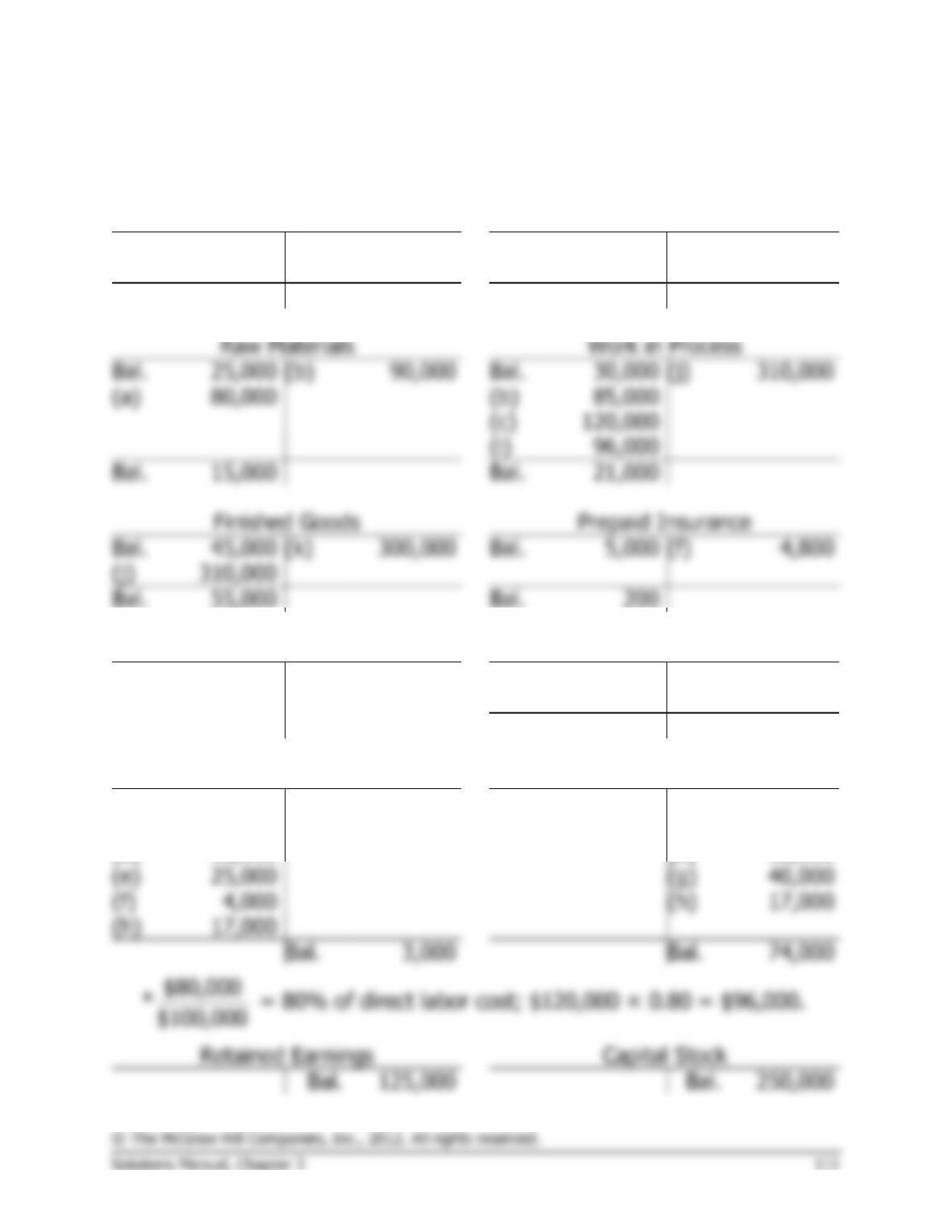
4.
Sovereign Millwork, Ltd.
Income Statement
For the Year Ended June 30
Problem 3-28 (60 minutes)
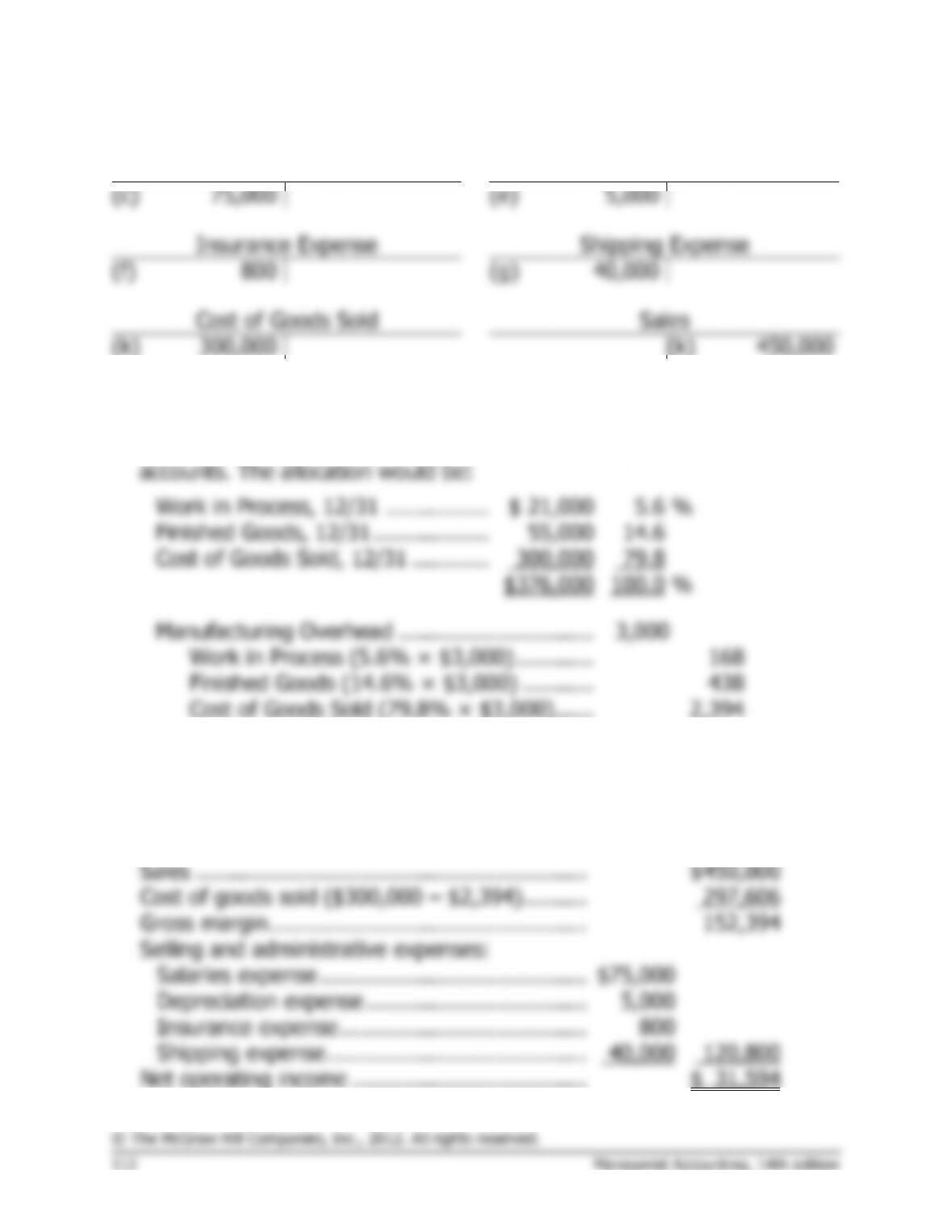
1. and 2.
Cash
Accounts Receivable
Bal.
15,000
(c)
225,000
Bal.
40,000
(l)
445,000
(l)
445,000
(m)
150,000
(k)
450,000
Bal.
85,000
Bal.
45,000
Bal.
(b)
90,000
Bal.
30,000
(j)
310,000
(a)
80,000
(b)
85,000
(c)
120,000
(i)
96,000
Bal.
15,000
Bal.
21,000
Bal.
45,000
(k)
300,000
Bal.
(f)
(j)
310,000
Bal.
55,000
Bal.
Buildings & Equipment
Accumulated Depreciation
Bal.
500,000
Bal.
210,000
(e)
30,000
Bal.
240,000
Manufacturing Overhead
Accounts Payable
(b)
5,000
(i)*
96,000
(m)
150,000
Bal.
75,000
(c)
30,000
(a)
80,000
(d)
12,000
(d)
12,000
(e)
(g)
40,000
(h)
17,000
Bal.
Bal.
74,000
Problem 3-28 (continued)
Salaries Expense
Depreciation Expense
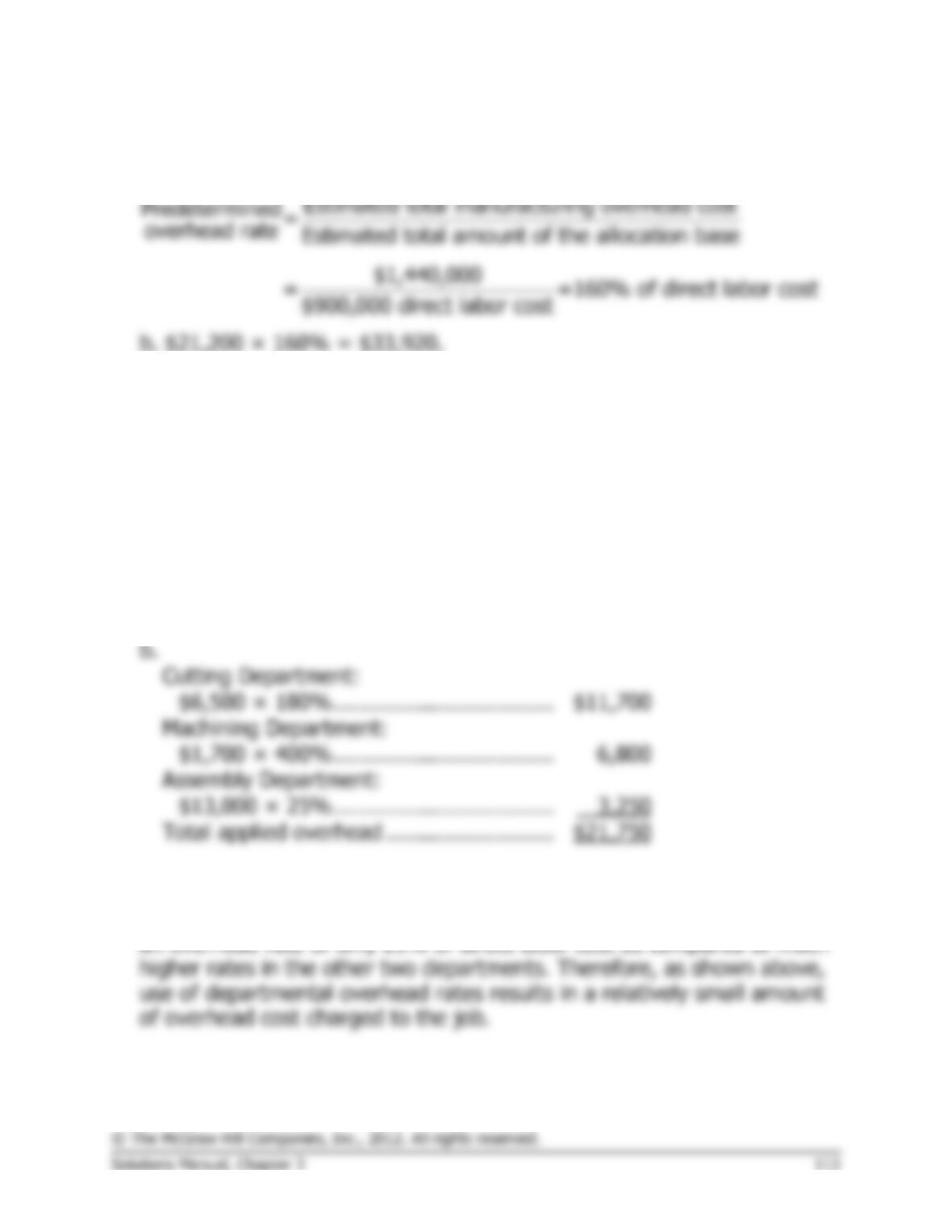
3. Manufacturing overhead was overapplied by $3,000 for the year. This
balance would be allocated between Work in Process, Finished Goods,
and Cost of Goods Sold in proportion to the ending balances in these
14.6
4.
Fantastic Props, Inc.
Income Statement
For the Year Ended December 31
Case 3-29 (60 minutes)
1. a.
2. a.
Cutting
Department
Machining
Department
Assembly
Department
Estimated manufacturing
overhead cost (a) ……….
$540,000
$800,000
$100,000
Estimated direct labor
cost (b) …………………….
$300,000
$200,000
$400,000
Predetermined overhead
rate (a) ÷ (b) …………….
180%
400%
25%
Cutting Department:
$6,500 × 180% …………………………….
Machining Department:
$1,700 × 400% …………………………….
Assembly Department:
$13,000 × 25% …………………………….
3,250
Total applied overhead ……………………..
3. The bulk of the labor cost on the Hastings job is in the Assembly
Department, which incurs very little overhead cost. The department has
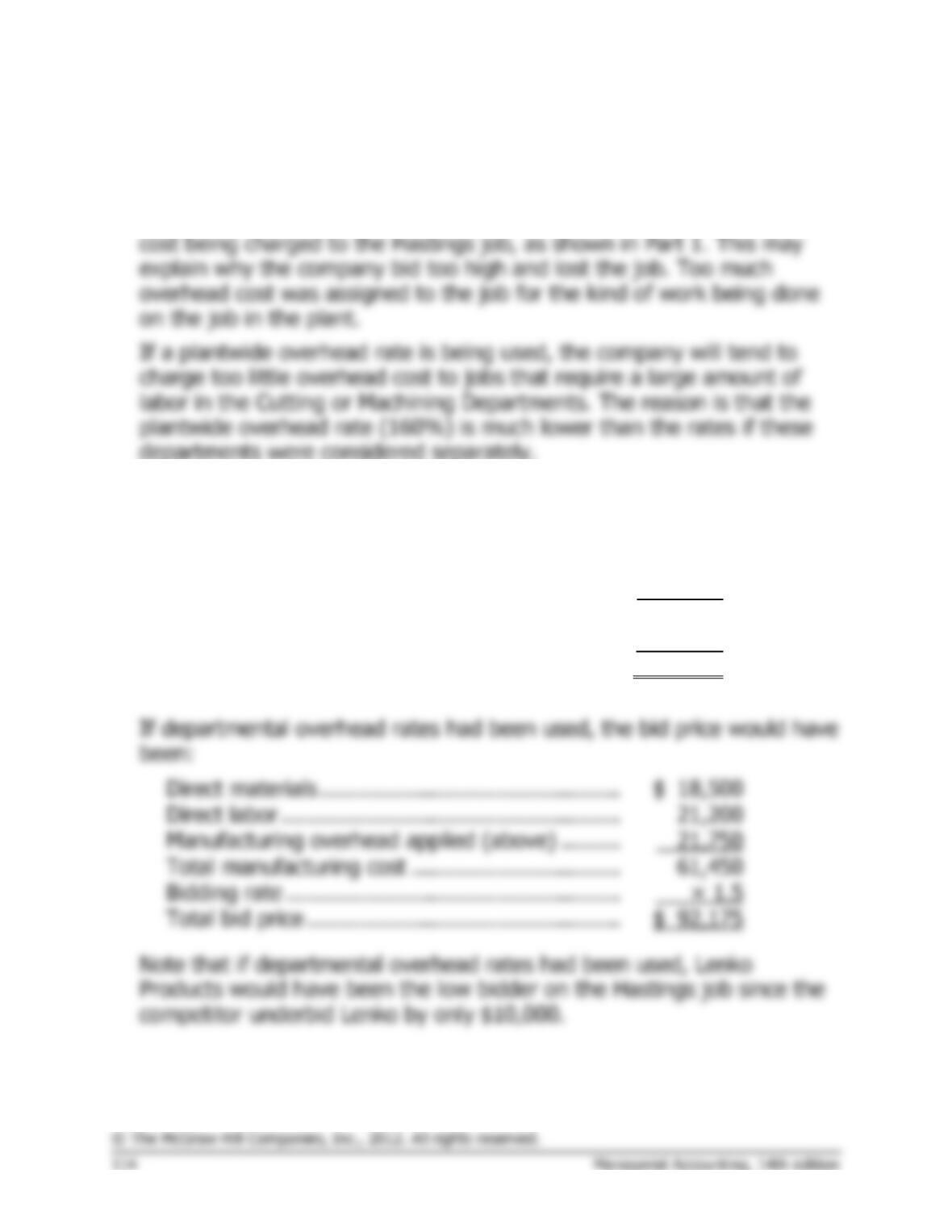
Case 3-29 (continued)
However, use of a plantwide overhead rate in effect redistributes
overhead costs proportionately between the three departments (at
160% of direct labor cost) and results in a large amount of overhead
4. The company’s bid price was:
Direct materials ……………………………………….
$ 18,500
Direct labor …………………………………………….
21,200
Manufacturing overhead applied (above) ………
33,920
Total manufacturing cost …………………………..
73,620
Bidding rate ……………………………………………
× 1.5
Total bid price …………………………………………
$110,430
Direct materials ……………………………………….
Direct labor …………………………………………….
Manufacturing overhead applied (above) ………
21,750
Total manufacturing cost …………………………..
Bidding rate ……………………………………………
× 1.5
Total bid price …………………………………………
Case 3-29 (continued)
5. a.
Actual overhead cost …………………………………
$1,482,000
Applied overhead cost ($870,000 × 160%) …….
1,392,000
Underapplied overhead cost ………………………..
$ 90,000
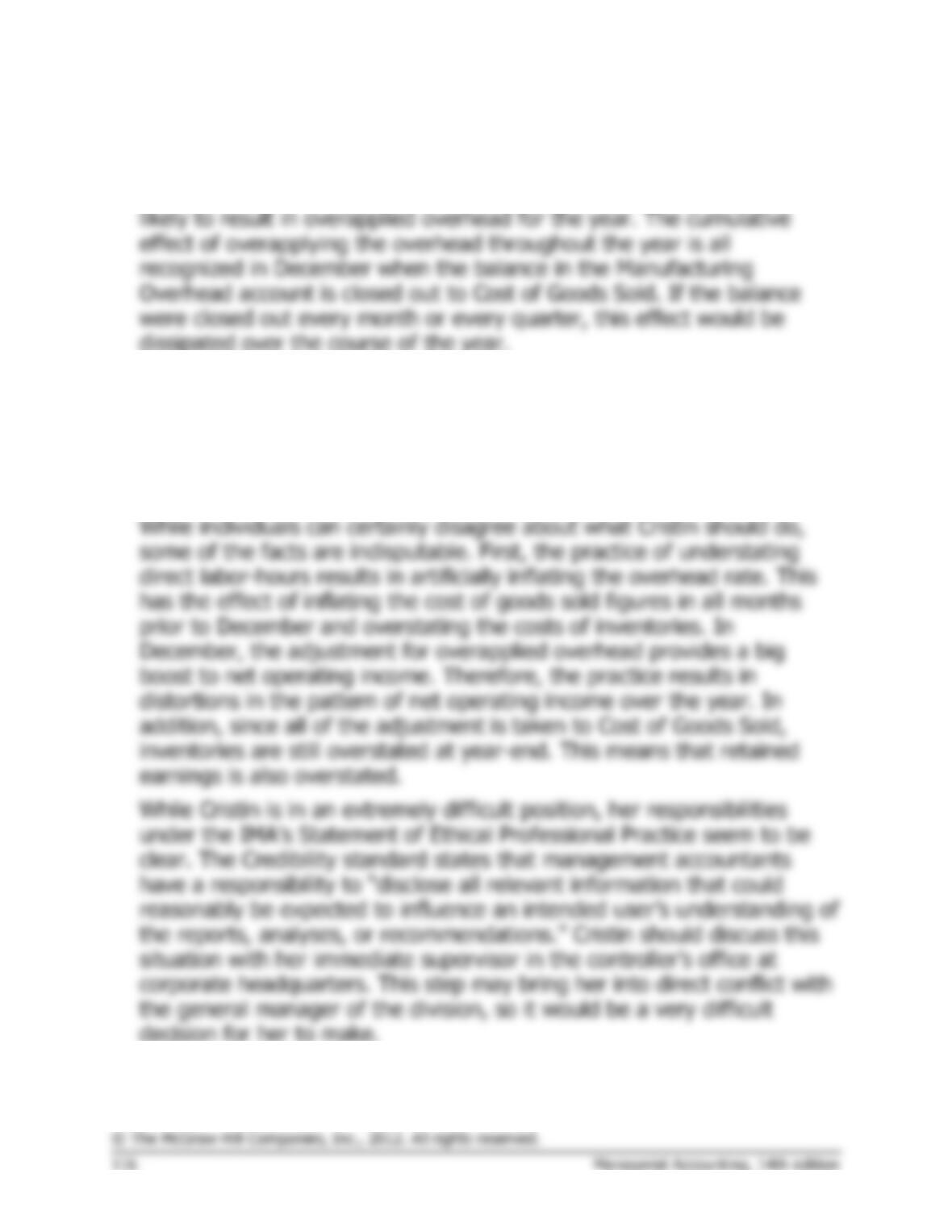
Actual overhead cost …………
$830,000
Applied overhead cost:
Case 3-30 (45 minutes)
1. Shaving 5% off the estimated direct labor-hours in the predetermined
overhead rate will result in an artificially high overhead rate, which is
2. This question may generate lively debate. Where should Cristin
Madsen’s loyalties lie? Is she working for the general manager of the
division or for the corporate controller? Is there anything wrong with the
“Christmas bonus”? How far should Cristin go in bucking her boss on a
new job?

Case 3-30 (continued)
In the actual situation that this case is based on, the corporate
controller’s staff were aware of the general manager’s accounting tricks,
but top management of the company supported the general manager
because “he comes through with the results” and could be relied on to
hit the annual profit targets for his division. Personally, we would be
very uncomfortable supporting a manager who will resort to deliberate
distortions to achieve “results.” If the manager will pull tricks in this
area, what else might he be doing that is questionable or even perhaps
illegal?
Appendix 3A
The Predetermined Overhead Rate and Capacity
Exercise 3A-1 (30 minutes)
1. The overhead applied to Ms. Miyami’s account would be computed as
follows:
2010
2011
Estimated overhead cost (a) ………………………..
Estimated professional staff hours (b) ……………
Predetermined overhead rate (a) ÷ (b) …………..
2. If the actual overhead cost and the actual professional hours charged
turn out to be exactly as estimated there would be no underapplied or
overapplied overhead.
2010
2011
Predetermined overhead rate (see above) ………
Overhead applied ………………………………………
Actual overhead cost incurred (by assumption) ..
Under- or overapplied overhead ……………………
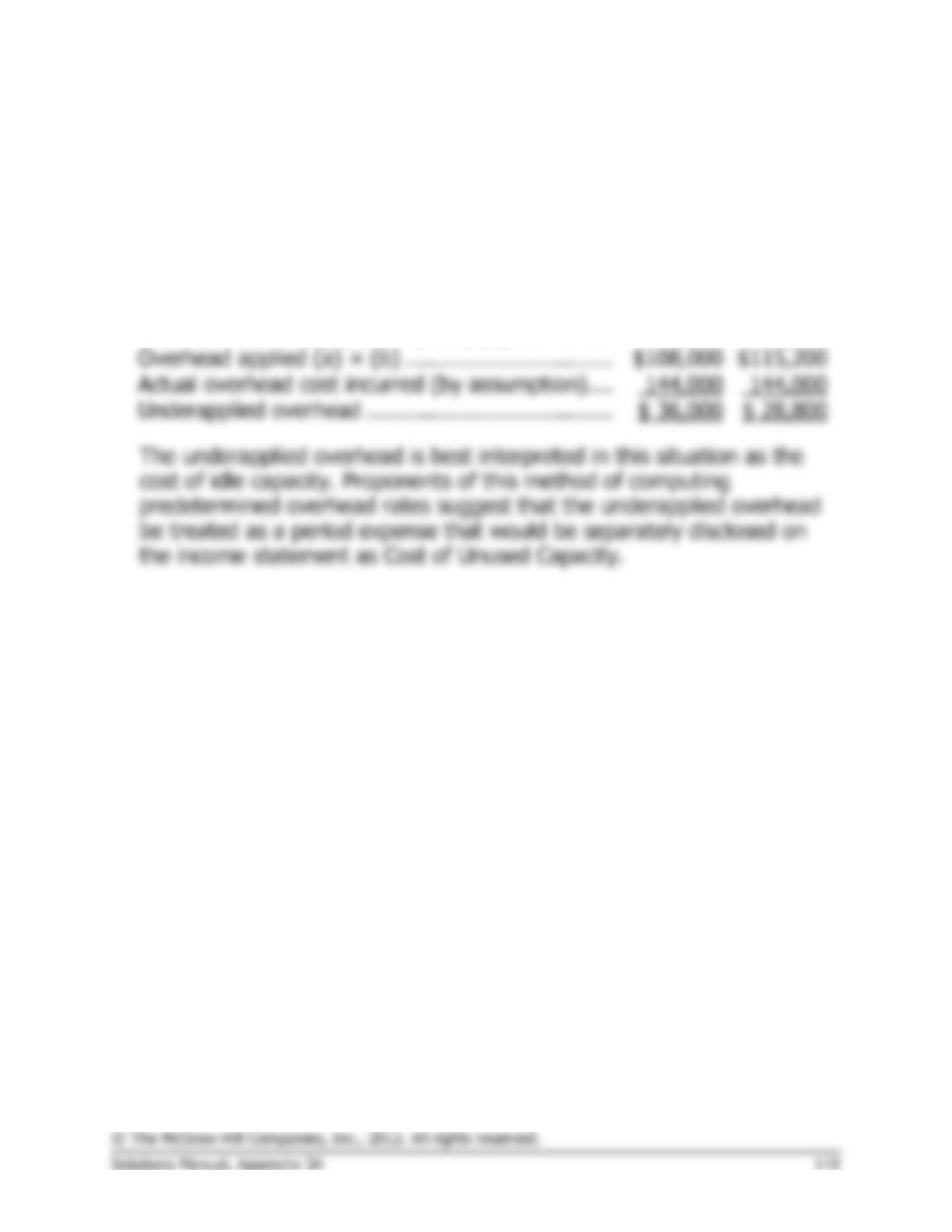
3. If the predetermined overhead rate is based on the professional staff
hours available, the computations would be:
2010
2011
Estimated overhead cost (a) ………………………….
Professional staff hours available (b) ……………….
Predetermined overhead rate (a) ÷ (b) ……………
Problem 3A-1 (continued)
4. If the actual overhead cost and the actual professional staff hours
charged to clients’ accounts turn out to be exactly as estimated
overhead would be underapplied as shown below.
2010
2011
Predetermined overhead rate (see 3 above) (a) …
$48
$48
Actual professional staff hours charged to
clients’ accounts (by assumption) (b) ……………
× 2,250
× 2,400
Overhead applied (a) × (b) …………………………..
Actual overhead cost incurred (by assumption) ….
Underapplied overhead ………………………………..
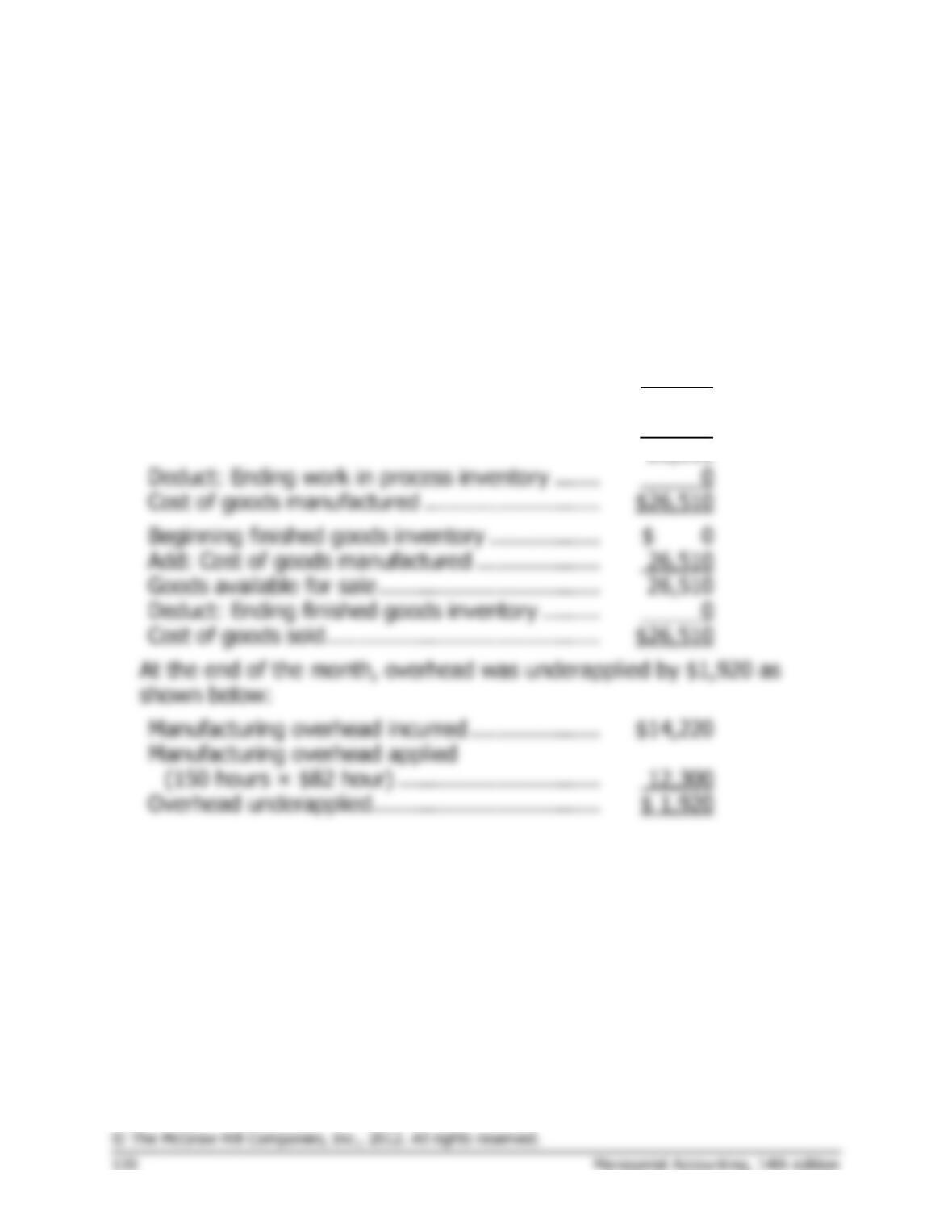
Exercise 3A-2 (30 minutes)
1. There were no beginning or ending inventories, so all of the jobs were
started, finished, and sold during the month. Therefore cost of goods
sold equals the total manufacturing cost. We can verify that by
computing the cost of goods sold as shown below:
Manufacturing costs charged to jobs:
Direct materials …………………………………….
$ 5,350
Direct labor (all variable) …………………………
8,860
Manufacturing overhead applied
(150 hours × $82 hour) ………………………..
12,300
Total manufacturing cost charged to jobs ……..
26,510
Add: Beginning work in process inventory ……..
0
26,510
Deduct: Ending work in process inventory …….
0
Cost of goods manufactured ………………………
Beginning finished goods inventory ……………..
Add: Cost of goods manufactured ……………….
26,510
Goods available for sale …………………………….
26,510
Deduct: Ending finished goods inventory ………
0
Cost of goods sold ……………………………………
Manufacturing overhead incurred ………………..
12,300
Overhead underapplied……………………………..
$ 1,920