3.1 The tolerance, , of the solution in the bisection method is given by , where and
are the endpoints of the interval after the nth iteration. The number of iterations n that are required for
obtaining a solution with a tolerance that is equal to or smaller than a specified tolerance can be determined
before the solution is calculated. Show that n is given by:
where and are the endpoints of the starting interval and
is a user-
specified tolerance
.
Solution
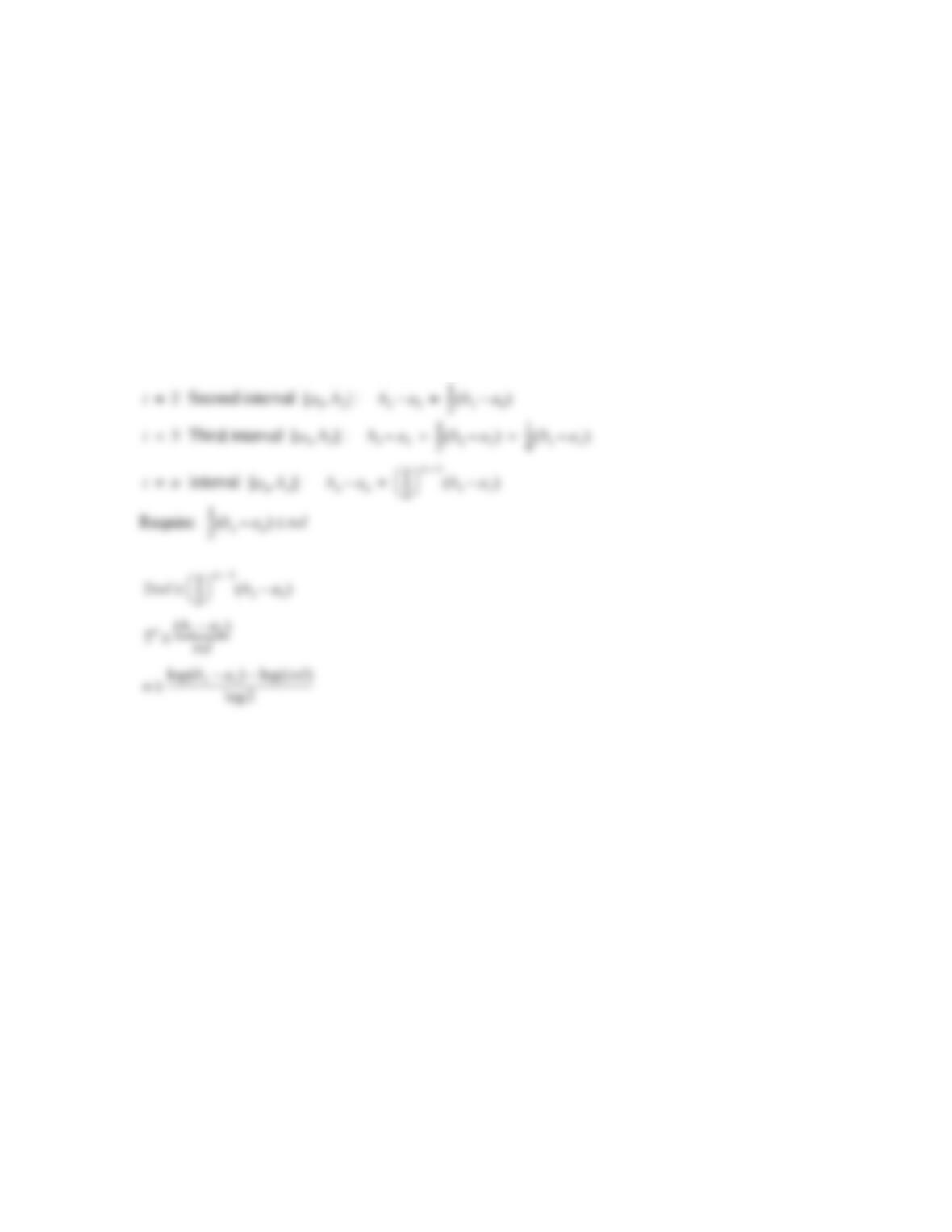
Starting interval
tol
tol 1
2
—–bnan
–()=
an
bn
nba–()log tol()log–
2log
—————–———————————–
≥
a
b
tol
i1=
ab,[] a1b1
,[]=
i2=
i3=
1
3.2 Determine the root of by:
(a) Using the bisection method. Start with and , and carry out the first three iterations.
(b) Using the secant method. Start with the two points, and , and carry out the first three iter-
ations.
(c) Using Newton’s method. Start at
and
carry out the first three iterations
.
Solution
Using 5 significant digits.
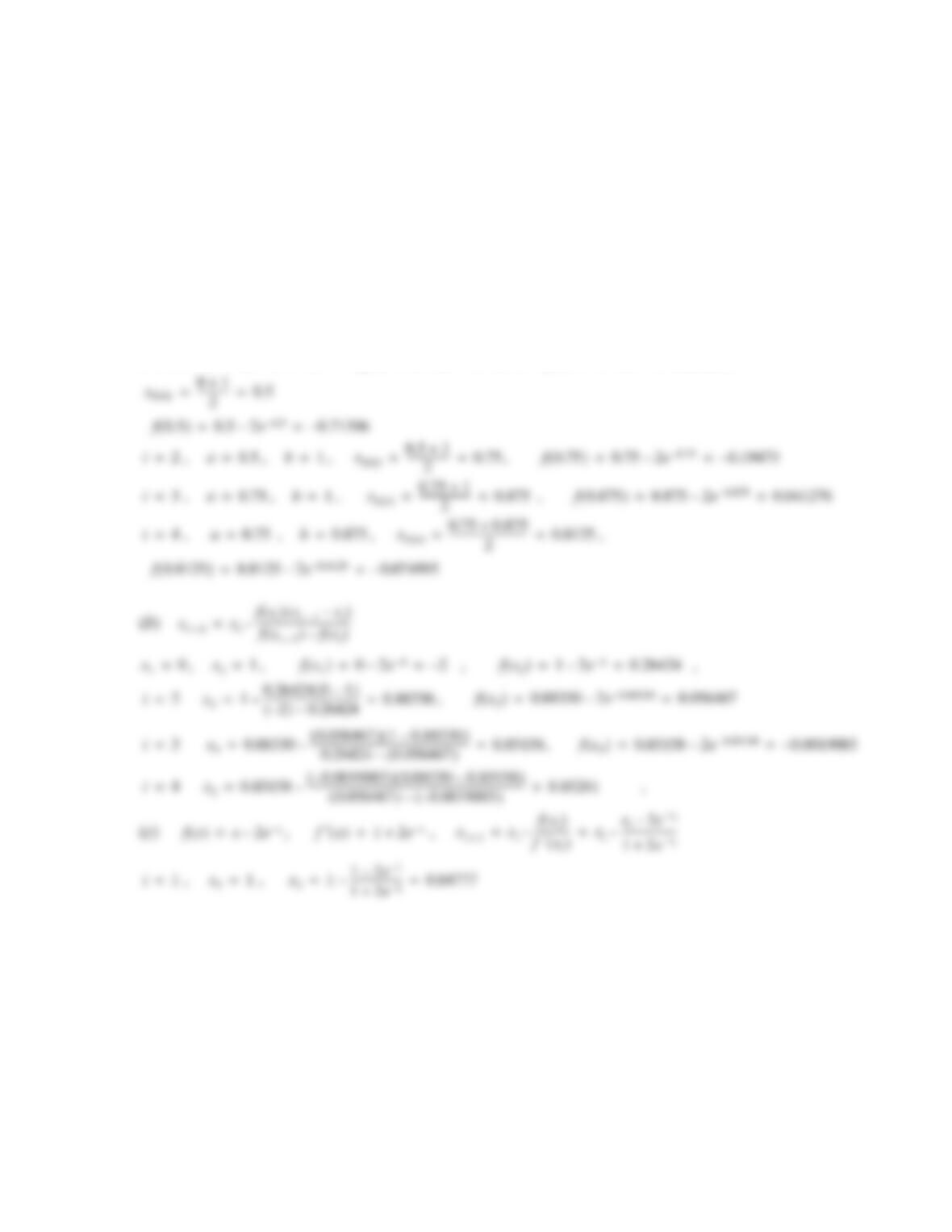
(a)
,,, , ,
fx() x2ex–
–=
a0=
b1=
x10=
x21=
x11=
fx() x2ex–
–=
i1=
a0=
b1=
f0() 02e0–
–2–==
f1() 12e1–
– 0.26424==
i2=
a0.5=
i3=
a0.75=
i4=
i2=
i3=
i4=
i1=
x11=

2
1
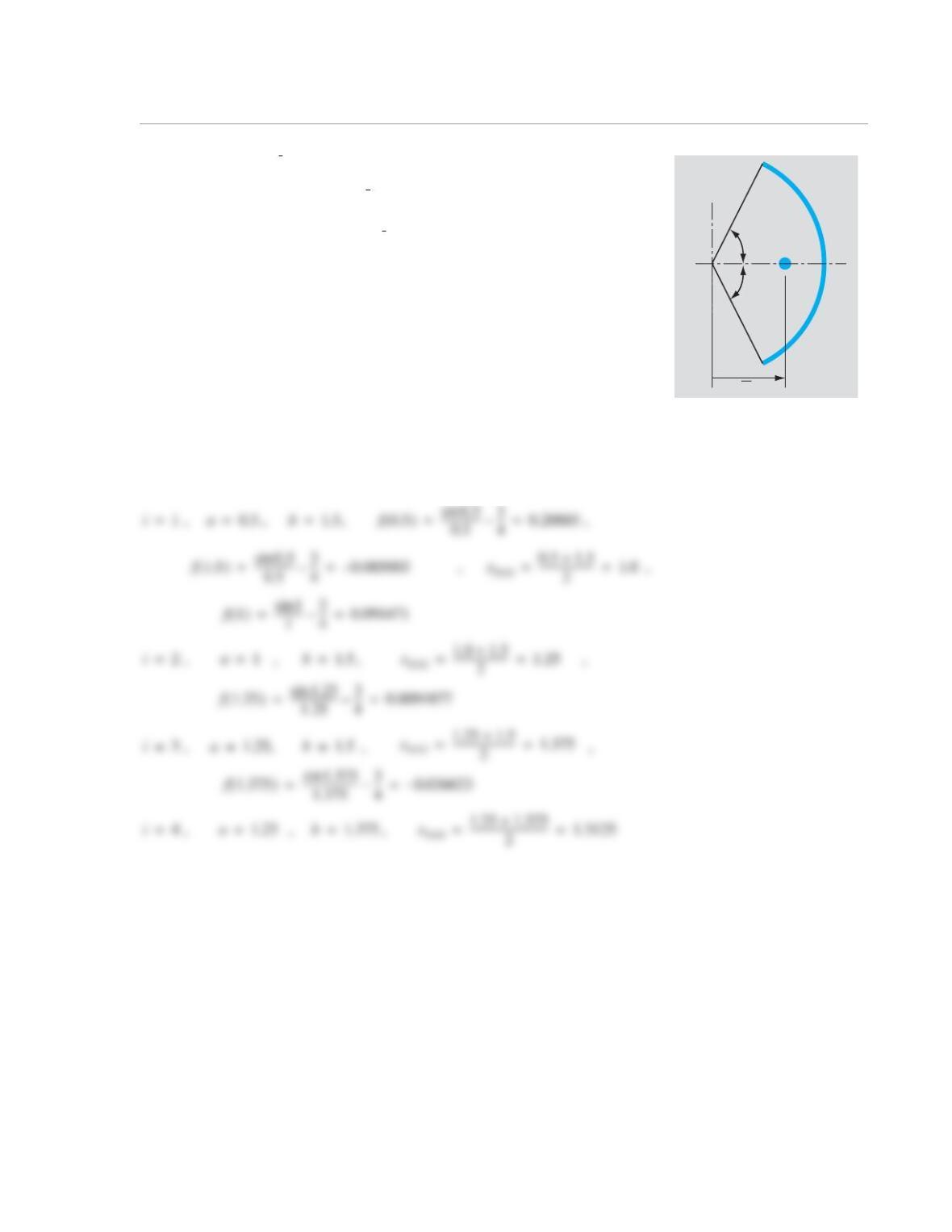
3.3 The location of the centroid of an arc of a circle is given by:
Determine the angle for which
.
First, derive the equation that must be solved and then determine the root using
the following methods:
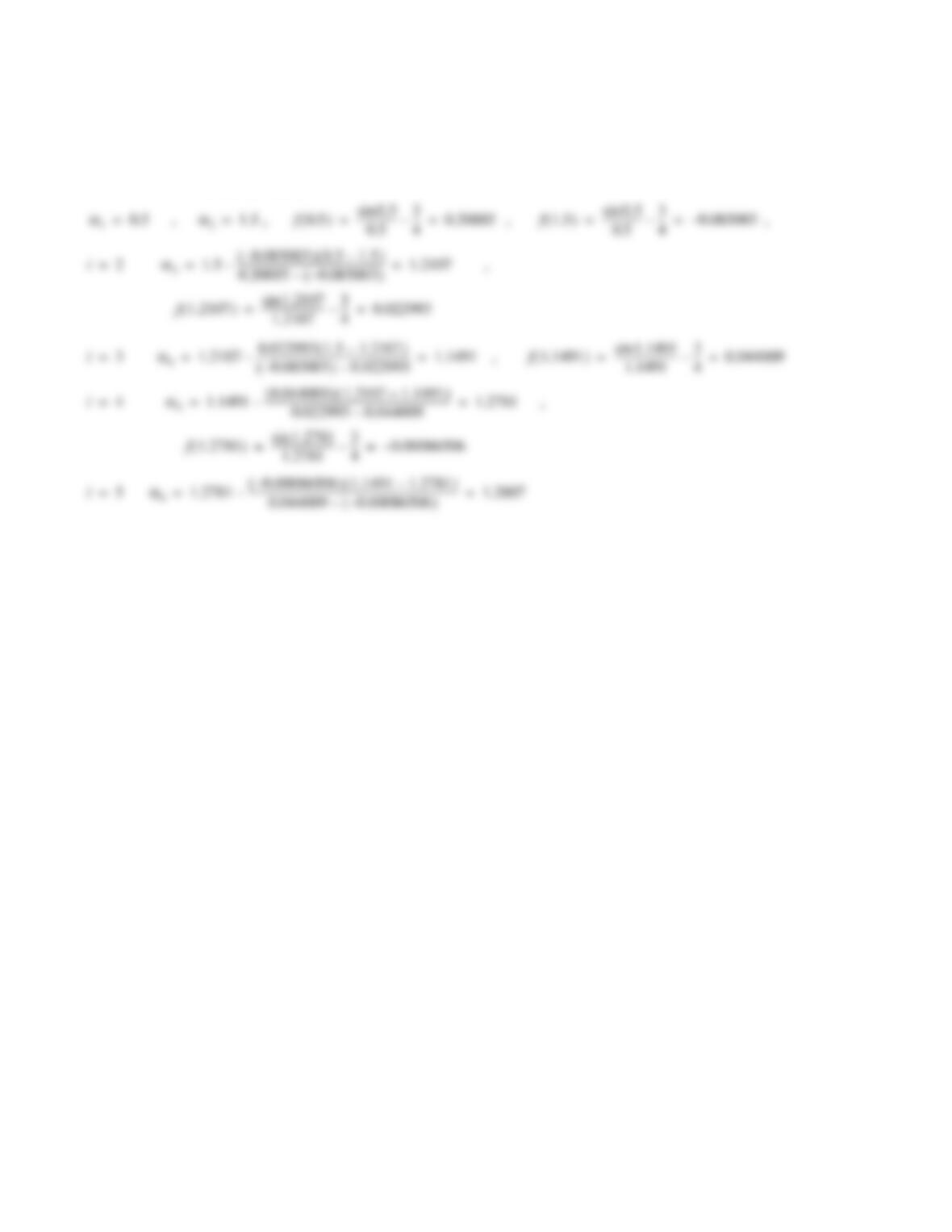
(a) Use the bisection method. Start with and , and carry
out the first four iterations.
(b) Use the secant method. Start with the two points and
, and carry out the first four iterations.
Solution
Using 5 significant digits.
(a)
x
α
C
α
r
x
xrαsin
α
————-–
=
α
x3r
4
—-–
=
a0.5=
b1.5=
α10.5=
α21.5=
fα() αsin
α
———-– 3
4
—–
–=
2
(b)
αi1+ αi
fαi
()α
i1– αi
–()
fαi1–
()fαi
()–
—————-———————–
–=
1
3.4 The lateral surface area, S, of a cone is given by:
where r is the radius of the base and h is the height. Determine the radius of a
cone that has a surface area of 1800 m2 and a height of 25 m. Solve by using
the fixed-point iteration method with as the iteration func-
tion. Start with
m and calculate the first four iterations.
Solution
Using 5 significant digits.
,m
2, m
h
r
Sπrr
2h2
+=
rSπr2h2
+()⁄=
r17=
ri1+
S
πri
2h2
+
——————-—-–
=
S1800=
h25=
1
3.5 Determine the fourth root of 200 by finding the numerical solution of the equation .
Use Newton’s method. Start at
and
carry out the first five iterations
.
Solution
Using 5 significant digits.
,,
x4200–0=
x8=
fx() x4200–=
f′x() 4x3
=
xi1+ xi
fx
i
()
f′xi
()
————–
–xi
xi
4200–
4xi
3
——————––
–==
1
3.6 Determine the positive root of the polynomial .
(a) Plot the polynomial and choose a point near the root for the first estimate of the solution. Using New-
ton’s method,
determine the approximate solution in the first four iterations.
(b) From the plot in part (a), choose two points near the root to start the solution process with the secant
method.
Determine the approximate solution in the first four iterations.
Solution
(a)
Plot with MATLAB:
fplot(‘x^3+0.6*x^2+5.6*x-4.8′,[0 2])
xlabel(‘x’); ylabel(‘y’);
x30.6x25.6x4.8–++
15
20
2
1
3.7 The equation has a root between and . Use these values
for the initial two points and calculate the next four estimates for the solution using the secant method.
Solution
,
,, ,
1.2x32x220x–10–+0=
x4–=
x5–=
fx() 1.2x32x220x–10–+=
xi1+ xi
fx
i
()xi1– xi
–()
fx
i1–
()fx
i
()–
————————————–
–=
x15–=
x24–=
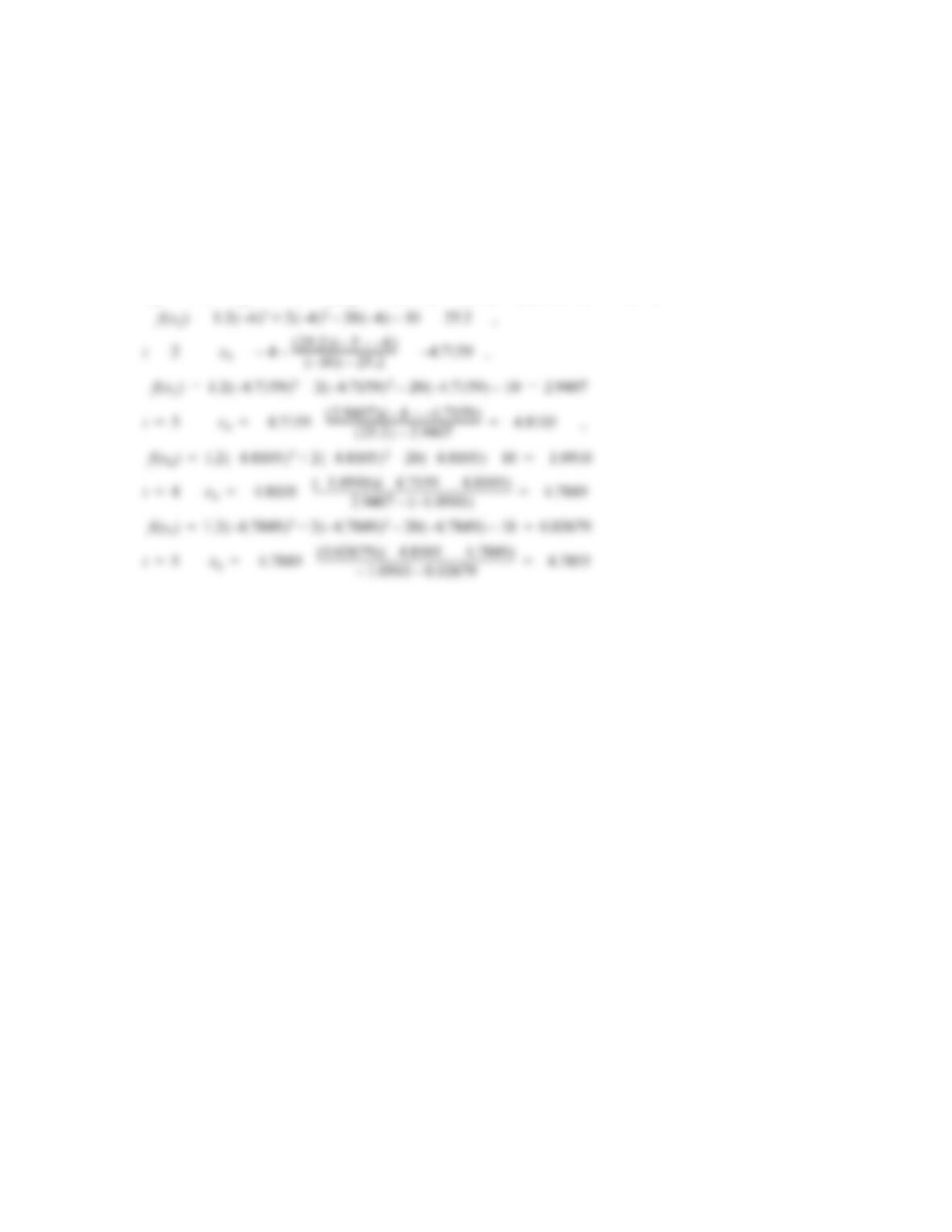
fx
1
() 1.2 5–()
325–()
220 5–()–10–+10–==
1
3.8 Find the root of the equation using Newton’s method. Start at
and
carry out the first
five iterations.
Solution
,,
xx
2
+7=
x7=
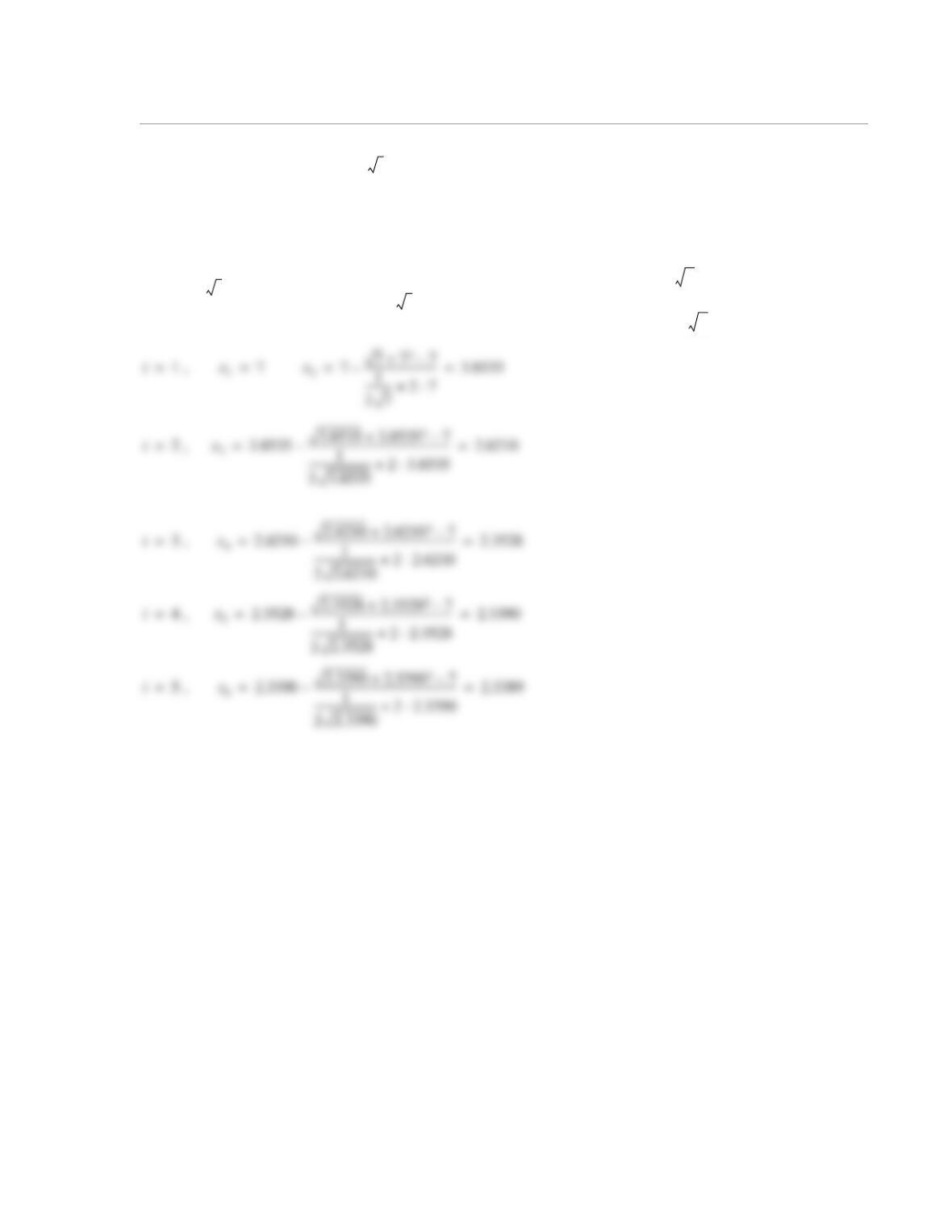
fx() xx
27–+=
f′x() 1
2x
———–2x+=
xi1+ xi
fx
i
()
f′xi
()
————–
–xi
xixi
27–+
1
2xi
———-– 2xi
+
—————–———–
–==
1
3.9 The equation has a root between and .
(a) Write four different iteration functions for solving the equation using the fixed-point iteration method.
(b) Determine which from part (a) could be used according to the condition in Eq. (3.30).
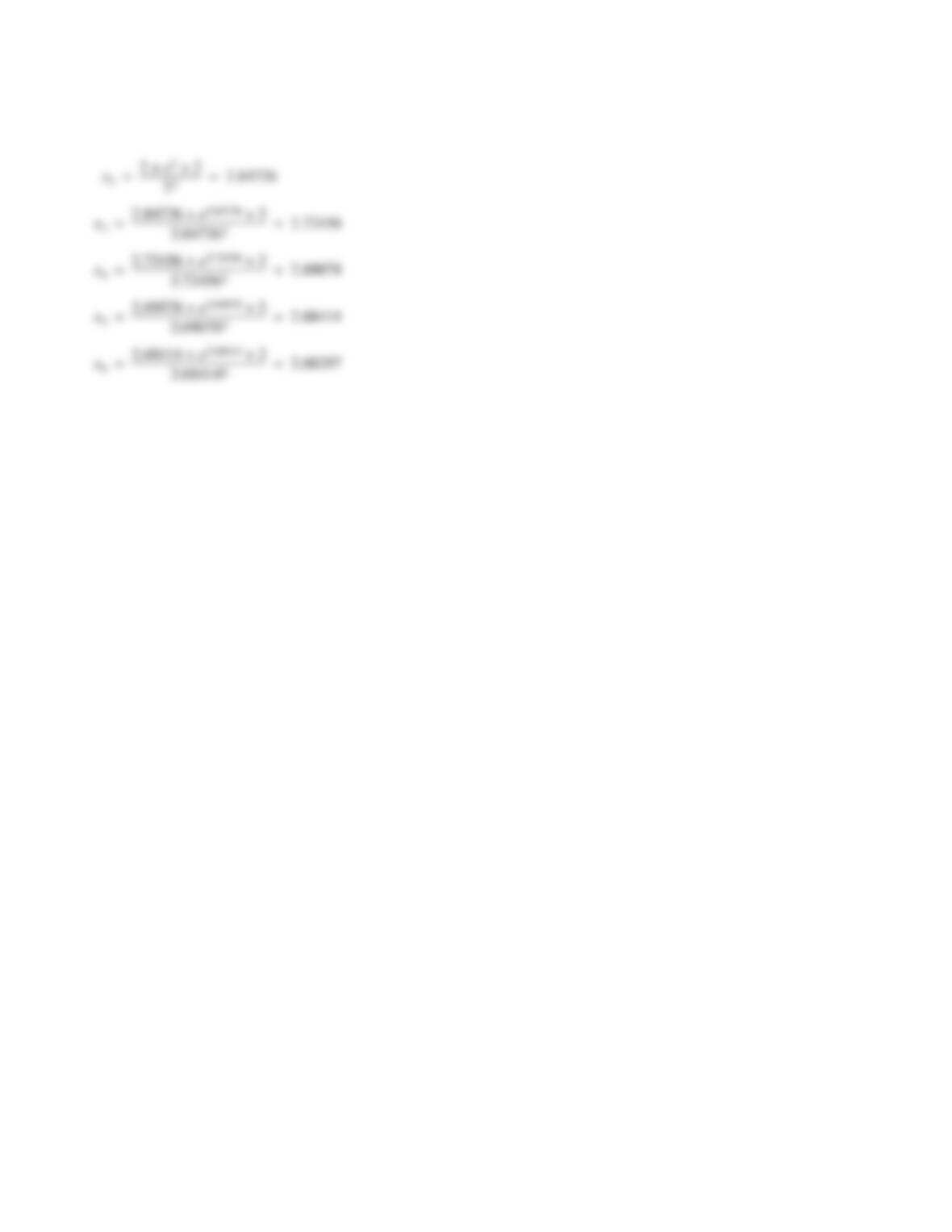
(c) Carry out the first five iterations using the determined in part (b), starting with .
Solution
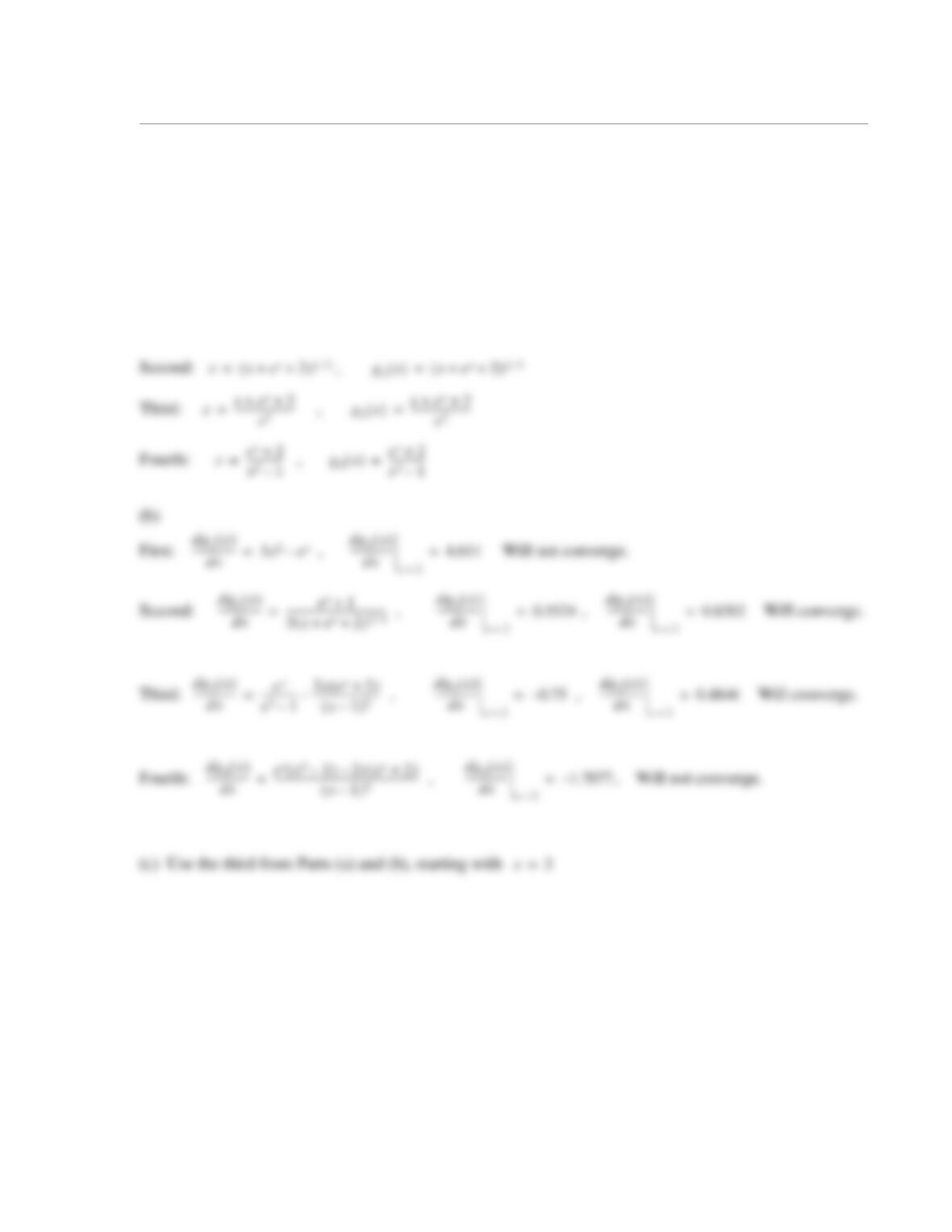
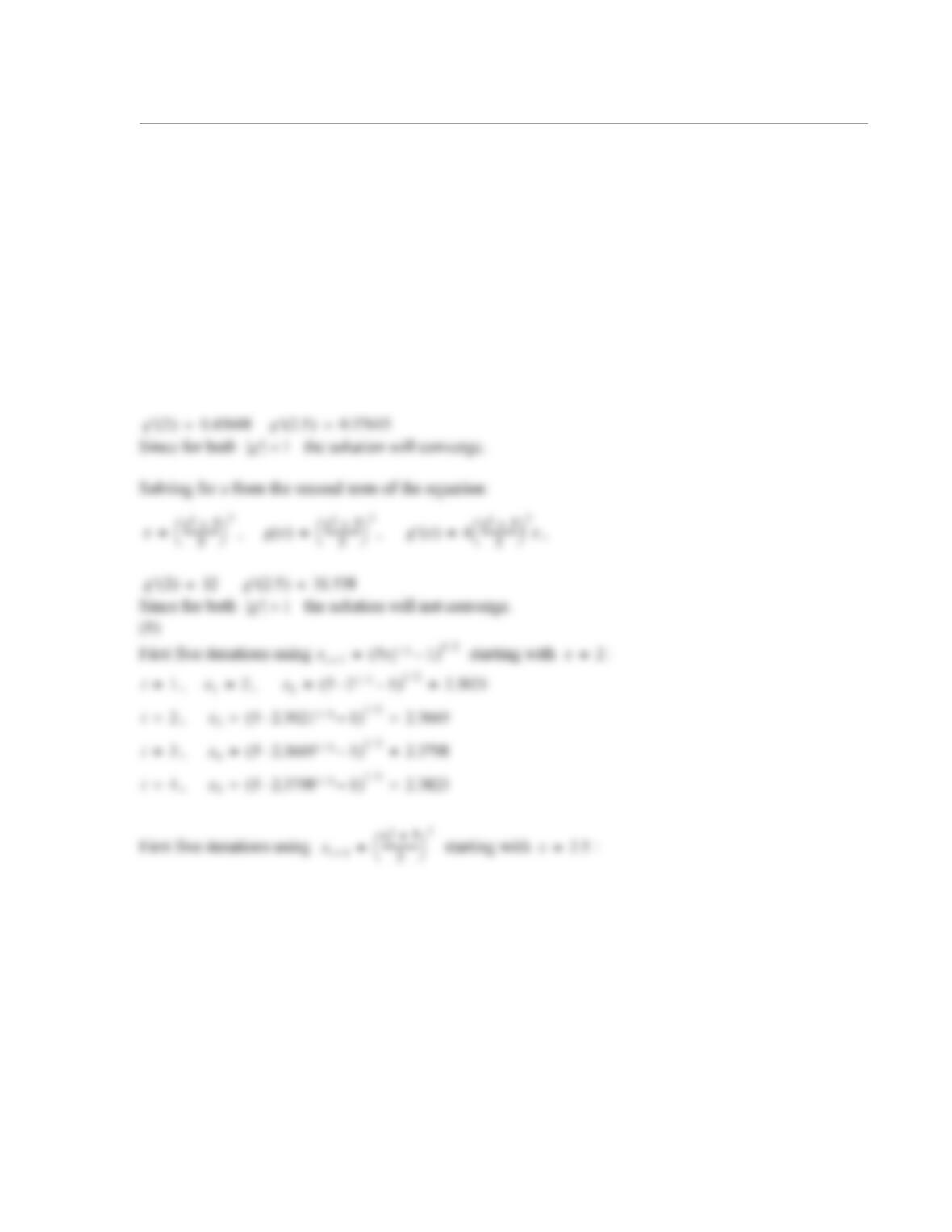
(a)
First: ,
x3x–ex
–2–0=
x2=
x3=
gx()
gx()
x2=
xx
3ex
–2–=
g1x() x3ex
–2–=
2
1
3.10 The equation has a root between and . To find the root by
using the fixed-point iteration method, the equation has to be written in the form . Derive two pos-
sible forms for — one by solving for x from the first term of the equation, and the next by solving for
x from the second term of the equation.
(a) Determine which form should be used according to the condition in Eq. (3.30).
(b) Carry out the first five iterations using both forms of to confirm your determination in part (a).
Solution
(a)
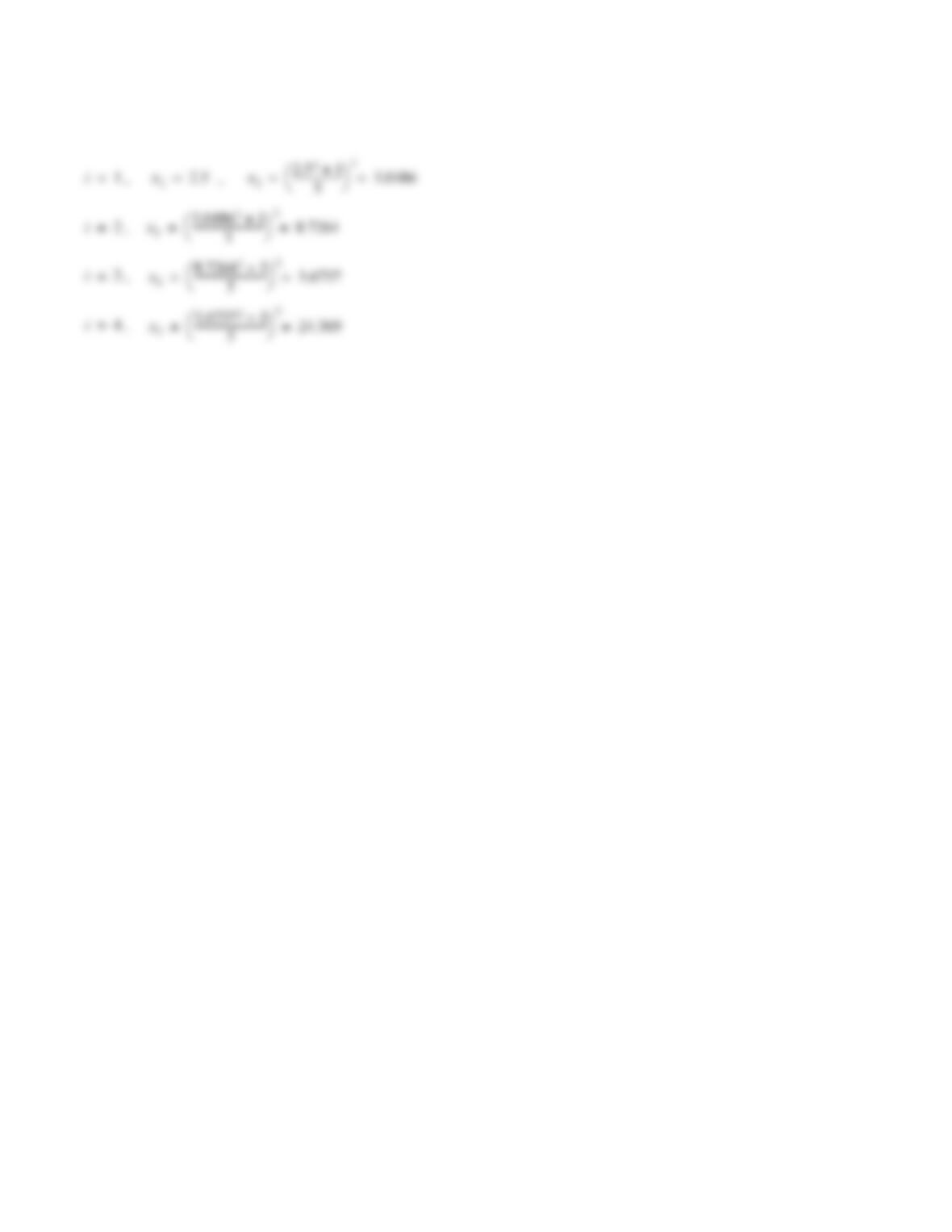
Solving for x from the first term of the equation:
,, ,
fx() x25x13⁄
–1+0==
x2=
x2.5=
xgx()=
gx()
gx()
x5x13⁄1–()
12⁄
=
gx() 5x13⁄1–()
12⁄
=
g′x() 5
3x23⁄5x13⁄1–()
12⁄
———————————————––=
2
3.11 The equation has a root between and . Find the root by
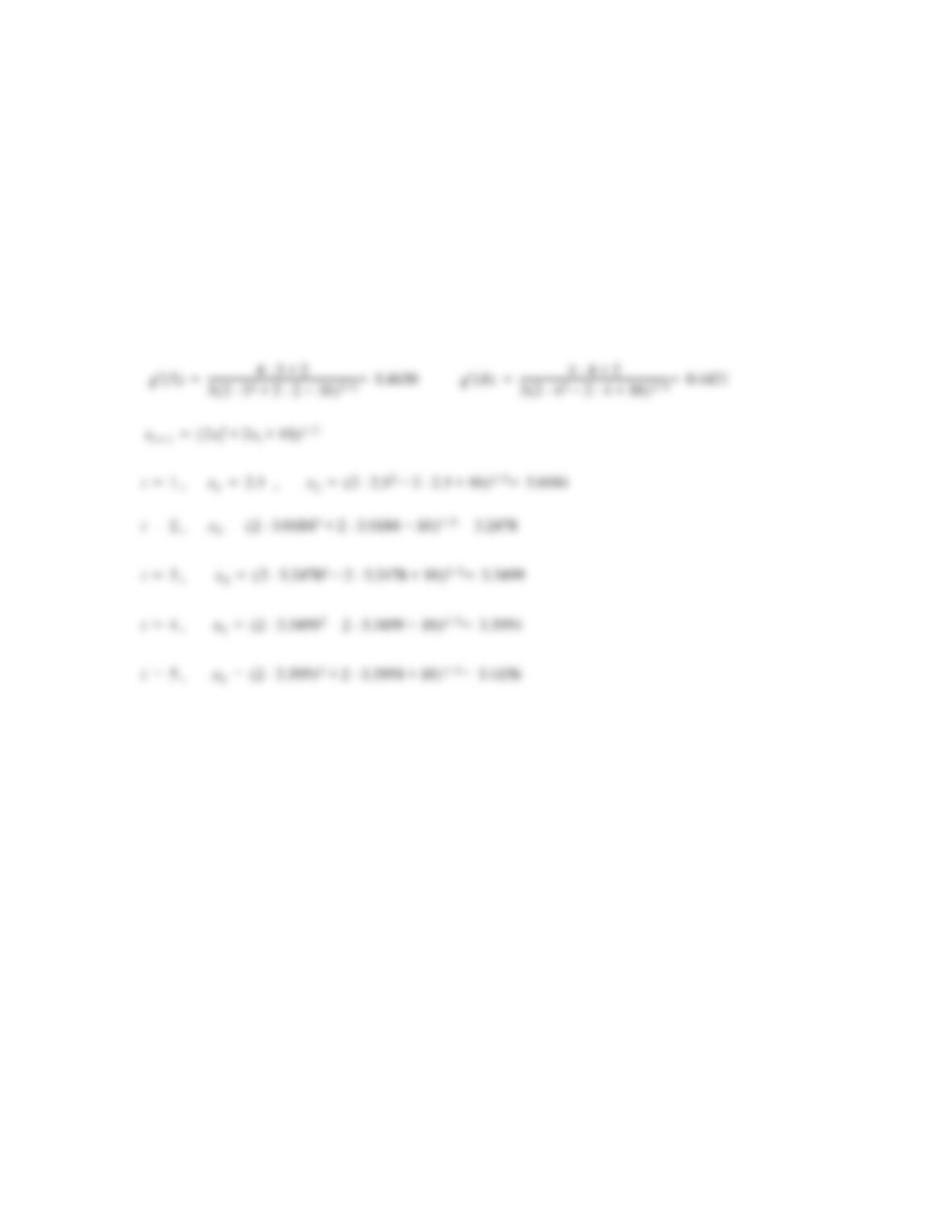
using the fixed-point iteration method. Determine the appropriate form of according to Eq. (3.30).
Start the iterations with
and carry out
the first five iterations.
Solution
fx() 2x34x2
–4x–20–0==
x3=
x4=
gx()
x2.5=
x4x24x20++
2
—————–—————–
13⁄
=
gx() 2x22x10++()
13⁄
=
g′x() 4x2+
32x22x10++()
23⁄
—————–——————————–
=
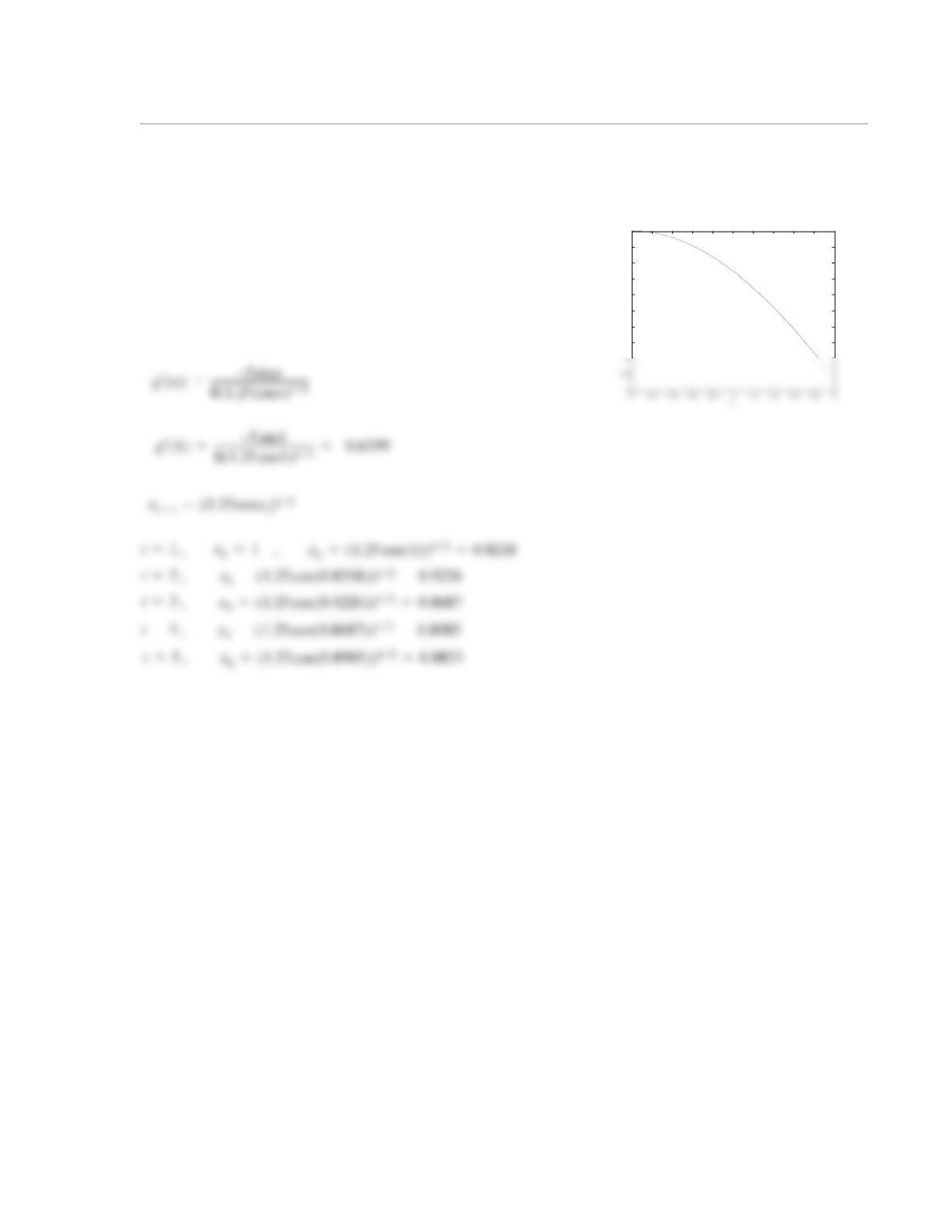
3.12 Determine the positive root of the equation by using the fixed-point iteration
method. Carry out the first five iterations.
Solution
Plot with MATLAB:
fplot(‘cos(x)-0.8*x^2’,[0 2])
xlabel(‘x’); ylabel(‘f(x)’);
xcos 0.8x2
–0=
-2.5
-2
-1.5
-1
-0.5
0
0.5
1
f(x)
x1.25 xcos()
12⁄
=
gx() 1.25 xcos()
12⁄
=
3.13 Solve the following system of nonlinear equations:
(a) Use Newton’s method. Start at
, , and
carry out the first five iterations
.
(b) Use the fixed-point iteration method. Use the iteration functions and
. Start at
, , and
carry out the first five iterations
.
Solution
(a) Using Newton’s method.
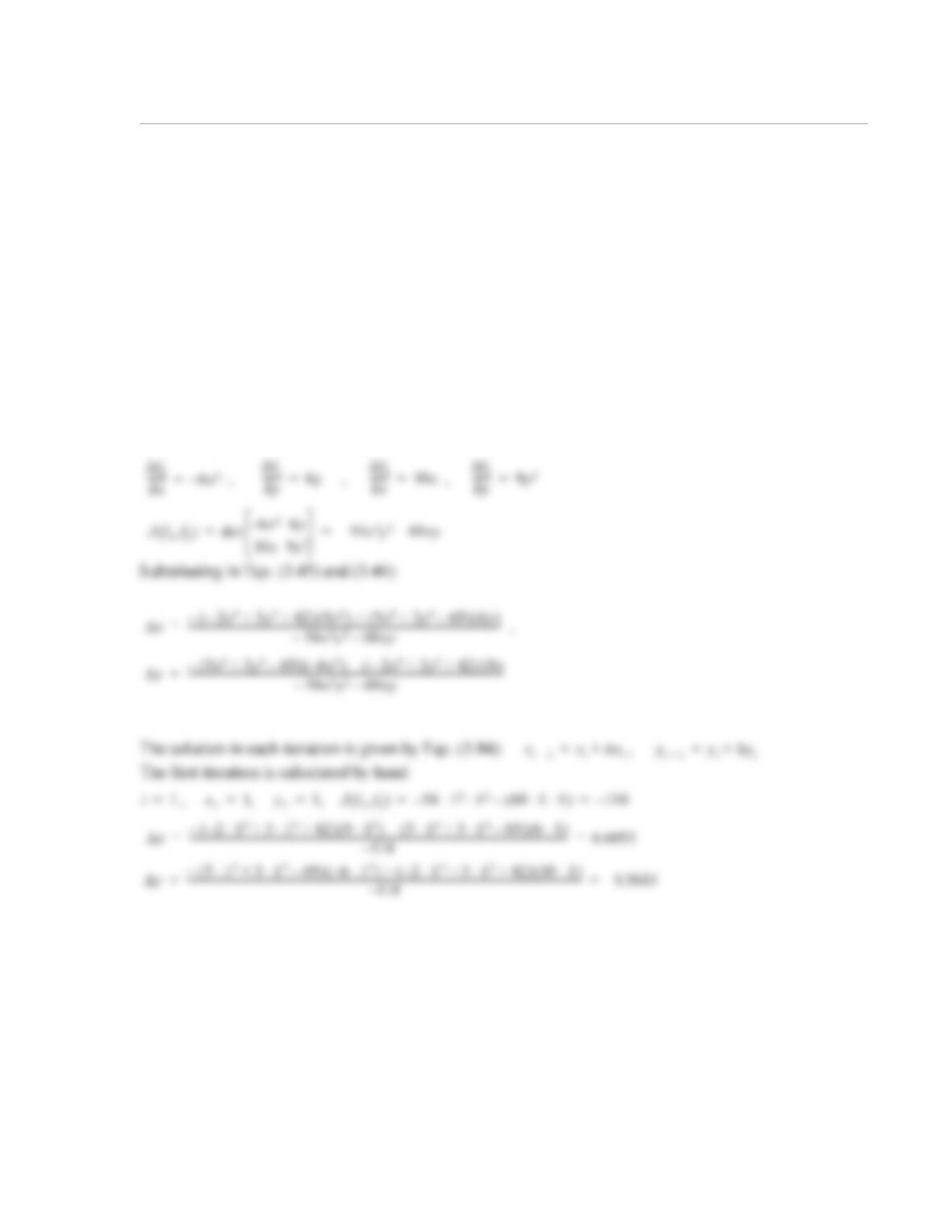
The Jacobian (Eq. (3.47)) is:
2x3
–3y242++ 0=
5x23y369–+0=
x1=
y1=
y5x2
–69+
3
——————-—––
13⁄
=
x3y242+
2
——————––
13⁄
=
x1=
y1=
f12x3
–3y242++ 0==
f25x23y369–+0==
,
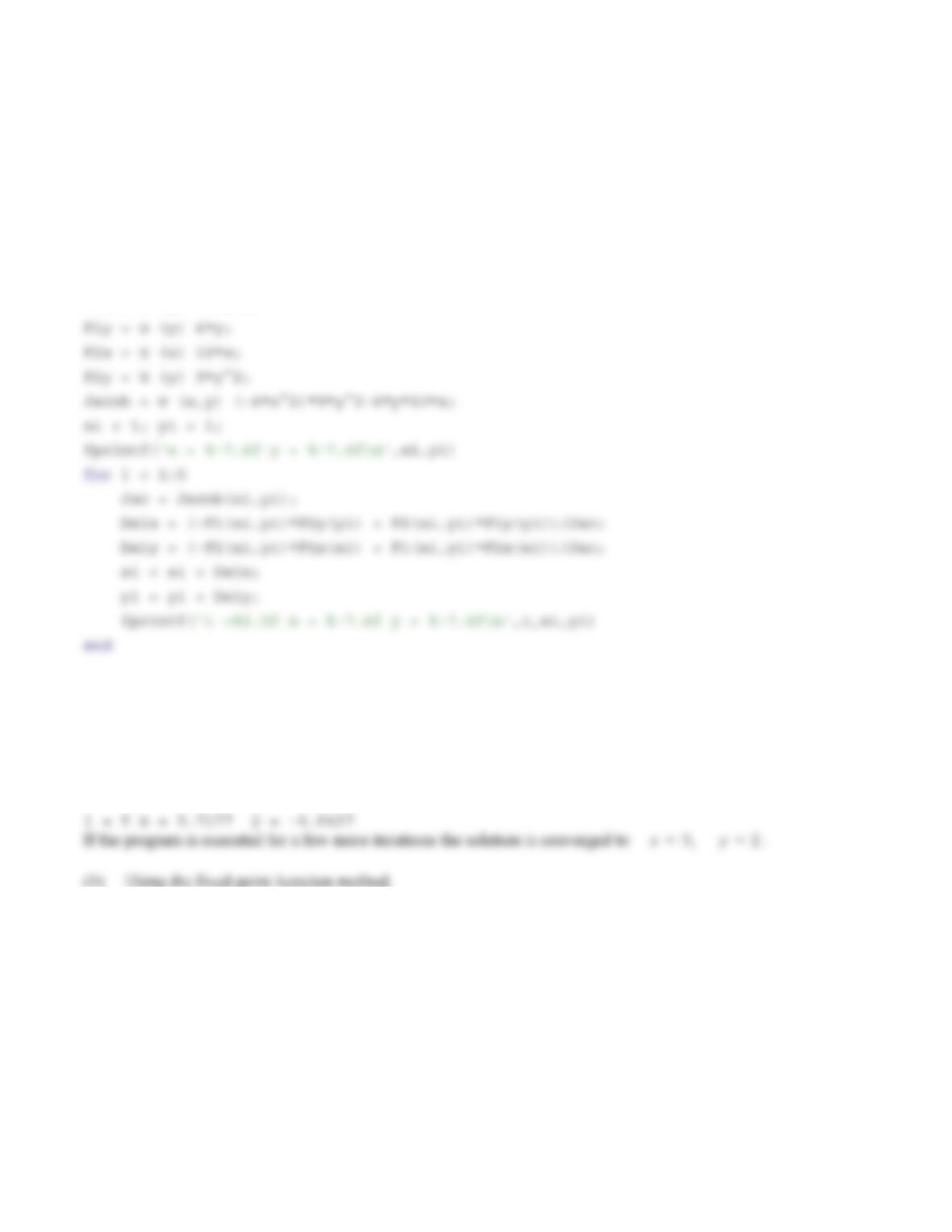
The calculations of the first 5 iterations are calculated with the following MATLAB program (script file).
%Solution of Chapter 3 HW 13a
clear all
F1 = @ (x,y) -2*x^3+3*y^2+42;
F2 = @ (x,y) 5*x^2+3*y^3-69;
F1x = @ (x) -6*x^2;
When the program is executed, the following (solution) is displayed in the Command Window:
x = 1.0000 y = 1.0000
i = 1 x = 7.6053 y = 0.4386
i = 2 x = 5.0714 y = -15.5856
i = 3 x = 5.2462 y = -10.4217
i = 4 x = 4.4193 y = -6.9736
x21 6.6053+ 7.6053==
y21 0.5614– 0.4386==
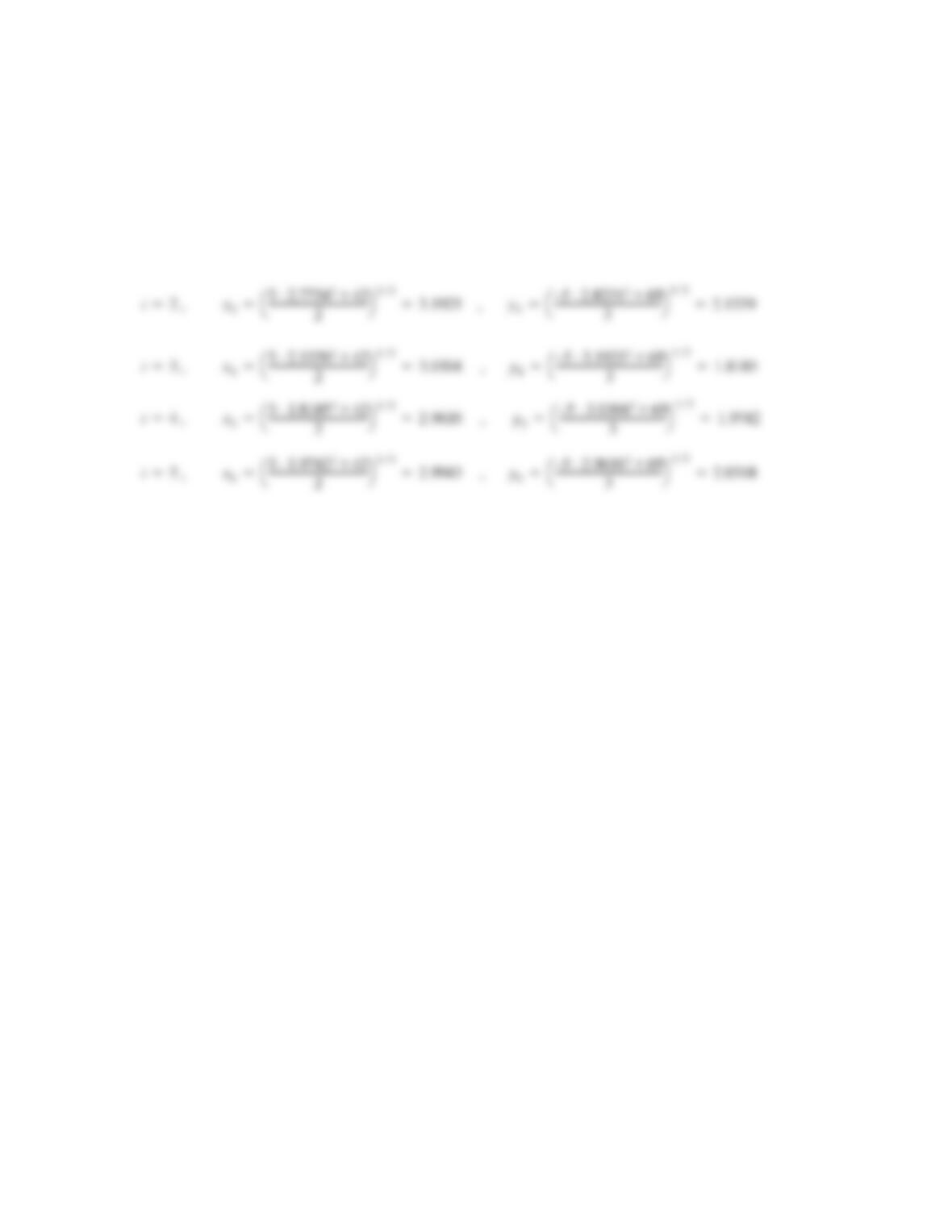
The iteration function are:
Use the iteration functions and
,
,,
,
yi
5xi
2
–69+
3
—————-——––
13⁄
=
xi
3yi
242+
2
—————-—-–
13⁄
=
i1=
x11=
y11=
x2
31
2
⋅42+
2
—————-——––
13⁄
2.8231==
y2
5–1
2
⋅69+
3
—————–———-–
13⁄
2.7734==
i2=
i3=
i4=
i5=