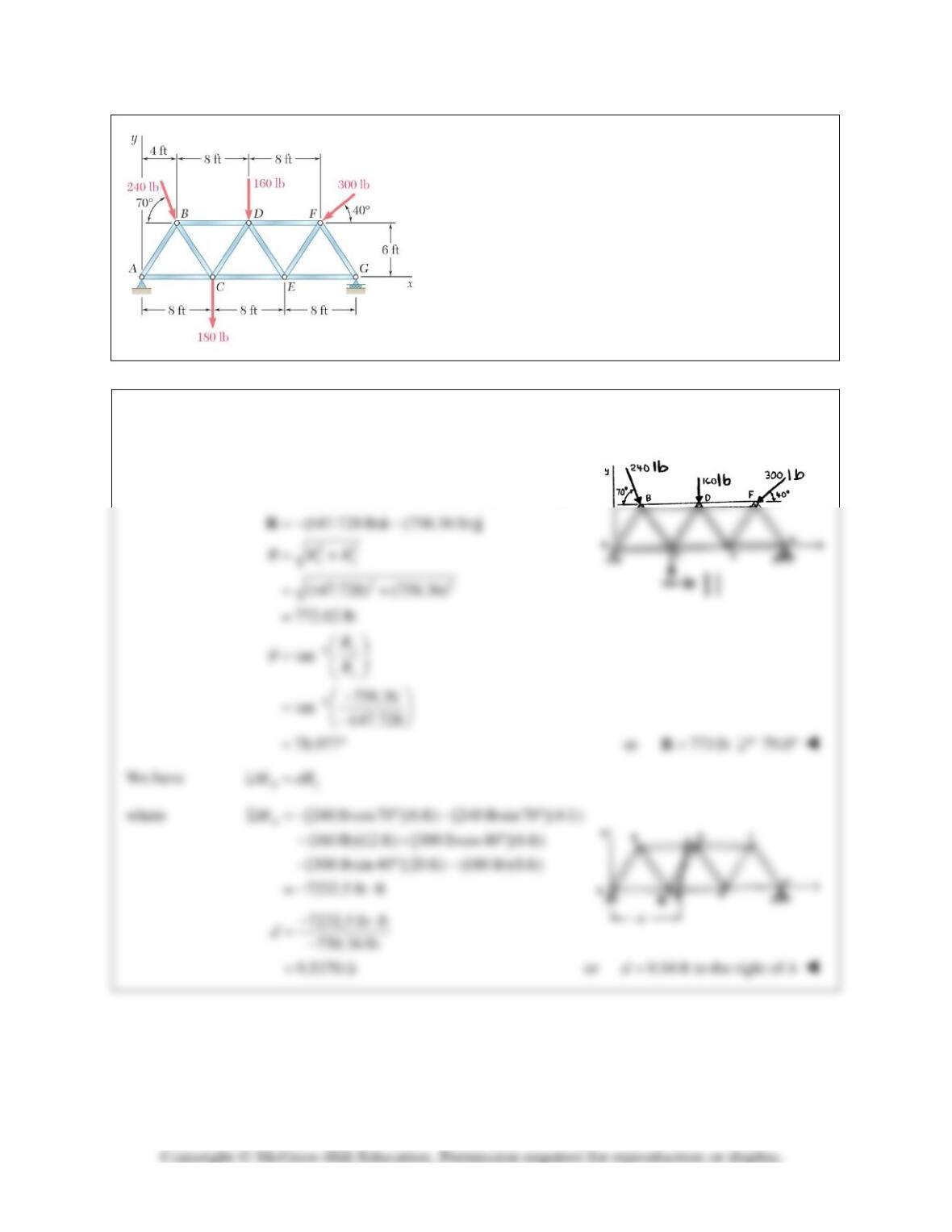
PROBLEM 3.113
A truss supports the loading shown. Determine the
equivalent force acting on the truss and the point of
intersection of its line of action with a line drawn through
Points A and G.
SOLUTION
We have
(240 lb)(cos70 sin 70 ) (160 lb)
(300 lb)( cos 40 sin 40 ) (180 lb)
= Σ
= °− ° −
+ − °− ° −
RF
R ij j
ij j
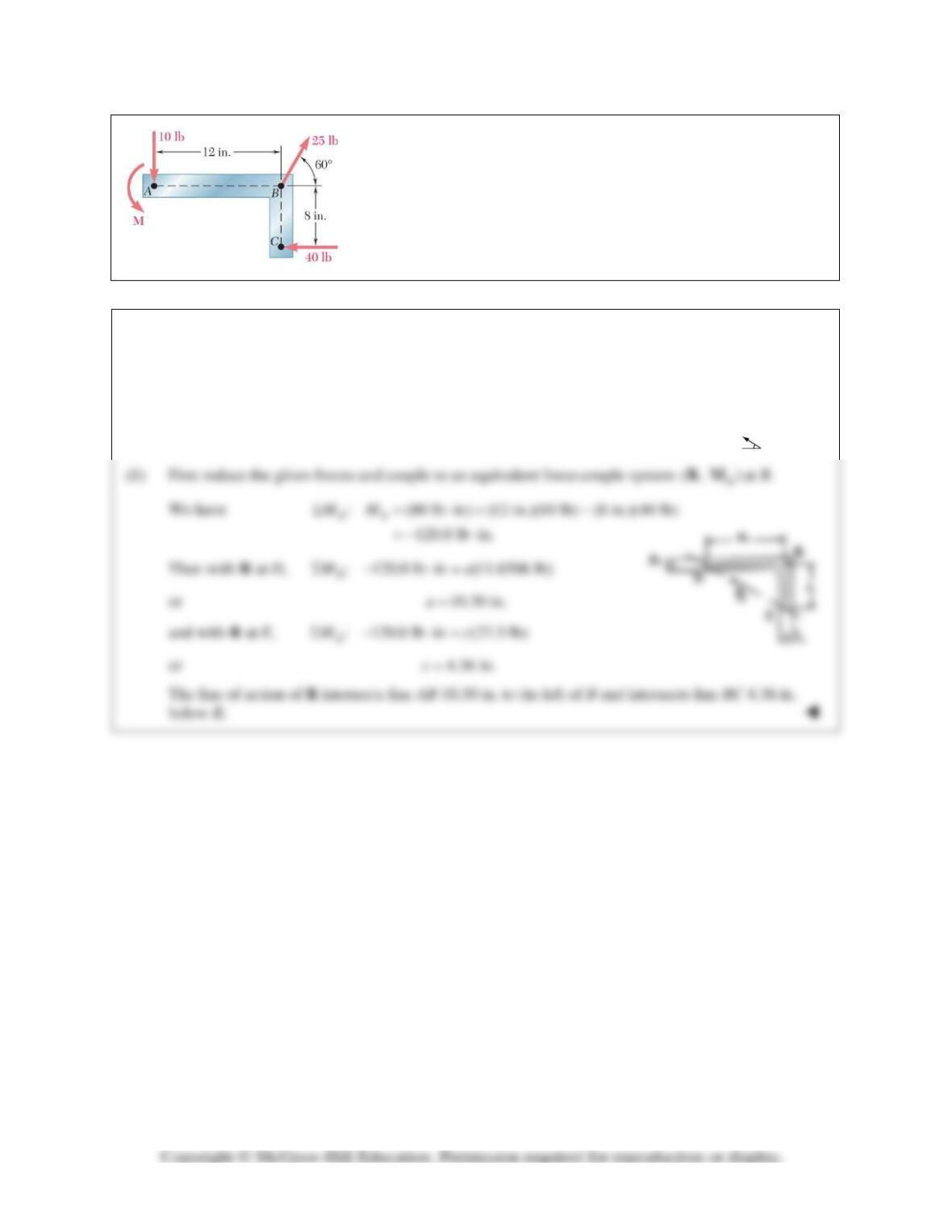
PROBLEM 3.114
A couple of magnitude M = 80 lb·in. and the three forces shown are
applied to an angle bracket. (a) Find the resultant of this system of
forces. (b) Locate the points where the line of action of the resultant
intersects line AB and line BC.
SOLUTION
(a) We have
: ( 10 ) (25 cos 60 )
(25 sin 60 ) ( 40 )
(27.50 lb) (11.6506 lb)
Σ =−+ °
+ ° +−
=−+
FR j i
ji
ij
or
29.9 lb=R
23.0°
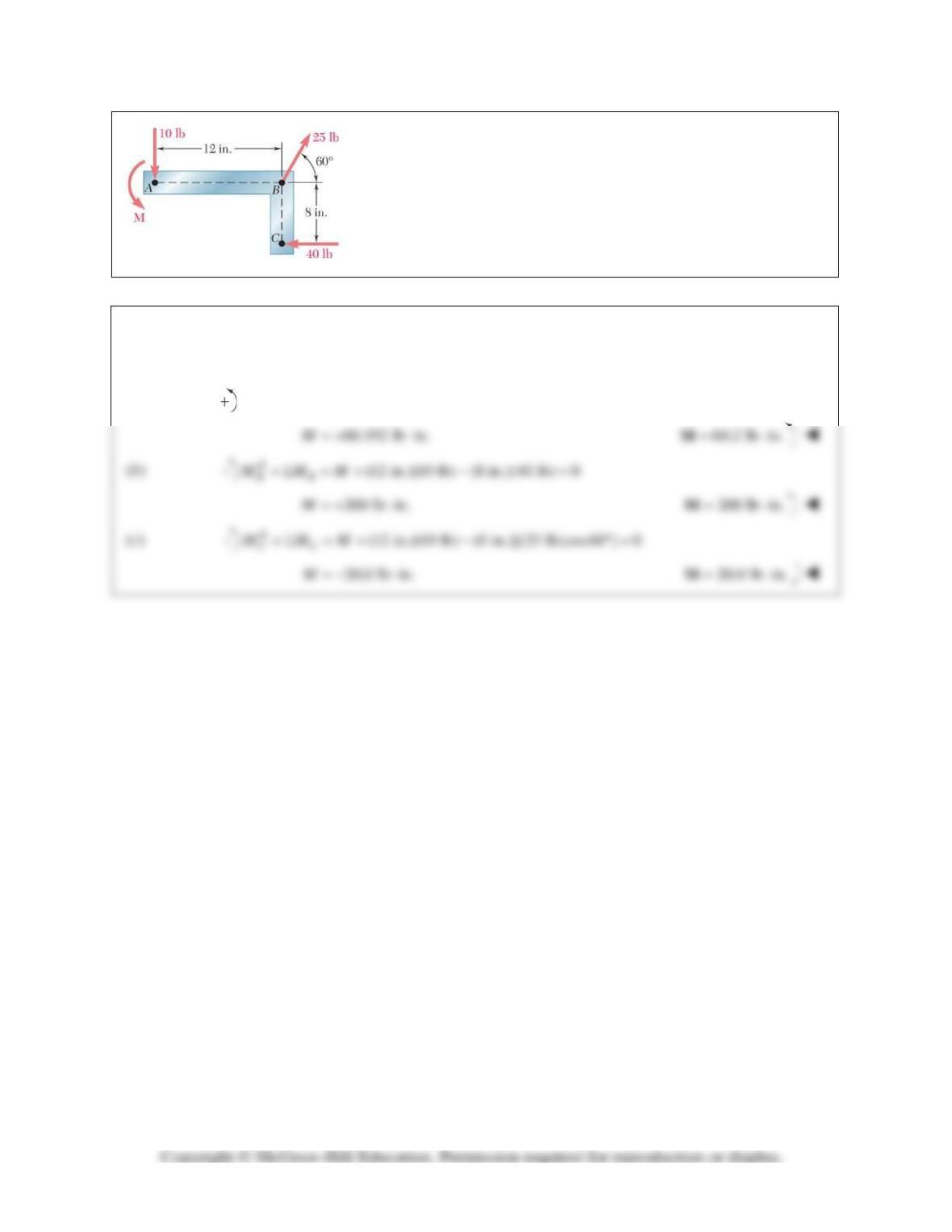
PROBLEM 3.115
A couple M and the three forces shown are applied to an angle
bracket. Find the moment of the couple if the line of action of the
resultant of the force system is to pass through (a) point A, (b) point
B, (c) point C.
SOLUTION
In each case, we must have
10
R=M
(a)
(12 in.)[(25 lb)sin 60 ] (8 in.)(40 lb) 0
B
AA
M MM=Σ = + °− =
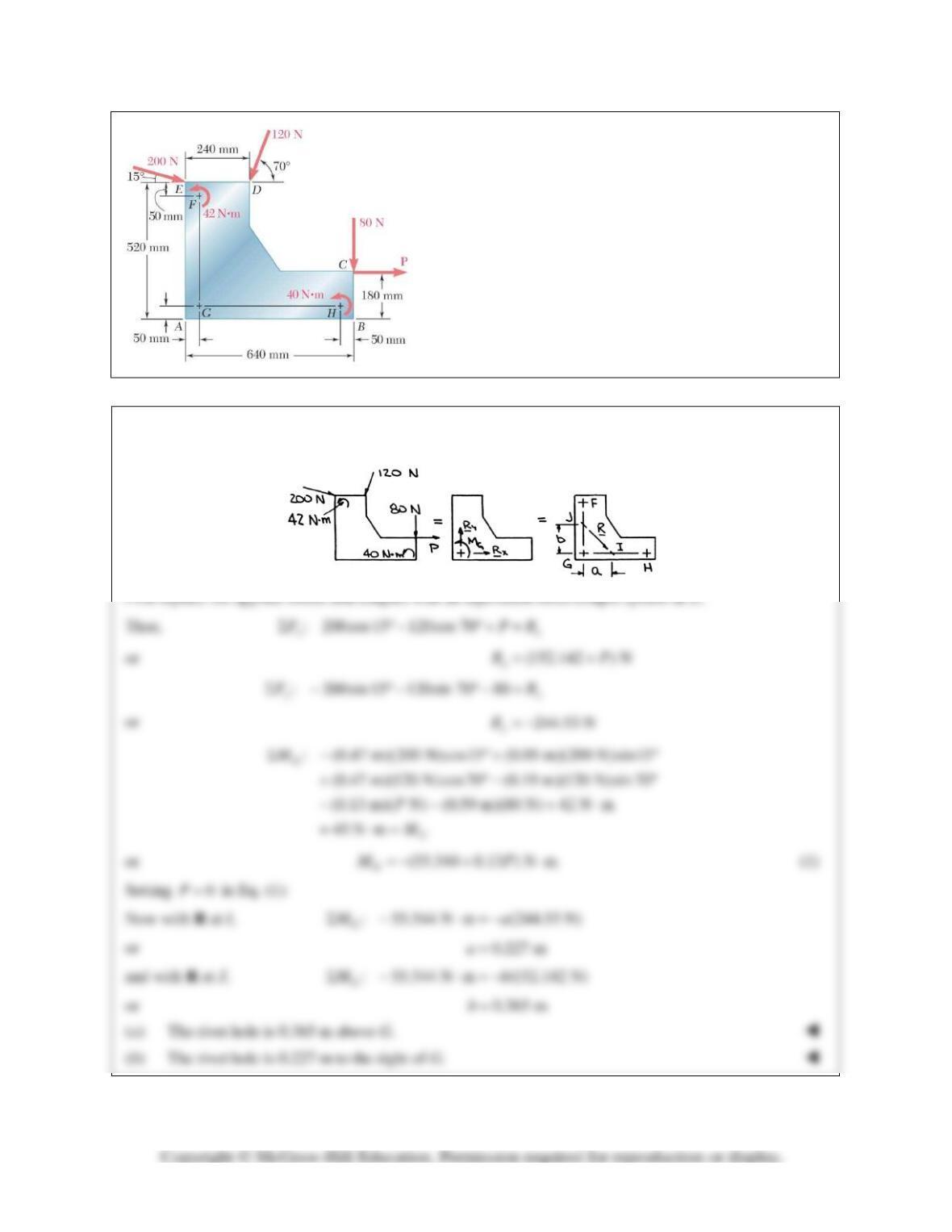
PROBLEM 3.116
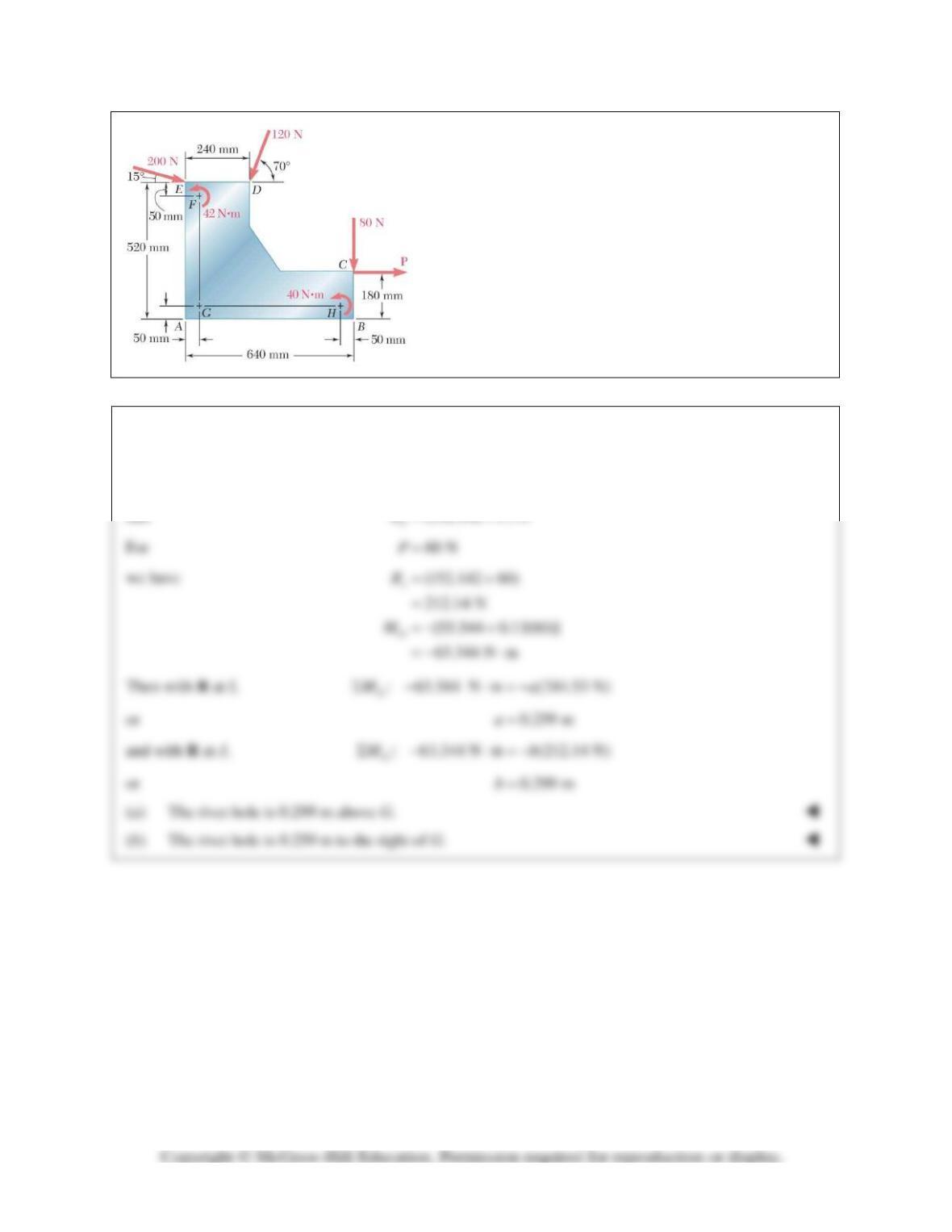
A machine component is subjected to the forces and
couples shown. The component is to be held in place by a
single rivet that can resist a force but not a couple. For
P = 0, determine the location of the rivet hole if it is to be
located (a) on line FG, (b) on line GH.
SOLUTION
We have
PROBLEM 3.117
Solve Problem 3.116, assuming that P = 60 N.
PROBLEM 3.116 A machine component is subjected to
the forces and couples shown. The component is to be held
in place by a single rivet that can resist a force but not a
couple. For P = 0, determine the location of the rivet hole
if it is to be located (a) on line FG, (b) on line GH.
SOLUTION
See the solution to Problem 3.116 leading to the development of Equation (1):
and
PROBLEM 3.118
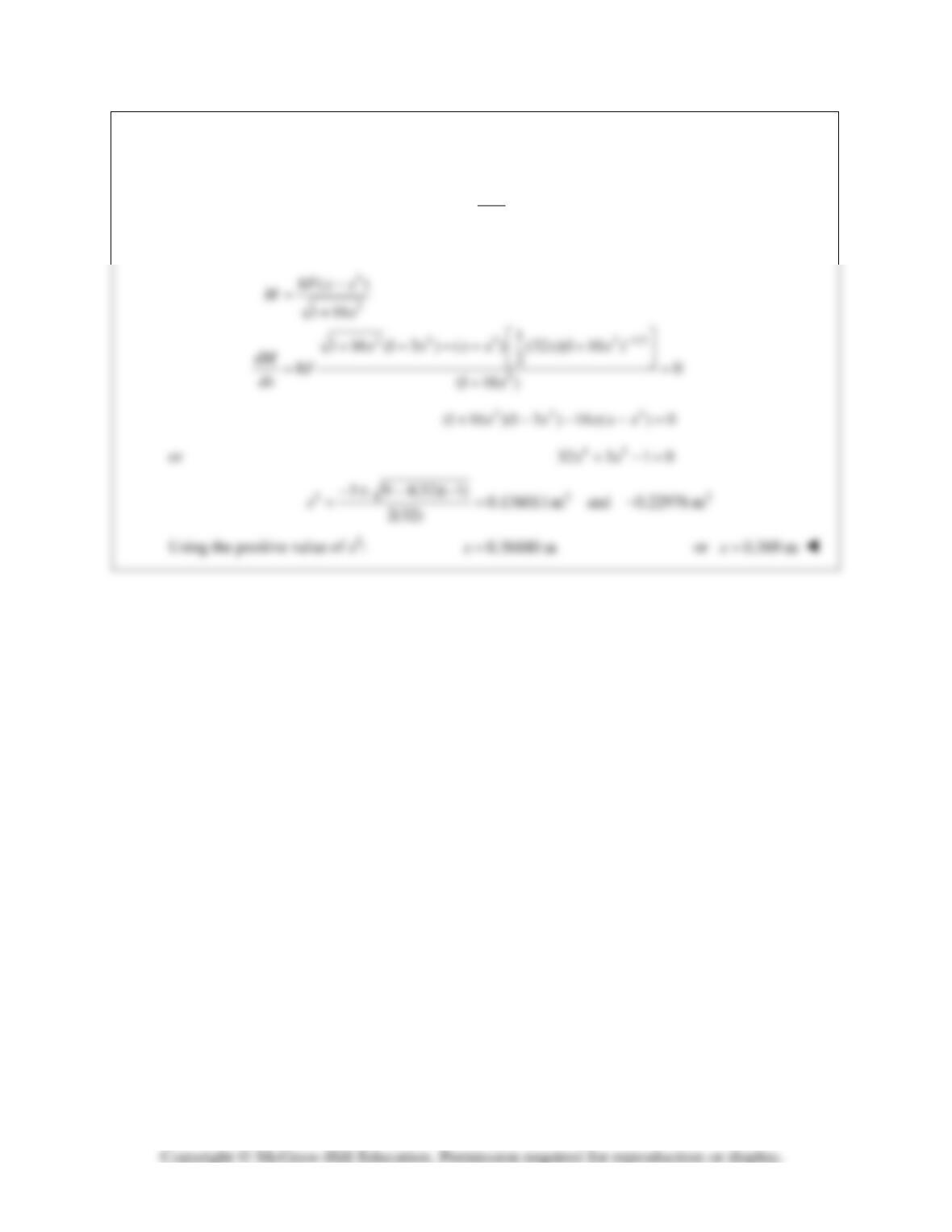
As follower AB rolls along the surface of member C, it exerts
a constant force F perpendicular to the surface. (a) Replace
F with an equivalent force-couple system at Point D
obtained by drawing the perpendicular from the point of
contact to the x–axis. (b) For a = 1 m and b = 2 m, determine
the value of x for which the moment of the equivalent force-
couple system at D is maximum.
SOLUTION
(a) The slope of any tangent to the surface of member C is
2
22
2
1
dy d x b
bx
dx dx aa
−
= −=
PROBLEM 3.118 (Continued)
(b) To maximize M, the value of x must satisfy
0
dM
dx =
where for
1 m, 2 mab= =
PROBLEM 3.119
A machine component is subjected to the forces shown, each
of which is parallel to one of the coordinate axes. Replace
these forces with an equivalent force–couple system at A.
SOLUTION
F
or equivalence
:
BCD A
Σ ++=FF F F R
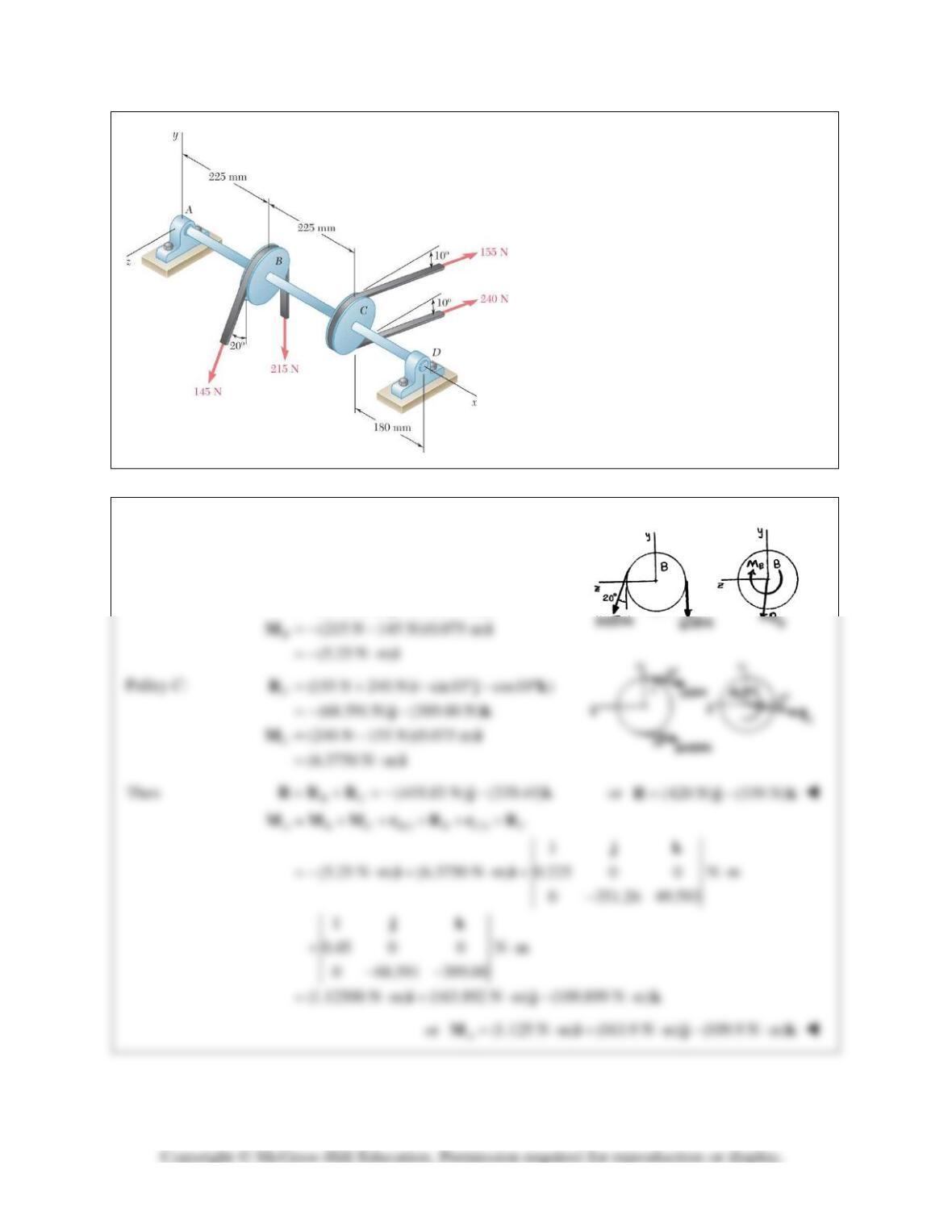
PROBLEM 3.120
Two 150-mm–diameter pulleys are mounted
on line shaft AD. The belts at B and C lie in
vertical planes parallel to the yz-plane.
Replace the belt forces shown with an
equivalent force–couple system at A.
SOLUTION
Equivalent force-couple at each pulley:
Pulley B:
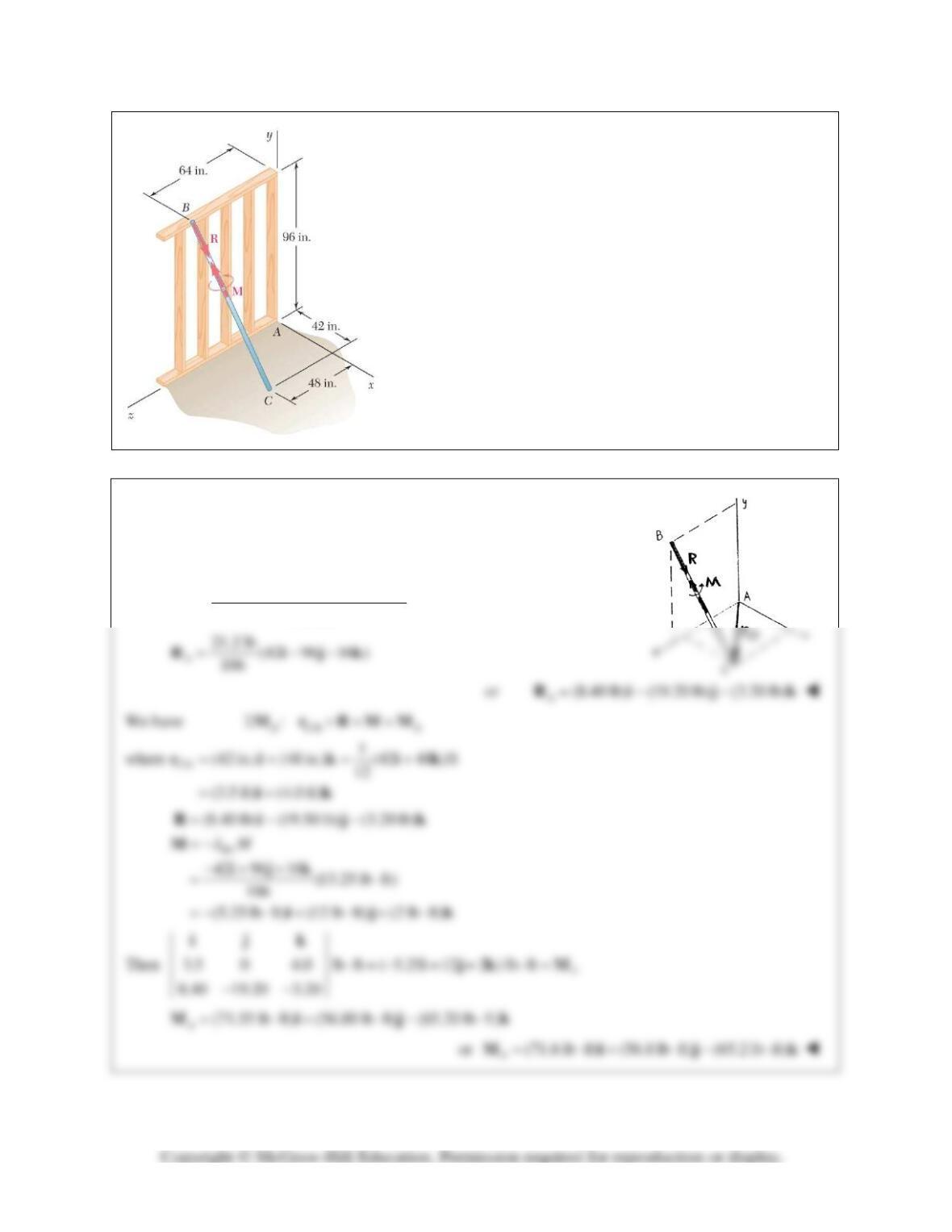
PROBLEM 3.121
As an adjustable brace BC is used to bring a wall into plumb,
the force–couple system shown is exerted on the wall. Replace
this force–couple system with an equivalent force-couple system
at A if
21.2 lbR=
and
13.25 lb · ft.M=
SOLUTION
We have
:
A BC
λ
Σ==F RR R
where
(42 in.) (96 in.) (16 in.)
106 in.
BC
−−
=i jk
λ
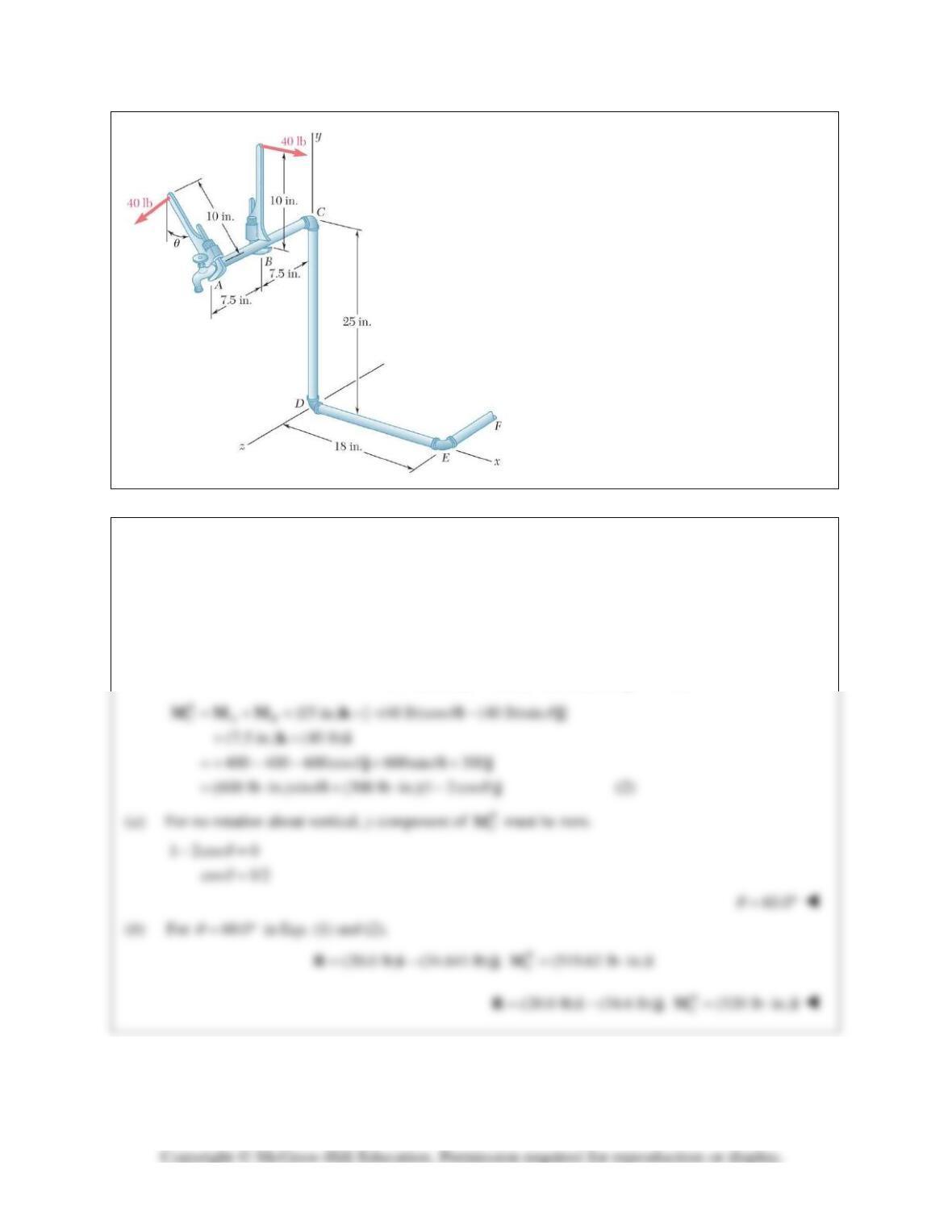
PROBLEM 3.122
In order to unscrew the tapped faucet A, a
plumber uses two pipe wrenches as shown.
By exerting a 40-lb force on each wrench, at
a distance of 10 in. from the axis of the pipe
and in a direction perpendicular to the pipe
and to the wrench, he prevents the pipe from
rotating, and thus avoids loosening or further
tightening the joint between the pipe and the
tapped elbow C. Determine (a) the angle θ
that the wrench at A should form with the
vertical if elbow C is not to rotate about the
vertical, (b) the force-couple system at C
equivalent to the two 40–lb forces when this
condition is satisfied.
SOLUTION
We first reduce the given forces to force–couple systems at A and B, noting that
| | | | (40 lb)(10 in.)
400 lb in.
AB
= =
= ⋅
MM
We now determine the equivalent force–couple system at C.
(40 lb)(1 cos ) (40 lb)sin
θθ
= −−R ij
(1)
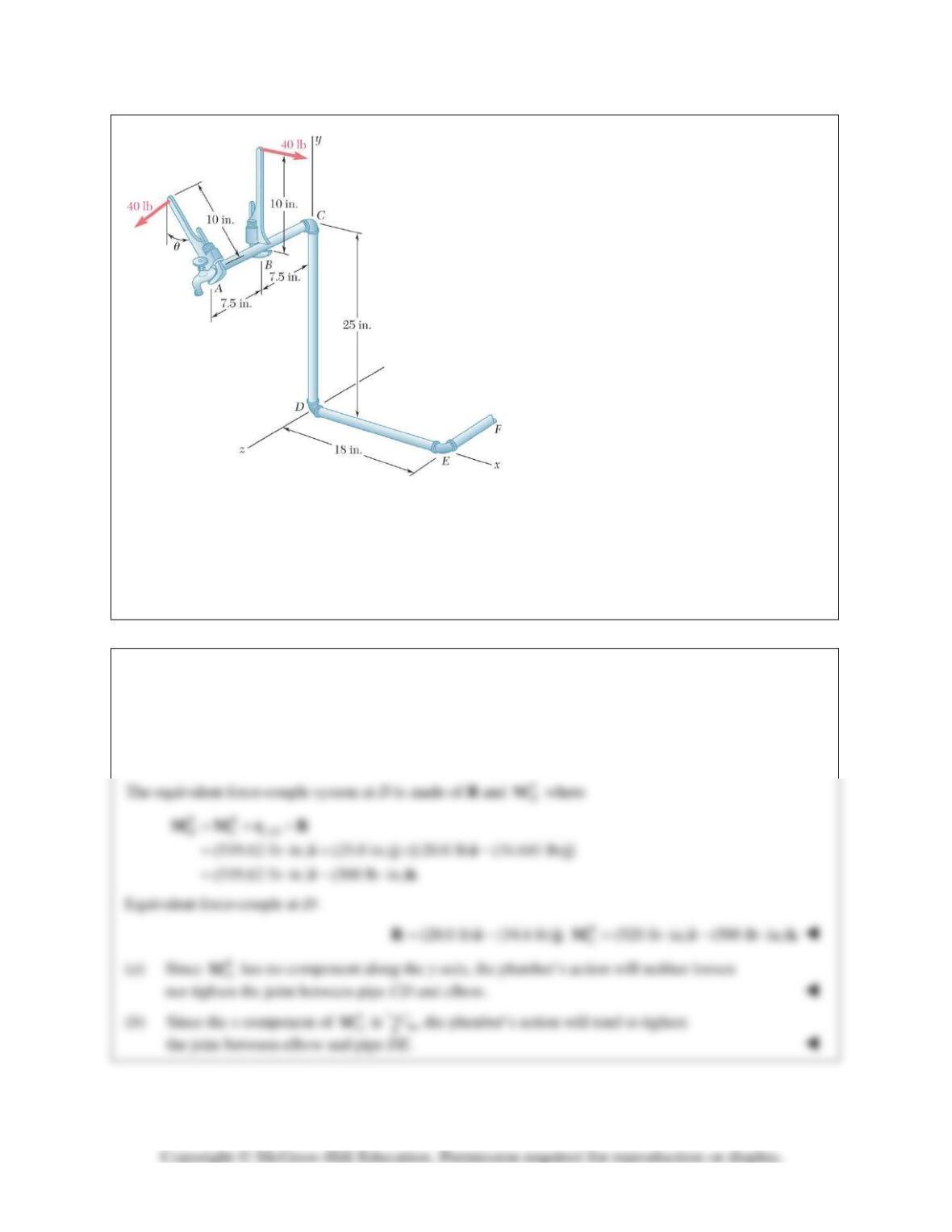
PROBLEM 3.123
Assuming θ = 60° in Prob. 3.122, replace the
two 40–lb forces with an equivalent force–
couple system at D and determine whether
the plumber’s action tends to tighten or
loosen the joint between (a) pipe CD and
elbow D, (b) elbow D and pipe DE.
Assume all threads to be right-handed.
PROBLEM 3.122 In order to unscrew the
tapped faucet A, a plumber uses two pipe
wrenches as shown. By exerting a 40-lb
force on each wrench, at a distance of 10 in.
from the axis of the pipe and in a direction
perpendicular to the pipe and to the wrench,
he prevents the pipe from rotating, and thus
avoids loosening or further tightening the
joint between the pipe and the tapped elbow
C. Determine (a) the angle θ that the
wrench at A should form with the vertical if
elbow C is not to rotate about the vertical,
(b) the force-couple system at C equivalent
to the two 40-lb forces when this condition
is satisfied.
SOLUTION
The equivalent force–couple system at C for
60
θ
= °
was obtained in the solution to Prob. 3.122:
(20.0 lb) (34.641 lb)
(519.62 lb in.)
R
C
= −
= ⋅
Ri j
Mi
PROBLEM 3.124
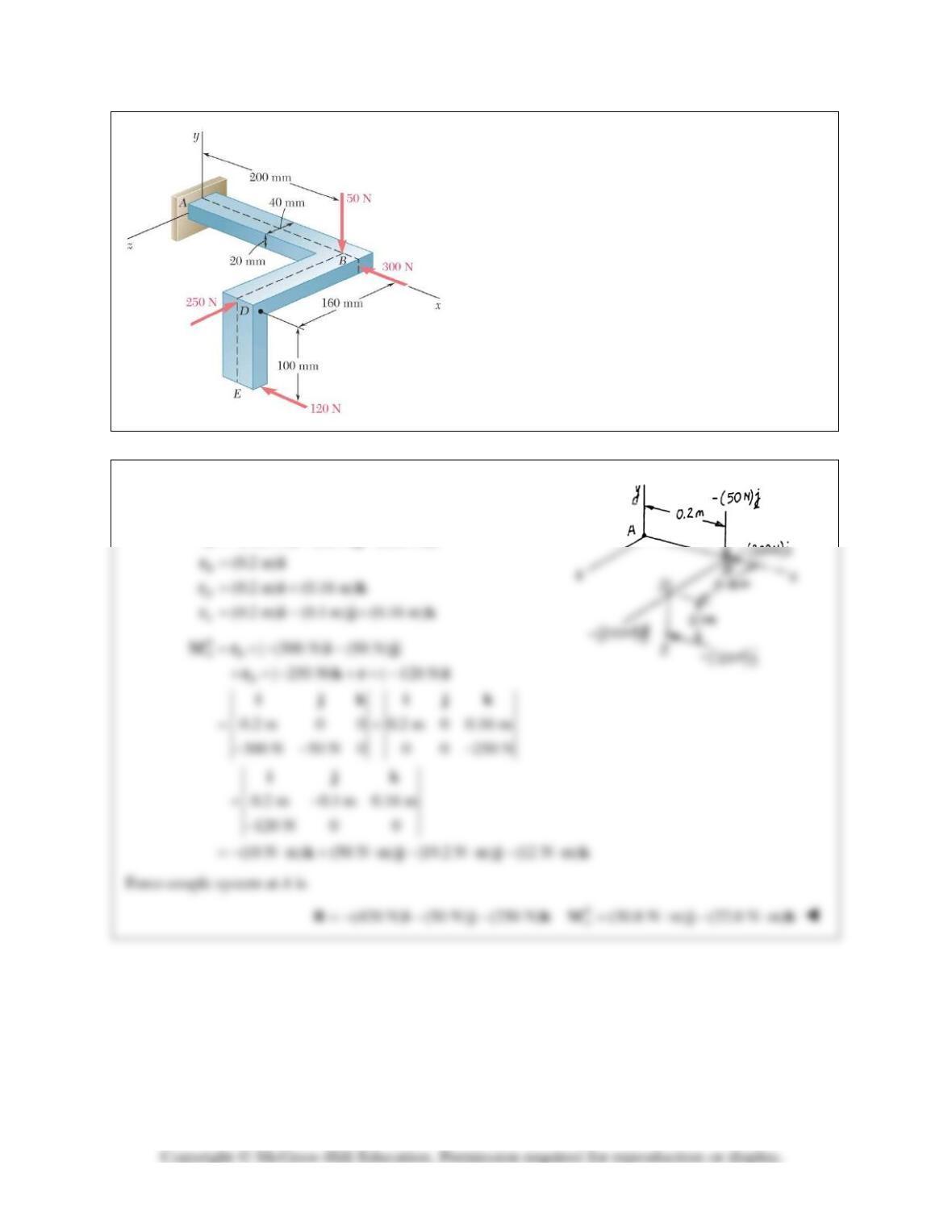
Four forces are applied to the machine component
ABDE as shown. Replace these forces with an
equivalent force–couple system at A.
SOLUTION
PROBLEM 3.125
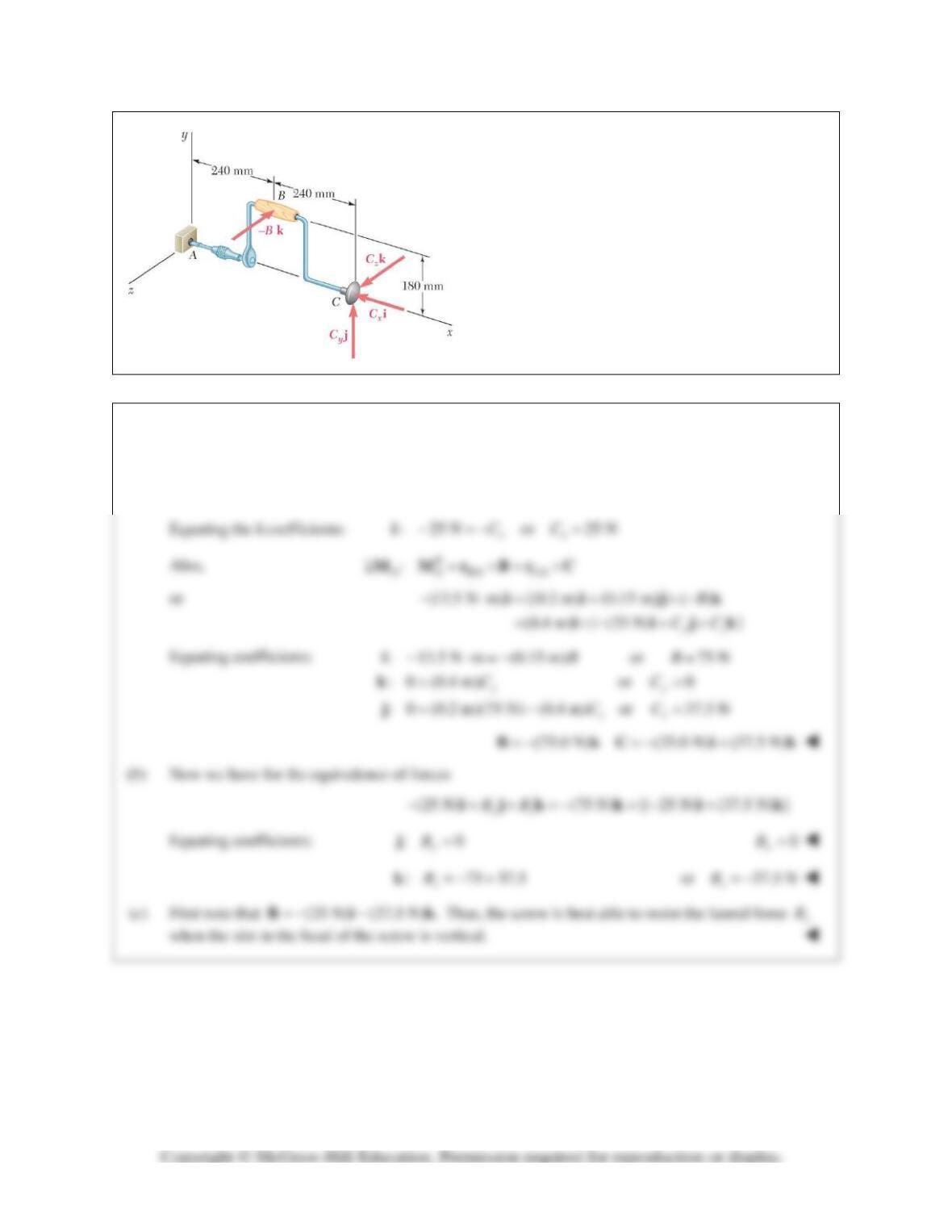
A blade held in a brace is used to tighten a screw at
A. (a) Determine the forces exerted at B and C,
knowing that these forces are equivalent to a force–
couple system at A consisting of R = −(25 N)i + Ryj
+ Rzk and M
R
A
= – (13.5 N·m)i. (b) Find the
corresponding values of Ry and Rz. (c) What is the
orientation of the slot in the head of the screw for
which the blade is least likely to slip when the brace
is in the position shown?
SOLUTION
(a) Equivalence requires
:Σ=+F RBC
or
(25 N) ( )
yz xyz
RR B CCC− + + =− +− + +i jk k i jk
PROBLEM 3.126
A mechanic uses a crowfoot wrench to loosen a bolt at C.
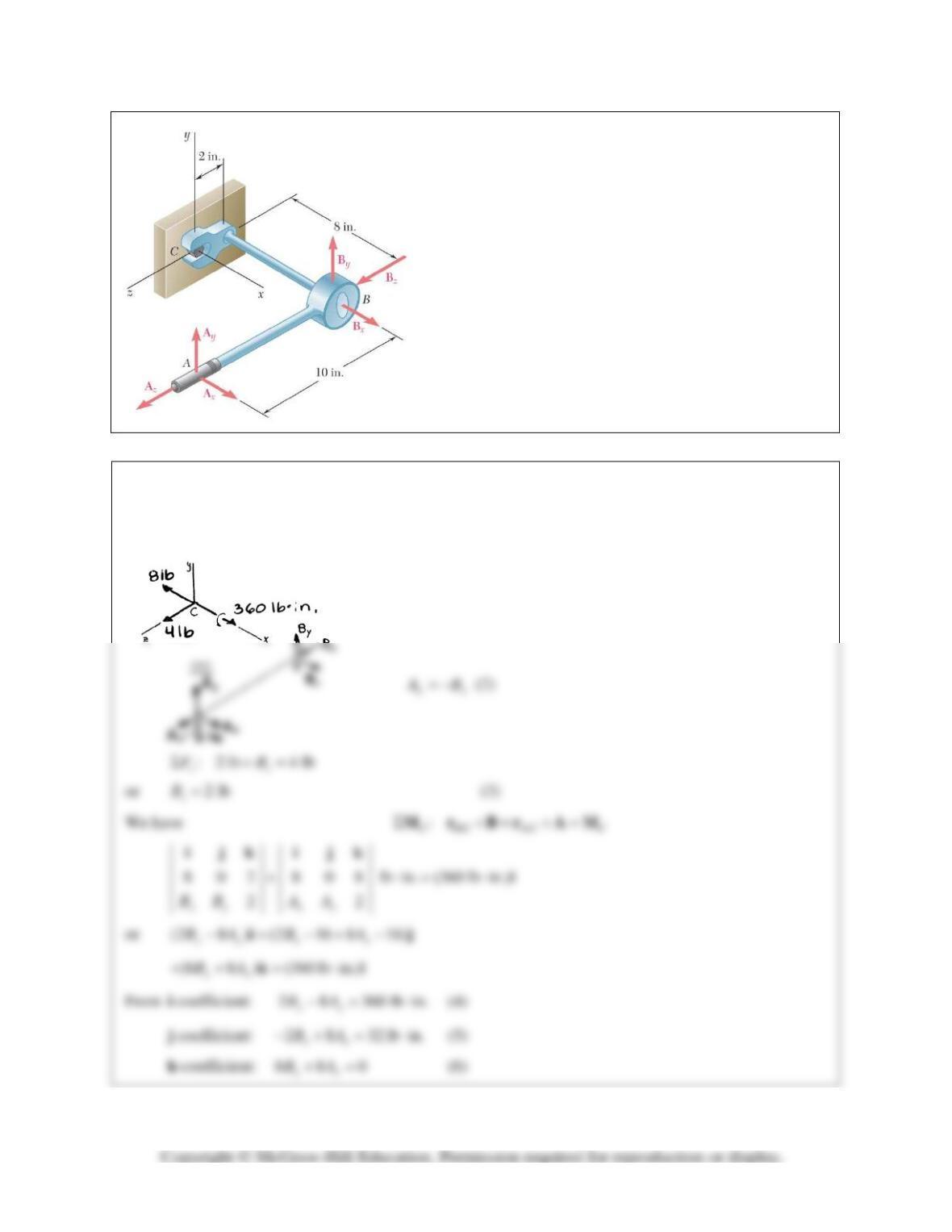
The mechanic holds the socket wrench handle at Points A
and B and applies forces at these points. Knowing that
these forces are equivalent to a force–couple system at C
consisting of the force
(8 lb) + (4 lb)= −C ik
and the
couple
(360 lb ·
C=M
in.)i, determine the forces applied at
A and at B when
2 lb.
z
A=
SOLUTION
We have
:ΣF
+=ABC
or
: 8 lb
x xx
F AB+=
( 8 lb)
xx
BA=−+
(1)

PROBLEM 3.126 (Continued)
From Equations (2) and (4):
2 8( ) 360
yy
BB−− =
36 lb 36 lb
yy
BA= =
From Equations (1) and (5):
2( 8) 8 32
xx
AA−−+ =
1.6 lb
x
A=
From Equation (1):
(1.6 8) 9.6 lb
x
B=− +=−
(1.600 lb) (36.0 lb) (2.00 lb)= −+A ijk
(9.60 lb) (36.0 lb) (2.00 lb)=−+ +B i jk
PROBLEM 3.127
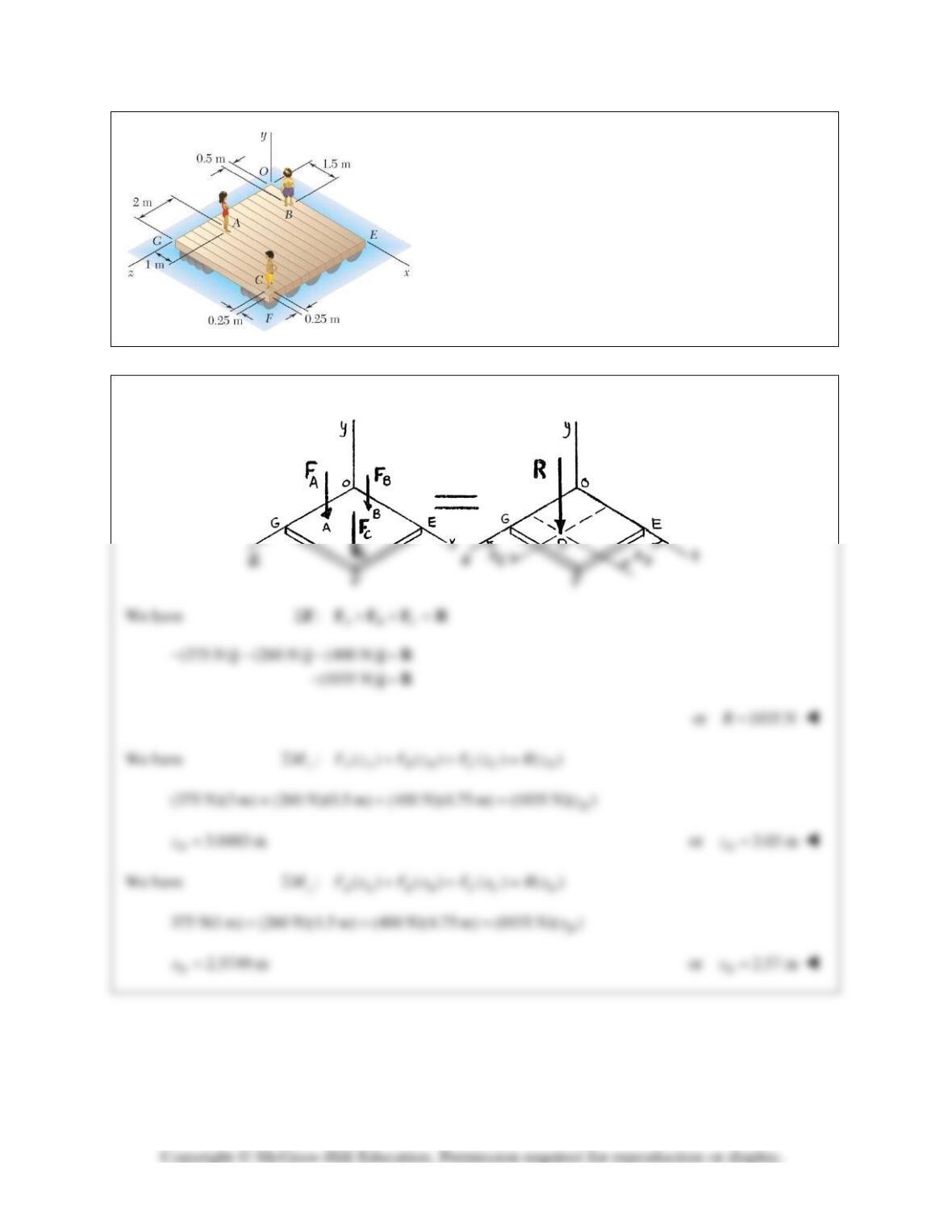
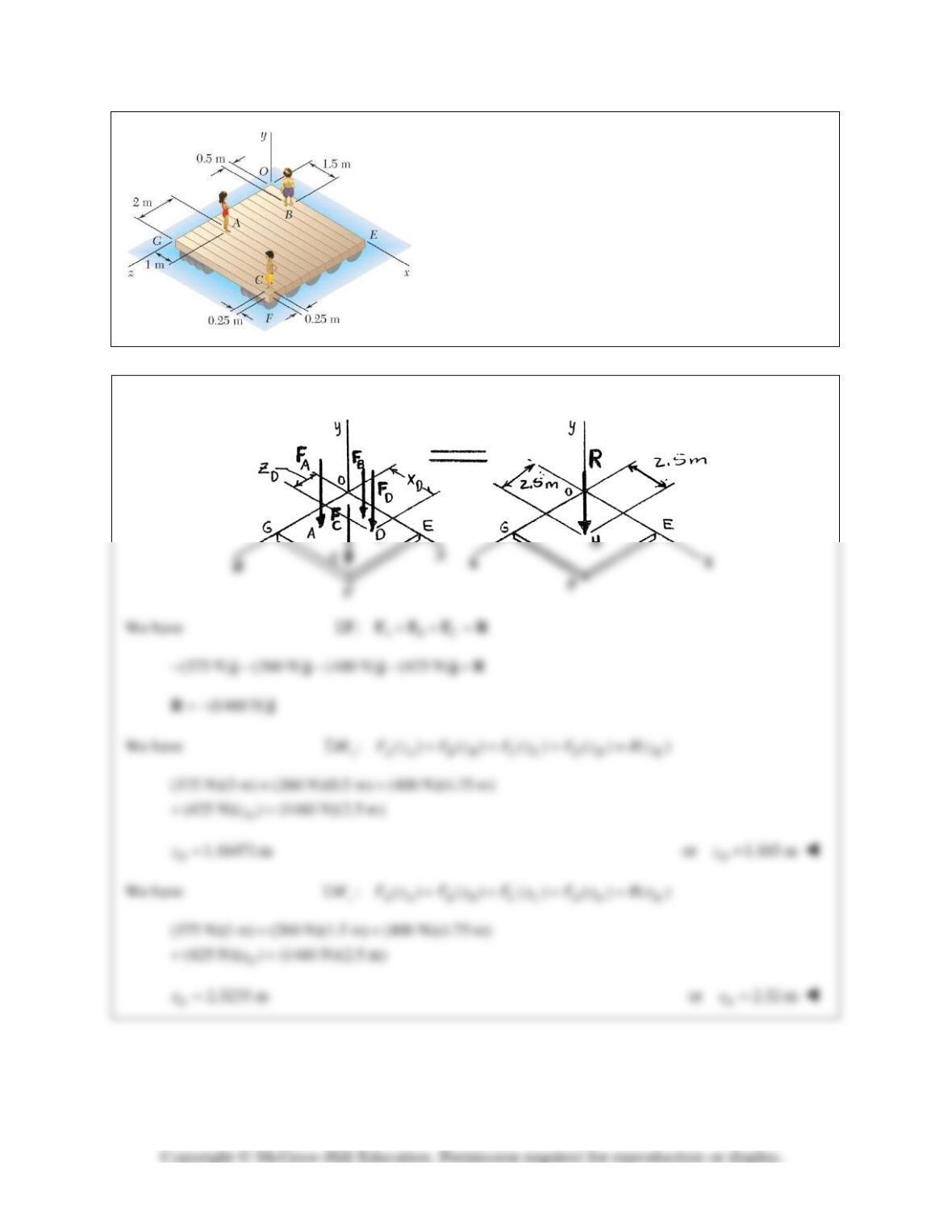
Three children are standing on a
5 5-m×
raft. If the
weights of the children at Points A, B, and C are 375 N,
260 N, and 400 N, respectively, determine the magnitude
and the point of application of the resultant of the three
weights.
SOLUTION
PROBLEM 3.128
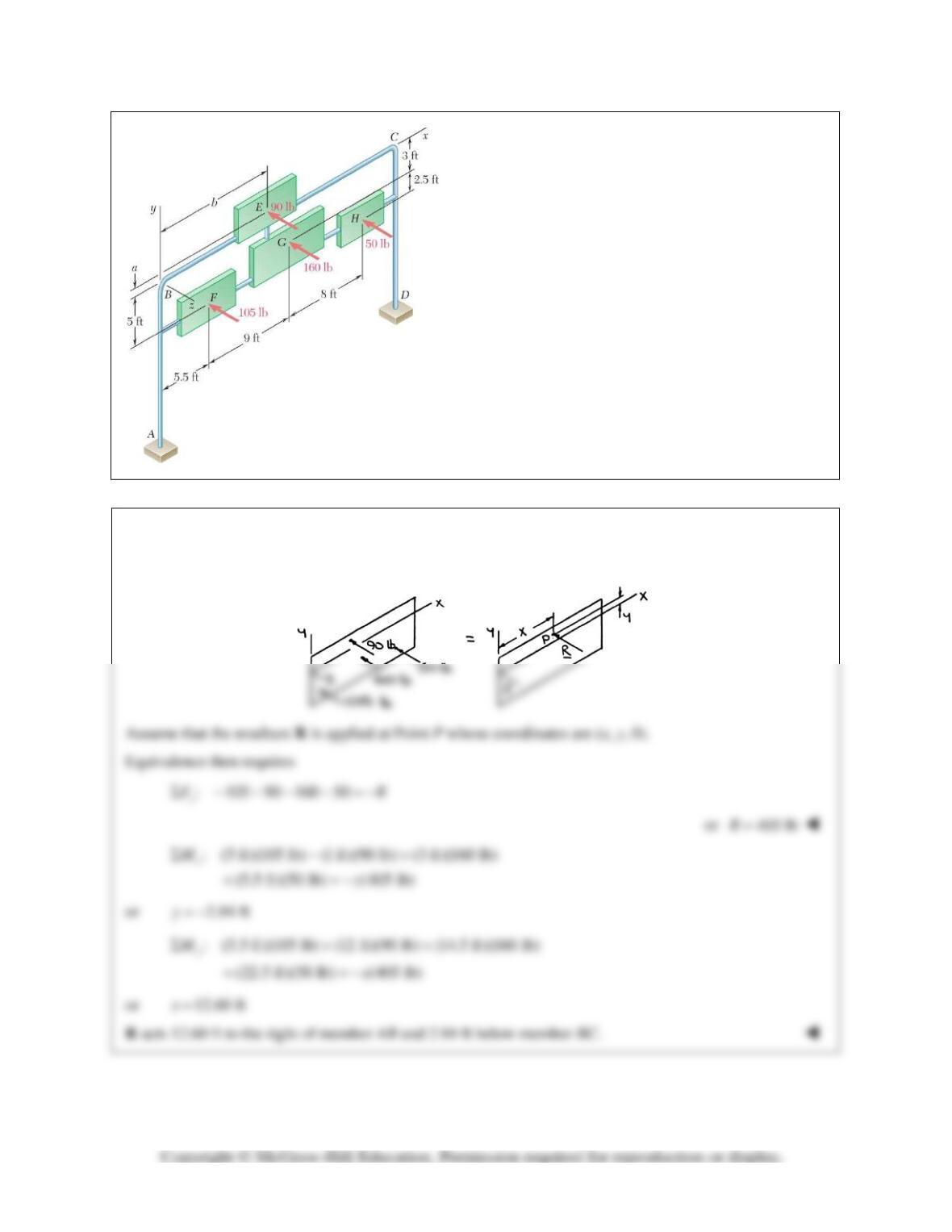
Three children are standing on a
5 5-m raft.×
The
weights of the children at Points A, B, and C are 375 N,
260 N, and 400 N, respectively. If a fourth child of weight
425 N climbs onto the raft, determine where she should
stand if the other children remain in the positions shown
and the line of action of the resultant of the four weights
is to pass through the center of the raft.
SOLUTION
PROBLEM 3.129
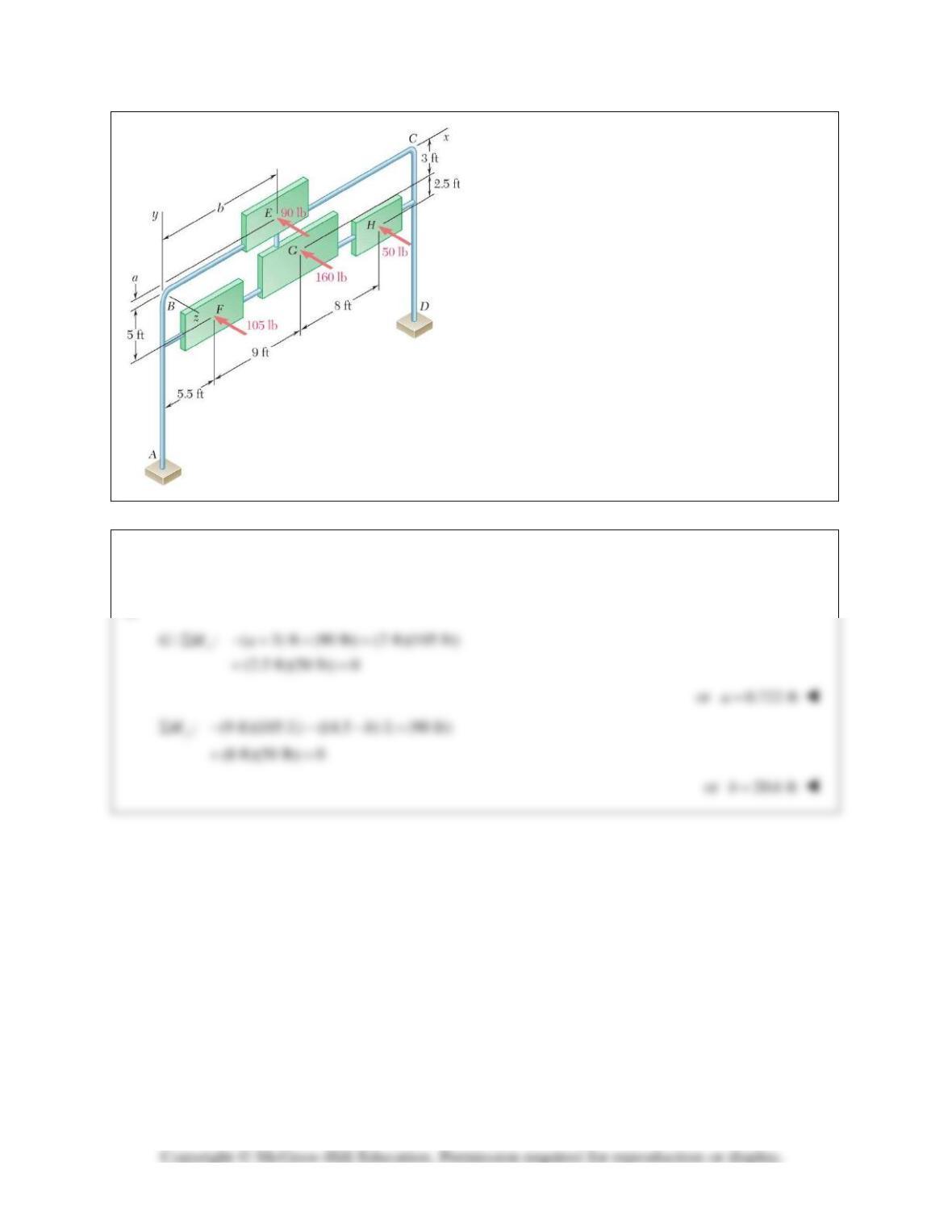
Four signs are mounted on a frame spanning a
highway, and the magnitudes of the horizontal
wind forces acting on the signs are as shown.
Determine the magnitude and the point of
application of the resultant of the four wind forces
when
1 fta=
and
12 ft.b=
SOLUTION
We have
PROBLEM 3.130
Four signs are mounted on a frame spanning a
highway, and the magnitudes of the horizontal
wind forces acting on the signs are as shown.
Determine a and b so that the point of application
of the resultant of the four forces is at G.
SOLUTION
Since R acts at G, equivalence then requires that
G
ΣM
of the applied system of forces also be zero. Then
at