Chapter 3
Job-Order Costing
Solutions to Questions
3-1 By definition, manufacturing overhead
consists of costs that cannot be practically traced
3-2 The first step is to estimate the total
amount of the allocation base (the denominator)
that will be required for next period’s estimated
level of production. The second step is to
3-3 The job cost sheet is used to record all
costs that are assigned to a particular job. These
costs include direct materials costs traced to the
job, direct labor costs traced to the job, and
manufacturing overhead costs applied to the job.
When a job is completed, the job cost sheet is
used to compute the unit product cost.
3-4 A sales order is issued after an
agreement has been reached with a customer on
quantities, prices, and shipment dates for goods.
The sales order forms the basis for the production
3-5 Some production costs such as a factory
manager’s salary cannot be traced to a particular
product or job, but rather are incurred as a result
of overall production activities. In addition, some
production costs such as indirect materials cannot
3-6 If actual manufacturing overhead cost is
applied to jobs, the company must wait until the
end of the accounting period to apply overhead
and to cost jobs. If the company computes actual
that is, the allocation base should cause the
overhead cost. If the allocation base does not
really cause the overhead, then costs will be
incorrectly attributed to products and jobs and
product costs will be distorted.
3-8 Assigning manufacturing overhead costs
to jobs does not ensure a profit. The units
produced may not be sold and if they are sold,
they may not be sold at prices sufficient to cover
all costs. It is a myth that assigning costs to
products or jobs ensures that those costs will be
3-10 Underapplied overhead occurs when the
actual overhead cost exceeds the amount of
overhead cost applied to Work in Process
3-11 Manufacturing overhead may be
underapplied for several reasons. Control over
overhead spending may be poor. Or, some of the
overhead may be fixed and the actual amount of
the allocation base may be less than estimated at
the beginning of the period. In this situation, the
amount of overhead applied to inventory will be
less than the actual overhead cost incurred.
period and therefore cost of goods sold was
intensive and another department is labor
intensive.
3-14 When automated equipment replaces
direct labor, overhead increases and direct labor
decreases. This results in an increase in the
predetermined overhead rate—particularly if it is
based on direct labor.
Exercise 3-1 (10 minutes)
The estimated total manufacturing overhead cost is computed as follows:
Y = $466,000 + ($3.00 per DLH)(40,000 DLHs)
Estimated fixed manufacturing overhead ………………
$466,000
Estimated variable manufacturing overhead:
$3.00 per DLH × 40,000 DLHs ………………………….
120,000
Estimated total manufacturing overhead cost …………
$586,000
DLHs
per DLH

Exercise 3-2 (10 minutes)
Actual direct labor-hours ……………………..
12,600
× Predetermined overhead rate …………….
$23.10
= Manufacturing overhead applied ………..
$291,060
Exercise 3-3 (10 minutes)
1. Total direct labor-hours required for Job A-200:
Direct labor cost ………………………….
$120
÷ Direct labor wage rate per hour …..
$12
= Total direct labor hours ……………..
2. Unit product cost for Job A-200:
Total manufacturing cost ……………..
$500
÷ Number of units in the job ………..
= Unit product cost …………………….
Exercise 3-4 (15 minutes)
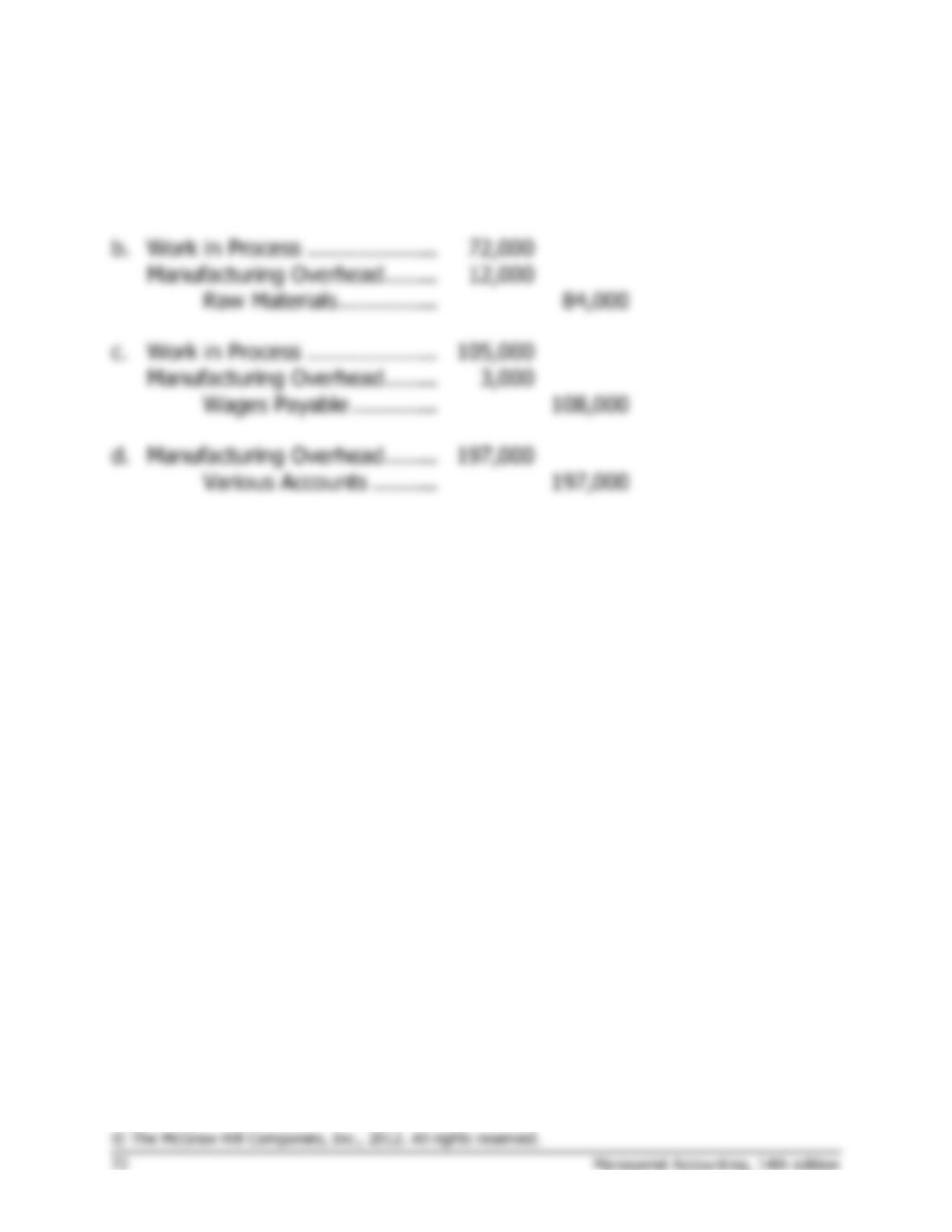
a.
Raw Materials …………………..
86,000
Accounts Payable ……….
86,000
Work in Process ………………..
72,000
Manufacturing Overhead ……..
12,000
Raw Materials ……………
84,000
Work in Process ………………..
105,000
Wages Payable ………….
108,000
Manufacturing Overhead ……..
197,000
Various Accounts ……….
Exercise 3-5 (20 minutes)
Parts 1 and 2.
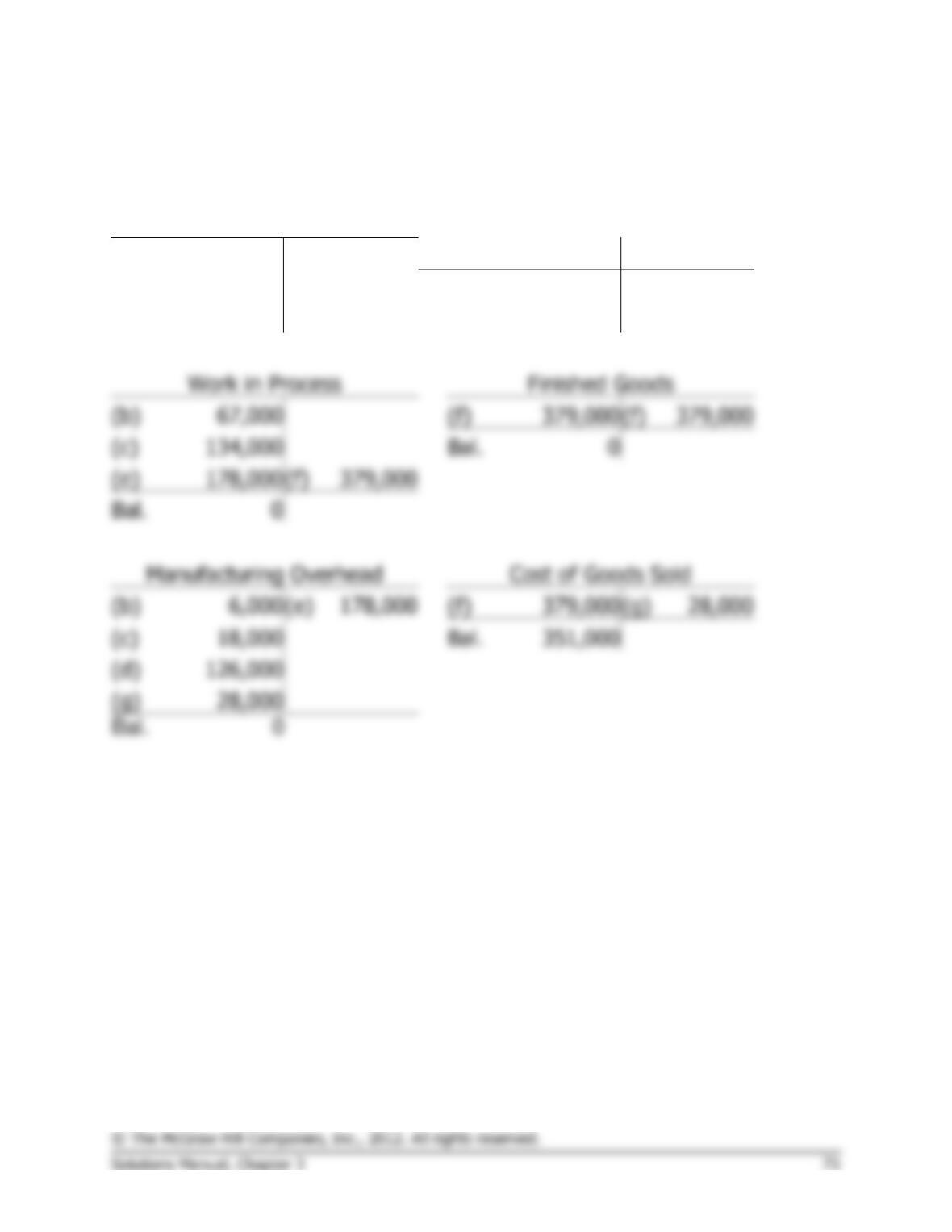
Cash
Raw Materials
(a)
75,000
(a)
75,000
(b)
73,000
(c)
152,000
Bal.
2,000
(d)
126,000
Finished Goods
(b)
(f)
(f)
(c)
Bal.
(e)
(f)
379,000
Bal.
(b)
(e)
178,000
(f)
(g)
28,000
(c)
Bal.
(d)
(g)
Exercise 3-6 (20 minutes)
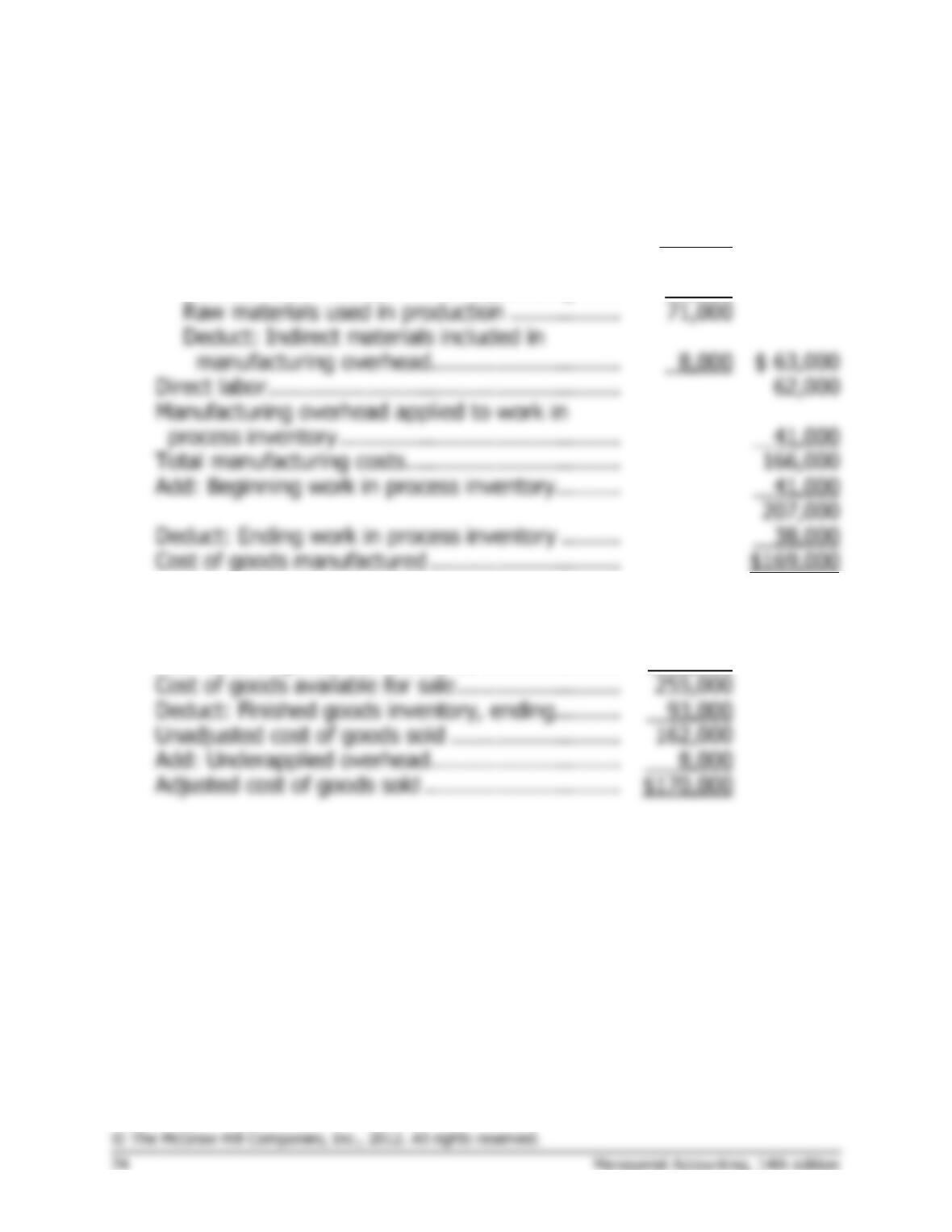
1.
Cost of Goods Manufactured
Direct materials:
Raw materials inventory, beginning……………
$24,000
Add: Purchases of raw materials ……………….
53,000
Total raw materials available ……………………
77,000
Deduct: Raw materials inventory, ending ……
6,000
Raw materials used in production ……………..
8,000
$ 63,000
Direct labor …………………………..………………….
Total manufacturing costs …………………………...
Add: Beginning work in process inventory……….
207,000
Deduct: Ending work in process inventory ………
Cost of goods manufactured ………………………..
$169,000
2.
Cost of Goods Sold
Finished goods inventory, beginning ………………
$ 86,000
Add: Cost of goods manufactured …………………
169,000
Cost of goods available for sale …………………….
Deduct: Finished goods inventory, ending……….
Unadjusted cost of goods sold ……………………..
162,000
Add: Underapplied overhead ………………………..
Adjusted cost of goods sold …………………………
$170,000
Exercise 3-7 (10 minutes)
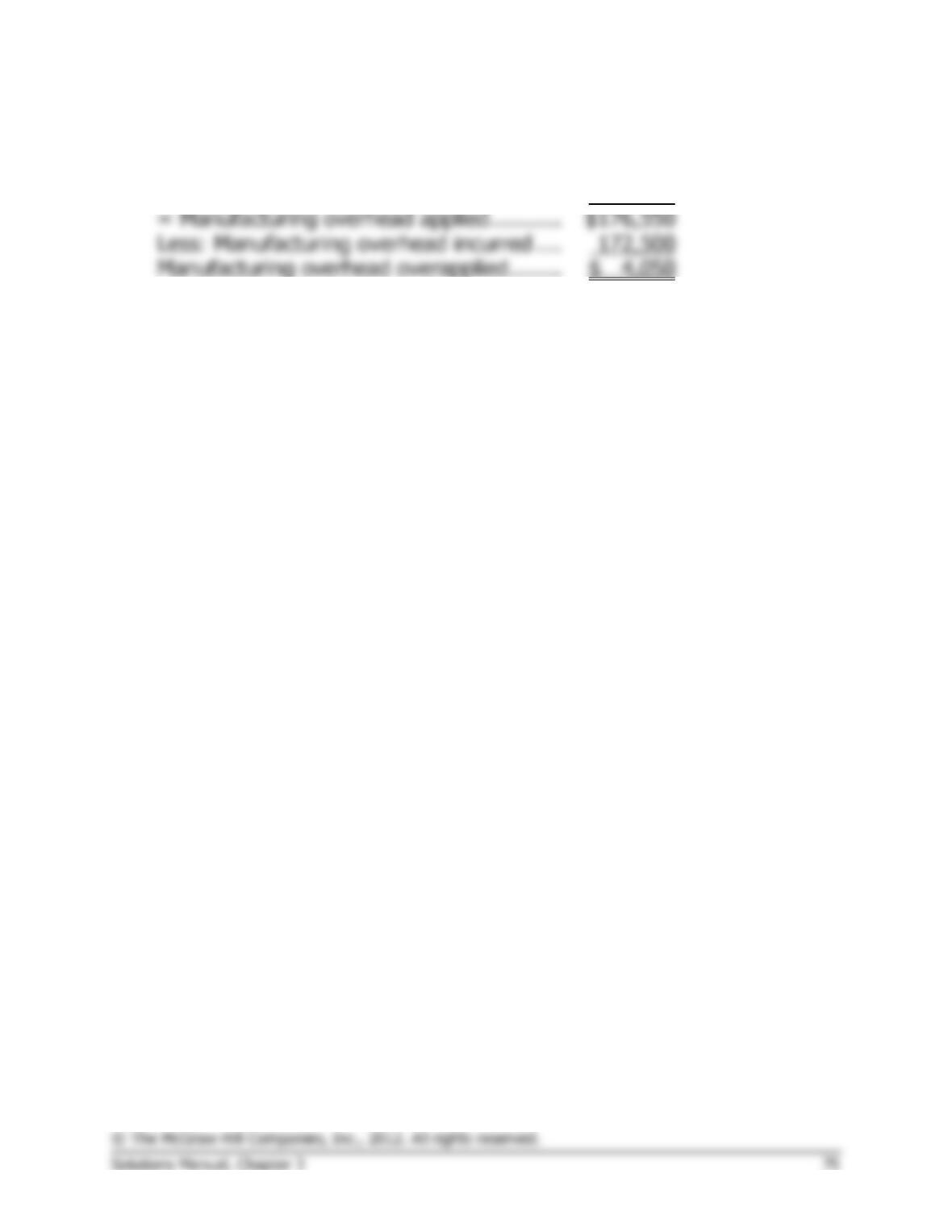
1.
Actual direct labor-hours …………………….
8,250
× Predetermined overhead rate ……………
$21.40
Less: Manufacturing overhead incurred ….
Manufacturing overhead overapplied ……..
$ 4,050
2. Because manufacturing overhead is overapplied, the cost of goods sold
would decrease by $4,050 and the gross margin would increase by
$4,050.
Exercise 3-8 (30 minutes)
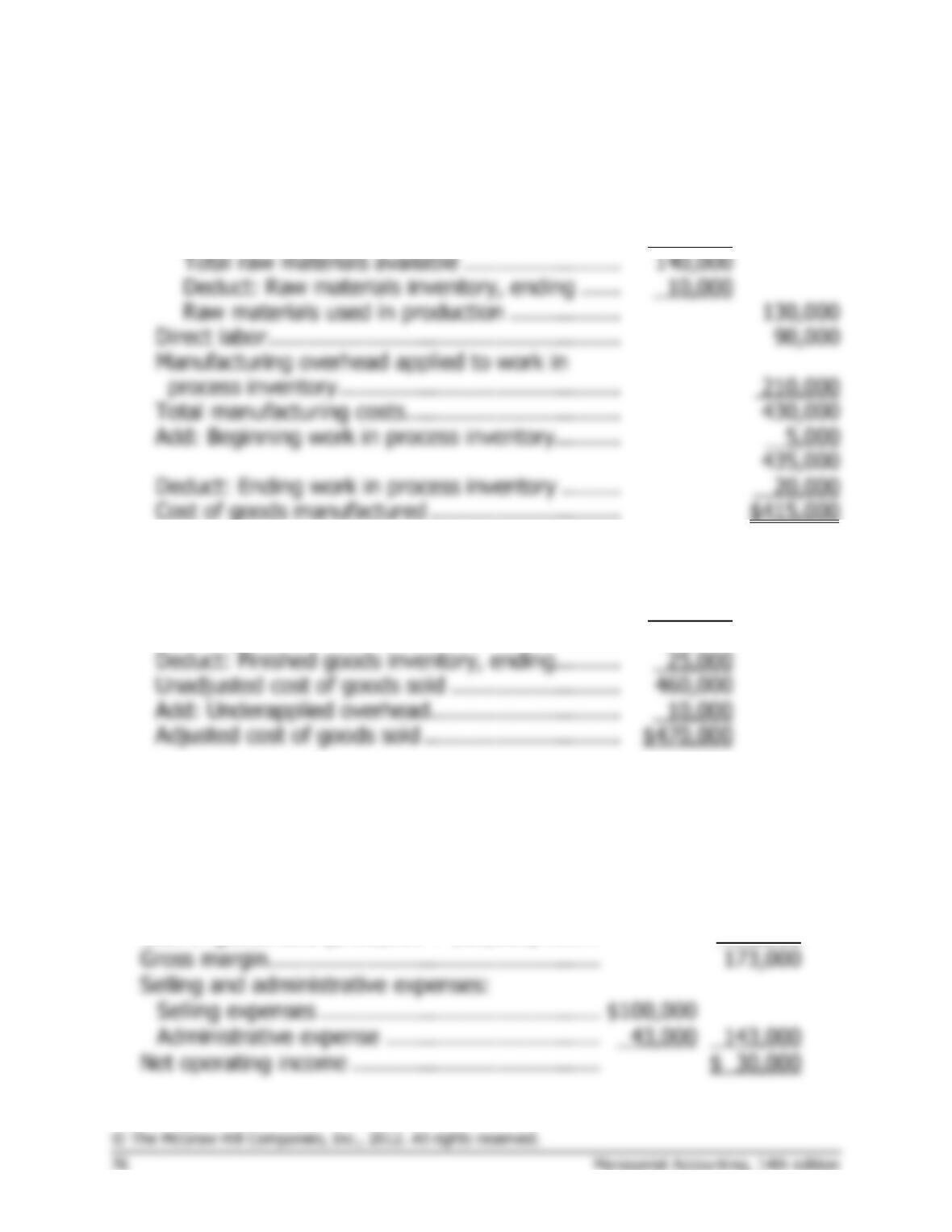
1.
Cost of Goods Manufactured
Direct materials:
Raw materials inventory, beginning……………
$ 8,000
Add: Purchases of raw materials ……………….
132,000
Total raw materials available ……………………
140,000
Deduct: Raw materials inventory, ending ……
Raw materials used in production ……………..
Direct labor …………………………..………………….
210,000
Total manufacturing costs …………………………...
430,000
Add: Beginning work in process inventory……….
Deduct: Ending work in process inventory ………
Cost of goods manufactured ………………………..
$415,000
2.
Cost of Goods Sold
Finished goods inventory, beginning ………………
$ 70,000
Add: Cost of goods manufactured …………………
415,000
Cost of goods available for sale …………………….
485,000
Deduct: Finished goods inventory, ending……….
Unadjusted cost of goods sold ……………………..
Add: Underapplied overhead ………………………..
Adjusted cost of goods sold …………………………
$470,000
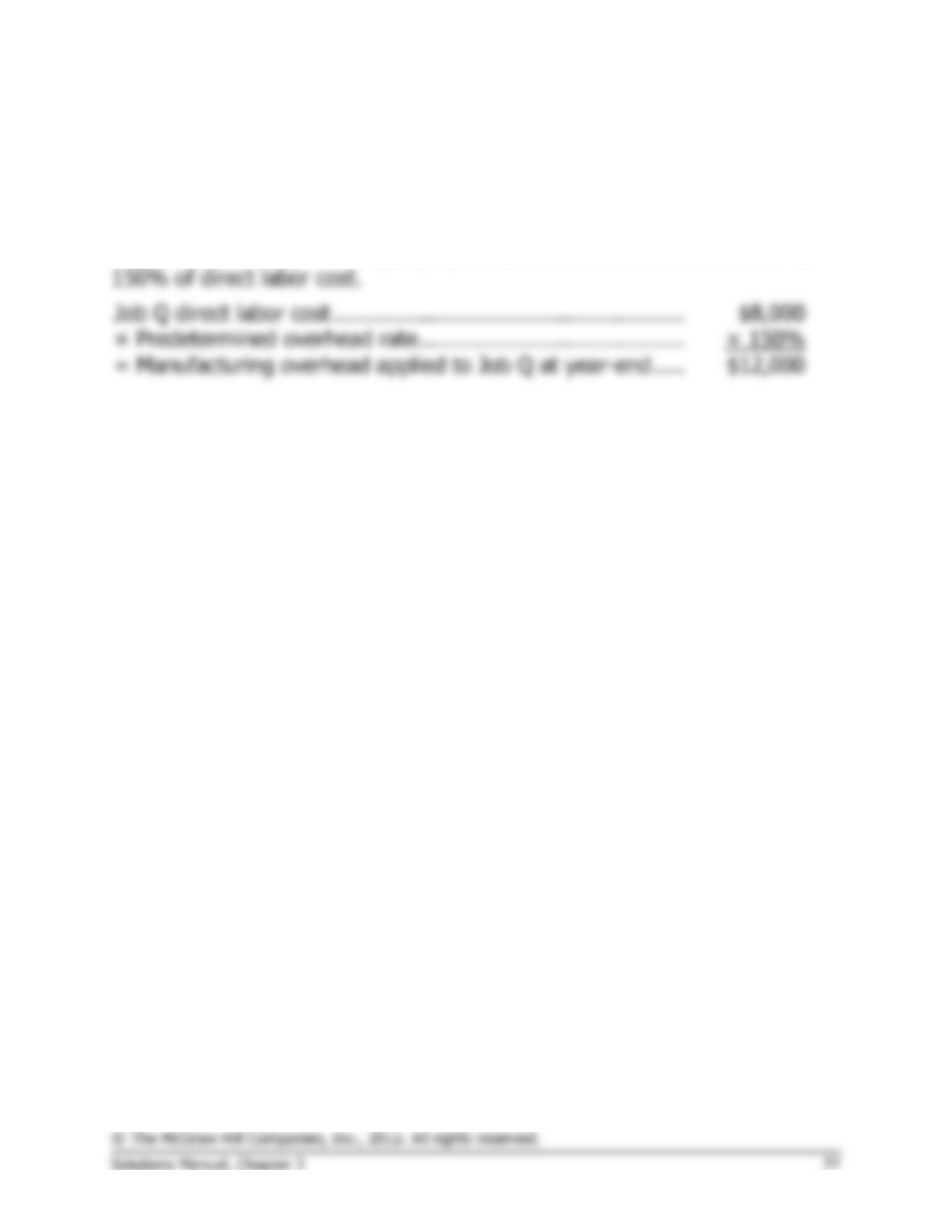
3.
Eccles Company
Income Statement
Sales ……………………………………………………..
$643,000
Cost of goods sold ($460,000 + $10,000) ………
470,000
173,000
Net operating income ………………………………..
Exercise 3-9 (10 minutes)
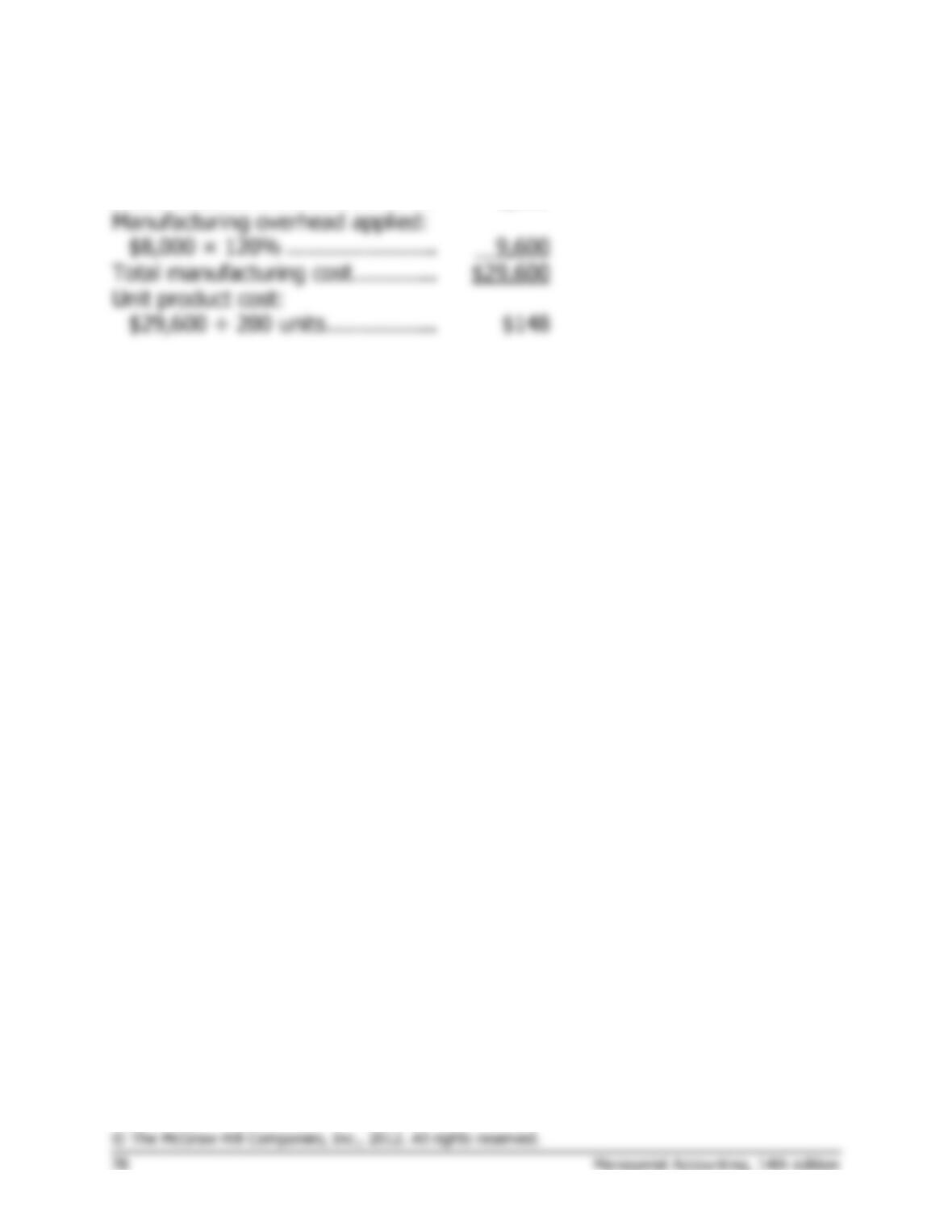
Yes, overhead should be applied to value the Work in Process inventory at
year-end.
Because $15,000 of overhead was applied to Job X on the basis of $10,000
of direct labor cost, the company’s predetermined overhead rate must be
Exercise 3-10 (10 minutes)
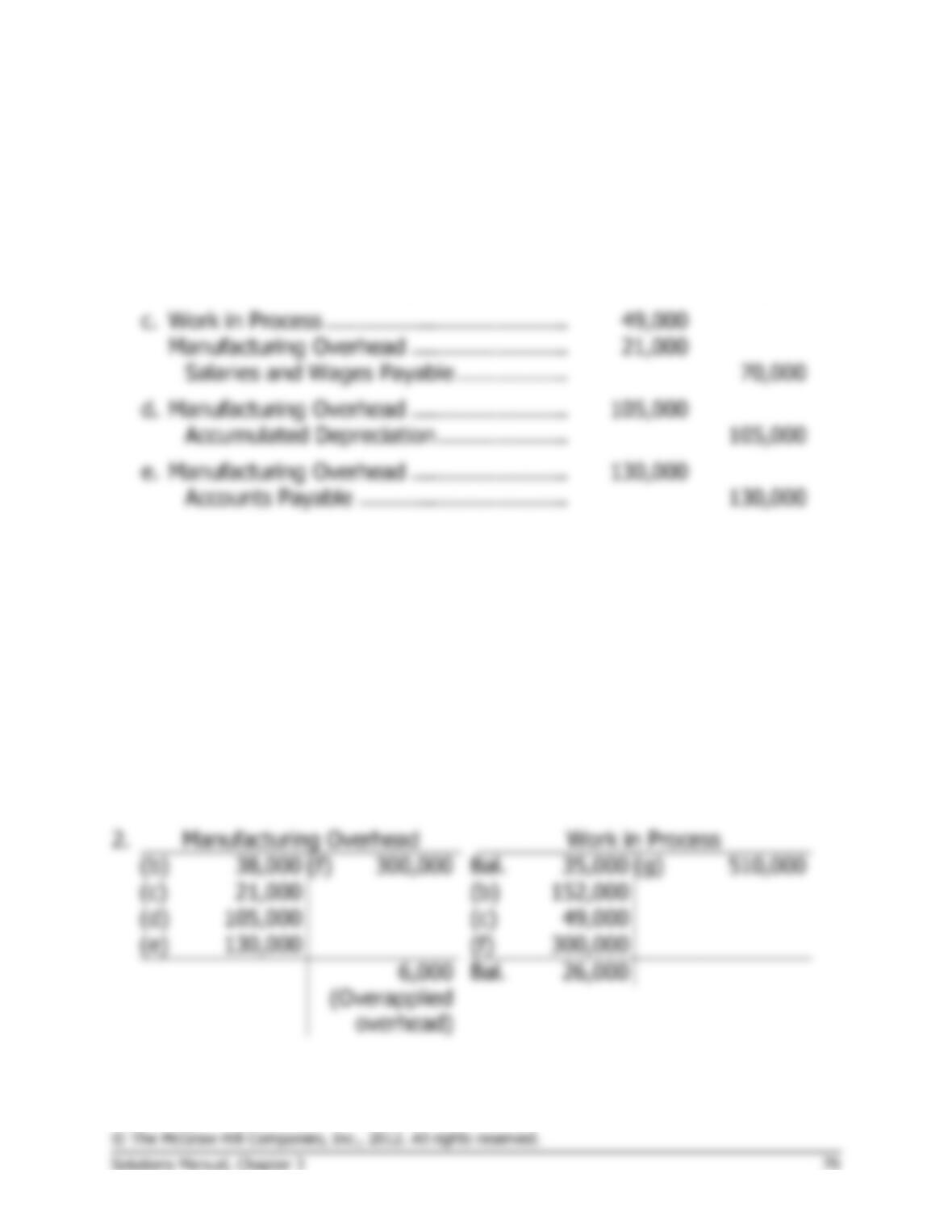
Direct material ……………………….
$12,000
Direct labor …………………………..
8,000
Exercise 3-11 (30 minutes)
1.
a.
Raw Materials Inventory …………………….
210,000
Accounts Payable …………………………..
210,000
b.
Work in Process ……………………………….
152,000
Manufacturing Overhead ……………………
38,000
Raw Materials Inventory ………………….
190,000
Work in Process ……………………………….
49,000
Manufacturing Overhead ……………………
21,000
Salaries and Wages Payable ……………..
d.
Manufacturing Overhead ……………………
105,000
Accumulated Depreciation ………………..
105,000
Manufacturing Overhead ……………………
130,000
Accounts Payable …………………………..
130,000
f.
Work in Process ……………………………….
300,000
Manufacturing Overhead ………………….
300,000
75,000 machine-hours $4 per machine-hour = $300,000.
g.
Finished Goods ………………………………..
510,000
Work in Process …………………………..…
510,000
h.
Cost of Goods Sold …………………………...
450,000
Finished Goods ………………………………
450,000
Accounts Receivable ………………………….
675,000
Sales …………………………..………………
675,000
$450,000 × 1.5 = $675,000.
2.
Work in Process
Exercise 3-12 (20 minutes)
1. The estimated total manufacturing overhead cost is computed as
follows:
Y = $750,000 + $4.00 per MH × 150,000 MHs
Estimated fixed manufacturing overhead …………….
$ 750,000
Estimated total manufacturing overhead ……..
$1,350,000
÷ Estimated total machine-hours (MHs) ……..
MHs
Estimated variable manufacturing overhead
2. Total manufacturing cost assigned to Job 500:
Direct materials …………………………..
$9.00 per MH × 30 MHs ……………..
270
Total manufacturing cost ……………….
$850
3. Computing underapplied/overapplied overhead:
Actual manufacturing overhead (a) …….
$1,325,000
Actual machine-hours ………………………
147,000
= Manufacturing overhead applied (b) ..
$1,323,000
Underapplied overhead (a) – (b) ………..
$ 2,000
Exercise 3-13 (15 minutes)
1.
Actual manufacturing overhead costs …………..
$ 48,000
Overapplied overhead cost …………………………
2.
Direct materials:
Raw materials inventory, beginning …………..
$ 8,000
Add: Purchases of raw materials ……………….
32,000
Raw materials available for use ………………..
40,000
Deduct: Raw materials inventory, ending ……
$ 33,000
Direct labor …………………………………………….
Total manufacturing cost …………………………..
Add: Work in process, beginning …………………
Deduct: Work in process, ending …………………
Cost of goods manufactured ………………………
Exercise 3-14 (30 minutes)
Note to the instructor: This exercise is a good vehicle for introducing the
concept of predetermined overhead rates. This exercise can also be
used as a launching pad for a discussion of the appendix to the chapter.
1.
Units
Produced
Manufacturing
Overhead
High activity level (First quarter) …
80,000
$228,000
Low activity level (Third quarter) …
20,000
192,000
Change ………………………………….
60,000
$36,000
Variable cost = Change in cost ÷ Change in activity
Total cost (First quarter) ……………………………………..
Variable cost element ($0.60 per unit × 80,000 units) .
Fixed cost element …………………………………………….
Estimated fixed manufacturing overhead ………………
$180,000
Estimated variable manufacturing overhead
$0.60 per unit × 60,000 units …………………………..
36,000
Estimated total manufacturing overhead cost …………
$216,000
Total manufacturing cost and unit product cost:
Direct materials ……………………………………………..
$180,000
= Unit product cost ………………………………………..
Exercise 3-14 (continued)
2. The fixed portion of the manufacturing overhead cost is causing the unit
product costs to fluctuate. The unit product cost increases as the level
of production decreases because fixed overhead is being spread over
fewer units.
The annual predetermined overhead rate is computed as follows:
Estimated total manufacturing overhead ….
$840,000
÷ Estimated total units produced ……………
200,000
= Predetermined overhead rate ……………..
$4.20
per unit
Exercise 3-15 (15 minutes)
1. Milling Department:
The estimated total manufacturing overhead cost in the Milling
Estimated fixed manufacturing overhead ………………
$390,000
$2.00 per MH × 60,000 MHs …………………………...
120,000
Estimated total manufacturing overhead cost …………
$510,000
The predetermined overhead rate is computed as follows:
Estimated total manufacturing overhead ….
$510,000
÷ Estimated total machine-hours ……………
60,000
MHs
per MH
Estimated fixed manufacturing overhead ………………
$500,000
$3.75 per DLH × 80,000 DLHs ………………………….
300,000
Estimated total manufacturing overhead cost …………
$800,000
The predetermined overhead rate is computed as follows:
Estimated total manufacturing overhead ….
$800,000
÷ Estimated total direct labor-hours ……….
80,000
DLHs
= Predetermined overhead rate ……………..
$10.00
per DLH
Exercise 3-15 (continued)
2.
Total manufacturing cost assigned to Job 407:
Direct materials ($800 + $370) …………………….
$1,170
Direct labor ($45 + $160) …………………………...
Milling Department (90 MHs × $8.50 per MH) ….
Assembly Department (20 DLH × $10 per DLH) .
Total manufacturing cost …………………………….
3. Yes; if some jobs require a large amount of machine time and a small
amount of labor time, they would be charged substantially less overhead
Exercise 3-16 (15 minutes)
1.
Item (a):
Actual manufacturing overhead costs for the year.
Item (b):
Overhead cost applied to work in process for the year.
Cost of goods manufactured for the year.
Item (d):
Cost of goods sold for the year.
2.
Manufacturing Overhead ………………………..
30,000
Cost of Goods Sold …………………………..
30,000
3. The overapplied overhead will be allocated to the other accounts on the
basis of the amount of overhead applied during the year in the ending
balance of each account:
Work in process …………………………..
%
Finished goods …………………………….
Cost of goods sold ……………………….
Total cost …………………………………..
%
Manufacturing Overhead ………………………
Work in Process (8% × $30,000) ……….
Finished Goods (10% × $30,000) ………