LU Decomposition 17
For the third pass, we note that
The larger value corresponds to r3, so again there is no need to modify the
contents of the row vector. After the last pass of Gaussian elimination, the
coefficient matrix is
Finally, we see that LU =P A, where
and
0001
(b) With b1=3 12 0 5 T, we find Pb1=5 12 0 3 T. Now,
forward substitution applied to Lz=Pb1yields
Next, back substitution applied to Ux=zgives
18 Section 3.5
With b2=−1−6−4 3 T, we find Pb2=3−6−4−1T.
Now, forward substitution applied to Lz=Pb2yields
Next, back substitution applied to Ux=zgives
With b3=3−8 10 2 T, we find Pb3=2−8 10 3 T. Now,
forward substitution applied to Lz=Pb3yields
Next, back substitution applied to Ux=zgives
13. A=
1 3 1 −2
2 4 −1 2
3 1 1 5
4 2 6 −1
b1=
1
−5
−2
9
,b2=
−5
−3
6
−5
,b3=
5
5
−2
1
LU Decomposition 19
(a) Initialize the row vector to r=1234T. Since
Among the values
The first pass of Gaussian elimination transforms the coefficient matrix to
Now, the largest value among
For the third pass, we note that
20 Section 3.5
After the last pass of Gaussian elimination, the coefficient matrix is
(b) With b1=1−5−2 9 T, we find Pb1=9 1 −5−2T.
Now, forward substitution applied to Lz=Pb1yields
LU Decomposition 21
Next, back substitution applied to Ux=zgives
Next, back substitution applied to Ux=zgives
14. A=
2 7 5
6 20 10
4 3 0
b1=
14
36
7
,b2=
−4
−16
−7
,b3=
−3
−12
6
(a) Initialize the row vector to r=123T. Since
22 Section 3.5
the largest corresponds to r3. We therefore interchange the first and third
entries in the row vector to obtain
After the last pass of Gaussian elimination, the coefficient matrix is
(b) With b1=14 36 7 T, we find Pb1=7 14 36 T. Now, forward
LU Decomposition 23
Next, back substitution applied to Ux=zgives
z1=−7;
Next, back substitution applied to Ux=zgives
With b3=−3−12 6 T, we find Pb3=6−3−12 T. Now,
forward substitution applied to Lz=Pb3yields
24 Section 3.5
15. A=
13 39 2 57 28
−4−12 0 −19 −9
3 0 −9 2 1
6 17 9 5 7
19 42 −17 107 44
b1=
−53
18
−7
0
−103
,b2=
57
−18
−11
18
69
,b3=
−145
49
−27
−4
−286
(a) Initialize the row vector to r=12345T. Since
Among the values
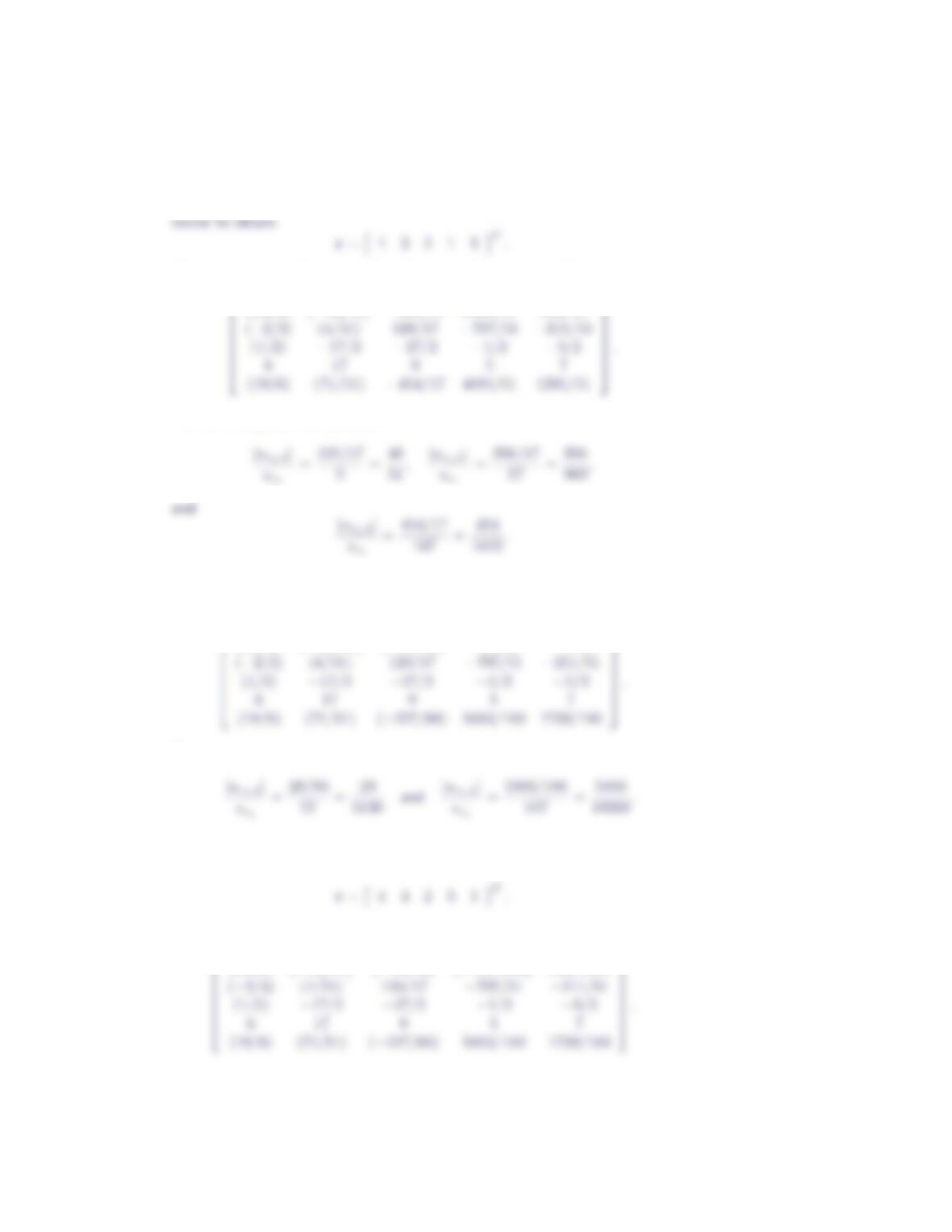
The first pass of Gaussian elimination transforms the coefficient matrix to
(13/6) 13/6−35/2 277/6 77/6
Now, the largest value among
LU Decomposition 25
corresponds to r3, so we interchange the second and third entries in the row
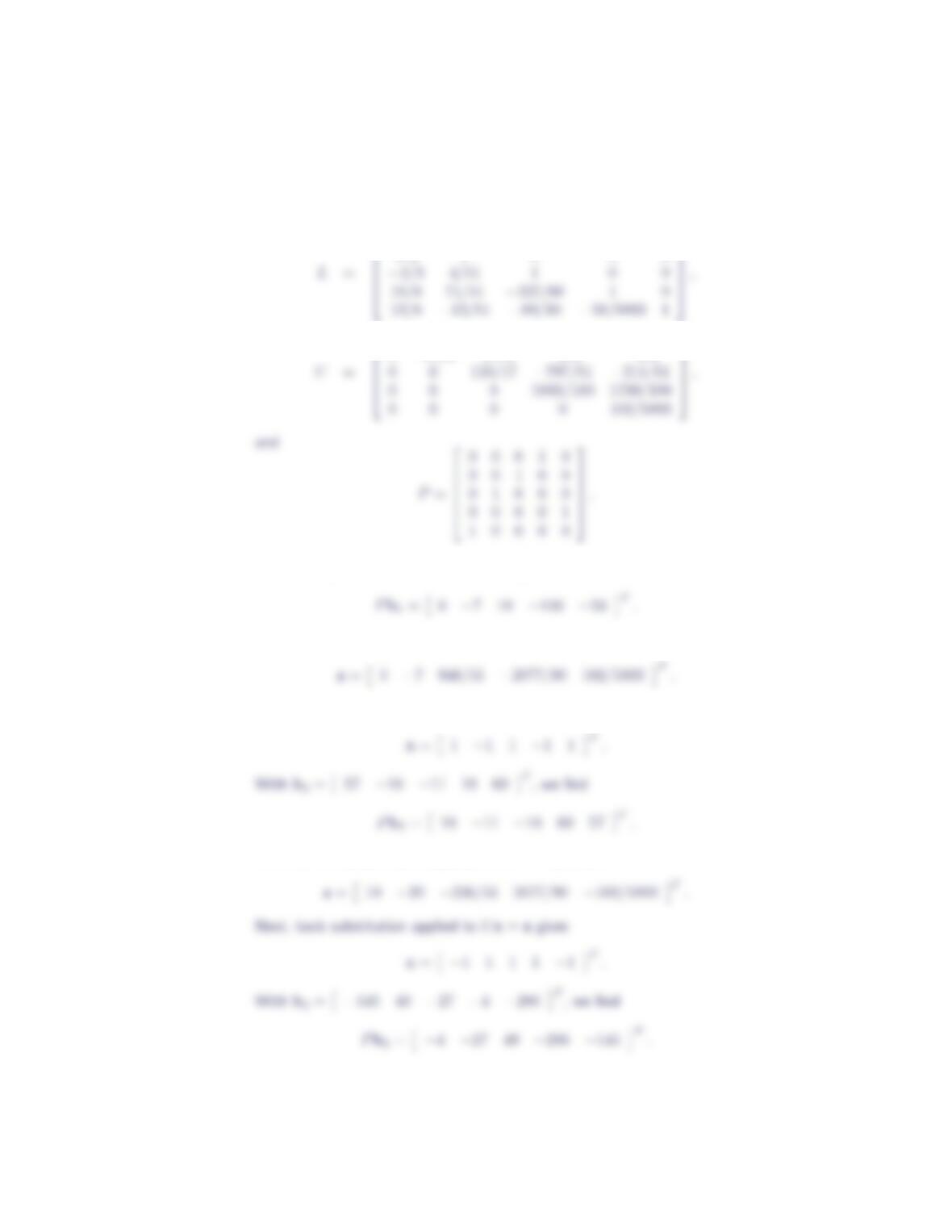
The second pass of Gaussian elimination transforms the coefficient matrix to
(13/6) (−13/51) −356/17 2348/51 622/51
For the third pass, we note that
The largest value corresponds to r3, so there is no need to modify the contents
of the row vector. After the third pass of Gaussian elimination, the coefficient
matrix is
(13/6) (−13/51) (−89/30) −29/90 −7/90
Now,
The larger value corresponds to r5, so we interchange the last two entries in
the row vector to obtain
After the final pass of Gaussian elimination, the coefficient matrix is
(13/6) (−13/51) (−89/30) (−58/5893) 102/5893
26 Section 3.5
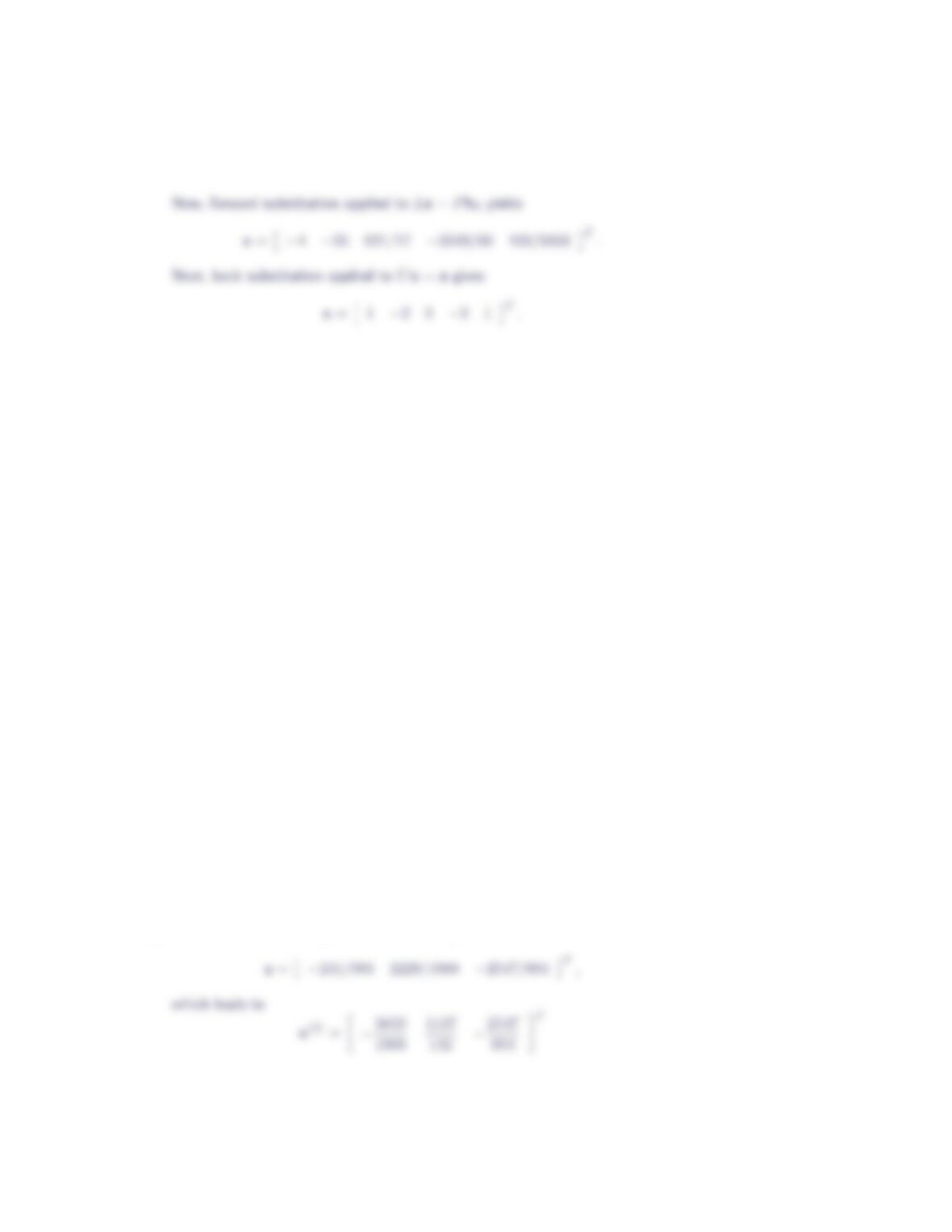
Finally, we see that LU =P A, where
1 0 0 0 0
1/2 1 0 0 0
6 17 9 5 7
0−17/2−27/2−1/2−5/2
(b) With b1=−53 18 −7 0 −103 T, we find
Now, forward substitution applied to Lz=Pb1yields
Next, back substitution applied to Ux=zgives
Now, forward substitution applied to Lz=Pb2yields
LU Decomposition 27
16. In the text, the Inverse Power Method, a technique for approximating the eigen-
values and eignevectors for an arbitrary matrix, was described. Given an initial
estimate for the eigenvalue, λ0, and a non-zero vector x(0), the following se-
quence of calculations are iterated:
x(m)= (A−λ0I)−1x(m−1)
λm=x(m)
pm−1
x(m)=x(m)/x(m)
pm.
The quantity λ0+ (1/λm) converges toward the eigenvalue of Athat is closest
to λ0, and x(m)converges toward a corresponding eigenvector. The integer pm
is is chosen so that
x(m)
pm
=kx(m)k∞.
For the remainder of this exercise, let
A=
1−1 0
−2 4 −2
0−1 2
.
(a) For λ0= 5 and x(0) =1−4 1 T, we had found that λ2= 994/124
and x(2) =−241/994 1 −318/994 T. Perform the next two itera-
tions. How does the value λ0+ (1/λ4) compare to the true eigenvalue
5.1248854198?
(b) For λ0= 2 and x(0) =1−1 2 T, perform the first four iterations of
the inverse power method. How does the value λ0+ (1/λ4) compare to the
true eigenvalue 1.6366717621?
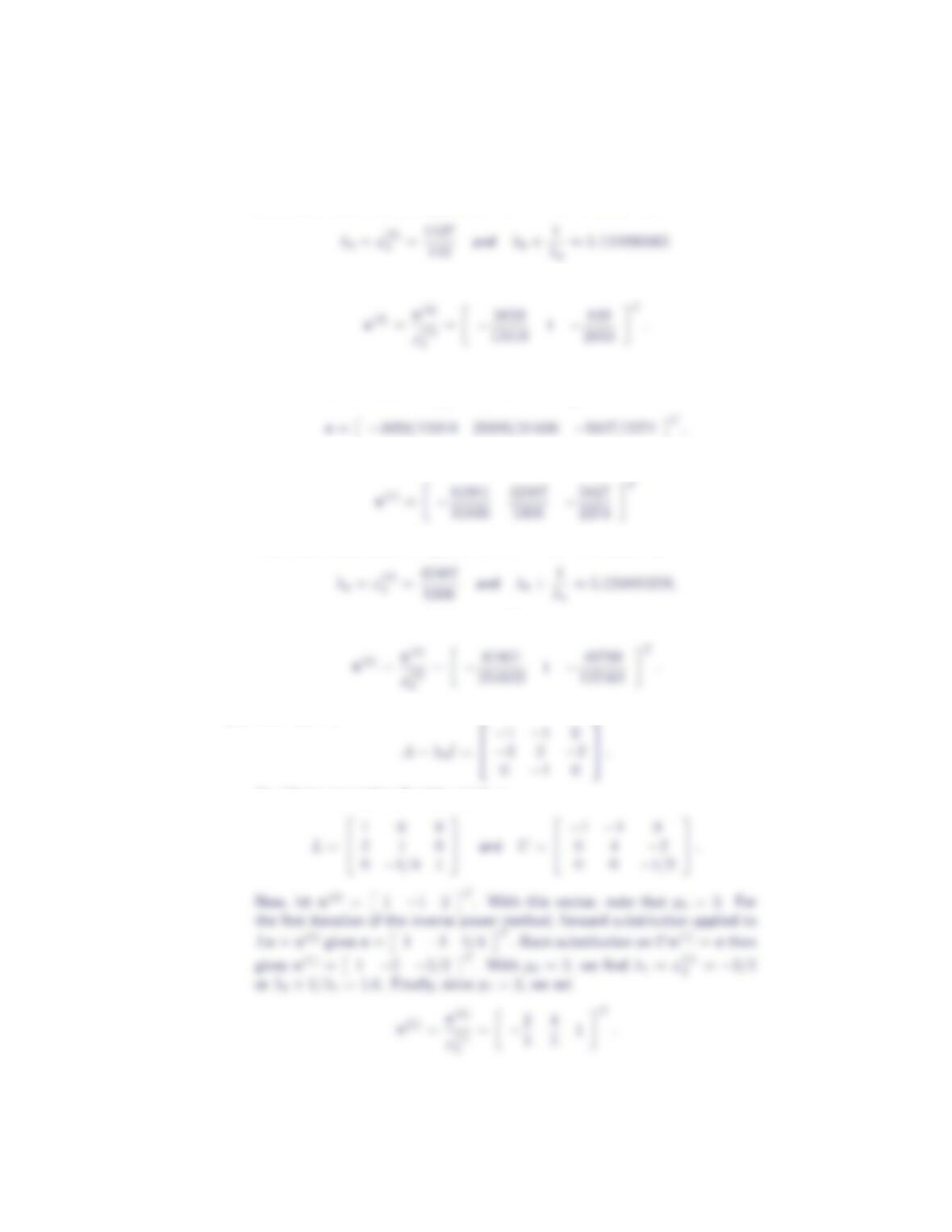
(a) Forward substitution applied to Lz=x(2) gives
28 Section 3.5
when back substitution is applied to Ux(3) =z. It follows that
The approximate eigenvector is
Next, forward substitution applied to Lz=x(3) gives
which leads to
when back substitution is applied to Ux(4) =z. It follows that
which is correct to six decimal places. The approximate eigenvector is
(b) With λ0= 2,
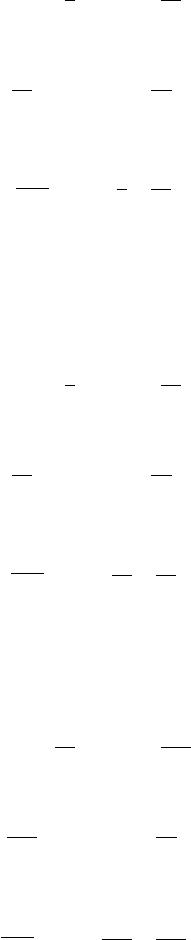
An LU decomposition for this matrix is
LU Decomposition 29
Forward substitution applied to Lz=x(1) gives
z=−2/5 8/5 7/5T,
which leads to
x(2) =7
5−1−14
5T
when back substitution is applied to Ux(2) =z. It follows that
λ2=x(2)
3=−14
5and λ0+1
λ2≈1.642857143.
The approximate eigenvector is
x(2) =x(2)
x(2)
3
=−1
2
5
14 1T
.
Next, forward substitution applied to Lz=x(2) gives
z=−1/2 19/14 75/56 T,
which leads to
x(3) =3
2−1−75
28 T
when back substitution is applied to Ux(3) =z. It follows that
λ3=x(3)
3=−75
28 and λ0+1
λ3≈1.626666667.
The approximate eigenvector is
x(3) =x(3)
x(3)
3
=−14
25
28
75 1T
.
Finally, forward substitution applied to Lz=x(3) gives
z=−14/25 112/75 103/75 T,
which leads to
x(4) =39
25 −1−206
75 T
when back substitution is applied to Ux(4) =z. It follows that
λ4=x(4)
3=−206
75 and λ0+1
λ4≈1.635922330,
which is in error by less than 10−3. The approximate eigenvector is
x(4) =x(4)
x(4)
3
=−117
206
75
206 1T
.
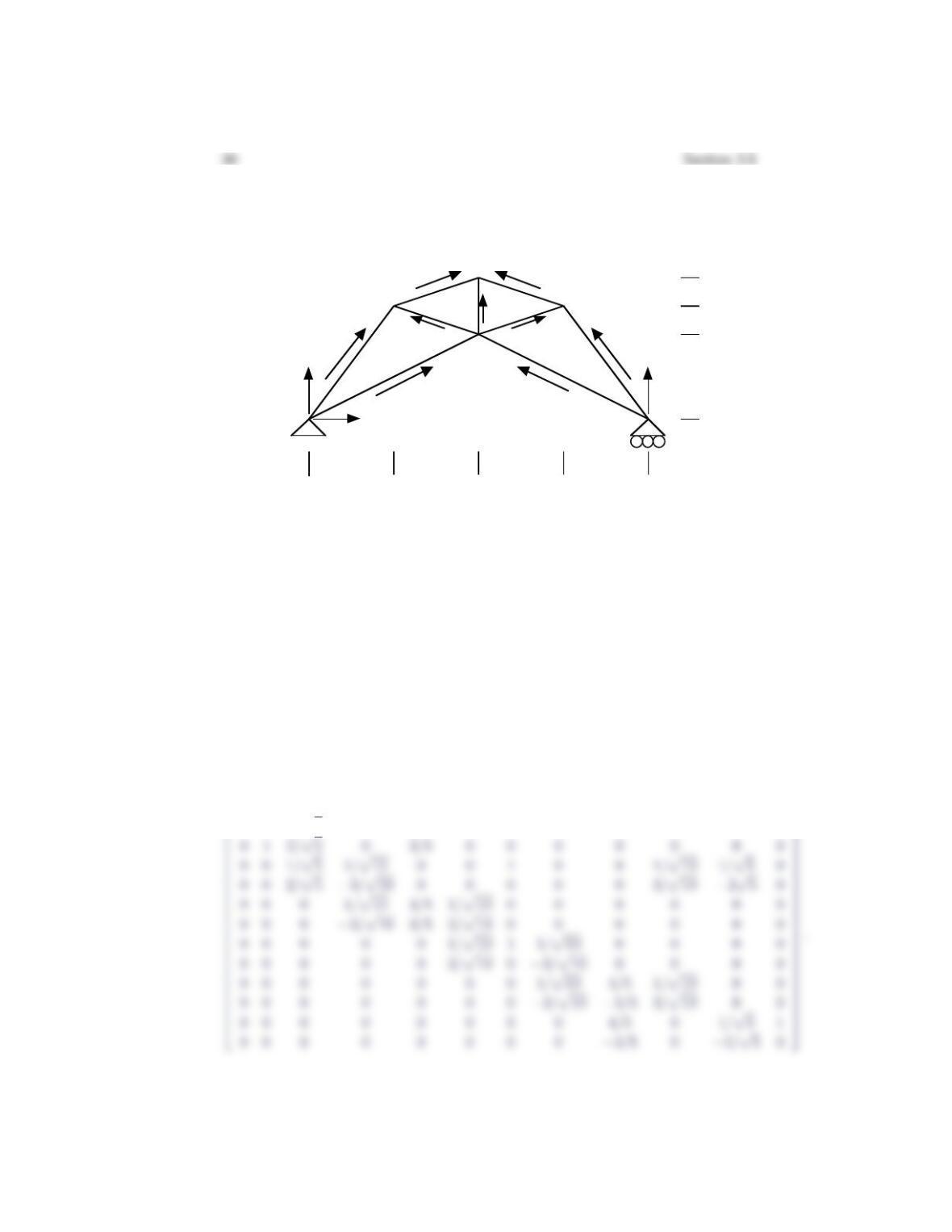
17. Determine the member and reaction forces within the plane truss shown below
when the truss is subjected to each of the following loading configurations.
15 feet
15 feet
15 feet
15 feet
15
feet
5 feet
5 feet
FH
FV
F1
F3
F2
F4
F5
F6
F7
F8
F9
FR
Node
#1
Node
#2
Node
#3
Node
#4
Node
#5
Node
#6
(a) 500 pound forces directed vertically downward at nodes #3 and #5 and a
1000 pound force directed vertically downward at node #4.
(b) 500 pound force acting at node #3, a 1000 pound force acting at node
#4 and a 1500 pound force acting at node #5, all forces acting vertically
downward.
(c) 1500 pound force acting at node #3, a 1000 pound force acting at node
#4 and a 500 pound force acting at node #5, all forces acting vertically
downward.
(d) 500 pound force acting at node #4 and a 1000 pound force acting at node
#3, both forces acting horizontally to the right.
(e) 500 pound force acting at node #4 and a 1000 pound force acting at node
#5, both forces acting horizontally to the left.
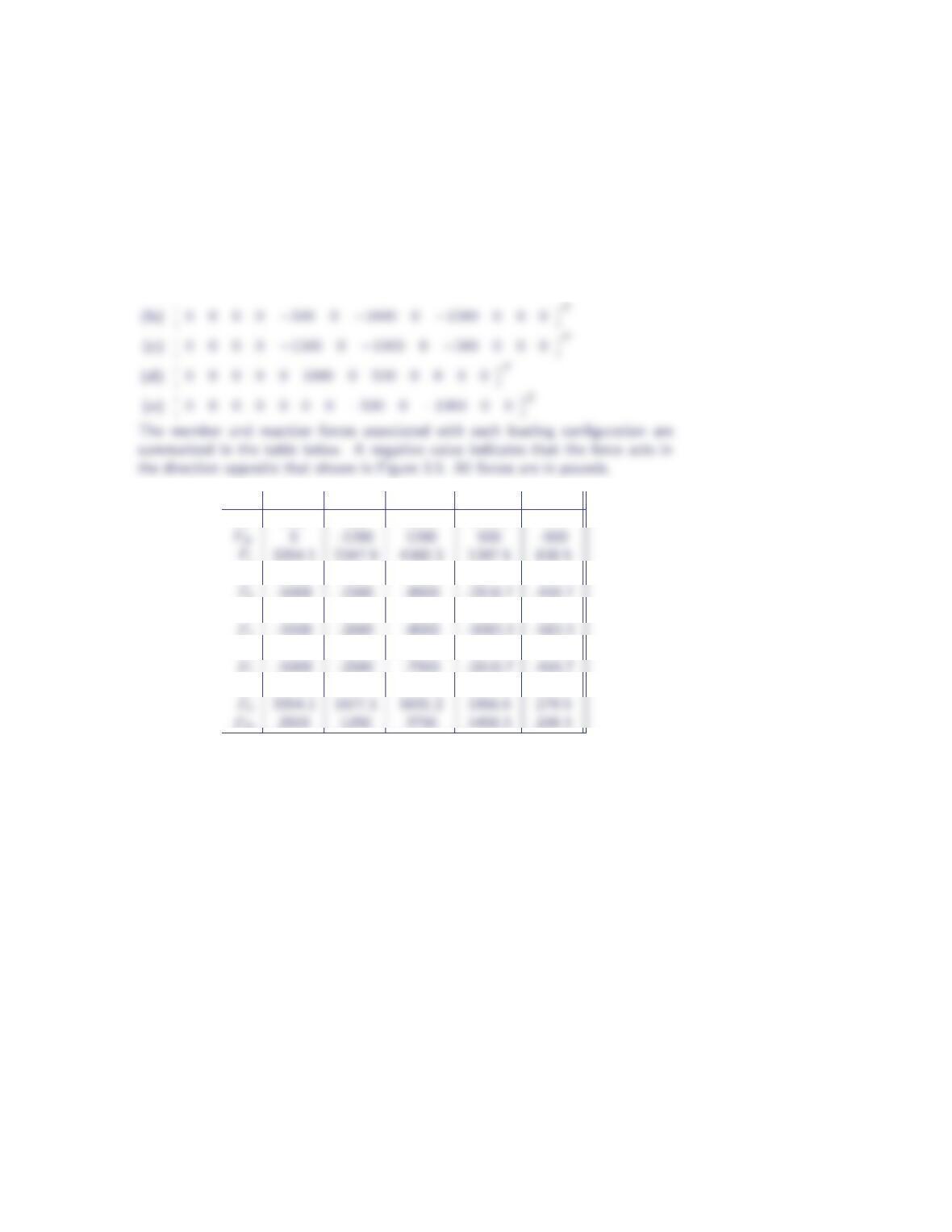
Assuming each force acts in the direction indicated in Figure 3.5, the coefficient
matrix becomes
101/√5 0 4/5 0 0 0 0 0 0 0
LU Decomposition 31
The rows correspond to the forces FV,FH,F1through F9, and FR, in order; each
pair of rows represents first the vertical and then the horizontal component of the
force acting on each node taken in order from node #1 through node #6. The
right-hand side vectors for each of the five loading configurations are
(a) 0000−500 0 −1000 0 −500 0 0 0 T
(a) (b) (c) (d) (e)
FV2500 150 4850 1708.3 -41.7
F23952.8 632.5 5692.1 2239.9 395.3
F47115.1 1581.1 11068.0 5138.7 658.8
F67115.1 1581.1 11068.0 4611.7 1185.9
F83952.8 0 6324.6 2767.0 -131.8