Chapter 3 – Communicating to Support Teacher Awareness
Summary
Communication to increase a teacher’s awareness of practices and interactions is the focus of this
chapter. Increasing effective listening, reflective feedback and exploring ways to resolve conflict
Outline
The chapter supports your growing capacity to
• mentor through dialogue;
• communicate for understanding and build common ground;
• pay attention to communication basics;
Communicating to
support
effective
disposition
build common
& culturally
responsive
understanding
OBSERVE
listen, seek
information
• use culturally responsive mentoring practice.
Learner outcomes
• Students will recognize the importance of building common and culturally responsive
understanding and communication choices
• Students will be able to identify ways to listen to understanding a teacher’s perspective
Suggested teaching activities
Opening Discussion – Introducing communication as a topic: Begin by emphasizing that
foundational to the topic of communication is understanding that any general strategy
suggestions must be used within the context of supporting an individual who is a cultural being
with a complex identity and a lifetime of experiences. In addition, the early childhood teacher is
working in a specific early childhood educational program context with patterns of
Culture influences communication style, ways of working with others and preferred ways
of learning. It is a guide for how to act and it influences our activities, beliefs and values. It
may be hard for any one person to describe their culture. However, it is clear when we
are made to feel comfortable or when we feel disrespected for our deep values or ways
Debrief the participant’s responses by connecting their comments to the following ideas and
keep the conversation going by asking more open-ended questions.
• Silence – Is it ok to interrupt? Is it best to wait?
• Time concepts – Should I get right to the point or should I wait and socialize first?
Summarize this opening discussion by repeating:
Encourage participants to keep an ongoing journal to respond to the question; What knowledge
or skills do I need in any roles I currently have working with other adults or early childhood
teachers?
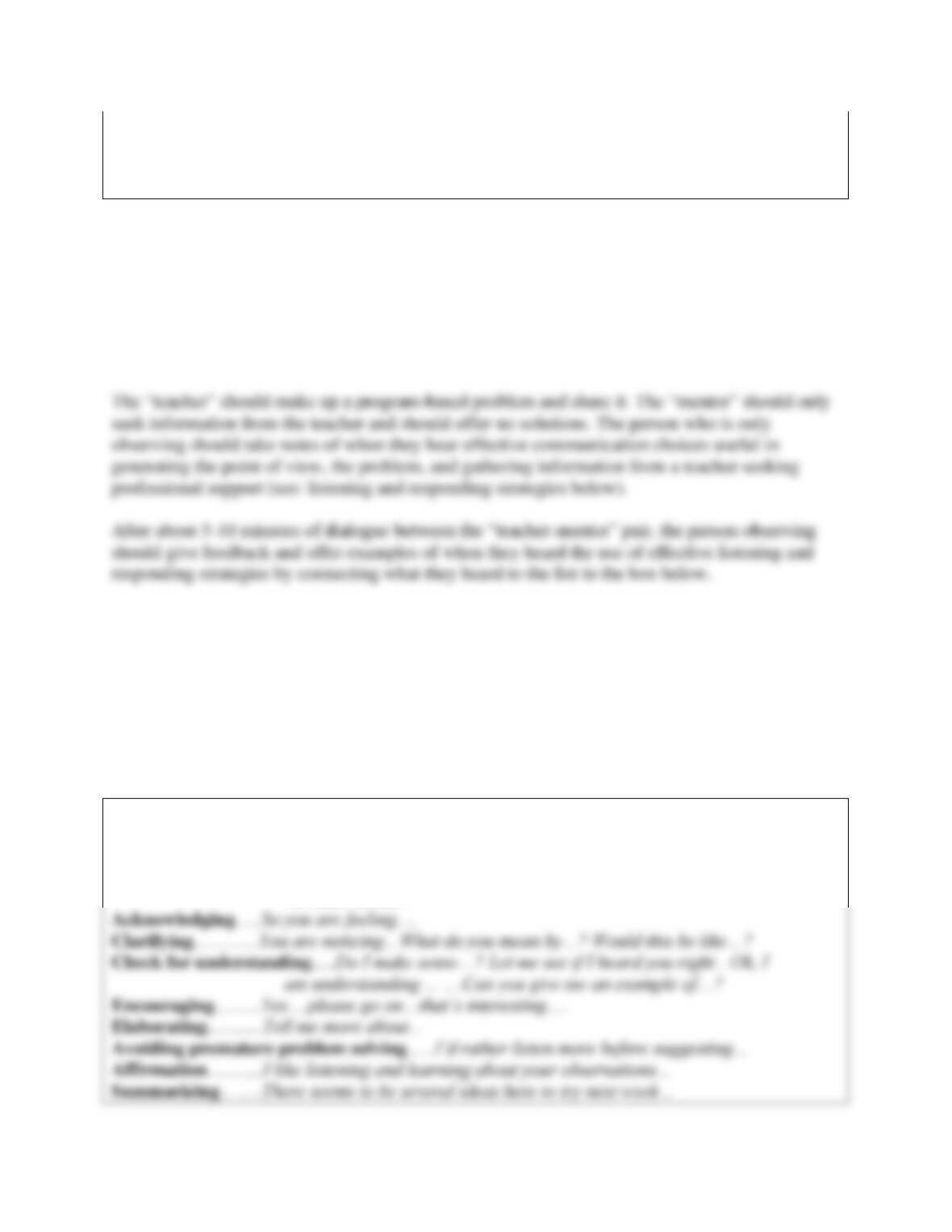
Overview of a Cycle of Communication Strategies
Ask students to view this graphic framework as you briefly describe primary communication
Introduce the cycle and describe the three main stages. The stages involve communication to:
(1) observe, notice and respond (e.g., paying attention, acknowledging, paraphrasing, and
Reflect
use positive
feedback,
facilitate
reflection,
Observe
listen,
respond w/
empathy,
(3) apply, plan, model and modify by clarifying what you hope will happen (Have you tried
dividing the class up into smaller groups and asking another teacher to help with that
transition?). End with affirmations to motivate teachers to keep the learning going (I like
listening and learning about your observations).
Activities
1. Listening for understanding
Ask participants to get into small groups of three persons. One person should role play an early
childhood teacher, another a visiting early childhood education mentor and the third person
should observe and take notes only.
After another 5-10 minutes of this debriefing of the role play, the instructor may then choose to
gather the small groups into one large group. The instructor could ask participants to share one or
two effective strategies used, or could summarize the effective strategies she heard around the
room.
The activity could conclude by the instructor either asking participants to share now or write in a
journal later, what they want to do more of to support effective listening and responding to others
from this list:
Listening and Responding: Includes paying attention, acknowledging, paraphrasing, and
summarizing
Paraphrasing……..I am hearing that you tried to limit the materials in the house area…
In other words…
2. Promoting reflection
Discuss with participants the characteristics and functions of reflective comments as follows:
Reflective comments are open and non-judgmental. These comments help a teacher to see from
the child’s, parents’ or other teacher’s perspectives. In the final phase this insight will be
essential to make the most appropriate instructional or other program choices. Questions to
promote reflection and find meaning in everyday events include:
Can you talk more about that?
What have you tried before?
What evidence do you have about that?
What do you want to happen?”
Tell me about a time when you saw this…
Pair and share: Role-play being either a mentor or a teacher having a conversation. Imagine this
Purpose: Students will be able to explain how to use reflective comments in order to find
meaning in information gathered about problems in their work.
Extend: If you are using a particular observational tool, and your mentoring is focused on a
specific content area, the reflective comments activity could include connections to those

3. Instructive feedback
After observing, using open-ended questions and promoting reflection, it is time for instructive
feedback. Examples of a mentor’s instructive comments might be:
When you greeted Juanita and showed her where to put her coat, she seemed relieved and
happy. Since she is new to the school that made her feel like she belonged.
Instructive feedback is very time dependent.
Add a few ideas or suggestions after listening for understanding and using positive and reflective
feedback. Include an empathetic point of view. Mentor comments may also reinforce what is
already happening that is effective.
Discus the importance of the timing of instructive feedback by asking participants to imagine the
comments above were made before using open ended questions and promoting reflection. How
might instructive feedback have been received if given immediately?
Notice signs of burnout when communication strategies are not effective
Ask participants to reflect on when they noticed another early childhood teacher or adult they
When have you recognized that a teacher or colleague needed to take care of him or herself
Debrief the discussions by saying that it is an ethical duty for all early childhood professionals
Help participants consider the program context if many teachers are showing these signs at the
same time.
Health: Change in appetite, and other symptoms such as low energy, fatigue, upset stomach or
backache and loss of sleep.
Feelings: Irritability, anxiety, guilt, anger, or sadness. Lack of empathy and a general feeling of
being exhausted.
4. Effective dispositions for teaching
Divide the group into four smaller groups. Give each small group one of the scenarios in this
section to read together. Give the following directions:
Connect behaviors in the following four scenarios with the effective teaching dispositions
Variation in activity: Only ask the groups to identify effective dispositions for teaching. After
they do that share how these dispositions might support the “effective professional teaching
practices” aligned with them.
Personal dispositions noted in the scenario
Effective professional teaching practices
From: Predictable, reliable, persistent and
responsible
To: Implement research based practices
consistently
collaborative
and willing to examine contradictions in
practices and ideas
makes connections
From: Takes risks with support and willing to
hear other perspectives
To: Creative, flexible and intentional

A) Predictable, reliable, persistent and responsible – One Family Child Care Teacher
Mary is a family child care teacher who has a reputation with her enrolled families for beginning
each day with a renewed enthusiasm. She can be counted on to remember what parents told her
B) Caring, sensitive, responsive and collaborative
Rebecca is a preschool teacher who is known for her ability to teach social skills. When five-
year-old Hattie pushed her best friend down on the playground, Rebecca skillfully comforted the
C) Curious, notices gaps in understanding and willing to examine contradictions in
practices and ideas
Victor is a student intern from the local community college early childhood education program.
He comes to a Head Start preschool classroom every Thursday morning to observe the children
D) Takes risks with support and willing to hear other perspectives
Brenda reads her anecdotal notes about an accident that happened in her toddler room at
the weekly teacher’s meeting. Her question for her fellow teachers is how to stay open to
toddler ideas while keeping the space safe for them. She reads her notes,

5. Conclude with affirmations to support ongoing reflection
End your session by using one of these affirmations related to discussion experiences in this
session.
You can find your own way to do this….
I liked talking to you about…
It was very interesting to look at that issue today…
Ask the group if they end conversations with affirmations or if they have received an affirmation
recently. Debrief why affirmations are encouraging and motivate adults to keep doing the hard
work of learning and growing in their professional roles.
Purpose: Students will experience how affirmations tend to keep learning relationships strong
Presentation summary
End your session by modeling the importance of summarizing the key ideas explored. Share the
chapter 3 summary in your own words.
Journaling
1. Conflict and Collaboration: Ask participants to journal about times they have not been successful in
teaching an adult something. Give them these questions for their reflective writing assignment:
Is my suggestion the only way to do it or are there many right ways?
Is this best practice or how my family did it?
Debrief their responses by linking comments to ideas about conflict and collaborative problem solving.
2. Online challenges: Participants are having challenges working with other adults in an online
environment. Ask them to journal and refer to these questions to spark ideas for improving their online,
virtual or asynchronous interactions.
Is our communication interactive and responsive?
Do I reply frequently enough to foster a positive learning relationship?
Do I individualize my comments online just as I would in a face-to-face setting?
Again, debrief their responses by linking comments to ideas about conflict and collaborative problem
solving.
Extension: Consider seeking a guest speaker or online contributor who is very experienced in both the
use of technology and mentoring or teaching adults.
More suggested reading and resources
Gallacher, K. (1997). Supervision, mentoring and coaching. In WPJ McCollum & C. Catlett
(Eds.). Reforming personnel in early intervention (pp. 191-214). Baltimore: Paul H. Brookes
Publishing Co.

Berkeley, CA: University of California Press.
Oja, S. N. & Reiman, A.J., (2007). A constructivist developmental perspective. In M.E. Diez &
J. Raths, (Eds)., Dispositions in teacher education, (pp. 93-117). Charlotte, NC: Information
Age Publishing.
Schon, D. (1983). The Reflective Practitioner: How Professionals Think in Action. NY: Basic
Books.
Sockalingham, S. & Waetzig, E. Z. (2012). Building common ground. In G. M Blau & P. R.
Magrab (pp.107- 140). The leadership equation: Strategies for individuals who are
champions for children, youth and families. Baltimore: Paul H. Brookes Publishing Co.